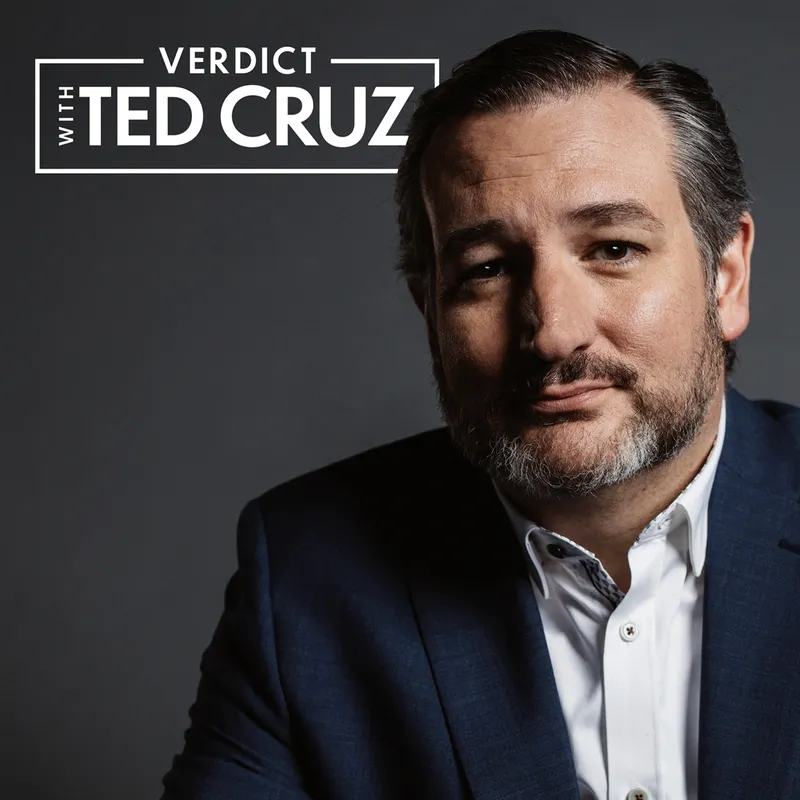
Verdict with Ted Cruz
Premiere Networks·Hosted by Ted Cruz and Ben Ferguson·1000 episodes
Join Senator Ted Cruz and co-host Ben Ferguson as they break down the most important news stories of the day and reveal what they mean for you. On "Verdict with Ted Cruz,” you will go behind the scenes of the political debates that define our country. "Verdict with Ted Cruz" is being brought to you by Jobs, Freedom, and Security PAC, a political action committee dedicated to supporting conservative causes, organizations, and candidates across the country. In 2022, Jobs, Freedom, and Security PAC plans to donate to conservative candidates running for Congress and help the Republican Party across the nation.
Why listen
Verdict with Ted Cruz gives conservative news listeners a fast-moving read on the day’s biggest political fights from a sitting U.S. senator and radio host Ben Ferguson. Episodes mix Beltway commentary, legal and policy analysis, and campaign-style argument, often with an insider framing on Congress, courts, immigration, foreign policy, and conservative priorities. It is best for listeners who want frequent, strongly opinionated Republican political analysis rather than detached news coverage.
Episodes
1. 🇮🇷 Iran, Israel, and U.S. Foreign Policy There were escalating military tensions between Israel and Iran, including missile exchanges and Israeli airstrikes. U.S. involvement: The U.S. was not directly involved in strikes. President Trump is portrayed as attempting to control escalation while negotiating a deal. Preventing Iran from obtaining nuclear weapons. Criticism of previous administrations (Obama/Biden) for being too lenient. 2. 🏛️ Minnesota Whistleblower and Fraud Allegations Officials in Minnesota (including Governor Tim Walz’s administration) ignored or covered up fraud in social programs. Whistleblowers were allegedly: Intimidated Monitored Investigated by private investigators There is: Systematic fraud Government retaliation against employees who reported misconduct 3. 👶 Missing Migrant Children at the U.S. Border Hundreds of thousands of migrant children were lost or unaccounted for during the Biden administration. Many were placed with unverified sponsors. Some children were subjected to trafficking, forced labor, or abuse. The Trump administration is now recovering these children (claims ~146,000 found). Connecting this issue to broader points on immigration policies and “open borders.” Please Hit Subscribe to this podcast Right Now. Also Please Subscribe to the 47 Morning Update with Ben Ferguson and The Ben Ferguson Show Podcast Wherever You get You're Podcasts. And don't forget to follow the show on Social Media so you never miss a moment! Thanks for Listening YouTube: <a href="https://nam04.safelinks.protection.outlook.com/?url=https%3A%2F%2Fwww.youtube.com%2F%40VerdictwithTedCruz%2F&data=05%7C02%7CRobertoDiaz%40iheartmedia.com%7Cd55f297ce8824f6f31a808dddbf7fab7%7C122a527e5b714eba878d9810b495b9e3%7C0%7C0%7C638
1. ActBlue Investigation Allegations ActBlue is a major Democratic fundraising platform. The CEO pleaded the Fifth Amendment repeatedly during congressional testimony. There are allegations of illegal foreign donations, including possible contributions from foreign nationals. Congressional Republicans are investigating whether ActBlue: Allowed foreign donations Misled Congress Failed to implement fraud safeguards 2. Southern Poverty Law Center (SPLC) Controversy Being investigated for funding extremist groups (including the KKK) via informants. Allowing funds to allegedly support activities like cross-burning (as claimed in DOJ allegations). The CEO is described as evasive during testimony, deferring to legal proceedings. Includes a segment about questioning the CEO on a politician with a Nazi tattoo. 3. Missing Migrant Children & Immigration Policy the Biden administration: Lost track of hundreds of thousands of migrant children. Failed to vet sponsors receiving children. Many children were subjected to abuse, forced labor, or trafficking. The Trump administration has allegedly recovered 146,000+ children. Democratic immigration policies are enabling harm. Lists votes where Democrats allegedly opposed deportation policies for certain offenders. Used to argue Democrats are: Soft on immigration enforcement Prioritizing undocumented immigrants over public safety 4. “Green New Deal” / Government Funding Criticism Discusses Department of the Interior actions to cut funding to: Environmental groups DEI-related programs Claims: Democrats funnel taxpayer money to allied nonprofits These groups then advance political agendas Describes this as corruption or misuse of funds Please Hit Subscribe to this podcast Right Now. Also Please Subscribe to the 47 Morning Update with Ben Ferguson and <a href="https://nam04.safelinks.protection.outlook.com/?url=https%3A%2F%2Fpodcasts.apple.com%2Fus%2Fpodcast%2Fthe-ben-ferguson-podcast%2Fid1386375601&data=05%7C02%7CRobertoDiaz%40iheartmedia.com%7Cd55f297ce8824f6f31a808dddbf7fab7%7C122a527e5b714eba878d9810b495b9e3%7C0%7C0%7C638908580290104132%7CUnknown%7CTWFpbGZsb3d8eyJFbXB0eU1hcGkiOnR
Meet my friends, Clay Travis and Buck Sexton! If you love Verdict, the Clay Travis and Buck Sexton Show might also be in your audio wheelhouse. Politics, news analysis, and some pop culture and comedy thrown in too. Here’s a sample episode recapping four takeaways. Give the guys a listen and then follow and subscribe wherever you get your podcasts. Sports Life Lessons Buck Sexton celebrates the New York Knicks’ dramatic 29-point comeback victory, described as one of the most remarkable in NBA Finals history. Buck highlights the scale of the comeback, noting that teams down by 20+ points rarely win in postseason play, which amplifies the significance of the Knicks’ performance. The discussion expands beyond sports into a broader sports culture and societal impact narrative, with Buck emphasizing how the win has unified New York City and captured national attention, illustrating the ability of major sporting events to create shared cultural moments and civic pride. At the same time, he criticizes instances of fan misconduct, including destructive celebrations and harassment of opposing teams, calling for sportsmanship, civility, and respect in fan behavior. Buck praised Knicks star Jalen Brunson for his leadership, humility, and professionalism. Buck presents Brunson as a model example of positive role models in professional sports, highlighting his “clutch” performance, team-first attitude, and composure under pressure. Brunson’s postgame remarks and actions—such as acknowledging a Make-A-Wish recipient—are used to underscore themes of character, leadership, and responsibility in public figures, reinforcing a broader discussion about the need for admirable role models in modern culture. The Black Culture Problem An interview with Turning Point USA reporter Savanah Hernandez, who covered the Karmelo Anthony murder trial, which resulted in a guilty verdict and a 35-year prison sentence. Hernandez provides detailed firsthand reporting on the courtroom environment, strict security measures, and intense public interest, noting that access to the trial was limited and highly competitive, with spectators lining up early each day. The hosts highlight how the case became a nationally discussed story, not only because of the crime itself but also due to the public reaction and broader cultural implications. A central theme throughout Hour 2 is the behavior and messaging of Anthony’s supporters outside the courthouse, who were described as highly vocal and, at times, confrontational. The conversation centers on reports of hostility toward journalists and opposing demonstrators, with the hosts framing these interactions as part of a larger issue involving media distrust, activism, and racial narratives in high-profile legal cases. According to the discussion, many supporters appeared less focused on trial evid
1. Immigration Green Card Policy Debate There is a new policy requiring some green card applicants to apply from abroad. Administration View: Closes loopholes Restores intended immigration system structure Criticism: Could: Separate families Disrupt jobs Create long delays 2. Allegations Against UNRWA (United Nations Relief and Works Agency) Over 100 UNRWA employees have been referred for suspension or investigation for ties to Hamas, including alleged participation in the October 7 attacks in Israel. Some employees (teachers, principals, administrators) were allegedly active members of Hamas or held military roles. U.S. taxpayer money (via aid funding) indirectly supported these individuals. Up to 1,500 UNRWA personnel may be under investigation for connections to Hamas. This represents roughly 5% of the agency’s workforce (using an estimated total of 30,000 staff). ✅ Political Perspective Calls to defund or dismantle UNRWA. Criticism of government oversight and foreign aid spending. U.S. politicians advocating sanctions or tougher actions. Please Hit Subscribe to this podcast Right Now. Also Please Subscribe to the The Ben Ferguson Show Podcast and Verdict with Ted Cruz Wherever You get You're Podcasts. And don't forget to follow the show on Social Media so you never miss a moment! Thanks for Listening X: <a href="https://nam04.safelinks.protection.outlook.com/?url=https%3A%2F%2Fx.com%2Fbenfergusonshow&data=05%7C02%7CRobertoDiaz%40iheartmedia.com%7Cd55f297ce8824f6f31a808dddbf7fab7%7C122a527e5
1. Drone Rescue of U.S. Soldiers in Iran American soldiers being shot down or stranded in Iran A rescue mission using drones, possibly highlighting advanced military technology The event is historic: A first-of-its-kind use of drones in rescue operations, built in Texas Or a significant geopolitical or military milestone 2. Minnesota Democrats & Private Investigators Allegations that Minnesota Democratic figures (or groups) hired private investigators The purpose: allegedly targeting fraud whistleblowers Descriptions of fraud allegations (possibly in government programs or funding) Claims of retaliation against whistleblowers Political framing or criticism of one party’s actions Please Hit Subscribe to this podcast Right Now. Also Please Subscribe to the 47 Morning Update with Ben Ferguson and The Ben Ferguson Show Podcast Wherever You get You're Podcasts. And don't forget to follow the show on Social Media so you never miss a moment! Thanks for Listening YouTube: https://www.youtube.com/@VerdictwithTedCruz/ Facebook: <a href="https://nam04.safelinks.protection.outlook.com/?url=https%3A%2F%2Fwww.facebook.com%2Fverdictwithtedcruz&data=05%7C02%7CRobertoDiaz%40iheartmedia.com%7Cd55f297ce8824f6f31a808dddbf7fab7%7C122a527e5b714eba878d9810b495b9e3%7C0%7C0%7C638908580290141425%7CUnknown%7CTWFpbGZsb3d8eyJFbXB0eU1hcGkiOnRydWUsIlYiOiIwLjAuMDAwMCIsIlAiOiJXaW4zMiIsIkFOIjoiTWFpbCIsIldUIjoyfQ%3D%3D%7C0%7C%
Meet my friends, Clay Travis and Buck Sexton! If you love Verdict, the Clay Travis and Buck Sexton Show might also be in your audio wheelhouse. Politics, news analysis, and some pop culture and comedy thrown in too. Here’s a sample episode recapping four takeaways. Give the guys a listen and then follow and subscribe wherever you get your podcasts. Republicans Buy Sneakers Too Clay Travis and Buck Sexton talk about President Donald Trump’s appearance at Madison Square Garden during a New York Knicks game, which Clay and Buck frame as a culturally significant moment in the intersection of sports, politics, and media narratives. They analyze reactions from fans, commentary from NBA Commissioner Adam Silver, and broader questions about the NBA’s political activism, arguing that the league may be shifting away from its previously “woke” positioning. The discussion expands into a broader critique of politics in sports, media bias, and public reactions to Trump as a New York figure. Could Steve Hilton Win? Steve Hilton joins the show to provide a detailed update on the California gubernatorial primary, explaining that he is highly confident of securing a top-two finish and advancing to the general election, even as official results remain delayed due to prolonged vote counting across the state. A major focus is the extended timeline for ballot processing in California, with Hilton criticizing the system as inefficient and mismanaged, particularly highlighting rules that allow ballots without clear postmarks to be accepted if they include handwritten dates. The conversation frames these practices as contributing to widespread skepticism around election transparency and trust in the vote-counting process. The discussion then shifts to a key voter ID ballot initiative in California, which Hilton says has strong public support and could be a near-term solution to many of the concerns being raised. The proposal would require government-issued identification for voting, whether in person or by mail, reducing reliance on signature verification processes that currently slow down vote counting. Clay and Buck strongly endorse voter ID laws, arguing they are consistent with requirements for other constitutional rights and would improve election confidence. They also debate the role of absentee and mail-in voting more broadly, suggesting that widespread early in-person voting could replace much of the current mail-based system. Election Integrity Clay and Buck explore campaign spending dynamics, particularly the failure of billionaire Tom Steyer to secure a top-two finish in California despite massive financial investment. This leads to a broader point about the limits of political advertising, with the hosts arguing that even heavy spending cannot overcome weak voter appeal. They als
1️⃣ Impact of COVID-19 on Education and Child Well‑being Remote learning during COVID-19 caused significant academic harm to children. Students experienced declines in reading and math proficiency across most U.S. states. Many children were “socially promoted” despite falling behind academically. There is now a long-term educational deficit, including students entering college without adequate reading skills. Additional Observations A reported decline in national child well-being metrics (2019–2024) across areas like education and health. Rising mental health issues, including increased child and teen deaths. Increased economic pressure on families (housing costs, food, etc.). Improvements in some areas (e.g., reduced teen birth rates, some state gains). The importance of stable family environments and investments in children. School closures Government policies Political actors for long-term damage to children 2️⃣ Allegations Against UNRWA (United Nations Relief and Works Agency) The document shifts to a second topic involving serious allegations about UNRWA, including: Claims that over 100 employees were linked to Hamas. Some allegedly participated in or supported the October 7 attack in Israel. Assertions that: UNRWA facilities may have been used by militants. Educational materials promoted anti-Israel sentiment. Reported Developments Over 100 individuals allegedly referred for suspension or debarment. Additional investigations ongoing involving hundreds more staff. Concerns Raised Oversight of U.S. foreign aid Whether taxpayer money may have been misused The effectiveness of UNRWA’s internal controls Please Hit Subscribe to this podcast Right Now. Also Please Subscribe to the The Ben Ferg
1. Los Angeles Mayor Race / California Politics: Karen Bass (incumbent) leading in early results. A close contest for second place between Nithya Raman (portrayed as more left-wing) and Spencer Pratt. The transcript emphasizes: Delays in vote counting (weeks after the election). Allegations or suspicions about election integrity, especially with mail-in ballots. California governance (taxation, homelessness, crime, wildfires). Public services (fire response, policing, infrastructure). 2. Middle East Conflict (Israel–Iran): Reports on recent escalation between Israel and Iran, including: Missile exchanges between both nations Israeli airstrikes on Iranian targets U.S. involvement (or lack thereof) Former President Trump’s stance and statement Iran’s nuclear capabilities Terrorism funding Regional instability 3. Election Integrity Discussion Mail-in voting Ballot harvesting Delayed vote counting Reference to the Carter-Baker Commission to argue that: Mail voting increases risks of fraud Comparison with states like: Texas and Florida (presented as more efficient and trustworthy) Please Hit Subscribe to this podcast Right Now. Also Please Subscribe to the 47 Morning Update with Ben Ferguson and The Ben Ferguson Show Podcast Wherever You get You're Podcasts. And don't forget to follow the show on Social Media so you never miss a moment! Thanks for Listening YouTube: <a href="https://nam04.safelinks.protection.outlook.com/?url=https%3A%2F%2Fwww.youtube.com%2F%40VerdictwithTedCruz%2F&data=05%7C02%7CRobertoDiaz%40iheartmedia.com%7Cd55f297ce8824f6f31a808dddbf7fab7%7C122a527e5b714eba878d9810b495b9e3%7C0%7C0%7C638908580290122821%7CUnknown%7CTWFpbGZsb3d8eyJFbXB0eU1hcGkiOnRydWUsI
1. Jill Biden and President Joe Biden Jill Biden’s remarks about President Biden’s debate performance. She feared he may have been having a stroke, arguing that: Her actions afterward (campaign event, public praise, restaurant visit) contradict that concern. This suggests either exaggeration or dishonesty. Claims that President Biden experienced cognitive decline. Allegations that political leaders and media knowingly concealed this. Media organizations and Democratic officials were aware of Biden’s alleged condition. There was a coordinated effort to hide or minimize it. They frame this as an example of: Political power being prioritized over transparency. A broader credibility problem in U.S. politics. 2. U.S. Shipbuilding and National Security Key points: Heavy reliance on foreign-built ships is presented as a national security risk. A major funding initiative (~$24 billion) for the U.S. Coast Guard is described. Investment includes: New ships and helicopters Arctic icebreakers Shipyard construction (notably in Texas) Claimed benefits: Increased domestic manufacturing Job creation (thousands of jobs) Strategic competition with China and Russia in the Arctic The senator describes: Internal negotiations over where shipbuilding contracts would go (Texas vs. Louisiana). Involvement of the White House and President Trump (in this narrative timeline). Emphasis is placed on: Negotiation strategy Achieving a “win-win” outcome Expanding production beyond initial goals 3. College Sports Crisis and NIL Issues Problems identified: Escalating athlete compensation (tens of millions per team) Transfer portal instability Financial losses for universities Elimination of non-revenue sports (e.g., tennis, Olympic sports) Proposed solution: A bipartisan bill called the “Protect College Sports Act” Supporting arguments: College sports provide educational opportunities for disadvantaged students They promote social unity and personal development Includes testimony from Nick Saban highlighting unsustainable financial trends. Please Hit Subscribe to this podcast Right Now. Also Please Subscribe to the 47 Morning Update with Ben Ferguson<
1. 🏈 College Sports Crisis & Proposed Legislation Core Argument The NIL (Name, Image, Likeness) system An unregulated transfer portal Escalating player compensation costs Financial losses across athletic programs Key Problems Identified Athletes transferring multiple times with little restriction Older players (mid-to-late 20s) still competing Universities losing millions or tens of millions of dollars Non-revenue sports (e.g., tennis, Olympic sports) being cut Risk of college sports shrinking to mostly football and basketball Proposed Solution A bipartisan bill called the “Protect College Sports Act.” Supported by both Republicans and Democrats Backed by universities, conferences, and athletic leaders Intended to: Stabilize college athletics Limit financial chaos Preserve broad participation across sports Broader Significance Provide education access to hundreds of thousands of students Offer life opportunities, especially for low-income athletes Serve as a cultural unifier in a divided country 2. ⚖️ Supreme Court Discussion & Justice Samuel Alito Guest Segment Key Discussion Points A. Justice Alito’s Role Portrayed as a major figure (“giant”) on the Supreme Court Known for a distinct form of originalism (interpreting the Constitution as originally understood) Seen as influential in shaping modern constitutional law B. Dobbs Decision & Leak Controversy The leak investigation was poorly conducted The leak damaged trust within the Court It may have endangered justices (mentions threats and an assassination attempt) The unprecedented nature of the leak The political consequences surrounding abortion and the Court C. Internal Court Dynamics Tensions between justices Allegations of “slow-walking” decisions for political purposes Strategic disagreements between conservative and liberal justices D. Criticism of the Political Left There are organized efforts to undermine the Supreme Court Calls to expand (“pack”) the Court are politically motivated Media and advocacy groups are targeting conservative justices Please Hit Subscribe to this podcast Right Now. Also Please Subscribe to the <a href="https://www.iheart.com/podcast/1119-the-47-morning-update-wit-25848125
Meet my friends, Clay Travis and Buck Sexton! If you love Verdict, the Clay Travis and Buck Sexton Show might also be in your audio wheelhouse. Politics, news analysis, and some pop culture and comedy thrown in too. Here’s a sample episode recapping four takeaways. Give the guys a listen and then follow and subscribe wherever you get your podcasts. We're Paying for Fraud Clay Travis and Buck Sexton talk about the massive government fraud and systemic inefficiencies, particularly within healthcare programs like Medicare and Medicaid. The hosts highlight a Department of Justice crackdown in Ohio involving fraud schemes totaling over $50 million, emphasizing that such cases are only “the tip of the iceberg.” Clay and Buck argue that healthcare fraud is a nationwide crisis, driven by bureaucratic complexity, lack of transparency, and excessive government involvement in the healthcare system. They cite examples of fraudulent billing practices—including cases where providers billed for nonexistent or even deceased patients—and criticize a system that allows billions in taxpayer funds to be misused. A key focus of the discussion is how healthcare costs and administrative bloat contribute to both inefficiency and fraud. The hosts point to the massive number of healthcare administrators and argue that the current structure incentivizes maximizing billing rather than delivering patient care. They also examine how ordinary Americans are disconnected from the true cost of healthcare, which reduces accountability and enables exploitation. Listener input reinforces this argument, with one caller suggesting that reintroducing direct patient financial responsibility could help restore cost discipline and reduce abuse. The Guy Behind the AI Pratt Videos Clay and Buck interview filmmaker Charles Curran, the creator behind the viral pro–Spencer Pratt AI political ads, which have become a major talking point in the ongoing Los Angeles mayoral race. They talk about the rise of artificial intelligence in political campaigns and digital media. Curran explains how his small team of four used emerging AI video tools to produce high-impact, low-cost campaign content that garnered hundreds of millions of views across social media and traditional platforms. The hosts emphasize that this represents a transformational shift in political communication, comparing AI-generated campaign videos to modern-day “political cartoons” that can cut through media noise and engage younger voters. They argue that AI-driven storytelling—rooted in humor, cultural relevance, and perceived authenticity—has the potential to disrupt traditional campaign advertising and lower production costs while dramatically increasing reach and influence. The interview also highlights growing dissatisfaction with conditions in Los Angeles, which inspired Curran
🧩 1: Criminal Case – Sanctions Violations: A 63-year-old dual U.S.-Iran citizen (Jamshid Ghomi) was arrested in Newport Beach, California. He is accused of: Illegally exporting U.S. computer hardware to Iran Violating U.S. sanctions laws (International Emergency Economic Powers Act) Supplying equipment allegedly used in Iranian military and nuclear programs The scheme allegedly: Lasted over a decade Generated millions of dollars annually Used front companies (UAE), intermediaries (Dubai), and online accounts (eBay/PayPal) to evade detection Additional allegations include: Money laundering Tax evasion (reporting only ~$20,000 income despite multimillion earnings) Authorities claim: Over 250 tons of controlled technology were shipped Equipment went to sanctioned entities and government-linked actors The suspect’s assets, including a $35 million mansion, may be seized. 🧩 2: Immigration Policy & Political Commentary: The policy would require many applicants already in the U.S. to: Leave the country Complete their green card process from abroad It limits the long-standing “adjustment of status” system, where applicants could stay in the U.S. during review. The rule: Closes loopholes Returns to the original intent of immigration law Makes the system more orderly and controlled Emphasizes: Restricting pathways from temporary visas to permanent residency Prioritizing national interests ❌ Critics (Democrats & advocates): Argue the policy: Could affect hundreds of thousands of immigrants Might separate families Could disrupt jobs and education Forces applicants into slow overseas processing systems Please Hit Subscribe to this podcast Right Now. Also Please Subscribe to the <a href="https://nam04.safelinks.protection.outlook.com/?url=https%3A%2F%2Fpodcasts.apple.com%2Fus%2Fpodcast%2Fthe-ben-ferguson-podcast%2Fid1386375601&data=05%7C02%7CRobertoDiaz%40iheartmedia.com%7Cd55f297ce8824f6f31a808dddbf7fab7%7C122a527e5b714eba878d9810b495b9e3%7C0%7C0%7C638908580290104132%7CUnknown%7CTWFpbGZsb3d8eyJFbXB0eU1hcGkiOnRydWUsIlYiOiIwLjAuMDAwMCIsIlAiOiJXaW4zMiIsIkFOIjoiTWFpbCIsIldUIjoyfQ%3D%3D%7C0%7C%7C%7C&sdata=RRil7WRhuVH0YkqvMtYlSM
1. Tax Cuts 97% of tax filers received a tax cut Total relief: $82 billion Average savings: $100k–$200k earners → ~$1,250 $50k–$100k earners → ~$815 Policy features emphasized: No tax on tips No tax on overtime No tax on Social Security Expanded standard deduction 2. Media and Political Criticism The media is ignoring or hiding the benefits of the tax cuts Democrats are accused of: Misrepresenting the bill as benefiting only the wealthy Opposing policies that help workers Increase GDP: +1.2% to +1.5% projected growth over several years Put more money into households Stimulate economic activity 3. Manufacturing & Shipbuilding Segment $24+ billion investment in the Coast Guard Building Arctic icebreakers Competing with Russia and China in the Arctic Creation of: 2,000+ jobs in Texas Additional indirect jobs Please Hit Subscribe to this podcast Right Now. Also Please Subscribe to the 47 Morning Update with Ben Ferguson and The Ben Ferguson Show Podcast Wherever You get You're Podcasts. And don't forget to follow the show on Social Media so you never miss a moment! Thanks for Listening YouTube: https://www.youtube.com/@VerdictwithTedCruz
Meet my friends, Clay Travis and Buck Sexton! If you love Verdict, the Clay Travis and Buck Sexton Show might also be in your audio wheelhouse. Politics, news analysis, and some pop culture and comedy thrown in too. Here’s a sample episode recapping four takeaways. Give the guys a listen and then follow and subscribe wherever you get your podcasts. Hedonic Adaptation Clay Travis and Buck Sexton discuss the growing relevance of political prediction markets, which Clay argues are more accurate than traditional polling. He discusses his own active wagers on key races, including multiple U.S. Senate contests, House control, and long-term presidential projections, highlighting how real-money betting markets are shaping modern election analysis and offering insight into voter expectations. This reinforces a broader theme of the show: skepticism toward conventional polling and increasing reliance on data-driven political forecasting. The hosts also debate whether California’s political landscape has national significance, asking whether issues like crime, homelessness, and governance failures will resonate with voters outside the state. They contrast this with what they see as a more immediate concern for most Americans: gas prices, inflation, and overall cost of living. The discussion underscores a key political question—whether economic pressures or cultural issues will ultimately drive voter decisions in upcoming elections. Vote Steve Hilton! An extended interview with California gubernatorial candidate Steve Hilton, who outlines his campaign message and policy priorities. Hilton argues that California is ready for change, pointing to widespread dissatisfaction with taxes, crime, homelessness, regulatory burdens, and high cost of living. He emphasizes the importance of the state’s primary system, warning that without sufficient support, Republicans risk being excluded from the general election if two Democratic candidates advance. Hilton presents a platform focused on economic reform and practical solutions, including plans to lower gas prices, reduce regulation, increase opportunity, and address homelessness through enforcement and treatment-based approaches. He also highlights concerns about businesses leaving California and population decline, framing the state’s current trajectory as unsustainable without major policy changes. His campaign emphasizes “common sense” governance and outsider leadership, appealing to voters frustrated with long-term one-party control. The discussion also touches on the impact of endorsements from President Donald Trump and Vice President JD Vance, with Hilton arguing that alignment with federal leadership could accelerate reforms and help restore economic growth. The interview reinforces broader themes of anti-establishment sentiment, vo
1. Graham Platner at a glance: Extremist symbolism (Nazi SS tattoo) Offensive online behavior (racist, sexist, homophobic remarks) Sexual misconduct or inappropriate online activity Disrespect toward religion, military members, and others Criminal behavior (e.g., DUI) Liberals LOVE HIM! 2. the Democratic Party The Democratic Party protects problematic figures if politically useful. Standards are applied unevenly based on party affiliation. Media bias is asserted—the “corporate media” shields Democrats. Media outlets ignore scandals unless politically convenient. They create and destroy political figures strategically. 3. Moral and Cultural Conflict The situation is a broader societal issue to: Race LGBTQ+ issues Religion Policing Please Hit Subscribe to this podcast Right Now. Also Please Subscribe to the The Ben Ferguson Show Podcast and Verdict with Ted Cruz Wherever You get You're Podcasts. And don't forget to follow the show on Social Media so you never miss a moment! Thanks for Listening X: https://x.com/benfergusonshowYouTube: https://www.youtube.com/@VerdictwithTedCruzSee omnystudio.com/listener for privacy information.
1. Maine Senate Candidate Scandal Focuses on a Democratic Senate candidate (referred to as “Graham Plattner”). Presents allegations including: Infidelity and sexually explicit messages Use of a controversial messaging platform allegedly linked to criminal activity Past extreme ideological positions (described with strong labels like “Nazi” and “communist”) The candidate is morally unfit and scandal-ridden. There may be an internal Democratic effort to remove him for political reasons. 2. Democratic Party Strategy & Infighting Prioritize political power over principles Support candidates despite misconduct until politically inconvenient Party leaders may be leaking damaging information about the candidate A replacement strategy may be underway before election deadlines 3. UNRWA and Hamas Allegations Alleged ties between staff and Hamas Mentions a reported investigation involving over 1,500 individuals UNRWA is corrupt and dangerous Calls for: Defunding Legal action Possible designation as a terrorist-linked organization 4. Joe Biden & Jill Biden Criticism President Biden’s mental fitness Jill Biden’s public statements defending him Inconsistencies in Jill Biden’s account of a debate night where she said she feared he was having a stroke. A broader cover-up by Democrats and media Lack of transparency about Biden’s condition 5. Media & Political System Critique Media outlets knowingly suppressed negative information Political actors prioritize power over truth Both scandals and narratives are strategically released 6. Iran Political Development (Breaking News) Iranian president allegedly submitting a resignation letter Possible internal instability Potential geopolitical implications Please Hit Subscribe to this podcast Right Now. Also Please Subscribe to the 47 Morning Update with Ben Ferguson and <a href="https://nam04.safelinks.protection.outlook.com/?url=https%3A%2F%2Fpodcasts.apple.com%2Fus%2Fpodcast%2Fthe-ben-ferguson-podcast%2Fid1386375601&data=05%7C02%7CRobertoDiaz%40iheartmedia.com%7Cd55f297ce8824f6f31a808dddbf7fab7%7C122a527e5b714eba878d9810b495b9e3%7C0%7C0%7C638908580290104132%7
1. 🗳️ Political Commentary on Democrats “extreme,” “radical,” or “out of touch” holding controversial or fringe views Democrats Use of Rhetoric & Persuasion Loaded language (“radical,” “crazy,” “dangerous”) Mockery and sarcasm Slippery-slope arguments (e.g., policies leading to extreme consequences) Generalizations about entire political groups 2. 👤 Who is James Talarico? vegan advocacy tied to climate policy progressive views on gender and religion criticism of American symbols immigration-friendly policies 3. 🏈 Policy Segment: NIL / College Sports Bill Key points of the proposed legislation: Regulates Name, Image, and Likeness (NIL) environment Addresses transfer rules for student athletes Prevents creation of a “super league” (SEC + Big Ten merger) Allows joint negotiation of media rights to increase revenue Protects: scholarships non-revenue sports Olympic and women’s sports Please Hit Subscribe to this podcast Right Now. Also Please Subscribe to the 47 Morning Update with Ben Ferguson and The Ben Ferguson Show Podcast Wherever You get You're Podcasts. And don't forget to follow the show on Social Media so you never miss a moment! Thanks for Listening YouTube: https://www.youtube.com/@VerdictwithTedCruz/ Facebook: <a href="https://nam04.sa
1. Athlete Compensation Protection Ensures athletes can: Earn money from legitimate NIL deals Participate in revenue sharing Prohibits: “Pay-for-play” disguised as NIL (e.g., booster cash handouts) 2. Transfer Rules Reform Allows: 1 unrestricted transfer Additional transfers allowed only under specific conditions: Coach leaves Program shuts down Athlete experiences serious issues (e.g., harassment) Otherwise: Athlete must sit out a year (“redshirt”) 3. Eligibility Limits Maximum: 5 years of eligibility Age cap of 24 (with exceptions like military service) Prevents older players from competing with younger athletes. 4. Athlete Health & Safety Protections Mandatory health insurance: Covers injuries for up to 5 years after playing No out-of-pocket costs Creation of a $60 million medical trust fund Stronger enforcement of: Concussion protocols Player safety standards 5. Academic Protections Prevents coaches from: Interfering with class attendance Steering players away from academics 6. Financial & Structural Reforms Allows schools/conferences to: Negotiate media rights collectively (to increase revenue) Requires: Preservation of scholarships and roster spots across all sports 7. Prevention of a “Super League” Explicitly blocks formation of a mega-conference (e.g., SEC + Big Ten merger) Aims to preserve competitive balance and opportunities for smaller schools 8. Coaching Stability Rule Coaches cannot: Leave for another job during a season or playoffs Designed to protect teams and players (informally referred to as the “Lane Kiffin rule”) Please Hit Subscribe to this podcast Right Now. Also Please Subscribe to the 47 Morning Update with Ben Ferguson and <a href="https://nam04.safelinks.protection.outlook.com/?url=https%3A%2F%2Fpodcasts.apple.com%2Fus%2Fpodcast%2Fthe-ben-ferguson-podcast%2Fid1386375601&data=05%7C02%7CRobertoDiaz%40iheartmedia.com%7Cd55f297ce8824f6f31a808dddbf7fab7%7C122a527e5b
1. 🇮🇷 Iran & National Security Iran is described as economically weak, with claims of: High inflation Declining oil exports Internal instability Trump’s strategy is portrayed as maximum pressure diplomacy: No sanctions relief until demands are met Willingness to escalate if negotiations fail Strong rhetoric suggests the U.S. has military and negotiating advantage 2. 🌍 Strait of Hormuz & Energy Security Highlights the strategic importance of the Strait of Hormuz (a key global oil route) Emphasizes concerns about global energy disruption Suggests the U.S. intends to monitor and influence stability in the region 3. 🚧 Immigration & Border Security Claims major success in: Reducing illegal immigration (even citing “zero entries”) Increasing deportations and enforcement Border policy is framed as directly tied to national security Contrasts sharply with the prior administration’s policies, which are criticized 4. 📉 Crime & Public Safety Attributes a drop in murder rates to immigration enforcement policies Suggests removing undocumented individuals reduces crime These claims are presented without independent verification in the text 5. 💰 Economy & Energy Policy Focuses on energy independence (“energy dominance”): Increasing domestic oil and gas production Reducing reliance on foreign energy Mentions: New oil production in Alaska Potential expansion in California Criticizes environmental regulations as harmful to the economy Please Hit Subscribe to this podcast Right Now. Also Please Subscribe to the The Ben Ferguson Show Podcast and Verdict with Ted Cruz Wherever You get You're Podcasts. And don't forget to follow the show on Social Media so you never miss a moment! Thanks for Listening X: <a
1. Election Results & Significance Ken Paxton wins decisively with roughly 64% vs 36% (a ~28-point margin). This is described as: A major upset for an incumbent A “sea change” in Republican politics Cornyn had: 24 years in the Senate Significant institutional power and funding Despite heavy financial backing (over $100M+ spent, mostly for Cornyn), Paxton wins overwhelmingly. 2. Why Paxton Won Several factors are highlighted: ✅ Anti-establishment sentiment The race was a: “Conservative grassroots vs establishment Republican” Voters favored a more ideological, outsider-style candidate. ✅ Trump’s influence Donald Trump endorsed Paxton (late in the race). The hosts argue: The endorsement boosted Paxton’s margin But Paxton was already leading in polls ✅ Perception of ideological purity Paxton is: “The most conservative attorney general in the country” This appealed to Republican primary voters. 3. The Role of Money The race becomes: One of the most expensive Senate primaries ever Despite: Massive spending (mostly pro-Cornyn) Outcome shows: 👉 Money was less decisive than voter sentiment and political alignment 4. Warning About the General Election Do not assume Republicans will easily win Historical comparison: Cruz compares this to the 2018 Texas Senate race: Democrats dramatically increased turnout He narrowly won despite being heavily outspent Key risks identified: Energized Democratic voters Lower Republican turnout in non-presidential cycles Heavy outside funding from national donors 5. Introduction of the Democratic Candidate The Democratic nominee is introduced as James Talarico. Ideologically extreme Strategically dangerous because: He presents himself in a calm, relatable manner He may appeal to moderate voters 6. Strategic Concerns for Republicans The authors emphasize: 🧠 Voter perception risk Talarico could appeal to: Moderates Less politically engaged voters 🎯 Campaign advice Republicans should: Focus on communicating Talarico’s positions</stron
1. Iranian Uranium Stockpile Iran’s enriched uranium stockpile is the central sticking point in negotiations. The U.S. position is: Iran must surrender, transfer, or destroy its uranium entirely No compromise on retaining enriched material is acceptable This is a more aggressive stance than past U.S. policies (e.g., Obama-era agreements focused on limits, not elimination). 2. Diplomacy to Pressure Strategy Diplomatic negotiations Active military pressure Mentions: “self-defense strikes” naval deployments near the Strait of Hormuz 3. Strait of Hormuz as a Global Pressure Point The strategic importance of the Strait of Hormuz: ~20% of global oil supply passes through it Disruptions affect oil prices, inflation, and global markets Current situation: Partially open Highly militarized Unstable 4. Negotiation Dynamics Multiple countries involved as mediators: Oman, Qatar, Pakistan Possible compromise ideas mentioned: Transfer uranium to third countries (Pakistan, Turkey, Russia, China) Dilution under supervision 5. Global Stakeholders China → dependent on oil flow Europe → sensitive to energy prices Gulf states → reliant on exports Israel → concerned about security Russia → may benefit from energy instability 6. Economic and Market Impact Disruptions to shipping have caused: Increased insurance costs Rerouted vessels Oil market volatility Please Hit Subscribe to this podcast Right Now. Also Please Subscribe to the The Ben Ferguson Show Podcast and <a href="https://www.iheart.com/podcast/1119-verdict-with-ted-cruz-562
🇮🇷 1. Iran Conflict & Potential Nuclear Deal Core Themes: The U.S. military campaign against Iran, has been highly successful. Iran’s military infrastructure (missiles, drones, navy) has been largely destroyed. Key Iranian leadership figures have been eliminated. A “good deal” must: Completely prevent Iran from obtaining nuclear weapons. Eliminate or control uranium enrichment. Ensure open access to the Strait of Hormuz (critical for global oil shipping). There must be NO: Giving Iran financial concessions. Allowing Iran to retain nuclear capabilities. There is much distrust of: Iran’s messaging (described as propaganda). Internal U.S. political disagreements over negotiation strategy. 🗳️ 2. U.S. Domestic Politics & Midterm Elections Core: Republicans are not necessarily in a weak position. Democratic candidates are portrayed as extreme or unelectable. Platner Democratic Senate candidate in Maine: Allegations of extreme ideology (communism, Nazism). Offensive statements and behavior. Undermine credibility of political opponents. Democrats are embracing radical candidates. Please Hit Subscribe to this podcast Right Now. Also Please Subscribe to the 47 Morning Update with Ben Ferguson and The Ben Ferguson Show Podcast Wherever You get You're Podcasts. And don't forget to follow the show on Social Media so you never miss a moment! Thanks for Listening YouTube: <a href="https://nam04.safelinks.protection.outlook.com/?url=https%3A%2F%2Fwww.youtube.com%2F%40VerdictwithTedCruz%2F&data=05%7C02%7CRobertoDiaz%40iheartmedia.com%7Cd55f297ce8824f6f31a808dddbf7fab7%7C122a527e5b714eba878d9810b495b9e3%7C0%7C0%7C638908580290122821%7CUnknown%7CTWFpbGZsb3d8eyJFbXB0eU1hcGkiOnRydWUsIlYiOiIwLjAuMDAwMCIsIlAiOiJXaW4zMiIsIkFOIjoiTWFpbCIsIldUIjoyfQ%3D%3D%7C0%7C%7C%7C&sdata=3fo08NMwfFSPoUyddyh3l8wtDuRi50hvzaET6sggVLw%3D&reserved=0" data-auth="
1. D.C. and Puerto Rico Statehood The U.S. Constitution intentionally established Washington, D.C. as a non-state federal district to avoid favoritism. Calls for D.C. statehood are framed as a partisan power grab to gain Democratic seats in Congress. Puerto Rico is described as: A more complex case, with internal disagreement among residents (statehood, independence, or commonwealth status). Assumed—by Democrats, according to the speaker—to lean Democratic politically. Democrats prioritize gaining and maintaining power over policy substance. Election systems and rules (e.g., California’s “top-two” system) are manipulated for advantage. A California election example is used to suggest: A possible increase in Republican support. Fear among Democrats of losing control. 2. Gerrymandering and Race A Senate Judiciary Committee hearing about racial gerrymandering. A Supreme Court decision limiting race-based redistricting. Both parties engage in gerrymandering, but Democrats are portrayed as worse offenders. Race-based districts are described as unconstitutional discrimination. The notion that minority candidates require racially drawn districts to win. Provides examples of Black Republican politicians elected in majority-white districts. The Democratic Party historically supported slavery, segregation, and Jim Crow laws. The Republican Party was founded to oppose slavery. 3. Raúl Castro Indictment Reports an indictment of former Cuban leader Raúl Castro for his alleged role in the 1996 shootdown of civilian aircraft. Strongly condemns Castro and communism. Praises U.S. legal action. Criticizes the Obama administration for engaging diplomatically with Cuba. Please Hit Subscribe to this podcast Right Now. Also Please Subscribe to the 47 Morning Update with Ben Ferguson and <a href="https://nam04.safelinks.protection.outlook.com/?url=https%3A%2F%2Fpodcasts.apple.com%2Fus%2Fpodcast%2Fthe-ben-ferguson-podcast%2Fid1386375601&data=05%7C02%7CRobertoDiaz%40iheartmedia.com%7Cd55f297ce8824f6f31a808dddbf7fab7%7C122a527e5b714eba878d9810b495b9e3%7C0%7C0%7C638908580290104132%7CUnknown%7CTWFpbGZsb3d8eyJFbXB0eU1hcGkiOnRydWUsIlYiOiIwLjAuMDAwMCIsIlAiOiJXaW4zMiIsIkFOIjoiTWFpbCIsIldUIjoyfQ%3
1. Breakdown of Senate Disruption Over Reconciliation Why a planned Senate vote (a “vote-a-rama” tied to reconciliation) collapsed unexpectedly. Key points: Reconciliation is described as a process used to bypass the Senate filibuster and pass major legislation (in this case, funding border security and agencies like ICE and CBP). The vote was canceled due to division among Republican senators, not just opposition from Democrats. Several GOP senators are described as politically frustrated or weakened due to: Losing primaries or endorsements Conflict with former President Trump These internal tensions created a fragile majority, making it difficult to pass legislation. 2. Controversy Over the DOJ “Judgment Fund” A newly announced $1.776 billion Department of Justice fund intended to compensate individuals allegedly harmed by government “weaponization.” Concerns raised: Republican senators reacted with anger and suspicion during a closed-door meeting with the acting Attorney General. Some believed the fund looked like “self-dealing,” particularly because it stemmed from litigation involving Donald Trump. There were fears that: Taxpayer money could go to controversial recipients Political optics would damage Republicans Senators across the party were reportedly yelling and openly hostile, suggesting unusually intense internal conflict. Impact: Democrats planned to introduce amendments targeting the fund. Enough Republicans were prepared to side with Democrats that the bill would likely fail. Leadership postponed the vote, indicating a temporary legislative breakdown. 3. Raul Castro Indictment Discussion Castro is accused in connection with the 1996 shootdown of civilian aircraft operated by “Brothers to the Rescue.” Charges allegedly include: Conspiracy to kill U.S. nationals Murder counts Destruction of aircraft A major moment of justice A stark contrast with past U.S. policy under President Obama (who pursued diplomatic normalization with Cuba) Please Hit Subscribe to this podcast Right Now. Also Please Subscribe to the 47 Morning Update with Ben Ferguson and <a href="https://nam04.safelinks.protection.outlook.com/?url=https%3A%2F%2Fpodcasts.apple.com%2Fus%2Fpodcast%2Fthe-ben-ferguson-podcast%2Fid13863
Meet my friends, Clay Travis and Buck Sexton! If you love Verdict, the Clay Travis and Buck Sexton Show might also be in your audio wheelhouse. Politics, news analysis, and some pop culture and comedy thrown in too. Here’s a sample episode recapping four takeaways. Give the guys a listen and then follow and subscribe wherever you get your podcasts. Branding vs. Education Clay Travis and Buck Sexton give an in‑depth critique of the American higher education system, with specific attention to grade inflation, standardized testing, and admissions fairness. The hosts highlight Harvard University’s decision to eliminate widespread grade inflation and reintroduce a bell curve grading model, noting that a large majority of students had been receiving A grades. They trace the historical roots of grade inflation back to the Vietnam War era, when professors were reluctant to assign low grades that could result in students being drafted, and argue that the COVID‑19 pandemic accelerated the trend by lowering academic expectations nationwide. The conversation expands into a broader analysis of elite universities such as Harvard, Yale, and Stanford, comparing traditional grading systems with pass‑fail models used in some law schools. While acknowledging arguments that elite students perform at a higher level, the hosts ultimately contend that grade inflation has eroded academic standards and made it harder to distinguish top performers. This leads into a discussion of the rise and fall of test‑optional admissions policies, which surged during 2020 but were later reversed after colleges found that standardized testing remained one of the most reliable ways to evaluate student readiness. Get Smarter Listening to This Ryan Girdusky joins the show to dissect the Democratic National Committee’s “autopsy” of the 2024 election loss, which returned Donald Trump to the presidency. The hosts highlight dramatic long-term political realignment trends, noting how Democrats have lost significant ground since 2009 across the Senate, House, governorships, and state legislatures, with Republicans gaining dominance in key regions. Girdusky argues the DNC report fails to address critical issues—especially Joe Biden’s age and Kamala Harris’s campaign weaknesses—while crediting effective Trump campaign messaging for reshaping voter perceptions. The discussion underscores how Republican gains, particularly in the South, reflect a broader collapse of historic Democratic strongholds and the lingering impact of the Obama era on local politics. MN Fraud Isn't a One-Off Clay and Buck discuss the breaking news of a major Minnesota fraud case, where the mastermind behind the “Feeding Our Future” scheme is sentenced to more than 41 years in prison for orchestrating a $250 million COVID relief fraud, funds ori
1. Historic Indictment Raúl Castro has been indicted by the U.S. for murder, conspiracy, and destruction of aircraft. Charges relate to the February 24, 1996 incident where Cuban military jets shot down two civilian planes. Four people (including three U.S. citizens) were killed. 2. Allegation of Direct Responsibility Prosecutors claim: The attack was intentional, not accidental. Castro, then Cuba’s Defense Minister, authorized and helped direct the operation. Evidence cited includes: Military communications Intelligence reports Longstanding testimony 3. Delayed Justice The indictment comes nearly 30 years after the incident. It is portrayed as long-awaited accountability for victims’ families. 4. Symbolic and Political Context Announcement took place in Miami’s Freedom Tower, a symbolic site for Cuban exiles. Marks one of the first times a senior Cuban leader is charged in U.S. court. 5. Shift in U.S. Policy Approach There is a change in U.S. posture toward authoritarian regimes: From diplomacy (e.g., Obama-era engagement) To criminal prosecution, sanctions, and pressure 6. Broader Strategic Message The indictment is framed as part of a larger strategy: Indict leaders Cut financial resources Increase international isolation Encourage defections Wait for internal collapse 7. Comparison to Venezuela The approach is compared to actions taken against Nicolás Maduro. Suggests indictments can: Isolate leaders globally Trigger internal fractures within regimes 8. Limited Immediate Practical Impact Castro is 94 years old, and Cuba is unlikely to extradite him. A trial in the U.S. is uncertain. 9. Psychological and Geopolitical Impact The indictment is presented as: A “warning shot” to authoritarian regimes A tool to undermine regime stability internally Intended to send message: Leaders who harm Americans can be pursued indefinitely Please Hit Subscribe to this podcast Right Now. Also Please Subscribe t
1. Power of Trump’s Endorsement Donald Trump’s political endorsements strongly influence Republican primaries. Multiple examples are cited: Indiana: Lawmakers who opposed Trump-backed redistricting lost primaries. Louisiana: Senator Bill Cassidy lost after Trump opposed him (linked to impeachment vote). Kentucky: Rep. Thomas Massie lost after Trump backed a challenger. Texas: Trump’s endorsement of Ken Paxton is expected to significantly shape the race. 2. Party Loyalty and Political Consequences Trump favors candidates loyal to his agenda. Politicians who consistently oppose him are portrayed as: Weakening party goals Facing electoral backlash There is an implication that internal GOP dissent is being reduced through these outcomes. 3. Impact on Senate Dynamics Short-term consequence: Some Republicans who lose or retire may become less cooperative (“pissed”), complicating votes. Long-term outlook: Trump could gain greater control over the Senate with more aligned members. 4. Potential DOJ Indictment of Raúl Castro The DOJ may indict Cuban leader Raúl Castro. Possible implications: Could mirror actions against Nicolás Maduro. May increase pressure on the Cuban regime. Broader narrative: Suggests a possible geopolitical shift in Cuba, Venezuela, and Iran. 5. Cuba Situation Cuba is: Facing severe economic crisis (fuel shortages, blackouts). U.S. pressure could lead to collapse of the communist regime. Vision: A free-market, democratic Cuba with strong U.S. ties. 6. Debate on Racial Gerrymandering A Senate Judiciary hearing: Republicans argue race-based districting is unconstitutional. Democrats are criticized for defending it. Key claims made: Democrats historically supported racist policies (poll taxes, Jim Crow). Gerrymandering is portrayed as more heavily used by Democrats. Counter-dynamic: Heated exchange shows deep partisan conflict on race and representation. Please Hit Subscribe to this podcast Right Now. Also Please Subscribe to the <a href
Meet my friends, Clay Travis and Buck Sexton! If you love Verdict, the Clay Travis and Buck Sexton Show might also be in your audio wheelhouse. Politics, news analysis, and some pop culture and comedy thrown in too. Here’s a sample episode recapping four takeaways. Give the guys a listen and then follow and subscribe wherever you get your podcasts. Trump Endorses Paxton Clay Travis and Buck Sexton highlight the key Republican primary battles, most notably the Texas Senate race between John Cornyn and Ken Paxton. During the hour, breaking news emerges that President Trump officially endorses Ken Paxton, immediately shifting momentum in the race and, according to the hosts, likely determining the outcome. They frame this endorsement as a major political development with implications for Senate control, emphasizing that Texas remains a crucial state in the GOP’s path to maintaining or expanding its majority. The hosts also provide a broader strategic analysis of the Senate map, arguing that Democrats face a difficult path to regain control given the number of competitive states leaning Republican. In addition to election coverage, Hour 1 includes discussion of foreign policy and national security, particularly the ongoing situation with Iran. The hosts note reports that President Trump may have paused or delayed potential military action due to apparent progress in negotiations, though they express skepticism based on past diplomatic efforts. They frame the Iran issue as a long-term geopolitical challenge that will extend beyond any single administration, with potential impacts on energy prices, global stability, and domestic political outcomes. The discussion connects foreign policy decisions directly to voter concerns, especially around gas prices and economic conditions, which are expected to play a major role in the midterms. Don't Believe the Hakeem Hype Clay and Buck discuss the evolving landscape of Republican leadership and Senate dynamics, particularly as several incumbent Republicans face political challenges or potential exits. The hosts analyze how figures like John Cornyn and Bill Cassidy are under pressure, suggesting that the party is undergoing a shift toward candidates more closely aligned with Trump’s agenda. They also raise concerns about the immediate legislative impact, noting that lame-duck senators and narrow margins in the Senate could complicate efforts to pass legislation, especially if party unity weakens. The broader takeaway is that control of the Senate remains highly sensitive to internal party shifts and primary outcomes, making these races especially consequential. Near-Death Experiences Change People The hosts spend significant time discussing what they view as a forward-looking, generational strategy, including infrastructure projects
1. Renewed Strategic Threat from Cuba Despite the Cold War being considered over, Cuba is again being viewed as a potential military staging ground for U.S. adversaries. The concern is not nuclear missiles like in 1962, but modern drone systems. 2. Drone Warfare Changes Everything Drones are: Cheap, mobile, and hard to detect Capable of low-altitude flight (avoiding radar) Effective in large swarm attacks Examples cited: Russia using Iranian drones in Ukraine Drones attacking infrastructure like power grids 3. Geographic Danger Cuba is only ~90 miles from Florida, making it: Extremely close for drone operations A potential launch platform against U.S. cities, ports, and infrastructure 4. Growing Alliance Against the U.S. Increasing military and intelligence cooperation between Cuba, Russia, and Iran Activities include: Naval visits Political meetings Agreements on military and intelligence coordination Iran also expanding influence across Latin America 5. “Gray Zone Warfare” Strategy Adversaries may avoid direct war and instead use: Drone attacks Cyber warfare Infrastructure sabotage Disinformation Goal: Disrupt the U.S. without triggering full-scale conflict 6. Potential Attack Scenarios Drone swarms launched from Cuba could target: Military bases Airports Power grids Ports and fuel systems Even small attacks could cause: Economic disruption Public panic 7. U.S. Vulnerabilities Current weaknesses include: Limited counter-drone defenses Unprepared local law enforcement Vulnerable infrastructure Borders are a possible entry point for equipment or operatives Please Hit Subscribe to this podcast Right Now. Also Please Subscribe to the <a href="https://nam04.safelinks.protection.outlook.com/?url=https%3A%2F%2Fpodcasts.apple.com%2Fus%2Fpodcast%2Fthe-ben-ferguson-podcast%2Fid1386375601&data=05%7C02%7CRobertoDiaz%40iheartmedia.com%7Cd55f297ce8824f6f31a808dddbf7fab7%7C122a527e5b714eba878d9810b495b9e3%7C0%7C0%7C638908580290104132%7CUnknown%7CTWFpbGZsb3d8eyJFbXB0eU1hcGkiOnRydWUsIlYiOiIwLjAuMDAwMCIsIlAiOiJXaW4zMiIsIkFOIjoiTWFpbCIsIldUIjoyfQ%3D%3D%
1. A “Power-Focused” Agenda Democratic proposals are primarily about gaining and preserving political control, not policy issues like the economy, crime, or border security. Examples include: Electoral College reform Supreme Court expansion Redistricting changes Statehood for D.C. and Puerto Rico 2. Election System Changes Key proposals discussed: Ending or reforming the Electoral College → reducing influence of smaller states. Multi-member districts → benefiting dense urban (Democratic) areas. Expanding Supreme Court (court-packing) → a way to influence rulings. 3. Judiciary and Legal System Concerns Efforts to impose ethics rules or penalties on judicial nominees are politically motivated. These could be used to pressure or intimidate judges, especially conservatives. 4. Statehood for D.C. and Puerto Rico Add additional Democratic-leaning Senate seats Shift the balance of power in Congress 5. Redistricting (Gerrymandering) Debate Historically using gerrymandering to control representation in certain states. Attempting further changes (e.g., Virginia case) to increase their advantage 6. California Political Scenario There are concerns about: A potential situation where two Republicans advance in a statewide race They are willing to intervene if the outcome is unfavorable. Please Hit Subscribe to this podcast Right Now. Also Please Subscribe to the 47 Morning Update with Ben Ferguson and The Ben Ferguson Show Podcast Wherever You get You're Podcasts. And don't forget to follow the show on Social Media so you never miss a moment! Thanks for Listening
1. Founding of the U.S. and AOC The Declaration of Independence (1776) and Constitution (~1787–1789) created the foundation of American democracy. These founding principles (e.g., “all men are created equal”) are portrayed as morally correct ideals, even though the country initially practiced slavery. Alexandria Ocasio-Cortez (AOC) and the left: They misinterpret U.S. history (e.g., framing the Revolution as anti-billionaire rather than anti-monarchy). They promote “ignorance” and misinformation about democracy and capitalism. They portray progressive ideology: Anti-law enforcement Supportive of open borders Fear-based (e.g., warnings about government overreach) Detention systems (like ICE facilities) are reasonable for enforcing law, not tools of oppression. Historical examples of mass detention (e.g., Soviet gulags, China, etc.) are linked to leftist governments, suggesting a warning about expanding state power. Republicans led abolition and civil rights gains, while Democrats historically supported slavery and segregation. 2. Virginia Supreme Court & Redistricting Dispute A Virginia redistricting plan heavily favoring Democrats (10–1 advantage) was struck down by the Virginia Supreme Court. Democrats responded by proposing structural changes (e.g., court reforms) to regain power. This is framed as an attempt to undermine judicial independence. Mentions a ruling that: Racial gerrymandering is unconstitutional. The ruling limits how districts can be drawn based on race. The speaker claims Democrats rely on such practices to maintain political control. 3. China Policy and Political Prisoners The final section shifts to foreign policy: A bipartisan U.S. Senate resolution (passed 100–0) urges the President to: Raise cases of political prisoners in China (e.g., Jimmy Lai, detained pastors). Key takeaway: The U.S. is encouraged to use diplomatic pressure to promote human rights and religious freedom. There are three priorities in talks with China: Human rights advocacy (release of detainees) Economic interests (trade, Boeing deals, agriculture exports) Geopolitics (China’s in
1. Support for Law Enforcement during Police Week Highlights bipartisan legislation to improve benefits for officers and their families. A specific bill aims to: Speed up death/disability benefit decisions (within 270 days). Expand eligibility to partially disabled officers. Core message: Police deserve greater respect, faster support, and fulfilled government commitments. 2. Fixing Bureaucratic Delays The current system for officer benefits is described as slow and inefficient, with cases delayed for years. The proposed reforms are framed as a common-sense fix to government inefficiency. Key theme: Government failure vs. responsibility to public servants. 3. “Trey’s Law” (Child Sexual Abuse Reform) Inspired by a victim who was silenced by a legal non-disclosure agreement (NDA). The law would: Ban NDAs that silence child sexual abuse victims. Ensure victims can speak freely about their abuse. Already passed in multiple states; advancing federally. Central idea: Protect victims and prevent legal systems from enabling abuse. 4. Human Rights Pressure on China A bipartisan Senate resolution calls on the U.S. President to: Advocate for release of political prisoners in China. Focus especially on: Religious leaders (Christian pastors) Pro-democracy activist Jimmy Lai Passed unanimously (100–0), signaling strong political unity. Strategy: Use unified U.S. political pressure as leverage in foreign diplomacy. 5. Foreign Policy Goals with China Broader objectives mentioned: Encourage China to influence Iran. Expand U.S. trade (e.g., agriculture, Boeing deals). Promote American economic interests. 6. Criticism of The New York Times & Israel Lawsuit Israel is suing The New York Times for defamation. Allegations center on a controversial column accusing Israel of abuses. The reporting is false, biased, and politically motivated. Media outlets are misrepresenting facts about Israel and Hamas. Please Hit Subscribe to this podcast Right Now. Also Please Subscribe to the 47 Morning Update with Ben Ferguson and <a href="https://nam04.safelinks.protection.outlook
Meet my friends, Clay Travis and Buck Sexton! If you love Verdict, the Clay Travis and Buck Sexton Show might also be in your audio wheelhouse. Politics, news analysis, and some pop culture and comedy thrown in too. Here’s a sample episode recapping four takeaways. Give the guys a listen and then follow and subscribe wherever you get your podcasts. Nation States with Yates An extended interview with national security expert Steve Yates, who has a new podcast "Nation States with Yates" that just debuted in the Clay and Buck podcast network this week. The discussion centers on the Trump administration’s ongoing China summit, U.S.–China diplomatic strategy, and broader geopolitical competition, with Yates emphasizing that negotiations with China involve dealing not just with a leader but with the broader Chinese Communist Party system. The conversation highlights the challenges of achieving meaningful long-term change, suggesting that while transactional wins—such as increased Chinese purchases of U.S. goods or limited cooperation on issues like Iran—are possible, deeper strategic shifts are unlikely in the near term. A key topic throughout Hour 2 is the potential for a China–Taiwan conflict, one of the most critical global security concerns. Yates argues that a full-scale Chinese invasion of Taiwan is unlikely in the near term due to military complexity and regional deterrence but acknowledges that China could pursue alternative strategies such as blockades or pressure tactics. The hosts underscore the enormous stakes involved, noting that Taiwan’s dominance in semiconductor manufacturing and microchip production makes it essential to the global economy, particularly in sectors like artificial intelligence, defense, and consumer technology. The discussion also explores global supply chains and economic security, with a focus on how long it would take the United States and its allies to achieve semiconductor independence. Yates explains that while progress is being made through international partnerships and new initiatives to secure supply chains, full independence would take years and require cooperation among advanced economies. This reinforces a central theme of the hour: economic resilience and technological competition are now central pillars of national security. Clay's Pitch to Trump Clay and Buck discuss domestic politics and future Democratic Party strategy, previewing upcoming remarks from Kamala Harris on major institutional changes. Clay suggests President Trump lowers gas prices or else could be in trouble come the midterms. Strategic in De-Coupling from China Senator Dave McCormick of Pennsylvania joins the show to provide insights into both the China trip and the U.S. political and economic landscape. McCormick emphasizes that China rema
1. Government Fraud Crackdown (Trump/Vance Initiative) The administration is prioritizing eliminating waste, fraud, and abuse in federal programs. A federal fraud task force claims: 186,000+ deceased individuals are still receiving SNAP (food stamp) benefits via identity fraud. 400,000+ people are allegedly receiving duplicate benefits (“double dipping”). Its a taxpayer protection effort with stronger enforcement expected. 2. Policy Actions and Consequences Threats to withhold Medicaid funding from states that fail to investigate fraud. Proposal for stronger penalties (e.g., jail, loss of benefits), though current deterrence is described as weak. Politically positioned as a major accountability push tied to reducing government spending. 3. Hospice and Healthcare Fraud Allegations Major focus on California (Los Angeles): Claim: a disproportionate number of hospices located there (about one-third nationwide). Allegation: up to half may be fraudulent. Actions taken: 800 hospices suspended, cutting off ~$1.4 billion in payments. Nationwide moratorium on new hospice and home health care licenses. Rationale: Fraud operations allegedly relocate to other states when cracked down locally. 4. Political Divide Republican perspective: Fraud crackdown is necessary and widely supported by voters. Seen as long-overdue accountability. Democratic criticism: Concerns about overreach, rushed investigations, and harm to legitimate services. Public sentiment (per the document): Broad agreement that fraud should be eliminated regardless of party. 5. CIA Whistleblower Allegations (COVID Origins) A whistleblower claims: CIA scientists initially favored a lab-leak theory for COVID-19. The official position shifted to “inconclusive/neutral.” Accusation: Anthony Fauci influenced intelligence discussions and expert selection. His involvement may have shaped the narrative away from the lab-leak conclusion. Evidence cited: Meetings and communications in 2020–2021. Internal disagreements within intelligence agencies. 6.
1. Allegations of Chinese Influence and Espionage The Chinese government is actively attempting to influence U.S. politics. A specific case is: An Arcadia, California city official allegedly pleaded guilty to acting as an agent of China. This reflects a broader pattern, citing: Prior cases involving political staffers or associates linked to Chinese intelligence. This is a systemic national security concern. 2. The Democratic Party Role: They are more vulnerable or receptive to foreign influence. Democratic leaders and media are largely silent on the alleged espionage cases. Major institutions aligned with Democrats (business, tech, academia, entertainment) have ties to China. 3. U.S. National Security Concerns China is a major long-term geopolitical threat. Espionage penalties are too lenient and should be harsher. The U.S. government is not responding strongly enough to infiltration attempts. 4. Virginia Redistricting Dispute The plan was highly partisan and favored Democrats. The court (even with Democratic-appointed judges) ruled it unconstitutional. Reaction described: Some Democrats are portrayed as proposing extreme responses (e.g., restructuring the court). 5. Broader Argument About Political Power Political actors (especially Democrats) prioritize maintaining power. Redistricting, legal challenges, and institutional changes are framed as tools for that goal. 6. Discussion of Gerrymandering and Race Court rulings against racial gerrymandering. Examples where representation outcomes shift based on district changes. Democrats apply inconsistent standards regarding race and representation. Please Hit Subscribe to this podcast Right Now. Also Please Subscribe to the 47 Morning Update with Ben Ferguson and <s
Iran's Bloodred Lines Clay Travis and Buck Sexton focus on inflation, energy prices, and cost-of-living concerns, which they identify as the dominant political issue heading into the midterm elections. Rising gas prices are tied directly to broader economic anxiety among voters, with the hosts arguing that energy costs are driving inflation trends even as other economic indicators—such as wage growth, unemployment levels, and stock market performance—remain relatively strong. They emphasize that controlling fuel prices will be critical to shaping voter sentiment, making inflation, gas prices, and economic affordability central SEO themes for this hour. Foreign policy also plays a major role, particularly the escalating Iran crisis and stalled nuclear negotiations. Buck highlights skepticism about any imminent deal, noting Iran’s reportedly aggressive demands, including sanctions relief and geopolitical concessions. The discussion explores the possibility of military escalation, oil supply disruptions, and the impact on global energy markets, connecting international tensions directly to domestic economic consequences. The hosts argue that the trajectory of the Iran conflict could significantly influence both gas prices and political outcomes in the United States. Dangerous Empathy Clay and Buck analyze the race as a broader referendum on urban governance, crime policy, homelessness, and quality-of-life issues. They highlight criticism of current leadership, including Mayor Karen Bass, and discuss challenger Spencer Pratt as a candidate positioning himself around themes of public safety, urban decline, and anti-establishment messaging. The hosts argue that rising crime—illustrated by incidents such as stabbings in high-profile areas—reflects the consequences of policies they describe as “soft on crime” and driven by progressive ideology. They frame the LA mayoral contest as a bellwether for broader national debates about crime, policing, and urban policy reform. A major segment of Hour 2 focuses on criminal justice policy and public safety, with the hosts criticizing decisions not to prosecute repeat offenders and arguing that such policies lead to continued violence. They cite examples of repeat offenders committing serious crimes after prior leniency, framing this as evidence that declining enforcement and prosecutorial discretion contribute to rising crime risks. The discussion centers on the contrast between what they describe as “empathy for criminals” versus “protection of victims,” positioning this as a core dividing line between political parties on criminal justice reform. Racist Redistricting Clay and Buck discuss the Supreme Court’s recent decision effectively limiting racial gerrymandering, sparking a heated debate about voting rights, redistricting law, and election integrity. Clay critiques media reactions, particularly from CNN com
1. Local Government Infiltration Case A former Arcadia, California mayor (Wang) allegedly: Admitted to acting as an undisclosed agent for the Chinese government. Faces a felony charge with potential prison time. Prosecutors claim she: Worked with Chinese officials for years before and during her time in office. Helped spread pro‑Beijing propaganda. 2. Use of Media for Influence Wang allegedly operated a Chinese-language website (“US News Center”) that: Posed as independent news. Was actually used to publish content directed by Chinese officials. The platform: Targeted Chinese-American audiences. Distributed messaging favorable to the Chinese Communist Party. 3. Direct Coordination with Chinese Officials Communication reportedly occurred via WeChat. Chinese officials: Sent prewritten propaganda articles. Requested edits and monitored engagement. Wang allegedly: Published content quickly. Sent analytics and performance data back to officials. 4. Narrative Control Example One cited article denied: Forced labor and human rights abuses in China. This illustrates: Efforts to shape U.S. perceptions of sensitive geopolitical issues. 5. Escalation to Political Power Concern heightened because: Wang rose into elected office while allegedly maintaining these ties. Suggests potential for policy influence at municipal level. 6. Federal Espionage Recruitment Attempt A second case involves: A House committee staffer being approached by a suspected Chinese operative. The offer: Up to $10,000+ for policy insights. Included advance payment to build trust. Targeted information: U.S. foreign policy, trade, and national security issues. 7. Spy Recruitment Tactics Alleged methods include: Financial incentives (“easy money” offers). Gradual relationship-building (“trial period”). Persistent communication and probing questions. Reflects a strategy of incremental access to sensitive information</str
1. AOC Misunderstanding or misrepresenting American history Promoting socialist/communist ideology Opposing wealth creation and free-market capitalism 2. The American Revolution AOC’s claim: The Revolution was against wealth concentration and powerful elites Counterargument in the text: The Revolution was about freedom from government power (King George), not wealth inequality Wealthy individuals (e.g., Robert Morris, George Washington) actually funded the Revolution 3. Wealth and Billionaires AOC’s position (as described): Billion-dollar wealth is “unearned” Counterargument: Wealth can be earned through innovation and value creation Examples used: John D. Rockefeller (oil industry) Henry Ford (assembly line, middle class growth) Elon Musk (technology, space, EVs) 4. Critique of Socialism/Communism Communism historically leads to: Economic failure Human rights abuses Authoritarian control Examples cited: Soviet Union, China, Cuba, North Korea Key idea: Centralized government power = loss of freedom and prosperity 5. Race, Democracy, and U.S. History AOC’s statements: Black Americans “created democracy” Counterargument: U.S. democracy originated from: Declaration of Independence Constitution The U.S. has improved over time (e.g., civil rights movement) Slavery is described as a “moral wrong” 6. Immigration and Government Power AOC warns: Immigration enforcement systems could expand and threaten broader populations Counterargument: Immigration enforcement is framed as law and order The concern about government abuse is dismissed as fearmongering Argument reversal: Leftist governments historically used detention systems more aggressively 7. Use of Historical Comparisons Historical examples to support arguments Comparisons to: Nazi Germa
1. Spirit Airlines Bailout Debate A proposed U.S. government bailout of Spirit Airlines ($500 million for ~90% ownership) was considered but ultimately rejected. Government should not own or run private companies. Bailouts are seen as wasteful and ineffective (compared to “burning money” metaphor). Argument that free-market capitalism is more effective than government control. 2. Impact of Spirit Airlines Collapse Emphasis on human consequences, especially job losses. A retired pilot missed his final flight due to shutdown. Received a symbolic sendoff from Southwest Airlines—highlighting solidarity and empathy within the industry. Displaced workers may find jobs elsewhere, but hardship remains. 3. Tucker Carlson He spreads misinformation and makes controversial or extreme statements. Allegations that he: Attacks political figures (especially Ted Cruz). Promotes or normalizes extremist views. Makes contradictory or false claims in interviews. His credibility and audience influence are declining. Heated exchange regarding: Claims of violence and moral responsibility by public officials. Comparisons involving extremism (Nazism, Holocaust references). Sympathizes with authoritarian regimes or controversial figures. Criticizes U.S. policies and capitalism. Promotes anti-American or antisemitic narratives. 6. Pramila Jayapal and Cuban Policy Rep. Pramila Jayapal: Accused of supporting Cuba’s government by encouraging efforts to supply oil. Criticized for: Calling U.S. actions “illegal” or harmful. Describing actions against Venezuela’s Maduro as “kidnapping.” Opposing viewpoint: Siding with communist regimes over U.S. interests. 7. Anti-Communism Argument Major ideological stance: Communism is historically destructive (oppression, poverty, violence). Personal anecdote: Family experience with Cuban communism used to reinforce position. Vision proposed: A post-communist Cuba with: Free markets U.S. alignment Economic investment and tourism growth Please Hit Subscribe to this podcast Right Now. Also Please Subscribe to the 47 Morning Updat
1. ⚖️ DOJ Investigation into Virginia Prosecutor The DOJ is investigating Fairfax County Commonwealth’s Attorney Steve Descano. Allegation: Preferential treatment toward undocumented immigrants in plea bargains and sentencing. Commentary framing: He is a “Soros-backed DA.” This is part of a broader trend of progressive prosecutors being lenient on crime. Supporting anecdotes: Repeat offenders allegedly released. Charges reduced or dropped in serious cases. 2. 🏛️ FBI Raid on Virginia Democrat Leader The Virginia Senate President Pro Tempore Louise Lucas is under investigation. Reported issue: Possible corruption tied to marijuana dispensary licensing. Presented as evidence of Democratic corruption and misuse of power. Also connects to accusations of political gerrymandering. 3. 🌎 Criticism of Democratic Congresswoman on Cuba Focus on Rep. Pramila Jayapal. She is advocating for supporting Cuba (fuel access) despite U.S. sanctions. She has sympathy toward communist regimes. She prioritizes foreign governments over U.S. interests. Communism is deeply harmful. 4. 🤖 Neuralink Segment Elon Musk’s Neuralink. Describes the technology: Brain implants that connect neurons to computers. Potential to: Restore movement to paralyzed individuals Enable speech via thought Possibly restore vision Presented as: Breakthrough, life-changing innovation A hopeful contrast to earlier negative political themes. Please Hit Subscribe to this podcast Right Now. Also Please Subscribe to the 47 Morning Update with Ben Ferguson and <
Can CA Be Saved? Clay Travis and Buck Sexton discuss California’s role as a political bellwether. The hosts closely analyze both the California governor’s race and the Los Angeles mayoral race, framing them as potential indicators of whether voters are beginning to push back against progressive governance. They highlight moments from recent debates, particularly around the controversial issue of transgender athletes competing in women’s sports, presenting it as a broader cultural flashpoint that reflects deeper national divisions on identity, fairness, and public policy. Energy and economic policy also receive significant attention, particularly California’s high gas prices and restrictions on in-state oil production. Clay and Buck argue that environmental policies limiting domestic energy output have contributed to economic strain and increased reliance on foreign energy sources, tying this discussion into larger concerns about affordability, inflation, and energy independence. The Los Angeles mayoral race becomes a major focal point, especially the candidacy of Spencer Pratt, who emerges as a disruptive outsider voice. The hosts emphasize his blunt critique of Los Angeles leadership, particularly on homelessness and public safety, highlighting his argument that addiction—especially to drugs like fentanyl and meth—is a primary driver of homelessness rather than simply a housing shortage. They position his messaging as resonating with voters who are frustrated with long-standing policies and escalating urban challenges, including crime and visible homelessness. Don't Fear the Hantavirus Clay and Buck discuss coverage of a developing Hantavirus outbreak linked to a cruise ship. They emphasize that while the virus carries a high fatality rate, it remains extremely rare and difficult to transmit between humans, urging listeners not to panic while highlighting how quickly fear can spread in the current climate. They discuss the lingering impact of COVID-19 on public trust in government and health institutions. Clay and Buck revisit controversial pandemic-era policies such as contact tracing, lockdowns, and shifting public health guidance, arguing that these decisions severely damaged confidence in institutions like the CDC. They warn that this erosion of trust could have serious consequences if a more dangerous pandemic were to emerge, as widespread skepticism might lead to public resistance against official guidance and potentially even societal instability. The conversation expands into a broader examination of pandemic preparedness and risk, including concerns about future viral outbreaks and biosecurity threats. The hosts speculate about how emerging technologies, particularly artificial intelligence and biotechnology, could lower the barrier for creating dangerous pathogens. They frame this as a double-edged sword—while AI could drive major scientific and medical brea
1. Shift to Aggressive, “Peace Through Strength” Approach Emphasizes proactive and forceful action against threats. Promises lethal retaliation against anyone planning harm to Americans. Frames the strategy as a return to “common sense” and strong deterrence. 2. Top Priority: Threats Near the U.S. Homeland Focus shifts to regional dangers, especially: Drug cartels Criminal networks in the Western Hemisphere Declares intent to “incapacitate” cartels: Target drug production, trafficking routes, leadership Treat cartels similarly to terrorist organizations 3. Border Security as National Security Strong emphasis on tight border control to prevent: Criminal entry Terrorist infiltration Links immigration policy directly to counterterrorism 4. Designation and Expansion of Terrorism Targets Focus on destroying major Islamist groups: Al-Qaeda ISIS and affiliates Suggests expanding terrorism labels to groups like: Muslim Brotherhood (controversial inclusion) 5. Use of Military Force (“Kinetic Action”) Endorses direct military operations and strikes Highlights past success against ISIS as a model Indicates willingness to act beyond U.S. borders 6. Combating Domestic Extremism (Highly Politicized Element) Calls for targeting: “Violent left-wing extremist groups” Groups described as anti-American, anarchist, or radical Claims prior administrations weaponized security agencies politically This section blends counterterrorism with domestic political conflict 7. Focus on Weapons of Mass Destruction Priority on preventing terrorist access to nuclear/radiological weapons Links strategy to confronting: Iran and its proxy groups (e.g., Hamas, Hezbollah) 8. Hemispheric Strategy (Western Hemisphere Control) Goal: eliminate foreign influence in the Americas Highlights: Anti-cartel operations Maritime drug interdictions Notes large claimed reductions in smuggling activity 9. Rebuilding International Partnerships (Selective) Plans to: Strengthen ties with African nations through security + trade </ul
1. Large-Scale Medicaid Fraud There is widespread fraud in Medicaid-funded home healthcare programs, particularly in Ohio. Companies bill the government for non-verifiable services (e.g., “companionship” or family care). Some businesses are shell companies or share addresses. Individuals may be paid to care for relatives, with limited oversight. This represents systemic misuse of taxpayer funds, potentially occurring nationwide. 2. Expansion of Fraud Narrative Similar fraud patterns exist in multiple states (e.g., Minnesota, California, New York). Fraud spans multiple industries (home healthcare, childcare, trucking). This is a national pattern rather than isolated incidents. 3. Government Oversight Criticism Federal and state oversight is inadequate. Medicaid systems are described as difficult to monitor because services occur in private homes. Authorities and regulators are portrayed as failing to detect or stop abuse. 4. Media Criticism Mainstream media outlets (e.g., CNN, New York Times): They ignore or underreport fraud stories. Independent or partisan outlets are portrayed as doing the investigative work instead. This reinforces institutional neglect or bias. Specific communities (Somali immigrants). Immigration and demographic changes. 5. Tucker Carlson Accuses him of: Making extreme claims (e.g., about Trump) Denying previous statements Promoting controversial or fringe viewpoints Please Hit Subscribe to this podcast Right Now. Also Please Subscribe to the 47 Morning Update with Ben Ferguson and The Ben Ferguson Show Podcast Wherever
Meet my friends, Clay Travis and Buck Sexton! If you love Verdict, the Clay Travis and Buck Sexton Show might also be in your audio wheelhouse. Politics, news analysis, and some pop culture and comedy thrown in too. Here’s a sample episode recapping four takeaways. Give the guys a listen and then follow and subscribe wherever you get your podcasts. The Deadliest Stretch Clay Travis and Buck Sexton discuss the escalating crisis in the Strait of Hormuz, a critical global shipping route for oil and natural gas. Clay and Buck analyze how Iran-related instability is disrupting maritime traffic, reducing the number of ships passing through the region by a significant margin and contributing to elevated oil prices hovering near $100 per barrel. They emphasize that the price of oil and gas is now the most important domestic political issue, directly affecting everything from transportation costs to consumer sentiment and electoral outcomes. A key segment features Clay proposing a bold economic solution: the U.S. government providing insurance guarantees for commercial ships traveling through the Strait of Hormuz. He argues that this would immediately restore confidence in the shipping industry, stabilize global supply chains, and potentially reduce oil prices by as much as $20 per barrel. Buck pushes back, raising concerns about crew safety, real-world risk tolerance, and whether financial guarantees can overcome fear of physical harm in a conflict zone. This debate highlights the complexity of balancing economic policy, national security, and human behavior in crisis situations. Would You Do It? A caller explains that traditional maritime insurers are refusing to cover ships in the region, which reinforces the seriousness of the threat and lends credibility to the idea that government intervention might be necessary to restore normal trade flow. The hosts also point out a critical long-term issue: even if ships can safely exit the Strait, many companies may refuse to send vessels back in, prolonging disruption to global energy markets. Presidential Fitness Test Clay and Buck discuss the return of the Presidential Fitness Test, sparking nostalgic commentary about physical fitness standards and generational differences. They also dive into humorous and off-topic discussions about dangerous jobs, maritime risks, shark attacks, and survival scenarios, tying these anecdotes back into the broader theme of risk tolerance and decision-making under uncertainty. Is Cuba Next? An interview with Florida House Speaker Daniel Perez, adding a major political component to the broadcast. Perez provides insight into the ongoing crisis in Cuba, describing severe economic and humanitarian conditions under the current regime, including shortag
1. Strategic Importance of the Strait of Hormuz The Strait of Hormuz is one of the most critical maritime choke points in the world. Over 20% of the global oil supply passes through it daily, not including broader commercial shipping. Although often perceived as narrow and easily controlled, the strait is ~21 miles wide at its narrowest, making comprehensive surveillance extremely difficult. Large commercial vessels are confined to two-mile-wide shipping lanes due to depth requirements, making them predictable and vulnerable. 2. Vulnerability of Commercial and Naval Shipping Massive oil tankers and cargo ships: Cannot maneuver quickly or stop. Take miles to change course. Become “sitting ducks” within narrow sea lanes. The remaining waters outside the main lanes provide cover for hostile actors. 3. Iranian Asymmetric Naval Strategy Iran avoids direct, conventional naval confrontation with the U.S., which it previously lost decisively. Instead, it relies on small, fast, low-profile attack boats operated by the Islamic Revolutionary Guard Corps (IRGC). These boats: Are often smaller than recreational boats. Use multiple engines for high speed. Are armed with heavy machine guns, rockets, and anti-ship missiles. Operate in swarms from multiple directions. 4. Concealment and Tactical Advantage Iranian fast boats: Operate in shallow waters close to shore. Blend in with fishing vessels and heavy commercial traffic. Remain difficult to detect by radar until moments before attack. The Persian Gulf’s dense maritime traffic makes threat identification even harder. 5. Recent Military Developments The U.S. reportedly sank six Iranian fast attack boats attempting to harass vessels. U.S. Central Command (CENTCOM) stated: Iran typically deploys 20–40 such boats, but only six were observed in this clash. U.S. naval and air assets (Apache and Seahawk helicopters) are heavily positioned in the area. Iran’s naval capabilities have been significantly degraded. 6. U.S. Position and Policy The U.S. frames its role as defensive, focused on: Protecting commercial shipping. Ensuring freedom of navigation. Hundreds of ships from 87 different countries are currently backed up in the Persian Gulf. The U.S. has offered escorted passage through the strait. </ul
Merger Blocked by Antitrust Action: JetBlue offered $3.8 billion to acquire Spirit in 2022. Shareholders, unions, and both companies supported the merger. The DOJ and Department of Transportation, urged by Elizabeth Warren and supported by Buttigieg and Biden, sued to stop it. A federal judge blocked the merger in January 2024. Consequences Claimed: Spirit declared bankruptcy and shut down, leading to: ~17,000 direct job losses Estimated 40,000+ indirect jobs affected Loss of service to dozens of smaller cities Reduced airline competition and higher fares on former Spirit routes (examples cited include increases of 15–66%). Critique of Antitrust Reasoning: Speakers argue antitrust law should protect consumers, not competitors. They claim the DOJ incorrectly defined the market as “ultra‑low‑cost airlines” instead of the broader airline market, making Spirit and JetBlue appear dominant when they were actually small players. They assert the decision strengthened the Big Four airlines (American, Delta, United, Southwest), which already control ~75–80% of the market. Rebuttal to Alternative Explanations: Democrats are criticized for blaming Spirit’s failure on fuel price increases or Trump-era policies. The speakers argue fuel price volatility affects all airlines and that Spirit would have been better positioned to withstand it with the merger funds. Internal Democratic Dissent: A Biden White House policy official publicly questioned whether blocking the merger was the right decision, though later softened the statement—used as evidence of internal doubts. Government Bailout Rejected: A proposed $500M government bailout (for 90% ownership) was discussed but rejected. The speakers strongly oppose government ownership of airlines, labeling it socialism and economically incompetent. Broader Ideological Argument: The collapse is framed as an example of government overreach, poor understanding of business, and ideological decision-making harming workers and consumers. The episode is used to argue that free‑market competition—not government control—is essential to lower prices and innovation. Please Hit Subscribe to this podcast Right Now. Also Please Subscribe to the <a
1. Secret Service Funding & Political Conflict The U.S. Secret Service stopped an alleged assassination attempt and they were underfunded due to Department of Homeland Security budget disputes. Democrats repeatedly voted against DHS/Secret Service funding, framing this as irresponsible given security risks. This political rhetoric contributes to political violence. Discusses legal opposition to construction of a White House ballroom with enhanced security features. The court’s temporary halt to construction is portrayed as dismissive of national security concerns. There are repeated threats against President Trump as justification for heightened security. 3. Radicalization & Political Violence Narrative Attributes recent acts of political violence to left‑wing ideology and alleged “Marxist” indoctrination in academia. Cites a purported manifesto to argue that ideological framing of “oppressors vs. victims” is used to justify violence. 4. FBI Raids and Minnesota Fraud Allegations FBI raids on over 20 childcare and nonprofit facilities in Minneapolis related to alleged large‑scale fraud. The fraud is involving misuse of taxpayer funds, particularly in programs tied to childcare and social services. Minnesota political leaders are accused of ignoring or covering up fraud while later taking credit for enforcement. There is widespread abuse of SNAP (food stamp) benefits, including recipients allegedly owning high‑end luxury vehicles. The federal eligibility rules (broad‑based categorical eligibility) are at fault for enabling fraud. Both fraudsters and policymakers who support current rules should be held accountable. Democratic officials are benefiting politically from fraud & welfare expansion. Specific figures are cited as symbols of incompetence, corruption, or ideological extremism. 7. DEI Policies & Homelessness Programs Describes homelessness assistance systems, particularly in Portland, Oregon, as driven by DEI (Diversity, Equity, Inclusion) scoring systems. Aid is prioritized based on race, sexuality, or identity over economic need leads to ineffective outcomes. Despite very high spending per homeless individual, homelessness‑related deaths increased significantly. Please Hit Subscribe to this podcast Right Now. Also Please Subscribe to the 47 Morning Update with Ben Ferguson and <a href="https://nam04.safelinks.protection.outlook.com/?url=https%3A%2F%2Fpodcasts.apple.com%2Fus%2Fpodcast%2Fthe-ben-ferguson-podcast%2Fid1386375601&data=05%7C02%7CRobertoDiaz%40iheartmedia.com%7Cd55f2
1. Supreme Court Ruling on Racial Gerrymandering A 6–3 Supreme Court decision invalidated Louisiana’s congressional map because it relied on race-based district drawing, which they describe as unconstitutional. The ruling is a landmark rejection of racial gerrymandering, asserting that race should not be a controlling factor in redistricting, even when justified under the Voting Rights Act. Democrats oppose the ruling because racial districting allegedly benefits their electoral prospects. 2. Maine Democratic Senate Primary Controversy Democratic Governor Janet Mills withdrew from a U.S. Senate race because she could not defeat a more extreme primary challenger. That challenger is a self-identified communist with a Nazi tattoo and a history of inflammatory online statements. This reflects radicalization within the Democratic Party, asserting that extreme ideological views are now tolerated or rewarded in Democratic primaries. 3. DEI-Based Homeless Policy (Portland, Oregon) Homeless services in Portland/Multnomah County, resource allocation is guided by DEI and “intersectionality” scoring systems. Factors such as sexual identity, race, and language status are prioritized over income level or length of homelessness. Despite large public spending per homeless individual, homeless deaths increased sharply, which the speakers attribute to ideological mismanagement rather than effectiveness. Please Hit Subscribe to this podcast Right Now. Also Please Subscribe to the 47 Morning Update with Ben Ferguson and The Ben Ferguson Show Podcast Wherever You get You're Podcasts. And don't forget to follow the show on Social Media so you never miss a moment! Thanks for Listening YouTube: <a href="https://nam04.safelinks.protection.outlook.com/?url=https%3A%2F%2Fwww.youtube.com%2F%40VerdictwithTedCruz%2F&data=05%7C02%7CRobertoDiaz%40iheartmedia.com%7Cd55f297ce8824f6f31a808dddbf7f
Meet my friends, Clay Travis and Buck Sexton! If you love Verdict, the Clay Travis and Buck Sexton Show might also be in your audio wheelhouse. Politics, news analysis, and some pop culture and comedy thrown in too. Here’s a sample episode recapping four takeaways. Give the guys a listen and then follow and subscribe wherever you get your podcasts. Getting Fat on Fraud Clay and Buck discuss the Supreme Court’s oral arguments on Temporary Protected Status for migrants from Syria and Haiti. The hosts frame the case as a straightforward question about whether the federal government can end a program explicitly labeled temporary. They criticize attempts to turn the issue into a racial debate and argue that U.S. immigration policy often punishes American generosity by transforming short‑term protections into long‑term residency expectations. From immigration, the discussion moves into a detailed critique of SNAP benefits, welfare spending, and Medicaid. Clay highlights that SNAP recipients can receive roughly $800 per month in food assistance, totaling nearly $10,000 per year, and compares this to average annual income in countries like Iran. The hosts argue that the scale of U.S. welfare programs has created powerful incentives for migration and dependency, while also noting that Medicaid is the largest driver of state‑level debt without producing measurable improvements in health outcomes. They share examples from listeners and former caseworkers describing how individuals with substantial assets can still qualify for full benefits under current rules. DEI Discriminates Against Whites Clay and Buck discuss a Supreme Court case involving Temporary Protected Status (TPS) and immigration law, where the hosts analyze exchanges about how race is defined in legal arguments. This evolves into a broader critique of DEI policies, affirmative action, and identity politics, with Clay and Buck arguing that racial classifications used in public policy are inconsistent and difficult to define in practice. They extend this discussion into Democratic Party strategy, suggesting that identity-based politics plays a dominant role in candidate selection and could shape future election cycles, including speculation about Vice President Kamala Harris’s political trajectory. The hour also features significant listener engagement, including calls discussing interstate migration trends, particularly individuals leaving states like Virginia and New York for Florida. Callers cite factors such as infrastructure, governance, cleanliness, and overall quality of life, reinforcing a recurring theme of population shifts driven by political and economic differences between states. Another caller introduces a conversation about race relations in South Africa, prompting the hosts to discuss broader global examples of racial politics and
1. Scope of Fraud The testimony describes large‑scale, systemic fraud within Minnesota’s Child Care Assistance Program (CCAP). Individual childcare centers allegedly billed hundreds of thousands to over $1 million annually, often with no real children present. 2. Organized and Long‑Running Scheme Fraud was not isolated or accidental; it showed characteristics of a loosely organized criminal enterprise operating for years (at least 2014–2019). Some perpetrators reportedly learned about the scheme before arriving in the U.S., indicating cross‑border knowledge of vulnerabilities in the system. 3. Common Fraud Methods Billing for nonexistent children and extended hours (e.g., multiple shifts, 7 days a week). Operating “paper” childcare centers that closed immediately once payments were stopped. Kickback arrangements involving parents, co‑owners, or employees. Reusing addresses and reopening under new business names after enforcement actions. 4. Evidence Gathered by Investigators Physical surveillance showed centers operating without children or staff. Electronic evidence (texts, phones, computers) revealed admissions of fraud and intent to profit. Investigations led to multiple felony convictions, including at least one federal case with prison time and restitution exceeding $1 million. 5. Overwhelming Volume of Fraud Investigators received so many credible tips that they had to prioritize only the highest‑dollar cases. Centers billing less than ~$700,000 often could not be addressed due to limited resources. 6. Internal Resistance and Obstruction According to the whistleblower, senior DHS officials discouraged, undermined, or obstructed investigations once fraud became large and visible. Actions alleged include: Attempts to alter or suppress information sent to the Legislative Auditor Harassment and intimidation of investigators Organizational changes that reduced investigators’ authority Procedural delays that significantly reduced investigative capacity 7. Retaliation Against Whistleblowers Investigators who pushed fraud cases reportedly faced: Threats and bullying Negative performance actions Loss of decision‑making power The whistleblower ultimately resigned, stating he would not be complicit. 8. Failure of Oversight The testimony suggests institutional tolerance of fraud</strong
Reviews
No reviews yet.
If you like this...

The Clay Travis and Buck Sexton Show
Same topic · Same tone · Same audience

Washington Watch
Same topic · Same format · Same audience

The Ben Ferguson Podcast
Same topic · Same audience · Same tone

The Sean Spicer Show
Same topic · Same audience · Same vibe

Garage Logic - Town Council Unfiltered
Same topic · Same tone · Same audience

The Charlie Kirk Show
Same topic · Same audience · Same format

The Glenn Beck Program
Same topic · Same audience

World Ablaze with George Fontes
Same topic · Same audience · Same format

Tom Bilyeu's Impact Theory
Same topic · Same tone · Same audience

Western Standard Shows
Same topic · Same format · Same audience

No Agenda Show
Same topic · Same audience

The John Fugelsang Podcast
Same topic · Same format

We Are Change
Same topic · Same tone · Same vibe

The Daily Article
Same topic · Same audience

The Daily Show: Ears Edition
Same topic · Same format

The Big Story
Same topic · Same format

Squawk Pod
Same topic · Same format

The BradCast w/ Brad Friedman
Same topic · Same format

Ways to Change the World with Krishnan Guru-Murthy
Same topic · Same format

Jocko Podcast
Same audience · Same format

CANADALAND
Same topic · Same format

The Bobby Bones Show
Same format · Same audience

Front Burner
Same topic · Same audience

Marketplace Morning Report
Same format · Same topic

Trial Lawyer Nation
Same topic · Same audience

Devine Intervention: Shedding Light on Illinois Property Tax
Same topic · Same audience

The Diary Of A CEO with Steven Bartlett
Same topic · Same format

The Woody Show
Same format · Same tone

Elvis Duran and the Morning Show ON DEMAND
Same format · Same audience

Modern Wisdom
Same vibe · Same audience

Freakonomics Radio
Same topic

Jim Cornette’s Drive-Thru
Same tone · Same format

Lawyerist Podcast
Same topic · Same audience
Explore more like this
Listening context
Discussion (0)
No comments yet. Be the first to start the discussion!