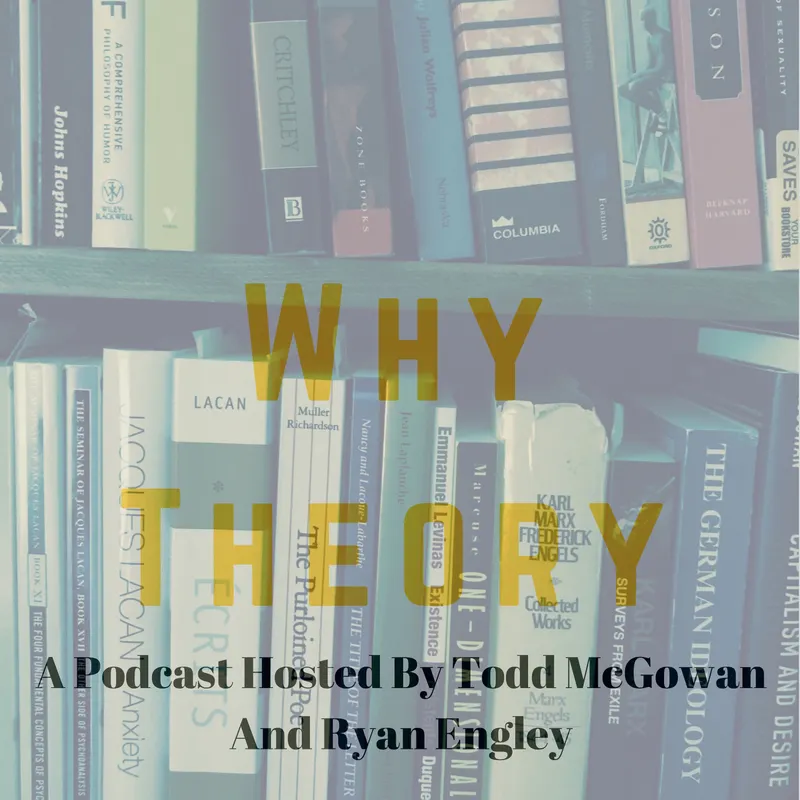
Why Theory
Why Theory·Hosted by Ryan Engley and Todd McGowan·223 episodes
Why Theory brings continental philosophy and psychoanalytic theory together to examine cultural phenomena.
Why listen
Why Theory is for listeners who want philosophy and psychoanalysis treated as living tools for reading culture, politics, film, television, and everyday life. Ryan Engley and Todd McGowan work through Freud, Lacan, Hegel, Kant, Marx, and Žižek in long, conversational episodes that feel like a rigorous seminar with recurring jokes and pop-culture detours. It is especially rewarding if you like theory but want it connected to Christmas movies, Rob Reiner, structural violence, television form, and contemporary capitalism.
Series(2)
Episodes
On this episode, Ryan and Todd discuss Christopher Nolan's recent film. The conversation begins with Emily Wilson's translation of The Odyssey that Nolan consulted and adapted to the screen. Much of the conversation is focused on teasing out the consequences of the changes Nolan makes to the poem's narrative. It's spoiler-town so be wary after about 35 minutes. Apart from experiencing the technical feat of the film, the reason to see it is to see and consider the changes and alterations Nolan makes to the epic, its most famous sequences, and well-known characters. Referenced in this episode:Orson Welles "Frozen Peas" commercial outtakesEmily Wilson's Substack "On Complicated..."Notes on Odysseus' nameAlso, at the end, I (Ryan) repeated what I now know is a common misconception that the Incredible Hulk TV series used music from Rocky Horror Picture Show. That was totally an error. Not as much of an error as saying Ayn Rand's sales figures were equal to Tolkien's in the 20th century but an error still.
On this episode, Ryan & Todd theorize the World Cup as a public event that enables the non-expert to see complex theoretical notions, such as Alain Badiou's conceptualization of the event and Jean-Paul Sartre's idea of self-transcendence. The episode also discusses how the World Cup offers complex ways to view our relationship to the law, nationalism, and climate change.(Quick note: Thank you to every very early listener who noticed the previous upload was incorrect! Hope everyone enjoyed just Ryan's side of the audio. Todd said that probably made the episode better but, alas, we're back to parity now.)
On this episode, Ryan and Todd complete their Sartre inflected trifecta of episodes by engaging his 1947 essay series What Is Literature? The hosts begin by talking about how much Sartre's method has meant to them respectively before moving on to engage the text's most famous claim: literature appeals to the reader's freedom. Sartre's diagnosis and prescription is that literary works--as opposed to poetry, music, and visual arts--must uniquely enact a praxis of "committed writing." For Sartre, committed writing is constant and conscious political awareness. Each text, according to Sartre, situates the author to their political temporal moment. The hosts discuss how this text presages his later movement toward thinking the "group-in-fusion" of the more Marxist and much less existential Critique of Dialectical Reason some thirteen years later. Ultimately, the hosts find that while many of Sartre's claims are untenable (or even abandoned by Sartre himself), the tension points his argument presents are fecund for developing the podcast's on claims about the transcendence of literary works and the importance of separating urgency from immediacy.Quick note: to avoid any confusion, this text has also somewhat recently been reproduced as Literature and Existentialism. We refer to it exclusively by its more common and canonical name throughout the episode but it's possible some listeners may have a copy of this by a different title.
On this episode, Ryan and Todd cover writer-director Tony Gilroy's 2007 political thriller masterpiece, Michael Clayton. The hosts weave in Sartre's notion of committing oneself to a project from the previous episode and work through the narrative and formal elements that make Michael Clayton's intervention exceptional for Hollywood film.
On this episode, Ryan and Todd discuss Jean-Paul Sartre's 1945 lecture titled "Existentialism is a Humanism." In it, Sartre answers criticism that existentialism has received from lay people, concerned Christians, and Marxists, and clarifies what existentialism means and (more importantly) what it hopes to do and inspire in action. The existential method that Sartre advocates is universal and optimistic, advocating for political change by encouraging everyone to see that their individual actions include every other person in them. Ryan and Todd discuss the main thrust of the lecture, Sartre's eventual shift to Marxism (covered in the Critique of Dialectical Reason episodes), how psychoanalytic theory intersects with and pushes back on Sartre's ideas, and why Total Recall is the perfect Sartrean film.
On this episode, Ryan and Todd discuss Freud's idea of the "impossible professions." First articulated in 1925, Freud is drawn to the idea that psychoanalysis is like government and education in that it proposes a necessary function without end. The intrinsic endlessness to the impossible professions often leaves them ripe for tendentious scrutiny. As we've seen over the last decade, those with roles in education, government, and medicine have had their expertise routinely ridiculed and undermined. The hosts each add an idea to Freud's initial proposition with Ryan offering that each of the impossible professions has a necessary tie to the public trust that, in our era, must be won back while Todd offers that transference holds the impossible professions together and excludes others that might be included.
Following up some of the discussion points introduced in the previous episode on Ambition, this episode takes a stab at the deadly sin of Avarice. Beginning first with a historical and etymological look into Avarice and Greed, looking at when Greed overtook Avarice in common parlance and when the word moved from referring to a wider programming of miserly hoarding to a specific rapaciousness toward financial accumulation. Unsurprisingly, with the global adoption of capitalism, Avarice dropped out of common parlance and Greed saw a rebranding, with accumulation and self-interest becoming virtues rather than vices. Ultimately, Ryan and Todd try to move discussion of Avarice as a deadly sin away from strictly moral terrain and move it toward the political. (Episode may be triggering for former lifeguards at municipal pools.)
On this episode, Ryan and Todd tackle the fading specter of ambition as a tragic or negative quality. Far from being a minor rhetorical or social phenomenon, the two trace the embrace of ambition to the broader injunction to sell oneself as a brand. This episode will lay some theoretical groundwork down for the following episode which will be on Avarice (a return to long fallow Seven Deadly Sins series).
On this episode, Ryan and Todd return to Kant's Critique of Pure Reason to discuss the Transcendental Analytic section of the text. Topics include: form and content, Kantian causality, whether example(s) can work for exploring Kant's philosophy, the subject vs. subjectivism, simultaneity, and Super Metroid. Plus Ryan makes an Announcement. (Bonus points go to any listener who currently lives in a house boat.)
On this episode, Ryan and Todd take a short break from their Kant Odyssey to discuss one of the podcast's most admired filmmakers: Rob Reiner. Coincidentally being released on Oscar's Sunday, the hosts dedicate their time to Reiner's first seven films--This is Spinal Tap, The Sure Thing, Stand By Me, The Princess Bride, When Harry Met Sally..., Misery, and A Few Good Men. While discussing each film individually, the pair articulate and build upon the following claim: the same things that made Reiner unique as a filmmaker were the exact same things that made him easy to overlook as an auteur.
On this episode, Ryan and Todd cover the next major idea in Kant's first critique: the transcendental deduction. While explicating the trajectory of Kant's argument, the pair continue to track the latent and manifest influence of this section on Fichte, Hegel, Freud, Heidegger, and Lacan. Later, they try to bring film examples to bear on this section of Kant--including the stark difference between the A and B sections of the text.
On this episode, Ryan and Todd return to Kant and discuss the Transcendental Aesthetic from his Critique of Pure Reason. The hosts work through a sketch of Kant's idea, why he's proposing it, and why even the form of its argumentation is significant for the history of philosophy. The hosts also work over the influence of this section on Heidegger and propose a possible influence on Freud. Later the pair try to mobilize Kant's conception of time and space through pop culture example which is often seen in psychoanalytic treatments of Freud and Lacan (and even some with Hegel) but much less with Kant.
On this episode, Ryan and Todd return to the topic of the superego to discuss--for the first time at length--the enjoyment particular to it. Superegoic enjoyment is an idea that first appears in Freud though it is not fully developed as a concept until Lacan (briefly) and Žižek (massively). For Žižek, transgression of the written law enables the group identification with a suspension of the law. This is crucial to the superegoic enjoyment we see in, for example, the banality of breaking the speed limit and the horror of militarized police brutally suppressing a protest movement under special orders. Ryan and Todd depart from Žižek's influential and important articulation of superegoic enjoyment by offering that it is not the obscene underside of the law but rather an internalization of the Big Other's demand that is the essential characteristic of the superego's injunction to enjoy.
On this episode, Ryan and Todd cover the topic of structural violence in both U.S. and global contexts. Beginning with an implicit debt to Slavoj Žižek's influential book Violence, the hosts move to clarify the idea as how unwritten dictates of oppression sustain themselves through their being unwritten Where it is easier to see the violence of a thrown punch, for example, structural violence is the invisibility structuring why the punch was thrown. Visible violence often hides its less visible structuring force. For this reason, the hosts discuss the difficulty of depicting structural violence in popular film before moving through examples of structural violences both contemporary and historical.
On this episode, Ryan and Todd discuss the recently concluded first season of Apple's Pluribus. Taking on the ideas of duration, repetition, alienation, and isolation presented by the show, the hosts analyze how Pluribus delivers a fascinating treatment of life under contemporary capitalism. The hosts foreground how Pluribus dramatizes the tension between the group and the individual, a deftly staged dynamic that recalls a fundamental psychical torsion that psychoanalysis has long concerned itself with.
On this year’s exploration of the Christmas film genre, Ryan and Todd look to three films from the early-2000s: The Family Stone, Love Actually, and The Family Man (but not Elf, to one host’s disappointment). The hosts theorize two core concepts across these films and, by extension, the Christmas films they have covered in general: deepening the cut in the family dynamic to integrate an antagonism and a Christmas articulation of Shakespeare’s Green World (a concept famously developed by Northrop Frye). The hosts layer these new ideas atop prior Christmas film genre concepts such as the necessity of the castration of the father, the misfit, the rejection of cynicism, and seeing a flawed person as though they are an unwrapped present.On a personal note (this is Ryan speaking), I just want to take a second to thank everyone for the support over the years. As I mention early in the episode, I recently made it through the tenure process successfully, which is a pretty big career milestone for me. It took an awful lot of work to get tenure, and I couldn’t have found as much depth and meaning in that work without this audience. Thank you, everyone.
On this episode, Ryan and Todd discuss the episode--a fading television art. Beginning with a brief history of what early American Broadcasting aestheticized about television as form (e.g., its liveness), the hosts theorize the unique cut of the television episode, an analysis typically reserved for film media. The cut has been aesthetically mobilized by television (as seen in the banal yet artistically fruitful breaks for commercials), though it is precisely this cut dimension of television that is currently being lost in favor of cliffhanger heavy models of recent streaming television series.
In this episode, Ryan and Todd continue their commentaries on Jacques Lacan's seminars by turning their attention to Seminar XIX: ...or Worse. Lacan deepens his consideration of the non-relation in this seminar, further breaking from the signifying chain that had defined much of his earlier and middle work. Lacan also turns more toward mathematics and set theory to ground his discursive inquiry, which requires him to articulate a seemingly new notion of the real. Ultimately, the hosts try to draw out the consequences and coordinates of these dynamic moves in Lacan's late work.Relevant Announcement! Ryan's book Seriality: Media and the Psychic Form of Everyday Life is available for preorder on a number of different websites. Here is the link to the publisher's page:https://www.bloomsbury.com/us/seriality-9798216197782/August 6th is the worldwide release date. GET EXCITED.
On this episode, Ryan and Todd continue their series of commentaries on Lacan's Seminars, this time bringing their attention to Seminar XVIII: On a Discourse that Might not Be a Semblance, which was recently published in an official English translation by Bruce Fink for Polity. The hosts work through the stakes and questions of this "morning after" seminar for Lacan's toward the quadratic formulation of the Four Discourses that will define his late work. Ultimately, the hosts see a stark break in the non-relation developed and insisted upon in XVIII from the signifying chain that had defined Lacan's work and thinking up to this point.
In this episode, Ryan and Todd complete their Gaze & Voice duology. While gaze & voice both enter into psychoanalytic theory as objects through Lacan's work at the same time, voice has received less critical attention since. The hosts put voice through a theoretical wringer, analyzing it at the levels of everyday life, aesthetics, and politics. Ultimately, the episode takes up the question of whether and to what extent voice can be mobilized as an emancipatory political concept.
In this episode, Ryan and Todd discuss one of psychoanalytic theory’s most influential ideas: the gaze. The hosts talk about how Laura Mulvey’s gloss on “the male gaze” made the idea widespread across film theory and cultural studies in different formulations. Yet often missing in these accounts is how the gaze is a challenge to mastery, rather than a confirmation of it. The hosts work through two of Lacan’s examples to this effect, found in Holbein and Velázquez, before offering several of their own as they try to hone in on what makes this idea both evergreen and elusive.
In this episode, Ryan and Todd pay tribute to the recently deceased film actor, director, and producer Robert Redford. Working through dueling top ten film lists, the hosts draw out a political and moral throughline that distinguishes Redford's long career. As the hosts contend, Redford's filmography is defined by an exploration of Kantian moral law and the nonverbal expression of an excess that cannot be named.
In this episode, Ryan and Todd conclude their Marx duology by working through the excellent Eighteenth Brumaire of Louis Bonaparte. The hosts focus on Marx's narrative and progressive understanding of history as well as the famous notion of repetition expressed in the work's first two lines. The discussion concludes with a critical engagement with Marx's concept of the psyche and the peasantry.
In this episode, Ryan and Todd discuss Karl Marx's posthumously published Economic and Philosophic Manuscripts of 1844, colloquially known as the 1844 Manuscripts. They begin by discussing how teachable and approachable the text is before underlining the book's core arguments. While not intended for publication by Marx, this text nonetheless offers a highly structured look at Marx's developing thoughts on capitalism, alienation, and the legacy of Hegel. Toward the end of the episode, the hosts draw out the tension in the text between Marx's reading of Hegel as a philosopher of history versus the podcast's long held contention that Hegel must be read as a philosopher of contradiction.
In this episode, Ryan and Todd discuss the so-called "End of History" in Hegel's thought. Francis Fukuyama's 1989 essay "The End of History?" thrust Hegel unexpectedly into mainstream political conversation. The first half of the episode discusses the legacy of Fukuyama's essay and considers how appropriate it is to regard the End of History as a purely Hegelian notion. The second half discusses issues with extracting any lesson--political or otherwise--from the publications collected as Hegel's lectures. Finally, Ryan and Todd offer their own takes on how to think the end in Hegel.Referenced in this episode: "The End of History and the Return of History" by Philip T. Grier from The Hegel Myths and Legends edited by Jon Stewart (not that one)BONUS CONTENT:Please check out good friend Russ Sbriglia's brilliant band Misconstruity. Pre-order the record if you're into it! There are all kinds of links on the webpage but here is the lead track available to stream on YouTube. Second thing, I (Ryan) was briefly featured on NPR's Academic Minute this week. None of what I say here will be particularly revelatory for the Why Theory audience but it's a cool thing I got to do and thought I'd share it. Thank you for your support!
In episode 201, Ryan and Todd work their lists of the Top 10 Television Series of the 21st Century. The hosts operated by the following rules: 1. Only completed series. No currently in production series.2. No series could be included, even if completed, if there is pre-production or production being done on a continuation to the original series. (Not a total spoiler but spoiler-adjacent comment: one of Todd's selections just about clears this on the basis of a related reboot rather than continuation being in production.)3. At least 51 percent of the series had to take place in the 21st century. (Again, Todd just about gets away with one.)4. No limited series or single seasons. (So, Todd also...)Thanks everybody for tuning in to the first episode of hopefully the next 200!
In Why Theory's 200th episode, Todd and Ryan work through their own respective lists of the Top Ten films of the past 25 years not know what the other person's picks are. No spoilers in the episode description. Thanks to everyone who has listened over the previous 199. You mean the world to us.
In this episode, Ryan and Todd return to their film genre series to discuss the musical through interlocked analyses of The Jazz Singer, Top Hat, The Wizard of Oz, Singin' in the Rain, and Carmen Jones. The hosts' theoretical intervention focuses on the musical as vehicle for technological innovation in Hollywood history, as well as how the genre operates as a site for excess becoming integrated into seeming normality.
On this episode, Ryan and Todd put the idea of common sense through the theoretical wringer. Working through examples both banal and world threateningly serious, the hosts present the argument that changes in what we often refer to as common sense fundamentally alter one's relationship to the everyday and that this is vital terrain for articulating a politics of liberation.
In this episode (recorded prior to such events as the Trump - Musk breakup and the National Guard being sent to L.A.), Ryan and Todd discuss Sigmund Freud's essay "On Narcissism: An Introduction." Freud's notion of narcissism clashes with the increasingly commonplace idea of narcissism that is largely informed by a pop-psychology importation of Narcissistic Personality Disorder. Freud's notion of narcissism can appear, at times, to be a difficult to make relevant relic of an earlier age. Nonetheless, the hosts attempt to draw out the consequences of Freud's theorization in order to unlock a novel way of currently understanding the present day conversation on narcissism.Val Rohy's book mentioned in the episode.
On this episode, Ryan and Todd work through Sigmund Freud's under discussed Group Psychology and the Analysis of the Ego. The hosts first lay out how Freud establishes the group, rather than the individual, as the psyche's primary formation. They then devote time to teasing out the consequences of group dynamics as Freud writes about them in the figures of the Church and the Military, while spending much time talking about the "destructive" character of the couple. Finally, the pair discuss a matter of translation and where the drive (first theorized the year previous to Group Psychology's publication) appears in this short book.
In this episode, Ryan and Todd dedicate a full-length treatment to one of the podcast's most frequently referenced works: Racecraft: The Soul of Inequality in American Life by Karen E. Fields and Barbara J. Fields. The hosts move from engaging the term racecraft itself (which, not for nothing, both gets a red squiggle when I write it and the computer keeps separating the two words from each other like it's an error after I insist that it's not) to discussing how and why the book has not had as much mainstream discursive success as others. The hosts tease out the uncomfortable and vital challenge the book puts to readers before finally highlighting the areas in which the Fields' project overlaps with psychoanalytic concepts. Note the below is referenced in the episode: Jacobin interview with Karen and Barbara Fields
In this episode, Ryan and Todd discuss the effect artificial intelligence is having on higher education, primarily through commentary on ChatGPT. They first discuss how immediacy and the elimination of labor are key to ChatGPT's appeal before moving to discuss how it produces an idea of what Lacan would term the Big Other and how its ruling logic is one of emergent consensus. They end by arguing that ChatGPT inverts Rick Boothby's axiom that "the Big Other doesn't know" and how that introduces a damaging psychic dilemma.
Kicking off a new Overview sub series of podcasts, Ryan and Todd discuss the influential ideas of Hegelian-Lacanian philosopher, Slavoj Žižek. After discussing Žižek's defining contribution in bringing the study of Hegel and the study of Lacan together, the two hosts move through three ideas apiece that each influenced their own work and their own thinking.
Ryan and Todd discuss the political implications of the societal tendency toward euphemism. They theorize euphemism ultimately as a tool of the reactionary forces and as a way of blunting the necessity of critique. Euphemisms make the people employing them feel better while furthering the very structure of oppression that the euphemism claims to ameliorate.
Ryan and Todd define and explore the key psychoanalytic concept of the symptom. They contrast the psychoanalytic understanding of the symptom with the therapeutic version and then think about how we must respond to the symptom, including what it means to enjoy one’s symptom. In the discussion of changing the relation to the symptom, they discuss the disaster film as a paradigmatic form of response.
In this episode, Ryan and Todd discuss the erosion of the public under contemporary capitalism. Using Jurgen Habermas's influential writing on the public sphere as a jumping off point, the hosts move to discuss different challenges to imagining a vision of the public untethered to capitalism and self-defeating notions of inclusivity.
On this episode, Ryan and Todd discuss Rick Boothby's terrific recent book, Embracing the Void: Rethinking the Origin of the Sacred. First they discuss how the book begins its argument by intervening in the gap between Freud's and Lacan's notion of religion (in both its social and psychical import). They then move to highlight Rick's original theorizing that links das ding to an encounter with the unknowability and indecipherability of the other. Finally, they conclude by discussing the relationship that Andrei Tarkovsky's Stalker has to an extension of Rick's argument.Also mentioned on this podcast:Misconstruity, "Let Them Rot" (referenced as Russ Sbriglia's King Crimson power hour)On Drugs, CBC Podcast (Special thanks to Hadeel and Geoff!)Ryan's essay in World Picture
Ryan and Todd discuss Lacan’s Seminar XVI: From an Other to the other. They focus on Lacan’s modification of Marx’s surplus value into surplus enjoyment and the implications of this discovery for the interpretation of capitalism. They frame this seminar as the end of the most fecund era of Lacan’s thought, a culmination that produces one of his greatest insights and the basis for a psychoanalytic theory of capitalism.
Ryan and Todd pay tribute to David Lynch’s life and work by discussing each of his ten feature films in order of value as artworks (in the view of one of the cohosts). They explore the role of fantasy in Lynch’s works and how he implicates the desire of the spectator in the films.
Ryan and Todd work through Jacques Lacan’s Seminar X: Anxiety. Since this is the seminar that provides a great deal of Lacan’s initial theorizing of the objet a, they devote much of their time to this concept. Additionally, they discuss how Lacan responds in this seminar to existentialism, especially through his redefinition of anxiety. They conclude with an analysis of the role that sacrifice plays relative to anxiety.
In their annual Christmas special, Ryan and Todd explore the Lesbian Christmas film and the theoretical contribution that this specific type of film makes to the Christmas film genre. They discuss Carol, Happiest Season, and Let It Snow in terms of their depictions of desire and the importance of desire itself coming out.
Ryan and Todd explore the possibilities for praxis in the vein of the notorious philosopher who expresses disdain for the possibilities of a philosophical praxis—Hegel. They look at instances of Hegelian praxis in action, including the church of contradiction developed by Peter Rollins. Hegelian praxis focuses on contradiction, failure, disappointment, and universality. Most importantly, it never operates through a preestablished road map.
Ryan and Todd explore Hegel’s concept of the beautiful soul as he lays it out in the Phenomenology of Spirit. They discuss the contemporary political situation in terms of this figure and theorize about its predominance in today’s landscape. The beautiful soul also becomes a way of thinking through the difference between Kant and Hegel or between morality and politics.
Ryan and Todd address the fundamental connections between Hegelian philosophy and feminism. They discuss the role of contradiction in both lines of thought and focus on some of the major feminist readers of Hegel’s philosophy, including Gillian Rose, Catherine Malabou, and Rebecca Comay.
Ryan and Todd work to explain Hegel's central idea of Aufhebung (translated as "sublation"). This unique German term, which means to cancel, to preserve, and to lift up, provides the key for understanding the movement of Hegel's philosophy, but it is also the site for misunderstanding Hegel's project, which the show discusses.
Ryan and Todd continue their discussion of the horror film by focusing on the genre since Psycho. They discuss Night of the Living Dead, Carrie, The Shining, The Blair Witch Project, It Follows, and The Substance. Their theorize the modern horror film in relation to the psychoanalytic notion of the death drive.
Ryan and Todd pay tribute to the recently deceased theorist Fredric Jameson. They note his deep and wide-ranging contributions to a variety of fields and his unique ability to find something valuable in the object of his critique.
Ryan and Todd explore the classical horror film in terms of the antagonism between life and the beyond, inclusive of death. They focus on the films The Cabinet of Dr. Caligari, Frankenstein, Invisible Man, Godzilla, and Psycho.
Ryan and Todd develop their theory of the heist film as a genre, which they see as structured through the opposition between desire and its object. They examine closely Rififi, The Killing, Heat, Ocean's 11, and Inside Man, as well as touching on many other key films of the genre. Hugh Manon's film noir podcast: https://open.spotify.com/show/0aQXewYjXrMtTjwpJ18rg6
Reviews
No reviews yet.
If you like this...

Acid Horizon
Same topic · Same vibe · Same audience

New Books in Critical Theory
Same topic · Same format · Same audience

Theory & Philosophy
Same topic · Same tone · Same audience

The Eastern Border
Same tone · Same audience

Spot On with Link Lauren
Same vibe · Same tone

Defending Democracy with Marc Elias
Same audience · Same tone

The DSR Network
Same audience · Same format

The Deep View: Conversations
Same format · Same audience
 CrossBinge
Discover films
One connected taste across films, series, games, books & music.
Explore more like this
Listening context
Discussion (0)
No comments yet. Be the first to start the discussion!