Emergency Medicine Cases
Dr. Anton Helman
Dr. Anton Helman
Emergency Medicine Cases – Where the Experts Keep You in the Know. For show notes, quizzes, videos and more learning tools please visit emergencymedicinecases.com
3d ago
In the ED, we regularly care for sick patients presenting acutely with abnormal vital signs, altered mental status, and end organ dysfunction. Oftentimes, the culprit ends up being sepsis, or overdose, or organ failure. But it is important that we consider rarer endocrine presentations like decompensated hypothyroidism. In this Part 1 of this two-part podcast with Dr George Willis and Dr Alyssa Louis, we answer questions like: Why is the term myxedema coma a misnomer and should be abandoned? How can we differentiate between sepsis or environmental hypothermia or toxidrome from decompensated hypothyroidism at the bedside? When is it appropriate to order a TSH, a T4 and T3? What are the most important life-threatening triggers that need to be addressed in patients with decompensated hypothyroidism? Why is it important to test for cortisol levels and consider stress-dose steroids in all patients with decompensated hypothyroidism? Why is endotracheal intubation particularly dangerous in decompensated hypothyroidsm? What is the best way to manage hypothermia? Why is the order of medications for treatment of decompensated hypothyroidism so important? and many more... Please consider a donation to EM Cases to ensure continuing Free Open Access Medical Education: https://emergencymedicinecases.com/donation/
Dec 2
On this month's EM Quick Hits podcast: Deborah Schonfeld on the differential diagnosis and work up of pediatric urinary retention & acute transverse myelitis, Jesse McLaren on his Tryptic Approach to Occlusion MI Diagnosis, Matthew McArthur on recognition and management of post-dural puncture headache, Joseph Yasmeh on Med Mal Cases: Clenched fist injury, Brit Long on IV thrombolysis for minor strokes and Victoria Myers & Lauren Westafer on mentorship and what it means to be a physician leader... Please consider a donation to EM Cases to support high quality Free Open Access Medical Education here: https://emergencymedicinecases.com/donation/
Nov 11
In this Part 2 or our 2-part podcast update on ED stroke management with Dr. Katie Lin and Dr. Walter Himmel we explore non-disabling strokes, where symptoms are mild enough that patients can continue daily activities if deficits persist. Yet, non-disabling does not mean benign. Non-disabling strokes occupy the same ischemic continuum as TIAs and carry a substantial risk of early recurrence with disabling stroke. In this EM Cases podcast we answer questions such as: Which patients with non-disabling stroke can safely go home with prompt follow-up and which require urgent investigation or admission? Which stroke mimics do we need to be on the look out for and how do we identify them at the bedside? How dangerous is thrombolysis in a patient with presumed stroke who turns out to be a stroke mimic? What are the key distinguishing features between a stroke and functional neurologic disorder? What are the most common causes of stroke in young people that we commonly miss? How does stroke etiology dictate the management pathway? What are the indications for carotid endarterectomy in patients with non-disabling stroke and what is the ideal timing of the endarderectomy? When is dual antiplatelet therapy vs single antiplatelet thereapy vs anticoagulant therapy indicated? What is the best medication strategy for the patient on a DOAC for atrial fibrillation who presents to the ED with a non-disabling stroke? For patients not on a DOAC for atrial fibrillation who come in with a stroke, when is it safe to start anticoagulation? and many more... Make A Donation: https://emergencymedicinecases.com/donation/.com
Oct 28
We are amidst a paradigm shift in the emergency management of acute ischemic stroke. The traditional way of categorizing ischemic strokes as 'minor' vs 'major' is no longer relevant to what we do in the ED. It's now about 'disabling' vs 'non-disabling' strokes. And this is no small change. This categorization dictates urgency of ED work-up and treatments, imaging choices, treatment decisions and goals of care. In this Part 1 or our 2-part main episodes EM Cases podcast series on management of ischemic stroke with Dr. Walter Himmel and Dr. Katie Lin, we answer questions like: How can we best rapidly determine if an ischemic stroke is disabling or non-disabling at the bedside? In what ways are 'wake up strokes' managed uniquely and what's the latest thinking on their pathophysiology? How should we best prioritize imaging depending on timing, geography and resources? How do we best predict large vessel occlusion amenable to endovascular therapy (EVT) at the bedside? How can we efficiently establish goals of care at the bedside to inform our emergency decision making around strokes? Which is better for thrombolysis in ischemic stroke - Tenecteplase or Alteplase? How have contraindications to IV thrombolysis changed over the last decade? When should we consider bridge therapy with EVT after IV thrombolysis? What are 4 key items the ED physician should have ready for the stroke neurologist on the first call? and many more... If you enjoy EM Cases content please consider a donation to help support ongoing FOAMed here: https://emergencymedicinecases.com/donation/
Oct 7
On this month's EM Quick Hits podcast: Dr. Isaac Bogoch on recognition and management of osteomyelitis in the ED, Dr. Anand Swaminathan on tourniquet tips and tricks. Dr. Andrew Tagg on managing pediatric distal radius buckle fractures & the FORCE trial. Dr. Justin Morgenstern on Delayed Sequence Intubation (DSI): RCT Takeaways. Dr. Brit Long on ESRD & Dialysis in the ED: altered mental status. Dr. Lisa Thurgur & Victoria Myers on leadership and medical education. Please consider a donation to EM Cases to ensure ongoing high quality free open access medical education here: https://emergencymedicinecases.com/donation/
Sep 16
Discover evidence-based sleep strategies for shift workers. Optimize performance, recovery, and health with tips from sleep expert Dr. Michael Mak... If you find this beneficial please consider a donation to support EM Cases: https://emergencymedicinecases.com/donation/
Aug 26
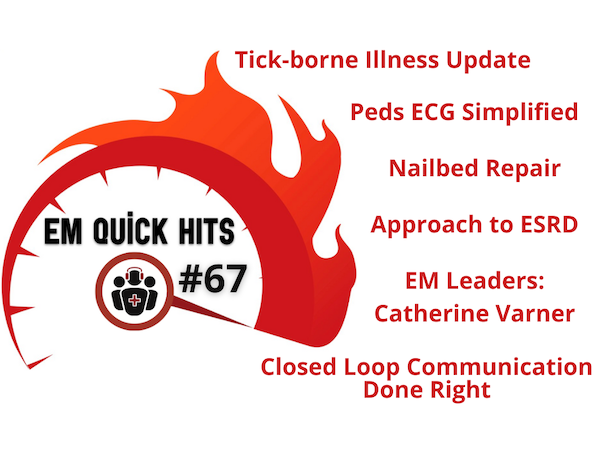
On this EM Quick Hits podcast: Tick Borne Illness Update with Dr. Issac Bogoch, Pediatric ECG Interpretation with Dr. Kathleen Stephanos, Nailbed Repair with Dr. Matthew McArther, Closed Loop Communication with Dr. Shawn Segeren, ESRD with Dr. Brit Long, Leaders in EM Dr. Catherine Varner... Please consider donating to EM Cases here: https://emergencymedicinecases.com/donation/
Aug 4
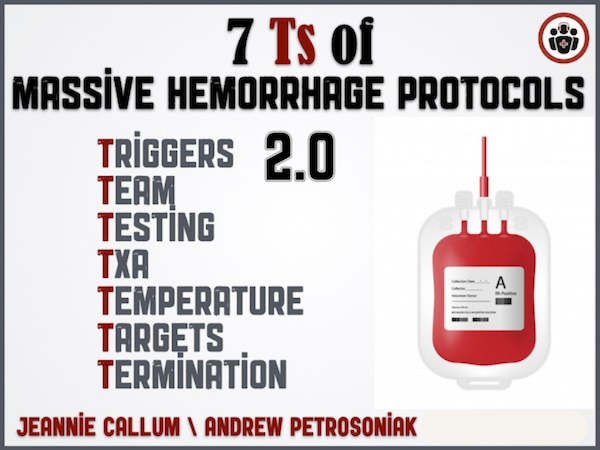
In this update to the 7 T’s of Massive Hemorrhage Protocols with Dr. Jeannie Callum and Dr. Andrew Petrosoniak, we explore the most current, evidence-informed strategies for bleeding patients, from polytrauma to obstetrical, drawing on the latest clinical trial data and real-world experience. We answer the questions: What is the evidence based alternative to FFP in EDs where FFP is not readily available? How accurate are decision scores in helping decide the trigger for MHP activation? Why is testing fibrinogen levels and giving fibrinogen concentrates so important in massive hemorrhage? How should we tailor our MHP to the GI bleed patient? To the obstetrical patient? and many more... Please donate to EM Cases to ensure ongoing Free Open Access Medical Education at https://emergencymedicinecases.com/donation/.