NTSB News Talk – Aviation Accidents, Safety Investigations & Pilot Lessons
Max Trescott | Aviation News Talk Network
Max Trescott | Aviation News Talk Network
NTSB News Talk is your go-to podcast for in-depth discussions of aircraft accidents, investigations, and the lessons pilots can’t afford to ignore. Hosted by award-winning aviation journalist Rob Mark and Max Trescott, a flight instructor who has trained as an accident investigator, this show breaks down recent NTSB reports, analyzes accident causes, and explores what every pilot, instructor, and aviation enthusiast can learn from these events. Whether you’re a student pilot, airline captain, or simply fascinated by aviation safety, NTSB News Talk brings you facts, context, and expert commentary—without sensationalism. Rob and Max balance serious safety insights with engaging conversation, making complex investigations accessible and informative. Each episode features real-world scenarios, industry trends, and sometimes, interviews with investigators, subject-matter experts, or those impacted by aviation incidents. Tune in to stay informed, sharpen your safety mindset, and better understand how aviation continues to evolve through hard-won lessons in the skies. Subscribe now and never miss a crash course in aviation safety.
1d ago
Max talks with Rob Mark about the fatal crash of a Citation 550 in Statesville, North Carolina, that killed six people, including a NASCAR driver Greg Biffle and members of his family. The accident occurred shortly after takeoff, making it one of the most closely watched aviation tragedies of the week and a focal point of this episode. Preliminary information indicates the Citation 550 departed Runway 10 at Statesville Airport and soon reported engine trouble. The crew attempted to return to land on Runway 28. ADS-B data shows the aircraft remained airborne for approximately seven minutes and came remarkably close to completing the return. The jet maneuvered back toward the airport, descended unusually low on downwind—likely to remain below cloud ceilings—and successfully aligned with the runway before crashing just short of the pavement following a rapid descent and post-impact fire. Weather conditions at the time were poor but not extreme, with drizzle, reduced visibility, and broken ceilings reported near the time of the accident. Max and Rob discuss how emergency returns immediately after takeoff create one of the highest workload scenarios pilots face, especially when compounded by weather, low altitude, and potential mechanical failures. While twin-engine aircraft are designed to continue flight after an engine problem, this accident highlights how quickly margins disappear when multiple stressors converge. The episode then places the Statesville crash within a broader context of recent fatal accidents involving business jets. Max and Rob examine a Citation III crash in Toluca, Mexico, that killed all ten people on board. Although weather at the time was VFR, the airport’s high elevation—approximately 8,500 feet—dramatically reduced aircraft performance. ADS-B data revealed excessive airspeed on short final, followed by an attempted go-around that showed no sustained climb. The hosts note that go-arounds at high density altitude are particularly unforgiving, and that many pilots underestimate how marginal climb performance can be when aircraft are heavy. Attention then turns to an unusually blunt public statement from NTSB Chair Jennifer Homendy , who criticized proposed military exemptions to ADS-B requirements in Washington, D.C. airspace. Homendy warned that maintaining separate rules for military aircraft risks repeating history, referencing a fatal midair collision nearly a year earlier involving a military helicopter operating without ADS-B. Max and Rob discuss how exceptions intended for rare circumstances can become normalized, undermining the very safety systems designed to prevent collisions. Several additional accidents are reviewed, including a fatal Twin Comanche crash in Illinois and a night training flight in Louisiana that ended when a Cessna 172 crashed into Lake Pontchartrain . In the Louisiana accident, ADS-B data showed a gradual descent toward the airport, followed by a tight 180-degree turn and a sudden acceleration. In the final seconds, the aircraft’s descent rate increased dramatically, consistent with somatogravic illusion—a powerful and often deadly sensory illusion caused by acceleration in dark or instrument conditions. Max explains how somatogravic illusion can trick pilots into believing the aircraft is pitching up when it is not, prompting them to push forward on the controls. In visual conditions, outside references correct the error. At night or in IMC, the illusion can persist unchecked, leading to controlled flight into terrain. Max connects this accident to several historic crashes, emphasizing that the only reliable defense is strict reliance on instruments and verification of a positive rate of climb. The episode also covers a preliminary NTSB report involving a King Air B100 that crashed in Florida during a humanitarian relief flight. The aircraft carried significant cargo and fuel and entered clouds shortly after departure before descending at extreme speed. With no early signs of icing or engine failure, Max and Rob discuss possible pilot incapacitation and the risks associated with cargo loading and securing. Even relatively modest shifts in unsecured cargo can have catastrophic consequences in flight. Two final preliminary reports underscore recurring themes. In Ohio, a Jabiru Sport aircraft crashed after repeated low-altitude passes over a residence, consistent with hazardous low-level maneuvering. In California, a Cessna 172 struck rising terrain in a narrow mountain canyon after departing Bishop Airport, illustrating the dangers of mountain flying without sufficient altitude or specialized training. Throughout the episode, Max and Rob return to a central message: many of these accidents—despite their differing aircraft types and circumstances—share common threads of workload, human limitations, and decision-making under pressure. As winter approaches and daylight hours shorten, they urge pilots to exercise extra caution, particularly during night operations and high-stress departures. The fatal Citation 550 crash in Statesville serves as a sobering reminder that even well-equipped aircraft and experienced crews can be overwhelmed in minutes, and that understanding both aircraft performance and human physiology remains essential to aviation safety.
Dec 1
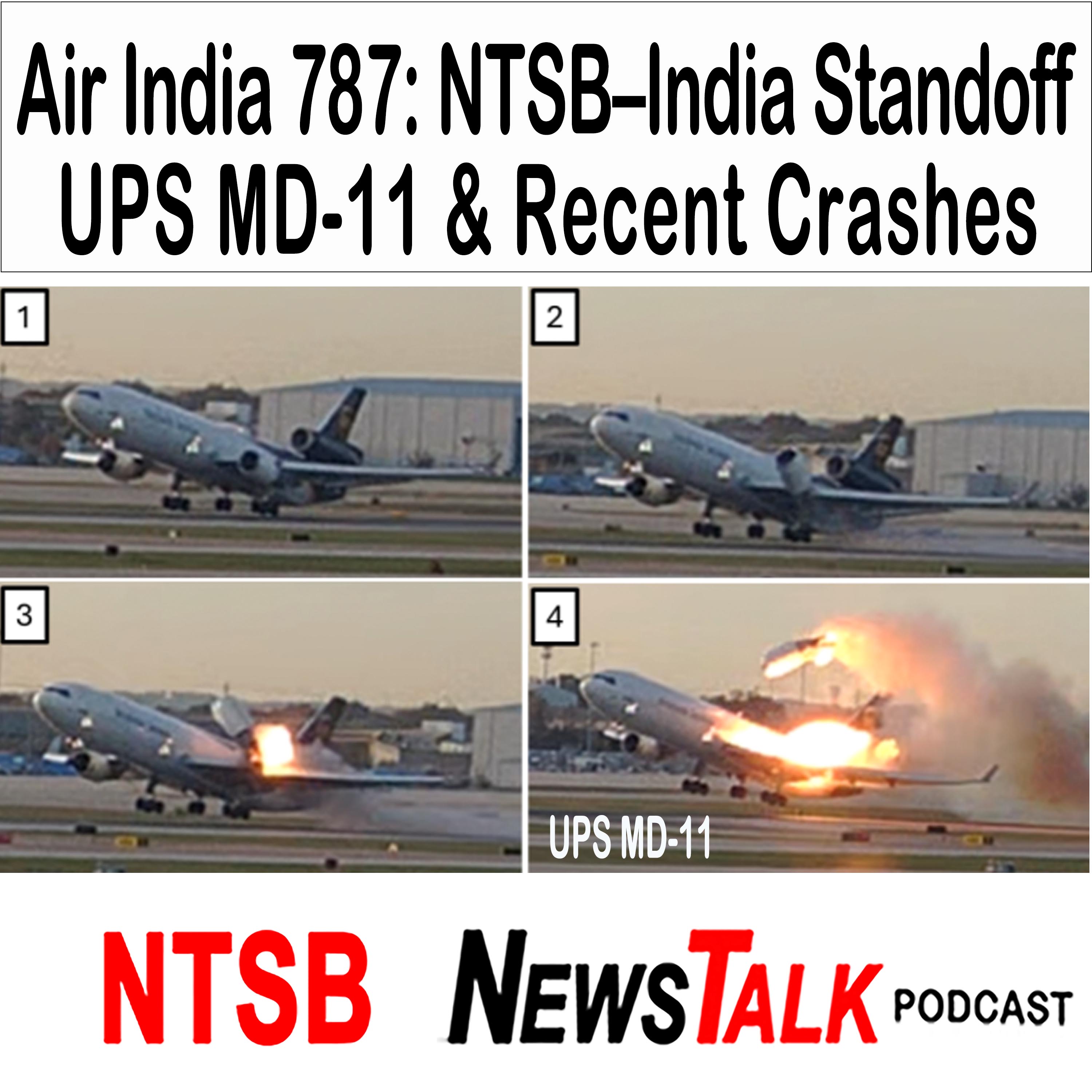
Episode 18 begins with an extraordinary behind-the-scenes dispute surrounding the Air India Boeing 787 crash investigation. Max and Rob open with a Wall Street Journal report describing how U.S. technical experts arrived in Delhi last summer expecting to assist with the black-box analysis, only to be told they would need to board a late-night military flight to a remote facility. NTSB Chair Jennifer Homendy expressed concerns about U.S. personnel and equipment being moved into an area under State Department terrorism advisories, especially given rising tensions in the region. The NTSB pushed instead for data extraction either in Delhi or in Washington, triggering a rapid series of high-level calls involving the U.S. Secretary of Transportation, Boeing, and GE Aerospace. Indian officials insisted they had full capability to download the recorders, yet simultaneously requested more than 30 pieces of specialized equipment from the NTSB, further complicating the diplomatic dynamics. Homendy ultimately issued a 48-hour ultimatum: select Delhi or Washington for the data download, or the U.S. would withdraw from the investigation entirely. India chose Delhi, but the episode highlights how political sensitivities can shape technical investigations—especially when early evidence, as reported, suggested the possibility of intentional fuel-cutoff switch manipulation. The hosts note that pilot-suicide scenarios, though rare, account for more fatal commercial accidents than many pilots realize, citing EgyptAir, Germanwings, Malaysia 370, and other historical cases. From the geopolitical, the episode shifts to more traditional NTSB investigations. A midair collision in Canada between a Cessna 172 and a Piper Seminole resulted in the 172 losing a wing and crashing, while the Seminole landed safely. Max shares the surprising statistic that roughly half of U.S. midair collision victims survive and recounts how a midair experienced by Cirrus co-founder Alan Klapmeier helped inspire the CAPS parachute system. The next story involves a Piper Arrow III that crashed during a nighttime arrival in Pittsfield, Illinois. The pilot had flown nearly five hours from Alabama—an exceptionally long time in that type of aircraft—and arrived as conditions were deteriorating to low visibility and a 300-foot overcast. Max emphasizes the difficulty of recognizing inadvertent IMC at night and discusses how fatigue and lack of instrument proficiency may become factors once more details emerge. A TBM 700 accident in Monroe, Wisconsin offers another sobering look at missed-approach challenges. With visibilities down to a quarter-mile and ceilings around 300 feet, the aircraft attempted a GPS approach to Runway 12, then initiated a missed approach. Instead of climbing outbound on the published track, radar data shows the aircraft turning prematurely, losing airspeed, and entering a stall and loss of control. Max highlights how even experienced instrument pilots often under-practice missed approaches in actual IMC, making it one of the most common fatal accident points in general aviation. The episode then examines a dramatic near-miss involving an Air Arabia Maroc Airbus A320 departing Catania, Italy. A ferry crew failed to load weight-and-balance data into the MCDU, meaning no V-speeds were computed. The aircraft rotated late, climbed shallowly, then descended toward the sea at night, triggering multiple GPWS warnings before the crew recovered at just 41 feet above the water. With moonless, dark-night conditions and no visual horizon, this oversight nearly resulted in a hull loss. Both pilots were highly experienced—proof that skipping basic procedures can endanger even seasoned crews. Next, Max and Rob turn to the UPS MD-11 engine-separation crash in Louisville. New preliminary findings show fatigue cracking in engine-pylon attachment lugs, reminiscent of the American Airlines DC-10 crash in 1979 where a maintenance procedure overstressed the pylon. The MD-11 fleet remains grounded as inspections continue, and Max notes how fortunate it is that inspectors have since found additional cracks on other aircraft. Even with a rapid emergency-response drill completed just weeks earlier, the flight crew had no survivable options the moment the engine detached at rotation. Finally, the hosts analyze new details from the Cirrus SR22 crash in Lincoln, Montana. The pilot, attempting his first-ever night arrival at a mountainous airport with no instrument approach, lined up over a highway before maneuvering at low altitude, with flaps changing configuration and the autopilot still engaged while turning in the pattern. A stall warning sounded, followed by a steep bank and loss of control. Max emphasizes a longstanding teaching point: pilots should avoid first-time nighttime arrivals at unfamiliar mountain airports, especially those without instrument procedures—which often signals surrounding terrain too challenging to support one. Across all these stories, Max and Rob reinforce a common theme: safety is not a static condition but an ongoing behavior. Pilots must maintain awareness, practice critical skills like missed approaches and go-arounds, and respect how quickly conditions or workload can change. The episode offers practical insights for every pilot seeking to build resilience and margin into their flying.
Nov 17
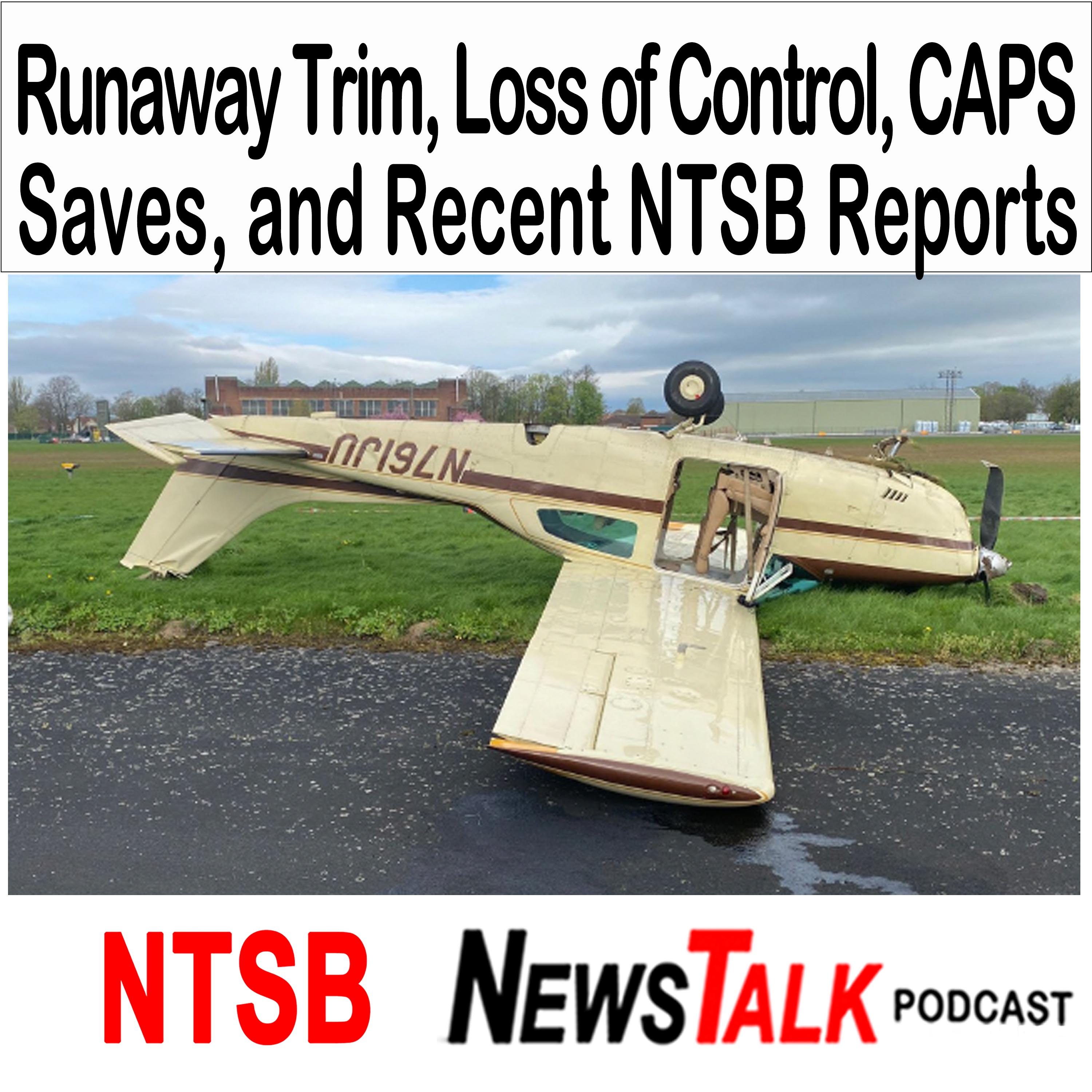
Episode 17 of NTSB News Talk brings together an unusually rich set of accidents and safety insights, all centered on pilot decision-making, trim system failures, swept-wing stall risks, and the ongoing challenge of hand-flying in IMC when automation misbehaves. In this week’s discussion, hosts Max Trescott and Rob Mark use recent NTSB reports to highlight the mistakes, mechanical failures, and chain-of-events that continue to trap even experienced pilots. For listeners who fly IFR, rely on autopilots, or operate aircraft with electric pitch trim, this episode offers lessons that are immediately relevant. The episode opens on an encouraging note. Max reports that the United States saw three CAPS parachute deployments in three days—Tuesday, Wednesday, and Thursday. These weren’t all Cirrus aircraft, either; one was N163BR, a Lancair Turbine LX7 , one of the fastest experimental turbine singles in the fleet. All three incidents involved engine failures on approach, and every person involved walked away uninjured. For Max and Rob, it’s another sign that whole-airframe parachutes continue to save lives and will become increasingly common as the general aviation fleet modernizes. But the tone shifts as the hosts examine the crash of N30HG, a King Air B100 on a humanitarian mission to Jamaica following Hurricane Melissa. Shortly after takeoff from Florida, the aircraft descended rapidly and struck palm trees before crashing into a pond, killing both on board. A similar King Air pilot’s Facebook account of a pitch trim runaway and violent pitch-down event becomes an important point of comparison. While the NTSB has not yet identified the cause, the parallels highlight how aggressive and unexpected trim-related events can be—and how essential it is for pilots to know exactly where the trim and autopilot disconnects are located, especially when operating older turbine aircraft. In the next case, XA-JMR, a Mexican registered Hawker 800XP fatal accident near Battle Creek, Michigan, post-maintenance work required a swept-wing stall test. The Hawker had been down for seven months while technicians inspected the wing’s leading edges for corrosion. Manufacturer guidance requires that a qualified test pilot perform the post-maintenance stall series. But when the crew was unable to schedule one, they elected to fly the test themselves. Moments after entering the test area at 15,000 feet, the crew transmitted in Spanish that they had stalled the aircraft and were attempting to recover—an attempt that ultimately failed. For Rob, a veteran swept-wing pilot, the lesson is clear: pilots must say “no” when a task exceeds their experience or training, especially in high-AOA testing where swept-wing handling characteristics are unforgiving. The episode then examines several loss-of-control accidents during IFR operations. N9627X, a Cessna 210 bound for Jonesboro, Arkansas deviated around convective weather, then began a series of inexplicable turns and large speed changes before crashing in heavy IMC. A separate Cirrus SR22 accident in Louisiana involved a pilot who reported autopilot issues during a go-around, then lost control while hand-flying. Both accidents reinforce how quickly pilots can become disoriented when hand-flying after automation confusion—especially in turbulence or low visibility. The hosts next highlight a N79338, a Mooney M20E, takeoff accident in New York involving a newly purchased aircraft with a history of contaminated fuel. Although the aircraft showed normal fuel samples before takeoff, the engine lost power at 200 feet. The CFI attempted a turn back but quickly realized the aircraft was too low, resulting in a crash into trees. Max emphasizes that turn-backs below a few hundred feet are rarely survivable, even for experienced pilots, and that extensive high-power runups should be mandatory when an aircraft has a known fuel-system issue. Another puzzling case involves C-FETM, a Canadian-registered Beech V35 Bonanza that departed Castlegar, British Columbia, and later crashed near Mount Callahan, Nevada, in IMC at high elevation. The pilot appeared to descend dangerously close to terrain before impact. With no flight plan, no stated purpose, and deteriorating mountain weather, the accident raises unresolved questions about fuel planning, pilot intent, and IMC mountain operations. The first NTSB final report of the episode comes from N860CA, a TBM700, that stalled during an unstable approach in Montana. Despite over 1,200 hours in type, the pilot allowed the aircraft to get high, pulled the power to idle, and ultimately stalled the aircraft at 40 feet. The TBM was destroyed in the resulting ground impact and fire. Max notes that pilots often recover successfully from unstable approaches—until the day they don’t—which is why turbine operations emphasize strict go-around criteria. The last final report is one of the week’s most revealing: N761JU, a Cessna T210 accident in the UK caused by near-full nose-down elevator trim that went undetected before takeoff. A malfunctioning Bendix-King KFC-200 autopilot may have slowly trimmed the aircraft nose-down during taxi without the pilot noticing. With the trim nearly at the forward stop, the airplane became uncontrollable as the takeoff was rejected. The nosewheel collapsed and the airplane flipped, killing the more securely belted passenger. The report reveals poor documentation, older components not aligned with the STC, and a pre-flight test procedure that provided no clear warning to the pilot—all pointing to the importance of thoroughly understanding autopilot and trim systems, especially in legacy aircraft. Episode 17 ultimately reinforces a common theme: pilots must stay ahead of their automation, know their trim systems cold, practice hand-flying often, and speak up when something doesn’t feel right. These accidents—whether involving swept-wing jets, turboprops, or piston singles—illustrate just how common and deadly loss-of-control, trim malfunctions, and automation confusion remain across all levels of aviation.
Nov 5
Max Trescott and Rob Mark explore one of the most overlooked killers in aviation: common medications that quietly impair pilots and contribute to fatal crashes. While many aviators think over-the-counter or prescription drugs are safe if they “feel fine,” the NTSB’s recent accident reports tell a different story. In case after case, pilots who ignored FAA medication rules—or failed to understand them—lost control of their aircraft, sometimes within seconds of takeoff. Pilots should read the FAA's Over-the-counter (OTC) Medications Reference Guide before taking an OTC medication. The episode opens with a discussion of the NTSB’s recent safety recommendation involving Learjet landing-gear inspections, then pivots to a more personal revelation. While preparing a previous show, Max reviewed several fatal accident reports and realized that three of them, selected at random, shared a common factor: medication use. A fourth involved an untreated medical condition. That chance discovery became the foundation for this episode. The first accident involves N510KC, a Piper Malibu converted to turbine power that crashed shortly after takeoff in Nebraska. Toxicology revealed Ambien (Zolpidem), a powerful sleep aid. The pilot—experienced and well-trained—appeared to rotate normally before the airplane rolled left and hit trees. Rob recalls his own experience with Ambien and how it caused amnesia: “My wife said I was talking and walking before bed, and I had no memory of it.” The NTSB concluded that impairment and overloading likely caused the loss of control. The next accident centers on N915DV, a Cessna Turbo 206 that struck mountainous terrain in Utah. The pilot had taken cetirizine (Zyrtec), an antihistamine many pilots assume is “safe.” Yet studies show that even mild sedation can impair cognitive performance—especially at altitude. The U.S. Navy found that cetirizine increased errors during flight-simulation tests at 10,000 and 15,000 feet. Zyrtec appears on the FAA’s “no-go” list, and pilots must typically wait up to five days after the last dose before flying. In another case, N880A, a Cessna 414 stalled after takeoff when the elevator trim was left in a full-nose-up position. The pilot had taken sertraline (Zoloft), an antidepressant that requires special FAA issuance and strict medical monitoring. He hadn’t reported it on his medical. Investigators also found other red flags: diabetes, unresolved maintenance issues, and a non-functioning tachometer. Rob calls leaving the engines running while stepping out of the aircraft “reckless,” and Max explains how unreported antidepressant use can disqualify a pilot without proper documentation. The final crash involved N4184G, a Nanchang CJ-6A performing a flyover in Colorado. The pilot abruptly pulled into a vertical maneuver, stalled, and spun in. Post-accident analysis revealed uncontrolled diabetes with blood-sugar readings over eight times normal levels. He had previously disclosed diabetes on his FAA medical but failed to list it later—suggesting denial or complacency. Fatigue or blurred vision may have contributed to his erratic control inputs. Across these four crashes, one lesson stands out: pilots often underestimate how medications affect cognition and coordination. Even “safe” drugs can delay reactions, dull alertness, and create false confidence. Worse, some—like Ambien—suppress the very self-awareness needed to recognize impairment. Max and Rob stress that pilots aren’t receiving enough education about FAA medication restrictions; most training programs and BFRs never address them. They also highlight the human factor behind the data. “If you cheat,” Max warns, “the only person you’re cheating is yourself—and your family will pay the price.” Rob adds that instructors should explain not just which drugs are disqualifying, but why they impair performance. The takeaway: check every medication—prescription or over-the-counter—before you fly. Search the FAA’s AME Guide or AOPA’s medication database, and observe all required waiting periods. Pilots pride themselves on discipline and preparation; medication awareness deserves the same rigor. This powerful episode of NTSB News Talk turns four tragic crashes into lifesaving lessons for anyone who flies—or teaches others to fly.
Oct 29
In Episode 15 of NTSB News Talk, co-hosts Rob Mark and Max Trescott examine a week filled with new legislation and a series of tragic accidents that highlight recurring lessons in aviation safety and human factors. The show opens with the Senate Commerce Committee’s new bipartisan aviation safety bill , which—if passed—would close the ADS-B loophole that allows certain military aircraft to operate without transmitting position data. Rob explains that the legislation was sparked by the midair collision near Reagan National Airport (DCA) involving a military jet and a civilian aircraft, after which the NTSB identified over 15,000 unreported near misses in the Washington, D.C. area. Max notes that while the bill’s text isn’t public yet, reports indicate it would require ADS-B In for aircraft already required to carry ADS-B Out. Rob then recounts the fatal stall-test crash of a Hawker 800 that had just undergone heavy maintenance in Battle Creek, Michigan. The aircraft entered an unrecoverable stall during post-maintenance checks at 15,000 feet, killing all three aboard. Having flown the Hawker himself, Rob explains how rare and risky such stall tests are—especially without an experienced test pilot. Max adds that with two similar Hawker losses in 18 months, new FAA or manufacturer guidance may soon follow. The discussion shifts to Erie, Colorado, where a JMB VL3 Evolution light-sport aircraft crashed during pattern work in extreme, sudden wind shear that tore down wind socks and caught multiple pilots off guard. Witnesses described gusts exceeding 50 knots. Investigators found the ballistic parachute’s activation pin still installed—a fatal oversight. Max explains how the startle effect and loss of fine motor control under stress can make removing such a pin nearly impossible in flight. His advice: Always pull the parachute pin before takeoff. From there, Rob examines the Gulfstream G150 runway overrun at Chicago Executive (PWK), where a new copilot landed long and fast on a wet runway while the speed brakes were never deployed. Despite thrust reversers and hard braking, the jet slid into the EMAS barrier. Fortunately, nobody was injured. Rob and Max use the incident to illustrate how auditory exclusion —the brain’s inability to process sound under stress—can cause pilots to ignore or not even hear a call to “go around.” Max next analyzes the Cirrus SR22 crash near Ruston, Louisiana , in which a private pilot flying an RNAV approach reported autopilot trouble and began hand-flying shortly before losing control. ADS-B data showed large heading deviations and a rapid descent from 1,200 feet AGL. Though weather looked benign, embedded thunderstorms and outflow boundaries were present. The Cirrus parachute was found undeployed. Max discusses how pilots under pressure often fail to pull CAPS when they should, particularly when they feel personally responsible for the problem. The episode closes with a sobering case from Lincoln, Montana, where a recently licensed private pilot attempted a night landing in mountainous terrain at an airport surrounded by peaks up to 8,600 feet. With only a 9% moon, no instrument approach, and minimal terrain clearance, the pilot apparently stalled and spun while maneuvering his Cirrus SR22 near the airport. Rob and Max emphasize how combining night, mountains, and marginal weather can be deadly—and how even experienced pilots should avoid such conditions. Throughout the show, Max and Rob circle back to key human-factor themes: complacency, startle effect, task overload, and decision-making under stress. Their closing message is direct: even experienced aviators must continually train, brief, and mentally rehearse emergencies—because survival often depends less on skill and more on anticipation and preparation. Share this episode with low-time pilots who may not yet recognize how quickly small mistakes can cascade into tragedy.
Oct 16
In Episode 14 of NTSB News Talk, hosts Max Trescott and Rob Mark analyze a series of recent NTSB preliminary and final reports that reveal how weather, fatigue, distraction, and airspeed management continue to play major roles in both near misses and fatal crashes. With their characteristic mix of insight and practicality, the two veteran aviation journalists connect the dots between accidents that could have been avoided — from runway confusion at LAX to a tragic Cessna 210 in-flight breakup in a thunderstorm. The episode begins with a dramatic runway incursion at Los Angeles International Airport . An American Airlines A320 was forced to abort its takeoff at 145 knots when a Boeing 777 cargo jet accidentally turned onto the same runway. The controller, distracted and calling the wrong call sign several times, urged the cargo flight to “cross quickly,” which only compounded the confusion. Thanks to a quick-reacting Airbus crew and reliable communications on LiveATC.net, disaster was narrowly avoided. Rob and Max explain that high-speed rejected takeoffs are among the most dangerous maneuvers in aviation because they push brakes, thrust reversers, and pilot reflexes to their limits. They emphasize that even in this case — where no one was injured — such events underline how fatigue, communication errors, and poor situational awareness can converge in seconds at busy airports like LAX. From there, the hosts shift to a string of recent fatal general aviation crashes, all with different aircraft and weather profiles but a common theme: loss of control in challenging conditions. The first involved a TBM 700, N111RF, that crashed shortly after takeoff from New Bedford, Massachusetts , during poor weather associated with a nor’easter. The aircraft struck a car on Interstate 95, killing both people onboard. ADS-B data showed the plane leveled off at just 800 feet and remained below the cloud layer before descending out of control — possibly an example of a pilot hesitating to enter IMC, losing situational awareness in marginal VFR. Next, they discuss a Beech Baron, N121GJ that went down near Williston, Florida . Three people were killed when the twin appeared to descend rapidly — over 3,500 feet per minute — just as thunderstorms moved through the area. With lightning reported nearby, the NTSB suspects weather penetration or turbulence led to the loss of control. A third case, a Beechcraft King Air C90, N291CC, that crashed near Hicks Airfield in Texas , drew particular attention because it appeared to be a training flight. The aircraft had spent 90 minutes practicing approaches before a sudden, steep, left-turn descent at low altitude. ADS-B data showed the aircraft slowed below 100 knots, consistent with an aerodynamic stall, possibly during simulated engine-out training. Both pilots were killed. Max and Rob discuss how multi-engine training carries inherent risk, especially when one engine is feathered or throttled back. “Airspeed is life,” they repeat — a theme echoed throughout the episode. In two preliminary reports, Max walks through additional lessons for pilots. A Sport Cruiser, N336SC, in Maine experienced an apparent engine failure, with witnesses reporting a loud pop before seeing the aircraft descending with its parachute only partially deployed. The host notes that parachute systems like CAPS are highly effective when deployed early, but once below 1,000 feet, the odds of survival drop sharply. Another case involved a Cessna 340, N269WT, departing Houston’s David Wayne Hooks Airport . After takeoff, the pilot requested to return but stalled and crashed on final approach with the gear down and flaps retracted. The NTSB found no mechanical issues. Both hosts speculate that an unnecessary return — possibly for a door warning or minor issue — can turn deadly if pilots lose focus on maintaining airspeed. The most widely discussed final report revisited the Lake Placid crash that killed AOPA Air Safety Institute’s Richard McSpadden and former NFL player Russ Francis. The Cardinal RG suffered a partial power loss after takeoff and attempted a turn back to the runway, but stalled and crashed. The NTSB cited loss of control and improper weight and balance planning. The case reignited the ongoing debate about the so-called “impossible turn.” Max and Rob strongly caution pilots never to attempt a 180-degree turn back to the airport after engine failure unless altitude, training, and aircraft performance clearly allow it. They note that even AOPA’s follow-up video subtly softened its earlier message, changing “turning back is a viable option” to “ may be a viable option.” Later in the show, the hosts analyze an NTSB report from San Diego where a Citation 560XL, N564HV, nearly landed atop a Southwest 737 after distracted controllers forgot the landing clearance. Only the airport’s ASDE-X ground radar system — which alerted both tower and crew — prevented a catastrophe. Max points out that fewer than 75 airports in the U.S. currently have ASDE-X, though the FAA is now deploying ASDE-X Lite, a more affordable ADS-B–based version that will bring runway-incursion protection to smaller airports. The final case involves a Cessna P210, N210JT, that broke up in flight after the pilot flew directly into a severe thunderstorm while descending toward Thomaston, Georgia. Despite having onboard radar and a lightning detector, the pilot never requested or received a weather briefing. The NTSB concluded that the pilot’s failure to avoid convective weather was the primary cause. Max compares it to the 2006 Scott Crossfield accident, another 210 that entered a thunderstorm with fatal results. Both hosts urge pilots to remember that NEXRAD radar is delayed by up to 10 minutes and that even a brief lapse in judgment near convective activity can be catastrophic. Throughout Episode 14, the recurring themes are unmistakable: weather awareness, disciplined airspeed control, fatigue management, and pre-planning. Whether it’s a cargo 777 taxiing into harm’s way at LAX or a single-engine pilot attempting a low-altitude turnback, most of these tragedies share a common trait — they were preventable. As Max concludes, “Airspeed is life." And so is thinking ahead.
Oct 1
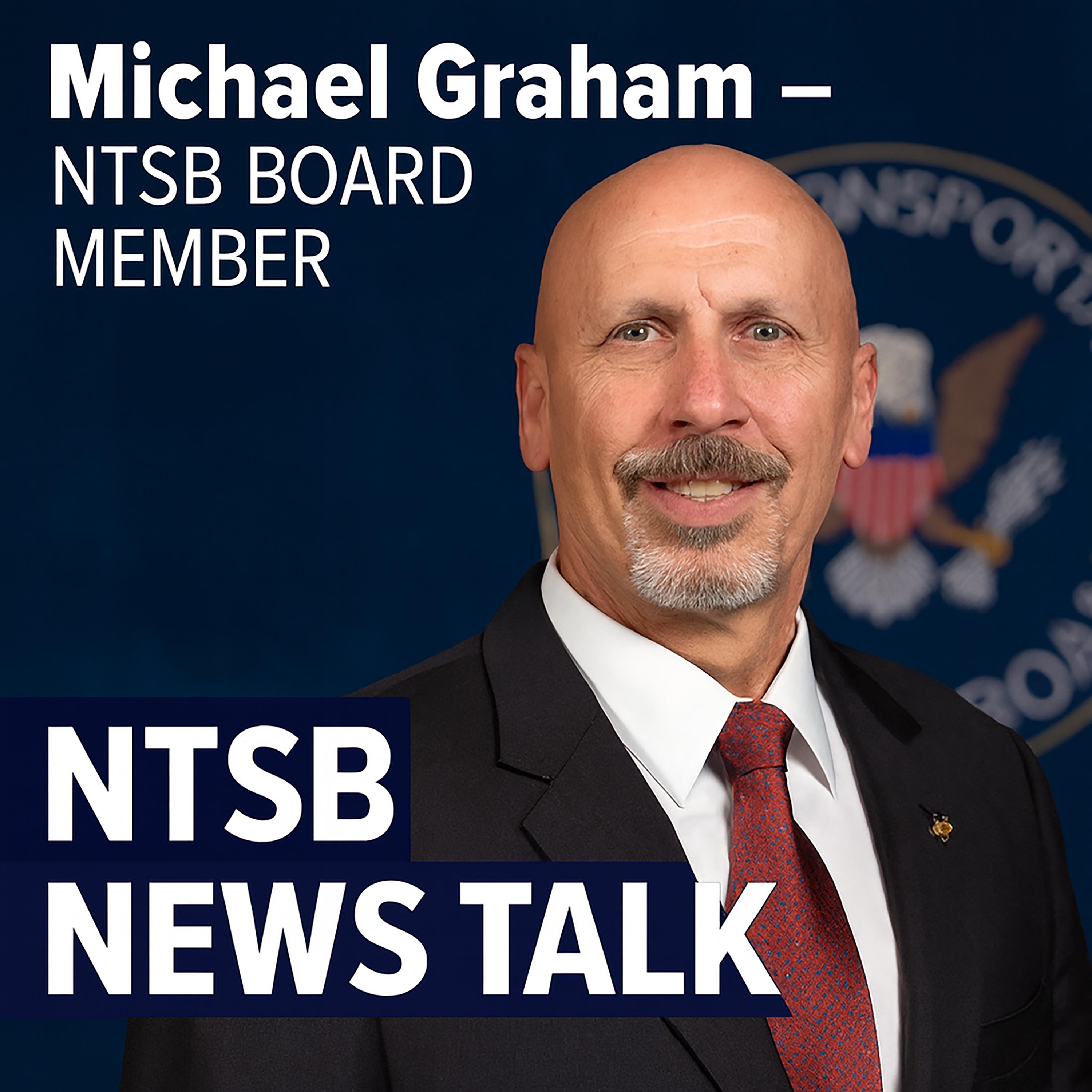
In this episode of NTSB News Talk , hosts Max Trescott and Rob Mark welcome Michael Graham, a current member of the National Transportation Safety Board (NTSB), for a deep discussion on the agency’s work and the broader state of aviation safety Graham begins by clarifying the role of NTSB board members, often misunderstood as investigators. While trained in accident investigation, board members function more like the “Supreme Court of Transportation Safety,” deliberating on reports and voting on recommendations that flow from investigative teams. They also serve as media spokespeople at accident sites, coordinate with local authorities, and meet with victims’ families. A major portion of the conversation focuses on advocacy—convincing regulators, manufacturers, operators, and associations to implement safety recommendations. Graham acknowledges that implementation can take years or even decades, citing the long struggle to mandate Positive Train Control in the rail sector. Despite delays, the board persists in pushing for life-saving changes. The discussion then shifts to Safety Management Systems (SMS). Graham describes his advocacy for SMS across Part 135 operators, manufacturers, and repair stations, and highlights FAA Advisory Circular AC 120-92D , which now provides scalable SMS guidance for small operators and even single-pilot GA. This, he says, is a breakthrough that makes SMS practical outside of large organizations. From his Navy background, Graham stresses the role of safety culture: open communication, willingness to accept critique, and rigorous debriefs after every mission. He encourages GA pilots to adapt these practices by critiquing their own flights, flying with peers who can offer feedback, and leveraging available flight data tools. Pilots, he argues, must move past ego and embrace constant improvement. Graham also highlights spatial disorientation as a persistent and deadly problem. While only a fraction of GA accidents involve it, more than 90% are fatal. He recalls accidents such as the 2019 Amazon Air crash near Houston, underscoring the importance of proficiency in instrument flying. Pilots, he warns, must remain both current and truly proficient to avoid disaster. The conversation touches on technology as an engineering control for safety. Graham sees promise in ADS-B In for situational awareness, particularly in congested or uncontrolled airspace, and advocates for broader adoption. He also points to angle of attack indicators as an underused but powerful tool for GA pilots to understand aircraft performance margins. Additional topics include lessons from the NTSB’s General Aviation Dashboard , frustrations with slow NextGen implementation and ATC staffing, and the destruction of the TWA 800 reconstruction once displayed at the NTSB Training Center. Graham also describes his path to the board, from Textron safety leadership to a lengthy nomination and confirmation process, and the challenges of balancing safety priorities with limited agency staffing. Throughout, Graham emphasizes that aviation safety is never static. A safe state is not permanent; it requires constant vigilance, adaptation, and recognition of new risks. For pilots and organizations alike, the lesson is clear: success comes from continuous critique, data-driven decision-making, and openness to feedback. This wide-ranging interview provides both a candid look inside the NTSB and actionable lessons for GA pilots, safety professionals, and anyone passionate about preventing accidents.
Sep 23
Episode 12 of NTSB News Talk with hosts Max Trescott and Rob Mark delivers a comprehensive discussion of recent accidents, preliminary findings, and final NTSB reports, highlighting recurring safety themes for GA pilots. The episode begins with the White House nomination of American Airlines captain John DeLouv to the NTSB board, and an invitation for listeners to suggest questions for an upcoming interview with a board member. The first accident examined is a Lancair Super ES crash near San Jose on September 12, 2025. ADS-B data showed unusual behavior, with a temporary TIS-B hex code indicating the aircraft may have suffered an electrical failure. The pilot completed odd turns, steep descents, and eventually lost control, reminiscent of a prior electrical-failure accident on the East Coast. The takeaway: system failures can snowball, and pilots should land at the first safe opportunity. Next, the hosts review a Bonanza BE-35 accident in Denver after multiple touch-and-goes. The ADS-B track suggested reduced altitude, slower speeds, and eventually a likely engine failure. The pilot attempted a turnback but fatally crashed. Max and Rob emphasize the priority of aviate–navigate–communicate, reminding pilots that talking to ATC should never outweigh flying the airplane. Two Cirrus SR22 accidents highlight starkly different outcomes. In Michigan, a Gen 6 SR22T ditched in Lake Michigan after an oil pressure failure. The pilot deployed CAPS, and thanks to a nearby Malibu and quick Coast Guard response, all aboard were rescued uninjured. In contrast, an SR22 in Franklin, North Carolina, crashed fatally during a go-around, illustrating how seldom-practiced procedures lead to errors with trim, flaps, and rudder control. The hosts urge pilots to rehearse go-arounds regularly. The preliminary reports shift focus to Shelter Cove, California, where a student pilot illegally carrying a passenger crashed into fog, killing himself and injuring the passenger. The case illustrates hazardous attitudes like anti-authority and the risks of taking unqualified passengers. Another case, a Cessna 340 in Missouri , involved a fatal stall-spin during pattern entry, with eyewitnesses describing a wing drop consistent with low-speed loss of control. Among final reports, the hosts cover a widely discussed PA-28 accident in Kentucky in which a young CFI posted on social media mid-flight before pressing into nighttime thunderstorms. Misunderstanding NEXRAD latency and underestimating storm hazards led to an in-flight breakup. In another Bonanza case in Georgia , a pilot attempted a steep turnback shortly after takeoff with the gear down, stalled, and crashed into a residential area despite a functioning engine. The accident raises questions about distraction, possible door issues, and the dangers of early turnbacks. The show closes with the Citation 550 crash in Murrieta, California , in July 2023. Two relatively low-time pilots flew two approaches into deteriorating fog. On the second, they descended below minimums and struck terrain short of the runway. Factors included fatigue at a circadian low, unstable approach speeds, dark-hole illusions, and potential pressure to get home. Max recalls his earlier Aviation News Talk analysis, suggesting the pilots may have mistaken a nearby white-roofed building for runway markings. The NTSB ruled controlled flight into terrain. Episode 12 underscores repeating patterns: hazardous attitudes, poor weather decisions, under-practiced maneuvers, and fatigue all contribute to accidents. By analyzing both new and final reports, Max and Rob provide actionable reminders for pilots to respect limitations, practice essential maneuvers, and make conservative choices when safety is at stake.