Nov 12, 2024
"Daddy's Home, and He's Pissed": What Bad Dog Training Can Teach Us About Authoritarianism
In this episode, recorded on November 6th, I recap some of the weird moments having to do with pets and other animals in the run up to the election, from Peanut the Squirrel to Kristi Noem shooting her puppy, several stories about people eating dogs and beyond. But the apex of the weirdness came to me in in a speech where Carlson Tucker starts off talking about how American’s are too nice to dogs, and then devolves into talking about how those on the left need to be, well… spanked. As a positive reinforcement trainer, I cannot help but reflect on the Trump’s win through the lens of animal behavior, as I’ve come to understanding it through working with dogs. This leads me to wonder what would happen if political governance wasn’t rooted in punishment? Is it possible that helping people to better understanding and applying positive reinforcement in dog training could have broader implications for society? Maybe? Maybe. Maybe if we all spent more time training, we’d at least spend less time doomscrolling… This episode includes parts from the last two chapters of my new book, How To Train Your Dog With Love + Science , one about studies that have been done on spanking kids and the American Veterinary Society of Animal Behavior’s recommendations on using punishment with dogs, and the other on BF Skinner’s suggestion for change people’s behavior on a societal level without force. An audiobook version of the book has just been released from Tantor Press, narrated by Eunice Wong. If you’d like a review copy of the audiobook, I have a handful of download codes I can share to the first few people who email me to ask! Put audiobook in the subject. Ruff timeline: 00:00 Reflecting on the Election Through a Behavioral Lens 00:52 Donald Trump's Childhood and Authoritarianism 02:01 Weird Moments in the Presidential Campaign Note: I edited both the Carlson and Noem clips here for length but without changing the meaning. I felt that playing the clips in full was just too inhumane. 05:54 Tucker Carlson's “Daddy’s Home” Speech 07:05 The Role of Punishment in Behavior 08:19 Positive Reinforcement in Dog Training 11:28 The Importance of Good Dog Trainers 13:02 Book Excerpt Links: Boston Globe article I wrote about Romney and his dog in 2012 https://www.bostonglobe.com/opinion/2012/05/12/animal-welfare-matter-perspective/svHGwYm1ySStcy71UsfDzI/story.html Mary Trump’s Too Much and Never Enough https://www.amazon.com/s?k=too+much+and+never&hvadid=570437041410&hvdev=c&hvlocphy=9198132&hvnetw=g&hvqmt=e&hvrand=9363389111012905557&hvtargid=kwd-918535063643&hydadcr=27861_14512710&tag=googhydr-20&ref=pd_sl_8vr7g1ahk4_e Youtube: Dog Bonking https://www.youtube.com/results?search_query=dog+bonking Audio montage clips: Trump “Eating The Dogs” RFK Jr whale incident RFK Jr denies eating dog RFK Jr bear cub story Kristi Noem reads from her book JD Vance on peanut the squirrel JD Vance on cat ladies Tucker Carlsons’s Speech Get full access to Don't Be a Dick to Your Dog at dogtraining.substack.com/subscribe

Oct 31, 2024
Dogmas & Dog Ewoks: How Halloween can polarize dog lovers
Everything seems crazy and awful right now in the world and then, on top of it all, people are… putting costumes on dogs. Anamarie and I delve into the weirdness and ethics of dressing up dogs. Additionally, we talk about Brian Hare and Vanessa Wood’s Atlantic article about a third wive of domestication in dogs, and the Monks of New Skete’s feature in the Associated Press. Ultimately, my 5-year-old sums up the spirit of the episode by sharing her own impromptu thoughts on how we should consider our dogs comfort above all else. Notes: Join me this Saturday 11/2 at The Museum Of The Dog where I will be interviewed by Alex Pasternack of Fast Company, and signing books and Brian Hare and Vanessa Woods in the Atlantic The Monks of New Skete in the AP Genealogy of Obedience by Justyna Wlodarczyk The Ewok Costume Time stamps: 00:00 Halloween cnversations with a three year old 00:49 Upcoming Events and Announcements 02:32 Dog Halloween Parade Concerns 06:57 Dog Training Philosophies and Stereotypes 12:00 Service Dogs and Domestication 16:00 The Monks of New Skete in the news 31:31 Halloween conversations with a five year old Get full access to Don't Be a Dick to Your Dog at dogtraining.substack.com/subscribe

Sep 30, 2024
What happens when you publish a paper showing e-collars can be effective? Anamarie replies to negative feedback to her study. Plus: Annie tries to buy one.
Anamarie and I recorded this episode separately because we had different things we wanted to communicate in a format that wasn't really right for conversation. Me first: What if you're someone who has strong feelings about putting dogs in shock collars and... one of your friends publishes a paper on research she did that involved putting shock collars on dogs? What if that person is your podcast host? Hi, I'm Annie, and this is my life. The day after I publish a book that is essentially a paean to Positive Reinforcement dog training rooted in science and research, a major journal publishes a paper (rooted in science and research!) that says that using a shock collar may be more effective when teaching a dog to stop chasing than reward-based training would be in the same period of time. Anamarie was one of the authors. Do you hop on the bandwagon and hate on this person? Do you yell at the angry mob -- which contains many of your colleagues -- to stop hating on her because she is someone you respect and love? Do you hit your desk on the head several times because you know that 99.9 percent of US dog owners don't care about the studies or the ethics and will never consult with experts but are going to use these things anyway because THEY'RE COMPLETELY LEGAL? Do you ... buy a shock collar? Join me as I confirm all my worst fears during a series of phone calls with shock collar retailers. In the 2nd part of the episode, Anamarie responds to attacks on the study that has been the source of so much criticism in the Positive Reinforcement dog training community over the last few weeks. You can read the study here: More: GET MY BOOK! Upload a receipt and I'll send you a clicker and a sticker. Testing dog shock collars on young humans Youtube compilation by me (from 2011) Add link to study https://www.mdpi.com/2076-2615/14/18/2632 Add link to the study about no one using trainers https://www.mdpi.com/2076-2615/14/9/1310 Other links? How big of a money making market the ecollar industry is: https://www.linkedin.com/pulse/dog-shock-collar-market-growth-trends-forecast Get full access to Don't Be a Dick to Your Dog at dogtraining.substack.com/subscribe
Sep 2, 2024
Professional dog trainers are really mad at each other! Also: Book Launch, Miniconference, and... New Co-Host!
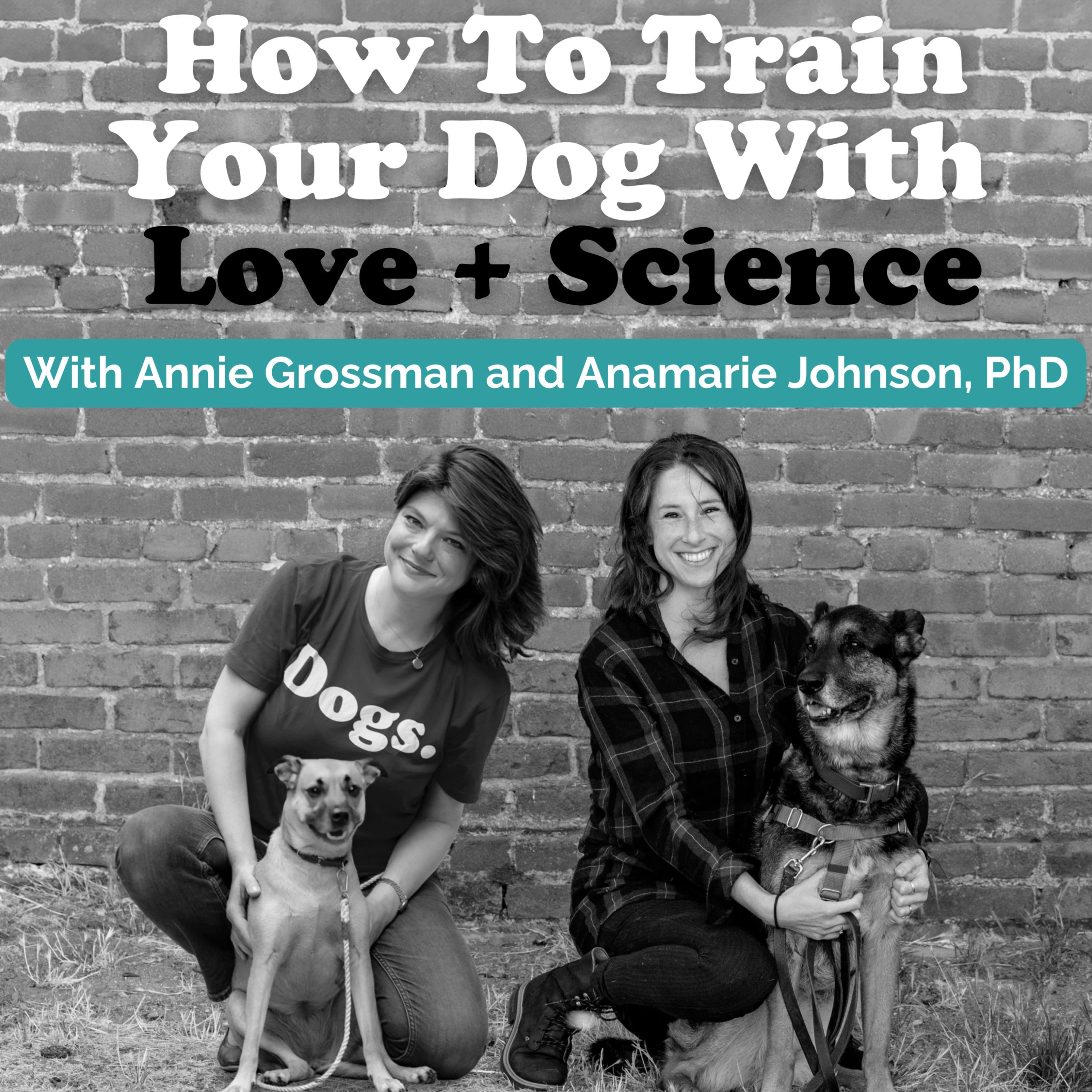
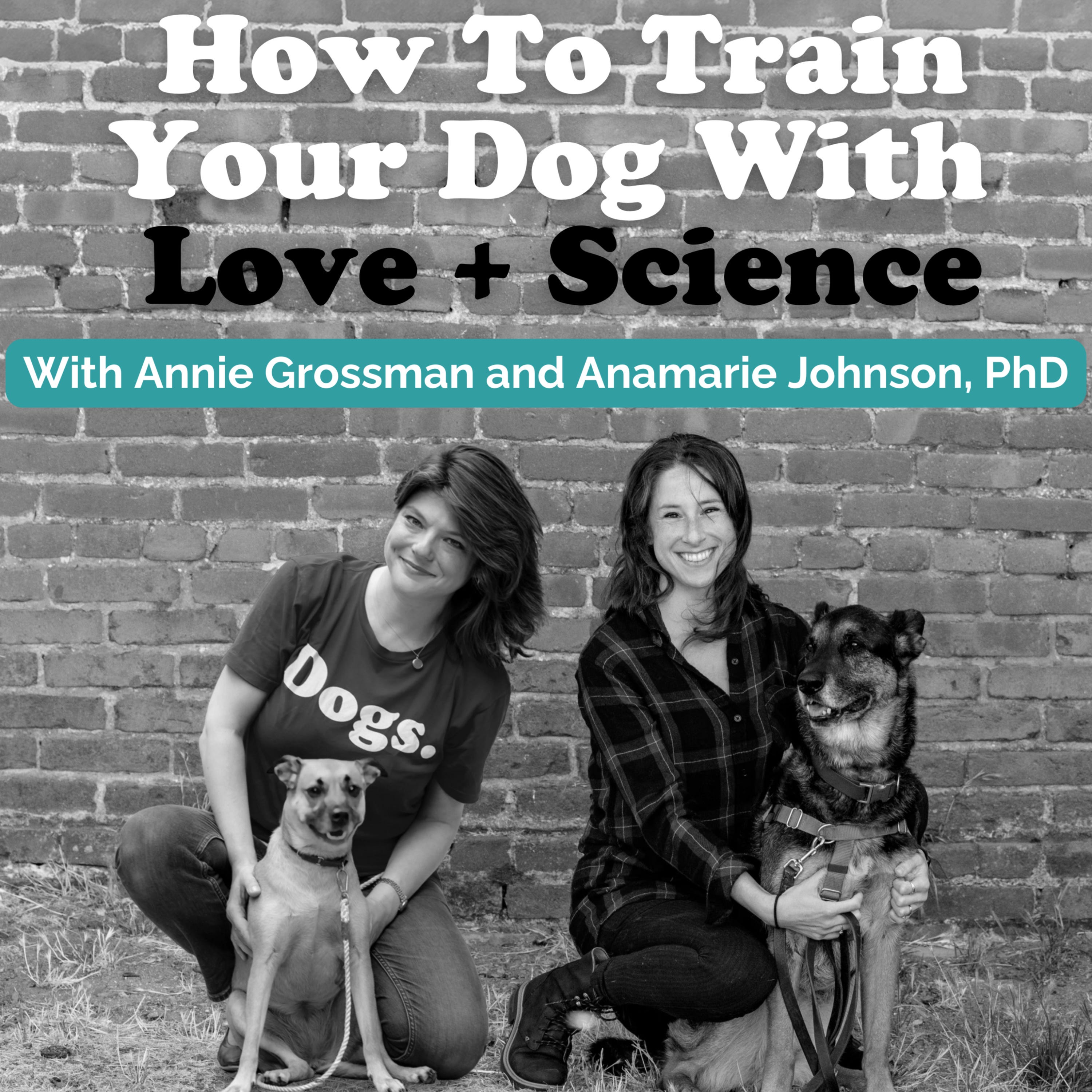
Meet Anamarie Johnson! She was one of my first hires at School For The Dogs nearly a decade ago. She recently got her PhD, and she'd coming on to join me as a co-host! Me= Annie Grossman, dog trainer, business owner, human. I started this podcast in 2018. I had to take a little time off, mostly because... I was working on a book! It comes out next week! Learn more at SchoolForTheDogs.com/book . It's called How To Train Your Dog With Love + Science and much of it stems from conversations that started on this podcast . In this episode, we talked about some of the crazy drama that's been going on, most of it having to do with positive-reinforcement pros and those trainers are positive-reinforcement adjacent going at each other online. Characters include Michael Shikashio, Zak George, Ivan Balabanov, Behavior Vets, Eileen Anderson, and Jo-Rosie Haffenden, among others. Anamarie and I come to the conclusion that a lot of the pros don't know how to interpret science, and are basically just talking to each other since the majority of dog owners have no idea that dog training has anything to do with science to begin with. I recently renamed the podcast to match the book's title: How To Train Your Dog With Love + Science. I think it is fitting for the new format because Anamarie can be the science and I can be... the love? Or something. Along with the new title came an amazing new theme song, by Sam Swinnerton, who recently KILLED IT on The Tonight Show! See here . Also: I'm hosting a mini-conference on Sept. 7 at School For The Dogs in NYC (and also online). Registration closes Sept. 4. Learn more at ShoolForTheDogs.com/event . See you next week! x Annie Get full access to Don't Be a Dick to Your Dog at dogtraining.substack.com/subscribe
Dec 13, 2023
Gray Areas: Thoughtful conversations about "balance" at a time when punishment has become a spectacle. Plus: the"mice" of at an R+ Floridian utopia
Annie reads a post from Denise Fenzi's page that sparked some interesting comments on labels in the world of dog training. Some dog trainers are considerate about the use of some punishment in training and others work to avoid it at all costs. And then there are trainers who simply don't know what they're doing at all. Like... Dog Daddy. He calls himself "balanced" but no educated pro trainer would give him that label. Maybe the real problem is that to non-professionals, what this Insta-celeb doing is all they know about dog training. TOPICS DISCUSSED: - Frustrations with the dog training industry - Divide between different training methods - The problem of most people's lack of understanding of dog body language - The weirdness of a spectacle-like approach to dog training - Importance of focusing on the dog's well-being - Potential for more animal training entertainment that actually shows off the magic of positive reinforcements KEY TAKEAWAYS: - Dog training should focus on the well-being and training effectiveness of dogs rather than creating a spectacle. - Understanding dog body language is crucial for preventing dog bites and improving communication with dogs. - The divide between different training methods should be approached with open dialogue and growth in mind. - Strength-based training can be effective in both academic and dog training settings. - The well-being and safety of dogs and the public should be the priority in dog training. REFERENCES: - Denise Fenzi's Facebook page: https://www.facebook.com/denise.fenzi GIVEAWAY: This month's giveaway: Dog Listener hat. Enter to win at http://schoolforthedogs.com/pod Get your own hat https://storeforthedogs.com/products/dog-listner-hat Dog Daddy, Part 1: The face of modern "bad" dog training https://spotifyanchor-web.app.link/e/IZ8rDgtkWEb Dog Daddy, Part 2: Zak George calls out animal abuse masquerading as dog training https://spotifyanchor-web.app.link/e/pqBs1htkWEb Annie sees Dog Daddy live. Also: Get to know Erin Whelan (2020 episode rebroadcast) https://spotifyanchor-web.app.link/e/0jWG1ftkWEb Get full access to Don't Be a Dick to Your Dog at dogtraining.substack.com/subscribe
Nov 22, 2023
Petitions, boycotts, and dog-abuse defenders: An Instagram Live with Zak George
Today I caught up with Zak George to hear the latest about his public feud with Dog Daddy. See Dog Daddy's petition against Zak George at Change.org https://www.change.org/p/stop-zak-george?source_location=search Dog Daddy, Part 1: The face of modern "bad" dog training https://spotifyanchor-web.app.link/e/IZ8rDgtkWEb Dog Daddy, Part 2: Zak George calls out animal abuse masquerading as dog training https://spotifyanchor-web.app.link/e/pqBs1htkWEb Annie sees Dog Daddy live. Also: Get to know Erin Whelan (2020 episode rebroadcast) https://spotifyanchor-web.app.link/e/0jWG1ftkWEb Get full access to Don't Be a Dick to Your Dog at dogtraining.substack.com/subscribe
Nov 16, 2023
Annie sees Dog Daddy live. Also: Get to know Erin Whelan (2020 episode rebroadcast)
Annie went to see Dog Daddy live in New Jersey this weekend and reports back about the odd experience of being in a room where what looked to her like animal abuse seemed didn't seem to bother anyone else. The episode then includes a rebroadcast of a 2020 interview Annie did with School For The Dogs trainer Erin Whelan. Erin was a professional French Horn Player. Then she adopted a beagle mix named Oliver and enrolled him in Puppy Kindergarten at School For The Dogs. Then she did the School For The Dogs Professional Program. Now, she is a trainer and manager at School For The Dogs. She and Annie discuss switching careers, what it means to teach dogs virtually, human body language, and training as a kind of benevolent con game -- not like Dog Daddy's con! Dog Daddy Part 1 -- all about DD Dog Daddy Part 2 -- a conversation w/ Zak George Enter November Giveaway at http://schoolforthedogs.com/pod Apply to the SFTD Professional course at http://schoolforthedogs.com/pro Sign up to hear about upcoming sales ate http://schoolforthedogs.com/twelve Get a Mendota leash that doesn't say "Tie Me Up Daddy" at http://schoolforthedogs.com/mendota Get full access to Don't Be a Dick to Your Dog at dogtraining.substack.com/subscribe

Nov 8, 2023
Dog Daddy, Part 2: Zak George calls out animal abuse masquerading as dog training
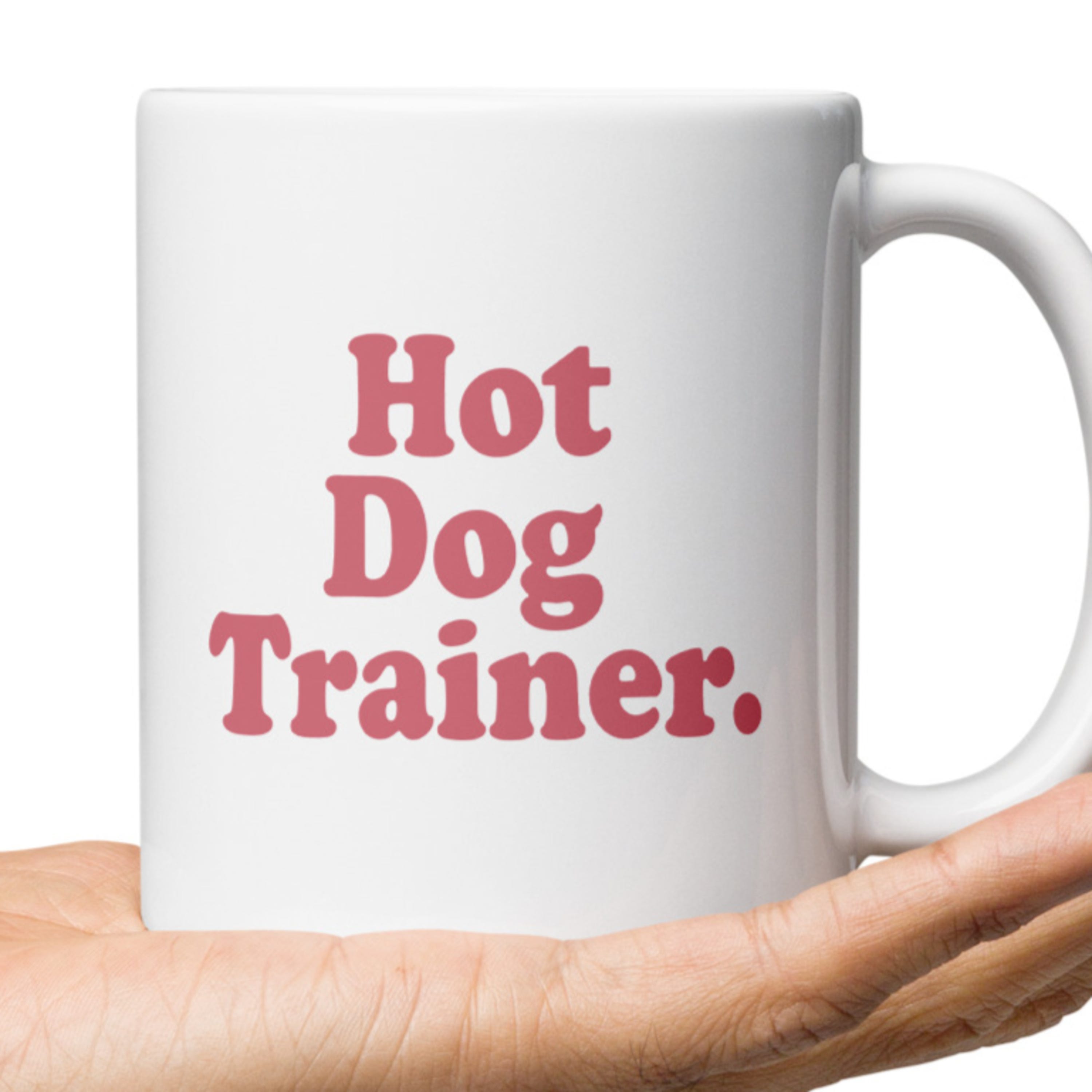
Zak George, one of the most influential dog trainers of the 21st century, has been using his large virtual platform to bring attention to the problematic methods being used by the Internet-famous dog trainer known as Dog Daddy. Zak and Annie discuss the origins of this work, his efforts to get his followers to picket Dog Daddy's events, and more. Annie also talks about why the conversation about whether or not it is advisable to use force in dog training feels especially important right now. Find Zak George on Instagram or Youtube : http://instagram.com/zakgeorge http://youtube.com/zakgeorge November giveaway: Enter to win a Hot Dog Trainer mug at http://schoolforthedogs.com/pod Listen to previous episodes about Dog Daddy: The SFTD origin story in "How We Got By" (Plus: Enter to win a "Hot Dog Trainer" Mug) https://rebrand.ly/dpmdhwn Dog Daddy, Part 1: The face of modern "bad" dog training https://rebrand.ly/ulbq7zi Karen Pryor's daughter Gale's article about her mother's dementia My scientist mother has recorded how dementia affects her brain https://www.bostonglobe.com/2023/10/11/magazine/her-dementia-in-her-words/ Annie is on Instagram at @annie.grossman Like this podcast? Subscribe! Rate! Woof! Get full access to Don't Be a Dick to Your Dog at dogtraining.substack.com/subscribe

Nov 2, 2023
The SFTD origin story in "How We Got By" (Plus: Enter to win a "Hot Dog Trainer" Mug)
Annie reads from How We Got By, a new book by Shaina Feinberg & Julia Rothman which includes a chapter about how School For The Dogs got started. She also gives an update on the bizarre/sad Dog Daddy world tour, and shares how excited she got when she first read about a man being called "the hot dog trainer." Who was the handsome fella? November giveaway: Enter to win a "Hot Dog Trainer" mug this month at http://schoolforthedogs.com/pod Apply to the SFTD Professional Course through Nov. 30th. http://schoolforthedogs.com/pro Get How We Got By on Amazon: https://rebrand.ly/hwgb Hot Dog Train Instagram: @annie.grossman @schoolforthedogs Get full access to Don't Be a Dick to Your Dog at dogtraining.substack.com/subscribe
Oct 24, 2023
Why you (maybe) shouldn’t dress up your dog for Halloween (Replay 2021 episode)
Annie talks about why she is generally against costumes for dogs and suggests some alternatives to dressing up your dog on Halloween. She also discusses some feedback she got about last week’s episode, which featured an interview with the lawyer representing the woman who was mauled by Cesar Millan’s dog. Lastly, she shares two anecdotes: one about how she is using a Buy Nothing group on Facebook to get neighbors to help her train her dog (unbeknownst to them) and the other about how her attempt to use negative reinforcement to get her daughter to brush her teeth ultimately back fired (in a sort of hilarious way). Like this episode? Leave a review on iTunes! Follow us on Instagram: @schoolforthedogs @annie.grossman Episode with the lawyer suing Cesar Milan: https://podcasters.spotify.com/pod/show/dogs/episodes/Suing-Cesar-Meet-the-lawyer-of-teen-mauled-by-Dog-Whisperers-dog--And-How-to-train-2-dogs-at-once-e18r9eb Get full access to Don't Be a Dick to Your Dog at dogtraining.substack.com/subscribe
Oct 18, 2023
Dog Daddy, Part 1: The face of modern "bad" dog training
A trainer who goes by the name "Dog Daddy" has millions followers and has recently incited arguments on social media: His critics accuse him of harming dogs and calling it training; his fans accuse his detractors of being sissies who can’t face reality. These two vociferous groups are facing off online and at his in-person events around the world. Annie puts the saga into the context of a larger (and longer) story about the use of force and coercion in dog training, and gives a nuanced explanation of what defines "balanced" training and what defines trainers that takes a "LIMA" approach. She also investigates Dog Daddy’s background and unconvers some surprising information about how he initially positioned himself to potential clients. PLUS: The podcast has a new jingle, to go with its... new name! School For The Dogs Professional Course is taking applications! Apply at http://schoolforthedogs.com/pro LIMA guidelines and the Hierarchy of Procedures for Humane and Effective Practice: https://www.ccpdt.org/about-us/least-intrusive-minimally-aversive-lima-effective-behavior-intervention-policy/ Judge Rottenberg center: https://www.nytimes.com/2021/07/15/us/electric-shock-school.html Dog Daddy Archive.org page: https://web.archive.org/web/20141108115514/http://gskennels.com/about-us/ Brandon McMillan’s training maraca: https://www.youtube.com/watch?v=1kiFZ6Mikpo Zak George on Instagram: https://www.youtube.com/watch?v=kp6GpMnZHxg&t=45s Cesar Millan’s “Shh”: https://www.youtube.com/watch?v=kp6GpMnZHxg&t=45s Jeff Gelman on how Positive Reinforcement ruined his life: https://www.solidk9training.com/sk9-blog/2016/02/16/positive-reinforcement-training-resulted-in-my-becoming-divorced-drunk-and-suicidal Facebook Page: The Truth About Griffin Shepherds https://www.facebook.com/TheTruthAboutGrffinShepherds Get full access to Don't Be a Dick to Your Dog at dogtraining.substack.com/subscribe
Jul 13, 2023
Join us in our Online Campus (plus: The story of the Hag Capisco)
Sometimes you stumble on something amazing and free. Maybe that's how you feel about this podcast? That's how Annie felt this week when her dream office chair appeared outside her door... You can buy good dog training (or great chairs). That's what School For The Dogs sells. But you can also get a lot of valuable dog training advice for nothing, if you're lucky. You, dear listener, just got lucky. Visit our new Online Campus to take advantage of a huge amount of free and low cost resource for dog owners. Join us for free Office Hours with a trainer every Thursday at 6PM ET. http://sftd.online/events Podcast exclusive: Get one month of full access to all our on-demand offerings, plus 12 Office Hours with a trainer per month. Listen to the episode for the link! http://online.schoolforthedogs.com http://schoolforthedogs.com/ http://storeforthedogs.com Get full access to Don't Be a Dick to Your Dog at dogtraining.substack.com/subscribe

Apr 10, 2023
Dom Hodgson is coming to NYC to talk to pet biz pros! Plus: What do you think a good dog training "pledge" should include?
Annie has been on podcast-hiatus working on her book, but... she's back! Join her for a conversation with longtime friend of the podcast, British pet marketing guru Dom Hodgson, who is coming to New York City to lead a seminar at School For The Dogs later this month. Dom shares his thoughts on the current state of the pet service industry and gives some really excellent advice on how to turn happy customers into brand cheerleaders. Sign up for Dom's April 23rd seminar Grow Your Pet Business FAST https://www.petbusinessmarketing.com/nyc See the proposed School For The Dogs "Good Dog Training Pledge" at http://schoolforthedogs.com/pledge Get full access to Don't Be a Dick to Your Dog at dogtraining.substack.com/subscribe
Aug 24, 2022
Bonus Ep. A 3.5-year-old, falls on her scooter and gets yogurt: A tale of classical conditioning? Plus: Online Campus' support groups and more
SFTD Podcast is still on hiatus, but Annie is popped on to say "Hi" and tell a quick story about her daughter. Join Annie in the Online Campus ! Get full access to Don't Be a Dick to Your Dog at dogtraining.substack.com/subscribe

Jul 22, 2022
Dealing With A Reactive Dog In Your Home: A Q+A. Plus 3 Special Announcements
Annie was recently browsing her local dog Facebook group, when she came across a post by a woman named Michaelle who was reaching out for training help with her reactive foster dog. Several of the replies recommended a trainer in the area who was not professionally certified, and Michaelle posted that she had decided to work with. When Annie, perhaps a little too aggressively, responded with critical questions about this trainer, Michaelle called her out on it. By way of apology, Annie offered to coach her through some of the issues she was dealing with, gratis. They discuss her foster dog Baozi's reactivity in the home, including his, growling, barking, sometimes sudden biting and lunging, his many triggers, and health issues that may be affecting his behavior. Rather than focusing on quick fixes for these unwanted behaviors, Annie approaches the issue by suggesting ways to get to the root cause for lasting and mutually beneficial behavior change. Note: School For The Dogs Podcast is going on hiatus for a few months! But you can join Annie inside the new School For The Dogs Online Campus. Join at http://schoolforthedogs.com/podcastfan and get one month free. Post in the Online Campus that you're a Podcast Fan and get free access to School For The Dogs' Body Language Basics on-demand course, a $47 value. Related: How to train "Touch": https://anchor.fm/dogs/episodes/How-to-train-your-dog-to-touch-your-hand-and-why-it-is-such-an-important-thing-to-master-e1e9i86/a-a2gg9qd How to train "Look": https://anchor.fm/dashboard/episode/e1jelng Body Language Basics: https://storeforthedogs.com/collections/online-courses/products/750634 Get full access to Don't Be a Dick to Your Dog at dogtraining.substack.com/subscribe

Jul 15, 2022
We're just "snowflakes" who don't use "bonkers": A frank conversation with dog trainer Beth Berkobien of Rehab Your Rescue of Dallas, TX
Texas-based trainer Beth Berkobien has a master's degree in animal behavior, specializes in dog aggression, and offers virtual training sessions internationally. She was raised on a farm with field-trial Labradors and grew up around punishment-based dog training using aversives. After being encouraged by a trainer to use an e-collar on her dog that caused him to completely shut down, she moved away from aversives. Many years later, she works primarily with rehabilitating rescue dogs. She joins Annie on this episode to discuss her journey as a dog trainer. Together they also listen to “bonker”-based dog trainer Jeff Gellman’s rant on dog trainers who prefer to use methods that don’t cause their dogs (and potentially others) additional harm. They also discuss an apparent societal tendency to blame people for their failures, and of balanced trainers to blame clients when their training protocols are ineffective. Annie finishes by reading some extreme training methods from a dog training book from the 1970's: The Koehler Method of Dog Training by William Koehler. Links: Learn more about Beth Berkobien at RehabYourRescue.com and on Instagram @rehabyourrescue Just When You Thought the Barbara Woodhouse Days Were Over | Animal Rights & Wrongs (animalrightsandwrongs.uk) Don't Shoot the Dog by Karen Pryor The Companion Species Manifesto: Dogs, People, and Significant Otherness by Donna Haraway Walden Two by BF Skinner Related episode: Episode 44 | Are you talking to your socks? Marie Kondo, Cesar Millan & training humans with snake oil --- Partial Transcript: Annie: Hello, Beth. Thank you for being here. Maybe you can just go ahead and introduce yourself ‘cause I'm worried I'm gonna say your last name wrong. And tell me the name of your business and where you're located. Beth Berkobien: Absolutely. Yeah, everybody worries about saying my last name. I am Beth Berkobien of Rehab Your Rescue. We're located in Dallas, Texas, but I do sessions virtually all over the world. I have some clients in South Africa, in London, in Seattle, so we are very accessible... Full Transcript at SchoolForTheDogs.com/Podcast Get full access to Don't Be a Dick to Your Dog at dogtraining.substack.com/subscribe
Jul 8, 2022
The words dog trainers use to describe their methods online: Anamarie Johnson, MA, CBCC-KA, on her survey of top US trainer's websites
Anamarie Johnson, a former School For The Dogs trainer and current PhD candidate in Behavioral Neuroscience and Comparative Psychology at Arizona State University, returns to the podcast to discuss her research on language used by dog trainers on their websites. In addition to discussing some of her findings (like what it means when a trainer talks about "nature" and some of the stranger New Age-y language used by aversive and R+ trainers alike), they talk about what's she's learned from working in shelters and more. Sign up for Anamarie's free presentation about her paper, August 8th at 3PM ET: http://schoolforthedogs.com/words Read the paper abstract: Training Dogs with Science or with Nature? An Exploration of Trainers’ Word Use, Gender, and Certification Across Dog-Training Methods https://www.tandfonline.com/doi/abs/10.1080/08927936.2022.2062869 Anamarie's previous visit to the podcast in 2018: https://podcasts.apple.com/us/podcast/lets-talk-about-pavlov-with-dog-trainer-anamarie-johnson/id1355439730?i=1000411989525 Episode on cues and commands: https://podcasts.apple.com/us/podcast/bonus-quick-thought-about-cues-commands-as-they-relate/id1355439730?i=1000515007001 Get full access to Don't Be a Dick to Your Dog at dogtraining.substack.com/subscribe
Jul 1, 2022
The woman behind Woof Cultr: Meet Mandy Boutelle
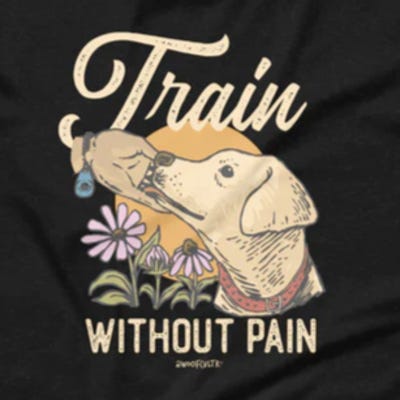
Hang out with any Positive Reinforcement dog trainer and they're bound to have a shirt in their wardrobe from the online store Woof Cultr: An apparel company that has a very niche market: Force-free trainers. Woof Cultr is the brainchild of Mandy Boutelle, who originally left a career as a hairstylist to become a certified dog walker in San Francisco. When she started doing off-leash group dog walks, she knew she had to learn more about dog training and behavior in order to manage her rowdy young pack. This led her to decide to become a dog trainer. At the start of the pandemic, however, she and her husband decided to move to Oregon and to spread the gospel of positive reinforcement dog training in a unique way: By printing bold-but-simple statements about training and behavior on t-shirts. Links: https://woofcultr.com/ DigiWoof | Web Design & Digital Marketing for Dog Trainers and Pet Pros Get full access to Don't Be a Dick to Your Dog at dogtraining.substack.com/subscribe
Jun 24, 2022
"It's not personal. It's just a dog thing." Sara Caron, SFTD CPT, on how training shifted her POV
Sara Caron had a leash-reactive dog, and as she started to research a quick fix for the problem, she threw out a wide net and tried lots of things. With guidance from this podcast, she began to see a way of dog training that made sense to her. When felt she had reached a plateau in her own solo study of animal behavior, she enrolled in the School For The Dogs Professional Course last year. She got another puppy shortly before starting the course which allowed her to see some remarkable differences in a dog raised with science-based/reward-based training methods versus one who was not. In this episode, Sara and Annie discuss some of the parts that have made the School For The Dogs Professional Course a life-changing experience for its graduates: The individualized attention, access to the SFTD community of trainers, classes, in-depth material, and the guest speakers. They also discuss the process of finding one’s place in the professional world of dog training. Apply to the Professional Course at: https://www.schoolforthedogs.com/professional-dog-training-course/ Applications for the next cohort are due June 30. Cohort begins Aug. 30. Want to learn more? Book a free consult at: http://schoolforthedogs.com/freeconsult --- Partial Transcript: Sara Caron: I developed this deeper relationship with dogs where, prior, dogs might have to me been one thing and dog training might have been one thing, but now it kind of has its – I can see its links to my own life and all these cultural things that we deal with. Yeah. So it just kind of kept getting more and more interesting to me. Annie: Sara Caron. I am so happy to have you here. Why don't you introduce yourself and we can just go from there. Sara: Sure. I'm Sara Caron. I'm a recent graduate of the School For The Dogs professional Cho. And I'm in Milwaukee, Wisconsin. Annie: You know, I think I told you this, but my dad's family's from Milwaukee. Sara: Oh cute. You did tell me that. Annie: Although I've never been there, but the main association I have with all things Wisconsin is that my grandmother when she would yell at my dad would be, I remember her always saying “Baaaab.” Sara: Yeah. That sounds about right. Yeah. Annie: His name was Bob and I remember drawing a cartoon of her when I was like seven and I spelled it out like B-A-A-A-A-B. Sara: That's adorable. So yeah, I'm from Chicago. I grew up in the city, but I've been living here long enough that that sounds very, very familiar. Annie: So I guess let's maybe just talk chronologically about how you got to the professional course . And then I guess we can talk a little bit about what that experience is like, because we are welcoming in our next cohort at the end of August, and I would love for anyone else who's interested in becoming a professional to sort of hear about what the experience was like for you. Full Transcript at SchoolForTheDogs.com/Podcast Get full access to Don't Be a Dick to Your Dog at dogtraining.substack.com/subscribe
Jun 17, 2022
Meet Leeyah Wiseman SFTD-CPT, School For The Dogs' "Reels" maven and recent Professional Course graduate
Leeyah Wiseman is a recent graduate of School For The Dogs Professional Course. If you follow us on TikTok or Instagram, you probably know her from the videos she does for SFTD. While she never thought of herself as a "dog person," she ended up adopting a puppy, George, and falling in love with him. But then she realized she had an issue on her hands: Separation anxiety. Her work figuring out how to deal with this issue in a way that felt right led her to decide to become a dog trainer. Annie and Leeyah discuss how she worked with her dog to improve his anxiety, what she got out of the Professional Course, and popular notions of what it means to "be" positive. Find Leeyah on Instagram @galdogtraining and @schoolforthedogs ! Like this podcast? Please rate and review on iTunes! Learn more about the Professional Course at http://schoolforthedogs.com/professionalcourse22 Next cohort starts in late August! ---- Spoil your smart pooch with a Brainy Box ! Listen to the episode for a special discount code to our new monthly subscription box. http://schoolforthedogs.com/brainybox --- Leeyah: I feel like just being – it felt like we were just there, and we were able to see how things played out in real life when tough training questions come up. When random training questions come up. When things happen like a dog peeing on the floor in the middle of a session. Or a dog needs a different type of assignment because they're struggling with something. And, you know, how to kind of answer questions that are tough, how to move training sessions along in a real way. ‘Cause in the course we kind of had a module on that as well. And then seeing it actually, especially seeing the trainers that do it the same way in the course, because it's like the School For The Dogs' method. It was kind of like a whole big picture of everything. [music] Annie: If you follow us on Instagram, TikTok, then you have seen Leeyah Wiseman who is a recent graduate of of School For The Dogs’ Professional Course. You are about to get to know her a little bit more. You can learn more about the Professional Course at schoolforthedogs.com/professionalcourse22 . I am thrilled to have you on the podcast yet again. Maybe you can just introduce yourself. Leeyah: My name is Leeyah Wiseman and I took the 2021 professional course, and I also do social media for School For The Dogs. So I do a lot of the coordination for the Instagram page and some talks and things like that. Annie: Which are really awesome and fun. And I love how you just go for it. Leeyah: Yeah. You gotta, you really have to. I mean, it's kind of like, if you don't then you're not gonna really make good content. Nobody's gonna watch something that you're not like being authentic in. Annie: Yeah. And you just gotta put yourself out there. I think it's a lesson about so many things. And some people really can't do it and when you do do it, you're accepting risk, right? Leeyah: Yeah. Annie: And you're accepting, you're opening yourself up to the possibility of failure and criticism, which can be no small thing. Right? Full Transcript at SchoolForTheDogs.com/Podcast Get full access to Don't Be a Dick to Your Dog at dogtraining.substack.com/subscribe
Jun 10, 2022
Private socialization lessons for "Misfit" dogs of NYC: A conversation with two SFTD (human) clients
The term "misfit" originally referred to people who were considered to be not great fit for their surroundings -- an ill fit. I miss fit. At School For The Dogs, we see it as our goal to help dogs -- whenever possible -- exist comfortably in an environment that may not be the best fit for them. New York City certainly isn't the best fit for many individuals of any species, which is perhaps one reason why we have several programs specifically for Misfit dogs. In this episode, Annie talks to two School For The Dogs clients who have been attending a couple of unique types of private sessions: Dog Socialization and Misfits Day School. New York-based dog owners Alyssa and Jen talk about how these sessions have helped them help their "Misfit" dogs. Learn more at http://schoolforthedogs.com/services ***** NEW: Subscribe to Brainy Box, and you'll get a new enrichment toy and new treats every month. Get 15% off for a limited time. Code in episode! Learn more and sign up at http://schoolforthedogs.com/brainybox Like this podcast? Subscribe, rate and review on iTunes! http://schoolforthedogs.com/listen Follow us on Instagram @annie.grossman http://instagram.com/annie.grossman @schoolforthedogs http://instagram.com/schoolforthedogs --- Partial Transcript: Alyssa: You know, I hear people say all the time that their dog is so socialized because when they got them as a puppy, they let them say hi to everyone and they let them say hi to every puppy. And so that's why they credit their dog to being so well behaved. And it just really gets under my skin because, you know, I did that too with him because I honestly didn't know better. And it really, I think, backfired. Because now when we walk down the street, he searches for humans or dogs to say hi to him. And it just doesn't always work out for every dog. And so I think having a well socialized dog takes a lot more work than exposing him to every human and creature that you encounter when they're young. [music] Annie: Do you have a dog who doesn’t necessarily get along with every other dog? One way to deal with those issues: send your dog to a good school. At School For The Dogs, we have several programs designed to help dogs exist more comfortably around other dogs and to help their owners set them up for success. I’m Annie Grossman, owner of School For The Dogs in New York City, and today I’m speaking with two clients who have been making use of two of our very special programs that we run out of our East village studio. One is called Dog Socialization , and the other is called Misfits Day School . If you’re wondering if one of these programs might be right for you and your dog, you can learn more at SchoolForTheDogs.com . Alyssa: My name's Alyssa Perry. I am dog owner to Michael, who is a two year old mixed breed dog of some sort. And I adopted him right before the pandemic, so in February of 2020, and I ended up seeking out your services because he is quite a handful. I love him very dearly, but he occupies a lot of my time, and good and better time now. More productive time than before I came to you all. Annie: You had done some training though, before coming to us, isn't that right? Alyssa: Yes. I guess just because we had got him in February of 2020, we, I had done some virtual training, and then I did do some training where I was relocated in Philadelphia. Some in person training there too. Full Transcript at SchoolForTheDogs.com/Podcast Get full access to Don't Be a Dick to Your Dog at dogtraining.substack.com/subscribe

Jun 3, 2022
How to train "Look" (Rebroadcast of 12/4/18 episode)
Everyone is impressed by a dog whose eyes meets a human's gaze with magnet-like intensity on cue. Teaching a dog to "touch" his or her eyes to your eyes is a great exercise to practice no matter what the pooch's training level is. When teaching this attention-based behavior to a dog-- whether you use a word such as "Look" or the dog's name -- Annie suggests focusing on your training mechanics before jumping to setting criteria for your dog. In this episode, she clearly breaks down how to build a stellar "Look" cue from scratch, in just six quick steps, using only sixty tiny treats. Notes: Treat suggestions - Tricky Trainers (and other brands that make these pencil-eraser sized morsels) can be broken up into at least four pieces, meaning you'll go through only 15 treats in your session: storeforthedogs.com/products/tricky-trainers- Lamb lung breaks up into neat pieces without getting greasy or crumbly: storeforthedogs.com/products/lamb-lung . Dogs and presidents: https://read.bi/2SrAVxu "Look For The Silver Lining" ukulele cover by Renei Yarrow: youtube.com/watch?v=CDIHff9eESQ Partial Transcript: **music** Annie: Hello, everyone. Thank you for listening. Today I’m going to walk you through what I call the Invisible Triangle method of teaching “look.” I think look is a really excellent thing to teach any dog, any age some people call it “watch me” or “attention,” whatever you want to call it, basically you’re teaching your dog to connect their eyes to your eyes on whatever cue you give. And of course that cue, today we’re going to use “look” you could be using their name, you could say “eyes,” you could say “bubblegum babaganoush.,” it doesn't matter but you are to give it some kind of cue. Of course, if you don’t give it a cue and you just teach them that locking eyes with your eyes is always a good thing that certainly not a bad thing to teach either. I generally think that everything we train our dogs to do, pretty much, comes down to targeting- targeting being teaching them to touch one thing to another. Of course, pretty much the first thing I teach every dog I work with is to hand-nose target so to touch their nose to my fingers, to my hand or to touch their nose to an object. And while there are lots of reasons I like to teach this specific exercise, the big reason is that I think of it as a building block exercise that you can use to teach lots of different things because really what you’re teaching is if you touch X to Y then good thing happens and basically everything you’re ever going to train your dog comes down to something that can fit into that equation. Sit is if if you touch butt to ground. Down is if you touch body to the ground. Go to the crate, well, that's if I touch body to crate. And I think that teaching look is really just the same thing except that if I touch my eyes to my human eyes good thing happens . And like I just said, certainly if that becomes just the default behavior, it's never going to be a bad thing since if your dog locks eyes with you, you certainly have your dog's attention and that's a great starting place for getting your dog to do whatever it is you want or need him or her to do... Full Transcript at Schoolforthedogs.com/Podcasts Get full access to Don't Be a Dick to Your Dog at dogtraining.substack.com/subscribe

May 27, 2022
Elise Mac Adam, SFTD CPT, on how the grief of rehoming a dog led her to the School For The Dogs Professional Course
Elise Mac Adam and Annie first met in 2002 when Annie wrote up Elise's engagement announcement for her column in The New York Observer. Both of them were terrier lovers, writers, and native Manhattanites: They became fast friends. When Annie and Kate first started School For The Dogs in 2011 and running classes out of Annie's Manhattan living room, Elise and her dogs were among their first clients. Elise, her sons, and her husband, have worked with half a dozen of School For The Dogs trainers over the last decade, with three of their dogs. She has, overall, clocked more sessions than any other single client. Eventually, she had to make the difficult decision to rehome one of her terriers. She and Annie discuss how rehoming a dog can feel like both a success and failure at the same time, and the silver lining of this difficult experience: It led her to decide to enroll in the School For The Dogs Professional Course. Apply to the Professional Course at http://schoolforthedogs.com/professionalcourse2022 Next cohort begins August 31. Episodes featuring other graduates: https://www.schoolforthedogs.com/meet-our-trainer-anna-ostroff/ https://www.schoolforthedogs.com/podcasts/episode-190-our-newest-sftd-certified-professional-trainer-ionelee-brogna-on-shock-collars-horses-schnauzers-trick-training-and-learning-empathy-by-selling-used-books/ https://www.schoolforthedogs.com/podcasts/episode-93-school-for-the-dogs-trainer-erin-whelan-on-how-dog-training-changed-her-life/ https://www.schoolforthedogs.com/podcasts/episode-111-school-for-the-dogs-trainer-em-beauprey-on-conformation-cats-bespoke-dog-walking-and-training-trainers/ --- Partial Transcript: Annie: Elise Macadam is here with me today. I am excited to talk to you because I think you're the only person – you're probably the person I've known longest who's been on this podcast. No, I guess I talked to my friend, Daisy , who I've known since I was 14, but second to maybe Daisy, in 200 plus episodes. You are someone who knew me from my previous life. Elise: I knew you from many previous lives, probably. Annie: And who I have now known as a friend, as a client and as an apprentice. Elise: Yeah. We go way back. Annie: And you've known me as well. You wanna tell the story of how we first met? Elise: So I met you when I was ghostwriting a book about wedding resources in New York City. And you were writing engagement column. Annie: Yeah, I was writing, I was at the New York Observer in, it must have been 2002? Elise: Yeah, probably. Annie: And I was the assistant to the editor and I wrote a weekly column where I interviewed three different couples who were getting married, and it was called The Love Beat: Countdown to Bliss. And it was a bit of a scramble sometimes to find couples, ‘cause this was long before social media. I had all these like hacks of finding couples. I remember seeing a woman with a big diamond ring on the subway and like writing her a note, slipping her a note once or going to places where people register and like going up to people. Elise: Oh, that's so awesome. I didn't know you did that. Full Transcript at SchoolForTheDogs.com/Podcast Get full access to Don't Be a Dick to Your Dog at dogtraining.substack.com/subscribe

May 20, 2022
An academic study of corgi butts on the Internet (and other animal content online): Univ. of Alabama's Jessica Maddox on Ukrainian kittens, cloned influencers, and the neoliberal "economy of cute"
Jessica Maddox, an assistant professor of digital media at the University of Alabama, is the author of the forthcoming book The Internet Is For Cats: How Animal Images Shape Our Digital Lives. Her research has largely involved looking at how people share and consume photos of animals on the Internet. She and Annie discuss a variety of topics relating to social media pets. Maddox offers an academic take on why people create Instagram accounts for their pets, are drawn to stories about Ukrainian rescue cats, and more. What does Youtube have to say about the practice of tying puppies to train tracks so that someone can post a video of their rescue? Why do some brands prefer to work with pet influencers over human ones? Are we living in a new era of anthropomorphizing our pets in a non-private arena, or is this just a new iteration of an age-old practice? And: Is it possible to breed an NFT cat? Maddox addresses these questions, and more. The secret life of pet Instagram accounts: Joy, resistance, and commodification in the Internet’s cute economy https://journals.sagepub.com/doi/abs/10.1177/1461444820956345?journalCode=nmsa More about Jessica Maddox https://cis.ua.edu/cis-theme-staff/dr-jessica-maddox/ The Internet Is For Cats: How Animal Images Shape Our Digital Lives https://www.rutgersuniversitypress.org/the-internet-is-for-cats/9781978827912 Why the Internet Is Obsessed With the Cats and Dogs of Ukraine https://slate.com/technology/2022/03/ukraine-war-dogs-cats-pets.html Crypto Kitties https://www.cryptokitties.co/ Instagram accounts mentioned: @lolabarksdale @wander_with_willow @thecalfvet @drhunterfinn Follow School For The Dogs on Instagram: @schoolforthedogs Follow Annie on Instagram: @annie.grossman --- Partial Transcript: Annie: So Jessica Maddox, tell me your exact title so I get it right. Jessica Maddox: Yeah. I am an assistant professor of digital media technology at the University of Alabama. I earned my PhD in mass communication from the University of Georgia in 2018. Annie: And tell me about your field of study. Jessica: Yeah, so I, largely speaking, just study social media and how social media contribute to internet pop culture. So, I've always been interested in things like selfies and memes and YouTube and TikTok and Instagram and the like. And several years ago, I became very interested in researching cats and dogs and horses and bearded dragons and all of the internet's pets. Because I was finding in my line of work that there really wasn't a whole lot of research being done on something that is so much a part of how we are online. Full Transcript at SchoolForTheDogs.com/Podcast Get full access to Don't Be a Dick to Your Dog at dogtraining.substack.com/subscribe

May 13, 2022
Happy Birthday Karen Pryor! Dr. Julie Vargas, daughter of B.F. Skinner, on the importance of this nonagenarian's work in the field of positive reinforcement-based animal training
Karen Pryor turns ninety on May 14th! Annie is celebrating today and... plotting continued celebrations on this podcast in the coming year. If you're a Karen Pryor fan, join the celebration! If you're not, you'll enjoy learning why she is so worthy of it. In this episode, Annie interviews BF Skinner Foundation president Dr. Julie Vargas, about the importance of this incredible scientist, writer and entrepreneur who, over the last thirty years, has done more than probably anyone else alive to help show people how we can use operant conditioning and secondary reinforcers to train dogs with rewards: aka, clicker training. When her husband bought Sea Life Park in the 1960s, Pryor was tasked with training the dolphins to perform. She got her hands on a paper written by students who were working in BF Skinner's Harvard lab, and it outlined the basics of operant conditioning and how to use a secondary reinforcer, like a whistle, to pinpoint the moment a desired behavior occurred. It further described how to then use successive approximations to shape the behavior using reinforcement. She took what she had learned about dolphins and wrote a book about about using positive reinforcement in everyday life: Don't Shoot The Dog!, then started doing seminars on how to use a clicker with dogs in the 1990s. In the 2000s, she started running Clicker Expo, a conference which brings the worlds best positive-reinforcement trainers together several times a year, and began training dog trainers through her Karen Pryor Academy. Follow us on Instagram, @schoolforthedogs , where we are giving away her book Reaching The Animal Mind and a signed clicker this weekend. Learn more about Dr. Vargas: https://www.juliesvargas.com/ Learn more about Karen Pryor: https://karenwpryor.com/biography/ Learn more about the BF Skinner Foundation: http://bfskinner.org Books: Don't Shoot The Dog! https://www.amazon.com/Dont-Shoot-Dog-Teaching-Training/dp/1860542387 Reaching The Animal Mind https://www.amazon.com/Reaching-Animal-Mind-Clicker-Training/dp/0743297776 --- Partial Transcript: Annie: Tomorrow May 14th marks the birthday of Karen Pryor. And this is not any birthday she's having tomorrow. She's turning 90. She has done so much with those years, so much that has benefited the lives of so many dogs and so many people through her work. Her work as a scientist, as a writer, as an animal trainer, an educator, and an entrepreneur. She started the Karen Pryor Academy, which I attended in 2010, really going in knowing nothing about the world of positive reinforcement dog training. I just thought being a dog trainer sounded like a great career, sign me up. There is no way I had any idea what a life changing experience it would be doing that six month program, because it really shifted the way that I see the world and the way that we treat so many behavior problems in our homes, in our society, in ways that don't make a lot of sense, at least when seen through the prism of what we know about behavioral science Full Transcript at SchoolForTheDogs.com/Podcast Get full access to Don't Be a Dick to Your Dog at dogtraining.substack.com/subscribe

May 6, 2022
"We don't expect this sort of robotic, one way dictatorship in other relationships..." Meet Dogminded's Jenny Efimova, KPA CTP
Before she became a dog trainer, Jenny Efimova was working human trauma survivors for a living. Her job involved being empathetic and meeting people where they were. It wasn't immediately obvious to her that a lot of the lessons she'd learned at work could be applied to someone in her home who was suffering: Her dog. Her young rescue, Larkin, was increasingly afraid to go out on walks in her neighborhood. The first professionals she worked with told her she was the issue: She wasn't “confident” enough with her puppy, and he thought he was the boss. It didn't feel right to her, and the suggested methods didn't work. In fact, they felt like they were making matters worse. Then she started working with a trainer who explained how to use positive reinforcement in training, and it was a behavioral game changer for her and her dog Larkin. This led her to become a certified dog trainer herself, through the Karen Pryor Academy. Today she trains online and in Brookline, MA. She also runs an Instagram account @dogminded . Annie and Jenny discuss the challenges that come with cultural expectations of how both dogs and dog owners should behave. They confront the popular idea that if you are not a stern leader with your dog, you are spoiling them, and consider whether there has been any cultural shift in changing the conversation about what it means to be a compassionate dog owner. They also discuss how interspecies relationships and examining our expectations of our pets can help us learn to be more humane and compassionate in general. Learn more about Jenny at: https://www.dogminded.training/ Follow Jenny on Instagram: @dogminded Follow School For The Dogs @schoolforthedogs --- Partial Transcript: Jenny Efimova: We don't expect this sort of robotic one way dictatorship in other relationships, but with dogs, for some reason, there's this expectation that there are these behavioral outputs, and that they have to do everything we say, and they have to behave in certain ways. And that any behavior that is inconvenient or troublesome for us has to be eliminated. And that there's not room to say, Hey, this is actually a sentient being. I'm gonna treat their behavior with the same courtesy I would treat the behavior of anybody else. So it's this kind of bizarre dynamic which isn't actually natural for a lot of people, because all the people I work with love their dogs tremendously. We know that there's research showing that people who lose their pets often grieve those losses more than they grieve losses of people in their lives, right? The relationships people have with their dogs and their pets are profound. We currently, I think, don't have the language and the norms in our culture to really honor that. And I think dog training as a whole falls really behind in that regard. Because what people really want is to have a joyful relationship with their dog. And at this point, I think a positive reinforcement based approach is what allows that to happen in the most compassionate way. [music] Annie: Jenny I'm so eager to talk to you, happy to have you on the podcast. I have followed you on Instagram for quite a while, and I feel like I kind of know you in an Instagram way. And I'd like to know you in a real person way. But this is the interim, I guess. Full Transcript at SchoolForTheDogs.com/Podcast Get full access to Don't Be a Dick to Your Dog at dogtraining.substack.com/subscribe
Apr 29, 2022
Live From New York, It's... Positive Reinforcement Dog Training! Saturday Night Live set designer Ken MacLeod on becoming a professional dog trainer
In his work as a set designer, Saturday Night Life staffer Ken MacLeod had seen many well-trained dogs, and had even done commercial work with his own Jack Russell, Mac. But then he got a dog named Scooter and he realized that every dog has different needs. This realization led him to decide he wanted to become a certified dog trainer. Today, he splits his time: Part of every month, he can be found building sets for SNL, and the rest of the time, he is training out of his Hoboken, NJ-based studio, My Positive Pup. He talks to Annie about getting certified, the emotional nature of working with dog owners, behavior lessons learned learned on the ski slopes, and how the old saying "you catch more flies with honey than vinegar" can be true for both people and dogs. Learn more about My Positive Pup at https://mypositivepup.com/ Learn more about L.E.G.S.® Applied Ethology Family Dog Mediation® Professional Course (thinkific.com) https://kimbropheylegscourses.thinkific.com/courses/legs-applied-ethology-family-dog-mediation-professional-course Learn more about the Karen Pryor Academy at https://karenpryoracademy.com/ --- Partial Transcript: Annie: Okay. Ken, why don't you just go ahead and introduce yourself and your business and we can, we can go from there. Ken MacLeod: Cool. My name is Ken MacLeod. I have a dog training company in Hoboken, New Jersey called My Positive Pup. You can find us on the web at mypositivepup.com . I am a positive reinforcement dog trainer, obviously with that name. And I also work in the film industry at Saturday Night Live. And, to say the least, both of them are pretty crazy businesses. Annie: So let's talk about your, what would you say, bifurcated career, which came first? Well, and actually also, are you originally from New Jersey? Where are you from originally? Ken: I'm originally from Massachusetts. I moved down to New Jersey when I was a sophomore in high school, became a huge Springsteen fan who couldn't. And then went to college to Penn State and came out and wanted to go into the film industry. I really didn't have a lot of interest in dogs until I met my wife, I guess, 14 years ago. And she had a dog named Mac who is a Parsons Jack Russell who I completely fell in love with. And everything kind of started from there. I had trained Mac to be in a couple commercials, ‘cause I worked in the commercial industry. And it all kind of, you know, snowballed from that. Annie: You were training him for commercials. Were you doing it with any guidance or just by feeling? Ken: Like, just like he'd have little parts in a commercial, like, pick a newspaper up and run to the door. Go to the couch and bark at somebody. And it wasn't like I was doing this for work. It's just that Mac was really, really good at it. And at that time Parsons Jack Russells were very, very popular. So in being in the film industry and around people, both my wife and I, we just knew producers and said, Hey, would Mac want to be in it? Would Mac, you know, would it be okay if you had Mac in this and it'd be like, sure, no problem at all. So it kind of started that way accidentally, I guess. Full Transcript at SchoolForTheDogs.com/Podcast Get full access to Don't Be a Dick to Your Dog at dogtraining.substack.com/subscribe

Apr 22, 2022
You can say "hi" to my dog, but DON'T BE A DICK ABOUT IT! How well-intentioned people make dogs anxious on the street (and how you can help them be better dog lovers)
Oftentimes, the toughest thing about training dogs is dealing with people. Strangers out in public, however well-intentioned, can be major obstacles to a fruitful training session, further complicating things in what is most likely already a high-pressure environment for your dog. Annie feels for dogs who are basically bullied (often unintentionally) by strangers, or even their own owners, during interspecies greetings. If people who love dogs so often make them uncomfortable without meaning to, is it fair to judge people by how they relate to their dogs? Maybe not. Annie reads aloud from an article that she wrote for the Boston Globe about how animal welfare is relative and not absolute. (Stay until the end for a rather shocking bit of trivia about a certain genocidal dictator). Episode includes a special Earth Day offer: a coupon code (good this weekend only) for 20% off the REVOL crate by Diggs . --- "Animal welfare is a matter of perspective" - Boston Globe article by Annie Grossman https://www.bostonglobe.com/opinion/2012/05/12/animal-welfare-matter-perspective/svHGwYm1ySStcy71UsfDzI/story.html Related episodes Episode 29: A modern dog owner's guide to sidewalk leash greetings https://www.schoolforthedogs.com/podcasts/episode-29-a-modern-dog-owners-guide-to-sidewalk-leash-greetings/ Episode 41 | New "Diggs" for your dog: Zel Crampton's dog crate revolution https://www.schoolforthedogs.com/podcasts/episode-41-new-diggs-for-your-dog-zel-cramptons-dog-crate-revolution/ --- Partial Transcript: Annie: So, something that drives me crazy is when I'm on the street training with Poppy, giving her treats, and someone else walks by with their dog, and their dog seems interested in saying hi, and I'm working keeping Poppy's focus on me. Not because she has a problem or because she's reactive, just because we're working. And then the other person who's just standing there with their dog says like, Oh, it's fine, my dog's friendly. As if what I'm doing has anything to do with whether or not their dog is friendly or not. And it's always frustrating to think about what to say in these situations. I usually say something like, Oh, we're just doing some training or, oh, my dog's friendly too. Today, I had a thought of what could be said in those situations. In French, there's a term called L’esprit de l’escalier, which is like, when you think of the perfect thing to say after something is over. I thought if someone says to me, Oh, it's okay, my dog is friendly. I could just turn around and say, oh yeah, well I’M NOT! Would probably make both them and their dog leave you alone. [music] Hello. Thank you for being here. I am Annie Grossman, owner and co-founder of School For The Dogs at East 7th street. You can sometimes find me there behind the desk. I curate our retail store, which is also online at storeforthedogs.com . If you don't know about School For The Dogs, check us out. We do so much great training, both in New York City and virtually. Full Transcript at SchoolForTheDogs.com/Podcast Get full access to Don't Be a Dick to Your Dog at dogtraining.substack.com/subscribe

Apr 15, 2022
Bad vegans, coercion & canine immortality: What sociopaths can teach us about dog training
The Netflix docu-series Bad Vegan is about the owner of a raw food restaurant (which happened to be located on Annie's street) who was conned out of millions of dollars by a narcissistic sociopath who claimed he could make her dog immortal. The story leads Annie to think aloud about how genius manipulators use coercion, punishment and classical conditioning in order to get the behaviors they want from their victims. While many of their techniques do not constitute “good” dog training, we can draw parallels between how they create positive associations in others to make themselves appear trustworthy. Can we do the same to build our dogs’ confidence? Also: Should we trust our pets to be good judges of character in potential partners? Annie offers her answer. --- Bad Vegan on Netflix https://www.netflix.com/title/81470938 Inventing Anna on Netflix https://www.netflix.com/title/81008305 Related Podcast Episodes: Episode 84 | Sociopaths as dog trainers, Negative Reinforcement at NXIVM & how to train humans to wear masks https://anchor.fm/dogs/episodes/Sociopaths-as-dog-trainers--Negative-Reinforcement-at-NXIVM--how-to-train-humans-to-wear-masks-ektcb7/a-a3gpaiv Episode 104 | Dog training with Mary Poppins, Professor Harold Hill and Little Orphan Annie https://anchor.fm/dogs/episodes/Dog-training-with-Mary-Poppins--Professor-Harold-Hill-and-Little-Orphan-Annie-enm162 Episode 123 | A conversation with Terra Newell (former groomer, owner of a mini Aussie) about killing her stepfather… and dogs https://anchor.fm/dogs/episodes/A-conversation-with-Terra-Newell-former-groomer--owner-of-a-mini-Aussie-about-killing-her-stepfather----and-dogs-er34gv/a-a4oiink --- Partial Transcript: Annie: So I just watched the Netflix docu-series ‘Bad Vegan,’ which is about the downfall of a restaurant called Pure Food and Wine. And this story, I thought, well, this is a show I have to watch for a couple reasons. One, Pure Food and Wine is on my block. Like it's just around the corner from me. I could get there without crossing a street. And I never dined there very much or went to its outpost, which was called One Lucky Duck, because it was very expensive. And I always sort of thought one day when I make a lot more money, I will eat here all the time. But then it closed. They specialized in this really interesting and tasty, raw vegan food, like gourmet vegan food, but not just vegan, but uncooked. And the couple times I did go, it was pretty fabulous. I was also interested cause the story is specifically about the owner Sarma Melngailis. I actually interviewed her and her former business and romantic partner, Matthew Kenney, 15 or so years ago when I was writing about restaurants for the New York Post. Full Transcript at SchoolForTheDogs.com/Podcast Get full access to Don't Be a Dick to Your Dog at dogtraining.substack.com/subscribe

Apr 8, 2022
Calm, confidence, love & joy: How Will + Jada Pinkett Smith helped create The Dog Whisperer
Did you know that The Dog Whisperer and Jada Pinkett Smiths are longtime best friends? Two weeks ago, Will Smith calmly and confidently sauntered up on to the stage of the Oscars and slapped someone who said something he didn't like. His vibe and techniques struck Annie as a bit Dog Whisper-y. Maybe that's because she was aware that Cesar Millan, aka The Dog Whisperer, was supposedly made famous in part early on because of his connection to a small handful of movie stars, among them, the Smiths. Annie unearths some old Red Table Talk recordings of The Dog Whisperer revealing his origin story to Jada and her mother,. She also reads from a 7-year-old Cesars Way blog post where Jada talks about how the dog training lessons she learned from Cesar has helped her marriage. Cesar Millan on Red Table Talk with Jada Pinkett Smith and Gammy (Adrienne Banfield-Norris) in 2018 https://m.facebook.com/story.php?story_fbid=600331890366290&id=538649879867825&_rdr Cesar’s Way article from 2015: Jada Pinkett Smith Takes The Lead https://www.cesarsway.com/jada-pinkett-smith-takes-the-lead/ --- Partial Transcript: Annie: Have you ever disliked a celebrity purely by proxy? I'm not telling you that there's a celebrity, I've maybe long disliked by association. I'm just asking you. Have you ever disliked a celebrity because of that celebrity's association with another celebrity? Where one of these celebrities might be in a completely different field than the other celebrity? Because there's this one celebrity who has been in the news a lot in the last week. And I don't think I need to tell you how I feel about this person. But I do wanna tell you that this person has probably had a larger impact on the field of dog training than one might realize, on dog training as it exists in the mainstream today. And I wanted to also maybe propose the argument that he has caused a lot more harm to dogs than he's ever caused to people, if only secondarily, if not also in practice. I don't know. Purely because this one person's celebrity helped create the celebrity we know as Cesar Millan, the dog whisperer. Now, if you've ever watched The Dog Whisperer, you probably would guess that someone who is an acolyte of Cesar Millan might be very forceful, might feel that they need to be the alpha, as they say, lead the pack, be the protector, be the leader and not take not take lip from anyone. And someone who might feel fine about using physical force, without considering the unintended consequences or fallout of using punishment, be it physical or otherwise, he'd be perhaps someone like Will Smith. Will Smith and his wife Jada Pinkett Smith are long time friends of Cesar Millan’s. And their celebrity is part of what helped him reach such heights in popular culture. I started thinking about this and wanted to do an episode on this and started to look online. I knew that he had worked with Cesar. I mean, I knew that Cesar had worked with Will Smith and Jada Pinkett Smith's dog. So I thought maybe I could find clips of him giving the kind of advice that, were you'd apply it to humans, would lead you to slap people in the face. Sometimes Cesar Millan is so often talking about humans and the human behavior and energy, and how to be an alpha, and all these kinds of things that make me think of someone actually kind of like Will Smith. Someone who is charismatic and seems like they're beaming love and energy and confidence, but also fine using force. Full Transcript at SchoolForTheDogs.com/Podcast Get full access to Don't Be a Dick to Your Dog at dogtraining.substack.com/subscribe

Apr 2, 2022
Best Pet Ever: Katya Lidsky, host of The Animal That Changed You, on writing love letters to her dying dog. Also: Jonathan Safran Foer's case for eating... dogs.
Annie interviews Katya Lidsky, a writer, podcaster and frequent dog fosterer who lives in Austin, TX. She recently started a podcast called The Animal That Changed You, and interviewed Annie about an animal that changed her (head over and check out the episode ! https://www.katyalidsky.com/podcast ). Katya, who refers to herself as a "soft core" animal activist, tells Annie about loving and losing a dog who helped her heal from her longtime struggle with an eating disorder. In her dog Ophelia's final days, Katya wrote her love letters daily. Annie lends her some advice on introducing a foster dog to her current dog, and the two discuss their thoughts on how vegetarianism relates to being a dog lover -- Katya doesn't eat meat, but Annie does and... has complicated feelings about that fact. That point in their conversation moved Annie to share a section from the 2010 book by Jonathan Safran Foer Eating Animals : The Case For Eating Dogs. Learn more about Katya at https://www.katyalidsky.com/ Find our on-demand courses (including Body Language Basics ) at http://schoolforthedogs.com/courses Get Safran Foer's Eating Animals at https://www.amazon.com/Eating-Animals-Jonathan-Safran-Foer/dp/0316069884 Rate, review and subscribe to this podcast at http://schoolforthedogs.com/podcast Book a session with us at http://schoolforthedogs.com --- Partial Transcript: Annie: So I recently started a series on School For The Dogs Podcast that is really just an excuse to talk to interesting people about their interesting pets and inspired in part by Betty White, who had a show in the seventies called The Pet Set, where she basically just got her famous friends to go on TV with her to talk about their pets. And I was pleased to see that I'm not the only person who's had this clearly genius idea because shortly after I started this series, I got an email with a subject line, The Animal That Changed You, and it was from Katya Litsky, who is joining me right now. Katya, thank you for being here. You are the host of the podcast, The Animal That Changed You. Tell me a little bit about yourself. Katya Lidsky: Oh gosh. I like the way you put – I like any sentence that says Betty White in it at all, but it's a podcast about talking to extraordinary people about the extraordinary animal or animals who have changed their lives. I look forward to having you on there Annie. And you know, it's kind of like a community for people who cannot watch what happens to a horse in a war scene in a movie, but have no problem seeing what happens to the human on the horse. Even if the horse tramples that human. That's fair game, but please spare the animal. And I have this theory that if we can identify with something, if we can identify as being animal lovers, I think we can grow into it. And even if we grow 2% more, that is really good for animals and for people, for everyone involved. So I'm all about, you know, if you love an animal, you have a space in that community. Annie: I know that you describe yourself on your website as a self-described, or you call yourself a self-described softcore animal activist. Full Transcript at SchoolForTheDogs.com/podcast Get full access to Don't Be a Dick to Your Dog at dogtraining.substack.com/subscribe
Mar 25, 2022
Best Pet Ever: Comedian (and Scottie lover) Douglas Widick on being a "Big Man [With A] Tiny Dog"
Annie recently received an email from a producer who had a request: Were there any School For The Dogs students who were big men with tiny dogs? Or people who had big dogs who wouldn't mind their dogs being humorously mocked on Youtube? The request came via Douglas Widick, a Brooklynite who had recently brought his young Scottie, Skye, in for playtimes at School For The Dogs. A musical comedian, he'd written a song and was casting its music video. The song's title was "Big Man, Tiny Dog." Annie called Doug to talk about the origin of a song that pitches woo to the Yorkiepoos of the world while also poking fun at men who seem to use big dogs as accessories to accentuate their own toughness. Their fun conversation touches on everything from being inspired by the Notorious BIG, swimming with dolphins, Dorothy's poor dog training abilities in The Wizard of Oz, dog-fostering tourism in Hawaii, and the joy of using a hands-free leash. ----- Through the end of this month: Get a FREE virtual 90 minute private session with a School For The Dogs trainer when you sign up for our on-demand courses. Learn more at SchoolForTheDogs.com/virtualbundle . ----- Big Man Tiny Dog on Youtube https://www.youtube.com/watch?v=H9Jsey3UOnk Douglas Widick https://www.douglaswidick.com/ The Found My Animal hands-free leash https://storeforthedogs.com/collections/found-my-animal-1/products/found-my-animal-leash-1 Annie's Reel walking with a hands-free leash on Instagram https://www.instagram.com/reel/CZSUtNGJ8Mx/ Maui Humane Society https://www.mauihumanesociety.org/beach-buddies/ Puppy Playtime at SFTD https://www.schoolforthedogs.com/services/puppy-playtime/ ---- Partial Transcript: Douglas Widick: I was watching the Notorious B I G documentary. And he talked about how he was like, “People told me that like certain lyrics were either too intense or whatever on this album, but I'm just writing my truth.” And I was like, oh, is it that simple? Like, he's just writing his truth. He had a song called, Ready to Die, which was about feeling suicidal. And I was like, okay, well, my truth right now is that I'm a big guy with a puppy. [laughs] [music] Annie: A few weeks ago, our client Douglas Widick got in touch with me to ask if I could help him cast a video he was doing a music video to go with a song he had just written. The song, he told me, was called “Big Man, Tiny Dog.” And I heard the song. I thought it was hilarious, just so witty and well written. And I said, of course, we'd be happy to help you. The music video and the song just dropped this week. You can find it on our Instagram @SchoolForTheDogs. I'll also link to it in the show notes. The video features his dog Sky who has come to our puppy play times as well as our Great Dane student Bandit, who came to us when he was just a tiny Great Dane pup. Full Transcript at SchoolForTheDogs.com/Podcast Get full access to Don't Be a Dick to Your Dog at dogtraining.substack.com/subscribe
![Best Pet Ever: Comedian (and Scottie lover) Douglas Widick on being a "Big Man [With A] Tiny Dog"](https://substackcdn.com/feed/podcast/1459389/post/149636696/ee265e4be492d26b93d183d0aeed6134.jpg)
Mar 18, 2022
Should your dog stop eating carbs? A conversation with dog food entrepreneur Daniel Schulof of Keto Natural Pet Foods
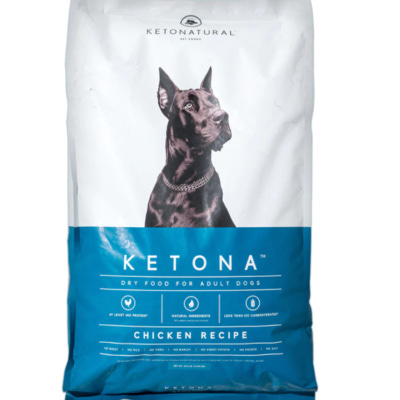
High-fat diets are popular right now in the human realm, but should your dog be "low carb" too? Annie speaks to Daniel Schulof, who left a career in law in order to help combat the canine obesity epidemic by getting people to stop feeding their dog food that is high in carbohydrates. He is the author of Dogs, Dog Food, and Dogma, and founder of a new company that makes low-carb dry food for dogs: Keto Natural. He and Annie discuss his journey into the world of pet food and chat about some of the myths and misconceptions about what dogs should be eating. KetoNatural food is available at https://ketonaturalpetfoods.com/ Dogs, Dog Food, and Dogma: The Silent Epidemic Killing America's Dogs and the New Science That Could Save Your Best Friend's Life https://www.amazon.com/Dogs-Dog-Food-Dogma-Epidemic/dp/0692768408/ Like School For The Dogs Podcast? Leave a review on iTunes ! http://schoolforthedogs.com/listen --- Partial Transcript: Annie: Keto eating is kind of all the rage right now. I feel like I was an early adopter. Six or seven years ago, I read on Reddit about something called keto chow because I am super lazy about eating. I don't like shopping for food. I don't like thinking about what I'm going to eat next. I don't like preparing food very much. And my favorite food is the food that just appears in front of me. And I thought, you know, if only I could find some kind of decent meal replacement that I didn't mind eating, that would be helpful. Anyway, so I read about keto chow, how it was really delicious and it was made with heavy cream. And that if you were gonna use this as a meal replacement, you really needed to have a diet that was overall super, super high fat, low carb. So that's sort of how I started to get interested in learning about ketosis and this way of eating and how this type of eating worked really well in conjunction with fasting. And I was sort of interested in that cause my natural rhythm has always been to only eat once or maybe twice a day. And I had thought that that was not a good thing, that I should be eating small meals all the time. But the more I read about high fat diets and ketosis, the more I realized it was okay if I only ate once a day and that eating fat does not make you fat. When I first started to learn about this type of eating, I thought, Huh, well, if this is a way of eating that makes sense for humans, would it be so crazy to think that this might be a good way for dogs to eat, too? And I looked around a little bit online for information on this and for products. And I really didn't find anything. But then the other day in my inbox, I got an email and the subject was Your Dog Wasn't Built to Eat Carbs: Podcast Guest Submission. It was someone suggesting I speak to Daniel Schulof who started a company that sells super low carb, dry dog food. So I wanted to learn more. [music] Daniel Schulof: My name is Daniel Schulof, and I am at least somewhat notable in the dog ownership community for two reasons. One is I am the author of a 2016 book that's called Dogs, Dog Food, and Dogma, which is about the weird overlap between industry clinical veterinary practice and the scientific community in the world of companion animal nutrition. Full Transcript at SchoolForTheDogs.com/Podcast Get full access to Don't Be a Dick to Your Dog at dogtraining.substack.com/subscribe
Mar 11, 2022
Private training for puppies: What it's like to work one-on-one with an SFTD puppy trainer (Also: Special offer on virtual training)
Every day, School For The Dogs trainers meet one-on-one with puppy owners in private sessions designed to help pave a path of success for all the species in that unique, particular household. Annie attempts to take an unbiased peak at what happens in these sessions by cold calling two clients who recently attended private ninety-minute sessions with a School For The Dogs trainer. She speaks to Dana, whose family has worked with SFTD's Erin Whelan with her dog, Goldie, and she speaks to Rachel, who saw SFTD's Shaina Norton. She discusses the experience of attending these sessions, their expectations, and their takeaways. Annie also chats with these owners about the benefits of walking with a leash attached to your waist, and throwing "desensitization picnics" for your puppy. Want to work with a School For The Dogs trainer? You don't have to be in NYC! Through the end of March 2022, take advantage of a special offer: Two of our on-demand courses plus a ninety-minute virtual private session with a School For The Dogs trainer for just $297 (a $591 value). Learn more at http://schoolforthedogs.com/virtualbundle Book a private session with us at http://schoolforthedogs.com/services Learn more about Shaina and Erin at https://www.schoolforthedogs.com/about-train-your-dog-new-york-city/ Episode with Erin Whelan: https://anniegrossman.com/2020/11/podcast/episode-93-school-for-the-dogs-trainer-erin-whelan-on-how-dog-training-changed-her-life/10279/ Also mentioned in this episode: The Found My Animal hands-free leash https://storeforthedogs.com/collections/found-my-animal-1/products/found-my-animal-leash-1 Follow us on Instagram to see photos and videos of the puppies mentioned in today's episode! @schoolforthedogs --- Partial Transcript Hi, podcast listeners. So it occurs to me that there might be some people who are listening, who see this as called School For The Dogs podcast, but might not realize that School For The Dogs is not just the podcast name. It is an actual place in New York City. We are located in the East Village in Manhattan, 92 E 7th street. It is a two story storefront location with a big red awning and a little yard out back. And we train dogs. Now I say we train dogs, but of course I believe we are always training dogs. Dogs are always learning. So dog training is kind of, you know, this, this amorphous thing that has no start and no end the way I see it. But we specifically work with dogs and they're human best friends in our location, doing group lessons, doing private lessons, doing what we call off-leash services which are essentially play groups that are monitored by trainers. We separate by puppies and adult dogs, and if they're adult dogs, we sometimes separate them by size or temperament. We have Drop-Off services. Those are services where people bring their dogs for part of the day to work in some cases one-on-one with a trainer, in some cases in group sessions with a trainer. We call that Day School... Full Transcript at SchoolForTheDogs.com/Podcast Get full access to Don't Be a Dick to Your Dog at dogtraining.substack.com/subscribe

Mar 4, 2022
A $229 bully stick holder? Yup! A chat with the Treat Clincher’s creator, Susan Mravca of BarkerFun
Susan Mravca is an entrepreneur with a mission: To help people spend more time with their dogs, without their dogs bothering them. Bully sticks, she found, are great at keeping a dog occupied, but she didn’t like having to hold her dog’s chews in place in order to keep her from burying it or swallowing it. She decided to try to design something that could work—something unlike any other product she could find for this purpose—but she had one major criterion that was rather unusual: It had to be an object of great beauty. The result, which she designed with help from her brother —an engineer with a background in the Department of Defense — is the recently-launched Treat Clincher, which just won the prestigious Good Design Award. The price tag, however, will leave some pet owners aghast. Annie interviews Susan about the origins of this product (and offers a $30 coupon to the first five people to purchase a Treat Clincher at SchoolForTheDogs.com/clincher ). https://storeforthedogs.com/products/treat-clincher-bully-stick-holder http://www.good-designawards.com/award-details.html?award=41703 Previous episodes about things relating to bully sticks: https://www.schoolforthedogs.com/podcasts/a-better-mousetrap-building-the-perfect-bully-stick-holder/ https://podcasts.apple.com/us/podcast/how-to-make-sure-your-dog-never-swallows-bully-stick https://anchor.fm/dogs/episodes/What-is-a-bully-stick--A-very-detailed-answer-to-an-awkward-question-ekd2ph/a-a3ih6c2 --- Partial Transcript: This episode is about a product we are just starting to sell at School For The Dogs and at StoreForTheDogs.com . And as I was editing the episode just now I was writing the product description for the online store. And this is what I wrote: Do you worry about your dog swallowing bully sticks? Do you hate having saliva coated chews or sinewy raw bones dragged all over your carpet? Does your dog make you hold her bully stick or bother you when you're on Zoom calls? Do you worry that a home strewn with dog products messes with your mid-century modern aesthetic? Are you looking to buy a pet accessory that your child will hand down for generations? If you answered yes to even one of these questions, then this product, winner of the Good Design Award 2021, may be for you. The product is the Treat Clincher, and it's pretty interesting. Its function is interesting. It's interesting looking and its creator is certainly interesting too. It's also pretty expensive. I'm gonna talk about that, but if you wanna get a visual and a spoiler alert on the price, go check out storeforthedogs.com while you are listening to this, or you can get to the product directly at schoolforthedogs.com/clincher Annie: As a dog trainer and someone interested in all things relating to products that help us have dogs in our homes and keep them happy and give them happy lives, I've developed this kind of sub interest in bully sticks. Bully sticks being dog chews that are made from pizzle, and pizzle is the penis of a bull. And we certainly sell a lot of bully sticks in our shop and online . And I think I first started becoming interested in bully sticks in a more [laughs] academic way because I was really thinking about how did this happen? Have people who've had cattle farms always known that this was something that dogs would really enjoy? Full Transcript at SchoolForTheDogs.com/podcast Get full access to Don't Be a Dick to Your Dog at dogtraining.substack.com/subscribe
Feb 25, 2022
Great writing about dogs: An NY Times Obituary and a chapter from Mary Poppins (Also: We’re 4!)
In celebration of School For The Dogs' recent ten year anniversary, this podcast's fourth anniversary, and Annie's birthday last week, she shares two gems for anyone who loves dogs and loves reading, or writing, about them. One is an obituary for Finn, a Manhattan-based dog who died last month. He belonged to Dr. Alexandra Horowitz of Barnard's Dog Cognition Lab. The other is a fictional piece about a pampered dog, yearning to break free from an overbearing woman who insists on treating him like a child. It is a chapter from the first Mary Poppins book, written by P.L. Travers in 1934. Special guest: Magnolia Pedicone Finnegan, Dog Known for His Exemplary Nose, Dies at 14 https://www.nytimes.com/2022/02/21/opinion/dogs-animals-obituaries.html Books by Dr. Alexandra Horowitz https://www.simonandschuster.com/authors/Alexandra-Horowitz/46971319 Miss Lark's Andrew https://lingualeo.com/en/jungle/p-l-travers-mary-poppins-chapter-four-miss-larks-andrew-165704 Mary Poppins https://www.amazon.com/Mary-Poppins-Dr-P-Travers/dp/0544439562 Liked this episode? Here are some others that may be of interest: Dog training with Mary Poppins, Professor Harold Hill and Little Orphan Annie https://www.schoolforthedogs.com/podcasts/episode-104-dog-training-with-mary-poppins-professor-harold-hill-and-little-orphan-annie/ Episode 1: Meet Annie and learn how School For The Dogs came to be https://anniegrossman.com/2018/03/podcast/school-dogs-podcast-episode-1/9222/ --- Partial Transcript: Annie: Hello, human listeners. Thank you for being here. Today I got a little reminder on Facebook that 10 years ago, I had put a t-shirt on my late wonderful dog Amos that said “The Dogs: Dog Training near Union Square.” And it made me remember that School For The Dogs just turned 10. Kate and I met in 2011 and started training together in 2011. So I guess it's actually a little bit more than 10 years. But I think it was about February, 2012 that we really started training out of my apartment, which is where we were located at the time. We converted my living room into a dog training center. And at first we called it the dogs, cause I had a blog called The Dogs and then we changed it to School For The Dogs to make it a little bit more descriptive, so people understood what we were doing and we've come a long way in the last 10 years. It went from being just me and Kate to now we have a staff of, I don't even know 15 people. And we're certainly still figuring it out. I had no idea what it meant to run a small business. Neither did Kate. And we're working hard at it, trying to make it work, learning all the time. And I'm really proud of our team and what we've created. And I'm honored that this podcast has listeners. And this podcast also is having a kind of birthday. I posted the first episode four years ago next week, and I had a birthday last week. So to celebrate all these birthdays today, I wanted to just share a couple things I've read lately that really touched me. So these are gifts that I want to give you or share with you these little gems. The first one is a piece that was written by Dr. Alexandra Horowitz last week for the New York Times. It's an obituary for her dog. She is the head of the Dog Cognition Lab at Barnard College. The author of several really wonderful books about dogs including Inside of a Dog and Our Dogs Ourselves. And totally a superstar celebrity in this field. Full transcript at SchoolForTheDogs.com/podcast Get full access to Don't Be a Dick to Your Dog at dogtraining.substack.com/subscribe

Feb 19, 2022
Best Pet Ever: Producer Meredith Witte on living in an NYC studio apartment with a Border Collie
In 2014, Meredith Witte decided she needed a Border Collie. The fact that she lived in a studio apartment in Manhattan did not deter it. But how was she going to train a puppy? The day the dog arrived, she called Annie. At the end of their first training session, Meredith was in tears. But they were good tears! Fast forward eight odd years: Meredith and her super bright dog sidekick, Roma, now live in LA. Roma knows how to count and can perform a wide array of adorable tricks. Annie and Meredith discuss their own friendship, Meredith and Roma's incredible relationship, and the wonders -- and challenges! -- of sharing your life with a brainiac, active dog. Find Roma and Meredith on Instagram! @romalovepup Get our free guide to people training at http://schoolforthedogs.com/people Book a free session with an SFTD Certified Professional Trainer this month only at http://schoolforthedogs.com/virtualconsult --- Partial Transcript: Annie: I am here with client turned friend Meredith Witte. Meredith, thank you so much for being on this segment of Best Pet Ever. You do have one of the best pets ever. Why don't you just introduce yourself, and then we can go ahead and talk about the lovely miss Roma. Meredith Witte: Oh gosh. I mean, I can talk about Roma for hours. It's always so fun to talk to you, Annie, and you made such a big impact in my life. I mean, when I got Roma, I didn't know what I was doing. So I think of you as this person who kind of saved me in this moment of crisis, which, not that getting a puppy was a crisis. But for me, it was such a big deal. And I was so concerned that I was going to do it wrong. And you reassured me so much and gave me the tools I needed to raise Roma up and enjoy the whole process. Annie: Aww. Well, pshaw. That's sweet of you. I just, I know the first time we met, I remember sitting on the floor in your apartment with you and you were holding Roma and you were crying. You had just gotten her like the day before. And I kind of remember thinking like, you know, she's really emotional, but you know what, that's not unreasonable. Like this is totally within the normal spectrum of responses someone could have when they're first getting a puppy and she's gonna be fine. [music] Meredith: My name's Meredith Witte, and I lived in New York for 10 years, and I'm a producer. And I decided one day I was really ready for a dog. I was in my thirties and I lived alone in a studio apartment in Manhattan. And I didn't want just any dog, I wanted a border collie. Annie: Yeah. Now that's…that's where I think you're a little nuts. So how did that come about now? Did you grow up with border collies? Meredith: Well, so kind of, yeah. My grandfather had a ranch in Texas and they always had two or three dog. And the majority of them were usually border collies. Some were German shepherds. But I grew up around them. So you know, whenever I’d go visit or like during college. My childhood dog growing up was kind of a mix. It was probably like an Aussie mix, just a good old Southern mutt, you know. But she looked kind of like that type of dog. Full Transcript at SchoolForTheDogs.com/podcast Get full access to Don't Be a Dick to Your Dog at dogtraining.substack.com/subscribe
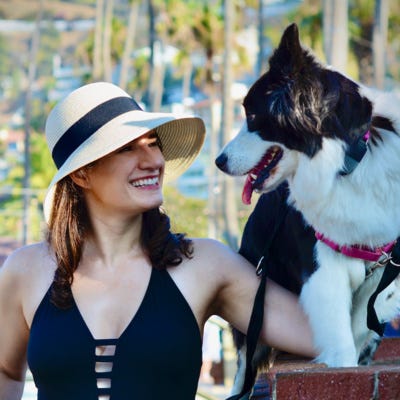
Feb 12, 2022
How to train your dog to touch your hand (and why it is such an important thing to master)
***February 2022 Special: New to School For The Dogs? Book a free virtual consult with a trainer at http://schoolforthedogs.com/freeconsult*** This episode is a rebroadcast. It first aired on May 15, 2020. There is one behavior we teach every dog we work with at School For The Dogs: Touch! This is an easy-to-teach building block that you can use to build... whatever you want! In this episode, Annie outlines how to teach touch, and talks about this behavior's countless uses and variations. Annie's Free Webinar on training touch - https://event.webinarjam.com/go/replay/78/k6v60c95ir6t6nf1 More on Chirag Patel's Bucket Game - https://www.facebook.com/thebucketgame Ken Ramirez demonstrates different types of targeting. - https://theranch.clickertraining.com/live-episode-1/ Doodle Buddy and other apps you can use with your dog - https://anniegrossman.com/2013/12/training/3-apps-your-dog-can-use-to-make-art-35313/8246/ Support this podcast by shopping in our online store, storeforthedogs.com ! http://storeforthedogs.com/ Products mentioned in this episode: Clicker Sticks https://storeforthedogs.com/products/clicker-stick Lamb Lung https://storeforthedogs.com/products/lamb-lung ---- +++ Need help house training your dog? Download our free eBook at http://schoolforthedogs.com/house +++ --- Full Transcript at SchoolForTheDogs.com/podcast Get full access to Don't Be a Dick to Your Dog at dogtraining.substack.com/subscribe

Feb 4, 2022
Best Pet Ever: Joanie Comenzo is in a complicated relationship with the dog she loves, Nelson the Welsh Terrier
Someone in a dog-related Facebook Group reported being bitten by a dog in School For The Dogs' neighborhood. The person wanted the dog owner to pay his medical bills -- this seemed, to Annie, to be reasonable. But then a client reached out to Annie, upset about the rancor in the comments section. It seemed like an angry mob was forming to lobby that the dog be euthanized. Could Annie maybe chime in to suggest that the dog and his owner perhaps deserve some empathy, too? She did. And she also suggested people in the group listen to this episode... This episode is part of our new Best Pet Ever! series. Inspired, in part, by Betty White's 1970s talk show, The Pet Set, this series features conversations with people about a pet they love, or loved. Listen to the first episode in the series here . https://anchor.fm/dogs/episodes/Best-Pet-Ever-WriterProducer-Jessica-Vitkus-talks-about-Cookie-and-Coffee--her-guinea-pigs-e1cjtj5 ----- Special announcements: Sign up to be notified when we begin taking applications for the next round of our Professional Course at http://schoolforthedogs.com/apprenticeship2022 This month only, we are offering a limited number of free virtual consults! Sign up for one at http://schoolforthedogs.com/freeconsult ---- This is a rebroadcast of an episode that originally aired October 22, 2018. After years of researching breeds, Joanie Comenzo of Manhattan decided to get a Welsh Terrier. When she went to pick up her new dog, Nelson, the breeder pushed him into her arms and said "Your puppy is an alpha." Joanie loved him from the moment she saw him, and that love never waned, even after he bit her multiple times, and sent her mother and boyfriend to the hospital. Over the last eight years, Joanie has sought training and medical advice from a wide array of professionals. Today, Nelson wears a muzzle every moment of the day that he isn't in his crate. He and Joanie live a happy, if unusual, life together. This is their love story. Notes: Nelson's preferred muzzle http://storeforthedogs.com/products/the-baskerville-muzzle Fun Dog Fact Of The Day: As late as the early 1900s, dogs were allowed to roam off leash in Philadelphia as long as they were muzzled. http://thepethistorian.com/2015/08/20/dog-muzzles-and-city-dogs-1900/ Music: "Love Is Strange" cover by Toast Garden --- Full Transcript at SchoolForTheDogs.com/podcast Get full access to Don't Be a Dick to Your Dog at dogtraining.substack.com/subscribe
Jan 28, 2022
Our Newest SFTD Certified Professional Trainer Ionelee Brogna on shock collars, horses, schnauzers, trick training, and learning empathy by selling used books
When Ionelee Brogna decided to bring a Miniature Schnauzer puppy into her NYC apartment a couple of years ago, she knew she didn't want to employ the punishment-based or "balanced" methods that her family had used on their dog back in rural Massachusetts. But she wasn't sure what other options there were. Her research led her to... this podcast! And then to classes at School For The Dogs, and then to our six-month-long Professional Course. Ionelee, who formerly worked in publishing and at New York's famous Strand Book Store, just finished apprenticing with us, and is now starting to see clients. She and Annie discuss her background training horses, the human insight one gains working in the service industry, the surprising lessons learned while teaching a dog tricks, and the challenges associated of living with a terrier who is training obsessed. If you're interested in being notified when we start taking applications for our 2022 Professional Course (aka our "Apprenticeship") join the waiting list at http://schoolforthedogs.com/apprenticeship2022 We will be welcoming four students into our spring cohort. Not in NYC? No problem! The program is fully virtual. Want to learn how you can use dog training techniques on people? Check out our free eBook at http://schoolforthedogs.com/people *** February Special!*** Book a complimentary 15-minute virtual consult with a School For The Dogs Certified Professional Trainer at http://schoolforthedogs.com/freeconsult --- Partial Transcript: Annie: I am joined today by Ionelee Brogna, one of the very most recent graduates of our Professional Course . When she is not training, she is often at the front desk at School For The Dogs and mans our inbox. Her official title is admin assistant and client coordinator. Ionelee, though, something I've wanted to ask you since I've met you, and I've never asked you, is tell me about your name, ‘cause I've never met an Ionelee before. Ionelee Brogna: So it's a variation on my grandmother's name, which was Ione space Lee, and my parents smooshed that together so that my middle name could be my other grandmother's name, which is Carol. Annie: Oh, and is Ione a kind of, is that a name from somewhere? Ionelee: Yes, it's Scottish actually. Annie: Oh, okay. Ionelee: Which is ironic. Cause I'm mostly Italian and Mexican, but… Annie: [laughs] But your grandmother was Scottish. Ionelee: Yes. Annie: And her name was Ione. Ionelee: Yes. Annie: Well, it's very pretty. Although it's, I've noticed and I'm guessing you've noticed in your life, people refer to you sometimes as Lone-ly. Ionelee: Yes, I get Lonely a lot. I like to tell telemarketers that I'm not lonely. I do have friends. Which is why a lot of times I'll just sign my name fully in lower case. Annie: Well, anyway, it's a beautiful name. So, I wanted to have you on today to hear about your journey into the world of dog training. Because, as I know, and as other people on staff know, you started out with us as a client, then started working for us doing work at the front desk, and now have graduated our apprenticeship program... Full Transcript at SchoolForTheDogs.com/Podcast Get full access to Don't Be a Dick to Your Dog at dogtraining.substack.com/subscribe

Jan 21, 2022
Does the Pope hate dog owners? A conversation with one of the pontiff's former secretaries, Professor Dan Gallagher of Cornell University
James Joyce said that Catholicism means "Here comes everybody." But does "everybody" mean our Yorkiepoos, too? Earlier this month, Pope Francis made the remark that "many, many couples do not have children because they do not want to, or they have just one – but they have two dogs, two cats… Yes, dogs and cats take the place of children [...] And this denial of fatherhood or motherhood diminishes us, it takes away our humanity." Annie, who is not Catholic, wondered if this pooh-poohing of pet ownership was echoing the church's stance on our relationships with non-human animals, or if maybe the Pope was going rogue. So, she called her friend Dan Gallagher, a professor of Classics at Cornell University. Professor Gallagher is uniquely qualified to discuss this topic: He used to be one of the Pope's secretaries and translators. He also grew up breeding Cocker Spaniels, and once gave a funeral to a hamster. He and Annie discuss some of the Catholic church's past champions of animals -- from Saint Francis of Assisi to cat-lover Pope Benedict -- try to parse the Pope's words and wonder if maybe it's time for Pope Francis to try his hand at...pet sitting. Read the Pope's full January 6th catechesis: https://www.vatican.va/content/francesco/en/audiences/2022/documents/20220105-udienza-generale.html Learn more about Daniel Gallagher https://as.cornell.edu/people/daniel-gallagher Learn more about the Paideia Institute https://www.paideiainstitute.org/ Donate to the School For The Dogs Scholarship Fund http://schoolforthedogs.com/fund Get a tile in the School For The Dogs Mosaic http://schoolforthedogs.com/mosaic --- Partial Transcript: Annie: I want to read a few paragraphs from the Catechism of the Catholic Church, that my friend Dan sent me the other day, on the Respect for the integrity of creation, 2415: The seventh commandment enjoins respect for the integrity of creation. Animals, like plants and inanimate beings, are by nature destined for the common good of past, present, and future humanity. Use of the mineral, vegetable, and animal resources of the universe cannot be divorced from respect for moral imperatives. Man’s dominion over inanimate and other living beings granted by the Creator is not absolute; it is limited by concern for the quality of life of his neighbor, including generations to come; it requires a religious respect for the integrity of creation. Animals are God's creatures. He surrounds them with his providential care. By their mere existence they bless him and give him glory. Thus men owe them kindness. We should recall the gentleness with which saints like St. Francis of Assisi or St. Philip Neri treated animals. God entrusted animals to the stewardship of those whom he created in his own image. Hence it is legitimate to use animals for food and clothing. They may be domesticated to help man in his work and leisure. Medical and scientific experimentation on animals is a morally acceptable practice if it remains within reasonable limits and contributes to caring for or saving human lives. Full Transcript at SchoolForTheDogs.com/Podcast Get full access to Don't Be a Dick to Your Dog at dogtraining.substack.com/subscribe

Jan 14, 2022
Two dog trainers' tips on bringing your dog to the dog park
Dog parks aren't appropriate for every dog, and urban dog parks have their own unique challenges--a revolving population and small foot prints, to name a few. If Annie had her way, all dogs parks would have life guards! She gives some reasons why you might think twice before bringing just any dog to any dog park. If you've decided the dog park might be a good thing for your dog, take some tips from Annie's partner Kate Senisi, a trainer with an expertise in working with high-arousal urban dogs. Annie shares Kate's top eight tips, and adds a few of her own. This episode talks about how to enter the park, what to bring, signs it may be time to leave, and more. This episode offers special thanks to Alexandra Messiter, who, along with her dog Cooper, has been students at SFTD since 2019. Alexandra and her husband gave a generous donation to our Scholarship Fund recently, and we are so appreciative! "I felt moved to donate mostly because Cooper (who we adopted from Bideawee in 2019) is just so awesome - he's such a fun, smart, loving companion and has made my husband and I much more passionate about trying to encourage folks to consider rescuing. Because we know that lack of access to affordable quality training can lead to more dogs being surrendered -- and can discourage folks from adopting great dogs with some behavior concerns -- we're always happy to help any organization that is filling a need, which SFTD is definitely doing here." -- Alexandra Messiter Visit our site for 8 tips to read Kate's 8 tips on keeping your dog safe at the dog park. https://www.schoolforthedogs.com/8-tips-to-keep-your-dog-safe-at-the-dog-park/ Learn more about our Scholarship Fund at schoolforthedogs.com/fund Get half off our on-demand dog body language course using code HALFOFFBODYLANG https://storeforthedogs.com/products/750634 Other episodes mentioned in this episode: SniffSpot: https://podcasts.apple.com/us/podcast/air-b-pee-sniff-spot-allows-dog-owners-to-rent-peoples/id1355439730?i=1000512680806 Bully Test: https://www.schoolforthedogs.com/podcasts/episode-95-the-bully-test-how-to-tell-if-your-dog-or-kid-or-country-is-having-fun-plus-fomo-crate-training/ --- Partial Transcript: Annie: Hey all. Annie here. Today, I wanted to talk about dog parks. Dog parks are not appropriate for every dog, and dog parks in cities have their own unique challenges. They can be very small and dense, and they can have a highly revolving population. Meaning that a lot of people in a big city, a lot of people bring their dogs to a big city dog park means that you might see a lot of different dogs there. It's not just a small population of a dozen or so dogs, like I imagine maybe some small town dog park, what that must be like. It can be challenging for dogs and for people. Full Transcript at SchoolForTheDogs.com/Podcast Get full access to Don't Be a Dick to Your Dog at dogtraining.substack.com/subscribe
Jan 7, 2022
Best Pet Ever: Writer/Producer Jessica Vitkus talks about Cookie and Coffee, her guinea pigs
Introducing a new series: Best Pet Ever! Wherein Annie talks to interesting people about their interesting pets. Inspired by Betty White's 1970s show, The Pet Set, Annie interviews one of her closest friends, Jessica Vitkus. Jessica is an East-Village based writer and TV producer — she was Annie's boss ten years ago on the Animal Planet show, Too Cute: Puppies and Kittens. Jessica, her kids and her partner Stephen recently got a pair of Guinea Pigs. Jessica talks about the world of Guinea Pig rescue, Guinea Pig Pavlovian Conditioning, and about how rodents may be an underused tool in couples therapy. Like this podcast? You can support us by leaving a review on iTunes and/or shopping at StoreForTheDogs.com Follow us on Instagram: @schoolforthedogs @annie.grossman --- Partial Transcript: Jessica Vitkus: I didn't expect Guinea pigs to be so fun and funny and comical. They are ridiculous furry potatoes in appearance. But also their behavior. A Guinea pig learns that a knife on a cutting board means maybe there's food coming. So anytime we cut on the cutting board, we hear “week, week, week, week.” They make this sound, they call it weeking. And it's “week, week, week.” Anytime plastic crackles, they think it's lettuce coming out of the fridge. So any crackling, if I am like taking batteries out of a deli bag and the bag crackles, they're like, “week, week, week.” They just, they know us. And now I think even the sound of the knife drawer opening, they get excited. “Week, week, week, week.” And also when they're happy, they cluck like chickens. It's hilarious. [music] Annie: Last week saw the passing of 99 year old actress and noted animal lover and advocate Betty White. In one of the obituaries for her, I read that in the 1970s, she had something of a talk show called The Pet Set, where she basically interviewed her friends about their pets. And I thought, huh, that sounds like a fun thing to do. Her friends were 1970s celebrities. Mine are not 1970s celebrities, but they're celebrities in my life. And I will grab at any opportunity to talk to people about their dogs. It's what I love to do. At first I thought maybe I could make it more focused and talk to people about their first dog or a dog that they've lost. But then I thought that would rule out me talking to so many of the dog owners who I've come to know at School For The Dogs who are our clients, both human and canine. So why limit things?And also, I thought why limit it just to dogs? In fact, the first person I realized I wanted to talk to for this series has a pet who is not a dog at all, but is a kind of animal I would really be curious to learn more about. So for the very first entry into this series, which I am going to call “Best Pet Ever,” I am speaking to my good friend, Jessica Vitkus. Jessica is a writer and TV producer. We have been good friends for nearly 20 years. And about 10 years ago, I was lucky enough to be hired by Jessica when she was the executive producer for the show Too Cute: Puppies and Kittens, which aired on Animal Planet. She hired me as an associate producer/animal wrangler/dog nerd on site with facts and training recommendations. Anyway, it was a fabulous job, really great experience for me. And during that time, I know that Jessica worked with lots of different kinds of animals, not just cats and dogs, and learned about all different kinds of animals, including pigs that people kept as pets, and hedgehogs. Full Transcript at SchoolForTheDogs.com/Podcast Get full access to Don't Be a Dick to Your Dog at dogtraining.substack.com/subscribe

Dec 31, 2021
SFTD's Behavior Therapy Trainer Jen Nastanski on working with guide dogs, competitive Obedience and more (Also featuring special guest: Melanie Friedson)
School For The Dogs' Behavior Therapy Trainer Jen Nastanski came to work at our New York-based facility after two decades of working with dogs at professional and competitive levels. She tells Annie about getting trained to be a trainer at PetSmart, getting involved in competitive Obedience using positive-reinforcement-based techniques, teaching (and helping to raise) guide dogs, and, most recently working at New York City's ASPCA, working to enrich the lives of dogs seized and held in custody by the NYPD. Special guest on this episode: Annie's friend Melanie Friedson, mom to Bichpoo, Herschel Stanley. Like this podcast? Leave a review on iTunes at http://schoolforthedogs.com/listen Need help leaving a review? See here: https://www.schoolforthedogs.com/subscribe/ Shop with us at http://storeforthedogs.com Support us by shopping with us online at storeforthedogs.com Book a session with Jen at http://schoolforthedogs.com/jen or call 212-353-3647 --- Partial Transcript: Annie: Can I include your funny dog voice on the podcast? I don't have to attach it to your name. Melanie Friedson: [funny voice] Of course. It's not funny. It's just how it is. Annie: [laughs] I should introduce you and say that you are – Melanie: You can. I'm not ashamed of my dog voice, Annie. Annie: You are one of my best friends, Melanie Friedson, human owner. How do you refer to yourself when it comes to Herschel? Melanie: [voice] I'm his mom . Annie: Okay. Mom to Herscshel Stanley [laughs]. 12 year old cavapoo? Melanie: Bichpoo. Annie: A bichpoo, of Washington, DC. Melanie: Yep. Annie: Anyway, so it's the last day of the year. And I'm putting up the last podcast episode of the year. I wanted to say to listeners that if they have enjoyed this podcast this year, that maybe they could leave a review on iTunes or shop at storeforthedogs.com to support us. But I thought it would be more fun if it was in your dog voice than in my normal human voice. Melanie: Oh, okay. So you want me to say that? Annie: Yeah. [laughing] Melanie: If you like this podcast, please support us! Leave a good review on iTunes, or you can shop for us at storeforthedogs.com . This is Herschel Stanley Friedson’s mom! [intro and music] Annie: Jen Nastanski. Jen Nastanski: Hello. Annie: Hello. Thank you for being on School For The Dogs podcast. And thank you for being part of School For The Dogs since, what, has it been two months now? Something like that? Jen: Something like that. Time is a little nebulous right now. Annie: Remind me of your official title, cause I'm bad with titles. Jen: I'm a behavior therapy trainer. Annie: And you've been doing private lessons. You've been doing Day School , right? Jen: Mm-hmm, yep. Full Transcript at SchoolfortheDogs.com/Podcast Get full access to Don't Be a Dick to Your Dog at dogtraining.substack.com/subscribe

Dec 24, 2021
How to teach a dog to "Break" during play. Also: On how "No" can confuse (and stress out) both dogs and humans
While doing the NYC's annual workplace Sexual Harassment Prevention course, Annie noted that people are being told to assume that many things other than the word "No" may mean "No." This might be a good thing, but it's also potentially confusing! In the world of dogs, she's seen how the word "No" can also be a confusing concept, as it is frequently used ineffectively, and can even end up positively reinforcing some behaviors. She thinks about how, for both dogs and humans, this confusion about "No" can lead to stress. What if, with both dogs and humans, the focus were not on explaining what not to do, but rather on teaching what appropriate behaviors can be engaged in instead? Maybe men, in particularly, could learn something by taking discussion-starting tips from "Linda Richman," the Mike Myers "Coffee Talk" character from Saturday Night Live in the nineties. ("Talk amongst yourselves: I'll give you a topic. Discuss!") Annie goes into how it's possible to condition a secondary punisher to make the word "No" more meaningful... but most people don't do this work. She also explains that it's a misconception that Positive Reinforcement-based trainers never try to stop behaviors. She explains how SFTD trainers work to help build a dog's ability to stop and start a behavior, and help owners think about what a dog should ideally be doing instead of an undesirable behavior. As an example, she explains how "Break" is taught at School For The Dogs for dogs attending off leash play sessions. Interested in learning more about our trainer supervised off-leash sessions? Visit us online at https://www.schoolforthedogs.com/services/school-yard/ NYC's Sexual Harassment Prevention https://www1.nyc.gov/site/cchr/law/sexual-harassment-training.page Coffee Talk with Linda Richman (Mike Myers) on SNL https://www.youtube.com/watch?v=haunEK4HLI8 In the #MeToo era, 60% of male managers say they’re scared of being alone with women at work https://www.marketwatch.com/story/men-are-afraid-to-mentor-female-colleagues-in-the-metoo-era-heres-what-not-to-do-2019-05-20 Episode 26 | Teach a foolproof DROP and COME using Classical Conditioning https://anchor.fm/dogs/episodes/Teach-a-foolproof-DROP-and-COME-using-Classical-Conditioning-e29h2c/a-a2daie5 Like this episode? Please leave a review on iTunes! Learn how here: http://schoolforthedogs.com/subscribe Special thanks to Toast Garden for the theme song! https://www.youtube.com/c/ToastGarden --- Partial Transcript: Voice: No comes in many forms. Verbal no means no. Body language can mean no. Excuses can mean no. A tone of voice can mean no. Maybe can mean no. [intro and music] Annie: I recorded that clip from the annual sexual harassment awareness training required by everyone at any business in New York state. So, I'm going through this online training thing, and I realize there's kind of this focus on the concept of no... Full Transcript at SchoolForTheDogs.com/Podcast Get full access to Don't Be a Dick to Your Dog at dogtraining.substack.com/subscribe

Dec 17, 2021
Spencer Williams wants you to be your dog's best friend: Meet the CEO of dog toy maker West Paw
Spencer Williams, the founder and CEO of Bozeman, Montana-based company West Paw, grew up on a working ranch where the dogs slept outside, worked hard, and, when they played, they did so with sticks. And... they were happy! Some twenty-odd years ago, he decided he wanted to help modern non-working dogs be that happy too, and wanted to do so in a way that wouldn't just improve doggie lives: It'd also improve the community and the earth. Those weren't small goals! Annie talks about the origins of this interesting company, whose guaranteed-for-life, recyclable, made-in-the-USA products have been sold at School For The Dogs in Manhattan and at storeforthedogs.com for nearly a decade. Learn how they became a "B-Corp" and what that means, in addition to finding out about some of their innovative products, materials, and practices. Find West Paw products in our online shop: https://storeforthedogs.com/collections/west-paw-designs Like this podcast? Tell your friends! And leave us a review on iTunes! http://schoolforthedogs.com/listen --- Partial Transcript: Annie: Well, thank you so much for taking the time to chat. I'm really excited to get to know you a little bit. I feel like I know you through your business. But maybe we could just start out, you could just say your name and your title, and we'll go from there. Spencer Williams: I'm Spencer Williams and I'm the CEO and owner of West Paw Annie: And West Paw, as School For The Dogs fans might know, makes some of the most fabulous dog toys on the market. We have been selling them at storeforthedogs.com since 2014. And I'm excited to talk to you, because as I've spent these years buying West Paw products, both for my own dogs and for our shop, I've learned a little bit about the company that has intrigued me. So first of all, tell me about being a B Corp. Is that what it's called? Spencer: Yeah, I mean, that's great. Well, and thanks for all the years of experience you have buying and using and selling our products. I'm looking forward to the conversation. And B Corp's a great place to start because it is a movement that matters a lot to West Paw. This whole concept started just about a dozen years ago. And what people realized is that when they were leading a business that was impact driven, if that business had a change in leadership or a change in ownership, sometimes those impacts the business was able to drive would be lost in those transitions. And the idea around the B Corp was how do you create more opportunity for those impacts to be long lasting? And how do you measure the impact? So the idea here, Annie is how, how do you differentiate from really good marketing to fact-based information on a company's impact. And so that's where the B Corp movement came from. And in a nutshell today, what it means is that a company can choose to become a certified B Corp, and the B stands for benefit. That's a good way to think of it. Like you're benefiting primarily four areas in a business: the employees who work in the business, the community that that business is located in or impacts; it's also around the environment and how the business impacts the environment; and then finally the customer piece. Full Transcript at SchoolForTheDogs.com/Podcast Get full access to Don't Be a Dick to Your Dog at dogtraining.substack.com/subscribe

Dec 11, 2021
The matrix of expectations & resilience, issues with the "Positive Reinforcement" label & more
A School For The Dogs Instagram Reel that was meant to help dog owners understand how to tell if a trainer is a "positive reinforcement" trainer or not resulted in a battle in the comments section about what kind of dog training methods are best. Annie considers how the very title of "positive reinforcement dog trainer" is problematic, and talks about how the conversation led her to consider the possibility that maybe the divide between dog trainers comes down to expectations about what we want dogs to do and how emotionally resilient we think they may be. Other episodes mentioned in this episode: What is good dog training? https://www.schoolforthedogs.com/podcasts/episode-2-what-is-good-dog-training/ Don't chase your cat around the house with the Christmas tree: On the TikTokers who are "traumatizing" their cats in order to spare their holiday decorations https://anchor.fm/dogs/episodes/Dont-chase-your-cat-around-the-house-with-the-Christmas-tree-On-the-TikTokers-who-are-traumatizing-their-cats-in-order-to-spare-their-holiday-decorations-e1b73jq "Clues a dog trainer may not be positive-reinforcement based" Reel: https://www.instagram.com/reel/CXHK_LHlOD6/ --- Partial Transcript: Annie: Last week, we posted a Reels on the School For The Dogs Instagram, and the title of the reel was “Clues that a dog trainer might not be positive reinforcement based.” And, you know, reels can be kind of tricky to do because they're short and to the point and meant to be kind of flip and quick and ephemeral. And, you know, it's not like we workshop them for weeks. We do them pretty quickly. And there have been a couple of times where I've sort of regretted ones we've put up, not because I didn't think they were good, but because they deal with a topic that in reality is quite nuanced and complicated. And when you reduce a topic like this down to something that is 20 seconds long or 10 seconds long and lip synced to music, it can be misleading and certainly reductive. Last week when we posted this reel saying, Hey, here are some tips that or some clues that a dog trainer you're working with might not be positive reinforcement based. I wrote the text for this reel and I guess the avatar in my mind of who was reading this is someone who is like I was when I was when I first got a dog, and first found a dog trainer. I mean, I didn't research different kinds of training. I just went to the closest doggy daycare that was offering puppy kindergarten classes and had no idea about the language people use or methods people use. And so, I guess, often in things I do when I'm thinking about clients, I'm thinking about the client I would've been, and if somebody's following us on social media, I assume that means that they're kind of into what we're doing. So, I thought of it as like, Hey, if you're into what we're doing, here is how to maybe try and figure out if a trainer you're working with or following is doing a similar thing. And the shorthand for the kind of training we do that's most well understood is positive reinforcement training. Full Transcript at SchoolForTheDogs.com/Podcast Get full access to Don't Be a Dick to Your Dog at dogtraining.substack.com/subscribe

Dec 4, 2021
Don't chase your cat around the house with the Christmas tree: On the TikTokers who are "traumatizing" their cats in order to spare their holiday decorations
Earlier this week, TikTok user @becs.richards posted a video of herself chasing her cat around her house while holding her Christmas tree like a bayonet; in the text that goes with the video, she explains that she saw a TikTok explaining that if you traumatize your cat with your Christmas tree before you put it up, the cat will leave the tree alone. The video and a few follow ups (showing that the cat hasn't attacked the tree) have gotten over thirty million views and four million likes. Annie meditates on the strange way that this example of punishment-based training -- billed as unvarnished traumatization -- is so funny and intriguing to the masses. Would a dog being traumatized get so many hundreds of thousands of "likes?" Beyond that, she ponders how weird it is that we expect cats to NOT want to interact with a tree in the house, and suggests some practical ways to keep pets from messing with holiday directions (spoiler alert: Get a menorah!). The video by @becs.richards that has gotten 30 million views and 4 million likes in just a few days: https://www.tiktok.com/@becs.richards/video/7035718104269491502 Bored Panda's 40 Genius People Who Found A Way To Protect Their Christmas Trees From A*****e Cats And Dogs https://www.boredpanda.com/protecting-christmas-tree-from-dogs-cats-pets/ Like this podcast! Tell your friends! Leave a review on iTunes ! Shop at StoreForTheDogs.com ! Follow SFTD on Instagram: http://instagram.com/schoolforthedogs Follow Annie on Instagram: http://instagram.com/annie.grossman --- Partial Transcript: Annie: So, there’s these TikToks that have been going around. They’re of people in their homes with lovely Christmas music playing, and then you see a person holding their Christmas tree in their arms, like a bayonet, and running around, pointing it at their cats [music and intro] And these videos are captioned, “If you traumatize your cat with your tree before putting it up, they will leave it alone.” At least one of these videos posted by user becs.richards just four days ago already has nearly 30 million views and 4 million likes. These videos in some cases are kind of funny. I mean, it's kind of funny to see a cat running around scared of a tree, something that we humans know will not hurt them. As much as I love cats and I don't want them to be fearful about the world we're asking them to live in, I admit that I sometimes laugh when a cat seems to think something is scary. I am specifically thinking about the many hours I have spent watching videos of people putting large zucchinis next to their cats, terrifying the cats, because the cats don't really realize it's not a snake, and many cats are hardwired to naturally be scared of snakes. Full Transcript at SchoolForTheDogs.com/Podcast Get full access to Don't Be a Dick to Your Dog at dogtraining.substack.com/subscribe

Nov 26, 2021
Making dog training affordable: SFTD's Scholarship Fund, Black Friday Sale, on-demand offerings, and more. Plus: Jimmy Stewart's poem about his dog
It costs a lot to run a small business in New York City, which can be a conundrum for a mission-driven business like School For The Dogs. Annie talks about some of the ways that she and Kate have worked to offer services and goods at prices that can make "Good Dog Training" accessible to everyone, and what it means to "shop small" in a world when the little guys are selling products that can so often be purchased at big-box stores or on Amazon. Listen up for information on SFTD's Black Friday sale -- including an exclusive discount for podcast listeners interested in on-demand courses. Annie also talks about the School For The Dogs Scholarship Fund, and mentions a special gift all donors to the fund will be offered between now and the end of the year. Lastly: She shares a poem written and read by the late Jimmy Stewart, about loving, and losing a cherished canine best friend. Mentioned in this episode: Our online shop: http://storeforthedogs.com The Revol crate by Diggs! The price of this crate will be going up by A LOT next week, so this is the time to purchase one! https://storeforthedogs.com/products/the-revol-dog-crate On demand courses: http://schoolforthedogs.com/courses School For The Dogs Scholarship Fund: http://schoolforthedogs.com/fund Photo of our mosaic by Jim Power: https://share.icloud.com/photos/07ATkMopdE8n7Zb2Jl6knpC5w . Learn More about Jim Power and our mosaic: https://schoolforthedogs.wistia.com/medias/2luqc0zxwi Last week's episode: https://anchor.fm/dogs/episodes/On-being-a-dog-run-snob--Also-The-case-for-spending-money-on-pets--and-how-to-help-your-dog-have-a-good-Thanksgiving-Hint-Be-your-dogs-advocate-e1ahqjo School Yard: https://www.schoolforthedogs.com/services/school-yard/ School Yard's NY Times mention: The New York Times: Does Your Dog Deserve a Private Park https://www.nytimes.com/2021/11/17/style/private-dog-parks-new-york-city.html Jimmy Stewart reading his poem to Johnny Carson in 1981: https://www.youtube.com/watch?v=mwGnCIdHQH0 Follow School For The Dogs on Instagram: http://instagram.com/schoolforthedogs Follow Annie on Instagram: http://instagram.com/annie.grossman --- Full Transcript of this episode available at SchoolfortheDogs.com/Podcast Get full access to Don't Be a Dick to Your Dog at dogtraining.substack.com/subscribe

Nov 19, 2021
On being a dog run snob! Also: The case for spending money on pets, and how to help your dog have a good Thanksgiving (Hint: Be your dog's advocate!)
A bunch of media outlets have recently done stories about private dog runs in NYC, and have mentioned School For The Dogs' School Yard sessions, which are playtimes for dogs. School Yard is members-only, by-appointment and trainer-supervised. Annie talks about why the service is so special, and also why it's so expensive. She addresses some of the negative feedback she's gotten to the articles. She also discusses how she plans to train with her dog, Poppy, while visiting family, and suggests ways in which people can approach training a timid dog in new places or with new people over the holidays. Follow School For The Dogs on Instagram: http://instagram.com/schoolforthedogs Follow Annie on Instagram: http://instagram.com/a nnie.grossman Learn more about School Yard here: https://www.schoolforthedogs.com/services/school-yard/ Products mentioned in this episode are all available Storeforthedogs.com ! Also come shop with us at our storefront in Manhattan at 92 E. 7th Street. Revol dog crate: https://storeforthedogs.com/products/the-revol-dog-crate Slow food bowls: https://storeforthedogs.com/search?q=slow+food Want to donate to help a rescue dog owner in need access free private training? Learn more about our Scholarship Fund at http://schoolforthedogs.com/fund Articles mentioned: The New York Times: Does Your Dog Deserve a Private Park? https://www.nytimes.com/2021/11/17/style/private-dog-parks-new-york-city.html New York Post: Pledging for pooches: VIP clubs where NYC’s doggie 1 percent hangs out https://nypost.com/2021/08/03/dog-owners-are-paying-thousands-to-join-exclusive-canine-clubs/ The Wall Street Journal: Dogs Rule at These New York City Spots—For a Price https://www.wsj.com/articles/new-york-city-dog-owners-private-clubs-dog-run-off-leash-pandemic-puppy-11625580000 Other episodes about relevant topics: https://podcasts.apple.com/us/podcast/sftd-off-leash-manager-adam-davis-on-training-as-teenager/id1355439730?i=1000510765257 https://www.schoolforthedogs.com/podcasts/episode-33-how-to-shape-your-dog-to-go-to-a-mat-and-to-be-a-polite-thanksgiving-guest/ --- Partial Transcript: Annie: Hello, Annie Grossman here. I am the host of School for the Dogs Podcast and the owner and co-founder of School for the Dogs in New York City on East 7th Street and 1st Avenue. Make sure you come on by when you're doing your shopping this holiday season. You can also shop with us at storeforthedogs.com . We specialize in selling toys that are meant to engage your dog’s brain and mouth at meal times. Of course, we also have an awesome selection of treats. We have our own house brand of Lamb Lung training tools. Everything we sell, we sell because we use these things ourselves. We use them with our dogs. It's just, yeah, just great stuff. So make sure you do shop with us this holiday season. We put a lot of love and effort into our shop and make sure to follow us on Instagram @SchoolfortheDogs, because we do product giveaways every Friday. Full Transcript at SchoolfortheDogs.com/Podcast Get full access to Don't Be a Dick to Your Dog at dogtraining.substack.com/subscribe

Nov 12, 2021
Two things every dog needs to know: Find it and touch! Featuring SFTD apprentice Leeyah Wiseman. Also: What Nat Geo was told about Cesar Millan's techniques before The Dog Whisperer even aired
Annie is joined by School For The Dogs apprentice Leeyah Wiseman to discuss two super important behaviors: Touch and find it. She and Annie discuss the benefits of teaching these two things and talk about why both behaviors are such great starting places for many dogs and their humans. Check out @schoolforthedogs ' Reels on Instagram to see Leeyah demo both! Annie also engages in some time travel, reading a letter that Dr. Andrew Luescher, a veterinary behaviorist at Purdue University, wrote more than fifteen years ago. It was addressed to National Geographic, which had asked him to review their show, The Dog Whisperer, before it was released... Based on what happened next, it seems like no one read it. http://beyondcesarmillan.weebly.com/andrew-luescher.html See the Illuminaughtii episode on Cesar Millan at https://youtu.be/ENl5RTBResY or find it on Spotify : https://open.spotify.com/episode/1Ygtrku55i49RA0HxxPVPG Find Leeyah on Instagram: http://instagram.com/galdogtraining Find Annie on Instagram: http://instagram.com/annie.grossman Previous episodes with Malena DeMartini: Episode 159 https://www.schoolforthedogs.com/podcasts/episode-159-how-has-quarantine-changed-the-way-we-think-about-treating-separation-anxiety-in-dogs-a-conversation-with-malena-demartini-ctc/ Episode 59 https://www.schoolforthedogs.com/podcasts/separation-anxiety-expert-malena-demartini-on-helping-dogs-learn-to-be-alone/ Want to make sure you know when the next round of our apprentice opens up? Make sure to sign up for our newsletter! You can also email Annie directly at Annie@Schoolforthedogs.com . Love this podcast? Give it a five-star rating and leave a review on iTunes! --- Partial Transcript: Annie: Hi! Today I am joined by School for the Dogs' apprentice, Leeyah Wiseman, who is going to talk about two very important behaviors that we teach all the time at School for the Dogs, Find it and Touch. Leeyah has been doing reels for our Instagram. You can see them @schoolforthedogs on Instagram. You can also find Leeyah on Instagram @galdogtraining , it stands for George and Leeyah dog training. George is her pup. I tried to schedule this call with Leeyah at a time when my infant daughter would be napping, but I was foiled. So you can hear her goo-goo ga-ga-ing a little bit during this talk. And I apologize for that, but as working mother, sometimes I just have to not allow the perfect to be the enemy of the good, as they say. In the beginning of the conversation, I'm asking her about Malena DeMartini, who I've had on the podcast before, who was a separation anxiety expert. And earlier in the week, Malena was gracious enough to speak to our apprentices. We have guest speakers who participate periodically. Full Transcript at SchoolfortheDogs.com/Podcast Get full access to Don't Be a Dick to Your Dog at dogtraining.substack.com/subscribe

Nov 5, 2021
She helps Positive Reinforcement dog trainers grow their businesses using Instagram: Meet Tiffany Chen, aka Pawsistant
Right after getting a pandemic puppy, Tiffany Chen decided to see if she could build some sort of side hustle in order to get her out of the corporate world. She signed up for the Virtual Assistant Internship and learned that it's wise to pick a niche. While she was working on learning about training her own dog (and building his requisite Instagram persona) she started following a lot of positive reinforcement dog trainers. It occurred to her that maybe she could use her virtual assistant powers to help them improve their marketing. She and Annie discuss how fun the R+ dog training movement is on Instagram, talk about ways to help trainers build their followings, and think aloud together about some of the overlap between training dogs and how social media's efforts to train us. Follow Pawsistant on Instagram @pawsistant Follow Annie on Instagram @annie.grossman Follow School For The Dogs on Instagram @schoolforthedogs Also mentioned in this episode: @misunderstoodmutt @fromdusktilldog @k9fuel_ @doginspired https://virtualassistantinternship.com/ --- Partial Transcript: Annie: In the decades of my life before I became a professional dog trainer, I think I had an avatar in my brain for who a dog trainer would be, what a dog trainer would be like. And I mean, if I try and remember what that avatar is, it's someone female, older, and kind of uncool, kind of schoolmarm-ish. I guess kind of like Barbara Woodhouse, like a martinet. Not that I thought of myself as particularly cool. I didn't. But I think I thought of myself as uncool in a different kind of way than that. And when I pictured myself becoming a dog trainer, I didn't really have a picture of what that would be like. I had, even when I graduated from Karen Pryor Academy, I hadn't even seen that many people train dogs, period. And I didn't really, I couldn't quite picture what it would be like as a career. I mean, I literally didn't know, like how would I dress when I went to clients' houses? Like how, how do I as a dog trainer, like what clothing do I wear? It sounds simple and even silly to say that, but we're all playing roles all the time and I wasn't sure what this role was about or like how I could fit myself into it. And I think I've talked about this on the podcast before, but in 2010, I went to the Association for Professional Dog Trainers Conference in Atlanta. It was shortly after I had graduated Karen Pryor Academy where I had only met a couple of trainers, because there were only two other people in my class, and my instructor. And my mind was kind of blown, cause I just sort of had this moment of like seeing there's so many cool and fun and interesting things in the world of dog training. There's so much that you could do with dogs. There's so much to learn about dogs. And I think that this is somehow an overlooked hobby, discipline, area of the world when so many people have dogs in their homes. Full Transcript at SchoolfortheDogs.com/Podcast Get full access to Don't Be a Dick to Your Dog at dogtraining.substack.com/subscribe

Nov 3, 2021
Bonus: Regarding Blippi, Duo Lingo's training of humans, Travis Barker's True Romance obsession, Nabokov's letters, the key to getting good at anything, and... a deathaversary
Annie's life has two speeds right now. You'll find her physically trapped underneath her two young daughters using a suite of remote treat dispensers to train her dog, or she's at a local co-working space in a tiny room alone, talking to herself. In this bonus episode, on the one-year anniversary of her beloved dog Amos passing, she is in the latter mode, recording a kind of phone call to her late father, who she thinks would've enjoyed learning what she's learned about the Youtube star Blippi, aka Stevin John, fka Steven or "Steezy" Grossman (no relation). A line of thought about loving those who are no longer alive leads her to discuss the nature of pet love as something that exists inside of us and how the expression and feeling of that love is, in many ways, projection of something that doesn't go away when someone gone. She somehow relates this both to Travis Barker and Kourtney Kardashian's recent public display of their love of the movie True Romance and the way in which Nabokov's letters to his wife and to his mistress were sort of fungible. Also: She talks about how the app Duo Lingo is manipulating our behavior in a good way and she reveals the not-so-secret key to getting better at anything, which she only really understood after she became a dog trainer. Want to use a remote trainer to train YOUR dog while your kids are climbing on you? Get a Treat and Train at http://schoolforthedogs.com/TT --- Partial Transcript: Annie: I'm sitting in a vertical phone booth, coffin-like, although rather brightly lit, tiny, windowless room in a We Work. If you can call this a room. I guess actually it does have windows, but not external windows. And I feel like my life rhythm is funny right now. I'm either in a spot like this, alone, either staring at a screen or talking to myself as I am now, or I am home underneath two small children, often literally lying down underneath them, it seems. Although to bring it back to dog training, I have set up a Pet Tutor and two Treat and Trains in my apartment because I feel like I have so little time to devote to training Poppy. And so I've been trying to use these moments where I'm like paralyzed under the two girls to do push button training, basically triggering the Treat and Train, one of the Treat and Trains. I have one on her bed, one in her crate, and then like her relaxation mat. So like go to bed, go to crate, go to mat. I just sort of have her going from one to the other with this hilarious, like all these buttons that I'm wearing, one for each dispenser. And it's, it's ridiculous, but I think it's been good for her. If only because when I have the two of them piled on me, like I don't also want her piled on me, which she has a tendency to do cause she likes to be snuggly. Anyway. But that moment is not this moment. This is the isolated-in-a-coffin moment. And I just wanted to share a couple things. One is that this is the one year anniversary of Amos dying today. And so I've been thinking a lot about him, but of course I think a lot about him every day. And I guess just, you know, feeling those feelings. Full Transcript at SchoolfortheDogs.com/Podcast Get full access to Don't Be a Dick to Your Dog at dogtraining.substack.com/subscribe

Oct 29, 2021
Ilana Alderman talks to the animals--all of them: Training and enriching the lives of fish, mice, squirrels, dogs and toddlers, too.
Dog trainer Ilana Alderman, one of Annie's closest friends, has a reputation at School For The Dogs for being a kind of Disney Princess: She looks sort of like Snow White, and seems to titter with birds and befriend fish like Cinderella or Ariel. For nearly a decade, Ilana has focused on training (and enriching the lives of) pretty much every animal she's come across. She has taught fish to play basketball, helped ring tail lemurs learn to step onto scales, taught goats to enjoy being milked, built tiny amusement parks for mice, and even trained the squirrels in her yard to ring a doorbell. She also has helped Annie organize her closet, and feels this is a kind of animal training too. Ilana has never owned a dog, but she has helped many dog owners, and is the architect of the School For The Dogs Professional Course and its open source free online text book, Born To Behave. She and Annie discuss her journey into the world of behavior and the latest animal who is benefiting from being her presence: Her son. Find Born to Behave at http://schoolforthedogs.com/courses For more from Ilana, see this summer’s bonus episode: Annie reads animal trainer Ilana Alderman's 14 tips on getting a toddler to brush his teeth https://podcasts.apple.com/us/podcast/bonus-annie-reads-animal-trainer-ilana-aldermans-14/id1355439730?i=1000524543383 Find Ilana on Instagram @baby_enrichment and on the web at childcooperativecare.wordpress.com/ --- Partial Transcript: Annie: Ilana Alderman. I have tried so hard to get you on this podcast. You know how hard I've tried. So, God, I don't even know where to start, cause you are such a dynamic person who I also happen to love very much. Ilana Alderman: Aw honey. Annie: But, why don't you just introduce yourself, and then maybe we can kind of go chronologically. Why don't you introduce yourself by whatever title you would currently give yourself in your life, and then we could maybe work backwards or forwards. Forwards from, from early on… Ilana: To now. Okay. Yeah. The title I would give myself professionally would probably be Animal Behavior Consultant or I, at parties, I say I'm a dog trainer. It's just so much simpler. And yeah, I like to work with any species of animals, including humans. So everything to do with behavior and how it works, and how we can change the way people or animals feel in a given situation. That's what really fascinates me. And let's see what else we were asking me, how did I, Annie: I mean, I say that you came into my life, I guess it was before the fire. Ilana: It was before the fire! Annie: Cause I remember you came to School for the Dogs when it was in my living room. Ilana: Yes. Annie: And yes, I think at that point you were thinking about doing Karen Pryor Academy and you were living upstate and you came in to just talk to me a little bit about it. Little did I know what a force you were. So it must have been like 2013, 2012. Full Transcript at SchoolfortheDogs.com/Podcast Get full access to Don't Be a Dick to Your Dog at dogtraining.substack.com/subscribe
Oct 22, 2021
Why you shouldn’t dress up your dog. Also: Dog training with “Buy Nothing,” Tooth Fairy tales & more
Annie talks about why she is generally against costumes for dogs and suggests some alternatives to dressing up your dog on Halloween. She also discusses some feedback she got about last week’s episode, which featured an interview with the lawyer representing the woman who was mauled by Cesar Millan’s dog. Lastly, she shares two anecdotes: one about how she is using a Buy Nothing group on Facebook to get neighbors to help her train her dog (unbeknownst to them) and the other about how her attempt to use negative reinforcement to get her daughter to brush her teeth ultimately back fired (in a sort of hilarious way). Like this episode? Leave a review on iTunes! Follow us on Instagram: @schoolforthedogs @annie.grossman Mentioned in this episode: Treat N Train Remote treat dispenser http://Schoolforthedogs.com/TT School For The Dogs Community App http://Schoolforthedogs.com/community Pet Paint - http://petpaint.com Ronda Kaysen’s NY Times article on Buy Nothing https://www.nytimes.com/2021/10/22/realestate/buy-nothing-facebook-group.html Other episodes mentioned in this episode: https://anchor.fm/dogs/episodes/Suing-Cesar-Meet-the-lawyer-of-teen-mauled-by-Dog-Whisperers-dog--And-How-to-train-2-dogs-at-once-e18r9eb https://anchor.fm/dogs/episodes/The-mainstream-media-is-confused-about-dog-training-Two-journalists-turned-trainers-discuss-a-misguided-WSJ-op-ed--more-featuring-Kiki-Yablon-e176pjj Previous episodes and blog posts Annie has done about dogs and Halloween: https://anniegrossman.com/2018/10/podcast/episode-31-halloween-dogs-how-to-make-costumes-less-scary-for-pets/10052/ http://anniegrossman.com/2010/11/training/the-psychological-torment-of-a-dog-on-halloween/346/ https://www.theawl.com/2011/10/the-east-village-halloween-parade-for-east-village-humans-who-enjoy-dressing-up-dogs/ --- Partial Transcript: Annie: So today's episode is a little bit of a hodgepodge. I have four things I want to talk about. One is a response to last week's episode. One is a bit of advice. And then I have two, I guess, stories to tell. One about operant conditioning and my daughter, and the other about some dog training success I've had with my own dog. A sort of clever solution to a problem I was having that I'd like to tell y’all about. Because maybe this, what would you call it, scheme that I've come up with could work for you too. Okay. First thing I want to address is that we're about a week away from Halloween and I've had a couple of people say to me, you really need to do some kind of episode about Halloween. Although every year when people start suggesting this, it's already October, and I think to myself I should have done an episode about this six months ago. Full Transcript at SchoolfortheDogs.com/Podcast Get full access to Don't Be a Dick to Your Dog at dogtraining.substack.com/subscribe

Oct 15, 2021
Suing Cesar: Meet the lawyer of teen mauled by Dog Whisperer’s dog. And: How to train 2 dogs at once
In the summer of 2017, Lidia Matiss, then a high schooler, went to visit her mom at her workplace and, inside the office, was brutally attacked by an off-leash dog. Her mother worked for Cesar's Way, which belongs to Cesar Millan, aka The Dog Whisperer; the dog was Millan's late pit bull, Junior. Annie interviews LA-based lawyer Brian Adesman, who is representing the victim in a suit against Millan, and learns some of the surprising details about the case, including Millan's blaming of the victim and how Queen Latifah's dead dog fits into the picture. Also, Annie answers a question from a longtime client who wants to know how to go about training a new dog, and her old dog at the same time. She mentions the Revol crate, the Treat and Train, and the Good Dog Training course, all available at StoreForTheDogs.com . https://storeforthedogs.com/products/the-revol-dog-crate http://schoolforthedogs.com/tt https://storeforthedogs.com/collections/online-courses/products/726834 For a limited time, we're offering a 30-minute virtual private session when you purchase our Good Dog Training course. Learn more when you do our free and useful 1-hour master class at http://anniegrossman.com/masterclass Have a training question you'd like answered? Submit it at http://schoolforthedogs.com/qanda Learn more about Brian Adesman at https://www.qureshi.law/brian-adesman Like this podcast? Please leave a five-star rating and a review on iTunes! https://podcasts.apple.com/us/podcast/id1355439730 Get full access to Don't Be a Dick to Your Dog at dogtraining.substack.com/subscribe

Oct 8, 2021
Dog Training Q and A! 10/7/2021: Are small dogs harder to train? Also: Dogs who have issues going in the yard, a Chihuahua who turns into "Cujo" on leash & puppies who jump (FT: Marigold Pedicone)
This is a recording of a live Q and A done on Instagram, @schoolforthedogs . Annie had no childcare while doing this episode and hoped her infant would stay asleep the whole time, but...she didn't! Annie answer's listener's questions about... -An older Cheweenie who has stopped peeing/pooping in the yard ever since a younger, smaller dog came to live with them. -A dog who will only go in the yard when the owner is there with him. -A newly-adopted senior Chihuahua who is goes bonkers when seeing other dogs on the street and -A Bernedoodle who is jumping on people. Get alerted about the next one or ask a question in advance at http://schoolforthedogs.com/qanda . Mentioned in this episode: Episode 117 | Dog Training Q and A! 2/4/2021: Is it okay if my dog only “goes” once a day? Also: Counter surfing, curbing barking in the dog park, helping a dog feel okay about the car after a car crash, and more https://bit.ly/3oZ703x SFTD's Sidewalks Psychos class https://www.schoolforthedogs.com/services/sidewalk-psychos/ --- Partial Transcript: Annie: I am recording this Q and A for the podcast, but I am conducting it on Instagram Live. And if you have a question and you would like to put it in the chat, I will try to answer it. However, full disclosure, I have a huge backload of questions to answer because people do submit questions to me at anniegrossman.com/ask . You are welcome to submit a question there and I will try and answer it. I'm a little embarrassed though, because I logged in today to look at the question file, and there were a whole bunch of questions that have come in, cause I haven't done a Q and A in a while. So if you asked a question a few months ago and I have not gotten to it, I'm sorry. I will try to be more on top of it. I squarely placed the blame on my infant daughter. She stands in the way of some things, but she's actually really wonderful and I'm mentioning her because I scheduled this Q and A right now at a time where I don't have anyone helping me with her. And so she is right next to me and she is fast asleep and I'm hoping she will stay asleep. but she might wake up. In which case you might end up seeing me giving a bottle to a three month old while answering dog training questions. I'm a modern woman who can do it all. Full Transcript at SchoolfortheDogs.com/Podcast Get full access to Don't Be a Dick to Your Dog at dogtraining.substack.com/subscribe

Oct 1, 2021
Where should you deliver a treat? The (easily forgotten) importance of treat placement during training
If you want to get the best work out of employees, do you send them on a scavenger hunt each week when it's time for them to get paid, or do you put the money directly into their bank account? When it comes to dog training, it's equally important to think about where you're delivering "payment." Annie suggests where you might want to put a treat, depending on the circumstances, why this is an important thing to think about, and talks about how she once witnessed a dog training miracle that involved nothing but a paper plate. Are you in NYC? Apply to School Yard, our members-only off leash service, at http://schoolforthedogs.com/application Learn more about all our services at http://schoolforthedogs.com/services Have a dog training question? Annie will try to answer it during next week's Q and A! Ask away at http://anniegrossman.com/ask --- Partial Transcript: Annie: I wanted to give a quick update on the friend I spoke to during last week’s episode. Right after we talked, she text messaged me: “Thank you for having this conversation with me tonight. I’m so clueless. I feel so comforted after our talk. Can’t wait to try the Flirt Pole , and I bought some bully sticks already. We’ll get lots of toys and I will do everything you said.” And then the next morning she wrote me, “I literally just made a maze on the ground with his food this morning. And he was so happy. I should’ve called you when my kid was struggling in school and was quote unquote bored. He really was bored, and we fixed it by packing his schedule with activities.” And then about a month passed. And I didn’t hear from her. And I had sent her access to a couple of our on demand courses . But I could see she hadn’t logged in. And I thought, you know, maybe she did decide to go the shock collar route, or maybe they decided to re-home the dog. So anyway, I texted her to check in and she wrote, “Hi, I was just thinking of how grateful I am for your help today. We had a playdate with a Coonhound. Much better. I did what you recommended with the intro to drop it by throwing hotdog pieces at him that helped a lot. Mike,” that’s her husband, “occasionally works with him in the field.” He does skeet shooting? Or I don’t know what you call it. Something with guns. [laughs] “Mike occasionally works with him in the field but has the shock collar on vibrate just to get his attention to come back. He’s having lots of play dates with my mom’s dogs.” So that was really nice to hear. And I’m glad she and the pup and the family are doing well. Tangentially related, if you are in the New York City area and you were trying to figure out how to get some good play time in for your dog, which was one thing that she and I spoke about last week, do make sure to check out a School for the Dogs’ web page, where we have information about our off-leash sessions. Full Transcript at SchoolfortheDogs.com/Podcast Get full access to Don't Be a Dick to Your Dog at dogtraining.substack.com/subscribe

Sep 24, 2021
My friend has puppy problems: Advice on resource guarding, enrichment, e-collars & more
One of Annie’s best friends from high school got a puppy and called Annie to get some advice on managing a puppy in a household with four kids (and a husband who isn’t totally in favor of keeping the dog…). Annie gives her friend some helpful tips. Links: Work to Eat toys https://www.schoolforthedogs.com/worktoeat/ How to make a flirt pole https://storeforthedogs.com/blogs/news/dog-flirt-poles-you-can-diy -- Partial Transcript: Annie: What you are about to hear is a conversation I had about a month ago with a friend of mine from high school. She lives in the Midwest, in the suburbs of a big city. She has four little kids. She texted me saying that she had just gotten a puppy, but things were not going so well, and her husband really wanted to get rid of the puppy, and she was feeling rather desperate. So I said, give me a call. Let’s talk this through. Maybe I can give you some ideas, but Hey, would you mind if I recorded our conversation? And perhaps I can share it on the podcast. As regular listeners know, I got a lot going on these days. In addition to running School for the Dogs, I have these two tiny kids. And so I’m looking for any opportunity I can find to multitask. So, she called while I was doing Play-doh with my older daughter. And yeah, enjoy this little, you get a little snapshot into my life. Kids in the background while I spoke to her and tried to talk her through some of her puppy problems. Full Transcript at SchoolfortheDogs.com/Podcast Get full access to Don't Be a Dick to Your Dog at dogtraining.substack.com/subscribe

Sep 17, 2021
Nutso men, a cranky kid & a self-appointed guard dog develops PTSD: Scenes from a dog trainer’s life
Annie shares two recent anecdotes from her life, both involving humans behaving in extreme ways and young animals she loves (her toddler and her dog Poppy) having meltdowns. These two events made her think about punishment, fear, socialization, behavioral expectations, generalizations, and the way in which people treat animals (dogs or humans) who are emotional, for whatever reason. The episode talks about counter conditioning, using punishment on animals who are experiencing fear, and looks at the weird ways in which different people react to scared dogs: from bellowing at them to getting down on all fours. Enjoying this podcast? Here are things you can do! -Give a 5-star rating and leave a review on iTunes -Follow @schoolforthedogs and @annie.grossman on Instagram -Shop at storeforthedogs.com -Tell your friends about us -Sign up for our newsletter at schoolforthedogs.com/newsletter --- Partial Transcript: [music and intro] Annie: I wanted to share two kind of crazy experiences I had recently that relate to behavior and dog training in my own life. I guess you could classify this kind of episode as a Dear Diary type episode. And my three month old Marigold is right next to me as I’m recording this. And first she had the hiccups and now she’s sneezing. I think she wants to make herself known in this episode, which actually is about her in some ways. So one of these life episodes is, I would say, crazier than the other. And they’re both about people who I guess you could call crazy, but I feel like that’s sort of a broad and sloppy term, probably not particularly PC. So I think I’m gonna go with calling both these people simply bananas. The first incident I wanted to talk about happened about a week ago when I was on my way home from my daughter’s nursery school. I think it was her first day of nursery school. I had her with me, she’s two and a half, and the baby. And we were waiting for the bus and the bus wasn’t coming. And finally the bus came, and right before the bus came, a cab went by, and Magnolia said, “I wanna take a taxi.” And I said, “No, honey, we’re taking the bus.” We got on the bus and she had a meltdown. “I wanna take a taxi! I wanna take a taxi!” Crying, screaming about how she didn’t wanna get on the bus, she wanted to take a cab. I had to pick her up because she was doing that toddler thing where they try and go flat on the floor. And I was also carrying the baby. I had the baby like strapped to me. And the bus was really crowded and some very kind person stood up and said, “Why don’t you take my seat?” And meanwhile, Magnolia is screaming, crying the whole time. And you know, I felt like everyone was looking at us, but not with like great anger. Just kind of with like that upside down smile, like Beaker the Muppet smile-frown, feeling pity for me, I guess. But the guy who was in the seat right next to me, an older man starts saying to me, “You need to chastise that child! This is the problem with the world today. You should be chastising her. If she was my kid, I’d smack her.” And at that point, I’d say two or three people nearby me offered to get up and give me their seats. Full transcript at SchoolfortheDogs.com/Podcast Get full access to Don't Be a Dick to Your Dog at dogtraining.substack.com/subscribe

Sep 10, 2021
The mainstream media is confused about dog training: Two journalists-turned-trainers discuss a misguided WSJ op-ed & more (featuring Kiki Yablon)
Last month, the Wall Street Journal ran an opinion piece about how positive-reinforcement dog training is too much trouble, concluding that punishment-based training is faster and, overall, underrated. Quite a few dog trainers wrote to the Wall Street Journal, angry that such a major publication would run something with such spurious facts and no sources. Annie called up her long time friend Kiki Yablon to talk about why so much "journalism" about dog training goes wrong. Kiki, who is a Karen Pryor Academy faculty member and trains dogs in Chicago, was an editor for many years, and turned to a career in dog training around the same time as Annie quit the field of journalism as well. In this casual chat, the two discuss the errors reporters frequently make when writing about dogs, the traditional media's dismissiveness of pets as a serious subject, the general public's misunderstandings about behavior as a science, and the flubs they both made themselves when attempting to write about dog training before they set out to become trainers. Learn more about Kiki at https://kikiyablondogtraining.com/ Learn more about m y cousin Dinah Grossman's pie shop in Chicago at https://www.spinningj.com/ Like this podcast? Please leave a review on iTunes ! ------ Notes: I’m Disciplining My Dog, Not Torturing Her, Wall Street Journal 8/2/21 https://www.wsj.com/articles/dog-training-barking-puppy-ecollar-prong-collar-11627919661 Letters to the editor about the article https://www.wsj.com/articles/peta-train-your-dog-humane-shock-prong-collar-crating-11628546838?cx_testId=3&cx_testVariant=cx_4&cx_artPos=0&mod=WTRN#cxrecs_s More about Laura Monaco Torelli https://www.lauramonacotorelli.com/ Roald Dahl's The Sound Machine (1949) https://fleurmach.files.wordpress.com/2014/01/rdahl_screamingtrees.pdf Annie's 2007 article about people becoming dog trainers https://www.nytimes.com/2007/12/27/fashion/27DOGS.html Chicago Reader article Kiki edited about pitbulls https://chicagoreader.com/news-politics/born-bad/ --- Partial Transcript: Kiki Yablon: There’s this Roald Dahl story that ran in The New Yorker that I think about all the time. And basically it’s a man who invents a box that makes sounds audible to him that other people can’t hear. And then he takes it out in the garden and the neighbor is pruning her roses and all he can hear are screams. That’s the level I think that we all get to when we’re working with animals and their people, and you see all these little moments of misery. Or like sometimes I wake up thinking about, God, dogs have to ask every time they need to go to the bathroom for their entire life. Like…! Full Transcript at SchoolfortheDogs.com/Podcast Get full access to Don't Be a Dick to Your Dog at dogtraining.substack.com/subscribe

Sep 3, 2021
How to house train a dog (Rebroadcast)
This is a rebroadcast of Episode 3 , which originally aired on 3/18/18. Training a dog where to pee and poop is a major priority for most new dog owners. But there is a lot of misinformation on how to do it -- we don't even have a term for it that make sense! Are we training the house? Is it still "house breaking" if you live in an apartment? Annie breaks down how to take on this task in a way that can be easy and error-free using smart management tools, good timing, and well-thought out rewards. Download our free eBook on house training at http://schoolforthedogs.com/house Please make sure to subscribe & give us 5-stars on iTunes! Click here for show notes! http://anniegrossman.com/2018/03/podcast/podcast-episode-3-modern-guide-house-training-dog/9308/ Full Transcript at SchoolfortheDogs.com/Podcasts/ https://www.schoolforthedogs.com/podcasts/episode-3-a-modern-guide-to-house-training-your-dog/ Get full access to Don't Be a Dick to Your Dog at dogtraining.substack.com/subscribe

Aug 27, 2021
Home Alone: Helping dogs adjust as we return to the office (Audio of live presentation for NYC's Animal Medical Center)
This is the audio of a live presentation Annie gave for New York City's Animal Medical Center's Usdan Institute for Animal Health Education last week. Annie offers actionable advice for preventing separation anxiety and handling other behavioral issues that may arise as people begin to return to offices after long periods of working from home, with their dogs constantly by their sides. This presentation discusses: How to locate a certified dog trainer and understand what "Good Dog Training" is... Changing a dog's emotional states... Reading dog body language to assess stress levels... Monitoring dogs remotely... Creative dog care arrangements for when owners aren't around... Conducting separation trials in a way that sets up dogs for success... And more! You can view the presentation in full here : https://www.youtube.com/watch?v=3NaAP5Cskd8&feature=youtu.be School For The Dogs' trainers are available for private sessions to deal with issues relating to true separation anxiety. Book a session at schoolforthedogs.com or call us at 212-353-DOGS Looking for online help? Check out Malena DeMartini's on-demand course on dealing with separation anxiety at http://schoolforthedogs.com/mission . Use code SFTD for 50% off. Learn more about School For The Dogs classes and workshops, both virtual and in NYC, at http://schoolforthedogs.com/services --- Partial Transcript: Annie: Hi. Today I am sharing the audio of a virtual presentation I did last week for New York City's Animal Medical Center. They asked me to talk about how people can prepare their dogs for them going back to work outside of their homes, which I know a lot of people are hoping to do soon. How can we make sure that dogs who have been home with us, as we've worked from home for the last year, plus. How can we make sure to set them up for success if they are going to need to be without us for longer periods of time? So yeah, I put together this presentation. If you want to see the presentation, not just listen to it, you can find the link to it in the show notes, I will put a YouTube link there. I will also link to some of the books that I mentioned on separation anxiety. This presentation is really sort of about how to prevent separation anxiety, not how to deal with separation anxiety, but if you are already dealing with separation anxiety, I definitely suggest these books. I also suggest checking out Malena DeMartini’s course, which you can find at schoolforthedogs.com/mission . I had her on the podcast a few months ago to talk about it. I've done it. I learned a lot from it. You can get 50% off if you use that link and the code SFTD. Also, before I play this for you, I wanted to let you all know that we have a lot of virtual offerings and we're adding even more to the schedule this fall. Of course, if you're in New York City, you should make sure to check out our website to find out about our local classes and workshops. You can also find our schedule on Instagram . Full Transcript at SchoolfortheDogs.com/Podcast Get full access to Don't Be a Dick to Your Dog at dogtraining.substack.com/subscribe

Aug 20, 2021
Becoming a trainer in prison: Nora Moran of Puppies Behind Bars PLUS: AVSAB's new position statement
Nora Moran is a director at Puppies Behind Bars, a program that employs prisoners to raise and train puppies who will grow up to become service dogs, therapy dogs, and working dogs. She first learned about the program when she herself got the opportunity to raise a puppy while incarcerated at New York's Bedford Hills Correctional Facility. Since her release in 2008, she has been working to help more prisoners raise dogs and learn about training. She and Annie discuss the kinds of work the prisoners are doing with the dogs, and talk about the transformations that take place as prisoners welcome dogs, and behavioral science, into their lives. In this episode, Annie also reads the American Veterinary Society of Animal Behavior's recent position paper on humane training. Learn more about Puppies Behind Bars at puppiesbehindbars.com Read the AVSAB position statement at http://schoolforthedogs.com/humanetraining Mentioned in this episode: Treat Everyone Like a Dog: How a Dog Trainer's World View Can Improve Your Life by Karen B. London, PhD http://amazon.com/Treat-Everyone-Like-Dog-Trainers/dp/1952960002 AVSAB's Recommended Reading List: 1. Decoding Your Dog (American College of Veterinary Behaviorists) 2. Decoding Your Cat (American College of Veterinary Behaviorists) 3. From Fearful to Fear Free (Dr. Marty Becker, Dr. Lisa Radosta, Dr. Wailani Sung, Mikkel Becker) 4. Wag: The Science of Making Your Dog Happy (Zazie Todd) 5. Puppy Start Right (Dr. Kenneth Martin and Debbie Martin) 6. The Power of Positive Dog Training (Pat Miller) 7. Don’t Shoot the Dog! (Karen Pryor) 8. How to Behave So Your Dog Behaves (Dr. Sophia Yin) 9. The Other End of the Leash (Patricia McConnell) 10. Control Unleashed: Reactive to Relaxed (Leslie McDevitt) 11. Animal Training: Successful Animal Management through Positive Reinforcement (Ken Ramirez) --- Partial Transcript: Annie: Hi there. I have an interesting conversation to share with you all today. I spoke to Nora Moran who learned to train dogs as an inmate in prison. She was incarcerated for 10 years and was a puppy raiser behind bars. And now she works for Puppies Behind Bars as a director. I asked her about the program and her evolution as a dog trainer. But before I share my chat with Nora, I wanted to read aloud a position statement that was just published by AVSAB, that stands for the American Veterinary Society of Animal Behaviorists. They put out this excellent statement about why we should not be using force punishment and aversive techniques to train dogs. So I am reading it aloud. It takes me about 13 minutes. I read the whole thing, including the Frequently Asked Questions, plus the books they recommend, if you’re interested in learning more about positive reinforcement training. So if you’ve already read it or you’re not interested, you can skip ahead about 13 or 14 minutes. You can also find the position paper on our website at schoolforthedogs.com/humanetraining . Full Transcript at SchoolfortheDogs.com/Podcast Get full access to Don't Be a Dick to Your Dog at dogtraining.substack.com/subscribe
Aug 13, 2021
She hikes with dogs like it's her job because... IT IS! Meet Tamara Meyer, owner of NYC's Shape Up Your Pup
Tamara Meyer is a dog trainer with something of a dream job: She hangs out in the woods with dogs. Her Manhattan-based business, Shape Up Your Pup, brings groups of dogs to trails near the city every day. Annie met her when she was very pregnant and was looking for ways to make sure that her young dog, Poppy, got some good exercise. Annie asks her about the origins of her business, her journey to becoming a trainer, and gets tips on how to work with dogs -- one or many! -- off leash. Shape Up Your Pup https://www.shapeupyourpup.com/ Tracking collar mentioned: Garmin Astro 430 https://buy.garmin.com/en-US/US/p/545353 Bear bells https://amzn.to/2VXCV85 --- Partial Transcript Tamara Meyer: Hi everyone. My name is Tamara Meyer. I am the owner of New York City-based dog hiking and training company, Shape Up Your Pup, which I founded in 2017. Dating back, I have always felt very connected with animals and drawn to them, obviously dogs, especially. But as a kid I needed to stop and pet every dog that walked on the street. It’s funny, cause I actually did not grow up with dogs in my early age. I spent actually 18 years of my life begging my parents to get a dog. And it was literally years and years and years of begging and begging. And my mom being very stubborn was always saying no, just simply based on her thoughts about the house being stinky and hair everywhere. And I just wouldn’t budge either, so I totally persisted and finally convinced my parents in 2007 when they agreed to get a dog. I had my heart set on a lab and I just felt that a lab would fit in perfectly with our family. So I did tons of research and we were paired with our amazing dog when he was around eight weeks old. But that moment that he came home truly carved kind of my life path. And I oftentimes get emotional talking about my dog Simba because he unfortunately passed three years ago. And I have so much to be grateful to him for, but he’s really the reason behind every milestone I’ve accomplished the last four years. And of course the biggest one being starting my own company. Annie: Did you go to college? Did you study anything relating to dogs in college? Or did you work in any areas before? Tamara: So it wasn’t until I really graduated from college that I knew I needed to set myself up for this career where I wanted to have really professional experience working with dogs for around two years. Cause I was just thinking very far ahead, and I was planning out, you know, what do I need to do to get myself to have the most experience I could? Work with every kind of dog, every breed, every temperament, and really set myself off on that path. So right out of college, I began working for a local dog walking and training company in my town, knowing this was the first step to gaining professional experience. I just wanted to get as much exposure and learn all I could about dogs. So I shadowed trainers, and I trained with my own dog whenever he was up for it. Full Transcript at SchoolfortheDogs.com/Podcast Get full access to Don't Be a Dick to Your Dog at dogtraining.substack.com/subscribe
Aug 6, 2021
Cofounders in Cars: School For The Dogs' 10th birthday, classes for urban dogs, celebrity dog trainers, shock collars & more
Kate Senisi and Annie Grossman founded School For The Dogs together in 2011. What a decade it's been! Kate, who oversees training and staff at School For The Dogs, is quite busy and can be hard to pin down. But, when trapped in a car with Annie, she agreed to record a casual conversation about the business, the specific challenges faced by city dogs and their owners, and SFTD's unique offerings. She also offered her tempered and reasonable views on two topics about which Annie tends to get highly fired up: Cesar Millan and shock collars. Learn more about Sidewalk Psychos https://www.schoolforthedogs.com/services/sidewalk-psychos/ Learn more about Stranger Danger https://dogs.pike13.com/courses/267279 Played in this episode: Millan discusses shows ABC 7 Chicago https://abc7.ws/2TKmQl7 10 reasons to watch Better Human Better Dog, from Cesar MIllan's Twitter feed https://twitter.com/cesarmillan/status/1421160078812479489 Previous episode mentioned: Terrible dog training, sugarcoated with New Age woo: Cesar Millan is back on TV https://anchor.fm/dogs/episodes/Terrible-dog-training--sugarcoated-with-New-Age-woo-Cesar-Millan-is-back-on-TV-e158cl8 --- Partial Transcript Annie: I am in a position where I have a lot of friends, colleagues, employees, who are amazing dog trainers and really smart, interesting people. And I have tried to get them to come on the podcast, and I’ve had a lot of trouble doing so. Now I don’t think that’s because they don’t like me or they don’t like the podcast. I think it’s because not everyone is as comfortable talking publicly about, I don’t know, things in general and maybe dog training in particular in this way that you’re doing when you’re doing a podcast where you’re sort of speaking to an unknown audience of people in what is sort of an intimate way, because we’re going straight into your ears. And a lot of these people who I respect and and love and I’ve learned from are very careful people who don’t necessarily have the time to put together all the notes and thoughts that they might like to have, I guess, on hand before talking to me for a recorded conversation for the podcast. And, you know, it’s something that I think is both a blessing and a curse in my person, is I think I generally lay things out, lay out the things that I’m thinking. I am not a big plan ahead-er. I am rather impulsive. And I think all of these qualities make it possible to produce a podcast. But also you know, like I talked about last episode, it can leave me feeling rather vulnerable, because I know that I am being very honest about my thoughts and feelings about things, and not everyone is gonna agree with me. But I believe, often, in not letting the perfect be the enemy of the good. Full Transcript at SchoolfortheDogs.com/Podcast Get full access to Don't Be a Dick to Your Dog at dogtraining.substack.com/subscribe
Jul 31, 2021
Terrible dog training, sugarcoated with New Age woo: Cesar Millan is back on TV
To many people, everything they know about dog training has come out of the mouth of one man: Cesar Millan. For nine seasons, on his show, The Dog Whisperer, he told people that they needed to fix their "energy" and become more assertive in order to get their dogs to be "calm submissive." He showed how to get dogs to do what he wanted by using punishment, force and coercion, although he had other words he used to describe his methods... words having to do with "joy" and "positivity." He managed to put a New Age-quasi-spiritual-spin on antiquated methods, and the public ate it up. In anticipation of his brand new show, Better Human Better Dog , Annie discusses her current, and past thoughts about Cesar Millan, and plays several interviews where he talks about his shows and his beliefs about dogs and the humans who, according to him, cause all their problems. 2012 blog posts Annie wrote about Cesar Millan: Cesar Millan’s secret training technique: Kicking dogs in the stomach https://bit.ly/2Vk6ZKG Cesar Millan’s techniques: choking, shocking, and setting up dogs to fail https://bit.ly/379zDRd The Dog Whisperer is cancelled, but Cesar Millan will not stop existing https://bit.ly/3rKi3Nc Having their say: Cesar Millan’s fans (and a few detractors) https://bit.ly/3BYHsr0 Alan Titchmarsh 2012 interview with Cesar Millan, aka The Dog Whisperer https://bit.ly/3xjBzB7 --- Trailer to Better Human Better Dog https://www.youtube.com/watch?v=upo4WZOnlLU&t=1s Millan discusses shows ABC 7 Chicago https://abc7.ws/2TKmQl7 --- Related episodes: Episode 68: Is Dominance Really A Thing? Cesar Millan, Libertarianism + A Dog Named Pizza https://bit.ly/377FYg9 Episode 44: Are you talking to your socks? Marie Kondo, Cesar Millan & training humans with snake oil https://bit.ly/3lmV7SO --- Like this podcast? Review and rate us on iTunes and shop in our online store, StoreForTheDogs.com ! StoreForTheDogs.com items mentioned in this episode: The Culture Clash by Jean Donaldson https://storeforthedogs.com/products/book-culture-clash --- Partial Transcript: Annie: I really hate Cesar Millan. I have found that there are basically three kinds of people. The first kind of person falls into the category of many of my friends, where those people just don’t care at all about Cesar Millan, and see my hatred of Cesar Millan as some sort of quirk about me. Kind of as if someone, I don’t know, you know, someone who hates the Beatles. It’s something you know about them that sort of doesn’t make a lot of sense. Then, there are people I know who are dog trainers like me, and pretty much every dog trainer I hang out with feels the same way as I do about Cesar Millan. Then there is a third category of person who loves Cesar Millan to the nth degree. And these people are very vocal about how much they love him. And, you know, this is a podcast essentially about dog training... Full transcript at SchoolfortheDogs.com/Podcast Get full access to Don't Be a Dick to Your Dog at dogtraining.substack.com/subscribe
Jul 23, 2021
New York magazine says rescue dogs are now luxury goods. Is it so? Plus: Tips on how to get a puppy
New York Magazine reports that the Pandemic Puppy boom has left many New Yorkers in a kind of do-gooder competition to see who can qualify to get one of a seemingly dwindling number of rescue dogs. Annie talks about why it’s so hard and how that this fact is probably a good thing for the dogs involved. She offers some tips on how to acquire a shelter dog and things to avoid doing when you're looking to buy or adopt a dog. She also argues that it can be a good idea to work with a quality breeder, and gives some advice on how to tell the good from the shady. New York Magazine article https://www.thecut.com/2021/07/why-adopting-a-rescue-dog-is-so-hard-right-now.html Orthopedic Foundations For Animals and the CHIC Program https://www.ofa.org/about/chic-program The Culture Clash by Jean Donaldson https://www.amazon.com/dp/1617811122?tag=thedogs00-20 Pets In America by Katherine C. Grier https://www.amazon.com/dp/0807829900?tag=thedogs00-20 The Dog Merchants by Kim Kavin https://www.amazon.com/dp/1681771403?tag=thedogs00-20 Predisposed: Liberals, Conservatives and the Biology of Political Differences by Kevin Smith, John Hibbing and John Alford https://www.amazon.com/dp/0415535875?tag=thedogs00-20 Episode with Cherie Mahon of River Valley Doodles https://www.schoolforthedogs.com/podcasts/lets-talk-about-dog-breeding-with-cherrie-mahon-of-river-valley-doodles/ --- Partial Transcript: Annie: So last week I talked about two articles in the New Yorker that related to — well, one really related to behavior, and the other related to dogs. This week, I want to talk about an article in another local, big deal magazine, which is New York Magazine just came out with a cover story called “No, you beg: how adopting a dog in the city became more competitive than getting into college” by Allie Conti. And the article does a good job at talking about how hard it has been to get a rescue dog since the onset of the pandemic, as so many more people decided to or had to work from home, or lost jobs, giving them more free time. Having a dog, in so many cases, became possible for individuals and for families for the first time ever in a lot of cases. I got my first dog when I went freelance after having office jobs for years when I was in my early twenties. I should mention that I am holding my infant daughter again this week. So you might hear some cooing and pacifier sucking noises. Anyway, yeah, interesting article. Makes some good points about the history of adoption and how it kind of started with a rebranding of dogs as bad stray mutts that need to be chased by the dog catcher, to kind of sad-eyed, wannabe man’s best friends eroding away in shelters. Full Transcript at SchoolfortheDogs.com/Podcast Get full access to Don't Be a Dick to Your Dog at dogtraining.substack.com/subscribe
Jul 16, 2021
Behavior, Misunderstood: Niggling issues with articles on "Crying it out" and "Pandemic Pets" in The New Yorker Magazine
Annie was pretty psyched to see The New Yorker had two articles in a recent issue that looked like they'd touch on the science of behavior as it relates to both training dogs and raising children. One article is about pandemic pet ownership and rescuing dogs from China; the other is about sleep training infants. Ultimately both underscore what she already knew: The science of behavior and its applications are pretty misunderstood, and few people share the kind of passion that Positive Reinforcement dog trainers have for molding behavior (canine or human) without using force and coercion. Mentioned in this episode: Why People Treat Their Dogs Like Humans https://www.youtube.com/watch?v=ZDFKvCL_JC8 What Will Become Of Pandemic Pets? (Note: Digital version has a different title than the print version of this article) https://www.newyorker.com/magazine/2021/06/28/what-will-become-of-the-pandemic-pets The Promise and Peril of a High-Priced Sleep Trainer https://www.newyorker.com/magazine/2021/06/28/the-promise-and-the-peril-of-a-high-priced-sleep-trainer People Of Earth, Hello: https://www.newyorker.com/magazine/2021/06/28/people-of-earth-hello Anna Heyward's Bad Dog article in The New Yorker https://www.newyorker.com/culture/personal-history/bad-dog Infant Sleep Info Source https://www.basisonline.org.uk/ Some We Love, Some We Hate, Some We Eat by Hal Herzog https://www.amazon.com/dp/0061730858?tag=thedogs00-20 Inside Of A Dog by Alexandra Horowitz https://www.amazon.com/dp/1416583432?tag=thedogs00-20 Dogs by Ray and Lorna Coppinger https://www.amazon.com/dp/0226115631?tag=thedogs00-20 Annie's dad's first cartoon in The New Yorker circa 1961 https://bit.ly/3il..So this issue comes the other day, and lo and behold, the first two articles — this is the issue, June 28th issue. It has a girl putting on eyeliner on the cover. The first two articles, one is called Pet Projects: Why are we so crazy about our animals by Nick Paumgarten... Full transcript at SchoolfortheDogs.com/Podcast Get full access to Don't Be a Dick to Your Dog at dogtraining.substack.com/subscribe

Jul 9, 2021
Traveling the world, training one animal at a time: Meet Maria Skorobogatov, CTC
Maria Skorobogatov, CTC, is a dog trainer who has spent the last six years traveling the world training animals. She's worked with dogs in Hanoi, cats in Tunisia and Rome, and everything from pangolins to elephants to vervet monkeys in Malawi. Originally from Brooklyn, Maria discovered the joys of animal training when she lucked into a client service's job at The Houston Zoo. When she saw the work the trainers were doing there, she started taking classes in behavior at a community college, where she learned to train rats. She later moved to San Francisco, worked at an animal shelter there, and eventually enrolled in Jean Donaldson's acclaimed Academy For Dog Trainers. While working as a trainer and dog walker in Brooklyn, she got the opportunity to dog sit in Vietnam for a month, and that trip ultimately led to her current lifestyle as a world-traveling trainer. Annie and Maria first met in middle school! They lost touch after eighth grade, but reconnected recently and discovered they both have ended up working as positive-reinforcement based dog trainers, and have nearly-identical heroes and philosophies. She and Annie catch up and discuss her life as a world-traveling animal trainer. Fun fact: As a child, Maria played the young version of the main character in a famous horror film. Listen to the episode to learn more! Like this podcast? Support it by leaving a 5-star review on iTunes , telling your friends, shopping in our online store , or signing up for Annie's mailing list . Learn more about School For The Dogs at SchoolForTheDogs.com . Mentioned in this episode: The Academy For Dog Trainers https://www.academyfordogtrainers.com The Huston Zoo https://www.houstonzoo.org/ The Peninsula Humane Society https://phs-spca.org/ Lilongwe Wildlife Trust https://www.lilongwewildlife.org/ Rome Torre Argentina Cat Sanctuary https://www.gattidiroma.net/web/en/ Culture Clash by Jean Donaldson https://storeforthedogs.com/products/book-culture-clash Don't Shoot The Dog by Karen Pryor https://www.amazon.com/dp/1860542387?tag=thedogs00-20 --- Partial Transcript: Annie: I am here with Maria Skorobogatov, who — I said it right, right? Maria Skorobogatov: You did! It’s perfect. Annie: Who I have known since 1992. Maria: Jesus. Yeah. Annie: We met in the sixth grade long before either one of us were dog trainers. And Maria and I then pretty much lost touch, I guess like at the start of high school. But we reconnected. Gosh, was it on Facebook? Maria: I think so. Annie: Last year or the year before? I can’t even remember how, but lo and behold, we’re both now — Maria: Illustrious dog trainers. Annie: We’re both now passionate, passionate reinforcement based dog trainers who have both had rather interesting careers. And we are meeting up today for the first time in so long because Maria happens to be in town, and I said, you have to come talk to me about your life as a world traveling dog trainer. Full transcript at SchoolfortheDogs.com/Podcast Get full access to Don't Be a Dick to Your Dog at dogtraining.substack.com/subscribe

Jul 2, 2021
How has quarantine changed the way we think about treating separation anxiety in dogs? A conversation with Malena DeMartini, CTC
For two decades, Malena DeMartini has been helping people help dogs who have separation anxiety. She joined Annie to discuss her new book, Treating Separation Anxiety in Dogs: Next Generation Treatment Protocols and Practices. In it, she reveals some surprising updates to the protocols she suggested in her first book (spoiler: she now wants her clients to do LESS training than before). She and Annie also discuss her virtual school for coaching Certified Separation Anxiety Trainers, her client-facing course, Mission Possible, and how quarantine changed the way people understand what canine separation anxiety really is. Malena's course: Mission Possible http://schoolforthedogs.com/mission Use code SFTD and save 50% at checkout Like this podcast? Support it by leaving a 5-star review on iTunes , telling your friends, shopping in our online store , or signing up for Annie's mailing list . Learn more about School For The Dogs at SchoolForTheDogs.com . ----------- Listen to Annie's May 2020 episode with Malena here https://www.schoolforthedogs.com/podcasts/separation-anxiety-expert-malena-demartini-on-helping-dogs-learn-to-be-alone/ ----------- Mentioned in this episode: Malena's latest book: Separation Anxiety in Dogs: Next Generation Treatment Protocols and Practices https://www.amazon.com/dp/1617812749?tag=thedogs00-20 Malena's first book: Treating Separation Anxiety in Dogs: Next Generation Treatment Protocols and Practices https://www.amazon.com/dp/B08D4SX4DP?tag=thedogs00-20 Dr. Kara Moore's post on The Human Magnet Syndrome https://drandyroark.com/secret-trick-handling-difficult-clients/ The Human Magnet Syndrome : https://www.amazon.com/dp/168350867X?tag=thedogs00-20 The Certified Separation Anxiety Trainer training program : https://malenademartini.com/for-trainers/separation-anxiety-training-certificate-program/ --- Partial Transcript: Annie: Tell me about what’s been going on, and maybe we can talk about the why in the future. And I guess just, for someone who’s just tuning in for the first time, maybe you should just introduce yourself with a brief bio. Malena: Sounds good. I’ll do that. So my name is Malena Demartini and I have been working exclusively with separation anxiety for over two decades now, just a little over two decades. I’m the author of two books on the topic of separation anxiety. The most recent one was released last year in 2020. And it is quite up to date with all of the research and understanding that we have about separation anxiety, which is tremendous. And it’s been quite a boon that we’ve got so much information, evidence and research coming forward about this topic. Full transcript at SchoolfortheDogs.com/Podcast Get full access to Don't Be a Dick to Your Dog at dogtraining.substack.com/subscribe
Jun 25, 2021
How to help your dog not freak out about fireworks (with Cheryl Gfrerer, KPA-CTP, of Giffy Dog)
Some dogs really freak out about loud noises. Unfortunately, too often, new dog owners learn this on a day when scary sounds abound: July 4th. Annie talks to fellow trainer, Cheryl Gfrerer of Giffy Dog in St. Paul, MN, about her personal experiences dealing with a sound-sensitive rescue dog, and together they discuss protocols and practical approaches to helping dogs who are triggered by fireworks and the like. Find Cheryl Gfrerer online at giffydog.com and on Instagram @giffydog Like this podcast? Support it by leaving a 5-star review on iTunes , telling your friends, shopping in our online store , or signing up for Annie's mailing list . Learn more about School For The Dogs at SchoolForTheDogs.com . Mentioned in this episode: DAP (Dog Appeasing Pheremone) products by Adaptil https://storeforthedogs.com/collections/dog-appeasing-pheromone Thundershirt https://www.amazon.com/dp/B0029PY7SK?tag=thedogs00-20 Decoding Your Dog https://www.amazon.com/dp/0544334604?tag=thedogs00-20 Through A Dog's Ear (on Spotify) https://open.spotify.com/artist/1MsgeM3kAiAt5NTnasaIh1 Storm Defender Cape https://www.stormdefender.com/ Karolina Westlund blog post on fireworks and thunder phobias https://illis.se/en/eliminating-firework-and-thunder-phobia-in-dogs/ --- Partial Transcript: Annie: Hello humans. In advance of the 4th of July, which is coming our way next week, I wanted to do an episode on preparing dogs to deal with fireworks and other auditory related stressors. And I was about to record an episode with all the protocol that I would suggest for preparing a dog for the 4th of July. And then I thought, I don't think I've worked specifically with dogs who have fireworks phobias and I've never had a dog like that, since I've been a trainer at least. And so I thought, it would be nice to talk to a trainer who has dealt with this issue in a more firsthand way. And because I'm also always happy to not have a podcast that's only my own voice, I decided to invite my colleague, Cheryl Gfrerer, who is a fellow Karen Pryor Academy graduate on to talk about how she has been working both with her own firework phobic dog, and helping rescue dog owners with their dogs who have similar phobias where she is based in St. Paul, Minnesota. So what you are going to hear is my conversation on this subject with her. Full Transcript at SchoolfortheDogs.com/Podcast Get full access to Don't Be a Dick to Your Dog at dogtraining.substack.com/subscribe

Jun 18, 2021
How to let two dogs greet on the street... or not (Rebroadcast)
This is a rebroadcast of Episode 29, which originally aired on 10/15/18. As much as we want our dogs to be social beings, the sad fact is that city streets are not an ideal place for leashed dogs to socialize. The close confines of the sidewalk can keep dogs from having enough space to greet each other properly, and leashes too often can become uncomfortably taught, leading a dog to think that even just the sight of another dog predicts yanking and choking. Like this podcast? Support it by leaving a 5-star review on iTunes , telling your friends, shopping in our online store , or signing up for Annie's mailing list . Learn more about School For The Dogs at SchoolForTheDogs.com . This episode addresses: -Avoiding other dogs on the street -Using the presence of other dogs on leash as a cue for your dog to pay attention to you -Providing your dog with appropriate off-leash socialization opportunities -Choosing which dogs you might let your dog greet -Helping your dog greet other dogs naturally and appropriately ... and more Notes: 7 things to consider before letting two dogs greet on leash https://schoolforthedogs.com/greetings Dogs In Need Of Space https://dogsinneedofspace.com/ The Yellow Dog Project Mendota leash -- Annie's favorite, lightweight leash https://storeforthedogs.com/products/braided-leash Woof Shout Out: Dog adoption vests by Mimi Reid https://etsy.me/2PzKd9T Fun dog fact of the day: NYC dog names (dogs named after fruits, vegetables, etc) https://nycedc.com/blog-entry/new-york-citys-dog-population Follow School For The Dogs on Instagram: Instagram.com/schoolforthedogs Ask Annie: AnnieGrossman.com/ask --- Partial Transcript: Annie: Hey everyone! So today we are going to talk about dog-dog greetings, specifically dogs greeting other dogs on the street, and I'm going to suggest how you can teach your dog to greet another dog well and all the things you need to keep in mind when deciding whether or not you're going to let your dog greet another dog. But before I get into the thick of it, I wanted to give my number one suggestion, which is this: Don't do it. Don't let your dog greet other dogs on the street. That's it. Now the reason I'm not going to end it there is because I know that that sort of like a bummer piece of advice. People don't generally love the idea of shielding their dog from every other dog on the street. We like the idea of being able to walk our dogs and have it be a kind of social thing where they can say hi to the other dogs in the neighborhood and everyone's gonna get along. But here's some reasons why I generally advise against letting your dog interact with other dogs on the street. First of all, I see a lot of crazy dogs at School for the Dogs, all of us trainers do... Full Transcript available at SchoolfortheDogs.com/podcast/ Get full access to Don't Be a Dick to Your Dog at dogtraining.substack.com/subscribe
Jun 11, 2021
Poppy Dop! Using a remote-controlled treat dispenser to teach a positive interruptor, and more
Annie has always loved using the Treat & Train , a bare-bones, battery-operated remote-controlled treat dispenser, but she has found it particularly useful for her current situation: Being busy and also largely pregnant in a city apartment with a toddler and a rambunctious adolescent dog. She describes how she has turned the word "Dop" into a tertiary conditioned reinforcer that, with the help of the Treat & Train, she uses to get her dog Poppy to stop jumping, leave her daughter alone, and more. Through the end of June, get 10% off your purchase of a Treat and Train using code TREAT21 at http://Schoolforthedogs.com/TT Also get 10% off the Revol crate and all of Diggs' products using code DIGGS21 at https://storeforthedogs.com/collections/diggs Like this episode? Please make sure to rate and review School For The Dogs Podcast on iTunes ! --- Partial Transcript: Annie: So a couple of weeks ago, in the episode I did about products that I think new dog owners can really benefit from , I mentioned that one of my favorite gadgets, probably my number one favorite dog training gadget, is the Treat and Train, which is a remote controlled treat dispenser that works on a radio frequency. There’s four different channels. It’s been around I think for about 20 years. I’ve been using it for about 10 years, and I’m always finding new fun ways to use it in training. It’s interesting cause it’s really, it’s not very slick looking. It doesn’t operate on Bluetooth. There are not a million options to it. There’s no camera, there’s no speaker. It’s a pretty bare bones gadget as far as dog gadgets go these days, but it is a workhorse. I have many Treat and Trains and they tend to last a really long time. They’re just battery operated. We use them at School for the Dogs, too. And anyway, since getting Poppy, I’ve been using it a lot, for a couple of reasons. One is simply that I’ve been pregnant the whole time we’ve had her. And I got pretty big pretty quickly. And I normally like to sit on the ground when I’m training. It’s just sort of how I’m most comfortable. And I’ve really had a hard time with my massive belly being able to sit on the ground these last few months. So it’s been sort of more comfortable for me to train her with a remote control, requires less movement overall from me. And I just fill the Treat and Train with dry food. I usually put in like her regular dry kibble. And then some like I mix some hard treats in with it. I like to use the tricky trainers, crunchy treats or tiny pieces of lamb lung or crumps naturals , which makes what they call mini trainers, which are these very small bits of beef liver. Full Transcript at SchoolfortheDogs.com/Podcast Get full access to Don't Be a Dick to Your Dog at dogtraining.substack.com/subscribe

Jun 7, 2021
Bonus: Annie reads animal trainer Ilana Alderman's 14 tips on getting a toddler to brush his teeth
One of Annie's best friends is Ilana Alderman, an animal trainer who, over the last few years, has been using what she knows about behavior to help create fun games for her son -- games that enrich his brain and games that require her to consider consequences, appropriate rewards, and antecedent arrangements in order to help him engage in necessary behaviors using positive reinforcement rather than punishment or coercion. Episode features a special appearance by Magnolia Pedicone, who is 2.5 years old. Find Ilana on Instagram @baby_enrichment and on the web at Childcooperativecare.com . Find this blog post at: https://childcooperativecare.wordpress.com/2021/04/13/14-tips-for-brushing-your-toddlers-teeth-without-tears/ --- Partial Transcript: Annie: So there is this incredible person who I have been trying to get to be on the podcast for literally years. Now, she is one of the most interesting people I know, period. And certainly one of the most interesting animal trainers I know. Her approach to animal training fascinates me endlessly. And what’s hilarious is she is one of my very best friends, and the amount of pleading I’ve done with her to come on the podcast, I mean, it’s pretty ridiculous. And there are two reasons. One, she’s a full-time mom and especially in this last pandemic year really hasn’t had a lot of reliable alone time. And the other reason is she is more of a perfectionist than I am. I’m like, let’s just have a conversation. It’ll be awesome. We’ll just talk about you and animal training and how could it be bad, but she, you know, wants to know what questions I’m going to ask in advance and wants to be able to prepare. So it’s been, it’s been a struggle, but I think I have finally convinced her to come on as a guest. This incredible person is named Ilana Alderman. And sometimes on Mondays when I’ve been able to get my act together over the last few months, I’ve just read things that I have found online or that I have in actual real books, things that have impacted me or made me think about behavior and dogs and humans in new ways. And so in advance of her coming on School for the Dogs podcast as a guest in the next week or two, I’m hoping, I thought I would read this fabulous blog post she wrote about training her favorite animal to train to brush his teeth. And her favorite animal to train is her two year old son. She has this new blog called childcooperativecare.com . She’s also on Instagram @baby_enrichment. And she has been talking about parenting from the perspective of someone who has trained many species of animals and is now focusing on one species and one individual of that species above all. So I thought today I would just read her blog post, which she put up a couple months ago on this new blog. It is called “14 tips for brushing your toddler’s teeth without tears.” Of course, I will also link to this in the show notes. And if you go there, you can see how adorable her little boy is. And some video. Here we go: When I began brushing my son Eytan’s teeth, I made so many mistakes. I tried lots of things. Some worked, some didn’t. I had to get over a few setbacks when I rushed to get it done and forced it. Luckily kids are resilient and I was able to learn from my mistakes. I decided to share what has worked for me so that you can hopefully benefit from my experience and be inspired to come up with your own games. Full Transcript at SchoolfortheDogs.com/Podcast Get full access to Don't Be a Dick to Your Dog at dogtraining.substack.com/subscribe

Jun 4, 2021
Negative reinforcement is why we are wearing masks & getting people vaccinated, but what if the government used positive reinforcement instead?
Is masking wearing an example of human behavior being motivated by negative reinforcement? What if the government made better use of positive reinforcement to motivate people to get vaccinated? Annie looks at the current state of our COVID-impacted lives from the point of view of a reward-based, science-based dog trainer. Like this podcast? Please subscribe, rate and review on iTunes ! --- Partial Transcript: [music and intro] Annie: Hi. So I just wanted to share some dog training point of view type thoughts I’ve been having about the current state of our COVID/quarantining/social distancing world, which I think is, overall, I think we’re coming out of the most difficult part of this period. At least I hope so. And it raises some interesting behavioral, I dunno, problems, questions, I guess, that I’ve been thinking about in terms of dog training. Firstly, I’ve been thinking about masks and why people are still wearing masks. I actually was listening to an episode of All of It with Alison Stewart which I listened to pretty frequently on WNYC on this topic. And I almost called in, and then I hesitated because I always… I always wonder if people might roll their eyes, if I say, Hey, I’m a dog trainer, and this is what I think in dog training terms. But if you’re tuning into my podcast, I guess you do want to hear a dog trainer thinks about this situation in terms of human behavior! Anyway, in the segment with Alison people were saying some things that I hadn’t even thought of about why they continue wearing masks. Some were saying that it’s helped with their allergies. It’s helped them not get sick in general. Some have said that they enjoy the kind of anonymity it gives them on the street. Overall, I think most people are wearing masks if they are still wearing masks, because sort of like better safe than sorry. Easier to wear a mask than to deal with being potentially fatally sick because you did not wear a mask. And it’s relatively easy thing to do. It’s not a behavior that requires a massive amount of effort to engage in and it can keep others from harassing you on the street. Although, of course, that can go both ways. Some people are annoyed when people are around them wearing masks, and some people are annoyed when they’re not wearing masks. Overall. However, I think it’s a really good example of negative reinforcement at work. Negative reinforcement is negative not because it’s bad, but because it involves the removal of something. And a reinforcement is when a behavior is encouraged. Full Transcript at SchoolfortheDogs.com/podcast Get full access to Don't Be a Dick to Your Dog at dogtraining.substack.com/subscribe
Jun 3, 2021
Dog Training Q and A! 6/3/2021: On keeping a puppy from attacking a cat, and using Harry Potter spell names as cues
This is a bonus episode: A recording of a live Q and A. Join Annie Grossman for a live Q and A most Thursdays on Instagram @schoolforthedogs . Get alerted about the next one or ask a question in advance at http://schoolforthedogs.com/qanda . She also sometimes goes live to answer questions on Clubhouse. Find her there: @anniegrossman. Today she answered a listener's question about keeping her young dog from attacking her cat. --- Partial Transcript: Annie: A quick Thursday Q and A for you, if you’re here and you have a question, you’re welcome to ask it. But I have a question that I got at Anniegrossman.com/ask that I really liked that I thought I’d share. And I’m rocking a side ponytail today. What do you think of my…what do you think of this look? [laughs] It was the best quick hairdo I could come up with. If I was going to have to show my face. Does it look, does it look intentional? Hey there, Dustbin Terrier, great name. Hi, Bo…Uh, Pixel. Okay. So, this question comes from Melissa and, did I lose it? Okay. Melissa, who is from, St. Louis, Missouri and has a corgi, right? Pachi is almost six months old. He and my two year old cat Covu love to play around together, but sometimes they get too rough. Anytime this happens, I use the touch cue with my fingers and give him a tasty treat, but then he turns around and runs right back to Kovu. Sometimes it’s friendly, but it always escalates into a serious fight. And then she has like a side note part, which I want to talk about in a second, but let’s just talk about this part. So really great question. Actually I’m gonna read the second part now because I think it relates, so then she writes: I’ve also given a name to the touch cue, which is Revelio, I’m using Harry Potter spells as trick names, and he’s brilliant. Isn’t that cute? He comes when I call almost every time, but I guess play time with Covu, is more fun. Sometimes I grabbed his favorite toy to distract him from Covu, but again, that only lasts for so long. Do you have any ideas? Thank you so much for your podcast. I’m amazed with how much I’ve been able to train Pachi within a short amount of time. And especially with three syllable trick names such as Expelliarmus for “drop it.” [laughs] I was told that it was impossible to do by a local trainer. Again, thank you. So it’s funny, you know, I’ve heard people do say dogs only understand like one or two syllables, but I think that’s probably b******t. So good for you, Melissa, for going the Harry Potter spell name route. I think that’s very clever. But to go back to the issue of what’s going on here with the cat and the dog. I mean, Pachi is only six months old, so I would hope that you’re able to get him some really good play time. I think puppies ideally need a really good jaunt with other puppies every day, if that’s possible. It doesn’t need to be a dog park. Full transcript at SchoolfortheDogs.com/Podcast Get full access to Don't Be a Dick to Your Dog at dogtraining.substack.com/subscribe
May 28, 2021
10 products that new dog owners need (and probably don't know about)
Annie catalogs the 10 dog training products that have been most useful to her and her family in the 5 months since they adopted Poppy. Find most of these items in our shop: bit.ly/tenproducts Share your fave products! schoolforthedogs.com/community 1. The Revol Dog Crate by Diggs Purchase from Diggs: schoolforthedogs.com/diggs Purchase from StoreForTheDogs: bit.ly/revolcrate 2. The Squishy Face Flirt Pole bit.ly/flirtpoles Make your own: bit.ly/diyflirt 3. Work To Eat Toys (take our Work To Eat toy quiz at schoolforthedogs.com/wte ) bit.ly/wtetoys Previous episodes on Work To Eat Toys: Ep. 72: bit.ly/snufflematepisode Ep. 20: bit.ly/slowfoodbowlepisode 4. Grass Patch Doggie Lawn schoolforthedogs.com/lawn (Get $5 off 1st order with code Affiliate5) 5. Bully Grip Bully Stick Holder bit.ly/bullygrips Bully Sticks bit.ly/bullystix Previous episode on the Bully Grip: bit.ly/bullygrip Previous episode on Bully Sticks Ep. 79: bit.ly/bullystickepisode 6. Liquid Treat Dispenser schoolforthedogs.com/ltd Previous episode on liquid treats bit.ly/liquidtreats 7. Klimb storeforthedogs.com/products/klimb 8. Treat Pouch SFTD's Treat Pouch bit.ly/2SGgGS0 Also mentioned: Silicone pouch bit.ly/3c1E1EV Home Trail Hip Pack by Ruffwear bit.ly/hometrailhippack Previous episode on the Home Trail Hip Pack Ep. 100: bit.ly/34tRroI 9. Hands-Free Leashes Found My Animal Double-Ended Leash bit.ly/foundmy Also mentioned: Squishy Face Belt bit.ly/leashbelt 10. Treat n' Train bit.ly/treattrain Also mentioned: Pet Tutor smartanimaltraining.com (Some of these links are affiliate links) Get full access to Don't Be a Dick to Your Dog at dogtraining.substack.com/subscribe
May 21, 2021
Training animals outside the Skinner box: Dr. Bob Bailey on the origins of the use of operant conditioning in the commercial realm and beyond
Dr. Bob Bailey first started training animals professionally more than six decades ago, when he was hired by the military to train dolphins at sea. On that job, he first crossed paths with a couple whose work he'd read read about: Keller and Marian Breland. The Brelands had learned how to use operant conditioning to train animals while working as graduate students in BF Skinner's lab at the university of Minnesota, and were the first to bring the technology out of the lab. Keller's guide to using operant conditioning to train dolphins majorly influenced the career of Karen Pryor, who would later work to bring these force-free methods to dog owners. Dr. Bailey would joined forces with them, and eventually helmed their business, Animal Behavior Enterprises. In advance of a screening of Dr. Bailey's short film Patient like The Chipmunks, Annie interviews Dr. Bailey about his incredible career, the origins of "clicker training," the importance of learning how to train chickens, the progressiveness (or lack there of) in the world of modern dog training, and more. Sign up for the May 22nd screening (and info on buying the Patient Like The Chipmunks DVD) http://schoolforthedogs.com/bailey Photos, manuals and details about Animal Behavior Enterprise and IQ Zoo exhibits: https://www3.uca.edu/iqzoo/Exhibits/exhibits.htm https://www3.uca.edu/iqzoo/documents/documents.htm Related episodes: A brief history of modern dog training https://podcasts.apple.com/us/podcast/bonus-brief-history-modern-dog-training-audio-lecture/id1355439730?i=1000514845966 Reading of Page 9 of Dr. Bob Bailey's site https://podcasts.apple.com/us/podcast/bonus-training-wisdom-from-page-9-dr-bob-baileys-website/id1355439730?i=1000515871429 Reading of The Misbehavior of Organisms by Marian and Keller Breland https://podcasts.apple.com/us/podcast/misbehavior-organisms-brelands-impactful-article-on/id1355439730?i=1000518316750 Reading of The ABCs of Behavior by Marian Breland https://podcasts.apple.com/us/podcast/bonus-annie-reads-from-abcs-behavior-by-marian-breland/id1355439730?i=1000516823369 --- Full Transcript at SchoolfortheDogs.com/podcast Get full access to Don't Be a Dick to Your Dog at dogtraining.substack.com/subscribe
May 14, 2021
More about pet insurance: Will it cover a veterinary behaviorist and any kind of training? What about pre-existing conditions?
This is a follow up episode to last week's "journey" through the world of pet insurance. Annie mentions some companies she's heard good things about from listeners in the wake of the episode airing, and dives deep into what insurance will cover in terms of dealing with behavior issues. Her guest is trainer Briana Balogh, who is the Client Care Coordinator at Behavior Vets. https://behaviorvetsnyc.com/our-team/briana-b/ Looking to get some help with house training? Download our free guide at http://schoolforthedogs.com/house --- Partial Transcript: [intro and music] Annie: Hey there. So this is sort of a follow-up last week’s mammoth pet insurance episode. I just wanted to mention or reiterate a few things and respond to some feedback I’ve gotten. And then I do have an interesting interview to share. But I just wanted to reiterate that I think it’s a good idea to get pet insurance as early in your dog’s life as possible, because I don’t think there are any companies out there that are really gonna cover preexisting conditions. So you want to get a plan that you like before your dog or cat has any conditions. And the sooner that you start out with one company, and the more time you may have to stop working with that company, try a different company, et cetera, et cetera, once your dog or cat has any kind of pre-existing conditions, you’re going to kind of be locked into working with whichever brand you’re with because you’re not going to be able to switch and get that stuff covered. If you do have a dog who has a pre-existing condition, definitely check out the pet assure discount code, which I talk about in the episode, which is probably the best option in those cases. I also got some feedback that I was a little dismissive of companies that offered different kinds of insurance. And I think that’s totally true. I was just trying to narrow the field a little bit, set some parameters, arbitrary as they may be. But a couple of people have reached out to me for instance, and said that they have Nationwide and said they’re really happy with Nationwide. I ran a quote and it looks like Nationwide would cover just about everything that the the company I ultimately chose would cover. They don’t have tons of options to toggle and choose from, which I actually really like. I think it simplifies things. And the quote that I got from them looks like it would be about what I’m going to end up paying per month with a plan I chose with the company I chose, except the deductible would be lower. I have a thousand dollar deductible. The nationwide one would be 250. The wellness visit would still be covered. And they would cover 90% of bills. Although the plan I got is a hundred percent of bills. So I think definitely that’s one worth checking out. And as I did mention in the last episode, if you already have insurance that you like, a lot of people already have Nationwide for their home insurance or renter’s insurance or car insurance or whatever. You might be able to get a deal bundling your insurances together. So again, that is one of my major recommendations. Full Transcript at SchoolfrotheDogs.com/podcast Get full access to Don't Be a Dick to Your Dog at dogtraining.substack.com/subscribe
May 7, 2021
All About Pet Insurance: Considerations, plans, options, opinions, realizations, reviews, alternatives & more
Annie wanted to get pet insurance for her young dog, Poppy, and decided to dive deep into researching all the options out there -- and oh boy, there sure are a lot of options! In this episode she speaks to several industry experts and company representatives, looks at reviews, reads the fine print, and, after narrowing down the options, discusses the matter with her husband, Jason, whose opinion about what to get ends up being a little different than hers. ----- Pet Insurance comparison: https://www.caninejournal.com/pet-insurance-comparison/ Companies mentioned in this episode: The Dog Tale https://thedogtale.com/ Wagmo https://wagmo.io/ Crum and Forster https://www.cfpetinsurance.com/ Pumpkin https://www.pumpkin.care/ ASPCA Pet Insurance https://www.aspcapetinsurance.com/ Hartville Pet Insurance https://www.hartvillepetinsurance.com/ Lemonade https://www.lemonade.com/pet Pet Assure https://www.petassure.com/ Eusoh Sign up for Eusoh through School For The Dogs and get 30% percent off the monthly membership fee for life at http://schoolforthedogs.com/eusoh --- Partial Transcript: Annie: Hello humans. So this episode really has been a challenge to put together for several reasons. It’s about pet insurance, and I was inspired to research pet insurance because of our young dog Poppy coming into our family. But there’s a lot of numbers when you’re looking at pet insurance. There’s a lot of choices, a lot of boring, fine print. So rather than just figuring out what I could from websites, I tried to get representatives of a bunch of different insurance companies on the phone, which was very helpful. But I was still left with a lot of options and a lot of information. So before I play the episode, I just wanted to share a few takeaways and explain or point out some things that I think are missing from this episode. First of all, there are a lot of pet insurance companies that I did not discuss in this episode. And that’s not because they’re not good. In fact, they might be great. They might be better than the ones I ended up focusing on. I’ll explain how I ended up picking the five companies that I focus on in a little bit, although it ended up sort of accidentally being more than five. But I just wanted to mention, you know, I’ve heard, I’ve heard a lot about Trupanion, Happy Paws, Embrace. Embrace is one, actually, I do kind of mention in the episode for a funny reason. So perhaps there could be a part two to this episode . And if you are using one of the companies I do mention, or one of the ones I don’t mention, I am super curious to hear about your thoughts on your pet insurance. Full Transcript at SchoolfortheDogs.com/podcast Get full access to Don't Be a Dick to Your Dog at dogtraining.substack.com/subscribe

Apr 30, 2021
Dog Trainer (and NYC small biz owner!) Amanda Gagnon on parenting using behavior modification techniques learned from working with dogs
As far as Annie knows, there is only one other female-owned dog training storefront in Manhattan: Amanda Gagnon Dog Training. Both Amanda and Annie also have toddlers. Annie reached out to Amanda, whose daughter is a couple years older than Annie's, for advice on how to approach parenting in a reward-based, non-coercive way. Learn more about Amanda at http://www.amandagagnondogtraining.com/ Canisius College's Masters in Anthrozoology https://www.canisius.edu/academics/programs/anthrozoology Oh Crap! Potty Training: Everything Modern Parents Need to Know to Do It Once and Do It Right https://amzn.to/2QCvbGc --- Partial Transcript: [Intro and music] Annie: So today I am here with Amanda Gagnon, who, you know, you and I actually have so much in common that I feel like this conversation could probably go on for five hours, like some Joe Rogan Experience episode or something. And we’ve actually never even chatted in real time before, so it’s pretty exciting that we’re getting to talk at all. But why don’t you sort of give a brief introduction to who you are, and then we can talk about some of the things we have in common and some of the things that I think I could probably learn from you. Amanda Gagnon: Absolutely. Yeah. I’ve been looking forward to this too. This is going to be a lot of fun. I, yeah, so I’m a dog trainer. I have a business in Manhattan, which is something we definitely have right in line with each other. I’ve been dog training for about a decade now. I’m also an anthrozoologist. That’s where I got my graduate degree in, which means I studied the relationship between people and animals. Obviously I focus on dogs and humans, and I really am particularly interested in dogs and humans and foreign cultures. So I spend my days typically training dogs and reading lots of books and talking to lots of people about how they feel about dogs based on where they live and who they’re around. So it’s a pretty fun life, I think, because I love dogs. Annie: That is so interesting. So where did you study anthrozoology? If only I had known that that was a thing one could study, but tell me more. Amanda: Tell me about it. You know, I spent so many years looking at animal behavior graduate programs because it seems like that’s what I should do. And every time I would read the curriculum, I would feel like it was missing something, and then I came across the anthrzoology curriculum. It’s at Canisius college, which is upstate New York and it included so much about the human side of the coin. And I realized, Oh, of course that’s what’s missing from a lot of animal behavior, the human animal. I didn’t get into dogs just because I love dogs. I got into dogs because I liked the relationship that we have with them. I think it’s really unique and cool and interesting. So yeah. Canisius College, it’s a really cool program if anyone’s interested in that. It’s partially in person, or at least it used to be before the pandemic, and it is partially remote. So it’s a pretty accessible thing. It’s a lot of work, but it’s a pretty accessible thing for people like you and me who work full time. Full Transcript at SchoolfortheDogs.com/Podcasts Get full access to Don't Be a Dick to Your Dog at dogtraining.substack.com/subscribe
Apr 28, 2021
Humans, and other mammals, can die from a broken heart: Annie reads "Dr. House, meet Doctor Doolittle" from Zoobiquity
Following a tragic loss in her family this week, Annie, worried about how the death will impact the health of her grief-stricken loved ones, remembered the first chapter from the 2012 book Zoobiquity , on the potentially-fatal heart condition that was discovered separately by veterinarians and by human cardiologists: Broken Heart Syndrome. It's called Takotsubo (when it effects humans) and Capture Myopathy (when in other species). The chapter goes on to talk about the "One Health" movement and to argue that human doctors (aka veterinarians who only work with one species) could learn something from those who work with medical conditions in other animals, and encourages readers to be more humble about humans' place in the animal kingdom. Zoobiquity: The Astonishing Connection Between Human and Animal Health by Barbara Natterson-Horowitz and Kathryn Bowers https://amzn.to/32Yd4Ne Featured "Black-chinned emperor tamarin (S. i. imperator).jpg" by Kevin Barret is licensed under CC BY-SA 2.0 --- Partial Transcript: Annie: Yesterday, my step-brother died in his sleep. He was only 41. He was in good health. It seems like it, it may have just been a sudden heart attack. We don’t really know what happened. But it’s just been a huge, huge bomb to my family. It’s such a tragedy. He was a wonderful person. Wonderful, wonderful father. He and his wife had been together 21 years. They were foster parents to many little children, and they had two kids of their own who are just two and four. And he was such a great dad to these kids. He and my stepfather were extremely close. They were really best friends. He’s my stepfather’s only kid. And, yeah, everyone’s just taking it really hard. And, and yesterday on the phone with my mom off and on all day, at one point, she said to me, I’m really worried about him, about my stepfather, that I’m worried he’s not gonna make it through this. And I wanted to say, Oh, you know, this is awful and terrible, but he’ll pull through. But the truth is, I felt her fear. And I thought of anecdotes, people I know or people I’ve heard about who have seemed to die of heartbreak. I have a friend whose parents were together 70 years and her mother who was in fine health died within, I think within 12 hours of her father dying. And then a few years ago when one of my favorite actresses, Carrie Fisher died, one of my other favorite actresses, her mother died the very next day. And, you know, one might say that all of this is a coincidence, but the other thing I thought about was this really interesting book I read a few years ago called Zoobiquity. And it is by a cardiologist, I think a cardiologist psychiatrist. Her name is Barbara Matterson Horowitz, also written with Catherine Bowers. And this isn’t about dog training, but it is about animal behavior, both mental and physical, this book. It’s really about the overlap between specifically veterinary medicine and human medicine. Full Transcript available at SchoolfortheDogs.com/Podcast Get full access to Don't Be a Dick to Your Dog at dogtraining.substack.com/subscribe

Apr 23, 2021
The Misbehavior of Organisms: The Brelands' Impactful Article on "Instinctive Drift" (Plus: Reminder about this weekend's special film screening with Bob Bailey!)
This weekend (Saturday April 24th at 4PM ET) we are hosting a screening of the short film Patient Like The Chipmunks , by Drs. Bob Bailey and Miriam Breland-Bailey, followed by a conversation and Q and A session with Dr. Bailey himself. In advance of this event, Annie has recently read aloud some of Dr. Bailey's work. Today, she reads a famous essay written not by him, but by his business partners: the late Keller Breland and Marian Breland (who would later married Dr. Bailey, hence the hyphenated name). This article, The Misbehavior Of Organisms, first appeared in American Psychology in 1961, and was titled in response to BF Skinner's book, The Behavior Of Organisms. The Brelands had worked closely with Skinner as graduate students, and were the first to bring his laboratory work into the commercial realm. There, working with over 100 species of animals, they discovered that it just isn't always possible to operantly condition a behavior. The reason? Sometimes, an animal's baked-in instincts take over and can't easily be overcome. Dr. Bailey's site: http://www.behavior1.com/ Other episodes about Dr. Bailey Training Wisdom From Page 9 of Dr. Bob Bailey's Website https://anchor.fm/dogs/episodes/Bonus-Training-wisdom-from-page-9-of-Dr--Bob-Baileys-website-Plus-Join-Annie-for-a-film-screening-and-Q-and-A-with-Dr--Bailey-on-April-24th-eu9mmo The ABC of Behavior By Marian Breland-Bailey and Bob Bailey https://anchor.fm/dogs/episodes/Bonus-Annie-reads-from-The-ABCs-of-Behavior-by-Marian-Breland-Bailey-and-Bob-Bailey-from-The-Dog-Trainers-Resources-by-The-APDT-Chronicle-Of-The-Dog-euonns --- Partial Transcript: Annie: Hello humans. So I’ve posted a few Bonus episodes in the last few months that are me reading things relating to dog training and animal behavior, the science of behavior. Reading aloud short things that have impacted the way I think about behavior. And I have read a couple of things in the last few weeks by Dr. Bob Bailey in anticipation of the screening and Q and A we are doing with Bob Bailey this weekend. You can still sign up at schoolforthedogs.com/Bailey . It is taking place this Saturday, April 24th, at 4:00 PM Eastern. We will be showing this rarely seen, really interesting short film by Bob Bailey called Patient like the Chipmunks. And he will then be joining us after that for a conversation with me and a Q and A. Bob Bailey really is a Titan in the field of animal training. And this film talks about his rather extraordinary career, his business Animal Behavior Enterprises, which he started with his late wife, Marian Breland Bailey, and her late husband Keller Breland. And talks about sort of the history of operant conditioning from BF Skinner’s lab through today. And it shows off some of the really entertaining and inspiring work that came out of Animal Behavior Enterprises, including their IQ Zoo, which was basically an amusement park they created of trained animals. It talks about some of their work with the military. Anyway, just really fascinating stuff. Full Transcript available at SchoolfortheDogs.com/Podcast Get full access to Don't Be a Dick to Your Dog at dogtraining.substack.com/subscribe

Apr 22, 2021
Bonus: Become a dog trainer with School For The Dogs! Annie answers questions from a listener considering a career in dog training
School For The Dogs is currently taking applicants for its six month Professional Course, which begins June 1! In this episode, Annie responds to a listener who is interested in becoming a dog trainer, but is worried that she may end up in a program that is a scam... She describes the evolution of School For The Dogs' Professional Course, discusses some some others, and talks about the many different paths people take towards becoming a professional dog trainer. She also answers a listener's question about a young dog who is resource guarding her food. Apply to the School For The Dogs Professional Course before May 1 at http://schoolforthedogs.com/professionalcourse Also mentioned in this episode: Kennelwood Academy - https://kennelwoodacademy.com/ The Academy of Pet Careers - https://www.theacademyofpetcareers.com/ Animal Behavior College - http://animalbehaviorcollege.com Jean Donaldson's Academy For Dog Trainers - https://www.academyfordogtrainers.com/ Victoria Stillwell Academy - https://positively.com/dog-training/become-a-dog-trainer/ --- Partial Transcript: Annie: Hi, this is a bonus Q and A episode. I try to go live every Thursday on the School for the Dogs’s Instagram account . If you would like to be alerted when I’m going to go live, or if you’d like to answer a question in advance, go to SchoolfortheDogs.com/qanda . Thanks for being here. So today’s question comes from Melissa, who lives in St. Louis. She has a corgi, Pembroke Welsh corgi named Patchy. And Melissa wrote: Actually, I have a question that isn’t about my pop, your cast and tips have been extremely helpful so far. I was actually wondering, where would you suggest someone who wants to get into the field of dog training go? I’ve looked into the Karen Pryor Academy, but there aren’t any nearby locations to St. Louis, Missouri. There is the Academy of pet careers, which costs $20,000 for a 180 day class. There is the Kennelwood Academy for $14,000. I really want to get into this field, and I enjoy using a lot of your techniques on my puppy with the clicker. But I’m trying to find something more affordable and something that isn’t a scam to just get my money. I also looked into Animal Behavior College, which is almost all online and that’s roughly $5,000. I look forward to hearing from you. Well, great question, particularly for today, because we have just opened up our dog training professional program which I think might be a great fit for you, Melissa. It is a six month program. We have been running professional programs at School for the Dogs since 2017. And I believe about half of our trainers came through our professional program. Most of them knowing little or nothing about training before that. And now they are honestly some of the finest trainers I know. So for that reason, I’m pretty proud of this program. Full transcript available at SchoolfortheDogs.com/Podcast Get full access to Don't Be a Dick to Your Dog at dogtraining.substack.com/subscribe

Apr 21, 2021
How to shape your dog to go to a mat (2018)
This is a rebroadcast of a previous episode-- we're sharing it because shaping is today's challenge in our Dog Training in 21 Days Challenge on Instagram . Join the challenge! Tag us and use use hashtag #dt21days. Through the end of this month, use code DT21DAYS to get our full Dog Training In 21 Days Course for free at http://schoolforthedogs.com/dt21days . Special announcements: We are now taking applications to our Dog Training Professional Program , which is fully remote this year. If you're interested in becoming a dog trainer -- and maybe even working for School For The Dogs some day -- visit http://schoolforthedogs.com/professionalcourse . Applications are due May 1. Also: Do you have pet insurance? Tell us about it and get $5 off your next purchase at http://storeforthedogs.com . Go to: https://www.schoolforthedogs.com/petinsurance About this episode: "Shaping" is simply the process of breaking a behavior down to its smallest components and slowly raising your criteria in order to build new behaviors. By reinforcing successive approximations, it's possible to train dogs to do almost anything they are physically capable of doing! In this episode, Annie goes over some key things to think when shaping a new behavior, and describes how to shape a dog to go to a mat, or what she calls a "sticky spot." A dog who knows how to go to a mat will make an excellent guest at holiday dinners: You can "shape" a pup to have a specific spot where he will have learned to stay put and be calm, no matter how good that stuffing smells! Transcript and show notes at: https://www.schoolforthedogs.com/podcasts/episode-33-how-to-shape-your-dog-to-go-to-a-mat-and-to-be-a-polite-thanksgiving-guest/ Get full access to Don't Be a Dick to Your Dog at dogtraining.substack.com/subscribe

Apr 16, 2021
Teaching your dog to stand (Day 17 of the Dog Training in 21 Days Challenge)
We've been running a challenge on Instagram this month based on our Dog Training in 21 Days course ! Day 17 is teaching stand. This is an often-overlooked behavior that is a great thing to teach both because it'll hone your training chops and also because it'll keep your dog from just guessing that after you ask for a sit you usually want a down, and vice versa. Sometimes... you're going to want a different stationary behavior! You might also want a dog to stand during grooming, or if you're ever doing any kind of commercial work or modeling with a dog, or if you're in the dog show world. Jump in and join the challenge on Instagram ! Tag @schoolforthedogs! Get the full Dog Training in 21 Days course free through 4/30 at http://schoolforthedogs.com/dt21days . Use code DT21DAYS at checkout. Like this podcast? Go to iTunes, rate us five stars, and leave a review! Thanks! --- Partial Transcript: Annie: So this guy goes to a dog trainer with a dog who he says has separation anxiety. And he says, the weird thing is when we leave, when he cries, it sounds like Toyota. And the trainer says, you know, that’s actually not that unusual. Tell me when you come home and he farts, what does that sound like? And the dog owner is like, actually, when we come home and he farts and it sounds like Ppppprius. And the trainer says, well that is strange. Usually absence makes the fart go Honda. [Intro and music] Annie: Frequent listeners will know that we are in the middle of running our Dog Training in 21 days challenge on Instagram. It is based on our on demand Dog Training in 21 Days course, which you can get for free, the whole thing, either by following along on Instagram, through April 21st. Or you can just get the whole course at once at schoolforthedogs.com/DT21days , use code DT21 days at checkout. And you can get it for free, between now and the end of the month. And tomorrow’s challenge is teaching a stand. And teaching stand is one of my favorite behaviors to teach for a few reasons. For one thing, dogs stand all the time.. Pretty much as often as they’re sitting or lying down, those are usually the three big stable, non-movement based behaviors dogs engage in. And while it’s very common to teach sit and down, stand often gets left out, but it’s useful for so many reasons. Sometimes you need a dog to be standing for whatever reason. Especially, you know, I’ve done a fair bit of commercial work, and that’s certainly a time when you might want a dog who not only knows how to stand, but can stand on a mark, can stand for a duration, whatever length of time you want the dog to stand for. Like stand, stay. Certainly in the world of show dogs, quite important to have a dog who knows to stand and stay. Although in my experience, this is not usually a behavior that’s given any kind of specific verbal or visual cue by the human, but it certainly could be. Full transcript available at SchoolfortheDogs.com/Podcast Get full access to Don't Be a Dick to Your Dog at dogtraining.substack.com/subscribe
Apr 14, 2021
Teach a foolproof DROP and COME using Classical Conditioning (2018)
There are two types of conditioning we use in dog training: Operant (aka learning by consequence, or "Skinnerian Conditioning") and Classical (aka learning by association, or "Pavlovian Conditioning"). When we teach new behaviors, we tend to focus on Operant Conditioning. In this episode, Annie talks about the differences between these two kinds of teaching/learning, and reveals how, in many cases, Classical Conditioning can produce very reliable behaviors with little effort. This is a rebroadcast of an episode that originally aired in 2018. We are sharing it as it relates to today's challenge in the Dog Training In 21 Days challenge we are running this month on Instagram. Join us, and tag us in your videos! Get access the entire 21 Days Course for free through the end of April at http://schoolforthedogs.com/dt21days ; code DT21DAYS at checkout. Notes: AnnieGrossman.com/podcast26 https://www.schoolforthedogs.com/teaching-come-and-drop-it-using-classical-conditioning/ Music: "Time Is On My Side" cover by Toast Garden Sponsor: Train your inbox using SANEBOX! Get $15 off at SchoolForTheDogs.com/Sane Like this podcast? Leave a review on iTunes at SchoolForTheDogs.com/Listen Get full access to Don't Be a Dick to Your Dog at dogtraining.substack.com/subscribe
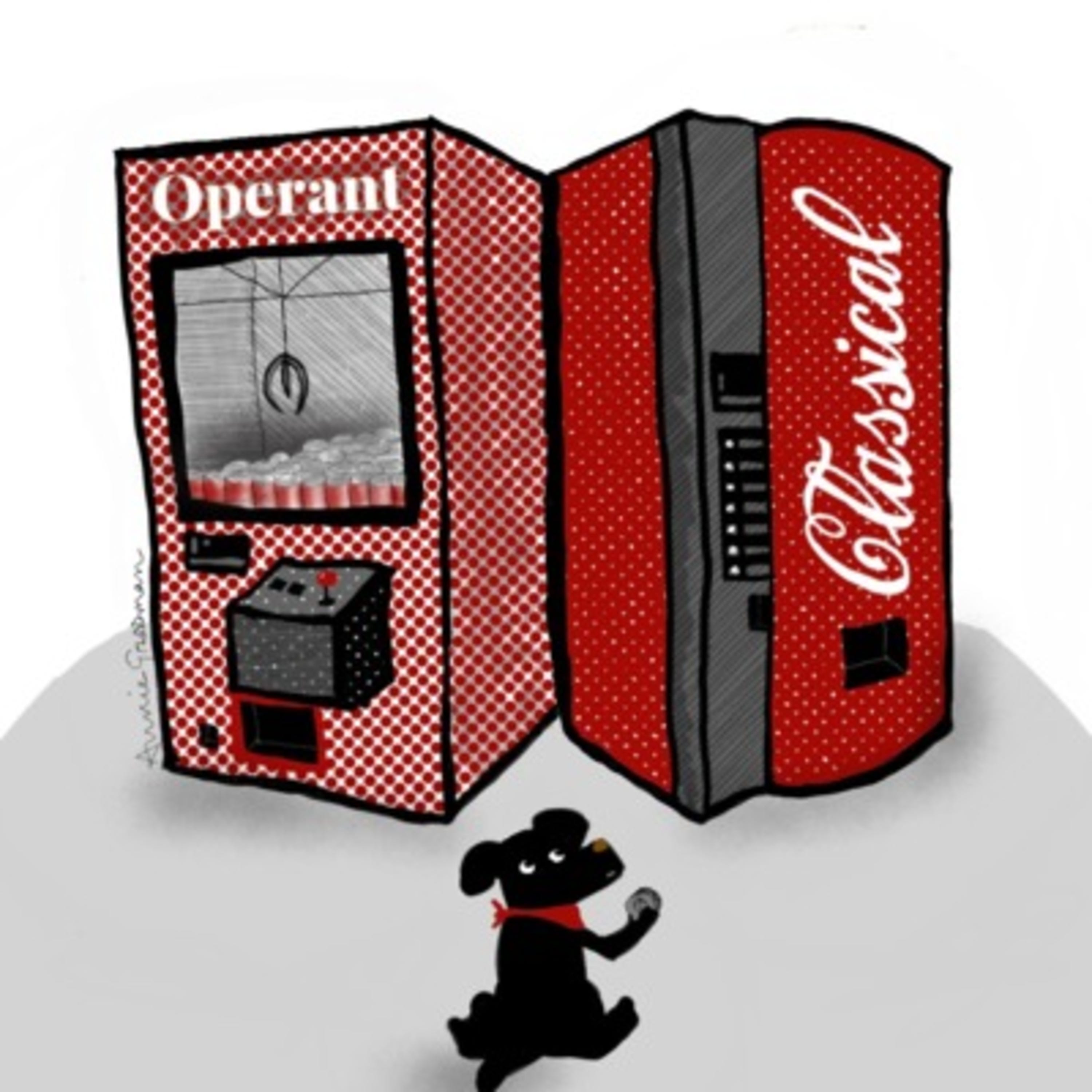
Apr 12, 2021
Bonus: Annie reads from The ABCs of Behavior by Marian Breland-Bailey and Bob Bailey from The Dog Trainer's Resources by The APDT Chronicle Of The Dog
In advance of School For The Dogs April 24th screening of Bob Bailey's short film, Patient Like The Chipmunks , Annie is reading aloud some works by Dr. Bailey and his late wife, Dr. Marian Breland-Bailey. Today she is reading from their 2001 article, The ABCs of Behavior, from The Trainer's Resource: The APDT Chronicle Of The Dog. The ABCs are Antecedent, Behavior, and Consequences. Sign up for the screening at http://schoolforthedogs.com/bailey Purchase The Dog Trainer's Resource by The APDT Chronicle Of The Dog - https://amzn.to/2Rv3ZsU --- Partial Transcript Annie: The Association of Professional Dog Trainers puts out a quarterly magazine which you can subscribe to digitally or in print. Or, you also get it if you become a member of the Association of Professional Dog Trainers. It is called Chronicle of the Dog. And it contains some excellent essays about dog training, about learning theory, about the business of dog training. They have put out some, what do you call it? Like anthologies. Yeah, I guess anthologies. And I have one of them that’s called the Dog Trainer’s Resource. It’s from 2007, it’s a collection of their essays and there’s so much good stuff in here. I think they’ve put out three or four of these collections of essays that appeared in the magazines. And honestly, if you buy these collections on Amazon, you can find them used, I find, usually for like six or $7. So you could buy like all of their collections probably for the amount that you would pay for a single year of quarterly magazines from them. So word to the wise. But definitely look into becoming a member you can do so apdt.com . Fun, fun, little known fact , they actually kicked me out. I was a member. I paid my a hundred dollars a year or whatever it was. And they kicked me out and then lobbied me to come back. Although I must've just been on some lapsed membership list, lobbied me to come back or continue to lobby me and actually to come back every few months saying we miss you, which I always think is funny. Cause they kicked me out for reasons I'm not going to get into right now, but maybe one day in the future, I will. It had nothing to do with dog abuse or anything like that. Anyway today I wanted to read an essay from my copy of the dog trainer's resource, which I love. The last few Mondays I've been doing these readings reading things that I've learned from that I'd like to share. Last week, I read from Bob Bailey's website, and this week I'm also going to read something by Bob Bailey. And next week I'm going to read something again by Bob Bailey. This is because on April 24th, at 4:00 PM Eastern, we are going to be offering a screening of a short film he made on the history of operant conditioning called Patient Like the Chipmunks. And after that, I will be hosting a Q and A with him, pretty excited about this. He is something of a legend in the world of animal training, living legend. You can sign up at schoolforthedogs.com/Bailey . All of the proceeds will be going to the Marian Breland Bailey scholarship fund. Full transcript available at SchoolfortheDogs.com/Podcast Get full access to Don't Be a Dick to Your Dog at dogtraining.substack.com/subscribe

Apr 9, 2021
SFTD Trainer Mike Wolf on changing careers at 50, navigating urban dog parks and working with puppy owners
Longtime East Villager Mike Wolf wondered into School For The Dogs a few years ago and... never left. Mike started out as a walker with us, and now leads puppy playtimes, School Yards, does Day School sessions with us and also does Day Training sessions with our clients. He was one of our first apprentices, and is currently completing our Professional Course. Interested in becoming a professional dog trainer? Our next Professional Course will be held entirely online! Interested? Fill out an application at http://schoolforthedogs.com/professionalcourse21 --- Partial Transcript: [intro and music] Annie: Glad to have you on School for the Dogs podcast, you have been a School for the Dogs employee and, et al, for a long time now. Mike: More than three years. Annie: Oh my goodness. Mike: I know. If we can still be measuring time, feels a little arbitrary, but. Annie: So, I know a little bit about how you came to us, but why don’t you share a little bit about how you ended up at School for the Dogs, and then we can talk about like the stuff that you’ve been doing work-wise. Mike: Okay. Well, I don’t consider it a very direct path. It’s either a third or a fourth career for me, depending upon what you consider a career. But I worked in the music industry for like 25 years and that led to a job in music journalism as a writer and editor. Annie: You worked at record stores, didn’t you? Mike: Oh I worked at record stores, that was a bit more recently actually. But starting in the late nineties, I began writing professionally, which was a surprise to me because I had never gone to journalism school or anything like that. But I had a background in working in music. So I guess I just had a certain type of info or a certain type of a background. Annie: What were you doing in the world of music? Mike: In the world’s music. Well, let’s see, I started at college radio, which doesn’t sound too unique, but it quickly led to an internship at a record label. This was all in Minneapolis, Minnesota. In the indie eighties, by the way. And so the internship at a record label led to a job at the record label. That led to a part-time job at the record label next door, that led to also deejaying at a club downtown, that led to full-time work at one of the record labels, deejaying at a club. DJing at radio city. Like I was doing, I was really lucky. I had a ton of really fun experiences in a fun, really fun music city, Minneapolis from like the mid eighties to the mid nineties. Then I had a two year detour in Chapel Hill, North Carolina, still doing music stuff, working for a record label that’s based in New Zealand. And then I made the move to New York and really tumbled into — like, I dunno, it’s definitely a function of my privilege, but I’ve recently just kind of stumbled from one job to the other and from one career to the next. I very suddenly with very little writing experience began working full-time at Time Out New York at the beginning of 2000. Which was really a really cool and overwhelming time to be involved in media in New York. And music was always kind of just like this overwhelming, engulfing experience. To be a big music fan and to get to work in the music industry, I was very lucky. Full Transcript available at SchoolfortheDogs.com/Podcast Get full access to Don't Be a Dick to Your Dog at dogtraining.substack.com/subscribe
Apr 7, 2021
How to train a dog to "sit" from scratch (2018)
This is a bonus episode-- a rebroadcast of Episode 19. It covers how to teach a dog to sit using a bit of a lure and a novel cue: A snap. This exercise is today's challenge in the Dog Training in 21 Days challenge we're running right on Instagram! Join us there for instructions, demonstrations, and more. Get the full Dog Training in 21 Days course for free through the end of April at http://schoolforthedogs.com/dt21days ; use code DT21DAYS at checkout. This episode originally aired on August 6, 2018. Newsflash: Your dog already knows how to sit! But he may not know the cue you want to associate with that behavior. Annie breaks down how to use the "capturing" technique to teach "sit" anew and to add a novel cue. She covers: -The downsides of "luring" a behavior or "molding" it -The trap of trying to teach a behavior by asking for it repeatedly -The difference between a "cue" and a "command" -How to add a cue -The never-ending process of "shaping" a behavior -How to fade a lure and turn it into a cue --- Partial Transcript: Annie: Hi, this is a bonus episode that is a replay of an episode I recorded in the summer of 2018 on teaching a dog to sit using the cue of a finger snap . This is kind of my favorite way to quickly teach a sit and incorporate what is usually a novel cue into the equation early on. I tried to break it down clearly and quickly in this podcast episode. And I’m reposting it today because this is the assignment for today’s challenge. We are running our Dog Training in 21 days course as a 21 day challenge . Right now you can learn more on Instagram and hop on into the challenge. It’s all right if you didn’t start on day one, we would love to have you start today. Full Transcript available at SchoolfortheDogs.com/Podcasts/ Get full access to Don't Be a Dick to Your Dog at dogtraining.substack.com/subscribe
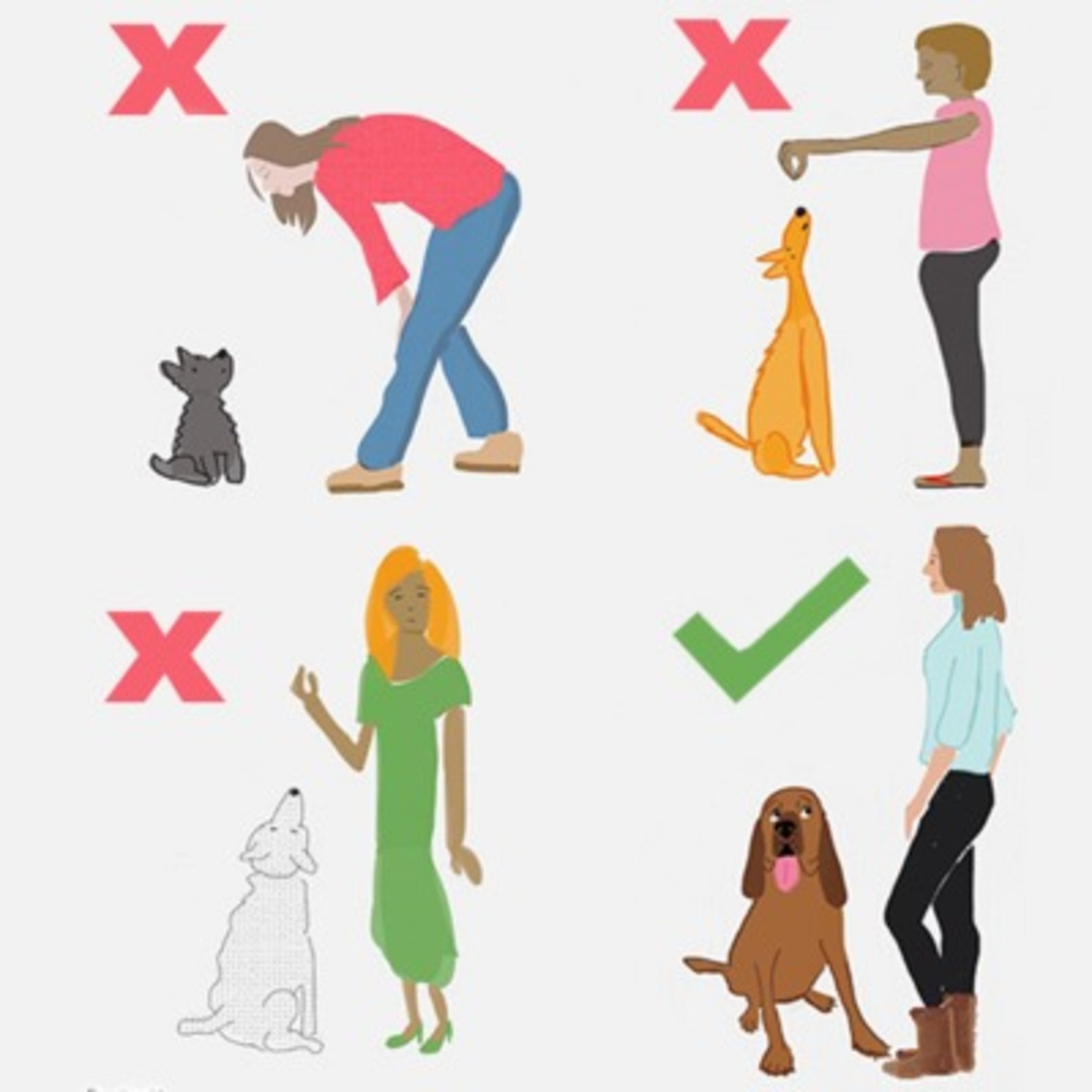
Apr 5, 2021
Bonus: Training wisdom from page 9 of Dr. Bob Bailey's website (Plus: Join Annie for a film screening and Q and A with Dr. Bailey on April 24th)
Bonus episode! Annie reads some casually-written but oh-so-important training tips from the website belonging to Dr. Bob Bailey, behavior1.com . Annie will be showing Dr. Bailey's film on the history of his company, Animal Behavior Enterprises, and the history of operant conditioning, and then hosting a conversation with Dr. Bailey, on April 24th at 4PM Eastern. Sign up at http://schoolforthedogs.com/bailey Dr. Bob Bailey is an animal trainer, inventor, designer, writer, teacher, diver, and photographer. He is the widower of B.F. Skinner's graduate student, Dr. Marian Breland Bailey. All proceeds from the screening will go to the Marian Breland Bailey Memorial Fund at Arkansas' Henderson State University. About the Baileys http://www.behavior1.com/page8.html Page 9 http://www.behavior1.com/page9.html More about Patient Like The Chipmunks http://www.behavior1.com/page5.html Dr. Sophia Yin's video about Chicken Camp with Dr. Bob Bailey from 2000 https://archive.org/details/Chicken_Training_Camp_2000 --- Partial Transcript: Annie: Bob Bailey, or I should say Dr. Bob Bailey, is a trainer who lives in Arkansas, and I’m kind of obsessed with him. He was both business partner and husband to Marian Breland Bailey, also Dr. Marian Breland Bailey, who together with her first husband, Keller Breland and Bob Bailey who came to work with them before Keller’s untimely death in the early 1960s, the three of them built this company called Animal Behavior Enterprises, which did so many really unique things in the realm of animal training. They train animals mostly for commercial purposes to do things that we’re pretty incredible. One thing they did was create these kind of like, I guess maybe you call it like a diorama with moving parts in it for animals. And they train like over a hundred different species of animals, but like an animal in this Lucite, basically Skinner box, they would train these animals to do all kinds of crazy funny tricks, like play basketball, play baseball, dance, play tic-tac-toe. And I actually, and then they would ship these all around the world, and I actually grew up at, the arcade that I used to go to as a kid in Manhattan had a dancing chicken and a tic-tac-toe playing chicken that I was pretty obsessed with. Actually my whole family, we all loved the tic-tac-toe chicken and would discuss the tic-tac-toe chicken. Never in my childhood did I think about where this chicken came from and whether the chicken was actually trained or how it was trained totally did not cross my mind. I guess if I thought about it, I would have thought the dancing chicken was like being electrocuted and that’s why it was jumping or something, although I was completely off base. Anyway, these amusements were part of what Animal Behavior Enterprises did among other things, which included training animals for the military, training animals for film. Full Transcript available at SchoolfortheDogs.com/Podcast Get full access to Don't Be a Dick to Your Dog at dogtraining.substack.com/subscribe
Apr 2, 2021
Why you should teach your dog to use your iPhone (seriously): SFTD's Dog Training in 21 Days' Day 2 Challenge, explained
Touchscreen devices can be used to teach a nose touch, which is a basic, building-block behavior that School For The Dogs' trainers teach almost every dog they work with. A nose touch can be taught with a person's hands and a dog's nose; the person clicks when the dog's nose touches the screen, and then the dog receives a reward. Using a touchscreen device and one of a handful of apps, you can take the clicker out of the equation and your dog's nose will register a sound when it makes contact with the screen, essentially doing the job of any good marker signal. Annie discusses the origins of her use of touchscreens with dogs and talks about some of the more advanced work that can be done with screens, such as teaching a dog to read, teaching cue differentiation, and more. Episode on teaching touch : https://www.schoolforthedogs.com/podcasts/episode-60-the-most-important-behavior-youll-ever-train/ More on using touch screens: Dogs Take Selfies Too - https://anniegrossman.com/2013/11/training/dogs-take-selfies-too-48370/8225/ Teaching Dogs to Use iPads in London - https://anniegrossman.com/2014/03/training/school-for-the-dogs-studies-abroad-teaching-dogs-to-use-ipads-in-london-80528/8330/ Teaching Pets to Use iPads in NYC - https://anniegrossman.com/2013/08/training/idog-teaching-pets-to-use-ipads-in-nyc-56551/8127/ The First App Made Specifically for Canines - https://anniegrossman.com/2013/09/science/app-for-dog-the-first-app-made-specifically-for-canines-79647/8190/ Three Apps Your Dog Can Use to Make Art - https://anniegrossman.com/2013/12/training/3-apps-your-dog-can-use-to-make-art-35313/8246/ Apps mentioned: Doodle Buddy - https://apps.apple.com/us/app/doodle-buddy-paint-draw-app/id313232441 App for Dog - https://apps.apple.com/us/app/app-for-dog-free-puppy-painting-button-clicker-training/id968928583 Yes No App - https://apps.apple.com/us/app/yes-no-from-i-can-do-apps/id635649909 --- Partial Transcript: [Intro and music] Annie: A few years ago, back when Kate and I were running School for the Dogs out of my living room, in 2013 I got a spate of prank phone calls. They might’ve all been from the same person. I don’t know. One was someone asking me if I could help them teach their dog to navigate the worldwide web, because right now he only knew how to do one thing online and it was to watch porn. Another caller asked if I could teach the dog to use the remote control. That one I actually, I thought was legit for, for half a second. I said, I guess I could teach a dog to use a TV remote, but why would you need to do that? And he said, well, I’d like it if he could change the channel when I’m masturbating. Full Transcript available at SchoolfortheDogs.com/Podcast Get full access to Don't Be a Dick to Your Dog at dogtraining.substack.com/subscribe
Mar 30, 2021
Bonus: Quick thought about cues and commands as they relate offers and bills
Good Dog Trainers will refer to giving a "cue" vs giving a dog a "command." A cue implies an opportunity; a command implies a threat. It just occurred to Annie that it's sort of like the difference between getting a special offer you can take advantage of and getting a bill you have to pay: Both result in the behavior of you spending money, but in one case you're engaging in that behavior because of positive reinforcement, and in the other, negative reinforcement. This may be a useful way to help the uninitiated understand the difference between cues and commands. --- Partial Transcript: Annie: I was just answering a question from someone. It’s actually for a presentation I’m putting together and Bailey who I work with doing Petcademy, which offers online training to people who are adopting and fostering dogs from a number of shelters throughout the country. Anyway Bailey and I are doing a presentation for a company about Petcademy. And there was a question in the deck about understanding a cue versus understanding a command. And I just thought of a good analogy that I wanted to share. So, we as good dog trainers tend to use the word cue instead of the word command when we’re referring to telling a dog what something is called. If I am teaching my dog to sit, when I say, sit, then sit is the cue. If I am teaching a dog to sit at the curb on the street, then the curb is the cue. And really there are cues all around us all the time, all around dogs all the time, indicating that it would be a good idea if you do X, Y, or Z. So cues are not just something that come from us human beings. But traditionally in dog training over the decades, the word command has been used. When I first started at Karen Pryor Academy in 2010, I remember answering homework questions with referring to giving a command to a dog and was corrected that it was a cue. And I thought, I think at first I thought like, Oh, well, I guess it’s about being nice. Like, I kind of reduced it down to that. Cue sounds nicer. But really a cue and a command are different things, because one is encouraging a behavior by saying, Hey, you, should you choose to engage in this behavior, something good is going to happen. Which is, you know, positive reinforcement, positively reinforcing behavior, adding something to the equation in order to encourage the behavior. And a command is saying, do this or else, negative reinforcement. If you don’t engage in this behavior, I’m going to take something away from you. Something bad is going to happen in the form of something desirable being taken away. And I was thinking, you know what it’s like, is like the difference between an offer and the bill. If you see a special offer for something, a sale for something you’re looking for, a deal, an ad that that results in you spending money, kind of like you responded to a cue. You didn’t have to take the offer. You chose to take the offer. The result is that you spent money. Full Transcript available at SchoolfortheDogs.com/Podcast Get full access to Don't Be a Dick to Your Dog at dogtraining.substack.com/subscribe
Mar 29, 2021
Bonus: A brief history of modern dog training (audio of lecture from the SFTD Professional Course)
Warning: If you're not a very nerdy aspiring dog trainer or a science geek when it comes to the history of the study animal behavior, this episode might not be for you! You've been warned. Annie talks about the evolution of dog training, starting with hypotheses about the domestication of dogs, the rise of the "pet" dog in the late 1800s, covering the work of Pavlov and Watson in the early 1900s, the birth of clicker training in Skinner's lab in the middle of the century, up through the rise of dominance-based trainers on TV in the late 20th and early 21st centuries. This is the audio from a lecture Annie put together for the School For The Dogs Professional Course. School For The Dogs has been training up dog trainers for four years, and is in the process of putting much of this curriculum online for aspiring dog trainers. If you're interested in learning more about the SFTD Professional Course and would like to be notified when it launches, email annie@schoolforthedogs.com . --- Partial Transcript: Annie: So this is a bonus episode that is really for listeners who are super nerdy about dog training. You’ve been warned if you end up finding it’s boring, you might not be nerdy enough. I recorded this for our professional course which we have been building out and really putting the finishing touches on. We’ve had a professional course for a few years, but we’ve been working on putting the majority of it online with both on demand and live interactive parts. If you’re interested in learning more and being notified as soon as it officially launches, just email me, annie@schoolforthedogs.com and I will give you more info. But yeah, so this is the audio of this lecture. There is a PowerPoint and video, too, which obviously you’re not going to experience because this is a podcast. But I thought I put it up here, because when I first got interested in dog training, I really didn’t have any context for any of it. So I put this presentation together to try and give some context, and answer the question where did, for instance, where did clicker training come from? And why isn’t it more widely used, and was it just recently invented et cetera, et cetera. So, hope that if you are an aspiring dog trainer or are just a geek about this kind of stuff as I am, I hope you will get something out of this. All right, here you go. Oh, and by the way, if I sound like I’m talking a little bit slowly or whatever, it’s because I’m going through slides while I’m talking. So that is that is my full disclaimer. Now go forth and listen. This lecture is going to be a brief history of dog training. This is not meant to be a comprehensive history, but rather something that touches on both the last century-ish of dog training and with an attempt to put it into the larger context of dogs in the human world over time. Did humans really domesticate dogs? We tend to have this assumption in our culture that domestication is something that we did to dogs. Actually, the more likely scenario is probably one of co-evolution, with natural selection favoring dogs who could exist in the human realm, favoring dogs who were less fearful of humans and more likely to engage in behaviors that human liked. Or have performed some kind of job for humans. The most basic job probably being eating a family’s scraps, which would reduce the amount of disease carrying vermin. Full Transcript available at SchoolfortheDogs.com/Podcast Get full access to Don't Be a Dick to Your Dog at dogtraining.substack.com/subscribe
Mar 26, 2021
Join the Dog Training in 21 Days Challenge! Meet student leader Leeyah Wiseman
On April 1 we are starting the Dog Training in 21 Days Challenge (#DT21DAYS). We’re using the hashtag on Instagram but if you don’t have IG, you can still participate! Each day there will be a simple challenge for you to complete. They are outlined below and we will be posting about them each day on Instagram as well as sharing what we are doing for it on Instagram Stories. Please join, get your dog excited about learning and flex those dog training muscles! To participate: Post a video or image everyday for 21 days showing your participation. Tag us and use #DT21DAYS so we can see. For anyone who wants to participate outside of social media, you can visit the link in bio, click Dog Training in 21 Days ( http://schoolforthedogs.com/dt21days ) and checkout with code DT21DAYS. The code will make it completely free. Note: It’s okay to miss a day(s), just jump back in when you can. Today's episode is an interview with Leeyah Wiseman, who will be demonstrating each day on our Instagram. You can also follow Leeyah on Instagram at @georgeandleeyah The Daily Challenges: WHAT’S YOUR DOGS $100 BILL? TEACH YOUR DOG TO DRAW CAPTURE 50 AWESOME THINGS TEACH A NOSE LICK TEACH LOOK (PART 1 OF 2) TEACH LOOK (PART 2 OF 2) TEACH SIT WITH A SNAP BOUNCE YOUR DOG BETWEEN 2 SPOTS TEACH A HAND TOUCH TEACH DOWN TRAIN FIND IT THE ELEVATOR GAME THE STAY GAME TEACH “DROP IT” MUZZLE TRAINING RELAXATION PROTOCOL TEACH STAND TEACH YOUR DOG WHERE TO WALK TOUCHING AN OBJECT THE PAW TOUCH SHAPING TO PAPER If you are sharing on Instagram, be sure to tag us and use the hashtag: #DT21DAYS If you’d like access to all 21 lessons, detailed steps and additional resources visit our on-demand portal - head to the link in our IG bio, click Dog Training in 21 Days and checkout with code DT21. The code will make it completely free. Good luck! --- Partial Transcript: [Intro and music] Annie: Hello listeners. Thank you for being here. I am interviewing today, Leah Wiseman, who is, we’re trying to figure out exactly what to call her, but for the moment I’m going to call her our student leader of our upcoming 21 day challenge. Leah, Hey, thanks for being here. Leah Wiseman: Hey, thanks so much for having me today. I’m so excited to chat about our challenge. Annie: I know, me too. So I wanted to have Leah on both to talk about the challenge and we can go through some of the specifics, but also just wanting to kind of hear about Leah’s journey into dog training. She has been a podcast listener, I know, since she got her puppy. Since you got your puppy, I don’t know if I should be, am I speaking to you or like the greater people? Leah: Right? It’s kind of surreal to be talking to you live when it’s I’m so used to like hearing your voice. Full transcript available at SchoolfortheDogs.com/Podcast Get full access to Don't Be a Dick to Your Dog at dogtraining.substack.com/subscribe
Mar 25, 2021
Dog Training Q and A! 3/25/2021: Training a "Velcro puppy" to be more confident and independent in order to prevent separation anxiety in the future
This is a bonus episode: A recording of a live Q and A. Join Annie Grossman for a live Q and A most Thursdays on Instagram @schoolforthedogs. Get alerted about the next one or ask a question in advance at http://schoolforthedogs.com/qanda . She also sometimes goes live to answer questions on Clubhouse. Find her there: @anniegrossman. Today, Annie spoke to the human belonging to Penny ( @heytherepenny on Instagram) about how to help young Penny feel more comfortable alone and how to start to prevent separation anxiety before it begins. Annie gives lots of tips on crate training, talks about how to create crate "FOMO," use the Treat and Train , and more. Join us on Instagram in April for our Day 1 of our Dog Training in 21 Days Challenge! --- Partial Transcript: Annie: Hi, is this Penny? Angela: Yes, this is Penny. Annie: And tell me your name. Angela: My name is Angela. Annie: Hey Angela. I’m recording this for School for the Dogs podcast. Is that okay? Angela: Yes. Annie: And where are you guys based? Are you in New York City? Angela: Yeah, so we are, we actually did sign up for a course at School for the Dogs, which starts in April. Annie: Oh, great. Which course are you doing with us? Angela: We’re doing Calm canine. Annie: Oh, great. Excellent. Angela: Just cause Penny, she’s really excited whenever she goes outside. So we’re hoping that’ll help. Annie: Is she a golden doodle? Angela: She’s a cavapoo. Annie: Okay. And how old is she? Angela: She’s six months old now. Annie: Oh, she’s a little, just a tiny pup. Okay. Well tell me what’s going on with Penny. Angela: Well, so she basically follows us everywhere in the home. So like if she’s on the couch and we get up to go somewhere, she will, even if she’s asleep, she will wake up, hop down and follow us to wherever we are. My only concern right now, my boyfriend works from home, so she’s around somebody all day, but my concern is just like, when things go back to normal, he goes back to work. Just because she’s so used to following us, seeing us everywhere, if this becomes an issue for separation. Annie: Yeah. Well, I think you’re right to be thinking about that in advance. Have you tried leaving her alone? Have you tried leaving her with anyone else? What happens when you do that? Angela: So she we’ve done little intervals, like maybe five, 10 minutes or something, but just like we’re in another room. So we’re still, you know, she’ll be in the living room and we’ll just go to another room and kind of watch her on the camera. She again tries to follow us. So for the five, 10 minutes, she will eventually, after a couple minutes of scratching at the door, will go and kind of like sit on the couch. But the longest that we’ve left her is probably like 10 minutes or so. Annie: And she cries during those 10 minutes? Full transcript available at SchoolfortheDogs.com/Podcast Get full access to Don't Be a Dick to Your Dog at dogtraining.substack.com/subscribe
Mar 22, 2021
Bonus: One positive-reinforcement dog trainer's point of view on guns in America
Annie reads a satirical essay she wrote, approaching the gun control debate from the point of view of a dog trainer. With dogs, we can create antecedent arrangements to control the environment in order to keep dogs from eating our shoes. If only it were so easy. If only it were so easy keep people from shooting each other... A FAREWELL TO FOOTWEAR: A DOG TRAINER WEIGHS IN ON THE SHOE CONTROL DEBATE by Annie Grossman As an animal trainer by profession, I am specifically interested in shoes that get into the hands, or, rather in the mouths, of dogs. From what I witness in the homes of my clients, the deleterious use of shoes by dogs is a problem with no easy solution. Almost daily, I hear of incidents relating to shoe carnage: people coming home to find their Uggs in pieces all over the living room floor; midnight vet runs spurred by decimated Nikes causing intestinal blockage; children arriving at school late and in tears because the goldendoodle has absconded with a sandal. The problem goes beyond mere inconvenience: At any shelter, you can find dogs who face euthanasia because of sins relating to their insatiable appetite for footwear, and vets around the country will attest to the damage (sometimes irreversible and even fatal) that dogs cause themselves because of their obsession with our shoes. After every incident, be it a small-time heel nibble or a full on closet rampage, there is one question that I hear over and over again: Why did he do it? Motive is a major cause of conversation around these issues. So many dog owners will say that shoe misuse stems from deep-seated puppyhood issues, profound mental disturbance, or a need for dominance. Some say dogs are prone to these kinds of disruptive behaviors because of spite, or inferiority complexes. But, as a trainer, I like to remind people that we cannot read dog minds. We can make a lot of guesses, but they’ll only ever be guesses. Did he do it because of issues with his absentee father? Was he trying to prove himself to the b***h next door? Maybe. And we could spend a lot of time trying to establish motives rooted in those kinds of storylines. But, the fact is, if a dog eats your shoe, it’s because there was a shoe available to eat.... Full Transcript available at SchoolfortheDogs.com/Podcast Get full access to Don't Be a Dick to Your Dog at dogtraining.substack.com/subscribe

Mar 19, 2021
The queen of lickable treats: Meet Brandi Barker, creator of the Bark Pouch
School For The Dogs' trainers and clients love treats that dogs can lick straight from a container. One woman has cornered this market, and we're so glad. Her name is Brandi Barker. She started out training dog, but now is the fulltime force behind Bark Pouches, which are little squirt bottles filled with shelf-stable deliciousness. She and Annie talk about how she entered the world of dog training, how she came up with her product, and more. Get Bark Pouches at storeforthedogs.com https://storeforthedogs.com/collections/bark-pouch or at BarkPouch.com https://www.barkpouch.com/ --- Partial Transcript: [Intro and music] Annie: Hello folks. Thank you for being here. I am here with Brandi Barker, who has the world’s best last name if you’re into dogs [laughs]. And Brandi who is joining us from Chicago? I believe. Brandi: I actually moved to Columbus, Ohio. Annie: Oh, okay. From Columbus, Ohio. Why don’t you tell us about your amazing product and then we can go from there. Brandi: Okay. Sounds good. So it’s called Bark Pouch, and it’s dog treats in a pouch. Everything is human grade. And I try to keep the ingredients really minimal and I have multiple sizes. I have multiple — Annie: Sorry to interrupt you, but explain it. Let’s explain what a pouch is because it has different meanings. Brandi: Okay. Okay. So you want me to start over then? Annie: No, no, no, just go ahead. Brandi: Okay. So it’s it’s dog treats in a pouch. So if you’ve ever seen the applesauce pouches, or the yogurt pouches that kids eat from, it’s basically like a paste type consistency that you just hold down for your dog and squeeze a tiny bit. They lick straight from the pouch. So it’s, I really design them for walking and training just to make that process easier for people. Annie: What’s funny is I have a toddler. And she eats now from these kinds of pouches all the time, but I feel like my first exposure to this kind of pouch was through Bark Pouch. And then I was like, Oh, wait, they make these for children too. And actually some of the ones that they make for children, I think you can also use for dogs. But yeah, so we’ve been carrying your product for several years now, and they are so genius because they’re lickable. And as trainers we are very into treats that can be licked straight from the container for so many reasons. One reason that I think that people might not think about is when you’re working with dogs all the time, as so many of us are, your hands get really gross and your pockets get really gross. So having something that can simply be given straight from the container into a dog’s mouth is great. Love using it for especially outside, love using it for stuff like muzzle training. So many reasons. And recently we have been selling so many more Bark Pouches before because they used to have to be stored frozen, and then put in the refrigerator after use, but by some magic of production, they are now shelf stable as of a few months ago. And so we’ve been shipping them all over the country. Full Transcript available at SchoolfortheDogs.com/Podcast Get full access to Don't Be a Dick to Your Dog at dogtraining.substack.com/subscribe
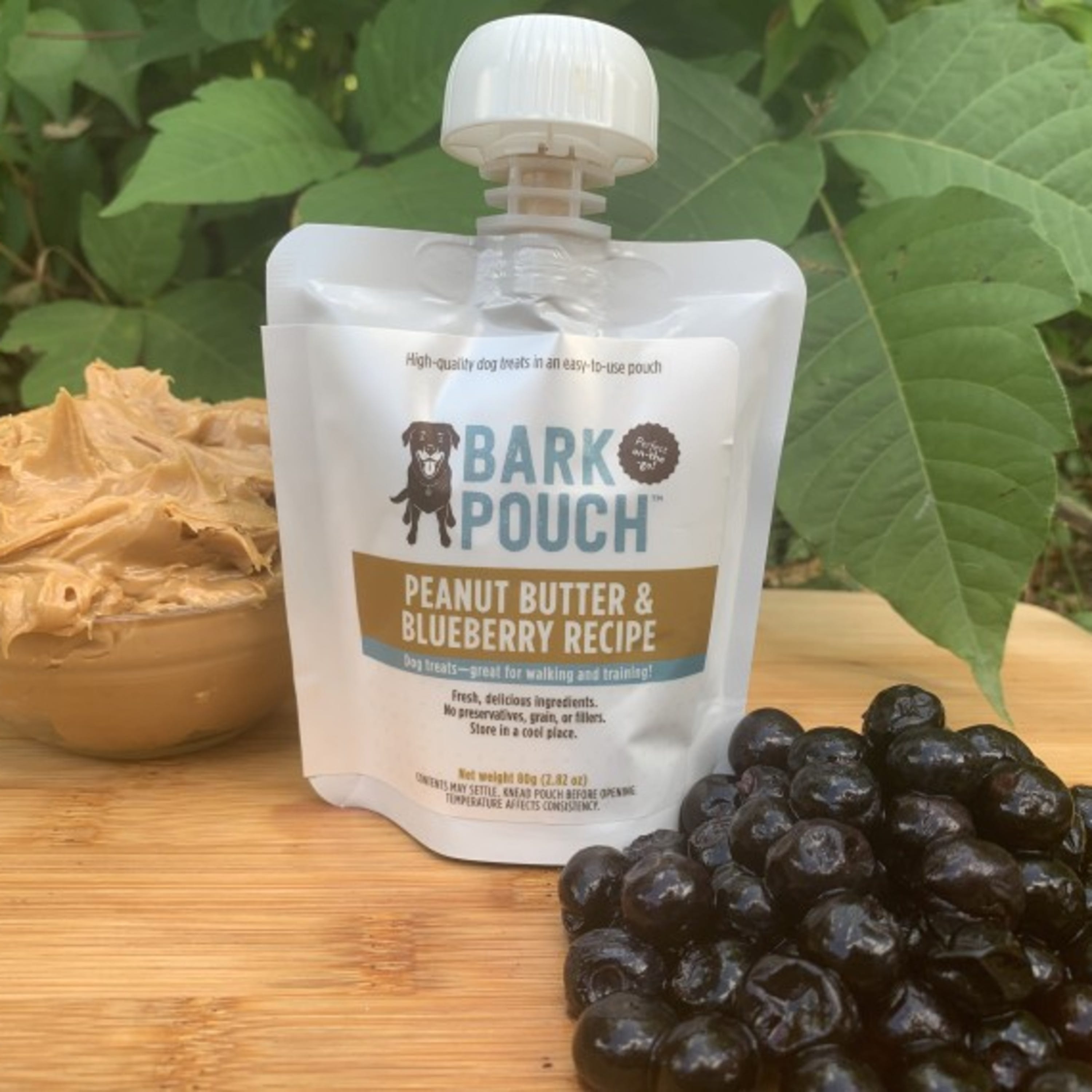
Mar 18, 2021
Dog Training Q and A! 3/18/2021: Keeping a dog off furniture, toys you can leave in the crate, using physical pressure during leash walks and more
This is a bonus episode: A recording of a live Q and A. Join Annie Grossman for a live Q and A most Thursdays on Instagram @schoolforthedogs. Get alerted about the next one or ask a question in advance at http://schoolforthedogs.com/qanda . She also sometimes goes live to answer questions on Clubhouse. Find her there: @anniegrossman. Join her on Clubhouse tomorrow 3/19 at 12PM ET to give your answer to the question: What is a good dog? Need a Clubhouse invite? Text 917-414-2625. Today, Annie answered the following questions: -Is it considered "positive punishment" if you use body pressure to encourage walking (from @vagabondpaws) -What is the best way to keep your puppy off of furniture? Saying "No" or "Off"? (from @eleniannm) -How do you get a 12-week-old puppy to potty outside (from @eastvillageenzo) -How do you get a puppy to eat her kibble if she only wants to eat treats and people food? (from @heytherepenny) -What are good toys to leave in the crate (from @303lauren) -How can you best train yourself before getting a dog? (from @alinalauranarvaez) -What should you do when a puppy cries overnight, besides taking him out to potty? (from @luvmesumkatie) Mentioned in this episode: SFTD's on demand courses course available at schoolforthedogs.com/courses SFTD's house training guide: schoolforthedogs.com/house SFTD's puppy nipping guide: schoolforthedogs.com/nip Truthaboutpetfood.com Products: The Groov by Diggs https://storeforthedogs.com/products/groov-training-aid?_pos=1&_sid=dfad4b503&_ss=r The Toppl https://storeforthedogs.com/products/toppl?_pos=1&_sid=b6781a892&_ss=r Yak Chews: https://storeforthedogs.com/products/himalayan-chews Bully Grip https://storeforthedogs.com/products/bully-grip-stick-holder?_pos=1&_sid=19b6e3056&_ss=r Other episodes mentioned: A Pet Food Killed My Dog (Interview with Sue Thixton of Truthaboutpetfood.com ) https://www.schoolforthedogs.com/podcasts/episode-63-a-pet-food-killed-my-dog-susan-thixton-the-truth-about-pet-food/ A Modern Dog Owners Guide To Nipping https://www.schoolforthedogs.com/podcasts/episode-10-a-modern-dog-owners-guide-to-nipping/ A Modern Dog Owners Guide To House Training https://www.schoolforthedogs.com/podcasts/episode-3-a-modern-guide-to-house-training-your-dog/ In Defense of Negative Punishment https://anchor.fm/dogs/episodes/In-Defense-of-Negative-Punishment-Teaching-dogs-patience-at-mealtime--stopping-thumb-sucking--more-erj8si Get full access to Don't Be a Dick to Your Dog at dogtraining.substack.com/subscribe
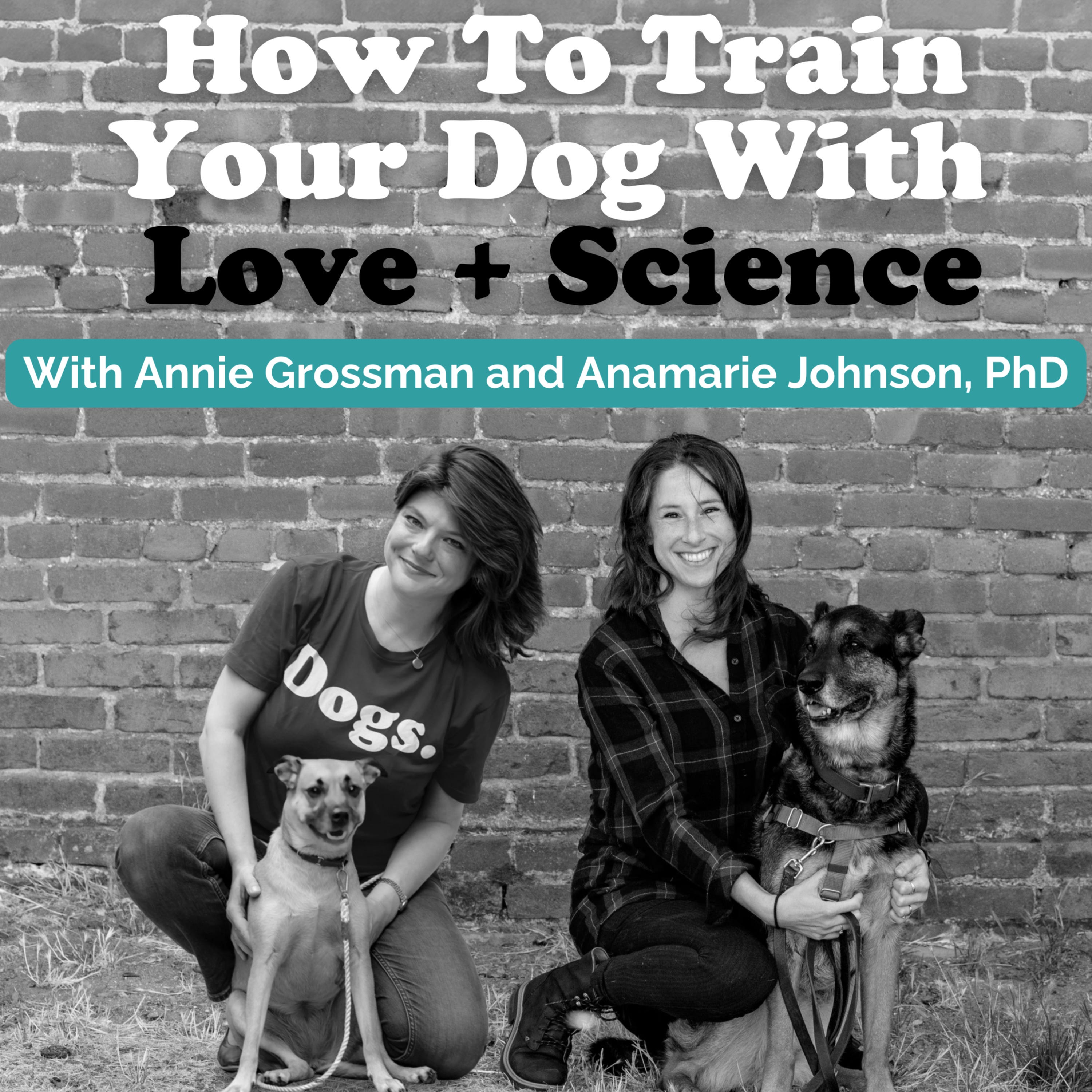
Mar 16, 2021
Bonus: Annie reads aloud Walden Two Revisited, the 1976 preface to BF Skinner's novel Walden Two
This is a bonus episode in which Annie reads aloud the preface to Walden Two , BF Skinner's 1948 novel about a utopian community that he imagines could be closely engineered based on what we know about behavioral science, and cooperatively governed based on principles rooted in positive reinforcement. The book was called "fascism without tears" when it was published and also compared to a plan for a dog obedience school for humans. Three decades after writing it, Skinner wrote Walden Two Revisited, which reflected on how society still hadn't done enough to harness the power of non-coercive, non-punitive control in order to better people's lives. Forty-five years hence, has anything really changed? Maybe dog training can help us better understand what Skinner had in mind... Notes: Clubhouse Reading Group on Walden Two: 4/1 at 3PM ET. Need a Clubhouse Invite? Text 917-414-2625 Annie imitates a dial up modem: https://www.youtube.com/watch?v=9B8KPvp9eew Buy Walden Two: https://amzn.to/3cKdGL8 3 minute summary of Walden Two, by the Prosocial Progress Foundation --- Partial Transcript: Annie: This is a bonus episode. Woo woo woo wee aw wee aw wee aw! That’s my bonus episode cheer. It happens to also sound a lot like a car alarm. I also do impressions of dial up modems, true story. Look in show notes. Anyway, I have decided to give myself permission as this podcast’s editor and producer to do the occasional episode that is really only tangentially related to dog training. It’s not specifically related to solving dog training problems, but that touches in my mind on dog training in a larger context. And that these episodes may sometimes simply be me reading things that I have found thought-provoking in this arena. Last week, I read the 1913 essay, um by John B. Watson psychology as the behaviorist views it. Which kind of pits the then just burgeoning world of behavioral psychology, behavior analysis, against cognitive psychology kind of as if it were pitting science or a theory of evolution against creationism. And today I read it and see a lot of similarities between the world of science based, positive reinforcement rooted dog training, and the world of dog training that has to do with myth and energy and misunderstood concepts like dominance. Today I wanted to read the 1976 forward written by BF Skinner for his 1948 novel, Walden Two. Which I first read about 10 years ago. And it really, it really affected me. It was sort of the first time that I realized that I had, I had just graduated KPA at that point that I had kind of learned how to use this technology of this field of sciences, field of behavioral science to train dogs. But really the same basic bits and pieces could be used to do things way outside of helping people get their dogs to not pee and poop in the house. And actually, Walden Two, which is, it’s not a book to be read because it’s like fine writing. It’s a book written by a scientist to communicate ideas. And when it came out it was, it was likened to the idea of creating a dog obedience school for humans. And was also called fascism without tears. And it, I mean, I guess there is fascism in his suggestions for how a utopia could be, but also communism, and also a kind of socio libertarianism. Full Transcript available at SchoolfortheDogs.com/Podcast Get full access to Don't Be a Dick to Your Dog at dogtraining.substack.com/subscribe

Mar 12, 2021
Air B and...Pee? Sniff Spot allows dog owners to rent people's yards! Genius!
When David Adams' girlfriend traveled with her dog, she had an issue: The dog only liked to pee in yards. Adams, who had previously build a site for people looking for short-term apartment rentals, had an idea: What if there where people could rent... yards? So, he built SniffSpot.com , which allows people to rent out their fenced-in outdoor spaces to dogs, hourly. Annie and David discuss how this innovative service may revolutionize the way dogs are able to exercise and socialize. Learn more at SniffSpot.com . Like this episode! Please leave a review on iTunes ! Support School For The Dogs by shopping at storeforthedogs.com Download our new app to join the conversation at http://schoolforthedogs.com/community Special thanks to Bill and Lizzie of Toast Garden for creating our Season Three intro song! Find them on Youtube.com/toastgarden --- Partial Transcript: Annie: All right, David. Thanks for being here. Why don’t you just go ahead and tell me about yourself and your really interesting business. David Adams: Yeah, yeah, definitely. Thanks for having me. So Sniff Spot, maybe I’ll start by telling you how it came about and I can talk about it a little bit. Annie: And if you don’t mind, tell me your full name and where you’re based. David: Yes. So my full name is David Adams and I’m currently living in Boston. Annie: Okay. And Sniff Spot. Is Sniff Spot your baby? David: Yes. Yes. One of them, one of them. Annie: Oh, okay. Well, are there other babies that we’re going to need to know about? David: There are other babies, there are two fur babies named Soba and Toshi, and they came before Sniff Spot and they actually inspired Sniff Spot. Annie: So what is Sniff Spot for those who don’t know? David: Yeah. So Sniff Spot is Airbnb for dog parks. The idea is that anyone can offer their land or their yard as a safe and private space for dogs to play. And people that have dogs can book hourly for private time with their dogs, for exercise, training, whatever they want. Annie: That’s such an interesting idea. So when did you first come up with this idea and tell me about its evolution David: Yeah, so I was living in Seattle at the time. And I had just met this wonderful woman who is now my wife and I had my dog Soba and she had her dog Toshi. And I was going around to dog parks with Soba. I was a first time dog owner and just kept having bad experiences. Soba is high energy, she’s a lab pit mix. And I needed to exercise her, but dog parks, you know, there were dogs there she didn’t get along with. They felt dirty and not hygienic. So I was feeling dissatisfied. Full Transcript available at SchoolfortheDogs.com/Podcast Get full access to Don't Be a Dick to Your Dog at dogtraining.substack.com/subscribe
Mar 11, 2021
Dog Training Q and A! 3/11/2021:Bringing a fearful puppy onto the city streets and/or to the dog park
This is a bonus episode: A recording of a live Q and A. Join Annie Grossman for a live Q and A most Thursdays on Instagram @schoolforthedogs . Get alerted about the next one or ask a question in advance at http://schoolforthedogs.com/qanda . She also sometimes goes live to answer questions on Clubhouse. Find her there: @anniegrossman. Here, Annie talks to an SFTD client who has a young rescue dog who became frightened about going outside after some bad experiences on walks. The owner has been bringing the dog to off-leash time at School For The Dogs in NYC and wants Annie's thoughts on bringing him to the dog park. Mentioned in this episode: Dog Body Language course available at http://schoolforthedogs.com/courses Lili Chin's book Doggie Language https://amzn.to/3cpAO1e Sue Sternberg's dog park app Learn more about off-leash offerings at School For The Dogs at SchoolForTheDogs.com Dogs under 5 months: https://www.schoolforthedogs.com/services/puppy-playtime/ Dogs over 5 months: https://www.schoolforthedogs.com/services/school-yard/ --- Partial Transcript: Annie: So Katie with her dachshund mix. Katie wrote: I got three-ish months old Sunny on January 13th and he has settled in swimmingly. He’s happy go lucky, playful, but overall, very calm and observant. One standout example. When a stranger came in the house briefly, he all blinked at him. He only barks in the mornings to get out of his crate. He’s crate trained and he sleeps for around eight hours every night. The issue: he was with foster mom on a farm before coming to be in Brooklyn and was increasingly skittish on our initial walks to the park. Note, he was on pain meds from his neutering at first. As days oere on and pain meds wore off this continued. So I started picking him up and walking him to the park. Eventually he didn’t want to go outside at all. We had a couple of unfortunate incidents that may have sped up the snowballing, including spooky home alone, where the passers-by, and one Pitbull that got a little too close sending Sunny between my boots and then yelping like a car alarm. I tried using treats, but after day five of growing anxiety, frankly, on both of our parts, I stuck to a pee pad in our backyard and we’ve since had great success with him going on command on the pads, both inside and outside. My question, how soon is too soon to hit the sidewalk and or the park? He’s had two rounds of vaccinations and we’re going to puppy socialization class at School for the Dogs on Monday. But again, she wrote this like a month ago and she just wrote me a little bit of an update. Let me see if I can find it, but I did also invite her to come on to chat here. So earlier today she wrote... Full Transcript available at SchoolfortheDogs.com/Podcast Get full access to Don't Be a Dick to Your Dog at dogtraining.substack.com/subscribe
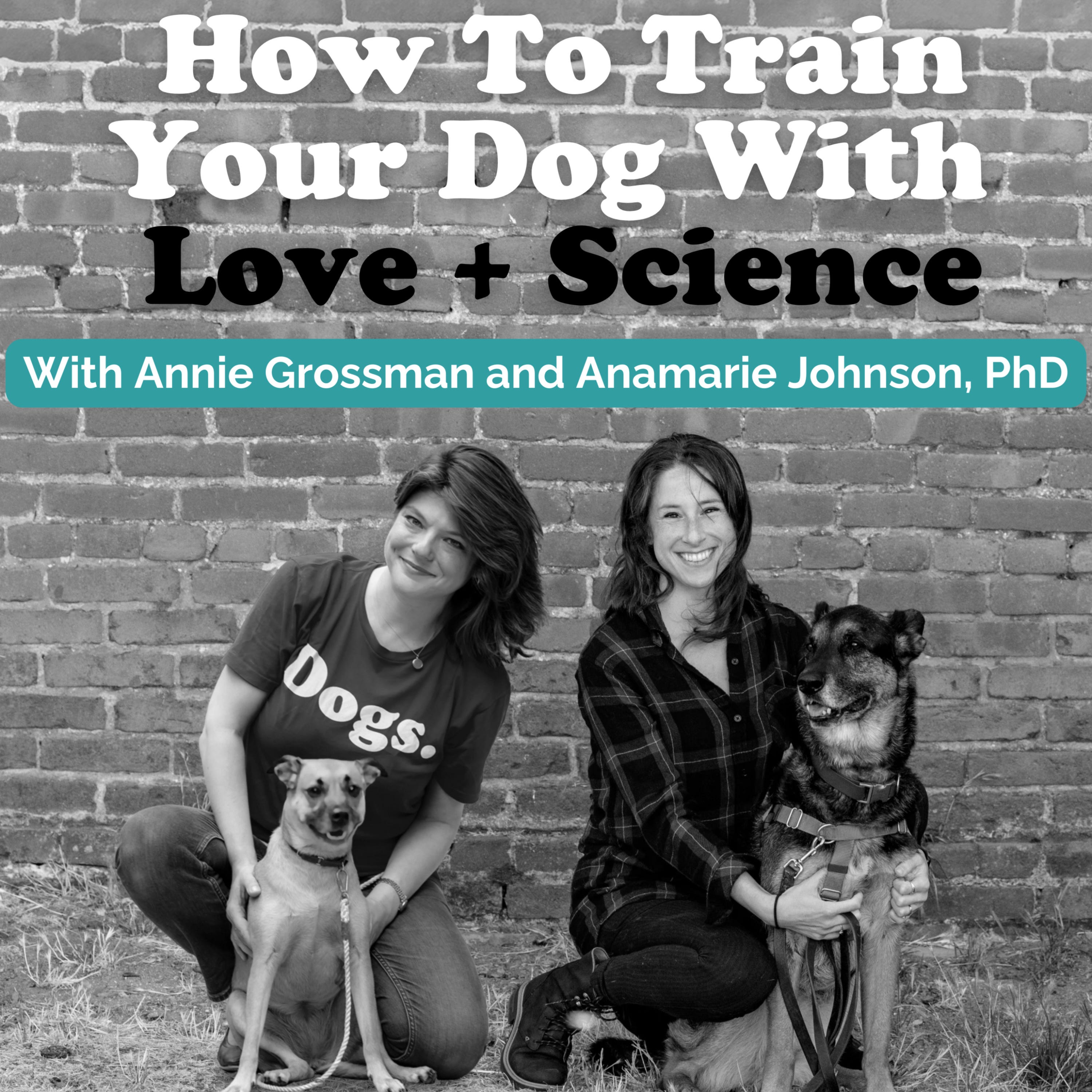
Mar 8, 2021
Bonus: Annie reads aloud John B. Watson's 1913 essay "Psychology As The Behaviorist Views it"
Professor John B. Watson's 1913 essay argues that psychology should be studied from a behavioral perspective, echoes some of the same conversations that are had today between dog trainers who are approach dog training as a science and those who approach dog training by making assumptions about dogs' internal feelings and motivations. Read "Psychology As The Behaviorist Views it" in full at http://anniegrossman.com/watsonessay Thoughts on this? Join the conversation by downloading the School For The Dogs Community app find it in iTunes: http://schoolforthedogs.com/app find it in the Play store: http://schoolforthedogs.com/play --- Transcript: [Intro] Annie: Happy Monday morning humans. I am going to take advantage of this quiet moment in my home. Quiet because my daughter’s wonderful babysitter has brought her to the playground. To share with you an essay I just looked up that I actually have not read in several years, but I remember it left quite an impression on me when I did read it. It’s from Psychological Review from 1913 by John B. Watson. I looked this up because I am working on some of the lectures that are going with our online professional course, which, I’m just finishing up these lectures. And I did a lecture on the history of dog training, and the history of dog training and both in universities and in pop culture, I guess is the best way to describe what the lecture is. And I mentioned Skinner and said something about how Skinner was influenced by the work of Ivan Pavlov and John B. Watson. Both of whom were mostly working in the very early 1900s. And I kind of just started looking up stuff about John B. Watson. Again, I got on kind of a Watson kick a few years ago. I read part of his biography, which I’d actually like to look at again. I think Watson has probably due his own episode at some point, and is widely considered the OG daddy of the field of behavioral science as I understand it. Briefly put, he was a psychology professor, I think at Johns Hopkins. His most famous experiment was most likely the baby Albert experiment, where he showed you could condition a child to be scared of all things fuzzy, like rabbits and that kind of thing, by pairing similar fuzzy furry things with a loud scary noise. It’s pretty cruel and weird considering his research subject was a non-verbal 18 month old boy named little Albert. But still interesting as it certainly relates to so much dog training where we see dogs become conditioned to fear seemingly random things. And he ended up leaving academics, I think because of some sort of affair he had with a student. And he ended up at the famous ad agency, J Walter Thompson, where he used what he had studied and learned about human behavior in order to manipulate humans into buying things. He is credited with having popularized the idea of a coffee break, giving people a built-in reason in their day to stop and go drink and buy coffee. So if you are a big coffee drinker, as I am, you might just have John B. Watson to thank for your very stained teeth. Full Transcript available at SchoolfortheDogs.com/Podcast Get full access to Don't Be a Dick to Your Dog at dogtraining.substack.com/subscribe

Mar 5, 2021
In Defense of Negative Punishment: Teaching dogs patience at mealtime, stopping thumb sucking & more
Is all punishment necessarily bad? Nope! There are two kinds of punishment, and one of them is actually frequently used by so called "positive reinforcement" trainers like Annie: Negative Punishment. Here Annie breaks down what Negative Punishment is, talks about how it interplays with positive reinforcement, and explains its role in the "Elevator Game," which is a great exercise you can to do at mealtimes in order to teach a dog to not bum-rush the food bowl. She also reads from Behavior Principles In Every Day Life by John D. Baldwin and Janice I. Baldwin, which talks about a study in which parents used negative punishment at story time in order to discourage children from sucking their thumbs. Behavior Principles In Every Day Life by John D. Baldwin and Janice I. Baldwin, https://amzn.to/3qd8TXf Eileen Anderson on Extinction https://eileenanddogs.com/blog/category/extinction-2/ Other episodes and blog posts on this topic: Episode 65: Don't let your dog cry it out: On training dogs to be alone https://anniegrossman.com/2020/06/training/episode-65-dont-let-your-dog-cry-it-out-on-training-dogs-to-be-alone/10141/ Episode 47: A busy person's guide to operant conditioning https://anniegrossman.com/2019/04/training/episode-47-a-busy-persons-guide-to-operant-conditioning/10094/ The Big Bang Theory explains Operant and Classical Conditioning https://anniegrossman.com/2012/03/funnies/operant-conditioning-as-explained-by-the-big-bang-theory/4094/ Dog Training Lessons Learned From Watching Girls https://anniegrossman.com/2013/02/training/dog-training-lessons-learned-from-watching-girls-54375/7793/ --- Partial Transcript: [Intro and music] Annie: So a few years ago near where I live in Manhattan, I saw a woman walking a dog with a shock collar, like a really big shock collar, bright, I think it was like bright yellow. And she had the remote very conspicuously in her hand. And maybe I shouldn’t have done this, but I posted a photo of it, I think an Instagram stories of her with her dog and a shock collar. Like from the back, you couldn’t really tell who she was or who the dog was. Again, maybe I shouldn’t have done this, but turns out she was a client of another dog trainer that has a studio, not that far from a school for the dogs in Manhattan. And I ended up taking the photo down but not before there was some back and forth in comments if I remember correctly on this photo. Maybe it wasn’t in stories, maybe it was in the feed. Anyway, there were comments, kind of along the lines of how we as quote unquote positive reinforcement trainers don’t understand the importance of using all four quadrants of operant conditioning, and that — although I think this trainer referred to them as corners — that we, we really can’t be good dog trainers unless we understand and use all four corners, AKA quadrants. So operant conditioning, is the process of learning by consequence. If you do something, there is a consequence and the consequence can either be punishing or reinforcing. The consequence can be involving adding something or subtracting something. And if you’re adding something, we call it positive. Full Transcript available at SchoolfortheDogs.com/Podcast Get full access to Don't Be a Dick to Your Dog at dogtraining.substack.com/subscribe

Mar 4, 2021
Dog Training Q and A! 3/4/2021: How SFTD hires trainers, dealing with a suddenly fearful dog + teaching a recall without treats
This is a bonus episode: A recording of a live Q and A. Join Annie Grossman for a live Q and A most Thursdays on Instagram @schoolforthedogs . Get alerted about the next one or ask a question in advance at http://schoolforthedogs.com/qanda . She also sometimes goes live to answer questions on Clubhouse. Find her there: @anniegrossman. Here, Annie answers three questions: @gussiethehussie asks: "How do you vet the trainers you hire? What sort of continuing ed do they get?" @artielepup asks: "Why is my dog suddenly so reactive" @roxyriddler asks: "My pup is no longer interested in recall unless she sees a treat! Help!" Mentioned in this episode: School For The Dogs' Professional Courses Association For Professional Dog Trainers Certification Council For Professional Dog Trainers Tawzer Clicker Expo ClickerTraining.com --- Partial Transcript: Annie: Hi. This is a bonus Q and A episode. I try and go live every Thursday afternoon on the School for the Dog's Instagram account, which is simply @SchoolfortheDogs. If you would like to ask a question in advance or be notified when I am going to go live, you can go to SchoolfortheDogs.com/qanda . I also periodically answer questions on Clubhouse. You can find me there @AnnieGrossman. GussietheHussie says: how do you get the trainers you hire? What sort of continued education do they get? Very good questions. So, a few years ago, we started our professional program training people up to become professional dog trainers. And I think that's Sophie. Hey, Sophie. And part of the reason we did that was because we had trouble finding trainers that we felt like we wanted to work with. It's really hard to find good dog trainers out there. And I'm happy to share some tips on how to find some good dog trainers. But before I do, I should plug that we are putting our professional program largely online. And what's extra exciting about that is a lot of the content is actually totally free because we want there to be more educated good dog trainers out there. We wanted to take away as many of the barriers as possible. So we are just on the brink of launching the full suite of courses, but the first two first two are up and you can get them schoolforthedogs.com/courses . The completely free open-source one which contains most of our professional course online content written content is called Born to Behave . You can find it there, you can sign up there. And there's like a tier one professional course which is the same content as Born to Behave. But you do get a certificate at the end, if you do all the parts and do the quizzes. Full Transcript available at SchoolfortheDogs.com/Podcast Get full access to Don't Be a Dick to Your Dog at dogtraining.substack.com/subscribe
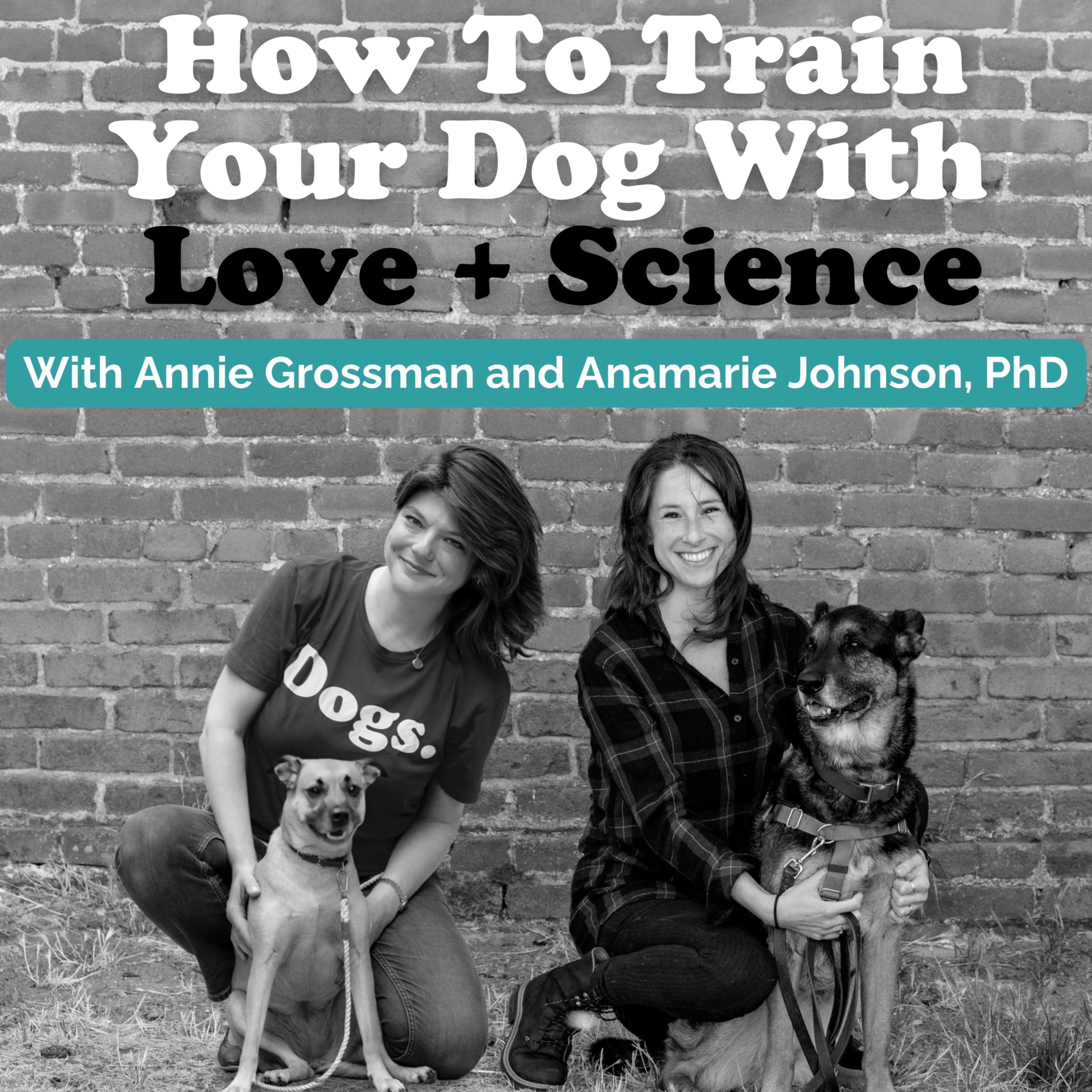
Mar 1, 2021
A conversation with Terra Newell (former groomer, owner of a mini Aussie) about killing her stepfather... and dogs
We're posting this as a bonus episode because it isn't really about dog training... but it's something we think you will want to listen to if you love dogs and empathize with people who love them. If you've heard the podcast Dirty John, or seen the dramatization on TV, also called Dirty John, you'll know that it's a story that is... complicated. The hero of the real-life true-crime story is Terra Newell, a soft-spoken dog groomer who was attacked by her sociopath stepfather one night when she and her dog were coming home from a day working at a shelter. Annie and Terra talk about her life with pets, the traumatic experience she and her dog experienced, how her dog impacted her recovery, and more. You can find Terra on Instagram at @terranewell Dirty John Podcast: https://podcasts.apple.com/us/podcast/dirty-john/id1272970334 Dirty John on Netflix: https://www.netflix.com/title/80241855 Mentioned in this episode: Don't Shoot The Dog https://amzn.to/37Nn7I2 The Human Magnet Syndrome https://amzn.to/3bzBv7G --- Partial Transcript: Annie: So I’m posting this as a bonus episode because it’s not really about dog training, but it is about a pretty incredible and traumatic experience that a woman who is a huge dog lover had with her dog. And I explain it in this conversation, which I recorded live on Instagram, why I wanted to talk to Terra Newell, who I first learned about from the podcast Dirty John. She is also portrayed in the dramatization of the story Dirty John, in the TV show called Dirty John. I think I say this in the conversation, but there’s so many things to talk about and think about that are brought up in Dirty John. But of course, with my dog training point of view, all I could think was this woman should become a dog trainer! [laughs] Anyway, I don’t think that is part of Terra Newell’s life plan, but I was happy that she agreed to talk to me. You can find Terra on Instagram @terranewell. I also just wanted to mention that my recording settings were a little off for the first minute of this conversation, but then they were fixed. So you will hear a transition about a minute in. Terra: I had to put you on mute on my computer. Annie: Yeah, I’m putting you on mute here too so I only have to record in one in one place, but I am psyched to get to talk to you, and what a beautiful dog. So is he a mini Aussie? Terra: Yeah, he’s a mini Aussie. He’s technically known for the AKC as a North American shepherd now, because the mini Aussies are considered their own breed because they had to use a Chihuahua or like the smallest of the smallest Aussie to kind of try to breed that breed. Annie: What made you decide to get that, or to get him? Terra: So I was at a pet store, working there, and I was with this guy, in a relationship, and he was obsessed with Aussies. And I was just like, okay, I kind of want a papillon because they have the butterfly ears, and I really liked that, and then I was like, well, they’re kind of cool. Full Transcript available at SchoolfortheDogs.com/Podcast Get full access to Don't Be a Dick to Your Dog at dogtraining.substack.com/subscribe
Feb 26, 2021
SFTD Off-Leash Manager Adam Davis on training as a teenager & developing a career specializing in helping dogs socialize
When Adam Davis came to work at School For The Dogs in late 2019, he was only in his mid-twenties but already had a decade of working with dogs professionally under his belt. In particular, his background involved a lot of hours spent helping city dogs learn to co-exist, and play, off leash. Today, he runs School For The Dogs' unique School Yard program-- a by-appointment, trainer-supervised members-only dog run -- and also oversees puppy playtimes, in addition to working private with clients. He and Annie discuss his early introduction to the world of science-based training, his interest in police dogs, his rescue dog Sonic, and more. Book a session with Adam at http://schoolforthedogs.com/adam Learn more about School Yard and Puppy Playtime at http://schoolforthedogs.com/services Mentioned in this episode: The Human Half Of Dog Training --- Partial Transcript: Annie: So I am here with Adam Davis. Adam, why don’t you introduce yourself with your official School for the Dogs title. Adam: Hi, Annie, thank you for having me on. Yeah, my name is Adam Davis and I am the off-leash manager at the School for the Dogs. Annie: And what does that mean? Adam: So pretty much, we have these really cool services, it’s called our Off Leash services, right? Pretty much it sounds exactly how it sounds you get to come into the school and allow your dog to be off-leash in a highly controlled and constructive kind of way. Our services are great for — Annie: And to be clear that the owners are there. Adam: Yeah. Owners are there, you’re there with your dog. You’re talking to other parents, you’re talking to the trainer, that’s there. Yeah, we definitely want people to be involved with their dog, especially when it’s in an off-leash kind of setting Annie: And we have two different kinds off leash services, which are? Adam: Yes we do. Yeah. We have the puppy ones, which, you come in it’s puppy play time. You get to learn a little bit about how dogs communicate to one another, when to give breaks. Really, really valuable. I would suggest this to anyone that has a puppy. It’s so valuable to have our puppy socialized in a highly controlled manner. So that’s the puppy side. That’s the cool, that’s the baby side. Right. And then we have school yard, which is a little bit of a step up. It’s for dogs that are 20 weeks and older. Very much a similar kind of structure, but a little bit more laid back, I would say. So school yard is really great for dogs that want to be social, that can communicate well. That can take communication well. And it’s a great space for them to be able to come and socialize in a highly controlled manner. This is for adult dogs. Well, not really adult, but non puppies. Annie: Some of, some of them are adults. We have some. Well, I think the part of the reason it’s maybe like less controlled as you say is because it’s… I mean, puppy playtime often, it’s, someone’s first time there with their dog. Whereas school yard, we have people who come almost every day of the week for years, so they don’t need as much as much instruction. So why don’t you talk about the process of getting into school yard. Puppy play time of course is open to puppies who’ve had at least their first round of shots. Full Transcript available at SchoolfortheDogs.com/Podcast Get full access to Don't Be a Dick to Your Dog at dogtraining.substack.com/subscribe

Feb 25, 2021
A group discussion about The New Yorker article, "Bad Dog," with its author Anna Heyward
Anna Heyward is a writer and a School For The Dogs apprentice who has been featured on this podcast. She joined Annie and others to discuss her heartbreaking new article in The New Yorker , "Bad Dog," on Clubhouse. Their discussion touched on the complicated world of behavioral euthanasia, the cultural fog about dog training and the rampant misinformation about it, and more. Former School For The Dogs trainer Anamarie Johnson, also previously interviewed on this podcast, was among those who joined the conversation. Find Annie on Clubhouse at @anniegrossman. Looking for a Clubhouse invite? Text 917-414-2625 Read Anna's article at NewYorker.com https://www.newyorker.com/culture/personal-history/bad-dog Anna Heyward is on Instagram at: @biggirl.world Mentioned in this article: School For The Dogs courses (including a FREE one) for aspiring dog trainers http://schoolforthedogs.com/courses The Freedom Harness https://storeforthedogs.com/products/freedom-harness Lessons learned from foster dogs: A discussion with our apprentice Anna Heyward https://anchor.fm/dashboard/episode/ejr8oh Let’s talk about classical conditioning with dog trainer Anamarie Johnson https://anchor.fm/dogs/episodes/Lets-talk-about-Pavlov-with-dog-trainer-Anamarie-Johnson-e1goa1/a-a3johv Authors mentioned in this episode: Sophia Yin https://amzn.to/3smqwoO Kathy Sdao https://amzn.to/3sxQkyx Lili Chin https://amzn.to/3smqPjs Karen Pryor https://amzn.to/3koAT8U Patricia McConnell https://amzn.to/3aUu0Ju Jean Donaldson https://amzn.to/3dOaWhU --- Partial Transcript: Annie: This is a bonus episode that was recorded on Clubhouse. Clubhouse is an app for iOS devices that is currently open by invitation only. If you would like an invitation text me at (917) 414-2625. And if I have an invite available, I will share it with you. You can find me there @AnnieGrossman. So thanks for being here, everybody I’ve asked Yolanta who is a virtual assistant specializing in dog businesses to be here to help me moderate this room. Cause I’ve never moderated a room before and I didn’t want to get it wrong. And Anna Heyward is here. Anna wrote the wonderful, very moving poignant article, Bad Dog, which appeared in the New Yorker last week. Anna Heyward is a School for the Dogs apprentice and started out with us as a client. I actually interviewed Anna for the podcast a few months ago and then wanted to have another conversation with her for the podcast about her article, but thought it would be fun and interesting to open it up to others who read the article. So Anna, thank you for being here. And if anybody would like to ask Anna a question or discuss the article, just go ahead and use that like hand raising button on the bottom of the screen and Yolanta or I will ping you to to the stage to speak. Full Transcript available at SchoolfortheDogs.com/Podcast Get full access to Don't Be a Dick to Your Dog at dogtraining.substack.com/subscribe

Feb 19, 2021
News flash: Positive reinforcement isn't about being kind!
After attending two webinars where people extolled the virtues of positive reinforcement, Annie was left wondering why the term seems to be so misunderstood-- or maybe she is the one misunderstanding it? While she tries to train using positive reinforcement and she believes the world would be a nicer place if people were able to identify positive reinforcement and use it more effectively, she doesn't see it as some kind of sugar-coated panacea. Positive reinforcement can be very mundane! It is why you look at your phone. It's why you put one foot in front of the other when you walk, and why you push the gas pedal to make your car move forward. If a behavior has been encouraged, it has been reinforced. If it has been encouraged because of the addition of something, rather than the subtraction of something, it has been positively reinforced. So why has the term "positive reinforcement" gotten so mixed up with the idea of kindness? Yelling "No!" can positively reinforce a dog for jumping, and hugging a person might do the opposite of positively reinforcing a given behavior. Annie recorded this episode on Clubhouse and was joined by podcast listener Leeyah ( @leeyahiredale ) and Dallas-based trainer Beth ( @rehabyourrescue ). If you're on Clubhouse , join Annie on Thursday February 25 at 3PM ET for a discussion with SFTD apprentice Anna Heyward about her article, " Bad Dog ," published in this week's New Yorker. https://www.newyorker.com/culture/personal-history/bad-dog https://www.joinclubhouse.com/event/mWVGKyBY If you need an invite to join Clubhouse (currently available on iOS devices only), text 917-414-2625 --- Partial Transcript: Annie: I was an attendee in two different webinars earlier this month. One was hosted by the BF Skinner foundation, and the other one was also by a dog training group. But they were both CEU earning webinars, pretty legit. Both were hosted by PhDs. One was not specifically about dog training. It was about I think the title was something like “how kindness helped me navigate the world of applied behavior analysis.” There was something about kindness. And the other one was about race and dog training. So I am a dog trainer and a big behavior nerd and very interested in kind of different takes on behavior, sort of tangential to dog training. So was interested in both of these presentations. But I ended up walking away -- well, they were right after the other, one was one day, one was the next day. And I ended up feeling kind of frustrated with both of them and tried to try to chat to the moderators while it was happening. But there were a lot of people in the room, and I couldn't seem to ask a question or say something in a way that made sense. But the takeaway from both of them was sort of like rah, rah, rah, isn't positive reinforcement a wonderful thing? And in the one about race, it was interesting. It was this black dog trainer who I think is, I think she's a psychologist and she was interviewing kids in, I guess she lives in like Ohio, Midwest in a very white area. And she was basically interviewing children about about her, and like working with her, and what it means to work with someone who is black, or person of color was the term that was used. Full Transcript available at SchoolfortheDogs.com/Podcast Get full access to Don't Be a Dick to Your Dog at dogtraining.substack.com/subscribe

Feb 12, 2021
SFTD Trainer Maddie Messina on studying animal cognition, dealing with allergies, and more
Our trainer Maddie Messina, who started out with us as a walker two years ago, is getting a master's at Hunter's Animal Behavior and Conservation, where she is studying canine cognition. She and Annie discuss her early interest in veterinary medicine, the opportunity she had to work with primates as an undergraduate at Bucknell University, her current focus on working with puppies, and doing it all... while being severely allergic to dogs. Book a session with Maddie at http://schoolforthedogs.com/maddie Follow Maddie at Instagram at @onlyfurendswithdogs Join our new community app, accessible in the iTunes App store, the Play store, or in any web browser at http://schoolforthedogs.com/community . Use hashtag #podcastlistener and we'll grant you a moth of Premium app access. Find Annie on Clubhouse @anniegrossman. Want a Clubhouse invite? Text a request to 917-414-2625 Like this podcast? Leave a review on iTunes! Need help? See our guide to leaving a review here. https://www.schoolforthedogs.com/subscribe/ --- Partial Transcript: Annie: So thanks for being here, everybody. I am here with Maddie Messina who's been at School for the Dogs, working with us in various capacities for, gosh, could it be two years now? Is that right? Maddie: It's definitely coming up on that, for sure. Annie: So why don't you talk a little bit about what you're doing right now with us, and then we can talk about what else you've done and what you're doing when you're not wearing your training pouch. Maddie: Okay. Absolutely. So I started at School for the Dogs as a walker, and I came from a training background. So that was my step into the School for the Dogs world. And since then, I've transitioned to working at Day School , which is our adult basic manners drop-off program. And I also mainly focus now on puppy training . I do a lot of first sessions. So people who come to the school, they see me for the first time as their trainer. And then from there, we kind of build out a program for them or lead them into our group classes, which I just started teaching as well. So last week was my first week of teaching puppy kindergarten . Annie: Oh yeah, congratulations. How did it go? I think I was, I was there right when you were starting to set up, I think. Maddie: Yeah, it was definitely a big change because I’m used to kind of handling one-on-one clients. But the one thing I will say is that I also think that I’m skilled in handling chaos. That was definitely just kind of practice in handling more chaos, but it went really well. I think the nice thing about our puppy kindergarten setup is that all the puppies who come, by the time they’re here for their first week, they’ve already kind of met with a private trainer and they know the gist, so I think it’s a little bit less chaotic than it would be if you had a group of puppies and parents who were stepping into the training world for the very first time Full Transcript available at SchoolfortheDogs.com/Podcast Get full access to Don't Be a Dick to Your Dog at dogtraining.substack.com/subscribe
Feb 5, 2021
The dog is peeing inside and it's totally okay: A family's practical and economical approach to housetraining a puppy
Annie has a toddler, a husband who is a busy guy, and a toddler. It's freezing outside, the dog hates the cold weather, and Annie's mobility isn't great at the moment: She's pregnant and lives in a walkup. All this resulted in a her family's inability to get the puppy, Poppy, on the six or so walks a day that she, as a dog trainer, knows would be needed to teach her to go outside on the city streets. The issue could be solved by hiring a dog walker to come a few times a day, but Annie calculated that this would cost at least a thousand dollars a month. So, Annie came up with a plan to teach Poppy to go on an indoor pottying spot -- one that could ultimately be transferred to the outside -- and to use her roof deck some of the time, while also making sure she goes out on the street at least once or twice a day, even if she isn't "bathrooming" out there. Mentioned in this episode: School For The Dogs (Free!) Community App http://schoolforthedogs.com/community Doggie Lawn Get $5 off your first Doggie Lawn order with our affiliate link and code AFFILIATE5 https://bit.ly/3aygtWu --- Partial Transcript: Annie: So you’re a dog trainer. You get a dog, you teach the dog to pee and poop outside. End of story. Right? Well, I wanted to talk a little bit today about my experience housetraining my new puppy Poppy, who we got just about five weeks ago. She is maybe like six, six and a half months, a Chihuahua mix. Actually, we just got her DNA results back. She’s a Chihuahua, Chow, Cocker spaniel, pitbull, beagle, boxer, Rottweiler mix, but I think she’s mostly Chihuahua. And she’s been a real dream. She is just a very sweet, affectionate dog, very tolerant of my toddler. Very loving with my toddler. Really the most cuddly kissy dog I think I’ve ever encountered. All she wants to do is sit in someone’s lap. And by and large, she’s a really quick learner. I think when you work with a lot of dogs doing the same exercises over and over and over as I have done, you start to get a sense of how quick a dog is. It must be like that when you’re working with people too. If you do the same task with 5,000 people, you start to get a certain idea of a certain kind of baseline intelligence and whether or not someone is above or below that. And I’d say she’s pretty quick. She’s pretty smart. Loves her crate, goes into her crate no problem and learns new things pretty quickly. But I don’t know if she had ever gone to the bathroom — it’s funny how we say go to the bathroom for peeing and pooping for dogs when they’re not actually going into a bathroom, but let’s go with that euphemism. I don’t know if she’d ever gone outside. She came from a shelter in Alabama. She was dropped off there with her parents and two sisters. Although I think whoever dropped her off just had her parents there to get spayed and neutered and ended up taking the parents back. So I think she must have been in some kind of home up until she was in the shelter. So I don’t know what, what her home life was like. And I don’t think she was in the shelter for very long. She then was brought from Alabama to New York, stayed with a foster here for a little bit. I don’t think the foster had her go outside at all. And the foster reported, she was kind of like a C minus, I think the way she put it, when it came to hitting wee wee pads. Full Transcript available at SchoolfortheDogs.com/Podcast Get full access to Don't Be a Dick to Your Dog at dogtraining.substack.com/subscribe

Feb 4, 2021
Dog Training Q and A! 2/4/2021: Is it okay if my dog only "goes" once a day? Also: Counter surfing, curbing barking in the dog park, helping a dog feel okay about the car after a car crash, and more
This is a bonus episode: A recording of a live Q and A. Join Annie Grossman for a live Q and A on Instagram most Thursdays. Sign up for the next one, and/or submit a question in advance, at http://schoolforthedogs.com/qanda . Discussed in this episode: -How do you get a dog to eliminate more than once a day? -My dog likes dogs on TV but not in real life -What do I do if my dog just wants to bark at other dogs in the dog park but not play with them? -How can I keep my dog from stressing out now that I'm going back to work? -How can you keep a dog from counter surfing? Disclosure: These Q and A's give very cursory to questions that are sometimes pretty complex! We encourage dog owners to seek out personalized profession training help whenever possible. Mentioned in this episode: Ruffwear Load Up car harness https://storeforthedogs.com/products/the-ruffwear-load-up-harness Treating Separation Anxiety In Dogs by Malena DiMartini https://storeforthedogs.com/products/book-treating-separation-anxiety-in-dogs Episodes on separation anxiety: Ask Annie: Separation anxiety, tips for crate training and an overview of attachment theory https://anchor.fm/dashboard/episode/e3c9ev Separation Anxiety Expert Malena DeMartini on Helping Dogs Learn To Be Alone https://anchor.fm/dashboard/episode/edpqpo Featured image: Flapjack and Wanda by cseeman is licensed under CC BY-NC-SA 2.0 --- Partial Transcript: Annie: Hi, this is a bonus Q and A episode. I try to go live every Thursday on the School for the Dog’s Instagram account. If you would like to be alerted when I’m going to go live, or if you’d like to answer a question in advance, go to School for the Dogs.com/q and a. Thanks for being here. Annie here. I have some training questions to answer. I was going to be starting this at three, but I’m a little late for a very serious reason, which is that I ordered food. Specifically if you must know, I ordered shake shack lunch, and I was waiting for the delivery to come so I wouldn’t be interrupted by the delivery. I’m actually pregnant. And so I had a real jonesing for French fries. So I ordered shake shack French fries, which for those of you who are not able to be eating French fries right now, I am not going to eat while I am doing this. So I’m sparing you that. So let me see if I can figure out how to get my questions up here while I’m talking. Here we go. I think I have it here. Okay. And I also have a dog owner named Megan who might be joining me live to talk about some housebreaking issues she’s having. Full Transcript available at SchoolfortheDogs.com/Podcast Get full access to Don't Be a Dick to Your Dog at dogtraining.substack.com/subscribe

Jan 29, 2021
How to make sure your dog never swallows a bully stick: Expert advice from Vaso Karras, the inventor of the Bully Grip
Dogs love bully sticks, and the weird world of dried bull penises (which is what they're made of) has become a bit of an obsession of Annie's. In this episode, she interviews someone else who is obsessed with them: Vaso Karras, the inventor of the Bully Grip. When dogs swallow small pieces of bully sticks, they can cause potentially-fatal intestinal blockages. Karras' puck-like rubber device is designed to slide over a bully stick and lock onto it, making it nearly impossible for a dog to swallow its nub. Annie interviews her about how she dropped everything in order to devote her life to figuring out how to help dogs chewing bully sticks safely. Notes: You can purchase all three sizes of the Bully Grip at StoreForTheDogs.com. https://storeforthedogs.com/products/bully-grip-stick-holder?variant=37868029968580 You can purchase bully sticks there, too: https://storeforthedogs.com/products/bully-sticks And the Qwizl, which is also mentioned in this episode: https://storeforthedogs.com/products/qwizl-bully-stick-holder Inserting a bully stick into the Bully Grip : https://www.youtube.com/watch?v=FN2-0bmITnM Visit School For The Dogs Community App to see a video on removing the bully stick from the holder. http://schoolforthedogs.com/community More on bully sticks: What is a bully stick? A very detailed answer to an awkward question : https://anchor.fm/dogs/episodes/What-is-a-bully-stick--A-very-detailed-answer-to-an-awkward-question-ekd2ph Dogs love bull penises, and you will too : https://anniegrossman.com/2012/12/funnies/dogs-love-bull-penises-and-you-will-too-73608/7517/ Bully stick holders your dog needs to try: https://storeforthedogs.com/blogs/news/5-bully-stick-holders-your-dog-wants-to-try A better mousetrap: Building the perfect bully stick holder : https://podcasts.apple.com/us/podcast/a-better-mousetrap-building-the-perfect-bully-stick-holder/id1355439730?i=1000419925025 --- Partial Transcript: Annie: Hello, Vaso! I’m here with Vaso Karras, the creator of the bully grip. Thank you so much for taking the time to talk. Vaso Karras: Thanks for having me. I'm really excited to be here. Annie: So the Bully Grip -- well, maybe you can explain exactly what it is, but I can tell you that I heard about it through a client some years ago. We've been carrying it in the shop now, oh, I guess for about a year. It is a bully stick holder, and you're actually the second bully stick holder inventor I've had on this podcast. So I guess you could say it's a sub interest of mine. But why don't you describe exactly what the product is and then maybe you can talk about how you came up with this product to begin with. Full Transcript available at SchoolfortheDogs.com/Podcast Get full access to Don't Be a Dick to Your Dog at dogtraining.substack.com/subscribe

Jan 22, 2021
School For The Dogs’ Group Class Manager Anna Ostroff on straddling a life of theater and dog training, fostering, teaching tricks & more
Anna Ostroff is a Tony-award winning theater producer and the head of a non-profit that brings arts education into New York public schools. Somehow, she also manages to work fulltime at School For The Dogs, where she trains dogs with behavior issues, manages (and teaches) group classes, and generally keeps everyone smiling with her sunny disposition and "can do" attitude. Here, she and Annie discuss her lifelong love of animals, her foster dogs, and her passion for teaching tricks to urban dogs and helping dogs deal with fear and anxiety. Anna's non-profit http://www.arts-for-all.org/ Anna's theater company: https://infinitytheatre.com/ Book a session or class with Anna: http://schoolforthedogs.com/services --- Partial Transcript: Annie: So listeners, I am joined today by someone who started out at School for the Dogs as a client, and then became an apprentice and then became a trainer. And along the way became one of my very, very good friends. So I’m happy to have any excuse to talk to her. Anna Ostroff. Hello, Anna. Anna Ostroff: Hi, Annie. Awesome to be here today, and I totally agree. Any excuse to talk to you is also awesome. Annie: Remember when you first started, Anamarie was with us and it was like, Anna, Annie, Anamarie. Anna: We had so many A names at that time. That was crazy. Annie: We had Addie Anna: Alison Joy. We had so many As. Annie: Yeah. So yeah, I of course know how you winded up at School for the Dogs, but it’s a pretty interesting path, I would say, especially because you have a whole other career both in your past and in your current life, which I think probably your current clients would be interested to hear a little bit about. So maybe before you start telling us about your dog life, you could tell us about your non dog life? All the things you were doing and continue to do professionally, not relating to dogs. Anna: Sure. Yeah. So, well, it’s hard to say like my pre-dog life, because I think animals and dogs have actually always been a huge part of my life, even when it wasn’t necessarily a professional part of my life. But what you’re talking about is my theater background. So I actually still, I have a theater company in Annapolis, Maryland that is run with my husband, Alan. The name of the theater company is Infinity Theater Company . And Alan now does most of the day to day on that. And since of course COVID hit, we have not been able to do any productions, which is very sad. So we’ll see what happens and where the world takes us. But before all of that, we had actually just celebrated our 10 year anniversary as a theater company, which is really cool. And we’ve produced shows regionally in Maryland where the theater is that we use every summer. It’s just a summer theater. But we’ve also been fortunate enough to produce on Broadway as well. And have been involved in a couple of shows on Broadway. We were co-producers on the Pippin revival for those who remember that, and actually won a Tony award for that production was incredibly exciting. And we also had a production that started at our theater in Annapolis, which later moved to New York to Broadway called Dames at Sea, which is a really fun musical, lots of tap dance. And we were fortunate enough to be able to be the lead producers on that production on Broadway. Full Transcript available at SchoolfortheDogs.com/Podcast Get full access to Don't Be a Dick to Your Dog at dogtraining.substack.com/subscribe
Jan 21, 2021
Dog Training Q and A! 1/21/2021: Are day cares a good place to socialize your dog? Why did my dog stop liking the crate? Thoughts on wee wee pads?
This is a bonus episode: A recording of a live Q and A. Join Annie Grossman for a live Q and A on Instagram most Thursdays. Sign up for the next one, and/or submit a question in advance, at http://schoolforthedogs.com/qanda . Here Annie addresses questions about socializing dogs during quarantine, using wee wee pads if the goal is to teach a dog to only go outside, getting a dog to like a crate again, using daycares to get a dog some social time, and more. --- Partial Transcript: Annie: Hi, thanks for those of you who came to my little Instagram live demo just now with adorable little Poppy. Hope that was helpful. I did have a couple of questions that came in that I wanted to answer as always. I try and go alive every Thursday at 3:00 PM. Eastern. If you want to ask a question or want to be notified when I’m going live on Instagram, just go to schoolforthedogs.com/qanda , and you can submit a question or sign up to be notified. Oh, hi Duke. Nice to see you there. Okay, so this question comes — I have two questions from a user, JimEVF. First one is, do you recommend taking your dog to daycare to improve his social skills? And in a word, No. [laughs] I don’t. I’m all for improving dogs’ social skills, but I don’t think daycare is the best place for a dog to work on being social. I think you want to try and give your dog opportunities to have good social interactions with other dogs while you are around or at the very least while someone is paying close attention to your dog. Now perhaps there are some daycares where they are doing a great job of paying close attention to every dog. But in general, my experience with dog daycares is they’re a little bit more like — they’re too much like dog parking lots. And it’s just, I don’t think the best set up for dogs to really learn to interact with other dogs. What’s more, your dog might have bad experiences there and you’re not going to necessarily know about them. Years ago we had a kind of heartbreaking situation where a client of ours put their dog in daycare because the dog had really severe separation anxiety. She had to go to work and it was just what she had to do. And you know, anxieties can sometimes be like switching seats on the Titanic. Like, okay, the separation anxiety more or less went away because the dog wasn’t being left alone, but the dog developed a fear of Hispanic men in hooded sweatshirts. I know it’s a very specific kind of fear. But my guess is there was a Hispanic man in a hooded sweatshirt at this dog daycare who either didn’t treat this dog well, or this dog made some sort of misaligned connection with this person. And now the dog owner had this new and very real fear to contend with at School for the Dogs. We run drop off a day school , which is kind of like the ideal form of dog daycare. I think there’s a ratio of one trainer for every three dogs. Sometimes it’s one trainer for two dogs and it’s a half day and they work the whole time. They’re doing training, they’re working on their socialization skills, whether that’s being introduced to new objects, sometimes going to new places. But also just playing with each other in a supervised way with professionals who are looking on and then reporting back to the owners about what’s going on. Full Transcript available at SchoolfortheDogs.com/Podcast Get full access to Don't Be a Dick to Your Dog at dogtraining.substack.com/subscribe

Jan 20, 2021
Dog Training Q and A! 1/14/2021: On why it can be useful to teach a dog to go in a bag
This is a bonus episode: A recording of a live Q and A. Join Annie Grossman for a live Q and A most Thursdays. Sign up for the next one at http://schoolforthedogs.com/qanda . Here, Annie answers two questions, and offers a similar suggestion to help deal with both issues: Train a dog to go in a bag! K9 Sport Sack Dog backpacks: https://storeforthedogs.com/collections/backpacks Boat and Tote: https://amzn.to/3p8bhPm --- Partial Transcript Annie: Thank you for joining me folks. I have two questions here that were submitted. As always, you can join me for these Q and A sessions live in two places, either in the new School for the Dogs app, which is free and you can get there by looking up School for the Dogs community in the app store or play store, or going to schoolforthedogs.com/community . Or you can join me in webinar format schoolforthedogs.com/QandA . And you can submit a question in advance as some people have done here at anniegrossman.com/ask . So two questions this week and they have a common thread in my answers. First one is regarding Wilson who's currently a School for the Dogs puppy student, and is very excited for prep school at School for the Dogs which is starting next month after graduating from puppy kindergarten. He's very rarely had an accident in our apartment, but given that he was still getting used to going downstairs, upstairs not being a problem, we've always carried him outside to eliminate. We thought we were golden saying, okay, once we made it outside and treating right after he eliminated. Wilson's much more confident walking down stairs now, however. We're in a fourth floor, walk-up in New York City. On foot, he's having about a 50-50 success rate holding his bladder until we get all the way downstairs and out the two front doors. Any tips for how we can help him out because he is getting heavy? They also note that he is eating puppy kibble and and treats. His high value treats are freeze dried duck and boiled chicken. So I think a 50, 50% rate and nearly a hundred percent success rate of getting this puppy to pee and poop outside is actually pretty good. So thumbs up to you guys. Zach and Molly, Wilson’s people. So this is behavior that [inaudible] anything else can be shaking him down 90% of the way, and then letting him walk the last 10% of the way. And if you can have success with that, without him going during that last 10% of the way outside then start carrying him down 85% of the way. And let him walk the last 15% of the way. Two other tips, you know, he’s still a puppy. His bladder is gonna get stronger, he’s still developing. So, it’s possible that the excitement of going out combined with his puppy-ish young bladder isn’t quite ready to handle being able to go all the way down. But again, you can help him build this behavior, the behavior of holding it, little by little. And certainly if you get outside and he has not peed or pooped, you would, should reward that behavior. I mean, being outside might be a reward in and of itself, but sure. Why not also give it a treat, give him a treat. Full Transcript available at SchoolfortheDogs.com/Podcast Get full access to Don't Be a Dick to Your Dog at dogtraining.substack.com/subscribe

Jan 15, 2021
What happens when you try to run a dog training business using dog training techniques...
A decade ago, Annie and Kate set out to become dog trainers. They ended up with a dog training business. They both knew a lot more about dog training than they did about business management, so they attempted to use what they knew about animal behavior to manage the company... In this episode Annie talks about four business lessons she's learned that stem from what she knows about dog training. She talks about the importance of creating shaping plans (something she is bad at, both when training dogs and when managing staff), the difficulty of using money to reinforce behavior, and how to use environmental environment and antecedent arrangements to change employee behavior (hint: don't). She also talks about how classical conditioning, and focusing on people's conditioned emotional responses, is just as important to think about when dealing with clients as it is when dealing with dogs. Find Aubrey Daniels' books on Amazon : https://amzn.to/3ii810T --- Partial Transcript: Annie: I was recently emailing with a podcast listener who was telling me she is thinking about becoming a dog trainer. And I asked her what she currently is doing for work, and she said she works in human relations. And I said, Oh, well, HR is kind of like human training. So you’d sort of just be moving from one species of animal to another. And I also said that I really never appreciated how important HR people are to businesses until School for the Dogs got to a size where it became quite evident to both me and Kate that we had so many people on staff, that the people on staff needed their own person basically to take care of them. We don’t have a full-time HR person, but we do have someone that we work with on an as-needed basis. And that is something that’s been really, really useful. And podcast listener wrote back, and she said, yeah, you know, I don’t think I really saw the connection between clean dog training and human resources until I started listening to your podcast. But now I see how behavior is unfortunately coerced a lot in businesses. I also see how sometimes rewards aren’t used effectively or appropriately and being a dog trainer yourself, you must be particularly skilled at managing staff. And I wrote back to her and I said, yeah, maybe you would think so, but the reality is, I think management in general is something I really, really struggle with. I’ve talked a little bit before about School for the Dogs’ origin story. Kate and I met about 10 years ago and we were both at a time in our lives where we were trying to figure out how to become dog trainers. I had been a freelance journalist and a journalist on staff at different New York city papers throughout my twenties. And Kate was a graphic designer at an agency. We met through an Association for Professional Dog Trainers message board, I think, and went for a cup of coffee. Turns out, we lived literally across the street from one another. And I kind of proposed to her. I said, let’s figure out a way to start something together. I saw early on that we had talents and skills that complemented each other. And we were kind of both at the same place of starting out. We knew a lot about training, but we both knew we needed to know more. And we both were sort of equally stumped as to how to become professionals and doing it as a team seemed like it would make things easier. Full Transcript available on SchoolfortheDogs.com/Podcast Get full access to Don't Be a Dick to Your Dog at dogtraining.substack.com/subscribe

Jan 8, 2021
School For The Dogs’ Trainer Em Beauprey on conformation, cats, bespoke dog walking and training trainers
Em Beauprey came to School For The Dogs in 2017 when he was working as a vet tech and running his own dog walking business. He started out as an apprentice, and went on to build SFTD's walking program from scratch, and to helm our professional program. These days, when he isn't putting the finishing touches on Born To Behave, our forthcoming free and open-source course for aspiring professional dog trainers, Em can be found doing virtual training with puppies and walking his cat on the streets of Portland, OR. Em and Annie discuss a youth spent training dogs for conformation trials, why knowledgeable dog walkers are so valuable, cat training, and more. Want to be updated on the launch of Born To Behave? Sign up for our newsletter to be alerted when it launches! https://schoolforthedogs.activehosted.com/f/23 Annie's 2005 NY Times article on part-time pets https://www.nytimes.com/2005/08/14/fashion/sundaystyles/instant-best-friend-for-the-day.html More on SFTD's Professional Program : https://www.schoolforthedogs.com/professional-dog-training-course/ --- Partial Transcript: Annie: I am here with the wonderful, peerless Em Beauprey. Em came to us as an apprentice. What was it? Gosh, four years ago Em Beauprey: That was…yeah, I think it was 2016, pretty sure. 27 to 2017. Annie: 2017, 2016. Gosh, that is almost four years. Em: It’s, all my years in New York have been kind of just a big blur that involves a lot of dogs. So it’s hard for me to put it at a specific time. Annie: [laughs] Well, why don’t you tell us a little bit about what you’re doing right now? As far as School for the Dogs goes. And then we can maybe work backwards in time and talk about how you got to this point. Em: Yeah, so right now I have a couple of capacities with School for the Dogs. I am an associate trainer with School for the Dogs. So I am seeing clients. I am doing so exclusively virtually because, surprise, surprise, I am currently living in Portland, Oregon. So I am School for the Dogs I believe first fully remote trainer. Fully remote by necessity trainer. Annie: To be clear, we would like to have you be doing actual sessions in Portland, but because of lockdown. Em: Because of the pandemic, right. The eventual plan is for me to actually get some sessions on the ground and be able to do some more one-on-one training, which is great. Portland’s got a lovely dog training community and I’m hoping to get more involved in it once it’s safe to do so. Annie: And then School for the Dogs will be officially bi-coastal. Em: Yeah. We’re going to do School for the Dogs West. But then also I am, as a former member of the apprenticeship program, I have also taken on the job of managing the School for the Dogs apprenticeship program, which I did for the first time at the beginning of this year and has been extremely educational for me. And a really interesting experience. Prior to that, I was doing some other program management. This is the first time that I really had kind of a team of students. And we have had a fantastic team of apprentices this year. So it’s been really a pleasure to see them learn and grow. Annie: How would you describe the School for the Dogs apprenticeship program to those who don’t know about it? Full Transcript available at SchoolfortheDogs.com/Podcast Get full access to Don't Be a Dick to Your Dog at dogtraining.substack.com/subscribe
Jan 7, 2021
Dog Training Q and A! 1/7/2021: Lickable Treats
This is a bonus episode: A recording of a live Q and A. Join Annie Grossman for a live Q and A most Thursdays. Sign up for the next one at http://schoolforthedogs.com/qanda or join in the School For The Dogs app at http://schoolforthedogs.com/community In this episode, Annie discusses why she loves using viscous treats with dogs, and reviews some of her favorite types of lickable treats. All of them can be found at storeforthedogs.com. https://storeforthedogs.com/collections/lickable-and-spreadable-treats --- Partial Transcript: Annie: Today, I actually want to answer a question that came to me from my husband. As I mentioned on the podcast last week , we have a brand new puppy. Her name is Poppy, and it’s been a lot of fun. She’s really a wonderful, wonderful girl. And my husband and I were talking and he said what has changed for you? Or, I guess he said, what do you think has changed in the world of dog training since you last had a puppy, which was in 2005, when I first got my dear my dear dog Amos. And it’s a big question to answer for me, because I really knew nothing about dog training when I got him, and really didn’t get into it until he was about five years old. So for me, so much has changed. In the world of training and pet care, I think a lot has changed too, I think for the better. So he asked me this question and I felt like God, there’s almost too much there for me to answer in any kind of concise way. But I thought, there’s definitely one thing that I had no idea about when that when I first got Amos and that I think probably a lot of dog owners still don’t know about. And this is a certain kind of product that I think can make such a huge difference in any training. But particularly when you’re working with a puppy and this is a product under the category heading lickable treats. Not sure the word lickable is actually a word because I feel like whenever I type it, it gets a red squiggly line under it. But that’s what I call these kinds of treats. Treats that can be licked, consumed with the tongue. So I just thought I would talk about some of my favorite lickable treats. Although first, perhaps I should say why I think these are so valuable to us when we’re working with dogs. First of all, as a dog trainer, I feel like I constantly have crumbs in my pockets. I feel like one of the downsides of the trade is that my hands are always kind of gross. And so it’s really nice to give a dog something that is in a tube where you never actually have to handle you know, lamb lung, turkey hearts, lots of things that are frankly, kind of gross. And these lickable treats make that easier to not actually have to physically handle this stuff. Also, licking is very soothing for dogs. That is certainly a bonus. And there are lots of situations where you want your dog to not waste a lot of time chewing and swallowing things. You just want them to kind of enjoy something and keep going. So that’s one nice thing about using these kinds of treats. Full Transcript available at SchoolfortheDogs.com/Podcast Get full access to Don't Be a Dick to Your Dog at dogtraining.substack.com/subscribe

Jan 1, 2021
Annie gets a puppy: On navigating Petfinder, vetting breeders, and falling in love with a new dog
Two months after losing her 15.5-year-old Yorkiepoo bestfriend, Annie and her family welcomed a new puppy into their home. In this episode, she talks about the experience of falling in love with rescue dogs on the Internet, conversing with breeders charging top dollar, and, finally, landing the perfect puppy for her family. Go to School For The Dogs' Instagram to see a picture of Annie's new puppy! https://www.instagram.com/p/CJhGbJFn6Ir/?utm_source=ig_web_copy_link Join the School For The Dogs Community at http://schoolforthedogs.com/community Episode with Anna Heyward : https://anchor.fm/dogs/episodes/Lessons-learned-from-foster-dogs-A-discussion-with-our-apprentice-Anna-Heyward-ejr8oh Products mentioned in this episode: Squishy Face Flirt Pole https://storeforthedogs.com/products/flirt-poles DIY Flirt Pole https://storeforthedogs.com/blogs/news/dog-flirt-poles-you-can-diy Revol Crate by Diggs https://storeforthedogs.com/products/the-revol-dog-crate --- Partial Transcript: [Intro and music] Annie: Hey folks, it’s New Year’s Day. And I only have a short window of time to record this while my in-laws are at the playground with my daughter. I actually had a different episode lined up for today. Kind of like a business lessons, behavior-minded business lessons of 2020 episode I was going to do. But at the last minute I decided instead I wanted to share that there’s some big dog news in my life that’s happened in the last week, which is that I got a puppy. And I thought while this event is still quite fresh, I would talk about it. We got her on Tuesday and today is Friday. So it’s really only been a few days. So as regular listeners might know, I lost my beloved 15 and a half year old Yorkie poo Amos about two months ago, November 3rd, after a swift illness. And I had him for most of my adult life. He really shaped who I am. And so it was a big loss, big loss to recover from. And it didn’t feel right away like, okay, now we need to get a new dog. I just kind of thought, I’m just gonna let this settle, see how I feel. Don’t need to rush into anything. And my husband was like, why don’t we wait a few years? And I thought, I don’t know if I can wait a few years. I mean, this is my life, dogs are my life. The house feels empty without a dog. Plus I realized I’ve only ever had one dog. I mean, I had dogs when I was a kid, but like since being a dog trainer, I’ve only ever had one dog. And when I got into dog training my dog was already five. So I’ve never had a dog who I’ve trained from the beginning. And the more I thought about it, the more I felt kind of like, gosh, am I fake? Am I a failure that I’ve only ever had one dog? I mean, I’ve certainly trained many dogs. I’ve spent extended periods of time with many, many dogs, but I just felt like, I think it will benefit me to be in the trenches with a new dog. That experience can only benefit my understanding of dogs in general. Full Transcript available at SchoolfortheDogs.com/Podcast Get full access to Don't Be a Dick to Your Dog at dogtraining.substack.com/subscribe

Dec 31, 2020
Dog Training Q and A! 12/31/2020: Can I speak multiple languages to my dog? Is it okay if my dog watches TV? How do I keep my dog off my sofa? & More
This is a bonus episode: A recording of a live Q and A. Join Annie Grossman for a live Q and A most Thursdays. Sign up for the next one at http://schoolforthedogs.com/qanda or join in the School For The Dogs app at http://schoolforthedogs.com/community Have a question? Visit AnnieGrossman.com/ask or upload a recording at anchor.fm/dogs . In this episode, Annie answers questions from: -A bilingual dog owner who is confused about what language to use with his dog, and who gets angry when the dog goes on the couch -A dog owner whose older dog just died, leaving the younger one, a border collie, sort of depressed... can any thing be done? -A person who lives with a dog who is obsessed with watching TV. Can TV time actually help this dog be less reactive with other dogs? -A Great Dane owner whose dog attacks the door when people come in, or when he can see people through the glass --- Partial Transcript: [Intro and music] Annie: Now onto some of these questions. I have four questions here that I am going to try and answer. First question today comes from Luis, whose dog is named Luca. He is a 47 pound one year old American bulldog. They live in Phoenix. You can find them on Instagram, @nomadatemporal. Luis says: I just welcomed a beautiful dog into my life after we met at the shelter and I started listening to your podcast to get ready and train her. I think we are making progress and your tips have been super helpful. I’m having a hard time because my tendency is to get angry. For example, I don’t have a ton of money, and I got a set of couches as a gift from my family. So I’m trying to keep her off the couches. But when she gets on them, I respond in a way that is not helpful to training. I usually say no point to the ground, and sometimes she listens. Other times I have to physically take her down. Also Spanish is my first language. So it’s been hard to give her commands in English when my instinct is to say the first thing and it’s usually in Spanish. I know commands can be whatever. The people around are English speakers or bilingual. So I feel like training twice as much to teach her two commands for each. I love her, she’s American bulldog and we are learning from each other. Thank you for such a beautiful show and I hope I can support your work. That’s very nice. Alright. So a few things here, first of all, I really wouldn’t worry about what language that you’re speaking to Luca. You know, it’s funny with this because I really think that you know, most of the things we say to dogs they interpret like, remember like the parents in Charlie Brown? Like wa-wa-wa-wa-wa-wa. Sure, I think they understand tone to some extent, but I wouldn’t get too caught up in worrying about which language you’re using. Because you know, you can use gestures, you can teach using visual cues, for example. And when you do start to teach her specific behaviors, then you can start to think about being specific about what cues you use. And you might choose a visual cue instead of a verbal cue if you’re worried about going back and forth from one language to another. Full Transcript available at SchoolfortheDogs.com/Podcast Get full access to Don't Be a Dick to Your Dog at dogtraining.substack.com/subscribe

Dec 25, 2020
School For The Dogs’ Private Training Manager Claire Cario on therapy dogs, deaf dogs, and more
Meet Claire Cario, School For The Dogs’ Private Training Manager. Annie interviews Claire about her journey into the world of dog training, which began with a childhood love of nature shows and eventually led to an array of interesting jobs working with dogs, from training dogs to herd geese in Prospect Park, to working with therapy dog teams at The Good Dog Foundation to evaluating dogs in New York City’s public shelter system and beyond. Claire also talks about the rewards, and occasional challenges, of living in New York with her deaf and partially-blind rescue dog, Otis. Book a session with Claire: schoolforthedogs.com/claire Get a free ebook on three keys to dog training success when you sign up for our free Master Class at anniegrossman.com/masterclass --- Partial Transcript: Annie: All right. So I am here with Claire Cario, who I am honored to call an employee. Claire, why don’t you introduce yourself and talk a little bit about what you do at School for the Dogs, and then we can move back in time from there. Claire: Sure. So I have been with School for the Dogs for the past year, and it’s been quite an interesting year for everyone. And I came on board as a private trainer manager and also as one of the behavior therapy consultant trainers as well. Annie and Kate, both of you guys have been colleagues of mine for years. We’ve walked in the same kind of pathway for over a decade. And it just really was a great opportunity and I was excited to come on board. Annie: Well, yeah, I mean, when we hired you, I felt like we have arrived. Like if we have Claire Cario working for us, we’re doing something right. And well I want to talk actually about the first time you and I met, which was like 10 years ago, but I’m interested in, in sort of knowing how you got into dog training to begin with. Cause you know what, I actually don’t really know. Claire: Yeah. Neither do I, Annie. [laughs] Annie: You’re like who am I? What am I doing? Claire: Who am I, well, you figure that out after the fact, I think, generally. Yeah, my story is interesting. I used to work in the film industry as a camera assistant for years. So I was a union camera assistant. Annie: Is that like a, what does a camera assistant do? Is that different than a best boy? And also, I don’t know what a best boy is. Claire: I actually was a best girl on a few jobs as well. That’s working in the electric department, specifically working with anything that’s electrical. But the camera assistant is, I was a first AC primarily. Worked my way up pretty quickly, and at the age of 23, I was walked into the union. Basically, like it’s so arbitrary, that job, and the skill set is so weird. But basically I kept things in focus. That was like my primary goal. And you know, I’m not going to get into, that’s a whole nother podcast about what that means. But that’s important. Like obviously actors need to be in focus. Annie: Did you work on any films that we may have seen, I may have seen? Claire: Yeah, I worked in a lot of independent film back in the day when it was still independent. I think probably the most well-known films that I worked on were Boys Don’t Cry and The Believer, that launched Ryan Gosling’s film career. And Wendigo. Annie: Boys Don’t Cry. I remember that one. That was a big deal. Full Transcript available at SchoolfortheDogs.com/Podcast Get full access to Don't Be a Dick to Your Dog at dogtraining.substack.com/subscribe

Dec 22, 2020
Dog Training Q and A! 12/17/2020: How can I get my dog to stop humping other dogs in order to exert his "dominance?"
This is a bonus episode: A recording of a live Q and A. Join Annie Grossman for a live Q and A most Thursdays. Sign up for the next one at http://schoolforthedogs.com/qanda or join in the School For The Dogs app at http://schoolforthedogs.com/community Have a question? Visit AnnieGrossman.com/ask or upload a recording at anchor.fm/dogs . In this episode, Annie talks about humping: Why dogs do it, how to get them to not do it, and why everyone should just chill out about it. --- Partial Transcript: Annie: I was going to talk just briefly about humping. Got a question: How do I get my malel neutered dog to stop trying to hump other male dogs to assert his dominance. So let let’s talk about that. The simplest answer to the question is you should work on getting your dog’s attention. You can manage a lot of behaviors if you have the ability to get your dog to come to you, to pay attention to you when you need your dog to do so. And you can do that by practicing getting your dog’s attention in less distracting situations. It’s a process of using classical conditioning to your advantage. I have a podcast episode where I talk about teaching come and drop it using classical conditioning. And, same idea. You want your dog to know that when you say whatever the specific word is, or blow whistle or whatever, that it is worth their while to stop whatever they are doing and to turn their attention to you. So, often with Come, people do this with a whistle, whether it’s an actual whistle or just whistling with your lips, because that’s a noise that’s very specific and could be meaningful. And it’s an easy thing to teach because all you need to do is whistle and then drop some great things at your feet. Drop some treats. And you just need to be really consistent about that. What’s nice about teaching behaviors in this way is, certainly in the beginning, you’re really not asking anything of your dog. You’re just teaching your dog to make the connection between stuff dropped on the ground. I’m sorry, between the sound and stuff dropped on the ground, stuff that is delicious. And I liken it to — I mean, there are so many, so many things that you can liken it to, but it’s kind of like throwing a sale, right? The sale isn’t happening because you are going to the store, but the store having the sale makes you go there because you’ve been conditioned to understand what a sale is. So my suggestion is work on teaching really good recall. It could also be like a break cue. At School Yard at School for the Dogs , we teach dogs that, when we say break, that means they need to stop what they’re doing and turn their attention to us. But also, I don’t know why your dog is having so many opportunities to hump other male dogs, but certainly as the controller of your dog’s social life, you could also limit access to other male dogs unless you’re really ready to be practicing that recall or that break. And then work up to situations where your dog is maybe in a dog park or less controlled situations. Full Transcript available at SchoolfortheDogs.com/Podcast Get full access to Don't Be a Dick to Your Dog at dogtraining.substack.com/subscribe
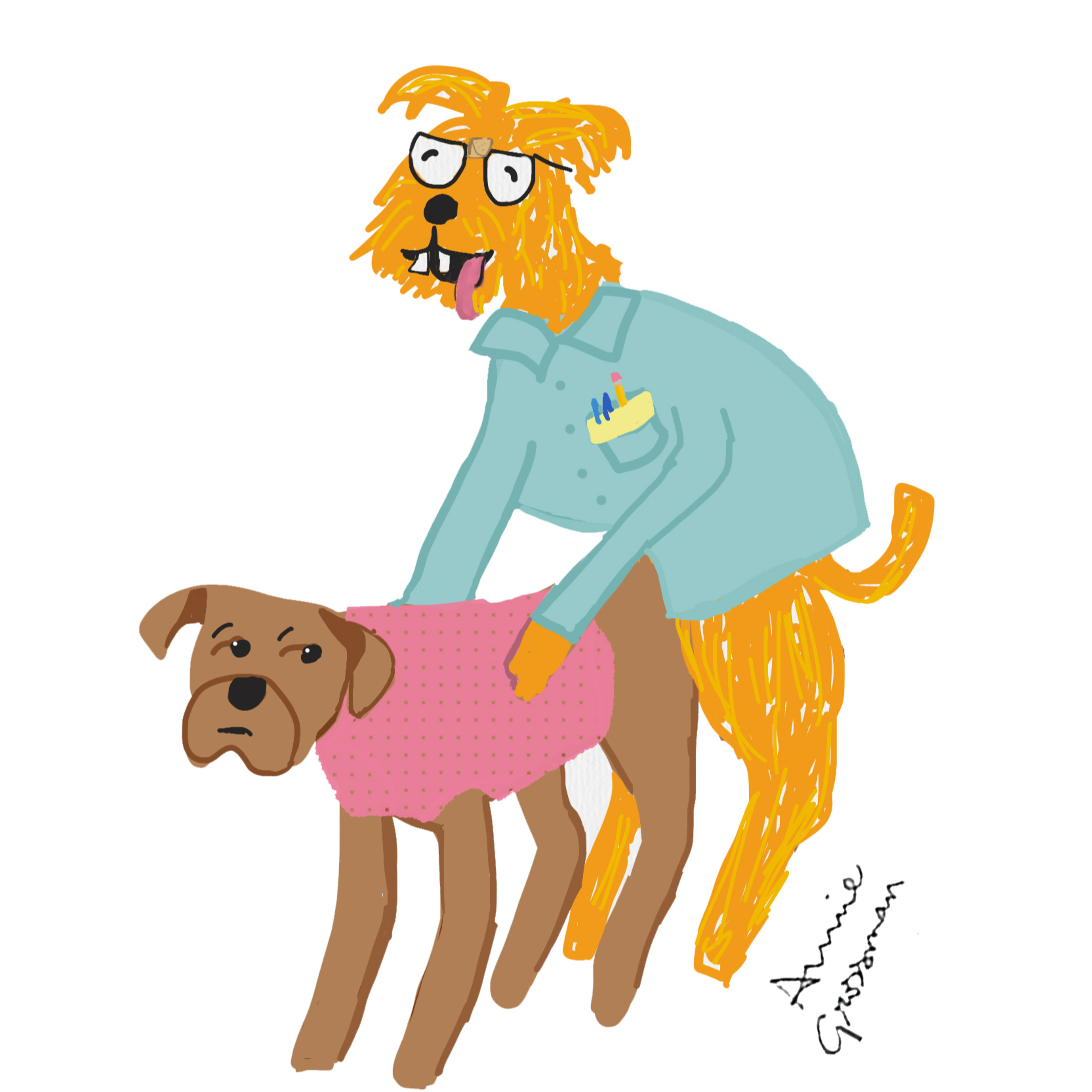
Dec 18, 2020
The Freedom "No-Pull" Harness: On the origins of School For The Dogs' #1 selling harness, with 2 Hounds Design's president Alisha Navarro
At School For The Dogs, we are very picky about products we recommend: We try to guide our clients towards products that we feel really work well and are made by US-based, sustainability-minded small businesses. North Carolina-based business 2 Hounds Designs ticks all the boxes. In particular, we are big fans of their Freedom Harness. It is one of only two harnesses that we sell in our Manhattan shop and in our online store. This innovative "no-pull" front-clip harness is one of the best selling items in our shop, and for good reason: it helps dogs learn to stop pulling! Annie interviews 2 Hounds' president, Alisha Navarro, who stumbled upon a little-known harness design nearly 18 years ago, purchased the patent, and now has a factory and 40+ employees who are working to keep up with ever-increasing demand for it. Annie and Alisha discuss why the harness works so well, the design's origins, its diehard fans, how the manufacturing side of the business was impacted by the coronavirus, and more. For a limited time, get 10% all 2 Hounds Design products at StoreForTheDogs.com using code ALISHA. https://storeforthedogs.com/collections/2-hounds-design --- Partial Transcript: Alisha Navarro: I’m Alisha Navarro. And I’m the founder and president of 2 Hounds Design. Annie: And how would you describe what 2 Hounds Design is? Alisha: So we make dog colors, harnesses, and leashes. Our harness is a patented no-pull harness. It has a Swiss velvet lining, and it’s all made in the USA. And our collars are pretty high end. We’re known for creating collars with our own ribbon designs. We also use some really high-end materials. Sometimes we’ll use home decoration materials, something that you would see in a luxury home. We’ll use that to put on collars. We’ve also taken wedding dresses apart and make collars out of them to match the bridal party. So we’ve done some really fun stuff on our collar side as well. Annie: So I discovered 2 Hounds because of the Freedom Harness. And so I’m really curious about that, but first I wanted to ask you, why is it called 2 Hounds? Alisha: 2 Hounds Design was named after my original two retired racing greyhounds, Iceman and Paradise. I adopted Paradise first in 2001, and I adopted Iceman in 2002, I believe. And then in 2003, I founded my company, and we were trying to come up with a name for it. And the company exists because of them, because I was selling collars for them. So we just named the company after them. Annie: So the Freedom No-Pull Harness is one of our best-selling items both in our online store and in our actual shop. And it is one of only two harnesses that we sell. And it’s definitely the harness that we recommend most. I love it for some reasons you already mentioned, for instance, I love that it has the velvet under the armpits. I love the front attachment. I was first made aware of this style of harness because of the Easy Walk harness, which is a similar harness, that I think is not as good actually. But I’d love to hear the story of how you came to discover this kind of harness. I understand that you didn’t invent it. But you kind of well, tell me, I bet there’s a good story here. Full Transcript available at SchoolfortheDogs.com/Podcast Get full access to Don't Be a Dick to Your Dog at dogtraining.substack.com/subscribe
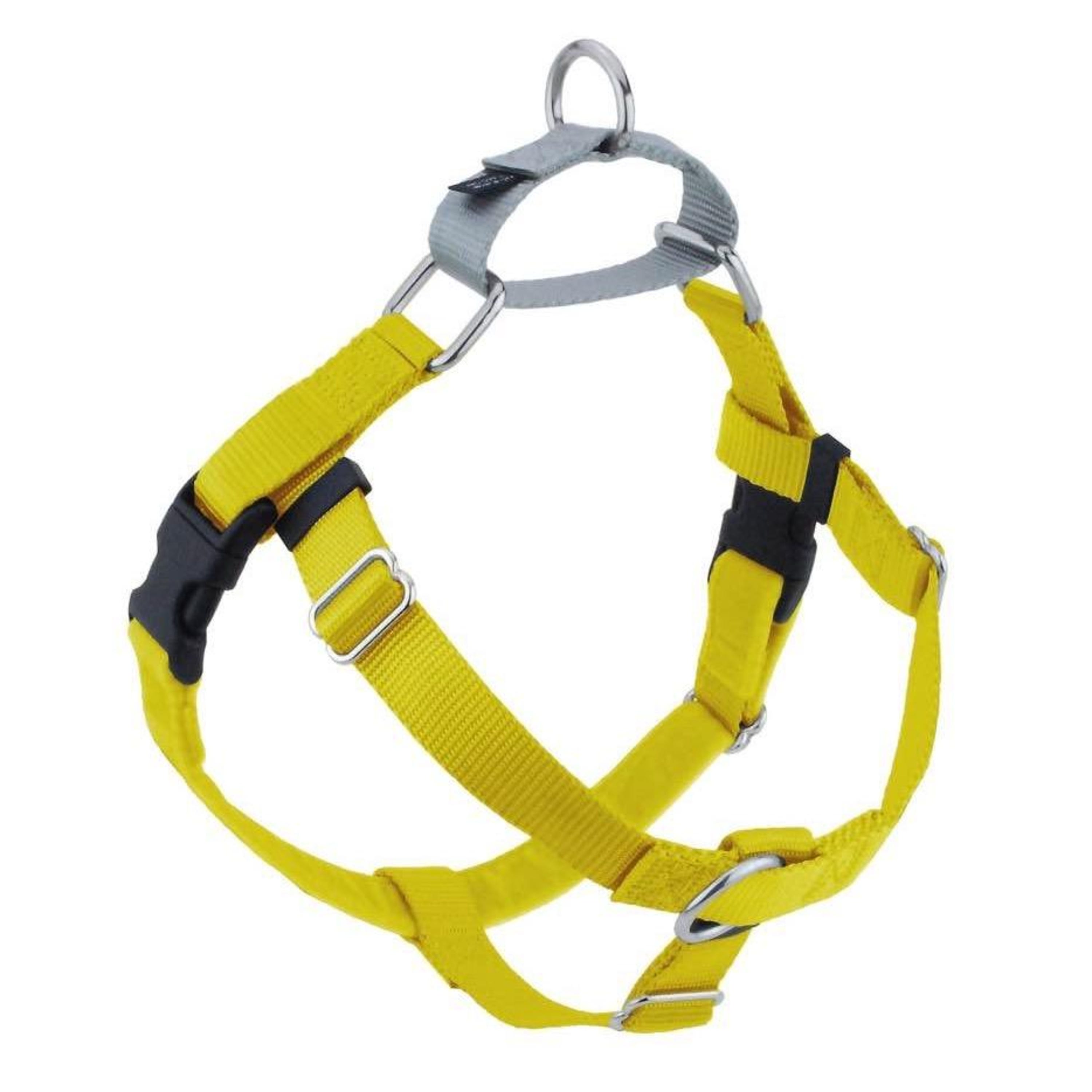
Dec 11, 2020
Dog training with Mary Poppins, Professor Harold Hill and Little Orphan Annie
During the dark days of 2020, Annie has been self-medicating. Her drug of choice? Watching clips from old movie musicals she loved as a kid. It turns out that there are a lot of lessons about behavior in these films, and storylines that unwittingly relate to dog training. In this episode, Annie gives a dog-trainer’s-eye-view analysis of Mary Poppins , The Music Man , and the movie Annie . See the full clips played in this episode when you join our new app: http://schoolforthedogs.com/community Mentioned in this episode: Animals Make Us Human , by Temple Grandin https://amzn.to/2KkyXA8 --- Transcript: Annie: So there’s something that I think probably a lot of people who know me well, probably don’t even know about me, which is that I love old movie musicals. I grew up with a small skyscraper of VHS tapes balanced atop the TV of Judy Garland movies, Fred Astaire movies, Gene Kelly, Robert Preston. I would watch these movies — I’m trying to think of some of them, 42nd street, GiGi, The Music Man, The Sound of Music, the Easter Parade, Oklahoma. I would just watch these movies over and over. And so much of them I feel like are deeply ingrained in me. And really it sort of informed my early view of what the world was like, which is maybe why adulthood has actually been something of a disappointment. Like it turns out if you’re an unmarried woman in your thirties who loves books, that doesn’t mean that Robert Preston is going to come serenade you in the library while everyone does a choreographed jig around you. I think I kind of put my love of movie musicals aside for many years, you know, occasionally maybe going to one if there was something at the Film Forum. But the existence of YouTube has really made it possible for me to occasionally dive in for an hour or two and watch some old favorite clips. It’s like a drug. It just makes me so happy to see people singing and dancing and these old movies. And during these gray months of 2020, I have started watching some of my favorite old musicals with my daughter, who’s almost two. We have Disney Plus, which is a treasure trove. And I’ve made her some YouTube playlists that we work through of my favorite scenes from old musicals. And of course I can’t help myself from finding little dog training lessons and dog life parallels in, in my old favorite movies. So I thought I would share a few songs today and tell you how I’ve been thinking about them as it relates to dog stuff. I don’t think there are any majorly important dog training lessons in what I’m about to share, but maybe it will just be a little bit of fun to share my thought process with you. And of course, to share these joyous, joyous movie moments. I am going to post the full videos in our brand new app, which you should definitely check out. You can get there at schoolforthedogs.com/community . There is a section there specifically about the podcast and that is where I’m going to post the videos. So, first one that I want to share with you is from Mary Poppins. Mary Poppins was based on the PL Travers books and of course starred Julie Andrews and Dick van Dyke. Two of my all time favorites, both of whom are still alive, fortunately. Julie Andrews, this was the first time she played an amazing babysitter. The second time being in the Sound of Music, which came a few years later. Full Transcript available at SchoolfortheDogs.com/Podcast Get full access to Don't Be a Dick to Your Dog at dogtraining.substack.com/subscribe
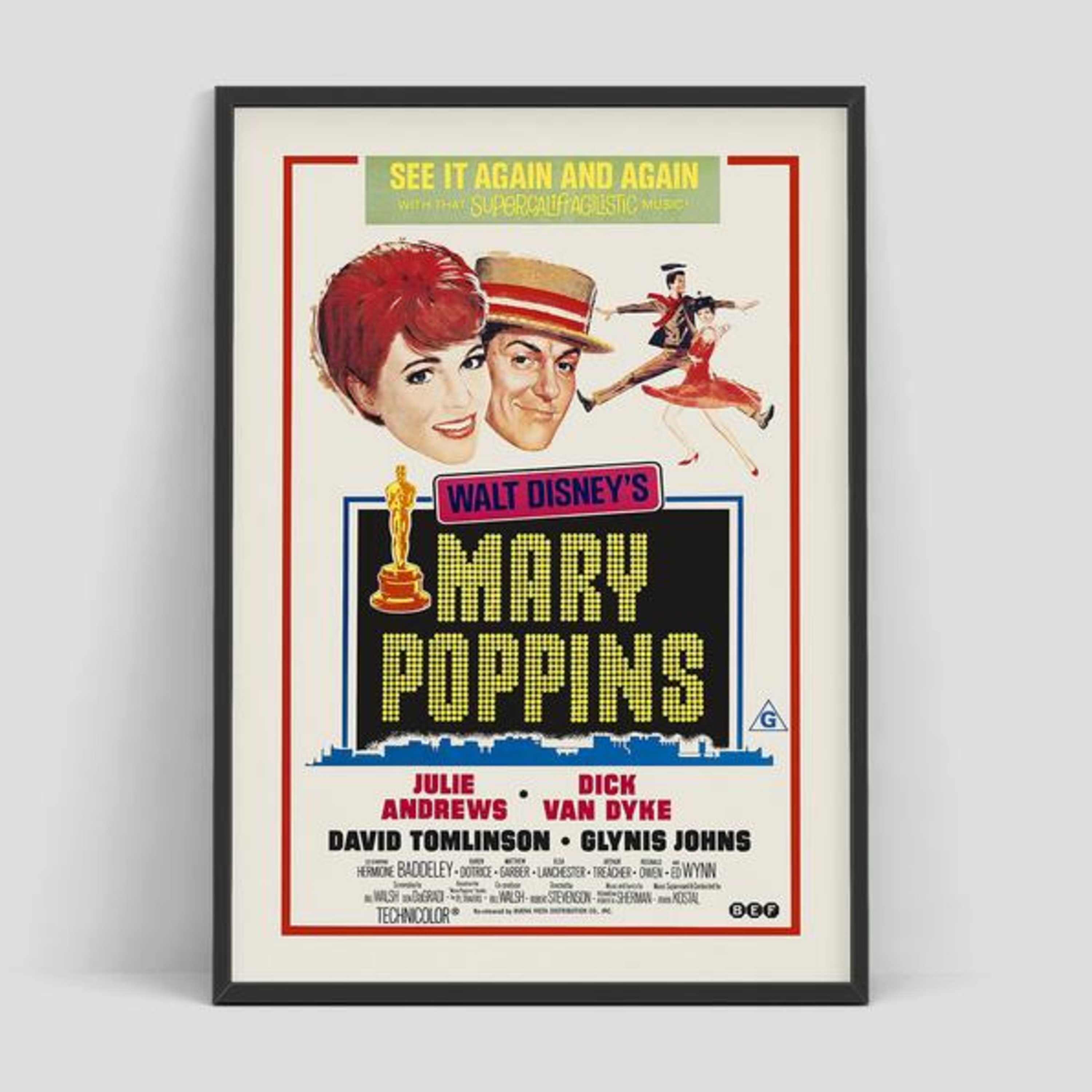
Dec 10, 2020
Dog Training Q and A! 12/10/2020: Should we send our puppy to do a board and train?
Shari asks: "A few months ago we had to put our beloved 17 year old dog Lola to sleep. A few months later, when a friend of mine who runs a shelter got a litter of lab puppies, she invited me to come play with them. Not surprisingly, I came home with Jasper, a now 4 month old chocolate lab. Already 50 lbs, Jasper is a big handful. We adore him and we're doing our best at training him, but we have a crazy busy household with three young children, two cats and two adults working very full time jobs from home. To be honest, we're feeling really overwhelmed about training him properly. Would you recommend a board and train program to help give us a leg up?" Annie talks about the cons of board-and-trains, and suggests a couple of alternatives. --- Partial Transcript: Annie: Hello, Annie here. Thanks for joining me. This is my first experiment with going live in our brand new app, which you can find by going to Schoolforthedogs.com/community , or look up School for the Dogs Community in iTunes. It’s pretty great. I’m pretty excited about it. And one cool feature is that I can do this in the app. If you’re able to tune in, say hi, love to see if this is working. You can also join these little Q and A sections online at schoolforthedogs.com/Qanda . And you can ask a question in advance at anniegrossman.com/ask . Okay. Today I have a question from my friend Shari. I actually worked with Shari on Too Cute the Animal Planet show. She was a producer there and I was an associate producer and sort of the resident dog nerd animal trainer. It was a great job for me for about a year. I did it about 10 years ago. Anyway Shari writes: A few months ago, we had to put our beloved 17 year old dog to sleep, Lola. A few months later, when a friend of mine who runs a shelter got a litter of Lab puppies, she invited me to come play with them. Not surprisingly, I came home with Jasper, a now four month old chocolate lab, already 50 pounds. Jasper is a big handful. We adore him and we’re doing our best at training him, but we have a crazy busy household with three young children, two cats, and two adults working very full-time jobs from home. To be honest, we’re feeling really overwhelmed about training him properly. Would you recommend a board and train program to help give us a leg up? So I think Shari is in a very understandable position that I think probably a lot of people are finding themselves in right now. A lot of people have gotten puppies during the pandemic, which is a great thing for a million reasons, but also I’m sure is posing a lot of challenges that are somewhat unexpected. Especially since a lot of people probably didn’t expect that they would have to continue trying to work from home with kids and maybe didn’t factor in what it would mean to have a puppy in that equation as well. My response to Shari is to think twice, though, before jumping to doing a board and train. I get the appeal of a board and train it as far as like what one imagines. It might be, I’m going to send my dog to some perfect person, perfect place, and my dog is going to come back with all the work done for me, and everything’s going to be easy. And all that stands between me and this is money. However, I think that it very rarely works out that way. Full transcript available at SchoolfortheDogs.com/Podcast Get full access to Don't Be a Dick to Your Dog at dogtraining.substack.com/subscribe
Dec 4, 2020
Amos
Amos Grossman Pedicone died on November 3, 2020. He was 15.5-years old, and lived with Annie Grossman since his puppyhood. He was a black Yorkiepoo who enjoyed playing fetch in the ocean, swimming in fountains, and learning new tricks -- sometimes pretty fabulous ones. But this episode isn't about his accomplishments, or about his braininess or cuteness. It's about death as part of dog ownership, and about how dog ownership can be part of a person's self-care. It's about how people can love a dog that doesn't belong to them. It's about how training can help us be able to enjoy our dogs and spend more time with them, and can help them be happy to be in the role of being the objects of our affection. It's also about how dogs are the opposite of death and heartbreak. But mostly, it's about Amos. He will be missed. Join the School For The Dogs Community app! On the web : http://schoolforthedogs.com/commumity On iTunes : https://podcasts.apple.com/us/podcast/id1355439730 In Google Play : https://play.google.com/store/apps/details?id=uk.co.disciplemedia.schoolfordogs --- Partial Transcript: Annie: So my dog died a month ago on November 3rd, Election Day. And I have been attempting to record this episode for the last few weeks, but it’s been hard to get myself to sit down and do it. To sit alone in a room and talk about losing my dog best friend over the last 15 and a half years, you know? And it’s not like I have to race cause someone else is going to scoop the story. It’s not like I have an editor breathing down my neck. I mean, I could just choose to not record a podcast episode about losing my dog. But this is a podcast about living with dogs, loving dogs, teaching dogs, learning from dogs. And unfortunately death is part of pet ownership. So I sort of feel like I would be chickening out if I neglected to talk about this part of my experience of this relationship. Also, this is School for the Dogs Podcast, of course, and Amos was a big part of how School for the Dogs came to be in existence. You know, some people I know have become dog trainers because they were really interested often from an early age in animal behavior in general, and dogs are a relatively easy animal to focus on if you’re interested in animal behavior, since you can study them and work with them without having to go scuba diving or camping out in a tree. I know quite a few dog trainers who consider themselves, I think animal trainers first, dog trainer second. And I also know a lot of people who got into dog training because they had a really difficult dog. But I don’t think I fit into either of those two categories for me. I think my dog training life started with a love of dogs in general and then a great love for one dog in particular. I didn’t become a dog trainer to change Amos in any way. I became a dog trainer because I wanted to figure out how to be a better person to my dog, how I could spend more time with him. I think I mentioned this in an early episode of the podcast, but I went through this real soul searching period during the last major economic downturn, like in 2008, 2009, 2010, where I was really thinking hard about how I could make a living doing something different than I had been doing. And I spent a lot of time with Amos in the dog park, writing lists of things I liked and things I could imagine spending my time doing. Full Transcript available at SchoolfortheDogs.com/Podcast Get full access to Don't Be a Dick to Your Dog at dogtraining.substack.com/subscribe
Dec 3, 2020
Dog Training Q and A! 12/03/2020: Answers to new dog owners' common crate training questions
Join Annie Grossman for a live Q and A most Thursdays. Sign up for the next one at schoolforthedogs.com/qanda . Have a question? Visit AnnieGrossman.com/ask or upload a recording at anchor.fm/dogs . In this episode, Annie talks about using a crate with a new dog. Among the questions answered: Where should you put a crate? What kind of crate should you get? Do you have to use a crate? How can a crate help with housetraining? What can you put in a crate? How can you get a dog to like being in a crate? What work-to-eat toys work in a crate? Can a dog be alone in a crate right away? Should you cover a crate? What training exercises can make a dog enjoy being in a crate? What behaviors can you teach in a crate? Mentioned in this episode: Slow Food Bowls https://storeforthedogs.com/collections/dog-bowls-and-treat-dispensers Revol Dog Crate https://storeforthedogs.com/products/the-revol-dog-crate Revol Crate Cover https://storeforthedogs.com/products/revol-crate-cover Groov Training Aid https://storeforthedogs.com/products/groov-training-aid Lickable Treats https://storeforthedogs.com/collections/lickable-and-spreadable-treats?sort_by=best-selling Susan Garrett's Crate Games https://amzn.to/3lCYnpK --- Partial Transcript: Annie: I have been getting a lot of questions about crate training. A lot of people getting dogs this year, which is pretty cool. The upside of global pandemic seems to be that people bring dogs into their homes. Who knew that that would be a silver lining. And crate is often one of the first things that people purchase right when they’re getting a dog. I think sometimes people get confused about how to use it, why they should use it or not use it. So I want to just sort of talk to y’all about the way I think about a crate. A crate is, of course, a great management tool. The three pillars of the dog training triad — management , timing and rewards . Management is all about setting the stage, setting a stage where our dogs are going to perform in ways we are going to be likely to like, and are not going to have a chance to do a lot of the stuff we might not want them to do. I think particularly a crate can be a very good management tool for house training. Full Transcript available at SchoolfortheDogs.com/Podcast Get full access to Don't Be a Dick to Your Dog at dogtraining.substack.com/subscribe

Nov 27, 2020
Creating gear for dog adventurers: Meet Ruffwear designer Liz Zarro
Meet Liz Zarro, a young designer at Oregon-based dog gear company, Ruffwear, which specializes in making products that help dogs and humans have outdoor adventures together. Liz and Annie discuss how Ruffwear's innovative products are developed, the thinking that goes into designing gear meant to please both dogs and humans, and how the products we use can affect how dogs are trained. You'll learn about the though process behind everything from treat pouches to dog seatbelts and more. This episode contains an Easter egg: a 25% discount on all Ruffwear products from now through 11:59PM ET on Monday 11/30. Find all the Ruffwear products mentioned in this episode, and more, at StoreForTheDogs.com ! Follow Liz Zarro on Instagram: @liz_zarro Take Annie's Master Class and get a free e-book on the three keys to dog training success! http://anniegrossman.com/masterclass --- Partial Transcript: [Intro and music] Liz Zarro: My name is Liz Zarro, and I’m a product designer and developer at Ruffwear in Bend Oregon. Ruffwear is an outdoor dog gear company. We basically design and develop the items that you would need to take your dog out on adventures with you and enable those outdoor pursuits. So things like dog boots, harnesses, backpacks, we kind of specialize in that area. Annie: And you studied in Bend, right? Isn’t Ruffwear in Bend. Am I right? Liz: Yes. Ruffwear is in Bend. Annie: And when you were going to school there in Oregon then, was Ruffwear kind of a spot that you thought, wow, that would be a great place to work as a dog lover and designer? Liz: Yes, I did. Yeah. When I was in college, actually, I sent an email to Ruffwear to see if they needed an intern or any extra help on their design team. And at that time I got an email back that was basically saying that at this time we don’t really need any help in that area. But fast forward a few years, after I had graduated and I was working as a freelancer. Ruffwear came back, and they did need a little extra help. And so I was able to freelance with their team, before I was offered a full-time job, and being able to move to Bend and join the team to make great performance dog gear. That was definitely like a dream come true, Annie: Ruffwear as a brand, it sells at REI. Do you think that’s how a lot of people discover it? Liz: I do. I think that, who I would consider our sort of core base, so outdoor and dog lovers, that sort of cross section. To me, that’s a total REI customer. For those people shopping at REI for other things, and then seeing Ruffwear, I think that is a big way that we become known. Annie: Yeah, it’s interesting because REI doesn’t carry a whole lot of pet gear. So it’s like the gear that they do carry, I guess, seems like it would have some kind of great stamp of approval on it. Because like I was saying, you know, you guys have huge fans, we carry it at my online store, storeforthedogs.com . We carry a lot of different brands and I don’t think any sort of thing, any specific brand has as big of a fan group. Have, have you, have you experienced the Ruffwear fandom? Full Transcript available at SchoolfortheDogs.com/Podcast Get full access to Don't Be a Dick to Your Dog at dogtraining.substack.com/subscribe
Nov 23, 2020
5 of our "go to" treats at SFTD (in ASMR + French)
This bonus episode is a recording of an Instagram Live Annie did, which can be seen here . https://www.instagram.com/tv/CH8i617n2mi/ The treats discussed here are main ones trainers use at School For The Dogs. They are: Happy Howies food rolls Carnivore Crunch by Stella + Chewy's Crumps Freeze Dried Beef Lamb Lung Tricky Trainers You can find them all at StoreForTheDogs.com https://storeforthedogs.com/collections/go-to-treats --- Partial Transcript: Annie: Hey, this is a recording of an Instagram live I just did about five of our go-to brands of dog treats at School for the Dogs. The first minute or two didn’t record. But the first treat I am talking about is Lamb Lung. We have our house brand of lamb lung. And a listener wrote in and suggested that I would have a good voice for a ASMR. So I attempted to talk about lamb lung in my best whispery, breathy voice. [whispering:] I never thought I would think so much about the lungs of lamb. It’s really a disgusting thing. When you think too much about the lamb lungs that are enjoyed by our dogs, but at least one of these animals is having a good life. I don’t know about the poor lambs. It makes me quite sad. Which it actually is one of the reasons why we started carrying a lot of vegan treats at School for the Dogs, because I think it’s actually a good idea to feed your dog vegan food, because it means fewer dead lambs, but that said the dogs do like the lamb lung. [whispering:] So this is the lamb lung that we carry. It’s our house brand. [crinkling plastic sound] Oh, it’s a crinkly noise to go with the whisper noise. So many good noises. So I like it cause it breaks up into really, really small bits. Really small, and they’re not greasy. And the dogs love them. [whispering:] So when I'm using a clicker, I will often have the treats and the clicker all together in one hand. And I will either have the lamb lung in small pieces, or I'll have one big piece, and then click, give a treat. You can like break off a treat while you like click and then just break off a little bit. So lamb lung is a real go-to at . [speaking] Oh my God, I don't think I can keep doing it. Doing the whisper is going to hurt my voice too much. [laughs] God, those whispering people on the internet have a lot of stamina. Okay. The second treat today is tricky trainers. We carry these in a bunch of different flavors kind of butter, cheddar cheese. This one is liver. I think liver is probably our most popular, and these are like the err dog treat. I think they're great. There's a couple of dog treats that come in, kind of brands that have treats in this kind of shape and size is like pencil eraser type treat size. It's great. Cause you can break one of these up into like one, two, three, four, right? I think I've got six pieces here. They're super low calorie. They’re three, three calories per treat. And like I said, one of these treats is really basically like 6 treats. So that's half a calorie per treat. They're made by Cloud Star , which is a small company in Missouri. You've probably seen their stickers. They have the slogan Wag more bark less. They make stickers that people put on their cars and whatever. Anyway, I'm a big fan of wheat and corn free Tricky Trainers. And look how cute is their little logo. It's a dog riding a bicycle. I love it. Full Transcript available at SchoolfortheDogs.com/Podcast Get full access to Don't Be a Dick to Your Dog at dogtraining.substack.com/subscribe
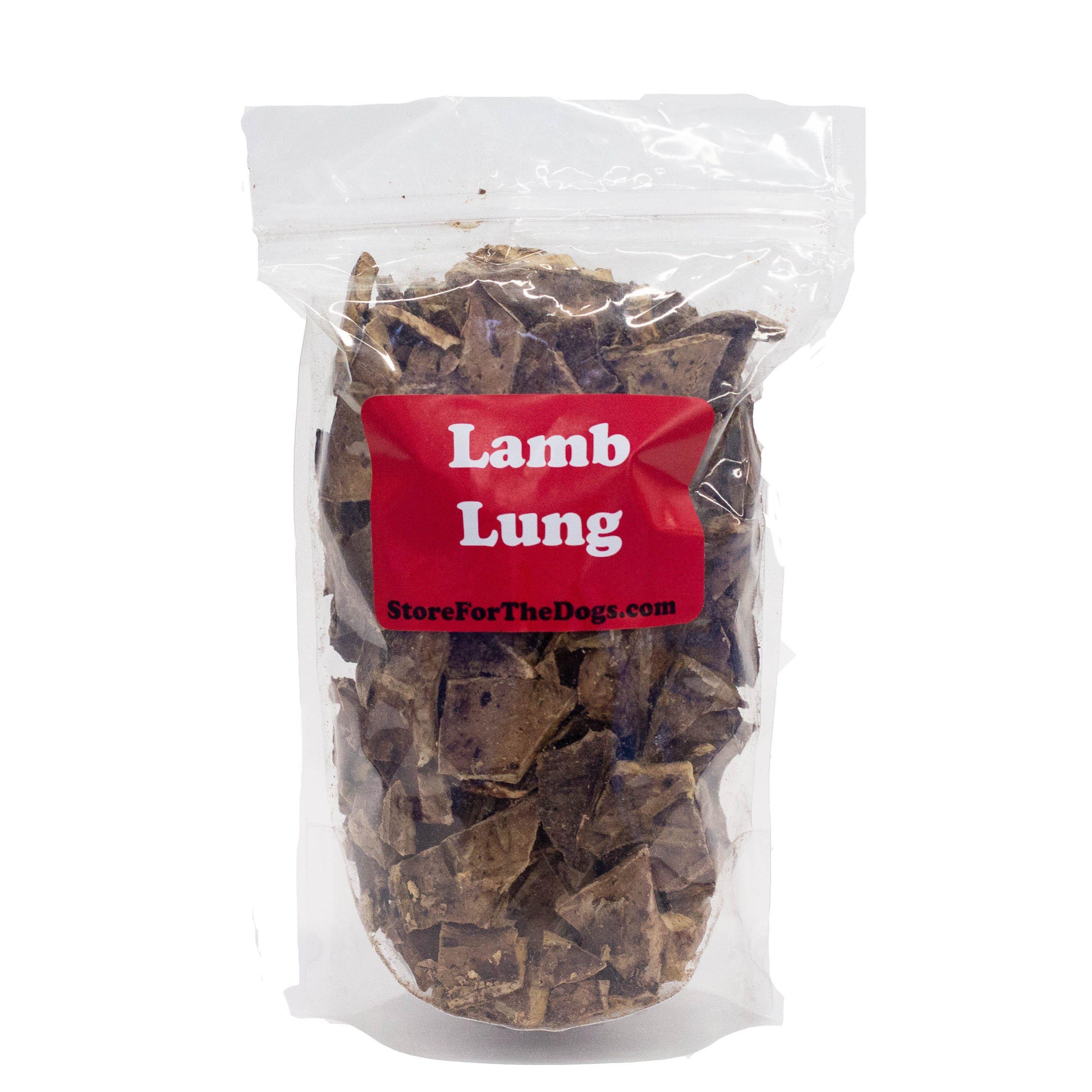
Nov 20, 2020
School For The Dogs' Sasha Prasad on helping animals live happier lives
Sasha Prasad moved to New York City with her three rescue dogs last year in order to get a masters degree in Animal Behavior and Conservation from Hunter. She began working at School For The Dogs right away, and has been with us ever since, doing everything from walking to client relations to social media. Her passion is helping all animals live happier lives; dogs are just one of the creatures she wants to work with. She and Annie discuss how she built her own dog walking company, Freedom Tails, in Boston, her shelter-based education in dog behavior, and her current work: researching how to make koi fish live happier, more enriched lives. Learn more about Sasha at http://SashaPrasad.com Articles by Dr. Becca Franks: https://scholar.google.com/citations?user=zBb257kAAAAJ&hl=en --- Partial Transcript: [Intro and music] Annie: So I think I’ve said this before and I don’t want to sound self-congratulatory, but I have to say Kate and I have really great people working for us at School for the Dogs. I am. So just thrilled, thrilled to have a team of people who have these special talents and interests. I’m thrilled to have these people working towards the same goal altogether under the School for the Dogs umbrella. The goal of helping dogs and people live happier lives together. And I feel especially I don’t know, sort of sappy about it. I think just because this has been such a difficult year for pretty much everyone in the world. And one thing, one blessing, one silver lining has been that I feel like it’s brought our staff closer together and just made me all the more grateful. So today I am sharing with you a conversation I had with Sasha Prasad. Sasha has been with School for the Dogs for over a year now. But you maybe haven’t met her at the studio because especially lately, she does a lot of behind the scenes stuff. She does a lot of our Instagramming, the wonderful roundups we do on the weekend. And she also is the person who answers a lot of emails that come into our info box. But Sasha is an animal trainer in her own right. Currently working with fish, actually. So I’m excited to share this conversation she and I had. Annie: Hi. Sasha: Hello. The lighting where you are as beautiful. You are glowing. Annie: I’m right in the window. Sasha: Yeah, amazing. Annie: So I am psyched to get to talk to Sasha Prasad and to see your little dog there. Sasha: Yeah. Chloe is here, Lilo’s down here. Jackson will probably make himself heard at some point. So the gang’s all here. Annie: You’re a three dog, three dog household in New York City. Sasha: Yeah. Not on purpose, but here we are. So. Annie: Aw. And I know one of them, one of them has been in hospice care — at home hospice care. Is that right? Sasha: Yeah. It’s been a pretty wild ride. So Lilo, she’s 17. We brought her to the emergency vet sometime in late August and they told us she was in kidney failure and that she had a couple of days to a couple of weeks left. But here we are going on a month. Behaviorally, she’s a little slower and I have to do a lot more coaxing to get her to eat, but she’s eating full meals. She’s still doing the things that she likes to do. She’s going for walks. And so, I don’t know. We’re really grateful and we’re taking it one day at a time. Full Transcript available at SchoolfortheDogs.com/Podcast Get full access to Don't Be a Dick to Your Dog at dogtraining.substack.com/subscribe
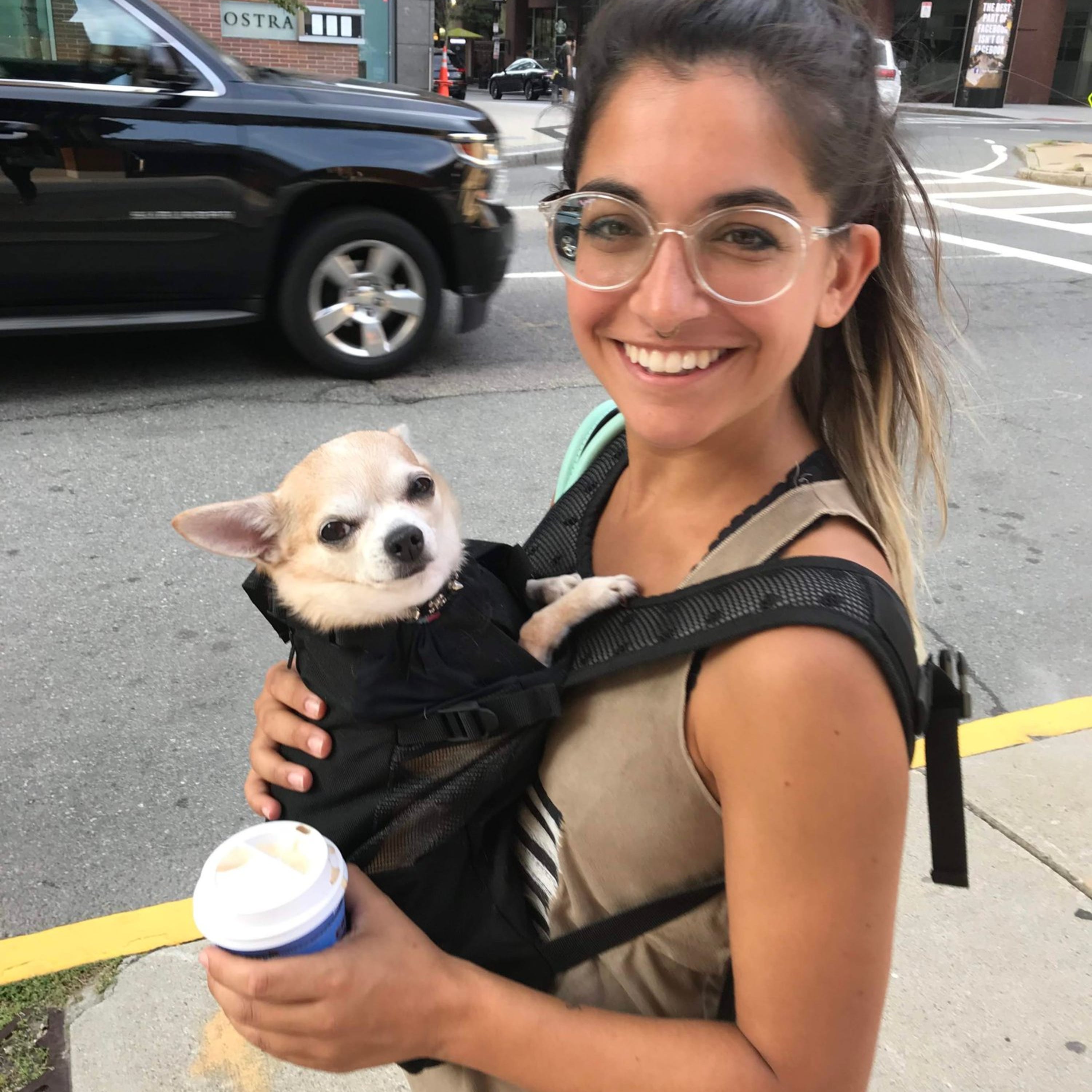
Nov 19, 2020
Dog Training Q and A! 11/19/2020: Handmade gifts, dealing with a dog who bites the leash & dog training tips for a toddler mom
Join Annie Grossman for a live Q and A most Thursdays. Sign up for the next one at http://schoolforthedogs.com/qanda . Have a question? Visit AnnieGrossman.com/ask or upload a recording at anchor.fm/dogs . In this episode: Annie talks about some of the awesome handmade products for sale at StoreForTheDogs.com and answers questions about a young dog who "submissive pees" and bites the leash on walks. She also talks about a friend who was receptive to Annie's dog training advice when it came to her kid throwing tantrums when it was time to get dressed. Find all the items mentioned in this episode at StoreForTheDogs.com http://storeforthedogs.com/collections/handmade --- Partial Transcript: Annie: So today I thought I would show you guys some of the really cool handmade things that we sell at School for the Dogs as as a lot of you know we really try and have items that are, first of all, things that we really like that we recommend. We have like a pretty limited amount of space. So we want to fill it with things that we truly think are great. We also try and support other small businesses, particularly small local businesses. And we have quite a few people who make really lovely goods by hand, and I wanted to show you just a couple of them. These are all available at storeforthedogs.com and also in our East Village shop. This is a toy that just came in . It’s pretty hilarious. I think it’s like a tomato with a baby tomato, I guess. I don’t know what’s going on here. It’s made by the company at the furry folks, we carry their whole line on our online store. But what’s cool about this is, you pull out the tiny, tiny baby tomato and this, I don’t know, yellow pulp stuff comes out, and you can hide treats in the pulpy part, in this like yellow fabric thing with holes in it. I’m trying to figure out how I would describe this to someone who can’t see it. It’s kind of like a big, weird stocking that comes out of this tomato. That’s like crackling. [crinkling sound] And we all know dogs like things that crackle. It has this really sturdy fabric on the outside. So anyway, you put dry food, treats, kibble, whatever in the yellow pull-out part and then stuff it in here. If you have the kind of dog who really loves to pull things apart, really nice toy that comes in this very cute little like tomato style box, like you would see at green market. Also by DogNMat, is this sushi snuffle toy . I’m a big fan of this because I think it’s just so cute. it comes like this rolled up like a sushi, totally made of fleece, machine washable. You unroll it and it has like avocado in it. What is this? The egg stuff? I never liked that stuff in my sushi rolls. Salmon. And, again, you just hide treats in the little bits here, roll it up, has a little Velcro closure, and you have a sushi snuffle roll! Full Transcript available at SchoolfortheDogs.com/Podcast Get full access to Don't Be a Dick to Your Dog at dogtraining.substack.com/subscribe

Nov 18, 2020
The Charles Mingus' CAT-alog for Toilet Training Your Cat (1972)
When he wasn't revolutionizing the world of mid-20th century jazz music, Charles Mingus was home training his cat, Nightlife. Specifically, he was really into training Nightlife to go on the toilet. Indeed, he was something of an evangelist on the subject. Here, Annie reads from "The Charles Mingus CAT-alog for Toilet Training Your Cat," his 1972 brochure that outlines a step-by-step process. You can find the full text here https://www.charlesmingus.com/mingus/cat-traning-program?utm_content=buffer97a50 Train your own cat with a modern invention: The Litter Kwitter https://litterkwitter.com/ Music: Full of Love from Album Stay Tonight, by Till Paradiso (CC BY-NC-ND 4.0) https://freemusicarchive.org/music/till-paradiso/stay-tonight/full-of-love-tp-031mp3 --- Partial Transcript: Annie: There are two things I love that I rarely talk about on this podcast. One is cats. The other is jazz music. Well, that's all going to change today. A few weeks ago in a Q and A I did, I mentioned this little known fact in the history of jazz, which is that jazz titan Charles Mingus was very interested in cat training. Specifically, he was interested in training cats to pee and poop on toilets, and he actually wrote a guide to how to do that . So today I thought I would just share with you a reading of this guide paired with some jazz music. Here is Charles Mingus is the Charles Mingus CAT-atalog for toilet training your cat. First, you must train your cat to use a homemade cardboard litter box if you have not already done so. If your box does not have a one-piece bottom, add a cardboard that fits inside so you have a false bottom that is smooth and strong. This way the box will not become soggy and fall out at the bottom. The grocery store will have extra flat cardboards, which you can cut down to fit exactly inside your box. Be sure to use torn up newspaper, not kitty litter. Stop using kitty litter. When the time comes, you cannot put sand in the toilet. Once your cat is trained to use a cardboard box, start moving the box around the room towards the bathroom. If the box is in a corner, move it a few feet from the corner, but not very noticeably. If you move it too far, he may go to the bathroom in the original. Do it gradually. You've got to get him thinking, then he will gradually follow the box as you move it to the bathroom. If you already have it there, move it out of the bathroom, around, and then back. He has to learn to follow it. If it is too close to the toilet to begin with, he will not follow it up onto the toilet seat. A cat will look for his box. He smells it. Now as you move the box, also start cutting the brim of the box down, so the sides get lower. Do this gradually. Finally you reach the bathroom, and eventually the toilet itself. Then one day, prepare to put the box on top of the toilet. At each corner of the box, cut a little slash you can run string around the box through these slashes, and tie the box down to the toilet so it will fall off. Your cat will see it there and jump up to the box, which is now sitting on top of the toilet. Get the sides cut down to only an inch or so. Full Transcript available at SchoolfortheDogs.com/Podcast Get full access to Don't Be a Dick to Your Dog at dogtraining.substack.com/subscribe
Nov 13, 2020
The Bully Test: How to tell if your dog (or kid or country) is having fun PLUS: FOMO crate training
If two dogs are playing, and you're unsure if your dog is into it, there is a simple "test" you can perform. The Bully Test, which was coined by Dr. Ian Dunbar, is a great way to tell how your dog feels about his or her playmate. Annie looks at how she herself behaved when faced with childhood mean girls, and how voters reacted when bullied by the Bully-In-Chief. Also: Is "bully" an inherent quality in a dog? Or a kid? Is there a term that we could come up with that doesn't vilify one of two puppies when performing this "test?" And: Why you shouldn't expect dogs to just "working it out" during play. Lastly: Annie explains how to use FOMO to train dogs to love going in crates. Master Class: http://anniegrossman.com/masterclass Community App Early Invite Signup: http://schoolforthedogs.com/podcastcommunity --- Partial Transcript: [Intro and music] Annie: Here is a pretty simple thing that any dog owner can do if their dog is playing with another dog and they're not sure if both the dogs are enjoying themselves. What you do is you gently restrain whichever dog is the more outgoing, the more aggressive one. I think a lot of the time, in play with dogs, just like with kids, one person is the chaser. Hold back, restrain in whatever gentle way you can, the more aggressive of the two dogs and see what the other dog does. If the dog comes right back and goes up to the dog, who's being restrained and is like, come on, I thought we were doing this. Then that dog probably was into it. Right? That dog was probably feeling good about that place session. If the dog goes to the other side of the room that tells you that that dog was most likely happy that he has the chance to take a break and that perhaps he was feeling bullied. This is called the bully test. I believe it was named, if maybe not also developed, by a Dr. Ian Dunbar, a trainer of great renown and also a veterinarian. It's such a simple thing. It makes so much sense. And if it can help you make sure that two dogs aren't enjoying playing with each other, there's really no downside. And by the way, the dog who is the possible bully -- if the dog who wasn't being restrained does take the chance to go to the other side of the room -- that does not mean that one dog is a bad dog. It just means that in that situation, maybe the intensity was too much. Maybe there’s a size difference between the two dogs that is making one of them uncomfortable. Maybe it has nothing — one dog might just be extra fearful for any reason, or no reason. Could be mix-matched play styles. So this isn’t, you know, see which dog is the good dog and which is the bad dog. It’s just a way to diagnose the healthiness and the happiness of play that is happening. So I wanted to mention this because I think it’s a really easy tool to have in your dog training dog-owning toolbox to use with dogs who are off-leash. And I think off-leash play is very important for most dogs, much better than on leash play. But I also think one-on-one play is often the best kind of play. However, this technique could be used in a dog park situation too, or with more dogs. Another reason why I was thinking about the bully test recently and wanted to mention it was because I was going through some stuff in my mom’s basement recently. And I found a letter. I wrote it to my mom from summer camp when I was nine. And it was about this girl who I was in grade school with at that time. Full Transcript available at SchoolfortheDogs.com/Podcast Get full access to Don't Be a Dick to Your Dog at dogtraining.substack.com/subscribe
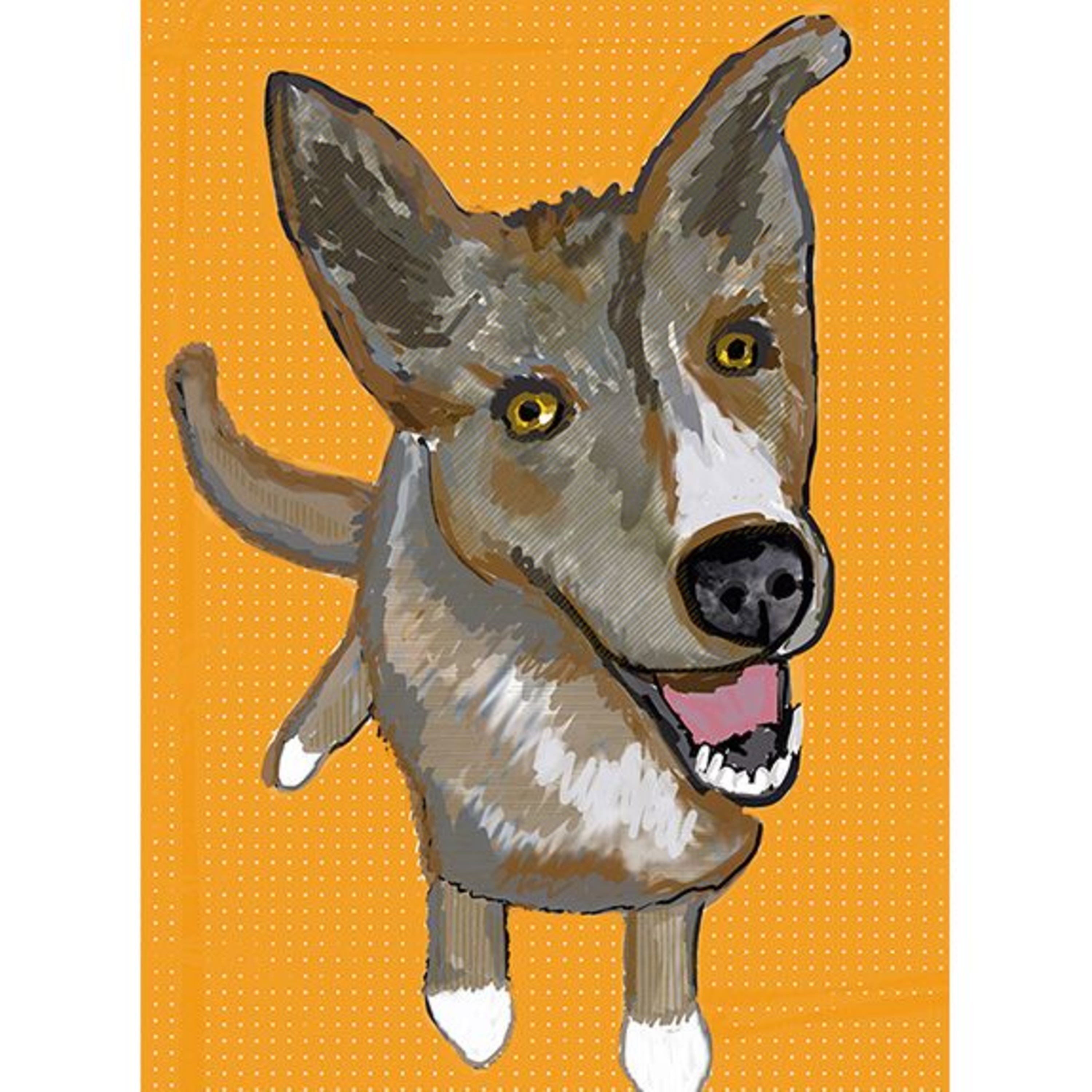
Nov 12, 2020
Dog Training Q and A! 11/05/2020: Cody doesn't want to go out with walker, Peaches won't pee on the patio & more
Join Annie Grossman for a live Q and A most Thursdays. Sign up for the next one at http://schoolforthedogs.com/qanda . Have a question? Visit AnnieGrossman.com/ask or upload a recording at anchor.fm/dogs . In this episode: A young labrador no longer wants to go to Fiesta Island with his walker. Is he being lazy? Peaches the Chihuahua doesn't understand why her human wants her to pee on the patio. Is it wise to get a second dog if a finicky dog seems more interesting in eating meals when other dogs are around? --- Partial Transcript: Annie: Hey everyone. This is a bonus Q and A Episode. I try and answer questions live every Thursday. You can sign up to come to my free live Q and A at schoolforthedogs.com/QandA and you will see the next one I’m doing. I then am trying to take recordings of those Q and A’s and post them here to the podcast feed. If you have a question, you can email me directly Annie@schoolforthedogs.com . You can also go to anchor.fm/dogs and record your question there. Thanks for being here. This is Annie Grossman here. I am doing a Live. We had some technical difficulties, but you you can join now at schoolforthedogs.com/Qanda . Or you can just hang out here. I have some great questions here. We have Max and Melissa in the room with us right now. Max has a two year old standard poodle named Lolo. I’m not sure I met Lolo, but how is Lolo doing? Anyway thanks for sticking with me. There were some technical difficulties just now. But I have some great questions. I am not sure if those who ask these questions are in the room, but if you are, do say hello. All right. Our first question is from Michelle Adams who has a Labrador, 70 pounds, lives in San Diego. And Michelle writes me this: Hooper has been going to Fiesta Island, a large off-leash park where he can chase a ball and play with other dogs, for about three months now. He has been going with a dog walker who also has other dogs. He absolutely loves Fiesta Island this week. This week he has decided he does not want to leave the house when they show up to take him. He is home by himself and simply needs to go out the doggy door. Rather, he sits on the sofa and looks at them through the window. If they come into the house, he will go with them. He then has a blast while he is at the park, pictures to verify (I guess she’s saying they take pictures to verify this). The first time he refused to go, they asked him if he wanted a treat and he went right out the dog door. The second time he refused to go, they again tried asking him if he wanted a treat and he still refused to go. They had to go into my home to take him. I am not certain if he is just being lazy, it’s not really his style. Or if I should listen to him and realize that he doesn’t want to go? Full Transcript available at SchoolfortheDogs.com/Podcast Get full access to Don't Be a Dick to Your Dog at dogtraining.substack.com/subscribe

Nov 6, 2020
School For The Dogs' trainer Erin Whelan on how dog training changed her life
Erin Whelan was a professional French Horn Player. Then she adopted a beagle mix named Oliver and enrolled him in Puppy Kindergarten at School For The Dogs. Then she did the School For The Dogs Professional Program. Now, she is a trainer and manager at School For The Dogs. Annie, who was once her dog trainer and is now her boss, is a big Erin Whelan fan. Annie and Erin discuss switching careers, Cesar Millan's best book, what it means to teach dogs virtually, human body language, and more. Sign up for a session with Erin , at our studio or virtually, at https://www.schoolforthedogs.com/erin/ Sign up for our master class at http://anniegrossman.com/masterclass Get invited to our new community app at http://schoolforthedogs.com/podcastcommunity The Like Switch https://amzn.to/2I5LVkl Cesar's Rules https://amzn.to/3p4hBrn --- Partial Transcript: Annie: If you work at School for the Dogs, you might, at some point be approached by our boss, with your boss, asking if you would be willing to be interviewed for the School for the Dogs podcast. In this scenario, I am the boss and the person I’m interviewing today is Erin Whelan. Erin started out with us as a client and ended up doing our professional program and is now a trainer and a manager with us. She is wonderful. I asked some of her coworkers to find adjectives to describe Erin. They said gregarious, honest, humble, fearless, compassionate, down to earth. Witty, Innovative, zealous. Funny, loyal, team player, empathetic, warm, goofy, creative. I hope you’ll enjoy this conversation with Erin. You can book a session with Erin, either at our studio or virtually at schoolforthedogs.com/Erin . [Intro and music] Annie: Hello. I am here with Erin Whelan. Did I say it right? Erin: You did. That’s very good. Annie: I know the H has to be sounded there. Erin: It doesn’t have to, but as long as it’s not wheelin, I’m happy. Annie: Whelan. And I am super psyched to be talking to you. I’ve known you for quite a while now, actually. Erin: Yeah it’s been over six years. Annie: So I, gosh, there’s so much to talk about, but why don’t you just kind of tell the story of how you ended up at School for the Dogs? And we can go from there. And actually, why don’t you start off by just explaining what you’re doing now at School for the Dogs, because you’ve been on both sides, the client and staff side, and you’ve worn a lot of hats on the staff side too, so. Erin: Well, yeah, so right now at the moment, I am both an associate trainer and interim day school manager at School for the Dogs. So I work at day school, puppy day school. I do private sessions for puppies and basic manners, adolescents, and day training. I also teach prep school and puppy kindergarten. Annie: Oh my goodness. Describe what day school is for people who aren’t familiar. Erin: So for day school and puppy day school, those are drop-off training programs. We have day schools for adult and adolescent dogs, and puppy day school. It’s in the name guys, it’s for puppies. And during both of those programs, the dogs go through some relaxation. They have the opportunity to play with other dogs... Full Transcript available at SchoolfortheDogs.com/Podcast Get full access to Don't Be a Dick to Your Dog at dogtraining.substack.com/subscribe

Nov 2, 2020
Dog Training Q and A! 10/29/2020: Helping a puppy pee when its pouring and how to occupy your dog inside
Join Annie Grossman for a live Q and A most Thursdays. Sign up at http://schoolforthedogs.com/qanda . Have a question? Visit AnnieGrossman.com/ask or upload a recording at anchor.fm/dogs . In this episode, Annie answers questions about how to deal with a young puppy who is scared to relieve himself outside when it is pouring, suggests how to keep dogs occupied inside, and discusses why dogs lift their legs when they pee, and more. --- Partial Transcript: Annie: So I am going to be answering some questions. I have at least one that’s on my agenda. Hi Lily. Hi Yolanta. But I think I’m probably gonna keep this pretty short because I’m not feeling great, but I took an aspirin, and I had a drink. [Laughs] And then I have another drink here that I’m sipping. So this isn’t a drinking problem, I have, it’s a drinking solution. Lily, where are you joining from? Yolanta as we know is in the borough of Staten Island. Yolanta, I’m curious, if you–last week we talked about you paying your neighbor to help you. I’m curious how that worked out. And I’m curious if you saw the movie The King of Staten Island. Cause I thought it was kind of like a sweet ode to Staten Island, but then I wondered how actual Staten Island people felt. Oh, Lily is in Kips Bay. Well then we are neighbors. Okay, Lily, since you’re here and you’ve already asked me a question, let’s start with you. So Lily asked: My puppy is six months and hasn’t learned how to pee with his legs standing up. Will he ever learn? Great question. I don’t know. Some dogs are always going to prefer peeing in a squat. My dog, sometimes squats, sometimes lifts his leg. Some female dogs prefer lifting their leg to squatting. I think there will probably be a day where all of a sudden out of nowhere he’ll lift his leg and you’ll feel very proud, but I wouldn’t worry about it. I think that I think that one of the reasons, I don’t think I’m making this up. I think I’ve read about this, but I think one of the reasons we think dogs lift their leg is so that they appear bigger. Isn’t that interesting. Like, you know, one reason probably why little dogs have big ferocious barks is because they want dogs that are far away to think they’re bigger than they are. And one way to make dogs who might never meet you think that you’re more ferocious and should be treated with respect is if they smell you, and they smell your pee way up there. I should also apologize. My husband is also on a call right now for work. He is helping wealthy kids get into expensive colleges in the other room. So if you hear that in the background, apologies. So yeah, I wouldn’t worry if he isn’t lifting his leg, but I’m curious if maybe he will. I don’t remember when my dog started lifting his leg, but six, seven, eight months. It sounds like it might be happening. And then we have a question here that came in from Mary Jane who is in Concepcion, Chile. She has a dog named Kenny, a mixed breed about 30 pounds. And Mary Jane says: I am having trouble teaching my dog to wear a harness and collar. I put a plate with bits of chicken to lure her as soon as she puts her head through it and the harness rests on her neck, but then she backs off. She is very touch sensitive. We’ve been four months together, and just a month ago she allowed me to pet and touch her across her body. Full transcript available at SchoolfortheDogs.com/podcast Get full access to Don't Be a Dick to Your Dog at dogtraining.substack.com/subscribe

Oct 31, 2020
Virtual private training session: Yoshi, an adolescent Shepherd who jumps on people on the street
Sit in on an initial virtual private dog training session with Annie Grossman and NYC resident Kari. Kari lives near School For The Dogs with an 8-month old Shepherd mix named Yoshi. Yoshi likes to jump on people when they're walking down the street, and he is quick to rollover on his back when people greet him. Annie gives Kari tips on keeping his attention while walking outside, suggests how to set up practice sessions with people approaching him, and gives Kari some fun and easy exercises she can work on with Yoshi in their home. Book a private session: schoolforthedogs.com/services - Get a free thirty minute private session when you purchase our Good Dog Training Course: schoolforthedogs.com/courses - Liquid Treat Dispenser: SchoolForTheDogs.com/ltd --- Partial Transcript: [Music] Annie: This is a recording of a private session we did with a client. You can book a virtual or in-person private session at schoolforthedogs.com . And for a limited time, you can get a free 30 minute virtual consult when you buy our Good Dog Training course available at schoolforthedogs.com/courses . The trainer in the session is me, Annie. The client is Carrie who lives in Manhattan with her adolescent rescue dog, Yoshi. Hi. Hi Kari. Nice to meet you. Kari: Hello. Hold on. Let me just adjust the volume. I don’t use zoom so I know nothing about this. Okay. Hi. Annie: Hi. So is this Yoshi? Kari Oh yeah. I gave him an antler to keep him busy, so he’s right behind me. Annie: Oh, yummy antler. Well, that sounds smart. So tell me a little bit about how Yoshi came into your life and then let’s figure out how we can deal with… Doesn’t sound like you’re having major issues, but maybe a couple of things that we can improve upon. Kari: Okay. So we adopted him early August. He was an instant foster fail. Annie: And remind me, do you live in New York city? Kari: I’m literally three blocks south of School for the Dogs. Annie: Oh, awesome. Okay. Where did, where did you adopt him from? Kari: True North rescue. So we’ve always wanted a dog for a long time, but I’ve never really pulled the trigger. I’d scroll Petfinder for a long time. We decided to, but you know, pandemic happened and I was home a lot and I’m like, I think it’s time. And we decided to foster at first because I wasn’t really sure or 100% ready to commit to a dog. So I said, let’s start fostering. The rescue that we got him from said that they were getting dogs from Puerto Rico. So that’s where he’s from. He’s from Puerto Rico. They flew him to Florida. He saw a vet there and then they loaded them to a truck and ended up in New York. So, I picked him out of a bunch of photos. I knew nothing about him. He was six months when we got him and all they told me that he was a shepherd mix. We don’t really know what kind of mix he is. I don’t know if that matters. I wasn’t really keen on finding out right now. So we got him, he was six months. He didn’t really have any problems. apart from, of course within the first week he was sleeping a lot. He was probably really exhausted. And of course he was scared. I think he was more scared of us than anything else. So I had very little trouble. I didn’t even have to crate train him. He would go into his crate, no problem. Full Transcript available at SchoolfortheDogs.com/podcast Get full access to Don't Be a Dick to Your Dog at dogtraining.substack.com/subscribe
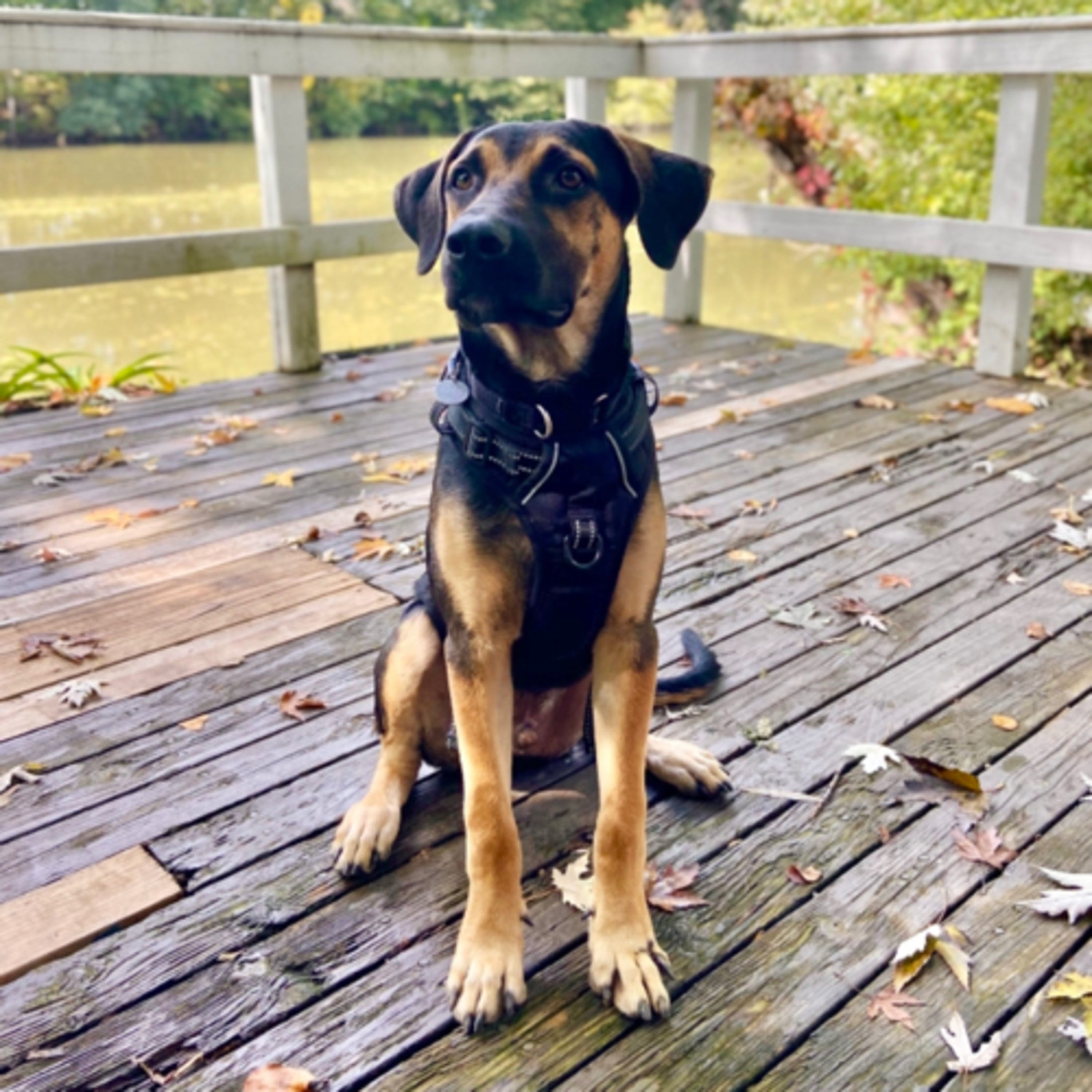
Oct 30, 2020
Recycled treats and retractable leashes: The good, the bad & the hilarious
In this episode, you'll learn about two products, each invented by a woman. The first is something you've probably encountered: the retractable leash. The second is a new brand of treats called Shameless Pets, which makes yummy stuff for dogs from pre-consumer food waste. The former can be quite dangerous, but Annie suggests a way to make it safer; the latter is a successful version of a Seinfeld-esque business plan that Annie's neighbor came up with in the 1990s. In between tips about using a retractable leash and the story of Shameless Pets, you'll hear a hilarious piece of standup by comedian Drew Lynch. Drew Lynch on retractable leashes - Mary Delaney's patent - Shameless Pet Treats - Free guide to house training --- Partial Transcription: Annie: Do you need some help teaching your dog where you want him to pee or poop, and when? If so, I hope you’ll check out our brand new totally free house training guide. You can find it at schoolforthedogs.com/house . It’s filled with lots of really good tips on how to train a dog to potty in the right spot. But it also is going to explain to you how to teach your dog to do it on cue. So go check it out. Schoolforthedogs.com/house . [Intro music] Hi, thanks for being here, humans. There are two parts to this episode. One part is about retractable leashes and the other part is a conversation I had with Alex Waite, who is one of the founders of Shameless, which is a really cool brand of treats that you’re going to learn a lot about. They’re doing things differently in a very interesting way. Just a reminder that if you liked this podcast, please go to iTunes and leave a review and support us by shopping in our online store storeforthedogs.com . I think we have the greatest stuff in the world there, for people who love their dogs. Enjoy. So here’s something you might not know if you’ve never worked with a dog trainer or you don’t hang out with dog trainers. Most dog trainers, at least the ones that I know, don’t like retractable leashes. And there are a bunch of reasons for this. For one, we want our dogs to ideally be walking on a loose leash. I always say a leash should be there the same way a seatbelt is in a car. You don’t wear the seatbelt and then feel like, okay, now I can drive like a madman. It’s there in case of an emergency. Ideally your dog should be able to walk in a vicinity that is acceptable, but the leash should be there in case of an emergency. And if you have a leash that is always taut, your dog can get used to feeling that the leash has to have some kind of pull on him at all times. So often dogs on retractable leashes are dogs who have learned to pull. Another reason is that the cord that attaches the class to the plastic chunky part of the retractable leash is very thin. And if you, if you get it wound around a finger or your leg or a dog, it can really do some damage. Actually, if you go to Google and you start typing in retractable leash, at least on my computer, the first suggested thing that comes up for you to be Googling is retractable leash injuries. Thanks to the magic of Google images, you can see what retractable leash injuries look like, and they’re pretty awful. Full Transcript available at SchoolfortheDogs.com/Podcast Get full access to Don't Be a Dick to Your Dog at dogtraining.substack.com/subscribe

Oct 27, 2020
Annie's BFF Daisy Carrington on growing up with a stolen dog, being a childhood loan shark & more
In this bonus episode, Annie talks to one of her best friends, Daisy Carrington, who she has known since high school. After Daisy recently came in second place at a Moth story telling event, Annie asked her to share her story on this podcast. Her story doesn't really have to do with dogs, so Annie drilled her about her childhood with dogs to justify having her on as a guest. Daisy remembers her screenwriter father, who lived in Malibu with a stolen Staffordshire Terrier named Zeb who he loved "as if he were an ex-wife," and talks about the time in tenth grade when Annie "ran away" to her apartment with her Wheaten Terrier, Zeke. Annie and Daisy met when they were seven, became friends in high school, and later both became journalists. Their children were born ten weeks apart. They discuss both of their transitions away from journalism into new careers. But the best part of the episode is when Daisy tells the story of how, as an 8-year-old living in Malibu, she became a loan shark to a famous British con man, Count Guiy de Montfort. Learn more about Guiy de Montfort here - Daisy's dad was screenwriter Robert Carrington , who wrote, among other things, the Audrey Hepburn movie Wait Until Dark - Learn more about Daisy Carrington at DaisyCarrington.com - Paris Themmen - What ever happened to the Oompa Loompa actors? --- Partial Transcript: Annie: This is a bonus episode in which I am talking to one of my very best friends about her life with dogs and some other things, too. This is a conversation with Daisy Carrington. We’ve been friends since we were kids. We both grew up to be journalists and are now both working in other areas. I hope you enjoy our lively conversation. I miss you. Daisy: I miss you too, my love. Won’t be gone for too long. I mean, I know it’s a couple months, but it will fly by. Annie: So I feel like I, since I’m going to record this, I feel like I need to explain to anyone listening, why I wanted to talk to you, as you are not someone who has a dog or works with dogs. Or I don’t think you have even very strong feelings about the things that I do as a dog trainer. But, as you know, you are one of my oldest and best friends, and I will take any excuse to chat with you. But, a few months ago back when people went out and did things, you told me that you went and did a story at The Moth. And I was sad that I didn’t get to go see it. And also sad that you didn’t win, that you came in second because you are such a great and hilarious storyteller that I’m sure that you should have won. Daisy: I did feel robbed. Annie: I’m sure you were robbed. And we just haven’t had a moment where I could be like, sit down and perform it for me. So I thought, all right, well, if I can like, have you on the podcast, then it’ll be more of an occasion. And you will be forced to tell me your story, which I guess I’ve heard, because I’ve just known you for so long, but I haven’t heard the perfect telling of it. So I don’t if you’re up for it, but in order to warm up and to justify having you here, I thought we should talk a little bit about dogs first. Full transcript available at SchoolfortheDogs.com/Podcast Get full access to Don't Be a Dick to Your Dog at dogtraining.substack.com/subscribe

Oct 25, 2020
Dog Training Q and A! 10/22/2020: Taking the Karen Pryor Academy and e-collars
Join Annie Grossman for a live Q and A most Thursdays. Sign up at http://schoolforthedogs.com/qanda . Have a question? Visit AnnieGrossman.com/ask or upload a recording at anchor.fm/dogs . In this episode, Annie answers questions about attending the Karen Pryor Academy. She suggests how you can deal with someone who seems to be needlessly yelling at their dog. A listener asks about Temple Grandin's use of e-collars and prey drive, and also asks about training using the beeping and vibrating function of a shock collar. Also: Can you train a dog to not pee near a water source? And can you pay the neighbor's kid to train your dog? --- Partial Transcript: Annie: Hey everyone. This is a bonus Q and A episode. I try and answer questions live every Thursday. You can sign up to come to my free live Q and A at schoolforthedogs.com/qanda , you will see the next one I'm doing. I then am trying to take recordings of those Q and A's and post them here to the podcast feed. If you have a question, you can email me directly Annie@schoolforthedogs.com . You can also go to anchor.fm/dogs and record your question there. Thanks for being here. Hello. Can you hear me? If you're here, please tell me if you can hear me this. Can you hear me? And hello, Kathy. Hello, Yolanda, Kathy. Where are you joining us from? Oh, great. You can hear me. Yolanda sent me thank you so much for the super sweet email you sent me Yolanta. Actually it was so sweet. Could I read it? Would you mind if I read it? Let me know. And I should tell you Yolanta. I just heard from -- so I took Amos, my dog to Blue Pearl yesterday, an animal hospital in New York City. And they did a needle biopsy of this mass that he has on his liver and it came out that it doesn't look like it's cancer. So, I mean I figured the chances of it not being cancer were like tiny. I was really not prepared for that good news. So I'm thrilled. I mean, they said his heart’s a little big, like he clearly is an old dog with the beginnings of some issues. But it’s possible he just had this really big mass on his liver for a long time. So overall just feeling quite glad about that. And my computer, which I spilled water on this time last week is working. I don’t want to jinx life, but the two terrible things that happened last Thursday are now a lot less terrible than they were. And I spent a lot of time over the last week, just like mourning him, even though he’s not gone yet. Just really had a lot of emotions, thoughts, feelings about life, death, time, et cetera. I’ve been a little emotional. And I am having a doctor who does acupuncture and like Chinese herbs stuff come, actually later today, see if maybe we can get his appetite going. And yeah, I feel also just so grateful to my two friends who are vets who have just gone above and beyond to help me through this scary week. Dr. Andrea Tu who’s with Behavior Vets, they used to rent space from us. They used to operate kind of outside of our studio for a long time. There are very few behavior vets in the country and she is, she and Dr. Christiansen are just such spectacular people. Full Transcript available at SchoolfortheDogs.com/podcast Get full access to Don't Be a Dick to Your Dog at dogtraining.substack.com/subscribe
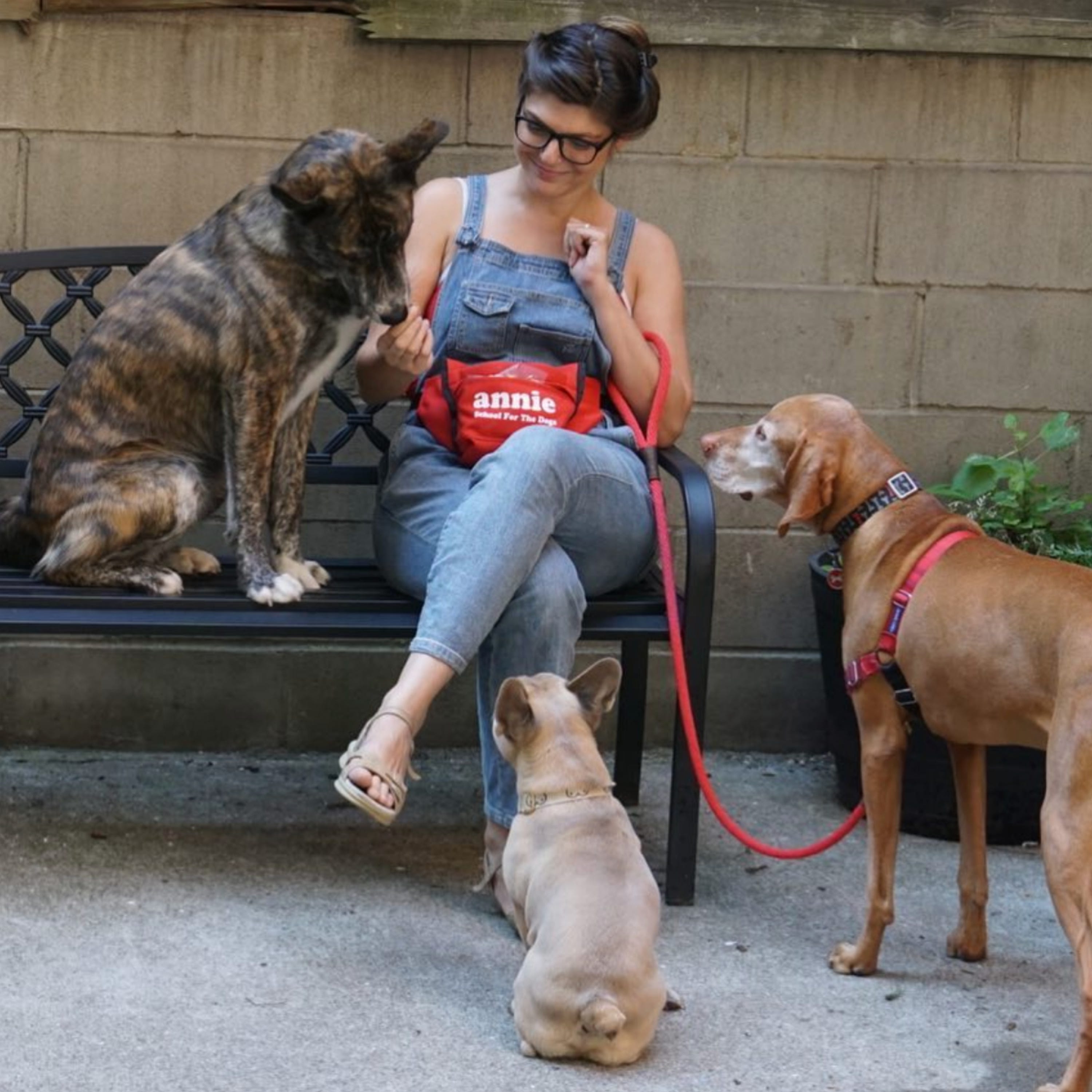
Oct 23, 2020
The "closet behaviorist" running for president: An interview with Libertarian candidate Jo Jorgensen
Did you know there is a woman running for president? Her name is Jo Jorgensen, she is the Libertarian candidate, and the only third party candidate who is going to be on the ballot in all 50 states. Dr. Jorgensen has a PhD in organizational and industrial psychology and teaches at Clemson University. She has a Basset Hound named Gertrude, and she has trained her to not beg at the table... but that's not actually why Annie wanted to talk to her. Annie wanted to talk to her because she has been trying to figure out if a world view and values informed by behavior-based dog training have turned her into a Libertarian. After she became a dog trainer, Annie started thinking about something that had never taken up much brain space for her before: Government. We can govern our pets' worlds, and produce good behaviors, using environmental management and conditioning. If we can do all that without punishment or coercion, couldn't it be possible to -- at least to some extent! -- govern people that way as well? Isn't "freedom" just the ability to make choices that will be positively reinforced, rather than doing things because of coercion? When Karen Pryor first started using a conditioned reinforcer to operantly condition dolphins to do tricks, she was using literature that had been given to her from the lab of Harvard Professor BF Skinner. He was experimenting on training animals in labs, but he was also writing about how humans could be conditioned. Last week, Annie looked at examples of people conditioning other people in some recent documentaries and biopics; this week, Annie speaks with the Libertarian presidential candidate about what it could mean to give people choice and to ease up on the use of coercion and punishment. Notes: Ukulele version of America The Beautiful By Roy Sakuma - Jo Jorgenson's Campaign Site - Annie's dad Robert Grossman's illustration of Ronald Reagan as Mickey Mouse - Walden Two by BF Skinner - Beyond Freedom and Dignity by BF Skinner --- Partial Transcript: Annie: Today’s episode is a little bit different. It’s an interview with a presidential candidate, Jo Jorgensen. She is the libertarian candidate for president this year. She is a professor of psychology at Clemson University. She has been an entrepreneur. She, her specialty is industrial and organizational psychology, and she is the only candidate other than Biden and Trump who is going to be on the ballot in every state. She’s also the best looking candidate that’s going to be on the ballot in every state. I guess that’s debatable, but I could say she looks more like me than anyone else running for president this year. I’m about to share with you a conversation I just had with her. But let me back up a little bit, because I feel like I need to explain that. First of all, I don’t actually think I’m a libertarian. And second of all, I feel like I need to explain why I’m having this conversation with this person on a dog training podcast. I mean, I’m sure she is a much better dog trainer with her dog than Biden is. And of course, Trump doesn’t have a dog, so that makes her the best dog trainer in the race, but that’s sort of over simplifying why I was interested and talking to her. I really have never considered myself a political person. My father was a political cartoonist and growing up politics to me like politics and cartoons went hand in hand. Full Transcript available at SchoolfortheDogs.com/podcast Get full access to Don't Be a Dick to Your Dog at dogtraining.substack.com/subscribe

Oct 22, 2020
Dog Training Q and A! 10/15/2020: Dealing with an adolescent dog and trying to find the perfect puppy
Join Annie Grossman for a live Q and A most Thursdays. Sign up at http://schoolforthedogs.com/qanda . Have a question? Visit AnnieGrossman.com/ask or upload a recording at anchor.fm/dogs . In this episode, Annie talks about her epically bad day. She describes how a teenager has trained people to stop leaving her voicemails. She talks to Joan, a Manhattan woman who has MS and an out-of-control adolescent shepherd in downtown Manhattan. She wants the dog to be a service dog, and also wants to breed him. She also talks to her longtime friend, New York Times columnist Ronda Kaysen, about her recent search for a non-shedding puppy. --- Partial Transcript: Annie: Hey everyone. This is a bonus Q and A episode. I try and answer questions live every Thursday. You can sign up to come to my free live Q and A at schoolforthedogs.com/qanda , and you will see the next one I’m doing. I then am trying to take recordings of those Q and A’s and post them here to the podcast feed. If you have a question, you can email me directly annie@schoolforthedogs. You can also go to anchor.fm/dogs and record your question there. Thanks for being here. I was going to wear sunglasses for this episode, but I think I can’t see properly. Hey Yolanda, nice to see you and Joan is here. Hi, Joan. I just, I need a second to recover. It’s been a bad day. I would say this has been a really bad… first of all, well second of all, second of all, I just posted a podcast episode, like just bonus…well bonus sounds like it should be like a nice cherry thing. It didn’t feel like a nice cheery thing, but anyway, but I felt like I needed to post this episode. And as I posted it, like the microphone has like a little thing on it ….. Anyway as I… it’s actually, the second part is funny. The second part is right as I posted this episode, just now I like spilled an entire bottle of seltzer on my laptop. Like not a little bit, like the entire bottle of water just went over on my laptop. Fortunately, I have like a desktop PC, so I have a computer, but it was like, anyway. And the first thing that happened today, which was much worse, thing is I just learned that my dog is dying. It was like that phone call that you don’t ever want to get. Well, I got that call this morning where that said that he has something in his liver that’s inoperable most likely. I mean, I guess I could get a second opinion, but it sounds like, sounds like this is probably it. And he’s been in really good health up until pretty recently when a couple things started to seem off. He’s 15 and a half-yesterday was his 15 and a half birthday. And you know, they don’t live forever. It’s just just processing. He’s doing really well, he’s doing pretty well. We’re going to give him something to help his appetite, but he’s been his perky self, mostly. My daughters and him are so sweet together and I’m really glad that like she had the experience of having him as a dog, even though she probably won’t remember it, but like, he’s just been such an important part of my life for so long. And obviously now I have her and it’s different, but I’m glad that they had a little bit of overlap in my life. Full transcript available at SchoolfortheDogs.com/podcast Get full access to Don't Be a Dick to Your Dog at dogtraining.substack.com/subscribe

Oct 20, 2020
Virtual private training session: Heidi, a rescue greyhound living in Manhattan
Sit in on an initial virtual private dog training session with Annie Grossman and NYC residents Aquilla and Briana and their new rescue greyhound, Heidi. Heidi doesn't want to sit and is trying to get to Aquilla and Briana's food whenever they eat while sitting on the couch. Annie offers some practical solutions and shows them how to shape Heidi to lie on a mat. Annie also shares Norwegian writer/dog trainer Turid Rugaas' thoughts on why we shouldn't train dogs to sit at all. Book a private session: http://schoolforthedogs.com/services - Get a free thirty minute private session when you purchase our Good Dog Training Course. https://storeforthedogs.com/products/726834 - Turid Rugaas: http://en.turid-rugaas.no/sit.html Mentioned in this episode: The Treat n' Train: https://storeforthedogs.com/products/treat-train - SFTD training mat: https://storeforthedogs.com/products/school-for-the-dogs-training-mat Also see these pertinent episodes: On dog food: https://www.schoolforthedogs.com/podcasts/episode-63-a-pet-food-killed-my-dog-susan-thixton-the-truth-about-pet-food/ On shaping a dog to go to a mat: https://www.schoolforthedogs.com/podcasts/episode-33-how-to-shape-your-dog-to-go-to-a-mat-and-to-be-a-polite-thanksgiving-guest/ --- Partial Transcript: Annie: This session is a recording of a private session we did with a client. You can book a private session schoolforthedogs.com . And for a limited time, if you purchase our online good dog training course available at schoolforthedogs.com/courses , you can do a complimentary 30 minute virtual private training session with a school for the dog strainer. The trainer in this session is me, Annie. Aquilla, Brianna and their dog Heidi are clients of ours who live in New York city. Heidi is a rescue dog that they just adopted. Annie: Hi, hi, Pretty rainbow collar. So how did Heidi come into your life, your lives? Brianna/Aquilla: We got Heidi almost a month ago now. I think a month tomorrow on the 19th, we rescued her from a Greyhound rehab. The organization’s called Greyhound Rescue and Rehab, and they take greyhounds that are retired from the tracks, rehab them and foster care and then adopt them out. So she was a racer for a couple of years. She’s three years old. So far we’ve done…we started on the 21 day training. Right. That’s where we started. She is really good with “look,” pretty okay with “touch” still working on that in distraction areas. So like when we go to the park depending on whether or not there’s a squirrel, she’ll respond or if there’s a lot of stimulus, she loves people. So people are a big distraction for her. Like, she’ll stop walking if she sees a person, which in New York, it’s like every three feet just so she can get pets from other people. Full Transcript available at SchoolfortheDogs.com/Podcast Get full access to Don't Be a Dick to Your Dog at dogtraining.substack.com/subscribe

Oct 16, 2020
Sociopaths as dog trainers, Negative Reinforcement at NXIVM & how to train humans to wear masks
Creepy Episode alert! It's all about sociopaths and cult leaders today. Some are both cult leaders and sociopaths! And one is a president. And one is the Unabomber. Annie talks about animal behavior manipulation methods observed in the following shows: The Vow ( https://www.hbo.com/the-vow ), Filthy Rich ( https://www.netflix.com/ ), The Social Dilemma ( https://www.youtube.com/watch?v=uaaC57tcci0 ), Manhunt ( https://www.netflix.com/ ). And then she looks at how the President is curing the Coronavirus with positive thinking, and looks at the differences between positive thinking, positive psychology and positive reinforcements. And... Annie offers ideas on how to train people to wear masks. If you like this episode, think positive thoughts about it. Or positively reinforce Annie for doing it by leaving a review on iTunes. Annie on Instagram: @Annie.Grossman School For The Dogs on Instagram: @schoolforthedogs Annie on her parents and Positive Reinforcement Vs Positive Thinking: http://anniegrossman.com/2013/03/training/positive-reinforcement-vs-positive-thinking-and-why-pollyanna-wouldve-sucked-at-dog-training-93401/7820/ Woof Mask by Found My Animal and School For The Dogs: https://storeforthedogs.com/collections/found-my-animal-1/products/woof-mask-by-found-my-animal Unabomber quotes https://www.quotetab.com/quotes/by-theodore-kaczynski --- Partial Transcript: Annie: I have a couple of quotes here I just wanted you to hear and think about whether they make sense to you. I'm going to come back to them in a little bit. The first is this one. “Imagine a home for a dog that subjects the dogs to conditions that make the dog terribly unhappy, then gives the dog drugs to take away the happiness. Instead of removing the conditions that make the dog depressed, the dog owner gives the dog antidepressant drugs. In effect, antidepressants are a means of modifying the dog's internal state in such a way as to enable the dog to tolerate social conditions that the dog might otherwise find intolerable.” Second quote. “Many dog owners tend to regard as a sickness, any mode of behavior that is inconvenient for the people in the home. And this is plausible because when the dog doesn't fit into the home, it causes pain to the dog and to those in the household. Thus the manipulation of a dog's behavior to adjust him to the system is seen as a cure for a sickness and therefore as a good.” **intro** Annie: Humans, friends, listeners. I need to talk to you about some things that have been on TV recently which I've just been thinking about so much because there's so much dog training in these two particular shows that I've watched recently. You know, never, ever did I think that becoming a dog trainer would make me think so much about cult leaders and also like sociopaths. One of these stories is about cult leader. The other is about a sociopath, actually, they might be both cult leaders and sociopaths in their own ways. Full Transcript available at SchoolfortheDogs.com/Podcast Get full access to Don't Be a Dick to Your Dog at dogtraining.substack.com/subscribe

Oct 15, 2020
Three funny things and one terrible thing just happened
Alternative titles Annie thought of for this episode: -Toddlers are hilarious and death sucks -And the dog dies in the end Annie is doing a Q and A. Join at schoolforthedogs.com/qanda If you like this podcast, go leave a review on iTunes please. Thanks! Instagram: @annie.grossman, @schoolforthedogs --- Partial Transcript: Annie: So, I think I'm posting this as a bonus episode because I already have an episode ready to go for tomorrow. But a couple of things happened in the last 24 hours I wanted to share three are silly and just funny. One isn't. So like the first three things are all funny mom/dog training-related things. My friend, Lori, sent me a text message, well she sent it to this mom group that I'm in on WhatsApp. She's been trying to wean him at night, wean him, so he won’t nurse at night. Actually, her son is one day older than Magnolia. So she wrote, Elliot is obsessed with morning and the sun because I told him we nurse in the morning when the sun comes up but not at night. So now, any old time, he says, “morning, sun, nursing, nursing.” And outside, he will suddenly point at this sky and say, “Sun, nursing, boobs.” So he's making long speeches where the only recognizable words are “sun,” “boob,” “nursing, “morning.” Just thought it was a funny example of classical conditioning, how he has this need to nurse now when he sees the sun. It’s kind of funny. Oh then I was thinking about it, a lot of animals must associate signs of morning with, “hey, its time to eat,” “hey, mom- person, feed me.” One of the other funny things have happened was I got a new like pop socket for my phone to hold on in the back and the pop socket thing comes on this piece of cardboard that's kind of like the size and shape of a phone, and she grabbed onto this thing, and has been using it as a phone for the last couple days. And one of the very first things she did was to hold it up to her toy dog as if she was showing her dog to someone. And I sent it to Alix Kris, head of marketing, she wrote back, “dog momager in the making,” which I thought was pretty funny. She doesn't have a lot of words yet but one word she does have is “shoes,” which she says, “oohg”. And she's always talking about “oohg”, and whenever we're on the phone with her with her grandparents or whoever, and we try and get her to say the words, her big word right now which is shoes. You know, we ask her to say it when she's doing Facetime so as she was holding up the phone to her toy dog, she was holding it in front of him and saying, “oohg, oohg.” put it up on my Instagram and stories, made me laugh. And then the other thing that made me laugh so hard and Jason wasn't around, it was just me so I couldn't even share it with anyone but I was like cracking up, it seemed so funny to me... Full Transcript available at SchoolfortheDogs.com/Podcast Get full access to Don't Be a Dick to Your Dog at dogtraining.substack.com/subscribe
Oct 12, 2020
Dog Training Q and A! 10/8/2020: Reactive Dogs, food toys, management of space
Join Annie Grossman for a live Q and A most Thursdays. Sign up at http://schoolforthedogs.com/qanda . Have a question? Visit AnnieGrossman.com/ask or upload a recording at anchor.fm/dogs . Here, Annie takes the following questions: How can you train a dog to not freak out if strange dogs, off leash, appear out of no where? What work-to-eat toys can you use with wet or fresh food? Can you train a dog to stay away from the litter box and the cat food? A dog likes playing fetch but doesn't like going on walks. Is fetch going to be enough exercise for him? A new rescue dog barks all night at nothing in particular. Why? And how can you get him to stop barking? How can you get a dog to pee on a curb instead of on trees? --- Partial Transcript: [Intro] Annie: Hey everyone. This is a bonus Q and A episode. I try and answer questions live every Thursday. You can sign up to come to my free live Q and A at schoolforthedogs.com/qanda . And you will see the next one I’m doing. I then am trying to take recordings of those Q and A’s and post them here to the podcast feed. If you have a question, you can email me directly at annie@school for the dogs. You can also go to anchor.fm/dogs and record your question there. Thanks for being here. You know, I was just thinking about how, when, when I used to work at an office, which was not for very long, but in my early twenties, it was so wonderful to have like an IT person, like just someone there, like when something doesn’t work, you can be like, excuse me. I remember this one great IT guy’s name was Ramon would just be like, Ramon, my mouse won’t click won’t make the right clicky sound, or whatever, like whatever little thing, and Ramon would be there and he would fix it or he’d like, go to get me like another computer or whatever. Like, don’t you like, I mean, I haven’t had that for a long time because I’ve been, I was just thinking that I bet right now in the, in the moment of COVID everybody working from home, that a lot of people are missing their… people are missing their IT people. That’s the moment of greatest appreciation for IT people. I say that because every time I have to do anything, I feel like I need a friking IT person. It’s like, it’s see right now, I’m trying to like record on in Audacity, which is what I record the podcast in while recording on whatever else, this thing is that I’m recording in. And, and it’s like, doesn’t want me to do it. Like it’s….I mean, the amount of stuff you have to figure out as an adult person is just beyond, like, there’s just like, like life involves so much paperwork and so much figuring things out. All right. Hi, Annie Grossman here I am answering dog training questions. I have a few lined up. This went well last week. So it went well. I mean, getting some questions in the chat area here I’m doing this on Instagram live at the same time and you…if you want to ask the question, do it through the computer at schoolforthedogs.com/qanda ... Full Transcript available at SchoolfortheDogs.com/Podcast Get full access to Don't Be a Dick to Your Dog at dogtraining.substack.com/subscribe

Oct 9, 2020
Be your dog's superhero: An interview with UK-based trainer and pet business coach Dominic Hodgson
Here's a cool approach to dog training: Teach your dog that you are a benevolent god. A superhero, if you will. That is UK-based trainer Dominic Hodgson's approach. In this episode, Annie interviews Dom about his journey from actor to tobacco salesman to dog walker to dog trainer to pet business consultant through his company, Grow Your Pet Business Fast. Annie learns about several dog business areas she never considered, and gets some great business advice from this titan in the field. Join Annie for a FREE Q and A next week! Sign up at http://schoolforthedogs.com/qanda Head over to Dom's Podcast, The Poodle To Pitbull Pet Business Podcast, to hear Dom interview Annie! https://podcasts.apple.com/us/podcast/the-poodle-to-pitbull-pet-business-podcast/id1395354685 How To Be Your Dog's Superhero! https://www.amazon.com/How-Your-Dogs-Superhero-Transform-ebook/dp/B01IE1KTIO Free offer from Dom: 33 marketing ideas for pet business professionals http://www.growyourpetbusinessfast.com/33ideas Enjoy this podcast? Please leave a 5-star rating and review on iTunes! Learn more about School For The Dogs at schoolforthedogs.com --- Partial Transcript: Annie: There’s this thing that dog trainers sometimes say, which is that the only thing two dog trainers can agree on is that the other person is doing everything wrong. And, you know, I kind of hate that kind of way of looking at things. It’s not how I see things. I do think that there are some good dog trainers out there and bad dog trainers. There’s maybe two large categories of dog trainers, but there are so many good dog trainers who are doing so many cool things and I’m always excited to learn about what they’re doing. Today’s conversation is with a dog trainer who is indeed doing so many cool things. I am speaking to Dom Hodgson who went from being an actor to being a tobacco salesman to starting his own dog-walking business, realized he needed to learn about dog training in order to be a better walker. And now he is a pet business coach and he has his own podcast called the Poodle to Pit Bull pet business podcast . I am on his podcast this week and he is on mine. And this meant that we got to have two really great conversations recently. So if you want to learn more about me, head over to his podcast, if you want to learn more about him, keep on listening. I’m thrilled to be able to share this conversation with you. *Intro* Dom: Hello, and thank you for having me on the show, Annie. My name’s Dom Hodgson. I am a dog trainer, a pet business coach and a regular dog owner slash lover. And I live in Sunderland, which is a city in the Northeast of England, probably near Newcastle. That’s probably where most of your listeners will maybe be familiar with the nearest. Annie: What is your business called? Dom: So there are two, well, three, two main kind of arms to the business. So my original business, was Pack Leader Dog Adventures ... Full Transcript available at SchoolfortheDogs.com/Podcast Get full access to Don't Be a Dick to Your Dog at dogtraining.substack.com/subscribe
Oct 6, 2020
Q and A! 10/1/2020: A new nervous rescue dog, working with dog barking, and helping a dog potty outside
Join Annie for a live Q and A most Thursdays. Sign up at http://schoolforthedogs.com/qanda . Have a question? Email Annie@schoolforthedogs.com or upload a recording at http://anchor.fm/dogs Here, Annie takes the following questions: A new young rescue dog seems to be nervous about some men but not others. Why? A dog is barking: Do you need to say "quiet" and do you reward even if the dog is barking? What do you do when a Shih Tzu won't go to the bathroom in the yard? Why didn't an adolescent male become less aggressive after being neutered? My dog is going crazy because the neighbor's dog is in heat! This puppy will not stop biting my feet! Why! How do I teach my Pomsky not to pull? The following products are available at StoreForTheDogs.com : Ruffwear Front Range Harness - Freedom Harness - Liquid Treat Dispenser - K9 Sport Sack - Flirt Poles --- Partial Transcript: Annie: Hey everyone. This is a bonus Q and A episode. I try and answer questions live every Thursday. You can sign up to come to my free live Q and A at schoolforthedogs.com/qanda . And you will see the next one I'm doing. I then am trying to take recordings of those Q and A's and post them here to the podcast feed. If you have a question, you can email me directly annie@schoolforthedogs. You can also go to anchor.fm/dogs and record your question there. Thanks for being here. Hey guys, Annie Grossman here. I am live answering dog training questions today, and we're starting with this one from Rachel. “So my husband and I had just started listening to your podcast. When we adopted our puppy, Penny. She's a total sweetheart and very passive. When you go to get her, she just rolls over and wants belly rubs. We brought her home a few days ago and she met our neighbor and loved him. However, after a day of settling in, she began barking at him whenever we were outside or going for walks. Also on our walk, she started barking at all older men. She met another neighbor who was a younger man, and she did not bark at all. She's only six months and we are hopeful we can get her comfortable with some training, any advice or guidance with this. Thank you, Rachel.” Annie: So great question, Rachel, and I'm glad that you're dealing with this on the sooner side because you know, so many behaviors that can develop into, you know, behaviors that are really difficult and dangerous stem from fear. And it sounds like you're noticing that Penny is a little bit fearful of your neighbor. Now, you know, it's possible that, you know, it looks like you're noticing a pattern that it's men. It's possible she had some kind of bad experience with a man in the past and that's causing this behavior. It's possible also that she just wasn't really exposed to that many men before this who knows, but rather than worrying too much about what's causing her to be this way, I would just really focus on how you can help her feel good about whatever men are around her. Full Transcript available at SchoolfortheDogs.com/podcast Get full access to Don't Be a Dick to Your Dog at dogtraining.substack.com/subscribe

Oct 2, 2020
What is a bully stick? A very detailed answer to an awkward question...
Dogs love to chew on bully sticks. We sell loads of them every day at School For The Dogs, and, very often, people ask what they are. The answer? They're penises! This answer makes some people giggle, some gag and then there are those, like Annie, who are just left with more questions. In this episode, Annie interviews Greg Claypool, a second-generation bully stick fabricator, about the origins of this canine delicacy, how they're produced, and what you can do in order to make sure your purchasing ones that don't stink (literally). Warning: This episode is pretty graphic! Bully sticks at storeforthedogs.com https://storeforthedogs.com/products/bully-sticks Bully Sticks Direct https://www.bullysticksdirect.com/ Bully Stick Ball Jerky https://www.bullysticksdirect.com/bully-stick-ball-jerky-7-ounces/ Turkey Tendon Strips https://storeforthedogs.com/products/turkey-tendon-strips?_pos=1&_sid=d7be10867&_ss=r Blog post: Dogs love bull penises, and you will, too https://anniegrossman.com/2012/12/funnies/dogs-love-bull-penises-and-you-will-too-73608/7517/ Related episode: A better mousetrap: Building the perfect bully stick holder https://anniegrossman.com/2018/09/podcast/episode-25-better-mousetrap-building-perfect-bully-stick-holder/9763/ Bull Penis Canes: https://fashionablecanes.com/collections/bull-penis-walking-canes Four Ways To Sautee a Sow's Vulva: https://medium.com/idle-musings/iv-ways-to-saut%C3%A9-a-sows-vulva-170f5f00d26a Toast Garden: http://youtube.com/toastgarden --- Partial Transcript: Annie: I am testing out a new community platform. If you like this episode, and you would like to discuss it with other podcast listeners, please go to schoolforthedogs.com/podcastcommunity . Make an account, it's totally free. If you would like to ask any dog training questions you can do so there as well. Thanks for helping me beta test this new platform. *Intro* Annie: In my career as a professional dog person over the last 10 years or so, I have developed some weird sub interests. Some of which are kind of gross. For instance, over the last few years, I've thought a lot about how we carry dog poop. I have thought deeply about poop bags and poop bag accoutrements. I have also thought a lot about certain dead animal body parts and no body part of any dead animal has taken up quite as much brain space for me as the bully stick, which is a dried bull penis that dogs love to chew on. Particularly as someone who has sold many bully sticks in her life, I have often found myself in the awkward position of having to explain to people that it really is made out of a dried bull penis, which is a conversation that has just concluded with giggles many, many times. Full Transcript available at SchoolfortheDogs.com/podcast Get full access to Don't Be a Dick to Your Dog at dogtraining.substack.com/subscribe

Sep 25, 2020
When your home isn't the right home for your dog (and other subjects)
Warning: This episode meanders a bit! Annie's Facebook friend made the difficult decision to rehome her rescue dog, and Annie considers what it means to decide that a different family might be a better fit for anyone you love, be it human or dog, temporarily or forever. What if all forms of parenting were truly voluntary? Is it a dog's fault if behavior problems are exacerbated by an environment that may have been chosen for him or her more or less at random? Were slaves insane if they tried to escape their masters? Annie follows a line of thinking that touches on how we could use positive reinforcement to help prevent unplanned pregnancies, and on how both fear and generalizations based on false assumptions can cause racism. She also explains BF Skinner's unusual argument in favor of teen pregnancy. Join Annie for a live Q and A this Thursday (10/01/2020) @ 12 pm EST! https://event.webinarjam.com/register/183/n7z7lsnw Sign up for Annie's free Master Class at http://anniegrossman.com/masterclass School Sucks Drapetomania episode: https://schoolsucksproject.com/053-drapetomania/ Walden Two : https://www.amazon.com/Walden-Two-Hackett-Classics-Skinner/dp/0872207781 The Cut's story about the Stauffer family and their adopted son : https://www.thecut.com/2020/06/youtuber-myka-stauffer-rehomed-her-adopted-son-huxley.html --- Partial Transcript Annie: Hello, human animals. And hi to the dogs that may be in the room. If you are listening, that means you are alive. And that’s, that’s a good thing right now. So I’m glad to know that about you. I have a lot of really cool episodes coming down the pipeline that I am excited to share with you all. I’ve been doing interviews with the people who work at School for the Dogs and well, last week I got, sometimes I say “we” cause like, I think of School for the Dogs as like me and Kate, but then I know sometimes I say “I,” and sometimes I get lost. Like, am I, am “I”? I think, I think this podcast is “I.” I interviewed Anna Heyward, our apprentice, one of our apprentices last week that was kind of, I guess, part of the inside School for the Dog series. But I have been talking to lots of different people on our staff and I’m going to be sharing those conversations, just talking about to them about how they got into what, what they, how they got into training and what they’re doing now. And so that’s been really fun. You know, running a business through a global pandemic, I now know is intense and I think I feel so appreciative of our staff right now. I just feel gratitude. I think, you know, the intensity and shared mission of, you know, trying to keep a business afloat through all of this and trying to, you know, continue helping dogs I think has brought us all closer together. So it’s really been lovely to get a chance to talk to some of these wonderful people. And I am also doing a series of episodes about some of the really cool products we have in our shop. I’ve been interviewing some of the brand owners people who have worked to develop really interesting things that I’m psyched we get to share it with our clients. Full Transcript available at SchoolfortheDogs.com/podcast Get full access to Don't Be a Dick to Your Dog at dogtraining.substack.com/subscribe
Sep 18, 2020
Lessons learned from foster dogs: A discussion with our apprentice Anna Heyward
At School For The Dogs, we've been lucky enough to be able to mentor a handful of aspiring dog trainers through our apprenticeship program. One of our current apprentices, Anna Heyward, first came to us as a client. Anna, a writer who is originally from Australia, has fostered dogs in NYC for years; last year, she took in a dog whose separation anxiety was beyond anything she'd ever seen. She came to School For The Dogs after consulting with several dog trainers. Some suggested the dog was just being dramatic and that she just needed to let him manipulate her; others told her to use a shock collar on him. In this episode, Anna explains how her experience fostering dogs in New York City and her work with our trainer Anna Ostroff led her to rethink everything she thought she knew about behavior, and ultimately pursue a career in dog training. If you enjoy this podcast, please leave a review on iTunes! You can also support us by shopping in our online store: StoreForTheDogs.com --- Partial Transcript: Annie: So, I’m about to share with you is a conversation with one of School for the Dogs’ apprentices, Anna Heyward. And I wanted to talk to Anna for a bunch of reasons. I’m really interested in how people are finding their way and to the world of dog training, whether that’s because they aspire to doing it professionally or not. And I met Anna when she started our six month apprenticeship. And we’ve gotten to know each other this year a little bit. And Anna is a very talented writer and recently I read an essay she wrote, a not yet published essay about her experience fostering. Specifically fostering one very difficult dog. And I was just so moved by what she wrote and how she wrote about the experience of being a temporary home to a dog who has behavior issues that are extreme and what that mean. What it meant-meant both for her, for the dog. What it helped her learn about the world. What she learned about the people around her, her family, her loved ones through this very difficult experience of being a foster, a foster mother to two dogs. And so I was thrilled when she said she would talk to me a little bit about her experience as a fosterer on the podcast. But I… before I share with you this conversation, I just wanted to mention another Anna who you’re going to hear about a little bit in this episode because Anna Heyward would not have come to School for the Dogs without Anna Ostroff, who is a woman I just love so much. And I was, I’m trying to think about how do I express my feelings… it’s like, I feel like it’s such a special thing when you get to mentor someone and then you see them being a mentor to someone else. And I should specify I’m talking about as a mentor, but I think more of sort of Kate and me and School for the Dogs as an entity, a mentoring entity, I guess, is sort of how I think of what we’re doing in a lot of ways to shape people to be better dog owners, if not dog trainers and Anna Ostroff came to School for the Dogs about four years ago with a very sweet and shy young dog named Ginger and her husband, Alan. They are theater producers and had, I believe had pretty recently before coming to us, won a Tony for a Broadway play that they produced. And I just enjoyed getting to know them as these very interesting people with an interesting theater background. So they were clients with whom I became friendly. Full Transcript available at SchoolfortheDogs.com/podcast Get full access to Don't Be a Dick to Your Dog at dogtraining.substack.com/subscribe

Sep 11, 2020
My family thinks I'm crazy: Dealing with those who don't see the "whole" picture of holistic dog training
What does it mean to be a holistic dog trainer? To Annie, it means addressing issues using what we know about the science of behavior as it applies to both dogs and humans, and looking at the whole picture of a dog's life in order to address issues. One alternative approach involves narrowly focusing on getting rid of a problem using punishment, which can produce new unwanted behaviors which are then part of the whole picture, too. Sometimes, that whole picture contains people who don't see that they're part of the whole picture, and Annie has found this can be tricky terrain to navigate as a dog trainer ... especially when those people are family members. Annie opens up about how she has learned to keep quiet about all things relating to dogs when she is with certain people in her family, and attempts to take a holistic view of a problem behavior they've dealt with in different ways: barking. Check out Annie's free Master Class at anniegrossman.com/masterclass Support this podcast by leaving a five-star review and by shopping in our online store, storeforthedogs.com . --- Partial Transcript: Annie: I recorded this episode a few weeks ago, and then I kind of hesitated about whether or not I should post it because it has to do with my family. And it’s tricky to talk about real live people, and I’m not eager to offend anyone or get into arguments. So after I recorded it, I thought, you know, let’s just let this one sit for a few weeks so that I can think about whether or not I want to go there. And I decided that the beauty of the podcast [laughs] as a medium is that you really have to show up and be interested in order to listen to a podcast at all. It takes some effort and it’s kind of in a lot of cases on, at least this podcast is like a one-way conversation where I get to sit alone in a room and tell you what I think about something. If you disagree with me, if you think I’m a jerk, you don’t have to keep listening, and you never have to listen again. And if you have no interest in what I think about dog training, then you don’t ever have to listen to begin with, and frankly, I think my family falls into that latter category. So I’ve really learned to bite my tongue when anything about dogs comes up in conversation when I am with many people in my family, because it’s just not worth having an argument. Even if it means suppressing my thoughts and feelings, it’s worth it for the sake of having a relationship at all and maintaining some degree of peace. But that doesn’t mean I’m not going to have my own thoughts and feelings going on. And this isn’t something that I have a few thoughts about. I have a lot of thoughts about it. I have a whole business devoted to a science-based approach to dog training, a behavior based approach to dog training. It’s pretty much my entire life. So I guess I decided I’m not going to suppress an entire part of my life all the time. And if the people mentioned, although unnamed, [laughs] in this episode are interested in what I think, they can listen to my one way side of a conversation whenever they please, and they’re welcome to record their own podcasts on their points of view. I would actually be interested in hearing that. Full transcript available at SchoolfortheDogs.com/Podcast Get full access to Don't Be a Dick to Your Dog at dogtraining.substack.com/subscribe
Sep 4, 2020
The Pandemic Puppy Boom: A discussion with breeder Cherrie Mahon of River Valley Doodles
This episode is a second conversation with Cherrie Mahon, with whom Annie spoke last year (Episode 45: Let's talk about dog breeding with Cherrie Mahon). During quarantine Cherrie, like many breeders, has been inundated with applications. She and Annie discuss how breeders are dealing with the deluge, and think about what this boom might mean in the future for both puppy mills and shelters. Annie also answers a question from a listener whose puppy is jumping up when she tries to prepare food at the kitchen counter. Episode 45: Let's talk about dog breeding with Cherrie Mahon Treat and Train - remote controlled treat dispenser and training tool --- Partial Transcript: Annie: If you are listening to this, at least if you’re listening to this around now, I’m recording this in late summer 2020. I am going to guess you fall into at least one of the following three categories, perhaps all three. You have either recently gotten a puppy, you’ve thought about getting a puppy, or you know someone who has gotten a puppy, or is thinking about getting a puppy. Okay, I guess that’s four categories. And I think that’s because puppies are the opposite of death, destruction, pandemics. They can certainly cure depression. And a good time to get a puppy is when you are going to be spending a lot of time home. I actually got my dog when I left a desk job. I spent exactly one year as a reporter at the New York Post, and I actually wrote their wedding section. I don’t know if they still have a wedding section. I wrote some other things there too, but that was my main gig. And I actually got fired. Well, it was kind of like a, I quit / You’re fired situation. But the issue at hand wasn’t the quality or content of my work. It was that I was instant messaging too much. That’s how old I am. I remember at the time thinking, “One day, this is going to seem hilarious, I have a feeling.” I wasn’t even sending, like, sexy instant messages or anything. I wasn’t talking to my boyfriend. I was either talking to other reporters who worked at other places, I think, or I was talking to my mom. And I certainly wasn’t the only one instant messaging, but I guess they needed some kind of scapegoat and wanted to crack down on this practice. And Cole Allen, who was the editor in chief there at the time called me into his office. And it was pretty terrifying. I remember, he had a print out like an inch high of my instant messages. And now here we are 15 years later, and basically all we all do is instant message. The president who’s instant messaging 200 times a day, also to other journalists, and my mom. Anyway, I’m telling the story only because after I left, after my ignominious departure from what was actually probably a very good job in right wing tabloid journalism, I started working from home. I was living in a ground floor apartment and in Brooklyn at the time. It had a little garden outside, kind of the perfect place for a dog. So I was sort of thinking a little bit about getting a dog, but then what really made it happen was a guy I had dated for a few years, a boyfriend, I was like madly in love with him. He broke up with me and I was completely devastated. So I was sort of thinking a little bit about getting a dog, but then what really made it happen was a guy I had dated for a few years, a boyfriend, I was like madly in love with him. He broke up with me and I was completely devastated... Full Transcript available at SchoolfortheDogs.com/podcasts Get full access to Don't Be a Dick to Your Dog at dogtraining.substack.com/subscribe

Aug 28, 2020
Dogs don't think we're dogs: Ethologist Dr. Marc Bekoff on how we can give our "frustrated captives" a good life in a human world
Last week, Annie looked a bit at the career of Dr. Stanley Coren, a writer who recently penned a Psychology Today article suggesting that one way to silence a barking dog is to clamp down on the dog's nose with your hand, like a mother wolf might do to try to silence a wolf pup. Ethologist Dr. Marc Bekoff, who is a columnist for Psychology Today, penned a response saying that we need to consider the causes of dog behaviors we don't like, acknowledge that they're engaging in behaviors that might be appropriate in a different environment, and then work at changing those behaviors with techniques that don't require that we attempt to school dogs as if we were one of them. Annie has a conversation with Dr. Bekoff, who discusses the Psychology Today article and explains why an ethological approach can shed so much light on the dogs who live in our homes, and beyond. Canine Confidential: Why Dogs Do What They Do by Dr. Marc Bekoff https://amzn.to/2YssUxK Unleashing Your Dog: A Field Guide to Giving Your Dog The Best Life Possible by Dr. Marc Bekoff and Jessica Pierce https://amzn.to/3j8L2ow A Quick Fix for a Barking Dog by Dr. Stanley Coren (Version edited post-publication) https://www.psychologytoday.com/us/blog/canine-corner/202008/quick-fix-barking-dog Original version of article can be found here. https://www.schoolforthedogs.com/a-quick-fix-for-a-barking-dog-home-health-choices/ Do Dogs Bark Unnecessarily or Excessively? by Dr. Marc Bekoff https://www.psychologytoday.com/us/blog/animal-emotions/202008/do-dogs-bark-unnecessarily-or-excessively The Herlihy Boy Dog Sitting Service (Saturday Night Live, 1994): https://www.youtube.com/watch?v=mq7DbWsjX6A --- Partial Transcript: Annie: Hey there. So last week I talked about the dog writer, Stanley Coren. He had a piece in Psychology Today where he basically suggested that the best way to get a dog to stop barking was to clamp down on the dog’s muzzle with your hand and say the word “quiet” to the dog, a method that he says mimics how a mother dog might quiet her pup. And in response to this article, Dr. Marc Bekoff wrote a really thoughtful essay saying, you know what, maybe we should be instead thinking about what's causing a dog to bark and see the situation from a dog's point of view, as best we can. And to acknowledge that they're basically captives in our world and we're asking them to live by our rules. And that most likely don't think about us as fellow dogs. So we probably don't need to be communicating to them as if we were dominant wolves in their pack. Anyway, it was a beautifully written response. So I reached out to Dr. Bekoff and I'm happy to share with you this conversation, which touches a little bit on Stanley Coren's article, but also went in some other interesting directions. I hope that you enjoy this episode. Full Transcript available at SchoolfortheDogs.com/Podcasts Get full access to Don't Be a Dick to Your Dog at dogtraining.substack.com/subscribe

Aug 21, 2020
Don’t put a towel over a dog’s head & other lessons not learned from Stanley Coren & Psych. Today
Looking for misguided information about dog training? Look no further than Psychology Today, which is publishing new articles that are offering outdated and possibly dangerous information. In this episode, Annie surveys the work of Dr. Stanley Coren, who recently suggested to the publication's readers that they should mimic wolves and clamp down on a dog's muzzle to stop barking. She reads from some of Dr. Coren's books on dogs from the early 1990s and also shares a comedy clip from the early 1990s on the topic of reading dog minds. Next week: An interview with Dr. Marc Bekoff. Take Annie's free Master Class! http://anniegrossman.com/masterclass My Dog's Smarter Than Your Dog, by Sarah Boxer (NY Times Book Review, 1994) https://www.nytimes.com/1994/06/05/books/my-dog-s-smarter-than-your-dog.html?partner=rssnyt&emc=rss/ Why Does a Reward During Training Change a Dog's Behavior? by Dr. Stanley Coren https://www.psychologytoday.com/us/blog/canine-corner/202008/why-does-reward-during-training-change-dogs-behavior A Quick Fix for a Barking Dog by Dr. Stanley Coren (Version edited post-publication) https://www.psychologytoday.com/us/blog/canine-corner/202008/quick-fix-barking-dog Original version of article can be found here . Do Dogs Bark Unnecessarily or Excessively? by Dr. Marc Bekoff https://www.psychologytoday.com/us/blog/animal-emotions/202008/do-dogs-bark-unnecessarily-or-excessively Punishment as defined by Psychology Today https://www.psychologytoday.com/us/basics/punishment Conan O'Brien 1993 clip: https://www.youtube.com/watch?v=2FFyNyfOqQQ --- Partial Transcript: Annie: A few years ago, a cousin gave me a pile of books about dogs, all these used books that I think he'd gotten at a garage sale. They were all from the nineties. And one was called, What Do Dogs Know? One was The Pawprints of History: Dogs in the Course of Human Events . One was called The Intelligence of Dogs . And I kind of flipped through the books and thought, you know, okay, there's some dated information here, and there was some decent info here and there, but overall I found the books a little, I guess, a little boring. And I put them on my shelf of books that are dated and, but possibly interesting for future reference relating to all things dogs and dog training. I have a lot of books in this category, or not even books that are dated, just like I like old, weird books about dogs. I like thinking about not only how people think about dogs now, but in the past. I guess I didn't really consider these books too much or the author, although I did remember seeing that he was a doctor, that he was a professor of psychology... Full Transcript available at SchoolfortheDogs.com/Podcasts Get full access to Don't Be a Dick to Your Dog at dogtraining.substack.com/subscribe
Aug 14, 2020
There’s so much to love about snuffle mats! Buy or make a fabric work-to-eat toy.
We are obsessed with work-to-eat toys at School For The Dogs! Snuffle mats are one type of work-to-eat toy we recommend all the time. Made of fabric, they’re great for hiding dry food or treats. They pack well, are easy to wash, and you can even make them yourself. Annie talks about some of the ones sold at storeforthedogs.com and gives instructions on how to make your own. Products mentioned in this episode: The Buster Activity Mat Wooly Snuffle Mat Fleece Activity Mat The Hol-ee Roller More Snuffle Mats: here Check out DogNmat On Etsy Get in touch on Instagram: @schoolforthedogs -- Partial Transcript: Annie: Hey folks. Today, I just wanted to talk a little bit about one of my favorite kinds of work to eat toys. As you might know if you've listened to this podcast before, we are huge fans of toys that give dogs jobs. I like to joke that we're trying to solve the canine unemployment problem -- that if you can figure out a way to engage your dog’s brain and body, even if it's just their tongue or their paws during meal times, that it's a really good way to channel energy that might otherwise go towards activities that you might not be that into. So there are lots of different kinds of work to eat toys. And one of them is, the broad category would be called snuffle mats. Now this is kind of a newer sort of work to eat toy. I think I first saw a snuffle mat maybe five or six years ago when we first started carrying the Buster Activity Mat . Which I right away thought was like the coolest thing ever. It is a mat that is pretty heavy duty. It has snaps on it, with these components that you can snap on. And the components, kind of origami-style, can be folded and manipulated in different ways. They can be used separately from the mat. It's very, very cool. It also comes in this adorable little turquoise duffle bag, which I like to use for things other than the mat sometimes, just because it's cute. But it's neat because there are so many different ways you can use it, and it can travel really well. Now, snuffle mats in general are easy to pack, and some of them can be used in different kinds of ways, but the main component is that they're soft and you can hide dry food or dry treats in them in different ways. They're not great for use with wet food. Some of them you could even hide toys in them. So anyway, the Buster activity mat, I think, was my first introduction to the world of snuffle mats, or we sometimes also call them activity mats. And then, I think I was at a trade show when I first saw the Wooly Snuffle Mat . And the Wooly is a much simpler product. It kind of just looks like a bath mat. Like a bath mat with really plush, long tendrils. It's gray, it -- you know, one thing I like about snuffle mats is they make me think of Snuffleupagus scoop is my favorite character on Sesame street... Full Transcript available at SchoolfortheDogs.com/Podcasts Get full access to Don't Be a Dick to Your Dog at dogtraining.substack.com/subscribe

Aug 7, 2020
Restaurant dining with your dog: How to train the perfect outdoor dinner date
It's a golden moment for those wanting to eat outdoors with their dogs. Just think: There's so much outdoor dining! And people are keeping their distance from each other! And tables are spaced at a nice distance from each other! Annie gives some tips about how you can help train your dog to be the perfect outdoor-dining companion. Also: Learn what 1950s superstar very nearly became the real Lassie's owner. Products mentioned in this episode: Tricky Trainer's Crunchy Treats : https://storeforthedogs.com/search?q=crunchy+tricky Lamb lung : http://schoolforthedogs.com/ll Snuffle/Activity Mats : https://storeforthedogs.com/collections/snuffle-mats VirChewLy Indestructible Leash : https://storeforthedogs.com/products/virchewly-industructable-leash-1 Found My Animal Leash: https://storeforthedogs.com/collections/found-my-animal-1 Hands-Free Leash: https://storeforthedogs.com/collections/squishy-face-studio/products/leash-belt SFTD Training Mat: https://storeforthedogs.com/products/school-for-the-dogs-training-mat Liquid Treat Dispenser: http://schoolforthedogs.com/ltd Frank Inn: https://www.youtube.com/watch?v=wkfLbHQl340 Episode 33: How to shape your dog to go to a mat https://www.schoolforthedogs.com/podcasts/episode-33-how-to-shape-your-dog-to-go-to-a-mat-and-to-be-a-polite-thanksgiving-guest/ Episode 66: Lassie’s Boy Sidekick: Meet Jon Provost, aka Timmy https://www.schoolforthedogs.com/podcasts/episode-66-lassies-boy-sidekick-meet-jon-provost-aka-timmy/ Episode 69: Mean Talk, mouse traps + water guns: Rudd Weatherwax's Lassie Method https://www.schoolforthedogs.com/podcasts/episode-69-mean-talk-mouse-traps-water-guns-the-lassie-method/ -- Partial Transcript: Annie: Guys. It's a really difficult time to be alive, to be a human right now. There's so much that's wrong with the world. But there's one, one silver lining that I just wanted to point out to anyone here who has a dog, which is probably you, if you're listening. This is an excellent time for dining out with your dog. I know different places have different rules, but I live in New York City and restaurants now have extended their outdoor seating areas into the streets and avenues, usually beyond the sidewalks. The tables are spaced at least six feet apart.... Full Transcript available at SchoolfortheDogs.com/Podcasts Get full access to Don't Be a Dick to Your Dog at dogtraining.substack.com/subscribe

Jul 31, 2020
Schedules of Reinforcement, “Baked In” Behaviors & How Dog Training Can Help You Take The MCAT
A listener who is studying for the MCAT exam wrote in to ask if there were any dog training scenarios that could help illustrate some of the terms she needed to know for the psychology section of the exam. Annie, who has learned most of what she knows about dog training from working with dogs rather than from studying terms or taking exams, does her best to help make some "science-y" concepts more understandable through the lens of dog training and human behavior as we experience in everyday life. She talks about schedules of reinforcement, learned behaviors vs preinstalled behaviors, learning by observation and more. Mentioned in this episode: Excel-Erated Learning: Explaining In Plain English How Dogs Learn And How Best To Teach Them, by Pamela J. Reid https://amzn.to/3fN3RfW Don't Shoot The Dog by Karen Pryor https://amzn.to/2Mugnpc Behavior Principles in Everyday Life by John D. Baldwin and Janice I. Baldwin https://amzn.to/30jJxNH Bobo Doll Experiment https://www.britannica.com/event/Bobo-doll-experiment --- Partial Transcript: Annie: Hello, human friends, Annie here. As I've mentioned before, I've been recording mostly in my neighbor's apartment while he's out of town so that I can escape the craziness of my apartment, but he doesn't have air conditioning. So I couldn't deal with sitting in his apartment to record today. So I came back to my apartment to record after sweating profusely while trying to record down there. And then I realized you can't really have the air conditioning on anyway when you're recording a podcast because of the background noise, which made me think about all the sweaty podcasters working from home right now. So I blast the AC really, really high, just long enough to try and cool down the room while I record. So anyway, Hi! I wanted to respond to an interesting question. I got from a listener who has been in touch with me, uh, before Supriya is, uh, her name. I might be saying it wrong. Supriya. Such a pretty name that sounds like surprise. She wrote: “ Hey Annie, I am currently studying for the psychology section of the MCAT, and while I've never heard of many things in this section before I am totally nailing the section on classical and operant conditioning, because I've been listening to your podcast for a while now. I was wondering if you happen to have time before my exam in September, would you be able to expand on operant conditioning in terms of dog training, which is what makes sense to me. Specifically, I'm studying reinforcement schedules, innate versus learned behaviors, escape and avoidance learning, the Bobo doll experiment and associative versus non associative learning. Then there's also biological constraints on learning, which I'm studying specifically for humans. But I'm curious about this in dogs too. Of course, if you don't have time, this is completely okay. Just thought I would ask considering I've learned so much from you already .” Isn't that a nice email to get, isn’t that a cool email to get? First of all, just wanted to say that I'm flattered that you feel that you've learned so much. And I'm amazed that anybody is asking me for MCAT advice... Full Transcript available at SchoolfortheDogs.com/Podcasts Get full access to Don't Be a Dick to Your Dog at dogtraining.substack.com/subscribe

Jul 24, 2020
Mean Talk, Mouse Traps & Water Guns: Rudd Weatherwax’s “Lassie Method”
A few weeks ago, Annie interviewed Jon Provost, who played the little boy Timmy on the Lassie TV series in the 1950s and 60s. He talked a little bit about Rudd Weatherwax, who was Lassie's owner and trainer. Jon talked about how Weatherwax only trained with praise and rewards, and Annie described him as "progressive." After the episode aired, however, she found some old videos that showed training methods that suggested otherwise. In this episode, Annie reads from Weatherwax's 1971 book, The Lassie Method: Raising & Training Your Dog With Patience, Firmness & Love, and considers the pros and cons of his suggested training techniques. Notes: Free ebook on dog training techniques you can use on people: http://schoolforthedogs.com/people 1971 footage promoting the book: https://www.youtube.com/watch?v=YMrD3wO2m0I The Lassie Method: Raising & Training Your Dog With Patience, Firmness & Love --- Partial Transcript: Annie: So a few weeks ago, I interviewed Jon Provost, the actor who played Timmy on the TV show Lassie when he was a kid. And we talked just a little bit in the episode about Lassie's trainer and owner, whose name was Rudd Weatherwax. And he was kind of a big deal in the world of commercial dog training in the early to mid 1900s. He trained Asta for The Thin Man. He trained Toto for The Wizard of Oz , but Rudd Weatherwax wasn't really the focus of the interview. And, you know, I admit in some episodes I have more of an agenda than in other episodes. Some episodes of this podcast, I am just interviewing people who have done interesting things with dogs or are working with dogs. I like stories about people and dogs, and I like sharing those stories, but of course I am dog trainer. I am opinionated. I have very specific points of view on the subject matter. But two things. One, I think I just assumed that someone who spent so much time on set with a dog and their trainer would be able to recognize what they were doing as far as training goes. Like I think I just take for granted at this point that someone could break down what someone's training methods are or what their approach is. But in reality, I know things can seem kind of opaque when you're watching training happening. And if you don't know what to look for or what you might not want to be seeing. I mean, I don't know. Also I'm talking to a man who is recollecting things that happened 60 years ago when he was a kid. The other thing of course, being that Rudd Weatherwax maybe really was all praise and reward with Lassie on set or whenever Lassie was with Jon Provost. They worked together very closely for many, many years, the dog who played Lassie and Rudd Weatherwax. Interestingly, they only ever had one Lassie at a time. I learned that speaking with Jon. Anyway, that dog, whichever Lassie it was at the time, and Rudd Weatherwax I'm guessing had a very strong bond. And I'm sure that that dog was tuned into understanding what Rudd Weatherwax wanted with very, very little force or coercion necessary because they had such a history working together. And also, because again this is me guessing, that they did a lot of training for him to learn new things off set. So by the time they got onset, it was more about maintaining those behaviors, which could be done using positive reinforcement. Cause that's the way that you're going to encourage behaviors that you want to keep happening. And if you're doing something on a set in front of a camera where they might do several takes, you want behaviors that are going to keep happening... Full Transcript available at SchoolfortheDogs.com/Podcasts Get full access to Don't Be a Dick to Your Dog at dogtraining.substack.com/subscribe
Jul 17, 2020
Is Dominance Really A Thing? Cesar Millan, Libertarianism + A Dog Named Pizza
Before she became a dog trainer, Annie assumed that understanding dogs' supposed obsession with dominance was an important part of being a good trainer. She pushed her 18-pound Yorkiepoo into alpha rolls so he'd know she was boss. She yelled in his face, and made sure he never entered through a doorway before her, because Cesar Millan said that that would make the dog think he was the one in charge. The whole idea that dog behavior, and the way dogs learn, had anything to do with science simply did not compute; the notion of them existing in a kind of Lord-Of-The-Flies quest for supreme power seemed plausible and not something worth reconsidering. After graduating dog training school, her thoughts on "dominance" shifted 180 degrees. Now, ten years spent working as a professional trainer, they've shifted yet again... Bonus Q+A: Pizza the mini goldendoodle (@the_pizza_dood) is obsessed with stealing collapsible water bowls at the park. Annie suggests a three pronged approach to curing him of the habit of destroying silicone water bowls that belong to other dogs. Products mentioned in this episode: The Zisc Flying Disc by West Paw https://storeforthedogs.com/products/zisc-flying-disc West Paw Toys https://storeforthedogs.com/collections/west-paw-designs Collapsible Slow Food Bowl https://storeforthedogs.com/products/collapsible-slow-food-bowl Learn more about Parvene Farhoudy http://behaviormatters.com/about-parvene-farhoody/ Books by Raymond Coppinger Dogs (with Lorna Coppinger) https://amzn.to/2UuJUzA What Is A Dog (with Lorna Coppinger) https://amzn.to/30mDhTZ How Dogs Work (with Mark Feinstein) https://amzn.to/32qcXuV The (now embarrassing) 2007 article Annie wrote in The NY Times about people wanting to become dog trainers: https://www.nytimes.com/2007/12/27/fashion/27DOGS.html --- Partial Transcript: Annie: Hello, human friends, and dog listeners, woof to you. I wanted to talk today about dominance. So in the three decades of life that I lived before becoming a dog trainer, I am pretty sure that I thought the word dominant was as much a part of dog training as boiling water was to cooking. It was just an essential part of the whole thing that was dog training. Dog training at that time being something that I think I thought of as, you know, something that happens when you sign up for a class or you hire a professional, and that dog training wasn't happening really outside of those times... Full Transcript available at SchoolfortheDogs.com/Podcasts/ Get full access to Don't Be a Dick to Your Dog at dogtraining.substack.com/subscribe

Jul 10, 2020
Puppy Socialization In The Time Of Quarantine
Nothing makes people want puppies quite like a global pandemic! Those who are raising puppies during quarantine may face some challenges when it comes to socialization. But, if you succeed at doing a good job with it -- if you can clear the unusual hurdles that new dog owners have to face right now -- you will be paving the way for a great future for your dog and while developing your own training abilities. Annie discusses what socialization is, how to spot signs of possible stress, and how to start at "criteria: zero" in order to build new and appropriate behaviors (and keep bad ones from happening). She talks about using food in socialization, using the right toys, and making use of sounds and objects you might be able to find in your home and enlisting neighbors in a safe way. She also talks about how to help your young dog get adequate puppy playtime, even if that means you... have to pretend to be a puppy. FREE EBOOK on The Dog Training Triad : http://schoolforthedogs.com/triad Get access to our private Facebook Group with the purchase of any of our new self-paced online courses . See http://schoolforthedogs.com/courses Additional resources: Annie's webinar on raising a puppy during quarantine : https://event.webinarjam.com/go/replay/81/k6v60c91ulrt9oi1 Dog Body Language Demonstated By A Human with Em Beauprey : https://event.webinarjam.com/go/replay/148/k6v60c5vhns2s1 First Episode of The Dog Whisperer featuring Nunu and Kane (both being flooded -- but lots of good examples of stress signals): https://www.dailymotion.com/video/x72q489 More on Slow Food Bowls: https://storeforthedogs.com/blogs/news/extend-the-joy-of-your-dogs-mealtime-with-slow-food-bowls K9 Sports Sack: https://storeforthedogs.com/products/k9-sport-sack-rover-backpack-1 Flirt Poles: https://storeforthedogs.com/products/flirt-poles --- Partial Transcript: Annie: Hey everyone. So lots of people have gotten puppies in the last few months during quarantine, which I’m super excited about. But the truth is, while the crazy world pandemic we’re living through might mean that you have more time to spend at home with your puppy, which by and large is a very good thing, it also means that there are some very real challenges that you may be facing that really might make things harder than they would be for a puppy owner getting a puppy in more normal times. You might not have the support system around you that you used to have. You might not have access to safe places that you can go with your puppy outside of your home. You’re probably dealing with financial stress. You might be having to move unexpectedly. You might get sick. But you know, all of this is to say that if you can get through having a puppy during quarantine, you know, it’s kind of like I tell my clients, if your puppy can make it here, he can make it anywhere. In New York City. Same thing with this. If you can get you and your new puppy through this difficult period in the right ways, you’re really going to be setting yourself up for a life together that is going to be enjoyable... Full Transcript available at SchoolfortheDogs.com/Podcasts Get full access to Don't Be a Dick to Your Dog at dogtraining.substack.com/subscribe
Jul 3, 2020
Lassie's Boy Sidekick: Meet Jon Provost, aka Timmy
Jon Provost was the boy sidekick to the 20th Century's most-loved dog: Lassie. In the late 1950s and early 1960s a third of American households tuned in each week to watch Lassie, a whip-smart Collie, help Timmy get out of countless pickles. Lassie came to define the "perfect" dog. In this episode Provost, who is now 70, talks about working with a dog star, and about what he learned from Lassie's rather progressive trainer/owner, the famous Hollywood dog trainer Rudd Weatherwax. He and Annie also discuss his early exposure to the notion of a "therapy" dog, and his more recent work to bring attention to rescue dogs, Army dogs, and more. Annie ends the episode by reflecting on how Lassie impacted our cultural notions about dogs, perhaps not for the better, and reads from Jean Donaldson's book Culture Clash , about the Disney-fication of dogs and how a desire to anthropomorphize "man's best friend" has led to some huge errors in the way people attempt to train and understand the dogs who live with us. If you're enjoying School For The Dogs Podcast, please subscribe to it, rate it, and leave a review! Jean Donaldson's Culture Clash : https://amzn.to/2KNwH2n JonProvost.com Timmy's In The Well: The Jon Provost Story https://amzn.to/2ZAVxbL Get a free eBook: Three Secret Keys To Dog Training Success when you register for Annie's Free Master Class ! http://anniegrossman.com/masterclass You can find some old episodes of Lassie on Youtube: https://www.youtube.com/watch?v=HluWrXiVNks Rudd Weatherwax's obituary: https://www.latimes.com/archives/la-xpm-1985-02-26-me-25026-story.html --- Partial Transcript: Annie: 60 years ago, there was a TV show that was so popular, it's estimated it was watched in a third of American households each week. Its star, whose name was Baby, was a guy playing the role of a girl -- a nonhuman girl. That girl was, of course, Lassie. [Whistling - Lassie theme] Baby has long since left us. The show is only on in reruns. And today, most people have not heard of Lassie's famous trainer, Rudd Weatherwax , who was responsible for many of the 20th century's most famous dog actors, but last year, his best friend is still around and still hanging out with dogs like it's his job. Today, I have for you an interview with Jon Provost who played Timmy on the show Lassie for most of his childhood. He spoke to me about Weatherwax’s progressive and positive reinforcement based training methods, what it was like to grow up off camera with Lassie, and about his continued work with dogs. Fun fact, did you know there was actually never an episode where Timmy fell in a well, can you believe that? Before we get started, I just wanted to suggest that you go check out my brand new one hour long master class. It's called “Three simple things every dog owner needs to know to teach a dog quickly and easily without, force, pain, a major time investment or fancy equipment.” It's a presentation where I talk about how I got into dog training, how it kind of revolutionized how I see the world. You'll learn to think about the way your dog learns, specifically wow to think about the way in which your dog is learning thanks to classical conditioning all the time... Full Transcript available at SchoolfortheDogs.com/Podcasts Get full access to Don't Be a Dick to Your Dog at dogtraining.substack.com/subscribe

Jun 26, 2020
Don't Let Your Dog Cry It Out: On Training Dogs To Be Alone
In an ideal world, dogs would all be trained to be able to be alone. It would be a process of shaping a behavior, and helping your dog make good associations with being without you. But, in the real world, not everyone can take the time to acclimate a dog to alone time. Annie talks about the "cry it out" method and some of the tools that are used to punish the behaviors that can occur when a dog is stressed about being alone, and their potential fall out. She also gives a few strategies you can use when you really just have to leave your dog before you are sure he can handle it, and discusses what it means when we get rid of a behavior using extinction. Support School For The Dogs by shopping in our online store! Products mentioned in this episode. Treat n' Train - https://storeforthedogs.com/products/treat-train Treat Separation Anxiety In Dogs by Malena DiMartini Scholarship Fund mosaic: http://schoolforthedogs.com/mosaic Master Class can be found at anniegrossman.com/masterclass NYDogShare.com Also listen to: Episode 26 | Teach a foolproof DROP and COME using Classical Conditioning Episode 59 | Separation Anxiety Expert Malena DeMartini on Helping Dogs Learn To Be Alone --- Partial Transcript: Annie: I am in my neighbor's apartment. This has become my backup recording studio. And my neighbor is a wonderful man I have known my entire life. He has a lot of stuff. He has a lot of stuff. I don't think he would disagree with that statement. And right next to the desk where I've been recording in order to seek some quiet, because my apartment is not quiet very often with my little daughter, right, running around. Right next to the spot in his apartment, where I sit is a dead cockroach that's been dead on its back for, uh, the last few months and has remained unmoved. And I feel like I've been paying homage to this dead cockroach. Like we've been sharing space with him in his death, me still alive. You know, I don't think I ever saw him when he was alive, but he did live in my building. I thought about picking him up. But then I started to feel like he was some kind of symbol. Not as cute as like a rabbit's foot, but actually kind of less gross. And, you know, people have taxidermied animals that they keep around. Right now, I'm just coexisting with a dead cockroach. [Intro and music] Annie: So I've been getting a lot of questions relating to separation, which I guess could be sort of seen as predictable seeing that there's been a period of people being home a lot with their dogs. And now perhaps a period of us being less at home with our dogs. And a lot of people who have gotten dogs in the interim period, this like COVID 19 puppy and adoption boom that we seem to have seen. And so I wanted to talk a little bit about how I think about separation and the various options of how you can deal with it. And you know, I should say that separation is such a frustrating issue. And if you've listened to this podcast before you might've heard the episode I did with Malena Dimartini , who is probably the separation anxiety dog training expert out there... Full Transcript available at SchoolfortheDogs.com/Podcasts Get full access to Don't Be a Dick to Your Dog at dogtraining.substack.com/subscribe
Jun 19, 2020
Cues & Commands: How We Communicate To Dogs What We Want From Them & Vice Versa
Before Annie became a dog trainer, she assumed all dogs were trained using "commands" and cues were for... pool games and stage actors. In this episode, she talks about the difference between cues and commands, describes the process of adding a cue, noticing cues, changing cues, and more. Enjoy School For The Dogs Podcast? Please leave a 5-star rating on iTunes and a review! Notes: Find Annie's new MasterClass at http://anniegrossman.com/masterclass A Connecticut Yankee In King Arthur's Court https://amzn.to/2Yectpg Episode 19: How To Train A Dog To Sit From Scratch https://www.schoolforthedogs.com/podcasts/episode-19-how-to-train-a-dog-to-sit-from-scratch/ Episode 40: Teaching A Stellar Down With A Verbal Or Visual Cue https://www.schoolforthedogs.com/podcasts/13927/ --- Partial Transcript: Annie: Mark Twain, satirist of the 19th century, one of my favorite writers, wrote the book A Connecticut Yankee in King Arthur’s Court . And it’s a story about–it’s a time travel story about a guy who gets bonked on the head and wakes up and thinks at first that he’s in Bridgeport, Connecticut, but actually he’s gone back in time from the 1800s to King Arthur’s court and he’s in Camelot. He gets himself into trouble there, he’s going to be burned at the stake. And then he realizes that he had learned in school that in the year 528, the year that he’s found himself in, there was a solar eclipse. So he predicts this natural event, and he makes everyone believe that he caused it. I think about this book sometimes when I’m thinking about the process of adding a cue to a behavior that we want our dogs to know. Now, before I first went to dog trainer school, I referred to commands. You gave your dog a command and the dog followed the command or not. It would have never occurred to me to call it anything other than a command. Instead, I was encouraged to think about how we can cue a dog to do the thing we want. Now, at first I understood the reason as, like we don’t want to be coercing dogs and it is coercive if you’re commanding something, because it’s like, you’re saying do this, or else. There’s an implied or else. And you know, that made sense to me, but I also thought that, you know, it would be possible to command and then reward. So maybe it was just too narrow a reading of the word command. But then I started to understand that the notion that we are commanding a dog to do something really gives us way too much credit. We are sometimes cueing a dog to do something perhaps on purpose, but perhaps not on purpose. And it would be funny to call that a command. Dogs do things all the time because of things that we do that we might not have actually wanted our dog to do. You wouldn’t call that command, but it might be some kind of cue to your dog, if your dog is perceiving it. What’s more, there are lots of cues that your dog is perceiving that have nothing to do with you. They are learning cues from the environment, all around them, from each other, from things we might not even be perceiving. Full Transcript available at SchoolfortheDogs.com/Podcasts Get full access to Don't Be a Dick to Your Dog at dogtraining.substack.com/subscribe
Jun 12, 2020
A Pet Food Killed My Dog: Susan Thixton & The Truth About Pet Food
Thirty years ago, a vet told Susan Thixton that dog food had given her dog bone cancer, and the dog had two weeks to live. "That day changed my life," she said. She dove into researching pet food, and found an industry doing its best to keep its practices opaque to pet owners. Too often, she discovered, we are literally feeding our dogs garbage. In the decades since, Susan has become a full time blogger on the subject and a consumer advocate, lobbying to try to improve the quality of the food we feed our pets. She and Annie discuss the difference the precise definitions of terms like "food" and "feed," "with" and "meal," and Susan reveals what she feels is the single most important thing to look for when selecting a pet food. This episode may forever change how you think about dog food. Sign up for Annie's new Master Class! http://anniegrossman.com/masterclass Notes: This conversation was recorded as a webinar, a replay of which can be found here. TruthAboutPetFood.com: What is feed grade and human grade pet food? Learn the differences . TruthAboutPetFood.com: Pet food ingredients differ from human food ingredients . TruthAboutPetFood.com: Learn how to add some real food to your pet’s diet. TruthAboutPetFood.com: 2020 List Of Preferred Foods Association For Truth In Pet Food Dr. Becker's Real Food For Healthy Dogs & Cats PlanetPaws.ca's food recipes Pet Food Politics: The Chihuahua In The Coal Mine by Marion Nestle Dr. Judy Morgan's naturally healthy Pets Recipes EvermorePetFood.com BalanceIt.com --- Partial Transcript: Annie: Hello, Sue, why don't you just go ahead and introduce yourself. Susan Thixton: I'm Susan Thixton. I run the website TruthAboutPetFood.com , and run a consumer stakeholder organization association for truth in pet food, providing food consumers with a voice at pet food regulatory meetings, and with FDA, when they choose to listen to us. It's strictly their ballgame and sometimes they listen to us and sometimes they don't. Annie: Now I first found you through your blog Truth About Pet Food. Did the associations start the blog or vice versa? Susan: Truth About Pet Food started first and I was going to AFCO meetings and wanted to ask them for an advisory position to where, you know, I could give them consumer opinion more than just being in the audience. And they denied me year after year. And when a president, former president, finally went off the board of directors, he told me that the trick is we didn't want a blogger to be an advisor to AFCO. Full Transcript available at SchoolfortheDogs.com/Podcasts/ Get full access to Don't Be a Dick to Your Dog at dogtraining.substack.com/subscribe

Jun 5, 2020
On Racism, Reinforcement, Leashes & Poop Bags
Last week in New York City a white woman called the cops on a black man, saying he was threatening her life. Really, he just wanted her to obey Central Park's leash laws. In this episode, Annie attempts to dissect the altercation from a dog trainer's point of view, talking about everything from how we should use leashes, to how the man used an interesting combination of treats and negative reinforcement to get the woman to leash the dog. Through the lens of dog behavior and training, we can also spot how fear, caused by ignorance or wrong associations or both, can lead to awful actions. Annie also talks about the animal-training concepts of "trigger stacking," her own "learned helplessness" when it comes to affecting change by voting, and her ongoing efforts to take a stance, one poop bag at a time. Get our free house training guide: Http://SchoolForTheDogs.com/house Notes: The Amy Cooper/Christian Cooper video https://www.washingtonpost.com/outlook/2020/05/29/amy-cooper-white-woman/ Mendota Leashes https://storeforthedogs.com/products/braided-leash Found My Animal leashes https://storeforthedogs.com/collections/found-my-animal/products/found-my-animal-leash-1 Coercion And Its Fallout by Murray Sidman https://behavior.org/product/coercion-and-its-fallout-2/ Donald Trump Poop Bags https://storeforthedogs.com/products/copy-of-irreverent-poopbags-assorted-selection --- Partial Transcript: Annie: Hey everyone. I recorded this episode over a week ago, before riots broke out all around the country. The episode is about the incident that happened just before George Floyd was killed in another part of the country in New York City. It felt to me, you know, I'm in New York, it felt like a local incident took place more or less than in School for the Dog's backyard. And I didn't expect it to go viral, but it did because it's about race and racism and white privilege. And then George Floyd's killing suddenly made this New York City incident seem all the more sinister and terrible. This isn't a podcast about race. But the reason I felt like I wanted to say something about the New York incident is because in the middle of these two people, one of whom was black, one of whom was white, there was literally a dog and no one else is talking that much about the dog, which makes sense. There's a lot to unpack here that has nothing to do with the dog, but this is a podcast about dogs and about dog training. And so I felt I wanted to talk about the dog and to do so without so much touching on the much larger issues going on because I'm not a political commentator or an activist. I am a white woman who owns a small business. I think Black Lives Matter and I'm depressed and frightened to be living in a world where we even need to point out that black lives matter. All weekend, I lay in bed, holding my daughter and listening to helicopters and sirens overhead. And I just felt helpless. And if you've listened to this podcast before you obviously know that I like to try and spot the dog training lessons in the world we live in because so much of our lives is about changing our own behavior or trying to change other people's behavior. Full Transcript available at SchoolfortheDogs.com/Podcasts/ Get full access to Don't Be a Dick to Your Dog at dogtraining.substack.com/subscribe
May 22, 2020
The Greatest Animal Trainer On Earth: Ken Ramirez
When Ken Ramirez is not training elephants to avoid poachers, teaching dogs to count, coaxing polar bears out of suburban garbage cans or getting butterflies to fly on cue, he is mentoring and educating dog trainers. Ken is the Executive Vice President and public face of Karen Pryor Clicker Training, which operates the Karen Pryor Academy, among other things. In this episode, he and Annie discussed his new book of essays, how he almost got The Dog Whisperer's time slot, the existence of free will, sleep training a baby and more. Get our guide to making walks more fun: Http://SchoolForTheDogs.com/funwalks Notes: The Eye Of The Trainer: Animal Training, Transformation and Trust , by Ken Ramirez - On My Mind: Reflections on Animal Behavior and Learning , by Karen Pryor - Ken Ramirez on Hannah Brannigan's Drinking From The Toilet Podcast - Ken Ramirez on Ryan Cartlidge's Animal Training Academy Podcast - KenRamirezTraining.com - Ken's Letters - Training Lessons From Pokemon Go - Talk To The Animals clip - Find the ukulele-duo Toast Garden on Youtube ! If you're enjoying this podcast, please subscribe, rate, and review! --- Partial Transcript: *Intro* Annie: So if you are a professional animal trainer or aspiring to be a professional animal trainer, I'm guessing that you've probably heard of my guest today. If you're not, you probably haven't. Whether you're in one of those categories or the other, I am really excited to get to share this conversation with you with this pretty remarkable man. Now, I normally like to ask people how they first got into the field of animal training or dog training in particular, but I didn't go into that with my guests today only because there were so many things I wanted to talk to him about, and you can also get his backstory on a couple other great podcasts, including the Animal Training Academy Podcast with Ryan Cartlidge and Hannah Brannigans podcast, Drinking from the Toilet . The short version is he grew up on a ranch, began volunteering, working with a guide dog organization when he was still a teenager, and then kind of lucked into a job working with exotic animals, which then helped mold his choices of what to study in college. He then spent more than two decades working at the Shedd Aquarium in Chicago, where he eventually was the Executive Vice President of Animal Care. And well, I'm just gonna let him introduce himself and talk about what he's doing now. Ken Ramirez: My name is Ken Ramirez and I am the executive vice president and chief trading officer for Karen Pryor Clicker Training. And I have been training, gosh, for over 40 years now. Worked in the zoological field. I work as a consultant for zoos and aquariums. I work as a consultant for search and rescue dogs and law enforcement and guide dogs. And I do a lot of work in the conservation arena, so I have a lot of interests and I keep very busy. Full transcript available at SchoolfortheDogs.com/Podcasts Get full access to Don't Be a Dick to Your Dog at dogtraining.substack.com/subscribe

May 15, 2020
The Most Important Behavior You'll Ever Train
There is one behavior we teach every dog we work with at School For The Dogs: Touch! This is an easy-to-teach building block that you can use to build... whatever you want! In this episode, Annie outlines how to teach touch, and talks about this behavior's countless uses and variations. Annie's Free Webinar on training touch - https://event.webinarjam.com/go/replay/78/k6v60c95ir6t6nf1 More on Chirag Patel's Bucket Game - https://www.facebook.com/thebucketgame Ken Ramirez demonstrates different types of targeting. - https://theranch.clickertraining.com/live-episode-1/ Doodle Buddy and other apps you can use with your dog - https://anniegrossman.com/2013/12/training/3-apps-your-dog-can-use-to-make-art-35313/8246/ Support this podcast by shopping in our online store, storeforthedogs.com ! http://storeforthedogs.com/ Products mentioned in this episode: Clicker Sticks https://storeforthedogs.com/products/clicker-stick Lamb Lung https://storeforthedogs.com/products/lamb-lung --- Partial Transcript: [Intro] Annie: Hey everyone. Annie here. Thank you so much for listening. If you're hearing this on Friday, May 15th, today is the last day that we are offering 30 minute free sessions at School for the Dogs. This is something that we started to do at the beginning of quarantine. We are bringing an end to this offer for the moment. So if you have not booked one yet, you should do so at schoolforthedogs.com and we can work on whatever you want to work on with your dog. Whether you want to talk about an ongoing issue you're having, or you just want some ideas of fun stuff you can do with your dog, or maybe you're thinking about getting a dog, whatever is going on. Our certified trainers would be psyched to talk to you, but again, today is the last day that you can get one of these sessions for free if you book before the end of the day today schoolforthedogs.com . Today I wanted to talk about my favorite behavior to train and the behavior that I think is probably the most important behavior for anyone to train, especially if you're just starting out training a dog. I would even go so far as to say that this might be the only behavior you need to train. I'll explain a little bit more about that in a moment, but the behavior is a Touch, specifically teaching a dog to touch his nose to your fingers. Now I first want to describe what this behavior is going to look like, what it's going to consist of, and then I'll talk about some variations and why I think it's such an essential building block behavior. Your first job is to decide which hand your dog is going to touch and which hand is going to hold the treats. Now you could certainly reward with play or lots of other things other than food. Full Transcript available at SchoolfortheDogs.com/Podcasts Get full access to Don't Be a Dick to Your Dog at dogtraining.substack.com/subscribe
May 8, 2020
Separation Anxiety Expert Malena DeMartini on Helping Dogs Learn To Be Alone
Some dogs have panic attacks when they are left alone. If you have a dog who can't be alone, and you have any interest in sometimes leaving your home without your dog, you know the agony of canine separation anxiety. It's an issue that has led to too many dogs ending up at shelters. A good dog trainer can help, but many good dog trainers dread taking on separation anxiety cases because...they're really hard. "Who in their right mind would choose separation anxiety as a speciality?" says Malena DeMartini. The answer? Malena DeMartini. Malena has helped countless dogs learn to be alone, and also trains trainers to deal with treating and preventing separation anxiety in dogs. Annie and Malena discuss why separation anxiety cases are hard, how people can address separation issues with or without a trainer's help, the ways in which modern technology can help us train dogs to be alone, behavioral medication, CBD for dogs, and more. Use code SFTD for ten percent off the Mission: Possible course at MalenaDeMartini.com Treating Separation Anxiety In Dogs by Malena DeMartini Zoobiquity by Barbara Nattersion-Horowitz Jean Donaldson's The Academy For Dog Trainers Uke'n' Daddy's All By Myself by Irving Berlin Book a free session through May 15th and check out our daily schedule of free webinars at SchoolForTheDogs.com . If you like School For The Dogs Podcast, please subscribe, rate, review, and share with your friends! --- Partial Transcript: Annie: I'm thrilled today to be interviewing Malena DeMartini. She is an expert in treating dogs with separation anxiety. She is the author of the book, Treating Separation Anxiety in Dogs , a book I’ve recommended so many times, I think I should be getting a commission on the royalties. Malena is a superstar in the world of dog training, so we might as well consider this a celebrity interview. On an important topic: the topic of helping dogs learn to be okay being left alone. But before I play you this interview, I did want to mention that we have been offering, free 30 minute virtual sessions with clients, the School for the Dogs’s trainers have been doing this since quarantine started but we are only going to be offering these sessions for one more week, so if you have yet to sign up for a free 30 minute session with one of our certified trainers, you absolutely should. We can help with problems that you have been facing during quarantine or maybe things you were wanting to deal with before quarantine, we can also help you find some fun things with your dog during this time that you are very likely spending more time together than ever. But that offer ends next Friday, May 15 so definitely book now and also if you are not aware, we have been offering free, daily webinars which you can learn more about at schoolforthedogs.com/webinars . They’ve been on a wide array of topics, we have gotten really great feedback and we also have the replays available for a limited time at that same link: schoolforthedogs.com/webinars . So if you’ve missed one, it is more likely there. This interview I did with Malena is an abridged version of a webinar we did earlier this week that I will link to in the show notes... Full Transcript available at Schoolforthedogs.com/Podcasts Get full access to Don't Be a Dick to Your Dog at dogtraining.substack.com/subscribe

May 1, 2020
A Different Kind Of Dog Photographer: Meet Andrea Castanon of BowieShoots
A few years ago, Annie thought it'd be fun to do yearbook-style posed photos of dogs graduating from classes at School For The Dogs. She mentioned the idea to a few photographers and they all gave her blank stares. Then, she was scrolling through Instagram and she found a photographer whose entire feed was... posed, yearbook-style photos of dogs. Annie got in touch with the person behind the account: Andrea Castanon. Andrea was working as a professional photo retoucher and during her downtime was making these hilarious photoshopped portraits of her friends' dogs for fun, and to raise money for rescue organizations. Annie invited her to hold some shoots at School For The Dogs. Two years later, Andrea -- whose company, BowieShoots, is named for her own rescue dog -- has shot hundreds of dogs (and even some other types of pets as well) all over the country, delighting their owners with her backgrounds and knack for catching doggie smiles. While she has had to stop shooting dogs in person during the COVID-19 crisis, she tells Annie about the creative way she has both been able to continue her business and help adoptable dogs find homes during quarantine. BowieShoots Bowie Shoots Instagram Social Tees Animal Rescue Train Your Dog Without Pain, Using Your Brain" Sticker School For The Dogs Partial Transcript: Annie: Hey everyone. I am here today with a wonderful photographer whose name is Andrea Castanon. You might know her by her business's name. Her business is called Bowie Shoots . Bowie is the name of her rescue dog. Andrea, it is so good to see you. Andrea: You too. Didn't know the next time would be virtual. Annie: I know, I know. So I am so excited to be talking to you. Well I, Andrea, I would really love to talk to you about how you got into doing what you do. And then I want to talk about how you're working currently, which I think is really interesting. But... Andrea: Yeah, all involved. Annie: It's so, it's so cool. It's so cool. You’re a hero to me. But I want to maybe just describe how you came into my life or how you came to School from the Dogs from my perspective. So for years we have had this, kind of like, school theme to School for the Dogs, kind of, playful sort of retro, like decorations and just a vibe and theme of, like, old school way to put it. Like if you have, I'm trying to think of like how I would describe it to someone who doesn't know about us or hasn't been to our studio, like just old chalkboards but also photos that are, kind of like, a retro throwback to school days, as you know, adults today might've experienced school in like a fun, playful way. And so years and years ago, I think, even before we opened up our first storefront location, we got a big like laser photo background made and we started having our graduates pose in front of this laser background photo, like kind of, something like from the nineties. And we were always just like doing it with our cell phones and it was never like it was particularly literally thought out. But it was kind of like just a fun, silly thing that we did. And I kept thinking like, we should go farther with this. It would be cool to, like, actually have more sort of styled like school photo kind of photos that we could take of graduates or puppies or whatever just to kind of go with this theme. And I couldn't really figure out like, just like how to make that happen... Full Transcript at SchoolfortheDogs.com/Podcasts Get full access to Don't Be a Dick to Your Dog at dogtraining.substack.com/subscribe
Apr 24, 2020
Helping The Sad Polar Bear & Trump's Coyotes: The World Of Dog Trainer Ferdie Yau
Ferdie Yau, behavior consultant at NYC's Behavior Vets , has been training animals in New York City for nearly twenty years. Today he mostly works with dogs (he trained his own to be a coyote poop detection dog...) but he started out working in the city's zoos. Learn how a lifelong passion for animals led this Long Island-born conservation biologist to think about the importance of enrichment in training urban-dwelling animals, whether they be puppies in living rooms, cats in shelters, or polar bears in Central Park. Notes: - SchoolForTheDogs.com/Mosaic -For a limited time, we are offering free thirty minute sessions with our trainers! Book yours at SchoolForTheDogs.com - BehaviorVetsNYC.com -Get $10 off to make your own custom stickers with Sticker Mule. Use this link . - Elly Lonon sings Aba Daba Honeymoon . Elly is the author of Amongst The Liberal Elite. - Sitsnwiggles.com Partial Transcript: Annie 1:24 That is Elly Lonon singing Abba Dabba Honeymoon. Thank you for tuning in. I have an episode that I'm really happy to share with you all today. It is an interview with a really excellent trainer who I'm pleased to call a colleague: Ferdie Yau. And, you know though, I actually recorded this with Ferdie almost a year ago, and then kind of took a hiatus with the podcast and I just wanted to mention that since then, he has taken a job with Behavior Vets, which is a highly respected veterinary practice that specializes in Behavioral Medicine. And yeah, I'm glad to be able to share this interview with you. I also wanted to mention that we are still doing free 30 minute private virtual sessions. With all clients, new and old. We're offering one to anyone who is interested. If you have not taken us up on that offer yet please do so, you can sign up at schoolforthedogs.com . Not sure how long we will be offering this promotion, but we feel it is something we can do during quarantine to help people who are either facing issues with their dogs having to do with the massive changes in lifestyle we're all experiencing, or if you're just looking to learn a little bit more about training, maybe looking for some ideas of fun stuff that you can do with your dog. Go ahead and sign up at schoolforthedogs.com . We are able to pay our trainers to offer these sessions thanks to our scholarship fund. So thank you to anyone who has already donated to the fund. You can learn more about it at schoolforthedogs.com/fund . And right now we are putting together a mosaic in our studio while we're closed. It's being built by the artist Jim power. Jim power is the artist who has done all the mosaics on lampposts throughout the East Village for like three decades. And he is doing this for us and if you donate $100 or more right now, we will thank you with a photo tile that will go in this unique mosaic. You can learn more about that at schoolforthedogs.com/mosaic , and I will link to it in the show notes as well. And lastly, if you're enjoying this podcast, please do leave a review but also reach out and say hi to me, I would love to hear from you... Full transcript at Schoolforthedogs.com/Podcasts Get full access to Don't Be a Dick to Your Dog at dogtraining.substack.com/subscribe
Apr 16, 2020
How do you become a dog trainer? A conversation between two women who switched careers
One of the many interesting things about dog training? Every professional has taken a different path. We are in a moment where many people are considering new careers. If you've ever thought about becoming a dog trainer, you will want to listen to this interview featuring two women who went from success in completely different fields to success in working with dogs. Annie, who became a dog trainer after working as a journalist for a decade, interviews Marie Poliseno, a former Wall Street Trader turned dog trainer turned CPA. Her company, Dollars & Scents, specializes in working with professional dog trainers who need help with the financial side of things. Learn more about Marie at Dog-Pro-CPA.com . Learn more about Annie at AnnieGrossman.com . Special thanks to Nikki Acton for sharing her lovely Yelp review in this episode. The audio in this episode is an abridged version of a webinar interview between Annie and Marie. You can watch it here . Learn more about Marie at Dog-Pro-CPA.com . Special thanks to Nikki Acton for sharing her lovely Yelp review in this episode. You can follow her dog, Mookie, on Instagram: @mookietheoriginal Mentioned in this episode: The Certification Council of Professional Dog Trainers Dana Crevling's Instructor Training Course Culture Clash by Jean Donaldson The Karen Pryor Academy The Academy For Dog Trainers School For The Dogs' Professional Dog Training Course Don't Shoot The Dog by Karen Pryor Reaching The Animal Mind by Karen Pryor LIMA Terry Ryan's Chicken Camps Clicker Expo The Association of Professional Dog Trainers Tawzer Partial Transcript: Annie (00:05): I am here with Marie Poliseno who is basically School For The Dogs’ CFO. I've known her for many years. She is our bookkeeper, accountant and a both a cheerleader and a shoulder to cry on. Her company is called Dollars and Scents. That “scents” S-C-E-N-T-S. She specializes in helping dog-related businesses. She is based in Montana. I've been wanting to interview Marie for a long time, but it usually occurs to me right around this time of year, around tax time. And I never want to bother her by asking to take her time to do an interview when she's preparing people's taxes. But this year, tax day got moved and I saw an opportunity! So I wanted to specifically have her here to talk about becoming a dog trainer and things to think about when making a, making a choice to move to this new kind of career. I think she has an interesting perspective. Marie, why don't you start out by telling us a little bit about how you first got into dog training. Full Transcript available at SchoolForTheDogs.com/Podcasts Get full access to Don't Be a Dick to Your Dog at dogtraining.substack.com/subscribe
Apr 9, 2020
How to train a dog to pee and poop inside
Dog trainers are commonly asked to help dog owners teach a dog to "potty" outside. Well, thanks to this crazy quarantine situation, we're not being asked the opposite question: How can I teach my dog to pee and poop inside? Annie interviews School For The Dogs' trainer Anna Ostroff, who has a dog who is a professional when it comes to peeing and pooping inside. Learn how to train a dog to have a potty spot inside, and how to put it on cue! Also: How socializing with people in face masks can help us thinks about dogs greeting each other in leash. Get our illustrated guide to house training when you sign up for our newsletter at AnnieGrossman.com/potty Learn more about School For The Dogs at SchoolForTheDogs.com . Make sure to also check out our 2018 episode all about house training! Products mentioned in this episode: http://FreshPatch.com http://DoggieLawn.com Partial transcript: Annie: Hey everyone. We've been getting a lot of questions about how to train a dog to go inside. Usually dog trainers are asked for help training dogs to go outside, but due to this mass quarantine, people can't go outside with their dogs or don't want to go outside with their dogs. And suddenly this new problem presents itself. How do we train dogs to go inside for an expert opinion on this? I wanted to talk to our trainer, Anna Ostroff, who is one of my very good friends and just a wonderful trainer and person. But as often happens with me, I was kind of last minute on this. And so rather than arrange an interview with her in advance, I called her up with kind of a surprise interview. I think you're going to enjoy hearing about her dog ginger and how she trained ginger to do her business in the closet. Annie: So this is a kamikaze interview cause I, I want to talk to you about teaching your dog to pee in that house recording right now. Is that okay? I can record you talking about how your dog pees in the house. People don’t normally call you up to ask you how you got your dog to pee in the house? Is this weird? Anna: Well, you know, these are weird times. You never know these days. How are you? Cool. I'm doing okay. So, you want me to just like talk about how I trained Ginger? Annie:To anyone listening, I should explain that you have a dog who's very sensitive to New York City among other things and well why don't you explain how it came to pass that she is an indoor pottier. I mean, the reason I want to talk about this is because so many people are asking this question right now because they don't want to, some of them can't go outside or feel like they shouldn't outside or whatever. The reason is there's an increasing amount of people trying to get their dog to go to the bathroom inside, which is unusual and unusual thing for a dog trainer to be asked about because usually it's the opposite. (Full transcript available at https://www.schoolforthedogs.com/podcasts ) Get full access to Don't Be a Dick to Your Dog at dogtraining.substack.com/subscribe
Apr 1, 2020
"Nobody Cares About Dog Training Right Now"
Someone on the School For The Dogs mailing list sent Annie an angry email accusing her of being out of touch because, with everything going on in the world, "no one cares about dog training right now." This inspired Annie to outline some reasons why people could, and maybe should, think about dog training and the science of behavior now... perhaps more than ever. Show notes: School For The Dogs' studio is closed, but we have lots of great content online: Classes, daily webinars, and FREE virtual private training sessions. We aren't sure how long we will be doing these sessions for free, so take advantage of this opportunity now. Learn more at SchoolForTheDogs.com/services . Rats get blamed for causing disease but they might've actually been helping keep all of us from getting Coronavirus sooner... Rats have been trained to find endangered pangolins. Pangolins are anteaters, the trafficking of which may have led to this pandemic. Want to see a video of these hero rats? Of course you do. Woof Shoutout to Dr. Lisa Lippman , who we had on our last episode. Both her parents have COVID-19. We are helping collect supplies for the hospital where they are currently being treated. If you have masks, gloves, or gowns, you can mail them to: Sue Kaufman 4292 Imperial Isle Dr. Wellington, FL 33449 You can support School For The Dogs Podcast by shopping at StoreForTheDogs.com or donating to our Scholarship Fund . SHOW TRANSCRIPT: ( 00:35 ): Thanks for being here. I just want to jump into things. I don’t think I need to talk too much about how crazy everything is right now here in New York city and pretty much everywhere. If you're listening to this in the future I hope you, Future Listener, are experiencing less craziness than what we're in right now. Quick update about School For The Dogs: We did have to close our studio and we had to suspend our walking program. Basically we are more or less shut down as far as our physical space goes. But we're trying to use this time as much as possible to offer training to people online wherever they are, because we feel this is a time when people are in need. And we also want to keep our trainers employed. So we're trying to take advantage of this time to be up our online offerings. ( 01:35 ): We've been doing daily webinars on lots of different subjects. We are doing free 30 minute sessions right now. We are trying to do everything we can to bring our services to people who are in need right now. People who are home with their dogs, people who are fostering dogs. I am trying to see this as an opportunity to to help people outside of New York city. Obviously we are normally focused New York City residents because that's where our studio is. But thanks to technology, we can reach more people. (Full transcript available at http://anniegrossman.com/2020/04/podcast/no-one-cares-dog-training-right-now-new-podcast-episode/9836/ ) Get full access to Don't Be a Dick to Your Dog at dogtraining.substack.com/subscribe

Mar 16, 2020
What dog owners need to know about the coronavirus with Dr. Lisa Lippman
Welcome to Season 2 of School For The Dogs Podcast! This episode is a conversation show host Annie Grossman had with veterinarian Dr. Lisa Lippman about the thing we are all talking about: COVID19. Annie asked Dr. Lisa if our pets can get sick, if they can get us sick, and the two spoke about how to take necessary precautions to keep our dogs safe. Most of this episode is from a webinar Dr. Lisa and Annie did on March 4. It can be found here . Learn more about Dr. Lisa Lippman at https://www.vetsinthecity.com/ Partial Transcript: Annie: Hey, everybody! So I ended up having to take a bit longer of a hiatus [laughs]. Sorry, I had trouble getting that word out. A hiatus from this podcast than I originally meant to. But there was good reason for it. I have spent the last year hard at work at putting together an online dog training curriculum. And if you’re hearing this, on Monday, March 16th, I hope you will tune in for the live webinar that I am going to be doing this evening. I will be talking about the online course in the webinar. You can register for that at anniegrossman.com/register . And we’re going to try and get back to a once a week schedule with the podcast. In these crazy times, I think we could all stop and think a little bit about dogs, and I hope to be the person who can do that with you. As always, if you have any dog training questions, please get in touch with me. I am going to try and do more Q&A episodes this season. We’re now on our second season at School For The Dogs Podcast. But what I have for you today is an interview I did with Dr. Lisa Lippman, a veterinarian, about a week ago about COVID-19. Specifically about dogs and COVID-19. Can dogs get Coronavirus? Can they give it to us? Can we give it to them? What do we need to be thinking about? She answered some of these questions and I’m glad I can share these answers with you. So here we go; my interview with Dr. Lisa Lippman... Annie: Hey, everybody! I am here with Dr. Lisa Lippman. I wanted to urgently talk to you, Dr. Lippman, about Coronavirus. Dr. Lippman: Yeah. Annie: It’s scary stuff. Dr. Lippman: It is really scary stuff. Annie: We’ve had a lot of clients asking us about it. And so, I wanted to get your expertise. Dr. Lippman: Yeah. Annie: When did you first hear about Coronavirus? Were vets in the know? I know sometimes vets are in the know about these things before we know that they can affect humans. Dr. Lippman: Yeah, for sure. Well, we know that every species has their own Coronavirus. I actually did research on Coronavirus on avian Coronavirus in veterinary school as a model for SARS in people. So we know that every... Annie: Oh really? Dr. Lippman: Yeah. We know that every species has their own Coronavirus. So, for example, in dogs it tends to be a respiratory disease. In cats, it tends to be a GI disease. One that can mutate. Maybe people know as Feline Infectious Peritonitis. But they tend to be pretty benign viruses that are actually pretty easy to kill, which is true of this current Coronavirus as well, because they don’t have a shell or an outer coating to the virus itself. The Coronavirus is named because of the way that it’s shaped. So it’s shaped like a crown or the corona. It’s got like little particles sticking off of it. But it actually is pretty easy to kill in the environments. So that is also good news. Full transcript available at https://www.schoolforthedogs.com/podcasts/episode-53-what-dog-owners-need-to-know-about-the-coronavirus-with-dr-lisa-lippman/ Get full access to Don't Be a Dick to Your Dog at dogtraining.substack.com/subscribe
May 17, 2019
Why viral videos are bad for dogs, with Eileen Anderson
Pet videos fuel the Internet, but too often they perpetuate false ideas about dog behavior by misattributing a dog's intentions, or by falsely framing their actions. Why do we seek to anthropomorphize dog behaviors rather than celebrating all the behavioral commonalties that exist between us and them? Annie and the acclaimed, prolific blogger Eileen Anderson of EileenAndDogs.com , tackle this question together. This is our 52nd episode, and marks the end of our first season! We'll be back with Season 2 in a few weeks! Have a question for Annie? Submit it at AnnieGrossman.com/ask or call and leave a message at 917-414-2625 If you are enjoying this podcast, please support us by shopping at StoreForTheDogs.com , or by leaving a review on iTunes ! Notes: Eileen on fake dog videos: https://eileenanddogs.com/blog/2019/04/22/fake-dog-videos/ Eileen on smiling dog video: https://eileenanddogs.com/blog/2019/03/04/shelter-pup-smiles-submissive-grin/ Dr. Susan Friedman's Living and Learning with Animals: http://www.behaviorworks.org/htm/lla_professional_overview.html Toast Garden: https://www.youtube.com/channel/UCFwYVIJt15j7sq5N22FNOng Doris Day's hotel in Carmel, CA: https://cypress-inn.com/doris-day-carmel-california-hotel/ Doris Day Animal Foundation: https://www.dorisdayanimalfoundation.org/ Sign up for the SFTD Newsletter! http://schoolforthedogs.com/newsletter Transcript: Hey everyone, thank you for listening! I am excited to share this conversation with you. It’s with someone whose work I’ve admired for a long time. She’s a dog trainer and writer whose name is Eileen Anderson. I had a couple little issues with the recording, so I apologize for that in advance, but it’s not too bad. But before I share this conversation with you, I wanted to let you know that we are taking a little break with School For The Dogs Podcast. This episode is our 52nd episode which marks the end of what we’re going to call “Season 1”. When I started doing this podcast, I aimed to do one a week for a year. And I started in late March 2018, so it’s been a little over a year. I have missed a few weeks mostly because of some big life events - my dad died, I had a baby, and we moved School For The Dogs to a new studio during the last year. So for those reasons, I ended up skipping a few weeks. But now we have 52 episodes, which means if you’re just starting out you can listen to one episode a week for a full year. The main reason why we are taking a break is because we are building an online course, which I’m really excited about, and I want to turn my attention fully to that for the next month or so. And after that, I will be back with new episodes. I’m hoping to do more Q&A episodes in the next season, so please share your questions with me. You can send them to me at anniegrossman.com/ask or you can leave a voicemail at 917-414-2625, or you can always shoot me a message on Instagram, we’re there at @schoolforthedogs. Full transcript available at http://anniegrossman.com/2019/05/podcast/episode-52-transcript-notes-viral-videos-bad-dogs/9841/ Get full access to Don't Be a Dick to Your Dog at dogtraining.substack.com/subscribe
May 7, 2019
Ask Annie: Dealing with humping and other annoying behaviors
Annie addresses questions from people who are dealing with dogs who have habits that annoy other dogs, and, ultimately, their owners as well. One owner wants to know how to deal with a new rescue who is bothering the household's other two dogs and generally causing chaos in the home, and a dog walker asks about how to manage a charge who is constantly trying to hump his walking buddies. In addition to addressing setting up appropriate social situations for dogs, exercising them and using crates in multi-dog households, this episode offers a thoughtful take on why dogs hump and how to keep it from becoming an issue. Follow the askers of these questions on Instagram at @uarndcool and @pudgydog Products mentioned in this episode: The Treat + Train: https://storeforthedogs.com/products/treat-train The Revol Crate: https://storeforthedogs.com/products/the-revol-dog-crate Flirt Poles: https://storeforthedogs.com/products/flirt-poles The Animatwist : https://storeforthedogs.com/products/animatwist The Animaswizzler: https://storeforthedogs.com/products/the-animaswizzler Partial Transcript: Annie: Hey everyone. Annie here. Thank you for listening and a particularly big thank you to those of you who have reached out in the last few weeks. We seem to be getting a bigger listenership which is really rewarding and I've appreciated the nice reviews on iTunes and the messages on Instagram etc. Seriously, I really appreciate it. As some of you know, I had a baby recently. Little Miss Magnolia who is so wonderful and I really love being a mom, but as you may have heard parenting is hard. Actually parenting is not so hard as much as parenting and trying to do absolutely anything else has proven difficult. Especially at podcasting because even if I can get someone else to watch her and I do have an amazing woman who comes and watches her a few hours, a few days a week and my in-laws and my mom and my husband, but even if I can get someone to watch her which is great; I live in like a loft basically, there's no doors so it's hard to find a quiet spot to record and uh best case scenario I can like find a way to record while she naps but her naps were sort of unpredictable and every night I think, “OK well tonight I'm going to record a podcast episode when she goes to sleep but usually by then I'm so exhausted that I know that I'm not going to be giving you my best self.” So right now I managed to have her in a sling, on my body, taking a bottle although she just pushed it out so that she could suck her thumb and I am going to attempt to answer some of the excellent questions that I've been storing up. I've gotten so many questions lately that are so good I want to answer them all but I'm going to see if I can get through two or three before uhm we have a baby meltdown here. OK so the first one comes from Emily of Cleveland OH. Emily writes... Full transcript available at Schoolforthedogs.com/Podcasts Get full access to Don't Be a Dick to Your Dog at dogtraining.substack.com/subscribe
Apr 24, 2019
How to train your dog to walk on a loose leash
Leashes, collars and harnesses are some of the first accessories most dog owners acquire when they get a dog, and very soon they come to depend on these tools. But, in this guide to teaching a dog to walk on a loose leash, Annie suggests teaching where you want your dog to walk in relation to your body (right next to your leg), and what you want your dog to be doing on leash (checking in with you often) before you start relying on equipment to control your dog's behavior. This episode contains suggestions on training exercises to help teach nice walking (with or without a leash), protocols for encouraging good behaviors on leash, and gear recommendations. Products mentioned in this episode: Found My Animal double-ended nylon leash: https://storeforthedogs.com/collections/collars-leashes-harnesses/products/found-my-animal-leash-1 Mendota Lightweight Braided Leash https://storeforthedogs.com/collections/collars-leashes-harnesses/products/braided-leash Freedom Harness https://storeforthedogs.com/collections/collars-leashes-harnesses/products/freedom-harness Liquid Treat Dispenser https://storeforthedogs.com/products/liquid-treat-dispenser Partial Transcript: Annie: Hey, everyone. Thank you for tuning in. Today’s topic is loose leash walking. Now I’m going to talk about how to walk the dog, like how you should be walking and what equipment you can use. I want to talk about what behaviors you’re going to reward and where you're gonna reward and then I’m going to give you two exercises that you can work on when you're trying to practice your dog’s loose leash walking. But first, I want to talk for a minute about what you want your dog to look like on leash or what you want your walks to look like on the leash? What do you want to look like with your dog on leash? Take a moment to conjure up sort of the perfect image of what a walk should be there. I don’t think there is really a right or wrong answer; I just want you to think about what you want your walks to look like so you can work towards that goal. I mention this because there is a man in my neighborhood who for years I’ve seen him walking his dog in this sort of militaristic- style. The dog, who is a big dog, his neck probably is close to the guy’s hip and this guy holds the leash super tightly- there's maybe 1 foot of leash between his hand and the dog’s neck or I think maybe he walks him on some kind of like head harness, anyway, they just look so tense, both of them, that they stress me out every time I see them- I want to like give both of them a massage. Anyway, at one time I was sitting in the park with my dog on a bench and this guy came and sat down on a park bench near me with his dog and we started chatting a little bit and I couldn't resist saying something, I was nice about it, but I said something like, “I notice your dog walks really close to you”, or something like that, it wasn't super judgy and he said something like, “ well how a dog is supposed to walk. Outside time isn’t about fooling around. “ So fair enough. But that’s not my idea of how my dog is supposed to walk. My vision of the perfect walk, if I were to paint a watercolor of it, would be my dog walking near me with a very loose leash, ideally no tension on the leash and I want us to kind of be paying attention to each other's needs. So if I need to go in one direction, I want him to be aware of that and go in that direction with me. Full transcript at Schoolforthedogs.com/Podcasts Get full access to Don't Be a Dick to Your Dog at dogtraining.substack.com/subscribe
Apr 15, 2019
How to live with seven dogs and three cats in a one bedroom in NYC
Native New Yorker Gloria Bardin lives in a one-bedroom apartment with three Dobermans, one pitbull, a Havanese, two mixed breeds and three cats. And yet... she seems totally sane. Annie talked to her about how she has built a life that can accommodate taking care of so many pets. Notes: Follow Gloria on Instagram: @fourtypawsvstwofeet Follow Beppi on Instagram: @bep.and.zo Garfield Mail: https://gizmodo.com/the-original-gmail-was-garfield-mail-1822970617 --- Partial Transcript: [Intro] Annie: I am here with Gloria Bardin who is an East Village native. I first met her when she came to our Puppy Playtime with two of her dogs, but the reason I was interested in having her on the podcast is not because she has two dogs, not because she has three dogs or four dogs. She has seven dogs in her East Village apartment and four cats. Did I get that right, Gloria? Three cats, and any other animals we should know about now? Gloria Bardin: No, I just have the seven dogs and the three cats only. Only those, just those, just those. Annie: No turtles or gerbils, or hamsters? Gloria: No, I had a Guinea pig, but my mom has it now. She really likes it. I do foster occasionally though. Annie: Oh my goodness Gloria: So I actually just had two puppies in my house that I just got adopted this weekend. Annie: So for a little while there you had nine dogs and three cats? Gloria: Yeah. Full Transcript available at: SchoolfortheDogs.com/Podcasts/ Get full access to Don't Be a Dick to Your Dog at dogtraining.substack.com/subscribe

Apr 8, 2019
Surfer, author, rapper, adventurer, humanitarian: Meet Pip The Beach Cat
Last fall, Emily Meadows and her husband took in a stray orange tabby kitten who they called Pip. Pip repaid the kindness by terrorizing their other cats and destroying their Ocean City, Maryland home. To help him extend energy in a more appropriate way, Emily began to take him on walks on the beach. She quickly discovered he loved digging in sand, swimming, and even riding surf boards. Six months later, Pip The Beach cat has become a local celebrity with worldwide fans, and Emily is a full-time cat "momager," who is currently orchestrating Pip's book launch, promoting his rap album, and bringing him nearly daily to do therapy cat work at local nursing homes. Annie talks to her about how finding a creative way to deal with her cat's behavior issues has led to a life neither she nor Pip could ever have predicted. Links: PipTheBeachCat.com Facebook.com/ImFeelingPipsy Instagram.com/ImFeelingPipsy Pip's NYC adventures as chronicled by The NY Post https://nypost.com/2019/02/15/this-bar-hopping-cat-is-nycs-hot-new-tourist-attraction/ Pip's Guide To Ocean City https://pipthebeachcat.com/store/Pips-Guide-to-Ocean-City-Signed-Pre-Order-p134297476 Pip's rap video: Big Pippin' By Yungg Bo Feat., with Lil P aka Lil Pip https://www.youtube.com/watch?v=sFiXGQ5Z0Kw Pip's first rap album with Yungg Bo https://soundcloud.com/user-604318223 Morris The Cat's 1980s commercials https://www.youtube.com/watch?v=OGE4bPgzovI Orange cat genetics explained https://cattime.com/trending/11023-why-orange-cats-are-usually-male Like this episode? Make sure to subscribe, rate and review School For The Dogs Podcast on iTunes , and follow us on Instagram . --- Partial Transcript: Emily: You know, we didn't realize how big it had gotten until we started going out just in our everyday lives with Pip, like, “Oh, let's go for a bike on the boardwalk, and people started screaming his name.” He's getting recognized and that has just been like the craziest experience of my life. Annie: Hey everyone. So today I am talking to someone who six months ago had a problem in the form of a tiny kitten who was driving her and her husband crazy. That problem is now a world-renowned phenomenon known as Pip, the beach cat. Now I wanted to do an episode on Pip, not only because I think it's kind of interesting, this idea of a cat as a social media sensation, but also because I think it's a pretty incredible story of owners who have used smart management and good training to create an excellent world and an excellent life for a cat who you might say had special needs. I'll let his human explain. Emily: Hello, my name is Emily Meadows and I'm the owner of Pip, the beach cat. Essentially Pip is, you know, a multifaceted feline. Full Transcript available at SchoolfortheDogs.com/Podcasts Get full access to Don't Be a Dick to Your Dog at dogtraining.substack.com/subscribe
Apr 3, 2019
A busy person's guide to Operant Conditioning
Positive Reinforcement, Negative Reinforcement, Positive Punishment and Negative Reinforcement: You may have heard these terms thrown around, but they're often misused or little understood. Together, they describe four different ways all animals learn by consequences-- aka, Operant Conditioning. In a rush to put up a podcast episode while her young baby naps, Annie challenges herself to describe each "quadrant" of Operant Conditioning in two and a half minutes. Notes: Phoebe controls the TV with her eyes https://www.youtube.com/watch?v=pMQfFIJU_Ho Operant conditioning explained in Little Golden Books https://anniegrossman.com/2012/03/training/punishment-reinforcement-in-little-golden-books-92902/6672/ Operant conditioning explained on The Big Bang Theory Being https://www.youtube.com/watch?v=5XUvm_smWHY BF Skinner's Daughter http://anniegrossman.com/2018/08/podcast/podcast-episode-21-bf-skinners-daughter-deborah-buzan-dispels-myths/9722/ 6 ways in which dogs and humans are exactly alike https://anniegrossman.com/2018/04/science/6-ways-dogs-humans-exactly-alike/9419/ A dog trainer's view of evolution http://anniegrossman.com/2018/04/science/dog-trainers-view-evolution/9438/ Episode 42: Let's talk about dog breeding with Cherrie Mahon https://www.schoolforthedogs.com/podcasts/lets-talk-about-dog-breeding-with-cherrie-mahon-of-river-valley-doodles/ Episode 44: Are you talking to your socks? Marie Kondo, Cesar Millan & training humans with snake oil https://www.schoolforthedogs.com/podcasts/episode-44/ Partial Transcript: Annie: Hey everyone. Annie here. And I'm with my three-month old cohost who is being quiet right now, but she may have something to say shortly. And because I am a full-time mom in addition to running School for the Dogs and in addition to doing this podcast, I am trying to be more efficient and how I do everything. Because although I have seven hands and four brains, it's hard to get it all done. So for that reason, I am challenging myself today to keep this episode short. And the thing I want to talk about today is operant conditioning, which really has four major parts. So I decided to see if I could describe each of those parts in two and a half minutes. Making all of operant conditioning, something that can be contained in 10 minutes. And let's see. Let's see if I can do it. But first, what is operant conditioning and why do I want to talk about it? Well, there are basically two ways that all animals learn. There's two kinds of conditioning. Conditioning is a term that's synonymous with learning. And those two ways of learning are operant conditioning and classical conditioning.,, Full Transcript at Schoolforthedogs.com/Podcasts Get full access to Don't Be a Dick to Your Dog at dogtraining.substack.com/subscribe
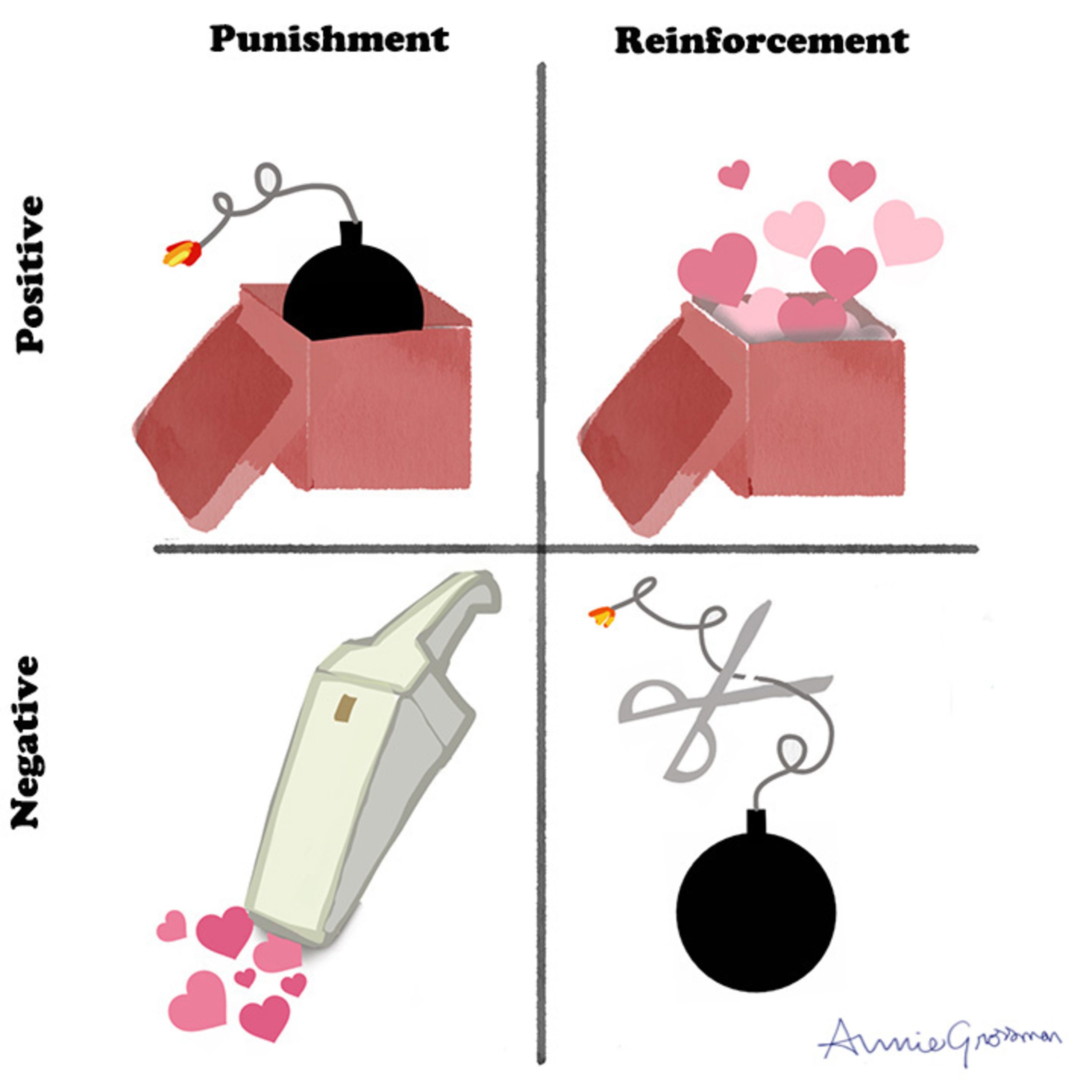
Mar 26, 2019
The Museum of the Dog opens in NYC
Up until last month, one of the world's largest collections of dog-related art resided outside St. Louis inside a museum that most of the locals didn't even know about: The Museum Of The Dog. That changed last month, when the museum officially relocated to midtown Manhattan. Annie interviews the museum's executive directly, Alan Fausel, about the museum's collection, history, and fan favorites. Annie will be doing a free training demo at the museum this Saturday, March 30th, at 1pm. Stop by! Learn More at museumofthedog.org Are you enjoying School For The Dogs Podcast? Please leave us a 5-star rating on iTunes and make sure to follow us on Instagram ! Partial Transcript: Annie: Hey everyone. Thank you, as always, for listening. If you are a dog lover in New York City, or maybe if you’re not in New York City, you may have heard that the Museum of the Dog has just opened, after spending many years in St. Louis it is now located in Manhattan on 41st and Park. And I am actually going to be at the Museum this Saturday, March 30 from 1 to 2 doing a training demonstration. So if you're around please come on by, it is free. Sadly, it is not open to dogs but my dog will be there doing a demo. And today, I have the pleasure of speaking with the Museum's Executive Director. Alan, why don't you go ahead and introduce yourself. Alan: My name is Alan Fausel, I’m the Executive Director of the AKC Museum of the Dog which has just been moved from St. Louis to New York. Annie: And were you the director also in St. Louis? Alan: No, I was not. I had an association with the AKC for years, when I was doing open houses at Doyle and Bonhams in New York and we always had them as one of our charity benefactors for the Humane Fund. So I knew the people in the collection and actually appraised the collection. Annie: What did you think of the collection when you first saw it? Alan: I have known it for years and there are some really great things here and also I went out to St. Louis twice before I took the job, you know, over the years. There are some fabulous paintings here and also a lot of interesting other teachable things that we have besides paintings and sculptures but there's also collars, trophies, a whole variety of things we call “doggyama.” Annie: Doggyama, I loved it. So tell me about how the museum first got stopped. Alan: It got started in the early 80s, so a number of people from the AKC and dog lovers formed a foundation because they didn't like the fact that Geraldine Rockefeller Dodge’s collection in the ‘70s had, sort of, been dispersed, they thought they wanted to retain some of this. Annie: I don’t know about her collection. What was her collection? Alan: It was several thousand pieces. She was a huge- she was behind the Morrison Essex dog show and was the preeminent dog person in the United States. Annie: And she was an art collector and a dog lover, I’m guessing. Alan: Yep, a dog breeder. She had hundreds of dogs at any one time. Annie: She was a Rockefeller? Alan: Yes, Geraldine Rockefeller Dodge in New Jersey. Annie: And what kind of dogs did she breed. Alan: Uh, German Shepherds were the main ones. I also think there were some Bedlingtons in there and Cocker Spaniels. She was instrumental in the development of American Cocker Spaniel, as opposed to the English Cocker Spaniel... Full Transcript at Schoolforthedogs.com/Podcasts Get full access to Don't Be a Dick to Your Dog at dogtraining.substack.com/subscribe

Mar 19, 2019
The body builder & the Boston: Joe & Lenny on their journey to Westminster
In 2012, Joe Freni's wife surprised him with a puppy they named Lenny. Lenny, they felt, was simply perfect. In fact, he was so perfect that they decided to start enrolling him in competitions. In the years since, Lenny has received titles both in dog sports and dog shows, the latter culminating in his recent spot in the Westminster Dog Show. Not long after he started showing his dog in the ring, Joe decided to also start showing... himself. In this episode, Annie learns about Joe's journey as a body builder, a power lifting world champion, and as a show dog handler. Lenny on Social Media: Facebook: https://www.facebook.com/lennytheboston/ Instagram: @puppy_kid Twitter: @LennyandJoeShow YouTube: https://www.youtube.com/channel/UCb9rAnMl99XelUhuyTG7_1w Shop Lenny Gear: https://shop.spreadshirt.com/lennys-loot Learn more about "The Good Boys of Boston" calendar at @good_boys_of_boston Fun Boston Terrier Facts: http://www.bostonterrierclubofamerica.org/about-boston-terriers/boston-terrier-history.htm Our beloved Boston Terrier student Reggie is on Instagram at @reggieinnyc --- Like this Podcast? Make sure to leave us a 5-start review on iTunes ! --- Partial Transcript: Annie: So I am here today with Joe Freni of Boston and he is the human who belongs a Boston Terrier named Lenny and Joe got in touch with me because he wanted to tell me a little bit about Lenny and I was intrigued because it turns out both Joe and Lenny are kind of both professional physical perfect specimens. Lenny competes in dog shows and Joe competes and what you might call human shows. He is a bodybuilder and a world champion powerlifter. Of course, you don't normally encounter bodybuilders in the dog show ring, at least as far as I know, so I wanted to learn more and Joe, thanks so much for taking the time to talk today. Why don’t you introduce us to your dog Lenny. Joe: So for anyone who's never met Lenny. He’s a fantastic little Boston terrier he is named after Leonard Nimoy a.k.a. Spock in Star Trek due to the pointy ears and the fact that we’re huge, you know, Star Trek nerds. Annie: You know it's funny as I almost named my dog, Lenny, after Lennie Briscoe on Law and Order. Joe: No way. Annie: And I also once met another dog named Lenny named after Leonard Bernstein. So there are lots of dogs named after people it seems. Joe: Leonard Nimoy is also from Boston which we thought was really cool. So Lenny is six and half years old, we got Lenny as a puppy about 10 weeks old, I believe. My wife actually actually got him, she completely surprised me with Lenny, I had no idea that we were getting him. I've always loved Boston Terriers and we actually had three Boston Terriers prior to Lenny so they were all rescues and this was our first first Boston Terrier from a breeder.... Full Transcript available at Schoolforthedogs.com/Podcasts Get full access to Don't Be a Dick to Your Dog at dogtraining.substack.com/subscribe
Mar 13, 2019
Are you talking to your socks? Marie Kondo, Cesar Millan & training humans with snake oil
The sprightly Japanese organizing guru Marie Kondo has gained worldwide acclaim for essentially being an excellent trainer of humans. Specifically, she trains people to "tidy up" their homes. While she might be adept at using positive reinforcement (mostly in the form of her sheer enthusiasm about junk drawers) and other methods that dovetail with Good Dog Training, her approach also encourages people to attach their actions to part in certain bizarre "superstitious" behaviors. like verbally "thanking" pieces of clothing and "waking up" sleeping books by tapping them. In this episode, Annie, who believes that behavior-changing techniques should appeal more to common sense than to magical thinking, talks about how Kondo and famous dog trainers like Barbara Woodhouse and Cesar Millan douse snake oil over their proposed solutions in order to suggest that clutter is caused by sleeping books, dogs love the letter T, and nice leash walking can only happen if you channel amorphous invisible powers. Notes: Marie Kondo on Netflix - Marie Kondo's book: The Life-Changing Magic of Tidying Up - Marie Kondo on The Late Show w/ Stephen Colbert, 2/5/2019 - Marie Kondo on Jimmy Kimmel Live, 1/29/2019 - Cesar Millan clip quoted in podcast , in which Millan tells the dog owner that her dog's won't listen to her unless she is "calm and assertive" and "injecting energy" into them while walking. - Barbara Woodhouse, dog trainer who throws books at dogs. Clip in podcast is taken from here - On doing dishes and peeing The following are blog posts about The Dog Training Triad. Each post contains the podcast episodes on the same subjects, which were I posted last July (Episodes 16, 17 and 18) Part 1: Management Part 2: Rewards Part 3: Timing --- Partial Transcript: [Intro] Annie: Hey there, humans. So today I want to talk about someone who has been making the rounds on talk shows, and just generally in the news a lot, her name is Marie Kondo. And if you live under a rock and you don't know who I'm talking about, she is an expert on tidying up. In fact, her new Netflix series is called "Tidying Up" but years before this Netflix show, she was already quite well known for her book, The Life Changing Magic of Tidying Up . Now, I know you're listening to this and you're saying to yourself, hold on, this is a dog training podcast. Why are we talking about this young Asian woman who helps people clean out their closets? Well, it actually has to do with superstition or what dog trainers call superstitious behaviors. Now you might be surprised that dogs are superstitious as are people, of course. And I'll talk a little bit more in a minute about what dog superstition looks like. I think you probably already know about human superstitions, like wearing a certain pair of socks so that your favorite baseball team wins or not walking under a ladder or crossing a black cat... Full Transcript available at SchoolfortheDogs.com/Podcasts Get full access to Don't Be a Dick to Your Dog at dogtraining.substack.com/subscribe
Mar 4, 2019
Ask Annie: Separation anxiety, tips for crate training and an overview of attachment theory
In this Q+A episode, Annie answers a question from a puppy owner whose dog is scared of the crate and stresses out when left alone, and then considers another dog owner who asks if "Attachment Theory" applies to dogs. Visit AnnieGrossman.com/ask or leave a voicemail at 917-414-2625. NOTES Products: Annie's preferred crate, the Revol (get $25 off the Revol with code SFTD25 at checkout through March 31, 2019) - See through pen on Etsy by ClearlyLovedPets - See through crate on Etsy by PrettyKennels - Treat and Train - The Toppl toy Books: Treating Separation Anxiety in Dogs by Malena Demartini-Price - I'll Be Home Soon by Patricia McConnell, PhD Sites: Evolutionary Parenting article on Attachment Theory and Attachment Parenting by Tracy Cassel PhD Shoutout: You can witness Gilby and Ghost's playdates at @GhostFrench and @GilbyKriss Fun Dog Fact: The Beatles song that contains a secret dog whistle --- Partial Transcript: [Intro] Annie: Hello humans. Today I am going to be answering some dog training questions that have come down the pipeline. If you have a question you'd like answered in a future Q&A episode, you can find us on Instagram @schoolforthedogs . You can send a direct message. Or go to Anniegrossman.com/ask and you'll find a nifty little form there. So our first question comes through Instagram from a listener named B. She writes: "Hi Annie. I've just finished listening to your crate training episode. I love how no nonsense you are with most subjects, and this one is of particular interest to me. My husband and I fostered a few dogs before we adopted. All the dogs we had before, including puppies and adults slept in a crate. However, our last foster and now adopted member of the family hates the crate. He'll go in if there's food, but if the door closes he immediately loses it and won't eat. He tries to eat the bars, jumps up and throws himself against the bars, and generally cries until you open the door. We've also tried pens, et cetera. We want to crate train for all the reasons you mentioned on the podcast and also because I want him to stop sleeping in our bed. He moves around and I'm always scared he'll fall off. He was rescued from a puppy mill. And I've been following the Best Friend's guidelines, which say that some dogs will never adapt to crates after being born in a puppy mill. He is five months old. He also hates pens. I've tried covering the crate to make it more den like, but he barks and jumps the whole time. Occasionally he goes quiet. I've even filmed him and left the apartment, and he keeps jumping and barking until I’m back. "He is very happy when he's let out. He also won't eat if he knows he's closed in the pen or crate. He's very stuck to me in general... Full transcript available at SchoolfortheDogs.com/Podcasts Get full access to Don't Be a Dick to Your Dog at dogtraining.substack.com/subscribe

Feb 26, 2019
Let's talk about dog breeding with Cherrie Mahon of River Valley Doodles
A few years ago, after years of volunteering at rescue organizations and owning both shelter pups and purebred dogs, Cherrie Mahon, a professor of business in Rochester, New York, did something that'd change her life forever: She got a Goldendoodle. Cherrie fell in love with the breed, and pitched an idea to her mother, a school bus driver who was looking for a retirement career: Maybe they could start a family business breeding doodles? In the years since, Cherrie, her mother, her sisters and a few cousins have been in the business of bringing fluffy dreams to life for hundreds of happy families. But there are plenty of moments that haven't been so... golden. Cherrie and Annie have an honest discussion about the way people acquire dogs, the science of good breeding, and the emotional rollercoaster of rearing puppies. NOTES RVD Online: RiverValleyDoodles.com - @RiverValleyDoodles Breeding resources referenced by Cherrie: MistyTrails' content can be found here - Puppy Intensive Care - On wolves and poodles - If you really want to geek out on dog genetics, this slide show is for you . Gets into poodles/wolves around the 4th minute - Also see Chapter 13 of Man and Wolf: Advances, Issues, and Problems in Captive Wolf Research - On Goldendoodles and "back crosses" Some of School For The Dogs' students from River Valley Doodles: @neptune - @ollie_bear_doodle - @freyadood - @joeyandbeau - @juliettethedoodle Woof Shout Out : Learn more about Gary, aka Garebear, an adorable and adoptable young Frenchie who currently being fostered in the East Village, at http://instagram.com/buckysfostercrew --- Partial Transcript: Hello humans. Thank you for listening. I am here with my seven week old baby, Magnolia. Again, I've tried to figure out times where I could podcast where she is not going to interrupt with adorable baby noises, but I've decided to just go with it. And so, I now have a little grunting cooing, occasional co-host who might just be the youngest podcast host out there. Also, perhaps the only nonverbal one. If you're enjoying School for the Dogs’ podcast, please do subscribe on iTunes while you're there. Leave a review and give us a five star rating. It's a good way to let other people know that this is something worth listening to. And if you're on Instagram tag us in your stories or in your feed, send a DM. We love to hear from you. Full Transcript available at SchoolfortheDogs.com/Podcasts/ Get full access to Don't Be a Dick to Your Dog at dogtraining.substack.com/subscribe

Feb 12, 2019
New "Diggs" for your dog: Zel Crampton's dog crate revolution
We use dog crates every day at School For The Dogs. They're an integral part of dog training: We recommend them to clients who are house training puppies, incorporate them into class exercises, and transport dogs in them. And yet, all of us who work at our training center agree: Crates... kind of suck! They're clunky and ugly! Noisy! Storing them is a pain, and when you have to open and then collapse them all day long (like we do), you're going to suffer pinched fingers. It has long seemed like a problem with no solution, but Zel Crampton might just be our white knight. Crampton is the founder of Diggs, a product development company whose flagship item, the Revol, is a crate that just might change everything... In this episode, he and Annie talk about the problem with crates, and the "revolution" that he foresees. Notes: Find the Revol at StoreForTheDogs - Through 3/31/19, get $25 off your Revol crate purchase from StoreForTheDogs.com with code SFTD25 - 10 innovative crates - Database of dogs licensed in NYC (last updated in 2017) - The Treat And Train In this episode, Annie spoke about how she wished there were a collar that could vibrate but not shock a dog; most vibrating collars are also shock collars. But after recording the episode, she was told about one! Witness the Dogwidgets " No Shock E-Collar Pet Trainer " --- Partial Transcript: Annie: So I am here with Zel Crampton, founder of Diggs . Is that how you call the company or is it Diggs pet products? Zell: Just Diggs. Annie: And I wanted to talk to Zel today because he has a product that is innovative in a bunch of ways, which we will talk about, but I think interesting to me in part because it's really like the only innovative thing in the world and the world is crates. At School for the Dogs we have maybe a dozen crates. They're really important. We use them every day, all the time. And nobody likes them. I would say these crates have no fans, but they're clunky. They hurt your fingers when you have to close them and open them all the time, which we do everyday, all day. They're noisy, they fall over, they, they're ugly. But they're totally necessary. Like we couldn't live without them. And yet I don't think anybody who works at School for the Dogs would have any nice things to say about any of them. And what you're doing in the world of crates is, it gives me hope that there is a future that could be better for this product. But I know Diggs has two products and why don't you tell us about those two products and then we can talk about how you got into this world. Zel: Sure. So our flagship product is the Diggs Revol dog crate. As you just rightfully said, crates are ugly, hard to use, unsafe, noisy, hard to collapse, hard to transport. Frankly, they're an abysmal product, when you consider other consumer categories, like they just haven't been changed in 50 years. They're just the same old ugly wire thing that for some reason never got, never innovated. Annie: Why? Zel: I'll give you my opinion. I don't know for a fact, but I actually think that the history of the pet industry is really that, you know, pets used to be property, right? And they're legally speaking, they are still property, but people used to view the pets as their property, right? I'm a dog owner. Right. Annie: Or a master? That's what my dad used to call himself, growing up. He was the art dog's master. Full Transcript available at SchoolfortheDogs.com/Podcasts/ Get full access to Don't Be a Dick to Your Dog at dogtraining.substack.com/subscribe
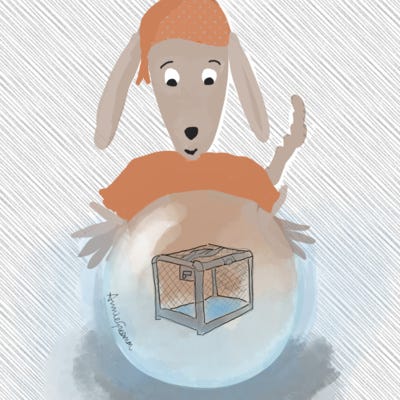
Feb 6, 2019
Teaching a stellar "Down" with a verbal or visual cue
Every dog already knows how to lie down -- your dog lies down all the time! The trick to training a "down" is to teach your dog to do it when you ask for it. That involves adding a cue. In this episode, Annie addresses the difference between a "cue" and a "command," and talks about some of the pitfalls people tend to fall into when attempting to cue a dog -- is the dog responding to your words? Or your body language? Or both? Or neither?! Annie goes over how to teach a "down" using two methods: Capturing, and luring. For the former, she describes how to use a verbal cue. For the latter, she explains how to morph a lured down into a down that is a response to a clear and subtle visual cue. The result is a dog who will understand what you want in as little as just one training session. Also make sure to see our recent episode on training "Sit." http://anniegrossman.com/2018/08/podcast/podcast-episode-19-train-dog-sit-scratch/9711/ Are you enjoying this podcast? Please leave it a 5-star rating and write a review on iTunes! If you have a training question you'd like answered, submit it at http://AnnieGrossman.com/ask School: http://schoolforthedogs.com Shop: http://storeforthedogs.com Instagram: http://instagram.com/schoolforthedogs Facebook Group: http://facebook.com/groups/schoolforthedogs Partial Transcript: Annie: Hello humans, thank you for tuning in to School for the Dogs podcast. As some of you know, I had a baby almost a month ago. I've been trying to find the perfect time to record this podcast all day and waiting for her to take a nap or at least be quiet for a while and finally decided I needed to do it while feeding her bottle so if you hear adorable little sucking and gurgling noises, that is my daughter who is a foot away from the microphone guzzling down some milk. So sorry sorry that the extra noise, maybe we can just pretend that baby Magnolia here is my co host. Listen to these adorable sounds, you can't make this kinda stuff up… and that was my dog snorting. Anyway, if you enjoy this podcast, just want to remind you that you can help me out by sharing it with your dog-loving friends. You can do this in multiple ways, you can take a picture of your podcast player and share it on social media, on your stories or your feed. Let other dog lovers know that this is out there. If you tag School for the Dogs, we will go ahead and share in our stories too. Also leave us a rating and review on iTunes- very much appreciated. I love reading your iTunes reviews, it really helps me figure out what you find interesting and what I can offer more of and if you have a question you can send a direct message on Instagram, you can also go to Annie Grossman.com/ask and I will do my best to respond. Today I wanted to go over how to teach your dog to lie down and as I mentioned in the episode I did a few months ago on teaching the dog to sit - obviously lying down is something your dog already knows how to do good, your dog lies down all the time-the trick is of course to teach your dog to lie down when you ask him or her to do it. So it's really just about adding a cue to a behavior your dog already knows and, like many dog trainers, use the word cue instead of the word command although if you want to say command instead of cue that's okay with me. Full transcript available at SchoolForTheDogs.com/Podcast Get full access to Don't Be a Dick to Your Dog at dogtraining.substack.com/subscribe
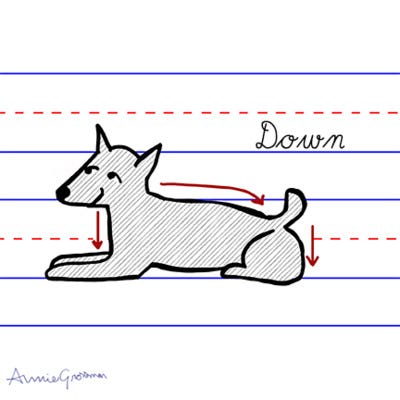
Jan 29, 2019
Let’s talk about dogs & babies with Jessica Jacobson of Dapper Dog Training
You might consider your dog your "baby," but what happens if you decide to add an actual infant to your family? Jessica Jacobson, owner of NYC's Dapper Dog Training, has spent years coaching families on prepping their dogs for the arrival of a tiny non-furry new family member. Annie and she discuss how she built her career, and go over some key things to consider when training a dog for interspecies sibling-hood. Notes: Dapper Dog Training - Marilyn Ullman of the "Discover Your Dream Career" course - Association of Professional Dog Trainers' annual conference - Nursing Your Baby by Karen Pryor - Snuggle Puppies - Annie's baby! - Music: "Hello Ma Baby" ukulele cover by The Channel Drifters --- Partial Transcript: **music** Annie: Hi everyone. Thank you so much for listening. Before we get into the meat of today's show, I just wanted to say thank you to everyone who has left reviews on iTunes. It's a really great way to let people know about this podcast. If you're enjoying it, please do leave a review. And Instagram stories has also been a fun way that people have let others know about the podcast. If you take a screenshot and share in stories and tag School for the Dogs on Instagram, we will reshare it. And it really feels good to know that we're reaching people. So today I am talking to my friend, fellow dog trainer, Jessica Jacobson, who has her own dog training business in New York City. And I wanted to talk to her both to just find out how she got into dog training and built her business, but also specifically because she has something of an expertise on preparing dogs for the arrival of a baby. And I have a baby on the way so I was hoping she might be able to give me some tips on getting Amos, my Yorkiepoo ready for this life event. Jessica: Hello? Hi. My name is Jessica and my company is called Dapper Dog training and I'm stoked to be here. Annie: And we've known each other actually for a long time now. Jessica: Yeah Annie: We met in Atlanta at the APDT dog conference dog conference. Jessica: 30000 years ago. Annie: 2010 it was. I remember it was 2010, cause it was right after I finished Karen Pryor Academy . Jessica: Oh yeah. Annie: Was that the first time you'd ever been to the association? APDT is the Association for Professional Dog Training? Jessica; Yes. I think it was my second conference or maybe my first. I don't remember, but I remember when I saw you and we had gotten together because I think I was listed on the APDT website as having a dog trainer meetup. Annie: Yeah, yeah. Which is actually also, I think how I met Kate was through your meetup. But that was like a real seminal moment for me because it was the first time that I was sort of immersed in a group of dog trainers outside of the two other people in my class at KPA. Jessica: It's like social crack. Annie: Yeah. It was a bit. It was also, it was just so interesting to meet people doing it, like all people from all over the country and also meeting different kinds of dog trainers and cause Association Professional Dog Training is not strictly, um... Full Transcript available at SchoolfortheDogs.com/Podcasts/ Get full access to Don't Be a Dick to Your Dog at dogtraining.substack.com/subscribe
Jan 22, 2019
French Bulldog Lola Barksdale: A Floofdragon's guide to Instagram stardom
When we first met Lola Barksdale, she was a tiny Frenchie puppy in our Kindergarten classes. We had no idea that she would become an Instagram star, or that she was secretly obsessed with unicorns and alpacas, loved purple fruit loops and waffles (which she calls "woofles,"), considered herself a "floofdragon" and had hobbies including interior decorating and counting her own feet. The genius behind her account is her human, Rachel Rednor. Rachel works in finance, but during her bathroom breaks at the office, she has developed an entire character for her little dog, built through photos and captions. Annie talked to Rachel about creating, and managing, her dog's Internet celebrity. Notes: @lolabarksdale - twitter.com/dog_feelings - #sukiisadopted - French Bulldog Club Of America - Music: Ukulele cover of "Play a Simple Melody" by JazzBanjoRex --- Partial Transcript: Annie: I am here with Rachel Redner. I met Rachel and her husband, Matt about six years ago when they did a lesson with me with their brand new puppy. Lola, who is this tiny, fawn colored, would you say? Rachel: I, we call her cream. Annie: Cream French bulldog, who was just, just the cutest little like potato of a dog. [laughing] She has like no neck, which adds to her adorableness, I think. And, they actually started doing classes when School for the Dogs was located in my apartment, which is where we are right now. In a previous iteration, it was the School for the Dogs classroom. And I wanted to talk to Rachel for this episode because, I think even before dogs on Instagram were sort of a thing, she had an account for Lola on Instagram. And I started following it and just sort of became obsessed with Lola's Instagram and was like, who is this person writing it? I mean, I knew it was Rachel, but it wasn't, it wasn't the voice of the woman who works in finance, who I had met in her apartment. It was the voice of this hilarious, um, tiny French bulldog. And I think a lot of people kind of develop a voice for their dogs, but I think, you do it better than most. So why don't we talk quickly? Just tell me about how Lola came into your life. Rachel: Sure. So my husband and I had different views on a dog in general. I had grown up with a dog and he grew up in a very animal free house and was not that interested in the idea of a dog, but I was very persistent. And when we moved to Manhattan, there were Frenchies. That started to be everywhere. They weren't as kind of everywhere as they are now, but they were-- Annie: Where did you move from? Rachel: We moved from college. We met in Syracuse and then we moved to the city. Uh, we were local. We grew up here, but not really in Manhattan. You know, so you don't get that much exposure to all the different breeds of dogs when you're living in the suburbs. So we moved to Manhattan and we started seeing Frenchies and I had thought I wanted a beagle. And then I read somewhere one time and it was, this was all, it took me that beagles are terrible in the city because they just have their nose to the ground. And it's really, really hard to manage that. So I said, okay, let's forget. But we started seeing Frenchies everywhere. And I don't remember if we looked it up or we just talked about it, but we started this obsession that just kind of grew. And the worst of it was we would follow people with Frenchies around the city. Full transcript available at SchoolfortheDogs.com/Podcasts/ Get full access to Don't Be a Dick to Your Dog at dogtraining.substack.com/subscribe

Jan 7, 2019
Dog training pet peeves: The word "energy" and the misuse of the word "positive"
In the modern era of dog training, people often rush to blame a person or a dog's "energy" for behavior issues. In this episode, Annie addresses why all the talk about using or observing "energy" in order to train a dog makes her cringe, and also why she thinks the misuse of the word "positive" leads to too many misunderstandings about science-based training. Notes: John Watson's Psychology As The Behaviorist Views It - Free eBook edition Fun Dog Fact Of The Day: Rowlf the Muppet was invented in order to sell dog food! Here he is making his debut in the early 1960s in a Purina commercial where he convinces his friend that dog chow is better than asparagus. Then he eats his kibble with a spoon. --- Partial Transcript: Annie: Hello human listeners. So today I am going to talk about some of my pet peeves when it comes to dog training, specifically, words people use in the dog training domain that drive me a little bit nuts. Now, if you've listened to this podcast before you might know that I generally think we use too many words with dogs in general. Too much talking goes on. I think we rely far too heavily on language when it comes to dog training. Considering that of all the many, many things that dogs and humans have alike, considering that we're both mammals living in the same time and place and environment and climate, etc, etc., language is a big thing, at least verbal language, is a big thing we don't have in common and I think there is too much focus on it in dog training. But I was specifically talking about, uh, words that we use with each other to discuss dog training. And you know, I think that these words that I want to talk about, two words in particular, I think they kind of speak to some of the divides that exist in the dog training field. And I know as someone who came to dog training from a totally different career, totally different place that a lot of the disputes that exist among different dog trainers can just seem like insider baseball to those who exist outside of the world of dog training. And again, because I come from that place, I totally get it. I get that people probably have this point of view before they are, sort of, in the world of training with their own dog or just because they're interested. I know that this point of view exists of, like, why does this matter? Why are you having these, you know, niggling observations about someone else doing something as simple as teaching a dog to sit. It's silly. He trained a dog to do something. The dog is trained. That's it. It's done. End of story. Let's not lose sleep over this. There are far more important things in the world to worry about. And I mean obviously I no longer feel that way because I see the extremes of how people approach dog training. And in my opinion, not only is it a matter of ethics, how we treat our dogs, but thinking about how we train them and how their learning I think has a lot to do with how we treat each other and how we treat our children and how our children learn to treat each other and to treat animals. And there's certainly an aspect of animal welfare that has to do with training. And there are a lot of dogs who I think are hurt more than we realized more than we realize because of the widespread acceptance of dog training methods that I and many others consider inhumane. But that kind of I think get lumped together under this dog training heading of... this heading of dog training and all the things that fall under it.. Full Transcript available at SchoolfortheDogs.com/Podcasts/ Get full access to Don't Be a Dick to Your Dog at dogtraining.substack.com/subscribe

Dec 5, 2018
Training "Look" using the "Invisible Triangle" method
Everyone is impressed by a dog whose eyes meets a human's gaze with magnet-like intensity on cue. Teaching a dog to "touch" his or her eyes to your eyes is a great exercise to practice no matter what the pooch's training level is. When teaching this attention-based behavior to a dog-- whether you use a word such as "Look" or the dog's name -- Annie suggests focusing on your training mechanics before jumping to setting criteria for your dog. In this episode, she clearly breaks down how to build a stellar "Look" cue from scratch, in just six quick steps, using only sixty tiny treats. Notes: Treat suggestions - Tricky Trainers (and other brands that make these pencil-eraser sized morsels) can be broken up into at least four pieces, meaning you'll go through only 15 treats in your session: storeforthedogs.com/products/tricky-trainers - Lamb lung breaks up into neat pieces without getting greasy or crumbly: storeforthedogs.com/products/lamb-lung - Happy Howies rolls can be sliced and then diced into very small bits: storeforthedogs.com/products/happy-howies-food-rolls \ Dogs and presidents: https://read.bi/2SrAVxu "Look For The Silver Lining" ukulele cover by Renei Yarrow: youtube.com/watch?v=CDIHff9eESQ Partial Transcript: **music** Annie: Hello, everyone. Thank you for listening. Today I’m going to walk you through what I call the Invisible Triangle method of teaching “look.” I think look is a really excellent thing to teach any dog, any age some people call it “watch me” or “attention,” whatever you want to call it, basically you’re teaching your dog to connect their eyes to your eyes on whatever cue you give. And of course that cue, today we’re going to use “look” you could be using their name, you could say “eyes,” you could say “bubblegum baba ganoush.,” it doesn't matter but you are to give it some kind of cue. Of course, if you don’t give it a cue and you just teach them that locking eyes with your eyes is always a good thing that certainly not a bad thing to teach either. I generally think that everything we train our dogs to do, pretty much, comes down to targeting- targeting being teaching them to touch one thing to another. Of course, pretty much the first thing I teach every dog I work with is to hand-nose target so to touch their nose to my fingers, to my hand or to touch their nose to an object. And while there are lots of reasons I like to teach this specific exercise, the big reason is that I think of it as a building block exercise that you can use to teach lots of different things because really what you’re teaching is if you touch X to Y then good thing happens and basically everything you’re ever going to train your dog comes down to something that can fit into that equation. Sit is if if you touch butt to ground. Down is if you touch body to the ground. Go to the crate, well, that's if I touch body to crate. And I think that teaching look is really just the same thing except that if I touch my eyes to my human eyes good thing happens . And like I just said, certainly if that becomes just the default behavior, it's never going to be a bad thing since if your dog locks eyes with you, you certainly have your dog's attention and that's a great starting place for getting your dog to do whatever it is you want or need him or her to do... Full Transcript at Schoolforthedogs.com/Podcasts Get full access to Don't Be a Dick to Your Dog at dogtraining.substack.com/subscribe

Nov 27, 2018
Part 2: How I used punishment to train my husband to cover his mouth when he yawns
In this episode, Annie offers a follow up to the previous episode, which featured a candid conversation with her husband about her ill-fated attempt to use punishment to keep him from showing her his uvula very time he yawned. Here, she points out some of the similarities and differences between using punishment with dogs and with humans. This episode touches on, among other things: -The long shadow punishment can cast -How language can offer clarification... or not -The subjective nature of "bad" behavior -Choosing appropriate punishers (and reinforcers) -The issue with a "Nothing In Life Is Free" approach to training -The importance of wisely selecting a training subject who isn't inclined to exhibit copious unwanted behaviors Notes: How I used punishment to train my husband to cover his mouth when he yawns (Part 1) : - Parentonomics -- a book that discusses the trap of toilet training a child with jelly beans - Plenty In Life Is Free by Kathy Sdao - Have a question for our upcoming Q + A episode? Ask it at AnnieGrossman.com/ask --- Partial Transcript: Annie: Hello listeners. So last episode , if you heard it was a conversation with my husband, Jason, about an instance where I tried to change a behavior of his that I didn't like by using punishment and the episode was a conversation about this, this debacle, let's call it. I got a bunch of questions about the whole thing. The specific behavior of course was that I was trying to get him to stop yawning with his mouth wide open. I was trying to train him to cover his mouth and the episode led to a lot of questions and I realized that it was sort of maybe like giving everybody a primary source without offering enough commentary and dissection about the whole thing. And I think that it's an anecdote that actually contains a lot of lessons that are applicable to all kinds of behavioral training, whether you're training a dog or your husband. Certainly it was a failed attempt. So might be helpful if you go back and listen to that episode before listening to this episode. The real meaty part starts about halfway through if you want to cut to the chase. The first thing I wanted to point out in looking at the whole incident, which Jason refers to as a “yawngate” is really how arbitrary and silly it is that, of course, that this was the thing I decided I was going to try and train. That this was the behavior that I was going to try and punish. So often with dogs, we're inclined to categorize behaviors as a good behavior or a bad behavior. But in the end, they're all just behaviors. And whether or not they're good or bad depends on who is making the judgment. Plenty of people would not be bothered at all by someone yawning without covering their mouths. And certainly working with dogs as trainers, we see all the time the things that are considered bad behaviors by one dog owner that someone else wouldn't mind at all. For instance, lots of people don't want their dogs on their furniture and other people have no issue with their dogs going on their furniture. My dog barks at the doorbell and I have had people come over and comment on this as if it's an irony that I have a poorly behaved dog who barks at the doorbell when I am in fact a dog trainer. Full Transcript available at SchoolfortheDogs.com/Podcasts/ Get full access to Don't Be a Dick to Your Dog at dogtraining.substack.com/subscribe

Nov 19, 2018
Part 1: How I used punishment to train my husband to cover his mouth when he yawns
Annie is happily married to a man named Jason Pedicone, who is basically perfect in every way except... he doesn't cover his mouth when he yawns. So, she decided to use her talents as a dog trainer to train him to change this behavior. But she decided to try something she doesn't normally do with dogs: She attempted to curb his habit by using punishment. While she sort of succeeded, she also got a first hand taste at how training using punishment can mar a relationship in unexpected ways. Notes: Pavlov Dog Monitor - Pet Safe Anti-Bark Autotrainer - Jonah Hill on Fresh Air with Terry Gross - Dogs and Yawning - Tips on keeping your dog out of the ER this Thanksgiving - Music: "Hello My Baby" ukulele cover by The Channel Drifters --- Partial Transcript: Jason: Coming to you live from New York state highway 81 North. It's a gray day here on the shores of Lake Ontario. Just came off extraordinarily greasy lunch and we're ready to talk about punishment. **music** Annie: Hello listeners. Doing a little bit of an experiment in podcasting this afternoon. My husband and I are on a little road trip to Montreal and we're gonna be doing some car casting. Is that an actual phrase? I don't know. Podcasting from the car. We'll see how it goes. I forgot my microphone back at home. So the quality might not be top notch, but the content will be because my husband is here and he's a genius. We are going to talk about punishment. Specifically a punishment in our relationship, more specifically about a specific incident where I attempted to use punishment to change Jason's behavior. But before we get into this particular incident, Jason, why don't you, I'm curious for if you could tell me or our listeners what you, how you would have thought about punishment or how you would have defined punishment prior to your union with a dog trainer. Jason: Yeah, that's a very good question. I guess, the first thing that comes to mind when I think of a punishment is just something bad that happens to someone or something in order to try to discourage it from doing something which is bad. So spanking a child or spraying a cat in the face with a water bottle, something like that. Annie: Yeah. Yeah. Although I think too often and really the technical definition of punishment is that it discourages a behavior. But I think too often it can get wrapped up in the idea that it's something bad. And that I was actually, I was just listening to an interview on Fresh Air with the actor, Jonah Hill, who has a new movie out about skateboarding, and he was talking about how he got really into skateboarding when he was a teenager because it was so, like, I think he described it as punishing and painful and punishing and that made him want to do it more. And I thought, okay, well I totally understand what he's saying, but actually the pain was reinforcing, not punishing because if it made him want to do it more, then that wouldn't be punishment. Anyway. But,I know you tried to use punishment with the dog that you had before we met, right? Jason: Yeah. Uh, I used to have a dog who was extremely high strung and he was a Papillon and just sort of always very excited. His little body was constantly taut and he barked a lot and he had this issue where, when I went out and left him home alone, he would bark nonstop for hours. Full Transcript available at SchoolfortheDogs.com/Podcasts Get full access to Don't Be a Dick to Your Dog at dogtraining.substack.com/subscribe

Nov 13, 2018
How to shape your dog to go to a mat (and to be a polite Thanksgiving guest)
"Shaping" is simply the process of breaking a behavior down to its smallest components and slowly raising your criteria in order to build new behaviors. By reinforcing successive approximations, it's possible to train dogs to do almost anything they are physically capable of doing! In this episode, Annie goes over some key things to think when shaping a new behavior, and describes how to shape a dog to go to a mat, or what she calls a "sticky spot." A dog who knows how to go to a mat will make an excellent guest at holiday dinners: You can "shape" a pup to have a specific spot where he will have learned to stay put and be calm, no matter how good that stuffing smells! Notes: School For The Dogs training mat - Don't Shoot The Dog - Karen Pryor's Ten Laws of Shaping - Fun Dog Fact Of The Day: Karen Pryor's Nursing Your Baby - Woof Shout Out - Share your shaping session with us by tagging @SchoolForTheDogs on Instagram or sharing at Facebook.com/groups/schoolforthedogs . Like this podcast! Please rate us five stars on iTunes! --- Partial Transcript: Annie: Hey everyone. So today I wanted to talk about a concept that is really crucial to dog training, but also something that is going to help you with a practical training exercise that you can start working on in preparation for Thanksgiving, which is a time when I think it's a good idea to show off how well your dog is trained to your family and friends. And, of course, that can be challenging because you're often in new places, there's food involved, there's a lot of commotion. But by playing this little shaping game that I am going to describe over the next week or so, I think that you are going to be able to really demonstrate how savvy your dog is at understanding what you want and just being an overall polite little buddy. Shaping is simply the process of breaking a behavior down to its absolute smallest parts and then positively reinforcing the behavior, raising your criteria at incremental steps. Now, the real trick to shaping is to never raise your criteria too quickly, which means there's kind of an art to shaping I think. And that's an art of really knowing the student you're working with, in this case, a dog so that you can make things harder only at a rate that they're going to be able to still figure out what it is you want. If you make things too hard, too fast, you get an animal who I call it “dropping out of school,” you get an animal who's just like, well, I can't do this, nevermind, goodbye. Now of course, shaping is happening all the time. And certainly school, a human school is a place where we all experience shaping. You start out at school and the criteria is very low. You show up and you do a crayon drawing and no matter how bad it is, everybody's clapping their hands and you put two blocks together and announced that that's the number two. And your teachers and parents will think you're a genius but of course pretty quickly, the criteria of what's expected of you is raised. And by the time you're in high school, you're doing algebra, geometry, trigonometry, calculus, and you didn't get there in a single leap from your days playing with blocks. The criteria was raised slowly over time with your teachers, step-by-step, raising the bar as far as what was expected of you. Full Transcript available at SchoolfortheDogs.com/Podcasts/ Get full access to Don't Be a Dick to Your Dog at dogtraining.substack.com/subscribe

Nov 5, 2018
Let's talk about NYC's 1st dog-friendly cafe with Logan Mikhly
Earlier this year Logan Mikhly and her father Coppy Holzman opened a business unlike any other in NYC: A dog-friendly cafe. Logan has a background in animal rescue, Coppy is a dog-loving serial entrepreneur, and both are obsessed with coffee. Frustrated by the fact that New York's health codes make it nearly impossible for them to grab a cup of joe without having to tie their dogs to a streetlight, they contacted the Department of Health for a brainstorming session on how to make a place where beverages and quadrupeds could lawfully co-exist. The result is Boris & Horton. Named after their own dogs, this bright, cheery, and well-loved cafe-cum-indoor-dog-park has quickly become a beloved neighborhood fixture. In this episode, Logan shares the business' back story. Notes: Boris and Horton is located at 195 Avenue A, at the corner of 12th Street. Learn more at BorisAndHorton.com . Other dog friendly cafes: The Bulldog in New Orleans - The Dog Cafe in Los Angeles - Chateau Le Woof in Queens, NY - Products mentioned: Klimb Platforms - Bocce's Bakery Treats - Stewart's Freeze Dried Beef Liver Treats - Nature's Miracle - Fun Dog Fact of the Day: The CoyoteVest - kansascity.com/news/nation-world/national/article220971390.html - Woof Shout Out: Last week the world lost a wonderful woman, and dog lover: Ellen Retter. She was a client, a friend, and a big School For The Dogs fan. A photo of Ellen and her dog Lucy training at School For The Dogs with Annie appeared in CNN in 2015. --- Partial Transcript: Annie: Today I am speaking with Logan Mikhly, who is one of the owners of New York city's first and only dog friendly cafe, Boris and Horton , which is in the East village and is named after, well, actually, Logan, why don't you tell us about the cafes namesakes? Logan: I actually have Horton here with me and the other dog that the cafe's named after is Boris and that's my dad's dog. Annie: And Horton, I should say is just the cutest, scruffiest, little like terrier mix who loves nothing more than to stare lovingly at Logan. Logan: Yes, stare deeply into my eyes. He does need a haircut. He looks scruffy, but he looks like a little, maybe a little too scruffy. Annie: I think he's perfectly, perfectly scruffy. Logan: He has like grandpa eyebrows now. Annie: And Logan runs Boris and Horton with her dad. So tell me his name. Logan: Yeah, his name is Coppy Holzman. Okay. So I actually worked with my dad at his previous company, which is called Charity Buzz and it's an online auction company that raises money for nonprofits. So he was in the process of selling the business. Annie: He's something of a serial entrepreneur, isn't that right? Logan: Yes. So for my whole childhood and up until now, he's started several different businesses, sold them. Uh, he's super creative, big ideas guy. But yeah, his previous company, Charity Buzz is an online auction company that raises money for nonprofits. And he was in the process of selling it. And we were actually out to dinner one night and I was staying at the company, but I wasn't kind of like loving the company culture and was thinking about leaving myself. Full Transcript available at SchoolfortheDogs.com/Podcasts/ Get full access to Don't Be a Dick to Your Dog at dogtraining.substack.com/subscribe
Oct 29, 2018
Halloween & Dogs: How to make costumes less scary for pets
Halloween can be a scary time… for dogs! But it can also be a time to think about how to use training to reduce fears and overcome challenges. In this episode, Annie discusses, among other things: -Ideas for low stress, easy costumes that most dogs can wear without anxiety. -Acclimating a dog to a costume by creating good associations with it over time. -Teaching your dog to wear costumes made out of muzzles, cones, and other things you actually may want to train him or her to feel okay about wearing. -Noticing stress signals your dog, or other dogs, may display to show their discomfort. Have an idea for an easy, low stress dog costume? Tag us on Instagram, join our Facebook Group, or share it by emailing Podcast@SchoolForTheDogs.com . Notes: The psychological torment of a dog on Halloween - Dog candy corn bandana - Ty Tag costume - Or make your own - Superhero Bandanas - Cowboy harness costume - Jockey harness costume - Pet Paint - Dog nail polish - Creative grooming (Vice video produced by Annie) Dog muzzle “costumes” - https://amzn.to/2yHptX6 - https://amzn.to/2yGUrPd - https://amzn.to/2yIs03g - https://amzn.to/2yGUwCv Dog cone “costumes” https://amzn.to/2yE03tw - https://amzn.to/2yE9b1p - Rubie’s “Disney” line of princess costumes et al Make sure to join our Facebook Group ! --- Partial Transcript: Annie: Hello human listeners, and dog friends. So I want you to take a moment to imagine a scenario where you are a foreign exchange student and you just arrived in this new country where you don't speak the language. And you've been placed with a family and they're pretty nice to you. You generally like them. You don't understand what's going on a lot of the time, but they're pretty kind to you and they tend to help you figure out what's what, where to be, what to do. And over time you pick up little things here and there and you get really good at just sort of reading situations in order to figure out what's happening. And then one day they take off all your clothing and they don't let you put other clothing on. And they don't seem to be doing this for any kind of sexual reason, but they seem to be getting a real kick out of it. And they begin taking your photo. They take you on a long walk throughout the city. Maybe they even take you to a park where there are a lot of other families who have foreign exchange students who are also naked and they don't speak your language either. And all you can kind of do is look at these other poor souls and feel great empathy and discomfort because everyone around you is staring at you and really enjoying the fact that you are naked. Now you have no idea whether or not they're ever going to give you back your clothes, or if this nudity situation is the new normal. You aren't clear why all of these other foreign exchange students also don't have any clothes... Full Transcript available at SchoolfortheDogs.com/Podcasts Get full access to Don't Be a Dick to Your Dog at dogtraining.substack.com/subscribe

Oct 22, 2018
Our student Nelson: Life with a muzzled dog
After years of researching breeds, Joanie Comenzo of Manhattan decided to get a Welsh Terrier. When she went to pick up her new dog, Nelson, the breeder pushed him into her arms and said "Your puppy is an alpha." Joanie loved him from the moment she saw him, and that love never waned, even after he bit her multiple times, and sent her mother and boyfriend to the hospital. Over the last eight years, Joanie has sought training and medical advice from a wide array of professionals. Today, Nelson wears a muzzle every moment of the day that he isn't in his crate. He and Joanie live a happy, if unusual, life together. This is their love story. Notes: Nelson's preferred muzzle - Fun Dog Fact Of The Day: As late as the early 1900s, dogs were allowed to roam off leash in Philadelphia as long as they were muzzled - Woof Shout Out: Zuri, who wears a muzzle to deter people from pestering her for being so cute, can be found on Instagram at Instagram.com/zurithebolo - Music: "Love Is Strange" cover by Toast Garden --- Partial Transcript: Joanie speaking to Nelson: Good boy Nelson, Oh, what a good boy. **music** Annie: I'm here with a client of ours, Joanie Comenzo and her dog Nelson, who is, a Welsh terrier. Is that right? Joanie: Yes Annie: I wanted to speak to Joanie about being Nelson's person because I think as a dog human pair, they've encountered some,pretty formidable obstacles and have come out on the other side, still loving each other. But let's start from the beginning. So you got Nelson when he was a puppy? Joanie: Yeah, 14 weeks. Annie: Okay. So what made you decide to get this breed in particular and where did you get him? Joanie: Well, I had a Yorkie that I had as a teenager and then I went off to college, so it kind of became my mother's dog. And I knew I wanted something a little bigger, but I liked, you know, Yorkie was a good experience, you know, as a terrier. I knew I wanted a terrier. Everyone told me that the Jack Russell's too insane, don't get a Jack Russell. So I was, I listened, funny story that I ended up with Nelson, but, and I'd seen a few Welsh Terriers around. I was thought they looked interesting and then I just did some research and they just seemed like the perfect dog for me, you know, they said good with kids, I thought I was going to have children. You know good with kids. Good for city or, you know, country living. They adapt well to an apartment or you know, like they just-- Annie: I always feel like those breed books make such grand generalizations, right? And yet so many people buy their dogs based on what it says. Joanie: Yeah. And just so much, you know, everything I read about them, I was like, I think this is going to be the dog for me. And then I researched rescues, it was impossible to get and you know, Welshies are just so hard to come by. There was no rescue with the dog for me and I was like, you know, I waited and I waited and I researched breeders and I found, you know, the top Welsh terrier breeder and you know, in the country and I was on a waitlist there for a really long time and they went through this huge interview process. You know, they were interviewing me to make sure that I was proper for their dogs, you know-- Annie: Which is something you want from a breeder. You want them to be doing their due diligence too... Full Transcript available at SchoolfortheDogs.com/Podcasts/ Get full access to Don't Be a Dick to Your Dog at dogtraining.substack.com/subscribe

Oct 15, 2018
A modern dog owner's guide to sidewalk leash greetings
As much as we want our dogs to be social beings, the sad fact is that city streets are not an ideal place for leashed dogs to socialize. The close confines of the sidewalk can keep dogs from having enough space to greet each other properly, and leashes too often can become uncomfortably taught, leading a dog to think that even just the sight of another dog predicts yanking and choking. This episode addresses: -Avoiding other dogs on the street -Using the presence of other dogs on leash as a cue for your dog to pay attention to you -Providing your dog with appropriate off-leash socialization opportunities -Choosing which dogs you might let your dog greet -Helping your dog greet other dogs naturally and appropriately ... and more Notes: 7 things to consider before letting to dogs greet on leash https://schoolforthedogs.com/7-things-to-consider-before-letting-two-dogs-greet-on-leash Dogs In Need Of Space https://dogsinneedofspace.com/ The Yellow Dog Project Mendota leash -- Annie's favorite, lightweight leash https://storeforthedogs.com/products/braided-leash Woof Shout Out: Dog adoption vests by Mimi Reid https://etsy.me/2PzKd9T Fun dog fact of the day: NYC dog names (dogs named after fruits, vegetables, etc) https://nycedc.com/blog-entry/new-york-citys-dog-population Follow School For The Dogs on Instagram: Instagram.com/schoolforthedogs Ask Annie: AnnieGrossman.com/ask --- Partial Transcript: Annie: Hey everyone! So today we are going to talk about dog-dog greetings, specifically dogs greeting other dogs on the street, and I'm going to suggest how you can teach your dog to greet another dog well and all the things you need to keep in mind when deciding whether or not you're going to let your dog greet another dog. But before I get into the thick of it, uh, I wanted to give my number one suggestion, which is don't do it. Don't let your dog greet other dogs on the street. That's it. Now the reason I'm not going to end it there is because I know that that sort of like a bummer piece of advice. People don't generally love the idea of shielding their dog from every other dog on the street. We like the idea of being able to walk our dogs and have it be a kind of social thing where they can say hi to the other dogs in the neighborhood and everyone's gonna get along. But here's some reasons why I generally advise against letting your dog interact with other dogs on the street. First of all, I see a lot of crazy dogs at School for the Dogs, all of us trainers do. And a lot of those dogs are dogs who have issues with other dogs and, especially, those are dogs who have issues with dogs on the street, issues with other dogs at close proximity and in New York City where I am, and in a lot of cities, when you're having a dog greet another dog on the street, there's a lot that could go wrong. And I have to assume that it's the minority of dogs who have problems greeting other dogs or problems even just being on the street at all where other dogs may or may not appear or just problems being on the street at all, no matter where other dogs are. Full Transcript available at SchoolfortheDogs.com/podcast/ Get full access to Don't Be a Dick to Your Dog at dogtraining.substack.com/subscribe

Oct 8, 2018
Let’s talk about the future of dog food with The Farmer's Dog's Brett Podolsky
When Brett Podolsky's dog was chronically unwell, he had an idea: What if he bought the same ingredients listed and in the commercial brand he was feeding her, and made her fresh food? The change in her health was drastic, and led to Brett, who was then working as a comedian, convincing his best friend, Jonathan Regev, to start a subscription-based high-end dog food company with him. Now three years old, their Brooklyn-based company, The Farmer's Dog, has secured some ten million dollars in VC funding and their health-supportive recipes are being enjoyed by tens of thousands of grateful dogs throughout the country. Annie and Brett discuss what it takes to start a dog food company from scratch, the problems behind commercial dog food, and the shifts in dog owner awareness that are leading to a tide change in the pet food realm. Visit SchoolForTheDogs.com/Farmer and get 50% off a two week trial subscription. Notes: Learn more about the Farmers Dog at schoolforthedogs.com/farmers - Brett and Jonathan in Forbes - Fun Dog Fact: Yes, it's possible to dog food that is nutritionally viable (according to government standards) using shoe leather, crushed coal, water, and motor oil . Woof Shout Out: Our sweet doodle student Webster recently moved to San Francisco. We miss him, but we enjoy keeping tabs on his left coast life on Instagram! instagram.com/westcoastwebbie/ Have a question about dog training? Get in touch! Podcast@SchoolForTheDogs.com --- Partial Transcript: Annie: Hey everyone. Today I am speaking to Brett Podolsky, who is one of the founders of The Farmer's Dog, which is a high end dog food subscription company. I first discovered The Farmer's Dog three or so years ago, not long after they opened up shop because I was at a cafe that I often go to near my apartment. And there was a guy there with a dog and he and I started talking about his cute dog and it came up in conversation that we're both dog business entrepreneurs. And I started looking into his company and that was Brett’'s business partner, Jonathan Ragiv. A year later, I was reading about them in Forbes.com . And last year, I read that they had secured an $8 million investment. At which point I realized these guys were actually maybe a big deal. So I was psyched to get the opportunity to talk to Brett **music** Annie: So tell me how you guys got started. Brett: Yeah, so Jonathan was actually living with me at the time. Annie: And how did you two know each other to begin with? We met abroad and basically just like hit it off and spent every single day with each other. Literally it might be like four and a half years now. Annie: Were you traveling together? Brett: Yeah. Yeah. We met like on a trip. And we bonded over, I think it was funk music and yeah, after that, we just had one of those moments, like, did we just become best friends? And then after that, yeah, we basically spent every single day with each other for years. Annie: So were you like trying to figure out what kind of business you could do together, or were you suddenly inspired by the idea of a dog food? Brett: No, it's funny. Well, when I met him, I thought besides just being like a great person, I thought he was like the smartest person I've ever met. So I was like, I definitely, if I'm going to start a business, that man will be my business partner. I don't know if that's what he was thinking at the time. He had been working on a couple of different startups. Full Transcript available at SchoolfortheDogs.com/Podcasts/ Get full access to Don't Be a Dick to Your Dog at dogtraining.substack.com/subscribe

Oct 2, 2018
Katie Sturino, mom to @ToastMeetsWorld, on Instadog stardom
Katie Sturino is many things: A publicist, an influencer, a fashion blogger, a product developer and more. You might know her from The12ishStyle, the blog and Instagram account where she suggests celeb-worthy looks that can be worm by larger ladies who identify as "body positive" or "body neutral." She also has a product line, MegaBabe, which tackles problems like boob sweat. But all of her successes have sprung from her passion for being a "dogager" or "momager" to a brood of dogs who've gained nearly a half million devoted followers on Instagram. Katie and Annie discuss her passion for rescuing puppy mill survivors, the challenges of living with five dogs in Manhattan, and what it takes to make a dog Instafamous. Notes: AnnieGrossman.com/podcast27 - Katie's Instagram accounts: Instagram.com/The12ishStyle - Instagram.com/ToastMeetsWorld - Instagram.com/UnderpantsTheDog - Instagram.com/MuppetsRevenge - Sponsor: Train your inbox with SANEBOX! Get $15 off at SchoolForTheDogs.com/sane --- Partial Transcript: Annie: Hey there everyone. So if you’re into following dogs on Instagram, really, I don't know why you wouldn't be, you've probably come across an account called Toastmeetsworld. Toast, who sadly passed away last year, was really one of the first mega stars of Instagram. She had over 350,000 followers. She appeared in Vogue and on Good Morning America, she was in Harper's Bazaar. And it's tempting to say she brought all of this upon herself because she was just very, very cute and particularly memorable because she had this funny face with a tongue that was always sticking out. But I'd say the real reason for her success was the powerhouse publicist who rescued her. Katie Storino, who I was fortunate enough to interview for this episode. Katie now manages several Instagram accounts for her dogs . She continues to manage Toast’s account and also her late dog, Underpants’s account. She's, she has a real talent at naming dogs, I think they're all very funny, very unique names. And when she isn't on Instagram, she is managing the lives of three dogs right now. Muppet and Cheese who, like Toast, were both rescued from puppy mills and then Sock who is a 16 year old Shih Tzu, who moved in with her when her fiance moved in with her. And there, there just so many amazing things about Katie. I mean beyond the fact that she is one of the only people I've ever met who has lived in a Manhattan apartment with five dogs, although now she's down to three. I think what's coolest about her is the way her career has kind of evolved and thrived in these unusual, exciting directions because of her love for dogs. Having these Insta-famous dogs ended up leading her to get attention for a blog and Instagram account she started for herself called The 12ishstyle , which is basically about how to look awesome in celebrity-worthy clothing, even if you're not a tiny celebrity-shaped person. She uses the term body neutral, which I really like as an alternative to the whole body positive movement. And as someone who is a pretty solid size medium, I don't know, I think it's a nice way to label yourself, like can I just be a normal sized and healthy person and not have to attach myself to some kind of movement. Full Transcript available at SchoolfortheDogs.com/Podcasts Get full access to Don't Be a Dick to Your Dog at dogtraining.substack.com/subscribe
Sep 24, 2018
Teach a foolproof DROP and COME using Classical Conditioning
There are two types of conditioning we use in dog training: Operant (aka learning by consequence, or "Skinnerian Conditioning") and Classical (aka learning by association, or "Pavlovian Conditioning"). When we teach new behaviors, we tend to focus on Operant Conditioning. In this episode, Annie talks about the differences between these two kinds of teaching/learning, and reveals how, in many cases, Classical Conditioning can produce very reliable behaviors with little effort. Notes: AnnieGrossman.com/podcast26 - What vending machines can teach us about training "come" & "drop it" - Music: "Time Is On My Side" cover by Toast Garden - Sponsor: Train your inbox using SANEBOX! Get $15 off at SchoolForTheDogs.com/Sane Like this podcast? Leave a review on iTunes at SchoolForTheDogs.com/Listen or visit us on Anchor at SchoolForTheDogs.com/Anchor to support it with a monthly contribution of $0.99, $4.99 or $9.99 a month. Thanks! --- Partial Transcript: Annie: Hello there, mammals. So I'd like to start this episode off with a little riddle. And uh, if you make it through this episode, you will be able to answer this riddle. So here it goes. You're in a room. Let's say it's a pretty small room with two people. One is a baby and the other is an adult, let's say it's a man and he doesn't speak English and you don't speak his language. Now he's holding a basketball and you want to teach him the meaning of the words “drop it.” Now, so just to recap, we have three people in the room, you, a baby, a man who doesn't speak English and is holding a basketball and that's it. There's no dictionary that you can use to translate. There's no dry erase board that you can write a diagram on and you are not allowed to really do any kind of a miming in order to try and get him to drop it. You also cannot touch him. So that's the setup. What are you going to do? Today's episode is specifically about teaching “drop it.” Of course we're going to focus on how to teach “drop it” to a dog, but teaching “drop it” to a dog is a little bit like teaching “drop it” to someone who doesn't speak your language and we're also going to talk about “come.” Now I know at a first glance it might not seem like these two behaviors have very much in common, but, again, by the end of this episode I think you will see what they do have in common and why I wanted to pair these two very important behaviors together. Now before I get too much into the nitty gritty of teaching these two important behaviors, I want to do a little review of the two kinds of learning that I'm always talking about on this show and that are so important to dog training: operant and conditioning and classical conditioning. So operant conditioning is what we tend to think about when we're thinking about dog training. Operant conditioning is really anything that fits into like a “if then” equation. If my dog's butt hits the ground, then I'll give him a treat. Or if my dog pulls, then we will stop walking. Of course, humans are very much affected by operant conditioning too, just think of everything in your life that you can put into this a kind of equation, right? Like, if I go to work, then I get paid... Full Transcript available at SchoolfortheDogs.com/Podcasts/ Get full access to Don't Be a Dick to Your Dog at dogtraining.substack.com/subscribe
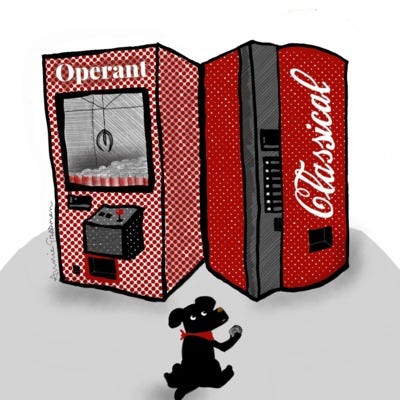
Sep 17, 2018
A better mousetrap: Building the perfect bully stick holder
If you have a dog, you've likely encountered bully stick chews. They're great for keeping dogs occupied, but there is always the risk of swallowing them, especially when they get chewed down to their ends. Several products have recently hit the market, each of which tries to solve this problem in a novel way by sheathing, clamping, or holding the chews in such a way to make it impossible (ideally) for a dog to choke on them. Annie surveys some of these products, and interviews the inventor of the The Everchew, designed by Austin-based inventor Kirby Kendall. Help fund his product on Kickstarter (through 10/3/18) at Everchew.com . Notes: AnnieGrossman.com/podcast25 - What is a bully stick? - Bully stick holders at StoreForTheDogs.com - Music: "Bully of the town" cover by JazzBanjoRex - Sponsor: SANEBOX! Get $15 off at SchoolForTheDogs.com/Sane --- Partial Transcript: **music** Annie: So, you know, you're a pretty big dog loving nerd, if you can get very excited about bully stick holders. And, uh, I'll explain later in this episode exactly what a bully stick is, if you're not familiar with bully sticks, but basically they're a very popular kind of dog too. I recommend them to clients all the time because they're a single ingredient and dogs love them. Lots of great things about bully sticks. But one downside to bully sticks is when they get to their very last inch or so, they kind of look like cigars depending on the size that you get, but when they get down to that little nub, there's always the risk that a dog can swallow it which is never a good thing. So over the last few years, a couple of companies have started offering various kinds of bully stick holders, basically devices that keep your dog from being able to get to that last little bit. And at School for the Dogs, we get really thrilled when we receive one of these things to try because like I said, we recommend bully sticks all the time. So right now a storeforthedogs.com , we sell three and each one kind of has a different approach to solving this problem. Probably our most popular one is called the Animaswizzler . It's this very cool looking kind of like plastic and rubber cage that fits over a bully stick. And we sell a lot of these. I like them, but they're not really great for super heavy chewers because plastic and rubber can be broken and sometimes the dogs do end up breaking them. So I don't recommend them for heavy chewers. Then we have one made by the company West Paw , which is a really great company. It's all rubber and you kind of shoved the bully stick in. It kind of looks like a really big hot dog bun. Um, and that also has its advantages and disadvantages. I think the main disadvantage is most of the bully stick is lodged in the rubber thing, so your dog really can't get to it at all. And then the third one we've be recently started selling is called the Bone Head . And it's kind of like a clamp that literally screws onto a bully stick with a screwdriver... Full Transcript available at SchoolfortheDogs.com/Podcasts/ Get full access to Don't Be a Dick to Your Dog at dogtraining.substack.com/subscribe
Sep 10, 2018
Let’s talk about in-home dog grooming with Ani Corless
Ani Corless is a dog groomer and the owner of the NYC-based business Luxury Groomer. Unlike most groomers, Ani goes into her clients' homes to groom their dogs. Annie and she discuss her path to becoming a groomer, some common mistakes that well-intentioned dog owners make when grooming their own dogs, and the various ways that in-home grooming can benefit dogs, dog owners, and groomers alike. Learn more about Ani at luxurygroomer.com Annie and Ani discuss the annual "Creative Grooming" competition held each year in Hershey, PA. Annie produced a short video about this event for Vice.com in 2011. youtube.com/watch?v=yq2f5ACx2fM Interested in pursuing a grooming career? PetGroomer.com offers both a list of US programs and several informative articles on selecting a school. petgroomer.com/schools/ petgroomer.com/selecting-grooming-school/ Sponsor: Is your Inbox a mess? You need SANEBOX! Get a free trial & $15 off when you sign up at Schoolforthedogs.com/sane --- Partial Transcript: Annie: So today I am interviewing a groomer. Her name is “Annie” like me, although she spells it, uh, Ani where I spell mine, the more, the more normal, boring way. And Ani is an in-home groomer in New York City. She goes to people's houses. I'm really interested in in-home grooming this concept of a groomer who comes to you for a variety of reasons, some of which we will get into in this episode. But the main reason is I think it can really be the most dog-friendly way to have your dog groomed. I think a lot of dogs get stressed out going to the groomer and you don't know exactly what's happening to them at the groomer. And the longer that I do dog training professionally, the more respect I have for groomers who really take the time to be thoughtful about how they're handling dogs during grooming and how the dogs are responding. You know, I used to think about a groomer kind of the same way that I think about like a shoe repair person, like, I just would bring my dog in, kind of like, I bring my messed up shoes in and then they would fix the dog. Like they fixed the shoes and I would pick them up and all would be well and I didn't really need to know about what went on in the interim period. But the fact is that grooming can be really traumatic for a lot of dogs. So I give a lot of credit to groomers who not only put in a lot of time and effort to acclimate dogs to the grooming process, but also who are willing to be transparent about it and if you have a dog groomer coming to your house, whether or not you're actually involved in the grooming process, you can at least be there to make sure that your dog is feeling comfortable. And if your dog isn't comfortable, the good news is grooming is usually not something that has to be rushed. It's something that can be done over a period of times, whether that means a groomer showing things that you can do to help your dog get better or feel better about grooming or having the groomer come again. But, it doesn't have to be a one stop process. And at School for the Dogs, we are encouraging our owners, our dog owners, from the time the dogs are puppies really, it's something that we, we try to drive home in Puppy Kindergarten to think about husbandry as part of training, to think about how you can make your dog feel comfortable around the equipment you're going to need to use with them or other people that are going to need to use with them from a very early point and to get them used to being handled. I think it's a really, really big favor that we can do to our dogs. Full Transcript available at SchoolfortheDogs.com/Podcasts Get full access to Don't Be a Dick to Your Dog at dogtraining.substack.com/subscribe
Sep 4, 2018
Ask Annie: Navigating dog runs and managing elevator manners
In this Q+A episode, Annie discusses how to deal with dogs in elevators, and how to navigate dog parks. She also talks about what to do if your dog gets off leash, and how to help a dog who attacks her brother whenever they pass another dog. Have a question for a future episode? Visit AnnieGrossman.com/ask Show notes - Products: Fleece Activity Mat - Wall-Mounted Slow Feeder - Freedom Harness - Liquid Treat Dispenser - Target Stick - Whistle Recall DVD - Grisha Stewart's BAT guide - Music: "Back To School Again" by JazzBanjoRex - Sponsor: Is your Inbox a mess? You need SANEBOX! Free trial and $15 off at SchoolForTheDogs.com/Sane --- Partial Transcript: **music** Annie: Hey podcast, listeners. Thank you so much for tuning in. This is a Q and A episode. This is my second Q and A episode. It's also our back to school episode, and I don't know about you, but I hated school, pretty much. I pretty much hated school all through all of my formal schooling to be totally honest. And I feel like September always felt like a sad time where there was sort of, dread, which I think, this song conveys. But now as an adult and as the owner of a school, School for the Dogs, I don't feel that way at all. I love the weather and I love that my dog students are all coming back from their vacations and they're psyched to be back. I'm really glad to see their owners. So many of whom have become really good friends. And it feels like it feels like school is, is a good thing and it's revving up. And actually we just signed a lease on a new space for School for the Dogs, our second space, we're going to be operating in both locations for at least a few months, if not longer. The new space is on East Seventh street. We're hoping to it open by next month. So that's another reason that I'm excited about this back to school season. But for me when I was younger, I think the only thing that made going back to school slightly manageable was the back to school shopping. To be honest, I liked getting books and pens and I liked getting a new backpack and I liked that part of it. So I thought in that spirit, I would mention before I start answering some of the great questions that have come in, I thought I would mention a few of the cool new products that we have at storeforthedogs.com and maybe a couple of ones that we've had for awhile. We’re really excited about these new activity mats that have come in, they're made of fleece. They're kind of like snuffle mats , which is something that we've carried for a while. Different kinds of snuffle mats, snuffle mats are basically fabric kind of like rugs that you can hide things in, you can hide dry food or treats and they're like really, really super plushy stringy bathmats. But these new activity mats have even more, sort of like, fabric obstacles on them, where you can hide things, tuck things in flaps and such. Full Transcript available at SchoolfortheDogs.com/Podcasts/ Get full access to Don't Be a Dick to Your Dog at dogtraining.substack.com/subscribe

Aug 27, 2018
Let’s talk about SFTD's origins with co-founder Kate Senisi
In 2011, Annie Grossman and Kate Senisi were both trying to figure out how to make a business out of dog training. They met through the Association for Professional Dog Trainers' message board, and discovered they lived a block away from one another in Manhattan. They also discovered they had complementary talents: Kate had an eye for detail, a background in graphic design, a head for organization, and a passion for dealing with aggressive dogs; Annie had an entrepreneurial spirit, writing skill, and lots of creative ideas. They decided to join forces, and together turned Annie's living room into a dog training classroom--they called it School For The Dogs. Here, Annie and Kate discuss SFTD's early days and their paths to becoming trainers. Notes: AnnieGrossman.com/podcast22 Training videos: Tawzer.com Music: "Sister Kate" cover by Lloyd Davis lloyddavis.bandcamp.com/track/sister-kate Sponsor: Is your Inbox messy? You need SANEBOX! Get $15 off at SchoolForTheDogs.com/Sane Partial Transcript: Annie: This week, School for the Dogs’ podcast is sponsored by Sanebox , the email service that is designed to make dealing with email a breeze. Sanebox gives you a powerful set of tools that can work just about any email client. It’s kinda like artificial intelligence for your inbox. Sanebox will automatically sort your email for you, defer your email for a more convenient time, set up reminders and more. Get a two-week free trial plus $15 off when you sign up at schoolforthedogs.com/sane . **Music** Annie: So I am sitting here with my- what do I even call you… Kate: Partner in Crime? Annie: My partner in crime. My partner, not in sexual way… Kate: yes, I always worry about when I say.. introduce you as my partner. I clarify it with… business partner? Annie: Business Partner. She with whom I founded School for the Dogs. Kate Senisi. The one, the only and Kate has certainly been one of the most important people in my life. Kate: Well Thank you. Annie: in the last decade. Kate: And you in mine. I think we are also friends. … I’m just kidding. Annie: Kate, do you want to be friends? Kate: I don’t know it might interfere with our working relationship. Annie: Laughing Kate: Is it possible? Annie: No, I really feel so lucky that we found each other when we did and I, so, I brought Kate on to talk about how she got into dog training and talk about some of the things that we both love about dog training. I think one thing, among many things, that we both have in common is we both get really excited about geeking out on training and I knew early on that that we were going to be friends for a long time when we were curled up on your couch drinking wine watching, like, Kathy Sdao.. Kate: Oh yeah the Tawzer days.. Annie: recorded videos of DVDs of seminars on Saturday nights together after dog training all weekend or figuring out how to become dog trainers all weekend, we would watch videos about dog training with our dogs. I remember one of those nights thinking like, “This is it. I have found a certain kind of soulmate.” Kate: I found an equal nerd partner. Annie: So Kate and I started working to gather pretty soon after we first met which I believe was in 2011 Kate: I think so. Annie: And at that point we were both. We had studied dog training on our own in different ways, which we will talk about in a minute. I think we were both at the point of trying to figure out how to parlay our interest and knowledge into work... Full transcript at Schoolforthedogs.com/Podcasts Get full access to Don't Be a Dick to Your Dog at dogtraining.substack.com/subscribe

Aug 21, 2018
Being BF Skinner's daughter: Deborah Buzan dispels the myths
Renowned behavioral psychologist BF Skinner codified much of the science behind positive reinforcement-based animal training, and is a hero to many dog trainers. But for over half a century, his reputation has been tarnished by rumors that his daughter went crazy and killed herself because he raised her in a box. Annie interviews said daughter, Deborah Buzan, who is alive and sane. She was in fact raised in a box... sort of. Buzan discussed the "Air Crib," aka the "Baby Box," and growing up with a genius father who was devoted to engineering ways to make life easier and happier for his wife and daughters. Notes - Music: Hello My Baby cover by Melissa Mahony of the Channel Drifters - Blue Danube cover by David Beckingham - BF Skinner Foundation: BFSkinner.org - Sponsor: Is your Inbox a mess? You need SANEBOX! Get a free trial and $15 off SchoolForTheDogs.com/Sane --- Partial Transcript: Today I am speaking to a very famous baby. Of course she is not a baby any more. She is a woman in her seventies. The story of her babyhood has become something of an urban legend. The misunderstandings about her youth I think actually dovetail with a lot of misunderstandings about dog training. Deborah Buzan is an artist who lives in England and we spoke via Skype, and, unfortunately, we didn’t have a great connection. So, this recording isn’t wonderful but I did my best to clean it up. But even if it is not the most easy listening I hope you’ll make it through this episode because we had a really interesting conversation. She is the daughter of B.F. Skinner and if you’ve listened to this podcast before, you’ve probably heard me talk about Skinner. He is one of my heroes and a hero to many good dog trainers out there. Skinner, who sadly passed away in the early 1990s, is considered to be one of the founders of the science of behavior.He codified a lot of what we know about the science and philosophy of behaviorism. If you’re not familiar with Skinner, I suggest going out and getting all of his books, or at least one of them. About Behaviorism a good one to start with, or Beyond Freedom and Dignity. He also wrote a novel called Walden Two which is kind of about how you could create a utopia creating positive reinforcement. Anyway, I thought the best way to introduce Deborah would be with this clip of her father discussing some of the misunderstandings about how she was raised. “I’d like to correct some rumors that go around. I am sure that some of you have heard them. A distinguished psychiatrist whose name you all know, I won’t mention it, told a distinguished person whose name you also would know, that the child that we raised in the so called box, the air crib, became psychotic. I wrote to him that we’ve heard this before and I’ve often heard this, would you mind telling me where you heard this rumor? Our daughter is very intelligent and talented, married, her husband teaches international studies at the Univ. Of Warwick, they live in London. My daughter is an artist, she does large color etching and sells all she can produce and so on. I don’t see any ill effects of the air crib on her. Well, he sent me a very apologetic letter, I must say that. But he didn’t tell me where he heard it." Full Transcript available at SchoolfortheDogs.com/Podcasts Get full access to Don't Be a Dick to Your Dog at dogtraining.substack.com/subscribe
Aug 13, 2018
Wonderful "Work To Eat" toys: Feeding Dogs In Slow Food Bowls
Every time you feed a dog, you have the opportunity to channel some of her energy into an appropriate activity, to tire her out, and to give her a sense of purpose. "Work To Eat" toys provide dogs with jobs, and dogs like to be employed! If we don't give them jobs, they too often make up their own jobs, alerting you to every sound in the hallway, or redesigning the couch cushions with their mouths. There are lots of kinds of "Work To Eat" toys. In this episode, Annie talks about one type: Slow Food Bowls. These kinds of toys can be used with any kind of food or treat (wet, dry, raw or frozen), and are no harder to use than a regular bowl. Slow Food Bowls: StoreForTheDogs.com/collections/dog-bowls-and-treat-dispensers Types of "Work To Eat" Toys: SchoolForTheDogs.com/WorkToEat "Ain't We Got Fun" ukulele cover by Jazzbanjo Rex: y outube.com/Jazzbanjorex/ Find Annie at AnnieGrossman.com --- Partial Transcript: Annie: Hi, my name is Annie Grossman and I'm a dog trainer. This podcast is brought to you by School for the Dogs, a Manhattan based facility I own and operate along with some of the city's finest dog trainers. During this podcast, we'll be answering your questions, geeking out on animal behavior, discussing pet trends, and interviewing industry experts. Welcome to School for the Dogs podcast. **music** Annie: Hey everyone. So Anchor, which is the wonderful company that hosts this podcast has just launched a really cool new feature. And they've asked us to be one of the first podcasts to try it out. It's called listener support. Today is the very first day they're making this available. And basically it's kind of like a tip jar. So if you enjoy this podcast and you want to support it in some small way, let me know that you're listening and you're into it. You can sign up to give a monthly amount, either 99 cents, $4.99 or $9.99. And that recurring contribution will go straight back to helping produce this podcast. All you need to do is go to any browser, type in anchor.fm/dogs , and then just go ahead and click that listener support button as a special thank you. During this launch of this new feature, the first five supporting listeners will receive a School for the Dogs bandana. So go ahead and check it out and thanks to the folks at Anchor for inviting me to be a part of this launch. **music** Annie: So today we're going to talk about work-to-eat toys, specifically, slow food bowls. And let me tell you, I have exerted a lot of brain power and a lot of time trying to figure out how to approach the topic of work to eat toys, because there's so many great work to eat toys, but they're like different kinds of work to eat toys. So my conundrum has been well, do I just try and cover all of my favorite work to eat toys in one episode, or do I talk about just a specific variety of work to eat toy, or do I mentioned a single work to eat toy in every episode, and, I'm not sure what the right answer is, but what I've decided to do is to start out talking just about slow food bowls. And I hope that I will have an episode soon where I'll cover some other kinds of work to eat twice. I'm not sure how I'll do that yet, but the reason I want to start with slow food bowls is because I think they're kind of like a gateway work-to-eat toy. They're really easy to use. But anyway, let's back up for a second. Full Transcript available at Schoolforthedogs.com/Podcasts Get full access to Don't Be a Dick to Your Dog at dogtraining.substack.com/subscribe
Aug 6, 2018
How to train a dog to "sit" from scratch
Newsflash: Your dog already knows how to sit! But he may not know the cue you want to associate with that behavior. Annie breaks down how to use the "capturing" technique to teach "sit" anew and to add a novel cue. She covers: -The downsides of "luring" a behavior or "molding" it -The trap of trying to teach a behavior by asking for it repeatedly -The difference between a "cue" and a "command" -How to add a cue -The never-ending process of "shaping" a behavior -How to fade a lure and turn it into a cue Show notes - Get a clicker - Sponsor: Is your Inbox a mess? Train it with SANEBOX! Get a 2 week trial & $15 off when you sign up at SchoolForTheDogs.com/Sane - More On Pooper Scooper Law - Featured Dog: Instagram.com/LeoTolstoyFrank Want to support this podcast? We now accept "Listener Support" at Anchor.FM/Dogs . Chip in $.99, $4.99 or $9.99/month. Thanks! --- Partial Transcript: Annie: Hey everyone. I am so glad you are here. Today we are going to talk about how to teach a dog to sit and whether or not your dog already knows how to sit. We're going to start from scratch. You can always start from scratch. And of course if your dog does already know how to sit he or she might not know, however, the word or whatever cue you have attached to that behavior. So rather than use the word “sit,” which I think if you've tried to teach your dog to sit before, if you have taught your dog to sit before, that's probably the cue you've used, we are going to use a new cue, just for the sake of showing how to teach something totally from scratch. The cue we're going to use is either going to be a finger snap or a hand clap. I usually do two. But before I get into the details of how to teach this behavior, I want to talk about some of the common ways sit is taught and I'll talk about some of the pros and cons of using these methods. And then we will go over how we teach it at School for the Dogs. Now, I think probably the most traditional way of teaching “sit” is basically just to say the word sit until your dog sits and then praise your dog, kind of like the word “sit” is eliciting the “sit” from the dog. I've heard this called the midwife approach as you are pulling the sit out of the dog. And in reality, two things tend to happen. One, usually people start saying it and then they repeat it and then they do kind of like something with their body to kind of try and help the dog, whether it's leaning or holding their hand over the dog's head, or even pushing the dog's butt down, which I'll talk a little bit more about in a minute. Or they just keep repeating it until the dog sort of gets frustrated and tries to do something. And when you think about it as kind of actually teaching, using negative reinforcement, the behavior that you want to happen, “sit,” is encouraged because it makes the annoying person who keeps saying “sit, sit, sit,” it makes them stop. Again, negative reinforcement is just another way of encouraging a behavior, but it's encouraging a behavior by making the behavior be the off switch that makes the annoying thing go away, as opposed to positive reinforcement, which is a behavior is encouraged because it produces something good. Now, if these methods of teaching “sit” have persisted for generations and generations, I think it's just because dogs are so forgiving and tend to pick things up pretty quickly. Full Transcript available at SchoolfortheDogs.com/Podcasts/ Get full access to Don't Be a Dick to Your Dog at dogtraining.substack.com/subscribe

Jul 30, 2018
The Dog Training Triad Part 3: Timing
So, you have a carefully engineered environment (see: The Dog Training Triad Part 1) where your dog is likely to do lots of things you want him to to do, and you have also selected really appropriate rewards (see: The Dog Training Triad Part 2). Now what? you need to make sure your rewards are being given with really excellent TIMING! Dogs are doing things constantly, and concurrently. Behaviors are overlapping at every moment, and a dog may sometimes think a reward is for something other than what you thought it was for. In this episode, Annie explains how to deliver rewards with A+ timing by using a "marker" signal. Read more about this on our blog: schoolforthedogs.com/tmng Parts 1 & 2 of The Dog Training Triad series: SchoolForTheDogs.com/mgmt SchoolForTheDogs.com/rewards Show notes: AnnieGrossman.com/podcast18 Music by: TheEnergyCommission.com Sponsor: Take control of your email! Get a 14-day free SANEBOX trial & a $15 coupon. Sign up at SchoolForTheDogs.com/Sane --- Partial Transcript: **music** Annie: Hello, humans, Annie here. I have got to tell you that I am pretty excited because this episode is the third in the three part series about the dog training triad, as I call it. I think of the triad as basically like a universal recipe that you can train any animal to do almost anything that you want, that of course they are physically capable of doing. And this recipe is not species specific. I really believe it can work on all animals. Of course it is individualized from one individual to another. And I can't tell you the specific ingredients you're going to need to train your individual student, but it's kind of like baking bread. There's like a basic recipe for making bread, and then you can riff on it from there. So if you can really grasp this training triad, I think you're about half way to figuring out how to train whatever it is you want to train. I say about half, because I do think there are three other really important factors to dog training. I think you have to understand operant conditioning. I think you have to understand classical conditioning. And I think you have to develop the ability to read some basic dog body language. And those are basically the big pillars. So we have the training triad and then we have operant conditioning, aka learning by consequence. Classical conditioning aka Pavlovian conditioning or learning by association and then dog body language. And we've talked about those latter three things in some previous episodes. And I will go into more detail about all those three things in future episodes, don't you worry. But if you've listened to the first two parts of this series, and now you're onto this third and final one about the dog training triad, give yourself a pat on the back or pat on the head or wherever you like to be pat, because you are well on your way to becoming an excellent dog trainer. So first part of the dog training triad, which we spoke about is management-setting the stage for your dog to succeed. Management I think of as everything that we can basically do from the outside in, in order to control behaviors and to make sure that we're going to get lots of behaviors we want and reduce the likelihood that we're going to get behaviors that we don't want from the get go. Full Transcript available at SchoolfortheDogs.com/Podcasts/ Get full access to Don't Be a Dick to Your Dog at dogtraining.substack.com/subscribe
Jul 23, 2018
The Dog Training Triad Part 2: Rewards
Once you've set the stage to up the chances that you'll get lots of behaviors you want (see The Dog Training Triad Part 1), you'll need to figure out how to reinforce those behaviors. In this episode, Annie discusses: -The difference between reinforcers and rewards -Discerning whether something is a reinforcer -Figuring out your dog's individual reward cornucopia -Understanding rewards as currency -The changing value and appropriateness of rewards -"Real life" rewards -The importance of treat size when using food Read more about this on our blog: schoolforthedogs.com/rwrds Products mentioned: Lamb Lung - Liquid Treat Dispenser - Kalles - Tricky Trainers "Big Rock Candy Mountain" cover by Nicole Toombs Learn more about... Leslie Hawke's Romanian initiatives: AlexFund.org Photographer Milla Chappell: RealHappyDogs.com Pike13: SchoolForTheDogs.com/Pike Partial Transcript: Annie: Hi, there. This is the second episode in a three-part series on the training triad. The training triad is made up of three things: management, reward and timing. And, in my opinion, these are the three big things that you need to consider when you're creating any kind of positive reinforcement based training plan. So in the last episode, we talked about management and management is just setting the stage for your learner to succeed, really creating a path where you are definitely going to get lots of behaviors you like, I like to call it the yellow brick road. So it’s a path that has boundaries which make it impossible to get a lot of behaviors that you wouldn't want. But within those boundaries your dog is going to have a lot of opportunity to do all the things we want him or her to do. And we talked about different ways you can think about management: you're going to physically manage their space, manage their time and you're going to manage their energy. So definitely go back and listen to that episode. But now we are going to be moving onto the next step. So you have this well thought out path where your dog is going to be engaging in lots of appropriate behaviors, things you want him/her to do. Now what? We need to communicate to the dog that we like all these behaviors that are going on. We need to encourage these behaviors and how are we going to do that? Well, we're going to reward them. I’m using the word reward here, rather than reinforcer, but truth is to use these words pretty interchangeably, I find most dog trainers do which is really fine but I just wanted to explain the difference even though, like I said, we often just use one word instead of the other. But the truth is that not all rewards are reinforcers and not all reinforcers are rewards. Technically speaking, reinforcer is anything that encourages the likelihood that a behavior is going to happen again and usually those are rewards. Right? Anything that your dog likes is gonna be reward. And if your dog engages in a behavior you like and you reward appropriately that behavior should be reinforced. The thing is there's another kind of reinforcer which is called a negative reinforcer so the reinforcement that we usually think of we think of that reward is now good stuff right: money, love, affection and attention, but a reinforcer is anything that encourages a behavior, that’s the definition of what a reinforcer is.. Full Transcript available at Schoolforthedogs.com/Podcasts Get full access to Don't Be a Dick to Your Dog at dogtraining.substack.com/subscribe
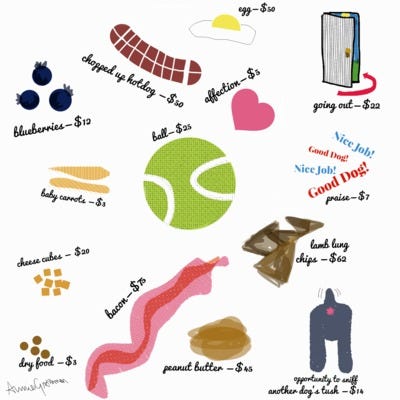
Jul 16, 2018
The Dog Training Triad Part 1: Management
There are three major ingredients required in any positive reinforcement-based dog training plan. They are: Management, Timing, and Rewards. This episode is about Management, and is the first of a three part series on the Triad. Simply put, management is all about making the right options the easy options for your learner in order to up the chances of getting the behaviors you want. In this episode, Annie looks at the many ways in which we can set up our dog students for success by controlling their physical space, and the ways in which we can also smartly manage their time and energy. Notes: The Dog Training Triad Part 1: Management - Work-To-Eat Toys post - Shop Work-To-Eat Toys - Crate training - The Klimb Platform - 8 Things You Didn't Know About The Kong --- Partial Transcript: Annie: Hey there everyone. So today I am going to talk about management and this is going to be the first part of a three part series on what I call the training triad. And this triad as its name would suggest is made up of three things. Management being the first, the other two are timing and rewards. And I think that with any kind of training that you're doing, management, timing and rewards are the three things that you need to consider in order to basically get whatever it is you want out of your dog in whatever the training situation is. So when we're thinking about management, in terms of dog training, we're really thinking about the stage that we're setting. We're thinking about all the parameters within which our dog is going to exist and thrive and have a great likelihood of doing the things that we want him or her to do, and not have a lot of opportunities to do the things we don't want him or her to do. The three most important things that we're managing when we're training dogs is their space, their time and their energy. And while these are really three things, I kind of lump them together into two: with space being one and time and energy being the other. So let's talk about space first. Now there are certainly a lot of things that you're probably already doing without even thinking about it, to manage your dog's space. You might be managing your dog's environment by using a crate or using a penned area. Even a leash is a management tool, right? Could you teach your dog to walk nicely next to you and never run in the street? Absolutely. Full Transcript available at SchoolfortheDogs.com/Podcasts/ Get full access to Don't Be a Dick to Your Dog at dogtraining.substack.com/subscribe
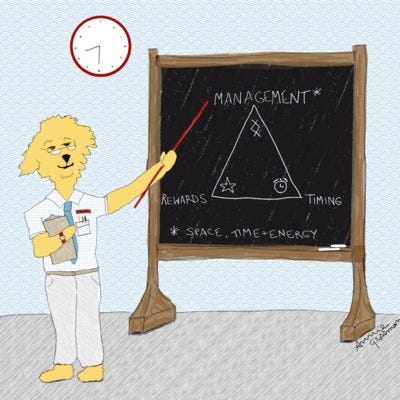
Jul 9, 2018
Let's talk about dog walking with DivaDog's Shelley Goldberg
In New York City, a good dog walker can be hard to find. Dog owners open up their homes to them, and put their most beloved and vulnerable family members in their care, but a majority of walkers have no training or even interest in their chosen career. DivaDog is a walking company that strives to bring professionalism to the industry. Annie interviews its owner, Shelley Goldberg, about her three decades in the business, her hiring and management practices, and finding meaning and soulfulness in the pet care industry. You can reach Shelley at 707-DIVA-DOG Show Notes - 11 questions to ask a potential dog walker - Music: Rockin' Robin cover by Danielle Anderson - School For The Dogs - Store For The Dogs - Instagram - Facebook --- Partial Transcript: Annie: Hi, my name is Annie Grossman and I'm a dog trainer. This podcast is brought to you by School for the Dogs, a Manhattan based facility I own and operate along with some of the city's finest dog trainers. During this podcast, we'll be answering your questions, geeking out on animal behavior, discussing pet trends, and interviewing industry experts. Welcome to School for the Dogs podcast. **music** Annie: So at School for the Dogs, we often get asked to recommend a variety of different dog service providers in New York City. And a lot of clients ask us to recommend dog walkers. Now this can be tricky because dog walking is a field where there's so much turnover, that it can be really hard for us to recommend anywhere because we're never sure that the walkers that we like are still going to be with the place. And as trainers we’re really well aware of all the things that can go wrong with a not good dog walker. You don't even have to have a dog who has a lot of issues to have a dog that can be really adversely affected by even one bad walk with a walker. And that might not be a walker who's necessarily nefarious or anything. It might just be one who's not that experienced. And, it's a job where most people do it as their careers. Most people kind of dip in and out of dog-walking. So over the years we have created a very small list of walkers that we tend to recommend. And today I'm speaking with the owner of one of the companies that we recommend, the company is called DivaDog. It's owned by Shelley Goldberg, who's based in the East Village. And some of the reasons why we recommend DivaDog, first of all, Shelley is a career dog walker. She doesn't walk dogs herself anymore. She runs the business, but she has been doing walking since 1990. And she's going to talk about that a little bit. Other things that set her apart, she is a lot more expensive than all the other walking companies that we recommend. And I don't know what she pays her walkers, but I'm guessing she pays them enough to make them stick around for a while, which I think again is important because a lot of the times dogs, especially really sensitive dogs, don't react well to having a new walker every three to six months. And it seems like she has some really good retention with her walkers and really devote some time to training her walkers. Something else that I appreciate about Shelley's business is the simplicity of it. Her walkers are not GPS tracked. She does everything on paper. She prefers to be contacted by phone then via email or in any other kind of way... Full Transcript available at SchoolforthDogs.com/Podcasts/ Get full access to Don't Be a Dick to Your Dog at dogtraining.substack.com/subscribe
Jul 3, 2018
Let's talk about dog photography with Milla Chappell
This episode is all about Real Happy Dogs, the NYC-based photography business started by Milla Chappell, who is known for her photojournalistic approach to capturing the lives of dogs and their humans in situ. Milla tells Annie about growing up as the daughter (and granddaughter) of veterinarians, and how she went from getting graduate degrees in linguistics and English to becoming a wedding photographer, before eventually finding a way to marry her passion for animals, her interest in writing, and her photography talents. Milla shares some tips for getting great photos of dogs, and tells the stories of some of the rescues she's shot and profiled on her popular Instagram. Show notes - Milla shares photo tips - Real Happy Dogs website - Real Happy Dogs on Instagram - School For The Dogs on Instagram Please make sure to rate 5-stars on iTunes! --- Partial Transcript: Annie: Hi, my name is Annie Grossman and I'm a dog trainer. This podcast is brought to you by School for the Dogs, a Manhattan based facility I own and operate along with some of the city's finest dog trainers. During this podcast, we'll be answering your questions, geeking out on animal behavior, discussing pet trends, and interviewing industry experts. Welcome to School for the Dogs podcast. **music** Annie: Hey everyone. Thanks for tuning in. I am here with my friend Milla Chappell, who is an incredible dog photographer. And if you follow us on Instagram, this whole month we will be featuring Milla's photos. So be sure to go to @schoolforthedogs on Instagram to check out some of her photos of our trainers at work, some of our students in our classes and in their homes. It's really awesome. We're really excited about it. Milla, thank you for agreeing to talk to me. Milla: Thank you. Annie: So I first met Milla because she was taking photos of some of School for the Dogs’ clients and I was seeing them on Instagram and I was like, who is this photographer that's doing such an amazing job? Not only of getting great pictures of the dogs and having, you know, technically beautiful photos, but also I felt like they were photos where I could see the personality of the dog coming through in a really special way. I remember in particular, Bane the bulldog. Milla: Yes, of course! Annie: People might be surprised that your background is actually more in the veterinary field than in the photography field at least as your family goes. So is that right? Milla: Yes, exactly. So I grew up in a home with two veterinarian parents. Actually, my grandfather was a veterinarian and then both of my parents are veterinarians. So that has been our world from as young as I can remember. That's, you know, the world. Annie: Did you just think everyone is a veterinarian? Millie: [laughs] Well, I do remember on, you know, when you bring your parents to work, I mean bring your parents to school and the parents talk about what they do. I always felt like my parents have coolest job. They would bring in, you know, dogs and cats and I always felt really proud. I loved growing up in, you know, in a veterinary home and in a home that loved animals. And it was great fun for a kid. Annie: What kind of pets did you have when you were growing up then? Full Transcript available at SchoolfortheDogs.com/Podcasts Get full access to Don't Be a Dick to Your Dog at dogtraining.substack.com/subscribe
Jun 25, 2018
Ask Annie: Curtailing jumping and helping scaredy dogs
Annie answers questions from listeners dealing with jumpy dogs, and also addresses how to acclimate a nervous dog to all the stimuli she needs to interact with on a daily basis. Have a training question? Leave a voice message at Anchor.fm or at 917-414-2625, or email podcast@schoolforthedogs.com . You'll learn: -Why dogs want to jump & why most attempts to punish jumping don't work -How to use treats effectively on the street -How to have people approach your dog on the street (& how to tell them to go away) -How to employ a remote-controlled treat dispenser to help your dog rehearse good dog manners whenever anyone enters your home Show notes - How to stop a dog from jumping before he starts - "Give Me Space" vests - Treat + Train - Resources for people w/ dogs who have issues with fearfulness in public: DogsInNeedOfSpace.com TheYellowDogProject.com --- Partial Transcript: Annie: Hi, my name is Annie Grossman and I'm a dog trainer. This podcast is brought to you by School for the Dogs, a Manhattan based facility I own and operate along with some of the city's finest dog trainers. During this podcast, we'll be answering your questions, geeking out on animal behavior, discussing pet trends, and interviewing industry experts. Welcome to School for the Dogs podcast. Hey everyone. So I am super excited because this is our very first School for the Dogs Podcast: Q&A episode. And I've collected some great questions here that I am going to answer. If you have a question that you would like answered on school for the dogs podcast, there are lots of ways that you can get in touch with us. If you're listening to this through anchor, which is our podcast hosting company, it's super easy through their app. To ask us a question, just click the, “send a voice message” button next to our icon. You will see it as soon as you log in. You can also send an email to podcast@schoolforthedogs.com or you can call and leave a voice message. (917) 414-2625. Alternatively, you can send a text message to that number. Our first question today comes from an anchor listener. Corey: Hi Annie, my name's Corey. I'm just new to your podcast and I'm also an owner of a newish Labrador puppy. She's actually 11 months old, but, um, my question is the jumping. My dog is extremely excited, very friendly, very happy. We've been through two basic trainings. No one's really been able to help me in the area of jumping. She's a jumper. She's a big girl, she's 75 pounds. And when people come in the house or we're outside a neighbor comes up to her, she just jumps in, of course I say down, of course we do the whole thing with the tree, but it just seems like we just cannot get over this hurdle of her jumping up. And of course it's not good because she could hurt somebody inadvertently. So any tips would be great. Thanks so much. Love the show. Annie: I'm so glad Corey asked this question because it's certainly a problem that a lot of dog owners deal with, especially people who have young dogs and large dogs. Jumping up is a totally normal puppy behavior. Really it's a normal behavior for any dog... Full Transcript available at SchoolfortheDogs.com/Podcasts/ Get full access to Don't Be a Dick to Your Dog at dogtraining.substack.com/subscribe
Jun 18, 2018
What you need to know about the dog flu
In NYC in the last month there have been nearly 100 dogs diagnosed with the dog flu. To learn more, I interviewed Dr. Andrea Y. Tu of Park East Animal Hospital and Veterinary Behavior Consultations of NYC. H3N2 is believed to have originated in birds and was first detected in dogs in South Korea in 2007. It was identified in March 2015 in the Chicago area; it most likely spread from dogs rescued from South Korea and brought to the US for adoption. In this episode, Dr. Tu addresses the following concerns, among others: -How the flu spreads -How you can keep your dog safe -What to do if your dog is infected -What to do if you run a facility that is frequented by dogs Show notes: AnnieGrossman.com/podcast12 A primer on the dog flu outbreak in NYC: schoolforthedogs.com/flu Transcript: Speaker 2 ( 00:36 ): Hello humans for this episode. I have interviewed Dr. Andrea Tu, a veterinarian who is with Park East Animal hospital, which is on the upper East side in Manhattan and she also works as a vet with Veterinary Behavior Consultants, which actually sees patients at School For The Dogs. I asked her every question I could think of about the dog flu, which has been a big topic of concern in New York city over the last month or so. I wanted to apologize for the quality of this interview. I spoke to Dr. Tu over the phone and it's not the greatest, but the information is pretty good. So I wanted to share this recording our phone call despite the not great audio quality. I just wanted to note that I've also put up a blog post that has some pretty comprehensive information about the flu and some useful links. You'll find it in the show notes, but you can go there directly by just typing in the URL schoolforthedogs.com . Dr. Tu ( 02:04 ): There really are kind of two big strains. So, um, the previous strain was one called the H3NH strain that's been around since about 2004 and it's found primarily in dog and we believe that jumped over to dogs from horses. Um, and that one, it wasn't as big of a deal because it's not as aggressive. It's not as infectious. The current strain now is the H3N2 strain. And this was a newer strain that was initially found back in 2015 and we believe it jumped from dogs to dog, sorry, from, um, birds from Korea. Um, and basically we rescued all these dogs from Asia and from, from, from folks from Korea. Yeah. So the, the current strain is the H3N2 that we're concerned about. It was initially found in 2015. It came from birds and then went to the dogs. ( 03:03 ): We believe it started in Korea. So when we adopted and rescue dogs, all these dogs from Asia traveled with those dogs over to us. And so the 2015 outbreak initially was found in Chicago. We didn't actually know that the strain existed at that time. Um, and that outbreak lasted for quite awhile. So the current outbreak in New York that we're dealing with now, we believe came from San Diego and it is, um, it's not the original strain that caused the outbreak in 2015 in Chicago that came from Chicago to New York. But this one may be the same strain, but it came from potentially a different dog that brought it to San Diego back in around January of this year. Full transcript available at AnnieGrossman.com/podcast12 Get full access to Don't Be a Dick to Your Dog at dogtraining.substack.com/subscribe

Jun 11, 2018
Let's talk about dog parties with Hayley Mehalco
Not long after throwing her own English Bulldog a princess-themed birthday party, Hayley Mehalco decided to leave her job as an event planner at one of New York's poshest hotels in order to become a full-time party planner for the canine set. In this episode, Annie learns about the ins and outs of Puppy Parties NYC, a business that caters to "dog Instagram socialites," and talks about her own former tendency to roll her eyes at such things. Annie also asks some larger questions about modern pet ownership: Is it okay for people to treat their dogs as ersatz children? Who is the real beneficiary of things like parties for dogs? Link to Show notes - Puppy Parties NYC - Puppy Parties NYC on Instagram - School For The Dogs on Instagram Please make sure to subscribe & rate 5-stars on iTunes! Annie Grossman owns School For The Dogs in Manhattan. Learn more at SchoolForTheDogs.com . --- Partial Transcript: Annie: So in the pet realm, there is this whole category of services that I think tends to make a lot of people roll their eyes. And when I was working as a journalist and releases for these kinds of services would come across my desk, I could always kind of tell when my editor would be interested and a story about one of these things, because it was kind of like there was always room to make fun of things people do for their dogs. And if you keep an eye out for this kind of story about these kinds of services, they almost always have the same lead. It's usually something like “Last Friday afternoon, Bethany got her nails done and then had a ballet lesson and saw her Latin tutor. Bethany is a French Bulldog..” And there's always this kind of sense to it of like, Oh, we got you, right. You thought we were going to say Bethany was a sophomore at ....Although I always find these leads sort of annoyingly dishonest because usually from the title of the article or the picture, you can tell they're going to be talking about a dog. So anyway, I am sure I wrote some stories like this, and I think I rolled my eyes just as I assumed my editor would and the reader would. Because I think there is this general underlying assumption, somehow that people who spend money extravagantly on their pets are just ridiculous. And I'm saying all this because my point of view has really changed. Now, I know it's possible. You might be listening to this and you might be thinking well, of course her point of view has changed, she runs a place called School for the Dogs where people spend money needlessly on their dogs, lots of the time. But I think it's actually more than that. You know, eight or nine years ago when I first kind of discovered the world of dog training and realized that it was something that really spoke to me, I started to think how weird it is that there aren't sections in the newspaper devoted to animals in any kind of serious way. I started to see that dogs could be a hobby that was no better or worse than any other hobby, but that pet ownership really isn't recognized in that way in our society, right? Look at the sections in newspapers, there's a section on sports, there's a section on cooking, there's a section on homes, cars, but if there's any kind of pet section, it has generally been more about showing pictures of cute adoptable animals rather than offering really interesting content on what it means to own a cat or a dog or any other kind of pet and with content that could actually appeal to someone's interest in animal behavior and that kind of thing... Full Transcript available at SchoolfortheDogs.com/Podcasts Get full access to Don't Be a Dick to Your Dog at dogtraining.substack.com/subscribe
Jun 4, 2018
A modern dog owner's guide to nipping
Nipping is something that tends to drive new puppy owners batty. A lot of the advice you'll find on the Internet suggests scolding a pup for nipping; usually people are told they should use a high pitched voice (as if to emulate another puppy) or to berate the dog in the deepest voice possible. There are still lots of professionals out there who will advise that conversing with a puppy will curb the problem, if done in the right tone of voice. In this podcast episode, I suggest thinking about puppy nipping less as a problem and more as a natural thing puppies do as they start to learn about the world. Both you and your puppy will benefit if he has lots of daily opportunities to use his mouth appropriately. Link to Show notes - 7 ways to deal with nipping - On bully sticks - Work to eat toys --- Partial Transcript: Annie: Hey, so if you've been enjoying this podcast, I just wanted to say thanks a lot for listening. We really appreciate when people leave reviews, make sure to give it a five star rating on iTunes. But also, you know, take a screenshot and put it in your Instagram stories so that your friends can know what you're listening to and maybe you'll turn them on to some new ideas about how to deal with dogs. We also are trying to do more Q and A's, so if you have any questions about anything relating to dog training, please share them with us. You can send us a direct message on Instagram at Schoolforthedogs . We also have a Facebook group, which is facebook.com/groups/schoolforthedogs . And of course you can email us podcast@schoolforthedogs.com . **music** Annie: So my job involves hanging out with a lot of puppies, which I gotta say is pretty awesome, but one downside of hanging with puppies is nipping. Nipping is a totally normal thing that puppies do. But if you follow my advice here, I think you're going to get a puppy that is a lot less nippy than your average dog. And I also always like to point out to puppy owners who are frustrated with their dog nipping that things do get better on their own. I think even without a lot of concerted training, most puppies tend to figure out how to use their mouths appropriately on their own, so that's good news. That's not to say that there aren't adult dogs who do not use their mouth well, but I would say the majority of them of adult dogs, I know, especially, those who have gone through any kind of puppy classes tend to figure out what is and isn't okay as far as where they should be chomping down those teeth. And a big part of that, part of the reason why I say a lot of the puppies I think who go through any kind of puppy play or puppy kindergarten program, the way they figured this out on their own is through each other. I'll talk a little bit more about that in a moment. If you have a nippy dog, I think the first thing you need to think about is where you're putting your hands. Our hands move around. They have lots of smells on them and they are often in and around a puppy's face. I can't tell you how many times I've been sitting with a client who's complaining about how their puppy keeps chewing on their fingers and I looked down and the person's hands are in the dog's face. Well, if your hands are... if you're choosing to put your hands in your dog's face, then you have to expect you might be nipped on a little bit. Full Transcript available at SchoolfortheDogs.com/Podcasts Get full access to Don't Be a Dick to Your Dog at dogtraining.substack.com/subscribe
May 28, 2018
Our student Basket: Helping geneticists improve pedigrees
School For The Dogs' clients Samantha Schwartz and Ben Ment wanted to find a mixed-breed Bernese Mountain Dog puppy, figuring that it'd be less prone to health issues than a purebred Bernese. When Samantha's email inquiries to breeders got posted to social media, she ended up being cyber bullied by hardcore breed enthusiasts/purists around the world. Samantha tells Annie about how this unexpected and bizarre turn of events led her and Ben to Basket, a puppy from the Bernese Mountain Dog Vitality Project, which is run by breeders and geneticists who are working to help modify the breed for the better over time. Link to Show Notes - Bernese Mountain Dog Vitality Project - Basket's Instagram Please make sure to subscribe & rate 5-stars on iTunes! Annie Grossman owns and operates School For The Dogs in NYC. Studio: SchoolForThedogs.com Shop: StoreForTheDogs.com Instagram: Instagram.com/schoolforthedogs --- Partial Transcript: Annie: I'm here with our clients. I should say clients, plural. I am here with our human client, Samantha Schwartz, and her dog are the canine client of this team. Oh, who's giving her a big hug right now. Who’s name is Basket and he is this huge, deliciously, lovely black and furry. Just big galoot of a dog who I wish I had a life-sized stuffed animal of that I could just snuggle and cuddle all day long. He looks like a Bernese Mountain Dog. He is not totally a Burmese mountain dog, which we're going to talk about in a moment. And when I first met Samantha and her partner, Ben, they started to tell me about how Basket came into their lives. And I was fascinated. **music** Samantha: I had always wanted a Bernese Mountain dog. I had grown up with labs and retrievers and Ben grew up with a Norwegian Elkhound and a Chinook. We were kind of like, I was just dead set on having a Bernese Mountain Dog. We were living out in Cape Cod, getting his family's house together last spring, just temporarily. And we were like, well, let's get the dog ‘ause it'll be easy to train the dog while we're out here. We have some time. So last year, we started more seriously looking at Berneses again, and he thought that it would be better if we maybe looked at getting a mixed breed. We were looking at all the rescues, there’s a lot of Bernese rescue organizations. And then we were, we were looking at just different options. And finally we ended up saying, why don't we see about getting a mixed breed, something that is part Bernese. Annie: You were said you were worried about the health issues. Samantha: So Bernese Mountain Dogs have, being one of the giant... they're one of the giant breed dogs, um, similar to great Danes and Saint Bernard's. So they can be up to 150 pounds, females on average weigh between I think 90 and 110, and then the males can weigh much more than that. Because they're a giant breed they have some joint issues and things like that because of their bones, but they also have a particular type of cancer that is really, really prevalent in their breed. They are dying really young. They're very... purebred dogs in general are very inbred. They have what's called closed studbooks and the close studbooks mean that they kind of all ended up being cousins with each other. And because of that, their genetic diversity is leading to many health problems... Full Transcript available at SchoolfortheDogs.com/Podcasts Get full access to Don't Be a Dick to Your Dog at dogtraining.substack.com/subscribe
May 21, 2018
Let's talk about Pavlov with dog trainer Anamarie Johnson
Anamarie Johnson has been with School For The Dogs for three years, and, in that time, has won us all over with her pep, humor, and training chops. In this episode, we discuss her background in rescue work, her childhood pets (fruit flies and incestuous cats), the wonders of classical conditioning and why squirrels at her college were painted orange and green. Show notes: AnnieGrossman.com/podcast8 Please make sure to subscribe & rate 5-stars on iTunes! Annie Grossman owns and operates School For The Dogs in NYC. Studio: SchoolForThedogs.com Shop: StoreForTheDogs.com Facebook: Facebook.com/groups/schoolforthedogs Instagram: Instagram.com/schoolforthedogs --- Partial Transcript: Annie: So I am here with a woman who I have known for three years. I met her in July, 2015. I could almost tell you the date that's, that's how important this day was to me. And um, and to everyone at School for the Dogs, her name is Anamarie Johnson. She is our general manager and has been training with us for almost three years. And is just the smiliest, sweetest person. All the dogs love her. I think the people love her too. But Anna Marie, tell us a little bit about how you came to be the ray of sunshine you are at school for the dogs. Anamarie: Oh I don't know how I became the ray of sunshine! Annie: You were born in a small town in California. Anamarie: San Francisco, [laughing] not so much small. Yeah. Annie: I picture you raised in the woods by like fairies and bunnies. No? Anamarie: No. [laughing] Anamarie: I was raised in Daly city, but, uh, basically grew up in San Francisco and there were no fairies and bunnies in my backyard. The fact that we got a squirrel that came to my house in high school was like the biggest moment of my mom's life. It's a running joke actually that, my friend was at my house and my mom just started screaming for everyone in the whole house to come look out the back window because the squirrel had arrived in the back, Annie: The squirrel had arrived? Anamarie: We didn’t get squirrels in Daly City. Annie: What color squirrel was it? Anamarie: Brown squirrel. Annie: Brown? Have you seen black squirrels? Is that like a New York thing? The black squirrel? Anamarie: We don't have, I mean, we didn't have black squirrels in California. It was just the brown boring, you know, whatever. Gray squirrels. And then where I went to college at UC Davis, I mean we're overrun with squirrels. That was actually a funny thing. Like one day on campus, all of a sudden all the squirrels were, some of the squirrels were spray painted and it was actually a big issue. Cause Davis has like a really big animal department and everything like that. They had actually um, taken and they were spray painting squirrels because they were giving-- Annie: Who's they? Anamarie: Like one of the departments, one of the like the animal research departments because they wanted to test a prophylactic on the squirrels. So they were giving some of the male squirrels and drugs to make them uh, not reproduce because the squirrel population was crazy. So they wanted to have like a noninvasive way. Annie: So what color were they spray painting them? Anamarie: They were like green and orange. [laughing] Anamarie: And then there was all these like poor undergrads on campus that were sitting on little corners and they were recording cause they wanted to see preemptively if this, whatever drug they were giving them was affecting their “natural” behaviors, so to speak... Full transcript available at SchoolfortheDogs.com/Podcasts Get full access to Don't Be a Dick to Your Dog at dogtraining.substack.com/subscribe

May 7, 2018
Let's talk about veterinary house calls with Dr. Lisa Lippman
Dr. Lisa Lippman, a visiting vet in Manhattan, isn't just a knowledgeable medical professional: She is also a savvy business woman who is using the Internet to build her in-home practice. She and her comedian boyfriend Richie Redding, with whom co-hosts the Pets & Punchlines podcast, chat about the benefits (and occasional downsides) of having a vet come to your home, the "zoobiquity" movement, the 28-pound cat whose star turn that jumpstarted her practice, and more. Links: Show notes - VetsintheCity - Pets & Punchlines - Dr. Lisa Lippman - Richie Redding Please make sure to subscribe & rate 5-stars on iTunes! Annie Grossman owns and operates School For The Dogs in NYC. Studio: SchoolForThedogs.com Shop: StoreForTheDogs.com Facebook: Facebook.com/groups/schoolforthedogs --- Partial Transcript: Annie: Hi, my name is Annie Grossman and I'm a dog trainer. This podcast is brought to you by School for the Dogs, a Manhattan based facility I own and operate along with some of the city's finest dog trainers. During this podcast, we'll be answering your questions, geeking out on animal behavior, discussing pet trends, and interviewing industry experts. Welcome to School for the Dogs podcast. Annie: Hey, I am here with Dr. Lisa Lippman. Dr. Lisa Lippman: Hi. Annie: And, and the boyfriend Richie-- Richie Redding: Redding. Annie: Okay. I wasn't sure of your last name. Dr. Lisa and Richie have their own podcast which is wonderful. Uh, it's called Pets and Punchlines. While Richie is a great lover of animals. Richie: I thought you were just going to cut it short. Richie is a great lover. And Lisa is a veterinarian. [laughs] Annie: Dr. Lisa is a veterinarian and she's a visiting veterinarian, which means she goes into people's homes, which I think is super cool for many reasons. But a big reason is, did you ever read those books when you were kids about the visiting vet. Dr. Lisa: No actually. Annie: That series of novels. Dr. Lisa No, I don't know how I missed that. Nobody loved me, I guess. Richie: Me either. Annie: All God's creatures. I think they were called. Dr. Lisa: I mean, I know of them, but I actually never read them. Annie: I never read them either. I know about them, but there’s clearly a gap in both of our educations about pets. What were our parents doing that they didn't make us read those books. Full Transcript available at SchoolfortheDogs.com/Podcasts Get full access to Don't Be a Dick to Your Dog at dogtraining.substack.com/subscribe
Apr 30, 2018
Let's talk about dogs in the workplace with Carly Strife of Bark
Annie interviews Carly Strife, COO and Co-founder of Bark, the company behind the incredibly successful BarkBox subscription service, which has earned more than half a million subscribers since it launched in 2012. Carly talks about the concept of turning dog toys into human entertainment, and she and Annie chat about the benefits and challenges involved in creating an office that caters equally to both people and pets. Links: Show notes - 8 tips for training the perfect office dog - Bark.co - "9 to 5" covered by Azalea Grace Please make sure to subscribe & rate 5-stars on iTunes! Annie Grossman owns and operates School For The Dogs in NYC. Studio: http://schoolforthedogs.com - Shop: http://storeforthedogs.com - Facebook: http://facebook.com/groups/schoolforthedogs --- Partial Transcript: Annie: Hello everyone. Today I'm really excited to be talking to Carly Strife, who is one of the three co-founders of Bark , and if you haven't heard of Bark the company, you've probably heard of their best known product, which is called Bark Box . It's a monthly subscription service that has been around for about six years and now has offices in New York City and in Columbus. I met Carly at Bark’s Canal Street office, which is full of dogs and the entire space is set up in such a way that the dogs were clearly a priority. Every desk has room for a crate to go underneath it. There are big baskets full of dog toys at every corner of the office, pretty much. There are poop bags by the elevator and a dog treat dispenser by the elevator. And they're also all these different sort of like cubby- like areas where you can hang out with your dog. There's an area that's gated off where dogs could play off leash and they're planning on expanding their offices in the next few months. I believe they now have three floors and they're going to have five floors or something plus a roof deck. So if you are a dog lover and you are looking for a job in New York City, this is the place to check out. So I was really excited to go there and have Carly give me a tour of the offices and I was eager to hear how they went about creating this especially dog-friendly workplace. In addition to wanting to talk about the space, I also wanted to talk to Carly about this kind of new sort of dog product she's created, which I would describe as dog products as human entertainment. Bark Boxes often have a theme and all the toys and treats that are in the box will go around this theme. So my favorite one is the artist box that they had with treats called starry bites and a paint palette squeaky toy. And the best part was the Bob Ross squirrel , a squirrel made to look like Bob Ross. Everything they make is really cute and kitschy and cool. But I admit that I used to be sort of against it all only because it seemed to me like all of their toys were being marketed so that they'd be fun for the humans as opposed to really enjoyable for the dog. But I eventually came around for two big reasons... Full Transcript available at SchoolfortheDogs.com/Podcasts Get full access to Don't Be a Dick to Your Dog at dogtraining.substack.com/subscribe

Apr 9, 2018
Our Canine Cousins: On behavior & evolution
Humans and dogs have more in common than what initially meets the eyes. As non-extinct land dwelling mammals, we are both species that are in a special category that makes up 1/20th of 1/20th of 1 percent of all the species of animals who have ever lived. Annie attempts to look at the dog/human relationship from the long lens of the evolution of life on Earth, and helps us think about about what we can extrapolate about dog behavior based on what we know about ourselves. Show notes: http://anniegrossman.com/podcast5 A dog trainer's view of evolution: http://anniegrossman.com/evolution 6 ways in which dogs and humans are exactly alike: http://anniegrossman.com/6ways Please make sure to subscribe & rate 5-star on iTunes! Annie Grossman owns and operates School For The Dogs in NYC. Studio: http://schoolforthedogs.com Shop: http://storeforthedogs.com Instagram: http://instagram.com/schoolforthedogs Facebook: http://facebook.com/groups/schoolforthedogs Partial Transcript: Annie: Hey Humans. So, so far on this podcast in past episodes we have talked about things pertaining to dog owners like where your dog is going to pee or poop, what your dog is going to eat, etc. But today I want to about two things that affect all of us whether or not we own dogs. Say hello to our special guests: time and evolution. Now I don’t think most people think a lot about evolution when they’re training their dogs. This might be because they're simply too busy trying to figure out where their dog should pee and poop and what they should eat. But it also might be because we tend to think more about dog training than we do about dog learning and dog learning, like all animal learning, has been a huge factor in their success on this planet as a species. A key to survival is the ability to adapt your behavior in such a way that’s going to be conducive to living in a given environment and natural selection has favorite animals who are good at figuring out what works in order to not expend energy unnecessarily and to stay alive. The inability to adapt to certain environments has caused many other species to not succeed. In the last couple decades, so much about dog training has gotten muddled up with trying to understand wolf behavior. Now there's some problems comparing dog behavior to wolf behavior, but I don’t even want to get into that right now. My larger feeling about trying to understand dogs by understanding wolves is that it's kind of over-complicating the situation because wolves learn in the same way that dogs learn but dogs learn also in the same way that we learn and we know a lot more about ourselves than we know about wolves. So if we are fishing for kind of animal to compare dogs to in order to better understand them, I think we are better off looking at ourselves. One thing that I often tell my clients is that dog training is all about understanding animal behavior and we all understand animal behavior a lot more than we give ourselves credit for, simply because we are animals and we are behaving, all the time. Full transcript available at Schoolforthedogs.com/Podcasts Get full access to Don't Be a Dick to Your Dog at dogtraining.substack.com/subscribe

Mar 27, 2018
Let's talk about dog food with Hanna Mandelbaum of Evermore
Annie interviews Brooklyn-based dog food entrepreneur (and sometimes trapeze artist) Hanna Mandelbaum on why it matters what we feed our dogs. Together, they consider some of the many choices, including dry vs. canned, frozen vs. fresh, and cooked vs. raw. Links: Show Notes - Evermore Petfood - School for the Dogs Facebook Group - School For The Dogs Please make sure to subscribe & rate 5-star on iTunes! NYC-based dog trainer Annie Grossman loves to find engaging ways to help both dogs & humans approach training as an exercise in better understanding all animal behavior. She specializes in working with puppies, teaching tricks, & prepping dogs for commercial work. --- Partial Transcript: Annie: Hi, I am here with my good friend, Hanna. Hanna: My name is Hanna Mandelbaum and I do lots of different, wonderful things, but the reason I'm on this podcast, Annie: You do do lots of wonderful things. Hanna: The reason I'm on this podcast is I am the co founder of a fabulous pet food company called Evermore Pet Food. Annie: And I should mention one of the, one of the wonderful things Hanna does when she's not making pet food is she is a trapeze artist and more than anyone else, I know she does an amazing job of combining her passions, which, I think, the best example is when she did a whole trapeze act dressed as dressed as a dog, wearing a cone. And, uh, Hanna: I was a fresh spay. Annie: A freshly spayed dog. And then at the end of the trapeze act where she was dressed like a dog, she ate her own dog food. Hanna: I'm sure that you should link that in the show notes. Annie: Hanna and I first met because she and her partner, Alison, literally decided to eat their own dog food, which I didn't even know that it was an expression. Did you know that? Hanna: It is. It's a tech expression, um,from the wonderful world of technology where “eat your own dog food” meant use the product that you're developing. It's, sort of, it's about like a willingness to, like, use your own product and you can't really understand the thing that you're creating unless you use it. Annie: Oh, okay. Hanna: Well, I actually didn't know that it was a thing either when I started. Annie: Well, Hanna and Alison started to literally eat their own dog food. Their dog food brand is called Evermore. And to be perfectly honest, um, I met Hanna when I was just starting to become a dog trainer and I don't think I'd ever thought that much about dog food until I started to talk to her. And what I mean by that is I don't think I ever thought about it as anything that was that important to my dog's life. I knew he loved to eat and eating was obviously a big part of his life. And I knew I wanted him to be healthy and live a long time, but I'm not sure I ever put it all together in that I understood that it actually mattered what I fed him. I think I felt like at the end of the day, he's a dog and he can eat dog food because that's what dogs eat. And I think dog food to me was just like one category of thing that I purchased. Full Transcript available at SchoolfortheDogs.com/Podcasts Get full access to Don't Be a Dick to Your Dog at dogtraining.substack.com/subscribe
Mar 18, 2018
How to house train a dog
Training a dog where to pee and poop is a major priority for most new dog owners. But there is a lot of misinformation on how to do it -- we don't even have a term for it that make sense! Are we training the house? Is it still "house breaking" if you live in an apartment? Annie breaks down how to take on this task in a way that can be easy and error-free using smart management tools, good timing, and well-thought out rewards. If you have a question for Annie or want to request a guest, join our Facebook Group at facebook.com/groups/schoolforthedogs Show Notes 10 Steps to House Training About: Dog trainer Annie Grossman loves to find engaging ways to help both dogs & humans approach training as an exercise in better understanding all animal behavior. Please make sure to subscribe & give us 5-stars on iTunes! Partial Transcript: Annie: Hey everyone. Thanks so much for tuning in today. Today, I wanted to talk about one of the main reasons that people contact a dog trainer, especially when people get a new puppy and that is they want their dog to know where he should and should not pee and poop. Now, I am going to talk in particular about how to work on training a puppy, but most of the tips I'm going to give could be applied to older dogs as well. Whether it's a new dog in your household or a dog that just needs a refresher course, but first of all, what do we call this kind of training? Well for simplicity, I'm going to refer to it as house training. But I think it's kind of a weird way to refer to it because first of all, like most of my clients, I don't actually live in a house and also aren't we training the dog to not go in the house most of the time? So wouldn't it be NOT in house training? I can only think that it's a term that must stem from a time when dogs mostly lived outside and so training them to be in the house meant training them to not eliminate in the house. Um, but actually in advance of doing this episode, I tried to research a little bit the origins of different ways that people have referred to what we're calling house training. And I looked up the word house breaking, which is also a weird term. I think it's generally understood at least as it applies to dog training. But I mean if you're “breaking in” something that you're kind of like doing something to the thing right? Like you break in a pair of shoes or I guess you break a horse, that's another training term, but you're not doing anything really to your house, although, maybe you are, because I am going to suggest some ways that you can set up your home to help with house training, but still house breaking I dunno, it's kinda weird, right? So I put it in to Google's Ngram search tools, which shows when and where and how words have been used. And as far as I can tell, it looks like up until,maybe like the mid 1900’s, housebreaking really referred to breaking into a house. It didn't really have anything to do with dogs. And that's still a definition found in many dictionaries. But then I looked it up in the online dictionary, Oxforddictionaries.com and it gives the definition “housebreak: verb housebroken, housebroken, train a pet to urinate and defecate outside the house or only in a special place; house train.” And then the example it gives is, “an elephant is exceedingly difficult to housebreak.” And I mean, why are you trying to teach an elephant to not pee or poop in your house? Why do you have an elephant in your house to begin with? Full Transcript at SchoolfortheDogs.com/Podcasts/ Get full access to Don't Be a Dick to Your Dog at dogtraining.substack.com/subscribe

Mar 8, 2018
What is “Good” dog training?
There are lots of approaches to training dogs, but they’re not all equally “Good.” Annie breaks down common labels for the kind of training School For The Dogs promotes, including “positive reinforcement training,” “clicker training,” and “science-based training.” Show Notes and full transcript: anniegrossman.com/2018/03/training/podcast-episode-2-good-dog-training/9257/ School For The Dogs: schoolforthedogs.com Store For The Dogs: storeforthedogs.com Please make sure to subscribe & give us 5-stars on iTunes! About: NYC-based dog trainer Annie Grossman loves to find engaging ways to help both dogs & humans approach training as an exercise in better understanding all animal behavior. She specializes in working with puppies, teaching tricks, & prepping dogs for commercial work. Partial Transcript: Annie: Hi! This is Annie. Thanks for tuning in to our second episode. In the last episode, I spoke about how I got interested in dog training, to begin with. Today, I’d like to talk specifically about the kind of dog training that we do at School For The Dogs. Now, before I started studying to become a dog trainer, I think I thought of dog training as just one thing. It was a thing that had a beginning and an end, and it was something that you did to your dog and then you were done. And I think these are some pretty common misconceptions. I think when people think about training a dog, they think “Okay. Well, I’m going to get a dog, maybe I’ll take some classes in a church basement, or maybe I’ll have someone come do this training thing to my dog for me. He’ll learn everything he needs to know, and then he’ll be a trained dog and we’ll be done.” And I know when I first got my dog 13 years ago, it certainly never occurred to me to seek out different approaches to training. There was a dog daycare near where I lived, they had classes, that’s where I went. I don’t think I asked any questions about what kind of training they did because I didn’t know there were different kinds of dog training. And even if I had known, I’m not sure I would’ve thought that it really mattered. I just wanted a dog who was trained and however we got to the point of him being trained was besides the point. Now, of course, I have a completely different take on the subject. For one thing, I like to ask my clients to consider what it really means to have a trained dog. There is not one universal training goal that we’re all trying to get our dogs to aspire to. And because every dog is different and each one of us has a different life situation in which we’re injecting that dog, no two people are going to ever have the exact same training goals for their dogs. And beyond that is the fact that training isn’t something that stops. And that’s because dogs are constantly learning. All animals are constantly learning, it’s how we stay alive. All day, every day, both humans and dogs are trying to figure out what works and what doesn’t work. And because their survival is so dependent on us, they’re really excellent at learning from us, which means training isn’t something that just starts when you enter a training class or when you strap on a treat pouch and it’s not something that ends when you get your puppy kindergarten diploma. Of course a lot of the time we inadvertently train them to do things we don’t want them to do. And that’s why I think it’s important to understand the basics of learning theory and understand how conditioning works in order to train them more effectively to do the things we want them to do. That’s why it does matter what kind of training you are doing if you want to train effectively and look at why what you’re doing is or isn’t working. Full Transcript available at SchoolfortheDogs.com/Podcasts Get full access to Don't Be a Dick to Your Dog at dogtraining.substack.com/subscribe
Mar 3, 2018
Meet Annie and learn how School For The Dogs came to be
In our very first episode, meet your host, dog trainer Annie Grossman, School For The Dogs' co-founder. Learn about her journey from average-jane dog lover to passionate defender of ethical dog training and ownership. Annie Grossman: http://AnnieGrossman.com Show Notes: http://schoolforthedogs.com/podcast School For The Dogs: http://schoolforthedogs.com Shop For The Dogs: http://storeforthedogs.com Instagram: http://www.instagram.com/schoolforthedogs Please make sure to subscribe & give us 5-stars on iTunes! NYC-based dog trainer Annie Grossman loves to find engaging ways to help both dogs & humans approach training as an exercise in better understanding all animal behavior. She specializes in working with puppies, teaching tricks, & prepping dogs for commercial work. Partial Transcript: Annie: Have you ever thought about starting your own podcast? When I was trying to get School For The Dogs Podcast off the ground, I had a lot of questions. How do I record an episode? How do I edit an episode? How do I get my show into all the apps? Is it possible to make money from a podcast? The answer to every one of these questions is really simple. Anchor. Anchor is a one-stop shop for recording, hosting and distributing your podcast. Now, Anchor can match you with great sponsors who want to advertise on your podcast. That means you can get paid to podcast right away. In fact, that’s what I’m doing right now by reading this ad. My favorite part about using Anchor is that I can record whenever I feel like it, directly into the app. I’m pretty busy, so I really appreciate how easy they’ve made it to podcast. So, if you’ve always wanted to start your own podcast, and make money doing it, go to anchor.fm/start . That’s anchor.fm/start , to join me and a diverse community of human podcasters already using Anchor. That’s anchor.fm/start . I can’t wait to hear your podcast. [Intro] Hi! My name is Annie Grossman and I’m a dog trainer. This podcast is brought to you by School For The Dogs, a Manhattan-based facility I own and operate along with some of the city’s finest dog trainers. During this podcast, we’ll be answering your questions, geeking out on animal behavior, discussing pet trends and interviewing industry experts. Welcome to School For The Dogs Podcast! Annie: Hi! This is Annie. Thanks for tuning in to our very first episode. I’m here with my co host, Amos, a 12 year old yorkipoo. Say hi Amos! [barks] Good job, buddy! Some of you might know me from School For The Dogs. Those of you who haven’t been by School For The Dogs, if you are in New York City, definitely come on by. We’re located on East 2nd Street near Avenue A. We host classes, play groups, private lessons and I’m sure that during the course of this podcast, we’ll talk about lots of the going-ons at School For The Dogs, and you’ll get to meet some of our trainers but also some of our students, both human and canine. We also have a small boutique where we have a great selection of interactive dog toys and training gear, which you can also find online at Storeforthedogs.com . So as this is our first episode, I wanted to take some time to talk both about how School For The Dogs came to be and my background in dog training. The dog training we do at School For The Dogs is called many different things, sometimes it’s called award-based training, sometimes it’s called clicker training, it’s called positive reinforcement training, and in the next episode I’m going to go into some detail about each of these labels and exactly what they mean... Full Transcript at Schoolforthedogs.com/Podcasts Get full access to Don't Be a Dick to Your Dog at dogtraining.substack.com/subscribe