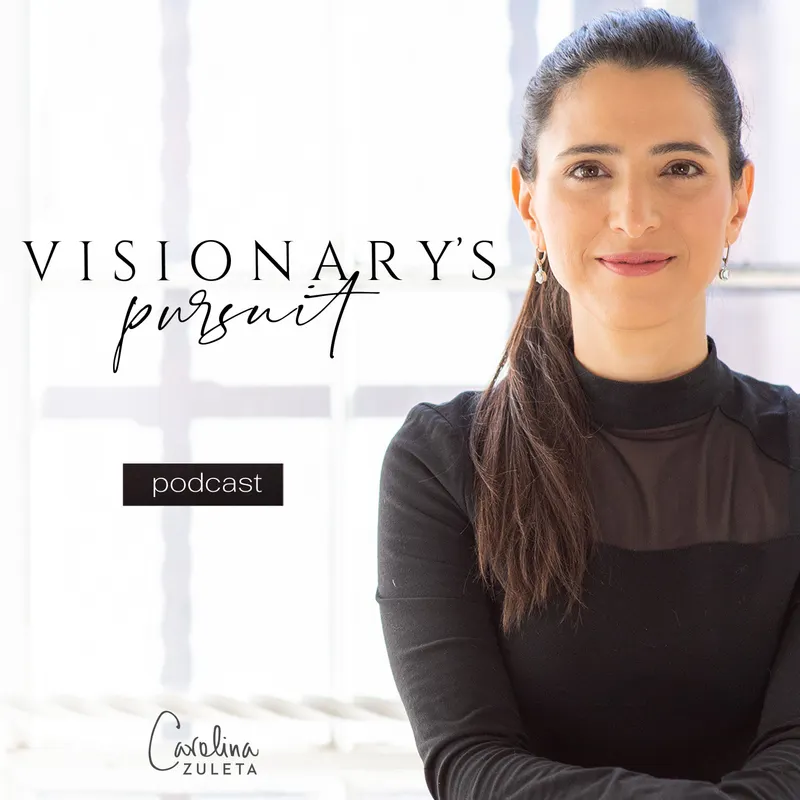
Visionary's Pursuit
Carolina Zuleta·95 episodes
Whether it's a business idea or a creative endeavor, bringing anything meaningful into existence demands emotional mastery, strategic clarity and the courage to make difficult decisions amid constant urgency and uncertainty. The Visionary's Pursuit Podcast explores the psychological and practical challenges of entrepreneurship. Host Carolina Zuleta, founder, coach and advisor, examines the tension between vision and execution, growth and sustainability, ambition and wellbeing. Each episode addresses the challenges that keep visionaries stuck: the inability to delegate, the pressure to be everything to everyone, the gap between knowing what to do and actually doing it. Peppered with candid insights from her...
Why listen
Visionary's Pursuit is a focused solo coaching show where Carolina Zuleta talks founders through the emotional and practical knots that make scaling a business harder than it looks. Episodes feel like a candid strategy session, mixing leadership psychology, client examples, and concrete questions about time, money, confidence, delegation, and difficult decisions. It is especially useful for entrepreneurs who know what they should do next but keep getting stuck in urgency, overwork, or self-doubt.
Episodes
A few days of travel turned into a flu that knocked me flat, so this week called for some rest in lieu of recording. We're revisiting an episode that absolutely deserves a second pass. Entrepreneurship begins with a vision that doesn't exist yet. You take on financial and emotional risk with the hope that the dream becomes real. But while you're building, your brain is scanning for threats and highlighting everything that might not work. In this episode, we explore how we can believe in something that isn't real yet. I break down why belief is one of the most significant factors in your success, how low belief sabotages business, and the skill I use to strengthen my own belief when it gets shaky. Key Takeaways: Belief Is Already a Practice: We believe unprovable things every day: that we'll wake up tomorrow, that our partner will stay, that we'll come home safely We accept these because constant anxiety is unsustainable Belief is a chosen orientation toward reality, not a guarantee The Brain Prefers a Safer Story: When doubt appears, the brain offers narratives like "this won't happen" or "choose the smaller goal" Plan B feels safer because it seems more familiar But Plan A and Plan B both have no guarantees. Believing in Plan B is still a belief choice, just aimed lower. How Low Belief Sabotages Execution: Early-stage founders hesitate, procrastinate and reduce effort because they don't believe the work will pay off Mid-stage founders with traction hold back on marketing and avoid bigger risks because they fear it was a fluke Advanced founders delay critical hires because they doubt they can sustain revenue The Deeper Driver of Results: Actions alone don't create results The chain is belief → emotions → actions → results Belief determines consistency, boldness and persistence through uncertainty Strengthening Belief Is a Practice: Locate your belief level and document why you're there Write down every reason you're not at a 10 Challenge each one and find alternative interpretations Some doubts point to real strategy issues worth addressing. Separate solvable problems from fear-based stories. Connect with Carolina: Website: carozuleta.com LinkedIn: linkedin.com/in/carolinazuletacoaching Subscribe & Review: If this episode was helpful, please drop a rating and give us a follow. Your support helps other entrepreneurs discover the show and enables us to continue creating this free content.
Episode Summary In this episode the conversation is about the energy we hold when we finally put our work into the world. Under the surface, there may be a part of you that's losing belief in your idea, or so focused on how it's received you forget the why you brought this into the world in the first place. It's all too common we start a project with joy and conviction, and by the time we're ready to share it, your excitement has waned. We also ask why so many of us do the opposite. We build something we believe in, then dim our own enthusiasm the moment it's time to hand it to someone else, worried about sounding like too much, waiting for someone else's approval before we let ourselves believe it too. This episode is an invitation to stop waiting for the world's approval and start believing in your own work first, the same way Billie and Taylor already do. Key Takeaways The energy behind your work reaches people as much as the message itself. Your enthusiasm comes through in a pitch as clearly as your hesitation does, even when you say the exact right words. Conviction has to start with you before it can start with anyone else. Waiting for the audience or the decision maker in the room to validate an idea first hands away your own belief in it. Loving your own work in public is not arrogance. Billie Eilish and Taylor Swift both stand fully behind what they create, and their excitement becomes contagious to the people around them. Rejection tests how long you can hold onto your own belief in something. J.K. Rowling faced repeated rejections before Harry Potter found a publisher, and she kept believing in the book anyway. You are your first customer. Before anyone else buys into an idea or a pitch, you have to be sold on it yourself, without needing outside permission. Memorable Quotes "I love my music more than any other music. People hear that and think, 'What the heck? Like, oh, you're listening to your own music?' And it
Episode Summary I built and ran my business on my own for ten years, and for most of that decade I really wanted a partner. Someone who would know the intricacies of the business, and care about the outcomes the way I did. About two years ago that finally changed, and the partnership Andrew and I created has given me almost everything I hoped it would. Unfortunately for most (and likely me too without this work), we're a rare exception. In this episode I get into why I believe the relationship between co-founders is one of the most underrated parts of business strategy. We cover why partnerships most often end poorly and how to mend a strained relationship. Key Takeaways The relationship between founders is a core business variable. Wasserman's research found that roughly 65% of high-potential startups fail because of conflict between the people at the top, not the market or the money or operations. We don't leave our humanity at home. Every meeting includes our insecurities and our need to feel respected, and pretending those needs aren't in the room is exactly what lets them run the show. The quality of your relationship with another person is based on the thoughts you have about them. When you change the thoughts you practice about a partner, the relationship improves, and that's a separate thing from excusing behavior that crosses a line. Karpman's Drama Triangle names the roles we slip into when things go sideways, the powerless victim, the blaming persecutor, and the rescuer who believes everything depends on him. All of them run on disempowerment, and leadership means catching yourself in one and stepping back to responsibility. Relationships get stronger through repair. Avoiding hard conversations to keep the peace is what slowly hollows them out, because distance is what ends a partnership and small withheld frustrations are how the distance builds. A recurring conversation for the hard stuff keeps resentment from collecting. Resources Mentioned <ul class="[li_&]:mb-0 [li_&]:mt-1 [li_&]
Episode Summary Most of us say we want to run our business in a way where our team gets all the credit. We mean it, right up until no one thanks us for the exhausting work or someone else gets credit for a win rightfully ours... even so far as feeling a touch of resentment. In this episode we sit with that flicker. We explore how self-validation is your key to handing out credit and why so many capable leaders are still answering an old question about whether they're important enough. Key Takeaways Service comes from wholeness. When we serve, we strengthen the mission and the team around us rather than cast ourselves as the hero who rescues everyone. The need to feel significant and seen is human, not a character flaw. It only becomes a problem when it turns into the main engine behind how you lead. Leadership becomes identity work at the exact moment no one thanks you and someone else takes the applause. That's where the difficulty lives, and it's emotional far more than it's strategic. Self-validation is what makes giving credit away possible. When you can affirm your own contribution, you stop needing every success to point back to you. A selfless leader builds people who can thrive without them, the same way good parenting aims for a child who needs you less and trusts themselves more over time. Memorable Quotes "I know I matter, so I don't need to be the center." "The whole world could line up to tell you you're a great leader, and if you don't believe it yourself, you won't be able to take it in." "We've done our job when the people we lead need us less and trust themselves more." Resources Mentioned <ul class
Episode Summary This week we're talking about the neuroscience behind why we put things off, even when we know exactly what to do and how much our future selves would thank us for starting. The central idea is around what neuroscientists call the Goldilocks Zone, the level of pressure that is set just right for action. Too much of it and we tip into overwhelm and avoidance but too little and we go flat and reach for the nearest distraction. I explain the roles dopamine and norepinephrine play in getting us moving, and why some brains need barely any pressure to engage while others, like mine, do their best work with a deadline breathing down their neck. Key Takeaways Procrastination and avoidance tend to come from how your brain regulates pressure, reward, and motivation, which means they can be understood and redesigned rather than judged There is a level of internal pressure that is set just right for action, sometimes called the Goldilocks Zone. Too much tips you into anxiety and overwhelm, and too little leaves you foggy and reaching for easy distractions Dopamine and norepinephrine drive whether you engage, with dopamine signaling that something is worth pursuing and norepinephrine creating the alertness and urgency to act. People need very different amounts of each, so the pressure that motivates one person can shut another down Your pacing style, whether you sprint at the deadline or fade somewhere in the middle, is a pattern rather than a fixed trait. Thanks to neuroplasticity, the brain keeps changing throughout life, so the pattern can be rebuilt with practice You can build motivation on purpose with a framework I call VECT, which works by raising a task's value and your confidence that you can do it, then bringing the payoff closer and clearing away the distractions that compete for your attention Memorable Quotes <li class="font-claude-response-body whitespace-normal bre
Episode Summary This week I'm digging into what I believe the most fundamental skill of growing a business is. We talk about the distinction between passive action and massive action, the busywork that feels productive because it keeps us safe versus the action that puts us in front of the market and hands us information we can use. We explore why so many of us retreat into safety, and it usually comes down to the emotional cost of the other kind, the rejection and the silence that come with putting yourself out there. Key Takeaways Big results usually rest on a much higher volume of attempts than people expect. The entrepreneurs who break through tend to try far more times, and tolerate far more misses, than everyone around them is willing to There is a difference between passive action and massive action. Passive action like reading another book or polishing the website one more time feels like progress because it feels safe, while massive action puts you in front of the market and produces information you can use The bigger risk in taking action is usually emotional rather than strategic. Founders avoid the highest-leverage moves less because they are confused about what to do and more because of the rejection and exposure those moves require There is no perfect formula waiting to be handed to you. Nobody knows in advance exactly how to grow your specific business, the plan only looks like a formula in hindsight, and in the middle it always feels like experimentation Emotional capacity is itself a growth skill. When you can move through shame and disappointment without letting it stop you, you keep taking the actions that eventually work, the way professionals keep creating and testing whether or not the conditions feel right Memorable Quotes "Massive action is not one dramatic leap. It is thousands of small,
Episode Summary Lately I've watched several clients and prospective clients arrive at the same strange crossroads. They set a vision years ago, chased it down with everything they had, and now they've actually reached it. They have the income, the title, the reputation, the kind of flexibility most people would envy but they keep circling back to is some version of "what's next for me?" In this episode we sit with that question. I talk about why human beings are wired to keep growing and what actually happens to us when we stop. I share the story of a CMO who landed the role she'd dreamed of and now feels boxed in by it, and a founder who sold her company for millions and is now sitting at home asking who she is without it. If you've reached a summit and the view isn't quite what you pictured, or you're still climbing and want to do it differently this time, this episode is for you. Key Takeaways Growth is one of our core human needs. When we stop growing we don't hold steady, we slowly start to feel smaller, even when nothing about our circumstances has gotten worse Getting stuck after a big win is usually a belief problem before it's a circumstance problem. When your current life is genuinely good, your brain struggles to believe something even better is available, and the old dream quietly becomes evidence against the new one The first vision asks you to risk failure and rejection. The next one asks you to risk the identity you built on the way up, which is why the second mountain can feel heavier than the first even when it looks smaller from the outside Once you've succeeded, the pull toward certainty grows because you finally have something real to lose. The known starts to feel safer than the fulfilling, and plenty of people trade aliveness for predictability without ever consciously choosing to A complete vision is a "yes, and" rather than an "either/or." Most founders frame the next chapter as growing the business or having a life, when the deeper work is learning to believe in a version where both are true at once. Sometimes the next mountain points inward instead of upward, an internal evolution toward pursuing something big with
Episode Summary In this episode, we talk about what it means to be obsessed with your customer, why so many skip building a real customer profile, and how the businesses I admire most use that profile as a filter for every decision they make. I share what I learned at the University of Chicago about the unsexy practice of picking up the phone and talking to your customers, why "I sell to women between 30 and 50" is not specific enough to build a business on, and how Anthropologie speaks to one very particular woman without losing anyone else. If you have been feeling like your marketing is not hitting the mark, your clients aren't quite the right fit, or your business has gone stagnant without an obvious reason, this episode will give you a clearer place to start looking. Key Takeaways Successful businesses are obsessed with their customers. They know how their customers think, what keeps them up at night, what they dream about, and what they are actually trying to solve Trying to sell to everyone is one of the most expensive mistakes a founder can make. If you talk to everyone, no one listens. If you talk to one person clearly enough, the right people raise their hand and the wrong people self-select out A real customer profile goes well past demographics. It includes psychographics, buying behavior, media habits, values, fears, and what people want their lives to look like. The deeper you understand the psychology, the better you can speak to it Anthropologie is a useful study. They design and market for one specific woman with a clear identity, lifestyle, and values, and people outside that profile still buy from them. Specificity does not shrink your audience, it sharpens it Once you have an ideal customer profile, it becomes a filter for every decision. Hiring, pricing, marketing, partnerships, product, and which clients you say yes to all run through it. Taking on a paying client who is not your ideal client almost always costs more than it earns Your ideal customer changes over time, and your profile needs to change with them. Revisiting it at least once a
May 18th - 30th, join me for my free daily mini-workshop series on essentialism and how to think about your calendar. If you can't make it live, you can still enroll through May 22nd to receive all recordings and PDFs. Link to save your seat below:https://www.carozuleta.com/10x Episode Summary I've been fascinated by the idea of potential since my late teens. For me, it has always been motivating, a possibility of what I could learn, develop, and become. But over the years, talking with friends and clients, I've heard a very different version of that word. Many people grew up hearing "you're wasting your potential," and they reference it as proof that who they are right now isn't enough. In this episode, I want to reset that. I talk about why potential should come from desire rather than lack, why we get to choose which potential we develop instead of treating it as an obligation, and why some of our potential will go undeveloped and that's perfectly okay. I draw on the concept of the gap and the gain from 10X Is Easier Than 2X and share a story about an ultra-high achieving client who almost abandoned her vision two weeks in because of the way she was looking at her goals. Be sure to tune in, this one is a goodie. Key Takeaways Potential is a possibility, not a finish line. There will always be more we could learn or achieve, and that fact doesn't mean where we are today is wrong or that we are not good enough The potential worth developing comes from desire, from what genuinely excites and matters to you, rather than from a place of lack or what others think you should be doing with your natural abilities The gap and the gain describe two ways of measuring progress. Focusing on the gap, on how far you still are from the vision, breeds anxiety and a sense of falling short. Focusing on the gain, on how much you've already learned and become, builds motivation, confidence, and gratitude Life is 50/50. No amount of revenue, fr
The Self-Led CEO: a FREE 5-day Workshop May 18th - 22nd for business founders who think, behave and lead like a CEO. Go here to enroll: https://www.carozuleta.com/10x Episode Summary A mentor once told me that if you are working more than 40 hours a week, you do not have a time problem, you have a leadership problem. In this episode I get into why your calendar is actually a mirror reflecting your current level of leadership, how many decisions still run through you, and how much of your business still depends on your personal capacity. Drawing from Dan Sullivan's and Benjamin Hardy's ,10X Is Easier Than 2X I explore the difference between a 2X mindset that asks, "How do I do more?" and a 10X mindset that asks, "What can I remove, delegate, or upgrade?" I also introduce the concept of over-functioning, which is the pattern most visionary CEOs fall into without realizing it, and the identity work required to lead at a higher level without giving your business every waking hour. This episode is the philosophy behind my brand new free mini course, The Self-Led CEO, which starts Monday. Key Takeaways Working long hours is rarely a time management problem. It is a leadership problem, and underneath that, an identity problem. Your calendar is a mirror reflecting how much your business still depends on your personal capacity The 2X mindset asks, "How can I do more, faster, with less waste?" The 10X mindset asks, "What needs to be removed, delegated, or upgraded?" 10X growth rarely comes from working ten times harder. It comes from doing less of the wrong things and more of the right ones at a higher level Over-functioning is the pattern where your business borrows from your energy and speed instead of building the structures, team, and decision-making muscles it needs to grow on its own. It is not about doing everything. It is about doing things you are capable of doing but s
Episode Summary I have a theory that may sound a bit harsh... but stick with me. Most of the time, difficult clients are a symptom of bad leadership. Yes, hard people exist in the world. Yes, some clients will push every boundary you have. But when I peek behind the curtain of a business that's drowning in difficult client situations, I almost always find the same three things missing. In this episode, I walk through what those three things are and how to start rebuilding them. If you've been resenting your clients lately, or if you've been tolerating misalignment because you're scared the next client won't come, this one is for you. Key Takeaways Difficult clients are usually a symptom of three things missing in your leadership: clarity, ownership, and follow-through. Hard people exist, but when difficult clients become the norm, the work is on you Most founders haven't actually defined their ideal client beyond someone who can pay. Values alignment, communication style, payment behavior, scope clarity, and the energy you feel working with them all belong on that list Saying yes to clients out of scarcity is one of the most expensive habits in business. You over-accommodate, lose money on scope, and build resentment toward the work you used to love The manual is a tool I learned at the Life Coach School. It's the unconscious set of expectations we carry for how others should behave. The two problems with it are that we rarely communicate it, and even when we do, people are still going to be people Even when a client crosses one of your boundaries, you are not a victim to their choices. You get to decide how to respond, whether that's holding the line or extending grace, and that decision needs to come from leadership rather than fear Follow-through is where most founders break down. They get clear, they communicate the rules, and then they go quiet the moment a client pushes back because they're scared of the difficult conversation You can fire clients. In 15 years of coaching, I've fired maybe two, and both times it was because I knew the work wasn't serving them. You can hold a hard line and still stay in connection and integrity with the person across from you Connect with Carolina Book a consultation: carozuleta.com/consult <span style="font-weight:
Episode Summary This episode is more personal than most. I sat down to share what I've learned about being a mom while running a business. This episode is a lot about how carefully I've thought about how to design a life where parenting and a career can exist without one constantly losing to the other. If you're a parent who works, or someone trying to build a life where ambition and love for the people closest to you don't have to compete, this one is for you. Key Takeaways The question is not whether to choose career or family, it is how to design a life that holds both. Trade-offs exist, but they rarely look the way we assume they do when fear is making the decision for us Guilt is information. When you feel it, the work is to ask whether you're out of integrity with your own values or absorbing someone else's idea of who you should be. Those are very different problems with very different responses There is no single template for a good mother. The most powerful version of motherhood is the one that flows from who you actually are, not from what you've watched other women do well Being present in your child's life is not measured in hours. It is measured in connection, in knowing what's happening in their world, and in showing up for the moments that matter to them The same coaching skills that work in business work in parenting. Awareness of your own thoughts, regulation of your own emotions, and intentionality about your impact are life skills that translate to every relationship you have Children give immediate, honest feedback. When you stop trying to fix their experience and start witnessing it instead, the entire dynamic changes. Most kids do not want their feelings solved, they want their feelings seen Modeling matters more than instruction. When children watch a parent love their work, take ownership of mistakes, and repair ruptures honestly, they learn to do the same in their own lives Setting limits and staying connected are not in conflict. You can hold a hard line, give a consequence, or have a difficult conversation while keeping the love completely intact <p class="font-claude-response-
Episode Summary So many of my conversations with high level executives are about their disdain for their work. One told me he goes to the office every day to breathe toxic air. That's what prompted this episode. Research from the National Association for the Self-Employed shows employees of smaller businesses report higher satisfaction than those at larger corporations, but only by about 11 points, which tells me there's still a lot of room for smaller businesses to do better. And the biggest lever for that sits with the founder. In this episode, I move past the usual conversation about "happy employees" and make the case for something more durable, which is engagement. I walk through the three categories of reactive tendencies we all carry into leadership, the ones we developed as kids to keep ourselves safe, and how the overuse of those tendencies quietly erodes trust, culture, and performance inside small businesses. If you've ever wondered why your team isn't following through, why the same patterns keep surfacing no matter who you hire, or why you feel resistance to the harder parts of leading, this episode is for you. Key Takeaways Employees at smaller businesses report 11 points higher satisfaction than those at larger companies, according to the National Association for the Self-Employed. But small doesn't automatically mean engaged, and the founder's leadership is the single biggest variable Happiness is fleeting. Engagement is different. William Kahn defined it in 1990 as the degree to which people bring their full selves physically, cognitively, and emotionally to their work. That's what we should be optimizing for Reactive tendencies are behaviors we developed as young children to keep ourselves safe. They made sense then, and many of them still serve us now. The problem is the overuse, which is where they start damaging our leadership The complying tendency shows up as people-pleasing, avoiding difficult conversations, and saying yes to keep harmony. It builds affection in the short term and erodes trust in the longer term The protecting tendency shows up as "I can do it better myself," e
Episode Summary In part one of this series, I made the case that time management starts with your values and goals. This week, we get into why, when you know exactly what should be on your calendar, your brain fights you when it is time to do the work. In this episode, I break down what I call the mathematical problem of managing your time and the order in which things should land in your calendar. We also cover the emotional side of execution, the inner battle between your amygdala and your prefrontal cortex, and why every productivity system eventually runs into the same wall of discomfort. I share the framing I learned during one of my coaching certifications, a story about my mother that has stayed with me for decades, and the relationship between following through on your word and the trust you build with yourself. If part one helped you see what to put on your calendar, this episode is about how to execute on what's in there. Key Takeaways Time management is two problems stacked on top of each other. The first is mathematical, deciding ahead of time how to organize your 24 hours. The second is emotional, navigating the resistance that shows up the moment it is time to execute Use one calendar, not several. Having a separate work calendar and personal calendar creates blind spots and makes it harder to be intentional about your full life The order of what goes on your calendar matters. Self-care, time off, hobbies, and relationships go first, then revenue-driving and strategic work, then team meetings, then everything else. Most founders flip this order entirely Planning ahead engages the prefrontal cortex, which is where higher-level thinking happens. Deciding in the moment hands the wheel to your amygdala, which will always optimize for immediate comfort Your amygdala is brilliant at keeping you safe, but its definition of safety is short-term. It will make unread emails feel urgent and a clean kitchen feel essential the moment you sit down to do something hard The internal voice that helps you follow through is loving but firm, the way a wise parent would speak to a child asking for ice cream at 7am. Not harsh, not permissiv
In this episode, the first of a two-part series, I make the case that the challenge with time management starts with a lack of clarity around your goals, values, zone of genius, and what is actually essential in your business. I walk through the four areas that need to come first, the trade-offs founders avoid making until exhaustion forces their hand, and the common beliefs I see running underneath chaotic calendars. I also share why your calendar is a direct reflection of what you believe about yourself, your team, and your business, and what to start examining if the same patterns keep showing up no matter how many productivity systems you try. Part two will go deeper into the daily prioritization and the emotional side of execution. Book a free consultation: https://calendly.com/carolinazuleta/1hr-complimentary Key Takeaways Without clear goals, values, and priorities, everything in your business will feel equally important and equally urgent A fulfilled life is one where you are honoring your values, and your values as a person and as a business owner directly determine how your time should be spent. There are no universally correct values, only yours Your zone of genius is the work only you can do, where you create the most impact for the business. Just because you can do something well does not mean you should be the one doing it Greg McKeown's framing from Essentialism is useful here: if it is not a clear yes, it is a no. The goal is precision about where you focus, not productivity for its own sake You'll need to make trade-offs, it comes at the price of intentionality. Founders who refuse to make them end up letting their calendars get made for them Your calendar reflects your beliefs. Common ones I see include "if I'm not involved, it won't be done right," "I have to say yes to every opportunity," "more work equals more success," and "if I slow down, everything falls apart" The order of priority that protects most founders: revenue-driving work first, strategic work second, team support third, everything else after that. Most founders invert the last three and wonder why they never get to the future of their business <p class="font-claude-respo
Episode Summary Years after starting my coaching business, I met a woman who had launched hers around the same time. Her revenue was $10 million a year and mine wasn't even close. My first instinct was to feel like I was failing, especially because on paper, my resume was stronger. In this episode, I walk through the honest assessment I did of our differences, what it revealed about the choices I had made and why I ultimately hired her as my mentor. If you've ever looked at a competitor, a peer, or even an old friend and felt the weight of being behind, this episode offers a different way to process that feeling without letting it sink your ship. Key Takeaways The feeling of being "behind" is one of the most common experiences for founders, and it often masks a deeper belief that we are somehow not enough When we compare ourselves to others, the first question to ask is whether we're comparing to another person or to an arbitrary expectation we set for ourselves before we had enough information The expectations we create for our businesses are hypotheses, not guarantees. Treating them as promises we were owed creates a sense of entitlement that holds us back Feeling urgency, shame, or contraction after comparing ourselves is a sign the thought is limiting us rather than serving us Comparison becomes useful when it moves us toward curiosity instead of self-punishment. Asking "why are they ahead?" from a place of genuine learning reveals skill gaps, focus gaps, and strategic differences we can act on Hiring someone who is further ahead than you requires an abundance mindset. Viewing competitors as proof that the market has room, rather than proof that you're losing, changes everything Memorable Quotes "I love comparing to others when it serves me as inspiration and fuel to continue pursuing what I really want." <li class="whites
If you want to explore a coaching relationship, click here, fill out your name and email and we'll be in touch Episode Summary I've wanted to record this episode for a long time. If you and I were sitting at a coffee shop and you asked me what I do and why I love it, this is the conversation we'd have... I share the full story of how I went from working in private wealth management at Morgan Stanley to discovering coaching through a conversation with my boss in 2008. I break down the differences between therapy, mentorship, and coaching, including what makes each one valuable and when each one applies. We explore the three most common reasons founders resist hiring a coach, why high performers in particular tend to talk themselves out of it, and the cost of staying where you are. I also share client stories that illustrate what coaching looks like in practice. If you've ever been curious about coaching or wondered whether it's worth the investment, this episode is for you. Key Takeaways Therapy tends to look at the past and often involves diagnosis. Coaching looks toward the future and operates from the belief that clients are naturally creative, resourceful, and whole. Mentorship is advice-based, drawing from someone who has walked your path. Coaching helps you find answers within yourself by revealing blind spots and expanding how you think. Coaching is not just about tactics and action steps. It's about evolving your identity so you become the person who naturally lives the results you want. Three common reasons founders resist coaching: a fear disguised as logic ("it's not the right time"), skepticism about intangible ROI, and the belief that money should only go toward tactical investments. Most people evaluate the cost of coaching but rarely evaluate the cost of staying where they are: slow decisions, avoided conversations, burnout, missed opportunities. High performers often resist coaching because they believe they should be able to figure things out alone, but the most successful people build
Episode Summary One of my all star clients recently told me that the thought "I'm not good enough" had been floating around a lot in her head lately. It served as another reminder these thoughts are a part of being human. They show up in all of us, especially for those who have big ambitions. In this episode, we explore the inner critic, what it is and how to build a more productive relationship with it. Key Takeaways The thought "I'm not good enough" is one of the oldest and most universal human stories, and it tends to get louder when we pursue something bigger than what we've done before When "not good enough" is tied to worthiness, it creates shame, which keeps us stuck, small, and in pain. This version requires a conscious decision that our value is intrinsic, not earned When "not good enough" reflects an actual skill gap, it becomes a growth opportunity. This is where a growth mindset and the concept of upgrading your self-concept become essential When "not good enough" is triggered by rejection or criticism from others, we need to develop the ability to let people have their opinions while we protect our sense of self-worth Bigger goals naturally widen the gap between where you are and where you want to be, which can amplify feelings of inadequacy. The key is not letting that gap become a statement about your worthiness We can hold both truths at once: acceptance and love for who we are today while also pursuing growth and evolution One of Carolina's favorite mantras for falling short: "Oh, look at me being human" Memorable Quotes "I believe that worthy doesn't come from anything outside of us. It's believing that our value is intrinsic, not earned." "If we truly believe we're not good enough, then maybe we're not gonna pursue that big thing. Maybe we're gonna choose to stay where we feel comfortable."</l
The Visionary Mindset Group Program for early stage entrepreneurs is open for enrollment! If your business' growth right now doesn't match what you know you're capable of, you're feeling stuck or plateaued, book a free call with me to see if this program is your ticket to scaling: https://calendly.com/carolinazuleta/visionaryEPISODE SUMMARYMost of us have an, I'll say, interesting relationship with money. The beliefs we've adopted over the years determine our thoughts and our thoughts create stories. Those stories then compel how we behave.With respect to money, our beliefs will influence what we charge, how we spend and whether we even look at the numbers at all. When was the last time you took a thorough, comprehensive look at every dollar coming in or going out of your business? I'm genuinely curious. If the answer isn't something you're proud to admit, you actually belong to the majority of founders who are reluctant to give their finances a hard look. It's been my experience that early-stage entrepreneurs, or most of them, prefer to ballpark the figures, delegate them or even turn a blind eye. I'll give you an example. Anna, a business owner who joined my group program (The Visionary Mindset Program), shared that after she makes payroll, there's was hardly enough left over to pay herself. If you subtracted her own salary, the business had never actually been profitable. In this episode, I share Anna's full transformation through the Visionary Mindset Program, from the moment she realized she hadn't looked at her own numbers in years, to the pricing breakthrough that changed the caliber of clients walking through her door. I also get personal about my own relationship with money, including the investment I put on a credit card years ago that has paid back a thousand times over. If you've been feeling stuck in your business or avoiding your finances, this one will hit close to home. The doors to the Visionary Mindset Program close early next week, with our kickoff on March 19th. Key Takeaways: Why Profitable Businesses Still Leave Founders Broke: A thriving reputation and loyal clients can mask a fundamentally broken business model Many founders delegate their finances to an accountant and stop looking at the numbers themselves This pattern shows up in small businesses and multi-seven-figure companies alike Your Relationship with Money Is Running Your Business: Fear, shame, and old stories about money quietly shape your pricing, your spending, and how you hold your team accountable Many founders avoid their finances because confronting the numbers triggers deep emotional responses The money itself is neutral. Your beliefs about it determine the results you get <p
Episode Summary Burnout gets talked about a lot, but rarely with the specificity it deserves. In this episode, I'm talking about two distinct types of burnout that show up for entrepreneurs who have a proof-of-concept and are working to scale. Based on the largest body of burnout research to date, I differentiate two types of burnout and how you can tell the difference, why the wrong recovery strategy can actually make things worse and what I've learned coaching entrepreneurs through both. Key Takeaways: Physical Burnout (Exhaustion) Comes from working long hours, answering messages at all hours, skipping meals, sleep, and movement Often fueled by the belief that more hours equals more results The recovery path is self-care: sleep, boundaries, breaks, exercise, and reconnecting with loved ones If you're solving every business problem by adding more hours, you're likely putting out fires instead of building systems Cynical Detachment Shows up as losing the love for your business, dreading work, feeling detached from clients or team Won't be solved by a vacation or working part-time, those can actually deepen the disconnection Often driven by the stories you're telling yourself about your business, clients, or team Requires examining the meaning you're assigning to circumstances and making decisions from an empowered place rather than a victimized one The Core Distinction Physical burnout tends to come from trying to control more than you need to <li class="
Enrollment is open (by application) for the $200k - $700k business founder cohort of the Visionary Mindset Program! Book a free coaching session with me where we tackle a challenge of your choosing and, if it seems like a fit, discuss how this program can move you past reactive mode and help you nail your 2026 goals.Schedule here: https://calendly.com/carolinazuleta/visionary Episode 73. 4 Steps to Scale Past a Business Plateau Episode Summary The entrepreneurial journey is not a straight line up. There are valleys, plateaus and stretches where everything that used to work just... stops working. In this episode, I cover what happens when founders shy away from the bold, risk-taking energy that got their business to where it is today. I introduce the framework of "playing to win" versus "playing not to lose" and share how this distinction shows up across four critical areas of your business. If you're stuck in a plateau right now, this episode will help you identify what's keeping you there and what it looks like to start moving again. I also share details about the Visionary Mindset Program, which is currently open for enrollment. Key Takeaways: Playing to Win vs. Playing Not to Lose: When we start our businesses, we have nothing to lose, so we take bigger risks, get creative, and put ourselves out there boldly Once we have something that works, the fear of losing it can shift us into protective mode Research on loss aversion shows that humans experience losses far more intensely than equivalent wins, which explains why this shift feels so instinctive Playing not to lose almost guarantees you'll end up losing because entrepreneurship requires ongoing boldness and reinvention Vision and Goal Setting: <ul class="[li_&]:mb-0 [li_&]:mt-1 [li_&]:gap-1 [&:not(:last-child)_ul]:pb-1 [&:not(:last-child)_ol]
Visionary Mindset Program now accepting applications for enrollment! Schedule time with me here: https://calendly.com/carolinazuleta/visionary Episode 72: Why You're Still Procrastinating (And What to Do About It) Episode Summary One of my most successful clients recently came to me with requesting help with procrastination. On paper, this woman is a powerhouse. But she was avoiding the projects that would sustain her next phase of growth. Her admission reminded me that procrastination has nothing to do with laziness, discipline or how successful you are. In this episode, I break down the why we procrastinate, I share my own patterns (including what I'm avoiding right now), and walk through some strategies to move forward even when your brain is building a very convincing case not to. I also announce that we're reopening the doors to our Visionary Mindset Program. Key Takeaways: The Real Reason You Procrastinate: Your brain operates on three instincts: avoid pain, seek pleasure, and conserve energy Procrastination is your brain's strategy for protecting you from perceived discomfort It shows up in high performers just as much as anyone else because success doesn't rewire your survival instincts The Most Common Triggers: Telling yourself a task will require too much effort, time, or energy Caring deeply about something and fearing the rejection or criticism that could follow Lack of clarity on what the project actually requires or what the outcome should l
Only a few slots remain for Founders Consult Week! If you haven't booked your free hour with me, do it ASAP before they're taken. Go here to access my calendar: https://calendly.com/carolinazuleta/founder-consultation-week Episode 71: How to Believe in What Doesn't Exist Yet Entrepreneurship begins with a vision that doesn't exist yet. You take on financial and emotional risk with the hope that the dream becomes real. But while you're building, your brain is scanning for threats and highlighting everything that might not work. In this episode, I explore the question I hear from founders constantly: how do I believe in something that isn't real yet? I break down why belief matters more than strategy, how low belief sabotages execution at every stage, and the practice I use to strengthen my own belief when it gets shaky. Key Takeaways: Belief Is Already a Practice: We believe unprovable things every day: that we'll wake up tomorrow, that our partner will stay, that we'll come home safely We accept these because constant anxiety is unsustainable Belief is a chosen orientation toward reality, not a guarantee The Brain Prefers the Safer Story: When doubt appears, the brain offers narratives like "this won't happen" or "choose the smaller goal" Plan B feels safer because it seems more familiar But Plan A and Plan B both have no guarantees. Believing in Plan B is still a belief choice, just aimed lower. How Low Belief Sabotages Execution: <ul class="[li_&]:mb-0 [li_&]:mt-1 [li_&]:gap-1 [&:n
Founder Consult Week is Coming! February 16-20 Access my calendar here or copy and paste the link below. https://calendly.com/carolinazuleta/founder-consultation-week Free one-hour private consultations with limited spots Bring a real business challenge and walk away with clarity on what's actually in your way Open to founders who have never worked with Carolina before Booking link above Episode 70: Are You in Survival Mode? Episode Summary I love leadership assessments. MBTI, DISC, Hogan, Enneagram. I've taken them all. But my favorite by far is the Leadership Circle Profile. Unlike most assessments, it pulls feedback from your team, business partners and investors and benchmarks you against leaders globally. In this episode, I use that framework to explore something most founders don't realize they're doing: leading from survival mode. I share my own reactive tendencies, including the one I'm actively working on right now, and break down the difference between drive that comes from vision and drive that comes from scarcity. I also announce Founder Consult Week happening February 16-20. Key Takeaways: Reactive Tendencies vs Creative Competencies: Reactive tendencies are survival-based patterns like people pleasing, controlling, overworking and defensiveness They aren't bad. They worked at earlier stages of life. But they become limitations as your business grows Creative competencies are developed through self-awareness and emotional intelligence and enable you to lead su
Take the free Founder Capacity Assessment here: https://carozuleta.scoreapp.com/ As founders, we often look outside ourselves when we're not growing. We blame the market, the team, the strategy. But after years of coaching founders and executives, I've seen a different pattern. The business is a mirror of its founder. Your mindset, emotional regulation and beliefs shape everything from your growth rate to your team culture. In this episode, I introduce a lens I believe is missing from most conversations about leadership: capacity. I break down the five capacities that determine how far and how fast you can scale, and I share a free assessment I created to help you see where your growth is actually being limited. Episode Summary: Strategy is rarely the bottleneck. While strategy problems are easy to spot, capacity issues can fly under the radar and be hard to name. They show up as slowed growth, disengaged teams and founder burnout. Drawing from years of coaching and my own experience, I explain what capacity actually is, why it matters more than most founders realize, and how each of the five capacities shapes your leadership and your business. Key Takeaways: The Founder's Inner World Shapes the Business: Your mindset, emotional regulation and beliefs are reflected in your business growth rate, team culture and organizational health Unexamined insecurities and limiting beliefs create complicated cultures and friction Business issues are often internal leadership issues in disguise What is Capacity?: Capacity is a founder's ability to handle risk, uncertainty, responsibility, emotional intensity and visibility <li class="whitespace-normal break-words
Take the Founder Capacity Assessment HERE I love entrepreneurship. I love the idea that we can create something from nothing, add value to the world, make money and create jobs. But there are two moments in entrepreneurship that can feel equally hard: when business isn't going well and when business is going really well. In both situations, our most common response is to work harder, push through and white-knuckle it until things feel easier. But the price we pay for that approach is enormous. Episode Summary: This episode challenges the default response of working harder under pressure. Whether your business is struggling or thriving beyond your infrastructure, pushing through creates costs to your health, your relationships and the quality of your decisions. Drawing from client stories and my coaching experience, I explain what capacity actually is, why it matters more than strategy, and how expanding your capacity allows you to become the leader your business needs. I also introduce the Founder Capacity Assessment, a free tool I created to help you see exactly where your growth is being limited. Take the FREE assessment here Key Takeaways: Hustle Comes From Fear: Your health and relationships suffer when you're always in overdrive When you operate from stress and fear, you don't access your highest level of thinking You make worse decisions for your business You deliver worse results for your clients and employees The price shows up in every area of your life and business It's Not Your Strategy: Most founders think their challenges are strategy problems but more often than not, it's a constrained capacity. The foun
When I ask founders and CEOs about their goals, some respond with excitement while others become tense. Those reactions tend to reveal far more about how someone relates to themselves than about the goal they're setting. In this episode, I explore why so many ambitious entrepreneurs have a complicated relationship with goal setting and what's actually happening beneath the surface. Drawing from a 35-year body of research by Edwin Locke and Gary Latham, we look at how goals create standards that trigger self-evaluation and why that mechanism determines whether your goals energize or paralyze you. Episode Summary: This episode examines the psychology behind goal setting and why the goal itself is neutral. What matters is how we relate to the self-evaluation that goals activate. Through the lens of research and patterns observed in coaching, we explore why some leaders only set safe goals while others set fantasy goals that sound bold but lack accountability. Both are ways of protecting identity rather than building something real. For CEOs and founders, this episode offers a framework for understanding how your relationship with yourself shapes your relationship with your goals and your team's ability to achieve them. Key Takeaways: Goals Create Standards That Trigger Self-Evaluation: A goal immediately creates a standard against which we measure ourselves That standard triggers internal questions about capability and self-worth The goal itself is neutral but our interpretation of it determines what happens next This mechanism is present from childhood and follows us into adulthood Healthy vs. Unhealthy Self-Evaluation: Healthy self-evaluation interprets mistakes as data and believes improvement is possible <li class="whitespace-normal break-words
Episode 66: The Missing Piece in Your Goal Setting Happy New Year! As we step into a new year of goal setting and intention, this episode challenges you to think beyond the revenue targets and marketing plans. What if the reason you keep living the same year over and over again has nothing to do with your strategy and everything to do with who you are as a leader? In this episode, I share why this year feels different for me and why expansion requires just as much internal evolution as transformation. Through client stories and my own experience, we explore the difference between "doing" goals and "being" goals and why your business will only grow as much as you do. Episode Summary: Most of us set goals around what we're going to do. Revenue targets and product launches and marketing campaigns. But we forget to set goals around who we need to become. Our businesses are a reflection of who we are, which means if we're not changing inside, the external changes we're chasing will never stick. This episode examines how unexamined beliefs and patterns show up in our leadership, from the controlling CEO editing code at 3am to the founder who keeps cycling through hires because she won't look at the parts of her business that cause discomfort. We explore what real self-awareness looks like beyond personality tests and why your business doesn't create new problems as it grows but amplifies the ones you already have. Key Takeaways Doing Goals vs. Being Goals: Most of us only set "doing" goals around revenue and launches and campaigns We forget to create a plan for "being" goals around who we are If we're not changing inside, external changes will never stick Our businesses are a reflection of who we are The Human Mess of Leadership: <ul class="[li_&]:mb-0 [li_&]:mt-1.5 [li_&]:gap-1.5 [&:not(:last-child)_ul]:pb-1 [&:not(:last-child)_ol]:pb-1 list-disc flex flex-
The number one regret of the dying is "I wish I'd had the courage to live a life true to myself, not the life others expected of me." Most people don't honor even half of their dreams and have to die knowing it was due to choices they made or didn't make. As we approach the end of the year and start setting goals for the next one, this episode challenges you to examine whether the life you're living is actually the life you want. In this episode, I explore why the pursuit of "having it all" leads to burnout rather than fulfillment, and I introduce a powerful exercise for evaluating every area of your life. Through personal stories, client examples, and practical frameworks, we examine how to reconnect with your desires, remember your power to choose, and build the courage to create a life that's truly aligned with who you are. Key Takeaways: The Myth of Having It All: Pursuing "having it all" leads to exhaustion, stress, and burnout The best leaders don't do everything themselves They surround themselves with people who help achieve their goals They spend the most time doing what they're best at The Power to Choose: Choice isn't a thing, it's something we do We can choose and then choose again We're not confined to stick with decisions made years ago The "Would You Choose It Again?" Exercise: At least once a year, evaluate whether you'd choose your current life again Ask yourself if you'd [marry your spouse, choose job, buy 'x'] again knowing everything you know now Look at your closet and ask if
If working more hours made people wealthy, the most exhausted workers in our society would be millionaires. But we know that's not true. Often the lowest paid jobs require the most hours. The people working three different jobs to make ends meet would be the wealthiest, but that's not how it works. In this episode, I dedicate the conversation to a specific client I've been working with on challenging a belief many of us have been taught: that more hours equals more money. Through stories, frameworks and behind-the-scenes examples, we explore what actually creates wealth and how you can start making more money while working less. Key Takeaways: How to Make More by Doing Less: Value is what you give to clients that they're willing and happy to pay for Value is a result someone wants enough to exchange money for Value is not effort, time, or what you think is valuable What creates wealth is what your clients consider valuable Parkinson's Law: Work expands to fill the time we give ourselves to do it If you give yourself all day to write an email, it takes all day If you must send it in an hour, you'll finish in an hour Constraining time forces you to choose what's most important The Essentialism Framework: Step one is to explore and get clear on what creates the highest value Step two is to eliminate, say no, edit, and remove from your schedule Step three is to execute on the essential 20% with focus and discipline Rest as Essential: Athletes treat rest as equally important as training Schedule all rest days, weekends, and holidays first in your calendar Strategic rest allows you to be more productive on working days Your ability to create value depends on being well-rested
Episode 63: The Two Questions Keeping Your Business Small I started recording this episode with a lot of emotions. Moments before, my husband (who's also my business partner) and I had just discovered we surpassed our revenue goals for the year. The emotion overwhelmed me because for eight of my ten years in business, this was the game I always wanted to play. For the first 8 years, two seemingly responsible questions kept me stuck in my comfort zone. In this episode, we expose why asking "How do I know it's going to work?" and "Is it the right time?" actually prevents growth rather than ensuring it and we reveal the mindset shift required to take action. Episode Summary: This episode confronts the two questions that paralyze entrepreneurs at every stage. Whether you're launching your first product or making your tenth strategic hire, these questions disguise fear as prudence and keep you playing smaller than your vision demands. Through wisdom from my own coach about making offers work rather than choosing perfect ones and the principle Andrew and I use to match value with revenue, you'll learn why certainty-seeking is the enemy of extraordinary outcomes. This episode challenges you to stop calculating your way to guarantees and start operating from desire rather than fear. Key Takeaways: Why These Questions Keep You Stuck: Asking if something will work seeks guarantees that don't exist in entrepreneurship These questions point to certainty, but uncertainty is what makes big outcomes possible Playing safe means you don't fail, but you also don't learn what you need for growth The clarity you seek before starting only comes after you've begun The Safe Zone: Doing only what you know will work teaches you nothing new A year of spectacular failures provides more education than a year of perfect planning <li class="whitespace-normal br
FREE GUIDE TO RECEIVING FEEDBACK - Click here to access Feedback can sting. "We need to talk." That's enough to tense up your body and make your mind race. Immediately we want to get defensive, and moments later you're either attacking back or shutting down completely. There's a better way. In this episode, we explore why even the most successful leaders struggle with feedback and reveal the nine-step framework that transforms criticism into rocket fuel for growth. Episode Summary: After opening with a powerful reflection on gratitude and the gift of being human (even the uncomfortable parts), this episode tackles one of leadership's most vulnerable moments... being on the receiving end of feedback. Building from the biological reasons our brains interpret criticism as danger to the specific steps that separate defensive leaders from growth-oriented ones, you'll learn how to stay grounded even when feedback comes wrapped in emotions, accusations, or poor delivery. Through real scenarios from coaching sessions and practical frameworks, this episode transforms how you process criticism, extract value from messy feedback, and demonstrate the kind of leadership that builds trust through visible growth. Key Takeaways: Why Feedback Triggers Our Defenses: Threatens our sense of identity when we conflate work with worth Nervous system interprets criticism as tribal rejection Activates harsh inner critic and old shame patterns Forces us into uncertainty about changing established behaviors Challenges the "high performer" identity many leaders carry The Four Automatic Responses to Avoid: Fight: Defensiveness, justifying, explaining why they're wrong Flight/Freeze: Avoiding feedback conversations, postponing meetings <li class="whitespace-normal b
If you're anything like the entrepreneurs I know, you've had nights lying awake at 2 AM mulling over the problem that can't wait until morning to solve... or furiously refreshing your email to see if the algorithm favored the post you poured your soul into... or checking every few minutes to see if that article about your business has been published... Meanwhile, the action items that need your attention sit untouched on your desk. In this episode, we expose the factors that are draining your energy while simultaneously keeping you stuck, and we cover the ONLY three things you can actually control that determine your success. Episode Summary: Most entrepreneurs spend their mental energy obsessing over things completely outside their control… could be the market conditions, algorithm changes, client decisions, or employee satisfaction levels. This creates a dangerous illusion of being “strategic” when it's actually just your worry disguised as your responsibility. This episode reframes how visionary leaders should approach problems and uncertainty. You'll learn the critical distinction between low-quality problems that make you a victim and high-quality problems that make you powerful, plus a coaching exercise to move from anxiousness to productivity. Key Takeaways: What’s Draining Your Energy and Killing Your Business: Worrying about external factors feels responsible but drains your power Your brain mistakes worry for strategy The more you focus on uncontrollables, the less action you take Success requires expanding your ability to be with uncertainty, not eliminating it The Only Three Things You Can Control: Your thoughts: The stories you tell yourself and meaning you create Your emotions: Your ability to generate confidence, calm, courage Your actions: Your standards, discipline, consistency, and follow-through Low-Quality vs High-Quality Problems: Low-quality: Problems you can't solve where you're the victim High-quality: Problems you can solve where you're the hero Every problem can b
Take a minute to think... are there any conversations you've been avoiding lately? Maybe it's an underperforming manager, a team member missing deadlines, or a client who's gone off the rails? You probably know it needs to happen but every time you think about it, your chest tightens. What if they get defensive? What if they quit or churn? What if you make things worse? In this episode, we dive into the exact step-by-step framework for having difficult conversations that transform conflict into clarity and broken trust into stronger partnerships. Episode Summary: Building on Part 1 of this series, this episode delivers the tactical framework I teach all my clients for navigating difficult conversations. From the crucial preparation phase through the conversation itself to the follow-up that ensures real change, you'll learn why most leaders approach these conversations backwards and how to flip the script. Through real examples including the manager who couldn't delegate and the business partners who built an unbreakable bond through monthly "hard stuff chats," this episode transforms one of leadership's most dreaded tasks into a powerful tool for growth. Key Takeaways: The Two-Part Preparation: Give advance notice so they can prepare mentally (never ambush) Separate facts from stories before the meeting Facts: What everyone agrees happened (missed deadline, client complaint) Stories: Your interpretation of why it happened Clarify your true intention for giving feedback The Conversation Framework: Start by sharing your intention explicitly Present facts first, then your story/theory Ask for their perspective: "What's your theory?" or "How do you see it?" Listen actively without defending or preparing rebuttals Own your part immediately when they point it out Creating Safety Throughout: <ul class="[&:not(:last-child)_ul]:pb-1 [&:not(:last-child)_
Episode 59 Show Notes: The conversations you're avoiding are slowly destroying your most important relationships. The unspoken truths between you and others are creating distance that's eroding trust, building resentment and ultimately costing you success and happiness. In this first part of a two-part series on how to have these difficult conversations, we explore why difficult conversations are the determining factor in relationship quality, how avoiding them creates more conflict than having them ever could and why the belief that good relationships don't have arguments is dangerously wrong. Episode Summary: Drawing from years of coaching executives and founders, I address one of the most common leadership challenges: navigating difficult conversations with employees, bosses, business partners and even family. Through the story of a COO whose once-fantastic relationship with her CEO crumbled into resentment because they avoided core conversations, this episode exposes the hidden cost of "keeping the peace." I frame it this way... each unspoken truth is like placing a pillow between you and the other person for each withhold you have, until there's so much distance that just their presence bothers you. The episode challenges the misconception that good relationships don't have arguments, revealing instead that relationships without difficult conversations are superficial masks destined to break. Most importantly, I distinguish between conflict (reactive, emotion-fueled, about being right) and difficult conversations (proactive, understanding-focused, about solving problems together), while exploring the Pygmalion Effect and how our beliefs about others directly impact their performance. Key Takeaways: The Cost of Avoidance: Unspoken truths erode trust and accumulate tension Distance grows until you're bothered by the person's mere presence Suppressed truths leak out through frustration, sarcasm, withdrawal and burnout Relationships end not from conflict but from accumulated withholds The Pillow Metaphor: Each unspoken concern creates a "pillow" between you and the other person <li class="whitespace-normal b
You have a plan to hit your growth targets, you have the metrics and the roadmap. But consider this... what if pursuing that goal is actually burning you out because you're missing something bigger? In this episode, we explore the critical difference between vision and goals through the lens of Dan Sullivan's "10x is Easier than 2x" framework. Learn why your biggest dreams simplify decision-making, how Netflix's vision transformed an entire industry and why letting go of what's working might be the key to exponential growth. Episode Summary: As 2025 ends, Carolina reflects on whether to push for year-end revenue goals or step back to reconnect with vision for 2026. This leads to a powerful exploration of how goals keep us moving forward while vision makes that movement meaningful. Through client examples and insights from "10x is Easier than 2x," this episode reveals why 10x thinking requires identity transformation rather than just doing more of what already works. Key Takeaways: Goals vs Vision: Goals tell you what to do this year with clear steps and metrics Vision tells you who you need to become without a clear roadmap Goals are about achievement while vision is about identity You need both for transformation rather than just success 2x vs 10x Thinking: 2x means doing more of what you're already doing 10x means doing only what matters most 2x feels safer but leads to burnout 10x feels risky but creates alignment and meaning The Identity Transformation: Vision requires letting go of who you've been Must release old patterns and definitions of success Shift from controlling to delegating Move from busy efficiency to intention
For nine years, I've been waking up at 3 AM, wide awake and ready to conquer the world. If you're a entrepreneur who can't seem to turn off your brain, this episode is for you. In a more personal exploration, we cover the addiction to achievement that drives most founders and why our greatest strength becomes our greatest vulnerability when it comes to rest. Drawing from my own journey with chronic sleep issues and the wisdom of my doctor who said "your body is in bed but your brain isn't," we uncover practical strategies for downregulating your nervous system without sacrificing your ambition. Episode Summary: This episode reveals why high achievers struggle with rest. I share my ongoing journey of learning to slow down, including the radical step of asking my husband child-lock my phone and the micro-practices that are finally helping me sleep through the night. You'll discover why traditional relaxation advice fails for ambitious entrepreneurs and learn a new approach that honors both your drive and your need for restoration. Key Takeaways: The High Achiever's Sleep Problem: Waking at 3-4 AM with energy and anxiety isn't insomnia, it's nervous system activation Your brain stays "on" from morning until bedtime, processing multiple streams of information Traditional advice (meditation, no screens) often fails because it doesn't address the root cause The addiction to achievement keeps us in constant activation mode Why We Love Being Busy: Being activated feels good - we love the challenge and creativity Achievement provides dopamine hits and makes us feel important We unconsciously seek more responsibilities even when overwhelmed Slowing down feels uncomfortable because stillness challenges our identity Building Nervous System Flexibility: Micro-breaks throughout the day (30 seconds to 2 minutes) Eating
You've been told to leave your emotions at home and bring only logic to work so in this episode, we explore groundbreaking research from Yale and Stanford that shows the best advice is to do almost the opposite. In other words, suppressing emotions actually degrades your cognitive function and decision-making abilities. Drawing from neuroscience and real-world leadership examples, we reveal why emotional intelligence drives everything from company valuation to team performance and introduce a four-skill framework that transforms emotions from liabilities into leadership assets. Episode Summary: I was once called "brave" for discussing emotions after I spoke at a corporate event revealing just how uncomfortable we are with feelings in professional settings. Reviewing research from Yale Center for Emotional Intelligence and insights from neuroscientist Lisa Feldman Barrett, this episode dismantles the myth that strong leaders suppress their emotions. Instead, we learn why the best leaders know how to regulate (not suppress) their emotional experiences and how this ability directly impacts strategic thinking, creativity and company performance. Key Takeaways: The Two Ways People Handle Emotions: Suppressing/numbing through distraction, substances or denial Getting hijacked and letting emotions run the show Why neither approach serves leadership or performance The Science of Suppression: Suppressing emotions takes your prefrontal cortex offline Reduces memory recall and decision-making capacity Like driving 80mph with the parking brake on Consumes cognitive resources needed for strategic thinking The Four Skills Framework for Emotional Mastery: Acceptance - Acknowledging emotions without judgment or agreement Identification - Accurately naming emotions to calm the amygdala Expression - Communicating emotions responsibly without blame Completion - Allowing emotions their natural 90-second course The Business Case for Emotional Intelligence: <
You finally land the million-dollar investment, or close the deal you've been chasing for months, or hit some ambitious goal that never felt realistic… and then, right in that moment of pure joy, a less enjoyable thought crosses your mind: "What if I lose this? What if I can't deliver? What if this is as good as it gets?" In this episode, we explore why joy is actually our most vulnerable emotion and how foreboding joy (that tendency to imagine disaster in our happiest moments) might be actually limiting your capacity for greater success. Drawing from research and my experience working firsthand with my clients, we reveal how gratitude becomes the antidote to fear and the key to expanding what you can hold in your business and life. Episode Summary: Through stories of entrepreneurs feeling foreboding joy after experiencing success along with moments and insights from neuroscience and positive psychology, this episode transforms how you think about joy, vulnerability and your capacity to receive more. You'll learn why your nervous system associates success with danger and discover practical tools to rewire this response through gratitude and somatic practices. Key Takeaways: The Vulnerability of Joy: Joy is the most vulnerable emotion we can experience When we feel joy, our nervous system senses we have more to lose Our minds try to protect us by imagining what could go wrong This happens most intensely during our greatest achievements Understanding Foreboding Joy: The expectation that something bad will balance out something good Shows up as worry, fear or heartbreak during moments of success A protective mechanism when we have limited tolerance for vulnerability Universal experience among high achievers and parents alike The Gratitude Solution: Joy doesn't make us grateful; gratitude makes us joyful Gratitude activates the prefrontal cortex and releases dopamine and
Your pitch is perfect, your logic is airtight and your value proposition is crystal clear. So why won't they buy, invest or partner with you? In this episode, we explore why most entrepreneurs approach influence backwards and reveal the three fundamental pillars that actually move people to action. Drawing from client cases including a stalled bank loan and a resistant team, we break down the difference between influence and manipulation and why the person you need to influence first is always yourself. Episode Summary: After reflecting on September's achievements and the beauty of being in the "messy middle" of entrepreneurship, we dive into one of the most critical skills for any visionary leader... influence. Carolina shares insights from working with clients in the Visionary Mindset Program's sales module, revealing why traditional persuasion tactics fail and what actually creates genuine influence. Through stories from the trenches and wisdom from sources like Brené Brown's work on trust, this episode transforms how you think about getting others to say yes. Key Takeaways: The Foundation: Influence Starts With You The person with the most certainty ultimately influences the other Rate your conviction about what you're offering from 1-10 Address your doubts before trying to influence anyone else Your internal alignment determines your external impact The Three Pillars of Influence: Trust - Making what matters to them feel safe with you Removing Judgment - Seeing them with genuine curiosity instead of criticism Understanding What Already Matters - Connecting your vision to their existing values and needs Common Influence Mistakes: Talking more than listening Relying only on logic when humans make emotional decisions Pushing your agenda instead of aligning with theirs <li class="whitespace-normal b
Episode Summary Is the mindset that got you here now holding you back? In this week's episode, we explore a fascinating distinction a client of mine made about seeing herself as an "underdog" rather than a "winning horse." This conversation spurred me to reflect on when entrepreneurs need to evolve their identity to match their ambitions and current reality. Summary After a thought provoking conversation with a client who mentioned she identified as the underdog, we get into the psychology behind two mindsets that shape how entrepreneurs and leaders show up. Drawing from stories of entrepreneurs and business titans, what made them successful being the same thing that led to their fall, this episode reveals both the strengths and limitations of the underdog and winning horse mentalities. Key Takeaways: The Underdog Mindset Fueled by overcoming odds and proving doubters wrong Strengths include resilience, grit, innovation from necessity, and high tolerance for failure Shadow includes potential addiction to struggle and unconscious sabotage of success Risk involves staying in familiar hardship instead of embracing success The Winning Horse Mindset Fueled by self trust, inevitability, and owning the frontrunner identity Strengths include confidence, calm execution, ability to attract opportunities, and magnetic presence Shadow includes pressure to maintain image, fear of failure, and playing defensively Risk involves becoming risk averse and stopping innovation (like Kodak and Blockbuster) Episode Highlights: [00:00] Introduction [02:15] The client conversation that sparked this episode [03:45] Stories of famous underdogs including Jim Carrey and J.K. Rowling [05:30] Understanding the underdog mindset and its fuel [07:
A coaching friend called recently, struggling because her client hadn't achieved expected results despite perfect execution on both sides. This conversation revealed a fundamental misconception that plagues every founder: the belief that effort should guarantee success. We've been conditioned since school to expect proportional rewards for our work. Complete the assignments, get the grade. Meet the requirements, earn the promotion. But entrepreneurship operates on entirely different physics. You can work 80-hour weeks, follow proven formulas, invest at the right time, and still watch your business stagnate while a competitor's rushed attempt succeeds brilliantly. This episode explores the dangerous entitlement that emerges when we believe the universe owes us results for our effort. We examine why founders oscillate between blaming the market and blaming themselves without ever questioning whether they're solving the right problem for the right people. The work requires you to develop the ability to hold total commitment without being attached to specific outcomes. We discuss how to evaluate without connecting results to self-worth, why timing matters more than we think (those "failed" ads might convert six months later) and how to transform disappointment into data. The entrepreneurial paradox demands we maintain steadfast commitment to outcomes while surrendering attachment to them. This means recognizing that we control our inputs while accepting we don't control the universe's response to them. Your business will not grow how you think it should. Not every strategy will deliver fair results. But when you accept this uncertainty while maintaining commitment to creating then iterating, you develop more and more resilience and spend less time fighting reality. Enrollment is now open for The Visionary Mindset Program!! Click here to set up a call with me: carozuleta.com/visionary
Every founder has an unconscious formula for success that got them where they are today. It just so happens to also be the thing preventing you from reaching your next level. In her book, "The Last Word on Power," Tracy Goss defines The Winning Strategy as follows: " A winning strategy is a lifelong unconscious formula for achieving success. You did not design the winning strategy. It designed you as a human being and as a leader, it is the source of your success, and at the same time, the source of your limitations, it defines your reality, your way of being, and your way of thinking." Your winning strategy shapes you as a leader. It determines what you listen for, how you act and what you expect in return. Maybe you're the person who always delivers what's needed without being asked... or the one who seeks the truth to stay safe... or the highly productive founder who moves at a breakneck speed. Yeah, these strategies helped you win in the past but they come with a cost and may very well be the reason you hit a ceiling. Those who deliver extra work without being asked may be too focused on pleasing others to set boundaries for themselves. Those who read between the lines to find what feels true may not take the risks necessary to scale their company. Or, those who move fast and push hard may not be able to relate to the methodical personalities on their teams or burn themselves out. And no. The solution to overcoming your winning strategy is not to find another one. Every strategy has limitations. Instead, we need to create a context so big that no single strategy can define us. This means you must constantly reinvent yourself and challenge your thinking to discover your untapped potential. Key takeaways from the episode: How to identify your winning strategy by noticing what you say about yourself as a leader. Why protecting your identity prevents you from playing your impossible game. The shift from entrepreneurial risk-taking to risk aversion as businesses grow. How to create a game so big that it requires you to become whoever the moment demands. SPECIAL ANNOUNCEMENT: The Visionary Mindset Program is now open for enrollment! Go to carozuleta.com/visionary to learn more!
In this episode, we examine the three critical visibility mistakes that cost founders time, money and customers, and explore the deeper beliefs driving these costly decisions. Through insights from a training I led last week on Visibility, we uncover why founders spray and pray with their content, chase vanity metrics instead of revenue and hide behind perfectionism. Effective marketing has nothing to do with being everywhere or being perfect. It's about understanding your customers deeply enough to speak directly to their needs, consistently showing up where they actually are and having the courage to be seen before you feel ready. We explore why your existing subscribers are enough to build your business, how one mentor generates $70 million annually with virtually no social media presence and why the language that connects with customers only emerges through iteration and conversation, never through endless perfecting in isolation. The brands winning today are those most obsessed with serving their clients' actual needs. Key takeaways: Why believing you need to be everywhere creates scattered, ineffective content. How obsessing over hashtags and algorithms before clarifying your message guarantees engagement without revenue. Why waiting for the perfect logo, website, or brand is sophisticated procrastination. The simple shift that transforms broadcasting to imaginary masses into genuine connection with real people. Special announcement: Founder Consultation Week is here! Five full days of free one-hour breakthrough sessions for founders ready to transform what's keeping them stuck. Limited spots available. Book your consultation here: https://calendly.com/carolinazuleta/founder-consultation-week
One year ago today, we launched this podcast with a simple message: Dream Big. In this anniversary episode, we explore why the mythology of the solo entrepreneur is holding you back and how blind spots shape every founder's journey. I share the story of a tech founder who lost everything in the dotcom crash and rebuilt his company with a radically different approach, ultimately selling for millions. This time around, he hired four advisors to help him see what he couldn't see alone. His coach's observation that he was "spending his own money," being too emotionally enmeshed with his business to make strategic decisions, transformed how he approached risk and investment. We cover why "figuring it out on your own" becomes the exact bottleneck preventing growth and discuss the hidden costs of independence beyond just money: time spent learning expensive lessons, energy drained by invisible patterns, missed opportunities, and strained relationships. Through examples from Diana Nyad's "solo" swim from Cuba to Florida and the support teams behind elite athletes, we see how no significant achievement is truly solo. The key insight is that your blind spots aren't character flaws but the inevitable result of being inside your own psychology. The founders who accelerate past their limitations invest in outside perspectives and build teams of advisors who see what they cannot. As the tech founder told me, "Experience is a great teacher, but it's damn expensive." Connect with Me!LinkedInInstagramSubscribe to my newsletterBook a free consultationWebsiteIf you found value in this episode, please subscribe, follow and leave a rating. It really helps to spread this message to more visionary leaders like you.
Giving a child a smartphone is like asking them to carry a warm chocolate chip cookie in their hand all day without ever taking a bite. This metaphor, shared by a school principal explaining their no-devices policy, reveals something important about how we manage attention at work. Every notification, Slack message, or "quick question" from your team is an invitation to take a bite. We spend considerable mental energy handling these impulses, constantly deciding what can wait and what can't. While we tend to think this is a time management issue, there's more to it when we examine the neurology involved. Our amygdala, the part of the brain always scanning for threats and opportunities, treats each incoming request as something that needs immediate resolution. It creates tension that seeks the relief of a quick solve or checked box. Yet our prefrontal cortex, where strategic and long-range thinking happens, requires something different. It thrives in calmer spaces and can hold unresolved questions while wrestling with complex problems. These two systems often pull us in opposite directions. The loudest problems that demand your attention are rarely the most important ones. The art of leading a company lies in knowing which problems to resolve immediately and which to sit with in service of a larger goal. Most of us operate with a poor signal-to-noise ratio, so overwhelmed by day-to-day noise that strategic signals barely get through. This episode covers how to create structures that protect your deepest thinking from the constant pull of your brain's need to resolve problems, including weekly reviews and scheduling strategic work in uninterrupted blocks. We'll also address why it takes psychological strength to stay focused on commitments when immediate pressures arise, and why learning to manage attention is a skill that develops with practice.Connect with Me!LinkedInInstagramSubscribe to my newsletterBook a free consultationWebsiteIf you found value in this episode, please subscribe, follow and leave a rating. It really helps to spread this message to more visionary leaders like you.
In this episode, I examine a question that came up during an executive coaching session: How do you want to be remembered as a leader? This conversation led to an examination of leadership standards, the personal code of conduct that defines your baseline for leading yourself and others. Based on work I done with founders and executives, I offer five pillars that make up a leadership standard: self-leadership, decision integrity, communication consistency, accountability, and culture modeling. The elements that make up your standard which becomes the blueprint for your company's culture. The episode addresses factors that cause leaders to compromise their standards, including the need for approval and the erosion that occurs when exceptions become patterns. These compromises affect organizational trust and the leader's self-perception, altering company culture and performance. You hear an approach for developing your leadership standard through self-reflection and the articulation of behavioral commitments. This framework transforms values into observable behaviors that guide decision-making and interactions. Your leadership standard represents the minimum threshold of behavior you commit to maintaining. When leaders operate from this foundation, they create environments where opportunities and talent gravitate toward the organization. Connect with Me!LinkedInInstagramSubscribe to my newsletterBook a free consultationWebsiteIf you found value in this episode, please subscribe, follow and leave a rating. It really helps to spread this message to more visionary leaders like you.
If your team is frustrated because you're micromanaging details or you’re up at night fixing their work, it might be time to try on a new identity. In this episode, I break down a challenge I see constantly with founders. As your business evolves, your identity must evolve too. Most of us cling to the identity that got us here, even when it's strangling our company's potential and that is guaranteed to create snowballing problems. We walk through the three distinct identities every founder must navigate as they scale. When you start, you're the doer who handles everything, knows every detail, and hustles through long hours. Your self-worth comes from checking tasks off lists and seeing tangible proof of your effort. After you add headcount, you must become the manager and decider. This means creating space to think strategically rather than just execute while teaching others to do things your way. The time you used to spend completing tasks now goes to managing people. Here's where most founders struggle. We think because something is clear in our minds, we can explain it quickly and save time by spending less time with employees. The opposite is true. You need to stay close to your team, communicate everything in your brain, and develop systems so they can execute your vision. As you continue growing, you must evolve again into the visionary CEO whose value comes from casting long-term vision, embodying culture, and creating context for operations. You spend days in meetings with investors and partners, thinking in longer time horizons, far removed from the daily creation that once energized you. Each transition requires letting your previous identity die so the next can emerge. I share the four-step process for navigating these identity upgrades and dealing with the uncomfortable emotions that come with new territory. If you're feeling like your own bottleneck or struggling with the evolution your business demands, this episode provides the framework for identity transformation that successful scaling requires.
You're hitting your goals, your business is growing, everyone may even think you have it all together. So why do you feel emotionally flat, scattered and physically depleted? This is functional burnout. Fresh off two weeks completely unplugged from work, we dive into the types of burnout that plague high achievers. Where you're still producing and performing but you've lost touch with things that interest you and feel generally disconnected from joy. You may feel resentful toward clients, employees, or maybe even your own success. When colleagues suggest ways to grow your business, your first thought is "I don't have it in me." There are two types of burnout that plague many founders: physical burnout and cynical detachment. Physical burnout comes from neglecting your body - poor sleep, skipping meals, no breaks, sitting at your computer for 16 hours straight. Your body is literally exhausted and needs basic care. Cynical detachment, on the other hand, can be more sneaky. It comes from the stories you tell yourself. You may feel like you’re always in reactive mode, putting out fires, telling yourself there's never enough time. You may be operating outside your values, while criticizing yourself for not doing enough. You've shut down your intuition because you have a relentless need to keep going or to achieve more. We don't have to wait for something to break before we change. We don't need a health scare, a divorce, or a business failure to give us permission to take care of ourselves. You'll hear about the energy audit I use with clients to identify whether burnout is physical, mental, or both. Then we tackle solutions. After all, managing your energy and recovery is a business strategy. This episode gives you the framework to spot burnout before it breaks you and the tools to build a more sustainable way of achieving your goals.
There's a massive of difference between taking responsibility as a founder and trying to control every outcome. This episode breaks down the distinction between control (i.e. trying to prevent mistakes by micromanaging) versus capacity (your ability to handle whatever comes without falling apart). Does it Lonely at the top? When we start thinking we're the only ones who care, we stop communicating our expectations clearly. We skip the training or we assume people should just know. You’ll learn how to build a culture where your team is invested and why scaling your business means upgrading the way you think. This episode gives you the mindset shifts to move from lonely leadership to having the support you deserve.
Reviews
No reviews yet.
If you like this...

The Life Coach School Podcast
Same topic · Same format · Same audience

The Goal Digger Podcast
Same topic · Same audience · Same tone

Online Marketing Made Easy
Same topic · Same audience

The Jasmine Star Show
Same topic · Same format · Same audience

Finding Mastery with Dr. Michael Gervais
Same topic · Same audience · Same tone

The Diary Of A CEO with Steven Bartlett
Same topic · Same audience · Same vibe

The Connection Compass
Same vibe · Same tone · Same audience

Hypnosis for sleeping deeply (Jason Newland)
Same format · Same tone · Same audience

The Robert Scott Bell Show
Same audience · Same vibe

The Wave from Ocean Reef
Same tone · Same vibe
Explore more like this
Listening context
Discussion (0)
No comments yet. Be the first to start the discussion!