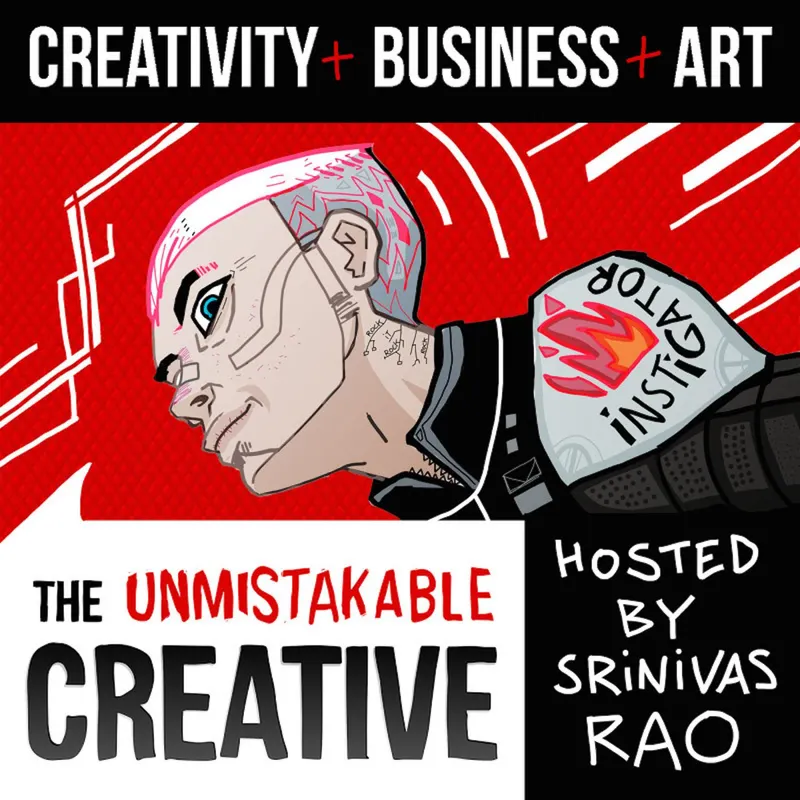
The Unmistakable Creative Podcast
Srinivas Rao·1000 episodes
Timeless Practical Wisdom For Living a Meaningful LifeInspiring stories and practical advice from creatives, entrepreneurs, change-makers, misfits, and rebels to help you become successful on your own terms Our listeners say, “If TEDTalks met Oprah you’d have the Unmistakable Creative.” Eliminate the feeling of being stuck in your life, blocked in your creativity, and discover higher levels of meaning and purpose in your life and career. Listen to deeply personal, insightful, and thought-provoking stories from the world’s leading thinkers and doers including best-selling authors, artists, peak performance psychologists, happiness researchers, entrepreneurs, startup founders, artists, venture capitalists, and even former ban...
Why listen
The Unmistakable Creative Podcast is a long-running interview show for people trying to build a more meaningful creative life, career, or business. Srinivas Rao talks with authors, researchers, entrepreneurs, artists, and unconventional thinkers in conversations that mix personal backstory with practical frameworks. It is especially good for listeners who like self-improvement without a purely hustle-focused tone.
Episodes
Pulitzer Prize-winning author Charles Duhigg breaks down the science of conversation and connection from his book Super Communicators. He explains why 80% of our conversations naturally align, how to use looping for understanding during conflict, and why super communicators ask 10-20x more questions than average. Hosted on Acast. See acast.com/privacy for more information.
Cell biologist Bruce Lipton explores how subconscious programming shapes our lives, explaining the science behind beliefs and habits. He discusses his research on epigenetics, how environment influences gene expression, and practical methods for reprogramming limiting beliefs installed during childhood. Hosted on Acast. See acast.com/privacy for more information.
Toy entrepreneur Brad Pederson shares how building multiple toy companies and going through three bankruptcies taught him that struggles forge character. From launching a styrofoam glider as a kid to getting thrown into special loans by his bank, Brad unpacks why pride comes before the fall, how he learned to become antifragile rather than just resilient, and why courage is the cardinal virtue that makes creative ideas matter. He discusses the three roles of a CEO, the importance of play for adults, and how his book Startup Santa captures the lessons of failing forward. Hosted on Acast. See acast.com/privacy for more information.
Brad Montague, creator of Kid President on YouTube, shares how his small-town upbringing and key mentors shaped his creative path. He opens up about working with his brother-in-law Robbie, protecting a child from the pressures of viral fame, and why maintaining childlike wonder is essential for authentic creative work. Hosted on Acast. See acast.com/privacy for more information.
Marketing professor and author Ben Guttmann explains why we over-complicate our messaging and how to apply design principles to communicate with clarity. He breaks down the drill-built method for identifying emotional benefits, shares his controversial take on AI as unlimited stupid people, and reveals why features never sell but benefits always do. Hosted on Acast. See acast.com/privacy for more information.
Economist Allison Schrager, author of An Economist Walks into a Brothel, discusses the psychology of risk tolerance through her framework of financial economics. She explores how our high school social choices reveal risk preferences, the difference between calculated risks and reckless ones, and why taking more risks often leads to becoming better at evaluating them. The conversation covers risk in creative careers, the math of making risky art, and how to organize your thinking around uncertainty to make better life decisions. Hosted on Acast. See acast.com/privacy for more information.
Science journalist Annie Murphy Paul explains her theory of the Extended Mind - how we think better when we use our bodies, environments, and relationships rather than keeping everything in our heads. The conversation covers gesture and memory, why big screens beat laptops for creative work, the neuroscience of exercise, and how physical spaces shape intelligent thinking. Hosted on Acast. See acast.com/privacy for more information.
Performance coach Alan Stein Jr shares lessons from training NBA legends like Kobe Bryant and Kevin Durant. He discusses the fundamentals that separate elite performers, why he does not let his kids win at games, the danger of measuring success by outcomes vs process, and why the unseen hours of practice matter more than highlights. Hosted on Acast. See acast.com/privacy for more information.
Brant Pinvidic, Hollywood producer and author of The 3 Minute Rule, shares how he accidentally discovered his pitch methodology after being asked to help investment bankers stop putting people to sleep. He breaks down the WHAC method (What is it, How does it work, Are you sure, Can you do it), explains the critical difference between informative and engaging content, and demonstrates his framework live by helping refine the Unmistakable Creative podcast pitch. Brant discusses why most pitches fail in the first 3 minutes, how to capture attention through statements rather than questions, and why simplicity beats complexity when communicating ideas. Hosted on Acast. See acast.com/privacy for more information.
Ananta Ripa Ajmera, author and Ayurveda expert, shares how ancient Indian wellness practices can help break negative patterns and build sustainable healthy habits. She discusses the importance of morning sun rituals, the three pillars of health (food, sleep, sex), and how small positive choices compound over time. Hosted on Acast. See acast.com/privacy for more information.
Anders Ericsson, the pioneering researcher behind deliberate practice, explains the essential components of purposeful learning and skill development. He discusses how teachers help identify performance gaps, why measuring progress against clear benchmarks is crucial, and the difference between mindless repetition and intentional practice designed to push beyond your current best. Hosted on Acast. See acast.com/privacy for more information.
Amber Rae shares her mission to redefine ambition—shifting from fear-driven achievement to heart-led self-expression. She discusses her pivotal moment at 22 when she left a conventional tech job during the recession to pursue a more meaningful path, and shares tactics from her work as chief evangelist at startups. Hosted on Acast. See acast.com/privacy for more information.
Brad Stulberg returns to discuss his book Master of Change and the concept of rugged flexibility—combining stability with adaptability to navigate life's transitions. He shares practical frameworks like the 4Ps for managing daily disruptions and Viktor Frankl's tragic optimism for embracing life's inevitable challenges without falling into toxic positivity or despair. Hosted on Acast. See acast.com/privacy for more information.
Shawn Dove, founder of the Campaign for Black Male Achievement, discusses how transformational leaders need support to birth their greatest work—using the metaphor of a doctor pulling his son from a breech delivery. The conversation explores race, media representation, economic mobility, and why those closest to problems hold the most innovative solutions. Hosted on Acast. See acast.com/privacy for more information.
Ananta Ripa Ajmera shares how ancient Ayurvedic wisdom can help break self-destructive patterns and build healthier daily habits. The conversation covers the three pillars of health—food, sleep, and sex—and practical morning rituals for connecting with natural rhythms. Hosted on Acast. See acast.com/privacy for more information.
Bob Gower, a former member of the organization One Taste, dissects the mechanics of toxic charisma in personal development. He explains how cult-like leaders exploit emotional immaturity and our desire to be fixed, and shares practical ways to recognize manipulation before it leads to heartbreak and exploitation. Hosted on Acast. See acast.com/privacy for more information.
After losing both parents in a car accident at age 20, April Rinne developed a framework for navigating constant change that became her book Flux. She discusses the eight superpowers for thriving in uncertainty—including running slower, seeing what is invisible, and letting go of the future—drawing from her work as a futurist and her deeply personal experience with loss. Hosted on Acast. See acast.com/privacy for more information.
Stanford addiction psychiatrist Anna Lembke explains the neuroscience of dopamine and why our brains respond to social media the same way they respond to drugs. Drawing from her book Dopamine Nation, she shares how a dopamine fast can reset reward pathways and why the solution requires both individual discipline and systemic change. Hosted on Acast. See acast.com/privacy for more information.
Brandeis professor Andy Molinsky breaks down the psychology of why we avoid challenging situations and shares his research-backed framework for pushing past fear. He discusses conviction, customization, and clarity as the keys to taking leaps that feel impossible. Hosted on Acast. See acast.com/privacy for more information.
Andrew Horn shares his journey from nightclub promoter to founder of Tribute and The Junto mens group. He discusses how a pivotal conversation with his father about pride led him to discover purpose through service, and explores how appreciation and emotional vulnerability create meaningful human connection. Hosted on Acast. See acast.com/privacy for more information.
Harvard professor Amy Edmondson breaks down the three types of failure—intelligent, basic, and complex—and why most of us never learn from them. She explores why kids lose their natural curiosity about failure as they grow up, how to design experiments that generate useful failures, and the systems thinking required to prevent cascading disasters. Hosted on Acast. See acast.com/privacy for more information.
Amy Blankson, happiness researcher and author of The Future of Happiness, explains how positive psychology can help us use technology intentionally rather than reactively. She shares practical strategies including tracking phone usage, leveraging wearables for self-awareness, and making conscious micro-decisions about when and why we use our devices. Hosted on Acast. See acast.com/privacy for more information.
Historian and futurist Alex Pang explains why history's most creative people worked in short, focused bursts and took their leisure seriously. He traces the science behind rest, walking, naps, and deep play as tools for creativity, drawing on everyone from Darwin to Stephen King. Hosted on Acast. See acast.com/privacy for more information.
B. Jeffrey, a teacher at Parsons School of Design and author of Creative Careers, discusses how to make a living from your ideas without chasing false definitions of success. He explores the difference between having a vision and proving a concept, why obsession is a necessary condition for building empires like Ralph Lauren or Apple, and how most creative people never ask themselves what success actually looks like to them. Hosted on Acast. See acast.com/privacy for more information.
David Allen, creator of the Getting Things Done methodology, shares the unconventional path that led him from 35 jobs before 35, drug experimentation, and a childhood fascination with magic to becoming the godfather of modern productivity. He explains why your brain evolved for pattern recognition, not task management, and breaks down his capture-clarify-organize-reflect-engage framework. Hosted on Acast. See acast.com/privacy for more information.
Dan Lerner teaches the Science of Happiness at NYU. He explains how to identify your signature strengths using the VIA assessment and why companies that emphasize character strengths see 73% employee engagement versus 9% for those focused on weaknesses. Includes a story about a lawyer who turned down a Fortune 100 job to join Jet.com as their 10th employee. Hosted on Acast. See acast.com/privacy for more information.
Cyril Bouquet, professor at IMD Business School and lifelong immigrant, explains how creativity requires seeing the world with fresh eyes. He breaks down the ALIEN framework, an acronym for five lenses that help you escape conventional thinking and approach problems like someone from another planet. Hosted on Acast. See acast.com/privacy for more information.
Brad Stulberg returns to discuss his book Master of Change, exploring how the science of allostasis reveals that true stability comes from adapting rather than resisting. He shares practical frameworks like 2Ps vs 4Ps for handling daily disruptions and tragic optimism for navigating life's bigger changes. Hosted on Acast. See acast.com/privacy for more information.
AJ Leon shares how losing his father at 14 and growing up marginalized shaped his philosophy of defiance over courage. He discusses the Ms. Mitchell moment that catalyzed his career, why context matters when processing grief, and the deliberate thoughtfulness behind building Misfit Inc into a collection of six companies. Hosted on Acast. See acast.com/privacy for more information.
Chase Jarvis, founder of CreativeLive and author of Creative Calling, discusses why creativity is a practical skill everyone possesses from birth that gets systematically suppressed by education and culture. He breaks down his IDEA framework for unlocking creative potential and building a life around the work you were meant to do. Hosted on Acast. See acast.com/privacy for more information.
UCSF neuroscientist Adam Gazzaley explains the evolutionary mismatch between our attention systems and modern technology. He breaks down top-down vs bottom-up attention, the limits of cognitive control, and practical strategies for reclaiming focus in a distracted world. Hosted on Acast. See acast.com/privacy for more information.
Austin Kleon, author of Steal Like an Artist and Keep Going, returns to discuss how creative work emerges from deep dissatisfaction with the world rather than contentment. He explores why the metaphors we use for creativity matter, how quilting offers a better model than vandalism for making art, and why every book requires learning the craft all over again. Hosted on Acast. See acast.com/privacy for more information.
Author and entrepreneur Luke Burgis joins us to explore the invisible architecture of human desire — and how understanding it can radically change our choices, ambitions, and sense of self. Drawing on his book *Wanting* and the mimetic theory of René Girard, Burgis unpacks how most of what we "want" is shaped not by independent reasoning, but by models — people we unconsciously imitate.From adolescent identity formation to startup culture, self-improvement traps, and curated social media personas, Burgis reveals how easily our values can be hijacked. He discusses the destructive loop of rivalrous desire, the myth of the autonomous goal-setter, and how most of us never pause to ask *why* we want what we want. The conversation also dives into the difference between thin vs. thick desires, how to build a life rooted in fulfillment rather than status, and the importance of discovering what only *you* can do. For anyone seeking clarity in a noisy, comparison-driven world, this episode is a wake-up call — and a blueprint for reclaiming your inner compass. Hosted on Acast. See acast.com/privacy for more information.
Laura Owens, broadcaster and domestic violence survivor, shares her journey from an abusive relationship to reclaiming her voice and sense of self. Growing up in a family dedicated to broadcasting and storytelling, she learned the power of narrative—but nothing prepared her for how deeply trauma would challenge her ability to trust and be vulnerable. Laura explains why going to the police felt like a betrayal that led nowhere, why victims face a coat of shame they shouldn't have to wear, and how emotional abuse can be more damaging than physical violence. She explores the difference between letting your past inform your future versus letting it define you, why self-worth recovery is a daily struggle, and how gratitude journaling and surrounding yourself with trustworthy people become part of healing. This conversation challenges the victim-blaming question of why didn't she leave and reframes survival as strength, not weakness. Hosted on Acast. See acast.com/privacy for more information.
Kristin Neff, pioneering researcher and author of *Self-Compassion*, shares a groundbreaking case for why treating ourselves with kindness isn’t indulgent — it’s essential. Drawing on decades of academic research and personal reflection, Neff outlines how self-compassion transforms mental health, resilience, motivation, and even our relationship to ambition.The conversation spans parenting, education, culture, and the myth of the “perfect” self. Neff breaks down the differences between self-esteem and self-compassion, explores how shame and criticism undermine growth, and reveals how to rewire self-talk using neuroscience and contemplative practice. Her concept of self-worth isn’t built on achievement or performance — it’s rooted in humanity, connection, and presence.From emotional resilience and rumination to social comparison and cultural programming, this episode is a masterclass in learning to care for yourself — not as a reward for success, but as a prerequisite for thriving. Hosted on Acast. See acast.com/privacy for more information.
Kate Peterson, artist and author, shares her journey from chasing Instagram validation to defining success on her own terms. After spending 10 months in Greece, she realized that achievement itself was hollow—what mattered was building a life where small joys like pastries and coffee became the reward, not just checkpoints on a path to something else. Peterson explores how growing up across cultures shaped her identity, why social media creates superficial positive reinforcement loops, and how artists must navigate the spectrum between creating what they want and creating what pays. The conversation challenges Western individualism, explores Greek concepts of joy and togetherness, and questions whether the pursuit of an extraordinary life undermines the value of a perfectly good ordinary one. This is about defining the good life for yourself, not inheriting someone else's blueprint. Hosted on Acast. See acast.com/privacy for more information.
Kamal Ravikant, author of "Love Yourself Like Your Life Depends On It," breaks down the neuroscience and daily practice of self-love as a transformative mental discipline. Drawing from his own journey through depression, Kamal explains how thoughts are just old mental loops running on autopilot, how we can consciously rewrite painful memories by changing their emotional charge, and why self-forgiveness is the necessary first step before transformation. He introduces the practice of layering one primal mental loop—I love myself—until it runs automatically and becomes the foundation from which your thoughts, feelings, and life arise. This conversation explores the malleability of memory, why the mind needs constant training like the body, and how seven minutes a day of internal work can compound into lasting change from the inside out. Hosted on Acast. See acast.com/privacy for more information.
Justin Connor, filmmaker and musician behind The Golden Age, shares how his saxophonist father and jazz-loving parents never encouraged music yet inadvertently programmed workaholism into his DNA—a double-edged sword that became both his greatest asset for wearing multiple hats on independent films and his potential downfall requiring hard drive reformatting of his life. Connor reveals how cigarette addiction reflected grief stored in the lungs, how psychedelics and ayahuasca offered exploration without true addiction, and why workaholism proved more dangerous than any substance by fueling perfectionism, obsessive careerism, and control. Drawing from his upbringing witnessing family dynamics, he explains how directing became about trusting himself as an adult after childhood wounds, why he interned for Eric Holder before a double feature of Shawshank Redemption and Pulp Fiction redirected him to Hollywood, and how creating The Golden Age with superhuman strength felt like lancing a boil that needed purging—a film he could never remake even with 10 million dollars. Hosted on Acast. See acast.com/privacy for more information.
Jim Kwik, brain performance expert and author of Limitless, reveals how a childhood brain injury transformed him from the kid with the broken brain into one of the world leading authorities on accelerated learning and memory. Drawing from his immigrant parents sacrifices and his own journey through learning disabilities, Jim breaks down the three forces that limit us mindset, motivation, and methods. He explains why risk-taking capacity gets drilled out of us with age, how reframing victimhood into gifts unlocked his superpower, and why comparison through social media creates digital depression. This conversation explores neuroplasticity, energy management, and how to align daily actions with core values to escape the box of limiting beliefs. Hosted on Acast. See acast.com/privacy for more information.
Vanessa Van Edwards, behavioral researcher and author, traces her expertise in human behavior back to being a highly neurotic student council nerd with few friends in high school. That discomfort zone became her comfort zone—teaching, conferences, and analyzing how people communicate. Van Edwards breaks down nonverbal communication patterns, micro-expressions, charisma signals, and what research reveals about likability versus respect. She explains how to read rooms, why authenticity beats performance in social settings, and the science behind first impressions. Her work transforms awkward interactions into learnable skills by treating social dynamics as data rather than mystery. Hosted on Acast. See acast.com/privacy for more information.
Tiago Forte, creator of the Second Brain methodology, shares how attending five different schools in five consecutive years obliterated his social circles and forced him to become a chameleon—crossing between student government, cross country, French club, and chess nerds. This adaptability became the foundation for his work on knowledge management and building systems that work across contexts. Forte explains the CODE method for organizing information, why traditional note-taking fails, how to capture and connect ideas across projects, and why your brain is for having ideas, not storing them. His system helps knowledge workers think better by externalizing memory into a trusted digital system. Hosted on Acast. See acast.com/privacy for more information.
Susan Magsamen, author of Your Brain on Art, explores creativity through neuroscience rather than philosophy or technique. Born to working-class parents who never attended college—her father worked his way up from nurseries to insurance executive—Magsamen learned management and relentless work ethic early. She explains how art and creative engagement physically change brain structure, why aesthetic experiences matter for wellbeing beyond productivity, and what neuroscience reveals about how humans process creative work. Her research-backed approach bridges the gap between artistic practice and biological reality, showing that creativity isn't mystical—it's measurable, trainable, and essential for cognitive health. Hosted on Acast. See acast.com/privacy for more information.
Robin Dellabough, writer and editor, shares her unconventional journey from growing up in a bohemian Greenwich Village household to spending decades supporting other people's creativity. Raised by beatnik parents who gave her the confidence to try anything, she hitchhiked Europe at 17, lived in a Hawaiian treehouse, worked as a theater stage manager, and ghostwrote books—all while her own creative voice remained underground. Dellabough explains the pattern of talented people who facilitate others' success while neglecting their own work, how she eventually claimed her creative life through poetry and writing, and why direct feedback without sugarcoating serves creative growth better than false encouragement. Hosted on Acast. See acast.com/privacy for more information.
Rob Bloom, creative director for Universal theme parks, shares his journey living with a stutter that shaped his entire life and career. He reveals how hiding his stutter for 30 years meant ordering food he didn't want, watching movies he didn't choose, and avoiding authentic self-expression. Paradoxically, stuttering forced him to become creative early—making videos for school presentations instead of speaking. Bloom explains the three coping strategies for stutterers (openly stuttering, blocking, or hiding), why hiding leads to inauthenticity, and how he eventually embraced his stutter. His story demonstrates how perceived limitations can become creative advantages and why vulnerability is essential for genuine connection. Hosted on Acast. See acast.com/privacy for more information.
Rich Karlgaard, author of Late Bloomers, dismantles the toxic narrative that success must come early. Drawing from his father's reinvention in his 30s and his own struggles after college, he explains why our obsession with early achievement is detrimental to people who develop at different paces. Karlgaard analyzes the college admissions scandal as a symptom of parental pressure, explores how comparison culture on platforms like Medium fuels inadequacy, and offers a research-backed case for why patience and diverse developmental timelines produce more fulfilled, successful individuals. He argues that being fired, struggling, and blooming late often leads to greater work than following the traditional fast-track path. Hosted on Acast. See acast.com/privacy for more information.
Rebecca Beltran shares her unconventional journey from polyamory to becoming a courtesan, challenging cultural stigma around sex work and intimacy. She reveals that her work is primarily about connection and being truly seen—not just physical encounters. Rebecca explains how religious Puritanism shapes American attitudes toward sexuality, why younger men in their 20s and 30s are now seeking her services post-Me Too movement, and how open communication about desire can shift sex from something dangerous to something empowering. She also discusses navigating relationships with partners outside her work and why pleasure rooted in fulfillment matters more than hedonistic thrills. Hosted on Acast. See acast.com/privacy for more information.
Jenny Blake, author of "Free Time," reveals how her father—an architect who gives ruthless editorial feedback with his "WKIYB" abbreviation (we know it’s your book)—taught her to eliminate unnecessary qualifiers and strengthen her writing. Drawing from her experience creating a paid family newsletter at age 11 with 50 subscribers, Blake has always been entrepreneurial, guided by her mother’s lesson: "you should always know how to support yourself." As the breadwinner in her marriage who rejects traditional domestic roles, Blake challenges societal pressures on both men and women around earning and gender expectations. She introduces the "time-to-revenue ratio"—a missing P&L metric that measures how much time it takes to generate revenue—arguing that revenue, ease, and joy aren’t mutually exclusive. Blake dismantles Benjamin Franklin’s "time is money" myth, explaining that business owners aren’t rewarded for butt-in-seat time and that working less actually requires more sophistication through systems, automation, and delegation. Her three-part framework—align, design, assign—helps entrepreneurs optimize what’s now, not just navigate what’s next. Hosted on Acast. See acast.com/privacy for more information.
Marc Elliott shares his controversial perspective on NXIVM, arguing that media narratives have distorted the truth about Keith Raniere and the organization. Living with severe Tourette syndrome for 20 years, Elliott found relief through NXIVM techniques when traditional medical approaches failed. He challenges the dominant narrative by examining inconsistencies in accusers stories, questioning the lack of due process in the trial, and arguing that salacious headlines and the MeToo movement created a climate where critical questioning was discouraged. Elliott explains how easy it is to be a victim in modern culture, the importance of evaluating evidence rather than emotions, and why he believes that prejudicial tactics corrupted the judicial process. This conversation explores media manipulation, the ethics of narrative control, and the uncomfortable space between believing victims and demanding evidence. Hosted on Acast. See acast.com/privacy for more information.
Luvvie Ajayi Jones challenges the cultural expectation that harmony is more important than justice. As a professional troublemaker, she argues that speaking up in rooms where bad ideas or unjust systems persist is not just necessary—it is our responsibility. Drawing from her Nigerian heritage and her grandmother's fearless example, Luvvie explores how we've been conditioned to shrink ourselves, hide our superpowers, and accept being called "too much" instead of claiming our full selves. She breaks down why we fear asking for what we want, why boundaries are gifts rather than selfishness, and how imposter syndrome can actually drive us to do better work. Her framework for professional troublemaking reframes discomfort as worthwhile when it serves a larger cause. Hosted on Acast. See acast.com/privacy for more information.
Peter Krask, creator of Myth Merchant and former Hollywood producer, shares his journey from quitting grad school to producing reality TV to building a business around storytelling and mythology. After realizing a PhD wasn't his path, Krask dove into the entertainment industry, learning the business side of creativity—budgets, staff, international shipping, and legitimacy through visibility. He explains how being on television instantly validated his work in ways that years of independent effort couldn't, why many people stay in PhD programs despite knowing it's not right for them, and what he's learned about balancing artistic ambition with commercial viability. This conversation explores the tension between creative freedom and financial sustainability, the cultural weight of visible success, and how mythology and narrative shape the way we understand our lives and work. Hosted on Acast. See acast.com/privacy for more information.
Reviews
No reviews yet.
If you like this...

Make Some Noise
Same topic · Same format · Same audience

On Being with Krista Tippett
Same vibe · Same tone · Same audience

The Portfolio Life with Jeff Goins
Same audience · Same vibe · Same format

How She Creates Podcast
Same topic · Same format · Same vibe

Creative Pep Talk
Same topic · Same audience · Same tone

Coach Corey Wayne
Same topic · Same audience

Lifehouse Messages
Same tone · Same audience

Sadhguru Deutsch
Same topic · Same audience

Sleep Sounds Meditation for Women
Same vibe
 CrossBinge
Discover books
One connected taste across films, series, games, books & music.
Explore more like this
Listening context
Discussion (0)
No comments yet. Be the first to start the discussion!