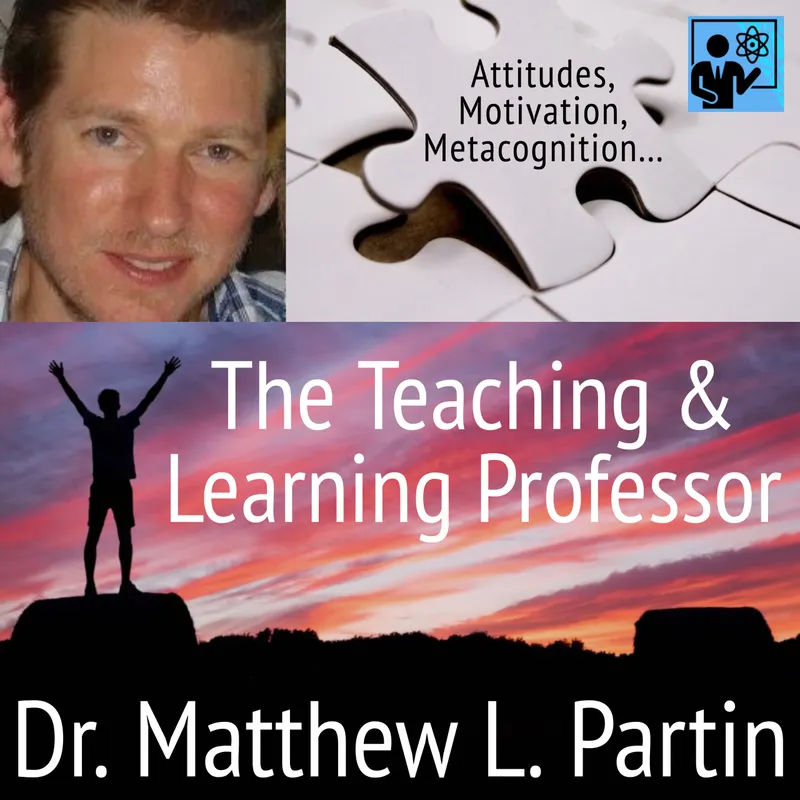
The Teaching & Learning Professor
Dr. Matthew L. Partin·10 episodes
Have you ever driven home from work and after arriving home you can’t remember any of the details of your daily commute? Did you wonder if you actually stopped at all of the stop signs or drove on the right side of the road? This actually began happening to me after teaching the same marine biology lectures for 10 years. My lectures were completely on auto-pilot. I think they were OK and my course reviews were good. However, I was bored and my students had to be bored too. To improve my courses and to keep myself engaged, I began to...
Why listen
The Teaching & Learning Professor is for college instructors, science educators, and curious students who want practical conversations about how people actually learn. Dr. Matthew L. Partin mixes short teaching reflections with interviews from BGSU faculty, covering topics like constructivism, growth mindset, undergraduate research, learning communities, and academic mentorship. It has a very campus-based, working-professor feel, which makes it useful for listeners who prefer concrete classroom experience over polished education theory.
Episodes
Today’s guest is my greatest inspiration and mentor. He is an Emeritus Professor of Education at Bowling Green State University. He served as the Coordinator for the Guidance and Counseling Program and as the Coordinator of Graduate Programs in the School of Teaching and Learning. He retired from the University in 1999 but continues to educate the public by serving as a volunteer docent at the Carl Sandberg home in Hendersonville, North Carolina. He is the author of several books including The Classroom Teacher’s Survival Guide, The Social Studies Teachers Book of Lists, Social Studies Teachers Survival Kit, and Online Social Studies Resources. In this interview, he discusses perfectionism, BGSU in the 1960s, and his teaching philosophy. Please welcome my father, Dr. Ronald L. Partin…_______________________Interact with Dr. Partin and the Teaching and Learning Professor community at:https://www.facebook.com/theteachingandlearningprofessor/_______________________Support this podcast at RedCircle— DONATE TODAY!!I'm using your donation to buy a new microphone and studio equipment to improve my sound. I need coffee too :-)_______________________Support this podcast at — https://redcircle.com/the-teaching-and-learning-professor/donations
Guest IntroductionToday’s guest is a professor in the School of Teaching and Learning at Bowling Green State University. He teaches Science Methods for the Inclusive Early Childhood Classroom, Advanced Methods in Elementary School Science, Advanced Pedagogy and Best Practices, Qualitative Approaches to Classroom Inquiry, as well as Issues and Trends in Curriculum and Instruction. His research focuses on “Play” in human and nonhuman primates, lesson study with preservice and inservice teachers, and the acquisition of pedagogical content knowledge. He is a good friend and collogue. Please welcome Dr. Rick Worch._______________________Table of Contents:00:00 - Introduction - Learning Theory 2) prior knowledge plays a key role in learning (Smith 2018). Because each individual has a unique view of the world, humans create their own learning experiences and uniquely decipher information in ways that may differ from others. Transformative TheoryTransformative learning
Today’s guest has built a lab that attracts both thriving graduate and undergraduate students. He currently oversees a doctoral student, 3 master’s students, and a few advanced undergraduates. The lab studies how human alteration of environmental factors influences the dynamics of animals in terrestrial and aquatic food webs and ecosystems using integrative approaches. Their work investigates basic ecological questions that have importance for achieving sustainable environmental management in a changing world. Their four key research areas include Terrestrial Water Webs, Water Quantity and Quality Effects on Aquatic-Terrestrial Linkages, Urbanization and Climate Change, and Riverine Macrosystems.Today’s guest has been working very long hours to get his lab up and running over the past five years and he has recently been tenured in the Biological Sciences at BGSU. He is a friend and colleague. Please welcome Dr. Kevin McCluney._______________________Table of Contents:00:00 - Introduction - Academic Tenure, Undergraduate Research, and society will benefit if scholars are free to explore a variety of topics, questions, and opinions. It also prevents schools from replacing more expensive seasoned teachers with less expensive novice teachers to save money. However, some believe that the tenure system doesn’t provide an incentive for faculty to remain productive after they are tenured. Tenure Track vs Non-Tenure Track The tenure process is rigorous and it can be brutal. New “tenure-track” faculty members typically have a limited amount of time to produce an adequate record in teaching, research (grants & publications), and serv
Intended for students working in the BGSU Marine Lab. This guide covers basic marine lab husbandry.________________________Table of Contents:00:18 - Marine Lab Handbook00:26 - BGSU Marine Laboratory04:24 - History05:32 - Table of Contents05:33 - Safety Precautions09:24 - General Rules13:32 - Marine Lab Position Hierarchy16:51 - Marine Lab Positions20:28 - Assistant Coordinator Positions23:22 - How to mix Saltwater29:08 -33:41 - Tank Checks34:56 - Freshwater Tank Procedures38:53 - Saltwater Tank Procedures44:06 -47:56 - Coral Systems52:18 -54:05 - Coral Husbandry59:47 -01:04:05 -01:09:37 -01:14:59 - Feeding01:18:01 -01:20:43 - Tank Maintenance01:24:26 - Filtration01:28:54 - General Aquarium Maintance01:31:00 -01:34:58 - Tours01:36:11 -01:39:05 -01:40:42 -01:40:45 - Salinity Chart01:41:43 - Nitrogen Cycle01:42:30 -01:42:34 -01:42:59 -01:43:03 -01:43:15 -01:43:18 -________________________Interact with Dr. Partin and the Teaching and Learning Professor community at:https://www.facebook.com/theteachingandlearningprofessor/orhttps://blogs.bgsu.edu/teachingandlearningprofessor________________________Support this podcast at — https://redcircle.com/the-teaching-and-learning-professor/donations
Today’s guest is a Professor in the Department of Biological Sciences at BGSU. He was formerly the Director of the BGSU Marine Biology Program from 1994-1999, the Director of the Center for Neuroscience, Mind & Behavior from 2000-2002, and the Director of the University Honors Program from 2002-2012.Today’s guest has also been the Director of the Laboratory for Sensory Ecology since 1994. The Laboratory for Sensory Ecology is a multi-disciplinary lab that is interested in any questions concerning sensory behavior, evolution, physiology, and ecology. Most of their current projects are centered on understanding the role that chemical signals play in an organism's ecological role. They have projects that range from understanding the physics behind antennae design, predator avoidance, selection of habitats and mates, dominance hierarchies and other social behaviors to analyzing the chemical composition of these signals.He is a former professor of mine, a colleague, friend, and mentor. Please Welcome Dr. Paul Moore._______________________Table of Contents:00:00 - Introduction - Undergraduate Research & Mentoring05:40 - Interview with Dr. Paul Moore_______________________Interact with Dr. Partin and the Teaching and Learning Professor community at:https://www.facebook.com/theteachingandlearningprofessor/_______________________Support this podcast at RedCircle— DONATE TODAY!!I'm using your donation to buy a new microphone and studio equipment to improve my sound. I need coffee too :-)_______________________URE vs CUREUndergraduate Research Experiences (UREs) and Course-based Undergraduate Research Experiences (CUREs) have recently become very popular among STEM disciplines in colleges and universities in the United States. UREs are usually limited to few students and competitive. Students who apply for UREs are typically highly interested in research, high achieving, and motivated. Students work closely with faculty, post-doctoral researchers, or graduate students during a summer, semester, year, or longer. CUREs are embedded in a course as part of the curriculum and typically only last for one semester, but they may span 2 or more courses. However, CUREs may put a strain on the professor teaching the course because they need to oversee many student’s simultaneously.BenefitsUndergraduate research offers opportunities for independent research, experience in the field of study, and professional mentoring. There is evidence suggesting that undergraduate research benefits students by preparing them t
This is a description of the Marine and Aquatic Biology Program at Bowling Green State University in Ohio.Table of Contents:00:00 - Intro00:32 - Marine Biology at BGSU00:53 - History02:58 - Marine Lab Hierarchy05:04 - Dr. Sylvia Earle06:23 - Marine Aquatic Biology Specialization08:49 - Field Experience10:18 - Study Abroad11:40 - Other Opportunities at BGSU16:17 - T-Shirts Sweat Shirts16:21 - Marine Aquatic Biology Checksheet_______________________Interact with Dr. Partin and the Teaching and Learning Professor community at:https://www.facebook.com/theteachingandlearningprofessor/_______________________Support this podcast at — https://redcircle.com/the-teaching-and-learning-professor/donations
Today’s guest is an associate professor of biological sciences at BGSU. She's been faculty at BGSU since 1985 and the director of the BGSU Herpetarium since 1997. Her research interests include developmental genetics, reptile and amphibian husbandry, egg incubation, as well as student engagement and attitudes. She is a good friend and mentor. Please welcome Dr. Eileen Underwood.____________________Table of Contents:00:00 - Introduction05:41 - Interview with Dr. Eileen Underwood24:34 - Video Outage26:25 - Video Back_______________________Interact with Dr. Partin and the Teaching and Learning Professor community at:https://www.facebook.com/theteachingandlearningprofessor/_______________________Support this podcast at RedCircle— DONATE TODAY!!I'm using your donation to buy a new microphone and studio equipment to improve my sound. I need coffee too :-)_____________________ MATT Testing… Testing… 123 Testing… INNER DIALOGUE MATT Hi Matt! Did you remember to push the record button? Last time you forgot and you had to rerecord the entire introduction. MATT Who said that? INNER DIALOGUE MATT Me. I'm your inner dialogue. You can call me at IDM. Short for INNER DIALOGUE MATT. MATT OK. Hi IDM. If you’ll excuse me I’m recording an introduction to a podcast. INNER DIALOGUE MATT I know. Do you realize that you are terrible at podcasting? You're obviously reading a script and you look like a deer caught in headlights. Maybe you should try mixing it up a little bit. MATT OK. Like how? INNER DIALOGUE MATT You'll think of something. Before you record, why don't you tell me about your topic. MATT I am talking about Learning Communities. I'm also talking about the Marine Lab and the Herpetarium. INNER DIALOGUE MATT Sounds kind of interesting. What is a Learning Community? MATT Nobody can say for sure. INNER DIALOGUE MATT What?! So, you don’t actually know what a Learning Community is?
To help us explore these topics further, I have invited Dr. Bob Midden to talk with us today. Dr. Midden is an Associate Professor of Chemistry and the Associate Vice Provost for Experiential and Innovative Learning here at BGSU. He came to BGSU in 1987 to join a team of scientists to build a new Ph.D. program in photochemical sciences and established BGSU as a national leader in photochemical sciences research. Since then his research interests have shifted from bioorganic photochemistry to finding ways to reform education at all levels. The recipient of more than $18 million in grants from federal and state agencies and private foundations, he has led multiple intercollegiate teams in efforts to improve K-12 as well as undergraduate and graduate instruction in the sciences, technology, engineering, and mathematics (or STEM) fields.Dr. Midden was the director of the Chapman Learning Community, which was the first comprehensive residential learning community at BGSU. He developed alternative learning experiences and actively engaged students with projects serving the surrounding communities. He also spearheaded an initiative to integrate service-learning into the undergraduate curriculum and to document the many ways in which faculty create such opportunities for their students.Dr. Midden was also the Director of the Northwest Ohio Center for Excellence in STEM Education (or NWO) with the mission of advancing STEM education for people of all ages. NWO serves the 29 counties of the northwest quadrant of Ohio and involves partnerships with most of the higher education institutions, many K-12 school districts, as well as numerous businesses and non-profit organizations throughout the region. NWO provides a variety of services to the region including K-12 and college faculty professional development, hosting annual symposia and student STEM competitions, administering multiple STEM college student scholarship programs, fostering the development of a new Learning Sciences doctoral program, and sponsoring other events aimed at promoting interest and success in STEM disciplines.In addition to his work as NWO Director, Dr. Midden lead a scientific research project investigating major issues threatening the environmental integrity and economic vitality of Lake Erie and other Ohio lakes, rivers, and streams. This project has involved more than 40 undergraduate and graduate students over the last five years and involves collaboration with several government agencies and scientists from throughout the region in addressing one of the most pressing environmental issues in Ohio.Bob is a colleague and good friend of mine. He helped me facilitate several learning communities and lead many teaching and learning workshops. He is someone who teaches me something new or presents a complicated concept with a fresh perspective every single time I talk to him. Please welcome Dr. Bob Midden.<p
To help us understand why exercise may make us smarter, I have invited my friend and colleague Amy Wager to talk to us today. She is an Associate Teaching Professor in the Department of Biological Sciences and Bowling Green State University and one of our Pre-Health Advisors. She teaches courses in Anatomy and Physiology and coordinates our anatomy labs._______________________Table of Contents:00:00 - Introduction - Locus of Control, Growth Mindset, and Control of Learning Beliefs03:10 - Interview with Amy Wagner_______________________Interact with Dr. Partin and the Teaching and Learning Professor community at:https://www.facebook.com/theteachingandlearningprofessor/_______________________Today’s main topic centers around the question “Can exercise make you smarter?” I think most of you know that physical exercise can make you healthier. You can build muscle, improve organ function, including your heart, circulatory system, and your cardiovascular system. Physical exercise may help you avoid lots of aches, pains, and disease later in life. But can physical exercise actually make you smarter? Mental exercise, such as learning, can make you smarter. In what-ever way you use your brain, you will build new neural connections that will strengthen each time you use those new pathways. Learning WILL make you smarter. But can physical exercise make you smarter? Researchers believe it can. To begin with, exercise stimulates the body's nervous system, causing it to release chemicals such as serotonin, dopamine, and endorphins that make us feel happy and calm. Endorphins have also been shown to improve memory. After exercise, memory improves and your ability to prioritize what is most import and what is less important improves, allowing you to block out distractions and better concentrate on an assignment. The release of these chemicals helps to explain why many people feel more focused and aware after they exercise. If you feel better, you can think more clearly and concentrate better. Your body will simply function at a higher level after exercising. With regular exercise and an improved cardiovascular system, you can bring blood and oxygen more efficiently to your brain. You may also improve the amount of time you can stay focused on studying and recover faster. In fact, it is believed that the growth of new brain cells and new neural connections can be stimulated by exercise. As your brain grows new cells and connections, the areas associated with memory and learning grow and overall brain function improves. So how much exercise do you need to keep your brain functioning at its best?A minimum is probably 15-20 minutes, three times
Interact with Dr. Partin and the Teaching and Learning Professor community at:https://www.facebook.com/theteachingandlearningprofessor/_______________________The purpose of this podcast is to explore best practices in teaching and learning in higher education. Keeping students focused and engaged can be challenging and often times frustrating. Sitting through long boring lectures can be difficult to follow and unlikely to leave you enthusiastic about the class or the discipline. With more engaging pedagogy from our professors and improved study habits from our students, far more knowledge will be transferred and everyone will be happier.Hi and welcome to The Teaching & Learning professor. My name is Dr. Matthew L. Partin. I am a Teaching Professor in the Department of Biological Sciences at Bowling Green State University in Bowling Green, Ohio. I have been faculty and the Director of the BGSU Marine Lab since 1999. I teach large lectures of marine biology for non-majors, a small upper-level aquarium husbandry course that incorporates undergraduate research, 2 service-learning courses, a marine biology freshman orientation course, and a study abroad field experience in Curacao (Southern Caribbean).The BGSU Marine Lab is a 1,500 sq. ft. facility which contains over 4,000 gallons of seawater in over 60 aquaria. Some of the larger systems include a 500-gallon touch tank, a 1,000-gallon shark system, and two coral research systems totaling 1,000 gallons. In the lab, eight major phyla are represented in over 66 genera of marine life including sea anemones, corals, starfish, sea urchins, snails, crabs, octopus, and algae as well as a wide variety of freshwater and marine fish.Outreach is a large part of the marine biology program at BGSU. The animals in the Marine Lab are maintained by students for class study and research projects but are also present for the appreciation of 2,000 visitors each year. The Marine Lab is free to visit, open to the public, and hosts local school groups every Thursday morning during the academic year.Undergraduate research is another focus of the marine biology program at BGSU. The BGSU Aquatic Research Laboratory (ARL) is a 1,450 sq. ft. facility dedicated to fresh and saltwater aquatic research for undergraduates. The ARL was recently built in response to BGSU’s strong support of undergraduate research and the prodigious growth of the Marine Biology program. The ARL is strictly for undergraduates not open to the public.The BGSU Marine Lab has been in existence since 1963 and as an undergraduate student in the early 1990s, I took courses in the marine lab and maintained the lab's first corals. After graduating with my bachelor’s degree, I became a professional aquarist in Manteo, North Carolina for a couple years. I eventually returned to BGSU for graduate s
Reviews
No reviews yet.
If you like this...


Explore more like this
Listening context
Discussion (0)
No comments yet. Be the first to start the discussion!