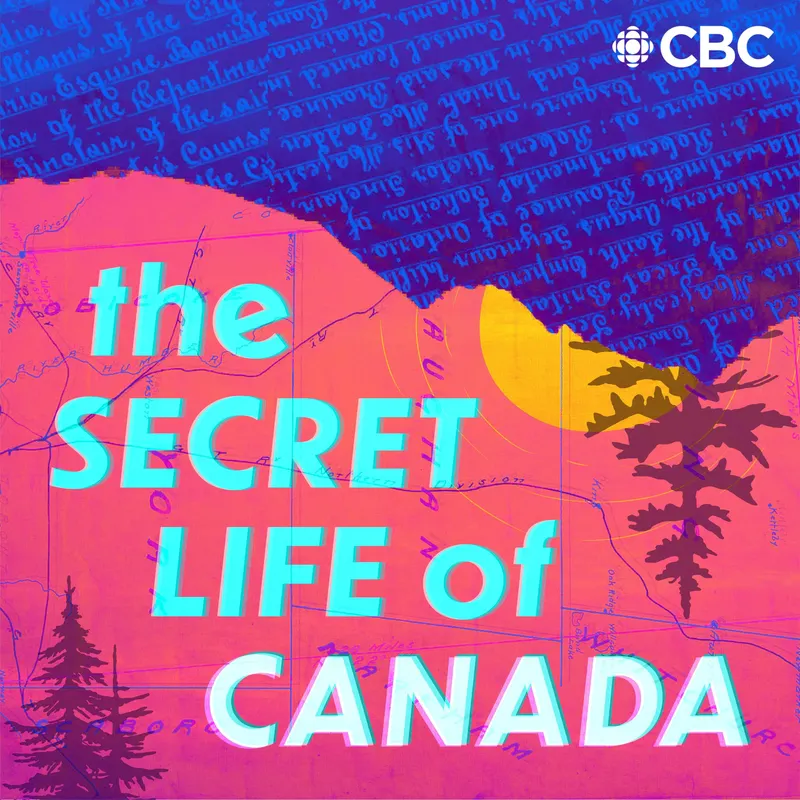
The Secret Life of Canada
CBC·Hosted by Leah-Simone Bowen and Falen Johnson·116 episodes
The country you know and the stories you don't. Join hosts Leah-Simone Bowen and Falen Johnson as they reveal the beautiful, terrible and weird histories of this land. New episodes every second Thursday.Visit us at www.cbc.ca/secretlife for show links, transcripts and more!Follow us on Instagram, Facebook, and TikTok.Subscribe to Sounds Good: CBC's Podcast newsletter for the finest podcast recommendations and behind-the-scenes exclusives.
Why listen
The Secret Life of Canada makes Canadian history feel vivid, funny, uncomfortable, and surprising, with Leah-Simone Bowen and Falen Johnson digging into the stories that rarely make the standard national narrative. Episodes mix co-hosted storytelling, archival context, expert guests, and sharp cultural commentary, so it works for listeners who want history that includes Indigenous, Black, immigrant, queer, regional, and pop-culture perspectives. It is especially good for curious listeners who like public-radio polish without a stiff classroom tone.
Series(3)
Episodes
The stories behind the legal battles that changed Canada — and the unlikely people who made it happen. Some were sh*t disturbers, some were convicts, and some were just regular folks dragged into a fight. Each week, host Falen Johnson teams up with a journalist to dig into a case that challenged the status quo, and asks: what kind of person takes on the law? What are the costs? And what would our lives look like if these cases never happened? Because let's be real, just because a case is closed doesn't mean the story’s over. More episodes of See You in Court are available here: https://link.mgln.ai/syic-sloc
Falen and Leah say goodbye, in the last episode of The Secret Life of Canada.For more links and more about this episode visit us at cbc.ca/secretlife. Follow us on Instagram , Facebook and Tik Tok.
People don’t think Graham Isador is losing his sight. They think he’s an asshole.Short Sighted is an attempt to explain what vision loss feels like by exploring how it sounds.Written and hosted by master storyteller Graham Isador, the show’s mini episodes are an intimate and irreverent look at accessibility and its personal impacts.Get lost in someone else’s life. From a mysterious childhood spent on the run, to a courageous escape from domestic violence, each season of Personally invites you to explore the human experience in all its complexity, one story — or season — at a time. This is what it sounds like to be human.More episodes of Personally are available at: lnk.to/SASSIAq9
Ah, the smell of fry bread, bright regalia, and vendors selling everything from dreamcatchers to expensive jewellery — the modern day powwow is really a feast for the senses. But did you know we can trace the roots of these gatherings to dodgy medicines and even old wild west shows? And how do you pronounce scone dog? Falen and Leah take to the powwow trail to find out what the powwow was and what it is now, and how it is helping some connect to culture. Check out our episode on the history of blackface here.And check out our episode on the potlatch ban here. For more links and more about this episode visit us at cbc.ca/secretlife. Follow us on Instagram, Facebook and Tik Tok.
Our country’s first sex scandal! At the height of the cold war several ministers in John Defeinbaker's government decided to have an affair. Turns out, they all ended up with the same woman. Was she really a spy for East Germany?For more links and more about this episode visit us at cbc.ca/secretlife. Follow us on Instagram, Facebook and Tik Tok.
It’s been called Canada’s Titanic. 106 years ago the Princess Sophia crashed into a coral reef on route to Vancouver and Victoria. Over 300 passengers died and it was the worst maritime disaster in the Pacific Northwest, so why haven’t we heard more about it? For more links and more about this episode visit us at cbc.ca/secretlife. Follow us on Instagram, Facebook and Tik Tok.
Don't Drink the Milk – The curious history of things from DW is a podcast that traces the unexpected backstories of everyday things that have traveled the world, by force, by chance, or by choice. In this episode, host Rachel Stewart unravels the history of witch hunts from deadly conspiracies in medieval Europe to use of the term today by powerful figures like Donald Trump. Why is it important to remember this history and how has the power shifted?More episodes of Don't Drink the Milk – The curious history of things can be found at: https://pod.link/1704462801
In 1955, Canada’s immigration officials began a special experimental program to bring in Palestinian refugees through Pier 21. Falen and Leah take a look back at this historic port of entry that saw almost a million immigrants and refugees arrive in Canada and then find out what has changed since Pier 21’s heyday. And then they try to find out if we are currently better or worse at responding to refugees in crisis zones like Gaza and Sudan.With special guests Jan Raska from the Canadian Museum of Immigration at Pier 21 and Gauri Sreenivasan from the Canadian Council for Refugees.Related episodes:Crash Course on Ukrainian CanadiansThe Halifax DonairThe province of JamaicaFor more links and more about this episode visit us at cbc.ca/secretlife. Follow us on Instagram, Facebook and Tik Tok.
In honor of spooky season, Falen and Leah are joined by producer Eunice Kim to learn why Winnipeg became known around the world for communicating with the dead. Together they’ll light some candles and find out why, in the mid-1900s, holding seances became sought after and then how that popularity inspired one of the most famous supernatural comedy films of all time — Ghostbusters. For more links and more about this episode visit us at cbc.ca/secretlife. Follow us on Instagram, Facebook and Tik Tok.
Leah and Falen take a (fully clothed) deep dive into the history of nudism in Canada. They learn the origins behind the naturist movement which includes a love of the outdoors, embracing nudity in a non-sexual way and most importantly, the use of a towel when sitting down. So, when did it all start here, who were the members of the clubs and what happened when someone got ...visibly aroused? We have all the answers in this brief history of nudism.*Content warning: this episode contains sexual content and adult themes which may not be suitable for younger listeners.Recommended companion episodes:Eugenics in CanadaWhere is Japantown?For more links and more about this episode visit us at cbc.ca/secretlife. Follow us on Instagram, Facebook and Tik Tok.
In a lot of history books we hear the names of European explorers who “discovered” the Americas. Columbus, Cook, Champlain. All boo-worthy men. But what about the people who went the other way? Indigenous people have been crossing oceans and going to Europe, too. But why don’t we know their names? In this episode Leah and Falen look into the story of those who went willingly and those who did not, those who came home and those who did not. With special guests Caroline Pennock, Coll Thrush, and Peter Morin.For more links and more about this episode visit us at cbc.ca/secretlife. Follow us on Instagram, Facebook and Tik Tok.
How did this country end up with the biggest Caribbean Carnival in North America? Leah and Falen dive into history of how a small one time event during Expo ‘67 became one of the longest running street parties in Canada — all courtesy of Trinidad and Tobago. With special guests Michelle Walker and Martin Scott-Pascall.For more links and more about this episode visit us at cbc.ca/secretlife. Follow us on Instagram, Facebook and Tik Tok.
The Secret Life of Canada went live at Hot Docs. Leah and Falen take a historical deep dive into the greatest thieves, crooks and liars that have made this country what it is today. Featuring guests, Sharjil Rasool and Brandon Hackett and music by Andrew Penner.For more links and more about this episode visit us at cbc.ca/secretlife. Follow us on Instagram, Facebook and Tik Tok.
People have been taking their clothes off for as long as they’ve been wearing them, but when did people start doing it for entertainment? In this episode Leah and Falen look into the history of burlesque in Canada and talk to a legend of the stage who’s been delighting audiences across the world for decades. With special guest, Judith Stein.For more links and more about this episode visit us at cbc.ca/secretlife. Follow us on Instagram, Facebook and Tik Tok.
Why did John Wilkes Booth, the man who assassinated President Abraham Lincoln, spend so much time in Montreal? We learn about how Canada was both the last stop on the Underground Railroad and the destination for Southern Confederate leaders and supporters to strategize, stash money and come up with plots against Abraham Lincoln. With special guests Dr. Afua Cooper and Julian Sher.For transcripts of this series, please visit: https://www.cbc.ca/radio/secretlifeofcanada/transcripts
Sable Island is the stuff of legends. A desolate tiny island in the Atlantic Ocean, where no one is permitted to live, except for wild horses. We figure out how they got there, how they’ve lived without humans since the 1700s and why many scientists think it's time to remove the horses out of their unique habitat.For more links and more about this episode visit us at: www.cbc.ca/secretlifeFor transcripts of this series, please visit: https://www.cbc.ca/radio/secretlifeofcanada/transcripts
Deception, backdoor dealings, unfulfilled promises and Canada’s largest mass hanging. Treaty 6 is one of the most well documented treaty signings in Canadian history. But what did it take to get there and why does it matter today? In this special episode Falen and Leah chat with guest Kyle Muzyka. They learn about all the mistranslations, misunderstandings and misinterpretations that were involved in the creation of Treaty 6. For more links and more about this episode visit us at cbc.ca/secretlife.
Today we have a special bonus episode for you from our sibling show Unreserved, a fearless space for Indigenous voices. Host Rosanna Deerchild is ready to Indigenize your summer with a tastemaker’s guide to the best books, movies, podcasts (with Falen!) and more. More episodes of Unreserved are available at: https://link.chtbl.com/JwTpaTTm
It’s been called the Indigenous Magna Carta and the Indigenous Bill of Rights. But what exactly does that mean? In this episode Falen and Leah dive into the history of the Royal Proclamation, a document that is often spoken about when discussing the history of Canada and Indigenous land rights. But what do we really know about it?Listen to our Crash Course on Beavers (as mentioned in the episode) here, and listen to our episode on Water here.For more links and more about this episode visit us at cbc.ca/secretlife.Follow us on Instagram, Facebook and Tik Tok.
A curious World War II-era photograph shows an unnamed woman in military uniform kneeling next to a man in a headdress who holds a pipe above her. We dig into the true story behind this photograph and the identity of this mystery woman.For more links and more about this episode visit us at: www.cbc.ca/secretlifeFollow us on Instagram, Facebook and Tik Tok.
Comedy has been called one of Canada’s biggest exports. But why exactly is that, and why can’t the country seem to keep our funny people at home? In this episode Leah and Falen look at the roots of comedy in Canada and look into why Canadians are so funny wherever they are in the world. And RIP Just For Laughs?For more links and more about this episode visit us at: www.cbc.ca/radio/secretlifeofcanadaFollow us on Instagram, Facebook, and Tik Tok!
Comedy has been called one of Canada’s biggest exports. But why exactly is that, and why can’t the country seem to keep our funny people at home? In this episode Leah and Falen look at the roots of comedy in Canada and look into why Canadians are so funny wherever they are in the world. And RIP Just For Laughs?For more links and more about this episode visit us at: www.cbc.ca/radio/secretlifeofcanadaFollow us on Instagram, Facebook, and Tik Tok!
It’s another baking episode! This time Leah and Falen look at why Thunder Bay, Ontario has their own sweet roll that you can't find anywhere else. We find out how these sweet buns with pink frosting came to be and who Persians are named after (spoiler — it strangely has nothing to do with Persian people).For more links and more about this episode visit us at: www.cbc.ca/radio/secretlifeofcanada
When three young queer men formed an art collective in the late 60s in Toronto named "General Idea", no one expected that they would end up becoming one of the most iconic art collectives of the 20th century. For 25 years Felix, Jorge and AA became internationally known for their edgy, subversive, funny and boundary pushing work. Leah and Falen learn about the early days of the collective [2:11], the time Life magazine tried to sue them [13:17], why they started a ”Miss General Idea” beauty pageant [16:51], and how they ended up creating one of the most indelible images of the AIDS epidemic [25:26]. And then, they’ll hear about the group’s final push to produce a catalog of work before AIDS took the lives of Felix & Jorge in 1994 [30:30]. With special guest AA Bronson.Here are some of the pieces referenced in the episode:Mail ArtFILE magazineThe Miss General Idea PageantP is for PoodleIMAGEVIRUS, AIDSFin De SiècleFor more links on General Idea’s work and more about this episode visit us at: www.cbc.ca/radio/secretlifeofcanadaFollow us on Instagram, Facebook, and Tik Tok.
Gimli is more than a dwarf in J.R.R. Tolkien’s fantasy series Lord of the Rings, in fact the community in Manitoba is home to the world’s largest Icelandic population outside of Iceland. So how did Canada become home to all these Icelanders, why did they end up living on a reserve and what exactly happens during Islendingadagurinn?Listen to Part 1 of our episode The Mounties Always Get Their Land (referenced in the episode) here.Follow us on social media. We're on Instagram, Facebook and Tik Tok.
Explore an important part of the rich history of Chinese-Canadians in this episode of Canadian Time Machine from The Walrus Lab. In the 1880s, Chinese men played a pivotal role in building the Canadian Pacific Railway, enduring challenges for a fraction of the wages. Discover the impact of the head tax and the infamous Chinese Immigration Act of 1923, known as "Humiliation Day." The episode delves into the intergenerational effects and gains insights from Dr. Melissa Lee, CEO of the Chinese Canadian Museum, on the compelling exhibit, "The Paper Trail to the 1923 Chinese Exclusion Act." More episodes are available at: https://lnkfi.re/slofcxctm. To read the episode transcripts in French and English, and to learn more about historic Canadian milestones, please visit thewalrus.ca/canadianheritage. There is also a French counterpart of this show called Voyages Dans L’Histoire Canadienne so if you’re bilingual and want to listen to more, visit https://lnkfi.re/Voyages-dans-lhistoire-canadienne
From PSAs to Euphoria, the identity of the teen on TV has shifted a lot over the years. Leah and Falen take a look back at the invention of the teen and teens on TV. They make the case that thanks to a little upstart franchise called Degrassi, the teen drama is a Canadian invention. Here is the link to our episode Bread and Cheese. And be sure to check out The Degrassi Kid Podcast!Follow us on social media. We're on Instagram, Facebook and Tik Tok.
It would become one of the key moments in Black history in Canada. In 1968, six Black students from Sir George Williams University in Montreal filed a complaint of racism against their biology professor. By 1969, the university denied their complaint and more than 200 students began a peaceful sit-in. By the end of it, a fire broke out, police in riot-gear were sent in and 97 people were arrested. Named “The Sir George Williams Affair” it is now considered to be the largest student protest in Canadian history. Here is a link to previous episode mentioned in this episode:The Province of Jamaica: https://link.chtbl.com/OOwfXRW2For links and more about this episode visit us at: www.cbc.ca/radio/secretlifeofcanada
Canadians are always apologizing, or are they? We are back for a sixth season and in this episode [1:29] Leah and Falen discuss how they use the word “sorry” and why [4:20] and take a deep dive into the theory that it comes from the country's British foundations. [8:33] We learn that the British and French brought dueling with them as a way to resolve conflict. [20:00] Then we look at how the word is connected to conflict resolution, which Indigenous people already were doing before contact [21:44] and examine the many apologies of the Canadian government [25:05] and try to find out whether or not Canadians actually apologize any more than anyone else.Here are links to previous episodes mentioned in this episode:Kanesatake 300 Years Later, Part 1: https://link.chtbl.com/eUDOXoMZKanesatake 300 Years Later, Part 2: https://link.chtbl.com/jeMsG6HUFor other links, references, transcripts and more about this episode, visit us at: www.cbc.ca/radio/secretlifeofcanada
From the BBC World Service and CBC Podcasts comes Hollywood Exiles. Host Oona Chaplin tells the story of the decades-long campaign to root out communism in Hollywood. It’s a campaign that eventually drove her grandfather, Charlie Chaplin, and many others out of tinseltown. Hollywood Exiles is a tale of glamour, duplicity and political intrigue that reverberates to this day. It’s the story of how Tinseltown became an ideological battleground. The toll of the fight was enormous – reputations, careers and families were torn apart by the campaign to drive communists from the movie business. More episodes are available at: https://link.chtbl.com/CqVG2aoP
Leah-Simone Bowen and Falen Johnson are back with a brand new season of conversations about the country you thought you knew. Catch our premiere episode on February 22, 2024 with new episodes biweekly.
Throughout its reign, the British Empire stole a lot of stuff. Today the Empire's loot sits in museums, galleries, private collections and burial sites with polite plaques. But its history is often messier than the plaques suggest. In each episode of this global smash hit podcast, Walkley award-winning journalist, author and genetic potluck, Marc Fennell, takes you on the wild, evocative, sometimes funny, often tragic adventure of how these stolen treasures got to where they live today. These objects will ultimately help us see the modern world - and ourselves - in a different light. This is a co-production between the ABC and CBC Canada. More episodes are available at: https://link.chtbl.com/-_tmpF0a
Falen Johnson took to the stage at the Hot Docs festival to speak candidly about her experience of growing up on Six Nations, a place that was both idyllic and complicated — especially when it came to water and the lack thereof.
In this episode we talk about lost buildings across Canada. Falen and Leah look into the history of the now torn-down Shanghai Restaurant, owned by the Lee family for over 70 years and a long-time staple of downtown Winnipeg and find out if the #99 Wonton in sweet ketchup sauce is as good as former customers say it is? Featuring Raymond Biesinger. For more about this episode visit us at : www.cbc.ca/radio/secretlifeofcanada
In 1921, Chief Dan Cranmer held a secret Potlatch — a ceremony celebrated by many First Nations along the Pacific Northwest. But because the ceremony had been banned by the Canadian government, authorities arrested people and confiscated many ceremonial items. These items then ended up in private collections and museums all over the world. This episode traces the winding journey of the ripple effects of a ban that lasted almost 70 years. We sit down with Dan Cranmer's son Bill Cranmer from the U'mista Cultural Centre to learn about his father’s story and the long process of repatriation by the Kwakwaka'wakw people of these precious items. We also speak with educator Sara Florence Davidson to talk to her about the book Potlatch as Pedagogy, what she has learned through the Potlatch and how her father, Haida artist Robert Davidson, worked to reclaim ceremony and artistic practice after the ban. With guests Chief Bill Cranmer and Sara Florence Davidson. For links and more about this episode visit us at: www.cbc.ca/radio/secretlifeofcanada
Bread and Cheese. More than just two of Falen and Leah’s favourite foods. Did you know it’s also a day? In Falen’s community of Six Nations, every Victoria Day weekend people from the community get in line and walk through the local arena to get a big squishy slice of bread and a giant hunk of orange cheese. Delicious? Yes. But why? For more about this episode visit us at : www.cbc.ca/radio/secretlifeofcanada
In 1992, Leilani Muir decided to sue the government. Along with thousands of other people Muir was forcibly sterilized as part of a robust government plan for members of the population it deemed “unfit.” In this episode we learn why some of the most notable Canadians from history championed eugenics, what it is and why Leilani Muir’s decision to step forward and tell her story changed everything. With guests Dr. Megan Davies and Dr. Ericka Dyck from the Eugenics Archive. Warning: this episode contains strong language and content. For more about this episode visit us at: www.cbc.ca/radio/secretlifeofcanada
In the 1990s artist and activist Bonnie Briggs asked herself, “Why isn't there a memorial for homeless people?” In this crash course we look at the work of Bonnie and tie it to the housing crisis we are seeing across the country. For more about this episode visit us at : www.cbc.ca/radio/secretlifeofcanada
Not all Canadian history happens in Canada. Over 70 years ago, nearly 30,000 Canadians volunteered to fight in the Korean War. It was the third-deadliest overseas conflict in our nation’s military history — so why is it often referred to as “The Forgotten War”? In this episode, friend of the pod and producer Eunice Kim joins us as we learn what led to the conflict, why Canada got involved and the lasting impact of a war that technically never ended. Then, we learn how some Korean Canadians are making sure we never forget. With guests Andrew Burtch, Sun Choung and Eunice Kim. *Warning: this episode contains strong language and content. For more about this episode, visit us at: www.cbc.ca/radio/secretlifeofcanada
In every part of the world a patty is just a patty, but in Toronto they are often called a "Jamaican Patty" and the why is connected to one of the weirdest stories ever. We talk to Patty Vs. Patty director Chris Strikes to learn that in the early 80s inspectors from the Canadian department of Consumer and Corporate Affairs tried to fine store owners for selling patties under the name patty. A battle ensued and guess who won? With guest Chris Strikes.
Deep below the city of Moose Jaw, Saskatchewan lies a network of tunnels from the past. The stories connected to them have turned the passageways into a major tourist attraction. But which ones are true? Were they really used as hiding spaces for Chinese laborers to escape the racism of the time? Did American gangsters like Al Capone actually use them to smuggle goods during Prohibition? Or were they simply built to move heating oil below buildings? With the help of a young listener named Leo, we grab our flashlights and head underground to try to find out fact from fiction, in the famed tunnels of Moose Jaw. For more about this episode, visit us at: www.cbc.ca/radio/secretlifeofcanada
How much history is contained in a meal, a restaurant or even a sandwich? Falen and Leah journey into the culinary history of Montreal’s Jewish community. We learn the backstory behind some of Montreal’s most iconic restaurants and why people are so passionate about the city’s bagels. Then, we look into cookbooks like “A Treasure for My Daughter” which has been a staple for many Jewish women in Montreal, providing recipes but also a guide on how to be the perfect Jewish woman. But what can you learn when you read between the ‘latkes’? With guest Andrea Eidinger. For more about this episode visit us at: www.cbc.ca/radio/secretlifeofcanada For more about this episode, visit us at: www.cbc.ca/radio/secretlifeofcanada
Confederation took place in 1867 but Newfoundland only joined Canada in 1949. We find out why the province held out for so long, what it all meant for the Indigenous people in Newfoundland and Labrador and what the colour of margarine had to do with it. With guest Caitlin Maura Hanrahan. For more about this episode, visit us at: www.cbc.ca/radio/secretlifeofcanada
Is it true that Alberta is a rat-free province? Is there really a Rat Patrol? We find out the truth behind the province’s rat hating reputation. For more about this episode visit us at: www.cbc.ca/1.6789203
Where have all the malls gone? And what happens to a mall when it “dies?” In this episode we look into how the mall started, what it looked like in its heyday and what happened when it began to decline. So put on your acid washed jeans and turn up the muzak and join Falen and Leah as they head to the mall. With guest Deborah Cowen. For more about this episode visit us at: www.cbc.ca/1.6787552 For more about the show, visit us at: www.cbc.ca/radio/secretlifeofcanada
Hosts Leah-Simone Bowen and Falen Johnson are back with an all new season of conversations about the country you know and the stories you don't. Catch our premiere episode on March 23 with new episodes weekly every Thursday.
In 1985, at the height of the Black Power era, police dropped a bomb in a Philadelphia neighborhood. Their target? A family of Black radicals known as ‘MOVE,’ who found themselves ensnared in a city — and nation’s — domestic war on Black Liberation. Over seven episodes, host Matthew Amha investigates the events that culminated in the MOVE bombing, and the long afterlife of a forgotten American tragedy. More episodes are available at: https://link.chtbl.com/JHku2dCD
Throughout the years, the Beothuk people have been written about as an “extinct” nation, whose numbers were few at the time of European contact to Newfoundland. By 1828, they were all gone except one woman named Shanawdithit. She is now known as "the last Beothuk" but was she? In our final episode of the season, we look at one of the longstanding myths that Canada loves to tell itself — that Indigenous people are no longer here. With guest Yvette Nolan. For more about this episode visit us at : www.cbc.ca/radio/secretlifeofcanada For transcripts of this series, please visit: https://www.cbc.ca/radio/podcastnews/inappropriate-questions-transcripts-listen-1.6740372
How did this place end up being called Canada? We look into the lore behind the naming of the country and the push to reclaim Indigenous place names across this land. Links: Reclaiming Indigenous Place Names: https://yellowheadinstitute.org/2019/10/08/reclaiming-indigenous-place-names/ The Squamish Language Atlas: squamishatlas.com Visit us at: www.cbc.ca/radio/secretlifeofcanada
Buffy Sainte-Marie is one of the most prolific singer-songwriters of the past century. For 60 years her music has quietly reverberated throughout pop culture, and provided a touchstone for Indigenous resistance. In this five-part series, Mohawk and Tuscarora writer Falen Johnson explores how Buffy’s life and legacy is essential to understanding Indigenous resilience. More episodes are available at hyperurl.co/buffy
Reviews
No reviews yet.
If you like this...

Stuff The British Stole
Same topic · Same format · Same audience

Telling Our Twisted Histories
Same topic · Same tone · Same audience

Unreserved
Same audience · Same topic · Same tone

BackStory
Same topic · Same format · Same audience

Throughline
Same topic · Same format · Same vibe

the memory palace
Same topic · Same vibe · Same tone

You're Wrong About
Same vibe · Same format · Same audience

The Dollop with Dave Anthony and Gareth Reynolds
Same topic · Same format · Same tone
Explore more like this
Listening context
Discussion (0)
No comments yet. Be the first to start the discussion!