The LIUniverse with Dr. Charles Liu
theliuniverse·Hosted by Charles Liu and Allen Liu·78 episodes
Join us for a half-hour dose of cosmic conversation with scientists, educators & students on the cosmos, scientific frontiers, scifi, more. And if you love science, please support us on Patreon.
Why listen
The LIUniverse with Dr. Charles Liu turns current astronomy into warm, funny conversations with working scientists, students, astronauts, and science communicators. Each episode mixes a guest interview, audience questions, sci-fi detours, and a recurring “joyfully cool cosmic thing,” so listeners get real astrophysics without feeling like they wandered into a graduate seminar. It is a strong fit for curious space fans who like Star Trek references, practical explanations, and researchers talking about why their work matters.
Series(5)
Episodes
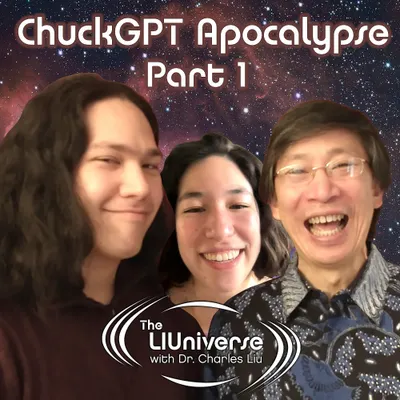
It’s time for the Season 5 finale of The LIUniverse, which means another episode of ChuckGPT where we answer our audience’s most vexing questions – this time via video from our Patreon Patrons. And to help us answer those questions, Dr. Charles Liu and co-host Allen Liu welcome back fan favorite guest and expert on ancient civilizations, author and educator Hannah Liu, M.Ed. As always, though, we start off with the day’s joyfully cool cosmic thing: the completion of DESI’s 5-year survey mapping millions of objects in the universe. The Dark Energy Spectroscopic Instrument completed the survey ahead of schedule, so there’s still time to map millions more. Hannah tells us about mapping the universe in antiquity, starting with the first star catalog created by the Babylonians about 3,000 years ago. You’ll hear about the Venus tablet from the first millennium BC, Chinese star charts from the Tang dynasty, and Atlas, the mythological Titan who was the “first astrologer.” Returning to the DESI survey, Chuck talks about the change in the dark energy content of the universe that we didn’t really expect. Allen, our resident mathematician, talks about the velocity of universal expansion and a concept called “the jerk.” Then it’s time for audience questions, and for this episode, we’re doing something new. Both audience questions come from Patreon Patrons, and both are in video format so you can actually see our fans asking Chuck the questions – if you’re watching rather than listening, that is. Our first question comes from Patron Lee Dubey, who asks, “Since atoms are mostly empty space, could all matter, including measuring devices, almost undetectably consume minimal space, warping the space around it? If so, could that cause gravity, and could the shrinkage cause a redshift related to dark energy?” We’re not even going to try and summarize the explanation from Allen and Chuck here, except to say that the ensuing conversation includes the physics concept of “unparticles.” Hannah brings up Democritus, who, along with his teacher Leucippus in ancient Greece, first theorized the existence of atoms. Our next question comes from our Patreon Patron Lee Williams, who asks, “If we live in a simulation, is it correct to assume that there’s an architect? Could there be a simulation without an architect?” Given that there’s no scientific answer to either of these questions, Chuck turns to Hannah for enlightenment. While she explains that the question of whether we live in a simulation is a modern concept, Hanna discusses how humanity grapples with the questions of existence and higher powers, and why people engage with religion, magic, or quantum entanglement in the first place. In the free-wheeling, far-ranging conversation that follows, Allen brings up how we create simulations now, by creating processes and letting them run, to offer some perspective on the role of the architect. And yes, H.P. Love
How do distant galaxies form? If you have two distant clouds of hydrogen, why does one turn into a star and another doesn’t? To find out, Dr. Charles Liu and co-host Allen Liu welcome Dr. Erika Hamden, Professor of Astrophysics at the University of Arizona. If Erika looks familiar, that might be because her TED Talk or “New Frontiers,” the TV show she hosts on Arizona Public Media. As always, though, we start off with the day’s joyfully cool cosmic thing, Artemis II, our first manned mission around the moon since 1972. Chuck, Allen and Erika share their excitement watching the mission, and especially the landing, while we watch the “only good video of the moon ever taken with a phone” that Reid Wiseman shot on his iPhone. Dr. Hamden tells us about her research into how distant stars and galaxies form. To fill in the blanks of this cosmic puzzle, she observes hydrogen in its elemental or molecular form – not looking at the stars themselves, but the emissions from hydrogen atoms. You’ll learn about star formation in our galaxy and how Erika discerns the moment that a new star “first turns on.” Then it’s time for our first audience question. Emma B. asks, “How many galaxies are there?” Erika says that in the observable universe, it’s an outrageously large number, probably hundreds of billions or more. We take a look at the Hubble Ultra Deep Field image, which reflects a “tiny, tiny part of the sky,” where every dot except for the 3 stars is a galaxy. And that’s just the universe we can see. Chuck asks Erika to tell us about her book, “Weird Universe: Everything We Don’t Know about Space (and why it’s important).” Professor Hamden shares her belief that anyone can understand anything if it’s explained the right way to them. She talks about a poem by Rebecca Elson called “Responsibility to Awe” and the responsibility scientists have to share the wonders of the world with everybody. For our next audience question, Ava asks, “What is the craziest job in Astronomy that you have seen AI take over from humans?” Erika talks about using LLMs to review the digitized photographic plates of stars and the massive amount of data from the Vera Rubin Observatory, and also which activities still require human creativity. Speaking of creativity, it turns out that before becoming an astrophysicist, Erika got a diploma at Le Cordon Bleu in London and had a career as a professional chef. She still loves to cook and shares her recipe (below) for the Swedish-style cardamom buns she shows us in the episode. Finally, before we go, we congratulate Emily on recently being awarded a Guggenheim Fellowship. She shares some wisdom and advice she’s learned on her journey that she also tells her students, but according to her it’s a bit “cheesy” so we’ll let her tell you in the show. If you’d like to know more about Dr. Hamden, you can keep up with her research, follow her on her social media accounts, and find out about he
Are there really exoplanets with where it rains ruby and emerald raindrops? How do we measure the atmospheres of exoplanets light years away? To find out, Dr. Charles Liu and co-host Allen Liu welcome Dr. Munazza Alam of the Space Telescope Science Institute. The STScI performs science operations for the Hubble Space Telescope, the James Webb Space Telescope, and the Nancy Grace Roman Space Telescope when it launches in 2026. As always, though, we start off with the day’s joyfully cool cosmic thing. On Feb 24, 2026, the Vera C. Rubin Observatory activated the alert system it will use to notify astronomers of noteworthy events and sent out 800,000 alerts on that single day! Munazza tells us about how she studies the atmospheres of exoplanets like Wasp 121-b, a gas giant thought to have ruby and sapphire rain. Dr. Alam describes exoplanets with surface oceans made of magma, and she and Chuck talk about the importance of plate tectonics. You’ll hear about Hot Jupiters, Super-Earths, and Sub-Neptunes – and the theories about why we don’t have any of them in our solar system despite the fact that they’re incredibly common in the Milky Way galaxy. Then it’s time for audience questions, which for this episode come from students at Notre Dame Academy on Staten Island, where Munazza is an alum. Not only does past guest Dr. Betty Jensen teach there, as well, but she was a critical influence on Munazza’s career path. (You can listen to our episode with Dr. Jensen here.) The first question is from Charlotte, who asks, “How far have we gone in space?” Munazza, Allen, and Chuck discuss Voyager 1, which at a current distance of nearly 16 billion miles is the man-made object that has gone furthest from Earth. Next up, Gabby asks, “What was the best advice you were given when you were preparing for college?” Dr. Alam’s answer: Pick something you enjoy and are good at - in spite of any pressure you might get from friends, family, and others. A second piece of advice Munazza got was to maintain your breadth, i.e., developing other interests besides your primary focus. For Munazza, that was art and writing, and she shares some of her art later in the show. Finally, Gisella asks if it was hard picking a college. Dr. Alam shares her process, with the caveat that it might not be good advice for everyone. Charles and Munazza reflect on the tradition of scientific exploration, observation, discovery and analysis of which she’s part. Munazza recounts the excitement when JWST observations of transmission spectra of the exoplanet Wasp 39b confirmed their predictions – and also detected something unexpected: sulfur dioxide in the atmosphere of the planet which is a by-product of photochemistry between light from its star and water molecules in the atmosphere of the planet. Finally
Can the physics you learned in High School take you to the stars? Who is behind many of your favorite pictures of space? What is it actually like to live and work in space? You might be surprised to know how much of it comes down to the physics you probably learned in class and thought to yourself, “When will this ever be useful?” To answer those questions and more, Dr. Charles Liu and co-host Allen Liu welcome Dr. Don Pettit –NASA astronaut, astrophotographer, chemical engineer, and genuinely one of the most interesting people alive, who was also a science consultant for the movie Project Hail Mary. As you’ll see, the complex physics of space could be critical to your future endeavors in the world of tech, space, and astrophysics. As always, though, we start off with the day’s joyfully cool cosmic thing, which was the famous DART mission (Double Asteroid Redirection Test). It’s a mission where NASA crashed a spacecraft into a small asteroid (Dimorphos) to see if they could literally change the orbit of an asteroid in space. This mission was successful, changing the asteroid’s orbit by nearly 30 mins. This is certainly joyfully cool, as it shows we can take planetary defense measures to change the path of an impending asteroid. Throughout the episode, Don, Chuck, and Allen ping pong back and forth with the following topics: Why he chose chemical engineering (and how that led to becoming an astronaut by consistently choosing passion and innovation over money) Whether being an astronaut is even worth it financially How cities look different from orbit over time (yes, you can literally see lighting technology evolve) The physics behind astrophotography from space (and why those images look so insane) How astronauts drink coffee in zero gravity! Just wait, there is even more that we dive into: from lunar bases, to Antarctica meteorite hunts, to a casual mention of driving a lunar rover simulator like it’s nothing. There’s a lot here that feels huge and abstract, but also weirdly human, like choosing passion over money, or just wanting your morning espresso in space. While Don always had a love for chemistry, he ultimately pursued chemical engineering because he thought he wouldn't be able to get a good job without higher ed (relatable or what?). Then he got a PhD anyway, following his passion. Don also discusses the coffee cup he invented, which is widely used in space and lets you drink espresso like normal. He designed a cup that lets astronauts drink normally in zero gravity using fluid physics. Toward the end of the episode, he talks about going to Antarctica to collect meteorites and what that tells us about the chemistry of space. During this episode, Don’s intrinsic love for creation and scientific innovation shines through. If you like physics, space, or just hearing someone explain complicated things in a way that actua
How do we find exoplanets? What is the Milky Way’s “Thick Disk” and what makes it so special? To find out, Dr. Charles Liu and co-host Allen Liu welcome Harvard astronomer Dr. Victoria DiTomasso, who has discovered an exoplanet system that includes exoplanet HD60079 b, which she sometimes calls “Bubbles.” As always, though, we start off with the day’s joyfully cool cosmic thing, a paper just recently published about the exoplanet Teegarden Star b. Dr. DiTomasso explains the difference in exoplanet research between the observational studies she does and the theoretical modeling represented in the paper. She goes on to discuss recent, exciting theoretical work coming out of UCLA that posits that rather than have our water brought to Earth by comets, we started out as a larger, sub-Neptune planet with a larger hydrogen-helium envelope that we’ve lost over time. This is a pattern seen in some exoplanets, especially given the fact that Super Earth and sub-Neptune planets are the most common types of planets we’ve found, yet we have none in our solar system. After we find out why a planet Chuck studied was called Flagellan, it’s time to find out how Victoria goes looking for exoplanets, and how she found Bubbles – with an assist from a team of citizen scientists. You’ll learn about using the transit method for discovering exoplanets and identifying potential targets with TESS, the Transiting Exoplanets Survey Satellite and other instruments. Dr. DiTomasso explains the differences between the Milky Way’s younger “Thin Disk,” the older “Thick Disk,” and the oldest of all, the Milky Way’s “Halo.” Victoria studies the chemistry of stars to categorize them and their planets by age. She’s found 4 stars in the thick disk that have “Hot Jupiters” so far, which is more impressive when you learn that we only knew about one before her work. Then it’s time for a question from the audience. Grace asks, “Has the environment ever been as bad as it is now, and can it heal by itself?” Chuck, Allen and Victoria discuss changing environments on exoplanets and on Earth, the difference between long and short term change, and the possibility of recovery. Finally, Chuck asks Victoria what she does outside of astronomy, and we learn all about her new hobby, crocheting. Don’t miss her show and tell, which includes Fred, the cutest crocheted dinosaur to ever appear on The LIUniverse. Victoria also talks about her other hobby, visiting museums – especially art museums. If you’re watching this episode on YouTube, you get to see one of her current favorite exhibits, which consists of semi-abstracted felted wool sculptures of creatures and supernatural beings (yōkai) at the MassArt Museum (MAAM) in Boston. If you’d like to know more about Dr. Victoria DiTomasso, you can find her on LinkedIn . But to see her latest telescope photos that she took during her observing trip to the Canary Islands, check out her Instagram <a href='https
How do stars die? And what happens when they do? To find out, Dr. Charles Liu and co-host Allen Liu welcome Dr. Ashley Villar, who teaches astronomy at Harvard and whose team studies supernovas as they happen. As always, though, we start off with the day’s joyfully cool cosmic thing, the release of a set of new Hubble Space Telescope images of the Crab Nebula and the pulsar at its center. Needless to say, it’s a great start to an episode about a team of scientists who actually study the moment a star explodes and the immediate aftermath. Ashley explains how they have been able to use LIGO, the gravitational wave detector, as a sort of early warning detector that twice gave them enough time to set up their instruments to observe the explosion over the next few hours and days as it unfolds. Professor Villar talks about how neutron star mergers and magnetars may be the source of heavy elements like gold and uranium. Or, as Chuck says, “A gold-filled smoke ring puffing off of a highly spinning, highly magnetic neutron star - what a great picture that would be.” Ashley is looking forward to how the Vera Rubin Observatory is going to change the observation of these events. In the process of explaining, Professor Villar answers an audience question from Jamison, who asks how often stars explode in space. It turns out, in our observable universe, there’s a supernova every 2 seconds! We currently detect about 10,000 of these explosions every year - Vera Rubin will be able to detect 10,000 of these explosions in just two weeks. In order to get a handle on this flood of data, Dr. Villar and her team will be looking for these exotic physics needles in a haystack using machine learning models to look for patterns and abnormalities and “go fishing.” Charles asks Ashley for her take on AI and whether we should be afraid of it or not.(And yes, take the opportunity to plug co-host Allen Liu’s forthcoming book, “The Handy Artificial Intelligence Answer Book.”) Allen and Ashley discuss the difference between how a chatbot like ChatGPT operates and how she trains her models. There was a second part to Jamison’s question about exploding stars: Are we in any danger. Dr. Villar explains that when we just look at our Milky Way, supernovas occur only once a century, so we’re not in any danger. Next, Jessie asks, “How do we know the universe is infinite?” Our answer is, we don’t. That doesn’t stop us from discussing it, though, and the conversation takes us to, among other places, the Nazca lines in Peru and the quantum effect that creates iridescent blue butterfly wings. (You can read the scientific research mentioned in the episode here: https://www.nature.com/articles/ncomms8959) We end with a discussion about supernovas, neutrinos, space dust, gamma ray bursts, and what kind of event it would take to interrupt the normal activities of space telesc
How do planetary systems form? If you wanted to observe them, where would you look and what would you look for? To find out, Dr. Charles Liu and co-host Allen Liu welcome Luke Keller, professor of Astronomy and Physics at Ithaca College, who together with his team has identified 9 of these early solar systems. As always, though, we start off with the day’s joyfully cool cosmic thing: a recently published paper that determined that at any given time, it is likely that a couple of extrasolar objects like 3I/ATLAS and Oumuamua would be present in our solar system. The real issue is detecting them. For context, Luke, whose science has focused over the years on finding debris from solar systems, explains how protoplanetary discs can eject matter that ends up orbiting that star. He’s especially fond of cosmic dust, “the catalyst for the formation of planets and asteroids and comets…” Then it’s time for a question for Luke from the audience, from Elisa: “I heard that the James Webb Space Telescope sees infrared light. How does that work? Does that mean it couldn't see the Sun?” Luke breaks down the various wavelengths of light and our Sun. He also explains how the JWST works and why it never looks at the sun. It turns out that Luke has built a variety of astronomical instruments including imaging and spectroscopic tools with for large observatories. He’s also used information from instruments like JWST in his studies of the formation of stars and solar systems. Luke explains how his teams search for preplanetary solar systems, what they’re looking for, and where they’re currently looking: associations of stars in the direction of the constellations Taurus, Scorpius and Chamaeleon. All told so far Luke and his team have identified 9 of these early solar systems. He then breaks down the current thinking on how planetary systems form from clouds of dust. He explains some of the processes that involves, along with the types of planets that may form. For our next audience question, Joan asks, “What do you think is the most interesting constellation?” Luke picks two: first, Ursa Major, aka “The Big Dipper,” because he grew up in Alaska and saw it all the time – along with “auroras all the time.” The second constellation he picks is Orion, aka “The Hunter,” because it contains some of the closest star forming regions of our galaxy. Luke unpacks the difference between “watching the sky” and “observing the sky” – and why he encourages the latter to both his students and the general public. And before the episode is over, we get to hear about Luke’s live show, Spacetime, where he collaborates with poet David Gonzalez and guitarist Álvaro Domene in a stage performance that’s equal parts astrophysics, poetry, and music. If you’d like to know more about Luke’s show, Spacetime, check it out at https://spacetimeshow.org/. We hope you enjoy this epis
How can a helicopter fly in space? How does LIGO detect gravitational waves? How do quantum electronic devices like Josephson junctions work? Could AI turn evil and destroy humanity? What about those grabby aliens? In this episode of Chuck GPT, Dr. Charles Liu and co-host Allen Liu answer audience questions about the technology of astronomy, astrophysics, and the future. To read those questions, we welcome back our executive producer Leslie Mullen, community director Stacey Severn, and intern Eleanor Adams. As always, though, we start off with the day’s joyfully cool cosmic thing: the ESA’s new Deep Space Antenna in Australia. This fourth antenna in ESA’s network will be used to manage communications for their slate of upcoming missions. For our first audience question, Anna asks, “How is it possible that a helicopter can work in space? I heard that NASA launched a helicopter to Mars and is going to send one to Saturn in a few years.” Leslie, who worked at JPL, talks about the Perseverance Rover and its helicopter, Ingenuity. She explains that they’re not actually flying in space, but in the atmospheres of a planet or a moon. Even so, the thin atmosphere of Mars (less than 1% of Earth’s) created unique problems that don’t exist on Earth. Leslie got to interview the inventor of Ingenuity, Bob Balaram, in her JPL podcast episode, “Flying with Ingenuity.” She describes how JPL tested the helicopter here on Earth, and what it was like the moment Ingenuity actually took flight. The team discusses Dragonfly, the helicopter that will be flying on Saturn’s moon Titan, and how Titan’s thick methane atmosphere creates an entirely different set of engineering problems than Ingenuity faced on Mars. Stacey reads our next question, from Joe: “Gravitational wave detectors like LIGO are said to detect changes in the length of space by less than the width of a proton. But how is that possible, if all the atoms that make up LIGO are so much bigger than protons?” Chuck explains interferometry (the I in LIGO!) and Allen offers a great analogy using a ruler. Eleanor reads a question from TikTok, which Esmeregildo asked in response to our video about Josephson Junctions and the Nobel Prize in Physics: “What is the purpose of the insulating barrier?” Chuck’s answer takes us down a quantum tunneling rabbit hole, filled with superconductors, insulators, and quantum computing. Diane asks: “Professor, you say that astronomers have used AI for a long time so you're not afraid of AI. But AI isn't being used by just scientists anymore, and corporations are using AI to make money now rather than to make scientific advances. So should we be afraid of AI today? Could AI turn evil soon and destroy humanity?” Allen, co-author of a soon-to-be published book about AI, offers a mostly hopeful answer, although Chuck compares AI to nuclear power and Leslie brings up real world problems AI is already creating. Our last qu
Is universal expansion slowing? What is the Bubble Universe Theory? Will we control AI, or will AI control us? In this special Chuck GPT episode of The LIUniverse, we answer questions from the Annual Global Summit in Erie, Pennsylvania where Dr. Charles Liu gave a talk on “2050 - The Future of Humanity.” To help ask those questions, Chuck and co-host Allen Liu welcome Stacey Severn, our Social Media Manager/Community Director; and physics student Eleanor Adams, our first intern. As always, though, we start off with the day’s joyfully cool cosmic thing, suggested by Stacey: the recent discovery of one of the most distant and earliest known galaxies observed, existing just 570 million years after the Big Bang. It’s got a supermassive black hole 20 times the mass of ours and was found via gravitational lensing by the Canadian NIRISS Unbiased Cluster Survey (CANUCS) using the James Webb Space Telescope. Then it’s time for the main event. Eleanor reads the first Erie audience question from William W., age 13, who asks, “In Bubble Universe Theory, is the force splitting universes apart the same force causing the expansion of the universe, also known as dark energy?” Chuck explains Bubble Universe Theory, aka “Eternal Inflation,” and then how dark energy is different than the forces that cause expansion. Next question: “Have you seen the latest research from South Korea stating universal expansion is actually slowing, thus reducing greatly the amount of dark matter? If it's correct, what are the implications?” Chuck explains the current state of research around the issue, starting with the Dark Energy Spectroscopic Instrument (DESI) survey at the Kitt Peak National Observatory telescope. DESI gave indications of a change in the amount of dark energy being produced; this new study raises questions about how we measure the expansion of the universe using type 1a Supernova. Next question: “What percentage of our global warming does science attribute to man-created activities vs. a natural progression? Even though the world is getting warmer, wouldn’t it be worse if the temperature were getting colder?” Chuck looks at the natural progression of the increase of carbon dioxide and compares it with the larger and more rapid increase in CO2 levels since the Industrial Revolution began. As to whether warming or cooling is better, Allen says that while it’s a question of magnitude, neither extreme is desirable. Mark M’s question is next: “Will we achieve control or effective management of AI, or will it control, or even define, our daily lives? Allen, whose book on AI is coming out soon, says the answer is far from clear cut. He explains that while there are many efforts to ensure we maintain control, there’s no guarantee that we’ll succeed. Next question from Erie: “How do we prepare our young children to be successful in the Age of AI?” Eleanor talks about how, like social media, yo
How do supermassive black holes actually form in the early universe? Is the Cosmological Constant not so constant after all? And what would be on the astrophysical menu at a Cosmic Brunch? To find out, Dr. Charles Liu and co-host Allen Liu welcome astrophysicist Thresa Kelly, who is a second year grad student working on her PhD at the Rochester Institute of Technology. As always, though, we start off with the day’s joyfully cool cosmic thing, one of the recent studies made using the Dark Energy Spectroscopic Instrument, aka DESI, located at Kitt Peak National Observatory near Tucson, Arizona. According to the DESI team’s research, there is a about a 95% chance that the dark energy levels in the universe have changed over cosmic time. This “Dynamical Dark Energy model” offers the first, tiny hint that the Cosmological Constant may not be so constant after all. Thresa, who is using DESI and other sources for her work putting together a catalog of AGNs, or active galactic nuclei – the supermassive black holes found at the center of galaxies, tells us about what DESI is trying to do and why it’s so important. The end goal of Thresa’s project is to estimate the black hole masses of AGNs, and she’s gotten spectra data on over 2,000 objects that have been observed using DESI. Thresa can’t get into the details of her catalog, which hasn’t been published yet and includes about 14,000 objects, but Allen and Chuck join her in a discussion of what’s going on with black hole masses, accretion discs, Eddington Luminosity, black hole growth, galactic evolution, and more. Our first audience question comes from Kathryn, who asks, “When we look through a standard telescope looking at "past" versions of planets/stars/etc., how far back in the past are we observing?” Thresa explains how we use red shift to measure how long light from a galaxy takes to reach us to help us determine how far in the past the objects are. For instance, an AGN with a red shift of 7 can reach back to the period of “Cosmic Dawn” or, as Thresa puts it, “Cosmic Brunch” taking place 12 billion years ago. Thresa talks about her experience in an REU, or “Research Experiences for Undergraduates,” funded by the NSF, which enabled her to spend time studying at the University of Hawaii and cemented her desire to go to grad school, get a PhD, and become a “real scientist.” She explains how each step of her career brought her from Kansas to where she is today. Our next audience question comes from Walter: “If a quasar's jets are aimed directly away from Earth, would we then not be able to see the supermassive black hole?” Thresa says that depends on how you define “seeing” a black hole, and that even without visible light, you can discern black holes by looking at other wavelengths like x-rays and ultraviolet rays which are generated by different component areas of the black hole like the corona, accretion disk, or the torus. Chuck notices a shelf of games
What were our joyfully cool cosmic things of 2025? To find out, Dr. Charles Liu and co-host Allen Liu welcome three members of The LIUniverse production team: Jon Barnes, our Editor and self-proclaimed “#1 LIUniverse Fan,” Stacey Severn, our Social Media Manager/Community Director, and physics student Eleanor Adams, the show’s first intern. Unlike nearly every episode so far, this time, rather than limit ourselves to one joyfully cool cosmic thing, the team is going to each share their individual joyfully cool cosmic things of 2025. Chuck’s saving his for later, so instead, we’re just going to jump right into everyone’s favorite “cosmic thing of the year”, starting with our co-host, Allen Liu. Allen picks the Vera C. Rubin Observatory and the Legacy Survey of Space and Time (LSST). Allen and Chuck, who is also on the Rubin’s Science Advisory Committee and has been involved in the development of the Observatory for over a quarter century, discuss how truly amazing the images are in terms of detail and resolution. Allen shares that he’s most excited to see images of transients like asteroids and gravitational lensing, since the Rubin will be taking images of the same areas twice with a gap of one week. Chuck talks about the citizen science aspect of the Rubin and encourages each of you in our audience to try and discover something on your own. We hear about some of Allen’s published papers, including one on using VR for scientific research. The group talks about VR (including Beat Saber) and Jon shares his experience using VR technology to record his senior project at the Harold Ramis Film School at Second City, and the difficulty he had with the audio. For Eleanor, this year’s cool cosmic thing was highly personal: her studies in modern physics this year, learning more than ever about what we don’t know, like the gap between classical and quantum physics! As she puts it, “the matter-antimatter asymmetry…broke my mind.” She also shares a little inspiration from Cal Sagan’s Cosmos. Stacey’s cosmically cool thing of the year is relatively current: Comet C/2025 K1 ATLAS, which recently broke into 3 parts. The team compares this with the breakup of all breakups: Comet Shoemaker-Levy 9, which broke up in 1994 on its way to a collision with Jupiter. Jon’s joyfully cool cosmic year end thingamabob is about the new science fiction show Pluribus created by Vince Gilligan (Breaking Bad, Better Call Saul), and he’s got a question for Chuck. How long would it take a signal like the one in Pluribus to travel from a star 600 light years away, like Betelgeuse or Antares? Without dropping any spoilers, the team ponders why an alien race would have reached out to Earth based on what they might have seen around the time of Charlemagne, and whether being subsumed in a hive mind would be good or bad. This is a bittersweet episode, though, because we officially bid f
Are Coronal Mass Ejections dangerous to life on Earth? When are we finally going to plunge through the sulfuric acid clouds to measure the atmosphere of Venus. And what’s up with 'Oumuamua and 3I/Atlas? To find out, Dr. Charles Liu and co-host Allen Liu welcome astrobiologist Dr. David Grinspoon, aka Dr. FunkySpoon. As always, we start with the day’s joyfully cool cosmic thing: the arrival at Earth of two consecutive Coronal Mass Ejections on Nov. 11, 2025, creating an amazing display of Northern and Sothern Lights. In the US, aurora were seen as far south as Texas and even Central America, and yet Chuck, Alan and David were all frustrated by clouds in their own attempts to see them! Luckily, they’ve each already seen auroras with their own eyes, a viewing event David likens to seeing a total solar eclipse. David discusses how solar flares can impact human technology, but that while solar flares from other stars could be dangerous for life on their planets, at this point in our sun’s lifetime, they are unlikely to wipe out life on Earth. Chuck shares aurora images that were taken by our previous guest, astrophotographer Elliot Severn. For our audience questions this week, we’re answering questions given to Chuck while he was presenting at an event in Erie, PA. The first question Chuck asks David is, “When we have interstellar visitors like 'Oumuamua and 3I/Atlas, [1] why are they moving so fast in our space? They seem to defy gravity [2] How can they know what 3I/atlas is made of but not the density or materials?” David explains why the extreme speed at which they are moving is actually proof that they are interstellar objects and not something else. He also discusses how we use spectroscopy to determine what they’re made of the same way we determine what distant stars and exoplanets are made of. Our next question from Erie, PA is, “Is there a mathematical probability or formula to predict the likelihood of life existing int he universe? In other words, has someone developed a model to predict how many unique things need to happen for life to evolve?” David explains the Drake Equation, a series of questions that help astrobiologists assess the probability of intelligent life in the galaxy. Our last question from Erie is, “If humans find life on a different planet, would we actually understand how to coexist with the information, or will world leaders hide the truth from us?” David points out – as someone who has helped devise astrobiology policy – that the response depends in part on the specifics of the discovery, like how far away that life is. But would the government be able to hide it? David says that the scientists who discover it would be shouting it from the rooftops: “How long would it take to type it and hit send?” And as Chuck points out, the very act of the government trying to censor it would turbocharge the speed at which scientists would get the news out. The real problem, David says, is
How do planetary ring systems rings form, and what keeps them in line? What exactly is the Dragon Cloud of Saturn? And what’s up with quasi moon 2025 PN7? To find out, Dr. Charles Liu and co-host Allen Liu welcome Cornell University’s dynamical astronomer Dr. Phil Nicholson for a refresher course in orbital mechanics. As always, though, we start off with the day’s joyfully cool cosmic thing, which is right up Phil’s alley: the recent discovery of quasi moon 2025 PN7. Phil unpacks the orbital mechanics to explain the critical differences between quasi moons and regular moons, and also 2025 PN7’s strange relationship to Earth’s orbit. He also explains the dynamics of the sun’s tidal forces and Earth’s Hill Sphere. For our first question from the audience, Jameson asks, “Are meteorites smaller copies of planets. Are all of them the same?” Rather than discuss meteorites, which are the tiny survivors that have crashed on Earth, Phil pivots to where many of them come from in the first place: asteroids. Really big asteroids share some characteristics with planets, like being spherical in shape, whereas the smaller ones can be highly irregular, like the dumbbell-shaped asteroid 216 Kleopatra, or Arrokoth, previously known as Ultima Thule. Chuck asks Phil about the different shapes large asteroids can come in, and Phil points out 433 Eros, the second largest Near Earth Object, which is banana shaped. The ensuing brief discussion of the “is it a long, skinny asteroid or an interstellar starship?” debate, like the one sparked by Oumuamua, leads to a conversation about Arthur C. Clarke’s “Rendezvous with Rama”, which described just such a starship back in 1973. Somehow, we end up looking at the “face” on Mars and the “Death Star,” aka, Saturn’s moon Mimus as it was imaged by the Cassini spacecraft. Phil actually worked on the Cassini mission, and Chuck asks him to talk about his experience peering hundreds of miles deep into Saturn’s atmosphere with the spacecraft’s Visible and Infrared Mapping Spectrometer (VIMS). Along with other instruments run by other teams, the mission changed our perception of Saturn’s “boring” atmosphere, documenting aurora, lightning, and giant storms like the “Dragon Cloud of Saturn.” Our next student question comes from Marvin, who asks, “What exactly is a Shepherd moon?” To answer, Phil describes what Saturn’s rings are made of, how they form, and how they’re structured. He explains what happens when particles that make up the rings collide, why some rings spread over time, while others stay very narrow, and the role Shepherd satellites play in the process. We end with Chuck soliciting a few classic sci-fi recommendations from Phil, who suggests anything by Arthur C. Clarke, the Foundation Trilogy by Isaac Asimov, and almost anything by Larry Niven, including Ringworld, his most famous series. We hope you enjoy this episode of The LIUniverse, and, if you do, pl
Can an ultra-compact dwarf galaxy have a supermassive black hole at its center? Are there galaxies with supermassive black holes that are offset from their galactic centers? To find out, Dr. Charles Liu and co-host Allen Liu welcome “the other” Dr. Matt Taylor, an Assistant Professor of Astronomy at the University of Calgary, who joins us from the control room of the largest astronomical telescope in Canada, at the Rothney Astrophysical Observatory (RAO) in Alberta, Canada. As always, though, we start off with the day’s joyfully cool cosmic thing, which starts with the discovery of a supermassive black hole in the middle of an ultra-compact dwarf galaxy M60-UCD1 located in the Virgo galaxy cluster. That led to the discovery of more 4 UCDs in the Virgo Galaxy Cluster and 1 in the Fornax galaxy clusters, but then the limits of technology prevented the discovery of any additional UCDs. But now, by using the James Webb Space Telescope, Matt and his fellow researchers (including Dr. Vivienne Baldassare, our former guest for Black Holes and Space Junk with Vivienne Baldassare) have just published a paper about their discovery that in the smallest, lowest mass UCD yet found, they found a roughly 2,000,000 solar mass black hole. Basically, that’s a tiny galaxy to hold a supermassive black hole, and Matt is sure there are many more of these waiting to be discovered. After that Matt tells us about his atypical journey to astronomy, including his first career – as a professional chef. When cooking stopped being fun, Matt enrolled at a local community college and “moved from gastronomy to astronomy” as Allen puts it. Our first audience question comes from our Patreon Patron Taylor L, who asks, “Is it possible dark energy and the acceleration of the universe's expansion could be explained by the idea that the black hole we live in is constantly devouring matter from outside?” Matt passes on determining whether or not we live inside a black hole. But, he explains that while at the galactic level expansion is happening on a really large scale, at a smaller scale like our local group of galaxies (Milky Way, Andromeda, and local dwarf galaxies), our mutual gravitation counteracts that expansion. Matt goes on to discuss how accretion disks are what makes it possible to “see” a black hole, but that ultra-compact dwarf galaxies don’t have gas and dust forming accretion disks. Instead, they use stellar velocities to find black holes in UCDs. Next up, Matt tells us about some of the research he’s doing into archetypal compact elliptical (cE) galaxies, which have the mass of a giant galaxy put into the volume of a dwarf galaxy, and how black holes appear in these systems. And Matt dangles another upcoming paper about galaxies with supermassive black holes that are offset from their galactic centers. For our next audience question, Pshemo asks: “We often say gravity is weak compared to other forces. But in the right re
How do very small galaxies form? What’s going on inside them? And what happens when black holes collide? To find out, Dr. Charles Liu and co-host Allen Liu welcome astrophysicist and “Galaxy Detective” Dr. Charlotte Olsen from New York City College of Technology – and you can call her Chuck, too! As always, though, we start off with the day’s joyfully cool cosmic thing, the latest announcement from LIGO about the detection of a gravitational wave event in 2023 from the loudest collision we’ve heard so far. In this case, the wave was caused by the collision of two black holes that created one new black hole about 60x the mass of our Sun and released an entire sun’s worth of energy. Charlotte explains why there are many black hole collisions going on, and how LIGO detections are now being combined with data from other gravitational wave detectors to give us more precise measurements. You’ll also hear about Active Galactic Nuclei (AGNs) and their negative impact on Charlotte’s research. Charlotte talks about what she looks for in her research, and why it all comes down to “wanting to see more photons” to better validate her modeling. Our first question from the audience comes from Joe, who asks, “What does it mean for the Milky Way to have a bar? Why does it have a bar? And how can such a long bar form?” It turns out that many spiral galaxies like ours have bars, and Charlotte explains a little about bar structure. She brings up the current debate about the stability of these bars, and points out that they actually come in slightly different configurations and that star formation at the ends of the bar has an impact, too. Unlike previous thinking, these bars can develop earlier in galactic evolution and can last a very long time. In other words, as Charlotte puts it, “The bar is always open.” Next, Chuck asks what got Charlotte into astronomy. She describes the inspiration she drew from both the dark skies of Northern California, where she grew up, and from the science fiction she read. She shares a few of her “million and one jobs” she did, including her stint as a bassist in a band. That tees up our next audience question, from Shivani, who asks, “How do you mix music and science? I can't decide if I want to be a scientist or a musician someday – can I be both?” Yes, Charlotte says, and explains why doing both might actually be better. She talks about the value of music, and passion, and hobbies that are more than just hobbies, as well as some of the live music she’s been seeing in Brooklyn, Long Island and Queens. Finally, Chuck asks Charlotte about the current passion project she’s working on. She tells us how she’s looking at a handful of galaxies in multiple wavelengths and comparing them to each other to figure out “what’s going on under the hood.” If you’d like to know more about Charlotte, you can connect with her on Bluesky at <a href='https://bsky.app/profile/did:plc:la5zf6rn5vpxchjjr7q5
How does a star form? How does the universe form? And how can we use every bit of astronomical data to answer those questions? To find out, Dr. Charles Liu and co-host Allen Liu welcome astrostatistician Sabrina Berger, all the way from Melbourne, Australia, where she’s currently pursuing her PhD. As always, though, we start off with the day’s joyfully cool cosmic thing, the new radioastronomy photographs of Callisto, one of the moons of Jupiter, taken by ALMA. Sabrina talks about her own low-frequency radio astronomy research looking for hydrogen in the very early reionization period of the universe when the first galaxies were forming. (Be warned: we dive into the difficulties ionization poses for trying to discern these early processes, including a side trip into quantum mechanics, the hyperfine transition of neutral hydrogen at 21cm depicted on the plaque attached to the Pioneer spacecraft, and even the Cosmic Background Radiation.) You’ll also hear how Sabrina is innovatively using GPS satellites to help calibrate large radioastronomy telescope arrays. For our first student question, Derek asks, “I heard that black holes can form right after the Big Bang, before stars do. How is that possible?” Sabrina describes these primordial black holes, and, although none have been confirmed yet, that there have been a number of papers published recently on the subject. In fact, one paper suggesting that the as-yet-undiscovered “Planet 9” could even be one of these primordial black holes. And then, finally, we get to the subject of astrostatistics, Sabrina’s area of expertise. She explains that it allows you to harness every piece of information that you’re observing in astronomy and to answer questions like “How does a star form?” or “How does the universe form?” You’ll hear about huge data sets, the use of artificial intelligence, field level inferences… and the MCMC, or the Markov chain Monte Carlo used in statistics. (If you don’t know what that is, you’re not alone, and our own resident mathematician Allen helps Sabrina untangle the complexity with a cotton ball analogy that blew Chuck and Sabrina’s collective minds!) For our next student question, Wally asks, “Why is redshift one like nine billion years ago, bur redshift two only two billion years before that, and redshift three only one billion years before that?” As Chuck says, “that’s a little complicated,” just before he, Allen and Sabrina proceed to explain how we measure universal expansion, the passage of time, and the “stretching” of light. Our next conversation is one of the most controversial we’ve ever had and revolves around who Sabrina thinks makes the best espresso, Australia, Italy or a “Third Wave Coffee Shop” like we have here in the US. You’ll hear about why there’s an ISSpresso machine on the ISS – and how the Italian Space Agency invented a way to make an espresso in zero-g! Plus, you’ll hear a little about the work-life balance in Australi
Have we discovered life on Mars? What does the center of our galaxy taste like? To find out, and to kick off Season 5 of The LIUniverse, Dr. Charles Liu and co-host Allen Liu have reached out all the way to Tokyo to chat with Dr. Kelly Blumenthal, the Director of the International Astronomical Union Office for Astronomy Outreach. As always, though, we start off with the day’s joyfully cool cosmic thing, a rock found in Sapphire Canyon by the Mars Perseverance Rover containing potential biosignatures. Allen explains why this rock is different: iron and sulfur nodules that exhibit indications of layers which, on Earth, could only be formed by bacteria. Kelly points out that there needs to be more investigation before we can say anything for sure. Chuck asks Kelly, who when she was 12 told her dad that she wanted to study galaxy evolution, to describe the research she did at the start of her career. She talks about studying with pioneering astronomer Joshua Barnes in Hawaii during her Masters projects and PhD. For her first project, she studied star formation rates in Jellyfish Galaxies, which are being ram-stripped of their gases and so appear to have tendrils. She ended up looking at the history of merging galaxies through cosmic time using large cosmological simulations. Then it’s time for our first student question of Season 5, from Jeannie, who asks, “Now that we’ve found so many planets outside of our solar system, should Pluto be promoted as a planet again?” (Pluto’s “demotion” nearly 20 years ago was traumatic for some.) According to Kelly, though, the “demotion” was really a reclassification, and at least for the time being, Pluto is going to stay a dwarf planet, a new category of which it was the first of its kind. She contrasts Pluto to the moons of Jupiter and reminds us of the new rules about what’s a planet and what’s not. Kelly brings up Star Trek and therefore gives Chuck permission to geek out over “Devil in the Dark” from the Star Trek: The Original Series, and “Silicon Avatar” from Star Trek: The Next Generation. Kelly talks about bingeing sci-fi in high school including 2001: A Space Odyssey, and the Foundation series, and more recently, The Expanse series, which she’s listened to three times as audio books! Chuck and Kelly discuss communicating about science, and even the role science fiction can play. Kelly talks about the importance of understanding your audience. She uses the example of explaining what nebulas look like through the Chandra X-Ray Observatory to a blind and low-vision audience. Kelly also talks about how you can approach science through poetry, music, dance, theatre and art – even smell. She recalls a talk where someone working with incarcerated kids, who was limited in what props they could bring, made the universe come alive for them using the scent of raspberries, which have a similar chemical signature as the center of our ga
It’s the end of everything! Welcome back to Part 2 of our season finale featuring Dr. Charles Liu, co-host Allen Liu, and our guest archaeology expert and author, Hannah Liu, MEd. (If you haven’t caught up to Part 1, we highly recommend you do before embarking on the next leg of this journey! Listen here or wherever you get your podcasts!) We pick right up where we left off, with the next question from our audience. Daniela asks, “If a black hole hits the Sun, will Earth be destroyed?” Chuck explains a few ways a black hole can mess with our day, including the fact that long before any actual collision took place, the Sun would start shedding material that would destroy us. He compares that unlikely event to the actual example of cosmic destruction we’re watching in NGC 4676 – aka “The Mice” – which are two galaxies swirling together in a death spiral playing out over hundreds of millions of years. Naturally, this leads Chuck to ponder what happens when civilizations fall apart here on Earth, and Hannah brings up the collapse of the Roman Empire. As she explains, “the fall of Rome happened a lot of times, and also, no time.” From 44 BCE and the assassination of Julius Caesar, to the 476 invasion and conquest of Rome by the Germanic tribes denoted by Edward Gibbon in The History of the Decline and Fall of the Roman Empire, to the fact ever since nations have claimed to be the descendants or inheritors of Rome. Chuck points out the influence of Gibbon’s book on Isaac Asimov’s “Foundation” series, followed by a very quick romp through “Decline and Fall of America” literature including The Handmaid’s Tale, A Canticle for Liebowitz, Man in the High Castle, and the zombie apocalypse tour de force, World War Z. Then it’s time for another question from the audience: Michael says, “I heard that scientists brought back a dire wolf. Could they bring back dinosaurs or animals that could destroy us all?” It turns out, these resurrected animals are just gray wolves that have been engineered to have some characteristics of the extinct predator. It’s still a pretty impressive feat, though, and you’ll hear how they collected bits and pieces of dire wolf DNA to “resurrect them.” Allen also brings up similar modification experiments they’re doing on chickens to make them more dinosaur-like. Allen points out that bioengineered germs are far more likely to cause our destruction than resurrected dinosaurs, regardless of the world envisioned in the Jurassic Park franchise. And speaking of Michael Crichton, Chuck gives us a breakdown of his sci-fi classic, The Andromeda Strain, about bacteria from space that cause a biological outbreak here on Earth. Hannah points out that historically, some of the biggest killers of human beings have been plagues. She gives us a guided tour of the bubonic pla
As our fourth season draws to a close, we’ve got an apocalyptic, 2-part ending lined up. That’s right, we’re talking Armageddon, and we don’t mean the 1998 Bruce Willis blockbuster. And of course, if we’re going to delve into the end of everything, Dr. Charles Liu and co-host Allen Liu are going to need the help of our ever popular archaeology expert and author, Hannah Liu, MEd. As always, though, we start off with the day’s joyfully cool cosmic thing, the failed Soviet-era Kosmos 482 lander that was designed to withstand entry into the Venus atmosphere but never actually let Earth orbit and finally just came crashing back home on May 10, just a few days after we recorded this episode! Chuck, Allen and Hannah ponder the possibilities of cataclysmic destruction that the more than half-ton object could produce. Then, without missing a beat, Hannah takes us all the way back to Greek mythology and the Titanomachy, the legendary fights between the Gods and the Titans that were possibly inspired by catastrophic volcanic eruptions that laid waste to the ancient Mediterranean. Chuck jumps continents to discuss the Norse apocalypse known as Ragnarök – casually dropping that is inspired the massively popular Baldur’s Gate 3 as he does. Not to be outdone, Hannah brings us all back to the original Armageddon itself: the final battle between good and evil that is foretold in the Book of Revelations to take place at Har Megiddo, the “Hill of Megiddo” in Hebrew. You’ll also hear about where the word apocalypse comes from, and why it’s become associated with the end of the world, as Hannah gives us all a quick lesson in eschatology, or the study of the end of the world. Our first question comes from Ahmed, who asks, “What are the odds that a killer asteroid will kill us all?” Allen gets a little excited about asteroid 2024 YR4, an asteroid the size of a 15-story building, that is predicted to pass safely by Earth in 2032 but at one point had as high a chance of hitting us as 4-5% – and still has about a 3% chance of hitting the Moon. Chuck explains that the odds of a true “dinosaur-killer” extinction event asteroid impact from an object at least a mile across is about 50 million to 1 in any given year. Hannah points out that it’s far more likely that Mount Vesuvius, the volcano that inundated Pompeii, will erupt again. The last one was in 79AD, and since it tends to blow its top every 2,000 years or so, we’re due. Moving back further, Hannah tells us about the Minoan Eruption that devastated the isle of Santorini in the Mediterranean, wiping out the city of Akrotiri, around 1600 BCE and was reported as far away as China. And that’s just a few of the disastrous historic collapses Hannah shares with us, including the Hekla 3 eruption in Iceland that had may have had something to do with the Bronze Age Collapse. It turns out that the apocalypse is too big for a single episode! Join us in two weeks for Part 2 of our journ
Who are the “Redshift Wranglers” and what can they tell us about the evolution of our universe? To find out, Dr. Charles Liu and co-host Allen Liu welcome back astrophysics PhD candidate Sadie Coffin from the Rochester Institute of Technology whose focus is galactic evolution, and in particular, the spectroscopy of galaxies and their lights. As always, though, we start off with the day’s joyfully cool cosmic thing: the Lucy spacecraft fly-by of asteroid 52246 Donaldjohanson, which was named after the American paleoanthropologist who discovered the Australopithecus afarensis “Lucy” fossil the spacecraft was named after. Then it’s time to learn a little about Sadie, who explains how questioning the unknown is what drove her to study astronomy. Chuck, Allen and Sadie talk about the awe embodied in the study of the universe and the universe itself. Like Chuck, Sadie studies galaxy evolution, but Sadie focuses on a galaxy’s light, spread into spectra, and dissecting different features in that light. You’ll hear about the citizen science project called “Red Shift Wranglers” that helps Sadie sift through all the spectroscopic data, and get an awesome explanation of the doppler effect and the way red shift, which measures speed, can be used to help build better maps of galactic evolution. Find out how you can get involved with the project and join the ranks of the 3,500 Redshift Wranglers who’ve participated so far in “Wrangling galaxies and the universe together.” (See below for links.) You’ll also hear about other citizen science projects on Zooniverse like Galaxy Zoo. Sadie talks about the value of non-experts engaging with experts in a community, and the surprising number of people who want to get involved. For our first audience question, Nina asks, “If nothing can go faster than the speed of light, why can galaxies have Z greater than 1?” Sadie’s explanation gets pretty technical, so we’ll let her do it in the episode. Our next question comes from Jerry, who asks, “Will we someday no longer need scientists and have AI do all our research?” Sadie, who gets similar questions all the time relative to citizen science, believes these two things can be complimentary, and that in the name of improving science we can’t forgo either for the other. We finish with a discussion about what defines an act of science and a work of art, the process of questioning, and the roles of humans and machines in these processes. Plus, Sadie tells us about the science-themed travel posters by Dr. Tyler Nordgren on her walls. Chuck also gets Sadie to talk about rowing and the lessons she’s taken from the sport into other aspects of her life and journey as a scientist. If you’d like to know more about the Redshift Wrangler project on The Zooniverse and get involved, or to reach Sadie, visit https://www.zooniverse.org/projects/jeyhansk/redshift-wr
If a black hole shreds a star and nobody is around to hear it, does it make a sound? To find out, Dr. Charles Liu and co-host Allen Liu welcome Professor Yvette Cendes, (aka u/Andromeda321 on Reddit), a Radio Astronomer studying transient radio signals from space. As always, though, we start off with the day’s joyfully cool cosmic thing, a report by the Dark Energy Survey that seems to show that the amount of dark energy originally described as the cosmological constant by Albert Einstein might in fact be variable. As Prof. Cendes explains, the data indicates that universal expansion is still accelerating but the rate might be changing. After Yvette explains what she does, and how radio astronomy works in concert with optical astronomy to deliver a more complete understanding, Chuck asks her to explain Tidal Disruption Events, or TDEs, about which she’s a world expert. A TDE is when a star wanders too close to a supermassive black hole and ends up getting shredded. Yvette prefers to call them “Shredders.” Our first audience question comes from Nachama, who asks, “When will the black hole in the Milky Way eat the Sun?” The good news, according to Yvette, is that will never happen. As she explains, black holes actually don’t suck any more than anything that massive would, and we’re 25-30,000 light years away from Sagittarius A* – too far away to worry about. Next, Chuck asks Yvette about one of the most famous transient signals we’ve ever found, the so called “Wow!” signal detected in 1977 by Jerry Ehman at the now-defunct Xavier Observatory in Ohio. Because the signal looked exactly like what might be expected if it were of extraterrestrial origin, Ehman circled it on the printout and wrote, “Wow!” Unfortunately, it never repeated. The most likely explanation, according to Dr. Cendes, is that it was some sort of manmade interference, although the signal is currently being reinvestigated. Yvette recounts how she ended up ended up as a first-term professor at the University of Oregon after studying in the Netherlands and Toronto and working at Harvard. Then she answers an audience question from Yan Min, who asks, “Where is the best place in the world to study astronomy? I live in New York – Is it New York?” Unfortunately for Yankees fans, Yvette says it would most likely be Cambridge, Massachusetts thanks to Harvard, which has the biggest number of astronomers under one roof and operates the Chandra X-Ray Observatory, and M.I.T. on the other side of town if you get bored. Chuck asks Yvette what happens after a black hole shreds a star. Shredders, she explains, are rare. In our own Milky Way, they probably happen once every million years. Once a TDE is classified by optical astronomers, Yvette and her team point their radio telescopes at the tidal radius outside of the event horizon to discern the outflows weeks, months and even years after the initial event. He also asks Yvette if she has any hobbi
Why is it so difficult to study the evolution of early galaxies? Are metallic D&D dice better than plastic ones? And can you have too many Pokémon tattoos? To find out, Dr. Charles Liu and co-host Allen Liu welcome Justin Cole, who is currently a grad student at Texas A&M studying the evolution of distant galaxies in pursuit of his PhD in Astronomy and Astrophysics. As always, though, we start off with the day’s joyfully cool cosmic thing – the recent – and remarkable – discovery of four planets orbiting Barnard’s Star, a tiny star not much bigger than Jupiter with the highest measured proper motion of any star in our sky. Chuck and Justin discuss why the discovery of new exoplanets is so challenging, which leads to Justin explaining what he’s studying: galaxies in our universe that developed less than 1.5 billion years after the Big Bang – about 2.5 billion years before the birth of our own Milky Way Galaxy. We’ve got a handle on what’s going on with our neighbors like the Andromeda Galaxy, but when it comes to early galaxies, we have a very limited range of wavelengths and scant data to study. This makes it harder to derive understandings of galactic evolution and whether they support or conflict with the standard model of physics. Our first audience question comes from Ricardo, who asks, “What if we discover extraterrestrial plant life and find out it’s intelligent? Actually, what if we discover plants on Earth are intelligent? Would it be unethical to eat them?” After Chuck shares a little about Marvel’s intelligent, telepathic species of plants called the Cotati, and imitates Audrey 2 from Little Shop of Horrors, Justin weighs in on the ethics of eating intelligent plants and asks a critical question: Would we understand them enough to know? What would happen if we bit into a head of alien lettuce and it started screaming? The ensuing discussion is… tasty, albeit a little unsettling. Our next question is from Thomasina, who asks, “I read that the Big Bang theory is in trouble – what does that mean? And did the Big Bang never happen?” Justin, who is an early universe guy, clarifies what’s going on here. We occasionally find galaxies that seem to be too big for the amount of time that they’ve had to grow. We’re also finding black holes that with our current instruments, also appear to be too big. In each case, we’re finding better ways to simulate these situations, and it’s not that they’re too big, or that the Big Bang isn’t supportable, it’s that we’re using tools that are calibrated to “nearby and today” that aren’t as good at helping us assess early galaxies. Next up, Justin, who is getting ready to run a Dungeons & Dragons 5th Edition roleplaying session after the podcast recording, talks about using D&D Beyond to create his own campaigns (set in the World of Warcraft universe!). Chuck and Justin discuss the benefits of rolling metal dice, and Justin shows off a couple of his beautiful D20. Not to be
What’s it like to stand at the edge of human knowledge, where we don’t know what leap forward in understanding the next technological innovation will herald? To find out, Dr. Charles Liu and co-host Allen Liu welcome Dr. Melodie Kao, resident radio astronomer at the Lowell Observatory in Flagstaff, AZ, where Clyde Tombaugh discovered Pluto back in 1930. (And if you’re scratching your heads saying, “What’s a radio astronomer doing at an optical observatory?” you’re not alone. Short answer: Melodie convinced them they wanted one, and that it should be her!”) As always, though, we start off with the day’s joyfully cool cosmic thing, the amazing discovery by the NEID Spectrograph at the WIYN telescope at Kitt Peak Observatory of a planet 9 times the mass of Earth orbiting a sun-like star 49 light years away with an orbital period of just 31 days. Melodie explains the precision of the measurement required to discover a planet at that distance, and shares one of her own recent discoveries using a technique called very-long-baseline interferometry (VLBI). In a groundbreaking effort she strung together 39 radio dishes across the northern hemisphere of Earth in a multi-observatory effort to create an Earth-sized telescope (similar to the technique that was used to create the first image of a black hole) and pointed it at a brown dwarf and measured its magnetic fields and radiation belts (like our Van Allen belts). For comparison, the effort was like measuring a pea perched on the Golden Gate Bridge in San Francisco while standing on the Statue of Liberty in NYC. The trio discusses the importance of the discovery of the Van Allen belts, and how that allowed us to plot trajectories that avoided the worst of that radiation for Apollo astronauts on their journeys to the Moon. For our first audience question, Ari from North Greene High School in Tennessee asks, “What is the percentage of possible exoplanets that are similar to the earth’s atmosphere, placed in their solar system (within a similar area of their respective Goldilocks zone), gravity, etc.? And how long would it take to hypothetically get to them?” That turns out to be a very complicated question, and Melodie knows someone who has devoted her entire career to answering it. It’s one of the questions that drove the creation of the James Webb Space Telescope and is the basis of the Drake Equation. The bottom line, though, is that we don’t know yet, and until we find a rocky planet with an Earthlike atmosphere orbiting a sun-like star outside of our solar system, it will remain unanswerable. Next, Charles asks Melodie how she became an astronomer, especially since she’d always planned on being an architect. She even went to MIT to become one, but she missed studying physics, which she realized she truly loved. MIT had just finished constructing their Center for Theoretical Physics, and Melodie shares the story of how she convinced MIT to bend the rules and let swi
What will well-dressed astronauts be wearing on the Artemis III mission? Will AI destroy creativity? Can we actually make leather clothing out of mushrooms? To find out, Dr. Charles Liu and co-host Allen Liu welcome engineer and futurist Alexia Stylianou, who is designing wearable biometric platforms that can measure human biomechanics to a resolution and degree far beyond what’s accessible to everyday people. Before we get to introducing our guest this episode, though, Charles whets our appetite about amazing developments coming out of the Vera C. Rubin Observatory where he’s on the Science Advisory Committee. Our joyfully cool cosmic thing of the day is Firefly Aerospace’s Blue Ghost Mission 1 to the Moon. As Allen points out, it’s part of NASA’s CLPS (Commercial Lunar Payload Services) initiative and is the most successful private Lunar landing to date – among other things, it landed right-side up! Alexa talks about the importance of giving engineers the freedom to solve problems and the uncertainty of programs like this continuing to be funded by NASA. Allen brings up the Viper, a NASA-funded lunar rover which was built, but lost its funding before testing was completed. Charles asks Alexia to tell us about an example of something on the horizon she thinks is really cool, and she mentions that Prada is designing the space suits for the Artemis III mission in partnership with Axiom Space. She explains that Prada has a history of using cutting edge materials and design that makes them an appropriate partner in the process. Then it’s time for our first audience question. Luis asks, “What is needed to create the next amazing space technology that will break all the conventions we have about space travel?” Alexia talks about the increasing importance of incorporating user-centered design or human-centered design, and how it’s revolutionizing the process. You’ll hear about the development of direct pressure space suits, as well as research into exoskeletons for use in industry and auto manufacturing – although sadly, Alien-style exoskeleton loaders like Ripley uses are still science fiction, for now. Looking even further out, Alexia talks about nuclear semiotics – the effort to come up with ways to communicate to societies that will exist hundreds of thousands of years in the future the danger of radioactive material we’re creating now? You’ll find out why the skulls and crossbones and other danger iconography we use now aren’t up to the task, and the universality of stick-figure iconography. Our next question comes from Johanna: “Will AI destroy creativity?” Questions like this are becoming more frequent, especially in areas like education. Chuck, Alexia and Allen jump into a thought-provoking conversation, and how there are ways to let students use AI as a tool like a calculator while simultaneously incentivizing and stimulating their creativity. Speaking of creativity, Chuck asks Alexia
What is a transiting brown dwarf, why are they so rare, and how do you find them? Equally important, how do you make a good French macaron? To find out, Dr. Charles Liu and co-host Allen Liu welcome astronomer and astrophysicist Dr. Theron Carmichael. As always, though, we start off with the day’s joyfully cool cosmic thing: a recent paper in the Astrophysical Journal possibly linking a supernova that took place millions of years ago and bombarded Earth with cosmic rays and radioactive iron with a flurry of virus mutation that took place in deep ancient lakes on our planet. After Theron brings up the Chicxulub meteor impact (the one that spelled trouble for dinosaurs) and how astronomical events can affect the evolution of life here on Earth, we naturally turn to the effects of extreme radiation events and… the mighty Marvel mutants themselves, the X-Men! Then it’s time to talk about Dr. Carmichael’s bread and butter: detecting and categorizing transiting brown dwarfs, an exceedingly rare form of the “failed stars” which actually orbit other stars. Theron explains that while we know how stars and planets form, we don’t exactly understand the formation of brown dwarfs, which exist in the gray region between a star and a planet. Allen reminds us how protoplanetary discs form, while Theron points out that the distinctions may not be as clear as we used to think. Our first student question comes from Ani, who asks, “There are a lot more small, faint stars than big bright stars. Does that mean there are a huge number of brown dwarfs in the galaxy?” Yes, according to Dr. Carmichael. And not only are there more of them, but Theron explains that they last longer, too. Finding them is challenging, but it’s become easier thanks to TESS, the Transiting Exoplanet Survey Satellite mission that’s been running for over 7 years, well past its operational lifespan. Our next student question comes from Josie, who asks, “Could there be life on brown dwarfs?” While brown dwarfs are colder than stars, they are still too hot to form and sustain the molecules we believe are necessary for life. And while those molecules are in fact present in the atmosphere of brown dwarfs – along with titanium oxide clouds – the pressure and temperature conditions of brown dwarfs make life as we know it unlikely. Theron explains that the atmospheric conditions of brown dwarfs are not dissimilar to Jupiter, as opposed to those on Jovian moons like Europa that we’re going to explore when the Europa Clipper reaches its destination in 2030. After that, Theron tells us about the annual MIT Mystery Hunt, his long-time love of baking, and the astronomical value of macarons. (For his French macaron recipe, please visit our Patreon page.) Allen shares how he has made cookies conforming to the Einstein tile, and Charles mentions a few scientists who also love to bake. Theron explains how baking and brown dwarf research use the same parts of his brain. We eve
What can the history of science tell us about the world we live in today and where we might be headed tomorrow? To find out, Dr. Charles Liu and co-host Allen Liu welcome historian of science Rebecca Charbonneau, PhD from the American Institute of Physics and the National Radio Astronomy Observatory with expertise in radio astronomy and the search for extraterrestrial intelligence (SETI). This episode kicks off with Allen and Chuck talking about January’s Lunar Occultation of Mars. You can see a photo taken by Chuck on our YouTube Community tab. And then it’s time for today’s joyfully cool cosmic thing: a recent paper in the Astrophysical Journal Letters confirming there are galaxies that were fully formed just 400 million years after The Big Bang. Chuck, who studies galactic evolution, tells us why this changes our understanding of galaxy formation. Rebecca talks about how new ideas can be controversial and how personalities, politics and cultures can impact the evolution of science. She brings up the current controversy in astronomy concerning the locations of terrestrial telescopes and the tension between scientific and cultural imperatives. She also recounts seeing people in Russia wearing NASA t-shirts and explains how NASA understood the importance of controlling the narrative, even inviting Norman Rockwell to popularize the space program. Our first question comes from Pablo P. on Patreon, who asks, “Can humanity be destroyed by AI powered by quantum computing?” Rebecca explains how during the Cold War, scientists on both sides engaged in “science diplomacy” that helped lower tensions. She applies this thinking to AI, pointing out that while a “Terminator-like” scenario is unlikely, public concern is causing the tech world to confront and grapple with real threats from AI like biases in hiring algorithms. Allen, a mathematician who writes about AI professionally, addresses whether AI powered by quantum computing is more dangerous than AI in general. Rebecca shares the terrifying story of a Soviet nuclear submarine and the US navy during the Cuban Missile Crisis that nearly started a nuclear war. The dissenting actions of a single officer named Vasily Arkhipov made the difference, and she wonders if AI would have made the same decision based on the available data. For our next question, we return to our Pablo P. from Patreon for his follow up: “How [do] we answer the question about whether or not we are engaging in self-destructive behavior?” Chuck and Rebecca discuss the confluence of astronomy and the military, and how the history of the SETI program highlights their shared concerns. You’ll find out what the Drake Equation has to do with concepts like The Great Filter. Science, she reminds us, is a tool to try to get closer to the truth, but it’s not always perfect in pointing out whether what we’re doing is safe or potentially self-destructive. Then we turn to Rebecca’s other big passion, art h
What’s the difference between a maser and a megamaser? How does uncertainty lead science to its newest discoveries? To find out, Dr. Charles Liu and co-host Allen Liu welcome back radio astronomer Dr. Jackie Villadsen, a professor at Bucknell University currently researching star/planet magnetic interaction in exoplanet systems. As always, though, we start off with the day’s joyfully cool cosmic thing. In November 2024 a group of researchers announced that they’d found a series of megamasers around the supermassive black hole system NGC1068, and that for the first time ever, they’d measured the polarization of the water megamasers. Jackie, who studies a different kind of maser, explains what they are (“just a really, really big laser pointer in space that shoots out radio waves or microwaves”) and why they’re important. Jackie studies masers around nearby stars, which are much smaller than megamasers that can be seen from other galaxies. Allen shares the fact that some megamasers can be around half a parsec (trillions of miles) across and bigger than our entire solar system. Then it’s time for our first question for Jackie. It’s from Guadalupe, who says, “I recall reading or watching a video that stated there is liquid on Mars beneath an "ice cap" - is that right?” According to Dr. Villadsen, the question is right on the cutting edge of our understanding, with promising evidence emerging right now that suggests the answer might be yes, although more investigation is necessary before we can confirm it. After our break, Jackie tells us about the research she’s doing using the Karl G. Jansky Very Large Array (VLA) while on her current sabbatical. You’ll hear about Karl Jansky’s breakthrough discovery of radio waves from space made nearly 100 years ago. Jackie brings us up to speed on the evolution of radio astronomy and why we’re able to get more data than ever out of the same telescopes. Our next question comes from Bryant: “What do you think would have happened if the universe was created a bit earlier than usual? Would anything have changed?” It turns out, there’s more than one way to look at this speculative question, and Jackie and Chuck ponder the possibility of having miscalculated the age of the universe and the impact that an older universe would have on the rate of universal expansion, the perception of dark energy, and more. Next up, Jackie tells us about the research she and her colleagues (including grad students!) have been involved with looking for star/planet magnetic interaction in nearby exoplanet systems. The search is inspired by the interaction in our solar system between the magnetic field of Jupiter and two of its closest moons, Io and Ganymede. While there are no confirmed examples yet, they already have one candidate out of the seven exoplanet systems they’ve studied. Our next question comes from Samuel, who asks, “As an astrophysics professor, how is the work-life balance
Have you ever wondered how data from the telescopes that peer into our universe ends up in the hands of the astronomers who interpret it? To find out, Dr. Charles Liu and co-host Allen Liu welcome Robert Sparks, currently from the NSF’s NOIRLab, but previously Fermi Lab and the Sloan Sky Survey. The National Optical InfraRed Astronomy Research Lab is responsible for operating the National Science Foundation’s ground based, nighttime optical and near infrared astronomy for the United States. Robert describes their Community Science Data Center which ties all the data from all their telescopes together to make it available for astronomers around the world to use in their research. As always, though, we start off with the day’s joyfully cool cosmic thing, a project coming out of NOIRLab called 88 Constellations. Robert, who spearheaded the project, explains how the final, incredibly detailed image combined classic constellations and new, modern additions and covered the entire sky. One of his favorite parts of the project? Learning about the constellations in the southern hemisphere that doesn’t get to see that often, like the Southern Cross. Chuck, Allen and Robert share some of their experiences stargazing down below, and yes, you know Chuck takes the opportunity to sing us a little Crosby, Stills and Nash! You’ll also hear which constellation is the smallest in the southern hemisphere, Crux (the Southern Cross) or Delphinus. Then it’s on to audience questions. Our first comes from Amirah, who asks, “Blue stars are hotter than red stars, so does that mean blue light bulbs are hotter than red light bulbs? Why would something's color matter about how hot something is?” The short answer: yes (pre-LED, that is!) Robert’s long answer involves black body radiation, the electromagnetic spectrum, and red giant carbon stars. Rob shares stories from a career that bridges astronomy and particle physics, including how he got his hands on some original scintillator material from particle detectors at Fermi Lab. (Check out The LIUniverse on Patreon for a scintillating deep dive into…well, scintillation!) The next audience question, from Bryan, is particularly relevant to the discussion: How do astronomy and physics work together? In many, ways, as Robert and Chuck explain. Allen shares the story of the discovery of the element Helium, which was first discovered in the Sun by astronomers, hence its name. You’ll also get to hear about Robert’s 38-year-long career in improv comedy – and get to watch him (and his cat) act out scenes prompted by Chuck. Finally, we’ve got one last audience question from Jerry, who says, “I live really far away from the city and I don't have a telescope. What's the best way for me to do astronomy research?” Robert, who grew up in Iowa, tells Jerry about citizen science astronomy projects he can get involved like those at The Zooni
What were the coolest science and sci-fi events in the LIUniverse in 2024, and what’s in store for us in 2025? To find out, Dr. Charles Liu and co-host Allen Liu welcome three members of our production team: Leslie Mullen, our Executive Producer making her first on air appearance, Jon Barnes, our Editor, and Stacey Severn, our Social Media/Patreon Community Director, both of whom are familiar to longtime fans. But first, as always, we start with the day’s joyfully cool cosmic thing: the latest development in the dispute that astrophysicists call the “Hubble Tension.” Over the past 20 years, the two different methods of measuring the Hubble Constant, which is used to calculate the rate of universal expansion, have led to two different conclusions. Leslie points out that the universe isn’t confused, we are, leading to a conversation about why accurate measurements matter in helping us expand our limited understanding. Then we begin our look back at the year in astronomy – or rather, our look up. Stacey takes us on a tour, from a Geminid meteor hitting the moon, to the spectacular aurora borealis visible in the Northeastern US, to Comet C/2023 A3 Tsuchinshan-ATLAS, to, of course, the Great North American Eclipse. The team share their viewing experiences while Chuck explains the impact of solar max on both the eclipse and the auroras. Next, Jon Barnes is back to talk about “The Three-Body Problem” science fiction series on Netflix. He asks Chuck to explain what we really know about cosmic particles (aka cosmic rays), because, in the series, the aliens use sophons, a supercomputer combined with a photon, to communicate across long distances at or near the speed of light. You’ll also hear about the recent detection of a surprisingly large number of very high energy cosmic rays that are hitting us right now. Our fan question comes from Pshemo on Patreon and concerns an experiment to measure the dynamics of a local system relative to spacetime by using light as a way of gauging the background nature of the universe. And if you think that sounds pretty geeky, it’s nothing compared to the conversation between Allen, Chuck and Leslie that ensues, encompassing Einstein, the Michelson–Morley experiment, gravitational waves, LIGO, Virgo, KAGRA, and LISA. There’s plenty more in this episode, including a discussion of the recent wave of drone sightings, their similarity to the past UFO sightings, and the likelihood that they are all explained by less exotic causes than aliens. Moving on to the coolest “identified flying objects” of 2024, Leslie tells us about the Europa Clipper, which launched in October. It will reach orbit around Jupiter in 6 years in order to search for alien life in the subsurface oceans of its icy moon Europa. Chuck reminds us all that NASA’s Parker Solar Probe will make its closest approach to our Sun on Christmas Eve 2024. Finally, it’s time for the team to share what they’re looking forward to
How far can following your passions take you in science? To find out, Dr. Charles Liu and co-host Allen Liu welcome the multi-faceted Leah Voytovich, a software development engineer for Project Kuiper who planned on going to med school but instead ended up working on space lasers for Amazon’s satellite internet constellation. As always, though, we start off with the day’s joyfully cool cosmic thing: the use of deuterium levels in the search for exoplanets with advanced civilizations. That’s because signs of deuterium depletion can indicate that a planet has developed nuclear fission power. After that, Leah tells us a little about Amazon’s Project Kuiper. She explains the wide variety of challenges to keeping the satellites, which are in low earth orbit, in communication with the ground. The project she’s working on now is using infrared space lasers to communicate more securely within the satellite constellation. Chuck brings up the impact that these massive groups of satellites like Starlink are having on astronomy, from satellite streaks on dark sky surveys to image-destroying flares. Leah said there are people working on reducing Project Kuiper’s impacts across multiple areas of concern. For our first question. Yasmin asks, “Will our satellites all be controlled by AI someday? If so, when? And is this a good idea?” Leah speculates that there may be some projects already using Machine Learning here on Earth, but that it will be further down the line before there’s AI actually present in satellites themselves. Leah doesn’t see a problem with the use of ML tools for science, as long as there are protections in place and that humans are still writing the software. After our break, Leah tells us about what she does outside her work – literally – from climbing Mount St. Helens in winter using an ice ax and crampons, to skiing, to running marathons – 3 so far! Then we’re back to AI, ML, and the differences between the two. Charles talks about how important AI has beome as a tool for astronomers and other scientists. Leah explains the “Chinese Room Argument” and why it’s a good analogy for machine learning, Allen shares the description of AI as a “stochastic parrot.” Our next question comes from Jonathan, who asks, “With so many problems facing the world like poverty, war and the climate crisis here on Earth, why should we spend money and resources on space exploration and astronomy?” Leah talks about how Project Kuiper is intended to serve underserved communities by providing internet access to people who don’t already have it. That in turn increases global communication and connectivity and can then help address those other problems. And of course, to launch those satellites, we need rockets. She also explains how valuable internet access is to communities– something she knows a little about. She and Martin Leet co-founded Maji, a nonprofit in Uganda that uses solar power t
What was it like forging a career in physics as a woman in the 1970s? To find out, Dr. Charles Liu and co-host Allen Liu welcome the “Dynamic Duo of Physics” – physicist Dr. Betty Jensen and astrophysicist Dr. Mary Lou West. As always, though, we start off with the day’s joyfully cool cosmic thing, a potential new revelation about Jupiter’s Great Red Spot. It seems that the current spot may be only 190 years old rather than 400 years old, and that the first spot described by Cassini in the 1600s may have actually disappeared in the early 1700s. Mary Lou points out that the older spot may not even have been red and gives us a primer on the storms of Jupiter. Next, Betty talks about her love of math and science, her research in fusion energy, and how she forged her own path to becoming the physicist she always knew she would be. Both scientists talk about how “the two body problem” led each of them to stay in the New York area. Mary Lou talks about how she also studied math and physics, but how she ended up becoming an astrophysicist. Then it’s time for an audience question for Dr. Jensen and Dr. West: “What kinds of mentoring opportunities were available during your PhD years?” Betty says that while as the lone woman in her area she didn’t feel very supported, she did have some really good experiences with professors at Columbia University, including Nobel prize winner in physics Dr. Isadore Isaac Rabi. Mary Lou, who was also at Columbia, tells the story of how she had to do a second thesis after someone published on the subject she’d been working on. She also recounts the wild story of how she used a children’s chalkboard to save her PhD thesis defense after student protests disrupted it. Charles brings up the story of Dr. Chien-Shiung Wu, one of the most famous woman physics professors of the period and a member of the Manhattan Project, with whom Betty took a class. In a perhaps unsurprising turn of events, Dr. Wu and the other women on her team who conducted the “Wu Experiment” were ignored by the Nobel Prize committee in favor of the male scientists who predicted the results of her experiment. Throughout the episode, Betty and Mary Lou share some of their most interesting experiences, from riding in the back of a car with Edward Teller, the father of the H-Bomb, to the nearly catastrophic installation of a large telescope at the Harriman Observatory. Chuck talks with Betty and Mary Lou about what it was like to use computers in the punch card era. It turns out, both Betty’s dissertation and Mary Lou’s thesis were on punch cards! Finally, after the two scientists brag about their families, Chuck asks them for some parting words of advice for future scientists. But we wouldn’t dream of speaking for them, so please tune in to the episode for words of wisdom from these two inspirational physicists. We hope you enjoy this episode of The LIUniverse, and, if you do, please su
Why should people care about fundamental questions of existence or try to understand the principles of our universe? Because we may be the only sentient beings in existence who can! At least, that’s what returning guest Dr. Kelsey Johnson, past president of the AAS and the ASP, and author of “Into the Unknown – The Quest to Understand the Mysteries of the Cosmos, tells Dr. Charles Liu and co-host Allen Liu as our interview resumes. And then we’re off and running! Kelsey explains where her passion for astrophysics comes from, and why it’s our responsibility to explore the reality in which we live. You’ll hear about how really big our universe is and why we need to get comfortable with the unknown – with an assist from Rainer Maria Rilke’s “Letters To A Young Poet.” Our first question comes from Violetta, who asks, “What was the most interesting thing that got you into astrophysics?” Kelsey describes how, long before she knew anything about astronomy, she fell in love with Vega while staring at it from the middle of a giant potato field. She talks about what it’s like to discover something through a telescope that no one on Earth has ever seen before. Charles shares a memory about hunting for – and discovering – quasars around the Hubble Deep Field (North) when he was a post-doc using the MMT Telescope in Arizona. Kelsey talks about seeing the unbelievable night sky while visiting the site of the ALMA Observatory in the Atacama Desert in Chile. We end the episode with Chuck and Kelsey talking about how hard it can be for parents to get their kids to follow in their footsteps, at least when those footsteps lead to a telescope! If you’d like to know more about Kelsey, you can visit her website and follow her on Twitter (X) and Instagram at @ProfKelsey, We hope you enjoy this episode of The LIUniverse, and, if you do, please support us on Patreon. Credits for Images Used in this Episode: The Hubble Deep Field (north) – NASA, Public Domain Inside the MMT observatory – Bill85704 on Flickr, CC BY 2.0 Two of ALMA’s radio antennae – Iztok Bončina/ESO, CC BY 4.0 Vega – Stephen Rahn, public domain (CC0) #TheLIUniverse #CharlesLiu #AllenLiu #SciencePodcast #AstronomyPodcast #KelseyJohnson #AAS #ASP #IntotheUnknown #RainerMariaRilke #LettersToAYoungPoet #ALMAObservatory #AtacamaDesert #Vega #MMTObservatory #HubbleDeepField
Why is star formation the workhorse of the universe? What is a flocculent galaxy? Which cosmic cataclysm creates new globular star clusters? And why are we currently seeing such amazing aurora in unusual places? To find out, Dr. Charles Liu and co-host Allen Liu welcome astronomer Dr. Kelsey Johnson, past president of the American Astronomical Society (AAS) and of the Astronomical Society of the Pacific (ASP), and author of “Into the Unknown – The Quest to Understand the Mysteries of the Cosmos.” As always, though, we start off with the day’s joyfully cool cosmic thing, the auroras that have been occurring during the peak of the current solar max period of the roughly 11-year-long solar cycle. From the Mother’s Day aurora borealis in May to the amazing night of October 10, when millions of people as far south as Florida and Mexico were treated to one of the most spectacular, vibrant light shows many of them had ever seen. Kelsey shares the story of the first time she saw an aurora, as a high school student in Minnesota who didn’t even know what one was. Upon leaving her boyfriend’s house at around 2 in the morning, she saw a brilliantly glowing sky. Kelsey’s availability bias kicked in, and her assumption was that it had to be either god or aliens, with the latter being the more likely. Needless to say, the next day the front page of the local paper solved the mystery. And then it’s on to a nerdy discussion of existential curiosity, deep, philosophical questions, and her book, “Into the Unknown.” You’ll hear what drove Kelsey to write the book, and about her lifelong drive to understand our place in the universe. Kelsey and Allen nerd out over Calabi-Yau manifolds (concepts from string theory), imaginary numbers and complex numbers, Euler’s Formula and more, and then, thankfully, it’s time for our first question. Johnny asks, “What is a flocculent galaxy, and why are they interesting?” Kelsey says that they’re spiral galaxies with spiral arms that aren’t very pronounced, that are exceptionally “floofy and chaotic” with very different, but very cool star formation. Chuck and Kelsey explain why star formation is the workhorse of the universe and how important it is. Kelsey also explains why globular clusters are her “favorite” type of star cluster. There are about 150 of them living around our galaxy, and they’re almost as old as the universe itself, over 10 billion years old. Kesley studies them to learn how the universe was formed and how galaxies came together. New globular clusters are rare, but they can be created by the collision of two galaxies. That’s all we could squeeze into Part 1, but come back in two weeks for Part 2 of "Into the Unknown with Dr. Kelsey Johnson." If you’d like to know more about Kelsey, you can visit her website at and follow her on Twitter (X) and Instagram at @ProfKelsey, We hope you enjoy this episode of The LIUniverse, and, if you do, please
Happy Halloween! In this special episode of The LIUniverse, Dr. Charles Liu and co-host Allen Liu welcome back archaeology expert Hannah Liu, MEd to bring a scientific eye to the holiday and some of its most familiar denizens: witches, werewolves, zombies, black cats and even the Great Galactic Ghoul! As always, though, we start off with the day’s joyfully cool cosmic thing: Comet C/2023 A3 (Tsuchinshan-ATLAS). You’ll learn all about this visitor from the Oort Cloud, including how we know where it came from. Hannah talks about how ancient people responded to the arrival of a comet, including how leaders have used them for their own political purposes, and Charles brings up the inclusion of Halley’s Comet on the Bayeux tapestry. Then it’s time for Chuck to introduce our theme for this special episode: how the superstitions of the past interact with the mysteries of science. You’ll hear from Hannah about the history of Halloween and its beginning as the Druidic celebration of Sawen (or Samhain) marking the end of the harvest season. Jumping ahead in history, we look at the Salem Witch Trials of the 17th Century, and the “science” that was used to condemn innocent young women to death for behaviors the powers that be disapproved of. You’ll also get serious answers to spooky questions like “Do full moons affect behavior?” (We’re talking the behavior of moths, sea turtles and humans, rather than werewolves, although we do actually get into the possible origins of the wolfman myth as embodied in the Greek myth of Zeus and Lycaon with a minor digression into D and that the day the mission returned was April 13, 1984, which was a Friday the 13th. Speaking of space, Hannah asks Chuck about the concept of “The Great Galactic Ghoul,” the fictitious space monster bla
Welcome to Season 4 of The LIUniverse and thank you for joining us on this journey. We’re kicking off the new season with another Chuck GPT episode devoted to answering your questions, and to do that, we’ve brought back archaeology expert Hannah Liu, MEd. She’s not alone: joining Dr. Charles Liu and co-host Allen Liu is The LIUniverse’s Social Media Guru, Stacey Severn. As always, we start off with the day’s joyfully cool cosmic thing, Earth’s temporary second moon 2024 PT5. Don’t get excited, though, because it’s only the size of a school bus and won’t be visible to the naked eye. But it gives Chuck the chance to ask Hannah about the impact of celestial visitors in the past, and she tells us the story of Caesar’s comet (C/-43 K1) which showed up for about a week in the summer of 44 BCE – not long after the assassination of Julius Caesar. Allen also brings up the Great comet of 1680 and how it affected the development of astronomy. Our first question comes from NSimplexPachinko, who asks, “During condensation of matter to 300,000 years after the Big Bang, did spacetime cease to expand, or did it continue expanding at the same rate as the energy within it?” Short answer: Yes. For the long answer, you’ll have to watch or listen to the show for Chuck’s description (honed for the Intro to Astronomy class he teaches) of decoupling, expansion, universal evolution and “BIG, BIG, INFLATION!” Stacey reads the next question from a listener in Poland. Pshemo Ziembora wonders, “The volume/length of space should be different for every observer depending on how fast they’re travelling or how strong the gravity field is. In other words, the speed of light will always be constant for each observer, but it may have a different value than 300,000 km/second. Distances on cosmic scales may vary due to your speed. When you are traveling faster in space your distance should be shorter. What am I missing?” Chuck explains that Pshemo isn’t missing anything and has got it exactly right, describing the insight we now call the “Lorentz Contraction” which Albert Einstein built into his Special Theory of Relativity. Allen explains the physics involved, with an example that includes muons and cosmic rays and how different mediums can impact the speed of light. Speaking of Poland, Hannah shares a story about licking the wall of the Wieliczka salt mine, which she visited on a trip there. For those of you watching, you can see a photo of one of the caverns hollowed out by the miners, with statues and scenic reliefs carved from the salt. There are no photos of the reported salt tasting. Our next question comes from one of Chuck’s Astronomy 100 students: “Is Earth Intelligent?” Chuck describes the Gaia Hypothesis, before the group grapples with the question. Hannah looks at the skepticism around the validity of that very hypothesis, and
How did the universe evolve, and more importantly, how might it end? To find out, Dr. Charles Liu and co-host Allen Liu welcome theoretical cosmologist and astrophysicist, Dr. Katie Mack, author of the recently published book, “The End of Everything (Astrophysically Speaking).” In Part 2, we look at dark matter, Gravitational Memory Effect, and more. (You can listen to Part 1 here.) We dive right in with a question from David: “I was wondering if any physicists have looked into the idea that the “empty” space in an atom is actually “filled” with dark matter. What experiments could be done to prove or disprove this hypothesis?” In order to answer David, first Katie explains the science supporting the idea that dark matter exists, including gravitational lensing and other evidence. The fact that there are indications of dark matter in areas where there is sparse regular matter suggests that dark matter is an entirely different kind of particle. Katie describes many of the ways that that dark matter is unrelated to the empty space in atoms, including the fact that dark matter has no real interaction with atoms at all. Chuck asks whether the amount of dark matter still holds the key to how the universe evolves as he was taught or have new understandings made it entirely irrelevant? Katie explains that dark energy has replaced dark matter in importance, and that’s what’s making the universe expand faster. But we really don’t know what it is, or what it’s doing, or even if it will remain constant. Our next question comes from Aileen Balderas: “I recently read about something called the Gravitational Memory Effect. This talks about how space remembers certain things. Gravitational wave signals have the power to make it so that the universe remembers what happens to it. How can scientists say that the universe is able to remember things?” Katie unpacks this fascinating phenomenon which she only learned about five years ago. It turns out that, as Chuck puts it, “The universe has memory the way that memory foam has memory, not like the way elephants have memory.” Chuck asks Katie about flying planes, which she learned to do in late 2020 during the pandemic, after her book came out. Talk about a lockdown hobby! Katie shares why she loves flying so much, and what she gets out of it. And while she doesn’t own her own plane, she has a share in a single engine airplane with 4 other people. Chuck also asks the inevitable question: Star Trek or Star Wars? Katie’s answer: Star Trek! We end the show with Katie describing what she’s doing at The Perimeter Institute, an independent research institute that’s dedicated to stretch the boundaries of our understanding of physics in areas like cosmology, particle physics, quantum information and various areas of theoretical physics. Katie’s been working with them to c
How did the universe evolve, and more importantly, how might it end? To find out, Dr. Charles Liu and co-host Allen Liu welcome theoretical cosmologist and astrophysicist, Dr. Katie Mack, author of the recently published book, “The End of Everything (Astrophysically Speaking).” You’re going to need your thinking caps for this episode, because the trio get into some pretty intense and complex concepts in physics and astrophysics. We start off this episode hearing why Katie, who grew up under the starless pink skies in LA, embarked on her journey to explore the very beginnings of existence itself. It turns out, it wasn’t the constellations or “pretty space pictures” that drew her to astrophysics, but the fact that all of the really cool, mindbending questions and extreme physics were related to stuff that happens in space like black holes and spacetime and “The Big Bang.” For the day’s joyfully cool cosmic thing. Chuck, who studies Observational Galaxy Evolution, brings up a paper recently published in the Astrophysical Journal by Anna de Graaff et al, about the discovery, using the James Webb Space telescope, of a group of 13-billion-year-old dwarf galaxies with an unusually large amount of dark matter inside them compared to modern day galaxies. The researchers then used the Illustris cosmological simulation of galaxy formation to evolve those galaxies and found that they would end up with a percentage of dark matter that is consistent with dwarf galaxies today. Katie talks about the value of simulations in the study of the galaxies and the early universe, especially as the simulations get better at exploring more physics, like Illustris does. The kinds of simulations she works with, though, are more simple models designed to capture the essential physics of galactic evolution. She’s currently studying the possibility of dark matter annihilation in the early universe and what that would mean in terms of interacting with gas and energy as galaxies evolve. (At least, we think that’s what Katie’s talking about!) Then it’s time for our first cosmological question for Katie. Ellis asks, “What’s your opinion on Block Universe theory?” Katie explains how the Block Universe theory attempts to model the past, present and future of spacetime, and how every point in space and time exists at the same time. (Again, we think that’s what she’s talking about!) You’ll hear about physics equations that look the same forward and backward in time, the Second Law of Thermodynamics, relativity, causality, predetermination, the limits of observation, and the meaning of time itself. Next, Chuck asks Katie about her book, “The End of Everything” and how she thinks the universe might end. The two discuss string theory, bouncing membranes, the ekpyrotic model of the universe, and other cyclical cosmological models. Katie shares how people often respond to her
How do you go from a small town in Colorado to being a scientist-astronaut candidate in Australia? And how can you make space accessible for disabled astronauts? To find out, Dr. Charles Liu and co-host Allen Liu welcome scientist-astronaut candidate Celene Shimmen. As always, though, we start off with the day’s joyfully cool cosmic thing, the new study using the James Webb Space Telescope that disproves the detection of tryptophan, a complex amino acid, in the interstellar cloud IC 348. Or, as Chuck jokes, no sleepy turkeys in space. Then we get to meet Celene Shimmen, who is a scientist-astronaut candidate in Australia. She’s a physical therapy student who is already putting her research to work in the space industry. Celene describes how she recently designed and implemented the Lower Extremity Motor Coordination Test in Microgravity for AstroAccess, a project she works with dedicated to promoting disability inclusion in human space exploration by paving the way for disabled astronauts. (You may remember Cady Coleman talking about working with AstroAccess in our recent episode, Sharing Space with Astronaut Cady Coleman, Part 1. You’ll hear about Celene’s acceptance into the scientist-astronaut training program for suborbital missions with the International Institute of Astronautical Sciences, beginning in 2023. She tells us about her upcoming parabolic flight where she’ll be the principal investigator testing balance differences after acute exposure to weightlessness. Chuck asks whether the “Vomit Comet” is aptly named – Celene explains that she’ll have to let us know, since her upcoming flight will have 16 periods of microgravity. Our first question comes from Anne, who asks, “What are some psychological or physical traits that make for a good astronaut?” Celene highlights the importance of training for strength, endurance, balance, and cardiovascular fitness, especially for upcoming, long-term missions on the moon. It turns out that while the moon has lower gravity, the encumbrance of spacesuits requires greater strength and endurance. Allen explains that lesser gravity doesn’t mitigate some aspects of force and inertia that also require physical strength. Celene describes the psychological aspects of being an astronaut, and the need for mental resilience to cope with isolation and stressful situations, as well as problem solving skills and the ability to work as part of a team. You’ll also find out about Celene’s journey from growing up in a single-wide trailer in a town of 1000 residents in Colorado to studying hospitality in the Disney College Program in Florida, where she met her Australian husband. After watching “First Man”, the movie about Neil Armstrong, Celene decided she wanted to get into the space program. She applied to and was accepted by the Melbourne
We jump right back in where we left off in Part 1 of our interview with Dr. Cady Coleman, astronaut, chemist, engineer, flautist, and most recently, the author of “Sharing Space: An Astronaut's Guide to Mission, Wonder, and Making Change.” (If you missed it, listen to Part 1 here.) Chuck asks Cady to tell us more about NASA’s decision to not include small and extra-large spacesuits to “save space.” She explains how, a few months later, they reinstated the extra-large suits, but not the small suits that affected about a third of the women, and the serious impact that decision had. Chuck and Cady discuss the importance of diverse perspectives in the exploration of space. And then Cady offers her ideas about how to change the world for the better and the importance of doing what you can to help the people who come next. You’ll hear about astronaut Ron Garan and his nonprofit’s efforts to provide millions of filter straws to allow people in Africa to have access to safe, clean water. And you’ll hear about how you can purposefully shift your own perspectives. For Part 2’s first question, Anne W. a student at “The School Without Walls” in Washington, D.C., asks, “What are some common reasons as to why people don’t become astronauts after starting training?” Cady explains why that rarely happens, mostly due the quality of the candidates who make it that far. But Cady then talks about why some people who should get selected to become astronauts don’t, and she shares some of her reasoning for the applicants she’s selected. The reason Cady stresses most is that if you don’t show them who you really are on the application, they cannot pick you. And she also explains the surprising reason why some astronauts who have flown already don’t get selected to go again. The conversation circles back to diversity and bias in NASA. Allen shares the story of test pilot Ed Dwight, which he believes reflects some racial bias. Cady, who knew Ed, talks about some of the political factors in the choice, but also what an amazing artist he became. She reflects on the importance of Sally Ride in her life, and wonders what would have happened if the original Mercury 13 had been allowed to become astronauts back in the 60s. Charles and Allen bring up Valentina Tereshkova, the cosmonaut who became the first woman in space in 1963, and how it took until 1983 for Sally Ride to take her famous flight as the first American woman. And yes, Cady does bring up “For All Mankind!” and “the role that art and storytelling can play to move the needle a little faster.” For our final question, Allen shares a question from our podcast producer Leslie M., who asks, “Would materials behave differently in a different universe?” Cady, a chemical engineer who studied chemistry at M.I.T. and then got her Ph.D. degree in polymer science and engineering from
What is the overview effect? Why is slow fast when you’re spacewalking? And what would happen to Chuck and Allen’s hair in space? To get the answers to these and other questions, Dr. Charles Liu and co-host Allen Liu welcome back astronaut, chemist, engineer, flautist, and most recently, the author of “Sharing Space: An Astronaut's Guide to Mission, Wonder, and Making Change,” Dr. Cady Coleman. As always, though, we start off with the day’s joyfully cool cosmic thing, a micrometeorite pit 2 microns across found on a tiny volcanic glass beat that was part of the lunar regolith collected by China’s Chang'e 5 Lunar Sample-Return Mission. On the surface of the pit is a trace of Di-Titanium Oxide (TiO2) in mineral form that can’t exist on Earth. Cady, who is a material scientist, talks about how this new discovery may not be as “new” as it seems, because we have much better detection technology for detecting it in lunar samples than we had during the Apollo lunar missions. She also explains how creating materials in space, unfettered by gravity, can be very different than here on Earth. She recounts the liquid physics experiments they did on her first Space Shuttle mission and how they could lead to innovations in the development of space toilets, among other things. (To find out more about space toilets and how to pee and poop in space, check out Appendix 1 of Cady’s new book!) Our first student question today comes from Violetta, a student at “The School Without Walls” in Washington, D.C., who asks, “What is your outlook on the overview effect? Cady defines the effect, and how it changes people who go into space and see the planet below them. For her, she explains, “I knew I was going to go to space, and I just thought I’d be going to a different place. Then, when I got up there, I looked back at Earth, I still felt at home. It’s just that the whole place felt like home, and home was closer than I thought.” Allen follows up Violetta’s question for Cady with one from Anne W., a fellow student, who asks, “How is Space?” Cady’s answer: “Space is Awesome!” She explains that here on Earth, we grow up with limits on what we can do, how far we can run, or how fast. But, in space, we’re constantly discovering more things that you can do: ”I love the flying.” You’ll hear Cady share what it was like in space during her two Space Shuttle missions and 6 months on the International Space Station as a member of Expedition 26/27. She talks about her work schedules and experimentation and the self-induced tendency to work too much, to more personal activities like looking out the window, social media posting, and even shopping – or ordering a pizza from Domino’s like Ron Garan did, hoping to earn a free pizza since there was no way they could deliver it in 30 minutes or less! What would she do differently if she went back? Sleep more and take better care of herself, w
Does sound travel faster in space? Is the multiverse theory true? Can gravity escape a black hole? In our latest episode of our popular “Chuck GPT” series, Dr. Charles Liu and co-host Allen Liu welcome our Social Media/Patreon Community Director Stacey Severn to answer fan questions collected from Patreon patrons, students, Facebook and YouTube. As always, though, we start off with the day’s joyfully cool cosmic thing: the recently released Euclid space telescope image of galactic cluster Abell 2390, which is about 2.7 billion light years away from Earth, in which more than 50,000 galaxies are visible. You’ll also hear about the Coma Cluster, the Virgo Cluster, the closest galactic cluster to us, and the planned Nancy Grace Roman Space Telescope. Our first fan question comes from Emil R. on Patreon: “I wonder what would happen, if you tied one end of a really, really long rope to the International Space Station and have the other end hang down all the way down in the Earth's atmosphere. Would the current speed of the ISS circling the globe counteract the fact that the rope is in the atmosphere and experiencing drag? Would people on airplanes be able to see a rope swing by? Would the end of the rope on the ISS be stretched out or loose, and would it drag the ISS down in its orbit?” Allen, who loves this question, addresses orbital velocity, drag, momentum, conservation of energy, space tethers, sky hooks, space elevators, and the ISS. Chuck talks about having seen the Tethered Satellite System trailing behind the Space Shuttle through the telescope he was using for his doctoral dissertation in the 1990s! Our first student question comes from Michael L.: “Is the multiverse theory true?” Chuck’s answer involves eternal inflation, bubble universes, quantum mechanics, many worlds, and, somehow, Schrödinger’s cat. From Facebook, Steven B. asks: “We all know that warp drive is still science fiction. But what is developing with other kinds of propulsion? Have we reached the limit of chemical propellants? What is happening with ion drives and nuclear systems?” Allen reviews the state of the art, including Ad Astra’s VASIMIR engine, which we covered in our 2-part episode Star Trucking with Franklin Chang-Diaz and Miranda Chang. Our next student question is from Roberto J.: “How was gravity created?” Chuck says that while we just don’t know for certain, gravity may have come into existence during the “Plank time” at the very start of our universe before cosmic inflation began. YouTuber @UnexpectedBooks asks, “How can gravity be “transmitted” via gravitons? It seems that a black hole would have no mass, because gravitons, like everything else, couldn’t escape it.” Chuck explains that even though definitely black holes have mass, if gravitons exist, they must be able to leave the event horizon, and Allen points out that gravitational waves do just that. Our last student question is from Omar: “Does so
Is there really a music of the spheres? And why is space so inspirational for creativity? To ponder these cosmic questions, Dr. Charles Liu and co-host Allen Liu welcome noted composer and pianist Bruce Lazarus. As always, though, we start off with the day’s joyfully cool cosmic thing, this time in honor of our guest: the fact that the movie “Oppenheimer” won the Academy Award for Best Original Score. Chuck mentions some other incredible musical scores, especially John William’s soundtrack to “Star Wars.” Bruce points out that Williams also did the theme song and soundtrack to the 1960s TV series, “Lost In Space.” And of course, his soundtracks for “Jurassic Park,” “Raiders of the Lost Ark,” “E.T. the Extra-Terrestrial,” and “Close Encounters of the Third Kind.” Bruce has composed many musical pieces inspired by and about the cosmos, including “Musical Explorations of Messier Star Clusters and Nebulae” and “Starry Messenger.” He talks about how the early U.S. space program and the Mercury 7, and the U.S. World’s Fair in 1964 inspired him. And while he got away from space-themed music for a while after his time at Juilliard in the 1970s, Bruce estimates that about two thirds of his work over the last 20 years has been astronomy themed. He talks about being inspired by other musical works, from science fiction movie soundtracks like “Arrival” to a few classical pieces like “Colors of the Celestial City” and “Visions from Beyond” by Olivier Messiaen. For our first student question, Ariella asks, “Is there really a music of the spheres?” To answer, Bruce quotes the 5th Century Roman philosopher Boethius, who wrote about how everything is vibrating, so everything has sound. We then listen to a portion of Bruce Lazarus’s piece, “Boethius Said.” Allen talks about how many aspects of our existence involve vibration and sound while Chuck brings up the Cosmic Microwave Background and Gravitational Wave Background. Bruce talks about his cycle of 14 pieces for the solo piano inspired by the most commonly referenced Hubble images of the celestial objects found in the Messier Catalog (not to be confused with Messiaen), including Andromeda Galaxy (M31), Ring Nebula (M57), Eagle Nebula (M16), Sombrero Galaxy (M104), and the Pleiades (M45). Our next student question comes from Gino, who asks, “Did you ever want to be a scientist before you became a composer?” Bruce explains that he’s always liked building things, so he began building music the way he’d built model airplanes, and at 14 years old decided he wanted to be a composer and also focused on the piano, for both composing and making money! The trio ends up discussing the original “Tron” – and believe it or not, it’s Bruce who brings it up, not our Geek-in-Chief Chuck! Our last student question comes from Wally, who asks, “Why is space the most inspirational thing to you when writing musi
Do gravitons exist? What are blazars? How did our universe begin? To grapple with questions on a cosmological scale, Dr. Charles Liu and co-host Allen Liu welcome Dr. Ron Gamble, a theoretical astrophysicist at the NASA Goddard Space Flight Center. As always, though, we start off with the day’s joyfully cool cosmic thing, the gravitational wave background. Luckily, we have the “cosmological - gravitational wave - black hole meister dude” Ron on board as our expert to unpack the concept. Ron’s explanation involves pulsars, pulsar timing arrays, and gravitational waves. You’ll hear about how ripples in spacetime can help us date the age. Ron compares the gravitational wave background to the cosmic microwave background, how both compare to sound waves, and how we decipher them. We interrupt Ron’s flow for an audience question from Kelly for Dr. Gamble: Do gravitons exist? Ron explains why gravitons should exist for the force of gravity the same way that particles exist for each of the other fundamental forces. (And yes, bosons and fermions get discussed.) Next, Chuck asks Ron about his journey to NASA, a path that began when he was 4 years old with a question and continued as a search for answers to this day. You’ll hear how he learned grad school level math 2 years before grad school so he’d be ready when he needed it to study non-linear gravitational wave theory. He explains why he had to relearn how to learn math and science, and how, after that, everything else was just like “building Legos.” He's currently studying little understood objects called “black hole lasers” – relativistic black hole jets, or blazars. You’ll hear all about them, as well as learning about the work of Roger Penrose and Dr. Reva Kay Williams, the first black woman to get a PhD in theoretical astrophysics in the U.S. which lead to a Nobel Prize in Physics –unfortunately awarded only to Penrose, as Chuck and Ron discuss. Our next cosmological question comes from Nicholas, who asks, “Is the big bang theory in trouble?” Not in trouble, Ron says, but incomplete. We have a pretty good idea of cosmology, but we’re still testing it, and we don’t know exactly what happened or what we might find. Ron is also a wide-ranging artist, and he shows off some of his work on the walls of his office, from artistic depictions of equations to visions of urban decay. (Sorry, podcast listeners – but Chuck does his best to describe what they look like!) If you’re interested in his work, you can find it in his new online store at www.theartoftheory.com. Finally, Chuck asks about what it’s like to be an artist and a NASA scientist. Ron talks about his role as the Director of the NASA Cosmic Pathfinders Program. You can keep up with Ron on TikTok, Instagram and Twitter (X) at @dr_gamble21. Or you can visit his website at www.theoreticallydrgamble.com<
Volcanoes in space...supervolcanoes here on Earth... and lava lakes everywhere! To get an expert opinion on eruptions, Dr. Charles Liu and co-host Allen Liu welcome Dr. Sam Tramontano, a Post-Doctoral researcher in geology and Earth sciences at The American Museum of Natural History. As always, though, we start off with the day’s joyfully cool cosmic thing, the Juno spacecraft’s two recent close passes (under 1000 miles) of Jupiter’s moon Io and the amazing images of volcanic activity and Io’s lava lake “Loki Patera” with an island in its center! Allen and Samantha dive into the fascinating and little-understood mechanics of lava lakes, which continue to remain liquid at their surface and persist for years at a time despite tidal fluctuations. You’ll hear about the Erta Ale lava lake in Ethiopia and the Kilauea lava lake in Hawaii. For our first audience question, Ellis asks, “Are there volcanoes on Venus?” Sam explains how studying volcanism on Venus is a promising avenue but that we don’t yet have a clear answer to that question. She talks about how scientists are only now untangling the Magellan mission data that suggests geologic activity on Venus. You’ll find out how Sam, a sax player who went to Fiorello H. LaGuardia High School of Music & Art and Performing Arts (the school in Fame), ended up falling in love with geology and never looking back. And you’ll hear all about the interesting geology – including billion-year-old rocks and “mica book crystals” – that you can find in and around New York City. Our next audience question is from Bianca, who asks, “How did global warming begin?” Samantha explains the difference between normal climate cycles and the climate crisis we’re in now as a result of human activity. We discuss the impact of volcanic super-eruptions on atmospheric CO2, including prehistoric eruptions like the three Yellowstone eruptions and the rifting of the Atlantic ocean and splitting of Pangaea. Dr. Tramontano, a self-described “Ash Lady” who is currently studying active volcanoes on Iceland’s Reykanes Peninsula, explains how we would have at least a year’s notice if something that large were to happen in the future. We end the episode with Sam describing what eruptions and cooling lava flows sound like. If you’d like to know more about Sam, you can follow her on Instagram @samtramrox and X @samtramrox. And if you’re a young undergraduate in Earth Sciences, you should check out her YouTube channel @EarthOpticsVideos to see what rocks look like under the microscope. We hope you enjoy this episode of The LIUniverse, and, if you do, please support us on Patreon. Credits for Images Used in this Episode: – Columnar basalts in the Palisades – Mark Wyman,
How does the brain actually work? And is there anything we can do when it doesn’t? To find out, Dr. Charles Liu and co-host Allen Liu welcome Dr. Nicki Driscoll, CTO and Co-Founder of NeuroBionics. As always, though, we start off with the day’s joyfully cool cosmic thing, the recently announced discovery of Super-Earth TOI-715 b that is within its star’s habitable zone. It’s roughly 1.5x the diameter of Earth and orbits an M-4 Red Dwarf star in a zone where liquid water could exist and be stable on the surface of the planet. And where there’s liquid water, there is the possibility for life. Charles and Nicki quickly move from the search for intelligent to the actual activities inside the brain itself that give rise to consciousness. As Nicki points out, as incredible as it is that our brains can ponder what’s out there, it’s equally incredible how little we know about what’s inside them... especially when things go wrong in the brain. Dr. Driscoll explains stochastic processes and brain complexity, with over a billion neurons, each behaving like its own little computer with thousands of connections with other neurons called synapses. You’ll hear about white matter and gray matter, and what they have in common with the interstate highway system. Nicki points out how humans frequently create systems that mirror efficient systems found in nature. Chuck points out that when we map the large scale structure of the universe, including the cosmic background radiation and dark matter, it looks like a brain! Then it’s time for a question for Nicki from the audience. Madison H. asks, “What is the most interesting thing about the brain that impacts the way humans think?” Nicki settles on the fact that the brain uses multiple mechanisms for signaling, from electrical signals in the neurons to chemical signaling via neurotransmitters and chemicals in the brain, and how they can vary due to minute differences. Nicki explains the field of neurotechnology, where her company NeuroBionics creates devices that allow us to interact with the brain, recording and even stimulating activity in the brain. She describes the two different areas of neurotechnology. The first, the domain of Elon Musk’s company Neuralink, is recording neural activity with brain computer interfaces that use electrodes to record brain activity and then try to decode that activity to try to help people with paralysis or who are unable to communicate. The second area, which involves stimulating the brain, is called neuromodulation and is very useful for therapy for people with epilepsy and Parkinson’s disease. NeuroBionics has developed a technique for neuromodulation that doesn’t require invasive surgery by feeding very thin fiber devices into the brain through catheters in blood vessels using the same process that neurosurgeons already use in treating strokes. Our next question comes from Elene, who asks Nicki, “Since you have yo
The total solar eclipse is almost here! In this special episode of The LIUniverse, Dr. Charles Liu and co-host Allen Liu bring you both the basics and some more in-depth investigations of how eclipses work, how to see them, and what makes them so unique. This episode includes clips from Chuck’s recent public talk at the College of Staten Island to a packed house. So, if you hear some background chatter, it’s the audience getting as excited about the eclipse as we are. Today’s joyfully cool cosmic thing is, of course, the eclipse itself! Dr. Liu discusses why total solar eclipses are so rare at any given spot on the planet, and how illustrations of eclipses can miss the mark. While a total eclipse will happen somewhere on Earth every year or two, each is only visible in a narrow band, so to see one you need to get lucky – or travel. With a path over land stretching from Mazatlán, Mexico (where Dr. Liu saw a previous eclipse in 1991) through Newfoundland, Canada, there are already tens of millions of people in place to see this astronomical wonder this time around. Millions more will travel to join them. Since the Moon’s shadow races across the landscape at about 1,000 miles per hour, Chuck likens the visual effect to something out of Lord of the Rings. Speaking of rings, the “diamond ring effect” and the “Baily’s beads” will become visible right before totality as the sun peeks through the Moon’s valleys. Chuck and Allen talk about how to protect your eyes so to enjoy these last rays of sun safely. Dr. Liu shares how best to get yourself into the ~100 mile wide path of totality. One piece of advice: Don’t try to battle the traffic driving up on the morning of the 8th! What if you can’t reach totality? Charles explains that 99% of the best parts of an eclipse happen in that last 1% of the eclipse where the Sun becomes completely covered. Don’t worry if you can’t make it to the path of totality – Charles and Allen share cool stuff you can watch for including a method for calculating the true size of the Moon (link below). Dr. Liu also explains his idea about how to have the most fun with the eclipse, and why his favorite 2017 eclipse photo isn’t a masterpiece. If you’re a fan of the LIUniverse, you know we love questions. At Dr. Liu’s recent public talk at the College of Staten Island, he fielded live questions from the audience which we’ve included here. The first is about a comet called 12P Pons-Brooks that you can spot in the direction of the sun during the eclipse, perhaps just on the edge of visibility with your unaided eye. <p class="L
What is the science behind the science fiction in Three Body Problem? In our second episode of “ChuckGPT” Dr. Charles Liu and co-host Allen Liu welcome two members of our production team: Jon Barnes, our Editor, and Stacey Severn, our Social Media/Patreon Community Director, to delve into the questions and answers posed by the award-winning novel and new series on Netflix. As always, though, we start off with the day’s joyfully cool cosmic thing: the recent discovery of an exoplanet by high school students in Mountain View, California in collaboration with the SETI Institute. The search for extraterrestrial intelligence and exoplanets that could bear life brings us to the topic of our second episode of ChuckGPT: Three Body Problem. Dr. Liu will be answering questions about the Hugo award-winning Chinese novel by Liu Cixin and new television series on Netflix. Jon, it turns out, is a big fan of Three Body Problem and he has a bunch of questions about the scientific reality of the science fiction in the story, which Chuck and Allen are happy to answer. (NOTE: We tried to avoid any spoilers for anyone who hasn’t read the book or seen the first three episodes of the series yet, except for the last question, which comes with a mild SPOILER ALERT.) Jon’s first question deals with the giant antenna on Radar Peak in the story. In the series, the antenna is turned on and a flock of birds flying by drop dead as they pass. Chuck dives into the physics of both microwave radiation and radio waves, and why even our most powerful transmitters don’t emit enough energy to have that kind of impact. Allen describes the difference between ionizing radiation and non-ionizing radiation, further pushing the answer into the realm of science fiction, not science. Stacey asks about the relationship between magnetic fields and bird migration – Chuck explains that it is possible that magnetic transmissions could disorient the birds, but not kill them. The next question is about whether suns can come in different colors like in the “Three Body” VR game in the story. The answer, according to Dr. Liu, is, yes – but primarily only because of their surface temperature, not their chemical makeup. Allen brings up the impact of the viewer’s atmosphere on their color perception of the star’s light. Jon’s next questions is about lifeforms that can dehydrate themselves to survive unstable, life-threatening weather cycles and atmospheric conditions. Allen brings up the fact that tardigrades can do exactly that, allowing them even to survive in the vacuum of space. He also discusses some of the chaotic orbits we know about that could result in stable and unstable orbital periods. Next up, Stacey asks one of Jon’s questions about whether snowflakes could be made of nitrogen and oxygen if the atmosphere is cold enough. The answer takes us from the nitrogen glaciers on Pluto to the methane rivers on Satur
What does the study of archeology, the study of the human past, offer to the astronomers of today? To find out, Dr. Charles Liu and co-host Allen Liu welcome archaeology expert Hannah Liu, MEd, to connect the past, the present, and the future of astronomy in an episode Allen has described as, “A Fistful of Lius.” As always, though, we start off with the day’s joyfully cool cosmic thing, a recent scientific paper just published by archaeologist Federico Bernardini and astronomer Paolo Molaro which suggests that a 3,000-year-old stone tablet discovered near Trieste, Italy may be the oldest European star chart yet discovered. Hannah, who is an expert in archaeology, takes us back to the hilltop area where the tablet was found, which had been occupied since the Iron Age, and was more than likely a farming area. She explains how early civilizations used the stars to keep track of planting and threshing seasons, which could support the theory that the tablet has an astronomical purpose. Then, it’s time for our first question. Hannah teaches History at the Pingree School in South Hamilton, Massachusetts, which is where we got the questions we answer on today’s episode. Maeve asks, “Are we the only living things on earth who have a sense of how small we are in the universe?” The Lius answer includes ancient Greeks, sea turtles who use stars for directions and moths that fly towards light thinking it’s the moon, and the beginnings of astronomy and astrology! Hannah explains how constellations and asterisms are cross-cultural, even though they have different names. In particular, The Pleiades is an example of star cluster relevant to cultures around the world. Coming back to that 3000-year-old star chart, Hannah breaks down the 29 markings on the tablet, and how 28 of them are connectable to constellations that we know like Scorpius, Cassiopeia The Pleiades, and Orion. However, the 29th marking, near Orion’s Belt, still remains a mystery, and until we can pin it down, we can’t definitively claim it’s really a star chart. Our next question comes from Abby, who asks, “Where do you think human involvement in space exploration is going?” Allen runs down the planned manned missions beyond low Earth orbit, where we haven’t gone since our last trip to the moon in 1972, along with the reasons we haven’t. We also hear how the stars were very important to ancient explorers like the Greeks and the Phoenicians, as well as the ancient Polynesian Wayfinders, who used the stars as their guides in their ongoing excursions around the world. After brief sojourns into Star Trek and The Odyssey, we dive into ancient alien visitors, gods, and supernatural forces. Hannah points out the inherent Western biases in theories that “ancient aliens” were responsible for building the Pyramids and other impressive accomplishments that just happened to have been created in n
How can college students who would like to work in the space industry and at NASA get their foot in the door? And what is the purpose of the Lucy mission to the Trojan Asteroids? To get the answers to both of these questions, Dr. Charles Liu and co-host Allen Liu welcome Freya Holloway, a NASA L’SPACE Lab Tech at ASU. As always, though, we start off with the day’s joyfully cool cosmic thing: the latest, most accurate coloration of Neptune. It turns out, the rich, deep blue Neptune we’ve come to know and love was placed by scientists to increase contrast which are no longer necessary. And Neptune is now a much lighter tone of blue, more in line with the current, turquoise coloration of Uranus. And with that, we turn to the Lucy mission to investigate the “Trojan Asteroids” which share Jupiter’s orbit around our sun. Lucy recently did a flyby of the asteroid Dinkinesh and its moon Selam, discovering that it actually not one asteroid but three distinct bodies. Freya Holloway is an ambassador for Lucy, and she explains the purpose of the flyby and brings us up to speed on where the mission is at. In December this year, Lucy will be making her second Earth gravity assist flyby to build up momentum to slingshot her towards Jupiter. And in April 2025, Lucy will encounter her second main belt asteroid, Donald Johanson. That asteroid is named for the paleontologist involved in the discovery of the Lucy fossil (the mission’s namesake) in Ethiopia in the 1970s, and who has actually been involved in the current Lucy mission. Freya explains why the mission is aptly named. Trojan asteroids are fossils, astronomically speaking, and they may be able to teach us something about the birth and evolution of our solar system the same way that Lucy has taught us about early hominids and our own evolution. You’ll learn all about this unique population of asteroids, which are far less familiar to most people than either the main asteroid belt between Mars and Jupiter or the Kuiper Belt beyond Neptune. One group precedes Jupiter in its orbit around the sun and the other orbits behind, and both groups are relatively pristine and date back to the origins of our solar system. In this episode, we have a special set of questions for Freya that all come from students who attend Notre Dame Academy on Staten Island. First up, Isabella wants to know who Freya’s favorite scientist is, and also, does she have a favorite song to listen to while studying. Freya tells us about Dr. Eugene Parker, the heliophysicist who predicted the existence of the solar wind and after whom the Parker Solar Probe and the “The Parker Instability” is named. For the second part, Freya listens to David Bowie’s “Let’s Dance” as a pick me up for long study sessions. For the first time in the history of The LIUniverse, Charles then brings up a second joyfully cool cosmic thing: the recent meteor (a bolide) that broke up over Germany whose pieces have been collecte
Welcome to the Season 3 premiere of The LIUniverse, your happy half-hour dose of cosmic conversation and geeky banter with host Dr. Charles Liu! In this episode, Chuck and co-host Allen Liu welcome back Dr. Jimmy Negus, who was our guest on our very first episode, to talk about Solar Flares, “Deep Space Nine,” and more. As some of you may remember, Jimmy was only a PhD candidate back then, with his research focused on active galactic nuclei, including black holes, quasars and more. Now that he’s got his doctorate, Jimmy has pivoted to studying solar physics, which is the perfect lead in to discuss the upcoming Great American Eclipse, the total solar eclipse on April 8, 2024 that has them – and the rest of America – buzzing with excitement. As always, though, we start off with the day’s “Joyfully Cool Cosmic Thing” – the discovery of a pulsar in a binary system with an unknown and mysterious object that seems to be somewhere between the mass of a neutron star and a black hole by astronomers using the radio telescopes in the MeerKAT array in the South African Radio Astronomy Observatory (SARAO). Jimmy explains that the leading theory may be that it is a smaller mass black hole than we’ve yet observed that was created by the collision of two neutron stars. Special thanks to our friends at the All Things Unexplained podcast (@allthingsunexplained) for bringing today’s JCCT to our attention! Our first question of the day – and the season! – comes from audience member Makalya, who asks, “What are the chances of having black holes consume each other, becoming giant black holes, and slowly start growing from there?” Pretty high, it turns out. Dr. Negus explains how we use gravitational waves to deduce the frequency of black hole mergers in the universe. If we look across the entire observable universe, there are between 200,000-400,000 mergers EVERY YEAR! Of course, that includes all types of black holes. If we’re only looking Jimmy estimates only about 10% of that number are collisions of supermassive black holes. And we’ve got a little while before that happens to our supermassive black hole, which will someday collide with Andromeda’s – something on the order of 4 billion years or so. Moving on, Jimmy tells us about his new gig at The University of Colorado, Boulder, where he stayed on as a research faculty member after getting his PhD. He’s now analyzing, calibrating and validating data from NOAA’s GOES-18 satellite (GOES is a suite of Geostationary, Environmental Operational Satellites, the longest running continuous stream of satellites, first launched in 1974.) In addition to its weather-sensing technology that points down at the Earth, the satellite carries X-ray and UV sensors that point towards the sun to track space weather. Next up, we turn to the impending Solar Max period of our solar cycle, where the magnetic field of the sun completely flips every 11 years. Jimmy discusses the 2025 peak of the
Reviews
No reviews yet.
If you like this...


 CrossBinge
Discover books
One connected taste across films, series, games, books & music.
Explore more like this
Listening context
Discussion (0)
No comments yet. Be the first to start the discussion!