Slow Burn
Slate Podcasts·228 episodes
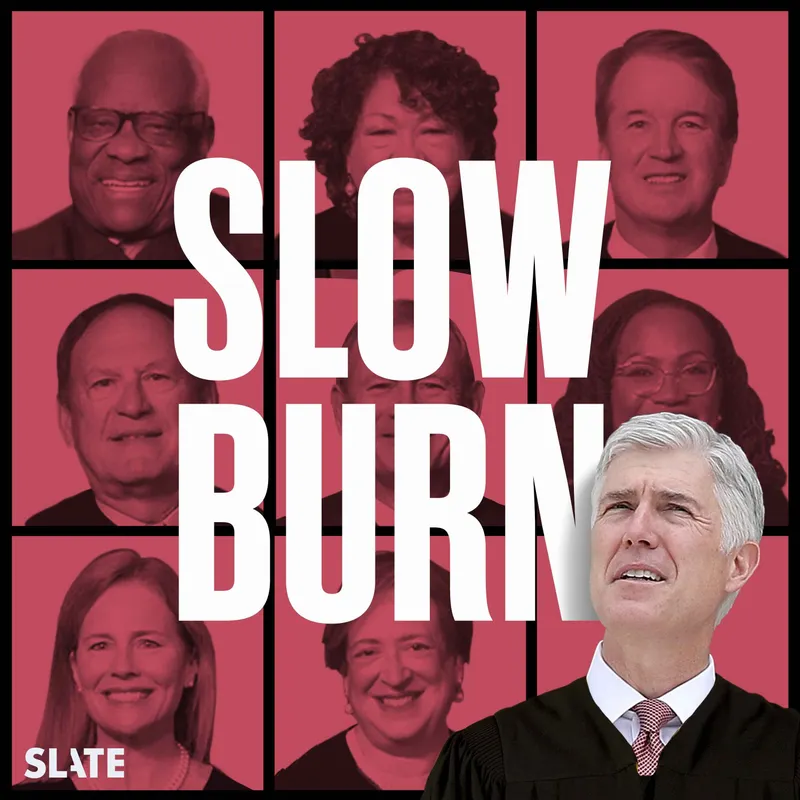
Slow Burn illuminates America’s most consequential moments, making sense of the past to better understand the present. Through archival tape and first-person interviews, the series uncovers the surprising events and little-known characters lurking within the biggest stories of our time.Join Slate Plus to unlock full, ad-free access to Slow Burn and your other favorite Slate podcasts. You can subscribe from the Slow Burn show page on Apple Podcasts and Spotify. Or visit slate.com/slowburnplus to get access wherever you listen.Season 11: Becoming Justice GorsuchHow Neil Gorsuch laid the foundation for a SCOTUS supermajority and then became its mo...
Why listen
Slow Burn is a deeply researched documentary series that uncovers the hidden stories and forgotten characters behind America's pivotal historical moments. Using archival audio, primary sources, and fresh interviews, each season tells a cinematic narrative that reframes how you understand the present. If you love investigative journalism, American history, and stories with real stakes, this is essential listening.
Series(5)



Episodes
Most of us use GPS—the Global Positioning System—on a daily basis: to find our location when we’re driving, running, shopping, dating, and so much more. But GPS is even more important, and more vulnerable, than you think.In the last few years, GPS interference has been reported all over the world, from war zones to shipping routes to public squares. What was once the fanciful plot of a Bond movie—bad guy manipulates GPS to start World War III—is increasingly plausible. How did the world come to rely so heavily on such an unreliable system?In this episode of Decoder Ring, host Willa Paskin talks to journalist Katherine Dunn, author of the new book Little Blue Dot: How GPS Shaped the Modern World. You’ll learn how GPS works, why it was created, how it became so ubiquitous, and why it’s now under attack. You’ll also hear from Dr. Todd Humphreys, an aerospace engineer who manipulated GPS to trick an $85 million superyacht into following his direction—for science, of course.This episode was written and produced by Max Freedman. It was edited by Willa Paskin and Evan Chung, our supervising producer. Merritt Jacob is Senior Technical Director. Our intern is Phoebe Mulder.If you have any cultural mysteries you want us to decode, email us at [email protected] or leave a message on our hotline at (347) 460-7281.Sources for This Episode Burgess, Matt. “When a tanker vanishes, all the evidence points to Russia,” WIRED, Sep. 21, 2017.Dunn, Katherine. Little Blue Dot: How GPS Shaped the Modern World, Bloomsbury Publishing, 2026.Dunn, Katherine. “How to Hack a Superyacht,” The Walrus, Jun. 13, 2026.Hopper, Nate. “The Thorny Problem of Keeping the Internet’s Time,” The New Yorker, Sep. 30, 2022.Hopper, Nate. “<a href="https://www.theatlantic.com/international/archive/2024/09/ukraine-timekeeper-kharkiv-clocks-standards/679923/" rel="noopener noreferrer" target="_blank
Here at Slow Burn, we explore the events and people who shaped America as we know it today. As the country marks its 250th birthday this summer, we want to introduce you to the first installment of First America, a great podcast series that explores a truly consequential moment from our nation’s past. We have been told the American Revolution was fought over taxation and representation. First America reveals the real story of why the colonists rebelled, what kind of government they created, and how it led to America’s current political moment. Hosted by Rebecca Nagle, an Indigenous author and former host of Crooked Media’s This Land podcast, the series looks at the hunger for Indigenous land that fueled the American Revolution—and questions how an entire country missed the point of its own founding document. The show's first episode takes its title from the lesser-known last grievance in the Declaration of Independence. Listen to “Merciless Indian Savages,” from First America—and find the rest of the series wherever you get podcasts.Need to set up your Slate Plus feed? If you subscribed through Slate.com, check out our FAQ at slate.com/podcastfaqs for easy instructions. Members subscribed via Apple Podcasts get automatic access—no setup required. Hosted on Acast. See acast.com/privacy for more information.
It seems like the only time you hear about new statues these days is when something goes horribly wrong. Unfortunate bronze renditions of Lucille Ball, Cristiano Ronaldo, Dwayne Wade, and many others are always going viral, becoming a fixture of late-night shows and mocking comment sections. Is the internet too harsh a critic? Or is American statuary a total bust?In this episode of Decoder Ring, host Willa Paskin talks to artist Atalanta Arden-Miller about what’s happened to one of the oldest artistic traditions in the world—why so many contemporary statues turn out off-center, off-kilter, and off-putting. The answer takes us from ancient Greece to Nazi Germany to North Korea.This episode was written by Willa Paskin. It was produced by Max Freedman. It was edited by Josh Levin and Evan Chung, our supervising producer. Merritt Jacob is Senior Technical Director. Our intern is Phoebe Mulder.Special thanks to the Works in Progress Podcast, where we first heard Atalanta talk about the dismal state of statuary today.If you have any cultural mysteries you want us to decode, email us at [email protected] or leave a message on our hotline at (347) 460-7281.Get more of Decoder Ring with Slate Plus! Join for exclusive bonus episodes of Decoder Ring and ad-free listening on all your favorite Slate podcasts. Subscribe from the Decoder Ring show page on Apple Podcasts or Spotify. Or, visit slate.com/decoderplus for access wherever you listen.Need to set up your Slate Plus feed? If you subscribed through Slate.com, check out our FAQ at slate.com/podcastfaqs for easy instructions. Members subscribed via Apple Podcasts get automatic access—no setup required. Hosted on Acast. See acast.com/privacy for more information.
In Australia, no wedding or school dance is complete without the Nutbush, Australia’s unofficial national dance. The Nutbush – a simple line dance to the song “Nutbush City Limits,” by Ike and Tina Turner – has become as stereotypically Australian as kangaroos, boomerangs, and Vegemite.And yet, hardly anyone outside of Australia even knows the Nutbush exists. Here at Decoder Ring, we certainly didn’t – until we started getting emails from Australians asking us to investigate its origins. How did an American song become the soundtrack for an Australian national tradition? Who invented the iconic steps, and why does every Australian know them?Our producer Max Freedman put on his dancing shoes to get some answers. The global, century-spanning story of the Nutbush involves Australia, Tennessee, Denmark, primary schools, gay discos, and demonstrates that even the goofiest cultural touchstones can go surprisingly deep.In this episode you’ll hear from culture journalists David Mack and Angus Kidman; Nutbush researchers Panizza Allmark and Jon Stratton; dance historians Erica Okamura and Richard Powers; Dr. Fiona Chatteur, Jeremy Santolin, and Brian Kerr.This episode was written and produced by Max Freedman and edited by Evan Chung, our supervising producer. Merritt Jacob is Senior Technical Director.If you have any cultural mysteries you want us to decode, email us at [email protected] or leave a message on our hotline at (347) 460-7281.Get more of Decoder Ring with Slate Plus! Join for exclusive bonus episodes of Decoder Ring and ad-free listening on all your favorite Slate podcasts. Subscribe from the Decoder Ring show page on Apple Podcasts or Spotify. Or, visit slate.com/decoderplus for access wherever you listen.Need to set up your Slate Plus feed? If you subscribed through Slate.com, check out our FAQ</
In our final episode, it’s time to talk about Neil Gorsuch and the future of SCOTUS. Host Susan Matthews enlists Slate’s jurisprudence team—Amicus co-hosts Dahlia Lithwick and Mark Joseph Stern—to discuss Gorsuch’s key rulings to date, his unpredictability, and how this textualist will shape this court (and our country) for decades to come.Want more Slow Burn? Join Slate Plus to binge every episode of Becoming Justice Gorsuch—and every season of Slow Burn, including Becoming Justice Thomas. You’ll also enjoy ad-free listening to all of your favorite Slate podcasts. Visit slate.com/slowburnplus to get access wherever you listen.Season 11 of Slow Burn was written and reported by Susan Matthews. It was produced by Sophie Summergrad and Joel Meyer. It was edited by Mia Lobel, Hillary Frey, and Evan Chung. Original music by Hannis Brown. Merritt Jacob mixed this episode. Mia Lobel is the executive producer of Slate Podcasts.Need to set up your Slate Plus feed? If you subscribed through Slate.com, check out our FAQ at slate.com/podcastfaqs for easy instructions. Members subscribed via Apple Podcasts get automatic access—no setup required. Hosted on Acast. See acast.com/privacy for more information.
When Justice Antonin Scalia died in February of 2016, the Supreme Court appeared to be headed for a 5-4 liberal majority. Instead, a staggering blockade by Senate Republicans and a shocking electoral upset helped steal a seat and clear the way for today’s conservative supermajority. In our second episode, we examine Neil Gorsuch’s politically fraught path to power and his time on the bench so far, including the unpredictability that has made him the high court’s wild card.Want more Slow Burn? Join Slate Plus to binge every episode of Becoming Justice Gorsuch—and every season of Slow Burn, including Becoming Justice Thomas. You’ll also enjoy ad-free listening to all of your favorite Slate podcasts. Visit slate.com/slowburnplus to get access wherever you listen. Season 11 of Slow Burn was written and reported by Susan Matthews. It was produced by Sophie Summergrad and Joel Meyer. It was edited by Mia Lobel, Hillary Frey, and Evan Chung. Original music and sound design by Hannis Brown. Mia Lobel is the executive producer of Slate Podcasts.Our legal editor is Mark Joseph Stern. Special thanks to Dahlia Lithwick, Sara Burningham, and Patrick Fort. Episode artwork by Natalie Matthews-Ramo.Need to set up your Slate Plus feed? If you subscribed through Slate.com, check out our FAQ at slate.com/podcastfaqs for easy instructions. Members subscribed via Apple Podcasts get automatic access—no setup required. Hosted on Acast. See acast.com/privacy for more information.
Neil Gorsuch may not be the most well-known justice on the Supreme Court, but he might just be the key to understanding how and why the current court has come to wield so much power over our day-to-day lives. In our first episode, host Susan Matthews examines Gorsuch’s early years, what he took away from his iconoclastic mother’s rocky tenure in the Reagan administration, and how his worldview was shaped by his time on a liberal college campus and in 1980s conservative circles. Plus: the controversial court case that might have gotten Gorsuch noticed by just the right people at just the right time.Want more Slow Burn? Join Slate Plus to binge every episode of Becoming Justice Gorsuch—and every season of Slow Burn, including Becoming Justice Thomas. You’ll also enjoy ad-free listening to all of your favorite Slate podcasts. Visit slate.com/slowburnplus to get access wherever you listen. Season 11 of Slow Burn was written and reported by Susan Matthews. It was produced by Sophie Summergrad and Joel Meyer. It was edited by Mia Lobel, Hillary Frey, and Evan Chung. Original music and sound design by Hannis Brown. Mia Lobel is the executive producer of Slate Podcasts.Our legal editor is Mark Joseph Stern. Special thanks to Dahlia Lithwick, Sara Burningham, and Patrick Fort. Episode artwork by Natalie Matthews-Ramo.Need to set up your Slate Plus feed? If you subscribed through Slate.com, check out our FAQ at slate.com/podcastfaqs for easy instructions. Members subscribed via Apple Podcasts get automatic access—no setup required. Hosted on Acast. See acast.com/privacy for more information.
Coming May 13: Host Susan Matthews traces the rise of Neil Gorsuch, from his formative years as a young conservative through his nomination to a “stolen seat” on the U.S. Supreme Court. Through interviews, legal analysis, and archival research, the mild-mannered Westerner emerges as the court’s most unpredictable—and most important—sitting justice.Need to set up your Slate Plus feed? If you subscribed through Slate.com, check out our FAQ at slate.com/podcastfaqs for easy instructions. Members subscribed via Apple Podcasts get automatic access—no setup required. Hosted on Acast. See acast.com/privacy for more information.
We are lucky to get fantastic questions from our listeners here at Decoder Ring, and in this episode, we’re going to open up our mailbag to answer three of them. What are the origins of an eerie horror film string motif? Why do companies insist on telling callers to “listen closely” to menu options that could not possibly have changed? And when did we start using the indispensable eye roll?In this episode, you’ll hear from historical musicologist Frank Hentschel, as well as Eli Spindel, artistic director of the String Orchestra of Brooklyn. We also speak with writer Nick Greene, Holdcom CEO Andrew Begnoché, and linguist Dr. Rebecca Clift.This episode was produced by Katie Shepherd and Evan Chung, our supervising producer. Decoder Ring is also produced by Max Freedman. Merritt Jacob is Senior Technical Director.Special thanks to Nicole Holliday, and to Leilehua Lanzilotti, whose website Shaken Not Stuttered is a fantastic resource about extended techniques for strings.If you have any cultural mysteries you want us to decode, email us at [email protected] or leave a message on our hotline at (347) 460-7281.Get more of Decoder Ring with Slate Plus! Join for exclusive bonus episodes of Decoder Ring and ad-free listening on all your favorite Slate podcasts. Subscribe from the Decoder Ring show page on Apple Podcasts or Spotify. Or, visit slate.com/decoderplus for access wherever you listen.Need to set up your Slate Plus feed? If you subscribed through Slate.com, check out our FAQ at slate.com/podcastfaqs for easy instructions. Members subscribed via Apple Podcasts get auto
Money is everywhere. Money influences just about everything. We think about money all the time. But how much do we really know about it? In this episode of Decoder Ring, we explore the obscure historical forces that make our money what it is and behave the way it does. We ask two simple-sounding questions with surprising answers: Why is our money called the dollar—and where are those dollars really coming from? First, you’ll hear from Brendan Greeley, a veteran finance reporter turned economic historian, and author of the new book, The Almighty Dollar: 500 Years of the World’s Most Powerful Money. Then, we get help from Mark Blyth, a political economist at Brown University who teaches about the architecture and plumbing of global finance.This episode was written by Willa Paskin and Max Freedman and produced by Max Freedman. Decoder Ring is also produced by Katie Shepherd and Supervising Producer Evan Chung. Merritt Jacob is our Senior Technical Director. Thank you to Lizzie O’Leary.If you have any cultural mysteries you want us to decode, email us at [email protected] or leave a message on our hotline at (347) 460-7281.Get more of Decoder Ring with Slate Plus! Join for exclusive bonus episodes of Decoder Ring and ad-free listening on all your favorite Slate podcasts. Subscribe from the Decoder Ring show page on Apple Podcasts or Spotify. Or, visit slate.com/decoderplus for access wherever you listen.Need to set up your Slate Plus feed? If you subscribed through Slate.com, check out our FAQ at slate.com/podcastfaqs for easy instructions. Members subscribed via Apple Podcasts get automatic access—no setup required. Hosted on Acast. See acast.com/privacy for more information.
In the summer of 2006, a teenage girl began posting video diaries to a then-new site called YouTube under the handle lonelygirl15. Within weeks she was a phenomenon—even though no one knew the truth of who she really was. The frenzied quest to change that, to solve the mystery of lonelygirl15, would ultimately land her on the front page of newspapers and the covers of magazines. Twenty years on, lonelygirl15 is both an artifact of an earlier online era and an origin point for the internet as we know it: a place full of video diaries, parasocial relationships, influencers, hyper-engaged fandoms, and the knowledge that you can’t always believe your eyes.In this episode, you’ll hear from some of the people who investigated lonelygirl15 way back in 2006: culture critic Virginia Heffernan, who writes the Substack Magic + Loss and co-hosts the podcast Omnishambles; entertainment journalist Richard Rushfield of The Ankler; Emmy Award-winning producer Jenni Powell; and one-time cybersleuth Chris Patterson. We also speak with the people involved in making lonelygirl15: Miles Beckett, Mesh Flinders, Jessica Rose Phillipps, and Amanda Goodfried. This episode was written by Willa Paskin and Evan Chung, Decoder Ring’s Supervising Producer. Decoder Ring is also produced by Willa Paskin, Katie Shepherd, and Max Freedman. Merritt Jacob is Senior Technical Director.Thank you to Greg Goodfried, Matt Foremski, and Tom Foremski. Special thanks to Ryan Broderick and Grant Irving of the podcast Panic World, who introduced Willa to the lonelygirl15 story on a recent episode of their show and suggested it might make a good topic for Decoder Ring.If you have any cultural mysteries you want us to decode, email us at [email protected] or leave a message on our hotline at (347) 460-7281.Sources for This EpisodeCresci,
For over a century, fans of Sherlock Holmes have been analyzing, debating, and creating new texts with Arthur Conan Doyle’s characters. But when a fan theory emerged about the BBC TV show Sherlock that posited the inevitability of a gay romance between Sherlock Holmes and Dr. John Watson—it wreaked havoc on the community. In this episode, which originally aired in 2018, we explore the Johnlock Conspiracy, with help from historians, journalists, and the fans at the heart of the controversial idea. It’s almost a Holmesian tale itself, full of brilliant theories, false leads and mysterious motives—except for the ending, which, unlike in a Holmes story, isn’t very neat.This episode was written by Willa Paskin. It was produced and edited by Benjamin Frisch, who also created the episode art. Shasha Leonárd provided production assistance, and Danielle Hewitt helped us fact check the episode. Decoder Ring is also produced by Katie Shepherd, Max Freedman, and Evan Chung, our supervising producer. Merritt Jacob is Senior Technical Director.If you have any cultural mysteries you want us to decode, email us at [email protected] or leave a message on our hotline at (347) 460-7281.Get more of Decoder Ring with Slate Plus! Join for exclusive bonus episodes of Decoder Ring and ad-free listening on all your favorite Slate podcasts. Subscribe from the Decoder Ring show page on Apple Podcasts or Spotify. Or, visit slate.com/decoderplus for access wherever you listen.Need to set up your Slate Plus feed? If you subscribed through Slate.com, check out our FAQ at slate.com/podcastfaqs for easy instructions. Members subscribed via Apple Podcasts get automatic access—no setup required. Hosted on Acast. See acast.com/privacy for more information.
When Eyes Wide Shut opened in the summer of 1999, it was widely considered a disappointment. This final film from legendary director Stanley Kubrick had been sold as an erotic thriller, and potentially even a peek into the real sex lives of its then-married stars, Tom Cruise and Nicole Kidman. But Eyes Wide Shut was stranger than that: a meditative art film whose much-hyped orgy scene is more creepy than sexy, run by a cabal of rich and powerful men who prey on young women.But Eyes Wide Shut has received a burst of new attention in the last few years, amid constant revelations about a real-life cabal of rich and powerful men who prey on young women. Across the internet, cinema sleuths have been asking: is it possible Eyes Wide Shut was not fictional? Was Stanley Kubrick trying to warn the world about a real conspiracy? And if so… was he murdered for it? In this episode of Decoder Ring, we follow Lane Brown—a lifelong Kubrick fan and features writer for New York Magazine—as he investigates this conspiracy theory and what it says about how we deal with ugly facts and murky fictions.This episode was written and produced by Max Freedman and edited by Willa Paskin. Decoder Ring is also produced by Katie Shepherd and Evan Chung, our supervising producer. Merritt Jacob is Senior Technical Director.If you have any cultural mysteries you want us to decode, email us at [email protected] or leave a message on our hotline at (347) 460-7281.Sources for This EpisodeBarbezat, Michael. “‘Pizzagate’ and the Nocturnal Ritual Fantasy: Imaginary Cults, Fake News, and Real Violence,” The Public Medievalist, May 4, 2017.Brown, Lane. “The Eyes Wide Shut Conspiracy,” New York Magazine, Dec. 17, 2025.Ebiri, Bilge. “An Oral History of an Orgy,” New York Magazine, June 27, 2019.Nicholson, Amy. “The Year Tom Cruise Gave Not One but Two Dangerously Vulnerable Performances,” The New York Times, Aug. 27, 2024.Raftery, Brian. “Dream Team: Cruise, Kidman, Kubr
The delicious, healthful prune has long had a cross to bear: It’s best known for making people poop. In the late 1990s, the California Prune Board set out on a quixotic mission to amend this sales-flattening reputation. It would attempt to rechristen this ancient fruit in the hopes the prune could one day be as unencumbered as an apricot, a raisin, or a fig. In a world where every product and person increasingly believes it’s one good rebrand away from changing how they are seen, the story of the prune’s attempt to become the “dried plum” is a telling tale about the impossibility of escaping who you really are—and the freedom that comes with self-acceptance. You’ll hear from Richard Peterson, retired Executive Director of the California Prune Board; food writer and chef David Liebovitz; lawyer and lobbyist Dan Haley; and Kiaran Locy, Director of Brand and Industry Communications at the California Prune Board.This episode was written by Willa Paskin. It was edited by Evan Chung, our supervising producer. It was produced by Katie Shepherd. Decoder Ring is also produced by Max Freedman. Merritt Jacob is Senior Technical Director.If you have any cultural mysteries you want us to decode, email us at [email protected] or leave a message on our hotline at (347) 460-7281.Sources for This EpisodeBarry, Dave. Dave Barry Hits Below the Beltway, Ballantine Books, 2002. Brasher, Philip. “FDA Approves Prune Name Change,” ABC News, Feb. 1, 2001. Brasher, Philip. “Where's the beef? Kids give prune burgers the taste test,” Associated Press, Jan 29, 2002. Cimons, Marlene. “A New Wrinkle for the Prune Industry,” Los Angeles Times, Dec. 21, 1999.Crespi, John M., Harry M. Kaiser, Julian M. Alston, and Richard J. Sexton. “The Evaluation of Prune Promotion by the California Dried Plum Board,” The Economics of Commodity Promotion Programs: Lessons from California, Peter Lang USA, 2005. Davis, Glenn. “<a href="https://teac
Three weeks ago, U.S. Secretary of the Interior Doug Burgum shared an unusual tweet: a cartoon image of himself with his arm draped around a giant, anthropomorphized lump of coal. This piece of coal has big googly eyes and a smudge of a nose, and is wearing a safety vest and a hard hat. He is, frankly, adorable—and he has a name: Coalie.When Coalie first appeared on the internet, he went viral—ridiculed on social media, in newsletters, and even on late night talk shows. And that’s because this big-eyed, cute piece of coal was widely understood to be coal propaganda, a tool to soften the coal industry’s image.But the truth about Coalie is more complicated. His origins tell a story about what it’s like for federal employees to try to do their work while navigating the Trump administration’s agenda. Coalie may be widely seen as a mascot for coal mining, but that’s not what he was made for.In this episode, you’ll hear from Simone Randolph, Director of Communications for the Office of Surface Mining Reclamation and Enforcement (OSMRE); Sara Eckert, formerly of OSMRE; Slate staff writer Nitish Pahwa; and Leah Stokes, who researches climate and energy policy at the University of California, Santa Barbara and co-hosts the podcast A Matter of Degrees.Thank you to Daniel Raimi, Tony Ho Tran, and Hannah Northey.This episode was written by Willa Paskin and Evan Chung and produced by Evan Chung, Decoder Ring’s supervising producer. Our show is also produced by Max Freedman and Katie Shepherd. Merritt Jacob is Senior Technical Director.If you have any cultural mysteries you want us to decode, email us at [email protected] or leave a message on our hotline at (347) 460-7281.Get more of Decoder Ring with Slate Plus! Join for exclusive bonus episodes of Decoder Ring and ad-free listening on all your favorite Slate podcasts. Subscribe from the Decoder Ring show page on Apple Podcasts or Spotify. Or, visit <a href="https://slate.com/podc
It’s a weird time for culture. There is more of it than ever before, it’s more accessible than ever before, but so little of it feels original. New movies are based on old stories, new songs are recycling old hooks, and fashion trends are cycling so fast that everything’s in. Has our culture grown stagnant? The author and culture critic W. David Marx thinks so. His new book, Blank Space, argues that there is a “blank space” in the 21st century where cultural innovation should be. In this episode, David explains to Willa how culture change worked in the 20th century, what changed after the turn of the millennium, and what we might do about it. This episode was produced by Max Freedman. Decoder Ring is also produced by Willa Paskin, Katie Shepherd, and Evan Chung, our supervising producer. Merritt Jacob is Senior Technical Director.If you have any cultural mysteries you want us to decode, email us at [email protected] or leave a message on our hotline at (347) 460-7281.Get more of Decoder Ring with Slate Plus! Join for exclusive bonus episodes of Decoder Ring and ad-free listening on all your favorite Slate podcasts. Subscribe from the Decoder Ring show page on Apple Podcasts or Spotify. Or, visit slate.com/decoderplus for access wherever you listen.Need to set up your Slate Plus feed? If you subscribed through Slate.com, check out our FAQ at slate.com/podcastfaqs for easy instructions. Members subscribed via Apple Podcasts get automatic access—no setup required. Hosted on Acast. See acast.com/privacy for more information.
We are really lucky to get lots of listener suggestions for the show, more good questions than we can possibly answer in a mailbag episode once or twice a year. So we’re starting a new segment we call… Decoder Rings Back! Every month, host Willa Paskin will personally call up a listener to answer their question. In this inaugural installment of Decoder Rings Back, Willa calls up listener Dustin Malek about his cultural mystery: Why did the Mona Lisa, of all paintings, become the most famous in the world, bar none? Willa shares the story of daring heist that turned Leonardo da Vinci’s enigmatic smiling subject into a celebrity.Future episodes of Decoder Rings Back will only be available to Slate Plus subscribers. So if you want to be sure not to miss them, sign up for Slate Plus! You’ll get exclusive episodes and ad-free listening not just on our show, but all your favorite Slate podcasts. Subscribe from the Decoder Ring show page on Apple Podcasts or Spotify, or visit slate.com/decoderplus for access wherever you listen. This episode was produced by Max Freedman. Decoder Ring is also produced by Katie Shepherd and Evan Chung, our supervising producer. Merritt Jacob is Senior Technical Director.If you have any cultural mysteries you want us to decode, email us at [email protected] or leave a message on our hotline at (347) 460-7281.Sources for This EpisodeCumming, Laura. “The man who stole the Mona Lisa,” The Guardian, August 5, 2011.Hoobler, Dorothy, and Thomas Hoobler. “Stealing Mona Lisa,” Vanity Fair, April 16, 2009.Hoobler, Dorothy, and Thomas Hoobler. The Crimes of Paris: A True Story of Murder, Theft, and Detection, Bison Books, 2010.Isaacson, Walter. Leonardo da Vinci, Simon & Schuster, 2018.Roberts, Sam. “<a href="https://www.nytimes.com/2022/10/07/arts/design/mona-lisa-vincenz
Hark, the holiday season is upon us—and with it the most solemn of festive traditions: a gift guide! In this video and podcast special, Slate hosts Dana Stevens, Chris Molanphy, and Willa Paskin beam-in from their collective hearths to deliver unto the internet their favorite gifts for culture lovers this holiday. In addition to sharing gifts, they also discuss the cultural artifact that is the “holiday gift guide,” and its history going back to the early 20th century, up to the modern day. See the entirety of the 1910 gift guide Our Special Holiday Gift-Book from Greenhut-Siegel Cooper, and Esquire’s ultra-mod gift guide from 1961. Check out our gift recommendations below: Dana Stevens’ Cozy Movie Night-In: The Salbree Collapsible Silicone Microwave Popcorn Popper & Amish Country Popcorn L'agraty Chunky Knit Blanket Throw The Adventures of Antoine Doinel, The Criterion Collection Box Set Chris Molanphy’s Hit Parade Collection: The Beatles’ Revolver CD Box Set Mad Men Blu-Ray Box Set Can't Slow Down: How 1984 Became Pop's Blockbuster Year, by Michaelangelo Matos Willa Paskin’s Fruit-Themed Trompe-l'œil Housewares: Cantaloupe-shaped bowls in the style of Bordallo Pinheiro 4-Pack Orange-Shaped Candle Stocking Stuffer Cherry-Shaped Toilet Brush The Slate Culture Gift Guide is produced for Slate Studios by Benjamin Frisch and Micah Phillips, with Meryl Bezrutczyk and Andrew Harding. Learn more about your ad choices. Visit megaphone.fm/adchoices
Hark, the holiday season is upon us—and with it the most solemn of festive traditions: a gift guide! In this video and podcast special, Slate hosts Dana Stevens, Chris Molanphy, and Willa Paskin beam-in from their collective hearths to deliver unto the internet their favorite gifts for culture lovers this holiday. In addition to sharing gifts, they also discuss the cultural artifact that is the “holiday gift guide,” and its history going back to the early 20th century, up to the modern day. See the entirety of the 1910 gift guide Our Special Holiday Gift-Book from Greenhut-Siegel Cooper, and Esquire’s ultra-mod gift guide from 1961.Check out our gift recommendations below:Dana Stevens’ Cozy Movie Night-In: The Salbree Collapsible Silicone Microwave Popcorn Popper font-siz
Decoder Ring listeners write in with some excellent mysteries, and for our last episode of the year we’re solving three of them. Why do children play in boxes full of sand? Why do rock bands pretend like the show is over when everybody knows they’re coming back for an encore? And what was up with those school assemblies where you’d get to skip class to learn about…yo-yos? The voices you’ll hear in this episode include yo-yo masters ”Dazzling Dave” Schulte and Dale Oliver, children’s book author Rob Peñas, Pulitzer Prize-winning design critic Alexandra Lange, and music journalists Brian Wise, Michael Walker, and Travis Andrews. You can find all the music from the segment about encores in this YouTube playlist. This episode was produced by Max Freedman, Katie Shepherd, and Evan Chung, Decoder Ring’s supervising producer. Merritt Jacob is Senior Technical Director. We had additional production from Joel Meyer. If you have any cultural mysteries you want us to decode, email us at [email protected] or leave a message on our hotline at (347) 460-7281. Get more of Decoder Ring with Slate Plus! Join for exclusive bonus episodes of Decoder Ring and ad-free listening on all your favorite Slate podcasts. Subscribe from the Decoder Ring show page on Apple Podcasts or Spotify. Or, visit slate.com/decoderplus for access wherever you listen. Learn more about your ad choices. Visit megaphone.fm/adchoices
Decoder Ring listeners write in with some excellent mysteries, and for our last episode of the year we’re solving three of them. Why do children play in boxes full of sand? Why do rock bands pretend like the show is over when everybody knows they’re coming back for an encore? And what was up with those school assemblies where you’d get to skip class to learn about…yo-yos?The voices you’ll hear in this episode include yo-yo masters ”Dazzling Dave” Schulte and Dale Oliver, children’s book author Rob Peñas, Pulitzer Prize-winning design critic Alexandra Lange, and music journalists Brian Wise, Michael Walker, and Travis Andrews. You can find all the music from the segment about encores in this YouTube playlist.This episode was produced by Max Freedman, Katie Shepherd, and Evan Chung, Decoder Ring’s supervising producer. Merritt Jacob is Senior Technical Director. We had additional production from Joel Meyer.If you have any cultural mysteries you want us to decode, email us at [email protected] or leave a message on our hotline at (347) 460-7281.Get more of Decoder Ring with Slate Plus! Join for exclusive bonus episodes of Decoder Ring and ad-free listening on all your favorite Slate podcasts. Subscribe from the Decoder Ring show page on Apple Podcasts or Spotify. Or, visit slate.com/decoderplus for access wherever you listen. Need to set up your Slate Plus feed? If you subscribed through Slate.com, check out our FAQ at slate.com/podcastfaqs for easy instructions. Members subscribed via Apple Podcasts get automatic access—no setup required. Hosted on Acast. See acast.com/privacy for more information.
Videomate: Men was a VHS tape released in 1987 featuring 60 single men pitching themselves as dates to women on the other side of the TV screen: “The love of your life could be on your TV tonight!” the box reads. In retrospect, Videomate: Men is a bizarre and hilarious time capsule, but at the time it was one of many manifestations of what was known as video dating. To find out how anyone thought this was a good idea, Decoder Ring examines the weird and forgotten world of video dating in the 1970s, ’80s, and ’90s to find out why video dating once seemed like the future—and if that future is still yet to come.On this episode, originally released in 2019, we talk to the creators of the Found Footage Fest, VHS collectors who unleashed Videomate on the internet; ask the creators of video dating services like Videomate’s Steve Dworman and Great Expectations’ Jeffrey Ullman what they were thinking; and talk to participants who used these services but not necessarily in the way that was intended. We’ll also discuss the future of video dating with Coffee Meets Bagel co-founder Dawoon Kang and former host of The Longest Shortest Time Andrea Silenzi.This episode was written by Willa Paskin and was produced and edited by Benjamin Frisch. We had research assistance from Cleo Levin. Decoder Ring is produced by Katie Shepherd, Max Freedman, and Evan Chung, our supervising producer. Merritt Jacob is Senior Technical Director.If you have any cultural mysteries you want us to decode, email us at [email protected], or leave a message on the Decoder Ring hotline at 347-460-7281. We love to hear any and all of your ideas for the show. Get more of Decoder Ring with Slate Plus! Join for exclusive bonus episodes of Decoder Ring and ad-free listening on all your favorite Slate podcasts. Subscribe from the Decoder Ring show page on Apple Podcasts or Spotify. Or, visit slate.com/decoderplus for access wherever you listen. Need to set up your Slate Plus feed? If you subscribed through Slate.com, check out our FAQ at slate.com/podcastfaqs for easy instructions. Members subscribe
Americans are currently besotted with protein. It’s touted as being good for muscle growth, weight loss, skincare, mental acuity, longevity, and much else besides. It’s sold to men, women, children, the elderly— you can even buy protein for your pets. The protein supplement market alone is worth $21 billion and growing—and extra protein is being added to coffee, cereal, pasta, beer, ice cream, and popcorn. But as frenzied as we currently are about protein, this is not the first protein boom—or even the second. Protein has been promoted as a charismatic, cure-all nutrient for nearly two centuries. In this episode, with the help of Samantha King and Gavin Weedon, the authors of Protein: The Making of a Nutritional Superstar, we look closely at all our protein crazes and their associated protein products—from beef tea to whey powder—and see what they can tell us about our current protein mania. This episode was produced by Max Freedman. Decoder Ring is also produced by Willa Paskin, Katie Shepherd, and Evan Chung, our supervising producer. We had editing support from Josh Levin and fact-checking by Sophie Summergrad. Merritt Jacob is Senior Technical Director. If you have any cultural mysteries you want us to decode, email us at [email protected] or leave a message on our hotline at (347) 460-7281. Get more of Decoder Ring with Slate Plus! Join for exclusive bonus episodes of Decoder Ring and ad-free listening on all your favorite Slate podcasts. Subscribe from the Decoder Ring show page on Apple Podcasts or Spotify. Or, visit slate.com/decoderplus for access wherever you listen. Sources for This Episode King, Samantha and Gavin Weedon. Protein: The Making of a Nutritional Superstar, Duke University Press, 2026. Baker, Ryan. “Protein has become America's latest obsession. Companies like General Mills and PepsiCo are capitalizing on it,” CNBC, July 22, 2025. Brock, William H. Justus von Liebig: The Chemical Gatekeeper, Cambridge University Press, 1997. Callahan, Alice. “<a href="https://www.nytimes.com/2025/04/09/well/eat/protein-fact-che
Americans are currently besotted with protein. It’s touted as being good for muscle growth, weight loss, skincare, mental acuity, longevity, and much else besides. It’s sold to men, women, children, the elderly— you can even buy protein for your pets. The protein supplement market alone is worth $21 billion and growing—and extra protein is being added to coffee, cereal, pasta, beer, ice cream, and popcorn.But as frenzied as we currently are about protein, this is not the first protein boom—or even the second. Protein has been promoted as a charismatic, cure-all nutrient for nearly two centuries. In this episode, with the help of Samantha King and Gavin Weedon, the authors of Protein: The Making of a Nutritional Superstar, we look closely at all our protein crazes and their associated protein products—from beef tea to whey powder—and see what they can tell us about our current protein mania. This episode was produced by Max Freedman. Decoder Ring is also produced by Willa Paskin, Katie Shepherd, and Evan Chung, our supervising producer. We had editing support from Josh Levin and fact-checking by Sophie Summergrad. Merritt Jacob is Senior Technical Director.If you have any cultural mysteries you want us to decode, email us at [email protected] or leave a message on our hotline at (347) 460-7281.Get more of Decoder Ring with Slate Plus! Join for exclusive bonus episodes of Decoder Ring and ad-free listening on all your favorite Slate podcasts. Subscribe from the Decoder Ring show page on Apple Podcasts or Spotify. Or, visit slate.com/decoderplus for access wherever you listen.Sources for This EpisodeKing, Samantha and Gavin Weedon. Protein: The Making of a Nutritional Superstar, Duke University Press, 2026.Baker, Ryan. “Protein has become America's latest obsession. Companies like General Mills and PepsiCo are capitalizing on it,” CNBC, July 22, 2025.Brock, William H. Justus von Liebig: The Chemical Gatekeeper, Cambridge University Press, 1997.Callahan, Alice. “
Autumn may have more cozy signifiers than any other season—though we all have our own favorites. Maybe for you it’s sweater weather, football games, spooky season, apple picking, leaf peeping, or mainlining candy corn. Whatever it is, in today’s episode we’re looking closely at three of these autumnal staples. First, we get to the bottom of a recurring complaint about the taste of the pumpkin spice latte. Then we gaze deep inside the enigma hiding inside colorful fall leaves. Finally we ask some hard-hitting questions about the seasonal availability of an elusive cookie. Snuggle up and enjoy! In this episode, you’ll hear from author and podcaster Don Martin who has a new audiobook out about loneliness called Where Did Everybody Go?. We also speak with Simcha Lev-Yadun, professor of botany and archeology; Susanne Renner, botanist and honorary professor of biology at Washington University in St. Louis; and Prospect Park Alliance arborist Malcom Gore. And you’ll also hear from Lauren Tarr, who runs the blog Midlife Moxie and Muscle, and her mother Grace Dewey, along with Caroline Suppiger, brand manager at Mondelēz. We’d also like to thank Brian Gallagher, Tom Arnold, Sylvie Russo and Laura Robinson. This episode was produced by Katie Shepherd. Decoder Ring is also produced by Willa Paskin, Max Freedman, and Evan Chung, our supervising producer. Merritt Jacob is Senior Technical Director. If you have any cultural mysteries you want us to decode, email us at [email protected] or leave a message on our hotline at (347) 460-7281. Get more of Decoder Ring with Slate Plus! Join for exclusive bonus episodes of Decoder Ring and ad-free listening on all your favorite Slate podcasts. Subscribe from the Decoder Ring show page on Apple Podcasts or Spotify. Or, visit slate.com/decoderplus for access wherever you listen. Learn more about your ad choices. Visit megaphone.fm/adchoices</a
Autumn may have more cozy signifiers than any other season—though we all have our own favorites. Maybe for you it’s sweater weather, football games, spooky season, apple picking, leaf peeping, or mainlining candy corn. Whatever it is, in today’s episode we’re looking closely at three of these autumnal staples.First, we get to the bottom of a recurring complaint about the taste of the pumpkin spice latte. Then we gaze deep inside the enigma hiding inside colorful fall leaves. Finally we ask some hard-hitting questions about the seasonal availability of an elusive cookie. Snuggle up and enjoy!In this episode, you’ll hear from author and podcaster Don Martin who has a new audiobook out about loneliness called Where Did Everybody Go?. We also speak with Simcha Lev-Yadun, professor of botany and archeology; Susanne Renner, botanist and honorary professor of biology at Washington University in St. Louis; and Prospect Park Alliance arborist Malcom Gore. And you’ll also hear from Lauren Tarr, who runs the blog Midlife Moxie and Muscle, and her mother Grace Dewey, along with Caroline Suppiger, brand manager at Mondelēz.We’d also like to thank Brian Gallagher, Tom Arnold, Sylvie Russo and Laura Robinson.This episode was produced by Katie Shepherd. Decoder Ring is also produced by Willa Paskin, Max Freedman, and Evan Chung, our supervising producer. Merritt Jacob is Senior Technical Director.If you have any cultural mysteries you want us to decode, email us at [email protected] or leave a message on our hotline at (347) 460-7281.Get more of Decoder Ring with Slate Plus! Join for exclusive bonus episodes of Decoder Ring and ad-free listening on all your favorite Slate podcasts. Subscribe from the Decoder Ring show page on Apple Podcasts or Spotify. Or, visit slate.com/decoderplus for access wherever you listen. Need to set up your Slate Plus feed? If you subscribed through Slate.com, check out our <a href="https://slate.c
There’s a ubiquitous prop in just about every police procedural and conspiracy thriller: a cork board pinned with documents, newspaper clippings, and Polaroid photos, all connected by a web of red string. They go by many names, including pin boards, string boards, evidence boards, investigation walls, conspiracy walls, and walls of crazy. These boards can be vehicles of insight or manifestations of madness—and in many cases, both. But where did they come from? And can they really solve a crime?In this episode, we try to unwind the red string board all the way to its center. To aide in our investigation, we enlist the help of Aki Peritz, a former CIA analyst and the author of Disruption: Inside the Largest Counterterrorism Investigation in History. You’ll also hear from Shawn Gilmore, editor of The Vault of Culture and creator of the Narrative String Theory project; and Dr. Anne Ganzert, author of Serial Pinboarding in Contemporary Television. And we learn about the intricacies of building a string board from production designers Michael Scott Cobb (It’s Always Sunny in Philadelphia) and John D. Kretschmer (Homeland).This episode was written and produced by Evan Chung, Decoder Ring’s supervising producer. It was edited by Willa Paskin. Decoder Ring is also produced by Katie Shepherd and Max Freedman. Merritt Jacob is Senior Technical Director.If you have any cultural mysteries you want us to decode, email us at [email protected] or leave a message on our hotline at (347) 460-7281.Sources for This EpisodeBenson, Richard. “Decoding the Detective's 'Crazy Wall',” Esquire, Jan. 22, 2015.Coley, Rob. “The case of the speculative detective: Aesthetic truths and the television ‘crime board’,” NECSUS, May 28, 2017.Ganzert, Anne. Serial Pinboarding in Contemporary Television, Palgrave Macmillan, 2020.Gilmore, Shawn. “Narrative String Theory,” The Vault of Culture.McGarry, Andrew. “Did Orwell's nightmare Nineteen Eighty-Four inspire the Snowtown murders?” Australian Broadcasting Corporation News, May
In 1993, more than 10 years into the AIDS epidemic, the Metropolitan Community Church of San Francisco (MCC-SF) tries to remember all they’ve lost. We think about remembering too after encountering an archive of 1,200 cassette recordings of this queer church’s services during the height of the epidemic. Whether you’re a regular church goer or would never step into one, we invite you to spend time with this LGBTQ+ San Francisco church as it struggles to reconcile sexuality and faith in the midst of an existential crisis. For images and links about this episode visit https://www.heavenpodcast.org/episode-1. About the montage: The worship service in this episode was on February 28, 1993. The Dyke March proclamation was written and read by Rev. Lea Brown. Rev. Karen Foster read the statement that sexual orientation does not need to be changed. Jim Mitulski recalled his hospital visit with the man who recognized him by his shape. Paul Francis told strangers at a restaurant to get ugly lovers and Eric Rofes told his mother that he was going to stay safe and keep having sex. Cleve Jones had the vision of a thousand rotting corpses, Rev. Ron Russell Coons preached that we have AIDS as a community, and Rev. Troy Perry proclaimed a revival on Eureka Street. The other people heard in the episode are either unknown or did not want to be named. When We All Get to Heaven is produced by Eureka Street Productions. It is co-created by Lynne Gerber, Siri Colom, and Ariana Nedelman. Our story editor is Sayre Quevedo. Our sound designer is David Herman. Our managing producer is Krissy Clark. Tim Dillinger is our consulting producer and Betsy Towner Levine is our fact-checker. We had additional story editing help from Sarah Ventre, Arwen Nicks, Allison Behringer, and Krissy Clark. For a complete list of credits, please visit http://heavenpodcast.org/credits. This project received generous support from individual donors, the Henry Luce Foundation (www.hluce.org), the E. Rhodes and Leona B. Carpenter Foundation, and California Humanities, a non-profit partner of the National Endowment for the Humanities (www.CalHum.org). Eureka Street Productions has 501c3 status through our fiscal sponsor FJC: A Foundation of Philanthropic Funds. The music for this episode is from the Metropolitan Community Church of San Francisco’s archive. It was performed by MCC-SF’s musicians and members with Bob Crocker and Jack Hoggatt-St.John as music directors. Additional music is by Tasty Morsels. Thanks to Paul Katz and Henry Machen for permission to use “June in San Francisco” from their fabulous 1991 musical Dirty D
In 1993, more than 10 years into the AIDS epidemic, the Metropolitan Community Church of San Francisco (MCC-SF) tries to remember all they’ve lost. We think about remembering too after encountering an archive of 1,200 cassette recordings of this queer church’s services during the height of the epidemic. Whether you’re a regular church goer or would never step into one, we invite you to spend time with this LGBTQ+ San Francisco church as it struggles to reconcile sexuality and faith in the midst of an existential crisis. For images and links about this episode visit https://www.heavenpodcast.org/episode-1.About the montage: The worship service in this episode was on February 28, 1993. The Dyke March proclamation was written and read by Rev. Lea Brown. Rev. Karen Foster read the statement that sexual orientation does not need to be changed. Jim Mitulski recalled his hospital visit with the man who recognized him by his shape. Paul Francis told strangers at a restaurant to get ugly lovers and Eric Rofes told his mother that he was going to stay safe and keep having sex. Cleve Jones had the vision of a thousand rotting corpses, Rev. Ron Russell Coons preached that we have AIDS as a community, and Rev. Troy Perry proclaimed a revival on Eureka Street. The other people heard in the episode are either unknown or did not want to be named. When We All Get to Heaven is produced by Eureka Street Productions. It is co-created by Lynne Gerber, Siri Colom, and Ariana Nedelman. Our story editor is Sayre Quevedo. Our sound designer is David Herman. Our managing producer is Krissy Clark. Tim Dillinger is our consulting producer and Betsy Towner Levine is our fact-checker. We had additional story editing help from Sarah Ventre, Arwen Nicks, Allison Behringer, and Krissy Clark. For a complete list of credits, please visit http://heavenpodcast.org/credits.This project received generous support from individual donors, the Henry Luce Foundation (www.hluce.org), the E. Rhodes and Leona B. Carpenter Foundation, and California Humanities, a non-profit partner of the National Endowment for the Humanities (www.CalHum.org).Eureka Street Productions has 501c3 status through our fiscal sponsor FJC: A Foundation of Philanthropic Funds.The music for this episode is from the Metropolitan Community Church of San Francisco’s archive. It was performed by MCC-SF’s musicians and members with Bob Crocker and Jack Hoggatt-St.John as music directors. Additional music is by Tasty Morsels. Thanks to Paul Katz and Henry Machen for permission to use “June in San Francisco” from their fabulous 1991 musical Dirty Dreams of a
Earlier this year, a tweet went out from the official account of the Democratic Party, tagging the Trump advisor Stephen Miller. It was an image of what appeared to be a simple hotel room chair. But for those in the know, it was much more than that: It was a “cuck chair,” an online meme straight out of a popular genre of hardcore pornography in which a man watches his partner have sex with another man. How did we get to a place where the Democrats could flame a political opponent with an image out of cucking porn and have millions of people immediately understand it? In this episode we trace the complicated and intricate history of the cuck. It’s a history that includes everything from Jacobean dramas to World War II pilots to, yes, pornography, as well as a host of deeply American prejudices that have become a lot less submerged over the last 10 years. And we also situate the cuck within a larger context, one in which porn is the elephant in the room of American culture. It’s a potent force, shaping and reflecting our very wants and desires and it is constantly seeping into mainstream culture—and yet we don’t analyze, critique, or even talk about it very much because, well, it’s porn. In this NSFW episode, you’ll hear from: Slate staff writer Luke Winkie who wrote about the tweet that kicked this episode off; Samantha Cole, one of co-founders of 404 Media and the author of How Sex Changed the Internet and the Internet Changed Sex; Jennifer Panek, professor of English at the University of Ottawa; sex therapist and clinical psychologist Dr. David S. Ley; Dr. Justin Lehmiller, social psychologist, senior research fellow at the Kinsey Institute, and podcast host; Mireille Miller-Young, associate professor of feminist studies at UC Santa Barbara and the author of A Taste for Brown Sugar: Black Women in Pornography, and New York Magazine tech columnist John Herrman. This episode was written by Willa Paskin. It was edited by Josh Levin and produced by Katie Shepherd, Willa Paskin, Max Freedman, and Evan Chung, Decoder Ring’s supervising producer. Merritt Jacob is Senior Technical Director, and we had he
Earlier this year, a tweet went out from the official account of the Democratic Party, tagging the Trump advisor Stephen Miller. It was an image of what appeared to be a simple hotel room chair. But for those in the know, it was much more than that: It was a “cuck chair,” an online meme straight out of a popular genre of hardcore pornography in which a man watches his partner have sex with another man.How did we get to a place where the Democrats could flame a political opponent with an image out of cucking porn and have millions of people immediately understand it? In this episode we trace the complicated and intricate history of the cuck. It’s a history that includes everything from Jacobean dramas to World War II pilots to, yes, pornography, as well as a host of deeply American prejudices that have become a lot less submerged over the last 10 years. And we also situate the cuck within a larger context, one in which porn is the elephant in the room of American culture. It’s a potent force, shaping and reflecting our very wants and desires and it is constantly seeping into mainstream culture—and yet we don’t analyze, critique, or even talk about it very much because, well, it’s porn.In this NSFW episode, you’ll hear from: Slate staff writer Luke Winkie who wrote about the tweet that kicked this episode off; Samantha Cole, one of co-founders of 404 Media and the author of How Sex Changed the Internet and the Internet Changed Sex; Jennifer Panek, professor of English at the University of Ottawa; sex therapist and clinical psychologist Dr. David S. Ley; Dr. Justin Lehmiller, social psychologist, senior research fellow at the Kinsey Institute, and podcast host; Mireille Miller-Young, associate professor of feminist studies at UC Santa Barbara and the author of A Taste for Brown Sugar: Black Women in Pornography, and New York Magazine tech columnist John Herrman. This episode was written by Willa Paskin. It was edited by Josh Levin and produced by Katie Shepherd, Willa Paskin, Max Freedman, and Evan Chung, Decoder Ring’s supervising producer. Merritt Jacob is Senior Technical Director, and we had help
When an actor opens their mouth to sing in a movie, chances are high that the voice you hear will be their own. Even in music biopics, movie stars without much singing experience regularly go to great lengths to impersonate the most beloved vocalists of our time. Why not simply play Johnny Cash or Bruce Springsteen’s actual recordings, the reasons why we care about them in the first place? When the world is full of beautiful singing voices, why force Pierce Brosnan to bray his way through Mamma Mia?What you hear when an actor unhinges their jaw is a matter that Hollywood has been negotiating since the dawn of sound. So in this episode, we’ll learn about the “ghost singers” of classic Hollywood musicals, find out why they went extinct, and why today’s music biopics so often fudge the music. Then we leave Hollywood for Bollywood, where the rise of the celebrity “playback singer” shows what can happen when good singing is the highest priority.In this episode, you’ll hear from Slate’s pop music critic Jack Hamilton; musicologist Dominic Broomfield-McHugh, editor of The Oxford Handbook of the Hollywood Musical; Stephen Cole, co-author of a memoir by the ghost singer Marni Nixon; Isaac Butler, longtime Slate contributor and scholar of American acting; and Nasreen Munni Kabir, who has written several books on Hindi cinema and curates Indian films for the UK’s Channel 4.If you want to listen to any of the songs you heard in this episode in full, you can find them all on this Spotify playlist.This episode was written and produced by Max Freedman. It was edited by Willa Paskin and Evan Chung, our supervising producer. Decoder Ring is also produced by Katie Shepherd. Merritt Jacob is Senior Technical Director. If you have any cultural mysteries you want us to decode, email us at [email protected] or leave a message on our hotline at (347) 460-7281.Sources for This EpisodeBasinger, Jeanine. The Movie Musical! Alfred A. Knopf, 2019.Beaster-Jones, Jayson. Bollywood Sounds: The Cosmopolitan Mediations of Hindi Film Song, Oxford University Press, 2015.Butler, Isaac. The Method: How the Twentieth Century Learned to Act<
In part two of our special two-part episode, we return to the 1982 VHS tape that created the at-home video industry: Jane Fonda’s Workout. On this episode, originally released in 2020, we deconstruct the tape itself, how it was made, and why anyone thought it was a good idea in the first place. Then we’ll explore how it was possible for an extremely polarizing political activist, despised by some for her activism during the Vietnam War, to become America’s premier exercise guru. It’s a story that involves one enterprising home video visionary, dozens of ridiculous celebrity workout tapes, Tricky Dick Nixon, and one very full life. Some of the voices you’ll hear on this episode include Jane Fonda; Court Shannon, former Karl Video employee; and Mary Hershberger, author of Jane Fonda’s War. This episode was written by Willa Paskin. It was edited and produced by Benjamin Frisch. We had research assistance from Cleo Levin. Decoder Ring is produced by Katie Shepherd, Max Freedman, and Evan Chung, our supervising producer. Merritt Jacob is Senior Technical Director. If you have any cultural mysteries you want us to decode, email us at [email protected], or leave a message on the Decoder Ring hotline at 347-460-7281. We love to hear any and all of your ideas for the show. Get more of Decoder Ring with Slate Plus! Join for exclusive bonus episodes of Decoder Ring and ad-free listening on all your favorite Slate podcasts. Subscribe from the Decoder Ring show page on Apple Podcasts or Spotify. Or, visit slate.com/decoderplus for access wherever you listen. Learn more about your ad choices. Visit megaphone.fm/adchoices
In part two of our special two-part episode, we return to the 1982 VHS tape that created the at-home video industry: Jane Fonda’s Workout. On this episode, originally released in 2020, we deconstruct the tape itself, how it was made, and why anyone thought it was a good idea in the first place. Then we’ll explore how it was possible for an extremely polarizing political activist, despised by some for her activism during the Vietnam War, to become America’s premier exercise guru. It’s a story that involves one enterprising home video visionary, dozens of ridiculous celebrity workout tapes, Tricky Dick Nixon, and one very full life.Some of the voices you’ll hear on this episode include Jane Fonda; Court Shannon, former Karl Video employee; and Mary Hershberger, author of Jane Fonda’s War. This episode was written by Willa Paskin. It was edited and produced by Benjamin Frisch. We had research assistance from Cleo Levin. Decoder Ring is produced by Katie Shepherd, Max Freedman, and Evan Chung, our supervising producer. Merritt Jacob is Senior Technical Director.If you have any cultural mysteries you want us to decode, email us at [email protected], or leave a message on the Decoder Ring hotline at 347-460-7281. We love to hear any and all of your ideas for the show. Get more of Decoder Ring with Slate Plus! Join for exclusive bonus episodes of Decoder Ring and ad-free listening on all your favorite Slate podcasts. Subscribe from the Decoder Ring show page on Apple Podcasts or Spotify. Or, visit slate.com/decoderplus for access wherever you listen. Need to set up your Slate Plus feed? If you subscribed through Slate.com, check out our FAQ at slate.com/podcastfaqs for easy instructions. Members subscribed via Apple Podcasts get automatic access—no setup required. Hosted on Acast. See acast.com/privacy for more information.
In 1982, the Jane Fonda Workout became the best-selling home video of all time. Over decades, it and its 22 follow ups would spawn a fitness empire, sell more than 17 million copies, and transform Fonda into a leg-warmer-clad exercise guru. And 40 years after its initial release, when the COVID pandemic hit, the workout had a moment yet again. People began doing it alone and on Zoom, tweeting about it, writing about it. So when Jane Fonda agreed to talk to us, we set out to do an episode about it—but it did not go as planned. On Part 1 of a special two-part Decoder Ring, originally released in 2020, we explore the decades-long relationship of Jane Fonda and Leni Cazden, a fraught friendship that birthed the VHS workout that changed the world. It’s a story of creation, fame, forgiveness, trauma, betrayal, survival, politics, and exercise. You’ll hear from Jane Fonda and Leni Cazden, the brain behind the workout, and Shelly McKenzie, author of Getting Physical: The Rise of Fitness Culture in America. In two weeks we’ll return with Part 2: the nitty gritty story of the bestselling VHS tape of all time. This episode was written by Willa Paskin. It was edited and produced by Benjamin Frisch. We had research assistance from Cleo Levin. Decoder Ring is produced by Katie Shepherd, Max Freedman, and Evan Chung, our supervising producer. Merritt Jacob is Senior Technical Director. If you have any cultural mysteries you want us to decode, email us at [email protected], or leave a message on the Decoder RIng hotline at 347-460-7281. We love to hear any and all of your ideas for the show. Sources for This Episode Burke, Carol. Camp All-American, Hanoi Jane, and the High-and-Tight, Beacon Press, 2005. Fonda, Jane. My Life So Far, Random House, 2005. Hershberger, Mary. Jane Fonda's War: A Political Biography of an Antiwar Icon, The New Press, 2005. Lembcke, Jerry. Hanoi Jane: War, Sex, and Fantasies of Betrayal, University of Massachusetts Press, 2010. McKenzie, Shelly. Getting Physical: The Rise of Fitness Culture in America, University Press of Kansas, 2013. Perlstein, Rick. Nixonland, Scribner, 2009. Rafferty, James Michael. “<a href="https://qm
In 1982, the Jane Fonda Workout became the best-selling home video of all time. Over decades, it and its 22 follow ups would spawn a fitness empire, sell more than 17 million copies, and transform Fonda into a leg-warmer-clad exercise guru. And 40 years after its initial release, when the COVID pandemic hit, the workout had a moment yet again. People began doing it alone and on Zoom, tweeting about it, writing about it. So when Jane Fonda agreed to talk to us, we set out to do an episode about it—but it did not go as planned.On Part 1 of a special two-part Decoder Ring, originally released in 2020, we explore the decades-long relationship of Jane Fonda and Leni Cazden, a fraught friendship that birthed the VHS workout that changed the world. It’s a story of creation, fame, forgiveness, trauma, betrayal, survival, politics, and exercise. You’ll hear from Jane Fonda and Leni Cazden, the brain behind the workout, and Shelly McKenzie, author of Getting Physical: The Rise of Fitness Culture in America.In two weeks we’ll return with Part 2: the nitty gritty story of the bestselling VHS tape of all time.This episode was written by Willa Paskin. It was edited and produced by Benjamin Frisch. We had research assistance from Cleo Levin. Decoder Ring is produced by Katie Shepherd, Max Freedman, and Evan Chung, our supervising producer. Merritt Jacob is Senior Technical Director.If you have any cultural mysteries you want us to decode, email us at [email protected], or leave a message on the Decoder RIng hotline at 347-460-7281. We love to hear any and all of your ideas for the show. Sources for This EpisodeBurke, Carol. Camp All-American, Hanoi Jane, and the High-and-Tight, Beacon Press, 2005.Fonda, Jane. My Life So Far, Random House, 2005.Hershberger, Mary. Jane Fonda's War: A Political Biography of an Antiwar Icon, The New Press, 2005.Lembcke, Jerry. Hanoi Jane: War, Sex, and Fantasies of Betrayal, University of Massachusetts Press, 2010.McKenzie, Shelly. Getting Physical: The Rise of Fitness Culture in America, University Press of Kansas, 2013.Perlstein, Rick. Nixonland, Scribner, 2009.Rafferty, James Michael. “<a href="https://qmro.qmul.ac.uk
Experimental archeology is, simply put, archeology that involves running experiments. Where traditional archaeologists may study, research, analyze, and theorize about how artifacts were made or used, experimental archaeologists actually try to recreate, test, and use them to see what they can learn. In doing so, they have given the field a whole new way to glean clues and get insights into the lives of our ancestors. Sam Kean is the author of a new book all about experimental archaeology called Dinner with King Tut. With help from him and a few archaeologists, we dig into a number of puzzles that experimental archaeology has helped solve—conundrums involving ancient megafauna, bizarre cookware, and deep sea voyages. In this episode, you’ll hear from archaeologists Susan Kaplan of Bowdoin College and Karen Harry of University of Nevada, Las Vegas, and Native Hawaiian activist and storyteller Nāʻālehu Anthony. To learn more about the story of Hokule’a and its first navigator, Mau Piailug, watch Nāʻālehu Anthony’s 2010 documentary, Papa Mau: The Wayfinder, as well as The Navigators: Pathfinders of the Pacific. This episode was produced by Katie Shepherd and Max Freedman. Decoder Ring is also produced by Willa Paskin and Evan Chung, our supervising producer. Merritt Jacob is Senior Technical Director. We had mixing help from Kevin Bendis. We’d also like to thank Metin Eren and Paul Benham. If you have any cultural mysteries you want us to decode, email us at [email protected] or leave a message on our hotline at (347) 460-7281. Get more of Decoder Ring with Slate Plus! Join for exclusive bonus episodes of Decoder Ring and ad-free listening on all your favorite Slate podcasts. Subscribe from the Decoder Ring show page on Apple Podcasts or Spotify. Or, visit slate.com/decoderplus for access wherever you listen. Learn more about your ad choices. Visit megaphone.fm/adchoices
Experimental archeology is, simply put, archeology that involves running experiments. Where traditional archaeologists may study, research, analyze, and theorize about how artifacts were made or used, experimental archaeologists actually try to recreate, test, and use them to see what they can learn. In doing so, they have given the field a whole new way to glean clues and get insights into the lives of our ancestors.Sam Kean is the author of a new book all about experimental archaeology called Dinner with King Tut. With help from him and a few archaeologists, we dig into a number of puzzles that experimental archaeology has helped solve—conundrums involving ancient megafauna, bizarre cookware, and deep sea voyages.In this episode, you’ll hear from archaeologists Susan Kaplan of Bowdoin College and Karen Harry of University of Nevada, Las Vegas, and Native Hawaiian activist and storyteller Nāʻālehu Anthony.To learn more about the story of Hokule’a and its first navigator, Mau Piailug, watch Nāʻālehu Anthony’s 2010 documentary, Papa Mau: The Wayfinder, as well as The Navigators: Pathfinders of the Pacific.This episode was produced by Katie Shepherd and Max Freedman. Decoder Ring is also produced by Willa Paskin and Evan Chung, our supervising producer. Merritt Jacob is Senior Technical Director. We had mixing help from Kevin Bendis.We’d also like to thank Metin Eren and Paul Benham.If you have any cultural mysteries you want us to decode, email us at [email protected] or leave a message on our hotline at (347) 460-7281.Get more of Decoder Ring with Slate Plus! Join for exclusive bonus episodes of Decoder Ring and ad-free listening on all your favorite Slate podcasts. Subscribe from the Decoder Ring show page on Apple Podcasts or Spotify. Or, visit slate.com/decoderplus for access wherever you listen. Need to set up your Slate Plus feed? If you subscribed through Slate.com, check out our FAQ at slate.com/podcastfaqs for easy instructions. Members subscribed via Apple Podcasts get
From The Simpsons’ Big Book of British Smiles to Austin Powers’ ochre-tinged grin, American culture can’t stop bad-mouthing English teeth. But why? Are they worse than any other nation’s? June Thomas drills down into the origins of the stereotype, and discovers that the different approaches to dentistry on each side of the Atlantic have a lot to say about our national values.In this episode, you’ll hear from historians Mimi Goodall, Mathew Thomson, and Alyssa Picard, author of Making the American Mouth; and from professor of dental public health Richard Watt.This episode was written by June Thomas and edited and produced by Evan Chung, Decoder Ring’s supervising producer. Our show is also produced by Willa Paskin, Katie Shepherd, and Max Freedman. Merritt Jacob is Senior Technical Director.If you have any cultural mysteries you want us to decode, email us at [email protected] or leave a message on our hotline at (347) 460-7281.Sources for This EpisodeGoodall, Mimi. “Sugar in the British Atlantic World, 1650-1720,” DPhil dissertation, Oxford University, 2022.Mintz, Sidney. Sweetness and Power: The Place of Sugar in Modern History, Penguin Books, 1986.Picard, Alyssa. Making the American Mouth: Dentists and Public Health in the Twentieth Century, Rutgers University Press, 2009. Thomson, Mathew. “Teeth and National Identity,” People’s History of the NHS.Trumble, Angus. A Brief History of the Smile, Basic Books, 2004.Wynbrandt, James. The Excruciating History of Dentistry: Toothsome Tales & Oral Oddities from Babylon to Braces, St. Martin’s Griffin, 2000.Watt, Richard, et al. “Austin Powers bites back: a cross sectional comparison of US and English national oral health surveys,” BMJ, De
In this episode we’re opening our mailbag to answer three fascinating questions from our listeners. How did “ass,” a word for donkeys and butts, become what linguists call an “intensifier” for just about everything? How do pharmaceuticals get their wacky names? And why do we all seem to think that aliens from outer space would travel to Earth just to kidnap our cows? In this episode, you’ll hear from linguistics professor Nicole Holliday, historians Greg Eghigian and Mike Goleman, and professional “namer” Laurel Sutton. This episode of Decoder Ring was produced by Willa Paskin, Max Freedman, and Katie Shepherd. Our supervising producer is Evan Chung. Merritt Jacob is Slate’s Technical Director. If you have any cultural mysteries you want us to decode, please email us at [email protected], or leave a message on our hotline at 347-460-7281. Get more of Decoder Ring with Slate Plus! Join for exclusive bonus episodes of Decoder Ring and ad-free listening on all your favorite Slate podcasts. Subscribe from the Decoder Ring show page on Apple Podcasts or Spotify. Or, visit slate.com/decoderplus for access wherever you listen. Sources for This Episode Bengston, Jonas. “Post-Intensifying: The Case of the Ass-Intensifier and Its Similar but Dissimilar Danish Counterpart,” Leviathan, 2021. Collier, Roger. “The art and science of naming drugs,” Canadian Medical Association Journal, Oct. 2014. Eghigian, Greg. After the Flying Saucers Came: A Global History of the UFO Phenomenon, Oxford University Press, 2024. Goleman, Michael J. “Wave of Mutilation: The Cattle Mutilation Phenomenon of the 1970s,” Agricultural History, 2011. Karet, Gail B. “How Do Drugs Get Named?” AMA Journal of Ethics, Aug. 2019. Miller, Wilson J. “Grammaticalizaton in English: A Diachronic and Synchronic Analysis of the "ass" Intensifie
In this episode we’re opening our mailbag to answer three fascinating questions from our listeners. How did “ass,” a word for donkeys and butts, become what linguists call an “intensifier” for just about everything? How do pharmaceuticals get their wacky names? And why do we all seem to think that aliens from outer space would travel to Earth just to kidnap our cows?In this episode, you’ll hear from linguistics professor Nicole Holliday, historians Greg Eghigian and Mike Goleman, and professional “namer” Laurel Sutton.This episode of Decoder Ring was produced by Willa Paskin, Max Freedman, and Katie Shepherd. Our supervising producer is Evan Chung. Merritt Jacob is Slate’s Technical Director. If you have any cultural mysteries you want us to decode, please email us at [email protected], or leave a message on our hotline at 347-460-7281.Get more of Decoder Ring with Slate Plus! Join for exclusive bonus episodes of Decoder Ring and ad-free listening on all your favorite Slate podcasts. Subscribe from the Decoder Ring show page on Apple Podcasts or Spotify. Or, visit slate.com/decoderplus for access wherever you listen.Sources for This EpisodeBengston, Jonas. “Post-Intensifying: The Case of the Ass-Intensifier and Its Similar but Dissimilar Danish Counterpart,” Leviathan, 2021.Collier, Roger. “The art and science of naming drugs,” Canadian Medical Association Journal, Oct. 2014.Eghigian, Greg. After the Flying Saucers Came: A Global History of the UFO Phenomenon, Oxford University Press, 2024.Goleman, Michael J. “Wave of Mutilation: The Cattle Mutilation Phenomenon of the 1970s,” Agricultural History, 2011.Karet, Gail B. “How Do Drugs Get Named?” AMA Journal of Ethics, Aug. 2019.Miller, Wilson J. “Grammaticalizaton in English: A Diachronic and Synchronic Analysis of the "ass" Intensifier,”
White noise has a very precise technical definition, but people use the term loosely, to describe all sorts of washes of sound—synthetic hums, or natural sounds like a rainstorm or crashing waves—that can be used to mask other sounds. Twenty years ago, if you’d told someone white noise was a regular part of your life, they would have found that unusual. Nowadays, it’s likely they use it themselves or know someone who does. The global white noise business is valued at $1.3 billion; TikTok is full of people trumpeting its powers; and Spotify users alone listen to three million hours of it daily. Far more of these sounds already exist than any one person could need—or use. And yet, more keep coming. Looking out at this uncanny ocean of seemingly indistinguishable noises, we wanted to see if it was possible to put a human face on it; to understand why there is so much of it, and what motivates the people trying to soothe our desperate ears with sounds you're not really supposed to hear. In this episode, you’ll hear from Elan Ullendorff, who writes the illuminating Substack Escape the Algorithm; Stéphane Pigeon, founder of myNoise; Brandon Reed, who runs Dwellspring; and Mack Haygood, author of Hush: Media and Sonic Self-Control and host of the podcast Phantom Power. We’d also like to thank Dan Berlau, Sarah Anderson, and Ashley Carman. This episode was written by Katie Shepherd, Evan Chung, and Willa Paskin. It was produced by Katie Shepherd. We produce Decoder Ring with Max Freedman, and Evan is also our supervising producer. Merritt Jacob is Senior Technical Director. If you have any cultural mysteries you want us to decode, please email us at [email protected], or leave a message on our hotline at 347-460-7281. Sources for This Episode Anderson, Sarah. The Lost Art of Silence: Reconnecting to the Power and Beauty of Quiet, Shambhala Publications, 2023. Blum, Dani. “Can Brown Noise Turn Off Your Brain?” New York Times, Sep. 23, 2022. Carman, Ashley. “Spotify Looked to Ban White Noise Podcasts to Become More Profitable,” Bloomberg, Aug. 17, 2023. Carman, Ashley. “<a href="https://www.bloomb
White noise has a very precise technical definition, but people use the term loosely, to describe all sorts of washes of sound—synthetic hums, or natural sounds like a rainstorm or crashing waves—that can be used to mask other sounds. Twenty years ago, if you’d told someone white noise was a regular part of your life, they would have found that unusual. Nowadays, it’s likely they use it themselves or know someone who does. The global white noise business is valued at $1.3 billion; TikTok is full of people trumpeting its powers; and Spotify users alone listen to three million hours of it daily. Far more of these sounds already exist than any one person could need—or use. And yet, more keep coming. Looking out at this uncanny ocean of seemingly indistinguishable noises, we wanted to see if it was possible to put a human face on it; to understand why there is so much of it, and what motivates the people trying to soothe our desperate ears with sounds you're not really supposed to hear.In this episode, you’ll hear from Elan Ullendorff, who writes the illuminating Substack Escape the Algorithm; Stéphane Pigeon, founder of myNoise; Brandon Reed, who runs Dwellspring; and Mack Haygood, author of Hush: Media and Sonic Self-Control and host of the podcast Phantom Power.We’d also like to thank Dan Berlau, Sarah Anderson, and Ashley Carman. This episode was written by Katie Shepherd, Evan Chung, and Willa Paskin. It was produced by Katie Shepherd. We produce Decoder Ring with Max Freedman, and Evan is also our supervising producer. Merritt Jacob is Senior Technical Director.If you have any cultural mysteries you want us to decode, please email us at [email protected], or leave a message on our hotline at 347-460-7281.Sources for This EpisodeAnderson, Sarah. The Lost Art of Silence: Reconnecting to the Power and Beauty of Quiet, Shambhala Publications, 2023.Blum, Dani. “Can Brown Noise Turn Off Your Brain?” New York Times, Sep. 23, 2022.Carman, Ashley. “Spotify Looked to Ban White Noise Podcasts to Become More Profitable,” Bloomberg, Aug. 17, 2023. Carman, Ashley. “<a href="https://www.bloomberg.com/ne
This episode is a first for Decoder Ring: a live show, recorded at the WBUR Festival in Boston, Massachusetts. Given the setting, we decided to take on a Boston-based cultural mystery: namely, the “Boston movie.” Beginning in the late 1990s and early 2000s, Hollywood has churned out a whole cycle of films drenched in Beantown’s particularities, crimes, crops, class conflicts, and accents, from The Departed to The Town. Why does a city smaller than El Paso or Jacksonville loom so large in the cinematic imagination? Why does Boston have a movie subgenre all its own? What makes a Boston movie a Boston movie?With the help of three guests—film critic Ty Burr; Lisa Simmons, founder of the Roxbury International Film Festival; and Boston University linguist Danny Erker—we look closely at the history and heyday of the Boston movie: how The Friends of Eddie Coyle set the template, Good Will Hunting shoved the door wide open, and Mystic River ushered in an imperial phase. We discuss the importance of race and class to the Boston movie and the city itself, the role of homegrown movie stars like Ben Affleck and Mark Wahlberg, and, of course, the best and worst of Boston accents on film.This episode of Decoder Ring was produced by Willa Paskin and Max Freedman. Our team also includes Katie Shepherd and supervising producer Evan Chung. Merritt Jacob is Slate’s Technical Director. If you have any cultural mysteries you want us to decode, please email us at [email protected], or leave a message on our hotline at 347-460-7281.Films referenced in this episode: The Thomas Crown Affair (1968) Love Story (1970) The Friends of Eddie Coyle (1973) The Brink’s Job (1978) The Verdict (1982) Quiz Show (1994) Good Will Hunting (1997) Squeeze (1997) Monument Ave. (1998) The Boondock Saints (1999) Southie (1999) Lift (2001) Blue Hill Avenue (2001) Mystic River (2003) Fever Pitch (2005) The Departed (2006) Gone Baby Gone (2007) The Fighter (2010) The Town (2010) Ted (2012) Ted 2 (2015) Black Mass (2015) Spotlight (2015)Want more Decoder Ring? Subscribe to Slate Plus to unl
Decoder Ring is marking its 100th episode this year. To celebrate, we’re revisiting our very first episode from 2018, which asks: What happened to the laugh track? For nearly five decades, the laugh track was ubiquitous, but beginning in the early 2000s, it fell out of sitcom fashion. What happened? How did we get from The Beverly Hillbillies to 30 Rock? In this episode we meet the man who created the laugh track, which originated as a homemade piece of technology, and trace that technology’s fall and the rise of a more modern idea about humor. With the help of historians, laugh track obsessives, the showrunners of One Day at a Time and the director of Sports Night, this episode asks if the laugh track was about something bigger than laughter. You can read more in Willa’s article “The Man Who Perfected the Laugh Track” in Slate. Links and further reading on some of the things we discussed on the show: Interview with Ben Glenn II on the history of the laugh track in McSweeney’s See a Charlie Douglas Laff Box on Antiques Roadshow More of Paul Iverson’s work restoring laugh tracks and inserting them into new shows The sitcom One Day at a Time Friends without a Laugh Track by Sboss “The Okeh Laughing Record” Tommy Schlamme and Aaron Sorkin’s Sports Night This episode was written by Willa Paskin. It was produced and edited by Benjamin Frisch, who also created the episode art. Decoder Ring is produced by Katie Shepherd, Max Freedman, and our supervising producer Evan Chung. If you have any cultural mysteries you want us to decode, email us at [email protected], or leave a message on the Decoder RIng hotline at 347-460-7281. We love to hear any and all of your ideas for the show. Want more Decoder Ring? Subscribe to Slate Plus to unlock exclusive bonus episodes. Plus, you’ll access ad-free listening across all your favorite Slate podcasts. Subscribe now on Apple Podcasts by clicking “Try
Decoder Ring is marking its 100th episode this year. To celebrate, we’re revisiting our very first episode from 2018, which asks: What happened to the laugh track? For nearly five decades, the laugh track was ubiquitous, but beginning in the early 2000s, it fell out of sitcom fashion. What happened? How did we get from The Beverly Hillbillies to 30 Rock? In this episode we meet the man who created the laugh track, which originated as a homemade piece of technology, and trace that technology’s fall and the rise of a more modern idea about humor. With the help of historians, laugh track obsessives, the showrunners of One Day at a Time and the director of Sports Night, this episode asks if the laugh track was about something bigger than laughter.You can read more in Willa’s article “The Man Who Perfected the Laugh Track” in Slate.Links and further reading on some of the things we discussed on the show: Interview with Ben Glenn II on the history of the laugh track in McSweeney’s See a Charlie Douglas Laff Box on Antiques Roadshow More of Paul Iverson’s work restoring laugh tracks and inserting them into new shows The sitcom One Day at a Time Friends without a Laugh Track by Sboss “The Okeh Laughing Record” Tommy Schlamme and Aaron Sorkin’s Sports NightThis episode was written by Willa Paskin. It was produced and edited by Benjamin Frisch, who also created the episode art. Decoder Ring is produced by Katie Shepherd, Max Freedman, and our supervising producer Evan Chung.If you have any cultural mysteries you want us to decode, email us at [email protected], or leave a message on the Decoder RIng hotline at 347-460-7281. We love to hear any and all of your ideas for the show. Want more Decoder Ring? Subscribe to Slate Plus to unlock exclusive bonus episodes. Plus, you’ll access ad-free listening across all your favorite Slate podcasts. Subscribe now on Apple Podcasts by clicking “Try Free” at the top of the <a h
Something seems to have happened to car headlights. In the last few years, many people have become convinced that they are much brighter than they used to be—and it’s driving them to the point of rage. Headlight glare is now Americans’ number one complaint on the road. The story of how and why we got here is illuminating and confounding. It’s what happens when an incredible technological breakthrough meets market forces, regulatory failure, and human foibles. So if you feel like everyone’s driving around with their high beams on all the time, it’s not your imagination. What once seemed like an obscure technical concern has gone mainstream. But can the movement to reduce glare actually do something about the problem? In this episode, you’ll hear from Nate Rogers, who wrote about the “headlight brightness wars” for The Ringer; Daniel Stern, automotive lighting expert and editor of Driving Vision News; and Paul Gatto, moderator of r/fuckyourheadlights. This episode of Decoder Ring was written by Willa Paskin and Olivia Briley, and produced by Olivia Briley and Max Freedman. Our team also includes Katie Shepherd and supervising producer Evan Chung. Merritt Jacob is our Senior Technical Director. If you have any cultural mysteries you want us to decode, please email us at [email protected], or leave a message on our hotline at 347-460-7281. Want more Decoder Ring? Subscribe to Slate Plus to unlock exclusive bonus episodes. Plus, you’ll access ad-free listening across all your favorite Slate podcasts. Subscribe now on Apple Podcasts by clicking “Try Free” at the top of the Decoder Ring show page. Or, visit slate.com/decoderplus to get access wherever you listen. Learn more about your ad choices. Visit megaphone.fm/adchoices
Something seems to have happened to car headlights. In the last few years, many people have become convinced that they are much brighter than they used to be—and it’s driving them to the point of rage. Headlight glare is now Americans’ number one complaint on the road. The story of how and why we got here is illuminating and confounding. It’s what happens when an incredible technological breakthrough meets market forces, regulatory failure, and human foibles.So if you feel like everyone’s driving around with their high beams on all the time, it’s not your imagination. What once seemed like an obscure technical concern has gone mainstream. But can the movement to reduce glare actually do something about the problem?In this episode, you’ll hear from Nate Rogers, who wrote about the “headlight brightness wars” for The Ringer; Daniel Stern, automotive lighting expert and editor of Driving Vision News; and Paul Gatto, moderator of r/fuckyourheadlights.This episode of Decoder Ring was written by Willa Paskin and Olivia Briley, and produced by Olivia Briley and Max Freedman. Our team also includes Katie Shepherd and supervising producer Evan Chung. Merritt Jacob is our Senior Technical Director.If you have any cultural mysteries you want us to decode, please email us at [email protected], or leave a message on our hotline at 347-460-7281.Want more Decoder Ring? Subscribe to Slate Plus to unlock exclusive bonus episodes. Plus, you’ll access ad-free listening across all your favorite Slate podcasts. Subscribe now on Apple Podcasts by clicking “Try Free” at the top of the Decoder Ring show page. Or, visit slate.com/decoderplus to get access wherever you listen. Need to set up your Slate Plus feed? If you subscribed through Slate.com, check out our FAQ at slate.com/podcastfaqs for easy instructions. Members subscribed via Apple Podcasts get automatic access—no setup required. Hosted on Acast. See acast.com/privacy for more information.
Products often tell you exactly how they’re intended to be used. But why leave it at that? As a culture, we have long had a knack for finding ingenious, off-label uses for things. In this episode, we take a close look at a few examples of products that are ostensibly meant for one thing, but are better known for something else entirely. We explore Q-tips, which we are explicitly told not to put into our ears; the Hitachi Magic Wand, the iconic sex toy marketed as a body massager; the musical washboard; and the children’s electrolyte solution Pedialyte that many adults swear by as a hangover cure.You’ll hear from Hallie Lieberman, author of Buzz: A Stimulating History of the Sex Toy; Jacqui Barnett of the Columbus Washboard Company; Christopher Wilson, curator and chair of the Division of Home and Community Life at the Smithsonian; musician and educator Súle Greg Wilson; zydeco musicians C.J. Chenier and Steve Nash; Shaughnessy Bishop-Stall, author of Hungover: The Morning After and One Man’s Quest for the Cure; as well as writers Roberto Ferdman, Dan Brooks, and Kaitlyn Tiffany.Decoder Ring is produced by Willa Paskin, Max Freedman, Katie Shepherd, and Evan Chung, Decoder Ring’s supervising producer. We had additional production from Sofie Kodner. Merritt Jacob is Senior Technical Director. Special thanks to Kate Sloan, Dr. Carol Queen, Bryony Cole, Amber Singer, Molly Born, Laura Selikson, and Nell McShane Wulfhart.If you have any cultural mysteries you want us to decode, please email us at [email protected], or leave a message on our hotline at 347-460-7281.Sources for This EpisodeBishop-Stall, Shaughnessy. Hungover: The Morning After and One Man’s Quest for the Cure, Penguin, 2018.Brooks, Dan. “Letter of Recommendation: Pedialyte,” New York Times Magazine, Jan. 26, 2017.Comella, Lynn. Vibrator Nation: How Feminist Sex-Toy Stores Changed the Business of Pleasure, Duke University Press, 2017.Dodson, Betty. “Having Sex with
Chicken Soup for the Soul was the brainchild of two motivational speakers who preach the New Thought belief system known as the Law of Attraction. For more than 30 years, the self-help series has compiled reader-submitted stories about kindness, courage, and perseverance into easily digestible books aimed at almost every conceivable demographic: Chicken Soup for the Teenage Soul, Chicken Soup for the Grandma’s Soul, Chicken Soup for the Golfer’s Soul, and on and on. Since 1993, these books have sold more than 500 million copies worldwide, becoming the best-selling non-fiction book series of all time.But in recent years, the company has become many other things that seem lightyears away from inspirational publishing: a line of packaged foods, a DVD kiosk retailer, and a meme stock. In this episode, with the help of journalist Amanda Chicago Lewis, we tell the story of how this feel-good brand went from comfort food to junk.This episode was written by Willa Paskin and Max Freedman and produced by Max. It was edited by Evan Chung, Decoder Ring’s supervising producer. Our show is also produced by Katie Shepherd. Merritt Jacob is Senior Technical Director. Special thanks to Rachel Strom.If you have any cultural mysteries you want us to decode, please email us at [email protected], or leave a message on our hotline at 347-460-7281.Want more Decoder Ring? Subscribe to Slate Plus to unlock exclusive bonus episodes. Plus, you’ll access ad-free listening across all your favorite Slate podcasts. Subscribe now on Apple Podcasts by clicking “Try Free” at the top of the Decoder Ring show page. Or, visit slate.com/decoderplus to get access wherever you listen. Learn more about your ad choices. Visit megaphone.fm/adchoices
Reviews
No reviews yet.
If you like this...

Fiasco
Same topic · Same format · Same audience

Bag Man
Same topic · Same format · Same vibe

American Scandal
Same topic · Same format · Same tone

Gangster Capitalism
Same format · Same audience · Same tone

The Asset
Same format · Same topic · Same audience

Rachel Maddow Presents: Ultra
Same topic · Same format · Same audience

Will Be Wild
Same format · Same tone · Same audience

Wind of Change
Same format · Same vibe · Same audience

Scene on Radio
Same format · Same vibe · Same audience

S-Town
narrative journalism · deep investigation · Same vibe

On the Media
Same topic · Same vibe · Same format

Trump, Inc.
Same topic · Same format · Same audience

Presidential
Same topic · Same format · Same vibe

Uncivil
Same format · Same vibe · Same audience

The Last Archive
Same topic · Same format · Same audience

In Trust
Same format · Same tone · Same audience

Berlingske undersøger
Same topic · Same vibe · power accountability

In The Dark
investigative journalism · narrative series · systemic accountability

This American Life
narrative storytelling · investigative reporting · Same format

British Scandal
Same format · Same topic · Same audience

Mobbed Up: The Fight for Las Vegas
Same format · Same tone · Same audience

Intelligence Squared
Same format · political narrative · investigative depth

Bundyville: The Remnant
Same format · Same audience · Same vibe

Unreformed: the Story of the Alabama Industrial School for Negro Children
Same format · Same vibe · Same audience
Explore more like this
Listening context
Discussion (0)
No comments yet. Be the first to start the discussion!