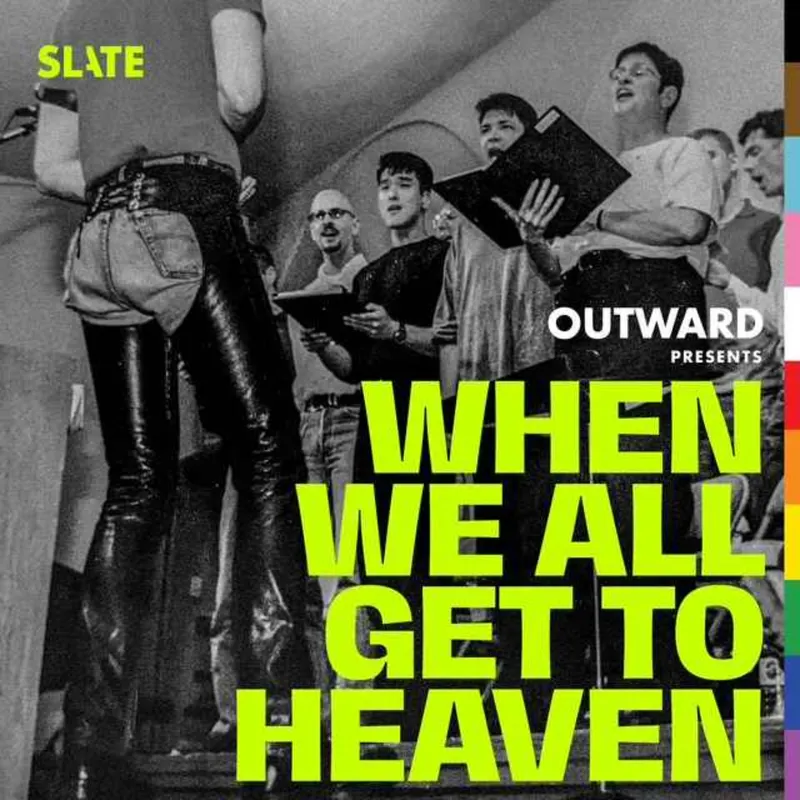
Outward: Slate's LGBTQ podcast
Slate Podcasts·179 episodes
Outward, Slate's queer podcast, is a whip-smart monthly salon in which hosts and guests deepen the audience’s understanding of queer culture and politics, delight them with unexpected perspectives, and invite listeners into a colorful conversation about the issues animating LGBTQ communities. Hosted on Acast. See acast.com/privacy for more information.
Episodes
Slate and the team at Eureka Street Productions are so honored by this award and want to thank everyone who has listened to and supported the show. This series tells the story of the Metropolitan Community Church of San Francisco, one of the first gay-positive churches in America, and how its congregation faced the AIDS epidemic, including the deaths of hundreds of its members.At the heart of the series is a remarkable discovery: 1,200 cassette tapes of sermons, memorials, and music recorded inside the church during the worst years of the crisis. A church member rescued them after they'd been thrown away. What you hear isn't people reconstructing the past from memory, it's the actual voices from inside the crisis, preserved on tape and brought to life across 10 episodes. It's a story about resilience, the strength of community, and finding beauty and hope even in the darkest of times—a message with powerful resonances decades later.To celebrate this award, Lynne Gerber, the host of the show, recorded a special note to listeners, and we are bringing back the trailer to introduce new listeners—who are just finding When We All Get to Heaven from the Peabody Award—to the show. Hosted on Acast. See acast.com/privacy for more information.
Our friends at Selects bring you this documentary from 2010 looking at the debate among LGBTQ folks in San Francisco around the fight for gay marriage and the cost of that fight borne by other parts of the broader community. The Selects Podcast is a free, twice-monthly show that is bringing you unearthed audio works that we’ve found buried in web archives, radio streams, and early podcasts. It’s hosted by Mitra Kaboli, whose work you may have heard on Welcome to Provincetown and The Heart. In addition to the free podcast, there’s a whole collection with exclusive shows and robust show notes looking at the history of these works and how they fit into the bigger audio landscape.The Selects Podcast aims to preserve work that is being lost to digital time - these are award-winning documentaries made by some of the best in the medium, but they are getting lost in web archives and defunct podcast feeds. Listening helps give these works a new life, something that can help make the audio industry more sustainable.Learn more about Selects at https://selects.supportingcast.fm/Beyond Gay Marriage was hosted and produced by Lisa Dettmer and co-produced bt Elena Botkin-Levy. Financial support was provided by Astraea Foundation and Making Contact at the National Radio Project. Lisa Dettmer is a radio producer with the feminist radio show "Women’s Magazine" at KPFA Radio in Berkeley, California, which can be heard at kpfa.org/program/womens-magazine. Learn more about Selects at https://selects.supportingcast.fm/ Hosted on Acast. See acast.com/privacy for more information.
As When We All Get to Heaven wraps up, Christina sits down with series host Lynne Gerber and producer Siri Colom. They discuss how the church has changed, the value of fleeting queer spaces, and what a decade or more spent working on this story has meant to—and taught—them.Get more Outward with Slate Plus! Join for weekly bonus episodes of Outward and ad-free listening on all your favorite Slate podcasts. Subscribe from the Outward show page on Apple Podcasts or Spotify, or visit slate.com/outwardplus for access wherever you listen.Produced by Palace Shaw and Merritt Jacob. Hosted on Acast. See acast.com/privacy for more information.
In the final episode of When We All Get to Heaven, we catch up on what’s happened in the many years between the emergence of effective treatment for AIDS in the late ‘90s and the fall of 2025, when we recorded this episode. We linger on a moment back in June 1999, when Jim was still pastor and called on the church to remember that AIDS wasn’t over. Because—advances notwithstanding—it still isn’t over. For more on Gilbert Baker and the history of the rainbow flag see the Gilbert Baker Foundation.For more on Prep see San Francisco AIDS Foundation, What is PrEP? “The Path that Ends AIDS: 2023 UNAIDS Global Update” outlines a possible end to the AIDS epidemic. The story of Jacob’s Ladder is in the book of Genesis chapter 28, verses 10-19.The text for “This is the Day that God Has Made” is biblical with music by Leon C. Roberts.“We are Climbing Jacob’s Ladder” is a traditional hymn.“This Little Light of Mine” – text traditional, music by Penelope Gneisen“Song of the Soul” is by Cris Williamson and was sung by her at MCC San Francisco on April 24, 2000. For images and links about this episode visit https://www.heavenpodcast.org/episode-10.When We All Get to Heaven is produced by Eureka Street Productions. It is co-created by Lynne Gerber, Siri Colom, and Ariana Nedelman. Our story editor is Sayre Quevedo. Our sound designer is David Herman. Our managing producer is Krissy Clark. Tim Dillinger is our consulting producer and Betsy Towner Levine is our fact-checker. We had additional story editing help from Sarah Ventre, Arwen Nicks, Allison Behringer, and Krissy Clark. For a complete list of credits, please visit https://www.heavenpodcast.org/credits.This project received generous support from individual donors, the Henry Luce Foundation (www.hluce.org), the E. Rhodes and Leona B. Carpenter Foundation, and California Humanities, a non-profit partner of the National Endowment for the Humanities (www.CalHum.org).Eureka Street Productions has 501c3 status through our fiscal sponsor FJC: A Foundati
In 1996 everything changed. With the introduction of antiretroviral medications called the “AIDS cocktail,” people started getting better – some dramatically – and surviving AIDS became a real possibility. In the wake of these changes, MCC found itself taking stock of what they lost to AIDS and using what they learned to address larger social issues– from medical marijuana to homelessness. Sometimes these political stances felt heroic and a way to use that collective energy, and other times it made the church very unpopular with the changing Castro neighborhood. “Freedom is Coming” is by Anders Nyberg. “All Things New” is by Rory Cooney.“Blessed Assurance” is by Franny Crosby.“Gloria (Angels We Have Heard on High” is a traditional Christmas hymn. “The Potter’s House” is by V. Michael McKay. For images and links about this episode visit https://www.heavenpodcast.org/episode-9.Get more Outward with Slate Plus! Join for weekly bonus episodes of Outward and ad-free listening on all your favorite Slate podcasts. Subscribe from the Outward show page on Apple Podcasts or Spotify, or visit slate.com/outwardplus for access wherever you listen.Production credits: When We All Get to Heaven is produced by Eureka Street Productions. It is co-created by Lynne Gerber, Siri Colom, and Ariana Nedelman. Our story editor is Sayre Quevedo. Our sound designer is David Herman. Our managing producer is Krissy Clark. Tim Dillinger is our consulting producer and Betsy Towner Levine is our fact-checker. We had additional story editing help from Sarah Ventre, Arwen Nicks, Allison Behringer, and Krissy Clark. For a complete list of credits, please visit https://www.heavenpodcast.org/credits.This project received generous support from individual donors, the Henry Luce Foundation (www.hluce.org), the E. Rhodes and Leona B. Carpenter Foundation, and California Humanities, a non-profit partner of the National Endowment for the Humanities (www.CalHum.org).Eureka Street Productions has 501c3 status through our fiscal sponsor
In 1995 Rev. Jim Mitulski became HIV positive -- what's known as seroconversion. It was 14 years into the epidemic and people knew what HIV/AIDS was, how you got it, and how you could prevent it. And when Jim got sick, he got very sick. What was it like to become ill so publicly? How would the church and the community respond? And what could Jim possibly preach about on his first Sunday back?“My Soul Doth Magnify” is from Camille Saint-Saens’ Christmas Oratorio, Op. 12, 1858.“The 23rd Psalm (Dedicated to My Mother)” is by Bobby McFerrin. The biblical story of the death of the prophet Elijah is in Second Kings, chapter 2. For images and links about this episode visit https://www.heavenpodcast.org/episode-8.When We All Get to Heaven is produced by Eureka Street Productions. It is co-created by Lynne Gerber, Siri Colom, and Ariana Nedelman. Our story editor is Sayre Quevedo. Our sound designer is David Herman. Our managing producer is Krissy Clark. Tim Dillinger is our consulting producer and Betsy Towner Levine is our fact-checker. We had additional story editing help from Sarah Ventre, Arwen Nicks, Allison Behringer, and Krissy Clark. For a complete list of credits, please visit https://www.heavenpodcast.org/credits.This project received generous support from individual donors, the Henry Luce Foundation (www.hluce.org), the E. Rhodes and Leona B. Carpenter Foundation, and California Humanities, a non-profit partner of the National Endowment for the Humanities (www.CalHum.org).Eureka Street Productions has 501c3 status through our fiscal sponsor FJC: A Foundation of Philanthropic Funds.The music for this episode is from the Metropolitan Community Church of San Francisco’s archive. It was performed by MCC-SF’s musicians and members with Bob Crocker and Jack Hoggatt-St.John as music directors. Additional music is by Domestic BGM. Thanks to Ed Wolf and Frank DePelisi for talking us through the issues around HIV status and sero-sorting in the mid-1990s. And thanks to Bobby McFerrin and Linda Goldstein for use of “The 23rd Psalm (Dedicated to My Mother).” You can see McFerrin conducting his VOCAbuLarieS singers singing the piece here. Great thanks, as always, to the members and clergy of the Metropolitan Community Church of San Francisco who made this project possible. Some
Scott and Bruce were the hottest couple in church. Scott, a hula dancer, seemed destined for Bruce, the hunky “lumbersexual,” and the church delighted when they got together. Their brief love affair sparkled before Bruce got sick and died. Their story is one of multiple “dress rehearsals”– when friends, family and lovers went through AIDS with their loved ones wondering who would be next and sometimes knowing it might be you. You can see Scott perform in a 1992 InterPlay piece called “God, Sex and Power” here. He’s the one with the bandaids on his knees. Singing Positive is a two-part documentary film about the San Francisco Gay Men’s Chorus (SFGMC) and its experience with AIDS that spans 15 years. The first film, which featured Scott, was produced in 1992 and is hard to find online. The second film, produced in 2009, saw the filmmakers return to SFGMC to explore the impact of AIDS on the chorus over time. The 2009 film, with clips of Scott from the first film, is here. And you can watch some amazing SFGMC performances on their YouTube channel here. Scott was a member of Hālau Nā Kamalei o Līlīlehua (here’s a recent video) under the direction of Kumu Hula Robert Uluwehi Cazimero. When he moved to San Francisco, Scott supported his hula brother, Patrick Makuakāne's hula school Nā Lei Hulu I Ka Wēkiu. Patrick's recent work includes Māhū, a production by and with trans hula performers. On the MCC in Hawai’i, see the Queer Histories of Hawai’i’s story here. For images and links about this episode visit https://www.heavenpodcast.org/episode-7 . When We All Get to Heaven is produced by Eureka Street Productions. It is co-created by Lynne Gerber, Siri Colom, and Ariana Nedelman. Our story editor is Sayre Quevedo. Our sound designer is David Herman. Our managing producer is Krissy Clark. Tim Dillinger is our consulting producer and Betsy Towner Levine is our fact-checker. We had additional story editing help from Sarah Ventre, Arwen Nicks, Allison Behringer, and Krissy Clark. For a complete list of credits, please visit https://www.heavenpodcast.org/credits.This project received generous support from individual donors, the Henry Luce Foundation (www.hluce.org</
The Sunday after Magic Johnson announced his HIV-status, Jim Mitulski preached a sermon on being tired of people dying. We’re sharing it as an interlude, a pause, and an immersion into one moment in AIDS’ bleak midwinter. For images and links about this episode visit https://www.heavenpodcast.org/interlude.In the sermon Rev. Mitulski refers to ARC. That means AIDS-Related Complex, a diagnostic category meant to indicate an earlier stage of HIV infection than AIDS. It was common in the period to hear references to both AIDS and ARC. “Old Devil Time” is by Pete Seeger. The AIDS verses are by MCC San Francisco congregant Paul Francis. You can see Magic Johnson's press release, announcing his HIV status here. The biblical passage Rev. Mitulski is preaching on is John 11:1-44.Get more Outward with Slate Plus! Join for weekly bonus episodes of Outward and ad-free listening on all your favorite Slate podcasts. Subscribe from the Outward show page on Apple Podcasts or Spotify, or visit slate.com/outwardplus for access wherever you listen.When We All Get to Heaven is produced by Eureka Street Productions. It is co-created by Lynne Gerber, Siri Colom, and Ariana Nedelman. Our story editor is Sayre Quevedo. Our sound designer is David Herman. Our managing producer is Krissy Clark. Tim Dillinger is our consulting producer and Betsy Towner Levine is our fact-checker. We had additional story editing help from Sarah Ventre, Arwen Nicks, Allison Behringer, and Krissy Clark. For a complete list of credits, please visit https://www.heavenpodcast.org/credits.This project received generous support from individual donors, the Henry Luce Foundation (www.hluce.org), the E. Rhodes and Leona B. Carpenter Foundation, and California Humanities, a non-profit partner of the National Endowment for the Humanities (www.CalHum.org).Eureka Street Productions has 501c3 status through our fiscal sponsor FJC: A Foundation of Philanthropic Funds.The music for this episode is from the Metropolitan Community Church of San Francisco’s archive. It was performed by MCC-SF’s musicians and members with Bob Crocker and Jack Hoggatt-St.John as music directors. Additional music is by Domestic BGM. Great thanks, as always, to the members and clergy of the Metropolitan Community C
San Francisco’s gay/lesbian community in the 1980s wasn’t just facing an AIDS crisis, they also struggled against ongoing anti-gay violence. In 1989, in the midst of a campaign to legally establish anti-gay violence as a hate crime, MCC San Francisco made headlines when their AIDS minister was attacked in her home. The city, the police department, and the LGBTQ community rallied around the church and the minister. And when they finally solved the puzzle of who did it, the answer shocked the church. For images and links about this episode visit https://www.heavenpodcast.org/episode-6.The voices from the service after the first attack include Rev. Troy Perry, Universal Fellowship of Metropolitan Community Churches – “If you come for one of us, you come for all of us.” Kevin Calegari, Dignity San Francisco – “Somebody by the name of Jesus…” Harry Britt, San Francisco City Supervisor – “It hurts to be reminded of the power of evil.” Gayle Orr-Smith, representative of the Mayor’s Office – “I am moved when I hear you say you are an angry people.” Rev. Duane Wilkerson, United Methodist Church – “But in the event that doubt has crept into your mind…” Rev. Troy Perry, Universal Fellowship of Metropolitan Community Churches – “And to the enemies who are attacking us…”“The Call” is by George Herber with music by Vaughan Williams. The soloist is Bob Crocker.“Nearer My God to Thee” is by Sarah Flowers Abrams.Some links to good groupsCommunity United Against Violence – still working for safe communities for queer people. National Alliance on Mental Illness LGBTQI Information PageThe Shanti Project - is a pioneering nonprofit that builds human connections to reduce isolation, enhance health and well-being, and improve quality of life. It innovated enduring models of attentive companionship to people facing the end of life through their work during the height of the AIDS crisis. The Trevor Project – the leading suicide prevention and crisis intervention non-profit organization for LGBTQ+ young people. Get more Outward with Slate Plus! Join for weekly bonus episodes of Outward and ad-free listening on all your favorite Slate podcasts. Subscribe from the Outward show page on Apple Podcasts or Spotify, or visit slate.com/outward
When Rev. Ron Russell Coons got diagnosed with AIDS he thought a lot about what healing meant when death was certain. He pursued it in his strained and broken family relationships and he preached about it from the pulpit. Though he knew, without a doubt, that he would die from AIDS, Ron claimed that he believed in and had experienced healing. What does healing mean when everybody knows it can’t mean survival? Maybe healing is one’s biological family and queer kin showing up and reaching for connection across those fractures.For images and links about this episode visit https://www.heavenpodcast.org/episode-5.Get more Outward with Slate Plus! Join for weekly bonus episodes of Outward and ad-free listening on all your favorite Slate podcasts. Subscribe from the Outward show page on Apple Podcasts or Spotify, or visit slate.com/outwardplus for access wherever you listen.When We All Get to Heaven is produced by Eureka Street Productions. It is co-created by Lynne Gerber, Siri Colom, and Ariana Nedelman. Our story editor is Sayre Quevedo. Our sound designer is David Herman. Our managing producer is Krissy Clark. Tim Dillinger is our consulting producer and Betsy Towner Levine is our fact-checker. We had additional story editing help from Sarah Ventre, Arwen Nicks, Allison Behringer, and Krissy Clark. For a complete list of credits, please visit https://www.heavenpodcast.org/credits.This project received generous support from individual donors, the Henry Luce Foundation (www.hluce.org), the E. Rhodes and Leona B. Carpenter Foundation, and California Humanities, a non-profit partner of the National Endowment for the Humanities (www.CalHum.org).Eureka Street Productions has 501c3 status through our fiscal sponsor FJC: A Foundation of Philanthropic Funds.The music for this episode is from the Metropolitan Community Church of San Francisco’s archive. It was performed by MCC-SF’s musicians and members with Bob Crocker and Jack Hoggatt-St.John as music directors. Additional music is by Domestic BGM. “When the Roll is Called Up Yonder” is by James Milton Black. “Give Me Jesus” is a traditional spiritual arrangement by Charles Ivey. The soloist is Maria Barnet. “It is Well with My Soul,” also known as “When Peace, Like a River,” is by Horatio Spafford.Thanks to Ron’s fa
As MCC grew as a denomination, they tried to figure out if and how to relate to other churches. Would any befriend a queer church? And if so, would that friendship help other churches shift their perspective on homosexuality? These questions got harder as AIDS numbers grew—it made people more afraid yet friendship more vital. But sometimes friendship emerges in the most unlikely of places. Like when a children’s choir visited an AIDS ward in San Francisco and sang for an MCC member there. That connection started a partnership between their churches that changed them both.For images and links about this episode visit https://www.heavenpodcast.org/episode-4.Get more Outward with Slate Plus! Join for weekly bonus episodes of Outward and ad-free listening on all your favorite Slate podcasts. Subscribe from the Outward show page on Apple Podcasts or Spotify, or visit slate.com/outwardplus for access wherever you listen.Production credits: When We All Get to Heaven is produced by Eureka Street Productions. It is co-created by Lynne Gerber, Siri Colom, and Ariana Nedelman. Our story editor is Sayre Quevedo. Our sound designer is David Herman. Our managing producer is Krissy Clark. Tim Dillinger is our consulting producer and Betsy Towner Levine is our fact-checker. We had additional story editing help from Sarah Ventre, Arwen Nicks, Allison Behringer, and Krissy Clark. For a complete list of credits, please visit https://www.heavenpodcast.org/credits.This project received generous support from individual donors, the Henry Luce Foundation (www.hluce.org), the E. Rhodes and Leona B. Carpenter Foundation, and California Humanities, a non-profit partner of the National Endowment for the Humanities (www.CalHum.org).Eureka Street Productions has 501c3 status through our fiscal sponsor FJC: A Foundation of Philanthropic Funds.The music for this episode is from the Metropolitan Community Church of San Francisco’s archive. It was performed by MCC-SF’s musicians and members with Bob Crocker and Jack Hoggatt-St.John as music directors. Additional music is by Domestic BGM.“Who Kept Us” is by Dr. Margaret Douroux.“The Wicked Shall Cease” is by Jessy Dixon.“Jesus is Here Right Now” is by Leon Roberts.“Child of God” and “Walk Together Children” are traditional African American spirituals. Special thanks to M
In the late ‘80s, two MCC San Francisco ministers wrote an article called “We Are the Church Alive, the Church with AIDS.” We wanted to know how a gay/lesbian church came to call itself “a church with AIDS.” The answers lie in the years before our audio archive begins. So we started asking people. We explore two stories in what’s likely a more complicated shift. One story is about a pair of religion geeks who learned to make queer church in New York during the early years of the AIDS crisis and then came to San Francisco to lead MCCSF. And the other is how an Easter Sunday ritual made the Christian hope of life through death viscerally real.“We Are the Church Alive, the Church with AIDS,” by Kittredge Cherry and Jamies Mitulski was published in the Christian Century on January 27, 1988.For images and links about this episode visit https://www.heavenpodcast.org/episode-3.Get more Outward with Slate Plus! Join for weekly bonus episodes of Outward and ad-free listening on all your favorite Slate podcasts. Subscribe from the Outward show page on Apple Podcasts or Spotify, or visit slate.com/outwardplus for access wherever you listen.Production credits: When We All Get to Heaven is produced by Eureka Street Productions. It is co-created by Lynne Gerber, Siri Colom, and Ariana Nedelman. Our story editor is Sayre Quevedo. Our sound designer is David Herman. Our managing producer is Krissy Clark. Tim Dillinger is our consulting producer and Betsy Towner Levine is our fact-checker. We had additional story editing help from Sarah Ventre, Arwen Nicks, Allison Behringer, and Krissy Clark. For a complete list of credits, please visit http://heavenpodcast.org/credits.This project received generous support from individual donors, the Henry Luce Foundation (www.hluce.org), the E. Rhodes and Leona B. Carpenter Foundation, and California Humanities, a non-profit partner of the National Endowment for the humanities (www.CalHum.org).Eureka Street Productions has 501c3 status through our fiscal sponsor FJC: A Foundation of Philanthropic Funds.The music for this episode is from the Metropolitan Community Church of San Francisco’s archive. It was performed by MCC-SF’s musicians and members with Bob Crocker and Jack Hoggatt-St.John as mus
Why would an out queer person in the Gay Liberation Days of the 1970s go to church? What church would they go to? And why would they stay? In the 1960s, and ‘70s, the separation between God and gays was not as vast as it seemed. Rev. Troy Perry started the first Metropolitan Community Church in his Los Angeles living room. Tired of flying to LA every week, a Navy veteran started the second one in a San Francisco gay bar. And the Metropolitan Community Church of San Francisco was there for a young lesbian as she navigated spirituality, coming out, and her increasingly conservative family. When her friend got sick, she tried to be there for him. Church helped. For images and links about this episode visit https://www.heavenpodcast.org/episode-2.Get more Outward with Slate Plus! Join for weekly bonus episodes of Outward and ad-free listening on all your favorite Slate podcasts. Subscribe from the Outward show page on Apple Podcasts or Spotify, or visit slate.com/outwardplus for access wherever you listen.Production credits: When We All Get to Heaven is produced by Eureka Street Productions. It is co-created by Lynne Gerber, Siri Colom, and Ariana Nedelman. Our story editor is Sayre Quevedo. Our sound designer is David Herman. Our managing producer is Krissy Clark. Tim Dillinger is our consulting producer and Betsy Towner Levine is our fact-checker. We had additional story editing help from Sarah Ventre, Arwen Nicks, Allison Behringer, and Krissy Clark. For a complete list of credits, please visit http://heavenpodcast.org/credits.This project received generous support from individual donors, the Henry Luce Foundation (www.hluce.org), the E. Rhodes and Leona B. Carpenter Foundation, and California Humanities, a non-profit partner of the National Endowment for the humanities (www.CalHum.org).Eureka Street Productions has 501c3 status through our fiscal sponsor FJC: A Foundation of Philanthropic Funds.The music for this episode is from the Metropolitan Community Church of San Francisco’s archive. It was performed by MCC-SF’s musicians and members with Bob Crocker and Jack Hoggatt-St.John as music directors. Additional music is by Tasty Morsels. Thanks to Dr. Heather White, author of Reforming Sodom: Protestants and the Rise of Gay Rights.</p
As Outward proudly presents the 10-episode series When We All Get to Heaven, from Eureka Street Productions, Christina and Bryan had the privilege of sitting down with series host Lynne Gerber. Lynne explains how 1,200 cassette tapes became a wealth of archival audio that infuses this series with so much vitality, joy, and shared mourning of queer churches during a devastating epidemic.Get more Outward with Slate Plus! Join for weekly bonus episodes of Outward and ad-free listening on all your favorite Slate podcasts. Subscribe from the Outward show page on Apple Podcasts or Spotify, or visit slate.com/outwardplus for access wherever you listen.Produced by Palace Shaw. Hosted on Acast. See acast.com/privacy for more information.
In 1993, more than 10 years into the AIDS epidemic, the Metropolitan Community Church of San Francisco (MCC-SF) tries to remember all they’ve lost. We think about remembering too after encountering an archive of 1,200 cassette recordings of this queer church’s services during the height of the epidemic. Whether you’re a regular church goer or would never step into one, we invite you to spend time with this LGBTQ+ San Francisco church as it struggles to reconcile sexuality and faith in the midst of an existential crisis. For images and links about this episode visit https://www.heavenpodcast.org/episode-1.About the montage: The worship service in this episode was on February 28, 1993. The Dyke March proclamation was written and read by Rev. Lea Brown. Rev. Karen Foster read the statement that sexual orientation does not need to be changed. Jim Mitulski recalled his hospital visit with the man who recognized him by his shape. Paul Francis told strangers at a restaurant to get ugly lovers and Eric Rofes told his mother that he was going to stay safe and keep having sex. Cleve Jones had the vision of a thousand rotting corpses, Rev. Ron Russell Coons preached that we have AIDS as a community, and Rev. Troy Perry proclaimed a revival on Eureka Street. The other people heard in the episode are either unknown or did not want to be named. When We All Get to Heaven is produced by Eureka Street Productions. It is co-created by Lynne Gerber, Siri Colom, and Ariana Nedelman. Our story editor is Sayre Quevedo. Our sound designer is David Herman. Our managing producer is Krissy Clark. Tim Dillinger is our consulting producer and Betsy Towner Levine is our fact-checker. We had additional story editing help from Sarah Ventre, Arwen Nicks, Allison Behringer, and Krissy Clark. For a complete list of credits, please visit http://heavenpodcast.org/credits.This project received generous support from individual donors, the Henry Luce Foundation (www.hluce.org), the E. Rhodes and Leona B. Carpenter Foundation, and California Humanities, a non-profit partner of the National Endowment for the Humanities (www.CalHum.org).Eureka Street Productions has 501c3 status through our fiscal sponsor FJC: A Foundation of Philanthropic Funds.The music for this episode is from the Metropolitan Community Church of San Francisco’s archive. It was performed by MCC-SF’s musicians and members with Bob Crocker and Jack Hoggatt-St.John as music directors. Additional music is by Tasty Morsels. Thanks to Paul Katz and Henry Machen for permission to use “June in San Francisco” from their fabulous 1991 musical Dirty Dreams of a Cl
When We All Get to Heaven tells the story of one of the first LGBTQ-positive churches, the Metropolitan Community Church of San Francisco (MCC-SF), and how it faced the personal, social, and political trials of the AIDS epidemic, including the deaths of hundreds of its members. This 10-episode series uses historical tapes rescued from the church to bring listeners into the heart of a community struggling to live while struggling with faith. The first two episodes are available here at Outward on October 15. This show is produced by Eureka Street Productions. Our theme song, “When We All Get to Heaven,” was written by Eliza Hewitt and performed by MCC-SF’s congregation and choir. Hosted on Acast. See acast.com/privacy for more information.
Trans rights and access to health care have been under attack on the state level for years, but the second Trump administration and the Supreme Court have accelerated a chilling effect at clinics across the country. Guest: Grace Byron, author of “The Grim State of Trans Health Care” and “The Bureaucratic Nightmares of Being Trans Under Trump” for the New Yorker. Want more What Next? Subscribe to Slate Plus to access ad-free listening to the whole What Next family and across all your favorite Slate podcasts. Subscribe today on Apple Podcasts by clicking “Try Free” at the top of our show page. Sign up now at slate.com/whatnextplus to get access wherever you listen. Podcast production by Ethan Oberman, Elena Schwartz, Paige Osburn, Anna Phillips, Madeline Ducharme, and Rob Gunther. Learn more about your ad choices. Visit megaphone.fm/adchoices
Trans rights and access to health care have been under attack on the state level for years, but the second Trump administration and the Supreme Court have accelerated a chilling effect at clinics across the country.Guest: Grace Byron, author of “The Grim State of Trans Health Care” and “The Bureaucratic Nightmares of Being Trans Under Trump” for the New Yorker. Want more What Next? Subscribe to Slate Plus to access ad-free listening to the whole What Next family and across all your favorite Slate podcasts. Subscribe today on Apple Podcasts by clicking “Try Free” at the top of our show page. Sign up now at slate.com/whatnextplus to get access wherever you listen.Podcast production by Ethan Oberman, Elena Schwartz, Paige Osburn, Anna Phillips, Madeline Ducharme, and Rob Gunther. Hosted on Acast. See acast.com/privacy for more information.
Outward is going on a little summer break, in the meantime we’re leaving you with a delightfully queer episode of Slate’s Hit Parade with Chris Molanphy called Mighty Real. This is part two—catch part one in our previous episode. Little Richard was rock ‘n’ roll’s flamboyant architect. Lesley Gore sang that no one owned her. Sylvester was a gender-fluid icon who helped define disco. Freddie Mercury made rock operatic, and George Michael demanded freedom. What all of these LGBTQ artists had in common was bold hitmaking—and fear of being fully out of the closet. For decades, queer acts topped the charts while cloaking their true identities and paving the way for today’s more openly queer stars. For Pride Month, join Chris Molanphy as he traces the hidden history of queer hitmakers on the charts—including those that managed to be both out and No. 1, right up through our modern age of Lil Nas X and Chappell Roan. It’s a celebration of these artists’ quest to feel… mighty real. Learn more about your ad choices. Visit megaphone.fm/adchoices
Outward is going on a little summer break, in the meantime we’re leaving you with a delightfully queer episode of Slate’s Hit Parade with Chris Molanphy called Mighty Real. This is part two—catch part one in our previous episode.Little Richard was rock ‘n’ roll’s flamboyant architect. Lesley Gore sang that no one owned her. Sylvester was a gender-fluid icon who helped define disco. Freddie Mercury made rock operatic, and George Michael demanded freedom.What all of these LGBTQ artists had in common was bold hitmaking—and fear of being fully out of the closet. For decades, queer acts topped the charts while cloaking their true identities and paving the way for today’s more openly queer stars.For Pride Month, join Chris Molanphy as he traces the hidden history of queer hitmakers on the charts—including those that managed to be both out and No. 1, right up through our modern age of Lil Nas X and Chappell Roan. It’s a celebration of these artists’ quest to feel… mighty real. Hosted on Acast. See acast.com/privacy for more information.
Outward is going on a little summer break, in the meantime we’re leaving you with a delightfully queer episode of Slate’s Hit Parade with Chris Molanphy: Little Richard was rock ‘n’ roll’s flamboyant architect. Lesley Gore sang that no one owned her. Sylvester was a gender-fluid icon who helped define disco. Freddie Mercury made rock operatic, and George Michael demanded freedom. What all of these LGBTQ artists had in common was bold hitmaking—and fear of being fully out of the closet. For decades, queer acts topped the charts while cloaking their true identities and paving the way for today’s more openly queer stars. For Pride Month, join Chris Molanphy as he traces the hidden history of queer hitmakers on the charts—including those that managed to be both out and No. 1, right up through our modern age of Lil Nas X and Chappell Roan. It’s a celebration of these artists’ quest to feel… mighty real. Learn more about your ad choices. Visit megaphone.fm/adchoices
Outward is going on a little summer break, in the meantime we’re leaving you with a delightfully queer episode of Slate’s Hit Parade with Chris Molanphy:Little Richard was rock ‘n’ roll’s flamboyant architect. Lesley Gore sang that no one owned her. Sylvester was a gender-fluid icon who helped define disco. Freddie Mercury made rock operatic, and George Michael demanded freedom.What all of these LGBTQ artists had in common was bold hitmaking—and fear of being fully out of the closet. For decades, queer acts topped the charts while cloaking their true identities and paving the way for today’s more openly queer stars.For Pride Month, join Chris Molanphy as he traces the hidden history of queer hitmakers on the charts—including those that managed to be both out and No. 1, right up through our modern age of Lil Nas X and Chappell Roan. It’s a celebration of these artists’ quest to feel… mighty real. Hosted on Acast. See acast.com/privacy for more information.
This week, Bryan is joined by theologian, activist, and ballroom historian Michael Roberson to discuss his new book, Ballroom: A History, A Movement, A Celebration. Roberson traces the rich legacy of the ballroom scene—from its origins in resistance and survival, to its role in shaping public health responses during the height of the AIDS crisis and beyond, to its ongoing significance as a spiritual and communal refuge for Black and Latinx queer and trans people. Learn more about your ad choices. Visit megaphone.fm/adchoices
This week, Bryan is joined by theologian, activist, and ballroom historian Michael Roberson to discuss his new book, Ballroom: A History, A Movement, A Celebration. Roberson traces the rich legacy of the ballroom scene—from its origins in resistance and survival, to its role in shaping public health responses during the height of the AIDS crisis and beyond, to its ongoing significance as a spiritual and communal refuge for Black and Latinx queer and trans people. Hosted on Acast. See acast.com/privacy for more information.
In this episode of Outward, Bryan talks with Slate legal reporter Mark Joseph Stern about a federal judge’s sweeping and controversial ruling in United States v. Skrmetti, which could have massive consequences for access to gender-affirming care. Then, Christina sits down with Congresswoman Becca Balint to talk about what it means to advocate for trans rights inside a Congress where culture war rhetoric, and policy, are escalating fast. Learn more about your ad choices. Visit megaphone.fm/adchoices
In this episode of Outward, Bryan talks with Slate legal reporter Mark Joseph Stern about a federal judge’s sweeping and controversial ruling in United States v. Skrmetti, which could have massive consequences for access to gender-affirming care. Then, Christina sits down with Congresswoman Becca Balint to talk about what it means to advocate for trans rights inside a Congress where culture war rhetoric, and policy, are escalating fast. Hosted on Acast. See acast.com/privacy for more information.
This week, Bryan talks with Christina about her new piece for Slate The Conservative Wave Is Having a Very Unexpected Effect on Pride which covers the power and politics of small-town Pride. Then, in the second half, they're joined by Van Knapp, co-founder of Canyon County Pride in Idaho, to talk about building queer joy in unlikely places. Learn more about your ad choices. Visit megaphone.fm/adchoices
This week, Bryan talks with Christina about her new piece for Slate The Conservative Wave Is Having a Very Unexpected Effect on Pride which covers the power and politics of small-town Pride. Then, in the second half, they're joined by Van Knapp, co-founder of Canyon County Pride in Idaho, to talk about building queer joy in unlikely places. Hosted on Acast. See acast.com/privacy for more information.
This week, Christina Cauterucci is joined by Erik Piepenburg, author of Dining Out, a new book that explores the history of gay restaurants in the United States. Piepenburg traces how restaurants have long served as essential spaces for queer people as places to gather, connect, and express themselves at a time when most public spaces were hostile or unsafe. Learn more about your ad choices. Visit megaphone.fm/adchoices
This week, Christina Cauterucci is joined by Erik Piepenburg, author of Dining Out, a new book that explores the history of gay restaurants in the United States. Piepenburg traces how restaurants have long served as essential spaces for queer people as places to gather, connect, and express themselves at a time when most public spaces were hostile or unsafe. Hosted on Acast. See acast.com/privacy for more information.
Outward’s Bryan Lowder and Christina Cauterucci talk to Alden Jones, editor of the new anthology, Edge of the World. With essays from Alexander Chee, Daisy Hernández, Edmund White, and more, the collection makes clear that queer travel writing isn’t just overdue—it’s transformative. Hosted on Acast. See acast.com/privacy for more information.
This week, Bryan Lowder is joined by Hope Giselle and Dr. David Johns to discuss Iowa’s recent decision to strip trans people of key legal protections, making it legal to discriminate based on gender identity. They explore the broader implications of this rollback, drawing parallels to the historical dismantling of rights during Reconstruction and the rise of Jim Crow. They discuss what this moment means for the future of trans rights and the strategies needed to organize and push back against this growing legal threat. Learn more about your ad choices. Visit megaphone.fm/adchoices
This week, Bryan Lowder is joined by Hope Giselle and Dr. David Johns to discuss Iowa’s recent decision to strip trans people of key legal protections, making it legal to discriminate based on gender identity. They explore the broader implications of this rollback, drawing parallels to the historical dismantling of rights during Reconstruction and the rise of Jim Crow. They discuss what this moment means for the future of trans rights and the strategies needed to organize and push back against this growing legal threat. Hosted on Acast. See acast.com/privacy for more information.
In this episode, Christina Cauterucci speaks with Zein Murib, Fordham professor and author of Terms of Exclusion: Rightful Citizenship Claims and the Construction of LGBT Political Identity, about the historical roots of the marginalization of trans and bi people in the gay rights movement. Zein, who recently wrote the Slate piece "Why Are Trans People Such an Easy Political Target? " breaks down how the movement’s focus on a narrow definition of identity left trans and bi people vulnerable to political attacks. Learn more about your ad choices. Visit megaphone.fm/adchoices
In this episode, Christina Cauterucci speaks with Zein Murib, Fordham professor and author of Terms of Exclusion: Rightful Citizenship Claims and the Construction of LGBT Political Identity, about the historical roots of the marginalization of trans and bi people in the gay rights movement. Zein, who recently wrote the Slate piece "Why Are Trans People Such an Easy Political Target? " breaks down how the movement’s focus on a narrow definition of identity left trans and bi people vulnerable to political attacks. Hosted on Acast. See acast.com/privacy for more information.
Christina Cauterucci speaks with Suzanne Ford, executive director of San Francisco Pride, about the goals and challenges of organizing Pride this year amid the corporate retreat from LGBTQ+ issues. They discuss the current political climate, how corporate sponsorship shapes the event, and how to maintain visibility and safety without losing political urgency. Learn more about your ad choices. Visit megaphone.fm/adchoices
Christina Cauterucci speaks with Suzanne Ford, executive director of San Francisco Pride, about the goals and challenges of organizing Pride this year amid the corporate retreat from LGBTQ+ issues. They discuss the current political climate, how corporate sponsorship shapes the event, and how to maintain visibility and safety without losing political urgency. Hosted on Acast. See acast.com/privacy for more information.
In this episode, Christina Cauterucci and Jules Gill-Peterson discuss Christina’s latest Slate article, The New Lavender Scare, which highlights the experiences of queer and trans federal employees grappling with the threat of retaliation, job loss, and a chilling political climate. Learn more about your ad choices. Visit megaphone.fm/adchoices
In this episode, Christina Cauterucci and Jules Gill-Peterson discuss Christina’s latest Slate article, The New Lavender Scare, which highlights the experiences of queer and trans federal employees grappling with the threat of retaliation, job loss, and a chilling political climate. Hosted on Acast. See acast.com/privacy for more information.
In this episode of Outward, Jules Gill-Peterson sits down with Colby Gordon to talk about his new book, Glorious Bodies: Trans Theology and Renaissance Literature. Gordon digs into early modern religious texts that, instead of rejecting trans existence, actually provided ways to think about gender transformation—socially, surgically, and theologically. They explore what Shakespeare, Milton, and other writers had to say about gender, how history challenges today’s assumptions about transition, and why the right-wing war on trans people gets the past all wrong. Learn more about your ad choices. Visit megaphone.fm/adchoices
In this episode of Outward, Jules Gill-Peterson sits down with Colby Gordon to talk about his new book, Glorious Bodies: Trans Theology and Renaissance Literature. Gordon digs into early modern religious texts that, instead of rejecting trans existence, actually provided ways to think about gender transformation—socially, surgically, and theologically. They explore what Shakespeare, Milton, and other writers had to say about gender, how history challenges today’s assumptions about transition, and why the right-wing war on trans people gets the past all wrong. Hosted on Acast. See acast.com/privacy for more information.
A gun won’t make you safer, but it will pull you into America’s deep-seated obsession with armed individualism. This week, Bryan, Christina, and Jules dig into The Washington Post’s “The Trans Americans Turning to Guns for Protection” and Defector’s “Don't Buy a Gun, Even If It Comes in Rainbow” to unpack the recent interest around queer gun ownership—and why safety has never really been the point of gun culture. Learn more about your ad choices. Visit megaphone.fm/adchoices
A gun won’t make you safer, but it will pull you into America’s deep-seated obsession with armed individualism. This week, Bryan, Christina, and Jules dig into The Washington Post’s “The Trans Americans Turning to Guns for Protection” and Defector’s “Don't Buy a Gun, Even If It Comes in Rainbow” to unpack the recent interest around queer gun ownership—and why safety has never really been the point of gun culture. Hosted on Acast. See acast.com/privacy for more information.
This week, Bryan Lowder sits down with activist and author Dean Spade to discuss his latest book, Love in a F*cked Up World. Together, they unpack how capitalism, white supremacy, and patriarchy shape our desires, the pitfalls of the “relationship escalator,” and why collective care might be the most radical love of all. From breaking free of toxic relationship scripts to reimagining intimacy beyond hierarchy and control, this conversation challenges everything we’ve been taught about love—and offers a vision for something more liberatory. Learn more about your ad choices. Visit megaphone.fm/adchoices
This week, Bryan Lowder sits down with activist and author Dean Spade to discuss his latest book, Love in a F*cked Up World. Together, they unpack how capitalism, white supremacy, and patriarchy shape our desires, the pitfalls of the “relationship escalator,” and why collective care might be the most radical love of all. From breaking free of toxic relationship scripts to reimagining intimacy beyond hierarchy and control, this conversation challenges everything we’ve been taught about love—and offers a vision for something more liberatory. Hosted on Acast. See acast.com/privacy for more information.
This week on Outward, host Christina Cauterucci talks to historian Rebecca Scofield about the new book, Slapping Leather: Queer Cowfolx at the Gay Rodeo. From rhinestone-studded chaps to the hard-won battles for inclusion, they explore how queer cowboys and cowgirls carved out space in the rodeo circuit, the gender politics at play in this community, and how the AIDS crisis shaped its trajectory. Plus, they dig into the current resurgence of cowboy aesthetics in queer culture and pop culture at large. Learn more about your ad choices. Visit megaphone.fm/adchoices
This week on Outward, host Christina Cauterucci talks to historian Rebecca Scofield about the new book, Slapping Leather: Queer Cowfolx at the Gay Rodeo. From rhinestone-studded chaps to the hard-won battles for inclusion, they explore how queer cowboys and cowgirls carved out space in the rodeo circuit, the gender politics at play in this community, and how the AIDS crisis shaped its trajectory. Plus, they dig into the current resurgence of cowboy aesthetics in queer culture and pop culture at large. Hosted on Acast. See acast.com/privacy for more information.
Bryan Lowder sits down with journalist Nico Lang to discuss their recent article for Slate It Was Never About Protecting Kids on Trump’s Executive Order restricting gender-affirming care for minors. They examine how the administration is using “child protection” rhetoric as a cover for anti-trans policies, the real-world impact on trans youth and their families, and the history of this political strategy. Learn more about your ad choices. Visit megaphone.fm/adchoices
Bryan Lowder sits down with journalist Nico Lang to discuss their recent article for Slate It Was Never About Protecting Kids on Trump’s Executive Order restricting gender-affirming care for minors. They examine how the administration is using “child protection” rhetoric as a cover for anti-trans policies, the real-world impact on trans youth and their families, and the history of this political strategy. Hosted on Acast. See acast.com/privacy for more information.
In this episode, Bryan Lowder and Christina Cauterucci sit down with ACLU lawyer Chase Strangio to unpack the strategy behind the latest legal fights over trans healthcare, passports, and military service. They explore how the language of Trump’s executive orders are more overtly cruel than his last administration, what this progression signals policy-wise, and how we can think about the road ahead for caring and protecting each other. Learn more about your ad choices. Visit megaphone.fm/adchoices
Reviews
No reviews yet.
If you like this...

Discussion (0)
No comments yet. Be the first to start the discussion!