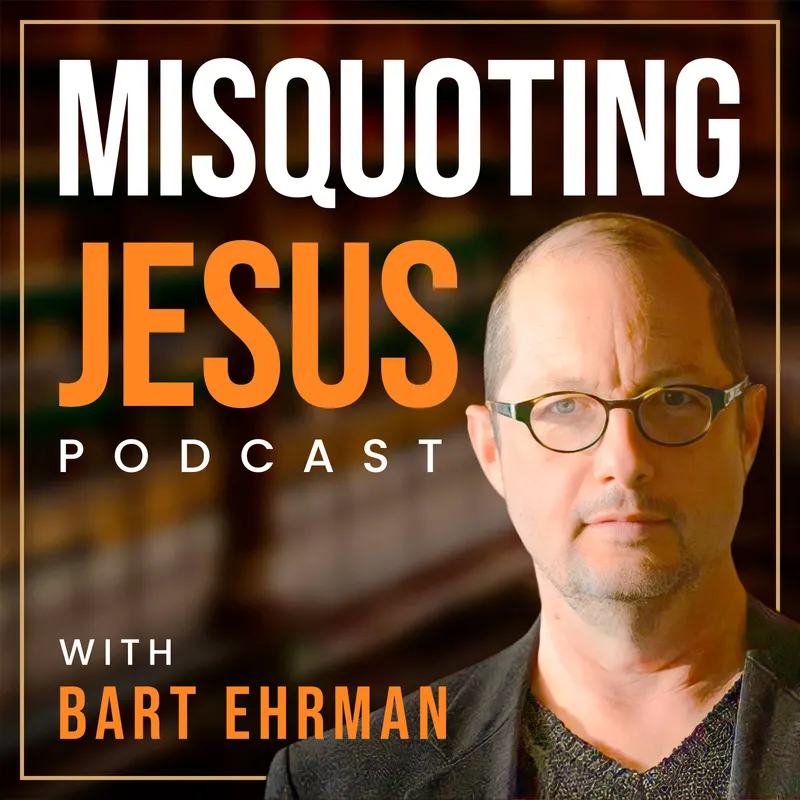
Misquoting Jesus with Bart Ehrman
Bart Ehrman·Hosted by Bart Ehrman and Megan Lewis·197 episodes
"Misquoting Jesus" is the only show where a six-time New York Times bestselling author and world-renowned Bible scholar uncovers the many fascinating, little known facts about the New Testament, the historical Jesus, and the rise of Christianity. The show features Dr. Bart Ehrman and host, Megan Lewis.
Why listen
Misquoting Jesus with Bart Ehrman turns academic New Testament scholarship into clear, lively conversations about what the Bible says, how it was written, and how Christianity developed. Bart Ehrman brings the rigor of a career scholar while Megan Lewis keeps the format accessible, so listeners get real historical context without feeling like they wandered into a graduate seminar. It is especially strong for curious believers, ex-believers, skeptics, and history fans who want to separate tradition from evidence.
Series(1)
Episodes
Did you know that Jesus didn't believe in the soul, heaven, or hell? As an apocalyptic Jew, these ideas would have been completely foreign to him. So where on earth did Christianity get the idea that a life well-lived would be rewarded with a place in paradise for your soul? Today, we're talking about where the idea of heaven came from.
Have you ever heard a Christian say something about the Bible and wondered exactly where they were getting their information from? Today we are talking about the most common claims Christians make about the Bible that are not actually based in reality.
Have you ever read something in the New Testament, maybe the Book of Revelation, and wondered why on earth it's included in the Bible? Why were these specific books included, and why are they considered inspired by God while the non-canonical writings are just the work of humans? Today we're talking about the formation of the New Testament, using listeners' questions.
Did you know that scribes made changes to all of the books of the New Testament? Some of them were accidental, but some of them were very deliberate. The gospel of John is no exception - but what was changed, and why?
Atheists often accuse people of religious faith of uncritically accepting a bunch of myths - but do atheists do the same? How closely do people actually examine their dearly-held views and beliefs, regardless of their religious persuasion?
In the gospels, Jesus' suffering is on a sliding scale - from sweating blood, to calmly accepting his fate. What did Jesus think about his own suffering, and is it even possible to answer that question from the evidence we have?
Ever wondered what the first Christian praise and worship service sounded like? Join us as Dr. Charles Cosgrove unveils the mystery of the Oxyrhynchus Hymn, the earliest known Christian hymn with musical notation!
The resurrection of Jesus is probably one of the most well known stories from the New Testament. But how do historians deal with this miraculous event? Should it be discounted in its entirety, or can it be investigated using the historical method? Today, we're talking about what historians can and can't say about the resurrection.
The Old Testament wasn't written in a cultural vacuum, but who and what influenced its writers. Today we're talking about the cultural background of the Old Testament and how the literature and societies of the surrounding cultures impacted its creation.
Love him or hate him, if you're listening to this podcast then you're probably familiar with some of Dr. Bart Ehrman's beliefs - but how familiar are you with the ideas he used to hold when he was an evangelical Christian?
The doctrine of the Trinity - that there's one single God who is father, son, and holy spirit - is central to modern Christianity. But is it even in the Bible?
The discovery of the Dead Sea Scrolls shook the field of biblical studies to its core. But did they actually change how we view the Old Testament? Today we're talking about the Dead Sea Scrolls, what they are, what they can tell us about the editorial history of the Old Testament, and whether they really show the perfect error-free transmission of the Hebrew Bible.
Hell – the fiery eternal torment known from many Baptist pulpits – is maybe the ultimate consequence for misbehaviour. But is it an afterlife that is present in the Bible? Today, Dr. Bart Ehrman joins me to to discuss what Jesus believed about life after death, where the idea of hell came from, and whether we can even find it in the Bible.
The Rapture, the ascent of Jesus' faithful flock to heaven at the end of the world is enthusiastically anticipated by many evangelical Christians. But is this expectation grounded in what the Bible actually says? Today, Dr. Bart Ehrman joins me to talk about the Rapture, what it is and whether it actually appears in the Bible.
Different Christian denominations have different beliefs about the Bible, and those who leave the faith have different ideas again. Today, Dr. Bart Ehrman joins me to talk about how his changing beliefs impacted his views on the Bible, and why he finally changed his mind about all of them.
The 10 Commandments are the most famous laws in the Bible, despite the fact that most people can't name more than a few. Today, I'm joined by Bart Ehrman to discuss why the 10 commandments are so famous, and why Christians still see them as important, even though most of the other 600 Old Testament laws are ignored.
Easter is fast approaching, and while children everywhere are looking forward to chocolate eggs, the minds of many Christians are turning to Jesus' resurrection. Today, Dr. Bart Ehrman joins me to answer audience questions about Jesus' crucifixion, and what happened after.
We've been talking a lot about the revolutionary message of altruism in Jesus' teachings recently - but how do we know what the historical Jesus actually taught? Today, Dr. Bart Ehrman joins me to discuss exactly how scholars reconstruct his message.
Jesus' most famous commandment might be to "love thy neighbour" - but what exactly does "love" mean, and how do you love your neighbour? Today, Dr. Bart Ehrman joins me to talk about the different meanings of love in the New Testament, and how that informs our understanding of Jesus' teachings.
Bart's newest book, Love Thy Stranger, will be released on March 24th - but really, how much can you say about Jesus' impact on the moral conscience of the west? As it turns out, quite a lot - and this week, we'll be getting into exactly what you can expect to read.
The difference between right and wrong and how to live a good life has been a matter of debate for millennia. In the ancient world, different schools of philosophers subscribed to different theories - but were these discussions something that Jesus would have been aware of? Today, Dr. Bart Ehrman joins me to discuss ethics in Jesus' time.
What did it mean to be a good person in the ancient world, and what did ancient cultures say about how we should treat one another? Today, Dr. Bart Ehrman joins me to discuss Jesus' teachings, the cultural norms of his time, and how early Christians changed his message.
The writer of Luke's gospel drew heavily on the gospel of Mark - but was very careful to remove any idea of atonement - the concept that Jesus died in the place of others. Today, Dr. Bart Ehrman joins me to discuss why he did that, and what purpose he thought Jesus' death served instead.
It's well-known Christian tradition that the apostles Peter and Paul were both crucified as a result of their Christian faith, but what does history have to say about those legends? Today, Dr. Bart Ehrman joins me to talk about the texts behind the tradition, and what we know about the execution of early Christian leaders.
Q is a hypothetical source for the gospels of Matthew and Luke - but did it exist, and if it did, why are there no fragments of it? Today, Dr. Bart Ehrman joins me to answer YOUR questions about Q.
The original manuscript of the gospel of Luke may have looked entirely different from the one you might be familiar with - to start with, it might have lacked the first two chapters entirely. Today, Dr. Bart Ehrman joins me to discuss what was added - or removed - and why.
The first followers of Jesus were Jewish, and followed Jewish law. After Jesus' death, gentiles started to convert to Christianity - along with additional Jewish members. Did these new converts need to follow Jewish law, and keep kosher? Today, Dr. Bart Ehrman joins me to discuss Matthew's take on keeping kosher as a Christian.
Sin and salvation are two incredibly important concepts for Christians - both ancient and modern. But exactly what is sin, and how does one attain forgiveness? Today, Dr. Bart Ehrman joins me to discuss what the apostle Paul says about the topic, and how that compares to modern Christians.
The book of Revelation predicts some incredibly unsettling events, full of suffering and blood. Are these predictions of our own future? Today Dr. Bart Ehrman joins me to talk about what the New Testament's most violent book actually predicts, and whether we should be worried.
The Gospel of Matthew was copied and recopied for hundreds of years before the invention of the printing press - and each new copy introduced new changes to the text. What were those changes, and how do they impact the meaning of the text? Today on Misquoting Jesus, Dr. Bart Ehrman joins me to discuss how scribes changed the gospel of Matthew, and what those changes mean for us.
Ever wondered what Mary, the mother of Jesus, was really like—beyond the nativity scenes and stained glass? This week, Megan Lewis sits down with Dr. James Tabor to dig into the life of the "woman behind the Messiah," exploring surprising theories about Mary's origins, her possible royal and priestly lineage, and her true role in the earliest days of Christianity. Was she really just a humble villager—or something much more? Tune in for a lively conversation that blends historical detective work, ancient drama, and just a pinch of scholarly mischief to help you see Mary as you've never seen her before.
Mary's virginity is a central tenet in most (or all) Christian denominations - but when did the story develop? Today, Dr. Bart Ehrman joins me to talk about where the idea of a virgin birth might have come from, and when it was first introduced into the Christian canon.
Did you know that the "Christmas story" everyone knows, with the shepherds and wise men, is actually an amalgamation of the accounts in the gospels of Luke and Matthew? Today, Dr. Bart Ehrman answers my questions about the inconsistencies in these two narratives, and whether they can be reconciled.
We have hundreds of manuscripts of the Gospel of Mark, and no two are exactly the same. From spelling errors to deliberate, theologically-driven changes, each scribe put their own mark on the gospel. Today, Dr. Bart Ehrman joins me to discuss the hows and whys of these rewrites.
We often talk about copies of the gospels, how different manuscripts differ from one another, and the implications of these differences - but we rarely talk about the original gospel manuscripts. Today on Misquoting Jesus, Dr. Bart Ehrman joins me to discuss what an original text actually is, and why they matter.
The Catholic tradition considers the apostle Peter to be the first Pope and the founder of the church in Rome, but what does the historical record say? Today, Dr. Bart Ehrman joins me to discuss where this idea came from, whether Peter was ever in Rome, and what historians know about the founding of early churches.
Gnosticism is one of the most confusing and enigmatic early Christian groups, whose beliefs were considered secret knowledge meant only for a select few. Today, Dr. Bart Ehrman answers my questions about what Gnostics thought about Jesus - where he came from, what he was doing on earth, and whether or not he was divine.
Have you ever submitted a question to the Misquoting Jesus podcast? Ever heard the answer? Today, Bart and I are going to be doing an entire episode covering listeners questions on the topic of the apostle Paul - keep listening, and we might get to yours!
There are several resurrection stories in the New Testament - including, of course, Jesus himself, but what about the mass resurrection in the gospel of Matthew? Today, Dr. Bart Ehrman joins me to discuss why the righteous were raised from the dead when Jesus came for sinners, and what happened to them after their resurrection.
Marcion, founder of the 2nd century Christian group imaginatively called the Marcionites, had some beliefs that would be cause for stoning in the Life of Brian. This week, Dr. Bart Ehrman joins me to talk about what those beliefs were, Marcion's own personal gospel, and what other christians thought about it.
The gospel of John doesn't mention Jesus' birth from a virgin, doesn't show Jesus' baptism by John, and does absolutely nothing to keep his identity secret - not even don a pair of glasses. This week, Dr. Bart Ehrman joins me to explain why the gospel of John is so drastically different to the rest of the new testament gospels!
The Dead Sea Scrolls preserve the beliefs of the Essenes, an ancient Jewish sect that were, like Jesus and John the Baptist, expecting the end of the world. Dr. Bart Ehrman joins me today to talk about whether Jesus and John were actually Essenes.
If Genesis 1 is an account of the creation of the world, why is the world recreated in Genesis 2? Dr. Bart Ehrman joins me to talk about whether these accounts can be understood as one story, or if something else is going on.
Why on earth would someone study the scripture of a religion that they don't even believe in? Today, Dr. Bart Ehrman joins me to explore that very question!
Mary is known in the canonical gospels as the virgin mother of Jesus - but what else did early Christian writings say about her? Dr. Bart Ehrman joins me today to talk about the Proto-Gospel of James, and what it says about the mother of Jesus!
Have Christians always believed the Bible contains no errors or mistakes, or did this understanding develop over time? Dr. Bart Ehrman joins me to talk about the Christian view of biblical inerrancy!
Understanding where the writers of the gospels got their information is the foundation of source criticism - but how does that work when the original sources are hypothetical? Dr. Bart Ehrman is here today to talk about the Q source!
Even though it was the religious text of Jesus, the Hebrew Bible is consistently overlooked by many Christians. Which is a shame, honestly, because it's a fascinating collection of literature and an incredible historical document. Luckily, today I'm joined by Dr. Joel Baden, expert in the Hebrew Bible, to talk about exactly what it is, and how a group of disparate texts were formed into the collection we see today.
The first gospel recording Jesus life wasn't written until approximately 30 years after his death. Dr. Bart Ehrman is here to tell us why it took so long for pen to be put to paper, and how this impacts their use as historical documents.
If the accounts of Jesus' life found in the four gospels contain contradictions, how can we know what the historical Jesus actually said and did? Dr. Bart Ehrman explains how scholars sort historical truth from theological fiction!
Reviews
No reviews yet.
If you like this...


Explore more like this
Listening context
Discussion (0)
No comments yet. Be the first to start the discussion!