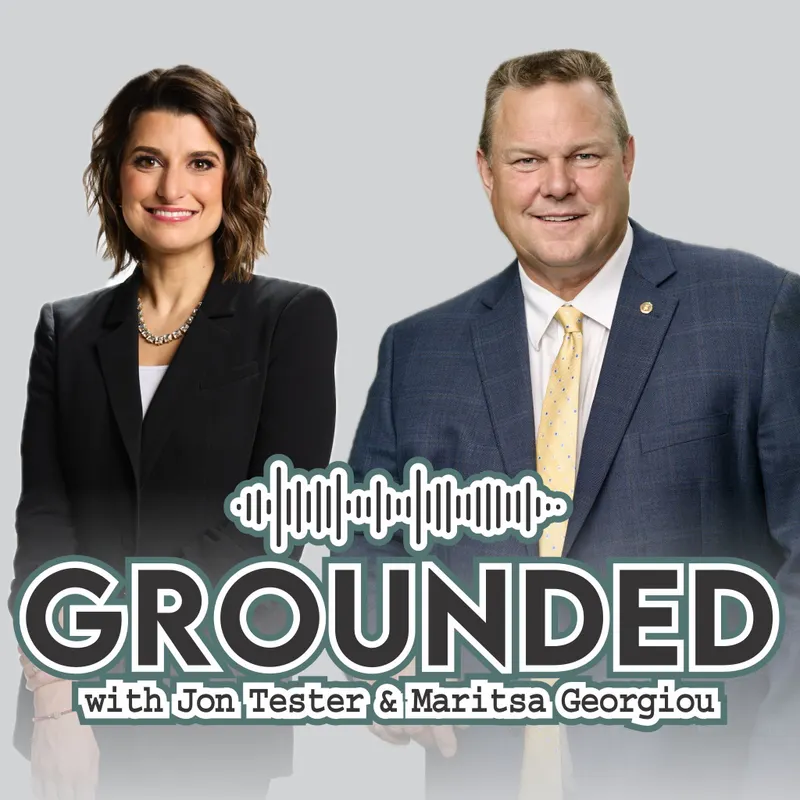
Grounded with Jon Tester & Maritsa Georgiou
Jon Tester & Maritsa Georgiou·119 episodes
If you’re feeling confused or overwhelmed by the news coming out of Washington, D.C. right now, know this: you are not alone. Each week, former U.S. Senator Jon Tester of Montana and veteran journalist Maritsa Georgiou are here to talk you through it.Grounded is about more than just deciphering the headlines; It’s about hearing from changemakers, sharing insider insight, and leaving each episode with a roadmap forward.Let’s stay grounded: In facts, in reason, and in community.You can also find us on YouTube and Substack! https://groundedpodcast.substack.com/https://www.youtube.com/@Ground...
Episodes
There are just 106 days until the November election and we have seen no shortage of drama-fueled shakeups. We were so pleased to welcome Erin Covey of The Cook Political Report for a deep dive into the 2026 midterm battleground races. Erin’s focus is typically the House, but she could have fooled us with her comprehensive and nuanced knowledge about the Senate map. She lays out Democrats' top defensive priorities in Georgia and Michigan to pickup targets in North Carolina, Maine, Alaska, and Ohio. We cover the Democrats’ “white whale” race in Texas, Iowa's Turek-Hinson race, and the wildcard role of independent candidates like Montana's Seth Bodnar and Nebraska's Dan Osborne. On the House side, Erin lays out why redistricting has reshaped the battleground, and which toss-up seats matter most. While the Democrats are favored to retake the majority, Erin explains why it’s not a foregone conclusion. To dig further into the races, the recent ratings changes, and more analysis from Erin, head to The Cook Political Report ratings page!
JT & MG sit down with Rep. Sean Casten (D-IL), a member of the House Financial Services Committee, to dig into a new report from Climate Power and the Center for American Progress on the rising cost of living. Casten, who spent 20 years in the energy industry before Congress, breaks down why natural gas prices are spiking, how blocking cheap renewable energy is driving up bills, and why Democrats need to talk about energy costs more, not less. On Monday, we’ll have a live conversation with the Cook Political Report's Erin Covey about the midterm landscape. Let us know which races you want us to dig into!
Attorney, journalist, and friend Katie Phang joins Grounded for an update on her ongoing legal fight against the DOJ after acting AG Todd Blanche essentially defied the court order to comply with the Epstein Files Transparency Act. This all comes days before an expected Blanche confirmation battle in the Senate. “So literally hot off the presses, I just filed this response,” Phang said. “And my response calls [Blanche] out for violating the judge’s order, not to mention still as of today, July 13th, 2026, still violating the federal law, the Epstein Files Transparency Act as he’s on the eve of his confirmation hearing in Senate Judiciary. And what I do is I ask the judge to fine him $1,000 a day until he complies. Him, not the Department of Justice, but Todd Blanche.” We also discuss headlines including the latest ICE involved fatal shooting in Maine and a new court ruling that recommends disciplinary action for Blanche and others for their involvement in the Trump IRS settlement slush fund move. We can’t let the episode end without some combine talk and another invitation to bring Katie to Big Sky Country.
JT & MG have a candid conversation with Rich Logis, founder of the nonprofit Leaving MAGA and author of the memoir One Betrayal Too Many. Logis is a former die-hard MAGA pundit, campaign volunteer, and donor. He talks about his break from the movement in 2022 and how it started with a simple idea: diversifying his news sources. Logis discusses what works to move people, what he calls an addiction to rage and fear, and what it takes to repair relationships. Plus, why he predicts an electoral revolt in November.
We always gain so much valuable perspective from David Becker, co-founder and executive director for the Center for Election Innovation and Research. He joins us again to break down myriad questions revolving around the upcoming midterm elections. We tackle the Supreme Court's 5-4 ruling about counting mail-in ballots that arrive after Election Day, including unpacking why the RNC sued deep-red Mississippi over the law. Why wouldn’t lawmakers just change the law in the state dominated by the GOP? We also dig into the president’s persistent obsession with the 2020 results and passing the Save America Act, which Becker says will never happen. “At the core of all of the false claims is the idea that Democrats somehow out of power in 2020, in the middle of a global pandemic, with President Trump controlling the entire federal government, managed the greatest conspiracy in world history to steal an election from him and that nobody was talking,” Becker said. “And then four years later, while those same Democrats held all of that power of the federal government, They forgot to do it again. That’s how ridiculous all of this is.” Plus, Becker lays out his idea on how we can get record midterm voter turnout this November.
What happens when the federal government tries to triple a small town's population overnight and won't even take your call? It’s what the city manager of Social Circle, Georgia was up against earlier this year. Eric Taylor joins grounded to take us through the six-month fight to stop the Department of Homeland Security from turning a vacant warehouse into an ICE detention camp. Taylor takes us through the story of how he locked the water meter, shut off the sewer valve, and helped force DHS to scrap a $128.6 million plan.
It was a big weekend in Big Sandy, Montana. Jeff Ament, through his nonprofit Montana Pool Service, hosted the 16th annual Big Sandy Skate Jam + Pig Roast Saturday. It gave us the perfect reason to host our first joint episode from the Tester farm (and snag some MPS merch)! A few days ago, our friend Dana DuBois connected us with Nick Paro, a disabled veteran and advocate who recently joined forces with Disability Community to craft a call to action based on a recent Department of Justice memo. It's raising serious concerns, but hasn’t been widely covered in mainstream media yet. The Arc published a great explainer. The memo basically reinterprets the 1999 Supreme Court Olmstead decision that ruled disabled people can’t be forced to be institutionalized if they can get support and services in their communities. The ruling said the institutional segregation of people with disabilities and mental illness is a form of discrimination under the Americans with Disabilities Act. That decision has been the basis for requiring states to improve access for community-based services. People briefed on the situation told reporters with Bloomberg Law that White House adviser Stephen Miller was the driving force behind the DOJ memo. The DOJ memo doesn’t change the law, but it does signal a shift. The National Alliance on Mental Illness says the language in the memo has the potential to promote a shift back toward institutionalization. It prompted Sen. Tammy Duckworth and other Senate Democrats to introduce a resolution that reaffirms the promise of Olmstead. It prompted Paro and his partners to publish their own call to action, saying this is an issue which will impact all of us. “Now is the time to speak — before they change the laws — and not after,” Paro’s group wrote. As the Arc wrote, “this isn’t the end of Olmstead. It’s the start of a new fight to protect it.” Stay tuned for more farm content from Big Sandy. If you want to learn more about MPS skatepark builds, make sure you check out Montana Grind and Paving the Way, two documentaries that feature Ament’s projects!
Oh so much to talk about with former RNC Chairman Michael Steele, who co-hosts the Weeknight on MSNOW. We discuss why Steele joined the GOP 50 years ago, his efforts to get the party back to its roots, and why he has no patience for Republican lawmakers (and pundits) speaking out against this administration only when it’s politically convenient. “Right now our system is broken because of the infestation of stupid,” Steele said. “The infestation of people who don’t give a damn about public service and are more interested in their grift. How much I can make. How much I can churn the system up.How can I piss off my base enough to write me a check?” Plus, Steele lays out why this upcoming election really is so critical, despite how many times we’ve heard that before.
Former DOJ pardon attorney Liz Oyer joins Grounded for the third time to discuss her new focus on Acting AG Todd Blanche's pending Senate confirmation. Hear why Liz thinks he's one of the most dangerous people in Washington right now, and what citizens can actually do to stop him. Plus, Oyer flags a potentially dangerous new policy change at the Bureau of Prisons and why she sees it as a tool to further weaponize the DOJ.
What does a secret, beautiful girlfriend in Canada have to do with the newly announced (and still unpublished) deal with Iran? Economist Justin Wolfers will tell you both stories smell off. He uses an "unraveling" argument from game theory and economic concepts to explain. “If I have an amazing deal, I would definitely run out and hold a press conference and show you the text right now. The fact that I’m not doing that tells you that I don’t have an amazing deal,” Wolfers explains. He breaks it down in even simpler terms. “If you’re on a dating app and the person doesn’t have their photo up what would you infer?” We cover the war in Iran’s economic ripple effects, including energy price spikes and the true cost of the conflict to people across the globe. We also tackle tariffs, the current impact on farmers, and what the AI revolution means for the future of work. Wolfers just launched the new Platypus Economics Substack channel with a simple mission: teach the world economics in an accessible way that helps us all collectively. “So, look, we all have our own theories about what ails the world right now. Mine is I think the world would be a better place if we all knew a little bit more economics,” Wolfers said. "The radicalizing moment for me is actually look at another field, medicine, where they’ve discovered these incredible vaccines that can prevent enormous amounts of illness and injury and death. And there’s not enough trust, public trust, in what the doctors are doing and people won’t even take the vaccines. Now my field, economics, we don’t have literal vaccines but we have metaphorical vaccines. We have ways of understanding the world that we think can lead people better, richer, fuller lives.”
The Leadership Conference on Civil and Human Rights, the country's oldest civil rights coalition, has put a lot of work into documenting the Trump administration’s efforts to turn back the clock on civil and human rights progress within the United States. The organization’s president and CEO Maya Wiley joined Grounded for a wide-ranging conversation to discuss several interconnected threats to civil rights. We discuss the Supreme Court's decision that led to the erosion of the Voting Rights Act, ICE detentions of people based on appearance and language rather than actual status, and threats to the nonprofit sector broadly. Wiley emphasizes that these attacks reach ordinary people, not just powerful figures — and that civil rights advocacy and voting are the tools citizens have to fight back.
Let’s be honest. There’s a lot to feel sad about in the world. There’s also a lot to stay hopeful about. JT’s travel schedule prevented us from locking in a guest for today, but we wanted to hop on and go over some of the big headlines. President Trump is still claiming a deal with Iran is just “days away” while fighting between Israel and Iran continues. We dissect parts of this weekend’s Meet the Press interview with Trump, during which he continuously defended J6 rioters, boasted about the “pay day” he delivered to farmers through $28 billion in taxpayer subsidies, and his interview-ending meltdown over “rigged elections.” Again. We also spend some time talking about the emotional and impactful interview Scott Pelley had with the New York Times over the weekend about his firing from CBS News. We highly recommend watching or listening in its entirety. “I’ve never worn the uniform,” Pelley said when responding to criticism from President Trump. “But I’ve been in combat for this country, in Afghanistan and Iraq, Kuwait. I’ve been shot at, spent nights in foxholes filling up with water in the desert. I’m not aware that the president of the United States has ever done any of those things for his country. Please correct me if I’m wrong. You become a journalist because you love the First Amendment. You become a journalist because you love the country. And while all the other descriptions that the president used about me might be applicable, not that one. [Tears up] There is no democracy without journalism. It can’t be done. That is why I am a journalist.” We couldn’t have said it better, Scott.
At a time when all of us are drowning in tech, AFT President Randi Weingarten just rolled out an action plan to combat the use of screens in classrooms before third grade, which includes an emphasis on more hands-on learning. “We are at a crossroads that will define the future of work and society,” Weingarten said. “Without proper oversight and strong guardrails, there will be real dangers to our safety, privacy, climate and the very fabric of society.” Weingarten added that she is “not calling for a total ban on AI or a Chromebook bonfire,” but “what I am calling for,” she said, “is getting the balance right to harness the benefits of technology while mitigating the harms.” How do we help kids learn and prepare in a world of AI without depriving them of curiosity, persistence and critical thinking? Plus, the new lawsuits aimed at overturning new rules that limit financial aid access under the so-called One Big Beautiful Bill Act.
We got an early start Tuesday dissecting all things legal with former federal prosecutor and national treasure Glenn Kirschner, who holds online community chats every night to discuss the pressing legal developments of the day. “When you’re fighting for democracy, it’s not really a job. This is mission. You know, I got a lot of kids and grandkids and what are we going to leave them?” Kirschner said. “I just try to figure out like what is the most important legal development for people to understand? And that’s what I try to tackle.” And there are so many to choose from. We hit on the $1.776 billion “anti-weaponization fund,” the great seashell caper, and the U.S. military’s boat strikes in the Caribbean and eastern Pacific. “When we suspect somebody is in international waters with drugs on the boat heading toward the United States, that’s why we have a Coast Guard,” Kirschner said. “We interdict them. We seize the evidence. We bring them into a court of law in the United States and we try to hold them accountable for any crimes they may have committed. We don’t murder them.” We also discuss the war in Iran (which is deeply personal to Kirschner's family), the untapped power of contempt in the courts, and the accountability mission Kirschner calls a non-negotiable.
“This is a film about cryptocurrency. It’s pretty stupid.” And as actor, author, and filmmaker Ben McKenzie will tell you, something that’s really stupid can also be really dangerous. McKenzie joined Grounded to talk about Everyone is Lying to You for Money, his film that dives into the deceitful world of cryptocurrency. It all started during the COVID-19 pandemic when a friend started telling Ben about investing in Bitcoin. McKenzie’s self-proclaimed obsession down the crypto rabbit hole ultimately led him to the U.S. Senate, where he testified before the Senate Committee on Banking, Housing, and Urban Affairs (and where McKenzie came face-to-face with another guy you might recognize). We discuss the dangers of the unregulated system, the overlap between crypto and MAGA, and the crypto industry’s grasp on our political system. “This is the poison fruit from Citizens United,” McKenzie said. “This is corporations and oligarchs having all the power and regular people not having much of any. And it’s really scary. I mean, they spent $240 million in 2024. It’s just a staggering amount of money. And they threatened to do that again in ‘26 and ‘28.”
“I often say that a vote is a kind of prayer for the world we desire for ourselves and for our children. And our prayers are stronger when we pray together.” Wise words from Sen. Rev. Raphael Warnock, who joined Grounded Wednesday to discuss Tuesday primary results, the redistricting fight in the South, and why turnout is going to matter so much in the general election in November. When it comes to the midterms, Warnock says he feels a lot better now than he did a year ago, but not quite as good as he did before the Supreme Court decision on Louisiana redistricting. “It’s hard really to overstate how devastating and massive this decision, the Calais decision, will be on our electoral program,” Warnock said. “They have literally turned the clock all the way back. And we could literally look up and see a Congress in terms of racial makeup that looks more like the Congress of the 1950s. That is where we are.” We touch on some policy, too—including private equity in housing and the warehouses the Dept. of Homeland Security bought up to turn into ICE detention centers. Plus, why Sen. Warnock says Jon Tester is the reason he’s in the Senate.
Apologies to everyone who noticed the blurry video in our live stream this morning— it seems the Montana WiFi overlords are not playing well with us. We uploaded the clean version here so you can watch it without frustration! Former Transportation Sec. Pete Buttigieg (or Mayor Pete, as we lovingly call him) is in Big Sky Country this weekend stumping for the Montana Plan, an effort to make the effects of the Citizens United decision a moot point—with hopes the effort will spread to other states. Last week, Hawaii Gov. Josh Green signed a similar measure into law. Basically, Montana has the authority to remove corporations’ power to spend in politics through corporation laws which are controlled by the states—other states can follow suit. While Hawaii’s measure passed through the legislature, Montana organizers are putting it to the voters with a ballot initiative. We couldn’t let Mayor Pete come to town without having him join us for an in-person podcast episode. We touch on the Montana Plan, but also discuss 2026, how to restore trust in our institutions, and what the Democrats need to do moving forward. Plus, we talk about soaring costs and the redistricting wars. Plus, does he ever lose his cool? While Pete didn’t make any major headlines about what his future holds, he did discuss the new book he’s working on and what he would do if he happened to find himself in a famous office now decorated with gold accents. Thanks to the University of Montana School of Journalism for letting us use their studio! You can watch the live stream of Sec. Pete Buttigieg’s Butte town hall HERE!
It's our 100th full episode! We love any chance to talk to our friend Katie Phang, especially when we get to talk about the historic lawsuit she filed against the U.S. Department of Justice over its botched handling of releasing the Epstein files. We talk about the complaint, the bipartisan support she’s getting from lawmakers, and the outcome she’s hoping to see. Plus, Katie’s take on the indictment of former FBI Director James Comey over a picture of seashells, the war with Iran, and the ballroom.
We have a lot to unpack after an eventful weekend. We discuss the 60 Minutes interview with President Trump about the shooting at the White House Correspondents’ Dinner, the 60-day mark to the war in Iran, and a new look for the National Reflecting Pool in Washington, D.C. Plus, Los Angeles Mayor Karen Bass joins JT & MG to discuss ICE raids, homelessness, and funding for wildfire victims. She also talks about her state’s upcoming primary both for the mayoral and gubernatorial races.
Talking with Scott MacFarlane was a great way to kick off the new week, even if it had to start in the 6:00 a.m. hour in Montana because of seeding on the Tester farm. Scott (NOT SETH) joined the independent media space earlier this year after leaving his correspondent role at CBS News. We talked extensively about his indefatigable reporting on January 6 defendants, why traditional journalism rules don’t apply today, and how to restore the norms. Plus, we discuss the regularity in which legacy media platforms misinformation, what he tells his kids about the future of politics in the U.S., and his favorite congressional cafeteria food. And no, he’s not related to Seth MacFarlane. Don’t miss the seeding progress update at the end!
On Jan. 23, 2020, then-Rep. Adam Schiff delivered his closing arguments in the first impeachment trial of President Donald Trump. “No constitution can protect us if right doesn’t matter any more. And you know you can’t trust this President to do what’s right for this country," Schiff said at the time. We discuss the relevance of those words when applied to Trump 2.0, how the conflict with Iran compares to the intelligence he received during the 2003 invasion of Iraq, and his concerns about the end game. Plus, what’s next for California’s jungle primary to elect the next governor now that Eric Swalwell has withdrawn from the race amid sexual assault allegations.
This is a repost from Heather Cox Richardson's channel Monday, when JT & MG join her to discuss the Citizens United decision, exorbitant amounts of money in politics, and the Montana Plan! Plus, organizations (like End Citizens United ) trying to combat the effects of big money in politics and what YOU can do about it.
It’s a month that starts with A, which means Jon Tester becomes increasingly harder to schedule because of work on the farm (April means planting; August means harvest). That said, many people have been asking where he’s been, so we attempted a Tractor Time with Tester episode that we came very close to pulling off… until his phone died. We asked Ellie Leonard to join us to discuss Melania Trump’s surprise statement to the White House press corps and how a deported Brazilian model (and her now deleted posts on X) could be part of the story. We dissect the timing, the tweets, and the relevance with Ellie, along with growing calls for Rep. Eric Swalwell to resign from Congress and drop out of the California gubernatorial race as new allegations of rape, sexual assault and misconduct come to light. We also discuss Hungarian Prime Minister Viktor Orbán’s crushing defeat after 16 years in power (and after VP JD Vance stumped for him), along with failed peace talks with Iran.
Big thanks to former White House counsel Ty Cobb for joining us on Grounded this morning. We shared some laughs and also talked about some very serious concerns about the rule of law, the Supreme Court hearing on birthright citizenship, the president’s threats to pull out of NATO, and more. Plus, how he came to work for the first Trump administration and his memories of his friend, former FBI director Robert Mueller.
We could have done an entire episode about the lengthy Trump cabinet meeting at the White House earlier today, including the 5 minutes spent talking about pens and sharpies (Yes, really). We cover a little bit of that with THE Sharon McMahon, America’s Government Teacher, author of The Preamble on Substack and also The Small and the Mighty (with newly illustrated version We Are Mighty out May 19). We also dive into other topics like the war in Iran, concerns about the 2026 election, and the lessons learned from the people of Minnesota. Plus, a spicier version of Sharon and why she says hope is the most grounded stance available to us.
If you’re worried about the future, Knowa De Baraso should help ease some concerns. The 14-year-old podcast host and political phenom is not only engaged—he’s bold. You may remember Knowa from the viral clip of him confronting the conspiracy peddling (and now Minnesota gubernatorial candidate) Mike Lindell at the 2024 DNC. We talk about how he became interested in politics, his plans to be active in the 2026 midterms, and what leaders need to do to reach the next generation. Plus, JT doesn’t hold back on recent headlines from a Pentagon press briefing.
We owe the parents of Kalpana Narlikar and Leo Auerbach an apology. A few weeks ago, we recorded a conversation with these two Georgetown University undergrads. Between the State of the Union and a new war, I completely forgot we had it on deck. Narlikar and Auerbach are students in JT’s discussion group this semester at Georgetown. They were kind enough to sit down with us to chat about the issues most important to their generation, how they view the political landscape, and also what gives them hope. Don’t miss the broken chair that is sure to become a new inside Grounded joke. We hit on bipartisan conversations, ICE policies, the national debt, artificial intelligence, and normalized mayhem. “We don’t know anything different than the pandemonium and the craziness that we’re seeing,” Auerbach said. “I don’t think our generation knows a normal politics. I don’t think we know decorum, I don’t think we know diplomacy, and I don’t think we know dialogue.” Ahead of our conversation with the students, we break down the Georgia special election results, the latest on Iran, the shoes making political headlines, and more reflections on Montana political bombshells.
Dover Air Force Base received another fallen U.S. soldier Monday night as a result of the war in Iran. The Pentagon says Army Sgt. Benjamin N. Pennington, 26, of Glendale, Kentucky died Sunday from injuries he sustained in an attack March 1 on the Prince Sultan Air Base, Saudi Arabia. There’s no audio on the recorded feed, which punctuates the sober reality of this moment. We talk about the latest Iran updates with Tara Setmayer, who is the co-founder and CEO of the Seneca Project and also a longtime political commentator and former GOP communications director. We discuss the mixed messages from the administration on the status of this war in Iran, renewed threats against Cuba, and a new video that appears to show a U.S. tomahawk missile hitting near a school where 168 people—mostly kids— were killed. She also talks about leaving the Republican party, messaging musts for successful political campaigns in 2026, and primary season infighting. Plus, Trump’s new threats about overhauling our voting laws ahead of the midterms.
To quote one of the many text messages I received Wednesday, what the hell is happening in Montana?!?!?! First it was Rep. Ryan Zinke announcing he wouldn't run for reelection days before the deadline to file in Montana. Not to be outdone, Sen. Steve Daines made a similar shocking move just minutes before the deadline to file, sparking confusion and, for some, anger. In the middle of it all, former University of Montana President Seth Bodnar made months of chatter official, filing to run for U.S. Senate as an independent. We chat about the massive political news, how it could shape the 2026 midterms as a whole, and also some other political headlines in this baby episode of Grounded.
It’s hard to keep track of the latest developments in the new U.S. war in Iran, mostly because we are seeing conflicting information coming from the administration—including differing timelines and justifications. Part of the justification given for this new war has circled around Iran’s nuclear ambitions, with Trump on Saturday saying Iran attempted to rebuild its nuclear program. This is subject matter Tom Countryman knows intimately well. He was the Assistant Secretary of State for International Security and Nonproliferation. From 1994 to 1997 he was the special advisor to United States Ambassador to the United Nations Madeleine Albright on Middle East affairs. He was on his way to an arms control conference in 2017 when Trump relieved him of his duties. We discuss the justifications, the timing of the attack, the negotiations it interrupted, and what this means for the future of diplomacy. How does Iran function without a government or organized opposition? Plus, what keeps him up at night and the very real scenarios he sees as a threat.
We woke up Saturday morning to the news that the U.S. is at war with Iran. By Sunday morning, we learned of the deaths of three U.S. service members and a promise of retaliation from Iran after U.S. and Israeli strikes took out Ayatollah Ali Khamenei along with dozens of other senior leaders. As we recorded this live episode, there are still so many unanswered questions. What comes next? Could more hardline forces take over? What does threatened retaliation look like? Is this about nuclear weapons and missiles? Why is the president posting on Truth Social about Iran meddling in the 2020 election? Is there any kind of plan? What’s the exit strategy? We could go on. Thanks to journalist Kevin Baron for joining us to chat through it. Baron served as the vice president of the Pentagon Press Association and also covered the Pentagon for many years. We discuss the parallel to other Middle Eastern conflicts, the motivation for this campaign, the timing, and what (more specifically, who) was missing at the Pentagon this weekend. Plus, what does regime change look like without organized opposition in Iran? Will there be a democratic process to put new leadership in power? What kind of extremism could arise? And what questions would Baron be asking if he were still at the Pentagon? We don’t have all the answers, but it’s a good start to lay out where we are and the concerns that exist.
If we’re the frogs, it’s getting hot in here (And no, JT hasn’t heard the 2002 Nelly hit of the same name). Thanks to former U.S. Attorney Joyce White Vance for joining us live on Substack to dissect a plethora of headlines, why we’re (again) the frogs in the increasingly hot pot of water, and the importance of civil discourse in this moment. Plus, the individual actions that keep Vance an optimist, and why she’s confident we won’t see the nationalization of elections. We also spend time discussing her book, Giving Up Is Unforgivable: A Manual for Keeping a Democracy, which combines lessons on history and civics and provides a roadmap for survival. Oh, and chickens—both literal and figurative.
A conversation between JT and MG about Maritsa's trip to Social Circle, Georgia in partnership with the Save America Movement. That's where the Dept. of Homeland Security recently purchased a newly built (and totally unfinished) warehouse for $128.6 million to be used for an ICE detention facility. We discuss what people in the town of 5,000 are saying, the red flags raised by experts on federal real estate, and the major concerns city officials have about the proposed project. Plus, the shocking timeline for when the federal government expects to move in its first inmates.
With floated plans to nationalize elections, calls for armed federal forces at the polls, and the FBI raid of the Fulton County, Georgia election hub, and the SAVE Act, there's a lot to discuss before this year's midterm elections. David Becker, prominent election security expert, lawyer, and the executive director and founder of the nonpartisan Center for Election Innovation & Research (https://electioninnovation.org/) joins Grounded to dissect the ongoing (and disproven) claims of mass voter fraud, the relitigation of the 2020 election results and what the persistent conspiracy theories are actually costing the American people. Plus, the conspiracy theory that drives him the most crazy and why he advocates for early in-person voting.
Ellie Leonard’s interest in the Jeffrey Epstein story started last year on a trip to Montana (where she has deep roots), and she wanted to better understand the story’s connection to Donald Trump. Fast forward to the passage of the Epstein Files Transparency Act, Leonard has been downloading and meticulously sifting through the DOJ releases page by page. Leonard joins Grounded's first episode of Season 2 to describe how she first started piecing things together, ways she uncovers redacted information in the DOJ document dumps, and the now massive community that has coalesced around (and adds to) her work. Come for the Epstein discussion, stay for the nerdy chatter about north central Montana.
Jon Tester set a new record for the number of phone calls that interrupted our live stream today—but that’s part of the deal when you work with a farmer who still has a landline. Alas, no calls from sitting senators today. We wanted to hop on for a quick(ish) chat about a few of the headlines from this week in politics. We start with Attorney General Pam Bondi’s performance on Capitol Hill. How would Jon Tester have reacted if he were on the receiving end of her “burn book” insults? We also go over the House’s passage of the SAVE Act, the announced end of ICE’s Operation Metro Surge in Minneapolis-St. Paul, and conditions in ICE detention facilities. Plus, two big legal wins this week for Democratic lawmakers who made a video that urged military members to refuse illegal orders.
It fortuitously lined up on the calendar to have Rachel Maddow as our guest to mark one year of Grounded. We talked seriously about the moment we’re in and what keeps her up at night. We also discussed what’s working, including the pushback that’s been a theme of Maddow’s show for many years. Maddow discusses how she hardens herself against threats, the future of news consumption, and how to beat the uncertainty that lies ahead. What would she ask Donald Trump if she interviewed him? What’s the scariest interview she’s ever done? What do Democrats need to do to win again? Plus, she gives us a sneak peak at her new book project she’s been working on all year. It’s a wide ranging conversation that will leave you with a lot to think about. Maybe you’ve been here from the start, and maybe you’re new to Grounded. We want to thank all of you. The truth is, we have the same questions, frustrations, and concerns as so many of you. We started this to try to make sense of the chaos. To stay grounded: in facts, in reason, in community. Let’s keep going. There’s more work to do.
2026 has already been a long year, which means we didn’t get to a fraction of the questions we had for former Rep. Adam Kinzinger. He tells us why he’s not immediately losing sleep over proposals to nationalize elections, but also what voters can do to ease concerns. Kinzinger has long been the focus of Donald Trump’s ire, especially since he was one of only two Republicans who served on the House committee that investigated the Jan. 6 attacks on the U.S. Capitol. With news that Trump is going to start holding daily meetings to focus on prosecuting his political enemies, Kinzinger has said he’s not worried, scared or intimidated. Kinzinger talks about putting country over party—calling out lies, defending democratic norms, and accepting the political fallout that came with it. Plus, don’t miss his answer when asked about running for president.
We’ve reached the point in the timeline when the federal government starts arrested journalists. We didn’t plan to release an episode tonight, but we’re thankful Dave Aronberg, former state attorney of Palm Beach County, was able to jump on with us at the last minute to unpack some legal headlines, including the arrests of independent journalists Don Lemon and Georgia Fort and the latest release of Epstein files. Some of those documents include shocking (and unsubstantiated) allegations against President Trump. We also tackle the FBI raid at the Fulton County election hub in Georgia, and the partial government shutdown that begins at midnight, despite the Senate passing a government funding bill. We apologize for the gap in audio episodes this week—Maritsa went to Minneapolis to cover the DHS operations and did live reports, which you can find on the Grounded Substack page.
Legal questions continue to swirl over the current surge of ICE agents in Minneapolis—reportedly enough agents to equate to FIVE TIMES the manpower of the Minneapolis Police Department. We asked former DOJ pardon attorney Liz Oyer to join us for a discussion about what’s happening on the ground and inside the Dept. of Justice. We dissect questions emerging as ICE agents and leaders spread misconceptions about what is and isn’t legal. Is it illegal to film a federal officer on a public street? Do ICE officers have absolute immunity as the Vice President stated? Can ICE officers order you out of your car? Do you have to show proof of legal status on request? Plus, what can concerned citizens do without giving the administration excuses to send in more troops? What would it look like if President Trump invokes the Insurrection Act? We cover it all.
PBS News White House correspondent Liz Landers joins Grounded to discuss her latest reporting that ties official administration language to extremist groups and white nationalist circles. We talk about how these messages are being used to recruit new ICE officers, the administration’s response and why experts have expressed concern. Plus, how to support public journalism oulets like PBS at a time when it matters more than ever.
t’s hard to believe all of the major news that happened in 2026—and we’re only nine days in. The capture of Venezuelan President Nicolás Maduro was not even one week ago. We’ve seen reporting that the U.S. government is considering sending individual checks of up to $100,000 to Greenlanders, and of course the protests happening all across the country after the killing of Renee Nicole Good in Minneapolis. Since JT made the trip to Maritsa’s side of the Continental Divide, we decided we should host a show about all of it with Miles Taylor, a national security expert who actually worked as chief of staff for the Department of Homeland Security during the first Trump administration. You might also know him as “Anonymous,” after he wrote an op-ed about resistance efforts inside Trump 1.0.
Minnesota again finds itself at the center of a political firestorm with the ICE killing of Renee Good, 37. Bystander footage contradicts the message from the Trump administration. The mayor of Minneapolis has told ICE to “get the fuck out,” while Gov. Tim Walz has alerted the National Guard. It’s a pivotal moment that we discuss in depth with Sen. Tina Smith (D-MN) and longtime political journalist Mary Lahammer.
We didn’t plan to release a weekend episode, but that all changed when we woke up to news the U.S. launched attacks on Venezuela and captured the country’s leader. In a news conference later Saturday, President Donald Trump said the U.S. is now “going to run” Venezuela until there’s a safe, proper, and judicious transition. But what does that mean? Sen. Angus King (I-ME) joined us for a discussion about what comes next, along with some other big picture questions. What happened to getting out of the business of regime change? How does Venezuela’s oil come into the conversation? Who will be the next Venezuelan leader? Will Congress do anything to demand oversight? What will be the unintended consequences? Plus, we discuss how this move stacks up against the recent pardon of former Honduran President Juan Orlando Hernández, who was convicted on similar drug trafficking charges.
As the press comes further under attack, journalists who are driven by integrity have found themselves exploring new ways to share unvarnished truth. We talk with Zach Toombs of Evident Media about the new nonprofit news outlet, their latest investigative work around immigration raids, and how to get this type of content into more hands. We also discuss the state of the press and the need for independent journalism at a time when CBS is pulling fully vetted 60 Minutes stories and media companies (ABC, CBS, Meta, YouTube) have doled out $90 million to settle lawsuits with President Trump. Can independent journalists hold the line? Plus, stick around for a musing session about our dream guests for 2026!
In what we hope is our final episode before the Christmas break, we take on one of the biggest stressors for American families: the cost of food. Why are grocery prices rising so quickly, and what can be done—locally and federally—to rein them in? Scott Faber of the Environmental Working Group joins us to explain the many factors at play, from the war in Ukraine to immigration crackdowns to industry consolidation.. Plus, JT has a lot of questions about buying a lottery ticket.
Our conversations with Michael McFaul, former U.S. ambassador to Russia, always go by way too quickly with pages of unasked questions. We still fit a lot in, including the state of peace talks between Russia and Ukraine. We discuss mistakes made in the Cold War, the difference in threats between Russia and China, and why he says his long-term strategy is for all American interests, not just members of a single political party. Plus, the topic that worries him most about our security. These are heavy (and complicated) subjects, but McFaul manages to dissect them in easy to understand language and even leaves us with glimmers of hope for our future. We don’t miss the chance to talk a little Montana football ahead of a big game this weekend.
Reviews
No reviews yet.
If you like this...

The Schilling Show
Same topic · Same format · Same audience

The Corbett Report Podcast
Same topic · Same audience

The Last American Vagabond
Same topic · Same format

Media Roots Radio
Same topic · Same format

Hillsdale Dialogues
Same topic · Same format

Red Scare
Same topic · Same format

Point of Inquiry
Same format · Same audience

Tony Evans' Video Podcast
Same audience
Discussion (0)
No comments yet. Be the first to start the discussion!