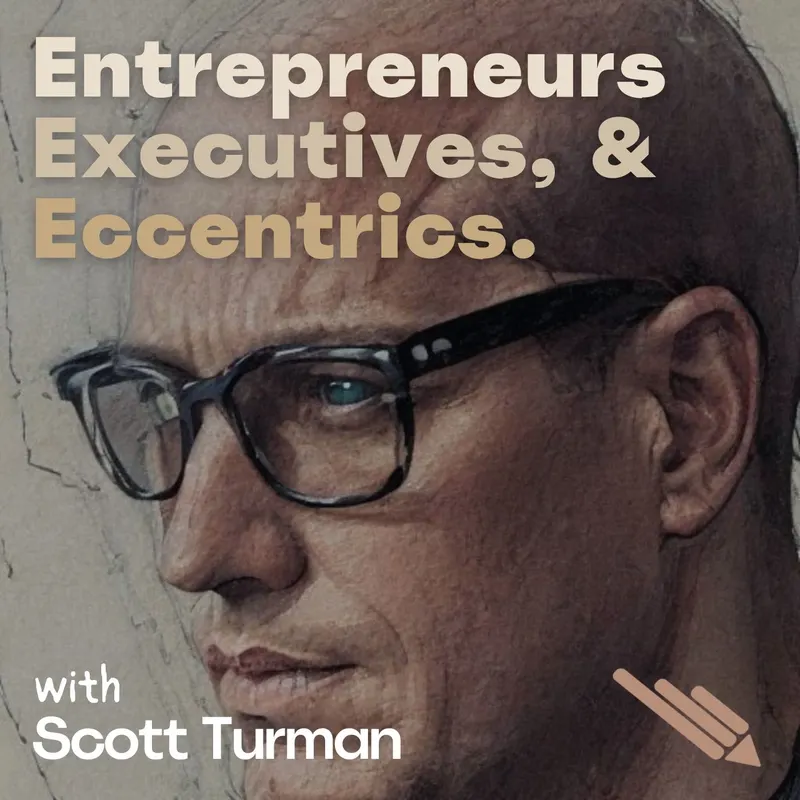
Entrepreneurs, Executives, & Eccentrics
Scott Turman·68 episodes
Entrepreneurs, Executives, & Eccentrics" is a new podcast exploring the world of business through in-depth interviews with a diverse range of guests, hosted by Scott Turman. From visionary entrepreneurs who have turned dreams into successful ventures, to accomplished executives shaping industries, and eccentric personalities with unique approaches to business and life, Scott navigates through their stories with a blend of curiosity and expertise. Gain valuable insights, learn from the experiences of trailblazers, and be inspired by the resilience, creativity, and unconventional wisdom of the individuals who have left an indelible mark on the business landscape. "Entrepreneurs, Executives, & Eccentrics" will grow into...
Why listen
Scott Turman interviews founders, executives, investors, coaches, and unconventional operators about how they actually built, adapted, and survived in business. Episodes feel practical and story-driven, with guests unpacking pivots, niche markets, leadership lessons, and the messy operational choices behind growth. It is a good fit for listeners who like founder stories with concrete takeaways rather than abstract business theory.
Episodes
In this conversation, David Steele, founder and CEO of One Wealth Advisors and executive chairman of Flour and Water Hospitality Group, shares why he builds businesses to last for generations rather than preparing them for sale. He explains how service, long-term relationships, delegation, mentorship, and creative work shape his approach to leadership. The discussion challenges the traditional view of retirement and explores how people can keep doing meaningful work by removing tasks they dislike and focusing on areas where they have mastery. Steele also discusses the importance of setting authentic goals, building strong teams, and helping immigrant restaurant owners gain access to capital, coaching, and systems that can turn small businesses into lasting companies.TakeawaysGenerational businesses require a different mindset from companies built for acquisition.Strong relationships with clients, partners, and employees can matter more than a large exit.Business ownership can serve as a creative practice, not just a path to wealth.Retirement can cause people to lose purpose when they stop meaningful work without replacing it.Delegation allows leaders to remove routine tasks and focus on work that uses their strongest skills.Teaching, coaching, and mentorship can turn delegation into a tool for developing future leaders.A well-designed calendar can create space for work, travel, hobbies, and personal growth.Goals should reflect personal values rather than status, ego, or social pressure.Good mentors help people discover their own goals instead of projecting goals onto them.Immigrant restaurant owners need more than startup grants, they also need capital, coaching, and systems that support long-term growth.Today's guest, David Steele, can be found at:Company Websites: https://onewealth.net/, https://www.flourandwater.com/Linkedin: https://www.linkedin.com/in/david-steele-76088a/Your host, Scott Turman, can be found online at:Website: https://scottturman.com/, https://brightray.com/LinkedIn: https://www.linkedin.com/in/scottturman/IMDb: https://www.imdb.com/name/nm14602682/Keywordsgenerational businesses, entrepreneurship, financial planning, wealth management, restaurant industry, hospitality, business ownership, leadership, delegation, mentorship, coaching, retirement, purpose, goal setting, authentic goals, business scaling, team development, employee retention, client relationships, creative work, long-term thinking, legacy planning, nonprofit organizations, immigrant entrepreneurs, restaurant ownership, access to capital, private equity coaching, franchise value, succession planning, lifestyle design, time management, service, personal fulfillment, business strategy
In this episode, Jackie Garrett, founder, designer, and CEO of Vilah Bloom, shares how a simple idea born from the challenges of motherhood became a thriving handbag and accessories brand. She explains how her patented diaper bag that dispenses wet wipes launched the business, the journey from sewing prototypes at her kitchen table to securing major retail partnerships, and how the company evolved into a customizable handbag brand with interactive bag bars. Jackie also discusses manufacturing, supply chain challenges, product development, hiring, leadership, retail expansion, and the lessons she learned through nearly 16 years of entrepreneurship. The conversation offers practical insight into building a product-based business, adapting to change, and creating sustainable long-term growth through creativity, resilience, and customer-focused innovation.TakeawaysVilah Bloom began with a patented diaper bag that dispenses wet wipes, inspired by Jackie's own experience as a new mother.The company's first prototype was handmade on her kitchen table using simple materials before evolving into a commercial product.Winning Best Diaper Bag at the ABC Kids Expo helped the brand gain early credibility and secure partnerships with major retailers, including Nordstrom.The business transitioned from primarily wholesale and ecommerce to a retail experience centered around customizable handbags and accessories.Vilah Bloom's Bag Bar concept allows customers to personalize bags with straps, charms, and monograms, creating a unique shopping experience.Small batch manufacturing and finishing products in the United States helped the company navigate supply chain disruptions and tariff challenges.Jackie credits much of her success to persistence, learning through setbacks, and adapting after difficult manufacturing experiences.Hiring and delegating responsibilities were essential milestones that allowed the business to scale beyond a family-run operation.Jackie's background in television sales, marketing, and retail provided valuable experience that helped her navigate relationships with major retailers.The company is exploring future expansion through additional retail locations and a potential franchise or ownership model.Today's guest, Jackie Garrett can be found at:Website: https://vilahbloom.com/LinkedIn: https://www.linkedin.com/in/jackelynn-k-garrett-a193a651/Facebook: https://www.facebook.com/jackie.garrett.374/Your host, Scott Turman, can be found online at:Website: https://scottturman.com/, https://brightray.com/LinkedIn: https://www.linkedin.com/in/scottturman/IMDb: https://www.imdb.com/name/nm14602682/Keywordscustomizable handbags, handbag brand, diaper bags, patented diaper bag, wet wipe dispenser, accessories, bag bar, personalization, monogramming, handbag design, product design, entrepreneurship, founder journey, manufacturin
In this conversation, Nicholas Allen discusses his path from architecture to building a performance marketing agency focused on legal lead generation in the U.S. He explains how he moved from small local lead gen clients into scalable pay-per-lead campaigns for personal injury, motor vehicle accident, and workers’ compensation leads. The discussion covers why Meta ads remain his strongest channel, how qualification surveys and dynamic funnels help route leads to the right buyers, and why creative testing became critical after tracking and attribution changed. Nicholas also shares lessons on focus, avoiding shiny object syndrome, building systems before growth becomes unmanageable, and using AI to improve workflows, automate data handling, and speed up technical work.TakeawaysNicholas Allen built a legal lead generation business after leaving a career in architecture.His agency focuses on pay-per-lead campaigns rather than monthly retainers.Personal injury lead generation became a strong niche because it is scalable and valuable to buyers.Meta ads, especially Facebook and Instagram, remain his primary traffic channels.The business model allows one campaign to serve multiple clients at the same time.Qualification surveys help filter leads based on case type, injury, fault, treatment, and other key factors.Lead quality often depends on the law firm’s intake process and follow-up system.Creative testing became more important after tracking and attribution changes affected ad performance.Nicholas believes focus and mastery helped him move past shiny object syndrome and build momentum.His biggest lesson was to build systems, hire earlier, and avoid doing every task alone.Today's guest, Nicholas Allen, can be found at:Website: https://influxx.co/LinkedIn: https://www.linkedin.com/in/nickallen-leads/Your host, Scott Turman, can be found online at:Website: https://scottturman.com/, https://brightray.com/LinkedIn: https://www.linkedin.com/in/scottturman/IMDb: https://www.imdb.com/name/nm14602682/KeywordsPerformance marketing, legal lead generation, personal injury leads, pay per lead, Meta ads, Facebook ads, Instagram ads, lead generation agency, motor vehicle accident leads, workers’ compensation leads, qualification surveys, lead routing, intake process, creative testing, attribution, tracking, AI automation, API, data cleaning, audience exclusion, entrepreneurship, architecture, online business, shiny object syndrome, business systems, scaling, outsourcing, client acquisition, social proof, legal marketing
In this episode, Scott Turman speaks with Paul DeRousselle, an NFL agent and author of Faith. Failure. Football., about his path from a small town in Louisiana to representing top football talent. Paul shares how his love for football began early, how law school helped shape his career, and how early failure taught him the value of preparation, humility, and discipline. The conversation covers the realities of becoming an agent, the pressure of recruiting and negotiation, the importance of faith and accountability, and why long-term success requires more than talent or confidence.TakeawaysPaul DeRousselle knew from a young age that he wanted a life connected to football.Becoming an NFL agent requires strong credentials, preparation, and a high level of commitment.Paul’s first major career setback came when a hometown player chose another agent.That early failure taught him not to rely only on relationships, but to bring a clear plan and real value.His first major commission as an agent brought relief and validation after years of work.Success created its own challenges, including ego, distraction, and the need for self-accountability.Paul credits faith, discipline, and reflection with helping him refocus on his purpose.He sees legendary agent Eugene Parker as a major professional influence.Paul believes strong agents must understand both the player’s needs and the team’s position.His book, Faith. Failure. Football., is not a how-to guide, but a story about perseverance, purpose, and growth.Today's guest, Paul Derousselle, can be found at:Website: https://paulderousselle.com/LinkedIn: https://www.linkedin.com/in/paul-t-derousselle-06959859/Instagram: https://www.instagram.com/theagentpaul/?hl=enYour host, Scott Turman, can be found online at:Website: https://scottturman.com/, https://brightray.com/LinkedIn: https://www.linkedin.com/in/scottturman/IMDb: https://www.imdb.com/name/nm14602682/KeywordsNFL agent, football, sports business, athlete representation, law school, negotiation, accountability, faith, failure, discipline, purpose, perseverance, recruiting, NFL draft, contracts, leadership, sports agents, professional growth, personal development, career setbacks, preparation, Louisiana, Southern University, football business, legacy
In this conversation, Richard McWhorter, managing partner of SRM Private Wealth in Beverly Hills, discusses his work advising family offices, entertainers, athletes, and high-net-worth clients on wealth management, estate planning, financial planning, and long-term investment strategy. He explains how family office investing differs from standard financial planning, why each client requires a custom approach, and how critical thinking shapes decisions in uncertain markets. The discussion also explores the role of AI in research, the risks of relying on AI without subject matter knowledge, the possible bubble around AI-related companies, and why Richard favors a disciplined “singles and doubles” investment approach over chasing home runs.TakeawaysSRM Private Wealth works with 36 families and manages about $2.1 billion in assets.A family office typically serves families with hundreds of millions of dollars in assets.Richard’s firm builds custom strategies based on each family’s wealth structure, goals, values, and existing holdings.Family office advising often includes investments, estate planning, financial planning, retirement planning, and broader decision support.Richard entered the financial industry young and built his career through focus, persistence, and long-term client value.His renewed interest in finance came from intellectual curiosity and a desire to understand complex issues in depth.Richard views economics as an inexact science because markets, policy, politics, and global events all affect outcomes.AI can help interpret large amounts of information, but it still requires human judgment, fact gathering, and review.Richard believes AI may create major value, but investors must consider energy needs, data centers, raw materials, and infrastructure.His investment style focuses on risk control, steady gains, and avoiding large mistakes rather than chasing the next big winner.Today's guest, Richard McWhorter, can be found at:LinkedIn: https://www.linkedin.com/in/richard-mcwhorter/Your host, Scott Turman, can be found online at:Website: https://scottturman.com/, https://brightray.com/LinkedIn: https://www.linkedin.com/in/scottturman/IMDb: https://www.imdb.com/name/nm14602682/KeywordsFamily office, private wealth, wealth management, estate planning, financial planning, retirement planning, investments, high-net-worth clients, accredited investors, AI, artificial intelligence, market risk, economics, investment strategy, utilities, energy, natural gas, oil, coal, raw materials, data centers, infrastructure, portfolio management, critical thinking, risk management, probability, poker, Beverly Hills, family practice, financial advisor
In this episode, inventor and entrepreneur Jason Rider shares the story behind C-BITE, a patented gardening clip designed to solve common plant support and trellising challenges. Jason discusses how a lifelong passion for gardening, combined with early access to 3D printing technology, led him to develop a versatile product that can connect in hundreds of configurations. He walks through the product development process, from rapid prototyping and patenting to manufacturing, distribution, and scaling a family-owned business alongside his sister. The conversation explores entrepreneurship, product design, retail distribution, in-house manufacturing, and the lessons learned from more than a decade of building a physical product company. Jason also offers practical advice for inventors and founders on finding mentors, learning quickly, and navigating the challenges of bringing an idea to market.TakeawaysC-BITE was created to solve the limitations of traditional tomato cages and plant support systems.Jason used an early desktop 3D printer to rapidly prototype and refine the product design.The product evolved from a simple gardening clip into a modular system with more than 150 connection possibilities.Inspiration for the design came from real gardening problems and woodworking joinery concepts such as dovetail connections.Early adoption in hydroponics and cannabis cultivation helped validate the product's usefulness.Building a physical product business required learning manufacturing, distribution, marketing, and retail operations.Jason and his sister split responsibilities, combining engineering, product development, sales, and marketing expertise.Manufacturing in-house with injection molding machines helped reduce costs and improve supply chain control.Distribution alone does not guarantee sales, ongoing education, marketing, and customer awareness are essential.Jason believes founders should seek mentors, learn from experienced industry professionals, and focus on failing fast to accelerate success.Today's guest, Jason Rider, can be found at:Website: https://thrivingdesign.com/LinkedIn: https://www.linkedin.com/in/jarider/Instagram:https://www.instagram.com/cbite_clips/?hl=en, https://www.instagram.com/cbite_guy/?hl=enYoutube: https://www.youtube.com/channel/UCcXqK8H0m7eavmvpa73t4kQYour host, Scott Turman, can be found online at:Website: https://scottturman.com/, https://brightray.com/LinkedIn: https://www.linkedin.com/in/scottturman/IMDb: https://www.imdb.com/name/nm14602682/Keywordsgardening, tomato cages, plant supports, trellising, garden stakes, 3D printing, rapid prototyping, product development, invention, patent, manufacturing, injection molding, entrepreneurship, startup growth, retail distribution, wholesale sales, hydroponics, aquaponics, cannabis cultivation, e-commerce, product design, supply chain, marketing, sale
In this episode, entrepreneur and Army veteran Charlie Felker shares his journey from serving in the U.S. Army and completing multiple combat deployments to building and selling home service businesses. Charlie discusses how lessons learned from operating those companies led him to launch Free2Grow, a business focused on helping home service companies improve customer service operations. The conversation explores the rapid evolution of AI-powered customer service, the challenges of scaling human call centers, and why AI voice assistants are becoming a practical solution for HVAC, plumbing, lawn care, and other home service businesses. Charlie explains the company's recent pivot to AI, the realities of adoption, lessons learned during the transition, and how automation is reshaping customer interactions, operational efficiency, and business growth in the home services industry.TakeawaysCharlie Felker served in the U.S. Army, including four combat deployments to Afghanistan, before becoming an entrepreneur.He built and later sold two aging-in-place home service businesses, which provided the foundation for his current venture.Free2Grow originally provided outsourced customer service representatives for home service companies.Scaling human customer service teams proved difficult due to hiring, turnover, training, and seasonal demand fluctuations.Advances in AI voice technology prompted the company to pivot from human CSRs to AI-powered customer service solutions.Many smaller home service companies are adopting AI quickly because it offers 24/7 availability and lower operating costs.Larger HVAC and plumbing businesses are often starting with after-hours and overflow call handling as a way to test AI adoption.AI booking rates are approaching levels that make them competitive with human agents for many customer interactions.Successful AI deployment requires customized workflows, scheduling logic, business rules, and CRM integrations tailored to each company.Charlie believes business owners should focus resources on core strengths and outsource non-core functions to improve profitability and scalability.Today's guest, Charlie Felker, can be found at:Website: https://www.free-2-grow.com/Your host, Scott Turman, can be found online at:Website: https://scottturman.com/, https://brightray.com/LinkedIn: https://www.linkedin.com/in/scottturman/IMDb: https://www.imdb.com/name/nm14602682/KeywordsArtificial Intelligence, AI Voice Assistants, Customer Service Automation, Home Services, HVAC, Plumbing, Lawn Care, Call Centers, Customer Service Representatives, Outsourcing, Business Scaling, Entrepreneurship, Small Business Operations, Workflow Automation, CRM Integration, Voice AI, Appointment Booking, Dispatching, Operational Efficiency, Business Growth, Private Equity, Franchises, Automation Technology, AI Adoption, Home Service Industry, Sc
In this episode, licensed therapist and coach Diana M. Garcia shares her journey from community mental health and university counseling into private practice and entrepreneurship. She discusses the realities of building a therapy business during the pandemic, the emotional challenges of running a practice, and the mindset shifts required to move from clinician to business owner. Diana also explains Acceptance and Commitment Therapy, or ACT, and how it helps people manage negative thoughts, build psychological flexibility, and take value-driven action. The conversation explores coaching, imposter syndrome, women in leadership, marketing strategies for therapists, the rise of online therapy and AI tools, and the future of mental health services in a rapidly changing industry.TakeawaysDiana M. Garcia transitioned into full-time private practice after learning her university role would end during the pandemic.Therapists are trained clinically, but often receive little education on running a business.Building a private practice requires emotional resilience, especially when dealing with uncertainty and financial pressure.Imposter syndrome is common for therapists entering entrepreneurship and leadership roles.Acceptance and Commitment Therapy, or ACT, focuses on psychological flexibility, mindfulness, and value-driven behavior.Diana works primarily with stressed millennials, couples, and first and second generation women in leadership or entrepreneurship.Many women struggle with confidence despite being highly qualified, while men often project confidence more easily.Word-of-mouth referrals, SEO, YouTube content, and relationship-building have been key marketing tools in her business growth.Writing a book required strict discipline, consistent deadlines, and long-term commitment outside of client work.Diana believes AI and technology will continue shaping mental health care, but human empathy and connection cannot be replaced.Today's guest, Diana M. Garcia, can be found at:Website: https://nurturingwellnesscollective.com/, https://nurturingmindscounseling.com/Youtube: https://www.youtube.com/@IamdianamgarciaYour host, Scott Turman, can be found online at:Website: https://scottturman.com/, https://brightray.com/LinkedIn: https://www.linkedin.com/in/scottturman/IMDb: https://www.imdb.com/name/nm14602682/Keywordstherapy, private practice, entrepreneurship, mental health, ACT therapy, acceptance and commitment therapy, coaching, couples therapy, millennials, imposter syndrome, women in leadership, confidence, mindset, business ownership, therapist marketing, SEO, YouTube marketing, emotional resilience, psychological flexibility, negative thoughts, behavioral therapy, coaching industry, online therapy, AI therapy, mental health apps, therapist burnout, self-pay therapy, networking, growth mindset, women entrepreneurs, Hispanic profess
In this episode, Benjamin Schieken, founder and CEO of Fincast, explains how his company is changing the mortgage shopping process through AI and competitive lending technology. He shares how traditional loan shopping creates friction for borrowers and limits visibility across lenders, often leading consumers to overpay on one of the largest financial decisions of their lives. Benjamin discusses how Fincast helps borrowers compare real mortgage offers without spam calls or repeated applications, while also creating better access for smaller lenders that struggle to compete with large institutions. The conversation also covers Benjamin’s journey from SaaS founder to fintech entrepreneur, lessons learned from failed ventures, the importance of trust in fintech branding, and his long-term vision to bring offline financial shopping behaviors into a transparent digital marketplace.TakeawaysFincast is an AI-powered mortgage shopping platform designed to help borrowers find better loan offers.The platform starts with a borrower’s existing loan estimate rather than requiring multiple new applications.Mortgage loan estimates became standardized by the CFPB in 2016 to support easier comparison shopping.Traditional mortgage shopping is time-consuming, while comparison websites often overwhelm users with calls and emails.Fincast anonymizes and shops mortgage offers across a lender network to reduce friction and protect borrower privacy.According to Benjamin, 73% of borrowers who use Fincast find a better mortgage deal.Smaller lenders often offer strong pricing and service but struggle to compete with the marketing budgets of large lenders.Benjamin’s motivation for building Fincast came from a desire to create technology that positively impacts consumers directly.The company plans to expand beyond mortgages into other financial products such as auto loans and SBA loans.Trust, education, and transparency are central to the company’s branding and long-term growth strategy.Today's guest, Benjamin Schieken, can be found at:Website: https://www.gofincast.com/LinkedIn: https://www.linkedin.com/in/benjamin-schieken/Your host, Scott Turman, can be found online at:Website: https://scottturman.com/, https://brightray.com/LinkedIn: https://www.linkedin.com/in/scottturman/IMDb: https://www.imdb.com/name/nm14602682/Keywordsmortgage loans, mortgage shopping, fintech, AI lending, loan estimates, CFPB, consumer finance, refinancing, home buying, lenders, mortgage marketplace, loan comparison, interest rates, borrower savings, financial technology, loan origination, mortgage rates, lending ecosystem, mortgage refinancing, SaaS, startup growth, fintech branding, mortgage automation, competitive lending, mortgage transparency, lending intelligence, home financing, digital marketplace, consumer lending, financial products, mortgage offers, loan shopping, mor
In this episode, Maggie Segrich shares the story behind building Texas’s only coworking space designed for women, communities of color, and the LGBTQ community. She discusses her path from jewelry designer and chamber founder to coworking entrepreneur, and explains how the business evolved from a small leased space into a 21,000-square-foot operation in Houston. The conversation covers the realities of scaling a physical business during COVID, managing construction delays and supply chain issues, building a referral-driven company, and creating flexible workspaces that adapt to modern business needs. Maggie also talks about leadership, resilience, community-driven growth, and the future of inclusive coworking across Texas.TakeawaysMaggie Segrich operates Texas’s only coworking space focused on women, communities of color, and the LGBTQ community.The business started after Maggie struggled to find a creative workspace in Houston for her jewelry company.The original coworking location opened in Montrose before expanding into a much larger Midtown space.COVID nearly forced the company to close after losing all clients within six weeks of opening.A conversation about “being allowed to quit” helped Maggie recommit to the business instead of walking away.The company scaled from 2,000 square feet to 21,000 square feet through phased expansion.Supply chain problems during construction created major delays, including missing doors and air conditioning materials.Flexibility is central to the business model, with clients able to rent offices for hours, weeks, or long-term use.The coworking space offers services beyond desks, including mailing addresses, conference rooms, showers, legal resources, and event spaces.Nearly all business growth now comes through referrals rather than paid advertising.Today's guest, Maggie Segrich, can be found at:Company Website: https://seshcoworking.com/LinkedIn: https://www.linkedin.com/in/maggie-segrich/Your host, Scott Turman, can be found online at:Website: https://scottturman.com/, https://brightray.com/LinkedIn: https://www.linkedin.com/in/scottturman/IMDb: https://www.imdb.com/name/nm14602682/Keywordscoworking space, entrepreneurship, Houston business, inclusive workplaces, women entrepreneurs, LGBTQ business community, communities of color, flexible office space, coworking industry, startup growth, commercial real estate, remote work, business resilience, COVID business recovery, referral marketing, Stripe billing, office rentals, community building, women-owned business, Midtown Houston, networking, nonprofit support, creative entrepreneurs, business operations, scaling a business
In this episode, Lee Norwood shares how she built a successful college consulting business focused on helping families navigate the complex college admissions process while avoiding full tuition costs whenever possible. She explains the challenges students and parents face with college applications, financial aid, Common App, and school selection, especially for first-generation families and students without access to strong school counseling support. Lee also discusses her entrepreneurial journey from pharmaceutical sales into education consulting, the importance of mentorship and networking, and how she created College Sharks, a scalable online platform designed to make expert college admissions guidance more affordable and accessible for families nationwide.TakeawaysMany high school counselors are overloaded, leaving students without enough personalized college guidance.Families should start college visits early to help students understand different campus environments and preferences.College pricing is often negotiable through scholarships, merit aid, and strategic planning.First-generation students and families without college experience face added challenges during admissions.The Common App simplifies applications but also encourages students to apply to too many schools.Successful college consulting requires both admissions knowledge and an understanding of student personality and goals.Lee transitioned from pharmaceutical sales into entrepreneurship through networking and mentorship.Buying an existing business gave Lee a foundation of reputation, systems, and client trust.College Sharks was created to scale expert college admissions advice at a lower price point through structured video lessons and workbooks.Lee believes entrepreneurship requires self-motivation, adaptability, and a willingness to solve scaling problems creatively.Today's guest, Lee Norwood, can be found at:LinkedIn: https://www.linkedin.com/in/leenorwood/Your host, Scott Turman, can be found online at:Website: https://scottturman.com/, https://brightray.com/LinkedIn: https://www.linkedin.com/in/scottturman/IMDb: https://www.imdb.com/name/nm14602682/Keywordscollege admissions, college consulting, Common App, college applications, financial aid, scholarships, college tours, higher education, first-generation students, entrepreneurship, mentoring, networking, educational consulting, college essays, merit aid, student counseling, homeschool families, college planning, admissions strategy, College Sharks, business scaling, online education, parent guidance, college affordability, student success
In this episode, Scott Turman speaks with Tessa Santarpia and Susan Santarpia, co-founders of VISUALIZEin360, about their integrated approach to health, wellness, and personal transformation. They explain how their work blends neuropsychology, coaching, and holistic practices to address the full human experience rather than relying on traditional talk therapy alone. The conversation explores the role of neuroplasticity and epigenetics in shaping behavior, the importance of combining mental and physical healing, and why consistent support and accountability are key to lasting change. They also discuss generational shifts in attitudes toward therapy, the unique challenges faced by young adults, and their vision for the future of healthcare, where individuals take a more active role in their own healing.TakeawaysVISUALIZEin360 was founded to create a more holistic approach to mental health and wellness.Traditional talk therapy often falls short when used as a standalone solution.Neuroplasticity and epigenetics show that people can change over time through behavior and environment.Healing requires both mental understanding and physical embodiment.Consistent coaching and support help individuals stay committed to personal growth.Integrating practices like mindfulness and somatic work enhances outcomes.Young adults in their thirties often face existential anxiety and a search for purpose.Generational trauma and learned behaviors can be addressed through intentional work.Attitudes toward therapy have shifted, with younger generations more open to self-exploration.The future of healthcare may focus more on self-healing and holistic practices rather than quick fixes.Today's guests can be found at:Susan Santarpia:LinkedIn: https://www.linkedin.com/in/susan-santarpia-32081366/Tessa Santarpia:LinkedIn: https://www.linkedin.com/in/tessasantarpiaYour host, Scott Turman, can be found online at:Website: https://scottturman.com/, https://brightray.com/LinkedIn: https://www.linkedin.com/in/scottturman/IMDb: https://www.imdb.com/name/nm14602682/Keywordshealth, wellness, neuropsychology, neuroplasticity, epigenetics, coaching, therapy, mindfulness, somatic psychology, mental health, personal growth, generational trauma, holistic healing, public health, consciousness, behavior change, self healing, anxiety, purpose, transformation
In this conversation, Eli Igra Serfaty, co-founder and CEO of MAIA Digital, explains how his agency helps B2B organizations, executives, and teams build a strong presence on LinkedIn through company page management, executive branding, and employee activation. He discusses why LinkedIn remains the most important platform for credibility, trust, and visibility in business, especially as it integrates with search engines and emerging AI tools. The discussion explores the evolution of LinkedIn from a hiring platform to a full business ecosystem, the risks of automation and artificial engagement, and the shift from vanity metrics to meaningful business outcomes. Eli also shares insights on organic versus paid strategies, the growing importance of thought leadership ads, and how a retainer-based business model enabled his agency to scale sustainably.TakeawaysMAIA Digital focuses exclusively on LinkedIn, allowing deep expertise and specialization in one platform.The agency operates across three pillars: company page management, executive branding, and employee activation.LinkedIn serves as a central growth engine that supports marketing, sales, hiring, and fundraising.A strong LinkedIn profile acts as a first impression and is often the top result in search engines.Businesses benefit from consistent visibility, as multiple touchpoints are required to build trust in B2B.AI-generated engagement and automation tools can harm credibility and risk account penalties.LinkedIn’s algorithm is shifting toward quality interactions and business outcomes rather than vanity metrics.Organic content should come first, with paid amplification used to scale content that already performs well.Thought leadership ads allow companies to promote personal profile content, increasing authenticity and reach.A retainer-based model provides predictable revenue and supports long-term client growth and scalability.Today's guest, Eli Igra Serfaty, can be found at:Company Website: https://team-maia.com/LinkedIn: https://www.linkedin.com/in/eli-igra-serfaty/Spotify: https://open.spotify.com/show/0k6SHSnZ7NjhdpdYr85JUCLinktree: https://linktr.ee/TEAM_MAIAYour host, Scott Turman, can be found online at:Website: https://scottturman.com/, https://brightray.com/LinkedIn: https://www.linkedin.com/in/scottturman/IMDb: https://www.imdb.com/name/nm14602682/KeywordsLinkedIn marketing, B2B marketing, executive branding, company page management, employee advocacy, thought leadership, LinkedIn ads, organic content, paid amplification, AI engagement, automation risks, social media strategy, personal branding, employer branding, retainer model, subscription revenue, digital marketing, SaaS marketing, venture capital, business growth
In this episode, Thiago Maior, CEO of EZOps Cloud, shares his journey from software developer to building a nearshore DevOps and cloud engineering company supporting US startups. He explains how the rise of DevOps transformed software delivery by enabling smaller, more efficient teams, and how his company scaled by training junior engineers to adopt modern cloud practices. The conversation explores the parallels between the early days of DevOps and the current wave of AI adoption, highlighting both the opportunities and risks of AI-driven development. Thiago and Scott discuss the realities of “vibe coding,” the importance of engineering fundamentals, and why experience, process, and disciplined workflows remain critical despite powerful new tools.TakeawaysThiago Maior transitioned from developer to founder by recognizing the early potential of DevOps and cloud technologies.EZOps Cloud built its team by training junior engineers, who adapted more easily to new paradigms than senior engineers.DevOps enabled startups to operate with smaller, more efficient teams by automating infrastructure and deployment.The current rise of AI mirrors the early disruption caused by DevOps, creating new opportunities for engineers and companies.AI can significantly accelerate development, including infrastructure setup and automated testing, when used correctly.“Vibe coding” without engineering discipline often leads to fragile, unmaintainable systems.Strong fundamentals, such as version control, code review, and incremental development, remain essential.AI tools require experienced engineers to guide prompts, review outputs, and debug complex issues.Many companies overestimate how complete AI-generated solutions are, leading to costly rework.The future will favor engineers and companies that combine experience with effective AI usage, while those who rely solely on automation may struggle.Today's guest, Thiago Maior, can be found at:Instagram: https://www.instagram.com/thiagomaior/LinkedIn: https://www.linkedin.com/in/thiago-maior/Your host, Scott Turman, can be found online at:Website: https://scottturman.com/, https://brightray.com/LinkedIn: https://www.linkedin.com/in/scottturman/IMDb: https://www.imdb.com/name/nm14602682/KeywordsDevOps, cloud computing, AI development, automation, startups, software engineering, infrastructure, continuous deployment, vibe coding, version control, agile methodology, engineering teams, cloud architecture, testing automation, developer productivity
In this episode, Rick Clark, an entrepreneur with over two decades of experience in legal discovery, joins Scott Turman to discuss the evolution of e-discovery from paper-based processes to AI-driven analysis. Rick explains how modern data sources such as text messages, Slack, Teams, and WhatsApp have transformed the legal landscape, creating new challenges in data collection, review, and compliance. He outlines how AI is reshaping early case assessment, document review, and legal strategy by enabling faster identification of key evidence across massive datasets. The conversation also explores the growing importance of information governance, the risks of unmanaged data, and how law firms must adapt to remain competitive in an increasingly technology-driven legal environment.TakeawaysLegal discovery has evolved from physical paper review to complex digital data analysis across multiple platforms.Modern cases involve massive datasets including emails, text messages, Slack, Teams, and social media.Early e-discovery relied heavily on manual review and keyword or Boolean search methods.Technology-assisted review introduced early forms of AI for document categorization.AI now enables faster early case assessment by identifying patterns, key conversations, and potential evidence.Cross-channel communication analysis is critical for understanding full context in legal cases.Legal teams still debate whether AI-generated prompts and categorizations qualify as protected work product.AI reduces reliance on large review teams by automating document classification and summarization.Information governance policies, including data retention and deletion, play a major role in legal risk management.Data thought to be deleted is often recoverable through forensic methods across multiple devices and backups.Today's guest, Rick Clark, can be found at:Website: https://cloudnine.com/company/#organizationalleadershipLinkedIn: https://www.linkedin.com/in/rickcclark/Your host, Scott Turman, can be found online at:Website: https://scottturman.com/, https://brightray.com/LinkedIn: https://www.linkedin.com/in/scottturman/IMDb: https://www.imdb.com/name/nm14602682/Keywordslegal discovery, e-discovery, artificial intelligence, AI in law, early case assessment, document review, data governance, digital forensics, text messages, Slack, Microsoft Teams, WhatsApp, cross-channel communication, legal technology, information governance, data retention, legal strategy, machine learning, technology assisted review, corporate data
In this episode, Scott Turman speaks with Mel McSherry, an international business and life guide who helps entrepreneurs move past overwhelm by utilizing the framework of Human Design. Mel explains how this system, which integrates elements of astrology, quantum physics, and traditional philosophies, serves as an internal operations manual for managing energy and making decisions. The discussion explores the importance of "hallways," or transitional spaces, and why entrepreneurs must flip the traditional hierarchy of needs to prioritize mental and emotional profitability over strictly financial metrics. By moving away from "copy and paste" business formulas and toward a deeper understanding of self-trust, Mel demonstrates how to achieve a level of success that is both high-performing and sustainable without the cost of burnout.TakeawaysHuman Design as a Blueprint: Human Design acts as a foundational operations manual that reveals how an individual best processes information and makes decisions.Energy Management Over Time Management: True productivity stems from checking in with your physical and emotional energy levels rather than just filling a calendar.The Value of the "Hallway": Transitional periods between business milestones are vital spaces for recalibration and should not be rushed.Flipping the Hierarchy of Needs: Prioritizing mental and emotional well-being creates a more fluid and sustainable path to financial profitability.Sustainability vs. Burnout: High achievement is often unsustainable when it is built on fear, scarcity, or the "rite of passage" of overworking.The "How" vs. The "Why": While most entrepreneurs understand their "why," the "how" often causes the most overwhelm when it does not align with their natural design.Rejecting the "Shoulds": Following external frameworks without customization leads to a disconnect between external success and internal satisfaction.The Power of the Pause: Taking a step back to address nervous system health can lead to a more powerful and authentic business "180."Decision Making in Gray Areas: Many people struggle in the "gray area" of a decision, which is often just a necessary period of waiting for more information.Philosophy as a Business Tool: Utilizing philosophical frameworks can help map personality types and behavioral patterns to improve business outcomes.Today's guest, Mel McSherry, can be found at:Website: https://www.melmcsherry.com/LinkedIn: https://www.linkedin.com/in/melmcsherry/Your host, Scott Turman, can be found online at:Website: https://scottturman.com/, https://brightray.com/LinkedIn: https://www.linkedin.com/in/scottturman/IMDb: https://www.imdb.com/name/nm14602682/KeywordsHuman Design, Entrepreneurship, Business Development, Energy Management, Burnout Prevention, Mental Health, Professional Growth, Sustainability, Strategic Planning, Self-Trust, Life G
In this episode, Haleh Shoa, founder of the Los Angeles-based archiving studio Picturli, joins Scott Turman to discuss the vital importance of preserving family history through professional photo and video organization. Haleh shares her journey from advertising executive to "photo manager," a transition sparked by her own family's experience as refugees fleeing the Iranian Revolution with nothing but their photographs.The conversation explores the technical and emotional challenges of managing “analog mountains” consisting of boxes of photos, old slides, and outdated digital media like CDs. Haleh explains how her team turns these items into searchable, high quality digital libraries. She describes her unique business model, which balances manual curation with modern technology, and discusses the strategic decisions behind scaling a high touch service business. From uncovering 19th century family secrets to navigating the risks of climate change on physical assets, this episode highlights why our visual legacies are worth the investment.TakeawaysPicturli is a specialized studio focusing on the chronological organization and digitization of analog and digital media.Context is key: Redating and renaming files during digitization is what makes a photo collection searchable and usable.The "Circle of Life": The business often moves assets from analog to digital and back to high-end, space-saving digital photo books.Manual Curation vs. AI: While AI helps with facial recognition, human experts are required to curate collections based on family history and emotional value.Scaling Challenges: Haleh discusses the "scary" necessity of saying no to the wrong clients to maintain high standards and healthy margins.Risk Management: With the rise of global warming, digitizing physical photos is a critical step in protecting family legacies from fire and water damage.Future Vision: The goal for Picturli is to establish a lasting brand and standard operating procedures that allow the mission to continue beyond its founder.Entrepreneurial Grit: Haleh shares the "immigrant story" of her parents and how it influenced her drive to build a business with a "zone of genius."Today’s guest, Haleh Shoa, can be found online at:Webiste: https://www.picturli.com/LinkedIn: https://www.linkedin.com/in/halehshoa/Instagram: https://www.instagram.com/halehshoa/Your host, Scott Turman, can be found online at:BrightRay Publishing: https://brightray.com/Entrepreneur Website: https://scottturman.com/LinkedIn: https://www.linkedin.com/in/scottturman/keywordsphoto archiving, digital asset management, analog to digital, business scaling, family memories, photo organization, digital preservation, entrepreneurship
In this conversation, Matthew Shollar, founder of Transcend Cruises, discusses the innovative concept of a B2B cruise line that focuses on providing customized experiences for private groups rather than individual consumers. He explains the challenges faced in the traditional cruise industry and how his company addresses these issues through unique ship designs, branding opportunities, and a focus on client needs. The discussion also covers the current operations, future plans for new ships, and the overall business model that sets Transcend Cruises apart from competitors.TakeawaysTranscend Cruises is the world’s first entirely B2B cruise line.The company focuses on private group departures, not individual sales.Customization and branding are key elements of the cruise experience.The ships are designed to accommodate various group needs and preferences.Transcend Cruises aims to simplify the charter process for clients.The company is building new ships tailored for group experiences.Sustainability and wellness are integral to the cruise offerings.The business model allows for higher margins compared to traditional cruise lines.Transcend Cruises operates internationally, catering to diverse markets.The future vision includes expanding the fleet and enhancing client experiences.Today’s guest, Matthew Shollar, can be found online at:Website: https://transcendcruises.com/LinkedIn: https://www.linkedin.com/in/matthew-shollar-930925/Your host, Scott Turman, can be found online at:BrightRay Publishing: https://brightray.com/Entrepreneur Website: https://scottturman.com/LinkedIn: https://www.linkedin.com/in/scottturman/KeywordsTranscend Cruises, B2B cruise line, luxury travel, river cruising, branding, custom experiences, travel industry, innovative ship design, corporate events, travel agencies
In this conversation, Tyler Rachal, co-founder of Higherframe, discusses the evolution of remote staffing, particularly in the context of nearshoring to Mexico and the Philippines. He shares insights from his experience in outsourcing, the challenges of navigating business in these countries, and the founding story of Hireframe. The discussion also touches on the importance of flexibility in staffing, the impact of AI on remote work, and the changing landscape of global hiring. Rachal emphasizes the need for authenticity in content creation and the influence of platforms like Amazon in the publishing industry.TakeawaysHigherframe specializes in remote staffing for B2B tech companies.Nearshoring has gained traction, especially post-COVID.Understanding local laws and customs is crucial for successful outsourcing.The 13th month bonus is a common expectation in Mexico and the Philippines.Building a network in target countries can mitigate risks in outsourcing.Flexibility in staffing is essential for startups and growing companies.AI is transforming the way talent is utilized in remote work.Companies are increasingly building globally from the outset.Authenticity in content creation is becoming more valuable.Amazon plays a significant role in the publishing industry, but there are alternatives.Today's guest, Tyler Rachal, can be found online at:Website: https://www.hireframe.com/LinkedIn: https://www.linkedin.com/in/tylerrachal/Your host, Scott Turman, can be found online at:BrightRay Publishing: https://brightray.com/Entrepreneur Website: https://scottturman.com/LinkedIn: https://www.linkedin.com/in/scottturman/Keywordsremote staffing, nearshoring, outsourcing, AI in business, global hiring, Hireframe, B2B tech, talent acquisition, business growth, entrepreneurship
In this conversation, Laura Patterson, founder and president of VisionEdge Marketing, discusses the evolution of growth strategy consulting over the past 25 years, emphasizing the importance of data insights and customer centricity. She shares her journey in establishing her firm, the transition to remote work, and the significance of understanding customer success. The discussion also touches on the challenges of marketing attribution and the impact of AI on the industry, concluding with advice for the next generation regarding career opportunities in emerging fields.TakeawaysData insights are crucial for making informed decisions.Curiosity about customers leads to better marketing strategies.Balancing customer value and business value is essential.Remote work can enhance operational efficiency.Identifying the right client is key to business success.Onboarding processes should be systematic and data-driven.Understanding customer success metrics is vital for growth.Marketing attribution remains a complex challenge.AI is a tool that requires skill to leverage effectively.Emerging industries like AI present significant career opportunities.Today's guest, Laura Patterson, can be found online at:Personal Website: https://laurapatterson.co/Website: https://visionedgemarketing.com/https://www.linkedin.com/in/laurapattersonvem/https://www.youtube.com/@VisionEdgeMarketingYour host, Scott Turman, can be found online at:BrightRay Publishing: https://brightray.com/Entrepreneur Website: https://scottturman.com/LinkedIn: https://www.linkedin.com/in/scottturman/Keywordsgrowth strategy, marketing, data insights, customer centricity, remote work, client onboarding, marketing attribution, AI in marketing, business growth, customer success
In this conversation, Coach Barry Davis shares his extensive experience in coaching, discussing the evolution of his career, the importance of emotional intelligence in leadership, and the nuances of recruiting talent. He emphasizes the significance of character over mere athletic ability and offers insights into his book, 'Old Dog, New Tricks,' which explores the journey of a coach learning to manage emotions and build effective teams.TakeawaysCoaching is a leadership position focused on developing people.Character is more important than talent in recruiting.Emotional intelligence is crucial for effective coaching.Building a team requires understanding individual motivations.Reflection on daily practices can lead to improvement.Mentorship and guidance are key in coaching roles.Creating a safe environment fosters team cohesion.Asking for input empowers team members.Leadership shapes the culture of an organization.Success takes time and consistent effort.Today's guest, Barry Davis, can be found online at:Website: https://drbarrydavis.com/LinkedIn: https://www.linkedin.com/in/drbarrydavis42/ Your host, Scott Turman, can be found online at:BrightRay Publishing: https://brightray.com/Entrepreneur Website: https://scottturman.com/LinkedIn: https://www.linkedin.com/in/scottturman/Keywordscoaching, emotional intelligence, recruiting, leadership, baseball, mentorship, team building, character development, sports, personal growth
In this conversation, Sean Rowe, founder of St. Angelo's Pizza, shares his journey from a software professional to a successful restaurateur. He discusses the origins of his family’s pizza business, the challenges he faced in the early years, and how he reinvented the menu and business model to adapt to changing circumstances, including the COVID-19 pandemic. Sean emphasizes the importance of mentorship, learning from mistakes, and the realities of running a restaurant, while also reflecting on the evolving landscape of the food industry.TakeawaysSean Rowe is the founder of St. Angelo's Pizza in Atlanta, Georgia.The restaurant's name has a family history dating back to his great uncle.Sean faced significant challenges when he first entered the pizza business.He learned the importance of fixing the food as a foundational principle.COVID-19 forced him to adapt his business model to focus on delivery and carryout.Mentorship is crucial for success in entrepreneurship.The restaurant industry is not for everyone; it requires dedication and hard work.Sean emphasizes the importance of community engagement in his business.He has learned to streamline operations to improve efficiency.The journey of entrepreneurship is often winding and filled with lessons.Today's guest, Sean Rowe, can be found online at:Website: https://www.stangelos.com/LinkedIn: https://www.linkedin.com/in/sean-rowe-4334a23/Facebook: https://www.facebook.com/stangelosviningsInstagram:https://www.instagram.com/stangelos_vinings/Instagram: https://www.instagram.com/stangelos_lakepoint/Your host, Scott Turman, can be found online at:BrightRay Publishing: https://brightray.com/Entrepreneur Website: https://scottturman.com/LinkedIn: https://www.linkedin.com/in/scottturman/KeywordsSt. Angelo's Pizza, entrepreneurship, restaurant business, COVID-19, menu innovation, business challenges, pizza industry, small business, community engagement, mentorship
In this conversation, Andrejka Bernatova shares her journey from a political science major to a successful investor in energy infrastructure and digital assets. She discusses her experiences in the finance sector, the importance of cultural adaptability, and the entrepreneurial spirit she found in Houston's energy community. Andrejka also delves into the complexities of SPACs, the challenges of valuation in public markets, and the future demand for energy driven by AI and digital assets. Throughout the discussion, she emphasizes the significance of resilience, grit, and surrounding oneself with good people in both personal and professional life.TakeawaysAndrejka transitioned from political science to finance and energy.She emphasizes the importance of taking risks in life.Cultural adaptability has been crucial in her career.The Houston energy community is welcoming and supportive.Grit and resilience are key to success in business.SPACs can be risky and should not be used as a last resort.Valuation challenges can hinder capital raising efforts.Energy demand is increasing due to AI and digital assets.Surrounding oneself with good people is essential for success.Understanding the energy sector is critical for future investments.Today's guest, Andrejka Bernatova, can be found online at:Website: https://www.dynamix-corp.com/LinkedIn: https://www.linkedin.com/in/andrejka-bernatova-85037013/Twitter/X: https://x.com/BernatovaYour host, Scott Turman, can be found online at:BrightRay Publishing: https://brightray.com/Entrepreneur Website: https://scottturman.com/LinkedIn: https://www.linkedin.com/in/scottturman/KeywordsAndrejka Bernatova, energy infrastructure, SPACs, entrepreneurship, investment, Houston, digital assets, AI, resilience, valuation
In this conversation, Praveen Sahay, founder of Wave Equity Partners, discusses his journey in investing in climate solutions, focusing on deep tech innovations that address critical issues in energy, food, and water. He emphasizes the importance of sustainable investments that do not rely on government subsidies and shares insights on innovative approaches to carbon capture and energy generation. Praveen also reflects on his unique career path from a nuclear physicist to a venture capitalist, highlighting the significance of creativity and purpose in driving innovation.TakeawaysInvesting in climate solutions requires a deep understanding of interconnected sectors.Sustainable solutions must be economically viable without government subsidies.Innovation is essential for transforming industries and creating value.The energy sector's reliance on government funding can distort market dynamics.Carbon capture technology can significantly reduce emissions and costs.Clean energy generation can be achieved using alternative fuels like water and ethanol.Entrepreneurship is a mindset that transcends industry boundaries.Life's opportunities should be embraced without fear of the unknown.Purpose in life can stem from love and creativity.Engaging with passionate entrepreneurs is a rewarding experience.Today's guest, Praveen Sahay, can be found online at:Profile: https://waveep.com/our-firm/team/praveen-sahay/Website: https://waveep.com/LinkedIn: linkedin.com/in/psahayYour host, Scott Turman, can be found online at:BrightRay Publishing: https://brightray.com/Entrepreneur Website: https://scottturman.com/LinkedIn: https://www.linkedin.com/in/scottturman/Keywordsclimate solutions, venture capital, carbon capture, energy generation, sustainable investments, innovation, clean technology, environmental impact, entrepreneurship, deep tech
In this conversation, Alex Hejazi, founder and CEO of Placement, shares his journey from finance to the kiosk industry, detailing the evolution of his business through various pivots, especially during the pandemic. He discusses the challenges and successes of launching a startup, the importance of adaptability, and the lessons learned along the way. The conversation highlights the innovative approach of Placement in the unattended retail space and the future potential of kiosk technology.TakeawaysAlex Hejazi transitioned from finance to the kiosk industry.Placement started as a rental service for sports and leisure equipment.The pandemic forced a pivot to package management solutions.The company evolved from hardware to a software-focused model.First dollar earned came from a proof of concept at the beach.Hiring a co-founder was a pivotal moment for the business.Entrepreneurs should consider maintaining supplemental income initially.Pivots are essential for adapting to market changes.The kiosk industry is evolving towards unattended retail solutions.Placement aims to maximize asset utilization for brands. Today's guest, , can be found online at:Website: https://findplacement.io/LinkedIn: https://www.linkedin.com/in/alexhejazi/Your host, Scott Turman, can be found online at:BrightRay Publishing: https://brightray.com/Entrepreneur Website: https://scottturman.com/LinkedIn: https://www.linkedin.com/in/scottturman/KeywordsPlacement, kiosks, unattended retail, entrepreneurship, business pivot, startup journey, technology, package management, distribution, innovation
In this conversation, Marilyn Yang, co-founder and CEO of Fun-Gal Snacks, shares the journey of creating Popadelics, a brand specializing in crunchy mushroom chips. From the initial idea sparked during the COVID-19 pandemic to navigating product development, scaling the business, and securing distribution in major retailers, Marilyn discusses the challenges and successes faced along the way. She emphasizes the importance of understanding the market, leveraging resources, and learning from experiences in the food industry.TakeawaysThe idea for Popadelics emerged during the COVID-19 pandemic.Marilyn and her husband leveraged their finance backgrounds to navigate the startup world.They recognized a gap in the market for mushroom snacks.Outsourcing R&D was crucial for product development.Building relationships with distributors was key to scaling the business.They focused on creating a product that was both tasty and commercially viable.Participation in trade shows helped validate their product concept.They learned the importance of being in retail spaces where their target customers shop.Marilyn reflects on the need for industry knowledge before diving into entrepreneurship.The journey has been both challenging and rewarding, leading to significant growth.Today's guest, Marilyn Yang, can be found online at:Website: https://popadelics.com/Instagram: https://www.instagram.com/popadelics/Facebook: https://www.facebook.com/popadelicsLinkedIn: https://www.linkedin.com/company/popadelics/Your host, Scott Turman, can be found online at:BrightRay Publishing: https://brightray.com/Entrepreneur Website: https://scottturman.com/LinkedIn: https://www.linkedin.com/in/scottturman/KeywordsPopadelics, mushroom snacks, entrepreneurship, product development, retail distribution, startup journey, food industry, business growth, R&D, healthy snacks
In this conversation, James, a seasoned resort architect, shares insights into his career spanning nearly four decades. He emphasizes the importance of placemaking in architecture, focusing on creating unique experiences rather than just buildings. James discusses his journey from concept to construction, highlighting the collaborative process with clients and the significance of passion in architecture. He reflects on his global experiences and the universal similarities among people, advocating for a more connected world through travel and understanding.TakeawaysJames has been a resort architect for nearly four decades.Placemaking is about creating unique experiences, not just buildings.Architecture should express its regional uniqueness.Good design requires understanding the client's vision.The design process involves intense collaboration and brainstorming.Sustainable concepts were part of James's work in the 90s.Resort design combines various architectural principles.Passion for architecture is essential for success.Building relationships with clients leads to repeat business.Traveling the world reveals our shared human experiences.Today's guest, James Freeman, can be found online at:Website: https://www.fscarchitects.com/LinkedIn: https://www.linkedin.com/in/jamesgfreemanfscarchitects/LinkedIn: https://www.linkedin.com/company/fsc-architects/Your host, Scott Turman, can be found online at:BrightRay Publishing: https://brightray.com/Entrepreneur Website: https://scottturman.com/LinkedIn: https://www.linkedin.com/in/scottturman/Keywordsresort architecture, placemaking, design process, sustainable communities, architecture career, unique experiences, hotel design, global perspective, client relationships, passion for architecture
In this conversation, Erin Holowach discusses her journey as an entrepreneur aiming to revolutionize the real estate industry. With over 22 years of experience, she highlights the inefficiencies in traditional real estate commissions and introduces her company, ComFree, which offers a commission-free model for selling homes. The discussion covers the evolution of real estate practices, the need for transparency and education, and the challenges faced in disrupting a long-standing industry. Erin emphasizes the importance of empowering consumers and providing them with the tools to navigate the real estate market effectively.TakeawaysErin Holowach aims to change the real estate industry.Real estate commissions have ballooned over the years.The traditional real estate model is outdated.ComFree offers a commission-free selling model.Transparency and education are crucial in real estate.Consumers are waking up to the inefficiencies in real estate.The value of real estate agents is being questioned.Legal aspects of real estate transactions are essential.ComFree provides support and education to sellers.The future of real estate is shifting towards consumer empowerment.Today's guest, Erin Holowach, can be found online at:Website: https://comfree.com/LinkedIn: https://ca.linkedin.com/in/comfreeFacebook: https://www.facebook.com/erin.holowach/Your host, Scott Turman, can be found online at:BrightRay Publishing: https://brightray.com/Entrepreneur Website: https://scottturman.com/LinkedIn: https://www.linkedin.com/in/scottturman/Keywordsreal estate, commissions, disruption, ComFree, home selling, entrepreneurship, transparency, education, market value, consumer empowerment
In this conversation, Brian Hamilton shares his journey as a perpetual startup entrepreneur, discussing the inception of Sageworks, his philanthropic efforts with Inmates to Entrepreneurs, and the importance of fostering entrepreneurship in disadvantaged communities. He emphasizes the role of AI in business, the challenges faced by new entrepreneurs, and reflects on historical contexts that shape our current society. The discussion also touches on the impact of war and the need for empathy in understanding the experiences of others.TakeawaysBrian Hamilton is a perpetual startup entrepreneur and philanthropist.Sageworks was created to simplify complex financial data for businesses.The importance of entrepreneurship in disadvantaged communities is emphasized.Successful small businesses often require minimal capital to start.AI should be used to solve real problems, not just as a trend.Networking with the right people is crucial for success.Many entrepreneurs fail by pursuing ideas that are already saturated.The role of AI in business is to enhance productivity and efficiency.Historical context shapes our understanding of current societal issues.War has profound effects on individuals and society as a whole.Brian Hamilton is chairman of LiveSwitch and a leading expert on entrepreneurship. As founder of Sageworks (now Abrigo), America’s first fintech company, Hamilton helped millions of small business owners understand their financial data. Through Inmates to Entrepreneurs, he encourages entrepreneurship as a means to economic opportunity. Hamilton’s work has been featured by outlets like Good Morning America and CNBC, and he starred in the show Free Enterprise on ABC.Today's guest, Brian Hamilton, can be found online at:LiveSwitch: https://www.liveswitch.com/Facebook: https://www.facebook.com/brianhamilton.entrepreneurInstagram: https://www.instagram.com/brianhamiltonnc/?hl=enTwitter: https://x.com/brianhamiltonncYour host, Scott Turman, can be found online at:BrightRay Publishing: https://brightray.com/Entrepreneur Website: https://scottturman.com/LinkedIn: https://www.linkedin.com/in/scottturman/Keywordsentrepreneurship, AI, philanthropy, small business, Sageworks, Live Switch, financial literacy, nonprofit, mentorship, historical context
On this episode Kasey Edwards shares her journey from being a stay-at-home mom to becoming a passionate advocate for her daughter diagnosed with SPG47, a rare neurodegenerative disorder. She discusses the emotional impact of the diagnosis, the formation of a nonprofit to support research, and the potential of AI in healthcare. Kasey emphasizes the importance of community, awareness, and the hope that exists for families facing similar challenges.TakeawaysKasey transitioned from a stay-at-home mom to a parent-driven researcher.SPG47 is an ultra-rare neurodegenerative disorder affecting her daughter.The journey began with a shocking diagnosis and a search for support.Kasey leveraged her background in healthcare to navigate the challenges.The formation of a nonprofit was a pivotal moment in their journey.AI technology has the potential to revolutionize rare disease research.Community support is crucial for families dealing with rare diseases.Kasey aims to create a feedback loop between business and research funding.Awareness and education are key to helping families find resources.Kasey encourages parents to find beauty in their unique journeys.KeywordsKasey Edwards, SPG47, rare diseases, nonprofit, gene therapy, AI in healthcare, venture philanthropy, parental support, awareness, cerebral palsyToday's guest, Steven Rothberg, can be found online at:Website: https://cartwheelsinchaos.com/LinkedIn: https://www.linkedin.com/in/kasey-edwards-7899b63Facebook: https://www.facebook.com/people/Cartwheels-in-Chaos/100091989288711/Your host, Scott Turman, can be found online at:BrightRay Publishing: https://brightray.com/Entrepreneur Website: https://scottturman.com/LinkedIn: https://www.linkedin.com/in/scottturman/
In this conversation, Steven Rothberg, founder of College Recruiter, discusses the mission of his job search platform aimed at helping students and recent graduates find meaningful employment. He shares insights on the evolution of the business, the impact of COVID-19 on recruitment, and the challenges of hiring and managing employees. Rothberg also highlights the importance of adapting business models in a changing market, implementing the Entrepreneurial Operating System (EOS), and his thoughts on the future of work for the next generation of job seekers.TakeawaysEvery student and recent graduate deserves a great career.The job market has a divide between employers and new graduates.COVID-19 significantly impacted recruitment and hiring practices.Adapting business models is crucial in a changing market.Hiring the first employee is a major challenge for entrepreneurs.Capitalization issues can lead to difficult business decisions.Implementing EOS has transformed the company's operations.Raising money can provide better capitalization for growth.The future job market will require adaptability to technology.Gen Z faces unique challenges in the current job market.Today's guest, Steven Rothberg, can be found online at:Website: https://www.collegerecruiter.com/LinkedIn: https://www.linkedin.com/in/stevenrothberg/Your host, Scott Turman, can be found online at:BrightRay Publishing: https://brightray.com/Entrepreneur Website: https://scottturman.com/LinkedIn: https://www.linkedin.com/in/scottturman/
In this conversation, Deb Tauber discusses her journey as a nurse and the evolution of her company, Innovative Sim Solutions, which focuses on medical simulation training. She emphasizes the importance of simulation in enhancing patient safety and improving healthcare education. Deb shares insights on the impact of COVID-19 on her business, the transition to virtual training, and the future of medical simulation technology.TakeawaysDeb Tauber is a nurse and founder of Innovative Sim Solutions.Her company offers a podcast, online courses, and consulting services.Simulation training enhances patient safety by allowing practice of high-risk scenarios.Real-world examples show the effectiveness of simulation in healthcare.COVID-19 accelerated the adoption of virtual training methods.The technology for medical simulation has become more affordable and accessible.Deb's consulting helps organizations achieve accreditation in simulation training.Simulation training leads to improved test scores in nursing education.The future of medical simulation will be driven by younger generations demanding technology.The transition to new technologies in healthcare is gradual but essential.Today's guest, Deb Tauber, can be found online at:Website: https://innovativesimsolutions.com/Podcast: https://open.spotify.com/show/2XmqzPTxcvwFwmHOrYScDPLinkedIn: https://www.linkedin.com/in/deb-tauber-simsolutions/Your host, Scott Turman, can be found online at:BrightRay Publishing: https://brightray.com/Entrepreneur Website: https://scottturman.com/LinkedIn: https://www.linkedin.com/in/scottturman/Keywordsmedical simulation, virtual reality, nursing education, patient safety, healthcare training, simulation technology, telehealth, consulting, innovative solutions, healthcare education
In this conversation, Josh Taylor, founder and CEO of Product Evo, shares his journey in product development and entrepreneurship. He discusses the importance of product validation, the challenges faced in early ventures, and the lessons learned that led to the establishment of his current business model. Josh emphasizes the significance of understanding customer needs and the impact of volume on business success. He also highlights the importance of targeting the right clients and adapting strategies to meet market demands.TakeawaysProduct validation is crucial to avoid wasted investments.Entrepreneurs often need to pivot based on market feedback.Learning from failures is a key part of the entrepreneurial journey.Building strong relationships with clients can lead to long-term success.Understanding customer pain points is essential for product development.Volume in testing can lead to better product market fit.Cutting unnecessary expenses can improve profitability.Targeting the right clients can streamline business operations.Iterative testing and feedback are vital for product success.A strong partnership can enhance business capabilities.Today's guest, Josh Taylor, can be found online at:Website: https://www.productevo.io/LinkedIn: https://www.linkedin.com/in/joshua-l-taylorLinkedIn: https://www.linkedin.com/company/productevoYour host, Scott Turman, can be found online at:BrightRay Publishing: https://brightray.com/Entrepreneur Website: https://scottturman.com/LinkedIn: https://www.linkedin.com/in/scottturman/Keywordsproduct development, entrepreneurship, product validation, business strategy, market fit, supply chain, startup success, product design, customer focus, business growth
In this conversation, Toby Thomas shares his entrepreneurial journey, starting from his early days in mechanical sales to founding Insight Solutions, a national service company. He discusses the challenges and triumphs of entrepreneurship, including the importance of understanding customer needs, navigating growth, and dealing with imposter syndrome. Toby reflects on his exit strategy, life after selling his business, and his humanitarian efforts in Ukraine. He also touches on the impact of COVID-19 on his personal and professional life, and his experiences in the entertainment industry.Takeaways-Toby started his first business, Insight Solutions, at 28.-The entrepreneurial journey is filled with highs and lows.-Understanding customer needs is crucial for business success.-Imposter syndrome is common among entrepreneurs.-The importance of surrounding yourself with supportive people.-Toby's first dollar came from a $6,700 check.-Selling the business was a pivotal moment in Toby's life.-Life after the exit involved new ventures and personal growth.-Toby engaged in humanitarian efforts in Ukraine.-COVID-19 opened new opportunities for investment and growth.Today's guest, Toby Thomas, can be found online at:Website: https://battlespringsranch.com/Website: https://alpha-inc.com/Website:https://www.palominocap.com/ensite-solutions-llc/LinkedIn: https://www.linkedin.com/in/toby-thomas-10848618/Your host, Scott Turman, can be found online at:BrightRay Publishing: https://brightray.com/Entrepreneur Website: https://scottturman.com/LinkedIn: https://www.linkedin.com/in/scottturman/Keywordsentrepreneurship, business growth, customer understanding, software development, imposter syndrome, exit strategy, humanitarian efforts, COVID-19 impact, entertainment industry, personal growth
In this conversation, Toby Thomas shares his entrepreneurial journey, starting from his early days in mechanical sales to founding Insight Solutions, a national service company. He discusses the challenges and triumphs of entrepreneurship, including the importance of understanding customer needs, navigating growth, and dealing with imposter syndrome. Toby reflects on his exit strategy, life after selling his business, and his humanitarian efforts in Ukraine. He also touches on the impact of COVID-19 on his personal and professional life, and his experiences in the entertainment industry.TakeawaysToby started his first business, Insight Solutions, at 28.The entrepreneurial journey is filled with highs and lows.Understanding customer needs is crucial for business success.Imposter syndrome is common among entrepreneurs.The importance of surrounding yourself with supportive people.Toby's first dollar came from a $6,700 check.Selling the business was a pivotal moment in Toby's life.Life after the exit involved new ventures and personal growth.Toby engaged in humanitarian efforts in Ukraine.COVID-19 opened new opportunities for investment and growth.Today's guest, Toby Thomas, can be found online at:Website: https://battlespringsranch.com/Website: https://alpha-inc.com/Website:https://www.palominocap.com/ensite-solutions-llc/LinkedIn: https://www.linkedin.com/in/toby-thomas-10848618/Your host, Scott Turman, can be found online at:BrightRay Publishing: https://brightray.com/Entrepreneur Website: https://scottturman.com/LinkedIn: https://www.linkedin.com/in/scottturman/Keywordsentrepreneurship, business growth, customer understanding, software development, imposter syndrome, exit strategy, humanitarian efforts, COVID-19 impact, entertainment industry, personal growth
In this conversation, Veronica Scarpaulino, founder of Goldfinch Leadership, discusses the intricate balance between creativity and leadership in entrepreneurship. She emphasizes the importance of emotional intelligence and creative problem-solving as essential skills for effective leadership and career transitions. The dialogue explores the journey from being a doer to a leader, the significance of understanding oneself, and how broad knowledge can enhance creativity. Veronica shares her personal journey and the founding principles of her coaching practice, highlighting the transformative power of creativity in professional development.TakeawaysVeronica Scarpaulino is a creativity and innovation coach.Entrepreneurs must transition from doers to leaders.Emotional intelligence is crucial for effective leadership.Creativity is not just art; it's problem-solving.Broad knowledge enhances creative thinking.Career transitions can happen at any age.Self-awareness is foundational for emotional intelligence.Creative intelligence can be developed through practice.Hiring complementary skills is essential for business success.Goldfinch Leadership embodies partnership and growth.Today's guest, Veronica Scarpellino, can be found online at:Website: https://www.goldfinchleadership.com/LinkedIn: https://www.linkedin.com/in/veronicascarpellinoAmazon Author Page: https://www.amazon.com/stores/Veronica-Scarpellino/author/B0DXT4CSKFYour host, Scott Turman, can be found online at:BrightRay Publishing: https://brightray.com/Entrepreneur Website: https://scottturman.com/LinkedIn: https://www.linkedin.com/in/scottturman/Keywordsentrepreneurship, leadership, emotional intelligence, creativity, career transition, coaching, innovation, problem-solving, personal development, Goldfinch Leadership
In this episode, Todd Fisher, founder and chairman of Intraprise Solutions, shares his journey from military service to entrepreneurship in the tech industry. He discusses the importance of leveraging technology, building strong networks, and the lessons learned in consulting and project management. Todd emphasizes the significance of legal clarity in contracts and the need for businesses to recognize and leverage their data as a valuable asset. The discussion also touches on the evolution of technology services in the financial and healthcare sectors, highlighting the role of data transformation and modernization.TakeawaysTodd Fisher is the founder and chairman of Intraprise Solutions, focusing on digital technology services.His military background as a signal officer shaped his problem-solving skills in business.The transition from military to entrepreneurship involved leveraging technology trends.Intraprise Solutions has acted as an incubator for new business ideas and technologies.Building strong networks and relationships has been crucial for business growth.Lessons learned include the importance of hiring talented individuals and treating them well.Adapting project management methodologies to client needs is essential for success.Legal clarity in contracts is vital to avoid payment delays and misunderstandings.Data transformation is key for businesses to leverage their existing data effectively.Organizations must recognize the value of their data and treat it as an asset.Today's guest, Todd Fisher, can be found online at:Website: https://www.intraprise.com/LinkedIn: https://www.linkedin.com/in/todd-fisher-b507175Your host, Scott Turman, can be found online at:BrightRay Publishing: https://brightray.com/Entrepreneur Website: https://scottturman.com/LinkedIn: https://www.linkedin.com/in/scottturman/KeywordsTodd Fisher, Intraprise Solutions, entrepreneurship, digital transformation, consulting, business lessons, data management, technology services, financial services, healthcare
In this conversation, Craig Ustler, a prominent real estate developer in Orlando, shares his journey from growing up in College Park to becoming a key figure in urban development. He discusses the evolution of Orlando, the principles of new urbanism, and his experiences with various projects, including Thornton Park Central and Creative Village. Ustler emphasizes the importance of community, market dynamics, and the challenges faced in real estate development, while also reflecting on the future of urban planning and the significance of creating meaningful spaces for people.TakeawaysCraig Ustler is a third-generation Orlando resident and developer.His early exposure to real estate came from his father, a real estate broker.Ustler believes in the shift towards urban neighborhoods and new urbanism.Education in urban economics shaped his understanding of city development.His first projects were small-scale developments in Thornton Park.Thornton Park Central was a neighborhood-defining project for Ustler.Creative Village represents a new vision for urban development in Orlando.Market dynamics play a crucial role in the success of real estate projects.Ustler emphasizes the importance of community and local businesses in development.He advocates for studying urban planning and place making for future developers.Today's guest, Craig Ustler, can be found online at:Website: https://ustler.net/Your host, Scott Turman, can be found online at:BrightRay Publishing: https://brightray.com/Entrepreneur Website: https://scottturman.com/LinkedIn: https://www.linkedin.com/in/scottturman/KeywordsCraig Ustler, Orlando, real estate development, new urbanism, Thornton Park, Creative Village, urban planning, neighborhood development, market dynamics, community building
In this conversation, JJ Garofalo discusses his journey in the legal services industry, the innovative concept of tele-law, and the evolution of his company, Attorney Live. He shares insights on the challenges faced in establishing a unique business model, the importance of strategic partnerships, and the future growth potential of his services in the legal technology space.TakeawaysJJ Garofalo has 19 years of experience in the legal services industry.The concept of tele-law was inspired by a personal experience with tele-health.The business model evolved from a monthly subscription to multiple revenue streams.Attorney Live focuses on providing legal services through a mobile app.The company aims to be a household name in tele-law.Strategic partnerships with companies like Clio are being explored.The platform offers benefits to both consumers and attorneys.The importance of understanding the market and competition is crucial.Garofalo's entrepreneurial spirit was influenced by his father's business background.The future of Attorney Live includes potential white label opportunities. Today's guest, JJ Garofalo, can be found online at:Website: https://www.legalresources.com/LinkedIn: https://www.linkedin.com/in/jj-garofalo-a296334/Facebook: https://www.facebook.com/legalresourcesYour host, Scott Turman, can be found online at:BrightRay Publishing: https://brightray.com/Entrepreneur Website: https://scottturman.com/LinkedIn: https://www.linkedin.com/in/scottturman/Keywordslegal services, tele-law, business model, entrepreneurship, revenue streams, legal technology, employee benefits, startup growth, telehealth, legal consultation
In this conversation, John Mason-Smith, owner of HireWith, shares his entrepreneurial journey, emphasizing the importance of sales as a superpower. He discusses the unique approach of HireWith in talent acquisition within the payroll industry and the concept of 'sticky niches' to identify profitable opportunities. John reflects on his experiences with failures, the significance of curiosity in sales, and the value of building relationships with industry experts. The discussion highlights the challenges and rewards of entrepreneurship, providing insights for aspiring business owners.TakeawaysJohn Mason-Smith is a serial entrepreneur and owner of HireWith.HireWith focuses on talent acquisition in the payroll and PEO industry.Sales is a superpower that can lead to success in business.Building relationships is key to successful sales strategies.The concept of 'sticky niches' helps identify profitable opportunities.Failures can provide valuable lessons for future endeavors.Curiosity can open doors and foster connections in sales.Networking with industry experts can lead to new insights and opportunities.Understanding the market and its needs is crucial for success.Execution is more important than the idea itself.Today's guest, John (JMS) Mason-Smith, can be found online at:Website: https://johnmason-smith.com/Website: https://hirewith.us/LinkedIn: https://www.linkedin.com/in/johnmason-smith/Instagram: https://www.instagram.com/jms.talks/Your host, Scott Turman, can be found online at:BrightRay Publishing: https://brightray.com/Entrepreneur Website: https://scottturman.com/LinkedIn: https://www.linkedin.com/in/scottturman/Keywordsentrepreneurship, sales, HireWith, payroll, blockchain, business strategy, talent acquisition, mergers and acquisitions, sales coaching, networking
In this conversation, David Irwin, an architect and founder of Terra Projects, discusses his journey from studying architecture to establishing his design studio in Joshua Tree, California. He explores the influence of Gaudi on his work, the duality of architecture as both an art and a science, and the impact of migration trends on architectural practices. David shares his personal story of moving to the desert, the challenges and successes of his first project, Project 17, and the importance of designing for extreme environments. He emphasizes the poetics of architecture and the cultural shifts between urban and rural living, ultimately reflecting on the solace found in nature.TakeawaysDavid Irwin studied architecture at Pratt Institute and founded Terra Projects.He emphasizes the spiritual aspect of architecture in his work.Gaudi's techniques influence modern architectural practices.Architecture requires both artistic and scientific skills.Migration trends are reshaping architectural needs and designs.David's move to the desert was inspired by personal reflection and meditation.Project 17 is a significant work located in Joshua Tree, California.Designing for extreme environments presents unique challenges.The poetics of architecture is essential for meaningful design.Cultural shifts are leading to a blend of urban and rural influences in architecture.Today's guest, David Irwin, can be found online at:Website: https://www.terraprojects.org/LinkedIn: https://www.linkedin.com/in/davidirwinarchitect/Instagram: https://www.instagram.com/terraprojects/Your host, Scott Turman, can be found online at:BrightRay Publishing: https://brightray.com/Entrepreneur Website: https://scottturman.com/LinkedIn: https://www.linkedin.com/in/scottturman/Keywordsarchitecture, David Irwin, Terra Projects, Gaudi, desert living, migration trends, urban culture, Project 17, poetics of architecture, extreme environments
In this conversation, Barbara Strait shares her journey of creating two successful businesses: a travel agency and Pickleball in Paradise. She discusses the challenges she faced during the COVID-19 pandemic, how she scaled her travel agency, and the importance of intellectual property in her new venture. Barbara emphasizes the significance of knowledge in sales and offers valuable advice for aspiring entrepreneurs, highlighting the need for proper training and understanding of business operations.TakeawaysBarbara started her travel agency during her time as a stay-at-home mom.She created Pickleball in Paradise during the COVID-19 pandemic.Barbara emphasizes the importance of branding and trademarking.She scaled her travel agency by leveraging her Disney planning experience.Networking with professional players helped market her pickleball trips.Barbara teaches her team the importance of product knowledge.She advises aspiring entrepreneurs to prepare their back office before starting.Understanding accounting and operations is crucial for business success.Barbara effectively balances her business with being a mom.She collaborates closely with resorts to enhance the customer experience.Today's guest, Barbara Strait, can be found online at:Website: https://pickleballinparadise.com/Website: https://straightawaytravel.com/LinkedIn: https://www.linkedin.com/in/barb-strait-506076143Your host, Scott Turman, can be found online at:BrightRay Publishing: https://brightray.com/Entrepreneur Website: https://scottturman.com/LinkedIn: https://www.linkedin.com/in/scottturman/KeywordsPickleball, Travel Agency, Entrepreneurship, Business Growth, Marketing Strategies, Intellectual Property, COVID-19 Impact, Travel Industry, Business Advice, Networking
In this conversation, Jeff Weller, co-founder of Lion Real Estate Group, shares his journey in real estate investment, focusing on multifamily housing and workforce housing in high-growth cities. He discusses the importance of raising capital, building investor relations, and navigating market cycles. Jeff emphasizes the significance of transparency and trust in the investment process and offers advice for aspiring investors, highlighting the need for a good partner and the fun in the business.TakeawaysInvesting in multifamily housing can yield strong cash flow.Building a successful real estate business requires a great partner.Navigating market cycles is crucial for real estate success.Transparency and trust are essential in investor relations.Real estate investment is a scalable business.It's important to have skin in the game with investors.Understanding the cyclical nature of real estate is key.Investors appreciate when you align interests with them.Starting small, like buying a duplex, can lead to bigger opportunities.Having fun in the business can lead to greater success.Today's guest, Jeff Weller, can be found online at:Website: https://www.lionreg.com/Profile: https://www.lionreg.com/jeff-wellerLinkedIn: https://www.linkedin.com/in/jeff-weller-84aa476Your host, Scott Turman, can be found online at:BrightRay Publishing: https://brightray.com/Entrepreneur Website: https://scottturman.com/LinkedIn: https://www.linkedin.com/in/scottturman/Keywordsreal estate, investment, multifamily housing, investor relations, market cycles, property management, capital raising, investment strategies, transparency, entrepreneurship
SummaryIn this conversation, Bob Knorr shares his journey from finance to founding Timeless Tartans, a collegiate fashion company. He discusses the innovative business model that captures school pride through unique Tartan designs, the challenges of university licensing, and the importance of quality manufacturing. Bob also reflects on future growth opportunities and the impact of his brand story on customers.TakeawaysBob Knorr transitioned from finance to fashion entrepreneurship.Timeless Tartans captures school pride without overt logos.The business model appeals to a wide audience, including alumni and students.Bob's teaching experience influenced his entrepreneurial journey.The unique Tartan designs are based on university founding years and coordinates.Licensing agreements with universities are crucial for brand identity.Quality manufacturing in Italy enhances product appeal.Social media presence is an area for improvement.The brand story resonates deeply with customers, creating connections.Future growth includes expanding product lines and university partnerships.Today's guest, Bob Knorr, can be found online at:Website: https://timelesstartans.com/Drexel University Article: https://drexeldragons.com/news/2022/1/21/paying-it-forward-bob-knorrs-journey-back-to-drexelLinkedIn: https://www.linkedin.com/in/robert-j-knorr-iii-12663825Your host, Scott Turman, can be found online at:BrightRay Publishing: https://brightray.com/Entrepreneur Website: https://scottturman.com/LinkedIn: https://www.linkedin.com/in/scottturman/Keywordsentrepreneurship, fashion, university licensing, business model, Timeless Tartans, Bob Knorr, innovation, manufacturing, growth strategies, brand story
In this conversation, Emma Davis shares her journey of creating a CBD product for animals, driven by personal experiences with pain management and a desire to help pets. She discusses the challenges of dosing and manufacturing, the complexities of marketing in a restricted industry, and her future goals for brand expansion. Emma also explains the science behind CBD and its effects on animal health, emphasizing the importance of the endocannabinoid system in managing pain and anxiety in pets.TakeawaysEmma's journey began after a serious injury and personal experience with CBD.Her dog’s cancer remission inspired her to create CBD products for pets.Dosing for animals is complex and varies by individual.Marketing CBD products is challenging due to legal restrictions.SEO and content marketing are key strategies for her business.Hemp products are legal to sell and ship across the U.S.Emma aims to be a leading brand in CBD for animals.She is exploring niche markets, including products for pigs.The potency of her products sets them apart from competitors.Understanding the endocannabinoid system is crucial for CBD efficacy.Today's guest, Emma Davis, can be found online at:Website: https://mikkoschoice.com/Facebook: https://www.facebook.com/MikkoschoiceLinkedIn: https://www.linkedin.com/in/emma-brayfield-02a8b1b6Your host, Scott Turman, can be found online at:BrightRay Publishing: https://brightray.com/Entrepreneur Website: https://scottturman.com/LinkedIn: https://www.linkedin.com/in/scottturman/KeywordsCBD, animals, pet health, dosing, manufacturing, marketing, hemp, cannabis, endocannabinoid system, animal wellness
Summary In this conversation, General David Petraeus shares insights from his extensive military and leadership experience, discussing the transition from military to private sector, the importance of understanding geopolitical risks in investment, and the lessons learned from counterinsurgency operations. He emphasizes the significance of strategic leadership, adaptability, and the historical context in shaping effective strategies. The discussion also touches on the complexities of regime change and the current geopolitical landscape. Takeaways General Petraeus has over 37 years of military experience.Transitioning to the private sector involved leveraging military skills.Geopolitical risks are crucial in investment decisions.The world has shifted from benign globalization to protectionism.Strategic leadership involves getting big ideas right.Counterinsurgency requires a focus on the security of the people.Adaptability is key in leadership roles.Historical context plays a significant role in strategy.Regime change can lead to unintended consequences.The quality of strategic leadership determines success. Today's guest, General David Petraeus, can be found online at: Website: https://www.kkr.com/about/our-people/david-h-petraeus CentCom: https://www.centcom.mil/ABOUT-US/LEADERSHIP/Bio-Article-View/Article/904777/david-howell-petraeus/ LinkedIn: https://www.linkedin.com/in/davidpetraeus Wikipedia: https://en.wikipedia.org/wiki/David_Petraeus Your host, Scott Turman, can be found online at: BrightRay Publishing: https://brightray.com/ Entrepreneur Website: https://scottturman.com/ LinkedIn: https://www.linkedin.com/in/scottturman/ Keywords: General Petraeus, military leadership, geopolitical risks, investment strategies, counterinsurgency, strategic leadership, global trends, historical context, adaptability, regime change
Summary In this conversation, Stephen Key, an inventor and expert in product licensing, shares his journey from creating innovative ideas to successfully licensing them to major companies. He discusses the power of licensing as a business model for creatives, the importance of execution over mere ideas, and the role of mentorship in achieving success. Key also reflects on his early successes with products like Teddy Ruxpin and the significance of understanding intellectual property in the licensing process. Throughout the discussion, he emphasizes the joy of seeing his products in the market and the continuous learning that comes with being in the innovation space. Takeaways Licensing ideas can be a lucrative alternative to starting a business.Many successful products do not require patents to be licensed.Companies prefer to work with creative individuals who are passionate about their ideas.The execution of an idea is often more important than the idea itself.Mentorship plays a crucial role in navigating the licensing process.Understanding the market and consumer needs is key to successful product development.Networking and building relationships with companies can open doors for inventors.Continuous learning and adaptation are essential in the innovation industry.Successful licensing can lead to long-term royalties and financial freedom.The joy of seeing products in the market drives many inventors. Today's guest, Stephen Key, can be found online at: Website: https://inventright.com/ Website: https://stephenkeymedia.com/ LinkedIn: https://www.linkedin.com/in/stephenmkey Your host, Scott Turman, can be found online at: BrightRay Publishing: https://brightray.com/ Entrepreneur Website: https://scottturman.com/ LinkedIn: https://www.linkedin.com/in/scottturman/ Keywords: inventing, licensing, intellectual property, Teddy Ruxpin, product development, royalties, mentorship, creativity, business model, innovation
Summary In this conversation, Fon Davis shares his extensive journey in the motion picture industry, detailing his early inspirations, career beginnings, and notable projects including his work on 'Nightmare Before Christmas' and 'BattleBots'. He discusses the evolution of his studio, Fonco Studios, and the importance of traditional craftsmanship in modern filmmaking. Fon's story is one of passion, perseverance, and creativity, showcasing the diverse paths one can take in the film industry. Takeaways Fon Davis has over 35 years of experience in the motion picture industry.His early inspiration came from watching 'Star Wars' at a young age.Fonco Studios was created to facilitate work between feature films.He emphasizes the importance of traditional craftsmanship in filmmaking.Working on 'Nightmare Before Christmas' was a pivotal moment in his career.Fon believes in the value of learning on the job.He transitioned from working at ILM to running his own studio.BattleBots evolved from a small competition to a major televised event.Fon has a passion for making robots and special effects.His journey highlights that success can come from non-traditional paths. Today's guest, Fon Davis, can be found online at: Website: https://www.foncostudios.com/ LinkedIn: https://www.linkedin.com/in/fonhdavis IMDB Filmography: http://www.imdb.com/name/nm0204603/ Your host, Scott Turman, can be found online at: BrightRay Publishing: https://brightray.com/ Entrepreneur Website: https://scottturman.com/ LinkedIn: https://www.linkedin.com/in/scottturman/ Keywords: Fon Davis, Fonco Studios, Industrial Light and Magic, Nightmare Before Christmas, BattleBots, model making, special effects, filmmaking, career journey, visual effects
In this conversation, Ron Krudo discusses the intricacies of investment banking, particularly in the realm of mergers and acquisitions. He emphasizes the importance of preparing a business for exit, focusing on building systems and processes that allow for scalability and increased valuation. Ron shares insights on the differences in business valuation multiples, the significance of growth through acquisition, and the concept of roll-ups in various industries. He also reflects on his journey into this field and the process he employs to help business owners achieve their exit goals. Takeaways Business owners often lack a clear exit strategy.Building a business to sell requires detaching from day-to-day operations.Valuation multiples can vary significantly based on industry and business structure.Growth through acquisition can enhance business value and market presence.Roll-ups can create strategic advantages in service-based industries.Planning for an exit should start years in advance, not last minute.Financial health is crucial for maximizing business value at exit.A phased exit strategy can yield higher returns for business owners.Understanding the market and potential buyers is key to successful exits.The journey from operator to shareholder is transformative for business owners. Todays guest, Ron Krudo, can be found online at: Website: https://www.equiturn.com/ LinkedIn: https://www.linkedin.com/in/ron-krudo-198a9943/ Your host, Scott Turman, can be found online at: BrightRay Publishing: https://brightray.com/ Entrepreneur Website: https://scottturman.com/ LinkedIn: https://www.linkedin.com/in/scottturman/ Key Terms: business exit, mergers and acquisitions, business valuation, growth strategies, investment banking, roll-ups, exit planning, business owners, financial management, organic growth
Join Scott Turman as he chats with Victoria Mendez, CEO of Downtown Financial Group, about her journey from corporate America to real estate mogul. Learn invaluable strategies for building wealth through smart investments and managing short-term rentals. Don't miss the secrets to turning your hard-earned cash into generational wealth!Victoria Mendez is a seasoned entrepreneur and the CEO of Downtown Financial Group, where she leverages her extensive experience in real estate to help other entrepreneurs build generational wealth. A former JPMorgan executive, Victoria transitioned from corporate America to entrepreneurship, driven by a passion for financial independence and a keen interest in real estate investment. She specializes in guiding clients through creative financing options and wealth strategies, ensuring they maximize their hard-earned money. Based in California, Victoria is not only a successful business leader but also a dedicated mom and wife, committed to empowering others to achieve financial freedom through diversified real estate portfolios.Below are the key takeaways from this episode:Transition from Corporate to Entrepreneurship: Victoria Mendez discussed her journey from a corporate job at JPMorgan to becoming an entrepreneur. She emphasized the increased workload but also the financial discipline required to succeed.Investment Strategies: She explained her thesis of earning money through one's job or business but storing and growing that wealth in real estate. She shared her personal experience of investing in properties across different states and managing them efficiently.Creative Financing Options: Mendez highlighted various financing strategies for entrepreneurs, such as using bank statements, profit and loss programs, and debt service coverage ratio (DSCR) loans to qualify for real estate investments without relying on traditional income documentation.Real Estate Management: She shared insights into managing Airbnb properties both locally and internationally, including the use of property management companies and virtual assistants for efficient operations.Market Trends and Opportunities: Mendez noted current trends in the real estate market, including the impacts of inflation on entrepreneurs and the evolving dynamics of the short-term rental market post-pandemic. She suggested considering less saturated markets for new investment opportunities.Todays guest, Victoria Mendez, can be found online at:Website: https://downtownfinancialgroup.com/LinkedIn: https://www.linkedin.com/in/victoria-mendez/Your host, Scott Turman, can be found online at:BrightRay Publishing: https://brightray.com/</
Reviews
No reviews yet.
If you like this...

How I Built This with Guy Raz
Same topic · Same format · Same audience

Masters of Scale
Same topic · Same audience · Same vibe

Entrepreneurs on Fire
Same topic · Same format · Same audience

The Remarkable Leadership Podcast
Same topic · Same format · Same audience

The Tim Ferriss Show
Same format · Same audience · Same vibe

The Agile Brand with Greg Kihlström®: Expert Mode Marketing Technology, AI, & CX
Same topic · Same audience

Economics Explained
Same audience · Same tone

Health Affairs This Week
Same format · Same audience

Stage Whisper
Same format · Same vibe
Explore more like this
Listening context
Discussion (0)
No comments yet. Be the first to start the discussion!