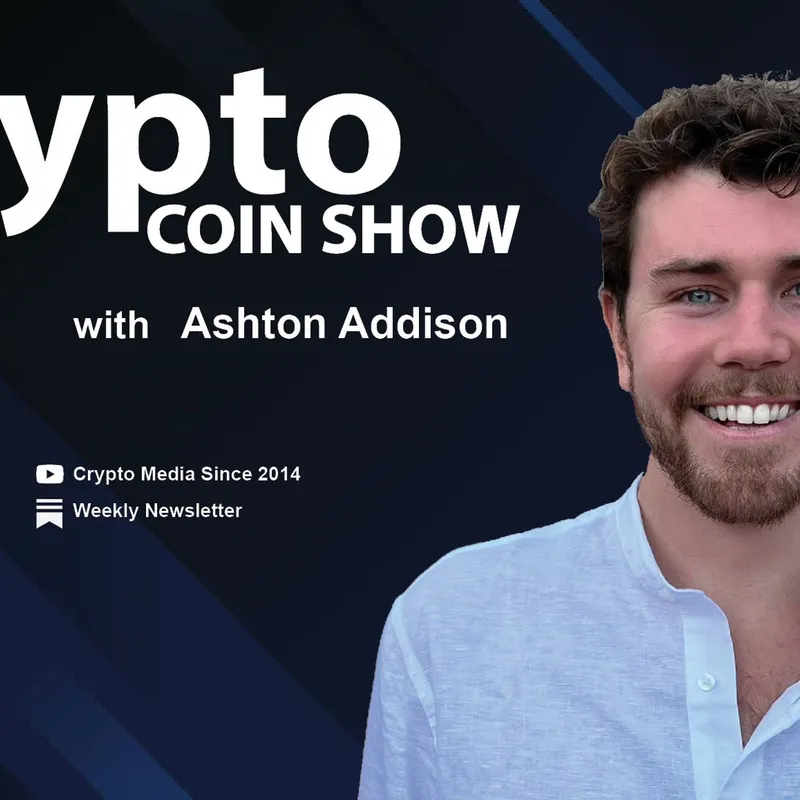
Crypto Coin Show
Crypto Coin Show·280 episodes
At the Crypto Coin Show, we interview investors, startups, and leading minds in the blockchain industries. Our team has been involved in blockchain since the early days of Ethereum in 2013, following the markets from the 2014 to 2021 Bull Runs and future ones! Our founder and CEO, Ashton Addison, is a thought leader in the industry, with over 1200 interviews including John McAfee, Roger Ver, Charles Hoskinson, and more. He is also a public speaker who has spoken in 10 countries on everything in Web3. We publish new videos multiple times per week. Follow us on Twitter, LBRY, Minds.com, and SUBSCRIBE TO OUR...
Episodes
Most crypto wallets are still just storage. Trust Wallet just added tokenized US stocks, perpetual futures, and prediction markets — all non-custodial, all on mobile. SELF-CUSTODIAL TRADING is no longer a contradiction, and Trust Wallet's General Counsel breaks down exactly what changed. Shehram Khattak, General Counsel at Trust Wallet, joins Ashton Addison on Blockchain Interviews. Trust Wallet has surpassed 220 million downloads across 100+ blockchains, hit $1 billion in perp volume within 40 days of launching on Hyperliquid, and became the #2 builder by volume on the network in its first weeks. Shehram explains how Trust Wallet integrated Hyperliquid's HIP-4 prediction markets as the first major wallet to do so, what bStocks means for someone who wants to trade tokenized NVDA, TSLA, and SPCXB 24/7 with dividends handled automatically onchain, and why the Trust Wallet Agent Kit — which lets AI agents execute trades on a user's behalf — is the next frontier for self-custody.You'll learn:How Trust Wallet hit $1B in perp volume in 40 days and became #2 by volume on Hyperliquid — what's actually driving demand for self-custodial leverage trading on mobileWhat bStocks are and what it means to trade tokenized US equities like NVDA and TSLA 24/7 with dividends and splits handled automatically onchain — versus just holding the stock in a brokerageHow HIP-4 prediction markets work and why Trust Wallet was first to integrate them — including how the team thinks about availability across different global jurisdictions🔗 https://trustwallet.com🐦 https://x.com/TrustWallet 🔔JOIN OUR FREE NEWSLETTER FOR 100X GAINS🔔: https://cryptocoinshow.substack.com/subscribe
Most AI training data flows through centralized providers like Scale AI and Appen — expensive, slow, and controlled by a handful of platforms. DECENTRALIZED DATA INFRASTRUCTURE is what Perceptron is building, and it's already serving 700,000+ nodes and generating real revenue.n Peter Anthony, Co-Founder of Perceptron Network, breaks down how a mesh of user-run nodes delivers AI training data at 92% lower cost than legacy providers, why the Data Questing Platform is the next frontier for distributed micro-tasking, and how the $10M AI Data Fund is accelerating teams with free data access. Perceptron has 700K+ nodes, 300K daily active users, and live client contracts — and they're about to launch the infrastructure that turns the community into the AI economy's labeling backbone. The decentralized data mesh works because you cut out the middleman; the Data Questing Platform does distributed precision labeling with incentive alignment that Scale AI and Mechanical Turk can't; and the $10M AI Data Fund matters because teams get access with no pre-funding, reshaping how AI training data is sourced.🔗 https://perceptrons.xyzn🐦 https://twitter.com/PerceptronLabsn 🔔JOIN OUR FREE NEWSLETTER FOR 100X GAINS🔔: https://cryptocoinshow.substack.com/subscribe
Africa's crypto adoption is accelerating faster than almost any region on earth, but the infrastructure to serve 1.7 billion people across 54 countries, multiple currencies, and remittance costs averaging 7 to 8% is still being built. SELF-CUSTODY CRYPTO EXCHANGE INFRASTRUCTURE is what VALR is building at continental scale — and a new FSCA OTC Derivatives Provider licence just expanded what it can offer.Farzam Ehsani, Co-Founder and CEO of VALR, joins Ashton Addison on Blockchain Interviews. VALR is Africa's largest crypto exchange by trade volume, backed by Pantera Capital, Coinbase Ventures, and Fidelity's F-Prime Capital, serving over 1.7 million registered users and 1,800 corporate clients. Farzam previously served as Blockchain Lead at Rand Merchant Bank and the FirstRand Group and was the inaugural Chairperson of the South African Financial Blockchain Consortium — making him one of the most credentialed voices on African crypto regulation alive. He breaks down what South Africa's draft capital flow management regulations actually say and why they represent an opportunity more than a threat, how the Onafriq integration gives users across the continent access to mobile money in local currencies, and what a VALR partnership with the DHL Stormers and helicopter campaigns flying "Crypto For Everyone" banners says about where mainstream crypto adoption is heading on the continent.🔗 https://www.valr.com🐦 https://x.com/VALRcom🔔JOIN OUR FREE NEWSLETTER FOR 100X GAINS🔔: https://cryptocoinshow.substack.com/subscribe
Selling Bitcoin to access liquidity means a taxable event, losing your position, and missing whatever comes next. CRYPTO-BACKED LENDING is the alternative — and Arch Lending lets borrowers use Bitcoin and digital assets as collateral to access cash without ever selling their holdings. Himanshu, CTO of Arch Lending, joins Ashton Addison on Blockchain Interviews to break down how crypto-backed loans actually work, how Arch protects borrower collateral when Bitcoin prices move sharply, and what a margin call looks like in practice. One of Arch's clients — Tyler Martin, a business owner and former sailing captain — used a Bitcoin-backed loan to buy a blue-water yacht and now sails the Caribbean with his wife while running his business remotely. He kept his Bitcoin. He got the cash. Himanshu explains the mechanics, the risk model, and who these loans are actually built for — from high-net-worth holders to everyday crypto investors who have accumulated and don't want to sell.🔗 https://archlending.com 🔔JOIN OUR FREE NEWSLETTER FOR 100X GAINS🔔: https://cryptocoinshow.substack.com/subscribe
Bitcoin has been promised as a payment layer for 15 years, but merchants still don't use it. Transaction finality, custody concerns, and merchant UX have kept Bitcoin commerce stuck in theory. NON-CUSTODIAL BITCOIN PAYMENTS are now live, and GoMining's GoBTC Pay is bringing debit-card UX to actual Bitcoin settlement.nMark Zalan, CEO of GoMining, launches the GoBTC Pay Gen1 SDK and API — opening Bitcoin payments to merchants, wallets, and ecosystem partners across his top-10 mining operation serving 5 million users. Mark walks through how GoBTC Pay settles directly on Bitcoin with users keeping control of their private keys, why a 0.2% fee split between wallets and miners aligns everyone's incentives, and how the 15 EH/s private mempool powered by Stratum V2 gives merchants the reliability Bitcoin payment layers have promised but never delivered. From tokenized hashrate making mining accessible to retail, to payments bringing Bitcoin into everyday commerce, this is what a fully integrated Bitcoin ecosystem looks like.nYou'll learn:- How GoBTC Pay achieves non-custodial Bitcoin settlement with merchant-friendly UX — and why previous attempts at Bitcoin commerce never broke throughn- Why a 0.2% fee with splits between wallet providers and miners is the incentive structure that makes Bitcoin payments actually work at scalen- How GoMining's 15 EH/s mempool and Stratum V2 infrastructure guarantee transaction priority and reliability — what that means for merchants adopting GoBTC Payn🔗 https://gomining.comn🐦 https://x.com/GoMiningn🔔JOIN OUR FREE NEWSLETTER FOR 100X GAINS🔔: https://cryptocoinshow.substack.com/subscribe
Sleep data is collected by Oura, Whoop, and Apple Watch every night — but the value flows to the platforms, not the user. GAMIFIED SLEEP DATA is the model Sleepagotchi is building, and it just evolved from a Sleep-to-Earn app into what the team calls "The Intelligence Layer for the Wellness Economy." Kenny Wood, CEO of Sleepagotchi, joins Ashton Addison on Blockchain Interviews. Kenny brings over two decades in AAA game development — including chart-topping franchises like Transformers, Bionicle, and Formula 1 — into a platform that turns sleep into permissioned data value, NFTs, and $SLEEP tokens. We cover how wearables including Whoop, Oura, and Apple Watch feed real-time biometric pipelines into chained AI agents, how the Telegram LITE mini-app hit 2 million users without any sleep tracking at all, and what $6.5M raised and over $100K in three-week beta revenue says about whether this is a health product or a rewards product.You'll learn:How Sleepagotchi turns a night of sleep into an NFT or $SLEEP — what's actually being measured and what the gamification mechanics do that a free sleep app doesn'tWhat "The Intelligence Layer for the Wellness Economy" means in the product: which AI agents are live today — starting with the AI Sleep Coach — and what's still on the roadmapWhy permissioned data value is the model that makes this work — what a user can actually do with their biometric data on Sleepagotchi that they can't do on Oura or Whoop🔗 https://www.sleepagotchi.com/ 🔔JOIN OUR FREE NEWSLETTER FOR 100X GAINS🔔: https://cryptocoinshow.substack.com/subscribe
Most tokenized real world assets still take 60 to 180 days to redeem. Most restaking protocols lock capital in silos that can't work across chains. COLLATERAL MARKETS INFRASTRUCTURE is what fixes both — and Symbiotic is building the layer that credit, insurance, and RWA liquidity are already running on. Misha Putiatin, Co-Founder and CEO of Symbiotic, breaks down why the restaking label undersells what Symbiotic is actually building, how Core V2's capital facilities let committed capital stay enforceable while earning yield between settlement events, and why immutable, permissionless infrastructure is the only design that institutions can actually trust. From how Symbiotic Instant Liquidity enables T+0 atomic settlement for tokenized assets with no pre-funded inventory, to why Cap Labs, Nexus Mutual, and Midas are all building on the same shared infrastructure — this is a clear look at what collateral markets actually mean for DeFi in 2026.You'll learn:Why Symbiotic moved beyond restaking to collateral markets — and what that distinction changes for builders and capital allocatorsHow Core V2 capital facilities work: vault capital that stays enforceable while deployed to Morpho and Euler, automatically recalled when obligations triggerHow Symbiotic Instant Liquidity solves the RWA redemption problem — T+0 settlement with no idle capital and no pre-funded inventoryWhy immutable core contracts are a feature, not a limitation — and what it forces you to get right before you ship🔗 https://symbiotic.fi🐦 https://x.com/symbioticfi 🔔JOIN OUR FREE NEWSLETTER FOR 100X GAINS🔔: https://cryptocoinshow.substack.com/subscribe
Half of web traffic is already synthetic, and neither platforms nor enterprises have a reliable way to tell humans from AI agents at scale. VERIFICATION INFRASTRUCTURE is what Verona is building — and the rebrand from XION, announced June 17 alongside an $18.5M raise for flagship consumer app EarnOS and $30M in brand spend, is the moment that becomes a public priority. Anthony Anzalone, Founder and CEO of Verona, joins Ashton Addison on Blockchain Interviews for his third appearance on the show. Anthony breaks down exactly what the XION-to-Verona shift changes — and what stays the same. The Cosmos SDK, CometBFT, and CosmWasm stack that powered walletless, gasless consumer crypto now underpins a decentralized network of verified information designed for AI agent commerce. From how Ero, the new consumer app from EarnOS, lets users earn from verified activity without ever exposing raw data, to how 115+ global brands including Uber, Amazon, Nike, and BMW already use this infrastructure for 69 million verified interactions across 3 million users — this is the clearest look at what a verification and intelligence layer for AI agents actually does.You'll learn:What changed and what didn't in the XION-to-Verona rebrand — how years of walletless, gasless infrastructure maps onto a new identity as a verification layer for AI agentsHow Ero works: what verified activity without exposing raw data means in practice, and what the $18.5M EarnOS raise is fundingWhy $VERONA's value is designed to track network revenue and usage rather than raw gas — and who's actually paying for the abstracted, gas-sponsored user experience🔗 https://verona.dev🔔JOIN OUR FREE NEWSLETTER FOR 100X GAINS🔔: https://cryptocoinshow.substack.com/subscribe
AI agents are already executing financial transactions autonomously — but the infrastructure they're running on was never designed for them. NEAR Protocol is building the settlement layer for the agentic economy: a blockchain where agents can express outcomes, route cross-chain transactions, and operate with built-in privacy guarantees — without a human in the loop for every step. Illia Polosukhin, Co-Founder of NEAR Protocol and co-author of Google's "Attention Is All You Need" — the 2017 paper that introduced the Transformer architecture behind ChatGPT, Gemini, and every major LLM running today — joins Ashton Addison on Blockchain Interviews. Illia breaks down how NEAR Intents lets agents express desired outcomes and have the protocol handle routing, bridging, and gas automatically; how IronClaw enables persistent, privacy-preserving AI agents with controlled access to user assets; and why NEAR just shipped a quantum-proof wallet upgrade at a moment when most of the industry isn't thinking about post-quantum security at all. You'll learn:How NEAR Intents works and why expressing an outcome rather than specifying a route changes what's possible for AI agents in financial workflowsWhat IronClaw adds to the NEAR AI stack — persistent autonomous agents with privacy safeguards and controlled asset access — and who that's built forWhy NEAR shipped a quantum-proof wallet and what the post-quantum threat actually means for crypto infrastructure timelines🔗 https://www.near.org 🐦 https://x.com/NEARProtocol 🔔JOIN OUR FREE NEWSLETTER FOR 100X GAINS🔔: https://cryptocoinshow.substack.com/subscribe
Retail traders are structurally disadvantaged on every traditional order book exchange — stop hunting is real, the spread is a hidden tax, and most platforms give institutions tools that retail will never see. FAIR EXECUTION is what Ouinex is building, and it starts by removing the CLOB entirely.Ilies Larbi, CEO of Ouinex, breaks down how the exchange's Fair Execution Engine eliminates the front-running and stop hunting that bleeds retail traders dry on most platforms. Ouinex is already live and regulated across 5+ entities, has raised $9M+ from over 5,000 community investors with zero VCs, and offers 500x leverage across crypto, stocks, indices, forex, commodities, and gold — all in a single platform. With TGE set for mid-June 2026 at $0.1334 and over 50% of $OUIX tokens already staked under a 3-year cliff, Ilies explains how the $OUIX flywheel works, why every trade on every asset class generates buyback pressure on a single token, and what it means to build an exchange that was financed, built, and optimized by traders.You'll learn:- What stop hunting is, why it keeps happening on traditional order book exchanges, and how Ouinex's Fair Execution Engine structurally removes it- How the $OUIX flywheel works — why revenue from crypto, stocks, forex, commodities, and indices all feed into a single buyback mechanism- What 50%+ of tokens already staked under a 3-year cliff means for supply dynamics heading into the mid-June TGE🔗 https://ouinex.com🔔JOIN OUR FREE NEWSLETTER FOR 100X GAINS🔔: https://cryptocoinshow.substack.com/subscribe
AI hallucinations aren't a model problem — they're a data problem. When AI systems have no way to verify what's real in the physical world, they fill the gaps with guesses. And when AI agents act on those guesses autonomously, there's no record of what happened or why. DATA PROVENANCE is the missing layer, and XYO just shipped it. Markus Levin, Co-Founder of XYO, breaks down two major announcements: Data Lakes — now live at xyo.network/data-lakes — and a partnership with Theta Network that pairs XYO's verifiable on-chain data infrastructure with Theta's decentralized media and delivery layer. Markus explains why AI hallucinations are fundamentally a data provenance problem, what the absence of an audit trail means as AI agents become financial managers, logistics coordinators, and healthcare decision-makers, and how XYO's AI SDK lets developers add cryptographic proof to agent decisions and model outputs today. From why enterprise regulators are demanding verifiable data to what the XYO x Theta partnership creates that neither network could build alone, this is the accountability infrastructure conversation that AI needs to have.You'll learn:Why AI hallucinations are a data provenance problem — and how XYO's verified physical-world data layer addresses it at the sourceWhat XYO Data Lakes unlocks for enterprises that need auditable, tamper-proof records of real-world operations and AI agent decisionsHow the XYO x Theta partnership combines verifiable data infrastructure with decentralized media delivery — and what that creates for developers building AI applications🔗 https://xyo.network 🐦 https://x.com/OfficialXYO
The internet is filling up with bots, and nobody has built a reliable way to tell the difference between a human and an AI agent at scale. PROOF OF HUMANITY is what World is building — and its full-stack upgrade just became the identity layer for AI agent commerce. DC Builder, Research Engineer at the World Foundation, joins Ashton Addison on Blockchain Interviews to break down what changed in World ID's full-stack proof of human upgrade, how the AgentKit launch with Coinbase puts verified human identity at the core of AI agent transactions, and whether proof-of-humanity is possible without putting an iris scan at the center of it.You'll learn:What the full-stack proof of human upgrade actually changed in World ID — and why it matters specifically because of AI agents, not just bots- How AgentKit uses zero-knowledge proofs to link AI agents to a verified human without exposing any personal data- What the Orb controversy gets wrong — and whether there is a credible path to proof-of-humanity that does not require a biometric scan🔗 https://world.org🐦 https://x.com/dcbuilder 📺 Refinitiv TV: https://lseg.group/4vhetd1🔔JOIN OUR FREE NEWSLETTER FOR 100X GAINS🔔: https://cryptocoinshow.substack.com/subscribe
Private credit has a trust problem. Borrowers, lenders, and underwriters operate in silos, incentives are misaligned, and most of the $1.7 trillion sitting in TradFi private credit markets is inaccessible to anyone outside institutional finance. ONCHAIN CREDIT changes that — and Cap is building the infrastructure to make it work.Benjamin Sarquis Peillard, Founder and CEO of Cap, joins Ashton Addison to break down how Cap brings private credit markets onchain with principal protection backed by Franklin Templeton. Benjamin previously scaled QiDAO from $0 to $400M in TVL and started his career in investment banking at Citi — a rare combination of TradFi credibility and DeFi execution. We cover how Cap's three-party model aligns borrowers, lenders, and underwriters in a way neither TradFi nor DeFi lending has managed, why this is structurally different from Celsius and the platforms that collapsed, and what happens at the protocol level when a borrower defaults.You'll learn:- How Cap's borrower-lender-underwriter model works and why principal protection changes the risk equation for lenders- Why Celsius, BlockFi, and Voyager collapsed — and the specific structural differences that make Cap's approach fundamentally different- What it took to bring Franklin Templeton in as the principal protection backer, and what that signals about institutional DeFi in 2026- How onchain credit can sit alongside traditional fixed income at institutional scale — and what has to be true for that to happen🔗 https://www.cap.app🐦 https://x.com/CapApp🔔JOIN OUR FREE NEWSLETTER FOR 100X GAINS🔔: https://cryptocoinshow.substack.com/subscribe
Bitcoin has $1 trillion in market cap sitting idle. The infrastructure to put it to work — natively, without bridges or wrapped tokens — has been the missing piece. OP_NET is building it. Samuel Pat, founder of OP_NET, breaks down how his team is bringing genuine DeFi utility to Bitcoin: a native DEX called Motoswap for peer-to-peer swaps and liquidity, a Bitcoin wallet built for the DeFi era, and an ecosystem being assembled on the world's most trusted chain. We dig into the velocity of money on Bitcoin — why BTC that can move through DeFi protocols creates compounding value versus BTC that just sits — and what it actually takes to build financial infrastructure on a chain that wasn't designed for it.🔔JOIN OUR FREE NEWSLETTER FOR 100X GAINS🔔: https://cryptocoinshow.substack.com/subscribe
Most people manage their own crypto portfolio the same way they always have — manually, reactively, and without the tools that institutional investors take for granted. Wallet V changes that. Adam Cai from Virgo Group sits down with us live at Consensus Miami 2026 to break down Wallet V and the AI agents being built into it to act as autonomous financial portfolio managers for everyday users. We explore what it actually means for an AI agent to manage a portfolio — making decisions, allocating assets, executing strategies — without the user needing to intervene. Adam explains how this levels the playing field between retail and institutional crypto investors, and why the convergence of AI and Web3 wallets is the most practical application of agent technology happening in crypto right now.🔗 https://Virgo.co🔔JOIN OUR FREE NEWSLETTER FOR 100X GAINS🔔: https://cryptocoinshow.substack.com/subscribe
Centralized AI infrastructure gives a handful of companies control over the data, compute, and models that everyone else depends on — and most builders have no way to verify what's actually happening under the hood. DECENTRALIZED AI is the alternative, and 0G Labs is building the infrastructure layer to make it real. Michael Heinrich, Co-Founder of 0G Labs, joins us live at Consensus Miami 2026 to break down why AI needs its own blockchain, what the Apollo launchpad is unlocking for AI-native projects, and how 0G's open-source infrastructure gives developers, agents, and communities real ownership over data and compute. From why existing chains like Ethereum and Solana fall short for AI workloads to what verifiable, trustless AI execution actually looks like in practice, this is a clear-eyed look at where decentralized AI infrastructure is headed.You'll learn: Why AI workloads expose the limits of general-purpose blockchains and what 0G was built to fix How the Apollo launchpad works and what kinds of projects are being accelerated on the 0G network What open-source AI infrastructure means for developers who want to build without depending on centralized providers Why decentralized compute and data ownership are the two things that actually determine whether AI stays open🔗 https://0g.ai🐦 https://x.com/0G_labs🔔JOIN OUR FREE NEWSLETTER FOR 100X GAINS🔔: https://cryptocoinshow.substack.com/subscribe
The Graph has processed 1.27 trillion queries and most builders still treat it as a subgraph indexer. After the Horizon upgrade, that's not what it is anymore. Nick Hansen, Team Lead at The Graph Foundation, joins us live from Consensus Miami 2026 to break down what The Graph has become: a modular, multi-service data backbone targeting the $47 billion agentic AI economy. The December 2025 Horizon upgrade didn't just improve the protocol — it transformed it. Six new data services are now live or in deployment: Subgraphs, Substreams, Token API, Tycho for DeFi solvers, Amp for institutions, and JSON-RPC. We get into how AI agents will query The Graph and pay per-query with no API keys, why record usage hasn't translated to GRT price performance, and what the missing ingredient is to kick the economic flywheel into gear.🔗 https://thegraph.com🔔JOIN OUR FREE NEWSLETTER FOR 100X GAINS🔔: https://cryptocoinshow.substack.com/subscribe
Hudson Jameson, blockchain security veteran, former Ethereum Foundation core dev liaison, SEAL Org member, and CertiK Security Advisor — sits down with us live at Consensus Miami 2026. CertiK controls over 65% of global blockchain auditing, has secured $600B+ in digital assets, uncovered 180,000+ vulnerabilities, and in April 2026 publicly launched its AI Auditor with an 88.6% hit rate across 35 real-world Web3 incidents. Hudson brings a rare perspective that spans Ethereum's earliest governance battles, Flashbots, Polygon, and now the front lines of AI-powered security. We dig into what AI can and can't catch, why cross-chain bridges remain the hardest attack surface to secure, how Skynet monitors threats in real time when both attacker and defender are AI systems, and what the industry still refuses to take seriously enough. This is the most honest conversation in Web3 security happening at Consensus this year.🔔JOIN OUR FREE NEWSLETTER FOR 100X GAINS🔔: https://cryptocoinshow.substack.com/subscribe
In this episode of Blockchain Interviews, Ashton Addison sits down with David Track, Founder of SOSANA — a Solana-based enforcement layer built to solve one of crypto's most persistent problems: discovery. With thousands of new tokens launching every week and retail investors drowning in noise, SOSANA is building a gated, verifiable community model that replaces trust-based systems with automated, transparent execution. David breaks down how the platform's community-driven voting reward system works, why enforced rules — not suggestions — are the only way to protect users, and how the bi-weekly "Safe from SOSANA" list is turning chaotic community sentiment into structured, accountable signal. A timely conversation for anyone trying to navigate the crowded crypto landscape.🔔JOIN OUR FREE NEWSLETTER FOR 100X GAINS🔔: https://cryptocoinshow.substack.com/subscribe
Sports bettors lose to the bookmaker before the game even starts. The house sets the lines, pockets the margin, and decides who gets to play — and most people have no idea how much that spread is actually costing them. PRED is a peer-to-peer sports prediction exchange built on Base that removes the middleman entirely.We sit down with the team behind PRED to break down how a decentralized sports prediction exchange works, why betting peer-to-peer changes the economics for bettors, and what it takes to build a regulated, on-chain alternative to the sportsbook model. From how PRED's matching engine works to the role of liquidity providers and what PRED token holders actually get, this is a practical look at what sports betting looks like when the house no longer has an edge.You'll learn:- Why sportsbooks are structurally designed to take a margin on every bet — and how much it costs the average bettor over time- How PRED's peer-to-peer exchange model works and what it means to bet directly against other users- What building a sports prediction exchange on Base (Coinbase's Layer-2) changes about accessibility, cost, and settlement speed- How liquidity works on a decentralized prediction exchange and who the counterparty actually is- What the PRED token does and how value flows through the protocol🔗 https://pred.gg/🔔JOIN OUR FREE NEWSLETTER FOR 100X GAINS🔔: https://cryptocoinshow.substack.com/subscribe
Most blockchains are fast enough to transact but can't prove the transaction was valid without trusting someone. That gap — between execution and verifiable proof — is what institutions, AI agents, and regulated finance keep running into. Daniel Marin, CEO of Nexus Labs, breaks down how Nexus is building a zkVM-powered financial network designed to make every computation cryptographically verifiable at scale. After Testnet III hit 3M+ users and 5M+ nodes, Mainnet launches with validators, provers, and oracles already live — not a blank canvas — plus enshrined financial applications built directly into the protocol rather than bolted on as smart contracts. We get into what zkVM 3.0's 1000x throughput jump unlocked, what 4.0 adds mid-2026, and why the one thing AI agents need most — the ability to transact and prove execution without a human in the loop — is the exact infrastructure Nexus is being built to provide.You'll learn:What "enshrined" financial applications mean and why building primitives into the protocol changes what developers can buildHow Nexus Mainnet differs from the testnet and what the 3M+ user scale of Testnet III proved before launchWhat zkVM 4.0's batching, instruction sorting, and recursive composition unlock for real-world DeFi and AI agent use casesWhy verifiable execution matters more than speed for institutions evaluating onchain infrastructure in 2026What the Nexus Exchange offers that existing DEXs can't and how the 96+ ecosystem partners fit into the Mainnet launch🔗 https://nexus.xyz📺 Refinitiv TV: https://lseg.group/431uyHy🔔JOIN OUR FREE NEWSLETTER FOR 100X GAINS🔔: https://cryptocoinshow.substack.com/subscribe
Token launches fail fast when liquidity is fake — and most teams do not know how to measure “good liquidity” until it is too late.Scott Byron, Managing Director at Forgd, breaks down how market making actually works, why RFQ processes mislead founders, and what Liquidity Transparency looks like when market makers are judged on real historical performance.Learn the signals that show liquidity is fragile, how fragmentation and post-launch incentives punish weak launches, and what founders should track 60 days pre-launch to avoid negotiating traps.🔗 https://www.forgd.com/🐦 https://x.com/Forgd_🔔JOIN OUR FREE NEWSLETTER FOR 100X GAINS🔔: https://cryptocoinshow.substack.com/subscribe
Crypto adoption has stalled at the on-ramp. Most wallets and dApps lose users at the exact moment they try to buy their first token — because the payment flow is slow, the KYC is clunky, and the failure rates are quietly killing conversion.Przemek Kowalczyk, Co-Founder and CEO of Ramp Network, breaks down how Ramp built a global fiat-to-crypto infrastructure layer operating across 150+ countries, supporting cards, bank transfers, Apple Pay, Google Pay, Pix, and more — all embedded directly into the apps users already have. From the root causes of failed onboarding (it's not what most teams think) to the just-announced Ramp multichain wallet and what stablecoins change about the entire ramp model, Przemek explains what it takes to run a real payments business inside the crypto economy — compliance, fraud, chargebacks, and all.You'll learn:- Why most crypto apps lose users at the payment step — and where the drop-off actually happens- How Ramp's end-to-end flow works when a user buys crypto with a card, bank transfer, or Apple Pay- Which payment rails drive the most volume across 150+ countries right now and why the mix matters- What KYC looks like when you're balancing low friction with compliance across dozens of regulatory regimes- The most common fraud vectors in crypto onboarding and how Ramp fights them without killing approval rates- What the new Ramp multichain wallet means for users and for dApp developers routing users to a destination wallet- How stablecoins as a default settlement rail change the future of on-ramps and off-ramps🔗 https://ramp.network🐦 https://x.com/RampNetwork🔔JOIN OUR FREE NEWSLETTER FOR 100X GAINS🔔: https://cryptocoinshow.substack.com/subscribe
Big Tech is spending $650B on AI infrastructure and still can't build fast enough. Half of US data centres planned for 2026 are delayed — and centralised compute is showing structural cracks. DECENTRALIZED AI is already running as a viable alternative at a fraction of the cost. Jack Collier, CMO at io.net, breaks down how io.net aggregates idle GPU power from data centres, mining rigs, and consumer devices into a single decentralised compute marketplace at up to 70% less than AWS or Google Cloud. We cover the IDE — io.net's new economic model that replaces inflation-driven tokenomics by paying suppliers in dollar value — and Agent Compute, the March 2026 launch that lets AI agents autonomously purchase their own GPU resources. From why DePIN economics kept breaking to what the sustainability ratio tells you about network health, this is the case that decentralised AI infrastructure has graduated from hype to utility.You'll learn:Why centralised AI infrastructure is hitting a wall and what decentralised compute actually solvesHow io.net's IDE replaces inflation-driven tokenomics with real revenue — and what the burn mechanism means for $IO holdersWhat Agent Compute is and why AI agents autonomously buying their own compute is a first in the token economyHow io.net routes around failure where a single AWS outage takes everything down🔗 https://io.net🐦 https://x.com/jack_ionet 🔔JOIN OUR FREE NEWSLETTER FOR 100X GAINS🔔: https://cryptocoinshow.substack.com/subscribe
Most Layer One upgrades are incremental. XYO just shipped a throughput jump of two to five times, dual DataLake support in the SDK, and validator and producer stability fixes — all at once — and the full implications for developers and XL1 economics haven't landed yet. Arie Trouw, Co-Founder, CEO, and CTO of XYO, breaks down what actually changed in this infrastructure push: what was bottlenecking throughput before, what the DataLake SDK unlocks for builders working with real-world data, and why stability at the validator layer matters more than most people realize. We also get into where verifiable data infrastructure fits in the AI stack — why provenance becomes more valuable than the data itself as AI scales into robotics, logistics, and autonomous systems — and what XL1's economics look like as the network grows.You'll learn:What caused the throughput bottleneck before and what specifically changed to push past itWhat private and public DataLake support in the SDK unlocks for developers building on XYO todayWhy verifiable data infrastructure is a critical missing layer as AI moves into the physical worldHow the throughput upgrade changes XL1's utility and the supply-demand dynamics around itWhat the KuCoin spot trading competition signals about XYO's strategy at this stage of the networkWhat to watch for in the May push beyond what's already shipped🔗 https://xyo.network🐦 https://x.com/XYONetwork 🔔JOIN OUR FREE NEWSLETTER FOR 100X GAINS🔔: https://cryptocoinshow.substack.com/subscribe
The travel industry runs on hidden fees and expiring rewards — and most hotel loyalty programs are designed to make points hard to use, not easy.Michael Ros, CEO of Europe at Staynex and founder of [Sleap.io](http://Sleap.io) (recently acquired by Staynex), breaks down how Staynex is building a Web3 travel membership — zero booking commissions for hotels, tokenized travel rights, and a revenue-sharing model for members ahead of the April 23 TGE. From why the [Sleap.io](http://Sleap.io) acquisition happened to what $STAY token holders can actually do with it, this is a practical look at what "Netflix for travel" means when it's backed by real inventory and on-chain mechanics.You'll learn:- What a Staynex membership actually unlocks — and how it differs from Airbnb, [Booking.com](http://Booking.com), and hotel loyalty programs- Why hotels pay zero commission to list on Staynex and where the platform's revenue actually comes from- What the [Sleap.io](http://Sleap.io) acquisition added to Staynex's European expansion and booking infrastructure- How the $STAY token's Stake & Claim revenue-sharing model works and what holders can do with it- What's actually on-chain — memberships, travel rights, rewards, or something else- How Staynex is thinking about post-TGE token distribution and avoiding a sell-off🔗 https://www.staynex.vip🔔JOIN OUR FREE NEWSLETTER FOR 100X GAINS🔔: https://cryptocoinshow.substack.com/subscribe
Most blockchains were built to be transparent by design. That transparency is now the single biggest reason institutions won't put sensitive data on-chain — and why the Clarity Act, as written, still misses the point. Charles Hoskinson, Co-Founder of Ethereum and Founder and CEO of Input Output Global, joins Ashton Addison to cover the most consequential conversation in crypto right now: why the US regulatory framework needs a full overhaul, not just amendments, what the fourth generation of blockchain actually solves, and why privacy infrastructure is the unlock that brings real-world adoption at scale. We also go live on a demo of the Midnight Passport — showing what selective disclosure looks like on a real interface, not a whitepaper.You'll learn:Why Charles argues the Clarity Act needs to be rebuilt, not refined, and what good crypto legislation actually looks likeWhat the fourth generation of blockchain means and why privacy is a structural shift, not a bolt-on featureHow Midnight's selective disclosure mechanism works in practice — demonstrated live with the Midnight PassportWhy Google Cloud and MoneyGram committed to running infrastructure on day one, and how those conversations happenedWhat the Glacier Drop's 4 billion token distribution across Cardano, Ethereum and other ecosystems signals about real demandHow Midnight balances confidentiality with accountability — and why privacy on-chain is not a gift to bad actorsWhat Charles didn't understand before building Cardano — and what he'd tell himself now🔗 https://midnight.network🐦 https://x.com/InputOutputHK 🔔JOIN OUR FREE NEWSLETTER FOR 100X GAINS🔔: https://cryptocoinshow.substack.com/subscribe
Most Bitcoin miners are leaving money on the table by using traditional pools — and they don't know it. Right now, buyers on the NiceHash hashrate marketplace are paying nearly 3% above the standard hashprice benchmark, and that premium flows directly to miners. Filip Primec, Director of NiceHash AG and Member of the Management Board, joins Ashton Addison to break down how NiceHash operates the world's largest hashrate marketplace, what RTPPS means for your daily earnings versus a standard FPPS pool, and why demand for on-demand hashrate is surging in 2026. From the EasyMining story — a solo miner who turned a $70 package into a $200K+ block reward — to where Bitcoin mining and AI compute intersect, this is a practical look at how miners at every scale can earn more. You'll learn:Why buyers are paying a premium for hashrate and how it flows through to minersFPPS vs RTPPS in plain English — what it means for daily earnings and riskHow NiceHash's real-time marketplace differs from traditional poolsWhat the EasyMining story reveals about solo mining with rented hashrateWhere Bitcoin mining and AI compute are genuinely convergingHow Lightning withdrawals, 4-hour BTC payouts, and Split Payments work🔗 https://www.nicehash.com🐦 https://x.com/NiceHashMining 🔔JOIN OUR FREE NEWSLETTER FOR 100X GAINS🔔: https://cryptocoinshow.substack.com/subscribe
Cross-border payments have been broken for decades — slow settlement, high fees, and opaque FX spreads quietly draining money that should reach contractors, suppliers, and workers around the world. Teymour Farman-Farmaian, Co-founder and CEO of Higlobe, breaks down how the company built a stablecoin sandwich — bank in, stablecoin in the middle, bank out — that moves funds in under 60 seconds at near-zero cost, without requiring any API integration or crypto knowledge from the business using it. From the 2021 insight that made this viable (marginal cost collapses to near zero when you remove the netting model) to how Higlobe monetizes without charging for transfers, Teymour explains why pricing tends toward zero when the underlying cost structure changes, and what that means for the next decade of global payments. SOC2 Type 2 compliant, MSB-registered, and backed by two bank partners for redundancy — this is what enterprise-grade stablecoin infrastructure looks like in 2026. You'll learn:Why traditional money transfer rails (bank wires, SWIFT, netting models) cost so much and why the 6% industry average hasn't changed in 20 yearsHow Higlobe's stablecoin sandwich works end-to-end: where funds enter, what moves them, and how "instant" is defined in practiceWhy pricing tends to zero when marginal cost collapses — and where Higlobe's revenue actually comes fromHow Higlobe competes with Wise, Payoneer, and crypto-native payment companies without charging per transferWhat SOC2 Type 2, FinCEN MSB registration, and dual bank partners mean for enterprise buyers evaluating riskWhere stablecoin yield regulation (Genius Act debate) could reshape the competitive landscape for Higlobe, Coinbase, and CircleWhy Higlobe is protocol-agnostic: the decision framework for switching between stablecoins, Bitcoin-based rails, and CBDCs🔗 https://higlobe.com 🔔JOIN OUR FREE NEWSLETTER FOR 100X GAINS🔔: https://cryptocoinshow.substack.com/subscribe
Perps are where most traders blow up — and copy trading can either amplify that risk or make it manageable. Loki from OdinBot breaks down how perps copy trading works in plain English, why Odin started on Jupiter, and what guardrails matter most when you are mirroring someone else’s leverage. Get a clear view of what to look for when picking a trader to copy, how to think about liquidation risk, and what it takes to drive real volume without paying for hype.You’ll learn:What perps copy trading actually is (and how it differs from spot copy trading)The risk controls that matter before you mirror a wallet or traderWhy Jupiter was the first venue, and what Odin needs to support more platformsHow to evaluate who is worth copying without guessingWhat Odin thinks is genuinely different about perps copy trading execution🔗 https://www.odinbot.io/🐦 https://x.com/OdinBotio 🔔JOIN OUR FREE NEWSLETTER FOR 100X GAINS🔔: https://cryptocoinshow.substack.com/subscribe
Fixed-income yield onchain sounds simple — until you realise most "yield" products in crypto either hide the risk or require constant manual management to capture it.Dan Hillery, Head of Treasury at Buck, breaks down how Buck is building the first SavingsCoin backed by Strategy's Bitcoin-collateralized perpetual preferred stock (STRC), targeting 10% APY with automated reward distribution and no manual claims. From designing the protocol's fee structure to managing flow-of-funds across DeFi lending markets and DEX liquidity pools, Dan explains what it takes to bridge traditional fixed-income mechanics into on-chain infrastructure — and why the timing matters now as institutional capital looks for yield that doesn't require trusting a counterparty.You'll learn:- What a SavingsCoin actually is and how it differs from a yield-bearing stablecoin- Why Buck uses Strategy's STRC as collateral and what overcollateralization means for token holders in practice- How the protocol raised yield from 7% to 10% APY and whether double-digit yield is sustainable long term- What automated reward distribution changes for users and why removing manual claims matters for adoption- How treasury strategy, DEX liquidity, and lending market distribution fit together as a system- Who Buck is built for first — and which geographies borderless savings matters most for🔗 https://buck.io🐦 https://x.com/hillery_dan🔔JOIN OUR FREE NEWSLETTER FOR 100X GAINS🔔: https://cryptocoinshow.substack.com/subscribe
We speak with Shresth Agrawal, CEO and Co-Founder of Pod Network, about building fair, high-performance decentralized markets. Today’s prediction markets and on-chain trading systems often suffer from latency, MEV extraction, and information asymmetry that can disadvantage retail traders. Shresth explains how Pod Network is approaching market design differently to create systems that are faster, fairer, and capable of reaching NASDAQ-scale performance while remaining decentralized.We explore what’s broken in current prediction markets like Polymarket and other on-chain trading venues, why latency and finality are critical to fair trading, and how Pod’s architecture aims to eliminate structural advantages that sophisticated players exploit today. From the role of MEV in market outcomes to the technical roadmap for 200ms finality and institutional-grade infrastructure, this conversation looks at what it will take for decentralized markets to compete with traditional financial exchanges.🔗 Learn more: https://pod.network Twitter (X): https://x.com/poddotnetwork🔔JOIN OUR FREE NEWSLETTER FOR 100X GAINS🔔: https://cryptocoinshow.substack.com/subscribe
In this episode of Blockchain Interviews, Ashton Addison sits down with Shady El Damaty, Co-Founder of human.tech, to explore how privacy preserving digital identity is being built for Web3 at global scale. The conversation dives into Human Passport, proof of humanity systems, zero knowledge cryptography, and how decentralized identity can enable fair governance, Sybil resistance, and secure token distribution across crypto ecosystems.We also cover human.tech’s evolution from Holonym, the launch of Wallet as a Protocol, partnerships including national digital identity initiatives, and the growth of the Human Network securing millions of cryptographic keys backed by billions in restaked ETH. If you want to understand how identity, privacy, and infrastructure will shape the next phase of Web3 adoption, this interview breaks it down from research to real world deployment.🔔JOIN OUR FREE NEWSLETTER FOR 100X GAINS🔔: https://cryptocoinshow.substack.com/subscribe
RWA infrastructure is easy to hype and hard to ship — and most teams underestimate what institutions actually need to move real assets onchain.Wish Wu, Co-Founder & CEO of Pharos Network, breaks down how Pharos is building an EVM-compatible Layer 1 designed for RWAs and cross-chain liquidity, with deep-parallel architecture aimed at scalable, real-time apps.Get a clear view of where tokenization projects get stuck (compliance, custody, liquidity, technical scale), what “institutional-grade” means in 2026, and how security and interoperability decisions shape whether an RWA chain can support enterprise DeFi.🔗 https://pharos.xyz🔔JOIN OUR FREE NEWSLETTER FOR 100X GAINS🔔: https://cryptocoinshow.substack.com/subscribe
Crypto feels loud, but the real shift is quiet — capital markets and payment rails are being rebuilt under the hood. Sam Hallene of CMT Digital breaks down what matters in crypto in 2026 as the industry moves from narratives to infrastructure, and why stablecoins, tokenized Treasuries, and institutional onchain settlement are turning into the real adoption curve. Get a clear view of where institutions are actually moving onchain (and why), how to think about market structure, and what founders should understand about building and fundraising when the next cycle is driven by utility, not hype. 🔗 https://cmt.digital/ 🔔JOIN OUR FREE NEWSLETTER FOR 100X GAINS🔔: https://cryptocoinshow.substack.com/subscribe
Moving money is still messy in 2026 — and most companies do not realize where the real bottlenecks are until settlement breaks. Lux Thiagarajah, Chief Commercial Officer (CCO) at OpenPayd, breaks down what “financial infrastructure” actually means behind the scenes, and how modern businesses scale accounts, payments, FX, and reconciliation across geographies. Get a practical view of where global payments get stuck (licensing, compliance, bank partnerships, operations), when stablecoins add real value versus hype, and what reliability looks like for an infrastructure provider that businesses depend on every day.You’ll learn:What OpenPayd provides that most teams should not build in-house (accounts, payments, FX, reconciliation)Where reconciliation breaks and how strong ops teams make it automaticWhen stablecoins help in payment flows and what must be true for enterprise adoptionHow founders should think about FX risk, pricing, and transparencyWhat “reliability” means in payments infrastructure (uptime, settlement certainty, controls)🔗 https://www.openpayd.com/ 🔔JOIN OUR FREE NEWSLETTER FOR 100X GAINS🔔: https://cryptocoinshow.substack.com/subscribe
Crypto news is infinite — and most investors still start the day with noise instead of signal. Ian Balina, Founder & CEO of Token Metrics, breaks down how an AI-powered AI Crypto Morning Briefing turns scattered markets, headlines, and on-chain data into actionable judgment across email, podcast, YouTube, and X.You’ll learn:How Token Metrics pivoted from charts to a daily briefing productHow the system verifies claims, sources, and numbers before publishingWhat prediction markets (like Polymarket) reveal that price charts often missA simple framework for staying grounded when crypto headlines get emotionalWhy $TMAI exists, and what behavior it is designed to incentivize🔗 https://tokenmetrics.com/🐦 https://x.com/tokenmetricsinc 🔔JOIN OUR FREE NEWSLETTER FOR 100X GAINS🔔: https://cryptocoinshow.substack.com/subscribe
A pro-planet economy is easy to talk about and hard to coordinate and most marketplaces still do not have a real incentives layer for behavior change. Claus Fischer, Founder at SanTerris One, explains how SanTerris is building what it calls the operating system for the pro-planet economy connecting a marketplace, social layer, affiliate engine, and academy into a single coordination stack. Learn how the S1 ERC-20 token is designed to drive demand across the ecosystem, what the 118 mechanism means in practice, and how SanTerris is approaching MiCAR-aligned compliance through partners like Bitbond and Lemonway ahead of Phase 1 of its public sale in May 2026. www.santerris.onehttps://t.me/santerrisone 🔔JOIN OUR FREE NEWSLETTER FOR 100X GAINS🔔: https://cryptocoinshow.substack.com/subscribe
A pro-planet economy is easy to talk about and hard to coordinate and most marketplaces still do not have a real incentives layer for behavior change. Claus Fischer, Founder at SanTerris One, explains how SanTerris is building what it calls the operating system for the pro-planet economy connecting a marketplace, social layer, affiliate engine, and academy into a single coordination stack. Learn how the S1 ERC-20 token is designed to drive demand across the ecosystem, what the 1 1 8 mechanism means in practice, and how SanTerris is approaching MiCAR-aligned compliance through partners like Bitbond and Lemonway ahead of Phase 1 of its public sale in May 2026.www.santerris.onehttps://t.me/santerrisoneRefinitiv TV: https://lseg.group/4lyqtTT🔔JOIN OUR FREE NEWSLETTER FOR 100X GAINS🔔: https://cryptocoinshow.substack.com/subscribe
Global commodity trade runs on slow settlement and trust gaps — and most teams have no way to prove provenance without adding friction.Mike Weeks, Executive Chairman & Co-Founder of SAGINT, breaks down how SAGINT is building a compliant commodity exchange and settlement stack designed to digitize the lifecycle of critical minerals.Learn how tokenization can reduce fraud, improve auditability, and make mine-to-market traceability usable in the real world, plus how SAGINT thinks about OECD due diligence, Dodd-Frank 1502, and multi-jurisdiction compliance from day one.🔗 https://www.sagint.com/🐦 https://x.com/sagintinc🔔JOIN OUR FREE NEWSLETTER FOR 100X GAINS🔔: https://cryptocoinshow.substack.com/subscribe
Privacy onchain is still broken — and most builders do not realize how many apps quietly leak sensitive user and trading data. Guy Itzhaki, Co-Founder & CEO of Fhenix, explains what Fully Homomorphic Encryption (FHE) makes possible for smart contracts, and what “compute on encrypted data” actually means in practice. Get a clear mental model for FHE, how it compares to alternatives like zk proofs and TEEs, and what can realistically ship now, including private DeFi use cases and confidential onchain AI.🔗 https://fhenix.io🐦 https://x.com/fhenix🔔JOIN OUR FREE NEWSLETTER FOR 100X GAINS🔔: https://cryptocoinshow.substack.com/subscribe
Canopy Network Co-Founder & CEO Adam Liposky joins Ashton Addison (Crypto Coin Show) to break down Canopy’s thesis: make launching a chain feel like shipping an app. We talk about what “Replit for Web3” actually means for builders, and why the next wave of teams may choose app-specific L1s once the tooling, security, and interoperability are handled out of the box. We also cover what Canopy is building next, including one-click L1 deployments and the L1 Launchpad, plus what a developer should try first if they want to test the stack this week.Website: https://www.canopynetwork.org/Twitter (X): https://x.com/CNPYNetworkLinkedIn: https://www.linkedin.com/company/canopy-network 🔔JOIN OUR FREE NEWSLETTER FOR 100X GAINS🔔: https://cryptocoinshow.substack.com/subscribe
Cloud compute is expensive, centralized, and full of hidden trust assumptions — and most builders do not have a real alternative. Alessandro De Carli, Founder of Acurast, breaks down how Acurast turns everyday smartphones into a decentralized compute network, and why trusted execution environments (TEEs) let real workloads run with confidentiality and verifiability. Understand what “confidential compute” actually means, how decentralized compute can compete with Big Tech cloud, and what it takes to scale a network toward billions of devices.🔗 https://acurast.com/🐦 https://x.com/AcurastLinks (extras):- iOS: https://apps.apple.com/us/app/acurast-processor/id6517361921- Android: https://play.google.com/store/apps/details?id=com.acurast.attested.executor.sbs.canary- Hub: https://hub.acurast.com/rebellion- LinkedIn: https://www.linkedin.com/company/acurast/- YouTube: https://www.youtube.com/@acurast🔔JOIN OUR FREE NEWSLETTER FOR 100X GAINS🔔: https://cryptocoinshow.substack.com/subscribe
Chris O’Brien, Partner and Head of the Crypto Practice at Venable LLP, joins Ashton Addison (Crypto Coin Show) for a practical, high-level conversation on what’s changing in US crypto regulation and what that means for builders in 2026. We cover how Web3 companies can engage with regulators without freezing innovation, the most common misconceptions founders have about “being compliant,” and the habits teams can build to reduce legal and enforcement risk as they scale. We also dig into what’s happening in DC right now on market structure and stablecoin legislation, including the Clarity Act and other proposals, plus the real-world scenarios if major legislation does not pass. Finally, Chris shares a grounded take on AI in legal work and why “ask ChatGPT first” can create serious pitfalls around confidentiality, missing context, and false confidence. Timestamps: #Crypto #VenableLLP #CryptoComplianceDC CLARITYAI PITFALLS🔔JOIN OUR FREE NEWSLETTER FOR 100X GAINS🔔: https://cryptocoinshow.substack.com/subscribe
We speak with Shresth Agrawal, CEO and Co-Founder of Pod Network, about building fair, high-performance decentralized markets. Today’s prediction markets and on-chain trading systems often suffer from latency, MEV extraction, and information asymmetry that can disadvantage retail traders. Shresth explains how Pod Network is approaching market design differently to create systems that are faster, fairer, and capable of reaching NASDAQ-scale performance while remaining decentralized.We explore what’s broken in current prediction markets like Polymarket and other on-chain trading venues, why latency and finality are critical to fair trading, and how Pod’s architecture aims to eliminate structural advantages that sophisticated players exploit today. From the role of MEV in market outcomes to the technical roadmap for 200ms finality and institutional-grade infrastructure, this conversation looks at what it will take for decentralized markets to compete with traditional financial exchanges.🔗 Learn more: https://pod.network Twitter (X): https://x.com/poddotnetwork🔔JOIN OUR FREE NEWSLETTER FOR 100X GAINS🔔: https://cryptocoinshow.substack.com/subscribe
We sit down with Muriel Médard, Co-Founder & CEO of Optimum, to break down one of blockchain’s most overlooked scaling bottlenecks: data propagation. While most discussions focus on execution, consensus, or data availability, Muriel explains why the propagation layer is actually the ceiling for everything above it — and what happens when it starts to struggle under real-world load. From redundant transmission and wasted bandwidth to uneven geographic performance, we explore why traditional gossip-style P2P networking may be limiting Web3’s growth.Optimum is introducing Random Linear Network Coding (RLNC) and a universal bandwidth fabric designed to materially improve propagation speed and efficiency across chains. We dive into what’s live today, how validators can integrate, key performance metrics to track, and what Flexnodes enable in a permissionless mesh network. If propagation becomes reliably fast and predictable, what new classes of low-latency applications could finally become possible? Watch to understand the next scaling frontier in blockchain infrastructure.Twitter (X): https://x.com/get_optimum🔔JOIN OUR FREE NEWSLETTER FOR 100X GAINS🔔: https://cryptocoinshow.substack.com/subscribe
We sit down with Toby Gilbert, Co-Founder & CEO of PACT SWAP, to explore the future of decentralized finance without bridges or wrapped tokens. As the industry matures, structural flaws in traditional cross-chain infrastructure are becoming impossible to ignore—especially for institutions preparing for the next wave of adoption in 2026. Toby breaks down how PACT SWAP is building the world’s first truly unified, bridgeless liquidity layer, eliminating the risks of intermediary-based swaps while unlocking native BTC liquidity at scale.From reactive smart contracts to collateralized accountability, this conversation dives deep into how secure, permissionless swaps across BTC, ETH, and Solana could reshape global finance over the next decade. If liquidity siloes disappear and DeFi becomes invisible to the end user, what does that mean for traders, institutions, and everyday users in hubs like Austin and Dubai? Watch to find out.🔔JOIN OUR FREE NEWSLETTER FOR 100X GAINS🔔: https://cryptocoinshow.substack.com/subscribe
We sit down with Sukhdeep Bhogal, Co Founder and CEO of Veera, to explore what it really means to build a global neobank onchain. Veera is bringing earning, investing, borrowing, and spending into one self custodial experience powered by passkey secured wallets and multichain infrastructure. We discuss why the traditional financial stack feels fragmented today, how Veera simplifies it, and what makes a true onchain neobank different from a crypto wallet or fintech app.Sukhdeep also breaks down Veera’s traction since mainnet launch, its approach to hardware backed security and non exportable keys, support for assets like crypto and tokenized gold, and the long term role of the VEERA token in the ecosystem. If you are curious about the future of banking, RWAs, and self custody done right, this conversation is worth watching.Twitter (X): https://x.com/on_veeraDiscord: https://discord.gg/veera🔔JOIN OUR FREE NEWSLETTER FOR 100X GAINS🔔: https://cryptocoinshow.substack.com/subscribe
In this episode of Blockchain Interviews, Ashton Addison sits down with Staci Warden, CEO of the Algorand Foundation, to explore where Algorand is headed and how blockchain infrastructure is evolving from experimentation toward foundational status. The conversation covers the Foundation’s relocation back to the United States, shifting regulatory dynamics, and why this moment could signal a more constructive phase for blockchain innovation in America.Staci also breaks down how blockchain can modernize payments, settlement, and record keeping, why verifiability matters for institutions and regulators, and where real-world impact is already happening in humanitarian aid and public sector use cases. From ecosystem growth priorities to long-term infrastructure vision, this interview examines what it will take for blockchain to become embedded in global financial systems over the next five years.🔔JOIN OUR FREE NEWSLETTER FOR 100X GAINS🔔: https://cryptocoinshow.substack.com/subscribe
In this episode of Blockchain Interviews, Ashton Addison speaks with Solve Maxwell from Rip.xyz about building institutional-grade vault strategies on Hyperliquid and HyperEVM. Rip is positioning itself as an on-chain hedge fund structure, giving users tokenized exposure to premium ecosystem assets like Hypurr NFTs while leveraging 24/7 market opportunities across crypto and emerging TradFi instruments.We break down the $rHYPURR model, treasury strategy, HIP-3 market expansion, and how Rip aims to democratize high-beta exposure to the Hyperliquid ecosystem. From retail UX to institutional infrastructure, this conversation explores whether Rip could become the capital allocator layer of Hyperliquid as DeFi continues to evolve.🔔JOIN OUR FREE NEWSLETTER FOR 100X GAINS🔔: https://cryptocoinshow.substack.com/subscribe
Reviews
No reviews yet.
If you like this...

Discussion (0)
No comments yet. Be the first to start the discussion!