Bone and Sickle
Al Ridenour·Hosted by Al Ridenour and Sarah Chavez·164 episodes
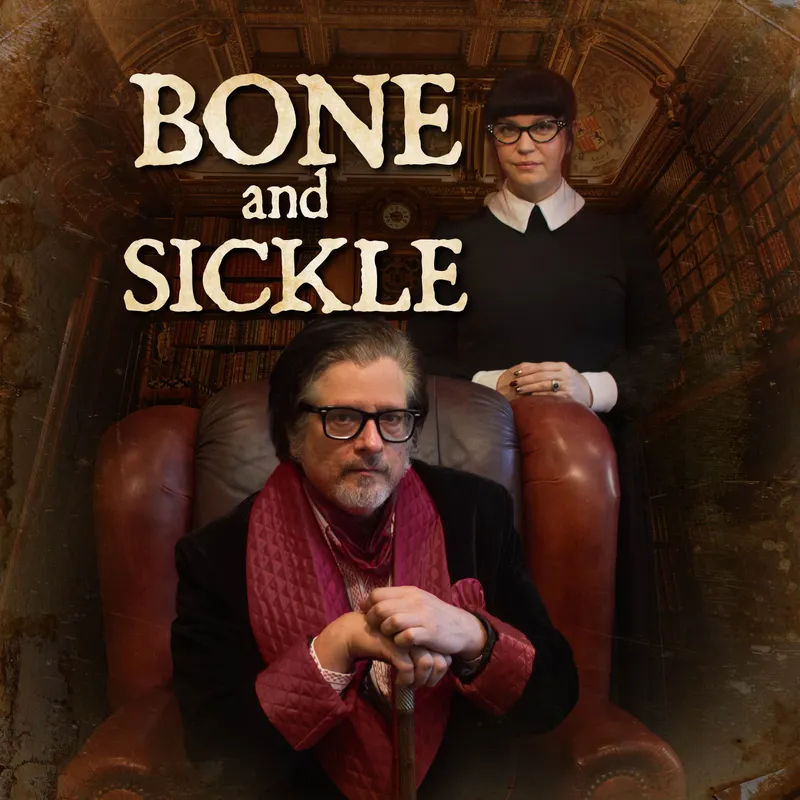
BONE AND SICKLE explores historical topics related to folklore and horror. With acerbic wit and a scholarly penchant for the grotesque, rogue folklorist Al Ridenour delves into a wide but carefully curated range of topics illustrated by stories from historical texts. Narratives are given dramatic readings by “Mrs. Karswell” (Sarah Chavez) backed by richly produced soundscapes blending original music, sound design and effects. The source books, though real enough, are said to be pulled from an imaginary library on Ridenour’s imaginary estate situated somewhere in the neighborhood of Charles Addams and Edward Gorey. Each episode begins with our hosts briefl...
Why listen
Bone and Sickle turns folklore, horror, and odd historical texts into atmospheric audio essays, with Al Ridenour guiding the scholarship and Mrs. Karswell adding dramatic readings. It is especially good for listeners who like old books, uncanny customs, saints, witches, monsters, ghost stories, and a dryly macabre sense of humor. Each episode feels like being led through a strange private library where the footnotes are as entertaining as the scares.
Episodes
Today he’s known mainly as a figure from medals carried to insure safe travels, but that image of a giant carrying the Christ Child across a dangerous river represents only the final stage in the long and strange evolution of the saint’s legend. Earlier or forgotten aspects of his story describe Christopher as a ferocious soldier, the Devil’s servant, a cannibal, and even a dog-headed monster. Our episode begins with the best known version of the tale recorded in The Golden Legend, the classic collection of hagiographies written in 1260 by Jacobus de Voragine, a Dominican friar in Genoa. Here Christopher begins as Reprobus, a fearsome giant determined to serve the most powerful master in the world. He first serves a king but abandons him after discovering that the king fears the Devil. Reprobus then serves the Devil, only to discover that the Devil fears Christ. Seeking Christ, Reprobus encounters a hermit who suggests that the giant use his great strength to carry travelers across a dangerous river. One night, a mysterious child asks to be carried across. As Reprobus struggles through the rising water, the child becomes impossibly heavy. Upon reaching the opposite bank, the child reveals himself as Christ and explains that Reprobus has carried both the Creator of the world and the weight of the world itself. Reprobus thus becomes Christopher, the “Christ-bearer.” St. Christopher Joachim Patinir, ca1522 After this, comes the lesser known portion of his tale, in which Christopher runs up against Roman authorities thanks to his Christian faith. As a sign that God will be with him throughout this, his staff planted in the earth breaks for in blooms, and he’s preserved through numerous tortures and attempts to execute him after his refusal to worship the pagan gods. Tortures fail to harm him, arrows miraculously stop in midair, and Christopher eventually converts the king responsible for his execution. But earlier versions of the legend are considerably stranger. Around 986, the German poet and bishop Walter von Speyer composed two Latin hagiographies, one in prose and the other in verse. Each tel
Robert the Devil is a supernatural medieval legend that inspired a 19th-century French opera, which incorporates key elements from a seminal Gothic novel. The opera and legend are substantially different but both interesting. We begin with Giacomo Meyerbeer’s 1831 opera, Robert le diable, which gained notoriety for a ballet sequence in Act III, which portrays an attempted seduction of the hero, Robert, Duke of Normandy, by the ghosts of corrupted nuns, freshly risen from their crypts. The scene is not found in the original legend, but as we learn, was borrowed from a particularly sensationalistic early Gothic novel,The Monk, written by Matthew Gregory Lewis in 1764. We also learn that Meyerbeer’s chief librettist, Eugène Scribe later went on to crib another storyline from Lewis’ The Monk for the 1854 opera by composer Charles Gounod, La nonne sanglante (“the bloody nun”). Rendering of cloister set for Paris Opera premiere. Along the way, we learn how Robert le diable helped save the financially imperiled Paris Opera after its royal subsidy had been withdrawn following the July Revolution of 1830. Along with public curiosity about the scandalous ballet, ticket sales owed much to the 19th-century equivalent of special effects — flashy and innovative stagecraft (new gaslight design, trapdoors, floating will-o-the-wisps, etc.) and a spectacular set replicating a ruined gothic monastery. Hans Christian Andersen, George Sand and Frédéric Chopin lavishly praised the production. Honoré de Balzac and Alexander Dumas worked mentions of the opera into their novels. Edgar Degas painted not one but two renderings of the Ballet of the Nuns. <img loading="lazy" decoding="async" class="size-full wp-image-3511" src="https://www.boneandsickle.com/wp-content/uploads/2026/06/Degas_Ballet_from_Robert_le_Diable.jpg" alt="" width="1575" height="1447" srcset="https://www.boneandsickle.com/wp-content/
Trolls, as presented in medieval literature, are vastly different from the creatures we encountered in our last episode’s collection of 19th-century Norwegian folktales. These Viking Age trolls are more vividly and gruesomely described, and the “troll-women,” who frequently appear, are akin to witches. We begin the show with a traditional song from the Faroe Islands, “Trøllini í Hornalondum,” telling the story of St. Olaf battling trolls on the coast of Norway. While the ballad presumably originated in Norway, it was first recorded by the Danish priest and historian, Anders Sørensen Vedel, in his 1591 publication, Hundredvisebogen, (the Book of 100 Ballads.”) While St. Olaf (King Olaf II) is regarded as the saint who drove paganism from Norway, but this struggle was ongoing with trolls continuing to embody the old pagan world as belied by various tropes — their dislike of church bells, and fear of crosses. We’ll next look at an interesting case from Iceland presenting a direct conflict between a church and troll. It was collected by the “Grimm of Iceland, Jón Árnason, a librarian and museum curator who published several collections of folktales, beginning in 1852. This one’s from his second volume of Icelandic Folktales, published in 1864. Encountering trolls — St. Olaf’s Journey, fresco by Albertus Pictor, ca 1470, Dingtuna Church, Västerås, Sweden After this, we have some general comments on the historical relationship between trolls and giant (jötunn, Þurs and risi) as well as trolls and witches or sorcery (trollldom). Our remaining four stories (the medieval ones) present trolls of the Icelandic saga, epic stories written in Old Norse and relating the adventures of ancestral heroes or rulers, usually with some connection to history but with certain creative embellishments. A subset of the sagas, which take place in their own mythic
Trolls in Scandinavian folklore can be a little different from what’s imagined in the rest of the world. We begin our show with a montage of clips from recent movies, Trollhunter (2010), Troll (2022), and Troll 2 (2025) — the latter two being Netflix productions that have rekindled interest in the subject while reimagining trollsin a way that does not always conform to the folklore. While all Scandinavian countries have their share of troll lore, this episode focuses specifically on Norway, the country with the most compelling collection of troll folklore. The first portion of our show looks at the Norwegian writer Henrik Ibsen’s play along with incidental music composed for the play by his associate Edvard Grieg. Introducing this topic is a clip from the 1970 musical Song of Norway, a fanciful Edvard Grieg biopic that garnered particularly bad reviews. We learn a bit about why Grieg hated his well-known “Hall of the Mountain King,” a composition which accompanies Peer Gynt’s encounter with trolls inside a mountain in the Dovre mountain chain. We also learn what Ibsen hoped to achieve in telling the story of his antihero Peer Gynt, and how he wrestled with the movement known in Norway as Romantic Nationalism. Next we look at two figures integral to this movement, Peter Christen Asbjørnsen and Jørgen Moe, a pair of folktale collectors often described as the “Brothers Grimm of Norway.” Their 1841 publication, Norwegian Folk-Tales, along with updated volumes published in 1844, 1845, and 1871, provide most all the troll tales with examine in this episode. An exception to this is a book authored by Asbjørnsen alone, High Mountain Scenes, volume 2, Reindeer Hunt at Rondane. Published sometime before 1846, it’s the only volume referencing tales told about Peer Gynt, those being very loosely represented in Ibsen’s play. <figcaption id="capti
Gammer Gurton’s Garland, published in 1784, is one of the earliest collections of English nursery rhymes, and contains verses both familiar and alarmingly unsettling. Intended to be read to toddlers (i.e., “children who can neither read nor run,” according to its subtitle) and named after a fictitious Grandma (“Gammer”) Gurton, who’d be analogous to Mother Goose, the volume were assembled by the eccentric scholar Joseph Ritson, who was known for his collecting of Robin Hood ballads, vegetarianism and ultimate descent into madness. Portrait of Joseph Ritson by James Sayers, early 1800s. We begin our episode with a snippet of a 1940s’ rendition of “Froggy Went a-Courting” by cowboy singer Tex Ritter. It’s a relatively modern take on Ritson’s “The Frog and the Mouse.” But like quite a few rhymes in the collection, this one had appeared in print earlier. Already in 1611, British composer of rounds and collector of ballads, Thomas Ravenscroft, had written out both lyrics and musical notation for “The Marriage of the Frogge and the Mouse,” a song he described as a folk song or “country pastime.” While a few other rhymes in Ritson’s collection were borrowed from one of two earlier editions of nursery verses (both published as Tommy Thumb’s Song Book 40 years earlier), most of what he collected appeared for tge first time in Gammer Gurton’s. We hear a bit about some of the familiar rhymes that premiered in this collection, including Goosey, Goosey Gander, Ride a Cock-Horse to Banbury Cross (with the “rings on her fingers and bells on her toes” lady), Bye, Baby Bunting, and There Was an Old Woman who Lived in a Shoe.” Ritson’s version of the last, however, takes a rather rude and unexpected turn. <img loading="lazy" decoding="async" class="size-full wp-image-3464" src="https://www.boneandsickle.com/wp-content/uploads/2026/01/1865gamm.jpg" alt="" width=
The Christmas Eve ghost story is a fine old tradition associated with Victorian and Edwardian England, one that’s been making a comeback on both sides of the Atlantic. Since 2018, Bone and Sickle has enthusiastically embraced the custom. Our offering for 2025, is “The Other Bed” written by E.F. Benson in 1912 and read for us by Mrs. Karswell. Previous Christmas ghost stories are linked here in our website show notes (2018, 2019, 2020, 2021, 2022 , 2023, and 2024.)
Historically, the celebration of Christmas and Carnival could overlap, and there is some reason to believe that customs associated with the former were inherited by the latter. A clue to this calendrical shift is offered by the Christmas song, “Carol of the Bells,” which uses the melody of an old Ukrainian New Year;s carol, one which dates back to the era in which New Year was celebrated in March (hence the springtime imagery of its original Ukrainian lyrics). Ukrainian postcard commemorating the folk song”Shchedryk” source of “Carol of the Bells” After a brief look at the variable date chosen to celebrate the New Year throughout European history, we take some time to rethink our modern understanding of what constitutes the Christmas season. The common notion that the season ends on December 25 or January 1, possibly including the weeks leading up to those dates, in historical understanding, was reversed, with Dec. 25 representing the start of Christmastide, which at the very least ran until Epiphany (Jan. 6) or Candlemas (Feb. 2). The merger of Christmas and Carnival is not only aided by the historically later end date of Christmastide, but also the variable start date for Carnival. A number of regional dates preferred for those festivities are discussed with Germany’s initiation of festivities on November 11 being the earliest. Another reason to suspect that Carnival inherited some of its customs from Carnival is the carnivalesque quality of the Christmas Feast of Fools celebrated anywhere from Dec. 26 to January 6. The wild, and sometimes dangerous revels celebrated on those days (and discussed in Episode 100) were ended by local bishops at roughly the same time that Carnival celebrations in France and Germany emerged, suggesting re-channeling of anarchic impulses and customs. Our discussion then turns to the Roman New Year, the January Kalends, which likely inspired chaotic e
In our second short episode for November, we take a close look at a the 1692 trial of Thiess of Kaltenbrunn, a purported werewolf in the town of Jürgensburg, in Livonia, (a Baltic region now divided between Estonia and Latvia). “Old Thiess,” as he was known, described himself as being a particularly exotic form of werewolf — one who served God in Hell. The testimony offered was so curious that we will be presenting the court transcripts verbatim, with nearly all exchanges between witness and judges included. Decide for yourself!
This is a special short episode looking at fictional evidence used to bolster horror narratives in literature, film, and broadcast media. We compare the found-footage phenomenon with earlier literary techniques and discuss some famous hoaxes and Halloween pranks, some historical and others closer to home.
This year, in the tradition of Halloween fortune-telling, we have an interactive divination game you can play at home. It comes from aa 19th-century book on cartomancy called, The oracle of human destiny: or, the unerring foreteller of future events, and accurate interpreter of mystical signs and influences; through the medium of common cards. TO PLAY ALONG, you will need an ordinary DECK OF CARS or you could can draw your cards from a VIRTUAL DECK like the one on deck.of.cards. (https://deck.of.cards). You will also need to know the ELEMENTAL GROUP of your ASTROLOGICAL SIGN. They are: FIRE SIGNS: Aries, Leo, Sagittarius EARTH SIGNS: Taurus, Virgo, Capricorn AIR SIGNS: Gemini, Libra, Aquarius. WATER SIGNS: Cancer, Scorpio, Pisces. Fortunes read fall into these categories (in this order): Absent Friends and Relatives Travel Friendship and Enmity Health and Longevity Property Lost Love Wealth and Fortune Success A Potential Spouse Happiness, Misfortune There are 88 fortunes provided, so you’ll have more fun listening with friends who have different astrological signs. Or write down the signs of absent friends and draw cards on their behalf. HAPPY HALLOWEEN!
If you’ve been curious regarding Mr. Ridenour’s and Mrs. Karswell’s troubles with anomalous events in the house, this short episode should answer some of your questions as Dr. Bartusch and crew attempt to restore order.
(SPOILER ALERTt: Do not listen to this until you have heard Episode 146 “Urban Legend”.) This is a short postscript to our “Urban Legend” episode based on feedback from a listener. It has to do with a very curious grave in Chesterton, Indiana, which may be related to our story. And here is the grave:
A 1968 Halloween “Spook Show” in the Midwest left an unsettling heritage of urban legends possibly rooted in even more unsettling facts. What little is definitively known regarding this event comes from the newspaper archives of the Danville News-Gazette, in which we find a short October 28 promo piece in the “Entertainment” section featuring this photo presumed to be of the impresario behind it all, J. Jolly. “Dr. Killer Hertz” will speak to “Space Spirits” (courtesy News-Gazette). There is also this advertisement for the event: Courtesy News-Gazette. That’s all the story you need for now. You can form your own opinions as we grope our way between fact and fiction. Headphones and lights out for best results!
The Halloween Jack-o’-lantern, made from pumpkins in the US and originally turnips in the UK, began its existence as a wisp of glowing marsh gas or “spooklight.” We begin our episode with a montage of modern American spooklights including that of Oklahoma’s “Spooklight Road,” North Carolina’s Brown Mountain, and the flying saucers sighted in Michigan in 1966, famously identified by investigator Allen Hynek as “swamp gas.” “Jack-o’-lantern” was just another name given to what’s more widely known now as a Will-o’-the-wisp — a wavering, bobbing light seen in marshy places, understood as mischievous spirit intent on leading travelers off course and into their doom in muck and mire. Flaming methane produced by rotting vegetation in such environments, is said to the the cause of the phenomenon, though the mode of ignition is still largely a matter of debate. The Latin name for such lights, ignis fatuus (fool’s fire), was also applied to phenomena having nothing to do with swamps, as it’s been used interchangeably with “St. Elmo’s Fire” to describe electrical discharges seen on ships; masts and other rodlike protrusions when atmospheric conditions are right. We hear a dramatic first-person account from 1847, in which St. Elmo’s Fire (identified by antiquarian Henry Duncan as ignis fatuus) appears on a coachman’s whip during a storm. A mirage in a marsh. Coloured wood engraving by C Whymper. Gas. Contributors: Charles H Whymper (1853–1941). We then hear what scientists of the 16th and 17th century made of ignis fatuus, often relating it unexpectedly to meteors or luminous insects, whi
There’s so much more to the figure of St. George than his battle with a dragon. Legends also tell of his grisly martyrdom, capture of a demon, and postmortem abilities to cure madness through contact with his relics. In the Holy Land, there is even a tradition syncretizing St. George with a a supernatural figure of Muslim legend. We begin with a look at a modernized take on the St. George legend, the annual Drachenstich, or “dragon-stabbing,” held in the Bavarian town of Furth im Wald. Beginning in 1590 with a performer representing the saint riding in a church procession, George was soon joined by a simple, canvas dragon, which over time evolved into the the world’s largest 4-legged robot used in the event today. 19th-century Drachenstich in Furth im Walld Mrs. Karswell next reads for us the primary source for the dragon story, Jacobus de Voragine’s collection of saint stories compiled around 1260, known as the Golden Legend. It popularized the tradition that George was a Christian soldier in in the Roman (Byzantine) army, born in Cappadocia, in central Turkey, and executed for refusing to bow to Imperial gods. There is also a princes to be rescued from the dragon but no king gives George her hand in marriage, as you might expect. Though Voragine set this episode in Libya, this setting was not really retained i the tradition. As one of early Christianity’s “soldier saints,” George held particular appeal for soldiers of the Crusades. We hear of two incidents of George leading Crusaders to victory as recounted in the Golden Legend and the Gesta Francorum (deeds of the Franks). When in 1483 William Caxton’s English translation of the Golden Legend appeared, anecdotes of British interest were added, including George’s connection to English knightood and The Order of the Garter. Elizabethan writer Richard Johnson featured George in his 1596 volume, Seven Champions of Christendom, elements o
As a summer replacement for our regular episode: a round-up of non-English-language Folk-Horror films (here as audio but also available as video) The presentation was created by Mr. Ridenour’s for the Rural Gothic conference hosted by The Folklore Podcast on 9/26/2020. The focus is on European folk-horror films, including Russian productions, and a few especially interesting Turkish films are also highlighted. It’s by no means comprehensive and naturally only includes films made in 2020 or earlier. You’ll hear the audio component if you continue listening here, but to watch the trailers, go to the Bone and Sickle YouTube channel (here: https://youtu.be/fJm6hgzaPV4). Or just Google “YouTube” and “Bone and Sickle” and you’ll find “International Folk-Horror Films” as a video. These are the films discussed (English titles). ANTHOLOGY FILMS: A Field Guide to Evil – Tale of Tales. SPANISH LANGUAGE: Tombs of the Blind Dead – Macario – Poison for the Fairies – The Witches of Zugarramurdi – Errementari: The Blacksmith and the Devil. GERMAN-LANGUAGE: Mark of the Devil – Laurin – Sennentuntschi. SCANDINAVIAN: The White Reindeer- The Juniper Tree – Trollhunter – Rare Exports- Thale- Border. POLISH-ESTONIAN: Witchhammer – November. CZECH-SLOVAKIAN: Valerie and Her Week of Wonders – Morgiana- Beauty and the Beast – The Cremator- Kytice – The Noonday Witch – Little Otik. RUSSIAN: Vasilisa the Beautiful – Kashchey the Immortal – Viy – Viy: The Forbidden Empire – The Night Before Christmas – Gogol: The Beginning – Gogol: Viy – Gogol: A Terrible Revenge – The Bride – Queen of Spades: The Dark Rite – The Mermaid: Lake of the Dead – Ghouls (Vamps). TURKISH: Dabbe films – Siccin films. <img loading="lazy" decoding="async" class="alignnone size-full wp-image-3341" src="https://www.boneandsickle.com/wp-content/uploads/2025/07/mv5bndzkmjezzdmtmdu5zs00yzy5lwfkmtgtytcwnzy1mwixn2q3xkeyxkfq.jpg" alt="" width="1280" height="1896" srcset="https://www.boneandsickle.com/wp-content/uploads/2025/07/mv5bndzkmjezzdmtmdu5zs00yzy5lwfkmtgtytcwnzy1mwixn2q3xkeyxkfq.jpg 1280w, https://www.boneandsickle.com/wp-content/uploads/2025/07/mv5bndzkmjezzdmtmdu5zs00yzy5lwfkmtgtytcwnzy1mwixn2q3xkeyxkfq-203x300.jpg 203w, https://www.boneandsickle.com/wp-content/uploads/2025/07/mv5bndzkmjezzdmtmdu5zs00yzy5lwfkmtgtytcwnzy1mwixn2q3xkeyxkfq-691x1024.jpg 691w, https://www.boneandsickle.com/wp-content/uploads/2025/07/mv5bndzkmjezzdmtmdu5zs00yzy5lwfkmtgtytcwnzy1mwixn2q3xkeyxkfq-768x1138.jpg 768w, https://www.boneandsickle.com/wp-content/uploads/2025/07/mv5bndzkmjezzdmtmdu5zs00yzy5lwfkmtgtytcwnzy1mwixn2q3xkeyxkfq-1037x1536.jpg 1037w, https://www.boneandsic
The Fates of Classical Antiquity not only survived in the form of related fairy-tale figures but also as the object of superstitions and rituals associated with newborns. In South Slavic and Balkan regions particularly, these customs represent a surprisingly long-lived and genuine case of pagan survival. We begin our episode examining the fairy godmothers of “Sleeping Beauty” as embodiments of the Fates. Mrs. Karswell reads a few key passages from the definitive version of the story included in Charles Perrault’s 1697 collection, Histoires ou contes du temps passé (“stories of times gone by.”) We learn how the fairies fulfill the historical role of godparents at the newborn’s christening. We also note the peculiar emphasis on the quality of what’s set before the fairies at the christening banquet, observing how a failure there leads the wicked fairy to curse the Sleeping Beauty. 1874 illustration by František Doucha for a Czech edition of Sleeping Beauty We then explore antecedents to Perrault’s tale, beginning with the 14th-century French chivalric romance, Perceforest. A peripheral story in this 8-volume work is that of Troylus and Zeelandine, in which the role of Sleeping Beauty’s fairy godmothers are played by Greek and Roman deities, with Venus as supporter of Princess Zeelandine (and her suitor Troylus) and Themis cursing Zeelandine to sleep in a manner similar to Perrault’s princess. A failure to correctly lay out Themis’ required items at the christening banquet is again again responsible f
During the 15th-century, citizens of Nuremberg, Germany, experienced spectacular Carnival parades highlighted by the appearance of floats known as “hells.” Featuring immense figures, including dragons, ogres, and man-eating giants, these hells were also peopled with costumed performers and enhanced with mechanized effects and pyrotechnics. In this episode, adapted from a chapter of Mr. Ridenour’s new book, A Season of Madness: Fools, Monsters and Marvels of the Old-World Carnival, we examine the Nuremberg parade, the Schembartlauf, as it evolves from costumed dance performances staged by the local Butcher’s Guild in the mid-1 4th-century into a procession of fantastic and elaborately costumed figures, and finally — in 1475 – into a showcase for the rolling hells. We begin, however, with an examination of a historical anecdotes sometimes presented as forerunners of the Carnival parades, and of the Schembartlauf in particular, including two sometimes put forward to support a “pagan survival” theory. The first involves a ceremonial wagon housing a figure of the putative fertility goddess, Nerthus, hauled about by Germanic peoples in the first century and mentioned in Tacitus’ Germania. The second, also involving a wagon with fertility figure, is described by Gregory of Tours as being hauled through farmers’ fields in the 6th-century. Period illustration of costumed figure from a Schembartbuch. <img loading="lazy" decoding="async" class="wp-imag
Your favorite podcast is now seven years old! As a birthday gift to our listeners, we decided to try a super short, experimental video podcast. For your pleasure, Mr. Ridenour yesterday edited together this vide0, entitled “The May Queen”.
Mr. Ridenour introduces his new book “A Season of Madness: Fools, Monsters, and Marvels of the Old-World Carnival,” explaining how the project grew out of his research for “The Krampus and the Old, Dark Christmas.” In this episode, he sketches out chapter themes and topics, from ancient Rome to modern Bulgaria, focusing particularly on cultural hinterlands where festivities still echo the cruel realities of the old, agricultural world and where medieval Christianity intertwines with pagan practice. The Carnival portrayed is at once beautiful, strange, and savage. Spring is welcomed by clowns waving inflated pig bladders. Stalking sheepskin monsters brandish clubs bristling with hedgehog spines, and plows are dragged over cobblestone streets by celebrants wearing masks painted with cow’s blood. Folk horror fans take heart as the Old World welcomes Spring! Available now for pre-order. US Publication date, May 6, 20205. A few advance reviews of the book: “Sumptuously illustrated and written with clarity, eloquence, and wry humor, “A Season of Madness” is one of those rare books that can pass muster as an academic study yet also provide a good read. Al Ridenour’s meticulous research exposes the subtleties and outrageous quirks of a topic you didn’t know you wanted to learn about until you picked up his book. Under his direction, the madness once again reigns, as the neglected history of European Carnival is placed center stage before the reader, in all its seedy, wild, and triumphant glory.” —Dr. Paul Koudounaris, author and photographer of: “Faithful unto Death,” “Heavenly Bodies,” and “Empire of Death“ “A Season of Madness“ is a fantastic carnival of a book. Equal parts irreverent and erudite, it lovingly cap
The Sin-Eater was a figure associated with funerals of the 17th – 19th century, mostly in Wales, and the English counties along the Welsh border. According to tradition, he was invited by grieving families to transfer the burden of sins from the deceased to himself by consuming bread and beer in the vicinity of the corpse, after which he might receive some financial compensation. He typically came from the fringes of society and was said to be motivated by a combination of poverty, greed, and irreligious indifference to matters of eternal judgement. After a quick montage of clips from the generally terrible films made on the theme —Sin Eater (2022), Curse of the Sin Eater (2024), The Last Sin Eater (2007) — we review the historical references to the tradition, which are surprisingly few in number. The first comes from a particularly early 1686 collection of British folklore written by John Aubrey, The Remaines of Gentilisme and Judaisme. His characterization of the custom is essentially that described above and despite the early date of the text, he describes the practice using the past tense, though qualifies this somewhat later mentioning that it is “rarely used in our days.” Mrs. Karswell, of course, reads Aubrey’s original text along with our subsequent examples. Our next account from 1715 comes from antiquarian John Bagford (published later, in 1776) in John Lelan’s, compendium, Collectanea. It does not mention Wales but locates the custom in Shropshire, an English county bordering Wales. It also has the Sin-Eater remaining outside the house where the body lies as he consumes his bread and ale. Bagford also adds a verbal formula, which the Sin-Eater is supposed to pronounce, mentioning the deceased’s soul attaning “ease and rest,” for which the Sin-Eater’s soul has been “pawned.” These phrases are recycled in later literature on the topic. The next text comes from 1838, appearing in the travelogue Hill And Valley: Or Hours In England And Wales by the Scottish novelist, Catherine Sinclair. It’s particularly brief, adding little detail other than specifying the tradition as one (formerly) belonging to Monmouthshire, in eastern Wales. She also characterizes the custom derisively as “popish,” or belonging to the Catholic past. The next and final account (not counting clearly recycled retellings of those above) was contributed by Matthew Moggridge in an 1838 journal of the Cambrian Archaeological Association. It also relegates the tradition to the past, placing it specifically in the Welsh town of f Llandybie. Moggridge removes the ale, keeps the bread, and adds salt (used symbolically rather eaten). He also makes explicit the Sin-Eater’s pariah status. Aubrey’s, Bagford’s, an Moggridge’s accounts receiv
Mélusine is a female fairy of medieval legend. who suffers under a curse transforming her once weekly into a monstrous form. In various tales she becomes either a serpent or fish from the waist down, or fully transforms into a dragon. Mélusine can only break this curse via marriage to a mortal who is obliged to allow her certain secret freedoms. In return, her husband enjoys magical assistance and sees his fortunes flourish, at least until that day pact is broken. The most famous version of this story, and the one to which we devote the bulk of the show is a French tale set down in 1387 by Jean d’Arras, Mélusine or the Noble Story of the Lusignans. The patron for whom he wrote, Duke Jean de Berry, belonged to the House of Lusignan, whose ancestral claims to the lands around Poitiers were portrayed by Arras as a matter of supernatural destiny involving the fairy. We learn how Jean de Berry’s ancestor, Raymondin (Raymond) became engaged to Mélusine after a meeting at an enchanted fountain. Raymond is unaware that this encounter, and all that follows, is the subject of a prophecy set in motion by his accidental killing of his uncle. We hear the curious way in which this transpires, of Raymond and Mélusine’s wedding attended by a multitude of fairy folk, and of the building of Château de Lusignan through a sly collaboration of fairy magic, ingenuity, and human agency. We then learn of Mélusine’s and Raymond’s offspring, all of whom are handsome and strong yet also betray their supernatural parentage via certain disfigurements — strange birthmarks, enormous stature, huge jutting teeth, or additional eyes. Much of Arras’ narrative is devoted to the sons’ heroic exploits, particularly as Crusaders in the Middle East, where the historical Lusignans gained lands and reputations, but our episode, focuses only only two sons, “Geoffroy Big-Tooth” and Fromont, whose stories are more intertwined with that of Mélusine herself. Next comes the central drama, the breaking of the secret pact between Raymond and his fairy wife, which I’ll leave for you to enjoy without spoilers. Mrs. Karswell delivers a fine dramatic reading of this lengthier passage. While that situation simmers, we hear how Geoffroy has returned from a giant-slaying adventure to discover that his brother, Fromont, is about to enter a monastery rather than devote himself to expanding the Lusignan empire. This doesn’t sit well with Geoffroy, whose disproportionately wrathful response is at once horrible and comic. Reacting to the tragic fall-out of Geoffroy’s rampage, Raymond himself flies into a rage, accusing Mélusine of producing offspring supernaturally inclined toward evil. Cruel as his words may be, Mélusine seems to validate them, assuming a diabolical presence as she abandons their marriage, flying away from Castle Lusignan in the form of a dragon. Finally, we exam
Unfortunately, release of the episode scheduled for this month has been delayed thanks to the Eaton Wildfire in California. Your hosts are safe and sound, but complications from the fire temporarily halted production. The episode in question should be available in February. Thank you for your patience!
The Victorian tradition of telling ghost stories at Christmas has been celebrated by Bone and Sickle since 2018. This year is no exception as we share two stories in this episode, one comic, and one frightening. We begin with the Introduction to the 1891 anthology, Told After Supper, by the British writer, Jerome K. Jerome, following this with “The Old Portrait” from Scottish writer Hume Nisbet’s 1900 collection Stories Weird and Wonderful. Pour a brandy, douse the lights, and enjoy!
A short extra episode on Befana, the gift-bringing Italian witch associated with Twelfth Night, the end of the Christmas season. Included in the show is material from the book, “The Krampus and the Old, Dark Christmas,” traditional music of the season, audio from actual celebrations, and a few pop songs associated with la Befana. Befana on the Piazza Navona, Rome. The Cucibocca of Montescaglioso
A figure of mythic proportions during his lifetime, Vlad the Impaler’s notoriety receded over the centuries only to be resurrected in the 1970s, when a pair of Boston University scholars went public with theories connecting him to Bram Stoker’s Count Dracula. We begin with snippet of Francis Ford Coppola’s 1992 film, Bram Stoker’s Dracula, the first film to connect the literary vampire with the Eastern European prince — a rather ironic departure from Stoker’s novel, which references the historic figure only in passing. Vlad’s 15th-century notoriety was sparked by two German texts both published around 1463, or shortly thereafter. Probably the earliest of these,written anonymously and published in Vienna, was titled, The History of Voivode Dracula, is sometimes called “the St. Gallen manuscript” named for the Swiss city where it is preserved. (“Voivode,” is a Slavic term, used in this context to mean, essentially, “Prince.”) The second is a rhymed narrative written by Michel Beheim, a poet associated with the Meistersinger tradition and a performer at the court of the King Friedrich III. About three decades later, in 1490, Vlad’s story appeared in northwestern Russia. We don’t know its author but the monk who copied it from a lost original, mentions that his source was written in 1486. All three of these narratives provide plenty of gruesome anecdotes detailing the voivode’s cruelties. Before going further into Vlad’s history, and as a quick appetizer, Mrs. Karswell reads a description by Beheim of a ghastly picnic said to have been enjoyed by the voivode. Life-size portrait from the Esterházy ancestral gallery of Forchtenstein Castle/Burgenland. Next, we clear away some misconceptions regarding Vlad the Impaler, the first having to do with his name. Called “Vlad Țepeș” (Vlad the Impaler) in Romanian, he is less dramatically referred to as Vlad III. His father, Vlad II, was also kn
The devilish reputation Ouija boards enjoy in horror films is a relatively new phenomenon. In the Victorian era, they were regarded by “psychical researchers” as something to be embraced in a spirit of calm scientific inquiry, while Spiritualists saw in them a means of reaching out to those who’d passed into the “Summerland,” an anodyne realm of sweetness and light. While these were the dominant attitudes of the day, the idea of spirit communications has always been fraught with a sense of the uncanny, tainted even by an association with witchcraft and the Devil. We’ll see this element already present in those first communications of the Spiritualist movement, the dialogues the Fox sisters with an unseen presence at first presumed to be a sort of devil. As we saw in our previous episode, spirit-boards represent a particular danger to those with psychologically fragile constitutions. Beyond the instances of obsessive madness detailed previously, this episode examines a handful of cases from the 1920s and ’30s involving actual bloodshed — murder, suicide, and explicit invocations of the Devil. Of course these remained isolated incidents, and historical distrust of the Ouija was generally low, and all but non-existent during the spiritual and occult explorations of the 1960s. But all of this would soon change with William Peter Blatty’s 1971 novel, The Exorcist, and its 1973 cinematic adaptation, both of which famously depict the Ouija board as a channel through which the Devil enters. Some listeners may know that Blatty’s novel was inspired by actual reports of an exorcism that took place in America of the late 1940s, one involving a teenage boy rather than girl, a change Blatty said he’d made to help preserve the privacy of the boy. Within the last decade, as individuals involved in these incidents have passed on, more information on this case has made its way to public scrutiny. In the last half of our show, we examine the role spirit-boards and Spiritualist practices played in these events as revealed by a day-to-day log kept by the lead exorcist during the rites . Mrs. Karswell reads for us the passages from the journal. An element Blatty wove in with t
Apparently, I clipped off the beginning of the show during the initial upload. It’s been fixed, so this would only effect those downloading yesterday, but for those who missed it, here it is..
Ouija boards, or more generally, “spirit boards” have antecedents going back to the very first days of the Spiritualist movement. We begin our show with a seasonally spooky visit to the cottage of the Fox sisters in Hydesville, New York, where the ghost of a murdered pedlar supposedly began communicating with the family through a series of mysterious knocking sounds. While the method used by the Fox sisters to translate these knocks into messages anticipates the process of pointing out letters on a Ouija board, the evolution of spirit boards was not so straightforward. We learn how the planchette, used on board as a pointer, appeared long before any boards were printed and was initially used as a writing device. It was equipped with a pencil inserted through it like a third leg. As the planchette was guided by the user (supernaturally and/or unconsciously), “spirit writing” was produced. We next hear from a number of contemporaneous accounts describing the pencil planchette as if it were inhabited by a ghostly presence and how these devices first appeared in Paris and London. Once imported to America, the homeland of the Spiritualist movement, merchants in Boston and New York did brisk business in producing versions of their own. By the 1880s, the planchette was finally beginning to be used as a pointer, and W. S. Reed Toy Company of Massachusetts became one of the first merchants to produce boards printed with letters. Reed’s model was known as the “Witch-board.” Along the way, we hear of an unexpected connection between President Grover Cleveland and Witch-boards. We then go to Baltimore, where former fertilizer salesman Charles W. Kenner partners with attorney Elijah to create their own version of the ghostly spelling board, one they name Ouija. Lore around the naming of the board (through a seance) and peculiar happenings at the US Patent office in Washington DC are discussed along with the passing of rights to manufacture the novelty to William Fuld, who manufactured the Ouija board from 1897 to his untimely death in 1927. We discuss the phenomenon of “Ouija-mania,” which generated a number of songs and (questionable) literary works. Ouija-mania also generated a certain degree of misery among unstable users. Several absurd and tragic stories
A special short announcement regarding the October 20 deadline for Trick-or-Treat-by-Mail for listeners joining our Patreon. Find out how you can receive a hand-packed candy bag from the home of Bone and Sickle Podcast. Each bag this year contains a special MYSTERY ITEM from Egypt! Visit: https://www.patreon.com/boneandsickle
We’re getting into the spirit of the season with a classic tale of witchcraft set in 17th-century Salem Village, Nathaniel Hawthorne’s short story, “Young Goodman Brown.” Written in 1835 for New England Magazine, it later appeared in the 1846 collection, Mosses from an Old Manse, which also includes the excellent supernatural story, “Rappaccini’s Daughter.” Hawthorne regarded “Young Goodman Brown” as his most impactful short story, and it received high praise from his contemporary, Edgar Allan Poe. Two more Halloween-themed episodes (historical explorations) await you next month.
Agartha, Shambhala, and Hyperborea are all names for a a mythic spiritually and scientifically advanced kingdom, always in some hidden location, sometimes within the earth, a legend which became an obsession of early Soviet spies, a mad soldier of fortune, and a mystical Russian artist during the 1920s. We begin with a clip from the 1939 German documentary, Secret Tibet, which records the activities of visiting Nazi researchers in that country. While we can’t establish to what extent the expedition focused on Third Reich mythology connecting their Nordic Aryan with South and East Asia cultures, we examine other efforts by the Reich’s department of Ahnenerbe (ancestral heritage) to make such connections. Alongside this, we look at some 19th-century precedents associating an ancient, primal race with both the far north and Vedic culture of the subcontinent. We also examine the classical concept of Thule (a far-north Neverland) appropriated by the pre-Reich Thule Society. We next look have a brief look at 1871 book by French writer Louis Jacolliot, The Son of God, which introduces the name “Agartha,” (and its many forms) to designate an underground city or land serving as a repository of ancient wisdom. Jacolliot places this land in the East and associates it with a sort of universalized Vedic culture. It’s Alexandre Saint-Yves’ 1886 book The Mission of India in Europe, that really defines Agartha as its come to be understood, placing it underground, in the East, and probably within the Himalayas. His fascination with the topic probably was inspired by his Sanskrit tutor, a mysterious Afghan, who called himself Hardjji Scharipf, and claimed to be “of the Great Agartthian School.” Scharipf, however, had little to do with the specific content of Saint-Yves’s book, which in part reads like Hollow Earth fiction of our previous episode. Mrs. Karswell reads for us some fantastical passages from his text. The majority of Saint-Yves’s work, however, is devoted to the ruling principle of this hidden kingdom, something he calls “Synarchy,” (from Greek words for “together” and “rule.” Fearing the West’s descent into anarchy (Synarchy’s opposite) and its inability to receive the “Synarchic radiations” of Agartha, he calls upon the East to unify with Europe and guide the world toward a Synarchic utopia (the titular “Mission of India to Europe”). Saint-Yves is particularly concerned with Britain and Russia’s competition for the lands of Central Asia, an area poised to become the hypothetical capital of a united East and West. This brings us Russia or the competing Red and White armies of the Russian Civil war fighting in this region.The Polish writer, Ferdynand Ossendowski, who served with the White Guard in this setting documents these conflicts
Borrowed from fairy lore, the notion of a hollow earth peopled by superior beings became a theme of literary fantasies as early as the 17th century and went on to influence fringe theories of the earth’s structure into the 19th century. We begin with a snippet of the medieval Norwegian ballad “Liti Kjersti,” telling the fairy story of a young woman abducted into the earth by the Mountain King, and follow this an anecdote from Gerald of Wales’ 12th-century Itinerarium Cambriae (Journey through Wales) describing a kidnapping of a young boy by “two tiny men,” and the interior world he visits. We then hear from Margaret Cavendish, a 17th-century poet, playwright, and writer on a variety of philosophical, political, and scientific topics. Her poem “The Fairy Queen’s Kingdom”(1653) and prose fantasy The Blazing World (1666) introduce the idea of interior kingdoms accessible only through entrances at the polar ends of the earth. Over the next couple centuries, at least a half dozen novels describing travels into an interior world appeared. We briefly touch on Danish-Norwegian writer Ludvig Holberg’s Niels Klim’s Underground Travels (1741), Giacomo Casanova’s Icosaméron (1788), American writer Mary Bradley Lane’s Mizora: A Prophecy (1880), and Irish-American writer William R. Bradshaw’s The Goddess of Atvatabar (1892), the last coming closer to what we would think of today as science fiction. Universal to these hollow earth tales is portrayal of the interior civilization as a utopia, highlighting the failings of our own. We then spend some time examining the particularly weird hollow 1895 earth novel by John Uri Lloyd, Etidorhpa, or, the end of the earth: the strange history of a mysterious being and the account of a remarkable journey, an underground adventure tale larded with odd religious, philosophical and pseudoscientific theories. It describes the education of a character identified only as “I—Am—The—Man—Who—Did—It,” guided by an eyeless amphibious humanoid along a subterranean route, with stops for various knowledge-imbuing experiences, i.e., “How to See Your Own Brain,” as one chapter is titled. <img loading="lazy" decoding="async" class="wp-image-3023 size-full" src="https://www.boneandsickle.com/wp-content/uploads/2024/07/we-live-inside-red.jpg" alt="" width="960" height="960" srcset="https://www.boneandsickle.com/wp-content/uploads/2024/07/we-live-inside-red.jpg 960w, https://www.boneandsickle.com/wp-content/uploads/2024/07/we-live-inside-red-300x300.jpg 300w, https://www.boneandsickle.com/wp-content/uploads/2024/0
While the dummies may be inherently creepy, they were not the source of ventriloquism’s dark reputation in earlier times. This originates with the understanding that the voice heard, when no mouth seems to speak, belongs to a demon. We begin with a bit of audio mixing bits from various frightful ventriloquist films, including Devil Doll (1964), Magic (1978), and the earliest example of the sub-genre The Great Gabbo (1929). Also adding to the mix, is a scene from the 1945 British anthology, Dead of Night, the head-and-shoulders stand-out among these, offering a truly satisfying wraparound story and use of ventriloquist and wooden colleague. Perhaps a third of our episode is dedicated to detailing the accounts of mysterious voices emerging from the possessed as documented in pamphlets and broadsheets of 16th- and 17th-century England. Witches are frequently involved, not as the ventriloquist themselves but as those who’ve sent these talkative demons into the bodies of their victims. One exception discussed is that of 16th-century case of Elizabeth Barton, also known as “The Holy Maid of Kent” or “The Nun of Kent,” in whose case, the voice happens to be divine rather than demonic. From “Dead of Night” (1945) Several linguistic issues are discussed along the way, including the source of the word “ventriloquist” from the Latin “venter” meaning belly (or more broadly “insides,” gut, or even womb) and “loqui,” meaning, “to speak.” While to many, the mysterious voices was understood to issue from the demoniac’s belly, other writers looked for a means of trickery employed, focusing on the Hebrew word “ov” taken from the Old Testament story of the “Witch of Endor,”in which King Saul, seeks out a medium who can foretell the outcome of his imminent battle with the Philistines. The future, in this story, is revealed by the spirit of the prophet Samuel, summoned from the dead. (The Witch of Endor is also discussed in our 2018 “Ancient Necromancy”<
Our understanding of hypnotism, once known as “mesmerism,” has radically evolved over the centuries. This episode looks at where it all began, examining the fascinating (and rather weird) story of the 18th-century German doctor, Franz Anton Mesmer, after whom “mesmerism” is named. We begin, with a look at the mesmerist’s sinister reputation in the 19th century, as reflected in the British writer George du Maurier’s 1894 novel, Trilby. While the book’s named for its protagonist, Trilby O’Ferrall, an Irish girl working as a model in a British artist’s colony in Paris, her nemesis is better known, namely, her vocal instructor, Svengali, an Eastern European musician whose hypnotic powers not only propel the aspiring singer to stardom but also come to dominate and ruin her life. We look at the novel’s forgotten popularity in its day, the phenomenon of “Trilbyana,” and the book’s cinematic adaptations, including the 1931 film, Svengali, with John Barrymore in the title role. Along the way, we note some surprising parallels with more prominently gothic novels and films. John Barrymore as Svengali in the 1931 film of that name. Beginning with Mesmer’s dubious scholarship at the University of Vienna, we make an attempt to untangle his concept of “animal magnetism,” describing an invisible, dynamic fluid, comparable to the “cosmic magnetism” that guides the planets, but particular to “animals” (i.e., creatures sharing an “animus” (L) or animating spirit. We particularly focus on Mesmer’s experiences while in Hungary, where in 1775 he was summoned by a Baron Horeczky de Horka, who hoped the German doctor’s new form of therapy might succeeds where treatments of his condition by others had failed. We hear of several curious incidents occurring in the castle, which were documented in detail the family tutor and interpreter Herr Seifert, who had observed Mesmer with a skeptical fascination, expecting the man to be a charlatan. <img loading="lazy" decoding="async" class="wp-image-2977 size-full" src="https://www.boneandsickle.com/wp-content/uploads/2024/04/portrait.jpg" alt="" width="800"
Banshees are spirits of Irish folklore, who warn of impending deaths. Originally considered fairies, their Irish name, bean sídhe, means “woman of the mounds,” those mounds (sídhe) being the ancient burial mounds believed in Ireland to be the home of fairies. The banshee’s wailing, which betokens imminent death of a blood relative, is probably based upon the wailing of Irish mourners called “keeners,” from the Irish word caoineadh, or “lament.” You can hear some snippets of traditional keeners in this segment, incliuding a 1957 field recording released by Smithsonian Folkways. Next we look at how the banshee’s appearance and behavior derives in part from that of Irish keeners, including some odd details having to do with petticoats. Her origins in the fairy world also has often suggested that she may be small of stature. We also examine some folktales involving combs lost by or stolen from banshees, and what you should or should not do should you find one. While the banshee is attached strictly to particular families, she is not bound to the Emerald Isle. We hear some accounts of her following travelers to other countries, including a surprising tale involving a party aboard an Italian yacht. The figure, as she’s known today, receives no mention in print until the 17th century. Mrs. Karswell reads for us what is probably the earliest account, retelling an incident experienced by Lady and Sir Richard Fanshawe, an English ambassador and his wife visiting Ireland. This account also introduces the notion that a banshee may not originate in the fairy world, but may also be a vengeful ghost. We hear another tale in this mode associated with Dunluce Castle in County Antrim, a location known for its “banshee room,” a feature duplicated in Shane’s Castle, about an hour to the south. Both of these castle banshees are sometimes called “the red sisters,” so named for the color of their hair. After a brief side trip to make note of figures similar to the banshee in Scotland (the caoineag) and Wales, the cyhyraeth and gwrach y rhibyn, we turn to older figures of the fairy realm regarded as banshees, but rather different from the figure born in the Early Modern Period. The first of these is Clíodna, who was known
The story of Snow White, as told by the Brothers Grimm, is only one of many narratives involving girls who have fallen into a deathlike state and are displayed in a glass coffins. In this episode, we examine the sordid details of the Grimm’s original 1812 version of the tale and compare it with analogous stories dating back to the 12th century. We begin with a review of the Grimms’ original story, many aspects of which have been subsequently muddled and obscured not only by Disney but by later alterations made by the Grimms. These include the identify of the Evil Queen, the malevolence of her intent, the purported benevolence of the Huntsman, and particularly, the nature of Snow White’s resurrection. “Snow White Receives the Poisoned Comb” Hans Makart (1872) After this, we have a look at the immediate predecessor to the 1812 story, a children’s play of the same name by the (unrelated) German author Albert Ludwig Grimm. Though it features dwarves who aid Snow White, a magic mirror addressed in rhyme, poisoned fruit, deception involving the heroine’s purported death, and glass coffin, it proves to be a very different story. The next tale explored is the 1782 novella Richilde, by the German writer Johann Karl August Musäus. Surprisingly, the title character here, Richilde, is the wicked stepmother rather than her step-daughter Bianca, whose name in Italian (i.e., “white”) might be compared to “Snow White.” Set in medieval Brabant (Belgium), this one has Bianca courted by a prince whom the jealous stepmother hopes to see married to her own daughter. A further complication is presented by the fact that the prince here is already married. <img loading="lazy" decoding="async" class="wp-image-2942
A few listeners commented that Mrs. Karswell’s dialogue was muffled at points in “Sorcery Schools of Spain.” That episode is now updated with a corrected version. Thanks for letting us know.
For centuries, Spain was said to be the home of secret, underground sorcery schools, Toledo being the first city with this reputation and later Salamanca. The notoriety of the latter was more enduring, and when the legend passed to Spanish colonies of the New World, the word, “Salamanca” was embraced as a generic term for any subterranean location said to be the meeting place of witches. We begin the show with a clip from the 1975 Argentine film Nazareno Cruz and the Wolf, which depicts just such a place. A particularly early reference to this concept can be found in a romanticized 12th-century biography of a particularly interesting character, a French pirate and mercenary Eustace the Monk. Mrs. Karswell reads for us a passage written by an anonymous poet of Picardy, who describes Eustace’s occult schooling in the city of Toledo. Along with this we hear as a passage from a 1335 Tales of Count Lucanor by Juan Manuel, Prince of Villena, which adds another element to the legend, that of its underground location. Curiously, a number of Spanish cities claim as their founder the Greek demigod Hercules, but in Toledo, he’s also credited with founding this school of magic, excavating a subterranean space in which he imparts his supernatural knowledge, at first in person, and later in the form of a magically animated sculpted likeness. Another Toledan legend, was later blended into this mythology. It’s the story in the Visigoth King Roderick, Spain’s last Christian ruler makes a discovery prophesying his defeat by the Moors in 711 CE. Along with a parchment foretelling this, Roderick exploration of this enchanted palace or tower results in the discovery of the Table of Solomon, a construction of gold, silver, and jewels also attributed with occult powers. Legends detailing this are believed to be of Arabic origin, first recorded in the 9th century and later appearing in One Thousand and One Nights. In later Spanish retellings, the treasure house is conflated with the Cave of Hercules, and the fall of Spain to the Moors is attributed to Roderick breaking of a spell woven by Hercules, to keep North African invaders at bay. <img loading="lazy" decoding="async" class="wp-image-2901 size-full" src="https://www.boneandsickle.com/wp-content/uploads/2024/01/tower.jpg" alt="Tower" width="800" height="1187" srcset="https://www.boneandsickle.com/wp-content/uploads/2024/01/tower.jpg 800w, https://www.boneandsickle.com/wp-content/uploads/2024/01/tower-202x300.jpg 202w, https://www.boneandsickle.com/wp-content/uploads/2024/01/tower-690x1024.jpg 690w, https://www.boneandsickle.com/wp-content/uploads/2024/01/tower-768x1140.jpg 768w, https://www.boneandsickle.com/wp-content/uploads/2024/01/tower-182x270.jpg 182w
Tonight we bring you our sixth annual Christmas ghost story, a tradition particularly beloved in Victorian and Edwardian Britain. First published in 1908, and set in the days before Christmas, the tale is by British writer Algernon Blackwood (from whom we earlier heard “Ancient Lights“) and whom many listeners will know through his other works, particularly, The Wendigo or The Willows. Throw a log on the fire, refill the brandy, and settle back for Mrs. Karswell’s reading of “The Kit Bag.”
The Christmas season is rich in superstitions. The whole period from the beginning of Advent, through the day itself, and especially throughout the twelve days (and nights!) between Christmas and January 6 or Epiphany are, in a sense haunted, a time when spirits are afoot and behavior is hemmed in by restrictions upon normal activities. Recently I stumbled upon a good collection of these folk beliefs in a volume from 1903 entitled Encyclopaedia of Superstitions, Folklore, and the Occult Sciences of the World: (And subtitled, A Comprehensive Library of Human Belief and Practice in the Mysteries of Life). The book’s contents are indeed as comprehensive as that title, and from their section on Christmas, I’ll be sharing some of the more interesting examples. The show closes with a recording of a song sung by costumed Swiss holiday figures known as Silvesterchläuse. In the hinterlands of the Canton of Appenzell-Ausserrhoden, the se Silvesterchläus, groups of men and male youths wearing huge bells and ornate costumes, go door to door to offer seasonal blessings and sing songs like the one you will hear. Swiss Silvesterchläuse
The Monster of Glamis was a Victorian legend involving a Scottish castle, a secret chamber, and a monstrous aristocrat hidden from the world–a perfect story for Bone and Sickle’s return to its old format, a 45-minute deep-dive into the castle’s lore, including its association with Macbeth, a legend of a cursed Earl’s card game with the Devil, as well as theories regarding the extravagant measures employed to keep the castle’s terrible secret. Along the way, we learn a bit about other secret chambers in castles and estates of Britain, a scandal involving the Royal Family, and a connection between the Glamis legend and a popular literary trope of the day, one embraced in Gothic fiction and later in the pulps and horror films. We even hear Lon Chaney, Jr. sing! Glamis Castle
Tonight we recreate for you elements of an old-fashioned Halloween party as experienced in the 1920s or ’30s. Foods, games, spooky stories and poems in an extra-long Halloween episode. For more retro delights of the era, listen to Episode 35 “Vintage Halloween.”
We present the horror story “Ringing the Changes,” by Robert Aickman. A British couple taking a seaside holiday encounter a strange seasonal celebration, which changes them forever. Our slightly abridged version is based on Aickman’s 1964 story from the collection, Dark Entries, Curious and Macabre Ghost Stories. Facebook Twitter The post Ringing the Changes appeared first on Bone and Sickle.
“The Spook House,” an 1899 short story by Ambrose Bierce is suitably spooky for the season, but not in the way you expect.It was a favorite of H. P. Lovecraft, who praised its “terrible hints of a shocking mystery.” Also, a macabre bit of poetic whimsy from A.E. Houseman, and an intruder is welcomed in Mr. Ridenour’s library.
The lore of graveyard-haunting ghouls is unexpectedly best explained in a seminal work on the subject of werewolves. We hear in this episode from the 1865 volume, The Book of Were-Wolves, by Sabine Baring-Gould, an Anglican priest known for his voluminous writings on folklore, local curiosities, and church history. While our episode is called “Ghouls,” and ghouls are indeed what the author had in mind, Baring-Gould named this chapter “The Human Hyæna.” probably to better harmonize with the book’s theme of human-animal transformations. Engraving showing François Bertrand, the “Vampire of Montparnasse,” from “Mémoires de M. Claude, chef de la police de sûreté sous le second Empire Paris,” Jules Rouff, 1880
A special short announcement regarding Trick-or-treat by mail option for listeners joining Patreon. Find out how you can receive a hand-packed candy bag from the home of Bone and Sickle Podcast. Each goody bag is guaranteed to include sinister extra as described in Halloween urban legends. Visit: https://www.patreon.com/boneandsickle Only while supplies last!
Six historical witchcraft cases as related in the 1880 volume by James Grant, The Mysteries of All Nations, Rise and Progress of Superstition, Laws Against and Trials of Witches, Ancient and Modern Delusions Together with Strange Customs, Fables, and Tales. Mr. Ridenour and Mrs. Karswell also share listener comments on the Halloween season as well as a remix of a seasonal viral video.
Marvel and cringe at this collection of curious cases presented from a favorite Victorian volume. Tonight’s episode includes a bit of proto-Forteana, namely the anomolies left in the wake of a particular lightning strike that fell on a small town in Hertfordshire in 1777. We also have brief look at the wicked deeds of those popes the Catholic Church would rather forget about, and we close with two gruesome gustatory cases, one macabre and the other simply bizarre.
Scenes of fiery Viking funerals have been woven into any number of literary and cinematic tales, but sources on the topic are limited. In this episode, we hear from what’s probably the definitive source, a firsthand account written in the 10th-century by an Arab traveler and diplomat, Ahmad ibn Fadlan, who was visiting what would be modern Ukraine, an area then populated by Germanic tribes originating in Sweden. Fadlan’s unflinching description of the bloody and brutal rites, it should be noted, may not be an easy listen for younger or more sensitive members of our audience.
Reviews
No reviews yet.
If you like this...


Explore more like this
Listening context
Discussion (0)
No comments yet. Be the first to start the discussion!