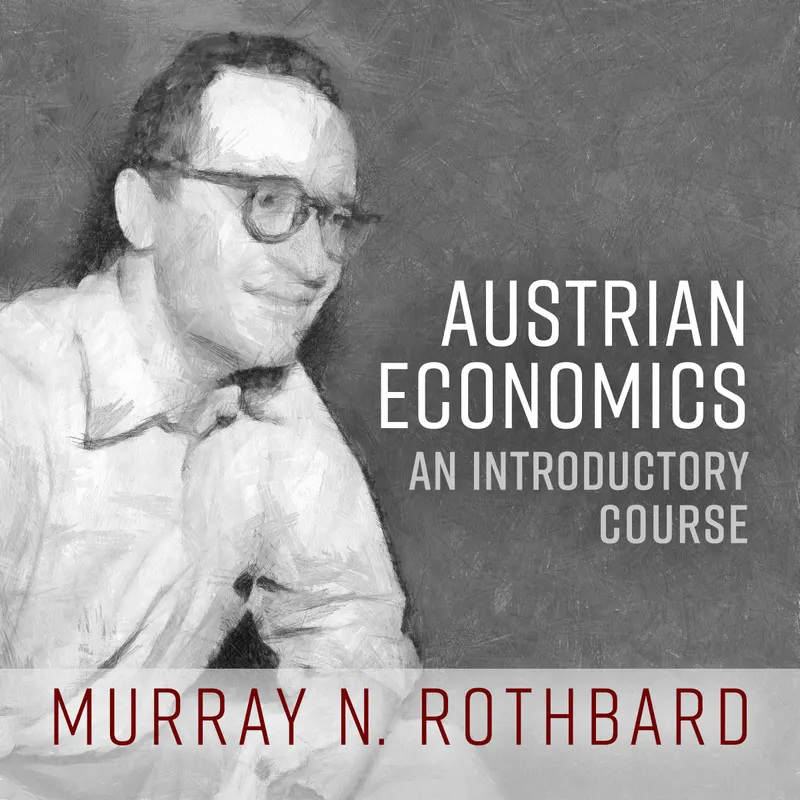
Austrian Economics: An Introductory Course
Murray N. Rothbard·16 episodes
Presented by Murray N. Rothbard in 1972 at New York Polytechnic University.
Why listen
This is a complete 16-lecture course from Murray N. Rothbard, recorded in 1972, that walks through Austrian economics from utility and demand to money, banking, and business cycles. It feels like sitting in on an old university lecture: direct, theory-heavy, and unapologetically ideological. It is best for listeners who want a primary-source introduction to Austrian and libertarian economic thought rather than a contemporary news podcast about markets.
Series(1)
Episodes
Lecture 16 of 16 from Austrian Economics: An Introductory Course, presented at New York Polytechnic University in 1972.
Lecture 15 of 16 from Austrian Economics: An Introductory Course, presented at New York Polytechnic University in 1972.
Lecture 14 of 16 from Austrian Economics: An Introductory Course, presented at New York Polytechnic University in 1972.
Lecture 13 of 16 from Austrian Economics: An Introductory Course, presented at New York Polytechnic University in 1972.
Lecture 12 of 16 from Austrian Economics: An Introductory Course, presented at New York Polytechnic University in 1972.
Lecture 11 of 16 from Austrian Economics: An Introductory Course, presented at New York Polytechnic University in 1972.
Lecture 10 of 16 from Austrian Economics: An Introductory Course, presented at New York Polytechnic University in 1972.
Lecture 9 of 16 from Austrian Economics: An Introductory Course, presented at New York Polytechnic University in 1972.
Lecture 8 of 16 from Austrian Economics: An Introductory Course, presented at New York Polytechnic University in 1972.
Lecture 7 of 16 from Austrian Economics: An Introductory Course, presented at New York Polytechnic University in 1972.
Lecture 6 of 16 from Austrian Economics: An Introductory Course, presented at New York Polytechnic University in 1972.
Lecture 5 of 16 from Austrian Economics: An Introductory Course, presented at New York Polytechnic University in 1972.
In this lecture in 1972, supply and demand concepts included: preferences of consumers, prices, quantity, quality, elasticity, equilibrium, marginal utility, present goods, and production processes. Lecture 2 of 16 from Austrian Economics: An Introductory Course, presented at New York Polytechnic University in 1972.
Advertising has always had bad press with economists, but consumers discover that a product either works and works well, or it doesn't. Consumer wants are not artificially created by business itself. Advertising as a selling cost seemed evil. The free market benefits every participant. But intervention benefits one group at the expense of another. Political advertising - propaganda - gets a free pass. Lecture 3 of 16 from Austrian Economics: An Introductory Course, presented at New York Polytechnic University in 1972.
Price controls — triangular interventions — occur when an intervener (generally government) either compels a pair of people to make an exchange or prohibits them from making an exchange. Although ludicrous, price controls are instituted because a product appears to be in short supply, e.g. oil — while price controls create artificial shortages of the product. The conservation movement ties in with the attack on comfort and consumption and humans in general. Lecture 4 of 16 from Austrian Economics: An Introductory Course, presented at New York Polytechnic University in 1972.
Economics begins with the concepts of scarcity and choice. If there was no scarcity it would all be free. Resources like time and materials need to be allocated to economically feasible uses. This will depend on the consumers' demand for the final product. Lecture 1 of 16 from Austrian Economics: An Introductory Course, presented at New York Polytechnic University in 1972.
Reviews
No reviews yet.
If you like this...


Explore more like this
Listening context
Discussion (0)
No comments yet. Be the first to start the discussion!