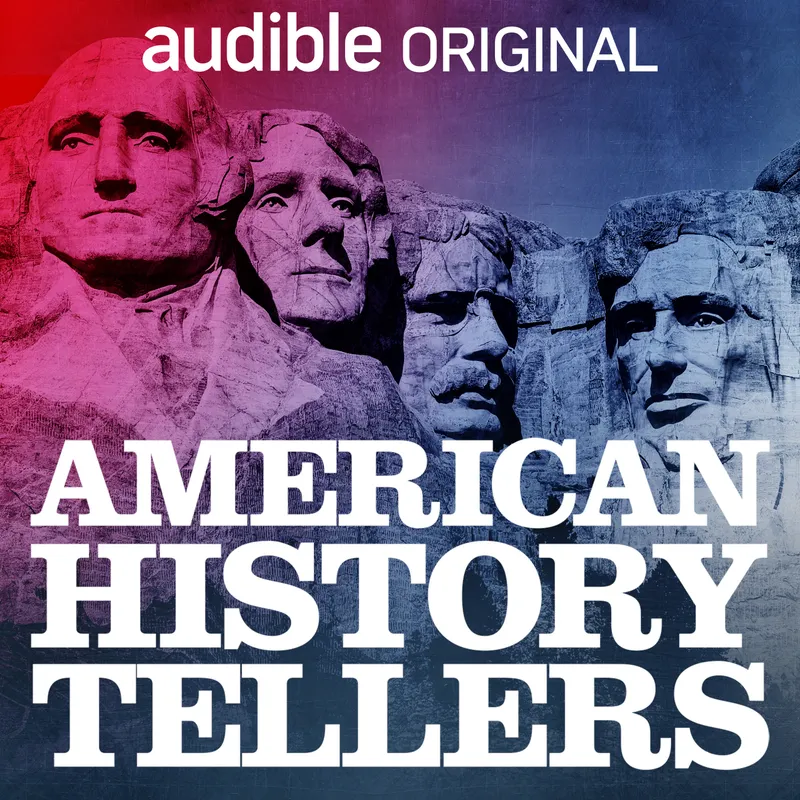
American History Tellers
Audible·Hosted by Lindsay Graham·489 episodes
The Cold War, Prohibition, the Gold Rush, the Space Race. Every part of your life - the words you speak, the ideas you share - can be traced to our history, but how well do you really know the stories that made America? We'll take you to the events, the times and the people that shaped our nation. And we'll show you how our history affected them, their families and affects you today. Hosted by Lindsay Graham (not the Senator). From Wondery, the network behind American Scandal, Tides of History, American Innovations and more.Audible subscribers can listen to all...
Why listen
American History Tellers turns U.S. history into polished, scene-driven audio stories, with Lindsay Graham guiding listeners through disasters, inventions, political fights, scandals, and cultural turning points. It is especially good for people who like history that feels dramatic and human without needing a textbook open beside them.
Series(2)
Episodes
Today George Washington is remembered as the quintessential “Founding Father,” but his path to becoming an American hero was far from certain. Throughout the Revolution, Washington and countless others—including women, free and enslaved Black people, and Indigenous nations—had to make difficult choices about where their loyalties lay and what kind of future they hoped to secure. To help us uncover these often-overlooked stories, Lindsay is joined by Dr. Scott Stephenson, President and CEO of Philadelphia’s Museum of the American Revolution, where the nation’s founding is explored as an ongoing experiment in liberty, equality, and self-government.See Privacy Policy at https://art19.com/privacy and California Privacy Notice at https://art19.com/privacy#do-not-sell-my-info.
Just in time for America’s 250th birthday, follow Dan Taberski (Hysterical, 9/12, Missing Richard Simmons) as he sets off on his most complicated quest yet: to reclaim the manifesto and write his own. Dan attempts to rescue the manifesto as a form from the sweaty clutches of cynical politicians and mass shooters and return it to its rightful place: with the artists, the warriors, the visionaries, and the mildly crazy regular folks with something to say, the passion to say it, and the courage to do something about it. From Audible Originals and Please & Thanks Productions, this 6-part series explores the power of the manifesto and asks: Can we get inspired again… and can we do it without a bullet? Listen to Dan Taberski's Manifesto wherever you get your podcasts. Or binge all episodes of Manifesto ad-free right now on Audible. Start your Audible subscription in the Audible App or on Apple Podcasts.See Privacy Policy at https://art19.com/privacy and California Privacy Notice at https://art19.com/privacy#do-not-sell-my-info.
After six long years of war, the Continental Army was exhausted, and Congress had run out of money. George Washington feared that without a decisive victory, the cause of independence would be lost.But there was fresh cause for hope in the summer of 1781, as a massive French fleet sailed for the Chesapeake Bay. French and American commanders devised a plan to trap the British Army on a peninsula in Yorktown, Virginia.See Privacy Policy at https://art19.com/privacy and California Privacy Notice at https://art19.com/privacy#do-not-sell-my-info.
In the aftermath of America’s victory at Saratoga, France entered the Revolutionary War, transforming the colonial rebellion into a global conflict. British officials decided that the path to victory lay in the South. As the fighting shifted to the Carolinas, a brutal civil war erupted, pitting families and neighbors against one another in cycles of violence and retribution.By 1779, the Patriot cause hung in the balance, undermined by rampant inflation, soldier mutinies, and one of the most notorious incidents of treason in American history.See Privacy Policy at https://art19.com/privacy and California Privacy Notice at https://art19.com/privacy#do-not-sell-my-info.
In 1777, as Americans sought the support of France, Benjamin Franklin struggled to convince officials in Paris to form a military alliance with the new United States. Meanwhile, British General John Burgoyne planned a grand strategy to crush the rebellion by conquering the Hudson River Valley. That summer, his troops fought the Continental Army in a battle that would turn the tide of the American Revolution.But late that year, American forces faced a winter of peril as George Washington led his exhausted army into quarters at Valley Forge, where the soldiers endured disease, freezing conditions, and the threat of starvation.See Privacy Policy at https://art19.com/privacy and California Privacy Notice at https://art19.com/privacy#do-not-sell-my-info.
Ed is the grandson of footballing legend Gordon Banks. He was a national icon, the only goalkeeper ever to win the soccer World Cup for England. But Ed’s heard a rumour: that in 1970, while defending the title, his granddad, his hero, was poisoned… by the CIA. All part of a Cold War plot to bolster a military dictatorship in Latin America, supposedly. Could this possibly be true? Banks did get ill in Mexico in 1970 with food poisoning. And England crashed out, marking the start of decades of hurt. Ed enlists the help of investigative journalist Gabriel Gatehouse. Together they embark on a journey into the bewildering world of Cold War espionage, a journey that threatens to unravel 60 years of sporting history; or possibly… to knock Ed’s granddad off his pedestal. Listen to FOUL PLAY on the Audible App or wherever you get your podcasts. Audible subscribers can binge all episodes of FOUL PLAY early and ad-free right now. Join Audible in the Audible App or by subscribing on Apple Podcasts.See Privacy Policy at https://art19.com/privacy and California Privacy Notice at https://art19.com/privacy#do-not-sell-my-info.
In July 1776, the British Royal Navy began landing a massive armada in New York Harbor, setting up the biggest battle of the Revolutionary War. In response, General George Washington faced the daunting challenge of preparing his motley army to defend New York and keep the colonists’ hopes alive.In the months that followed, faith in the cause of independence began to waver, and the Continental Army teetered on the brink of collapse. But on Christmas night, the Patriots made a bold strike against the British Army that began with a daring crossing of the icy Delaware River.See Privacy Policy at https://art19.com/privacy and California Privacy Notice at https://art19.com/privacy#do-not-sell-my-info.
In the aftermath of the Battles of Lexington and Concord, colonial militiamen converged on Boston to confront the veteran British Army. But over the next six months, newly appointed commander-in-chief George Washington struggled to transform a patchwork of amateur militias into a unified national army.As the conflict wore on, Americans debated whether to escalate the fight and take the unprecedented step of declaring their independence.See Privacy Policy at https://art19.com/privacy and California Privacy Notice at https://art19.com/privacy#do-not-sell-my-info.
Dr. John Schneider rode into town like a character out of a Western: an outsider on a Harley-Davidson, in trademark cowboy boots. He promised relief to patients suffering in Wyoming and Montana. He seemed like the hero they needed. But when surgeries go wrong and a strange letter exposes a bitter feud, medical professionals and government officials search for the truth about this cowboy doctor. They discover claims of broken bodies, bullying, fraud, and lawsuits.From Audible, the fifth season of the hit series Dr. Death returns with The Cowboy: the story of a surgeon who took advantage of a broken system and the fight to bring him to justice. Listen to Dr. Death: The Cowboy wherever you get your podcasts. Audible subscribers can binge all episodes of Dr. Death: The Cowboy ad-free right now. Start your Audible subscription in the Audible App or on Apple Podcasts.See Privacy Policy at https://art19.com/privacy and California Privacy Notice at https://art19.com/privacy#do-not-sell-my-info.
In 1765, King George III and his ministers in the British Parliament sparked outrage in the American Colonies when they announced they were issuing the Stamp Act, the first direct tax on the Colonies. American critics decried the “taxation without representation,” and Boston radicals staged protests, boycotts, and attacks on tax collectors.After a decade of growing tension over taxes, representation, and imperial control, the first shots of the Revolutionary War rang out in the Massachusetts countryside, as colonial militiamen confronted British regulars on the Lexington village green.See Privacy Policy at https://art19.com/privacy and California Privacy Notice at https://art19.com/privacy#do-not-sell-my-info.
Thomas Edison is one of the most celebrated inventors in American history, having helped transform a world lit by candles and gas lamps into one powered by electricity. Over his lifetime he was granted more than a thousand patents, and pioneered the very idea of organized innovation at his ground-breaking research and development laboratories. But the story of how he did it is complicated. So, to help us understand Edison’s remarkable achievements, Lindsay is joined by Dr. Paul Israel, Director and General Editor of the Thomas A. Edison Papers at Rutgers University. He’s the author of Edison: A Life of Invention. See Privacy Policy at https://art19.com/privacy and California Privacy Notice at https://art19.com/privacy#do-not-sell-my-info.
Is what’s happening on OnlyFans real? Or is it only a fantasy?In this provocative investigation into OnlyFans—the adult platform where subscribers around the world spent more than $7 billion in 2024—journalist Leon Neyfakh teams up with comedian and OnlyFans creator Gracie Canaan for a one-of-a-kind exploration into the current state of human connection. Throughout, they discover that the site originally built for spicy adult content has quietly and surprisingly become something more complicated— an emotional marketplace where desire, performance, care, fantasy, and vulnerability seemingly blur together.As Neyfakh and Canaan navigate timely questions about autonomy, performance, and profit, a question emerges: is connection mediated by a screen still authentic? To find the answer, they meet creators building lucrative businesses, subscribers who believe they’ve found something real, professional “chatters” who are paid to simulate affection, and pioneers who have helped engineer intimacy at scale.Captivating and tender, OnlyFantasy is ultimately about the cost of loneliness, the seductive power of desire, and how the rules of human intimacy are being rewritten online.Listen to OnlyFantasy wherever you get your podcasts. Or binge all episodes of OnlyFantasy ad-free right now on Audible. Start your Audible subscription in the Audible App or on Apple Podcasts.See Privacy Policy at https://art19.com/privacy and California Privacy Notice at https://art19.com/privacy#do-not-sell-my-info.
By 1888, the race to power America's cities had become a battle between the rival visions of Thomas Edison and Nikola Tesla. But when the powerful industrialist George Westinghouse threw his weight behind Tesla and his AC system, what had been a personal falling out became something far larger – a war over the future of electricity itself. Their bitter fight spilled into courtrooms, ignited a national debate about capital punishment, and culminated in a fierce competition for the contract to illuminate the most ambitious event of the decade: the Chicago World’s Fair.See Privacy Policy at https://art19.com/privacy and California Privacy Notice at https://art19.com/privacy#do-not-sell-my-info.
In the spring of 1884, a little-known Serbian immigrant named Nikola Tesla arrived in America with little more than a letter of introduction to the most famous inventor in the world – Thomas Edison. Tesla went to work for Edison, impressing his new employer with his intelligence and work ethic. But the two men were too different, too stubborn, and too convinced of their own vision to coexist for long. Tesla would break away, determined to prove that his own approach to electricity – a system run on alternating current – was superior to everything Edison had built.See Privacy Policy at https://art19.com/privacy and California Privacy Notice at https://art19.com/privacy#do-not-sell-my-info.
In the 1870s, the age of artificial light was still in its infancy. Gas lamps cast a dim glow on city streets, and early arc lights were just beginning to appear in a handful of public spaces. But reliable, practical light for homes and businesses remained out of reach for most people. Then, in 1878, America’s most famous inventor, Thomas Edison, witnessed a demonstration of a novel electric generator and had a spark of inspiration. Edison was convinced that he would be the one to harness electricity to illuminate the world. He set his sights on an audacious goal: not just to improve the light bulb, but to build a system capable of lighting an entire city. It was a vision that would demand years of relentless experimentation and push him to the brink of failure. And just as his system flickered to life, a new rival would emerge — one with a radically different vision of electricity.See Privacy Policy at https://art19.com/privacy and California Privacy Notice at https://art19.com/privacy#do-not-sell-my-info.
The devastation of the 1900 Galveston hurricane left thousands dead and a city in ruins — but it also set in motion a remarkable story of recovery and reinvention. As survivors buried their dead and relief poured in, city leaders adopted an entirely new form of government to steer the rebuilding effort. In this episode, Lindsay is joined by historian Dr. Patricia Bixel, who shares how Galveston rose from the wreckage — constructing a massive seawall and raising the city's own grade to face whatever the Gulf might bring next. Bixel is the co-author, with Elizabeth Hayes Turner, of Galveston and the 1900 Storm: Catastrophe and Catalyst.See Privacy Policy at https://art19.com/privacy and California Privacy Notice at https://art19.com/privacy#do-not-sell-my-info.
On September 9, 1900, the residents of Galveston, Texas woke up to find their island in ruins. Entire neighborhoods had vanished overnight. Telegraph, telephone, and electrical lines were destroyed, as were the four bridges connecting Galveston to the mainland. Bloodied men, women, and children stumbled through the streets. And thousands of corpses were strewn amongst the wreckage, victims of what remains America’s deadliest natural disaster.As the survivors reckoned with the challenge of rebuilding their lives, Clara Barton, the 78-year-old founder and president of the American Red Cross, rushed to Galveston to aid with relief.See Privacy Policy at https://art19.com/privacy and California Privacy Notice at https://art19.com/privacy#do-not-sell-my-info.
As a catastrophic hurricane approached Galveston, Texas on the morning of September 8, 1900, residents continued to go about their daily lives, with little warning of what was to come. Children played in the surf at the beach, and workers clocked in for their shifts downtown. But when the full strength of the storm hit, water from the Gulf of Mexico flooded the streets of the island city, and 100 mile-per-hour winds sent bricks, tree branches, and slate roof tiles flying through the air. Between 6 and 8 o’clock that night, a monster storm surge washed over the island, forcing thousands of men, women, and children into a battle for their lives.See Privacy Policy at https://art19.com/privacy and California Privacy Notice at https://art19.com/privacy#do-not-sell-my-info.
At the turn of the 20th century, a booming cotton trade had made the Gulf Coast city of Galveston, Texas an economic powerhouse. Located just a few feet above sea level on a narrow barrier island, it was prone to flooding. But in a time before sophisticated weather forecasting, residents failed to grasp the danger lurking in their midst.In early September 1900, as a tropical storm gathered strength in the Caribbean Sea, Cuban forecasters warned that a powerful hurricane was charging toward Texas. But in the aftermath of the Spanish-American War, U.S. Weather Bureau officials had banned all weather-related telegrams from Cuba. Soon, the deadliest natural disaster in American history would strike Galveston without warning.See Privacy Policy at https://art19.com/privacy and California Privacy Notice at https://art19.com/privacy#do-not-sell-my-info.
In 1949, aspiring writer Nelle Harper Lee moved from her home in small-town Alabama to New York City. She was following in the footsteps of her childhood friend, author Truman Capote. Within a few years she had penned a novel of her own, and called it To Kill a Mockingbird.To Kill a Mockingbird catapulted Harper Lee to the heights of literary fame. But just as she found success, she withdrew, overwhelmed by being in the public eye, and the pressure to produce another book as good as her first. Decades would pass before anyone mentioned the possibility of her publishing again - and this time, people wondered how much of a voice she really had in the publication of her second book.See Privacy Policy at https://art19.com/privacy and California Privacy Notice at https://art19.com/privacy#do-not-sell-my-info.
Born into poverty in Harlem in 1924, James Baldwin rose to become a celebrated novelist, essayist, playwright, and poet, and a leading voice in the Civil Rights movement of the 1960s. In his debut novel, Go Tell It on the Mountain, and in his essay collections, Notes of a Native Son and The Fire Next Time, Baldwin wrote eloquently and provocatively about race, religion, sexuality, politics and class. To distance himself from the racial hatred and discrimination at home, Baldwin spent much of his adult life in France, helping to create a vibrant community for other Black artists, such as Nina Simone, Miles Davis and Josephine Baker. But he returned to America often to provide a fearless and incisive testimony to the events that defined his tumultuous era.See Privacy Policy at https://art19.com/privacy and California Privacy Notice at https://art19.com/privacy#do-not-sell-my-info.
Growing up in the Salinas Valley of Northern California, John Steinbeck dreamed of becoming a professional writer. In his youth he took on odd jobs and worked amongst ranch hands and migrant workers, who would inspire some of his greatest work, including The Grapes of Wrath. Published in 1939, the book captured the struggles of everyday Americans during the Great Depression, and Steinbeck became famous for his empathetic portrayal of the working class.Steinbeck would go on to become one of the most decorated authors of the 20th Century, winning the Pulitzer Prize and the Nobel Prize for Literature, but he was plagued by marital struggles and chronic illness that threatened to cut short his writing career.See Privacy Policy at https://art19.com/privacy and California Privacy Notice at https://art19.com/privacy#do-not-sell-my-info.
In the late 1850s, a young man named Samuel Clemens started out piloting steamboats on the Mississippi River. Within a few years, he embarked on a writing career, adopting the pen name that became famous: Mark Twain. Armed with a wry sense of humor and a natural flair for storytelling, Twain gained wide acclaim for his short stories, travel sketches, and novels.In 1885, he published The Adventures of Huckleberry Finn, a story of two runaways on a quest for freedom. It would become one of the most celebrated, and controversial, books in American literature. But at the height of his popularity, his risky business ventures and his critiques of American policy abroad threatened to ruin his legacy.See Privacy Policy at https://art19.com/privacy and California Privacy Notice at https://art19.com/privacy#do-not-sell-my-info.
In 1840, eight-year-old Louisa May Alcott moved to the small town of Concord, Massachusetts with her family. There, she spent her days wandering through the woods, putting on plays with her sisters, and learning from famed writers and philosophers such as Henry David Thoreau and Ralph Waldo Emerson.For years, Alcott struggled to achieve success as a writer. Then in 1868, she drew inspiration from her youth to write her beloved coming-of-age novel Little Women. By exploring the aspirations and challenges faced by young women, she defied 19th century norms that sought to confine women in both life and literature.See Privacy Policy at https://art19.com/privacy and California Privacy Notice at https://art19.com/privacy#do-not-sell-my-info.
In February 1826, 17-year-old Edgar Allan Poe was a promising student at the University of Virginia. But within a few months, gambling debts forced him to abandon his studies. It was just one of many setbacks Poe endured in a life marked by financial struggle, alcoholism, and personal tragedy.But Poe launched a remarkable career in writing, helping to establish American literature with a bold, new voice. From short stories including “The Fall of the House of Usher,” to the poem that made him famous, “The Raven,” he transformed the horror genre by delving into the dark recesses of the human subconscious and pushing the boundaries of fiction and verse.See Privacy Policy at https://art19.com/privacy and California Privacy Notice at https://art19.com/privacy#do-not-sell-my-info.
In the aftermath of the St. Valentine’s Day Massacre, authorities faced mounting pressure to clean up Chicago and take down the violent mobsters who overran the city – most notoriously, Al Capone. The federal government took on the challenge, pursuing Capone relentlessly. In the end, Capone did go down – not for murder, but for tax evasion. And since Capone’s conviction in the 1930s, this unorthodox charge has been used repeatedly to bring down otherwise “ungettable” criminals. To discuss how the feds finally closed in on Capone, Lindsay speaks with Jonathan Eig, the Pulitzer Prize–winning author of Get Capone: The Secret Plot That Captured America’s Most Wanted Gangster.See Privacy Policy at https://art19.com/privacy and California Privacy Notice at https://art19.com/privacy#do-not-sell-my-info.
On Valentine’s Day 1929, seven men were gunned down in a Chicago garage in an attack that stunned the nation. Photographs of the bloody scene appeared on front pages across the country, and the public reacted with horror. Even in Chicago—a city hardened by daily gang violence—the message was clear: this was different.City officials were under intense pressure to respond, and suspicion quickly fell on the city’s most powerful gang leader, Al Capone. But proving who ordered the hit would be far more difficult than expected. And as investigators struggled to build their case, the fallout from the massacre would change Chicago—and Capone’s fate—forever.See Privacy Policy at https://art19.com/privacy and California Privacy Notice at https://art19.com/privacy#do-not-sell-my-info.
In 1920, a young Al Capone arrived in Chicago looking for a fresh start, and his timing couldn’t have been better. That same year, Prohibition outlawed the manufacture and sale of alcohol, turning America’s thirst into a criminal gold rush. Chicago quickly became the epicenter of bootlegging, and Capone was determined to seize the moment and make himself rich beyond imagination. But the city was already crowded with ambitious gangsters chasing the same prize. As rival bootleggers carved up territory, Chicago descended into a violent turf war that would reshape the criminal underworld.See Privacy Policy at https://art19.com/privacy and California Privacy Notice at https://art19.com/privacy#do-not-sell-my-info.
In the early 1950s, Jonas Salk and Albert Sabin were in a race to develop a vaccine against polio. While Salk’s killed-virus vaccine was the first to be distributed, Sabin continued working to perfect his own approach. In the end, Sabin’s oral polio vaccine—made from a weakened live virus—proved easier to administer and was ultimately distributed far more widely, though his name never achieved the same recognition. In this episode, Lindsay is joined by epidemiologist and oral historian Karen Torghele. Her book Albert Sabin: The Life of a Polio Vaccine Pioneer is due to be published by Yale University Press in June of 2026. See Privacy Policy at https://art19.com/privacy and California Privacy Notice at https://art19.com/privacy#do-not-sell-my-info.
In April 1954, a group of first graders lined up in the gymnasium of an elementary school in McLean, Virginia for the start of the Salk polio vaccine trials. In an era before widespread federal government involvement in public health, the National Institute of Infantile Paralysis executed an unprecedented experiment involving nearly 2 million children and tens of thousands of doctors, nurses, and volunteers. It was the largest peacetime mobilization in American history.While scientists evaluated the results, Americans waited anxiously to find out whether the vaccine was safe and effective, putting an end to 40 years of fear. But in the spring of 1955, a shocking revelation would bring the vaccination program to a sudden halt.Be the first to know about Wondery’s newest podcasts, curated recommendations, and more! Sign up now at https://wondery.fm/wonderynewsletterListen to American History Tellers on the Wondery App or wherever you get your podcasts. Experience all episodes ad-free and be the first to binge the newest season. Unlock exclusive early access by joining Wondery+ in the Wondery App, Apple Podcasts or Spotify. Start your free trial today by visiting wondery.com/links/american-history-tellers/ now.See Privacy Policy at https://art19.com/privacy and California Privacy Notice at https://art19.com/privacy#do-not-sell-my-info.
By the late 1940s, the National Institute of Infantile Paralysis had raised millions of dollars to pay for patient care and laboratory research. But polio cases were reaching record levels, and scientists were no closer to a cure. Frustrated by the slow progress, Basil O’Connor resolved to recruit fresh talent to the cause. He soon found what he was looking for in a young and energetic researcher named Jonas Salk.In 1951, Salk began testing a killed virus polio vaccine on monkeys in his Pittsburgh lab. His research soon put him at odds with the leading polio scientist Albert Sabin, who wanted his own live virus vaccine formula to prevail. As their rivalry escalated, Salk prepared to take the risky step of testing his vaccine on human subjects.Be the first to know about Wondery’s newest podcasts, curated recommendations, and more! Sign up now at https://wondery.fm/wonderynewsletterListen to American History Tellers on the Wondery App or wherever you get your podcasts. Experience all episodes ad-free and be the first to binge the newest season. Unlock exclusive early access by joining Wondery+ in the Wondery App, Apple Podcasts or Spotify. Start your free trial today by visiting wondery.com/links/american-history-tellers/ now.See Privacy Policy at https://art19.com/privacy and California Privacy Notice at https://art19.com/privacy#do-not-sell-my-info.
After two turbulent decades in the ice trade, Frederic Tudor had finally made it. Expanding into the American South had paid off, with cities like New Orleans delivering steady profit. But Tudor’s insatiable appetite for risk kept pushing him to bet everything – again and again – even as losses mounted and disaster loomed.As he entered his 50s, Tudor seemed ready to slow down. But when he was offered the opportunity to ship his ice halfway around the world to India, he couldn’t resist expanding his business once more. And just when it seemed he had mastered the trade he built from nothing, one final gamble threatened to undo everything he’d spent decades building.Be the first to know about Wondery’s newest podcasts, curated recommendations, and more! Sign up now at https://wondery.fm/wonderynewsletterListen to American History Tellers on the Wondery App or wherever you get your podcasts. Experience all episodes ad-free and be the first to binge the newest season. Unlock exclusive early access by joining Wondery+ in the Wondery App, Apple Podcasts or Spotify. Start your free trial today by visiting wondery.com/links/american-history-tellers/ now.See Privacy Policy at https://art19.com/privacy and California Privacy Notice at https://art19.com/privacy#do-not-sell-my-info.
In the summer of 1921, 39-year-old Franklin Delano Roosevelt was on vacation with his family when he developed a fever, muscle aches, and chills. Pain spread to his legs, and soon, he was paralyzed from the waist down. Doctors diagnosed him with polio, which was fast becoming America’s most dreaded infectious disease.Every summer, polio struck without warning, causing swimming pools and movie theaters to close and panicked parents to keep their children indoors. Polio killed thousands of Americans each year and paralyzed many more. But scientists had no idea how to stop it.Roosevelt and his friend and colleague Basil O’Connor resolved to change that, launching the March of Dimes, a revolutionary fundraising campaign that galvanized millions of Americans to donate their time and money to the fight against polio.Be the first to know about Wondery’s newest podcasts, curated recommendations, and more! Sign up now at https://wondery.fm/wonderynewsletteListen to American History Tellers on the Wondery App or wherever you get your podcasts. Experience all episodes ad-free and be the first to binge the newest season. Unlock exclusive early access by joining Wondery+ in the Wondery App, Apple Podcasts or Spotify. Start your free trial today by visiting wondery.com/links/american-history-tellers/ now.See Privacy Policy at https://art19.com/privacy and California Privacy Notice at https://art19.com/privacy#do-not-sell-my-info.
By 1816, Frederic Tudor had spent a decade shipping New England ice to Cuba—with little to show for it. Setbacks and vanished profits nearly ruined him, and a gamble on shipping tropical fruit had left him barely solvent. Then a chance conversation sparked a bold new idea: expand the ice trade into the American South. Tudor rushed to South Carolina, only to clash with state officials who refused to grant him a monopoly on trade – a tactic he’d come to rely on. Their refusal forced him to rethink everything, and revise his strategy. But just as he began to find success, a series of catastrophes threatened his health, and events were set in motion that would transform the Ice King’s future forever.Be the first to know about Wondery’s newest podcasts, curated recommendations, and more! Sign up now at https://wondery.fm/wonderynewsletterListen to American History Tellers on the Wondery App or wherever you get your podcasts. Experience all episodes ad-free and be the first to binge the newest season. Unlock exclusive early access by joining Wondery+ in the Wondery App, Apple Podcasts or Spotify. Start your free trial today by visiting wondery.com/links/american-history-tellers/ now.See Privacy Policy at https://art19.com/privacy and California Privacy Notice at https://art19.com/privacy#do-not-sell-my-info.
In 1806, Frederic Tudor set out to build a fortune by shipping ice from his family’s pond near Boston to the tropical Caribbean—an audacious idea no one believed in. But turning frozen water into profit proved far harder than he imagined. By 1809, an embargo had halted his shipments, his debts had mounted, and Tudor himself landed in jail. Still, he refused to abandon the dream that everyone else mocked. Forced to improvise, innovate, and gamble, Tudor pushed ahead—determined to make the impossible pay. Be the first to know about Wondery’s newest podcasts, curated recommendations, and more! Sign up now at https://wondery.fm/wonderynewsletterListen to American History Tellers on the Wondery App or wherever you get your podcasts. Experience all episodes ad-free and be the first to binge the newest season. Unlock exclusive early access by joining Wondery+ in the Wondery App, Apple Podcasts or Spotify. Start your free trial today by visiting wondery.com/links/american-history-tellers/ now.See Privacy Policy at https://art19.com/privacy and California Privacy Notice at https://art19.com/privacy#do-not-sell-my-info.
In 1801, a young Boston merchant named Frederic Tudor made a life-changing visit to Cuba. There he had a wildly ambitious idea: he would ship New England ice to the sweltering Caribbean, where no one had ever seen frozen water – let alone tasted a cold drink or ice cream. Lacking experience and money, Tudor was mocked by seasoned ship captains who called his plan foolish. Still, by 1806 he’d scraped together enough funds to send a shipment of ice to the island of Martinique. But once it arrived, Tudor would have to convince island residents to buy a product they’d never imagined – before any hope of profit melted away.Be the first to know about Wondery’s newest podcasts, curated recommendations, and more! Sign up now at https://wondery.fm/wonderynewsletterListen to American History Tellers on the Wondery App or wherever you get your podcasts. Experience all episodes ad-free and be the first to binge the newest season. Unlock exclusive early access by joining Wondery+ in the Wondery App, Apple Podcasts or Spotify. Start your free trial today by visiting wondery.com/links/american-history-tellers/ now.See Privacy Policy at https://art19.com/privacy and California Privacy Notice at https://art19.com/privacy#do-not-sell-my-info.
In 1620 the Pilgrims arrived in a land already shaped by centuries of Native history. For the people who lived there, the Wampanoag, it was Patuxet—a place with its own stories, its own politics, and, as the Pilgrims soon learned, a complicated history of encounters with Europeans.In this episode Lindsay is joined by David Silverman, professor of history at George Washington University and author of This Land Is Their Land: The Wampanoag Indians, Plymouth Colony, and the Troubled History of Thanksgiving. He helps us imagine the arrival of the Mayflower from the Wampanoag point of view—what they saw, what they feared, and what choices lay before them.Be the first to know about Wondery’s newest podcasts, curated recommendations, and more! Sign up now at https://wondery.fm/wonderynewsletterListen to American History Tellers on the Wondery App or wherever you get your podcasts. Experience all episodes ad-free and be the first to binge the newest season. Unlock exclusive early access by joining Wondery+ in the Wondery App, Apple Podcasts or Spotify. Start your free trial today by visiting wondery.com/links/american-history-tellers/ now.See Privacy Policy at https://art19.com/privacy and California Privacy Notice at https://art19.com/privacy#do-not-sell-my-info.
December 1, 1934. Leningrad mayor Sergei Kirov is assassinated by a lone gunman, giving Soviet Premier Joseph Stalin the justification to purge the Communist Party of his rivals.You can listen ad-free in the Wondery or Amazon Music app. Or for all that and more, go to IntoHistory.comHistory Daily is a co-production of Airship and Noiser.Go to HistoryDaily.com for more history, daily.See Privacy Policy at https://art19.com/privacy and California Privacy Notice at https://art19.com/privacy#do-not-sell-my-info.
In May 1622, the Pilgrims were still reeling from Squanto’s betrayal when a ship appeared in Plymouth Harbor, carrying an advance party for a rival English colony. Governor William Bradford reluctantly agreed to host the men while they searched for a site to settle. But the newcomers strained Plymouth’s limited food supplies, pushing the hungry colony to the brink of starvation. As the new arrivals began antagonizing their Indian neighbors, word spread of a plot to destroy the English. The Pilgrims’ violent response to the crisis would change New England forever.Be the first to know about Wondery’s newest podcasts, curated recommendations, and more! Sign up now at https://wondery.fm/wonderynewsletterListen to American History Tellers on the Wondery App or wherever you get your podcasts. Experience all episodes ad-free and be the first to binge the newest season. Unlock exclusive early access by joining Wondery+ in the Wondery App, Apple Podcasts or Spotify. Start your free trial today by visiting wondery.com/links/american-history-tellers/ now.See Privacy Policy at https://art19.com/privacy and California Privacy Notice at https://art19.com/privacy#do-not-sell-my-info.
On May 5, 1993, three 8-year-old boys were brutally murdered in West Memphis, Arkansas. The tiny local police department launches an investigation but finds little physical evidence to lead them to a suspect. Eventually, outside pressure pushes them to charge someone with the killings, whether or not the evidence supports their conclusions.American Scandal takes you deep into the heart of America’s dark side to look at what drives someone to break the rules and what happens when they’re caught. In our latest series, three teenage boys are falsely accused of a vicious triple homicide, but their story doesn't end with their trials or convictions. Instead, their plight will capture the imagination of the entire country and spark a campaign for justice that will last for almost two decades. Listen to American Scandal: The West Memphis Three: Wondery.fm/AS_IFDSee Privacy Policy at https://art19.com/privacy and California Privacy Notice at https://art19.com/privacy#do-not-sell-my-info.
November 24, 1859. Charles Darwin sparks a scientific revolution by introducing the theory of evolution in his book On the Origin of Species.You can listen ad-free in the Wondery or Amazon Music app. Or for all that and more, go to IntoHistory.comHistory Daily is a co-production of Airship and Noiser.Go to HistoryDaily.com for more history, daily.See Privacy Policy at https://art19.com/privacy and California Privacy Notice at https://art19.com/privacy#do-not-sell-my-info.
"The winter of 1620-21 took a deadly toll on Plymouth Colony. The Pilgrims had only just begun to construct their homes when illness began spreading through the settlement. Their flimsy shelters offered little protection from the freezing weather. As dysentery, pneumonia, and scurvy ravaged the colony, only a handful were left to build the settlement, care for the sick, and bury the dead. And the Pilgrims sensed that nearby Indians were waiting patiently for the right moment to strike. But they knew that if they were going to survive in the New World, they would need to befriend the Native people who had lived in the region for generations.Be the first to know about Wondery’s newest podcasts, curated recommendations, and more! Sign up now at https://wondery.fm/wonderynewsletterListen to American History Tellers on the Wondery App or wherever you get your podcasts. Experience all episodes ad-free and be the first to binge the newest season. Unlock exclusive early access by joining Wondery+ in the Wondery App, Apple Podcasts or Spotify. Start your free trial today by visiting wondery.com/links/american-history-tellers/ now."See Privacy Policy at https://art19.com/privacy and California Privacy Notice at https://art19.com/privacy#do-not-sell-my-info.
"In the fall of 1620, the Mayflower embarked on a 3,000-mile journey across the Atlantic Ocean. Over the next nine weeks, its passengers and crew battled fierce storms and rampant illness. They had left England dangerously late in the season, and provisions ran low. In the ship’s cramped cabins, the Puritan Separatists shared close quarters with a group known as “Strangers” who did not share their tight bonds or religious beliefs. When strong gales blew the ship off course, tensions between the Puritans and the Strangers exploded, threatening to tear the colony apart before they even set foot in the New World.Be the first to know about Wondery’s newest podcasts, curated recommendations, and more! Sign up now at https://wondery.fm/wonderynewsletterListen to American History Tellers on the Wondery App or wherever you get your podcasts. Experience all episodes ad-free and be the first to binge the newest season. Unlock exclusive early access by joining Wondery+ in the Wondery App, Apple Podcasts or Spotify. Start your free trial today by visiting wondery.com/links/american-history-tellers/ now."See Privacy Policy at https://art19.com/privacy and California Privacy Notice at https://art19.com/privacy#do-not-sell-my-info.
In the early 1600s, an orphaned teenager named William Bradford joined a clandestine congregation of passionate Puritan worshipers in the village of Scrooby, England. Every Sunday, he met in secret with the radical group known as Separatists, who believed that the Church of England was corrupt, and that the only way forward was to break with it entirely. But defiance of the Church of England was a serious crime, and Bradford and his fellow worshippers faced harassment and persecution.So they resolved to leave England altogether and flee to Holland, where they could worship in peace. It was the start of a long and turbulent odyssey that would end on the rocky shores of New England, with the founding of Plymouth Colony. Be the first to know about Wondery’s newest podcasts, curated recommendations, and more! Sign up now at https://wondery.fm/wonderynewsletterListen to American History Tellers on the Wondery App or wherever you get your podcasts. Experience all episodes ad-free and be the first to binge the newest season. Unlock exclusive early access by joining Wondery+ in the Wondery App, Apple Podcasts or Spotify. Start your free trial today by visiting wondery.com/links/american-history-tellers/ now.See Privacy Policy at https://art19.com/privacy and California Privacy Notice at https://art19.com/privacy#do-not-sell-my-info.
Humans are resilient. In our toughest moments, we will fight, we will struggle, and we will triumph...often against the odds. In this immersive series from Wondery, host-adventurers Mike Corey and Cassie De Pecol will share thrilling stories of survival. From the daring rescue of a soccer team trapped in an underwater cave in Thailand, to a woman taken hostage by Somali pirates, these stories made headlines around the world.Against The Odds will make you feel as though you’re living these experiences with our heroes as they push themselves to their limits. Listen to Against The Odds: Tsunami In Thailand: https://Wondery.fm/ATO_IFDSee Privacy Policy at https://art19.com/privacy and California Privacy Notice at https://art19.com/privacy#do-not-sell-my-info.
In the aftermath of the deadly shootout at the OK Corral, the residents of Tombstone are sharply divided over whether to indict the Earp brothers and Doc Holliday. As the town teeters on the edge of all-out war, Wyatt Earp decides to take justice into his own hands leading to a vengeful ""Vendetta Ride"" that puts Wyatt on the wrong side of the law.Be the first to know about Wondery’s newest podcasts, curated recommendations, and more! Sign up now at https://wondery.fm/wonderynewsletterListen to American History Tellers on the Wondery App or wherever you get your podcasts. Experience all episodes ad-free and be the first to binge the newest season. Unlock exclusive early access by joining Wondery+ in the Wondery App, Apple Podcasts or Spotify. Start your free trial today by visiting wondery.com/links/american-history-tellers/ now.See Privacy Policy at https://art19.com/privacy and California Privacy Notice at https://art19.com/privacy#do-not-sell-my-info.
Tensions boil over in Tombstone, Arizona as the Earp brothers confront the Clanton and McLaury outlaw gang, resulting in a 30-second shootout that leaves several dead. With the town divided over the Earps' actions, the brothers face an onslaught of assassination attempts as they try to maintain order in the lawless frontier town.Be the first to know about Wondery’s newest podcasts, curated recommendations, and more! Sign up now at https://wondery.fm/wonderynewsletterListen to American History Tellers on the Wondery App or wherever you get your podcasts. Experience all episodes ad-free and be the first to binge the newest season. Unlock exclusive early access by joining Wondery+ in the Wondery App, Apple Podcasts or Spotify. Start your free trial today by visiting wondery.com/links/american-history-tellers/ now.See Privacy Policy at https://art19.com/privacy and California Privacy Notice at https://art19.com/privacy#do-not-sell-my-info.
After several months of anxiety, the tensions in Tombstone finally explode into violence as Ike Clanton and his friends provoke the Earp brothers and Doc Holliday into a deadly showdown.Be the first to know about Wondery’s newest podcasts, curated recommendations, and more! Sign up now at https://wondery.fm/wonderynewsletterListen to American History Tellers on the Wondery App or wherever you get your podcasts. Experience all episodes ad-free and be the first to binge the newest season. Unlock exclusive early access by joining Wondery+ in the Wondery App, Apple Podcasts or Spotify. Start your free trial today by visiting wondery.com/links/american-history-tellers/ now.See Privacy Policy at https://art19.com/privacy and California Privacy Notice at https://art19.com/privacy#do-not-sell-my-info.
In the 1880s the booming silver mining town of Tombstone, Arizona was home to one of the most famous gunfights in American history. Wyatt Earp, Doc Holliday, and Wyatt's brothers try to bring law and order to a small town, but they clash with a gang of outlaw cowboys, leading a legendary final showdown: the Shootout at the OK Corral.Be the first to know about Wondery’s newest podcasts, curated recommendations, and more! Sign up now at https://wondery.fm/wonderynewsletterListen to American History Tellers on the Wondery App or wherever you get your podcasts. Experience all episodes ad-free and be the first to binge the newest season. Unlock exclusive early access by joining Wondery+ in the Wondery App, Apple Podcasts or Spotify. Start your free trial today by visiting wondery.com/links/american-history-tellers/ now.See Privacy Policy at https://art19.com/privacy and California Privacy Notice at https://art19.com/privacy#do-not-sell-my-info.
In early 1864, a group of Union prisoners made a daring escape from Libby Prison in Richmond, Virginia - the capital of the Confederacy. Known for its sadistic guards and horrific conditions, Union Officers at Libby suffered from hunger, lice, and the freezing cold. In this episode, Lindsay is joined by historian Dr. Robert P. Watson, author of Escape!: The Story of the Confederacy’s Infamous Libby Prison and the Civil War’s Largest Jail Break. Together they discuss how the group of Union prisoners escaped against all odds.See Privacy Policy at https://art19.com/privacy and California Privacy Notice at https://art19.com/privacy#do-not-sell-my-info.
Reviews
No reviews yet.
If you like this...

History That Doesn't Suck
Same topic · Same format · Same audience

Presidential
Same topic · Same format · Same audience

American Scandal
Same format · Same vibe · Same audience

Tides of History
Same topic · Same format · Same audience

Key Battles of the Civil War
Same topic · Same audience · Same vibe

The History of the Americans
Same topic · Same audience · Same vibe

History of the Civil War, 1861-1865
Same topic · Same audience · Same tone

American Innovations
Same format · Same tone · Same audience

Throughline
Same topic · Same format · Same audience

You're Wrong About
Same audience · Same vibe · Same tone

Labor History Today
Same format · Same audience
Explore more like this
Listening context
Discussion (0)
No comments yet. Be the first to start the discussion!