UAV News Talk – Drone News, eVTOLs, UAS Policy & Air Mobility
Max Trescott | Aviation News Talk Network
Max Trescott | Aviation News Talk Network
UAV News Talk, formerly The UAV Digest, is your go-to source for drone, UAV, UAS, and eVTOL news. We cover the latest developments in drone regulations, pilot certification, emerging tech, advanced air mobility (AAM), and real-world use cases across industries. Whether you’re a drone pilot, developer, policy maker, or just an aviation enthusiast, you’ll find something in every episode to keep you informed and ahead of the curve. We talk about both commercial and military applications from all perspectives.
Oct 30
Max Trescott and David Vanderhoof tackle an unexpected reversal in global drone production and a growing crisis for the hobbyist drone community. The show opens with a headline few would have predicted a decade ago: Ukraine negotiating to produce drones for the U.S. military . David explains that after years of battlefield innovation, Ukrainian engineers have become world leaders in low-cost first-person-view (FPV) and kamikaze drone design. The proposal, reported by The War Zone , envisions a five-year, $50 billion program to produce up to 10 million drones annually. These aren’t large Predator-style aircraft but lightweight, single-use drones capable of swarming and overwhelming defenses. Max notes that instead of replacing airplanes, these weapons replace artillery shells, changing the economics and tactics of warfare. Both hosts see the deal as a remarkable symbol of Ukraine’s technical maturity—and a reminder that the U.S. may now be learning from a nation at war rather than supplying it. The second story turns domestic and controversial. Several California cities used drones to catch illegal fireworks, leading to fines exceeding $300,000 for one homeowner whose show produced 300 explosions. Each was recorded and counted by a city-operated drone at $1,000 per violation. David raises constitutional questions about warrantless aerial surveillance, while Max points out the state’s wildfire risk that motivates strict enforcement. They compare cities such as Brea and Anaheim, which issued much smaller or even zero citations, and wonder how long it will take before courts define what’s legal when drones are used for neighborhood enforcement. Next, Max introduces a topic from his home state of Pennsylvania. A local hunter used a drone to locate a wounded deer , prompting fines that were later dismissed. A state senator now proposes changing wildlife regulations to permit drone searches for downed game. David, also from Pennsylvania, notes that under current law, using “artificial means” such as a drone for tracking is prohibited. Max jokes that a drone large enough to lift a hundred-pound deer out of the woods would certainly attract attention—but admits it could save hunters’ backs and even lives. The duo then contrasts Pennsylvania’s reform effort with Kentucky’s new ban on using drones for any hunting or fishing activity . Kentucky allows UAVs only for research, enforcement, or removing invasive carp. David observes that ranchers in Texas and Oklahoma already use drones to herd cattle, highlighting how every state is creating its own patchwork of rules. Max predicts that, just as right-on-red traffic laws eventually became standardized, federal guidance will probably harmonize drone-wildlife laws within a decade. Humor keeps the conversation lively—Max quips that the FAA’s jurisdiction over fishing would only apply to “flying fish.” But their closing story is no joke. They discuss an article warning that the American drone-hobby industry faces an accessibility crisis . With DJI products banned from federal use and dwindling retail stock, newcomers are finding it harder to buy affordable, high-quality drones. The lack of alternatives, combined with strict FAA rules, could shrink the pipeline of young pilots and engineers who might otherwise build future aerospace systems. Max reads data showing that high-school drone programs help students master UAV systems within hours once they enter military service. David adds that at his local helicopter museum , “Learn to Fly a Drone” classes remain their most popular STEM offering, teaching kids to handle quadcopters safely and even take one home. Both agree that restricting hobby drones doesn’t just affect weekend flyers—it threatens STEM education, workforce development, and national innovation. By episode’s end, David’s cold has nearly silenced him, but the discussion leaves listeners energized about the future of drones—from Ukraine’s mass-production lines to the next generation of American technologists. Max and David signs off and remind listeners why UAV News Talk remains the go-to podcast for drone technology, policy, and the people shaping the sky ahead.
Oct 25
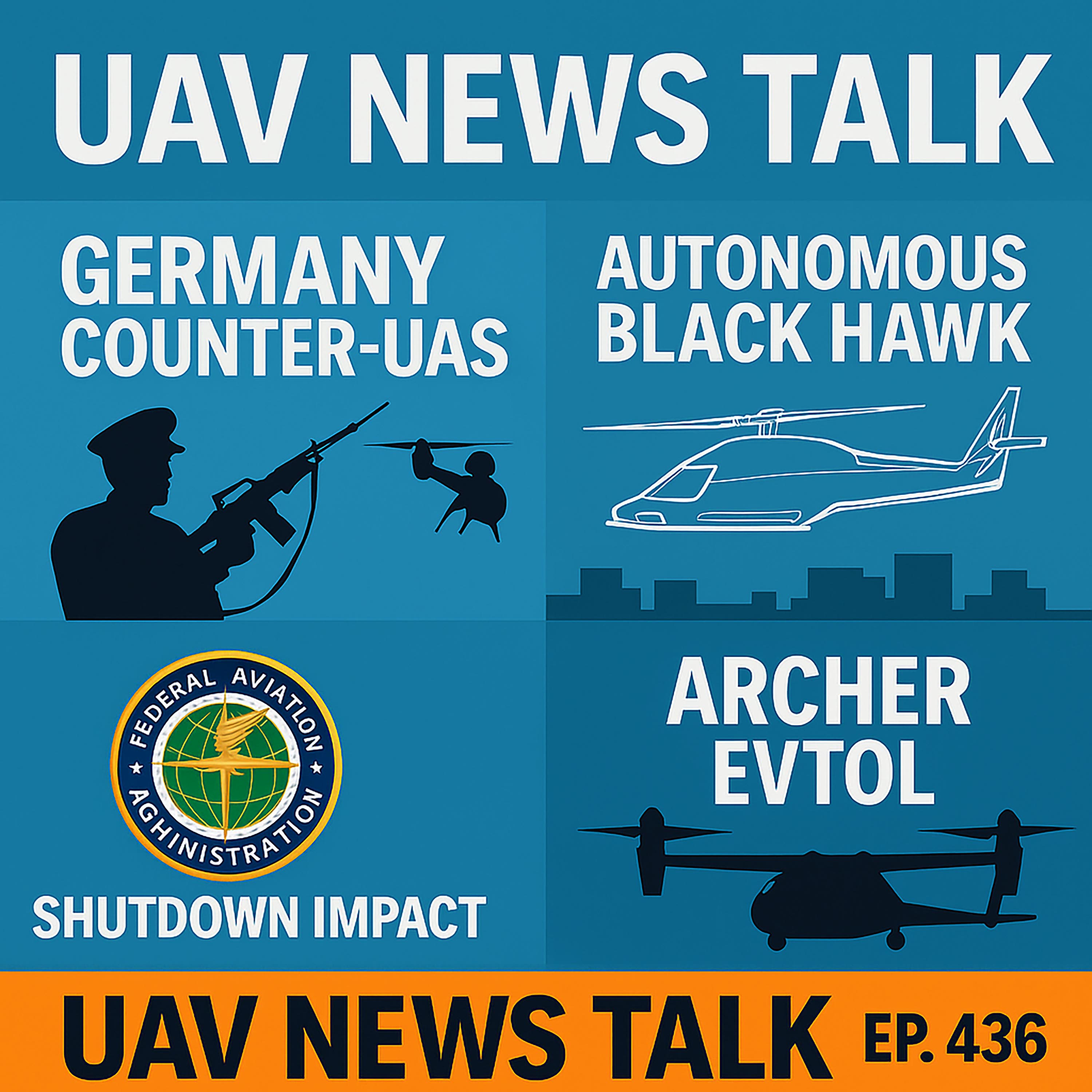
Episode 436 of UAV News Talk dives into global security, emerging automation, and the effects of Washington’s budget stalemate on the future of flight. Hosts Max Trescott and David Vanderhoof examine how nations, defense contractors, and innovators are redefining drone policy and autonomy at the same moment that the FAA’s own progress is slowed by the ongoing government shutdown. Germany authorizes police to counter rogue drones The show opens with the news that Germany has approved new counter-UAS authority allowing police to neutralize unmanned aircraft threatening airports and public safety. Max and David debate whether “shoot down” literally means gunfire or refers to electronic jamming and interceptor drones. Max notes that rogue drones have forced multiple Munich Airport closures—172 incidents in 2025 alone—leaving thousands of passengers stranded. David links the policy to Germany’s proximity to the Ukraine conflict , where drone incursions have heightened sensitivity across Europe. The hosts agree that while the measure feels drastic, persistent incursions make formal counter-drone rules inevitable. Drone-in-a-box systems chase shoplifters Next, the discussion turns to a futuristic retail-security concept: autonomous drones that pursue shoplifters once they leave a store. The hosts describe how “drone-in-a-box” platforms—similar to systems now deployed for school-campus emergencies—could track suspects until police arrive. Max imagines Apple Stores or high-end jewelers using such tools, while David questions cost and privacy implications. They joke about criminals splitting up so a single drone can follow only one thief. The takeaway: aerial surveillance is extending from military to consumer sectors, and regulation will soon need to catch up. Sikorsky’s fully autonomous U-Hawk - Video of the Week #1 In one of the episode’s most popular segments, Sikorsky unveils the U-Hawk , an autonomous variant of the UH-60 Black Hawk helicopter. The cockpit has been removed entirely, replaced by cargo-bay clamshell doors for vehicles or supplies. David calls it “a major step beyond optionally piloted,” while Max compares it with Skyryse Aviation’s SkyOS , which retrofits existing aircraft for unmanned flight. Drawing from his own visit to Skyryse’s Southern California facility, Max explains how their flight-automation suite can be adapted to both helicopters and fixed-wing platforms. The hosts discuss potential missions—resupply, firefighting, and hazardous evacuations—and note that Boeing is exploring similar automation for the CH-47 Chinook . The ability to deploy heavy-lift helicopters without pilots, they say, could transform both logistics and combat operations. Mystery drones over New Jersey explained A long-running puzzle also gets closure: the mysterious nighttime drone sightings over New Jersey that drew public complaints and congressional attention. New reports reveal that a private defense contractor conducted classified U.S. Army UAS demonstrations , accounting for many of the sightings. The hosts appreciate finally having an answer but point out that such secrecy fuels conspiracy theories and misidentifications. Still, it’s a reminder that rapid testing is happening just beyond public view. Archer Aviation’s big wins in Korea and L.A. From defense to commercial innovation, the conversation shifts to Archer Aviation’s new partnerships . In Korea, Archer and Korean Air will run urban-air-mobility (UAM) trials , marking one of Asia’s most advanced eVTOL collaborations. In the U.S., Archer becomes the official air-taxi partner for the Los Angeles Sports & Entertainment Commission , aligning the company with the 2026 World Cup, 2027 Super Bowl LXIX, and 2028 Olympics. Max notes that Los Angeles —with vast geography and hundreds of heliports—offers better infrastructure for eVTOLs than compact, high-rise cities like New York. David recalls the 1984 Olympics’ traffic gridlock and imagines VIPs flying above the congestion in Archer’s Midnight aircraft by the time the next Games arrive. The foldable Janus 1 “backpack helicopter” - Video of the Week #2 Then comes a lighter story: the Janus 1 , a foldable, man-portable tandem-rotor helicopter weighing 70 kilograms (154 lbs). You can watch a video of it flying here . It’s essentially a “ flying lawn chair ,” says David, but one that could aid isolated troops or appeal to experimental aviators. Max dissects its teetering two-blade rotor—similar to Robinson helicopters—for its simplicity and low cost, while speculating that its symmetrical design inspired the name Janus , after the Roman god who looks both forward and back. The hosts agree that even if it never goes commercial, it showcases the creative energy surging through small-scale VTOL design. FAA shutdown slows eVTOL certification Finally, Max explains how the ongoing U.S. government shutdown is affecting aviation oversight. Essential safety functions continue, but rulemaking and certification for new aircraft have slowed. FAA engineers, committees, and inter-agency partners are furloughed, delaying type certificates , airworthiness approvals , and BVLOS waivers . David warns that Europe and Asia could gain a competitive edge if the backlog persists. Even after reopening, he says, catching up could take months. Both hosts remain optimistic that Congress will resolve funding soon, allowing innovation to resume. Takeaway Episode 436 captures the global pulse of UAVs and advanced air mobility in late 2025— Europe tightening laws, the U.S. pushing autonomy, Asia expanding UAM, and Washington’s gridlock slowing progress . With equal parts insight and humor, Max Trescott and David Vanderhoof continue to make complex drone news accessible for pilots, engineers, and enthusiasts worldwide. Check out our other Aviation Podcasts: NTSB News Talk Podcast Aviation News Talk Podcast Rotary Wing Show Podcast
Sep 13
Max talks with David Vanderhoof in Episode 435 of UAV News Talk about an especially busy week in drone, eVTOL, and military UAV news. The episode covers new FAA certifications, autonomous launch systems, solar-powered endurance flights, Chinese technology in Africa, U.S. counter-drone readiness, and even a domestic security case involving explosives and drones. Together, these stories paint a vivid picture of how fast the unmanned aviation sector is evolving — and where the biggest opportunities and threats lie. AIR eVTOL gains FAA Experimental Certificate The first headline is the Israeli company AIR receiving an FAA experimental airworthiness certificate for its AIR One eVTOL. This isn’t the final approval needed for commercial operations, but it marks a critical milestone. The certificate allows AIR to expand its flight envelope testing in Florida — flying higher, faster, and with more maneuvering limits than before. Max explains that with this certificate, companies can begin validating systems under real-world conditions and build marketing buzz through legitimate flight footage. However, limitations remain: only essential crew can be onboard. No journalists, investors, or passengers are allowed until type certification and a production certificate are granted. David points out discrepancies in reported pre-orders — one source cites 150, another 2,500 — and the hosts remind listeners that early order numbers in this industry often need to be taken with caution. Max ties the discussion to the FAA’s MOSAIC rules for light-sport aircraft , which broaden certification pathways. These rules may make it easier for eVTOL manufacturers like AIR to secure final certification. For UAV enthusiasts and future pilots, this means the barriers to entry are slowly lowering, even if the process is still measured in years rather than months. Germany’s “Drone-in-a-Box” The second story introduces a “drone in a box” platform from Germany’s Skycar. This portable autonomous launch and recovery system can be mounted on trucks, ships, or rigid-hulled inflatable boats. Inside the box: a drone, charging system, and comms suite. Two models are supported, including the R70 SkyRanger, which can fly at up to 100 km/h. Max and David highlight how this technology, initially aimed at military markets, could quickly spill into commercial applications. Imagine delivery companies like UPS or Amazon mounting these on vehicles, enabling drones to launch, deliver, and recharge without human intervention. First responders could also benefit, deploying drones at wildfire scenes, active shooter incidents, or rescue operations. Even lifeguards or cruise ships might one day use such systems for rapid deployment of flotation devices or surveillance. The takeaway is that “drone in a box” technology represents a turnkey UAV ecosystem — plug it into any vehicle, and suddenly it’s drone-enabled. HALE Solar UAV Achieves 73-Hour Flight Next, the hosts discuss the U.S. Navy and SkyDweller Aero’s successful high-altitude long-endurance (HALE) UAV test at Patuxent River Naval Air Station. Powered by solar energy, the UAV stayed aloft for more than 73 continuous hours . Max compares this to Solar Impulse’s world-circumnavigation, noting that daytime solar climbs and nighttime battery descents make such endurance possible. David emphasizes the military significance: persistent surveillance over a battlespace for three days straight. Unlike satellites, which pass overhead only periodically, HALE UAVs can loiter over a target area for extended periods, making them invaluable for ISR (intelligence, surveillance, reconnaissance). Challenges remain: the huge wings required for solar panels limit where the UAV can operate, and structural fragility makes turbulence a risk. But the Navy’s test demonstrates that solar endurance UAVs could fill roles once reserved for P-3 Orions or P-8 Poseidons — at a fraction of the cost. Hang’s First Passenger Flight in Africa The show then turns to China’s EHang , which completed its first autonomous passenger eVTOL demonstration in Rwanda . Government officials, including Rwanda’s president, observed the flight. While it was largely symbolic, it underscores China’s push to expand its low-altitude economy influence beyond Asia and into Africa. Max notes that although EHang claims over 73,000 safe flights , questions remain about how many involved passengers. Still, it’s clear EHang is ahead of U.S. companies in terms of international demos. David adds that Rwanda’s relatively uncongested airspace may make it easier to adopt pilotless eVTOLs than in places like New York or London. Both hosts admit they’d eventually like to ride in one — but only after many others have tested it first. Counter-Drone Warfare and APKWS The next topic is sobering: a new report says the U.S. military is not prepared for large-scale low-cost drone threats like those seen in Ukraine and the Middle East. Expensive systems like Sidewinders aren’t cost-effective against $2,500 quadcopters. Fortunately, innovations are underway. At Eglin AFB, the Air Force tested the APKWS (Advanced Precision Kill Weapon System) on F-15s. By converting unguided Hydra rockets into guided weapons, each fighter can carry dozens of low-cost munitions instead of only a handful of high-end missiles. Max calls this a smart adaptation for asymmetric warfare , where cheap drones can overwhelm even the most advanced aircraft. FBI Sting Foils Domestic Drone Attack The final major story covers a chilling domestic case. A 24-year-old man pled guilty after plotting to use a C-4-laden drone to attack power substations. The FBI, using undercover operatives, allowed the plan to progress to the point where the drone was powered up before stepping in. Thankfully, no attack occurred, but the case highlights how dual-use UAV technology can be weaponized. David reflects on how easily hobby drones can be repurposed for harm, echoing lessons from Ukraine where small quadcopters wreak havoc. Max recalls seeing early RC drone battles and feeling uneasy about technology designed to destroy itself rather than innovate for good. Closing Thoughts The episode ends with lighter anecdotes: an RC plane accident at a California airshow and the benefits of AMA membership for insurance. Max shares how his wife encouraged him to take up RC flying — the hobby that led him into drones and, eventually, UAV News Talk itself.
Aug 25
Max and David reunite for UAV News Talk episode 434, bringing listeners a wide-ranging discussion on the latest UAV, eVTOL, and rotorcraft developments. FAA Advisory Circular on Powered-Lift They start with the FAA’s release of AC 21-17-4, the long-awaited certification guidance for powered-lift aircraft . Max explains how this 64-page document emphasizes performance-based outcomes rather than prescriptive design rules. Much of the content resides in Appendix A, covering equipment from cockpit voice recorders to flight data recorders. The standout requirement: aircraft must withstand impacts from a four-pound bird—a test historically performed with frozen chickens fired from “chicken guns.” David points out that eVTOLs, operating at lower altitudes, will likely encounter more bird strikes than traditional aircraft, making the requirement especially relevant. Joby Acquires Blade Passenger Business The hosts then dive into Joby Aviation’s $125 million acquisition of Blade’s passenger business . Blade, known for helicopter and charter flights around Manhattan, gives Joby an existing customer base, operational infrastructure, and valuable experience. Max and David consider how quickly wealthy corporate travelers might switch from Sikorsky and Bell helicopters to Joby’s quieter eVTOLs. They expect a mixed fleet for years, with pricing likely used as an incentive to encourage adoption. The acquisition excludes Blade’s medical transport division but secures its premium commuter routes. China’s Two-Ton eVTOL China’s aviation industry stunned observers with the unveiling of a two-ton eVTOL. Although the aircraft carries 880 pounds of payload—comparable to a Robinson R44—Max notes the figure is underwhelming relative to the aircraft’s size. David highlights its 124 mph cruising speed and one-hour endurance, branding it part of China’s new “low-altitude economy.” Max contrasts U.S. and European reserve requirements for electric aircraft, noting that European operators can fly with only a 10-minute reserve, boosting usable endurance. They also reference the FAA’s MOSAIC rules, which propose pilot certificates requiring just 20 hours of training for simplified eVTOL controls—though both hosts believe real-world training times will be closer to 40 hours. Ukraine’s Drone Bicycle Rescue In a dramatic wartime innovation, Ukraine used drones to deliver electric bicycles to a soldier trapped behind enemy lines . After multiple attempts, including one foiled by a landmine, the soldier finally escaped thanks to the unusual delivery. Max appreciates this rare “good news” drone story, contrasting it with the common use of UAVs as weapons. David likens the aerial surveillance role to Vietnam-era A-1 Skyraiders providing overwatch during rescues. Boeing Lawsuit and Startup Dispute The discussion shifts to Boeing’s legal troubles with Zunum Aero, a Seattle-based hybrid-electric startup. After bankruptcy, Zunum sued Boeing for intellectual property theft . Though the case has bounced between rulings, the Ninth Circuit reinstated a $72 million verdict against Boeing, highlighting concerns about the aerospace giant’s corporate practices. Waterfall Rescue with Drones and Helicopters Finally, the hosts cover a California hiker who spent days trapped behind a waterfall in the Sequoia National Forest. Drones first located him before a sheriff’s helicopter hoisted him to safety. David jokes about future quadcopters equipped with hoists, while Max cautions hikers about the Seven Teacups Trail. The story reinforces the growing synergy between UAVs and helicopters in rescue operations. Please check out these other podcasts in the Aviation News Talk Network: Aviation News Talk Rotary Wing Show Podcast NTSB News Talk
Aug 10
BVLOS rules, school safety drones, NASA’s Mars helicopters, and Michigan’s 40-mile drone research skyway take center stage in UAV News Talk episode 433, hosted by Max Trescott and David Vanderhoof. The discussion begins with the newly introduced LIFT Act —short for Leading Innovation in Flight Technology Act—proposed by Representative Jen Kiggans of Virginia on July 24, 2025. The bill would compel the Department of Transportation to accelerate FAA rulemaking for Beyond Visual Line of Sight (BVLOS) drone operations. The hosts explore how AI could be used to speed approvals, contrasting deterministic AI rule-checking with generative AI’s potential for errors, and weighing how this fits—or clashes—with the FAA’s traditionally deliberate safety-first approach. Next, the conversation shifts to Florida’s plan to trial armed drones for school security . Developed by Campus Guardian Angel, these drones would be stored on-site in protective boxes and launched within seconds to engage an active shooter—potentially firing powder pellets to incapacitate the suspect. Max and David raise practical questions about launch authority, piloting, targeting in chaotic conditions, and operational control from a central dispatch center. They note the program’s $1,000-per-month cost and early deployments in four Florida school districts and one Texas university. Video of the Week: A vivid example of drones aiding law enforcement —a Scottsboro, Alabama thermal video showing the nighttime capture of an attempted murder suspect hiding beside railroad tracks. The video’s bright, detailed imagery stands out from typical black-and-white thermal feeds, illustrating drones’ growing value in search and apprehension. From terrestrial policing to interplanetary exploration, the episode dives into NASA’s ambitious proposal to send six helicopters to Mars . Building on the Ingenuity mission’s unexpected 72-flight success, the new fleet could haul 11 pounds each, operate autonomously, and even act as communication relays to extend range. The hosts discuss rotor speed adjustments for Mars’ thin atmosphere, coaxial rotor benefits, and lessons from Ingenuity’s final hard landing caused by a rotor strike. Back on Earth, Michigan unveils its M Air Research Skyway—a 40-mile-long drone corridor enabling BVLOS operations, swarm testing, and drone traffic management (UTM) development. The University of Michigan’s engineering programs, private partners, and state agencies will collaborate to test delivery drones, advanced operations, and multi-drone coordination in a controlled yet realistic environment. Max notes the unique scale compared to most U.S. university programs, and David speculates on potential eVTOL or medical delivery applications. The episode wraps with a look at China’s booming “low-altitude economy” and its newly recognized profession: drone flight planner. With over 247,000 licensed drone operators and 2.17 million drones registered, China sees structured planning roles as key to safety and efficiency. Max compares these figures with the United States’ 460,000 Part 107 pilots and 822,000 registered drones, and the hosts discuss differences in regulatory pace and industry growth. Packed with policy developments, technology advances, and global industry insights, UAV News Talk 433 delivers essential updates for drone pilots, UAS professionals, and anyone tracking the future of unmanned aviation.
Jul 24
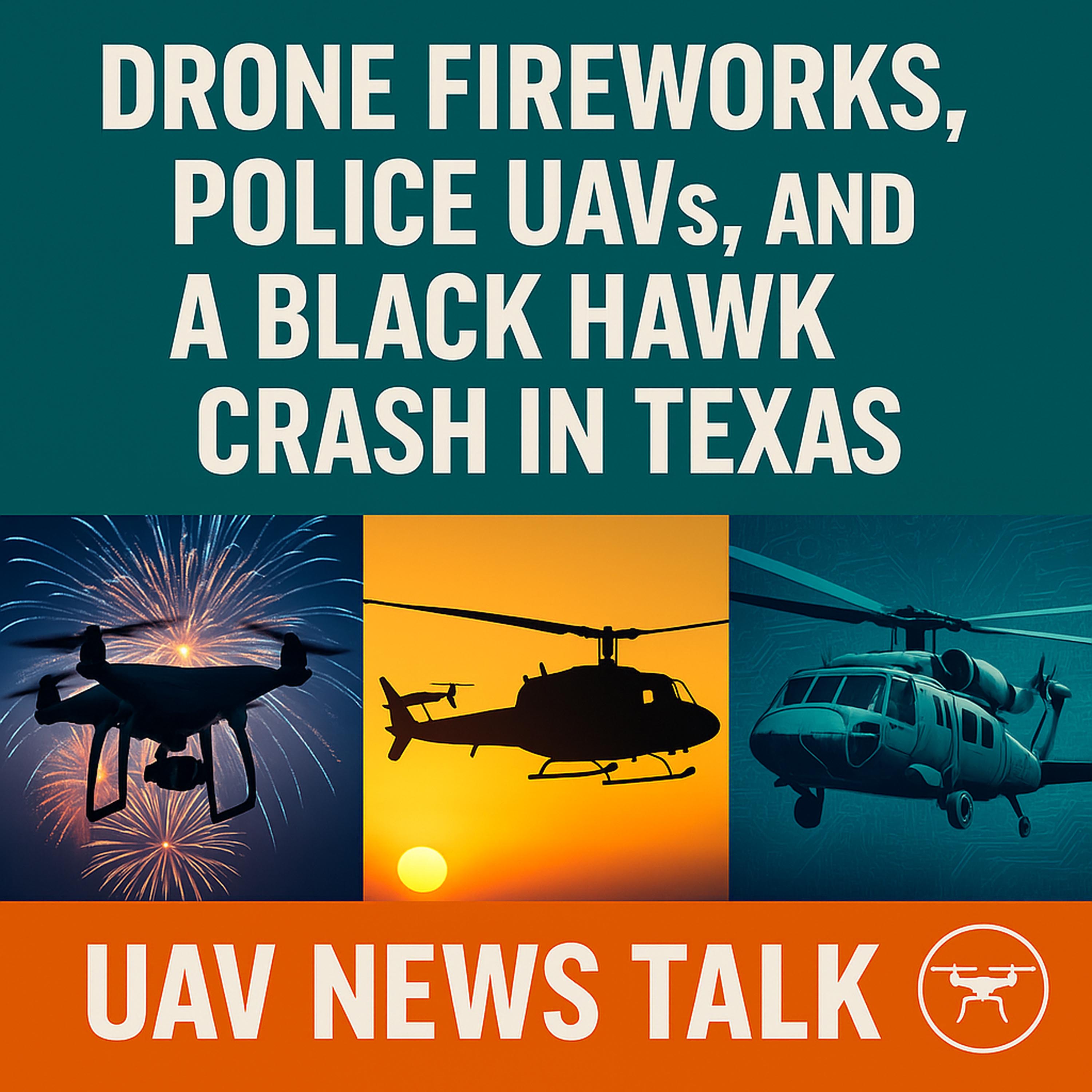
In Episode 432 of UAV News Talk, Max Trescott and David Vanderhoof explore the evolving role of drones in public events, law enforcement, and emergency response—highlighting both their growing utility and the risks of poor coordination. Titled "Drone Fireworks, Police UAVs, and a Black Hawk Crash in Texas," this episode covers breaking drone news from California and Texas, trends in UAV policing, and innovations in helicopter autonomy from Sikorsky and Skyryse. The episode opens with Max sharing a personal story about diving back into ham radio and noting the crossover with FPV drone pilots who use amateur radio frequencies for extended range. It’s a humorous but insightful segue into the broader theme: drones are becoming essential tools in unexpected places, from backyard hobbies to high-stakes public safety operations. 🎆 Drones Replace Fireworks in San Jose The first major story is about San Jose, California , where a last-minute shift from traditional fireworks to a July 4th drone light show occurred following a major fireworks factory fire in the Central Valley. With pyrotechnics canceled, city officials quickly pivoted to a drone display. The mayor noted that the cost of drone shows is “comparable to fireworks,” depending on the number of drones used. Max and David discuss how drone shows have grown increasingly sophisticated, but viewers should be aware that real-time transitions between drone formations are slower than what’s shown in sped-up YouTube clips. Drone light shows are not just a visual marvel—they’re also a safer and more sustainable alternative to traditional fireworks. This switch is becoming part of a national trend, particularly in fire-prone areas like California. But San Jose’s drone integration didn’t stop at entertainment. 🚨 Police Drones Monitor Illegal Fireworks San Jose also deployed police UAVs to monitor for illegal fireworks across the city, joining another California municipality doing the same. Max shares how drone surveillance is increasingly used to spot unlawful activity on holidays like the Fourth of July. David warns hobbyists against the temptation to fly drones into fireworks displays for viral footage, noting that it’s both dangerous and illegal. These developments tie into a larger trend: law enforcement agencies across California are embracing drones as essential tools for first response. Max and David detail programs in San Jose, Alameda County, Elk Grove, and Los Angeles , where drones are now dispatched to emergency scenes—sometimes arriving before officers 74% of the time , as was the case in Elk Grove. Drones are being used to safely observe volatile situations like domestic disputes and fleeing suspects. In one example from San Leandro , UAVs tracked a suspect hiding under a box in a backyard, guiding officers to the location with minimal risk. Applications also include search and rescue, missing persons, and real-time crowd monitoring. 👁️ Privacy Concerns and the Future of Police UAVs While the benefits are clear, David raises privacy concerns , such as whether UAV-collected evidence is admissible in court or if warrants are required. The discussion highlights future scenarios where drones equipped with AI and facial recognition technology could misidentify individuals, leading to false arrests. Max compares this to helicopters used by NYPD during 9/11, which had long-range surveillance capabilities. The same tech is now migrating to drones, which are cheaper to operate and able to hover closer to the action. 🚁 Black Hawk vs. Drone: Collision in Texas Flood Zone The most serious story in the episode comes from Kerr County, Texas , where a drone collided with a Bell 206 helicopter during a search-and-rescue mission in flood conditions . Thankfully, no one was injured, but the collision underscores the risks of deploying UAVs without coordination. The drone was reportedly operating without proper integration into the rescue efforts. Max and David stress the importance of respecting Temporary Flight Restrictions (TFRs) and coordinating with emergency services. Unauthorized drones have repeatedly grounded firefighting aircraft during wildfires and now threaten helicopter rescue crews in flood zones. The hosts remind licensed drone pilots to fly responsibly, especially during emergencies. 🤖 Sikorsky’s AI-Powered Black Hawk: Autonomy in Rotorcraft From disaster to innovation, the episode turns to Sikorsky’s announcement about advancing AI-driven autonomous flight for their H-60 Black Hawk helicopters . David explains how the Black Hawk is now being tested as an optionally piloted aircraft —capable of flying with or without a human pilot. This would allow military operators to use the aircraft in dangerous or high-tempo environments without risking human lives. Max highlights how companies like Skyryse are also transforming helicopters. He shares insights from his FLYING Magazine article on Skyryse's retrofitted autonomous R66 helicopter , controlled via a single joystick with all traditional flight controls removed. Max had the opportunity to fly the simulator and compares it to a standard R66 experience. The appeal of retrofitting existing, certified platforms like the Black Hawk or R66 is that it fast-tracks deployment. Instead of waiting years for eVTOL aircraft to be certified, these aircraft already have flight-proven designs and infrastructure. 🧩 From Kitty Hawks to Flying Cars at the Helicopter Museum David wraps up with an inside look at the American Helicopter Museum near Philadelphia, which recently acquired two Kitty Hawk Flyers , early eVTOL prototypes meant for recreational use over water. Though commercially unsuccessful, they’re now hands-on exhibits for the public. He also previews upcoming museum displays focused on Naval and Marine Corps rotorcraft history and encourages listeners to visit helicoptermuseum.org.
Jul 2
Max Trescott and David Vanderhoof dive into the future of drone delivery in Episode 431 of UAV News Talk. Max shares his firsthand experience receiving multiple packages via drone as part of a pilot program from Matternet, a Mountain View, California-based drone logistics company. After visiting Matternet’s headquarters and observing the behind-the-scenes operations, Max witnessed the packaging, pre-flight procedures, and live flight operations, including the dispatch and precise delivery of chocolate bars and snacks. Matternet’s program currently serves residents in Mountain View and Sunnyvale, delivering small items such as chocolates and drinks for free as part of a test initiative to gather feedback and flight data. Max details how customers apply to join the program, undergo a home site survey, and then place orders via a website. Deliveries are tracked in real time, and drones use tethers to gently lower packages into designated clear areas, where they automatically release the payload and return to base. Listeners hear live audio from Matternet staff explaining how deliveries are prepared, packaged, and executed under the watchful eye of a remote pilot monitoring telemetry and airspace conditions. Max describes the system’s precision and automation—including launchpads, a “mushroom-shaped” autonomous docking hub for future point-to-point missions, and how flight plans are uploaded for mostly autonomous execution. The drones, significantly larger than consumer quadcopters, are equipped with carbon fiber propellers and make a lower-pitched, deeper noise due to their larger rotors spinning at lower RPMs. The box itself, constructed of cardboard with padded interiors, is pristine upon arrival, having avoided the rough handling common in traditional delivery systems. David questions the economics of drone delivery, especially for low-cost items like chocolate, and Max suggests the long-term potential lies in delivering high-value or time-sensitive items, such as medical samples. They discuss how drone delivery is expanding, with Amazon, DoorDash, and companies like Flytrex, Zipline, and Alphabet’s Wing offering services in cities like Phoenix, College Station, and Dallas-Fort Worth. While drone delivery is advancing, both hosts acknowledge challenges remain—including weather, regulatory hurdles, noise concerns, and public perception. Max’s takeaway: while drone delivery isn’t yet widespread, real-world operations like Matternet’s signal that UAV logistics are finally reaching the cusp of mainstream adoption. Mentioned in the Show Matternet 390 Electric Airplane Test Flight: Max Trescott Reviews the Bristell B23 Energic
Jun 16
In episode 430 of UAV News Talk , Max Trescott and David Vanderhoof return from vacation with urgent news and safety concerns in the drone industry. The episode opens with a major headline: the DJI Mavic 4 Pro is not available in the United States . Although the drone boasts high-end specs—including a 6K camera and improved flight performance—it’s currently unavailable in the U.S. due to concerns about data security and alleged ties between DJI and the Chinese government. The ban stems from a long-standing effort by U.S. government agencies to restrict the use of DJI drones, especially after reports emerged that some DJI models were transmitting sensitive data back to China. The Pentagon, in particular, flagged DJI as a national security risk. In light of this, many online resellers and websites claiming to sell the Mavic 4 Pro may be scams . Max warns of fake DJI websites offering steep discounts, unauthorized sellers providing units without warranty coverage, and used drones that are “bricked” due to being locked to previous owners' DJI accounts. Buyers are urged to verify the source before purchasing any DJI drone—especially when new models are not officially available. Next, the discussion shifts to drone battery fires, a serious issue affecting both hobbyist and commercial UAV operators. Max highlights a recent vehicle fire in Mountain View, California , caused by a drone battery left charging on the passenger seat of a truck. Though the fire was extinguished quickly and injuries were minor, it serves as a critical reminder of the dangers associated with charging LiPo (lithium polymer) batteries in enclosed or flammable environments. In a separate and more devastating incident, a house in Kenosha County, Wisconsin was completely destroyed by a fire linked to drone batteries charging unattended. Tragically, several pets were lost in the blaze. According to reports, the batteries were connected to a newly purchased six-foot drone, and the homeowner had left them charging for hours while away from home. The episode underscores the importance of charging drone batteries only in safe, monitored locations—preferably on a non-flammable surface such as concrete and never inside unattended vehicles or homes. From fire hazards to electric flight innovation, Max and David then explore the historic cross-Atlantic flight of Beta Technologies’ Alia electric aircraft. The Beta Alia CX300 , a fixed-wing eVTOL aircraft, is currently touring Europe and made headlines for flying across the Irish Sea under VFR rules. Its final destination is Bristow Helicopters in Norway, a company known for operating offshore flights to oil platforms. The Alia’s 250-nautical-mile range—significantly farther than most other electric VTOL aircraft—positions it as a promising alternative to traditional helicopters. Max notes that replacing helicopters for short regional missions is one of the most realistic and cost-effective early use cases for electric vertical takeoff and landing (eVTOL) aircraft. The Beta Alia also features fixed wings to improve lift and efficiency during cruise, giving it a hybrid profile that blends characteristics of both airplanes and helicopters. In defense-related drone news, the episode also covers the U.S. Department of Defense’s recent unveiling of two “loyal wingman” drone programs—the QF-42 and QF-44 . These autonomous fighter drones are designed to fly alongside manned aircraft like the upcoming F-47 Next Generation Air Dominance fighter, providing added firepower, surveillance capability, and operational safety. David notes that these aircraft are in the pre-production phase and may be deployed in the coming years as force multipliers in high-risk combat zones. The rise of autonomous military drones is reshaping battlefield tactics, and even U.S. ground troops are training to evade detection from enemy drones. A recent report reveals that the U.S. Army is now showing new recruits how they appear to enemy UAVs during surveillance missions, emphasizing the importance of movement discipline and cover when drones are overhead. On the civilian side, Max discusses a new product from uAvionix called SkyAlert —a wearable aircraft detection system designed for drone pilots and visual observers. The compact device receives dual-band ADS-B signals and gives real-time audio and visual alerts when manned aircraft are nearby. This enhances safety during drone operations, especially in mixed-use airspace near airports or urban areas. SkyAlert integrates with several popular electronic flight bag (EFB) apps like ForeFlight, SkyDemon, and OzRunways. Although still on pre-order, its $499 price point may appeal to commercial operators and professional drone pilots seeking an added layer of situational awareness. While wearable drone safety tech shows promise, Max and David debate whether alarm fatigue or sensory overload could diminish its effectiveness. Drawing parallels to over-complicated aircraft cockpits, they emphasize the need for smart filtering and possibly automated drone responses, such as auto-landing when a threat is detected. The episode closes with a tease for next week: Max received two drone deliveries to his front lawn—not deliveries of drones he purchased, but actual drones lowering deliveries into place and flying off. This real-world experience with drone delivery services will be the focus of the next episode. From DJI drone bans and battery fire safety tips to electric aircraft innovation and military UAV trends, episode 430 offers a comprehensive look at the evolving landscape of drone technology. Whether you fly drones recreationally, operate commercially, or are simply fascinated by aerospace innovation, please tell your friends about UAV News Talk , and encourage them to listen.