Dec 10
Ep 589: The Monticello AVA of Virginia- The Birthplace of American Wine
Located about 2.5-3 hours southwest of Washington DC, in the southeast of the United States, the Monticello AVA is making world class wines that you need to know about! Photo: Afton Mountain Vineyards. Credit: WFNP Although California is the state for which American wine is known, the first place to tirelessly attempt to make premium wine was, in fact, Virginia. In the land Thomas Jefferson, the greatest wine advocate in American history, called home, the third president never realized his dream of making great wine. But in 1976 a couple of prominent Italians made a go of it and since then, the wine of the Monticello AVA, located In the foothills of the Blue Ridge Mountains of central Virginia, has gone from strength to strength. In this show I discuss the history of how the Monticello AVA of Virginia finally was able to make good wine on a difficult terroir. I talk about the particulars of the climate and (very diverse) soils, the grapes that grow here (yes, it's mostly Vitis vinifera ), the challenges of the business of wine in the Monticello AVA, and then I give my list of top wineries and go into some detail about what makes them great. Monticello is an evolving story, but it only has upside. If you haven't had the wines from here or visited and you get an opportunity to do one or both, I really recommend it! It's beautiful and the wines are world class (if you stick to my recommendations, there are still people learning here…😂). Full show notes and all back episodes are on Patreon. Become a member today! www.patreon.com/winefornormalpeople _______________________________________________________________ Check out my exclusive sponsor, Wine Access. They have an amazing selection -- once you get hooked on their wines, they will be your go-to! Make sure you join the Wine Access-Wine For Normal People wine club for wines I select delivered to you four times a year! To register for an AWESOME, LIVE WFNP class with Elizabeth or get a class gift certificate for the wine lover in your life go to: www.winefornormalpeople.com/classes

Dec 3
Ep 588: The Greats of Bordeaux – Pomerol
As our last in the series of the Greats of Bordeaux, I tackle Pomerol -- land of the hedonistic, silky, velvety, complex wines. The name of the game in Pomerol is terroir, and what the excellent, dedicated producers do to express it in the glass. I cover the history of Pomerol, its variable terroir and what that means for the wines, discuss the main grapes in the blend, viticulture and winemaking and then go over some of the top châteaux: Petrus, Le Pin, Château Lafleur, Château La Conseillante, Château Trotanoy, and more! Full show notes and all back episodes are on Patreon. Become a member today! www.patreon.com/winefornormalpeople _______________________________________________________________ Check out my exclusive sponsor, Wine Access. They have an amazing selection -- once you get hooked on their wines, they will be your go-to! Make sure you join the Wine Access-Wine For Normal People wine club for wines I select delivered to you four times a year! To register for an AWESOME, LIVE WFNP class with Elizabeth or get a class gift certificate for the wine lover in your life go to: www.winefornormalpeople.com/classes

Nov 25
Ep 587: The Thanksgiving Show 2025 - Two-Wine Strategies to Rule the Feast
Thanksgiving is one of the most difficult meals to pair with, but that doesn't mean we shouldn't try! Source: Canva This year, for one of our weekly discussion questions I asked the Patrons how many wines they would be serving with their Thanksgiving/holiday feasts and the answer was overwhelmingly 2-3. Given that, in this show I talk about combinations of two wines you can purchase for your table that will pair with many types of Thankgsivings. Some examples: If your dishes tend to be on the sweet side… honey glazes, marshmallow sweet potatoes, candied sweet potatoes, etc Off-dry Riesling or Vouvray (although butternut squash soup with a kick could do well with a regular Gewurztraminer) Reds: Grenache, GSM blends from Rhône, California, Australia, etc., Garnacha from Spain, Zinfandel Asian-influenced Thanksgiving Aromatic whites: Alsace Riesling, Pinot Gris, Gewürztraminer, Torrontés, or Viognier Fruity reds with low tannin: For smokey or braised meat: New World Pinot Noir, Côtes du Rhône, Garnacha. For something especially smoky: Saumur-Champigny from Loire Desserts....Pecan Pie: Tawny Port, Madeira, Pedro Ximenez Sherry From Getty Images via Canva There are these ideas explained and so much more packed into the episode. Listen, take what you want leave the rest! Please know that I'm grateful to you for listening and your loyalty to me and the show!! Full show notes and all back episodes are on Patreon. Become a member today! www.patreon.com/winefornormalpeople _______________________________________________________________ Check out my exclusive sponsor, Wine Access. They have an amazing selection -- once you get hooked on their wines, they will be your go-to! Make sure you join the Wine Access-Wine For Normal People wine club for wines I select delivered to you four times a year! To register for an AWESOME, LIVE WFNP class with Elizabeth or get a class gift certificate for the wine lover in your life go to: www.winefornormalpeople.com/classes

Nov 19
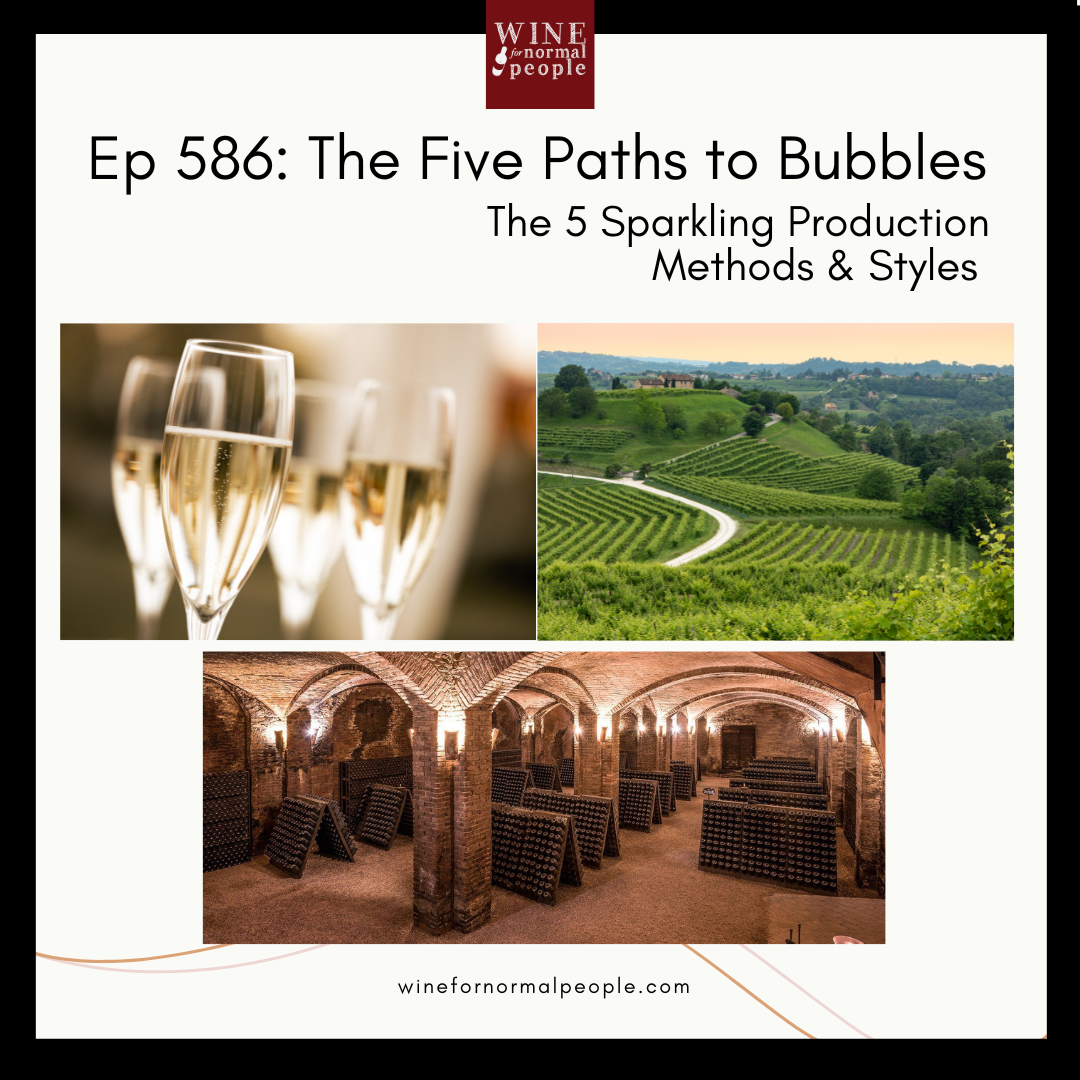
Ep 586: The Five Paths to Bubbles - The 5 Sparkling Production Methods & Styles to Try
Just in time for the holiday season, I review the five ways to get fizz in a wine (on purpose) -- and the wines that result. I discuss regions and styles of different wines in each of the three major categories: Ancestral Method/Pétillant Naturel, Méthode Champenoise/ Metodo Classico, and the Martinotti/Charmat/Tank Method. From Col Fondo to Method Cap Classique to German Sekt, I offer you new possibilities and sparkling wine types you may not know or think of off the top of your head, but which are all great in their own right and many which are ridiculously affordable (and yes, it's way more than just Prosecco and Cava!). Photo: The "Underground Cathedrals" in Canelli, a UNESCO site Source: Alta Langa DOCG Full show notes and all back episodes are on Patreon. Become a member today! www.patreon.com/winefornormalpeople _______________________________________________________________ Check out my exclusive sponsor, Wine Access. They have an amazing selection -- once you get hooked on their wines, they will be your go-to! Make sure you join the Wine Access-Wine For Normal People wine club for wines I select delivered to you four times a year! To register for an AWESOME, LIVE WFNP class with Elizabeth or get a class gift certificate for the wine lover in your life go to: www.winefornormalpeople.com/classes
Nov 12
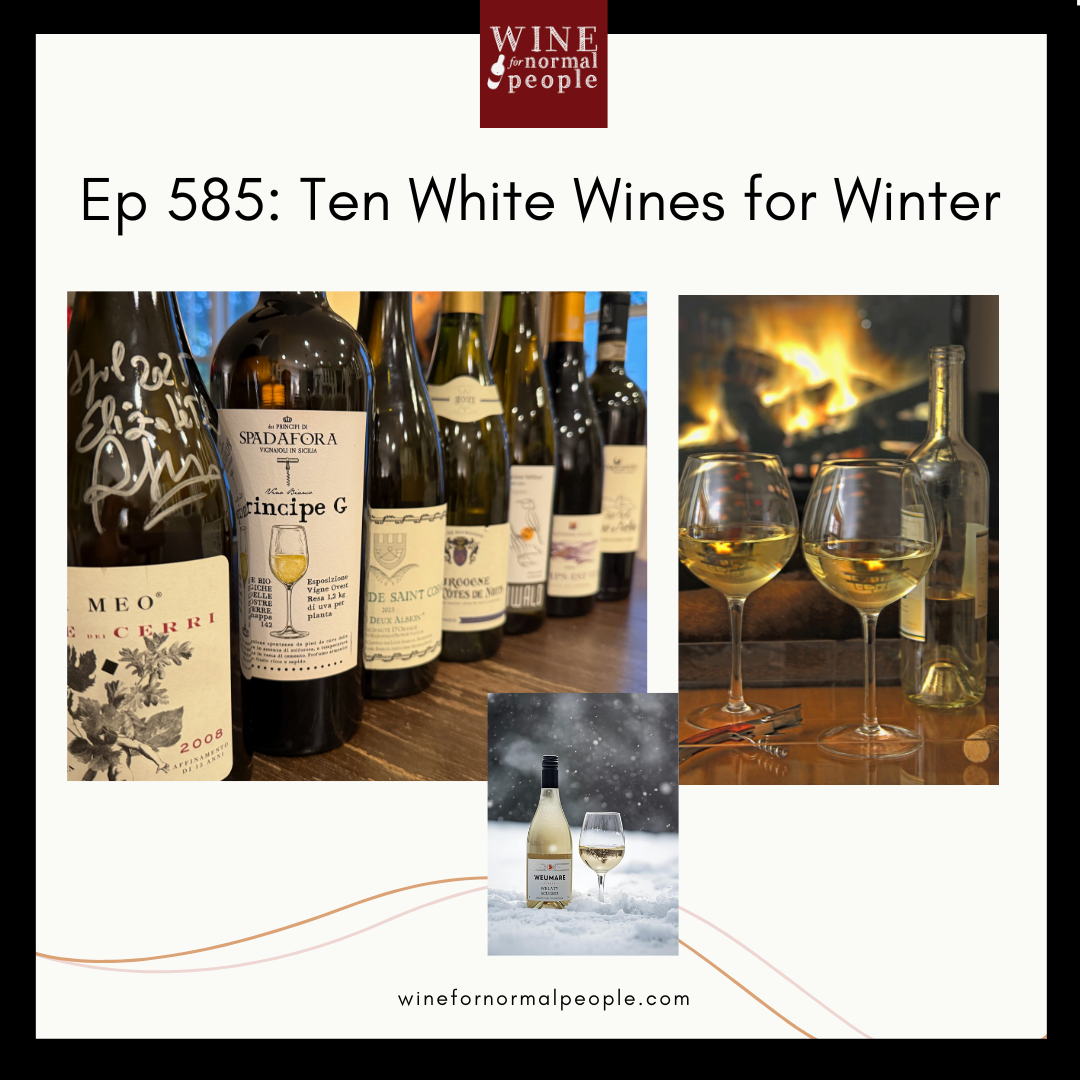
Ep 585: Ten White Wines for Winter
At the suggestion of Patron John D., in this show I give you a list of 10 great winter whites and review each in detail! I discuss the varied styles, since most regions have multiple versions of these wines, and how to get the bone warmers, not the light sippers. I offer food pairing ideas to boot! From white Burgundy to Poşip to Savienníeres and Fiano, I've suggested a great white bottle for almost every week of winter! I hope you find the list useful. Full show notes and all back episodes are on Patreon. Become a member today! www.patreon.com/winefornormalpeople _______________________________________________________________ Check out my exclusive sponsor, Wine Access. They have an amazing selection -- once you get hooked on their wines, they will be your go-to! Make sure you join the Wine Access-Wine For Normal People wine club for wines I select delivered to you four times a year! To register for an AWESOME, LIVE WFNP class with Elizabeth or get a class gift certificate for the wine lover in your life go to: www.winefornormalpeople.com/classes
Nov 5
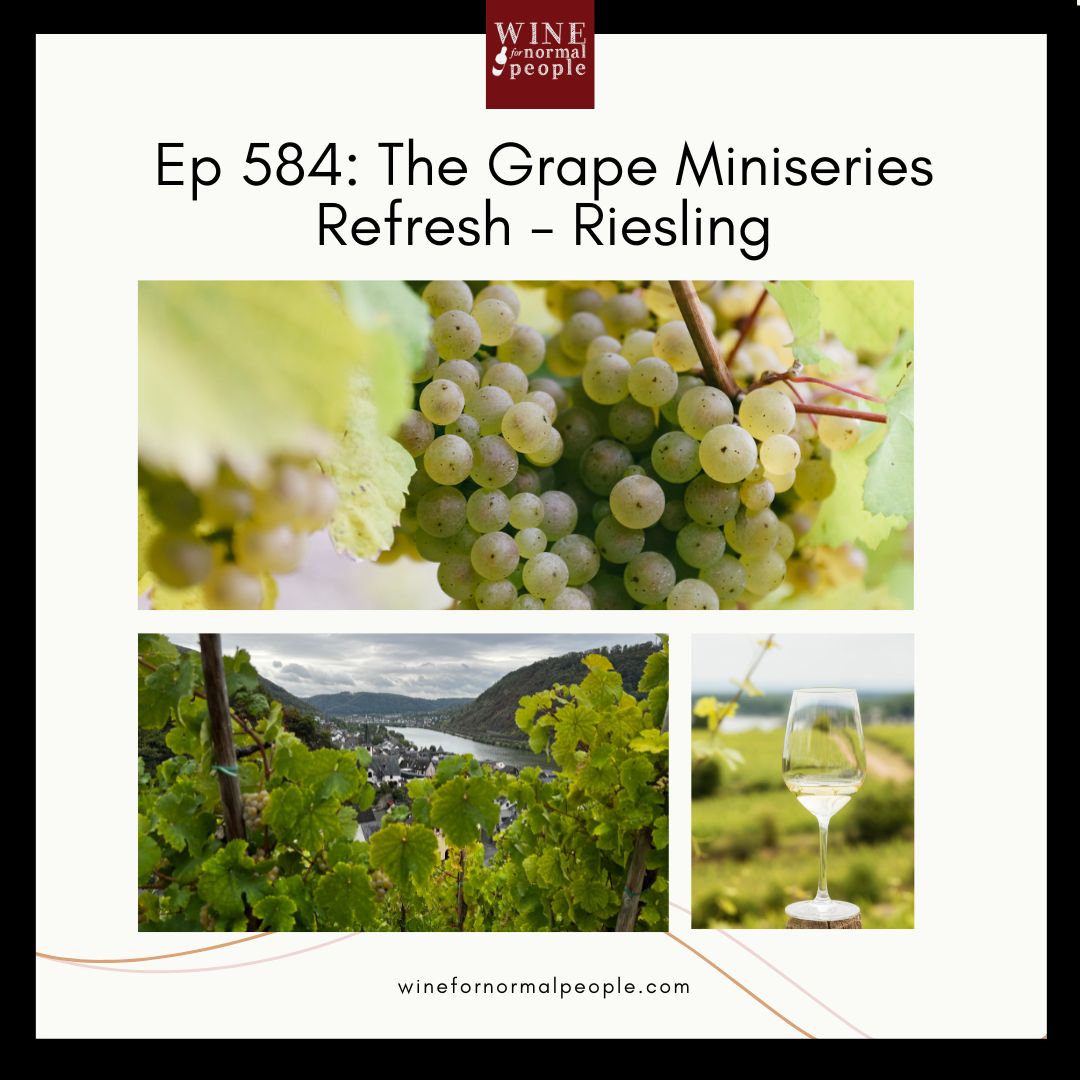
Ep 584: The Grape Miniseries Refresh - Riesling
This time in the grape miniseries -- a refresh on one of my all time favorite grapes -- Riesling. This versatile grape has a long history of quality, and is highly misunderstood by most people. I review the long and noble history of the grape, starting in 1435 and talk about how it wound up in places like the US and Australia, where it makes world class examples. I cover Riesling in the vineyard, in the cellar, and what makes a wine sweet or dry. I even explain a bit about the International Riesling Foundation scale! I hope this overview gives you a new apprecaition for this grape that can be dry, sparkling, off-dry, sweet, and everything in between. Full show notes and all back episodes are on Patreon. Join the community today! www.patreon.com/winefornormalpeople _______________________________________________________________ This show is brought to you by my exclusive sponsor, Wine Access – THE place to discover your next favorite bottle. Wine Access has highly allocated wines and incredible values, plus free shipping on orders of $150 or more. You can't go wrong with Wine Access! Join the WFNP/Wine Access wine club and get 6 awesome bottles for just $150 four times a year. That includes shipping! When you become a member, you also get 10% all your purchases on the site. Go to wineaccess.com/normal to sign up!
Oct 30
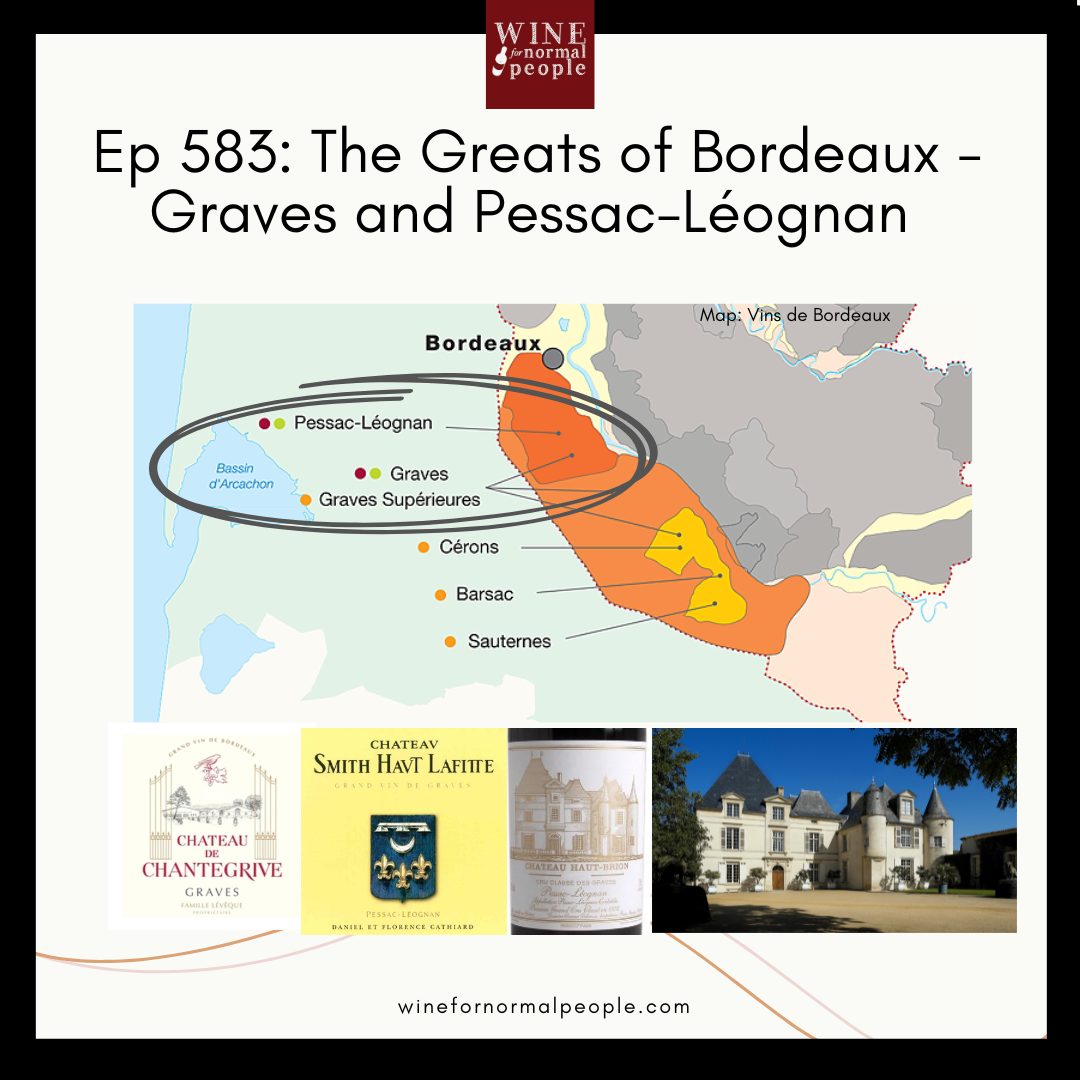
Ep 583: The Greats of Bordeaux - Graves and Pessac-Léognan
Lying just south of the city of Bordeaux is one of the oldest winemaking regions in the Bordeaux AOC -- Graves. Graves, along with it sub appellation of Pessac-Leognan are covered in this show as two of the great of Bordeaux. Graves has a wine history stretching back to 100 BCE when the Romans first settled this area and realized that its gravelly (graves=gravel) soil was excellent for viticulture. That was the start and Graves has been continuously making wine for more than 2000 years. I discuss this wonderfully historic area, some of the challenges that it has faced, and the things that make it so special. Map: Vins de Bordeaux After discussing Graves, I take on Pessac-Léognan, the northern area of Graves, just south of the city of Bordeaux. It is the home of the most famous châteaux of the southern Left Bank including Haut Brion, the first growth in the 1855 classification. As with all "The Greats" shows, I cover the history, terroir, grapes and winemaking, and then discuss key châteaux but after this show I encourage you to seek out a bottle of the larger Graves AOC and Pessac-Léognan to see the similarities and differences between each of these regions. I think you will then understand why Pessac-Léognan is so different, in spite of the fact that it is part of Graves! Full show notes and all back episodes are on Patreon. Become a member today! www.patreon.com/winefornormalpeople _______________________________________________________________ Check out my exclusive sponsor, Wine Access. They have an amazing selection -- once you get hooked on their wines, they will be your go-to! Make sure you join the Wine Access-Wine For Normal People wine club for wines I select delivered to you four times a year! To register for an AWESOME, LIVE WFNP class with Elizabeth or get a class gift certificate for the wine lover in your life go to: www.winefornormalpeople.com/classes
Oct 22
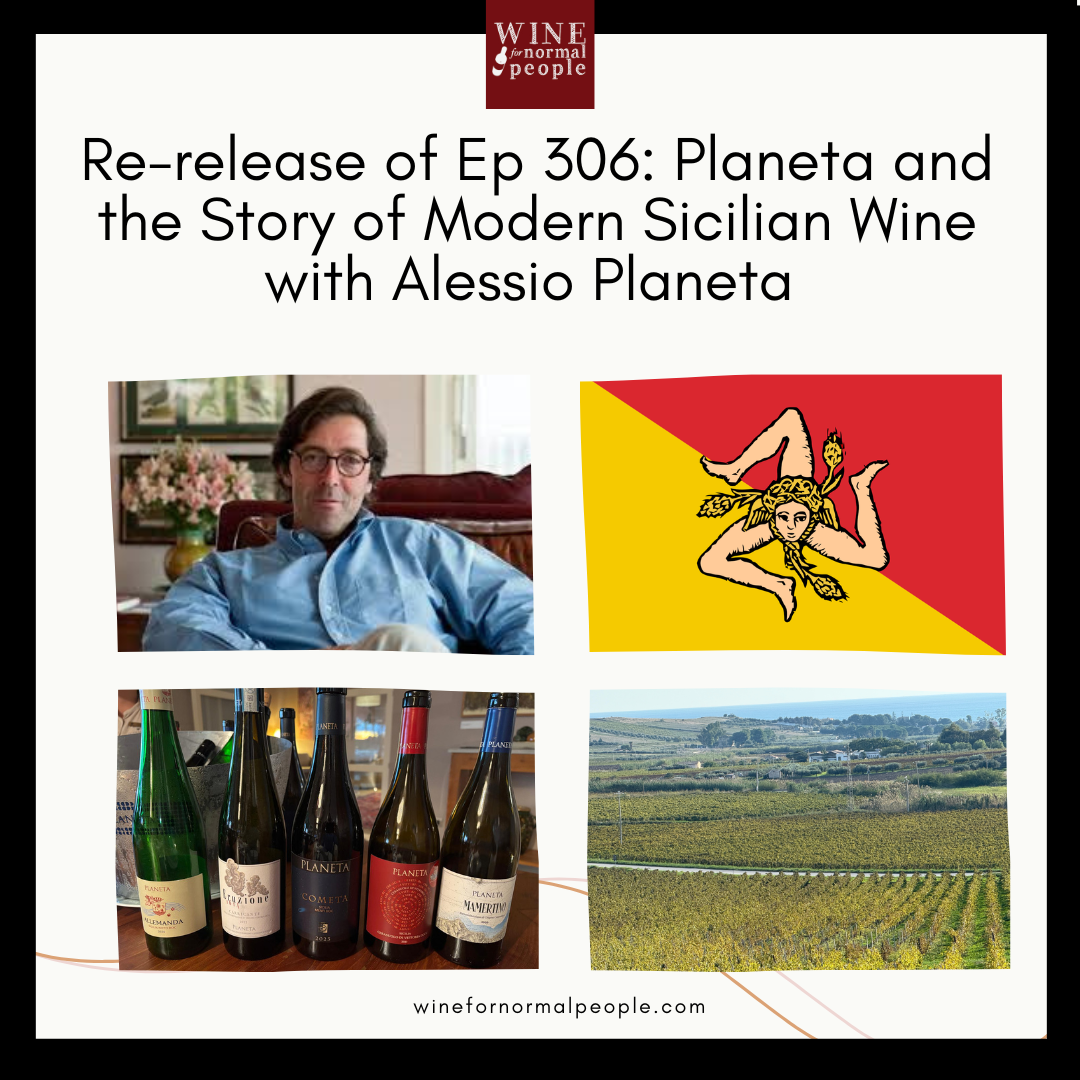
Re-release of Ep 306: Planeta and the Story of Modern Sicilian Wine with Alessio Planeta
I happen to be in Sicily with a group of Patrons (this could be you if you join Patreon!). While I was in Verona at Wine2Wine , in 2019, I had the honor to speak with Alessio Planeta, President at Assovini Sicilia and Owner at Planeta Winery For five centuries and through seventeen generations, Planeta has been active in changing and improving agriculture in Sicily. Alessio Planeta has spent his life dedicated to the study of Sicily and figuring out how to make it a significant force in world wine. With his family, Alessio now has six wineries around Sicily, and they have almost single-handedly put Sicily on the map as a quality player. Planeta continues its mission to show what Sicily can do and what it's forgotten varietals can bring to the world of wine. They are one of the big reasons we have access to excellent Sicilian wine today. Full show notes and all back episodes are on Patreon. Become a member today! www.patreon.com/winefornormalpeople _______________________________________________________________ Check out my exclusive sponsor, Wine Access. They have an amazing selection -- once you get hooked on their wines, they will be your go-to! Make sure you join the Wine Access-Wine For Normal People wine club for wines I select delivered to you four times a year! To register for an AWESOME, LIVE WFNP class with Elizabeth or get a class gift certificate for the wine lover in your life go to: www.winefornormalpeople.com/classes
Oct 15
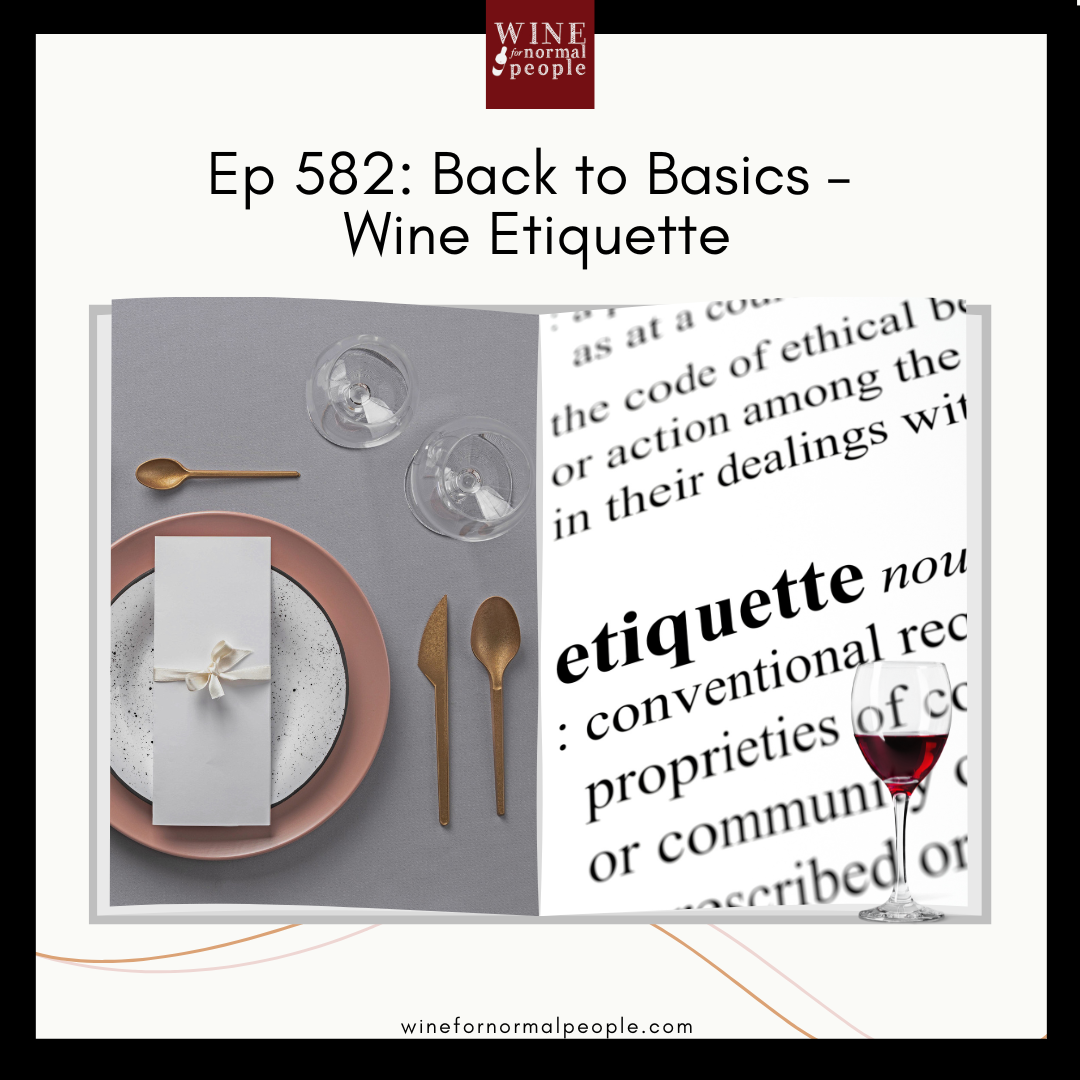
Ep 582: Back to Basics – Wine Etiquette
This time I revisit a show from long ago on Wine Etiquette. In this Back-to-Basics episode, I cover the three main places you would use etiquette - a dinner party, a restaurant, and a tasting room. I address: The Dinner Party: What to bring a host, a good welcome drink, whether or not to open a bottle that a guest brings, the etiquette of what to do with the last glass in the bottle, and the point in the night to serve your best wine. I also talk about the proper way to pour, how high to fill a wine red or white wine glass, and whether or not to display a bottle you have decanted. Source: Des Moines Register The Restaurant: I review every step of wine ordering from perusing the menu to looking at the cork to approving the wine. I discuss the interaction with a sommelier and what to do with large groups, and how to handle a restaurant that serves less than fresh wine by the glass. I touch on giving the waiter a taste of a special wine and some ideas of what to do at a BYO restaurant. Tasting rooms: When to make a reservation, what to wear, tasting room fees, spitting, commenting/ask questions, and the most pressing question people have: what to tip tasting room staff. I tried to cover everything, but if you still have questions, feel free to reach out! Full show notes and all back episodes are on Patreon. Become a member today! www.patreon.com/winefornormalpeople _______________________________________________________________ Check out my exclusive sponsor, Wine Access. They have an amazing selection -- once you get hooked on their wines, they will be your go-to! Make sure you join the Wine Access-Wine For Normal People wine club for wines I select delivered to you four times a year! To register for an AWESOME, LIVE WFNP class with Elizabeth or get a class gift certificate for the wine lover in your life go to: www.winefornormalpeople.com/classes
Oct 7
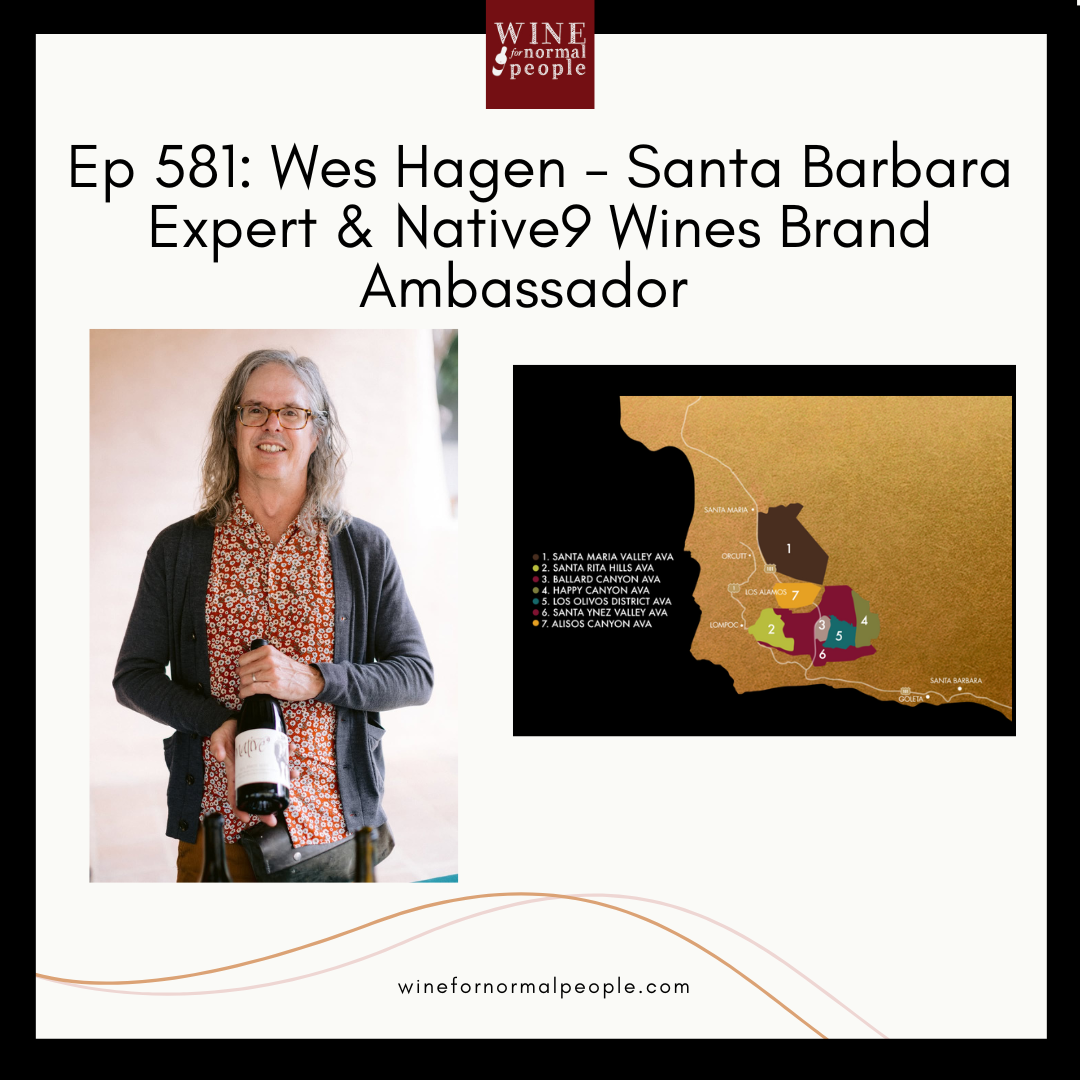
Ep 581: Wes Hagen - Santa Barbara Expert & Native9 Wines Brand Ambassador
You will get no better primer on Santa Barbara wine country than in the show. Wes Hagen comes on to school us on his region. Ask anyone in Santa Barbara wine about Wes Hagen and they'll tell you he is a legend. He has worked in Santa Barbara wine for 30+ years as a vineyard manager, winemaker, hospitality specialist, wine educator, and sommelier. He has run prestigious vineyards , made wine in amazing wineries (Clos Pepe, J. Wilkes Wines, Miller Family Wines), and then became the go-to guy for creating American Viticultural Areas in Santa Barbara, writing and getting four AVAs approved between 1997-2019. He is also a noted educator, having lectured at many of the top viticulture and enology schools in the US and he is known for his famed TED talk on the History of Wine. Image: Wes Hagen. Credit: Wes Hagen Wes is currently the brand ambassador for Native9 wines, a brand representing the Ontiveros family's 9th generation of California farmers . In the show Wes educates us on Santa Barbara geology and climate, the various Santa Barbara County AVAs and what each grows, the process of petitioning for an AVA, the Santa Barbara wine country culture and how the movie "Sideways" affected it, and his reasons for believing that a downturn in the wine industry is "doom and room", rather than "doom and gloom"! You are guaranteed to learn a ton about Santa Barbara in this show! Info on how to contact Wes: Wes Hagen is available through to help guide you through planning a Santa Barbara Wine Adventure: wes@native9.com or text him at 805-450-2324. Wes's web site: www.weshagen.com Learn more about Native9 Wines at www.native9.com Vineyard Tours and 'Deep Dive' tastings with Wes are available at Native9 by appointment: BOOK A TOUR - https://www.exploretock.com/native9 Full show notes and all back episodes are on Patreon. Join the community today! www.patreon.com/winefornormalpeople _______________________________________________________________ This show is brought to you by my exclusive sponsor, Wine Access – THE place to discover your next favorite bottle. Wine Access has highly allocated wines and incredible values, plus free shipping on orders of $150 or more. You can't go wrong with Wine Access! Join the WFNP/Wine Access wine club and get 6 awesome bottles for just $150 four times a year. That includes shipping! When you become a member, you also get 10% all your purchases on the site. Go to wineaccess.com/normal to sign up!
Oct 1
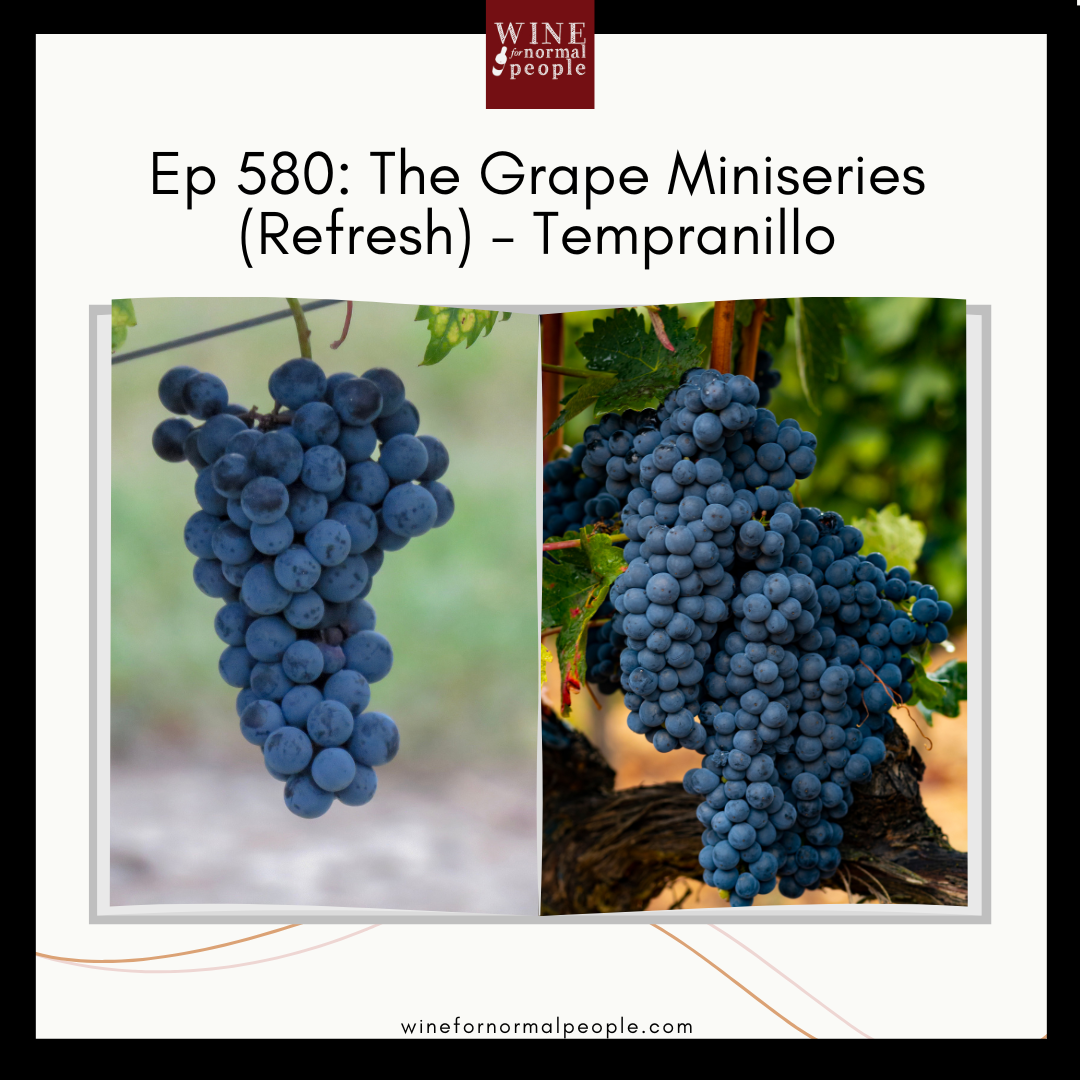
Ep 580: The Grape Miniseries (refresh) -- Tempranillo
It's been 13 years since I've done a grape miniseries on Tempranillo, so it was high time! This grape has come a long way in a decade +, proving that it has more nuance, terroir driven finesse, and versatility than it gets credit for. Tempranillo is now the third most widely planted wine grape in the world, at 231,000 ha/570,000 acres. It is not widely grown outside of Spain but there are growers in 17 countries making a go of it. That said, 88% of Tempranillo's vineyard area is in Spain and most of it is in the northern central parts, with Rioja and Ribera del Duero as the shining stars. Photo: Getty Images via Canva In this show, I go over the DNA and history of the grape and I discuss the many, many names it has. I talk about how it reacts to terroir and its behavior in the vineyard, and why it is so uniquely suited to the special areas in Spain where it thrives. I talk about winemaking and its effect on the grape and then I dive into the aging criteria of Spain (Generico, Crianza, Reserva, Gran Reserva) before going over the specific regions in Spain, Portugal, and the New World in which this grape does amazing things. This is one of the most important grapes in the world, and the mini-series is packed with info! Enjoy and go try some different wines, you will be surprised at how different they are based on all the factors I mention in the show. You can test yourself to see if you can figure out if it's the land or the hand of man that has an effect! Full show notes and all back episodes are on Patreon. Become a member today! www.patreon.com/winefornormalpeople _______________________________________________________________ Check out my exclusive sponsor, Wine Access. They have an amazing selection -- once you get hooked on their wines, they will be your go-to! Make sure you join the Wine Access-Wine For Normal People wine club for wines I select delivered to you four times a year! To register for an AWESOME, LIVE WFNP class with Elizabeth or get a class gift certificate for the wine lover in your life go to: www.winefornormalpeople.com/classes
Sep 24
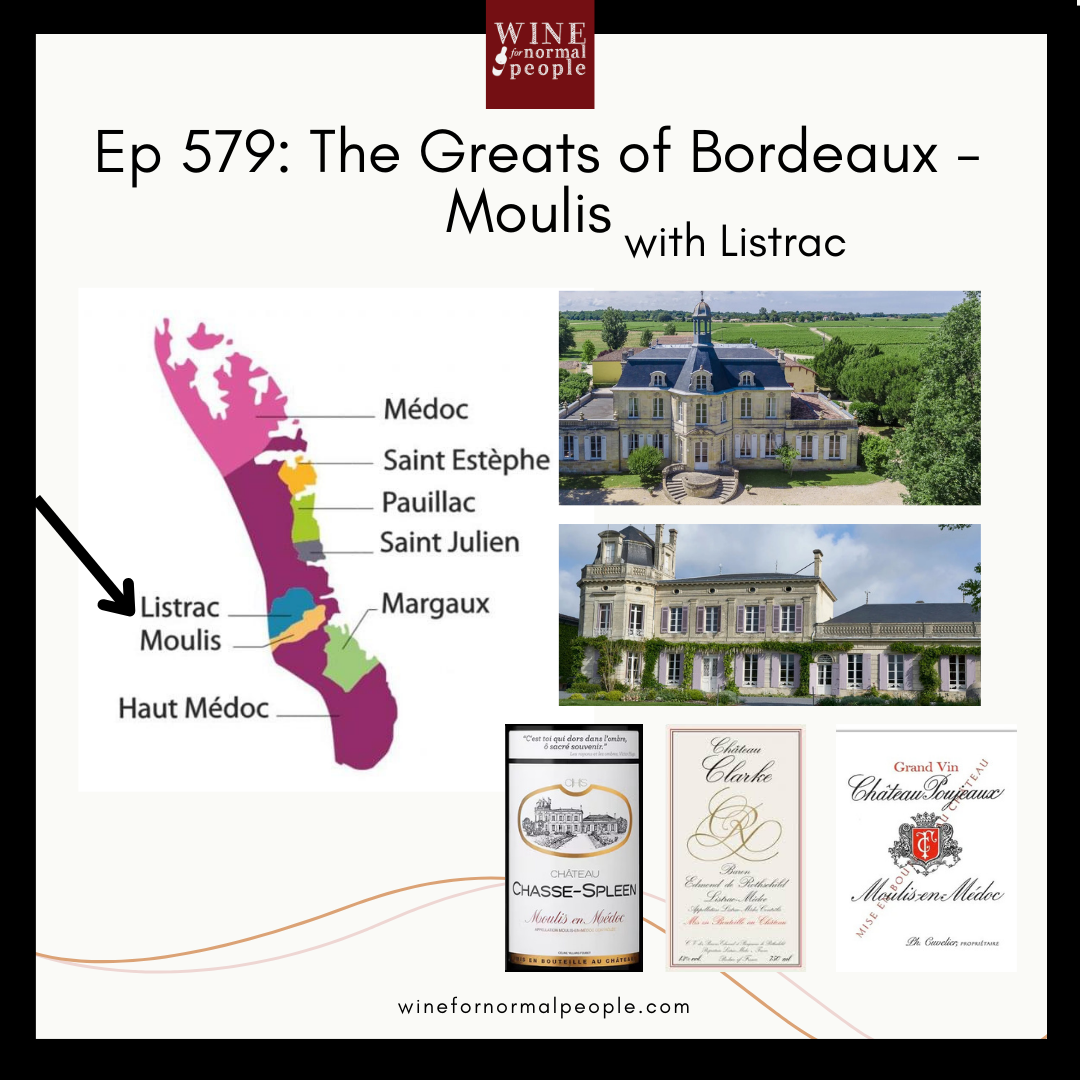
Ep 579: The Greats of Bordeaux - Moulis with Listrac
This week I finish up the communal appellations of the Médoc for our "Greats of Bordeaux" series with Moulis! Map: Wines of the Médoc Although the communes of Moulis and Listrac are often seen as one in the same because both are inland and neither is adjacent to the Gironde River/Estuary, this grouping is a mistake. The wines of Moulis, especially from the Grand Poujeaux plateau next to Margaux, can rival or exceed the quality of the wines from the big name communes on the river -- Margaux, St-Julien, Pauillac, and Saint-Estèphe. Moulis is varied and not all the wines grow on the top terroir, but those that do make exquisite, ageworthy wines that are undervalued. Châteaux like Poujeaux, Chasse Spleen, and Maucaillou make top wines for relatively low prices. I spend most of the show on Moulis but also cover Listrac. Listrac, in my mind is not one of "The Greats" but it is historic and important. I review the commune and try to point out some of the main reasons I think Moulis and Listrac are so very different, with Moulis earning top billing over Listrac. This is the final in the Médoc Greats! We have covered Margaux, Saint Julien, Pauillac, Saint Estèphe, and now Moulis. We will move to Graves and Pessac-Leognan next, before ending where we began this series, on the Right Bank! Enjoy!! Full show notes and all back episodes are on Patreon. Become a member today! www.patreon.com/winefornormalpeople _______________________________________________________________ Check out my exclusive sponsor, Wine Access. They have an amazing selection -- once you get hooked on their wines, they will be your go-to! Make sure you join the Wine Access-Wine For Normal People wine club for wines I select delivered to you four times a year! To register for an AWESOME, LIVE WFNP class with Elizabeth or get a class gift certificate for the wine lover in your life go to: www.winefornormalpeople.com/classes
Sep 17
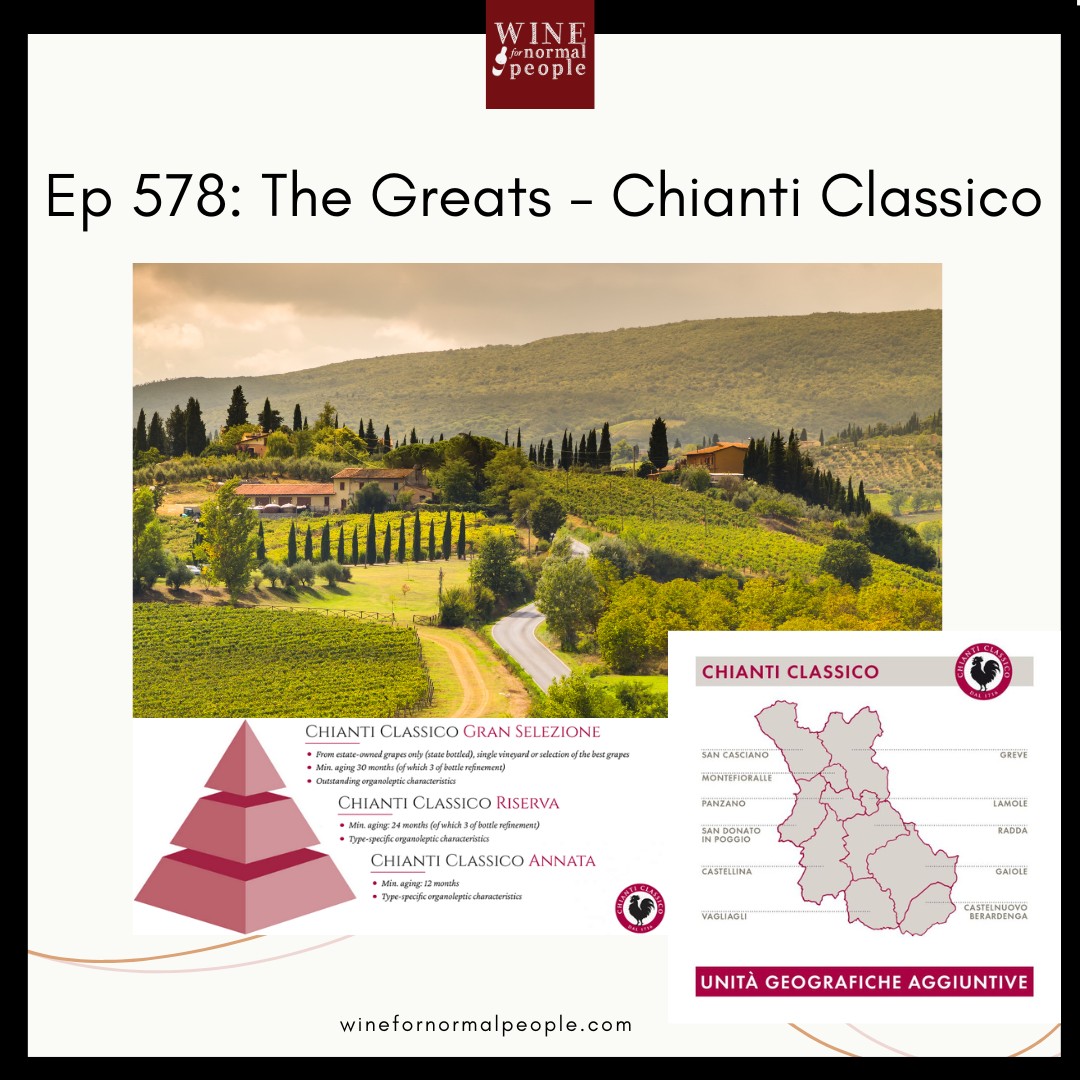
Ep 578: The Greats - Chianti Classico
This week I return to The Greats series in which I explore the greatest wines in the world and how they became such big deals. Photo: Vineyards in Chianti Classico. Credit: Unsplash Chianti Classico, with its 700+ years of history and ideal terroir, is indisputably one of the great wines in the world. In this episode, I cover the long history of Chianti Classico, its ebbs and flows, and its current leaps in quality. I talk about the terroir of the region and why wines here are different from any other in the world and the best pairing with food you could ask for. I address the new Gran Selezione and Unità Geografiche Aggiuntive (UGA) systems, which are signs that Chianti Classico is ever improving. Several times in the show I make the distinction between Chianti Classico DOCG and Chianti DOCG, so I'll reiterate here -- there is a big difference and it definitely is worth your time to listen and figure out why looking for the Gallo Nero/black rooster on a bottle of Chianti Classico will pay off in the glass! Full show notes and all back episodes are on Patreon. Join the community today! www.patreon.com/winefornormalpeople _______________________________________________________________ This show is brought to you by my exclusive sponsor, Wine Access – THE place to discover your next favorite bottle. Wine Access has highly allocated wines and incredible values, plus free shipping on orders of $150 or more. You can't go wrong with Wine Access! Join the WFNP/Wine Access wine club and get 6 awesome bottles for just $150 four times a year. That includes shipping! When you become a member, you also get 10% all your purchases on the site. Go to wineaccess.com/normal to sign up!
Sep 10
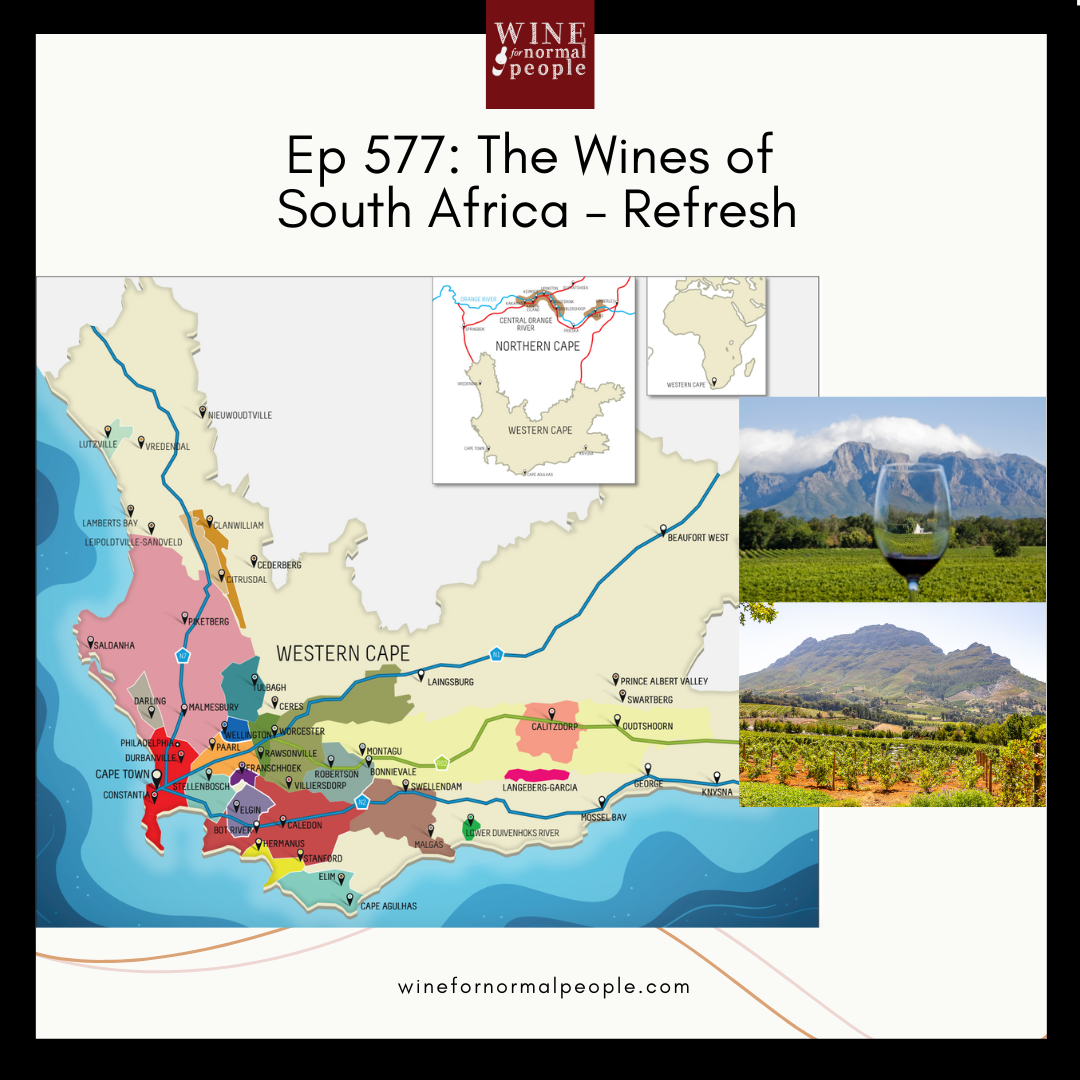
Ep 577: The Wines of South Africa - Refresh
This week's show is on South Africa, a much more historic region than many realize, it has been making wine for more than 350 years. Although considered a 'New World' wine region, winemaking and ethos are often more oriented towards the Old World. Its style often straddles the line between New and Old World, offering fruit-driven wines with minerality, earthiness, restraint, and higher acidity. In this show, I talk about the unique conditions of this country, located between latitudes 27° and 34° south. I discuss the lengthy winemaking history, and how the Mediterranean climate, old soils, and a unique topography create world class wines of mainly Chardonnay, Chenin Blanc, Sauvignon Blanc, Shiraz, Cabernet Sauvignon, Pinotage, and Merlot. Photo: South African Winelands/Stellenbosch. Source: Canva/Getty Images Full show notes and all back episodes are on Patreon. Become a member today! www.patreon.com/winefornormalpeople _______________________________________________________________ Check out my exclusive sponsor, Wine Access. They have an amazing selection -- once you get hooked on their wines, they will be your go-to! Make sure you join the Wine Access-Wine For Normal People wine club for wines I select delivered to you four times a year! To register for an AWESOME, LIVE WFNP class with Elizabeth or get a class gift certificate for the wine lover in your life go to: www.winefornormalpeople.com/classes
Sep 3
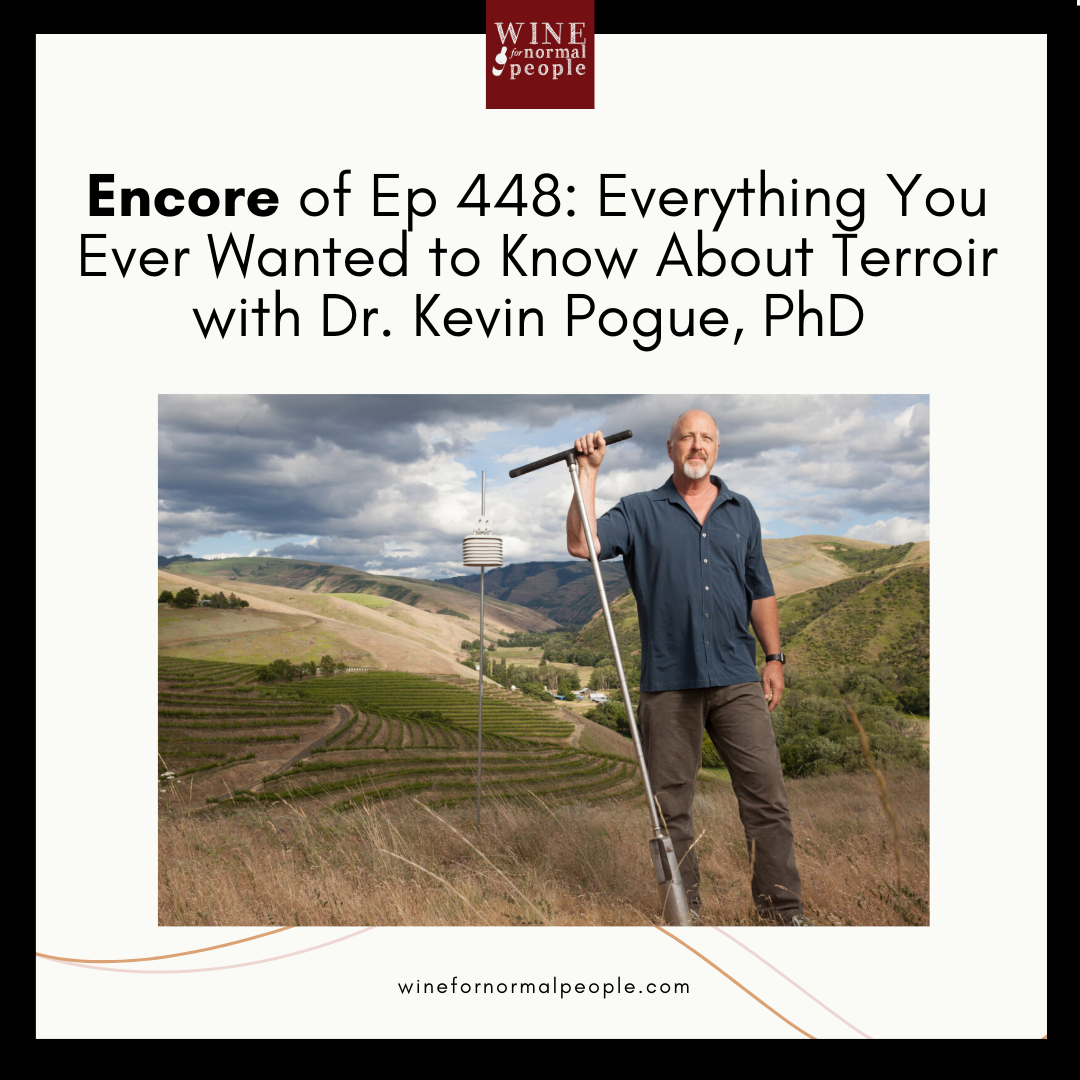
Encore of Ep 448: Everything You Ever Wanted to Know About Terroir with Dr. Kevin Pogue, PhD
In this ENCORE presentation, Dr. Kevin Pogue, PhD, professor and geologist educates us on terroir. This podcast is like taking a terroir class: it debunks so many things that people spout in reference books, at wineries, and in mainstream press about the topic! He explains things brilliantly and he is one of the first people I've ever met who actually has answers to my really dorky questions about terroir. Photo: Kevin Pogue. From Vinterra.net Kevin is one of the most famous people in the field of terroir. He's considered the foremost terroir expert on Washington State wine and he's known around the world - his work has been featured in both national and international journals. He's a licensed geologist and professor of geology at Whitman College in Walla Walla. Kevin has a doctorate in geology from Oregon State University, and decades of college teaching and research experience. He has authored books, articles, and done extensive research on the terroir of the Pacific northwest, with a good portion of this time spent on investigating the deposits of the Missoula floods, which were the pivotal event that formed the geological base of the region. Kevin's research today focuses on terroir. He owns a consulting company, Vinterra , through which he assists wineries in choosing the best vineyard sites, matching grape to site, and educating winery owners and winemakers and their customers on why their specific terroir leads to the style in their wine. This is a great show and well worth a listen -- whether it's your first time or it's an encore for you, you will definitely learn something (again!). Remember that this and ALL back episodes are on Patreon. Become a member today and help the show continue! I can't do it without your support! ____________________________________________________ www.patreon.com/winefornormalpeople _______________________________________________________________ Check out my exclusive sponsor, Wine Access. They have an amazing selection -- once you get hooked on their wines, they will be your go-to! Make sure you join the Wine Access-Wine For Normal People wine club for wines I select delivered to you four times a year! To register for an AWESOME, LIVE WFNP class with Elizabeth or get a class gift certificate for the wine lover in your life go to: www.winefornormalpeople.com/classes
Aug 27
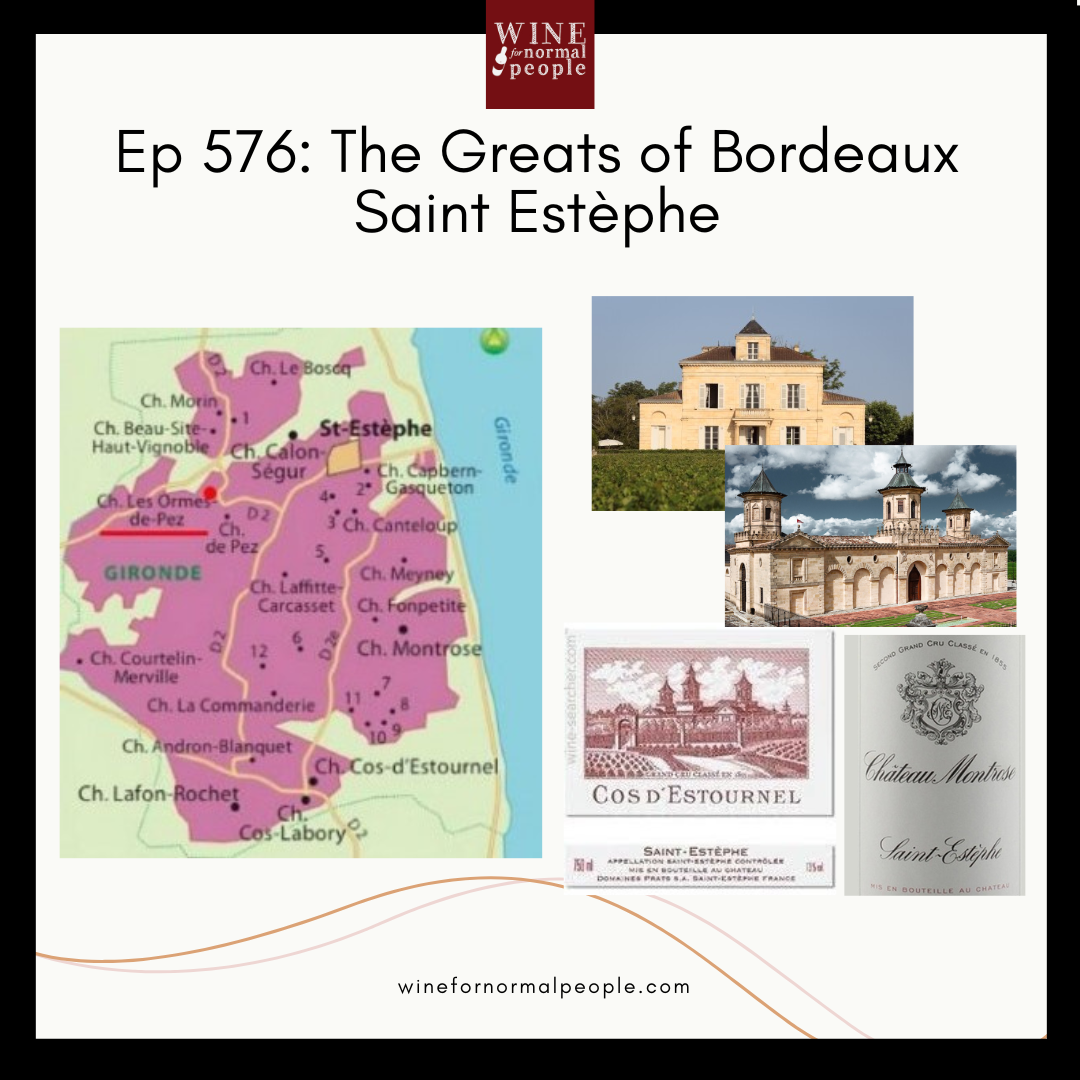
Ep 576: The Greats of Bordeaux Saint Estèphe
Saint Estèphe is the northernmost of the six communal appellations of the Médoc. 50 kilometers/30 miles north of the city of Bordeaux, this red wine only appellation borders Pauillac to the south and a part of the Haut-Médoc in the north. This commune is very different from the others I've covered and the wines are amazing, but of a completely different ilk (they are also much more affordable!). Photo: Château Cos d'Estournel. Credit: Cos d'Estournel photo library The largest of all the major, prestigious Médoc communes, Saint Estèphe is varied but its diversity, which has been a hinderance in the past, has become a great asset with climate change and better viticulture. Today the wines have gone from tough wines requiring long aging to softer, tasty wines that are approachable earlier. This is not the most prestigious commune (it has no first growths) but it is unique and probably the one which I have the most of in my cellar! I love these wines and the people who make them. In this show, I cover what makes Saint Estèphe so unique. As in the other Greats of Bordeaux shows, I review the history, terroir, climate, and then discuss the top Châteaux. For reference, H ere is a link to the 1855 Classification Full show notes and all back episodes are on Patreon. Become a member today! www.patreon.com/winefornormalpeople _______________________________________________________________ Check out my exclusive sponsor, Wine Access. They have an amazing selection -- once you get hooked on their wines, they will be your go-to! Make sure you join the Wine Access-Wine For Normal People wine club for wines I select delivered to you four times a year! To register for an AWESOME, LIVE WFNP class with Elizabeth or get a class gift certificate for the wine lover in your life go to: www.winefornormalpeople.com/classes
Aug 20
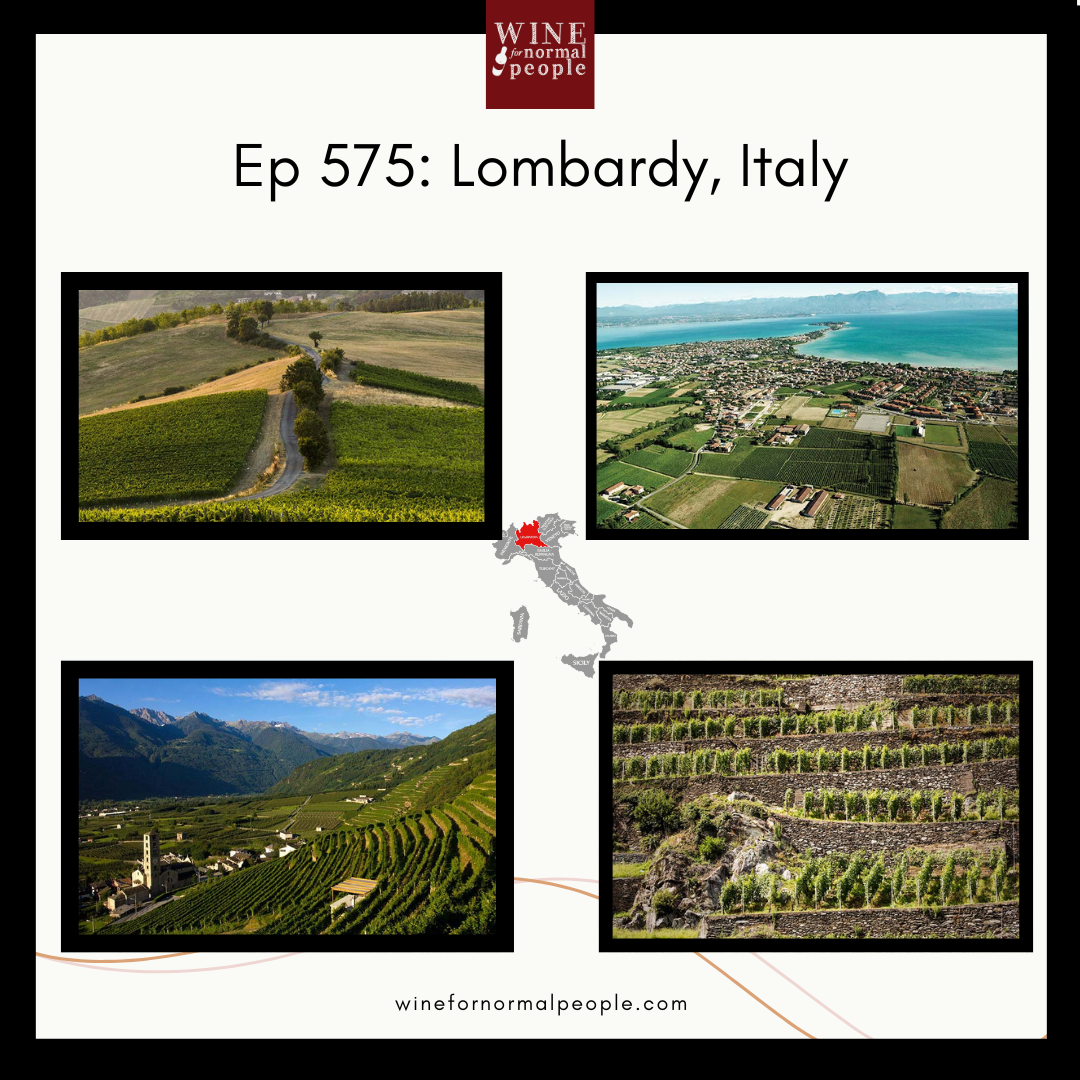
Ep 575: Lombardy, Italy
This week I cover Lombardy/Lombardia, one of the smaller wine production areas of Italy. Lombardy, home to the cities of Milan, Bergamo and Brescia is known far more for its fashion, its industry, and osso bucco and risotto alla Milanese than it is for its wines, but there are some gems to be discovered. Photo: Lugana Credit: Consorzio Lugana Because there is limited availability of these wines, I only cover the major regions that you may encounter and discuss the terrain of Lombardy and the terroir of each of the fine wine regions. Lombardy is known in the wine world primarily for Franciacorta, the sparkling wine made in the Champagne method, which has been called the best sparkling wine of Italy. But Lombardy is is more than just Franciacorta. There are exceptional sparkling, sweet, and still wines of Oltrepò Pavese in the southwest of the region, complex reds from the Alpine area of Valtellina on the Swiss border, tasty, refreshing whites from Lugana near Lake Garda, and other interesting regions that have significant production. Photo: Valtellina. Credit: Consorzio Valtellina I hope you enjoy this look at one of the smaller wine producing areas of Italy and, more importantly, that you can use this info if you ever see these wines on the shelf or (more fun!) find yourself in Lake Garda or Lake Como or Milano with some time and desire to explore the wines of this beautiful place! Full show notes and all back episodes are on Patreon. Join the community today! www.patreon.com/winefornormalpeople _______________________________________________________________ This show is brought to you by my exclusive sponsor, Wine Access – THE place to discover your next favorite bottle. Wine Access has highly allocated wines and incredible values, plus free shipping on orders of $150 or more. You can't go wrong with Wine Access! Join the WFNP/Wine Access wine club and get 6 awesome bottles for just $150 four times a year. That includes shipping! When you become a member, you also get 10% all your purchases on the site. Go to wineaccess.com/normal to sign up!
Aug 13
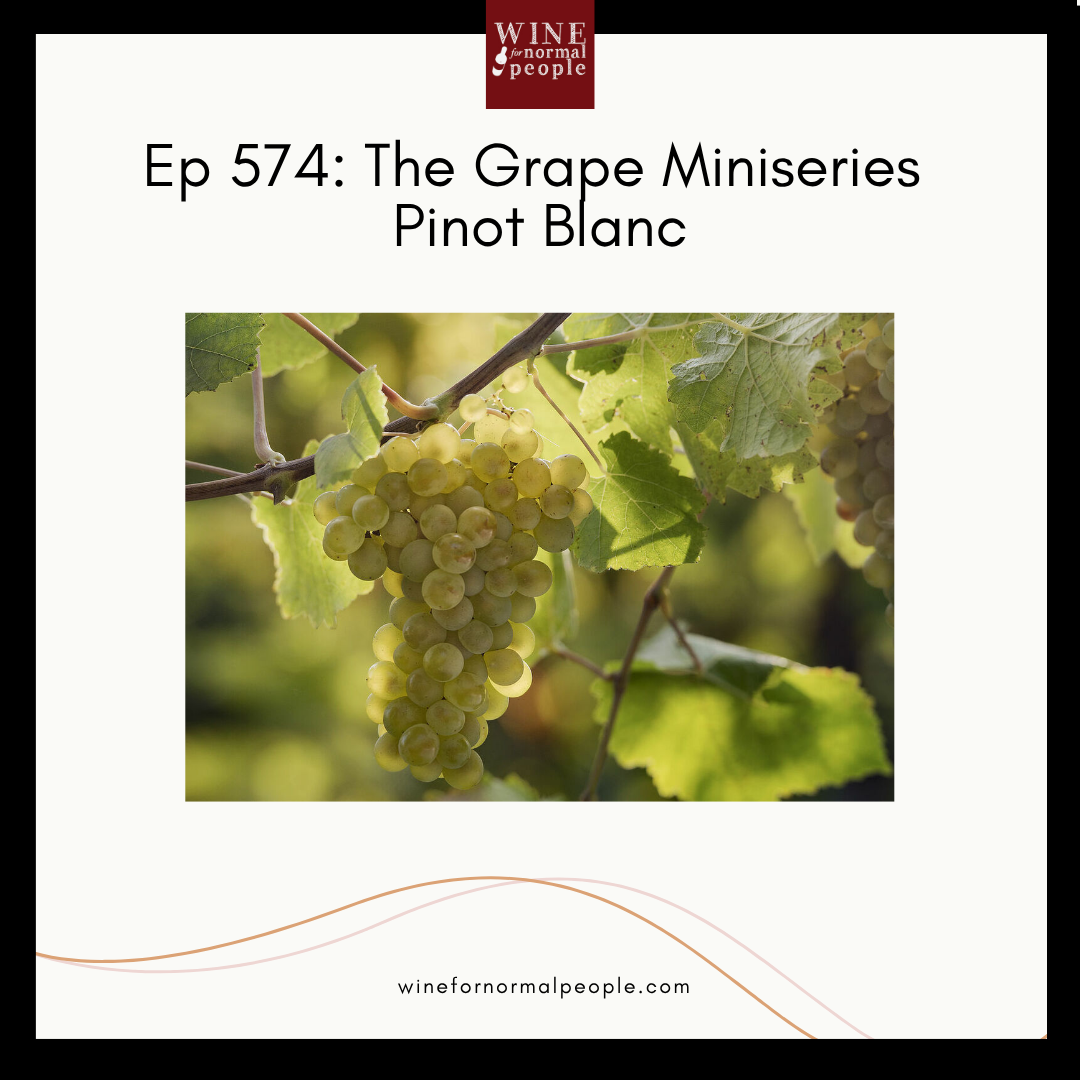
Ep 574: The Grape Miniseries -- Pinot Blanc
In this week's show, I cover Pinot Blanc as part of the grape miniseries. Pinot Blanc is a white color mutation of Pinot Noir, native to Burgundy/Bourgogne. It creates refreshing light- to medium-bodied wines that run the gamut from simple sippers to much more complex, oak-aged versions, to excellent sweet and sparkling wines. Photo: Pinot Blanc. Credit: Wines of Austria This lovely grape is often described as a "workhorse" and not treated with much reverence, partially because it is often seen as inferior to its cousin Chardonnay. But a handful of producers these days are showing that Pinot Blanc can be a lot more than a light sipper. When grown on the right sites and treated well, this grape can create beautiful, complex wines. With its high acidity and medium sugars, it is also extremely versatile -- making great still, sparkling, dry, or sweet wines. In the show, as I always do with the grape miniseries, I cover the history of the grape, how it behaves in the vineyard, the aroma and flavors and how it changes with winemaking. I end with where it is grown and food pairing ideas. This show has a lot of producer names in it because I know that it is hard to find good versions of Pinot Blanc, so I'm trying to steer you in the right direction. Full show notes with producer names and all back episodes are on Patreon. Become a member today! www.patreon.com/winefornormalpeople _______________________________________________________________ Check out my exclusive sponsor, Wine Access. They have an amazing selection -- once you get hooked on their wines, they will be your go-to! Make sure you join the Wine Access-Wine For Normal People wine club for wines I select delivered to you four times a year! To register for an AWESOME, LIVE WFNP class with me or get a class gift certificate for the wine lover in your life go to: www.winefornormalpeople.com/classes
Jul 30
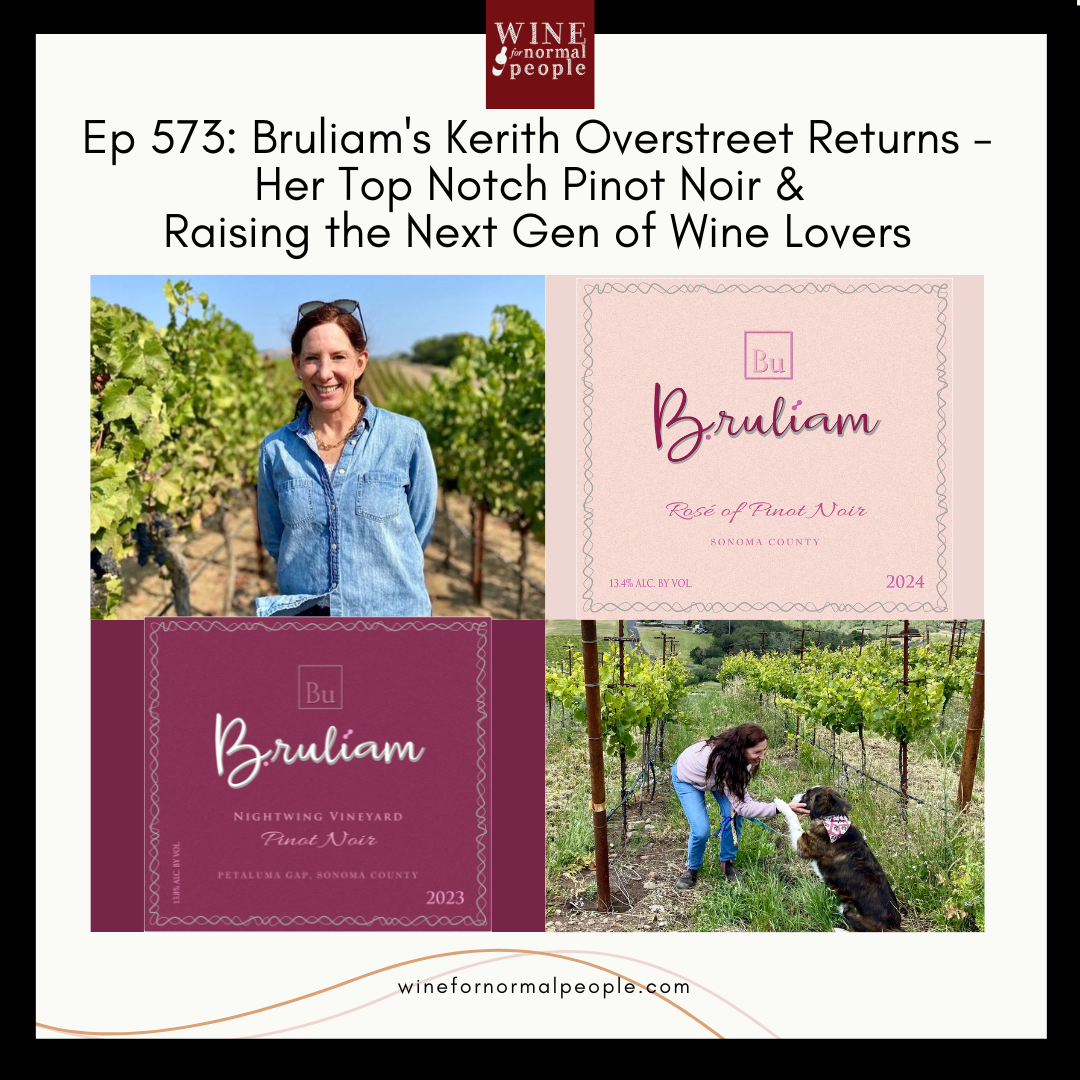
Ep 573: Bruliam's Kerith Overstreet Returns - Her Top Notch Pinot Noir + How to Spark Love for Wine in the Next Gen
In this unique episode, Kerith Overstreet of Bruliam Wines in Sonoma returns to give us an update (she was on Ep 269 in 2019). Kerith/Bruliam is a boutique producer of vineyard-designated wines, mainly of Pinot Noir and she gives us a full education on the differences between some of the main Pinot regions of California. The cool thing about this show? The last third of the podcast is a business discussion about something she and I are always discussing – how to get our kids' generation – Gen Z – to appreciate wine. Kerith's daughter Amelia (the AM in BruliAM), a 21-year-old Gen Z'er, joins to help us analyze the situation and give some advice (she's a smart cookie and has some great insight!). For anyone who has young people in their lives and is wondering how to turn them on to wine, this should be an interesting perspective. Photo: Kerith Overstreet in her vineyard. Courtesy of Bruliam Wines Full show notes and all back episodes are on Patreon. Become a member today! ______________________________________________________________________ www.patreon.com/winefornormalpeople _______________________________________________________________ Check out my exclusive sponsor, Wine Access. They have an amazing selection -- once you get hooked on their wines, they will be your go-to! Make sure you join the Wine Access-Wine For Normal People wine club for wines I select delivered to you four times a year! To register for an AWESOME, LIVE WFNP class with Elizabeth or get a class gift certificate for the wine lover in your life go to: www.winefornormalpeople.com/classes
Jul 23
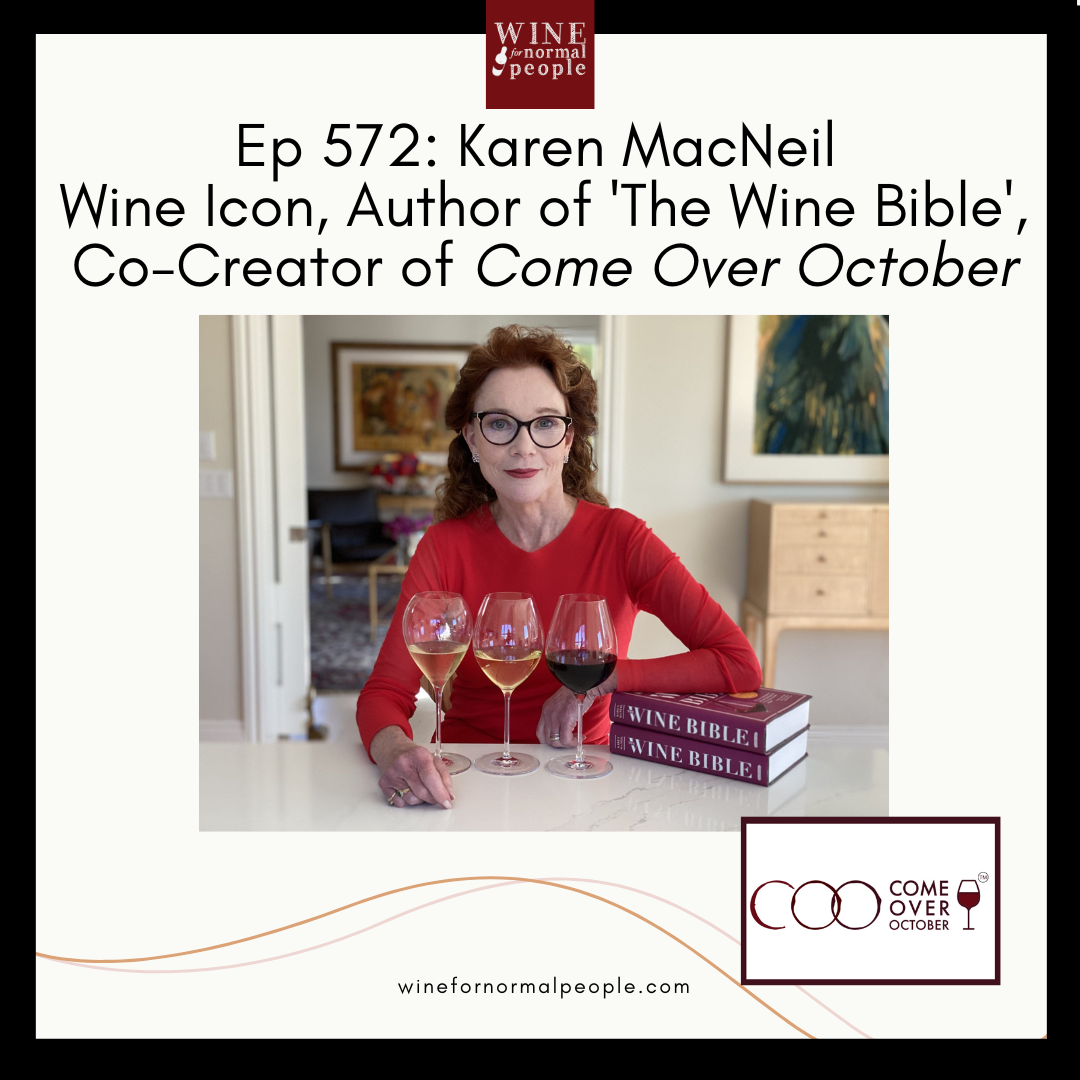
Ep 572: Karen MacNeil, Wine Icon, Author of 'The Wine Bible', Co-Creator of Come Over October
In this episode I'm joined by author and American wine icon, Karen MacNeil. We discuss her amazing career trajectory in wine from food stamps to international fame, and her new initiative, Come Over October , which is having enormous success in encouraging people to get together over a bottle of wine! Karen is one of the foremost wine experts in the United States. She's the author of the award-winning book, "The Wine Bible," which has been recognized as "the most comprehensive and authoritative book on wine written by an American author." Karen is the only American to have won every major wine award given in the English language -- the James Beard award for Wine and Spirits Professional of the Year, the Louis Roederer award for Best Consumer Wine Writing, and the International Wine and Spirits award as the Global Wine Communicator of the Year. Recently, Karen teamed up with public relations and communications veterans Gino Colangelo and Kimberly Charles (the three are pictured above) to begin a program called Come Over October . Troubled by the disconnect in society due to the faster pace of life and the dominance of technology, these three saw a role for wine. They created Come Over October to encourage friends, family, and colleagues to "come over" during the month of October and share some wine and a personal connection. The show is mainly about Karen's road to success, and then we wrap with the concept of Come Over October , which I fully support! Full show notes and all back episodes are on Patreon. Become a member today! www.patreon.com/winefornormalpeople _______________________________________________________________ Check out my exclusive sponsor, Wine Access. They have an amazing selection -- once you get hooked on their wines, they will be your go-to! Make sure you join the Wine Access-Wine For Normal People wine club for wines I select delivered to you four times a year! To register for an AWESOME, LIVE WFNP class with Elizabeth or get a class gift certificate for the wine lover in your life go to: www.winefornormalpeople.com/classes
Jul 16
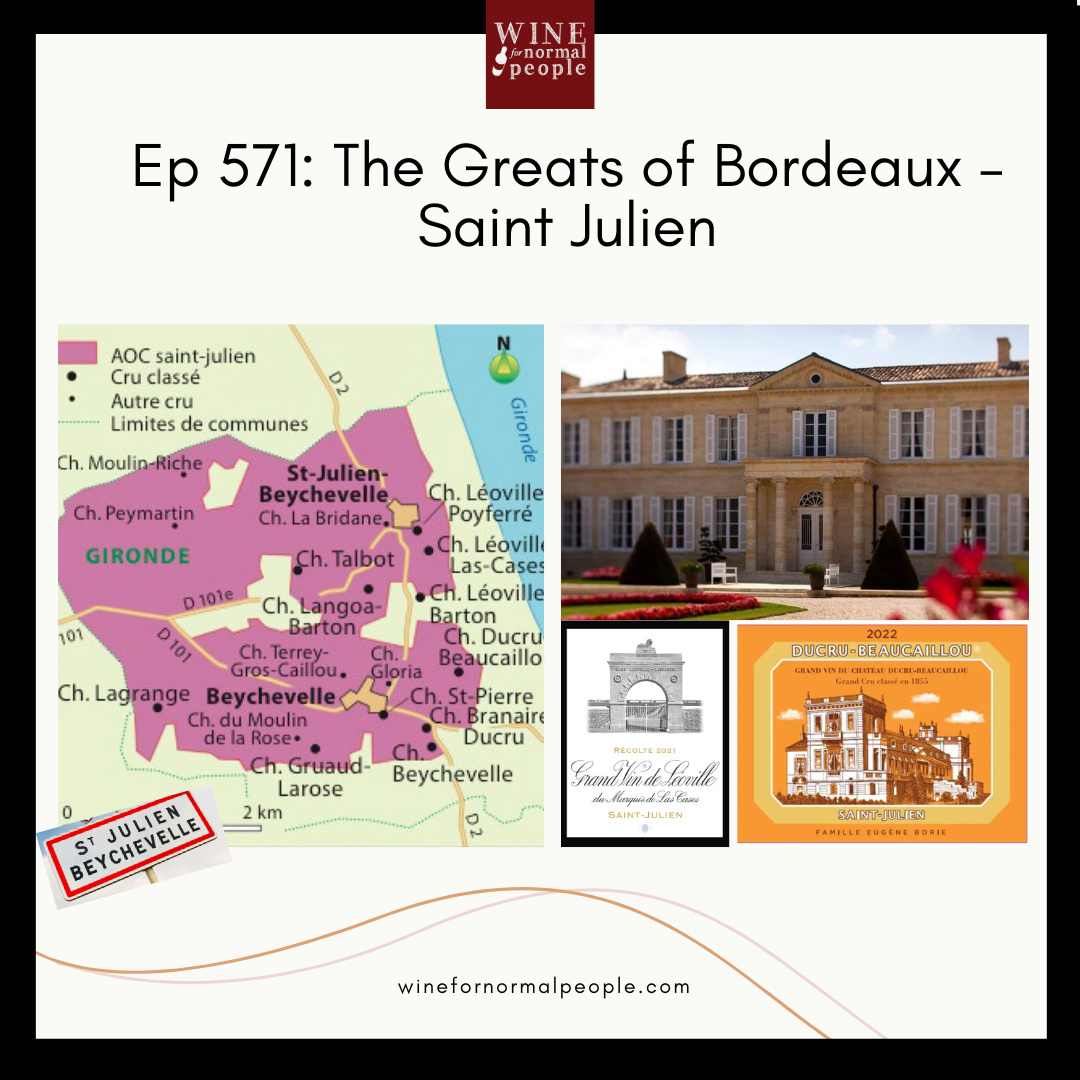
Ep 571: The Greats of Bordeaux – Saint Julien
Sandwiched between the famed Médoc AOCs of Margaux in the south and Pauillac in the north, Saint Julien has one of the highest concentrations of classified growths from the 1855 Classification in Bordeaux. This red wine only AOC is just 910 ha/2,250acres, which is 6% of the Médoc vineyard. It is one-sixth the size of Pauillac. It makes an average of about 6 million bottles a year. Image courtesy of Château Léoville Barton But this densely planted appellation may be small but what it lacks in size, it makes up for in quality. Saint Julien is considered the most consistent of the Médoc communes and it is known for Cabernet Sauvignon dominant wines with the perfect balance of tannin, flavor, and acidity year after year. In this show, I cover what makes Saint Julien so unique. As in the other Greats of Bordeaux shows, I review the history, terroir, climate, and then discuss the top Châteaux. For reference, H ere is a link to the 1855 Classification Full show notes and all back episodes are on Patreon. Become a member today! www.patreon.com/winefornormalpeople _______________________________________________________________ Check out my exclusive sponsor, Wine Access. They have an amazing selection -- once you get hooked on their wines, they will be your go-to! Make sure you join the Wine Access-Wine For Normal People wine club for wines I select delivered to you four times a year! To register for an AWESOME, LIVE WFNP class with Elizabeth or get a class gift certificate for the wine lover in your life go to: www.winefornormalpeople.com/classes
Jul 9
Ep 570: 8 Refreshing Red Wines
In this episode, I discuss eight refreshing red wines that are lighter, fresher, and perfect for sipping on a warm day. I give you ideas for wines that go easy on the oak, tannin, and alcohol, and focus instead on the freshness and lightness. These wines have a multitude of flavors and are from around the world but all of them go beyond the bold and heavy. The wines pair well with light meals, can take a chill, and are perfect for when you want something easy-drinking. Think all red wines are bold, heavy, and best served with steak? Nope! From Frappato to Listán Negro, these wines are something totally different. Image: Pixabay Full show notes and all back episodes are on Patreon. Become a member today! www.patreon.com/winefornormalpeople _______________________________________________________________ Check out my exclusive sponsor, Wine Access. They have an amazing selection -- once you get hooked on their wines, they will be your go-to! Make sure you join the Wine Access-Wine For Normal People wine club for wines I select delivered to you four times a year! To register for an AWESOME, LIVE WFNP class with Elizabeth or get a class gift certificate for the wine lover in your life go to: www.winefornormalpeople.com/classes

Jul 2
Ep 569: The Masters of Vernaccia di San Gimignano Cappella Sant'Andrea with Owner & Winemaker Francesco Galgani
Last fall, I met Francesco Galgani and tried his wines and I was completely blown away. I always think of Vernaccia as a more historical Pinot Grigio -- light on flavor, boring, and not anything to get excited about. But then I visited Cappella Sant'Andrea. HOLY CRAP!! This is the BEST Vernaccia on earth. Francesco and Flavia, the owners and winemakers, are truly the Masters of Vernaccia di San Gimignano. You will never taste Vernaccia like this. In the show Francesco and I discuss the long history of Vernaccia, wine in San Gimignano, why there is so much crappy Vernaccia, and how they do it right. Their Rialto and Prima Luce, especially are stunning. I can't sing their praises more. Two things mentioned in the show: Follow Francesco on IG, he's a brilliant artist: @francescogalgani If you want to order directly from Francesco, and have the wine shipped from Italy, please visit their website: https://www.cappellasantandrea.it/chi-siamo1 and you can contact them for orders and pricing! Full show notes and all back episodes are on Patreon. Join the community today! www.patreon.com/winefornormalpeople _______________________________________________________________ This show is brought to you by my exclusive sponsor, Wine Access – THE place to discover your next favorite bottle. Wine Access has highly allocated wines and incredible values, plus free shipping on orders of $150 or more. You can't go wrong with Wine Access! Join the WFNP/Wine Access wine club and get 6 awesome bottles for just $150 four times a year. That includes shipping! When you become a member, you also get 10% all your purchases on the site. Go to wineaccess.com/normal to sign up!

Jun 25
Ep 568: Alternatives to a Favorite -- Sauvignon Blanc
It's another edition of the "Alternatives to a Fave" series! This time: Sauvignon blanc. As an extension of the Grape Mini-series, for this series I come up with lists of wines that lovers of a specific grape can try as alternatives. Sauvignon blanc is not a one note! It has so many different styles -- from the acidic, minerally, citrus and flinty notes of Sancerre and Pouilly-Fumé to the tropical fruit, peach, grass, green pepper, and sauteed herb aromas in New Zealand and the blends with Semillon in Bordeaux, there are many, many iterations of this very popular grape. Photo: Sauvignon Blanc in South Africa. Credit: Getty Images from Canva After a brief refresh on the Sauvignon blanc grape, in this show I come up with a list of eight wines that are alternatives -- things like Chablis for the more minerally, flinty substitutes for Sancerre, and then fruity alternatives like Vermentino to stand in for Chilean or New Zealand Sauvignon. I hope, as usual, that this show opens some new doors and gives you new ideas of wines to add to your repertoire! Full show notes and all back episodes are on Patreon. Join the community today! www.patreon.com/winefornormalpeople _______________________________________________________________ This show is brought to you by my exclusive sponsor, Wine Access – THE place to discover your next favorite bottle. Wine Access has highly allocated wines and incredible values, plus free shipping on orders of $150 or more. You can't go wrong with Wine Access! Join the WFNP/Wine Access wine club and get 6 awesome bottles for just $150 four times a year. That includes shipping! When you become a member, you also get 10% all your purchases on the site. Go to wineaccess.com/normal to sign up!

Jun 17
Ep 567: The Wines of Victoria, Australia with CEO of Wine Victoria, Stephanie Duboudin
Stephanie Duboudin, CEO of Wine Victoria , joins to educate us on this state at the southern end of Australia that has a ton of diversity and makes all styles of wine. A boutique winery heaven, Victoria is something you need to know about! Wineries mentioned: Tahbilk Seppelt Mount Langhi Wild Duck Creek Yeringberg Yarra Yering Brown Brothers Pizzini Campbells Chalmers Chambers Rosewood Stanton & Killeen Giant Steps Bindi Wines _________________________________________________________ Full show notes and all back episodes are on Patreon. Become a member today! www.patreon.com/winefornormalpeople _______________________________________________________________ Check out my exclusive sponsor, Wine Access. They have an amazing selection -- once you get hooked on their wines, they will be your go-to! Make sure you join the Wine Access-Wine For Normal People wine club for wines I select delivered to you four times a year! To register for an AWESOME, LIVE WFNP class with Elizabeth or get a class gift certificate for the wine lover in your life go to: www.winefornormalpeople.com/classes

Jun 11
Ep 566: The Greats of Bordeaux – Pauillac
Located the middle of the Médoc, 50 km/31 miles northwest of Bordeaux, Pauillac is home to 18 of the 61 châteaux classified 1855, just under a third of the list. There are three first growths, two second growths, one fourth growth, and twelve 5th growths. The first growths are Château Latour, Château Lafite-Rothschild, and Château Mouton-Rothschild. Pauillac is north of St-Julien and south of St-Estèphe with the manmade Landes Forest to the west, sheltering the vines from Atlantic winds. The commune has 1,213 ha/3,000 acres of vines (7.5% of the Medoc) and makes about 7 million bottles a year. The AOC Pauillac is only for still red wines, famous for their balance of power and elegance that is rare in Cabernet Sauvignon-Merlot blends. These wines have strong aromas and flavors but with great acidity and tannin – the best are not overripe or overly tannic -- and are balanced. In this show, I cover everything about Pauillac -- history, terroir, climate, sustainability, and then the top Châteaux. I break it down by terroir, location, and some details on top chateaux and then tell you to save your pennies to get these wines! H ere is a link to the 1855 Classification ___________________________________________________________ Full show notes and all back episodes are on Patreon. Become a member today! www.patreon.com/winefornormalpeople _______________________________________________________________ Check out my exclusive sponsor, Wine Access. They have an amazing selection -- once you get hooked on their wines, they will be your go-to! Make sure you join the Wine Access-Wine For Normal People wine club for wines I select delivered to you four times a year! To register for an AWESOME, LIVE WFNP class with Elizabeth or get a class gift certificate for the wine lover in your life go to: www.winefornormalpeople.com/classes

Jun 3
Ep 565: Back to Basics – 8 Ideas to Break Your Rut and Discover New Wines
As part of the Back to Basics series, in which I update previous podcasts on practical topics that can be helpful to everyone, I update podcast Episode 28 from September 2011! Rick was the co-host then and it was a much shorter, less detailed show. Image: Assembled on Canva by WFNP Some of the suggestions from those many years ago were great, and some have changed or I've augmented them. The goal of this show: to give you some ideas to motivate you to try new wines and new ways to explore. Ideas include: exploring different grapes from the same regions you like, joining a wine club (hint hint: the Wine Access/WFNP Wine Club , going to tasting events, and more! It's a short and sweet re-do of a show from long ago. I hope you get some ideas from it! Full show notes and all back episodes are on Patreon. Join the community today! www.patreon.com/winefornormalpeople _______________________________________________________________ This show is brought to you by my exclusive sponsor, Wine Access – THE place to discover your next favorite bottle. Wine Access has highly allocated wines and incredible values, plus free shipping on orders of $150 or more. You can't go wrong with Wine Access! Join the WFNP/Wine Access wine club and get 6 awesome bottles for just $150 four times a year. That includes shipping! When you become a member, you also get 10% all your purchases on the site. Go to wineaccess.com/normal to sign up!

May 28
Ep 564: The Greats – Taurasi DOCG
On the heels of my trip with a group of Patrons to Campania, I wanted to do a show on Taurasi while it was still fresh in my mind. Taurasi, a small (472 ha / 1,166 acres) DOCG region, is indisputably one of Italy's greatest red wines along with Barolo, Barbaresco, Brunello, Chianti, Vino Nobile, and Montefalco Sagrantino. Taurasi, made of the ancient Aglianico grape, is in Campania, more specifically in hills northeast of Irpinia/Avellino and is centered around the town of Taurasi, a small town with a 10th-century castle that was rebuilt by the Normans. Over the 17 towns within the denomination soils and altitudes range dramatically. Higher altitudes create complex, more acidic styles due to a longer growing season with great diurnal swings. Towns with more clay create extremely tannic wines, while those with sand have certain warmth and fruitiness that makes them easy to drink in their youth. There are a multitude of styles and, with soils in the region layered like a lasagna, the flavors you get from the Aglianico grape depend largely on the site on which it grows. Aglianico is a misunderstood grape, as is Taurasi as a wine. Aglianico is a red with complex, terroir driven flavors of dark fruit, red fruit, spice, black pepper notes, and excellent acidity and tannin. Taurasi, made from a biotype of Aglianico that is particularly dark-skinned, small berried and flavorful makes exquisite wines that have the aging capability of a Barolo or Bordeaux. The grape translates the terroir into the bottle and both where the grapes grow and who makes the wine determines the style – it's an area you could explore for ages and keep discovering new expressions of Aglianico. In fact, Taurasi is called the "Barolo of the South" for nuance and depth of flavor, and variation of its terroir. In this show I cover the extensive history of the region, with all its ups and downs, the climate, altitudes, and land and then discuss the expression of the Aglianico grape and why it makes such fascinating wines. If you haven't had a Taurasi, get on it. Vis a vis other top wines, it is insanely affordable (top wines are less than US$100) and it is a wine that will hold your interest with every sip! Certainly for its history and for its quality, Taurasi is one of the great wines of the world. Full show notes and all back episodes are on Patreon. Join the community today! www.patreon.com/winefornormalpeople _______________________________________________________________ This show is brought to you by my exclusive sponsor, Wine Access – THE place to discover your next favorite bottle. Wine Access has highly allocated wines and incredible values, plus free shipping on orders of $150 or more. You can't go wrong with Wine Access! Join the WFNP/Wine Access wine club and get 6 awesome bottles for just $150 four times a year. That includes shipping! When you become a member, you also get 10% all your purchases on the site. Go to wineaccess.com/normal to sign up!

May 20
Ep 563: Alentejo, Portugal -- Original Blends, Great Value
This week I go in depth on one of the best value regions of Portugal -- Alentejo. These wines are mainly blends and they are as easy on the palate as they are on the wallet -- a perfect combo! Photo: Vineyards in Alentejo outside of Évora. Credit: WFNP Located in southern Portugal, a two hour drive east of Lisbon, Alentejo is huge -- representing almost one-third of the Iberian nation. Although in the past the region was known only as the breadbasket of Portugal and as the world's largest supplier of cork (nearly half of the world's corks come from Alentejo's cork trees), today the region is experiencing a wine renaissance. After a rocky history, Alentejo has grown and its reputation has expanded with it. Known for fruity, lush and plush red blends (about 75% of the wine) of grapes like Alicante Bouschet, Aragonez (Tempranillo), Trincadeira, Alfrochero, and Castelão, there are some higher end versions that sometimes contain Cabernet Sauvignon, Merlot or Syrah as well. The whites are in the minority and are fruity, soft, yet balanced blends as well. The tropical, tangerine noted and soft Antão Vaz is Alentejo's most important white with Arinto used for acidity, Fernão Pires for aroma and soft textures and Roupeiro for aroma as well. Map: Rota dos Vinhos, from the Wines of Alentejo This show covers all the bases on this fascinating region -- from its turbulent history to the climate, terroir, and the many DOPs that each have a distinct identiy. Full show notes and all back episodes are on Patreon. Join the community today! www.patreon.com/winefornormalpeople _______________________________________________________________ This show is brought to you by my exclusive sponsor, Wine Access – THE place to discover your next favorite bottle. Wine Access has highly allocated wines and incredible values, plus free shipping on orders of $150 or more. You can't go wrong with Wine Access! Join the WFNP/Wine Access wine club and get 6 awesome bottles for just $150 four times a year. That includes shipping! When you become a member, you also get 10% all your purchases on the site. Go to wineaccess.com/normal to sign up!

May 15
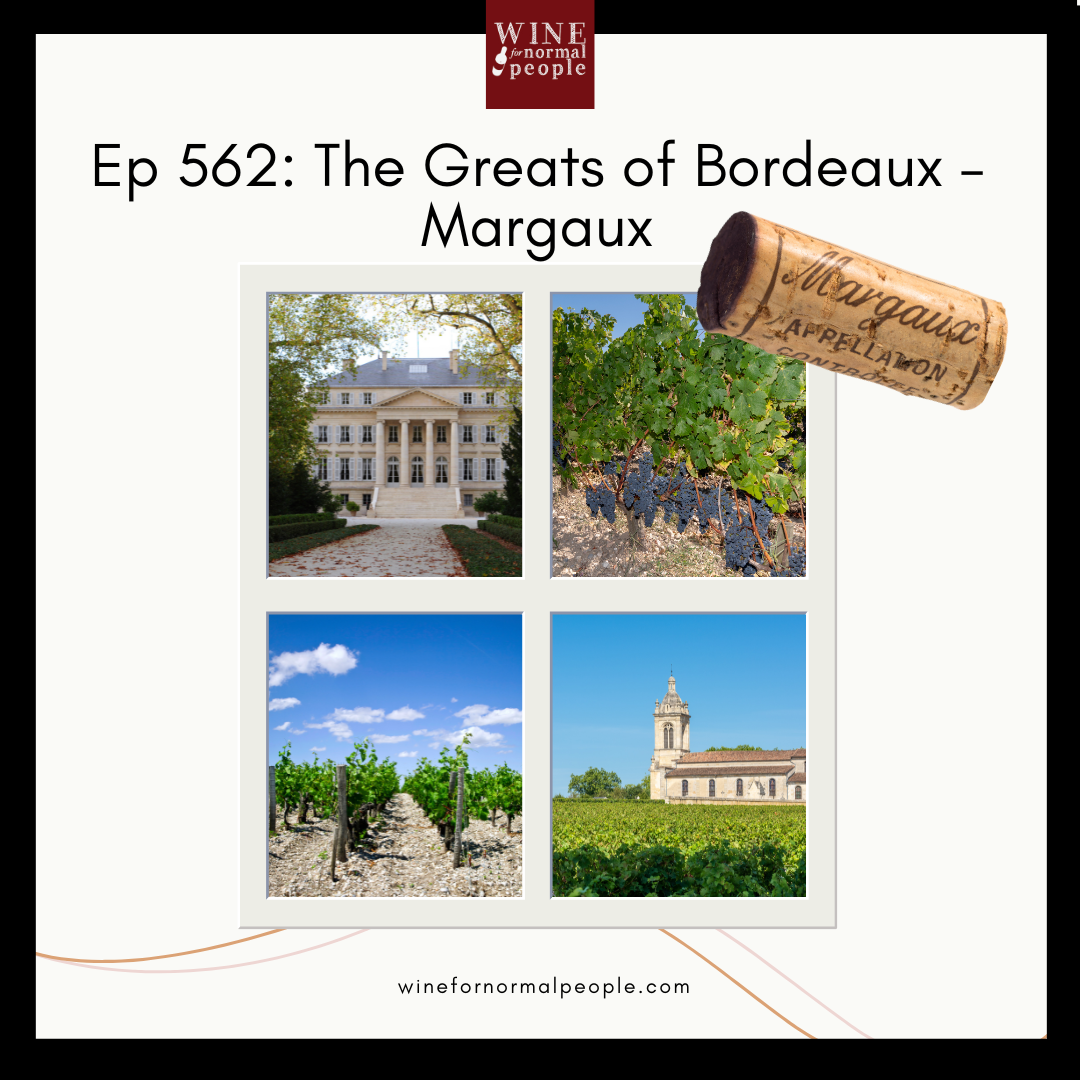
Ep 562: The Greats of Bordeaux – Margaux
This is the second in the Greats series on Bordeaux. This time, the first, most southerly, and most famed commune of the Médoc, Margaux. Surely this is one of the world's greatest regions, with the only major appellation with a château named after the region, Château Margaux. Margaux is a 1,500 ha/3,700 acre communal appellation on the Left Bank of Bordeaux, 25 km/15 miles north of the city of Bordeaux in the Médoc. Margaux is the largest Médoc AOC, representing 9% of Medoc vineyards and an average of 6.5 million bottles yearly, depending on vintage. Due to its size, the region has varied soils, and that means that as much as people like to generalize about Margaux being elegant and pretty, it's not as simple as that. In this show, I cover everything about Margaux -- history, terroir, climate, sustainability, and then the top Châteaux. I break it down into digestible bites and try to convince you that these wines are certainly something that you must try! H ere is a link to the 1855 Classification Here are the Châteaux that are open to the public __________________________________________ Full show notes and all back episodes are on Patreon. Join the community today! www.patreon.com/winefornormalpeople _______________________________________________________________ This show is brought to you by my exclusive sponsor, Wine Access – THE place to discover your next favorite bottle. Wine Access has highly allocated wines and incredible values, plus free shipping on orders of $150 or more. You can't go wrong with Wine Access! Join the WFNP/Wine Access wine club and get 6 awesome bottles for just $150 four times a year. That includes shipping! When you become a member, you also get 10% all your purchases on the site. Go to wineaccess.com/normal to sign up!
Apr 30
Ep 561: Fred Peterson of Peterson Winery on the (d)Evolution of Soil Health Over the Last 40 years
Fred Peterson has been making wines in Sonoma County for more than 40 years. While attending UC Santa Cruz, he took a job in a classmate's family vineyard in Mendocino County and he found his passion. He left Santa Cruz, and used the rest of his GI Education benefits to attend UC Davis. Photo: Peterson Winery . Credit: Wine for Normal People Fred got his bachelor's degree in Viticulture and Enology in 1978. And after managing vineyards for a large winery in the Central Coast, he moved to the Dry Creek Valley of Sonoma in 1983. That same year, he planted a vineyard and built his house on Bradford Mountain. In 1987, Fred hung a shingle on a red barn off of Lytton Springs Road and Peterson was born. The winery is no longer in the red barn, but it remains an important part of their history and is represented on every wine label with a back drop of Bradford Mountain, where the Peterson Estate Vineyar d is located. Photo: Fred Peterson. Courtesy of Peterson Winery In this (super dorky) show Fred takes us through some of the fascinating history of how philosophies about terroir and soil have changed since he started as a grower and winemaker in the early 1980s and how he has managed to be a leader in sustainable, but not dogmatic sustainable farming and winemaking. Fred was one of the first voices in Sonoma to promote low intervention farming and winemaking. It shows in the wines! Full show notes and all back episodes are on Patreon. Join the community today! www.patreon.com/winefornormalpeople _______________________________________________________________ This show is brought to you by my exclusive sponsor, Wine Access – THE place to discover your next favorite bottle. Wine Access has highly allocated wines and incredible values, plus free shipping on orders of $150 or more. You can't go wrong with Wine Access! Join the WFNP/Wine Access wine club and get 6 awesome bottles for just $150 four times a year. That includes shipping! When you become a member, you also get 10% all your purchases on the site. Go to wineaccess.com/normal to sign up!

Apr 23
Re-release of Ep 230: The Biz of Small Wineries with Jim Morris and Oded Shakked of Longboard
On the heels of the tariff show last week, and news that wine consumption is at its lowest point in 60 years, I thought it may be interesting to revisit the US industry structure in more depth. As I say in the freshly recorded intro (the show is edited for relevancy too, so it's not a straight re-release) I wanted to carve out the issues for small wineries that are every bit as relevant today as they were when I launched this show in 2018 with Oded Shakked of Longboard and Jim Morris, the Sonoma Wine Guy and frequent pod guest. Oded Shakked (left) and Jim Morris (right) As I point out in the intro , the biggest change since 2018? The environment around wine has gotten gloomier: Wineries are closing and being bought up, and small family wineries that aren't financially viable are done – there are tons of wineries for sale or that are just going out of business. It's hard to compete in this environment. After the tariff show, this show offers another perspective on the wine business – fake brands, ego brands, how the three tier system and score system fails the small producers, and how big wine is trying to take wine to the lowest common denominator – take wine to the lowest level they can get away with to save money. Ultimately, consolidation in American wine is squeezing the producers who built it and who are the backbone of it. Not everyone will make it, and not everyone should make it, but hopefully this show will remind you why we need small producers who are financially viable, and who make unique, great wine. _______________________________ Full show notes and all back episodes are on Patreon. Become a member today! www.patreon.com/winefornormalpeople _______________________________________________________________ Check out my exclusive sponsor, Wine Access. They have an amazing selection -- once you get hooked on their wines, they will be your go-to! Make sure you join the Wine Access-Wine For Normal People wine club for wines I select delivered to you four times a year! To register for an AWESOME, LIVE WFNP class with Elizabeth or get a class gift certificate for the wine lover in your life go to: www.winefornormalpeople.com/classes

Apr 16
Ep 560: Wine Tariffs and their Dire Consequences for American Wine Businesses with Ben Aneff, President of the USWTA and Daniel Posner of Grapes The Wine Company
Tariffs have been a hot topic in recent weeks, but this issue has been ongoing. During President Trump's first term, the wine industry was caught flat-footed when, in 2019, the administration put a 25% tariff on still wines from France, Germany, Spain, and the UK (notably, Italy and Portugal were not included) as part of a trade dispute with the EU over subsidies given to Airbus. It was then that my guests – Ben Aneff and Daniel Posner started to organize and get industry leaders together to lobby Congress and try to explain why these tariffs were so harmful to wine. Those tariffs remained in place through 2021, and although there was relief for the last few years, the U S Wine Trade Alliance, which was the body that formed out of the initial tariff crisis, continued to exist with Ben at the helm. In this show, I am honored to have the very busy and very awesome Ben Aneff, a native Texan who now lives in NYC and is the Managing Partner of Tribeca Wine Merchants in New York City , named one of "America's Best Wine Shops" by Food & Wine Magazine, and an "Editor's Favorite" by Wine Spectator. Ben has been actively involved in the fight against wine tariffs – working with all parts of the industry and Congress, and testifying about tariffs' effects at the International Trade Commission. He is the president of the US Wine Trade Alliance Ben Aneff, President of the U.S. Wine Trade Alliance (USWTA) & Managing Partner of Tribeca Wine Merchants I also have previous guest and Patron Daniel Posner, owner of Grapes the Wine Company in White Plains, NY. Daniel serves on the Board of Directors of the National Association of Wine Retailers, a national trade organization founded in 2006, for which he served as President from 2011 to 2019. He helped form the USWTA. Daniel Posner of Grapes, the Wine Company & Industry Insider Full show notes and all back episodes are on Patreon. Join the community today! www.patreon.com/winefornormalpeople _______________________________________________________________ This show is brought to you by my exclusive sponsor, Wine Access – THE place to discover your next favorite bottle. Wine Access has highly allocated wines and incredible values, plus free shipping on orders of $150 or more. You can't go wrong with Wine Access! Join the WFNP/Wine Access wine club and get 6 awesome bottles for just $150 four times a year. That includes shipping! When you become a member, you also get 10% all your purchases on the site. Go to wineaccess.com/normal to sign up!

Apr 9
Ep 559: 12 Great Wines Under $20
I think people are feeling a bit of a worry about the economy worldwide, so I thought I'd make some suggestions for inexpensive wines that taste like expensive ones! Almost every wine is below $18, although I put under $20 in the title because it seemed punchier! I did lots of research to make sure these were way below US$20 in markets across the US and around the world. For inclusion in the list they had to be great wines that I would buy even if they weren't such great values (and with tariffs, they will be less good values, but still inexpensive). These are wines I drink regularly. Even though there are inexpensive versions of some wines (Fiano, Chianti, etc), I did not include them because I don't think the inexpensive versions of those are good enough. This list is the cream of the crop below $20. For each wine I discuss the background, the flavors, and why they are inexpensive (in case you are suspicious!). Some wines included: Picpoul, Crémant de Loire, Côtes de Bordeaux and Argentinean Malbec from Cafayate (different from Mendoza) Enjoy the list! Full show notes and all back episodes are on Patreon. Become a member today! www.patreon.com/winefornormalpeople _______________________________________________________________ Check out my exclusive sponsor, Wine Access. They have an amazing selection -- once you get hooked on their wines, they will be your go-to! Make sure you join the Wine Access-Wine For Normal People wine club for wines I select delivered to you four times a year! To register for an AWESOME, LIVE WFNP class with Elizabeth or get a class gift certificate for the wine lover in your life go to: www.winefornormalpeople.com/classes

Mar 26
Ep 558: The Grape Mini Series -- Sagrantino
In this grape miniseries, I cover one of the greatest yet little known red grapes of Italy: Sagrantino. Photo: Sagrantino. Source: Arnaldo Caprai This grape is likely native to Umbria in Central Italy, although there is speculation that it is from more far-flung parts of the globe. Nevertheless, most of the world's plantings are in Montefalco and the surrounding areas and it is firmly rooted (literally and figuratively) there. With outrageously high polyphenols, Sagrantino is dark in color, high in tannin, and needs lots of heat to ripen. Its brambly berry notes contrast with savory herb, smoke, tobacco, and baking spice aromas and flavors to give this wine a sweet yet savory profile that you'd be hard pressed to find in any other bottle. In the show I review the history of the grape, its behavior in the vineyard, its flavors and aromas, and the various regions in which it is grown, including Australia, warmer parts of the US, Argentina, and Brazil. Although it requires age to live up to its true potential, Sagrantino is a grape you should try – it is truly one of the great reds of the world and as winemakers learn more about making dry wine from it, it's only getting better every year. Full show notes and all back episodes are on Patreon. Join the community today! www.patreon.com/winefornormalpeople _______________________________________________________________ This show is brought to you by my exclusive sponsor, Wine Access – THE place to discover your next favorite bottle. Wine Access has highly allocated wines and incredible values, plus free shipping on orders of $150 or more. You can't go wrong with Wine Access! Join the WFNP/Wine Access wine club and get 6 awesome bottles for just $150 four times a year. That includes shipping! When you become a member, you also get 10% all your purchases on the site. Go to wineaccess.com/normal to sign up!

Mar 19
Ep 557: The Greats - Saint-Émilion of Bordeaux
As part of the series on the greatest wines in the world, I cover Saint-Émilion on the Right Bank of Bordeaux. With its legacy of winemaking, its unique terroir, and its small producers who are constantly innovating and improving, this region is indisputably one of the top in the wine world. As with all the regions in "The Greats" series, I go in depth on the fascinating history of Saint-Émilion, the complex terroir, the (convoluted) classification, and the grapes and flavors that are possible from this outstanding "Great." As promised, here are the Premiers Grands Crus Classes A & B from the 2022 Classification... PREMIERS GRANDS CRUS CLASSES AChâteau Figeac Château Pavie PREMIERS GRANDS CRUS CLASSES B Château Beau-Sejour Becot Château Beausejour Heritiers Duffau Lagarrosse Château Belair Monange Château Canon Château Canon la Gaffeliere Château Larcis Ducasse Château Pavie Macquin Château Troplong Mondot Château Trottevieille Château Valandraud Clos Fourtet La Mondotte Sources used: "Inside Bordeaux", Jane Anson Les Vins de Saint-Émilion The Wine Cellar Insider "St Emilion: True grit", James Lawther, MW Decanter "Ian D'Agata on the Great Wines of Saint-Emilion: Terroir and Grand Vins, to Be or Not to Be…" TerroirSense ____________________________________________________________ Full show notes and all back episodes are on Patreon. Become a member today! www.patreon.com/winefornormalpeople _______________________________________________________________ Check out my exclusive sponsor, Wine Access. They have an amazing selection -- once you get hooked on their wines, they will be your go-to! Make sure you join the Wine Access-Wine For Normal People wine club for wines I select delivered to you four times a year! To register for an AWESOME, LIVE WFNP class with Elizabeth or get a class gift certificate for the wine lover in your life go to: www.winefornormalpeople.com/classes

Mar 12
Ep 556: Back to Basics -- European Classification Systems
This week I take a fresh look at European Classification Systems, going into detail on the history of how and why they evolved, what the current EU scheme is based on, and what the major wine nations' systems are structured (and how they differ from what the EU would like them to look like!). I discuss: How Europe classified its wines to protect the names of specific products and link them to their place of origin, to the benefit of consumers and producers. A history of wine classifications from the monks in medieval Burgundy to the winemakers of Tokaj in the 1600s to Chianti, Port, and Bordeaux in the 1700s and 1800s. A detailed look at the evolution of the French classification system. I go through the steps that the French took to prevent fraud, protect the origin of their wines, and ultimately create the system off which the EU system is based. I address the EU system with its two main categories: -Wine without a geographic origin (table wine) -Wine with a geographic origin: Protected Geographical Indication (PGI): At least 85% of the grapes used have to come exclusively from the geographical area where the wine is actually made. These wines cover large areas, and a lot of grapes and winemaking methods are permitted. There is only a minor influence of place of origin Protected Designation of Origin (PDO): Every part of the production, processing and preparation process must take place in the specific region. Grapes have to come exclusively from the geographical area where the wine is made. Origin and terroir are essential to the identity of the wine. Then I review the major countries' classification categories France: Vin de France=Table wine IGP, indication géographique protégée (PGI) AOP=appellation d'origine protégée, often called AOC (contrôlée) (PDO) Italy: Vino=Table Wine IGP=indicazione geografica protetta, producers frequently use the old IGT = indicazione geografica tipica (PGI) DOC = denominazione di origine controllata (PDO) DOCG = denominazione di origine controllata e garantita (PDO) DOP = denominazione di origine protetta, the new name, conforming to the EU standard that includes DOC and DOCG. DOP is rarely used (PDO) Spain: Vino de España=Table wine IGP / VT = indicación geográfica protegida, usually called vino de la tierra (VT) (PGI) VC = vino de calidad con indicación geográfica (PDO) DO (DOP) = denominación de origen, sometimes called DOP (PDO) DOCa = denominación de origen calificada (PDO) VP = vino de pago (PDO) Germany Deutscher Wein =Table wine Landwein =PGI Qualitätswein (also called Qba from the 13 regions, PDO) Prädikatswein – Prädikat means special attribute and refers to the ripeness of the grapes and the type of harvest. Pradikat levels: Dry or sweet: Kabinett, Spätlese, Auslese Sweet (expensive and rare): Beerenauslese, Trockenbeerenauslese, Eiswein Other terms: Trocken is dry, Halbtrocken is "Half Dry" or "Off-Dry, "Feinherb" is an unofficial term for off-dry wine The VDP is a German marketing organization that includes many of the country's top producers. Producers can use the VDP eagle and the VDP classifications WITH "Qualitätswein" or "Prädikatswein" · Gutswein: First wines of a wine year to be bottled and sold, Estate-grown grapes · Ortsweine: Village wines · Erste Lage: Premier Cru wine from first-class vineyards · Grosse Lage: Grand cru or highest quality German vineyards. Dry wines within this category are called Grosse Gewächs or GG Portugal (I don't discuss in the show because it follows the French/EU model) Vinho=Table Wine IGP = indicação geográfica protegida, often called vinho regional (PGI) DOP = denominação de origem protegida, still sometimes called DOC, denominação de origem controlada (PDO) _________________________________________________ Full show notes and all back episodes are on Patreon. Become a member today! www.patreon.com/winefornormalpeople _______________________________________________________________ Check out my exclusive sponsor, Wine Access. They have an amazing selection -- once you get hooked on their wines, they will be your go-to! Make sure you join the Wine Access-Wine For Normal People wine club for wines I select delivered to you four times a year! To register for an AWESOME, LIVE WFNP class with Elizabeth or get a class gift certificate for the wine lover in your life go to: www.winefornormalpeople.com/classes

Mar 5
Ep 555: Château Talbot - The Saint-Julien 4th Growth Bordeaux Estate with GM Jean-Michel Laporte
Château Talbot is a 4th Grand Cru Classé of Saint-Julien in the Médoc of Left Bank of Bordeaux. It's an historic and large property – its vineyards extend over 110 hectares/272 acres in a single block. The story of Talbot is a long and interesting one, but the chapter being written by the current family and management of the Château may be the best yet. With extreme dedication to quality, an eye towards the environment and careful winemaking, Talbot has a focus on making unbelievable wine that overdelivers for the price, vintage after vintage. In this show, General Manager of Château Talbot , Jean-Michel Laporte, joins to discuss Saint-Julien and Talbot. Photo: Jean-Michel Laporte. From Château Talbot . We discuss: Saint-Julien and it's terroir. We talk about how it stacks up to the other communes on the Left Bank and even discuss comparisons with the Right Bank, where Jean-Michel got his start The history and terroir of Talbot. The château is hundreds of years old, but got it's name from an English general who won Bordeaux back from the French in the 1400s! Photo: The Chai of Château Talbot . From the Château site. Winemaking, aging, their amazing chai (barrel room, pic above), spectacular vintages and how long to hold both the Grand Vin -- Chateau Talbot and the second wine, Connetable de Talbot. We also discuss Caillou Blanc, their fascinating white wine! Château Talbot makes excellent wines. They are around US $70 and although that will set you back, it is so high quality and over delivers for the price. If you have some extra money at some point, and want to invest in a wine to age, this is one to seek. I love the floral and dark fruit aromatics, the complexity, the medieval church notes, the earth, and the perfect tannin and acidity. Saint-Julien is indeed, incredibly balanced, and Château Talbot is a great example of the AOC. ________________________________________________________________________ Full show notes and all back episodes are on Patreon. Become a member today! www.patreon.com/winefornormalpeople _______________________________________________________________ Check out my exclusive sponsor, Wine Access. They have an amazing selection -- once you get hooked on their wines, they will be your go-to! Make sure you join the Wine Access-Wine For Normal People wine club for wines I select delivered to you four times a year! To register for an AWESOME, LIVE WFNP class with Elizabeth or get a class gift certificate for the wine lover in your life go to: www.winefornormalpeople.com/classes

Feb 26
Ep 554:The Wines of Alto Adige, Italy
Alto Adige, in the far northeast of Italy, is a small wine region that makes incredibly high quality reds and whites. In this episode I discuss the unique terroir, grapes, and mixed culture of this region, with its heavy Germanic and Austrian influences. I cover: The long history of Alto Adige wine The varied soil types and geology The range of climates and growing conditions The unique grapes (including Kerner, Schiava and Lagrein) The DOCs and subzones of Alto Adige A truly beautiful and unique Italian wine region, and one I hope I've convinced you to explore! Copyright: Wines of Alto Adige Full show notes and all back episodes are on Patreon. Become a member today! www.patreon.com/winefornormalpeople _______________________________________________________________ Check out my exclusive sponsor, Wine Access. They have an amazing selection -- once you get hooked on their wines, they will be your go-to! Make sure you join the Wine Access-Wine For Normal People wine club for wines I select delivered to you four times a year! To register for an AWESOME, LIVE WFNP class with Elizabeth or get a class gift certificate for the wine lover in your life go to: www.winefornormalpeople.com/classes

Feb 19
Ep 553: The Grape Mini-Series -- Malvasia(s)
This is a grape mini-series like no other! This time I untangle Malvasia, which I share is not a single grape at all, nor is it even a family of grapes. This ancient grape has unknown origins and, in many respects, is more of a brand name than a grape. I cover the history of how the many Malvasias got their single name, discuss some commonalities in growing conditions (they are at least all Mediterranean!), and then call out the specific Malvasias of quality from Friuli, Tuscany, and Sicily in Italy; in Madeira, Douro, Dão and Colares in Portugal, and in the Canary Islands and Rioja in Spain. Photo: Malvasía de Rioja. Credit: Rioja DOCa I wish I could say this was a straightforward grape mini-series, but this will take many twists and turns -- hopefully I served as good enough navigator to help the ride be a little less bumpy! ______________________________________ Full show notes and all back episodes are on Patreon. Become a member today! www.patreon.com/winefornormalpeople _______________________________________________________________ Check out my exclusive sponsor, Wine Access. They have an amazing selection -- once you get hooked on their wines, they will be your go-to! Make sure you join the Wine Access-Wine For Normal People wine club for wines I select delivered to you four times a year! To register for an AWESOME, LIVE WFNP class with me or get a class gift certificate for the wine lover in your life go to: www.winefornormalpeople.com/classes

Feb 12
Ep 552: The Greats - Napa Valley
Napa Valley is unquestionably one of the great wine regions of the world. Located about 50 mi/80 km north of San Francisco, Napa is renowned for its decadent Cabernet Sauvignon and Chardonnay and its glamourous, fancy and expensive tasting rooms. Napa only represents 4% of California's wine grape harvest, but it holds the highest reputation among all US regions. But the region isn't all show – it has excellent terroir to make world class wines. Photo: Napa Valley Vineyard. Source: Pixabay Napa Valley stretches southeast to northwest for approximately 35 miles (60 km) from just north of the San Pablo Bay to the northern reaches of Calistoga. Nestled between the Vaca and Mayacamas mountain ranges, the Valley is about 4 miles wide at its widest point. It contains half the soil types in the world and its mountains, benchlands, and valleys have so much diversity that each wine made here reflects a different character. In this show I go over the history, the geology and terroir, the main grapes and wine styles, and then I go into detail on the 16 American Viticultural Areas in Napa and what to expect from each. This is a comprehensive look at this great wine region of the world that made the reputation of American wine as we know it today. Full show notes and all back episodes are on Patreon. Become a member today! www.patreon.com/winefornormalpeople _______________________________________________________________ Check out my exclusive sponsor, Wine Access. They have an amazing selection -- once you get hooked on their wines, they will be your go-to! Make sure you join the Wine Access-Wine For Normal People wine club for wines I select delivered to you four times a year! To register for an AWESOME, LIVE WFNP class with Elizabeth or get a class gift certificate for the wine lover in your life go to: www.winefornormalpeople.com/classes

Feb 5
Ep 551: How to Make Your Wine Shop Work for You with Steve Tocco, Wine Buyer and Retailer
This week, I'm joined by Patron and friend Steve Tocco is the wine buyer and manager of a fine wine store near Boulder, Colorado -- Atlas Valley Purveyors (yes, I've been there!). He is great at what he does -- creative, community oriented, great palate -- basically he is the wine guy we all want! I asked him to come on the show to share tips on how to best work with a local wine retailer to create great relationships that lead to better wines. We discuss: How to figure out your shopping style How create a relationship with your wine shop person How to glean what someone knows so you can decide if you want to go back to the store Corporate buying v. small retail Important questions to answer before you go into a shop (and if you don't ask those quesitons, what the wine shop person should ask you!) How to take advantage of discounts and special things the store may offer It's a fun show and a great checklist of things to look for to make sure you find the right local shop for you! Full show notes and all back episodes are on Patreon. Become a member today! www.patreon.com/winefornormalpeople _______________________________________________________________ Check out my exclusive sponsor, Wine Access. They have an amazing selection -- once you get hooked on their wines, they will be your go-to! Make sure you join the Wine Access-Wine For Normal People wine club for wines I select delivered to you four times a year! To register for an AWESOME, LIVE WFNP class with Elizabeth or get a class gift certificate for the wine lover in your life go to: www.winefornormalpeople.com/classes

Jan 29
Ep 550: South Australia - An Overview of Australia's "Wine State"
This show features an overview of an essential place in the wine world: South Australia. There is much to learn here but I try to break it down into what is important to know. The show is somewhat heavy on history, since that is an essential part of why South Australia is important today. South Australia is an Australian state located in the central south of the continent that refers to itself as Australia's "Wine State", and rightfully so: it produces 50% of all bottled wine and about 80% of the country's premium wine. Most large wine companies (8 of the 13 continuously operating wine companies in Australia are here), many small wineries and almost all the official wine trade organizations, including Wine Australia, the government body responsible for regulating and promoting Australian wine, and the Australian Wine Research Institute (AWRI), which plays a crucial role in wine research, are based in South Australia. South Australia consists of 18 regions, and although I address most of them, I also point out that there are a handful that are essential to truly knowing about South Australia: Barossa, Eden Valley, Clare Valley, Adelaide Hills, Coonawarra, and McLaren Vale. Map: Wine Australia This is a bit of a whirlwind show, but hopefully it gives you a flavor for this famed, and essential corner of the wine world. My hope is that heard one or two things I said that you may not have known and that you seek out those wines. Australia is under appreciated in the US, especially, and when you get a good one, it is usually unbelievably good! Full show notes and all back episodes are on Patreon. Become a member today! www.patreon.com/winefornormalpeople _______________________________________________________________ Check out my exclusive sponsor, Wine Access. They have an amazing selection -- once you get hooked on their wines, they will be your go-to! Make sure you join the Wine Access-Wine For Normal People wine club for wines I select delivered to you four times a year! To register for an AWESOME, LIVE WFNP class with Elizabeth or get a class gift certificate for the wine lover in your life go to: www.winefornormalpeople.com/classes

Jan 22
Ep 549: The Grape Mini-Series --Touriga Nacional
Touriga Nacional is, beyond a doubt, the most important, praised, and discussed red grape in Portugal. An essential part of Port and the dry wines of the regions of Dão and Douro, this powerful grape has spread throughout Portugal and has captured the imagination of winemakers from Australia to South Africa to California and more. Photo: Touriga Nacional. Credit: Unsplash In this show, I go through the highlights of this beautiful grape and talk about how it went from near extinction to the Queen grape of Portugal. I review the origins, vineyard habits, aromas and flavors, and then discuss the specific places the grape grows and why it thrives where it does. Touriga is not just a fantastic grape, it will be an important factor in dealing with our changing climate. Take a listen to the show and see why this grape is so outstanding. _______________________________________________________________ Full show notes and all back episodes are on Patreon. Become a member today! www.patreon.com/winefornormalpeople _______________________________________________________________ Check out my exclusive sponsor, Wine Access. They have an amazing selection -- once you get hooked on their wines, they will be your go-to! Make sure you join the Wine Access-Wine For Normal People wine club for wines I select delivered to you four times a year! To register for an AWESOME, LIVE WFNP class with Elizabeth or get a class gift certificate for the wine lover in your life go to: www.winefornormalpeople.com/classes

Jan 15
Ep 548: Bandol - The Ageworthy Reds and Rosés of Provence, France
Bandol is arguably the most important appellation in Provence at the southeastern tip of France. Although it makes white, this very small region is known for its ageworthy reds and rosés made mainly of Mourvèdre, Grenache, and Cinsault. In this show I review the long history of Bandol from the Greeks to the real estate agents of today, and talk about the various terroirs in this appellation. I talk about the grapes, why Mourvedre makes such a big difference in allowing the reds and rosés to age, and some ideas of flavors, producers, and how long to age these wines. From the Rosés of Southern France by Liz Gabay, MW and Ben Bernheim Since these are rosés that can age and ones that have more robust flavors, I wanted to do this show in the winter. I think it's good for us to think about different ways to look at pink wine, especially high-quality pink wine! And considering Bandol a multi-season wine is a great step in that direction! ________________________________________________________________ Full show notes and all back episodes are on Patreon. Become a member today! www.patreon.com/winefornormalpeople _______________________________________________________________ Check out my exclusive sponsor, Wine Access. They have an amazing selection -- once you get hooked on their wines, they will be your go-to! Make sure you join the Wine Access-Wine For Normal People wine club for wines I select delivered to you four times a year! To register for an AWESOME, LIVE WFNP class with Elizabeth or get a class gift certificate for the wine lover in your life go to: www.winefornormalpeople.com/classes

Jan 8
Ep 547: Back to Basics...12 Bottles to Learn About Some of the Classic Wine of the World
I start by asking for a big favor!! I haven't asked in about 10 years – but if you get a moment, could you drop a positive review for WFNP on iTunes, or a good rating on Spotify, or tell a friend who you think would like the show? Thank you in advance! This show is part of the effort to refresh the WFNP catalog, based on the ideas of Patron Chris C, who did a ton of work to help me come up with a list of things he thought I could re-do, given that it's been 14 years since I covered some of this stuff. If you have any ideas, please drop a DM on Patreon or send me ideas through the site! This show has my recommendations for filling a case of wine with classics from around the world. These wines will give you a great idea of what these regions represent and why they are so famed. Even for experienced wine drinkers, I think it's good to go back to the basics and try stuff you haven't had in a while to remind ourselves why they are so good! The list contains 12 still wines (no sparkling or fortified this time!), whites, reds, and one rosé. The wines are: Whites: White Burgundy, which is Chardonnay. I recommend the wine especially from the Hautes Côtes de Beaune or Hautes Côtes de Nuits, Côte d'Or Blanc, or Chablis 2. New Zealand Sauvignon Blanc – with a twist. Look for wines from the Awatere or Wairau Valleys. 3. German Riesling from the Mosel (for off-dry wines) or Rheingau. I also mention Pfalz for great dry wines. 4. Portuguese Alvarinho – Vinho Verde, specifically from sub-regions of Monção and Melgaço Rosé 5. Tavel from the Rhône Reds 6. Bordeaux – especially from the Médoc or Côtes de Bordeaux for Merlot-driven wines (Pomerol and St. Émilion) and for bolder, more ageworthy wines with more Cabernet -- Haut-Médoc or Saint-Estèphe or for spendier versions – Graves, Margaux, Saint Julien, Pauillac 7. Rioja from Spain 8. Italian reds either Chianti Classico (have food with it!) or Roero/Langhe Nebbiolo/Nebbiolo d'Alba/Barbaresco 9. California – Santa Barbara County Pinot Noir (or more specifically Santa Maria Valley or Sta. Rita Hills) 10. Barossa Valley Shiraz (take another look if you haven't in a while!). For more restraint, you can look for Shiraz from Eden Valley, a sub region of the Barossa Valley 11. Chilean Cabernet Sauvignon, especially Maipo Andes/ Alto Maipo is best, due to the higher altitude in this area 12. Argentinean Malbec, more specifically from Gualtallary, Tupungato, Altamira or, more generally the Uco Valley and Lujan de Cuyo Full show notes and all back episodes are on Patreon. Become a member today! www.patreon.com/winefornormalpeople _______________________________________________________________ Check out my exclusive sponsor, Wine Access. They have an amazing selection -- once you get hooked on their wines, they will be your go-to! Make sure you join the Wine Access-Wine For Normal People wine club for wines I select delivered to you four times a year! To register for an AWESOME, LIVE WFNP class with Elizabeth or get a class gift certificate for the wine lover in your life go to: www.winefornormalpeople.com/classes

May 14, 2024
Friends of the Pod Series - Ep 520: The historic, urban wines of Vienna (yes, the city!) with Alex Zahel of Weingut Zahel
Here's something you probably didn't know: Vienna is the only major city in the world where serious wine grown, with its own appellation, DAC Wien. In the green belt surrounding this very green city, wine grapes grow as they have since at least the Middle Ages. And it's not negligible -- 582 ha/1438 acres. It's also not crappy, tourist wine. It's high quality, interesting wine that's tasty and different. It's become such a priority for Vienna and Austria that Viennese state law states that all existing vineyards must remain vineyards protecting valuable viticultural land from real estate speculation! Standing side by side with the wine and with the Gemischter Satz blend is the unique tradition of the Heurige wine taverns. These are such an important part of Austria's list of UNESCO intangible cultural heritage in 2019. To discuss this amazing tradition that I bet you had little idea even existed, Alex Zahel joins. He's the 4th generation of the Zahel family and is the GM and winemaker of Zahel. A great, eye opening show! Full show notes and all back episodes are on Patreon. Become a member today! www.patreon.com/winefornormalpeople _______________________________________________________________ Check out my exclusive sponsor, Wine Access. They have an amazing selection -- once you get hooked on their wines, they will be your go-to! Make sure you join the Wine Access-Wine For Normal People wine club for wines I select delivered to you four times a year! To register for an AWESOME, LIVE WFNP class with Elizabeth or get a class gift certificate for the wine lover in your life go to: www.winefornormalpeople.com/classes

Mar 19, 2024
Friends of the Pod Series - Ep 513: The Divine Dolcetto of Diano d'Alba with Giulio Abrigo of Abrigo Giovanni
I welcome to the show my friend Giulio Abrigo of Abrigo Giovanni Azienda Agricola , who focuses on the exquisite Dolcetto in Diano d'Alba in the Barolo zone of Piemonte. Abrigo Giovanni is a small family operation, operating on just 13 ha or 32 acres mainly in Diano d'Alba -- the site of the winery and the family home. Dolcetto Diano d'Alba is one of a handful of DOCG zones for the grape – stricter controls and the top Dolcetto wines are made in this area. Here, the elevation, the soils, and the exposition are ideal for this highly underrated grape. Abrigo Giovanni focuses on Dolcetto but for the past 11 years they also make a highly rated and awarded Barolo from the site of "Ravello" which has caught the attention of many wine critics, and, although not available in the US, they make the single best nocciole (hazelnut spread) I have ever had in my life. This is a fascinating look at the passion behind making a wine that is part of a long legacy and tradition, but frequently flies under the radar...for no apparent reason. After this show, you will want to run out and get Giulio's Abrigo Giovanni Dolcetto wines , and maybe even move to Diano d'Alba (his descriptions of it sound like paradise to me!). ______________________________________________________ Full show notes and all back episodes are on Patreon. Become a member today! www.patreon.com/winefornormalpeople _______________________________________________________________ Check out my exclusive sponsor, Wine Access. They have an amazing selection -- once you get hooked on their wines, they will be your go-to! Make sure you join the Wine Access-Wine For Normal People wine club for wines I select delivered to you four times a year! To register for an AWESOME, LIVE WFNP class with Elizabeth or get a class gift certificate for the wine lover in your life go to: www.winefornormalpeople.com/classes
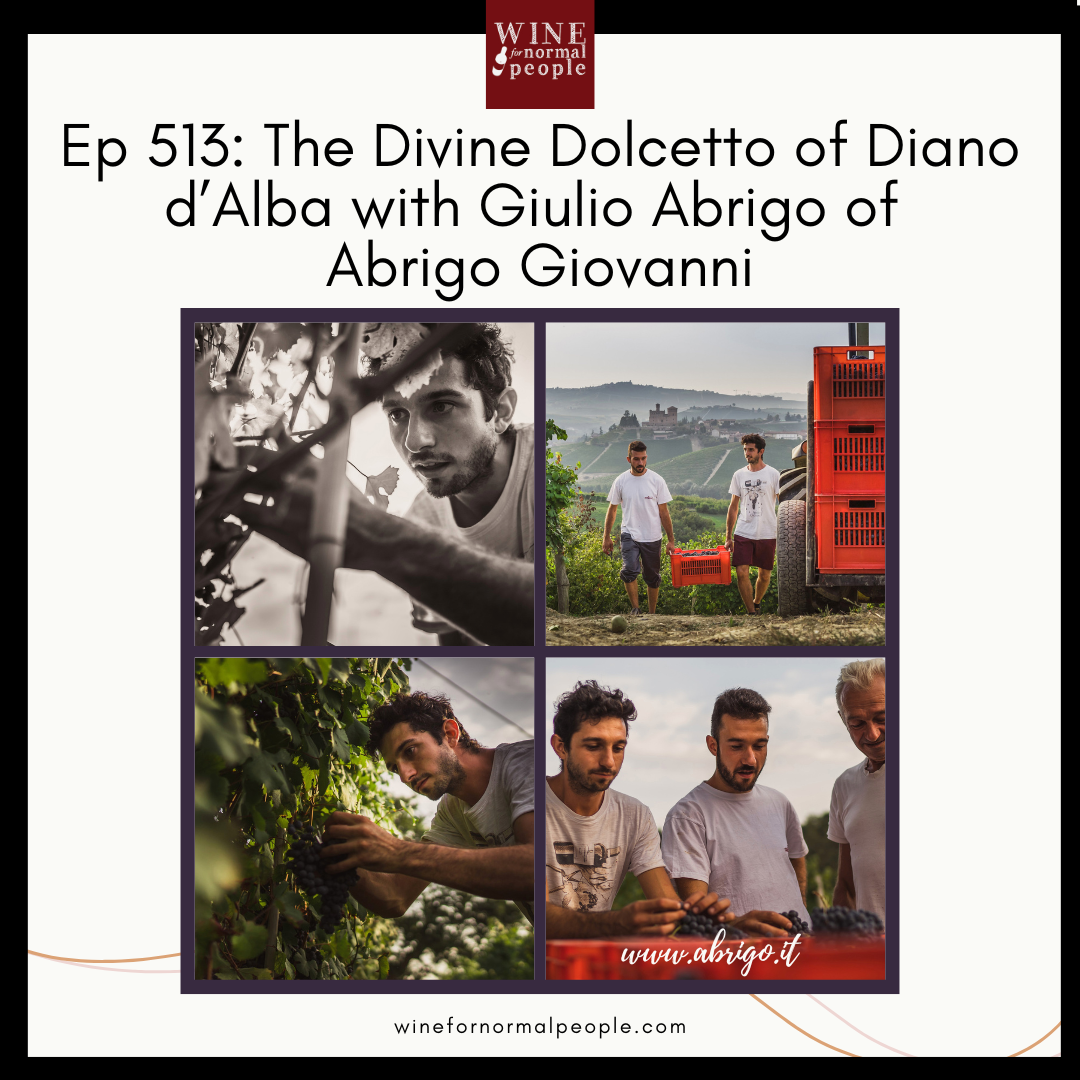
Feb 14, 2024
Friends of the Pod Series -- Ep 509: Felicity Carter Exposes the Jaw-dropping Truth of Who is Guiding Global Wine & Health Policy
My guest Felicity Carter is probably the most brilliant journalist in wine, and certainly one of the only ones doing vital investigative work in the field of wine, health, and the neo prohibitionist movement. From 2008 to 2021, she was editor-in-chief of Meininger's Wine Business International , a global, English-language magazine, one of Germany's oldest publishing houses. She reported from 22 countries in that position. She writes for Decanter, The Guardian, and pretty much every major prestigious wine publication out there. Photo: Felicity Carter. Credit: https://felicitycarter.com.au/miscellaneous/ Felicity is the foremost authority on wine and health and has information about what is ACTUALLY going on with the "new" data on wine and health…talk about a malevolent hand. HOLY SH&T when you find out what is behind the WHO's recommendation. Your jaw will drop… Full show notes are on Patreon. Become a member today! www.patreon.com/winefornormalpeople _______________________________________________________________ Wine Access has an amazing selection -- once you get hooked on their wines, they will be your go-to! Make sure you join the W ine Access-Wine For Normal People wine club in time for the first quarter shipment (it's shaping up to be outstanding). Get 10% your first order with my special URL. To register for an AWESOME, LIVE WFNP class with Elizabeth or get a class gift certificate for the wine lover in your life go to: www.winefornormalpeople.com/classes

Dec 19, 2023
Friends of the Pod Series -- Ep 502: Stu Smith of Smith-Madrone -- Why Napa County is Strangling Small Wineries
This is a baffling story that includes a Napa history lesson, an idea of how the Valley has grown and then a jaunt into intrigue, sting operations, and what appears to be an effort to kill the goose that laid the golden egg by the Napa County government. It seems that the County is going after small wineries in an attempt to bankrupt them out of business. Friend of the pod, Stu Smith of Smith-Madrone joins to discuss and explain the situation -- at least the parts that have an explanation! If you want background on Smith-Madrone, check out... Ep 253: Stu Smith of Smith-Madrone Vineyards Talks About 48 Years in Napa Valley Please support small wineries! Now, more than ever they need our help!! Stu Smith, Smith-Madrone Vineyard Lindsay Hoopes, Hoopes Vineyard Full show notes are on Patreon. Become a member today! www.patreon.com/winefornormalpeople _______________________________________________________________ Wine Access is my go-to source for the best selection of interesting, outstanding quality wines you can't find locally. Make sure you join the W ine Access-Wine For Normal People wine club in time for the first quarter shipment. Get 10% your first order with my special URL. To register for an AWESOME, LIVE WFNP class with Elizabeth or get a class gift certificate for the wine lover in your life go to: www.winefornormalpeople.com/classes

Oct 10, 2023
Friends of the Pod Series --Ep 493: Marina Marcarino of Punset; Barbaresco's Most Forward-Looking Producer Returns to WFNP
I first spoke to Marina Marcarino of Punset in 2017 and I was fascinated by her story and loved her wines . We became friends and I've visited her over the years and keep in touch with her for a pulse on what is happening in the vineyards and wineries of Barbaresco, where Punset is located. Marina Marcarino of Punset Wines in Barbaresco As a recap of the first show , when Marina Marcarino was in her early 20s, she took over the family vineyard in Neive, Barbaresco (Piedmont, Italy) and named it Punset . She had a revolutionary idea for the 1980s: to turn the vineyard organic. Marina became the first organic producer in Barbaresco. Her vineyards look different, her practices were strange to most back then and when she started using biodynamic in the 1990s, her reputation as "la pazza" – the crazy, was cemented. Fast forward to today, and everyone has followed Marina and she has become one of the thought leaders in environmental stewardship of vineyards in Barbaresco. Those who once mocked her, now use the very same practices she pioneered and she has gained the respect of them all. Photo: The Amazing Punset wines When I was visiting Piedmont recently, I was able to catch up with Marina and ask her for an update about the region and about Punset . She is such a forward looking person -- this is a real opportunity to hear about what will likely be happening in wine and in Piedmont in the future. We discuss controversial topics and general ones, and her insightful answers will have you thinking more deeply about the entire region and about farming, winemaking, and a little of life philosophy thrown in. She is the president of Albeisa , a consortium of quality producers who seek to educate and properly market the wines of the Langhe, and she shares some of the things she's done and is doing in that role as well. I hope you find her passion and intelligence as awesome as I do! Enjoy this one – you'll learn so much! Don't forget to listen to Ep 182, the OG with Marina that goes over her story.. .LINK Full show notes are on Patreon. Become a member today! www.patreon.com/winefornormalpeople _______________________________________________________________ I love my exclusive sponsor, Wine Access, my go-to source for the best selection of interesting, outstanding quality wines you can't find locally. You HAVE to check out our Halloween pack at https://wineaccess.com/wfnp-halloween/ -- Spooky wines for my favorite holiday! GREAT Wines and a ton of fun. Get 10% your first order with my special URL. To register for an AWESOME, LIVE WFNP class with Elizabeth go to: www.winefornormalpeople.com/classes
Aug 21, 2023
Friends of the Pod Series -- Ep 486: The (REAL) Inner Workings of the Wine Industry with NY Retailer Daniel Posner of Grapes, The Wine Company
In this show, I welcome my friend and wine industry guru Daniel Posner, the owner of the prestigious New York retailer, Grapes, The Wine Company . Daniel joined Grapes, The Wine Company in 2000 and was the managing partner by 2004. For the past 23 years, he has been a wine consultant, with clients from all over the globe. He travels to wine regions to meet with producers, winemakers, winery owners, especially in his favorite areas of Burgundy, Piedmont, Tuscany, and California. He knows the ins and outs of the New York wine scene, and the inside dirt that is pretty fascinating to those of us on the outside. Daniel also serves on the Board of Directors of the National Association of Wine Retailers, a national trade organization founded in 2006, for which he served as President from 2011 to 2019. I met him at the NAWR conference, where he and frequent podcast guest Tom Wark were gracious enough to have me. Daniel has been featured and quoted in the New York Times, Wine Spectator, Food & Wine Magazine, Forbes Magazine, and The Wall Street Journal referred to him one of the most influential wine retailers in the United States. From how companies in Europe get their wine to the us, to pricing and how the producers and consumers lose out through layers upon layers of markups, to the murky politics of wine and international wine scandals, in the last 20+ years, Daniel has seen it all and he shares it in this show. This podcast will teach you more about the business of wine than almost any other I've done. I often talk about the shady underbelly of wine – here it is, exposed in all its glory! Check out Daniel's amazing, curated selection and order wine for shipping (where legal!). https://www.grapesthewineco.com/ Full show notes are on Patreon. Become a member today! www.patreon.com/winefornormalpeople _______________________________________________________________ I love my exclusive sponsor, Wine Access, my go-to source for the best selection of interesting, outstanding quality wines you can't find locally. Go to www.wineaccess.com/normal to join my co-branded wine club with Wine Access and www.wineaccess.com/wfnp so see a page of the wines I'm loving right now from their collection. Get 10% your first order with my special URL. Check out Wine Access today! To register for an AWESOME, LIVE WFNP class with Elizabeth go to: www.winefornormalpeople.com/classes
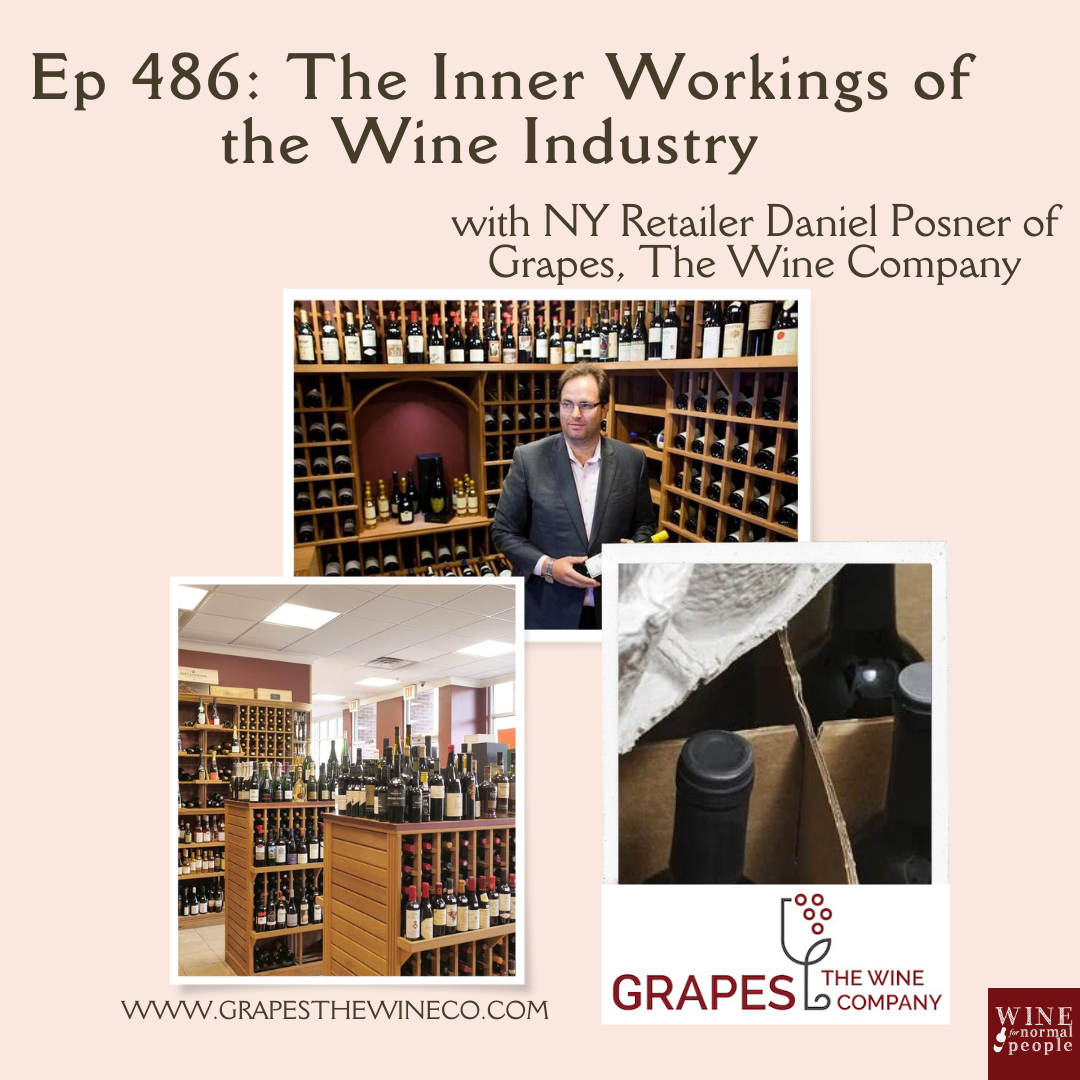
Jul 17, 2023
Friends of the Pod Series -- Ep 481: Eva Martinelli - Chianti Classico Winemaker & Region Expert
Eva Martinelli is a young, innovative, and experienced winemaker from Tuscany. She has a degree in oenology, a deep understanding of terroir of Chianti Classico, and an unrivaled passion for the region. She has worked harvests in New and Old World countries, after which she returned home to follow her dream of being a winemaker in the region she loves most. Photo: Eva Martinelli, Credit:Wine For Normal People I met Eva in May 2023, while on the tour of Tuscany with a group of Patrons. She works for a very historic winery in Chianti Classico, giving tours and managing the sales and tourism for that winery. The Patrons and I loved her and learned so many new things about Chianti Classico from her. In this show we discuss the terroir of Chianti Classico from a more geological standpoint, the history of the region, and the honest truth about the struggle of young, talented winemakers in Chianti Classico and other parts of Italy. Here is her list of her three favorite wineries in Radda in Chianti (Patreon show notes have an expanded list): -Fattoria di Montemaggio -Podere Capaccia -Il Barlettaio This is an eye-opening show and a great one to learn general info about Chianti from an objective expert who has no brand agenda or marketing angle to put forward! Cheers to Eva and all the young winemakers of Chianti Classico! Full show notes are on Patreon. Become a member today! www.patreon.com/winefornormalpeople _______________________________________________________________ Big news! Wine Access, my go-to source for the best selection of interesting, just gave a haircut to the price of my wine club with them! Now it's juts $150 for 6 bottles of amazing wines that I select, write about, and record videos on! Go to www.wineaccess.com/normal to join my wine club with Wine Access and get 10% your first order. To register for an AWESOME, LIVE WFNP class with Elizabeth go to: www.winefornormalpeople.com/classes

Jul 3, 2023
Friends of the Pod Series -- Ep 480: The Leelanau Peninsula of Michigan (US) - Portrait of an Emerging Region
This episode is all about the Leelanau Peninsula AVA of Michigan (a state in the midwestern US, on the Canadian border). Drew Perry, head of Production for Simpson Family Estates , a family business located on the peninsula, joins to educate us about this very unique area, which has been making wine since the 1970s. We discuss the land, the climate, and the history of this region, which is an essential part of the terroir here. Photo: Drew Perry of Good Harbor Vineyards & Aurora Cellars. Credit: Simpson Family Estates Drew tells us about his time in the industry and about being head of Production at Simpson Family Estates, which owns the award-winning brands Good Harbor Vineyards and Aurora Cellars. They make delicious sparkling, whites and reds from this unique terroir. These are great wines and definitely worth checking out (they ship!). I mention my favorites in the show! Full show notes are on Patreon. Become a member today! www.patreon.com/winefornormalpeople _______________________________________________________________ I love my exclusive sponsor, Wine Access, my go-to source for the best selection of interesting, outstanding quality wines you can't find locally. Every box you get from Wine Access is meticulous -- tasting notes with food and wine pairing, serving temperature suggestions, and perfectly stored wine. Go to www.wineaccess.com/normal to join my co-branded wine club with Wine Access and www.wineaccess.com/wfnp so see a page of the wines I'm loving right now from their collection. Get 10% your first order. Check out Wine Access today! To register for an AWESOME, LIVE WFNP class with Elizabeth go to: www.winefornormalpeople.com/classes
Jun 26, 2023
Friends of the Pod Series -- Ep 479: Champagne Le Brun de Neuville -- Côte de Sézanne's Stunning Sparklers
Agathe Bellanger from Le Brun de Neuville Champagne joins to discuss the Chardonnay-centric Côte de Sézanne, the role of growers and smaller co-ops, the terroir of this small sub-region, and the beautiful wines her group makes. I LOVE these wines, which focus on longer lees aging. Agathe Bellanger, Champagne Le Brun de Neuville. Here are the lines of wines from Le Brun de Neuville : The Côte : This is their house style, representing 80% of production. The goal of these wines is to express the terroir and the essence of Chardonnay. They are aged 3 to 4 years on the lees (the mandatory minimum is 15 months, and they go above and beyond). There are several wines in this line including a Demi-sec. Les Chamins : Three wines in this line -- a blanc de blancs, rosé, and a Chardonnay and Pinot Noir blend -- are all single vineyard wines that represent specific plots and villages. In a nod to the historic methods, this wine is aged under cork instead of a crown cap. This method allows more oxygen transfer, and produces more complex flavors. Aged 4-5 years on the lees, this wine is excellent with food -- it is more gastronomic. Autolyse : Made only in best years, these wines show what the top wines that have excellent aging potential can offer. These wines are aged 10-14 years on the lees. The blanc de blancs, rosé, a cuvee with 86% Pinot Noir (their only wine with a Pinot lead) are wines of terroir but also exhibit Champagne's characteristic breadiness from long aging. These wines are dedicated to people who like older wines Vintage – MILLÉSIME . These wines are only released in top years. Right now 2008 and 2009 are available in the market with 2012 for rose. These wines age for a long time and show the best of the best years. Seek these out! They are unbelievably delicious! Full show notes are on Patreon. Become a member today! www.patreon.com/winefornormalpeople _______________________________________________________________ I love my exclusive sponsor, Wine Access, my go-to source for the best selection of interesting, outstanding quality wines you can't find locally. Every box you get from Wine Access is meticulous -- tasting notes with food and wine pairing, serving temperature suggestions, and perfectly stored wine. Go to www.wineaccess.com/normal to join my co-branded wine club with Wine Access and www.wineaccess.com/wfnp so see a page of the wines I'm loving right now from their collection. Get 10% your first order. Check out Wine Access today! To register for an AWESOME, LIVE WFNP class with Elizabeth go to: www.winefornormalpeople.com/classes

Jun 19, 2023
Friends of the Pod Series -- Ep 478: Piero Mastroberardino -- the Soul of the Wines & Vines of Campania
Campania was one of the most famous wine regions of antiquity. The pedigree of Fiano, Greco, and Aglianico are well documented in literature of the time (including Pliny the Elder's Naturalis Historius)! These wines have a legacy of cultivation for more than 2000 years on this land, and since the 1700s, the Mastroberardino family have taken the lead in protecting and elevating the region and its wines. This family kept these ancient grapes alive when all others abandoned them, and have been tireless champions of the grapes, the wines, and the region for centuries. Mastroberardino has been called the "guardian" of the wine history of Campania and they are the most historically significant winery in southern Italy. Photo: Piero Mastroberardino. Credit: Kellogg Wine Selections This show features the brilliant Piero Mastroberardino , whom I had the honor and pleasure of meeting when I was in Campania. He makes one of the single best wines I have ever had (Stilèma Taurasi) and all of these wines are fantastic. Here's a link to the wines of Mastroberardino , most of which we discuss in the show! Photo: The vines of Taurasi. Credit: Wine For Normal People Full show notes are on Patreon. Become a member today! www.patreon.com/winefornormalpeople _______________________________________________________________ I love my exclusive sponsor, Wine Access, my go-to source for the best selection of interesting, outstanding quality wines you can't find locally. Every box you get from Wine Access is meticulous -- tasting notes with food and wine pairing, serving temperature suggestions, and perfectly stored wine. Go to www.wineaccess.com/normal to join my co-branded wine club with Wine Access and www.wineaccess.com/wfnp so see a page of the wines I'm loving right now from their collection. Get 10% your first order. Check out Wine Access today! To register for an AWESOME, LIVE WFNP class with Elizabeth go to: www.winefornormalpeople.com/classes
Jun 12, 2023
Friends of the Pod Series -- Ep 477: Stefania Fuselli of Le Vigne di Silvia in Bolgheri, Tuscany -- Family, Football, Fortitude, & Fantastic Wine
When we were on our last day of the Patron trip in Tuscany, we had our final dinner in Bolgheri at a fairly new winery, Le Vigne di Silvia . This farm is owned by a family that was as kind as they could be. It was everything you could hope for when visiting an Italian family -- great food, welcoming hospitality, homey vibe, and great wine! Photo: Stefania Fuselli, left. Silvia Fuselli, right. Credit: Le Vigne di Silvia Le Vigne di Silvia was started by Silvia Fuselli, famed former pro footballer (soccer player), her brilliant sister Stefania, the star of this podcast, and her parents. Photo: From left to right Silvia Fuselli, Carlo Fuselli, Stefania Fuselli, Lavinia Fuselli. Credit: Le Vigne di Silvia There's nothing better than finding a family-owned winery where the wines are great and the people making them as wonderful. The Vermentino (Giochessa) was outstanding, the Artemio (Cab/Cab Franc blend) silky and lovely, and the Itinerante (all Cabernet Franc) nuanced and layered. Stefania shares her family's story, how the winery got started, and shares great information about Bolgheri. The show is such a great look at what it takes to start a winery (and about the history of immigration in Italy too!). This upstart has a huge future. The only downside --as of the release of this show, they aren't imported into the US yet, so if you know anyone, contact me or them! I know many people who will pre-order -- me included! For details and full show notes go to Patreon. Become a member today! www.patreon.com/winefornormalpeople _______________________________________________________________ I love my exclusive sponsor, Wine Access, my go-to source for the best selection of interesting, outstanding quality wines you can't find locally. If you want to find small, family-owned brands, this is the site for you! They scour the globe looking for awesome wines you can't get anywhere else. Every box you get from Wine Access is meticulous -- tasting notes with food and wine pairing, serving temperature suggestions, and perfectly stored wine. Go to www.wineaccess.com/normal to join my co-branded wine club with Wine Access and www.wineaccess.com/wfnp so see a page of the wines I'm loving right now from their collection. Get 10% your first order. To register for an AWESOME, LIVE WFNP class with Elizabeth go to: www.winefornormalpeople.com/classes

May 8, 2023
Friends of the Pod Series -- Ep 472: David Kong, CEO of GlasVin -- the best new handblown glasses to hit the market
Alert: David is so awesome that he has offered us a discount on your purchase of GlasVin ! Use code: WINEFORNORMALPEOPLE for 10% off ( Patrons, please see Patreon for a deeper discount!) We have never before had on a glassware producer because, in the past, it has been a very limited field. One company dominated and sometimes their products made no sense because, like many things in wine, there were too many options and not enough differentiation for normal wine drinkers. https://glas.vin/ But in recent years new glassware companies have burst onto the scene. I've tried many, many of those glasses, but the only one that actually captured my attention and that I decided to use as more than a sample was GlasVin . They are very light, very thin, and yet more durable than some of their competitors. GlasVin was founded in 2020 by David Kong, who left his job at a hedge fund to start the company and today, his mission is to deliver handcrafted glasses at affordable prices. He was a Forbes 30 Under 30 recipient in 2022 and today he joins to tell us about the glassware industry and how he created what I think are the best new glasses to hit the market. David Kong, CEO of GlasVin _______________________________________________________________ I love my exclusive sponsor, Wine Access. Every box you get from Wine Access is meticulous -- tasting notes with food and wine pairing, serving temperature suggestions, and perfectly stored wine. Go to www.wineaccess.com/normal to join my co-branded wine club with Wine Access and www.wineaccess.com/wfnp so see a page of the wines I'm loving right now from their collection. Get 10% your first order. Check out Wine Access today! If you think our podcast is worth the price of a bottle or two of wine a year, please become a member of Patreon... you'll get even more great content, live interactions and classes! www.patreon.com/winefornormalpeople To register for an AWESOME, LIVE WFNP class with Elizabeth go to: www.winefornormalpeople.com/classes

Feb 20, 2023
Friends of the Pod Series -- Ep 462: Aurelien Chirat of Vignobles Chirat
This episode presents our first ever producer on from the northern Rhône – Aurelien Chirat from Vignobles Chirat . Photo: Aurelien Chirat. Credit: WFNP Located in the steep terraced slopes overlooking the Rhone, in the village of Saint Michel sur Rhône, Vignobles Chirat began in 1925 when Benoit Chirat harvested his first Syrah at the Domaine. In 1948, his son George joined and worked with Benoit until 1970. Viognier was planted on their site in Condrieu in 1980 and the real changes to the domaine happened when, in 1984, Gilbert Chirat took over the domain. Within 6 years of his taking the reins, he stopped all the polyculture on the estate and focused only on Syrah and Viognier. The family moved from focusing on Condrieu, to the wines of Saint Joseph, and then added Côte Rôtie. Aurelien Chirat joined his father in 2012, after completing his studies and working in New Zealand, Burgundy and the south of France. We welcome Aurelien, who I had the pleasure of meeting and spending a lot of time with last year, at the Domaine, learning, and discovering all sorts of things about the northern Rhone I didn't know. As always, we discuss, land, winemaking, history, and tradition. For full show notes, join our membership community, Patreon . Here are the wines we discuss: From Condrieu: Clos Poncin, Les Chays , Sous L'Eglise, Viognier "Or Piste" From St. Joseph: Soliste, La Côte, Syrah "Or Piste " Côte Rôtie Photo: Chirat Condrieu. Credit: WFNP In the US, many of the wines are available in Total Wine because Chirat works with the negociant business of Laurent Delaunay, who has been on the podcast . _______________________________________________________________ I could not be happier to announce my partnership with Wine Access, once again. This time we have the WFNP/Wine Access Wine Club! Sign up today to get 6 bottles I select once a quarter. Excellent wines that represent classic examples of the wine region from which they hail. Every box you get from Wine Access is meticulous -- tasting notes with food and wine pairing, serving temperature suggestions, and perfectly stored wine. It's no wonder that Wine Access was rated the best wine club by New York Times Wirecutter and is the official partner and wine provider of The MICHELIN Guide. Go to www.wineaccess.com/normal to sign up for their daily emails and get 10% your first order. Wine Access is a class act -- check them out today! If you think our podcast is worth the price of a bottle or two of wine a year, please become a member of Patreon... you'll get even more great content, full show notes, live interactions and classes! www.patreon.com/winefornormalpeople To register for an AWESOME, LIVE WFNP class with Elizabeth go to: www.winefornormalpeople.com/classes

Jan 30, 2023
Friends of the Pod Series -- Ep 459: Château Chasse-Spleen of AOC Moulis-en-Médoc with Jean Pierre Foubet, Managing Director
Jean Pierre Foubet is the managing director of and chief communicator for Château Chasse-Spleen , the best estate in Moulis appellation of the Médoc. His wife, Celine Villars-Foubet is the owner of the estate, and together they have brought this château to new heights in quality and prestige. Photo: Jean Pierre Foubet. Credit: ROLAND COIFFE & ASSOCIÉS According to Jane Anson, in her book "Inside Bordeaux": "One of the star estates of Moulis, Chasse-Spleen is one of only two that I can think of that would have a fair chance of being recognized if the 1855 ranking were to be carried out today" With their modern outlook, but respect for tradition, they have kept the wine on a path of constant improvement. They have transformed their château into a natural and man-made paradise, one that marries tradition with modernity in the form of art. From the barrel room, to the grounds, to the art gallery, and the accommodations for guests, Chasse-Spleen is a model for how to bring a château into the 21st century. Céline and Jean-Pierre's personalities, hospitality, and passion show through and it makes the experience of the wines so special, as I found out when I had the pleasure of staying there and spending an evening sipping the unbelievable wine, eating a delicious meal, and having so much fun and many, many laughs with the two of them in 2022. Jean Pierre joins to tell us about Moulis, Chasse-Spleen, and explains some things to me that I always wanted to ask! Photo: Jean Pierre Foubet and me, June 2022. Credit: WFNP Here are some of topics Jean-Pierre and I discuss: Jean-Pierre talks about the Moulis-en-Médoc appellation , of which he is the head: The unique location at "elevation" in Médoc, 17 meters The soil diversity with gravel, clay, and composite soils, and how that yields a variety of wine styles How practices must be altered in the vineyard, not in the cellar to handle climate change How Listrac and Moulis differ, and why it makes sense that they eventually join as one appellation – and how there are three very strong Chateaux ("locomotives" as Jean-Pierre calls them –Chasse-Spleen, Grand Poujeaux, Maucaillou) which are famed all over Europe and carry the reputation for the 34 other châteaux) Map: AOC Moulis Then we discuss Chasse-Spleen , an unofficial Grand Cru of the Médoc. Jean-Pierre tells us about the early history of Chasse-Spleen, the English origins of its name and its history of women ownership. We discuss some of the harder times in Bordeaux and touch on the difficulties of upkeep of a château. We talk about the terroir of Chasse-Spleen – its size (175 ha) and its large percentage of gravel in the vineyard, and how it plants to the soil (it is 65% Cabernet Sauvignon because that reflects how much gravel they have, and 30% Merlot on clay-limestone soils). Chateau Chasse-Spleen, Credit: Moulis.com Jean Pierre tries to explain the difference between second wines and other cuvees to me. He does it successfully for Chasse-Spleen (L'Ermitage de Chasse Spleen is an Haut-Médoc "other" cuvee, and L'Oratoire de Chasse Spleen is a true second wine). We leave with the conclusion that I may never know what is actually a second wine from other chateau because no one really knows! In the spirit of asking every question I've ever had about how Bordeaux works 🤣🤣, I ask about Chasse-Spleen's consultant, Eric Boissenot. He is very well respected and known to be a champion of terroir, but I ask Jean Pierre how difficult it is to make sure that Eric helps them to make wine that represents their land and doesn't taste like the other properties for which he consults. We also discuss the famed consultant, Michel Rolland, who is famed for helping chateaux and wineries devise wines that would get 100-point scores from Robert Parker. We discuss Chasse-Spleen's wine and why it is so ageworthy. We talk about the 1855 classification, what it represents and what it doesn't and how Chasse Spleen, despite being out of the ranking, sells far better than 5th growth Château Camensac , which the Villars -Foubet family also own. The conversation incorporates the decision for Chasse-Spleen to leave the Cru Bourgeois classification as well (many top châteaux left after the last round). We discuss their refreshing, lively white wine (mostly Sémillon) and Jean Pierre expresses skepticism about a potential Médoc Blanc appellation (I still think it's a great idea!) We end my talking about Céline and Jean Pierre's love of art and how they have incorporated it into Chasse-Spleen in creative and magical ways – from the life-like 3 meter high boots outside the Château, which help them remember that workers make the Château what it is, to the eclectic art collection, to the 3-D perspective painting in the chai (barrel room). If you are interested in staying at the Château, contact them here. The Chai (pronounced shay) at Chasse-Spleen. Credit Chasse-Spleen This was a great conversation with one of the top château of the Médoc. Once you try Chasse-Spleen , you'll see why it is such a special wine, that rivals top Medoc wines. A special thanks to Jean Pierre and Céline for their hospitality and again to the Wines of Médoc and Carole Vidal for the trip there last year, where I was able to visit Chasse Spleen . _______________________________________________________________ I could not be happier to announce my partnership with Wine Access, once again. Wines Access is my go-to source for the best selection of interesting wines you can't find locally. Every box you get from Wine Access is meticulous -- tasting notes with food and wine pairing, serving temperature suggestions, and perfectly stored wine. It's no wonder that Wine Access was rated the best wine club by New York Times Wirecutter and is the official partner and wine provider of The MICHELIN Guide. Check out my favorite wines on the page at www.wineaccess.com/normal , sign up for their daily emails, and join one of their wine clubs...AND get 10% your first order! If you think our podcast is worth the price of a bottle or two of wine a year, please become a member of Patreon... you'll get even more great content, live interactions and classes! www.patreon.com/winefornormalpeople To register for an AWESOME, LIVE WFNP class with Elizabeth go to: www.winefornormalpeople.com/classes

Nov 15, 2022
Friends of the Pod Series -- Ep 450: Aldo Vacca, Managing Director of Europe's Best Co-op, The Produttori del Barbaresco
For decades, Aldo Vacca has been the Managing Director of the Produttori del Barbaresco , the best and most successful wine co-op in Europe. Through his leadership and guidance, the Produttori has taken its wines, and with it, the wines of Barbaresco beyond Piedmont in northeastern Italy, to world renown. Aldo's job at the Produttori is not just an occupation, it is his family legacy and a professional choice he made that has benefitted all who love Nebbiolo. Photo: www.rarewineco.com Aldo took a degree in Viticulture at the Torino University and worked at the prestigious University of California at Davis, after which he got one of the most coveted jobs in Piedmont – he got a job working for Gaja in 1986. But after 4 years, he realized that rather than fame and modernism, he wanted to do something that celebrated the land of Barbaresco and all it represented. He followed in the footsteps of his great grandfather and used his infinite knowledge of Nebbiolo and his skills at management and hospitality, to transform the Produttori into one of the best-known brands in Italy. I have spent time with Aldo. He's brilliant, cheeky, and passionate, and after two years, I'm so happy to have finally gotten him on the show. Aldo speaks to groups about the Produttori all the time, has been in lots of media, and he is absolute pro. This is a great show! Here is a general outline of what we discuss: We discuss the harvest that just was (2022) – what was hard, what was normal, and the changes that the Barbaresco region has endured as climate change has taken hold here. Aldo discusses his family legacy in Barbaresco and how it ties into the region's development. He tells us about the hard times in the region and how the Cantine Sociali and then the Produttori were formed to address the social and economic challenges of grape farmers in the 1800s and then again in the mid 1900s. We learn about the structure of the Produttori and how its quality standards, efficiency, and generosity make it so successful. Aldo tells us how the Produttori has managed to hold its members to such high standards. Photo: Bottling at the Produttori del Barbaresco in May 2022 (c)Wine For Normal People We get into the details on some of the logistics, the management and membership structure, and the winemaking philosophy (to let Barbaresco shine!). We discuss the extras the members get – knowledge sharing, status and prestige by being part of the Produttori, and the incentives to farm for quality not quantity. And why owning great land yields to great results – they own pieces of the best vineyards. Aldo tells us about the Barbaresco DOCG – the land, factors that make it different from Barolo, and the overview of the style of wine here. He talks about the MGA system (he refers to it as single vineyard, which is what they are) and what it means for the area. Aldo and I talk about the wines the Produttori makes, we discuss the flagship Barbaresco and how it is made, and the very affordable and delicious Langhe Nebbiolo, an important product to show people who are just getting into Nebbiolo what it can do and be. Aldo also helps us understand their single vineyard wines and why each expresses something so unique and individual, based on site Photo: Aldo Vacca educates Wine For Normal People Patrons(c)Wine For Normal People We end with a conversation of why the new generation of winemakers and land owners in Barbaresco is so great and Aldo's great hope for a bright future for Barbaresco and the Produttori . Here are links to all the wines the Produttori makes: NEBBIOLO LANGHE D.O.C. BARBARESCO D.O.C.G. BARBARESCO D.O.C.G. RISERVA ASILI BARBARESCO D.O.C.G. RISERVA MONTEFICO BARBARESCO D.O.C.G. RISERVA MONTESTEFANO BARBARESCO D.O.C.G. RISERVA MUNCAGOTA BARBARESCO D.O.C.G. RISERVA OVELLO BARBARESCO D.O.C.G. RISERVA PAJÈ BARBARESCO D.O.C.G. RISERVA PORA BARBARESCO D.O.C.G. RISERVA RABAJÀ BARBARESCO D.O.C.G. RISERVA RIO SORDO Photo: www.rarewineco.com _______________________________________________________________ Thanks to our sponsors this week: Wine Spies uncovers incredible wines at unreal prices - on every type of wine in a variety of price points. It's not a club and there's no obligation to buy. Sign up for their daily email and buy what you want, when you want it. They have a build-a-case option, so you can mix and match wines while enjoying free shipping on every purchase. Visit www.winespies.com/normal you'll get $20 credit to use on your first order! Check them out today! If you think our podcast is worth the price of a bottle or two of wine a year, please become a member of Patreon... you'll get even more great content, live interactions and classes! www.patreon.com/winefornormalpeople To register for an AWESOME, LIVE WFNP class with Elizabeth go to: www.winefornormalpeople.com/classes

Aug 16, 2022
Friends of the Pod Series -- Ep 437: Tom Wark on the history of US alcohol law, recent threats to wine shipping & how Prohibition altered cultural views of wine
Tom Wark is a wine writer, wine public relations company owner (Wark Communications), and our trusted resource for figuring out what is going on with the US wine industry and how it affects us, as wine drinkers. In his role as the executive director of the National Association of Wine Retailers , he manages and helps direct lobbying, litigation, and membership strategy and management for the retailers in the US and in that role has really helped dissect and expose some of the logistical and really cultural issues around wine in the US. He is the author of "Fermentation: The Daily Wine Blog". Photo: Tom Wark. Source: "Fermentation Blog" In this show we discuss a variety of topics, including the recent threat to US interstate wine shipping from the Uniform Law Commission . The bulk of our conversation revolves around the historical legacy of alcohol Prohibition in the US and the damage it caused to the way alcohol is sold, marketing and viewed in the United States. Our main topics for the show: The latest news from the Uniform Law Commission , a body of lawyers from all 50 states who try to create laws that states can adopt and adapt based on common principles. We discuss the misguided nature of their proposals, and how it could potentially affect wine shipping in the United States The history of Prohibition in the United States – how it came about based on the events and culture of the 1910s and how, during the repeal, systems were set up that are now outdated but have enormous ripple effects in how wine is sold, distributed, and ultimately viewed in the US The Crusaders were a group that fought to repeal Prohibition in the 1930s. Photo: Smithsonian Institute We touch on the active temperance movement of today and why the temperance lobby has a big problem fighting against wine, in particular. We mention marijuana as well, and the coming reckoning for that new industry. Here is the Washington Post article we reference: "From Dry January to Fake Cocktails, Inside the New Temperance Movement" Tom tells us what the US market would look like without a three-tier distribution system (Hint: pretty awesome) and the multitude of choices it would open up for producers and retailers. I highly recommend that you subscribe to Tom's very well-written blog, which is full of excellent and novel thinking. Click here to sign up. _______________________________________________________________ Thanks to our sponsors this week: Wine Spies uncovers incredible wines at unreal prices - on Zinfandel, Barolo, Champagne...you name it - up to 75% off! It's not a club and there's no obligation to buy. They have a build-a-case option, so you can mix and match wines while enjoying free shipping on every purchase. Visit www.winespies.com/normal you'll get $10 credit to use on your first order! Check them out today! If you think our podcast is worth the price of a bottle or two of wine a year, please become a member of Patreon... you'll get even more great content, live interactions and classes! www.patreon.com/winefornormalpeople To register for an AWESOME, LIVE WFNP class with Elizabeth go to: www.winefornormalpeople.com/classes
Jul 18, 2022
Friends of the Pod Series -- Ep 434: The World's Foremost Authorities on Rosé -- Elizabeth Gabay, Master of Wine, & Ben Bernheim, Co-Author
Elizabeth (Liz) Gabay, Master of Wine, is the world's foremost expert on rosé and a big part of her career has been studying, writing about, and understanding rosé. Ben Bernheim, her son, is now learning from her wisdom and and is a specialist in his own right. The two of them have just completed the excellent book " Rosés of Southern France" (which is now available on Amazon for purchase. Liz is largely responsible for shifting the tide on rosé and helping people to understand that this wine is its own serious category that deserves thought, study, and consideration. In addition to the new book , Liz is the author of "Rosé: Understanding the Pink Wine Revolution," and she is also a contributor on rosé in Decanter, The Drinks Business, The Buyer, SevenFiftyDaily, Meiningers, and many more prestigious publications. Photo: https://www.elizabethgabay.com/about/ The wisdom these Liz and Ben have on the subject of rosé is vast, and they are so fun, engaging, and real, that they make it all so interesting and accessible. This is an incredible education on rosé and will enjoy every minute of listening to these fantastic humans. Photo: Ben Bernheim, taken by me when we were partners in a Beaumes de Venise mini-class in the Rhone Valley 4/22 Here are the things we discuss in the show: Liz talks about her background and how she got into wine . She discusses how, when she took the MW, it was a professional certification, and how it has changed dramatically over time. She discusses how she got into rosé, and how Ben got involved in it as well. Then we get into the nuts and bolts of rosé Liz and Ben define rosé (harder than you think!). We discuss he book's intro and what rosé is really about: "We love rosé. We love its diversity, its complexity, and the infinite combinations of terroir, grape variety, vintage variation and winemaking that we find around the world. Many people think we're crazy. They see rosé as a pale pink lightly alcoholic swimming pool tipple that somehow tastes better if you're wearing a bikini. That isn't what this book is about. " Photo credit: Canva Liz and Ben tell us about rosé winegrowing: Grapes that are commonly used(red AND white!) The role of terroir in rosé The picking decisions and harvest parameters that matter in making rosé Climate change and how it is affecting grapes for rosé We talk next about rosé winemaking We discuss the various ways to make rosé – direct press, limited maceration and saignée We talk about some of the key factors in rosé winemaking: Time on the skin Yeast strains Co-fermenting with whites Fermentation vessel (oak v. stainless) Temperature control in fermentation Malolactic fermentation vs. no MLF Aging/storage vessel and time – oak, cement, glass, amphora, etc Photo credit: Canva Liz and Ben tell us why rosé, can be ageworthy and why most isn't. We also talk about lightstrike and why clear bottles are the worst thing for rosé. We cover the wines of the southern Rhône -- Tavel, Luberon, Ventoux, the rosés of Provence and Bandol and the wines of the Languedoc-Roussillon. We have an interesting conversation about Costieres di Nimes, which really drives home how certain regions can be outstanding but if they don't send in samples to writers, or market their wines, they remain unknown. Liz and Ben help us understand how to buy better rosé. They provide some shortcuts for finding better wines – like looking for sub regions in Cotes de Provence such as Ste. Victoire and La Londe. We talk about how using Google maps to see where the winery is located can help you get better wines (e.g., If it's in a cool mountain area, it may be crisp, if it's nearer the ocean the wine may be fatter). They discuss how essential it is to find out about the producer, since often producers want you to see the name "Provence" and buy the bottle…if you poke around a bit you may get a better idea about what you are getting so it's not a surprise or disappointment Liz and Ben tell us about the trends in rosé – why it has become so popular, and what are great regions we should keep an eye on. Liz's recommendations for countries/regions that have been making intresteing rosé (besides France!): Austria, Greece, Sicily (Etna especially), Spain (Clarete from Sigales, Rioja, Ribera del Duero, Navarra), Portugal (Douro, pink Port), Israel. We end with a conversation on the future of rosé and what Ben and Liz hope for the category. This is a fantastic conversation about a category of wine that is experiencing a big paradigm shift. Liz and Ben are some of the most normal, kindest, smartest people I've met in wine in a long, long while and the show is sprinkled with a ton of industry information – insider things that can help shed light on what goes on with producers, negociants, and writers. I hope you enjoy and you are motivated to buy their wonderful book ! Reach out to them at https://www.elizabethgabay.com/about/ Photo credit: Canva ________________________ From our Sponsors... Wine Spies uncovers incredible wines at unreal prices - on big names or boutique brands from all over the world at up to 75% off! It's not a club and there's no obligation to buy. They have a build-a-case option, so you can mix and match wines while enjoying free shipping on every purchase. Visit www.winespies.com/normal you'll get $20 credit to use on your first order! You can get some awesome deals on rosé! If you think our podcast is worth the price of a bottle or two of wine a year, please become a member of Patreon... you'll get even more great content, live interactions and classes! www.patreon.com/winefornormalpeople To register for an AWESOME, LIVE WFNP class with Elizabeth go to: www.winefornormalpeople.com/classes

Jul 12, 2022
Friends of the Pod Series -- Ep 433: Quinta da Raza -- Terroir, Family, & the Complex White Wines of the Vinho Verde Region of Portugal
Vinho Verde, the DOC (Denomination of Controlled Origin) Region, has made wine since Roman times. This region is one of the largest DOCs in Europe but within its boundaries there are vast differences between the nine sub regions. In this show, Mafalda Teixeira Coelho, co-owner of Quinta da Raza and Pedro Campos, winemaker clear up a lot of the misconceptions about Vinho Verde. We learn about the terroir of this old and complex region, the various subregions, and how serious, and sometimes ageworthy wine is being produced here. Photo: Mafalda Teixeira Coelho, co-owner of Quinta da Raza and Pedro Campos, winemaker (c)Wine For Normal People In September 2021, I visited the region and I just loved the wines of Quinta da Raza , I adored Mafalda and Pedro, and I thought they were perfect representatives to tell us about their corner of this big region, in Basto, and what they are capable of making in this unique terroir. Here's what we discuss in the show: The diversity of Vinho Verde, it's 9 sub regions and how proximity to the sea, position in the mountains, and soil type make big differences in the grapes you can grow and the resulting wines. Map: Vinho Verde Commission Pedro tells us about the Basto subregion, where Quinta da Raza is located. It is inland, on granite, schist, and clay soils. The location is a bit more continental with warmer summers and cooler winters than places near the coast, meaning grapes can get fully ripe and quite flavorful. To understand Vinho Verde, you must understand the nuance between the granite terroir v. the schist terroir. Pedro tells us what the differences are and why they matter. Mafalda shares the history of the estate and how it was passed down to her husband Diogo, who she manages things with today. Mafalda Teixeira Coelho, co-owner of Quinta da Raza and her daughters, (c)Wine For Normal People Pedro tells us about the main grapes of the region: Azal, Alvarinho, Avesso, Arinto, Trajadura, and the reds Padeiro and Vinhão. He tells us about the various brands of Quinta da Raza Dom Diogo is the traditional brand that is sold mainly in the Portuguese market Quinta da Raza is a more international style, and where you'll find those more serious whites like Alvarinho, Avesso, and Gouveio Raza is the very traditional, fizzy Vinho Verde of Arinto, Trajadura, and Azal, with the Rosé made of Vinhão, Padeiro and Espadeiro Nat their line of Pet Nat (Petillant Naturel), sparkling wine made in the ancestral method with a single fermentation happening in the bottle from which you drink it We discuss some of the important techniques they use to get high quality wine – traditional things like hand harvesting grapes and foot treading in stone lagares, and then more modern things like using stainless steel tanks and modern winemaking techniques. Hand harvest at Quinta da Raza (c)Wine For Normal People Pedro tells us Alvarinho and Avesso are good candidates for aging, with Gouveio as a possible third. We finish the conversation by talking about Quinta da Raza's commitment to sustainability and the bright future for the Vinho Verde region and for the winery. Quinta da Raza 's wines are fantastic. Seek out the basic Raza, but try to find the single varietals, they are inexpensive and drink way above their price point! ________________________ From our Sponsors... Wine Spies uncovers incredible wines at unreal prices - on big names or boutique brands from all over the world at up to 75% off! It's not a club and there's no obligation to buy. They have a build-a-case option, so you can mix and match wines while enjoying free shipping on every purchase. Visit www.winespies.com/normal you'll get $20 credit to use on your first order! Don't forget to go to the store page to see what wines I love with descriptions I have written. If you think our podcast is worth the price of a bottle or two of wine a year, please become a member of Patreon... you'll get even more great content, live interactions and classes! www.patreon.com/winefornormalpeople To register for an AWESOME, LIVE WFNP class with Elizabeth go to: www.winefornormalpeople.com/classes
Jul 5, 2022
Friends of the Pod Series -- Ep 432: Agroforestry -- An Answer to Wine's Biggest Environmental Challenges with Jean-Baptiste Cordonnier of Château Anthonic in Moulis-en-Médoc
Jean-Baptiste Cordonnier of Château Anthonic in the Moulis-en-Médoc appellation on the Left Bank of Bordeaux is revolutionizing the entire Médoc with a novel approach to farming and adapting to climate change: Agroforestry. This show talks about the practice and the unbelievable results that can be achieved by farming in this way. It will inspire hope that there is a future for viticulture, even in areas where there is great climate change. Photo: Jean-Baptiste Cordonnier Château Anthonic Château Anthonic is in the Moulis-en-Médoc appellation on the Left Bank of Bordeaux. It is owned and operated by Jean-Baptiste and Nathalie Cordonnier. They make very classically styled, delicious (and relatively low alcohol) red wine from mainly Merlot with Cabernet Sauvignon and some Cabernet Franc and Petit Verdot. Photo: (C) Wine for Normal People, Château Anthonic Since 2016, Jean-Baptiste and his team have practiced agroforestry –trying to mimic the soils and conditions of the forest to enrich soil health and encourage the vines to return to a state where they are part of an eco-system, with fungi, trees, wildlife, and healthy micro-organisms. Using very specialized cover crops, they have managed to lower soil temperatures and keep sugar levels under control by practicing the tenets he discusses. May people claim to do great things, but Jean-Baptise is the real deal. If there is anything that will inspire hope that human ingenuity and nature may help us out of bad times to come, this show is it. Here are the topics we discussed: Jean-Baptiste tells us about his very different educational background, which led him to tackle environmental issues in the way he does today. Forestry, not viticulture, was the foundation of his education (and we should all be grateful for that!) We get a good background on Moulis-en-Médoc – the terroir, the diversity, and where Château Anthonic is located. We discuss the blue clay, which makes up 70% of his vineyard Photo: (C) Wine for Normal People, Blue Clay Château Anthonic Then we get into the details of just how we have gotten into the predicament in farming that we have today. Jean-Baptiste explains the phases that humans have gone through to deplete the earth through farming (inadvertently and through a series of bad decisions). He addresses how "the new guest in the dance", climate change has sped up the need for a solution. Photo: (C) Wine for Normal People, Château Anthonic We get into the nuts and bolts of agroforestry and how hedges, trees, and grasses in the vineyard are the keys to bringing back fungi and mico-organisms that are vital to making the land healthier and, ultimately, to maintaining the style of Bordeaux that many of us love. He also addresses the economics of the vineyard, and how planting trees has actually given him 2% MORE yield in his vineyard, despite the trees taking out two rows per hectare. Jean-Baptiste shares the results of his years of agroforestry practices: lower alcohol and more acidity in his grapes, less water stress, and more balanced wines. He is too modest to really brag, but he has trained first and second growth chateaux on the practices of agroforestry, as well as many other prestigious chateaux in the Médoc and beyond. Many are implementing his methods in their vineyards. Jean-Baptiste leaves us with a message of hope – viticulture is not doomed, Bordeaux is a phoenix, and the rapidity with which change has come means the future is bright for this warming and changing climate, regardless of what nonsense naysayers may spout. Photo: (C) Wine for Normal People, Château Anthonic ________________________ From our Sponsors... Wine Spies uncovers incredible wines at unreal prices - on big names or boutique brands from all over the world at up to 75% off! It's not a club and there's no obligation to buy. They have a build-a-case option, so you can mix and match wines while enjoying free shipping on every purchase. Visit www.winespies.com/normal you'll get $20 credit to use on your first order! Don't forget to go to the store page to see what wines I love with descriptions I have written. If you think our podcast is worth the price of a bottle or two of wine a year, please become a member of Patreon... you'll get even more great content, live interactions and classes! www.patreon.com/winefornormalpeople To register for an AWESOME, LIVE WFNP class with Elizabeth go to: www.winefornormalpeople.com/classes

May 16, 2022
Friends of the Pod Series -- Ep 426: Giovanni Correggia of Matteo Correggia -His Exquisite Wines from Roero in Piedmont
Giovanni Correggia of Matteo Correggia. Photo ©Wine For Normal People This podcast was extra special for me, as I was able to record live with Giovanni Correggia of Matteo Correggia in Roero, a part of the Piedmont in Italy that I love and that I try to champion as much as possible. I met Giovanni several years ago and loved his wines and his family story. This podcast is so many things all at once: A great education on the Roero region, by the most famed producer there The story of a grape that was reborn in this place A lesson in the politics of the Piedmont and how some simple choices have brought fame to Barolo and Barbaresco and kept Roero down A fascinating family story that includes a talented champion of Roero, horrible tragedy, triumph of a widow who had nothing to do with wine and her unbelievable strength of character and perseverance for the legacy of her kids, and the current generation (Giovanni) with its shining positivity, great vision and promise of a great future for the Correggia family and its wines. I truly love the wines of Matteo Correggia and I believe that the Nebbiolos he makes (just called Roero on the bottle) are the exact style of wine so many of us love – elegance, minerality, balance with none of the heaviness or the tannins that we sometimes get from Barolo. The Arneis, it goes without saying, is a white for the ages – a minerally, floral, saline wine with real gravity and the Barbera also has a lighter touch than some of the versions from over the river. Although hard to find, Giovanni's Brachetto is as tasty as he will describe as well. I have to say that in interviewing Giovanni and then in editing this show, I laughed and teared up many times. I felt indignant on his behalf, and also triumphant. I hope the conversation we had evokes the same emotions in you. If nothing else, it's a great story and a great education on an underestimated region. Here are the show notes: We discuss Roero, its location across from Barberesco and Barolo, and what that means for the climate of the area versus the other famed Nebbiolo areas of Piedmont Giovanni describes the soil types and how a small sea that once existed here, as well as the changing course of the Tanaro River, created a terroir with seashells, a canyon, and steep slopes covered in sandy soil that imbues the wines with a unique minerality that only exists in Roero Val dei Preti Vineyard, Matteo Correggia. Photo ©Wine For Normal People Once Roero was criticized for having multiple crops, but Giovanni talks about how this is now a distinct advantage Giovanni gives us a history lesson on Roero through his single vineyards on which he has great records: La Val dei Preti and Roche d'Ampsej and Marun . We discuss some of the modern history of Roero and some of its challenges Matteo Correggia wines. Photo ©Wine For Normal People We learn about the history of the Correggia family and of his father, Matteo, who started the winery in 1985 at age 23. We talk about Matteo's early relationship with the founder of Slow Food, Carlo Petrini, and how that led to great opportunities for the winery and the philosophy around organics. Giovanni tells us about his father's "membership" in the Barolo Boys as the only non-Barolo producer and how those relationships with Elio Altare and Roberto Voerzio were pivotal to early success Giovanni shares with us the tragedy around his father's death and how his mother Ornella, brought the winery to new heights with great vision and the help of winemaker Luca Rostagno , and the Barolo Boys We talk about the wines and specific vineyards: Giovanni talks about how different vineyards -- La Val dei Preti, Roche d'Ampse j, make different Nebbiolos and how they make wines that are more elegant, less tannic, and more aromatic and minerally than the Nebbiolo of the Langhe. We discuss the biggest problem for Roero, which is that Barolo and Barbaresco producers make excellent wines from the region and label them Langhe Nebbiolo or Nebbiolo d'Alba instead of Roero, thus keeping the region from being recognized We discuss Correggia's Barbera , and the funny story of the Marun vineyard. Giovanni gives me a great lesson on Barbera and its challenges in the vineyard We discuss Brachetto, the special clone from Roero, and why it is such a unique grape that, when made dry, is great for summer drinking Giovanni Correggia with Brachetto. Photo ©Wine For Normal People We wrap with a discussion of Matteo Correggia 's leadership on screw cap in the region, and a discussion of the challenges and opportunities for Roero, and how Arneis is just the beginning for this undervalued region Definitely check out Giovanni's wines – they are so inexpensive for what they are! Saratoga Wine in the states has almost the entire line, as does Tannico in the UK . _________________________________________________________ Thanks to our sponsors this week: Wine Spies uncovers incredible wines at unreal prices - on big names or boutique brands from all over the world at up to 75% off! It's not a club and there's no obligation to buy. They have a build-a-case option, so you can mix and match wines while enjoying free shipping on every purchase. Visit www.winespies.com/normal you'll get $20 credit to use on your first order! Don't forget to go to the store page to see what wines I love with descriptions I have written. If you think our podcast is worth the price of a bottle or two of wine a year, please become a member of Patreon... you'll get even more great content, live interactions and classes! www.patreon.com/winefornormalpeople To register for an AWESOME, LIVE WFNP class with Elizabeth go to: www.winefornormalpeople.com/classes

Mar 28, 2022
Friends of the Pod Series -- Ep 420: Denise Marrone of Agricola Gian Piero Marrone In Barolo
Denise Marrone comes from a long line of wine growers and winemakers in Barolo. Starting in 1910 when Pietro Marrone , at age 23, asked his father in if he could improve vineyard practices, the family has had a dedication to producing the highest quality grapes and wines possible from the Langhe, specifically Barolo and Barbaresco. The family's legacy, dedication to the land, and their unbelievable hospitality at the winery in La Morra (you have to visit), is such a joy to learn about. Denise Marrone, Courtesy of Marrone Denise and her sisters run Marrone with their father, Gian, today. Denise is a fireball of energy, and her outlook on wine, her candor, and her genuine kindness make this show one of the best I've done! I hope you love her as much as I do! Here are the show notes: Denise tells us about her life in Barolo and a bit about her family's history in the region, as well as about what life used to be like there, during her grandparents' time We discuss how young Barolo is as a region, and why it's important to realize that although it has made wine for a long time, really Barolo is at the beginning of its journey versus regions like Chianti Marrone Barolo Bussia, Courtesy of Marrone Denise gives us a full education on the terroir of Barolo, the most important thing behind the wine. FINALLY I get an excellent definition of the MGA (menzione geografica aggiuntive) system: a mapping of soil types that give some indication about the types of wines you may expect from that area. It's very similar to the system in Burgundy, but without the cru classifications. Within this conversation with discuss the importance of things like exposure, altitude, position on a slope, wind, rain, and more Denise talks about her various vineyards in Madonna di Como and her family rents land to farm in some of the MGAs to make their Barolo (her family prefers to do this versus buying grapes because then they have total control over the farming, which is mainly organic and all sustainable) We hammer out the differences in Nebbiolos – Langhe, Nebbiolo d'Alba, Barolo, and Barbaresco – all of which Marrone makes masterfully. We talk truthfully about how some Langhe Nebbiolo and Nebbiolo d'Alba may be better than Barolo, even if it can't get the same price for the wine. Denise talks about her beautiful Barberas, finnicky Dolcettos (and I confirm, it IS an insider's wine! I love it, I'm biased!), and Marrone's expansive white wine selection. Marrone's production is 40% white – Arneis, Chardonnay, and Favorita (Vermentino) – are excellent and their focus on whites shows in the wines. Denise talks a bit about the history of Arneis, specifically, and how difficult it was to make before there was good technology. We discuss the role of women in Barolo, and how normal it has become for women like Denise and her sisters Serena and enologist/vigneron Valentina, to take the reins from their fathers today. Denise makes an incredibly astute point that now that technology has made work in the vineyards easier, men and women are much more on equal footing and it's more a mind thing than a physical thing (BRILLIANT!!). Denise Marrone, Courtesy of Marrone Denise is the QUEEN of hospitality. Our conversation tries to do justice to how good it really is (but you have to go there to understand). Perhaps her last statement about always striving to do more and better explains it best – the attitude of a winery like that has one way to go – and that's UP!! You can find Marrone's wines in the US, Canada, and the UK! They are wonderful, as is she! _______________________________________________________________ Thanks to our sponsors this week: Our new sponsor: Wine Spies! Wine Spies uncovers incredible wines at unreal prices - on Zinfandel, Barolo, Champagne...you name it - up to 75% off! It's not a club and there's no obligation to buy. They have a build-a-case option, so you can mix and match wines while enjoying free shipping on every purchase. Visit www.winespies.com/normal you'll get $20 credit to use on your first order! Check them out today! If you think our podcast is worth the price of a bottle or two of wine a year, please become a member of Patreon... you'll get even more great content, live interactions and classes! www.patreon.com/winefornormalpeople To register for an AWESOME, LIVE WFNP class with Elizabeth go to: www.winefornormalpeople.com/classes

Sep 13, 2021
Friends of the Pod Series -- Ep 391: Édouard Miailhe - Dynamic leader of the Margaux AOC & 5th Generation Owner of Château Siran
Château Siran is an historic and innovative estate on the Left Bank of Bordeaux, in the commune of Margaux. Once owned by the painter Toulouse-Lautrec's great-grandmother, in the mid-1800s Siran was purchased by ancestor of Édouard Miailhe's family and today he is the 6th generation to run Siran. Miailhe, like many of the most interesting people in the wine industry, had an entire career doing something other than wine (in his case finance and real estate in the Philippines) until his mother and father retired about 15 years ago and he decided to move back to France to run the Château. He likes to stay busy (and take on challenges) because in addition to being the leader of Château Siran in 2018, he took the difficult job of running the winegrowers association of Margaux, a post that was held by his predecessor for decades! Photo: Team at Château Siran, Marjolaine Defrance, oenologist on the left, Édourard Miailhe center, Jean-Luc Chevalier, vineyard manager, right. In this show Édouard does double duty – telling us first about Margaux and then about the spectacular, very classic wines of Château Siran , which are an insane value and should be sitting in your cellar to age right now! We discuss the Margaux AOC: the location, the climate, the (slight) elevation, the soil and the typical style of Margaux, plus how it differs from its close neighbors like Pauillac, St-Julien, Listrac, Moulis, and parts of the Haut-Médoc Édouard shares a bit of the political landscape of the Margaux appellation, its long history (he is amazingly and refreshingly honest about this – Margaux hasn't always been fancy, glitzy and glamorous!) and talks about how Bordeaux was a very different place 35 years ago. We talk about the grapes in Margaux and what each brings to the blends in the appellation (with special attention given to Petit Verdot ). Then we discuss Château Siran … We learn the history of the château and how the property wound up in the Miailhe family's hands in 1859. Édouard tells us about the fine gravels and subsoils of the region, the proximity of Siran to the river and its unique place in the Labade commune. The blend and the role of Petit Verdot is featured -- they use up to up to 11% of the grape in some years. We also discuss Merlot and Cabernet Sauvignon. We discuss the importance of sustainability – Édouard's father never sprayed chemicals in the vineyard so it has been free of pesticides for more than 40 years. His vines are old, healthy and full of character. We talk about the Grand Vin – Château Siran – the blending, vinification, and aging. Then we discuss the other wines: S de Siran , the second wine Château Bel Air de Siran (Haut-Médoc) Château Saint-Jacques (Bordeaux Superieur) We really get into the limitations of classifications and why Siran originally opted out of the 1855 Classification and why they recently decided to opt out of the Cru Bourgeois classification. We close talking about how Château Siran is one of the few estates in the Médoc that people can visit. Let's visit!!! Photo credit: Château Siran Other notes... Chateaux mentioned: Château Giscours, Château Dauzac, Château Prieure-Lichine, Château Pichon-Lalande, Château Palmer, Château Margaux Édouard also mentions Professor Denis Dubourdieu as wine consultant from St.-Émilion Here's a link to the video of Marjolaine Defrance, the enologist at Chateau Siran _____________________________________________________ Thanks for our sponsors this week: Wine Access: Access to the best wines for the best prices! For 15% off your next order, go to www.wineaccess.com/normal To become a member of Patreon go to www.patreon.com/winefornormalpeople To register for an AWESOME, LIVE WFNP class with Elizabeth go to: www.winefornormalpeople.com/classes
Aug 3, 2021
Friends of the Pod Series -- Ep 385: Anne Le Naour of Chateau Meyney - Redefining Saint-Estèphe of Bordeaux
Anne Le Naour is the technical and managing director for Château Meyney of St-Estèphe in the Médoc of Bordeaux. She also manages the other properties of CA Grands Crus. The company is owned by the top bank that supports wine in France, Crédit Agricole Group (sometimes referred to as "la banque verte" due to its historical connections with farming). Its current portfolio includes Chateaux Meyney , 5th growth Grand Puy Ducasse in Pauillac, and Santenay in Burgundy. Le Naour is a trained oenologist with global experience and since she began at Meyney in 2016, she has transformed the Château, restructuring vineyards, improving viticulture, and moving towards organics. She has introduced better winemaking – less extraction, less obvious oak, and more care in handling vine and wine. Her deep knowledge of wine and winemaking, plus her unwavering dedication to quality has meant that the wines of Meyney are attracting more attention than ever. These are exquisite wines, underpriced for what they are ( Meyney is right next to second growth, Montrose, incidentally, even though it was unfairly omitted from the 1855 classification) and Anne joins to tell us about her outstanding career, the underappreciated area of St-Estèphe on the Left Bank, and the beautiful wines of the historic Château Meyney. Here's my quick tasting video for a review. Here are the notes from our conversation: We open with a discussion of Meyney and its heritage first an ecclesiastical property, then as a woman-owned property (that was, at that time, conspicuously left out of the 1855 classification), to the more recent family ownership and then to Credit Agricolé, the current owner. Photo: Château Meyney Anne gives an overview of her outstanding career, where she worked at chateaux and domaine in Champagne (Mumm), Burgundy, Loire, Bordeaux (at Château Beychevelle) --some of the biggest names in French wine. She discusses her time in the Yarra Valley of Australia (Yering Station), and the US working with David Abreu. We discuss how her curiosity and a bit of innocence about how hard it would be to break into the industry helped her excel, and how going to Australia gave her an education of a lifetime. We discuss what it means to be of Generation X and in a management role in wine, and how our generation differs from others. We move on to St-Estèphe, and why it is not as esteemed as it should be… Anne posits that St. Estèphe's distance from Bordeaux city – it takes 1.5 hours to travel St-Estèphe vs. 40 mintues to Margaux, may make it less desirable. We discuss the terroir – the traditional ability for wines to get riper in Margaux and St-Julien (those wines were known for elegance) vs St-Estèphe (called rustic). With better decisions in the vineyard and with winemaking the wines of St-Estèphe are often full and elegant – the best of all world due to the presence of gravel on the top soils to help ripening and clay beneath to keep soils wet during periods of drought. Map: Bordeaux.com, Vins de Bordeaux The we discuss the specifics of what Anne has done to improve the vineyards and wines of Meyney . This is a great education session on what actually matters in the vineyard and why. We discuss some specific improvements that have been made at Meyney to boost wine quality: Switching Merlot and Cabernet Sauvignon sites to improve quality of the wine dramatically Using better grape material – quality over quantity is now the priority Improving canopy management and increasing vine density Watching extractions and over-use of oak Creating a unique style for the second wine, Prieur de Meyney Organic and sustainable practices to improve soil health Photo: Wine.com We wrap up with a discussion of how we need to keep terroir in mind, but be flexible about our ideas of the appellations. Here is a link to the video with the soil and plantings map, that is so very well done: Meyney Video This was an excellent conversation from one of the best people working in wine today! I learned more than I can express, and I think you will too. Take a listen! _____________________________________________________ Thanks to our sponsors this week: Thanks to YOU! The podcast supporters on Patreon, who are helping us to make the podcast possible and who we give goodies in return for their help! Check it out today: https://www.patreon.com/winefornormalpeople And to sign up for classes, please go to www.winefornormalpeople.com/classes! Get your copy Wine For Normal People Book today! Wine Access Visit: www.wineaccess.com/normal for a special deal on your order! I'm so excited to work with Wine Access and you should definitely try them out. Wine Access is a web site that has exclusive wines that overdeliver for the price (of which they have a range). Wine Access provides extensive tasting notes, stories about the wine and a really cool bottle hanger with pairings, flavor profile, and serving temps. They have REAL brands, REAL people picking the wines, and the deals and service are outstanding. Try their wine club out -- it's one of the best ways to get quality wines you may never have tried! Check it out today! www.wineaccess.com/normal
Mar 16, 2021
Friends of the Pod Series -- Ep 366: Riccardo Sobrino of Cascina Delle Rose, The Toast of Barbaresco's Boutique Producers
Riccardo Sobrino, of Cascina delle Rose , runs a small estate in Barbaresco that produces elegant, perfumed and complex wines and has been in his family for more than 70 years. This 5 ha/12 acre vineyard is a family operation – he and his brother inherited the property from their parents, who are still involved in major decisions of the winery. Cascina delle Rose was started by Riccardo's mother, Giovanna Rizzolio, in 1992 on this ideal site – steep vineyards with calcareous soils on the Tre Stelle vineyard side and clay soils on the Rio Sordo side to yield two equally wonderful but very different Barbarescos. Since its inception, Giovanna insisted on biodiversity, organic viticulture, and making wines that represent the elegance and grace. Made to highlight terroir, these wines represent the elegance and grace that is inherent to the wines of this region. Photo: Courtesy Cascina delle Rose , Riccardo is second from the right The estate is run by Davide, Riccardo's older brother and Riccardo, who I welcome and who I have had an opportunity to visit and learn from in the vineyards and in the winery. In the show we cover: The history of Barbaresco and of Riccardo's family in the area We discuss his AWESOME mother, Giovanna Rizzolio, who saved up money working at a job she hated in textiles to buy the winery from her family and create outstanding wines that she made working in concert with the land. Riccardo shares her story and what it was like to be a woman in the early 1990s owning a winery on her own (hint: she is amazing) Riccardo talks about the roles everyone in his family plays in the business – his brother as head of the vineyards, Riccardo as a co-winemaker and businessman. Barbaresco Riccardo gives us an excellent view into the terroir of Barbaresco, the MGA system and then we go into detail on his beautiful vineyards, Rio Sordo (heavier soils, a bit bolder in flavor) and Tre Stelle (lighter soils, a bit more elegant in style). Riccardo teaches us about the importance of aspect, elevation, slope, and soil – it's a great dork out and so well explained. We discuss, in detail, the differences between Nebbiolo, Barbera, and Dolcetto. And how Riccardo and Davide work hard in the vineyard to achieve the elegance that typifies Cascina delle Rose . We wrap with a very useful discussion of how long to age Barbaresco (we both prefer it around 10-15 years, but agree it's personal preference) and Riccardo gives us his word that tradition at Cascina delle Rose , is sacrosanct, so we can expect these wines to stay in their beautiful style for years to come. Photo: Courtesy Cascina delle Rose, View of property ___________________________________________________________ Thanks to our sponsors: Wine Access Visit: www.wineaccess.com/normal and for a limited time get $20 off your first order of $50 or more! Wine Access is a web site that has exclusive wines that overdeliver for the price (of which they have a range). They offer top quality wines by selecting diverse, interesting, quality bottles you may not have access to at local shops. Wine Access provides extensive tasting notes, stories about the wine and a really cool bottle hanger with pairings, flavor profile, and serving temps. Wines are warehoused in perfect conditions and shipped in temperature safe packs. Satisfaction is guaranteed! Check it out today! www.wineaccess.com/normal Thanks to YOU! The podcast supporters on Patreon, who are helping us to make the podcast possible and who we give goodies in return for their help! Check it out today: https://www.patreon.com/winefornormalpeople

Aug 4, 2020
Friends of the Pod Series -- Ep 337: Feudi di San Gregorio and the Unrivaled Wines of Campania, Italy
Feudi di San Gregorio is the largest winery in Campania region of Southern Italy. The winery has fought to bring the region to prominence in the minds of wine drinkers looking for reds and whites unlike any others in the world (that you HAVE to try!). Campania was the premier winemaking region in Italy in Ancient Roman times, but after the fall of Rome the producers chose to be grape growers/merchants, rather than winemakers. Although some made headway, it was after a large earthquake hit and destroyed much of Campania in 1980, that reinvestment in wine truly began. To support local industry, along with another family, the Capaldo family began Feudi di San Gregorio in 1986 in the town of Sorbo Serpico in the province of Avellino. One son of the family, Antonio Capaldo grew up around wine but then he pursued business, leaving Campania to obtain a Masters in Management and Economics at the London School of Economics and a PhD in Economics and Finance from a joint program between LSE and University of Rome. By age 32, he was working at McKinsey (a top consulting firm) and made partner. On that very day, he quit consulting and got to work for his family's winery in Campania, putting his skills and vision to work. To my great delight, Dr. Antonio Capaldo, with his brilliance and razor-sharp humor, joins me to discuss the beautiful wines of Campania, one of my all-time favorite regions in Italy. He is the Chairman of Feudi di San Gregorio and shares his insights on the region, its appellations, what makes the land and grapes special, and the bright future Campania has ahead of it. Some of the areas we mention: Fiano di Avellino (I love this wine!) Greco di Tufo Lacryma Christi (white is Coda di Volpe, red is Piedirosso, Aglianico, Scianscinoso) Irpinia Aglianico – Taurasi, Irpinia, Aglianico del Vulture (in Basilicata) Check out the beautiful wines (with their beautiful, mosaic labels) of Feudi di San Gregorio . They are everything we describe and more! Thanks to our sponsors this week: Wine Access Visit: www.wineaccess.com/normal and for a limited time get $20 off your first order of $50 or more! Wine Access is a web site that has exclusive wines that overdeliver for the price (of which they have a range). Check out their awesome wine site with fantastic, hard to find wines -- you won't regret it! Thanks to YOU! The podcast supporters on Patreon: https://www.patreon.com/winefornormalpeople

Feb 28, 2020
Bonus Sponsored Ep: Vanessa Conlin, MW, Head of Wine for Wine Access
This bonus episode is sponsored by Wine Access. Founded by wine lovers and searchers in 2007, each day, they write stories about wines they discover, taste, and evaluate in the cellars where they were made. They negotiate prices on their membership's behalf, then arrange to have bottles shipped directly from the source — right to your door. They stake their reputation on every bottle they select, and it shows! Wine Access offers some wines on their site and their email offers are amazing, so sign up today. Visit: www.wineaccess.com/normal and for a limited time get $20 off your first order of $50 or more! This episode is with Vanessa Conlin, Master of Wine, and the Head of Wine for Wine Access . She has had a wonderful and unexpected career: While pursuing a career in opera, she discovered a love of food and wine and pursued wine education while continuing her music studies. Eventually, she chose wine over music working in wine in New York. She has been the head of sales and marketing for several prestigious Napa wineries including Arietta Wines, Dana Estates, and Realm Cellars. Vanessa holds the WSET Diploma, and was the recipient of the Niki Singer Memorial Scholarship from the International Wine Center. She is a newly minted Master of Wine!! Some of the topics we cover: The career transition Vanessa made from a completely different field into wine The connection between wine and music Vanessa's path to becoming a Master of Wine and the difference between the MS and MW programs The things that make Wine Access so special -- Meticulous selection and excellent, original notes done by Vanessa and her team The guarantee of provenance (where the wine came from -- always directly from the winery) A Napa-based service team that can help with shipping and selecting wine, and if any bottle is not to your liking, they'll refund your order. We wrap up by discussing the changes in the industry and how important direct to consumer channels like Wine Access are! Check out Vanessa's favorite picks on www.wineaccess.com/normal and for a limited time get $20 off your first order of $50 or more!

Jan 21, 2020
Friends of the Pod Series -- Ep 309: Tranquil Vale of Hunter Valley, Australia on Boutique Wine, Bushfires, and Climate Change
Connie Paur Griffiths is winemaker and vigneron at Tranquil Vale Vineyards in the Hunter Valley of New South Wales, Australia joins to educate us about this fascinating region, discuss the bushfires that have threatened it, and to talk about the challenges facing wine and climate in Oz's future. Connie shares how her parents found Tranquil Vale advertised in an Australian paper, while living in London, and took a chance on a total lifestyle change. From there, they moved their lives and two kids, including then 8 year old Connie to the hot Hunter Valley, 2.5 hours from Sydney to begin their adventure. They learned to make wine and grow grapes and have won multiple awards for their Semillon, Chardonnay, and Shiraz. Tranquil Vale makes 3,000 cases of wine and is a family-owned and run boutique producer. Connie tells us about this unlikely place, which is the oldest wine region in Australia. Hunter Valley characteristics include: A subtropical climate with maritime breezes in some areas, but also with humidity that can cause rot Temps that get above 40˚C/ 100˚F on a regular basis Great diurnal temperature swings that allow for the three main grapes to maintain good acidity and keep alcohol levels lower Gently sloping hills with lower altitude 3 big subregions: Upper Hunter Valley, Broke Fordwich (we discuss how many producers will not harvest in 2020 due to smoke taint), Pokolbin, which has many of the famed wineries and is in foothills of Brokenback Range. The main grapes of the area are: Semillon – which miraculously, with time, turns into something like Oak aged Chardonnay in spite of the fact that there is no oak and no malolactic fermentation ever done in the winemaking process Chardonnay -- a lightly oaked, lower alcohol versio Shiraz -- which in spite of sometimes punishing heat, still keeps a lighter style, lower alcohol, and a peppery note that is often "baked out" of other styles of Shiraz in regions of Australia The second half of our conversation focuses on the bushfires of 2019-2020 and the havoc they have wreaked, but also on the endemic climate, infrastructure and land management issues that Australia will likely need to deal with to prevent the kind of historic fires we have seen this year. A fascinating perspective, and a thought-provoking conversation! Thanks to Connie for reaching out to us and sharing her story! Don't forget to order your Wine For Normal People book today!! _______________________________ Thanks to our sponsors this week: Thanks to YOU! The podcast supporters on Patreon, who are helping us to make the podcast possible and who we give goodies in return for their help! Check it out today: https://www.patreon.com/winefornormalpeople And to sign up for classes, please go to www.winefornormalpeople.com/classes!
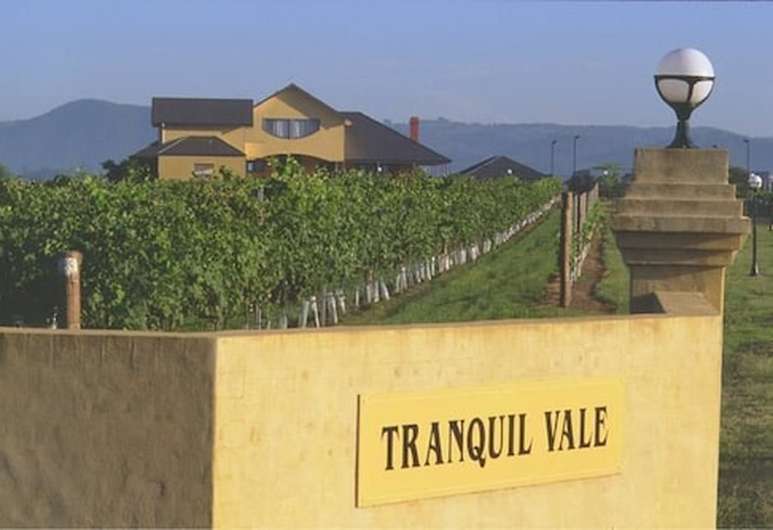
Oct 8, 2019
Friends of the Pod Series -- Ep 297: Anthony Road Wine Company -- a Legend in the Finger Lakes Region of New York
Anthony Road Wine Company is a legend in the Finger Lakes Region of New York. It's one of the pioneering wineries of the area, and it makes wines that reflect the soils and climate of the Finger Lakes. Their wines are made from grapes grown in vineyards owned or managed by the Martini Family and carefully selected by Peter Becraft, the head winemaker. Anthony Road is a family run, family owned, and family operated winery that makes outstanding Riesling, Gewurztraminer, Pinot Gris, Chardonnay, blends, and a variety of reds and rose, as well as some skin contact wines. This week I speak with Peter Becraft, a man of many talents. He started out his career as a Fine Arts Masters student, working as a casting director for a famed fashion photographer in Manhattan. As with many of our generation, Peter found himself at a crossroad after September 11, 2001. He realized he needed to do something more fulfilling with his life. Previously finding more common ground and excitement in the folks his pastry chef wife Cary hung out with, he pursued a wine shop job in lower Manhattan and immersed himself in the world of wine. Today, he is the head winemaker at the iconic Anthony Road Wine Company in the Finger Lakes on Seneca Lake. Here are the show notes: Peter tells us how John and Ann Martini moved from Baltimore in 1973 and set up their farm. He gives us a great lesson on the history of Finger Lakes – what it was like when the Martinis came, and how things have evolved over the last 45 years. We learn about the role of hybrid grapes and why they are different from and similar to the grapes we know and love (vitis vinifera) Peter tells us about the climate and the differences between the Martini Family Vineyard and the Nutt Road Vineyard and why microclimate is so essential to winemaking In the Finger Lakes. Peter gets into really nerdy detail, including glacial movement, silt-loam soils, and how the depth and width of Seneca Lake influences the vineyards Peter then shares his incredible journey from sculptor to winemaker. He tells us how he went from student in Virginia to fine arts Masters student in New York City to winemaker at one of the premier wineries in New York Peter tells us how he learned winemaking, the importance of mentorship from former head winemaker Johannes Reinhardt and how he approaches winemaking We discuss the variety of wines in Anthony Road's portfolio – Riesling, Pinot Gris, Chardonnay, Gewurztraminer, Vignoles (a hybrid), Lemberger, Pinot Noir, Cab Franc, Merlot We wrap with Peter's view on what makes the Finger Lakes so special – its unity, vision, and collegiality Peter and Anthony Road will be at the Underground Wine Event on 11/9/19! You can meet Peter and try his wines at the Underground Wine Event in Washington, D.C. on November 9, 2019! Don't forget to order your Wine For Normal People book today!! _______________________________ Thanks to our sponsors this week: Thanks to YOU! The podcast supporters on Patreon, who are helping us to make the podcast possible and who we give goodies in return for their help! Check it out today: https://www.patreon.com/winefornormalpeople And to sign up for classes, please go to www.winefornormalpeople.com/classes! Last Bottle I love this service!! Last Bottle Wines finds great wines and offers them at a one time discount. Last Bottle Wines: Is a fun way to discover the best wines at the lowest prices Maintains relationships with producers in the most prestigious wine regions around the world and traveling to Europe several times each year to eat with, stay with, drink with, walk the vineyards with the people who make the wines. Offer a range of prices from low end to high end $9 to $99 and the wines range from the lesser known kinds like Albariño and Bläufrankish to Cabernet, Merlot and Chardonnay. Visit: http://lastbottlewines.com/normal and join to get a $10 instant credit to use toward your first order. Invite your wine drinking pals and they'll get $10 instantly and you get $30 when they make their first buy.

Oct 1, 2019
Friends of the Pod Series -- Ep 296: Boundary Breaks of the Finger Lakes, Where Terroir Reigns Supreme
Boundary Breaks is located in the Finger Lakes in Central New York. It's the consummate cool weather growing region, where Riesling and aromatic whites reign supreme. Bruce Murray, the founder and creative force behind Boundary Breaks , tells us how he went from newspaper man, to working with Elon Musk, to running a winery so focused on terroir, they don't even have a dedicated winemaker. Boundary Breaks was founded in 2007 by Bruce on the East side of Seneca Lake. It focuses on Riesling, which range in style from dry and complex to lightly sweet to a true Riesling Ice Wine. In addition to Riesling, small amounts of Gewurztraminer, Cabernet Franc, Merlot and Cabernet Sauvignon are grown on the estate. The wines are spectacular with a purity of flavor, and excellent terroir expression. Bruce's life is fascinating and Boundary Breaks, indeed, has broken some boundaries in what can be done in the wine world! Here are the topics we discuss: Bruce tells us how his life unfolded to bring him back to the area in which he grew up. He tells me how the Donnhoff Riesling from Nahe, Germany in a Thai restaurant in Vegas changed the course of his life. We talk about the Finger Lakes, how they were formed, why they are so unique and why the east side of Seneca Lake produces such excellent grapes. We get extra dorky, discussing Boundary Breaks' unique drainage system and why "wet feet" are bad for grapes We discuss Riesling and how vineyard management is so pivotal to getting pure flavor. We detail each style Boundary Breaks makes -- dry, off-dry, ice wine plus aromatic whites like Gewurztraminer. We talk extensively about the challenges of growing reds in the climate of the Finger Lakes and how quality has been spotty over the years, but is improving by leaps and bounds. You can meet Bruce and try his wines at the Underground Wine Event in Washington, D.C. on November 9, 2019! Don't forget to order your Wine For Normal People book today!! _______________________________ Thanks to our sponsors this week: Thanks to YOU! The podcast supporters on Patreon, who are helping us to make the podcast possible and who we give goodies in return for their help! Check it out today: https://www.patreon.com/winefornormalpeople And to sign up for classes, please go to www.winefornormalpeople.com/classes! Last Bottle I love this service!! Last Bottle Wines finds great wines and offers them at a one time discount. Last Bottle Wines: Is a fun way to discover the best wines at the lowest prices Maintains relationships with producers in the most prestigious wine regions around the world and traveling to Europe several times each year to eat with, stay with, drink with, walk the vineyards with the people who make the wines. Offer a range of prices from low end to high end $9 to $99 and the wines range from the lesser known kinds like Albariño and Bläufrankish to Cabernet, Merlot and Chardonnay. Visit: http://lastbottlewines.com/normal and join to get a $10 instant credit to use toward your first order. Invite your wine drinking pals and they'll get $10 instantly and you get $30 when they make their first buy.

Sep 24, 2019
Friends of the Pod Series -- Ep 295: Sleight of Hand- Washington State's Wine Magic
Sleight of Hand Cellars is the fulfillment of two dreams. Jerry Solomon was a real estate attorney in San Diego who longed for a small town life and wanted wine to be part of it. Trey Busch was a Walla Walla winemaker who had insane talent but needed a partner to make his dream winery a reality. The two created Sleight of Hand 12 years ago to create exceptional, terroir driven wines that reflect the unique land of Walla Walla and Columbia Valley. Jerry takes us on a journey of the winery, the land, and the beautiful wines they produce! They will be at Underground Wine Event on November 9, 2019 – don't miss it! www.undergroundwineevents.com/events Here are the show notes: Jerry tells us how he and his wife Sandy made the move from San Diego Real Estate attorney to Director of Winemaking at the coolest winery in Walla Walla He talks about the wonderful friendship and partnership between him and Trey Busch, an Atlantan who became a skilled Walla Walla winemaker after working for several excellent wineries We talk about the special role of music at Sleight of Hand and how the winery got its name from a Pearl Jam song Jerry explains why the Columbia Valley, and Walla Walla, in particular, are so special for winemaking. We talk soil (loess, which the Walla Walla folks pronounce "luss" and basalt), sun exposure, latitude and why these wines are so different from those from California We talk about the variety of Sleight of Hand wines from Riesling, Chardonnay, Syrah, and red blends and what makes each so special We discuss why Syrah, in particular, is such a standout in Walla Walla ad why Milton-Freewater Rocks District is so insanely good I ask Jerry if he thinks Washington gets the respect it deserves on the world wine scene and why scores work against Washington wines We discuss why Sleight of Hand wants to stay small We close with how Neil Patrick Harris wound up on the Conjurer label! Don't forget to order your Wine For Normal People book today too!! ____________________________________________________ Thanks to our sponsors this week: Thanks to YOU! The podcast supporters on Patreon, who are helping us to make the podcast possible and who we give goodies in return for their help! Check it out today: https://www.patreon.com/winefornormalpeople And to sign up for classes, please go to www.winefornormalpeople.com/classes! Last Bottle I love this service!! Last Bottle Wines finds great wines and offers them at a one time discount. Last Bottle Wines: Is a fun way to discover the best wines at the lowest prices Maintains relationships with producers in the most prestigious wine regions around the world and traveling to Europe several times each year to eat with, stay with, drink with, walk the vineyards with the people who make the wines. Offer a range of prices from low end to high end $9 to $99 and the wines range from the lesser known kinds like Albariño and Bläufrankish to Cabernet, Merlot and Chardonnay. Visit: http://lastbottlewines.com/normal and join to get a $10 instant credit to use toward your first order. Invite your wine drinking pals and they'll get $10 instantly and you get $30 when they make their first buy. Coravin Coravin is the first and only tool in the world that lets you pour wine without removing the cork. You can pour wine in any amount and preserve what's left of the bottle for weeks, months of even years. Thousands of wine professionals, from sommeliers to winemakers, around the world have tested and trust Coravin with their wines and it will change the way you drink wine too. For a limited time, visit Coravin.com and enter NORMAL at checkout to get $20 off your purchase of $50 of more!

Aug 19, 2019
Friends of the Pod Series -- Ep 290: Theresa Breuer of Georg Breuer Represents Rheingau, Riesling, and the New Face of German Wine
If you had no interest in Riesling or in Rheingau previously, this show will change your mind completely and make you jump out of your seat to try Georg Breuer's exquisite wines. Theresa Breuer is a young woman who found herself (sadly, earlier than she expected) at the helm of one of the most respected, highest quality Riesling producers in the Rheingau region of Germany. I had the pleasure of spending the day with her a few years back and she is brilliant, poised, kind and a genius vigneron and cellar master, but more than anything, at 30-something, she is one of the best fresh faces and ambassadors for what Rheingau wine is, was, and should be. This show should give you a perspective on why Rheingau is so special and make you understand why a dork like me loves this place so much! Here are the show notes: HISTORY Theresa shares Weingut Georg Breuer's nearly 140 years in wine -- from her great grandfather Peter's involvement in the business side of wine, to her grandfather after whom the Weingut is named, to her dad, Bernhard, and then to her. We discuss Bernhard Breuer's obsession with quality, bringing the reputation of Rheingau back from a less than stellar period, and her involvement in the business. Theresa shares her (beautiful) philosophies about wine and why it means so much to her. Rheingau Education! I have rarely found anyone who can educate on a region as well and succinctly as Theresa Breuer and we are lucky to have her explain stuff like: Where is Rheingau and what makes it so unique for wine? The parallels with Burgundy in terms of Grand Cru, Premier Cru, Village, Regional sites and why it is so easy in Rheingau Why Riesling is so dominant in Rheingau and why it does so well here (hint: reflection from the river, slate/quartzite soils, slopes!) How climate change has affected the region, what a hot year like 2019 means for the wine, and what really matters to vintage How oak is used in Rheingau (and it is used, a LOT!) Theresa gives us the deep dive into site specific info. It's fascinating: Theresa shares detailed and excellent information about George Breuer's sites and the why and how behind the differences in the wines. We discuss their beautiful Grand Cru sites in Rüdesheim – Berg Schlossberg, Berg Roseneck and Berg Rottland and their wholly owned site, Nonnenberg in Rauenthal (in the eastern part of Rheingau Theresa talks about her commitment to organic viticulture and her vision for the wines -- to let the vineyard produce the best wines and to let the Riesling show its home in the glass! We talk about what makes Theresa's wines elegant and age worthy. We discuss the generational shift in Rheingau and what it does and will mean for wine in the future. Theresa unveils big news: Weingut Georg Breuer bought some land in the (very different, Mittelrhein-type) wine area of Lorch, to the west of their Grand Cru vineyards. They will be learning more about the sites, and making wine from them soon! Check out the videos on my YouTube Channel -- you will love Theresa even more! Don't forget to order your Wine For Normal People book today too!! ____________________________________________________ Thanks to our sponsors this week: Thanks to YOU! The podcast supporters on Patreon, who are helping us to make the podcast possible and who we give goodies in return for their help! Check it out today: https://www.patreon.com/winefornormalpeople And to sign up for classes, please go to www.winefornormalpeople.com/classes! Last Bottle I love this service!! Last Bottle Wines finds great wines and offers them at a one time discount. Last Bottle Wines: Is a fun way to discover the best wines at the lowest prices Maintains relationships with producers in the most prestigious wine regions around the world and traveling to Europe several times each year to eat with, stay with, drink with, walk the vineyards with the people who make the wines. Offer a range of prices from low end to high end $9 to $99 and the wines range from the lesser known kinds like Albariño and Bläufrankish to Cabernet, Merlot and Chardonnay. Visit: http://lastbottlewines.com/normal and join to get a $10 instant credit to use toward your first order. Invite your wine drinking pals and they'll get $10 instantly and you get $30 when they make their first buy. Coravin Coravin is the first and only tool in the world that lets you pour wine without removing the cork. You can pour wine in any amount and preserve what's left of the bottle for weeks, months of even years. Thousands of wine professionals, from sommeliers to winemakers, around the world have tested and trust Coravin with their wines and it will change the way you drink wine too. For a limited time, visit Coravin.com and enter NORMAL at checkout to get $20 off your purchase of $50 of more!

Aug 7, 2019
Bonus Sponsored Ep: Greg Lambrecht, Inventor of Coravin
This episode is sponsored by Coravin, the first and only tool in the world that lets you pour wine without removing the cork. You can pour wine in any amount and preserve what's left of the bottle for weeks, months or even years. Thousands of wine professionals, from sommeliers to winemakers, around the world have tested and trust Coravin with their wines and it will change the way you drink wine too. Although sponsored by Coravin , this is the same as any other interview show! Don't miss it! Greg Lambrecht is the inventor, founder and board member of Coravin™ along with a number of other medical device companies. Greg holds a Masters of Science in Mechanical Engineering and a Bachelor of Science in Nuclear Engineering from the Massachusetts Institute of Technology. He holds numerous patents in the fields of gynecology, general surgery, cardiology, and orthopedics. Greg is one of those great minds you come across every now and then -- creative, structured, smart, unhindered by things that seem impossible. You'll love learning about Coravin and how he made an enormous difference in the wine industry by taking off the guardrails of staid industry thinking and solved a problem wine drinkers the world around grapple with -- sometimes you just want one darn glass without opening a bottle! Here are some of the topics we cover: We talk about how a guy like Greg was as a child, and what it really means to be "mission-driven" Greg tells us about his journey into wine and how, while the rest of the dads of the world just drank too much or drank skunky wine while their wives were pregnant, he got busy inventing Coravin ! Greg tells us all about the development process and some awesome stories about stuff that happened as he was developing today's Coravin Greg and I talk about the weird quirks of the wine industry and how being outside of it helped inspire his enormous creativity We get geeky on the details of how Coravin works. Greg sets me straight on Argon gas and why it doesn't work when I spray the stuff in the bottle but DOES work in Coravin. We talk about the next frontier for Coravin : screwcaps and sparkling! For a limited time, visit Coravin.com and enter NORMAL at checkout to get $20 off your purchase of $50 of more.

Jul 9, 2019
Friends of the Pod Series -- Ep 284: Lorenzo Muslija from Andis Wine in Sierra Foothills, California
This week I speak with Lorenzo Muslija, the co-owner and National Sales Manager for Andis Wines in the Sierra Foothills of California . I had the honor of meeting him and getting to know him when he joined our November 2018 Underground Wine Event and I adore both him and his wines. Opened in November of 2010, Andis Wines is a boutique winery located in historic Amador County in California's Sierra Foothills. They source from the best vineyards in the Sierra Foothills, hand sort and ferment their wine in small lots and the result is well-balanced, food friendly, terroir-driven wines. Lorenzo recently became a co-owner of the business and we talk about his fascinating personal story, his love of Sierra Foothills, and what makes Andis unique. Here are the show notes: Lorenzo tells us about his early years growing up in Albania and Italy, his university life as a civil engineer, and how became owner and founder of one of the most popular (French-inspired) restaurants in Florence. We discuss how his love of his children brought him to California and why he felt it was the right choice to study Wine Business Management rather than enology or some other path in the higher education vis a vis wine. We discuss why Lorenzo, the international man of culture, taste, and cuisine, found excitement in working with one of the least developed wine regions of California (Sierra Foothills) Lorenzo gives us the dish on the Foothills and why it's great and not so great, as well as how Andis is able to do things well in their region. We also discuss how Lorenzo's Italian sensibilities have helped shape Andis Wines. We wrap by talking about Lorenzo's latest venture – how he has become a partner in Andis and what that means for the winery and for this dynamic, wonderful guy! Thanks to our sponsors this week: Patrons on Patreon Thanks to YOU! The podcast supporters on Patreon, who are helping us to make the podcast possible and who we give goodies in return for their help! Check it out today: https://www.patreon.com/winefornormalpeople And to sign up for classes, please go to www.winefornormalpeople.com/classes! Last Bottle I love this service!! Last Bottle Wines finds great wines and offers them at a one time discount. Last Bottle Wines: Is a fun way to discover the best wines at the lowest prices Maintains relationships with producers in the most prestigious wine regions around the world and traveling to Europe several times each year to eat with, stay with, drink with, walk the vineyards with the people who make the wines. Offer a range of prices from low end to high end $9 to $99 and the wines range from the lesser known kinds like Albariño and Bläufrankish to Cabernet, Merlot and Chardonnay. Visit: http://lastbottlewines.com/normal and join to get a $10 instant credit to use toward your first order. Invite your wine drinking pals and they'll get $10 instantly and you get $30 when they make their first buy. The Citizenry The Citizenry is a socially conscious home décor brand bringing time-tested craftsmanship to the modern home. They travel around the globe, partnering with master artisans to create designs with a soul, story, and a purpose. With pieces crafted in over 15 countries, their collections are designed to highlight the unique materials and craft traditions of each destination. And even better -- every dollar you spend supports fair wages, safe working environments, and is a direct investment into artisan entrepreneurs. For a special offer, go to CitizenryPodcast.com and enter WINE.

Mar 25, 2019
Friends of the Pod Series -- Ep 269: From Doctor to One Woman Winery--Kerith Overstreet of Bruliam
Kerith Overstreet is a triple threat: Bruliam Wines co-founder and winemaker, medical doctor, and mom to three teens. After retiring from general surgery to pursue pathology and then medicine to raise a family, she tried her hand at winemaking with one barrel. She quickly found she had the chops for it and her fourth baby, Bruliam Wines was established in 2008. Since then, Kerith has completed her enology courses at U.C. Davis and she is a one-woman show. She does EVERYTHING herself and the lovely single vineyard Pinot Noir, Zinfandel, and chardonnay benefit from it. www.undergroundwineevents.com for tickets! Here are some of the things we cover in the show: Kerith takes us on her journey from growing up in San Diego, to East Coast college and med school student, to single vineyard, terroir-driven winemaker Kerith discusses the interplay between wine and medicine and how it affects her today We talk all about site, growers and why this kind of thing is the obsession of small winemakers We discuss Pinot Noir and why it's such a fascinating grape On a personal note, we discuss family, doing it as a one-woman show, and strange things people have said to Kerith in her time in wine You can get her wines at www.bruliamwines.com Thanks to our sponsors this week: YOU! The podcast supporters on Patreon, who are helping us to make the podcast possible and who we give goodies in return for their help! Check it out today: https://www.patreon.com/winefornormalpeople

Mar 11, 2019
Friends of the Pod Series -- Ep 267: Leo Hansen of Leo Steen Wines, The Dane who Mastered California Chenin Blanc
Originally from Denmark where he grew up as the son of a chef and hotelier in the happiest country in the world, Leo Hansen started in the hospitality world at the ripe old age of 12 and hasn't stopped since. First he was a certified European sommelier working for a Michelin starred restaurant and that brought him to the US where he immersed himself in the world of New World winemaking. In 2004 he started Leo Steen Wines , which concentrates on divine Chenin Blanc (AKA Steen in South Africa, but ironically a family name as well!) but also makes Cab Franc, Chardonnay, and Grenache. He has been in California for 20 years but he maintains a European palate and focuses on traditional European winemaking techniques like foot treading, natural yeasts, lower alcohols and less new oak. He's the perfect balance of professional winemaker and sommelier and a fascinating guy all around. And a few show notes: Leo tells us about his early life as a the son of a chef and hotelier, including some notes about Danish cuisine! We learn about Leo\'s career path, especially his time at Kong Hans in Copenhagen, a Michelin Starred Restaurant We discuss the difference in sommelier culture in Denmark v. the US Leo takes us through his journey from a harvest worker at Clos du Bois to owner of Leo Steen . Finally, we discuss his specific philosophies and wines and why site is so important to his wine. For more info on Underground Wine Events, go to www.undergroundwineevents.com Thanks to our sponsors this week: YOU!The podcast supporters on Patreon, who are helping us to make the podcast possible and who we give goodies in return for their help! Check it out today: https://www.patreon.com/winefornormalpeople Blinkist: Blinkist is the only app that takes the best key takeaways, the need-to-know information from thousands of nonfiction books and condenses them down into just 15 minutes so you can read or listen to. 8 Million people are using Blinkist right now and it has a massive and growing library: from self-help, business, health to history books. Get the main idea of books so you can decide if they are something you want to read more of or if the gist is just enough! Right now, for a limited time Blinkist has a special offer. Go to www.blinkist.com/WINE to start your free 7 day trial.

Jan 27, 2019
Friends of the Pod Series -- Ep 262: Serge Dore Outstanding French Wine Importer
Serge Doré has been importing high quality, outstanding value wines from small French family wineries for decades. His passion, discerning palate, ethics, and intelligence make him a model for how importing should be done. He shares his story with us!! First, here's where you can find Serge and his wines: Serge's wines: www.sergedoreselections.com The store that carries them: www.grapesthewineco.com Contact Daniel Posner - daniel@grapesthewineco.com at Grapes, The Wine Company with questions And here are a few of the many topics Serge and I cover in the show: 1. Serge answers the big question: What exactly does an importer do 2. Serge discusses how he got into the profession and his experiences in building his business -- the joys and struggles (he tells us how importing can be very ugly for some of these small wineries when they hook up with the wrong people). 3. We discuss the wonderful family wineries Serge works with all over France and what it means to have their products sold in international markets, especially the U.S. 4. Serge tells us why French wines are often a better value than US wines 5. We discuss up and coming French regions that we should look out for and Serge offers advice for people who have a palate for New World wines but who would like to expand into French wines Serge is passionate, kind, smart as a whip, and a fantastic person. I think you'll learn an incredible amount about importing, the wine business, and the struggles of small wineries by listening to this fascinating show. One of my favorite guests of all time! Thank you to our sponsors this week: YOU! The podcast supporters on Patreon, who are helping us to make the podcast possible and who we give goodies in return for their help!Check it out today: https://www.patreon.com/winefornormalpeople

Dec 18, 2018
Friends of the Pod Series -- Ep 259: Will Henry of Lumen Wines talks about Santa Barbara, Surfing and Wine
Will Henry, co-proprietor at Lumen Wines in the cool climate AVAs of Santa Barbara, talks about his life in surfing, environmental activism, photography, and wine. He educates us on Santa Barbara and helps us understand why the region is world class. Will is partners with Lane Tanner, a force in the Santa Barbara wine industry who help jump start the region in the 1980s. Lumen makes wines that are beautiful examples of how the cool climate of Santa Maria Valley, Sta. Rita Hills, and surrounding areas can result in restrained, yet sunkissed wines. Awesome stuff!! Here are the show notes: Will tells us how he made the jump from sociology major to cellar rat, then to surfing photographer and philanthropist, and now to winery owner (he's been busy). We talk about the various appellations of Santa Barbara and why it makes such fantastic wine. We discuss the grapes and wine styles too! Will and I debate the effects of the movie 2005 movie Sideways on Pinot Noir and Santa Barbara as a wine region. We discuss why Paso Robles has, in recent years, been so much more popular than Santa Barbara as a tourist destination and why we should all go visit SB! We get a glimpse into Lumen – Will and Lane's philosophy and why they do what they do. (Spoiler alert: Lane Tanner will be on to give us a more in depth look at the winery next season!). Thanks for listening! Please go see Will at Pico or The Wine Shepherd ! Thanks to our sponsors this week: YOU! The podcast supporters on Patreon, who are helping us to make the podcast possible and who we give goodies in return for their help! Check it out today: https://www.patreon.com/winefornormalpeople M. Gemi is redefining the luxury Italian footwear market by taking all the things we love about the industry—unparalleled quality, family-owned workshops, and personalized, concierge-level service—and leaving behind the luxury price tag. Many brands that once represented the epitome of quality craftsmanship have abandoned Italy in order to maximize profits—all at the expense of quality, their customers' wallets and the very craftspeople who helped build their businesses. M.Gemi is Italian luxury made the old way, sold the new way. The result is the highest-quality, handcrafted Italian shoes at a price that clients can feel good about. Go see for yourself how amazing these shoes are at www.mgemi.com/wine for fifty dollars off your first pair.
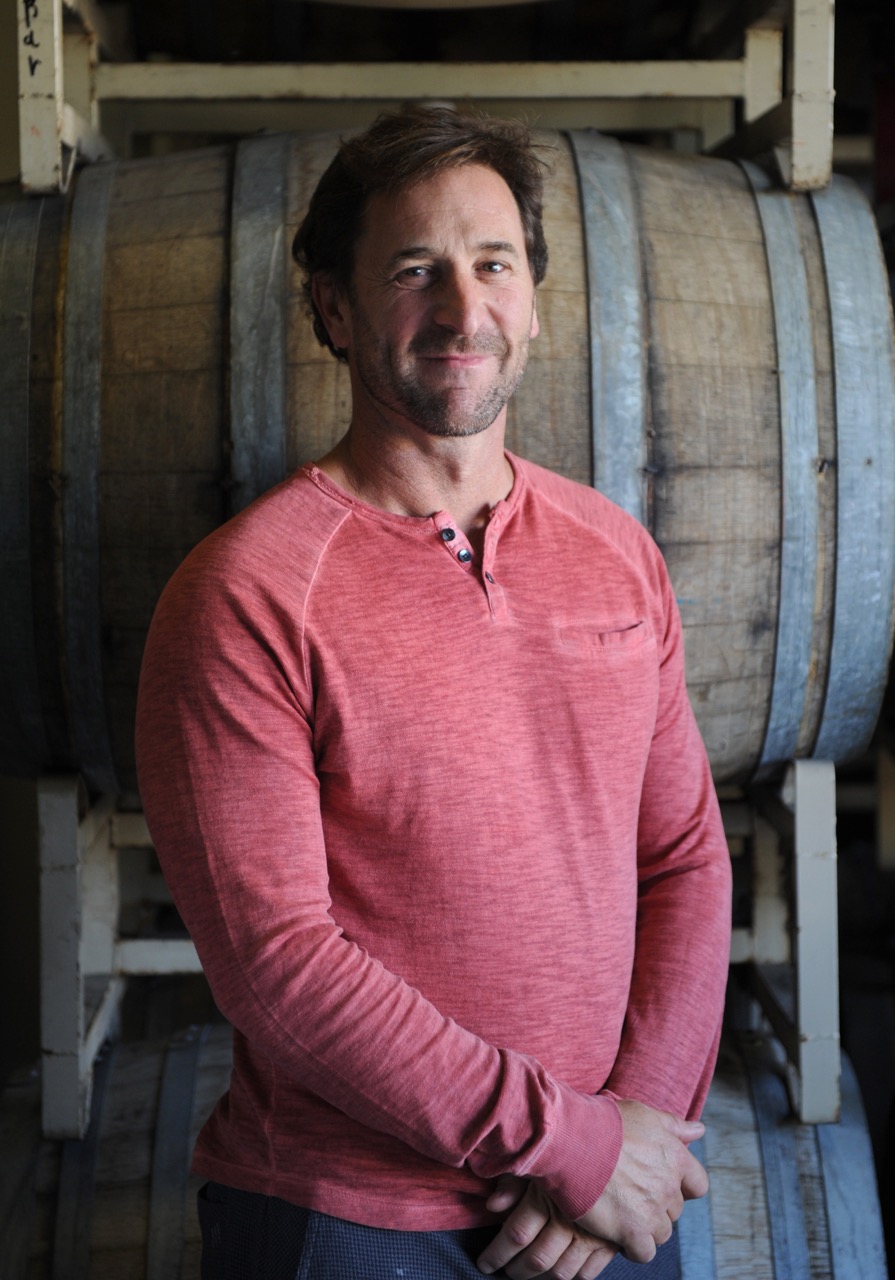
Nov 4, 2018
Friends of the Pod Series -- Ep 253: Stu Smith of Smith-Madrone Vineyards Talks About 48 Years in Napa Valley
In May 1971, with a partnership of family and friends, Stuart Smith bought a vineyard on Spring Mountain, which today is Smith-Madrone Vineyards and Winery. He was 22 years old and had just received his B.A. in Economics from UC Berkeley and was taking classes towards his Master's in Viticulture at UC Davis. 48 years later, Smith-Madrone is going strong and Stu is full of ideas, opinions, and perspective! Here are the notes: Stu tells us how a 22 year old viticulture student took a trip to Napa and wound up buying what would become Smith-Madrone We discuss what Napa was like in the 1970s v. today We chat about what drew Stu to Spring Mountain and the effort it took to restore this pre-phylloxera vineyard area, atop Spring Mountain, to a modern vineyard and winery We discuss why Smith-Madrone grows what it does -- including Riesling Stu talks about why Smith-Madrone has stayed small And finally Stu shares his theories on why organic, biodynamic and conventional farming are all incredibly problematic types of agriculture Thanks to Smith-Madrone , whose wines I love and who joined us for Underground Wine Events, DC ! Thanks to our sponsors this week: YOU! The podcast supporters on Patreon, who are helping us to make the podcast possible and who we give goodies in return for their help! Check it out today: https://www.patreon.com/winefornormalpeople Last Bottle I love this service!! Last Bottle Wines finds great wines and offers them at a one time discount. Last Bottle Wines: Is a fun way to discover the best wines at the lowest prices Maintains relationships with producers in the most prestigious wine regions around the world and traveling to Europe several times each year to eat with, stay with, drink with, walk the vineyards with the people who make the wines. Offer a range of prices from low end to high end $9 to $99 and the wines range from the lesser known kinds like Albariño and Bläufrankish to Cabernet, Merlot and Chardonnay. Visit: http://lastbottlewines.com/normal and join to get a $10 instant credit to use toward your first order. Invite your wine drinking pals and they'll get $10 instantly and you get $30 when they make their first buy.

Mar 17, 2018
Friends of the Pod Series -- Ep 224: Ana Keller of Keller Estate in the brand new Petaluma Gap AVA of Sonoma, CA
Continuing the Women in Wine series for Women's History Month 2018, I speak with Ana Keller of Keller Estate . She helped establish the Petaluma Gap American Viticultural Area (AVA), which is Sonoma's newest cool climate appellation making excellent Pinot Noir, Chardonnay, and Syrah. Ana is one of the only women of Mexican heritage running a wine estate, and she is simply amazing. Here are some of the notes from our conversation: We talk about how her family got into wine. We discuss Ana's educational background -- she attended the University of Mexico and obtained a biopharmaceutical chemistry degree and then to King's College in London for a Masters in Pharma Development. We talk about how Ana got into wine as a consumer and how her dad roped her into the business as Estate Director. Ana shares her feelings about mentors in the wine industry and what it was like to be a young woman in wine in the 1990s. We dig into the Petaluma Gap AVA -- what makes it different, how the appellation was conceived of, and why the wines are so very different from the rest of Sonoma. Finally, we wrap up with a conversation about the current state of women in the wine industry and the role of amazing men in forwarding the careers of women in it. Please support our (delicious) sponsor, HelloFresh: A meal kit delivery service that shops, plans and delivers your favorite step-by-step recipes and pre-measured ingredients so you can just cook, eat and enjoy! Delivered right to your door, with a variety of chef-curated recipes that change weekly, this is a new way to eat and cook! We love it! For $30 off your first week of HelloFresh, visit www.hellofresh.com and enter WINE30. You won't regret it!

Feb 5, 2018
Friends of the Pod Series -- Ep 218: Nalle Winery of Dry Creek Valley, Sonoma, CA -- Elegant Zinfandel like no other
In this episode, I talk to the Zinmasters of the Dry Creek Valley, Andrew & April Nalle. Nalle has been making Zinfandel in a milder style than most other wineries -- with balance, acidity, & finesse for nearly 40 years. Andrew recently took over the winery from his dad, Zin legend Doug Nalle. The Nalle story -- it's past and future -- is a family story and one that represents the small producers of Sonoma well. A few things we discuss... Nalle's 100+ year family history in Dry Creek Valley and its history with making wine. The power of Zinfandel and how it doesn't have to be what you traditionally think of when you think of the grape. April Nalle's fascinating background in grower relations, and how she made it as one of the only women in a male dominated field Andrew's winemaking philosophy, what he's learned from his dad and how he will carry forward the Nalle Zin tradition We nerd out about Zin, about the land, and about the mother of the Zin vine, Crjlenak Kastelanski, which Andrew has tried! Finally we wrap by talking about Andrew and April's thoughts for the future, as they take over from Andrew's folks. Truly normal people, who make great wine! www.nallewinery.com
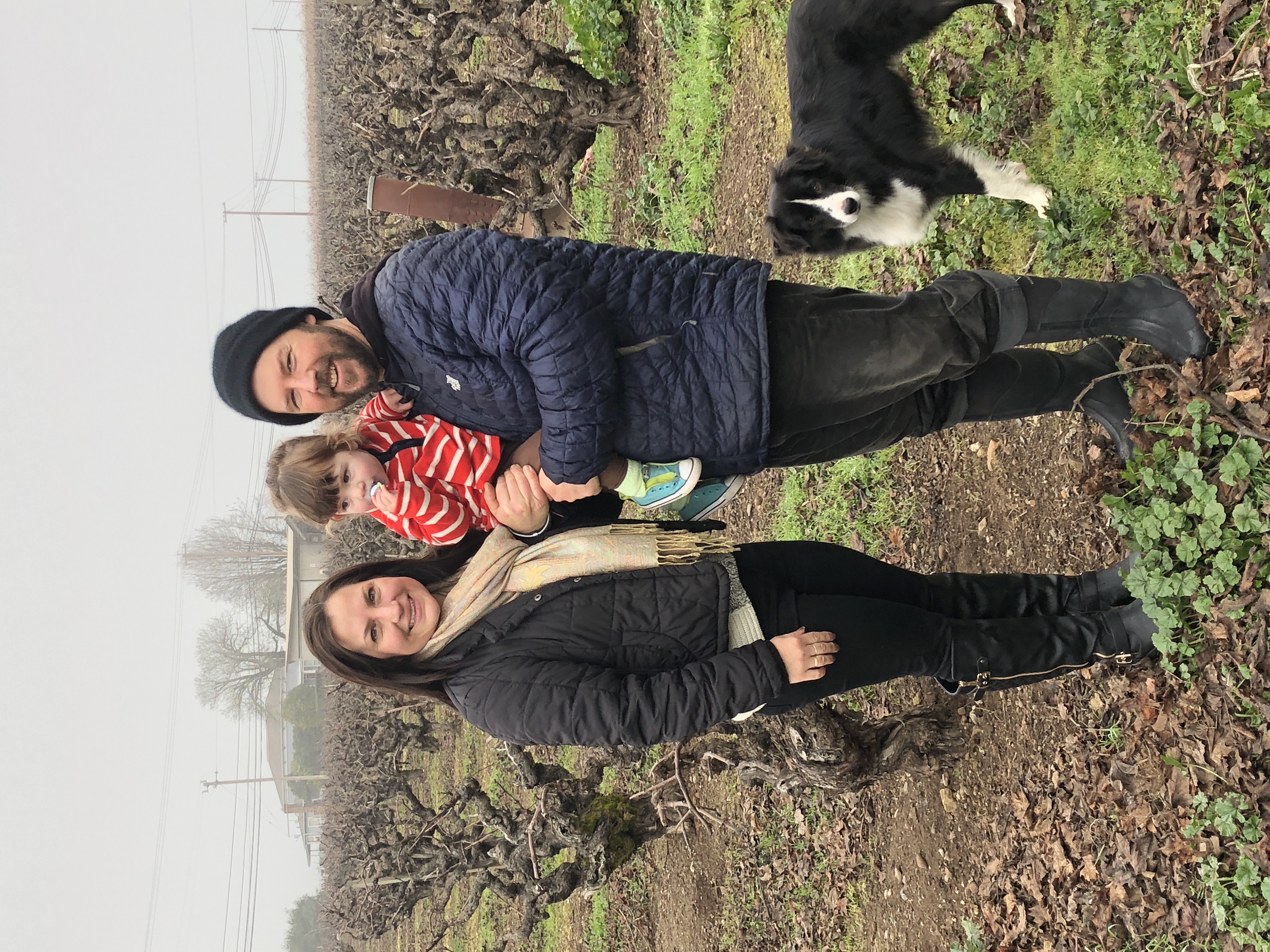
Jan 27, 2018
Friends of the Pod Series -- Ep 217: Peterson Winery of Dry Creek Valley of Sonoma, CA
I recorded this podcast at the Peterson Winery tasting room while I was visiting Sonoma in support of the Sonoma Underground event I co-founded ( www.undergroundwineevents.com ). This is a fascinating conversation with the force and Dry Creek Valley icon that is Fred Peterson, his son and Peterson's winemaker Jamie, and his daughter and head of sales and marketing, Emily. As Fred discusses, following time in the military, he studied viticulture and winemaking and graduated with honors from UC Davis. After working in and around Santa Cruz for prestigious wineries as a vineyard manager, Fred came to Dry Creek Valley in 1983 to find and develop world-class vineyard properties. Fred developed vineyards all over the Dry Creek Valley of Sonoma County, including on Bradford Mountain, where most of the fruit for Peterson's top wine hails. In 1987, Fred, launched Peterson Winery. Peterson Winery now makes an average of 8000 cases annually, all in many small lots from estate vineyards and from like-minded growers and friends. Peterson produces many wines... - 3V White Blend- Vermentino, Verdelho, Vernaccia - Agraria — a proprietary Bordeaux/Cabernet Franc varietal blend - Barbera - Cabernet Sauvignon - Cabernet Sauvignon Port- dessert wine - Carignane - Grenache - Merlot - Mendo Blendo – Petite Sirah based blend - Muscat Blanc — Dessert Wine - Petite Sirah - Petit Verdot - Rosé - Sauvignon Blanc - Sangiovese — Dry Creek Valley and Il Granaio - Syrah - Vignobles- Red Rhone Style Blend - Zinfandels — Dry Creek Valley, Tradizionale, Bradford Mountain, Bernier Zinyard, Warren Ranch, & Old School - Zero Manipulation — an old-fashioned red blend Please support our sponsor this week, who helps make the podcast possible: Thanks to this week's sponsor who makes the podcast possible! The Great Courses Plus -- who makes you smarter and more well rounded! With thousands of outstanding video lectures that you can watch or listen to any time and anywhere, The Great Courses Plus is an easy way to stimulate your brain and make you smarter! For a free month trial, go to thegreatcoursesplus.com/wine
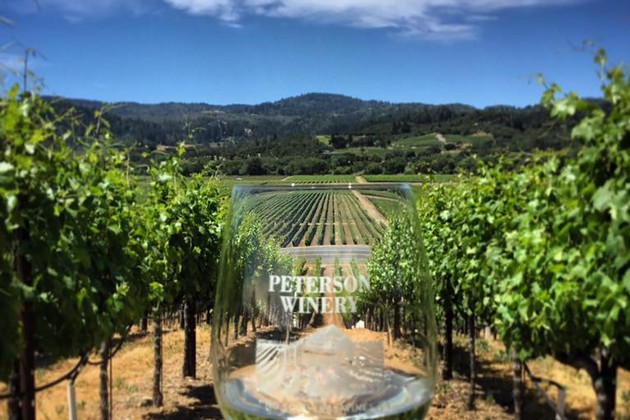
Jul 21, 2017
Friends of the Pod Series -- Ep 195: Oded Shakked, Dynamic Winemaker & Owner of Longboard in Sonoma
This time, an outstanding interview with Oded Shakked of the small Russian River Valley producer, Longboard Vineyards . Although he's been making wine for most of his life in California, Oded is originally from Israel and has a global perspective on wine, winemaking, and wine business that's refreshing and fascinating. He's fantastic and all his wines are delicious, well-balanced, and all are made to accompany food. Here are the show notes: Oded shares his amazing story, from being a kid in Israel to discovering surfing, traveling the world, and then winding up at UC Davis in Sonoma to study winemaking. We talk about what things used to be like in Napa and Sonoma, and what a winemaking degree from UC Davis gave to Oded that was so valuable. Oded discusses his love of Sonoma and why it's so special to him. We discuss the changes that have occurred over the years in Sonoma and what Oded has seen in the food and wine scene -- for good and bad. Oded is a deep thinker. We tap into some of that brain power when he discusses his philosophy on food and wine, and how it helps him makes wines of balance Since he is one of the few winemakers in California that does a full line of still wine and also makes a Methode Champenoise sparkling wine, he uses this unique experience to tell us the differences in mentality you need to make each type of wine (a very cool discussion). We chat about Syrah (Oded's is stunning!) and why it isn't as popular as it should be. All in all a fascinating conversation with a great winemaker, a guy with great perspective on the last 30 years in Sonoma, and an all around nice person! Go visit Longboard when you're in Healdsburg: https://www.longboardvineyards.com

May 10, 2017
Friends of the Pod Series -- Ep 188: Kieran Robinson, Where Sonoma Meets the Rhône
Kieran Robinson is a small producer of Rhone style wines in Sonoma --and his stuff rocks. A Philadelphia native, after working in the Northern Rhône he moved to Napa & worked for cult wineries going it alone. A great story from a truly talented winemaker! Here are the show notes: Kieran tells us about his early life in Philadelphia, at Ithaca college, and getting his start in wineries in the Finger Lakes. He takes us on his journey from Northern Rhône to Napa to Sonoma and details what it was like to work with everyone from Michel Rolland, Aaron Potts, and Paul Hobbs before going out on his own. We address Kieran's real passion: making Viognier and Syrah. We talk about the current situation in Sonoma with grapes and more people looking at Rhône varietals as a viable and awesome option. Kieran takes us through the differences between his wines, the wines' nod to Philly, and why they are so darn great! To learn more about Kieran, go to http://www.kieranrobinsonwines.com And thanks to our sponsor, The Great Courses: https://www.thegreatcoursesplus.com/wine
Jun 30, 2016
Friends of the Pod Series -- Ep 162: Jason Haas of Tablas Creek in Paso Robles, CA
Jason Haas was the 2015 Paso Robles Wine Industry Person of the Year. As the GM and a partner in the Tablas Creek joint venture with the Perrin family of Rhône fame (Château de Beaucastel is one of the most famed properties in Châteauneuf du Pape and the family own several other ventures through out Rhône and Provence), Jason has had an enormous impact on the Paso Robles region and the wine style there. In addition, he is one of the most talented writers in the industry – his Tablas Creek blog has won multiple Wine Blog Awards and is up for another one in 2016. This conversation was a culmination of years of admiration from afar -- I am a huge fan of the Tablas Creek wines and style. Here are some notes from the show: First we talk about the history of Tablas Creek and how the partnership between the Haas and Perrin families happened. We talk about the factors involved in finding a perfect site for the project – soil types, microclimates, altitudes, etc. and the process they went through to find it. We discuss the process Tablas Creek went through to import the vines from Beaucastel. We cover how and when Jason got involved with Tablas Creek and his hand in carving up Paso Robles into 11 appellations which happened in 2015. We answer the questions: what did and does make Tablas Creek's vineyards so unique? and... It is possible anywhere with the right people and the right winemaking and growing, or is this a characteristic unique to certain sites that not all people are cognizant of in CA winemaking? We discuss farming: organics, biodynamics, and dry farming and why Tablas Creek uses all three. We talk about blends, and about the various tiers of Tablas Creek wine and how Jason and his team benchmark his brands against California and Rhône wines, and how they usually stack up. A great conversation with a California legend in the making! This is a fascinating look at an up-and-coming area of California, and it's star player.
Aug 27, 2015
Friends of the Pod Series -- Ep 139: Fred Frank of Dr. Konstantin Frank in Finger Lakes NY
As a follow up to episode 138 on the Finger Lakes wine region, we interview Fred Frank, grandson of the man who made growing premium wine grapes on the East Coast of America possible. Fred tells Konstantin's fascinating, important story & shares the ins & outs of cool climate viticulture. A must listen -- Dr. Frank is the reason viticulture exists in unorthodox regions around the US.