Ishq-e-Karimi Podcasts: The Light of Ismailism
Ishq-e-Karimi: Illuminating the Path of Faith, Wisdom, and Devotion
Ishq-e-Karimi: Illuminating the Path of Faith, Wisdom, and Devotion
Ishq-e-Karimi Podcasts: The Light of Ismailism" is a heartfelt exploration of the rich spiritual, historical, and cultural heritage of the Ismaili community. Rooted in devotion and love for the Imam of the Time, this podcast series illuminates the timeless teachings and profound wisdom of Ismaili thought. Each episode delves into captivating stories, insightful reflections, and inspiring lessons drawn from Ismaili history, poetry, and philosophy. From the spiritual journeys of revered dais and poets like Pir Nasir Khusraw and Al-Mu'ayyad fi’l-Din al-Shirazi, to the mystical connection between the murid and the Imam, the podcast is a treasure trove of soulful narratives. "Ishq-e-Karimi Podcasts" invites listeners to embark on a journey of self-discovery and spiritual enlightenment. Whether you're seeking to deepen your understanding of Ismailism, connect with the community's values, or find inspiration in its legacy, this podcast offers a luminous path to the essence of divine love and knowledge. Let "The Light of Ismailism" guide your soul through the realms of faith, wisdom, and devotion. Join us in celebrating the beauty of Ishq-e-Karimi! www.ishqekarimi.com
Dec 11
Whenever the Imam has veiled Himself, tests have appeared — and we often failed to recognize those tests. The Qur’an reminds us that trials are part of the path: “Do you think you will be left alone while Allah has not yet made evident those among you who are truthful?” — Surah At-Tawbah 9:16 Imamat is Divine Light — and the Qur’an clearly expresses this: “Allah brings you out of darkness into Light.” — Surah Al-Baqarah 2:257 Then how is it that we begin to see the Imam merely as a celebrity, or only as a guide? Before any veil descends upon the Imam, I must understand the spiritual relationship between me and the Imam. Through the reverence of my pirs and teachers, I humbly seek spiritual support from Imam-e-Zaman, Shah Rahim al-Husaini (a.s). O Imam, bless me with a portion of the knowledge from Your treasure — Ameen. Earlier, the Imam used to express spiritual truths openly. Today, His language contains more symbols — signs and allusions. The Qur’an confirms this: “Indeed, in this Scripture are many signs for people of understanding.” — Surah Aal-e-Imran 3:190 Allah Himself often speaks in symbolic language. And the Qur’an says: “Allah guides whom He wills.” — Surah Al-Qasas 28:56 This means that real guidance is spiritual. But we ask more for outward guidance, and the Imam, according to our intention, grants outward guidance — within which the spiritual signs are hidden. Only those who reflect deeply can understand these signs. Hazrat Imam Sultan Muhammad Shah (a.s) said: “Whenever we speak, we utter pearls and jewels.” The present Imam repeatedly speaks about empathy. Why? Because only when the heart becomes soft does the next step of the spiritual journey open. We are not preachers, but one point must be understood: When a veil appears upon the Imam, the real veil appears upon our own intellect. When intellect becomes illuminated, one begins to see the Light of Allah within the Imam. The Qur’an says: “The Light of Allah shines within their hearts.” — Surah An-Noor 24:35 (Ayat an-Noor) But over time, human beings begin to think highly of themselves — and the Imam, a spiritual guide and master, begins to appear like a “celebrity” in their eyes. The heart should feel pain at this — How can someone with whom I have a sacred spiritual bond become a celebrity for me? The Qur’an answers: “Whoever has been given knowledge has been granted a great blessing.” — Surah Al-Baqarah 2:269 If worldly degrees were true knowledge, then everyone would be immersed in love for the Imam. But worldly degrees last only a few years. Spiritual knowledge becomes the cause of the soul’s salvation. The stories of our pirs’ tears and devotion are well known. Pir Sadruddin said: Their only concern was that the murids might consider them ordinary human beings. If the Imam arrives late at a darbar, that moment is not merely waiting — it is an opportunity for spiritual communion and inner supplication. But due to our ignorance, even a few moments of waiting feel burdensome, and people begin to complain… How unfortunate. Today, the Imam has begun to veil Himself — and this is a time for concern and reflection for all of us. Before anything else, it is essential to understand the relationship between the body, the soul, and the intellect: “And I breathed into you from My Spirit.” — Surah Al-Hijr 15:29 The soul is Allah’s trust, and the intellect is also Allah’s trust. But if we turn our limited intellect into a servant of the ego, how will the soul awaken? The Imam illuminates our intellect through the form of inspirations and thoughts. When the Imam says, “We are always connected,” it means the spiritual connection is always present. But we often ignore these inspirations, thinking they are just random thoughts. We get caught up in superficial matters: “Why did the Imam wear these clothes? Why does He have this tattoo?” And we drift away from the true spiritual guidance. The first miracle of the Imam is that He is Haazir-o-Naazir — present and witnessing. He says: “I am from the family of the Prophet. I am the descendant of Ali.” Hazrat Imam Sultan Muhammad Shah And the Qur’an testifies: “Allah will not leave you alone until He distinguishes the pure from the impure and reveals what lies in your hearts.” — Surah Aal-e-Imran 3:179 Would Allah promise us guidance and Light, and then abandon us? No. But our arrogance makes us blind and deaf, as the Qur’an says: “Their hearts are sealed, their ears are burdened, and their eyes are covered.” — Surah Al-Baqarah 2:7 When Allah says: “Indeed, We chose the family of Ibrahim and Imran over all the worlds.” — Surah Aal-e-Imran 3:33 It means this chosen family remains present in every era. During the era of Prophethood, the Imams were concealed. After Prophethood ended, the Light of Ali (a.s) appeared openly. All of this was for us. But how much value do we give to it? If we cannot obey the Imam, how will we obey the Prophet? If we cannot obey the Prophet, how will we obey Allah? The Qur’an gives a very clear command of obedience: “Obey Allah, obey the Messenger, and obey those vested with authority among you.” — Surah An-Nisa 4:59 (The foundational proof of obedience to the Imam) In the end, my prayer: O Mawla, forgive us — Your naïve children. Remove every veil. Grant our intellect knowledge and our souls devotion. Ameen. We are beggars — You are the King. Forgive us. Ameen. Thank you for listening to this podcast. Ya Ali Madad. This is a public episode. If you would like to discuss this with other subscribers or get access to bonus episodes, visit www.ishqekarimi.com
Nov 8
Every artist, every creator, every dreamer has felt it — that spark we call talent .But what if our talent isn’t really ours?In this heartfelt reflection, we explore how ta’yid — divine support — flows through every note we sing, every word we write, every creation we share. When we stop chasing recognition and start seeking khushnudi — the Imam’s pleasure — our art transforms from expression to worship.This episode is a reminder that true peace doesn’t come from views or applause,but from knowing who gifted us the ability to create in the first place. From the heart of Ishq-e-Karimi — where devotion meets reflection. This is a public episode. If you would like to discuss this with other subscribers or get access to bonus episodes, visit www.ishqekarimi.com
Sep 28
In the name of Allah, the Most Compassionate, the Most Merciful I often ask myself: why is there dasond? why is there naandi? why is money collected in majalis? With respect to my teacher — who is like a gate — and to the Imam, who is Light, through them I seek the spiritual strength of the Imam of the Time, so that this reflection may remain filled with light. I know there are many waez and historical answers to these questions… but today, instead of going into history, I want to pause… and reflect on something deeper.Something that can itself bring showers of answers — and silence these questions from the root. Every relationship rests on two pillars: knowledge ( ilm ) and love ( ishq ). When I look at the world, I see how, when someone falls in love, he or she forgets everything else — and moves forward only with the desire to reach the beloved. So many sacrifices are made — of wealth, of family, of habits, of reputation, sometimes even of life. All of this only to gain a human companion for 70–80 years. And when the beloved sees this kind of devotion, they also give back — even sharing their wealth and treasures. Now I reflect: the Imam of the Time — the King of both worlds — is the possessor of infinite knowledge, the treasure that Allah has placed within him. The Qur’an reminds me: “Allah is the Light of the heavens and the earth.” (24:35)“We have sent you with the Truth as a bearer of glad tidings and a warner. And there is no nation without a guide.” (35:24) This treasure is open — but only if my heart burns with love. If my inner light is weak, I do not see Him. My love weakens. Doubts creep in. And doubt… it kills the soul. Without love, questions turn into doubts. So I must ask myself: if even an ordinary human lover is tested with sacrifices, then how can I expect the Master of both worlds not to test me? And what is sacrifice? Sacrifice means to draw near — qurbani comes from qurbat — to give up selfish desires. One of those desires is wealth. When I earn, I feel pride. When I earn, I become attached. And when I am asked to spend for my True Beloved, suddenly my ego questions me: Why does the Imam need this money? Why should I give dasond? Why should I pay majalis fees? But then I remember — Allah says in the Qur’an: “Never will you attain righteousness until you spend from that which you love.” (3:92) If I want admission into a spiritual university, how can I expect it to be free? We all know — people rarely value what comes without cost. That is why there is a token — a symbolic fee. A reminder that money is earned through deeds, and so my offering must be pure, halal — not tainted. If I give, but in my heart there is ego, or show-off, then that means either my money is impure, or my intention is corrupt. In both cases, it holds no value. The Imam does not accept such offerings. In today’s time, money is dearer than even children. It never leaves my neck. That is why most people fail this test, and their sacrifice is wasted. But if my heart is truly filled with love, if I see nothing but the Imam of the Time, then I do not worry. I am ready to sacrifice anything. Yes, I may still ask questions — but those questions only deepen my love, not my doubt. And when the Imam sees such sincerity, He opens the door of His mercy. He showers His true love upon me. So whether it is dasond or majalis fees, these are not just payments — they are symbols of sacrifice. Through them, the soul advances. The Qur’an gives sacrifice a very high station: “Their meat will not reach Allah, nor will their blood. But what reaches Him is your piety.” (22:37) This is why without sacrifice, I cannot truly value what I receive. If doubt enters, I know it is like a seed of disease. If I let it grow, it will turn into a tree that blinds me, until I start seeing the Imam not as my Beloved, but as an ordinary man. This is a deadly disease of the soul. It leads people into envy, into rebellion, even against the very one who is the King of both worlds. And we see this today — on social media, where some who call themselves “ex-Ismailis” make videos against the Imam, seeking false joy while in reality burning in spiritual fire. But if my heart carries the peace of Paradise, and the fire of true love — why should I care for such voices? Like a horse with blinders, I must keep my eyes fixed — only on my Beloved. So when questions arise, I must search for answers — but through love, not through doubt. And if answers don’t come, I must pray: Mawla, increase my knowledge. Protect me from the hellfire of doubt. O Imam, whatever happens, never let go of my hand. Never let me wander into dark thoughts. You alone are my True Beloved. Everything else… is a deception. Ameen. This is a public episode. If you would like to discuss this with other subscribers or get access to bonus episodes, visit www.ishqekarimi.com
Aug 15
Ya Ali Madad. Bismillahir Rahmanir Rahim. I prostrate myself while seeking divine support at the sanctuary of the Lord of the Time, Shah Rahim al-Husayni, so that this beggar may be granted a drop from the treasure of His knowledge, by His grace. Ameen. “You ˹O Prophet˺ may see them facing towards you, but they cannot see.” — (Qur'an 7:198) By the boundless kindness and infinite mercy of Mawla Shah Rahim, the Jamat in France witnessed the Deedar (vision) of the Imam for the first time. Alhamdulillah, what a glimpse it must have been! Even though we only saw photographs, our souls became restless with longing for the Deedar of the Imam of the Time. But is Deedar only about a physical glimpse? If we don’t understand its inner meaning and essence, we will easily forget the Deedar and return to our daily life.So today, we seek divine support from the Imam to understand the true importance of Deedar . When we look toward the Imam in Darbar , our hearts are filled with love, and our eyes are filled with tears. What does this mean? In truth, it is the heart that is crying. The tears appearing in our eyes are simply its expression. This means: "O Mawla, You granted us the gift of Your Zahiri Deedar (external vision), now also bless us with the Baatini Deedar (inner vision), so we may reach Your Noorani Deedar (Luminous Vision).” This Baatini Deedar may come in the form of knowledge and divine support. When the Imam blesses us with His knowledge, then true love is elevated, and through that love, He bestows upon us His Noorani Deedar . The Baatini Deedar is essential for the soul and the intellect, and the Noorani Deedar is even more crucial. The soul has an eternal home, and the first step toward reaching it is the Zahiri Deedar . The second is the Imam's knowledge. The third and final step is the Noorani Deedar . But often we make the mistake of stopping at the Zahiri Deedar . After giving Mubaraki (greetings), we forget and get busy with life again. Then what is the benefit?When a lover ( ashiq ) sees their beloved ( ma'shuq ) in the physical form, it should ignite a fire in their heart to attain the Beloved. If this yearning doesn't arise, how can the Beloved be found? When a lover sees the Beloved and the fire of longing arises, he begins striving for knowledge — not just through prayers and devotion but by trying to understand every gesture of the Beloved. And when the Beloved sees the sincerity of the lover’s heart, He gives everything to that lover. But if that yearning is not born? Then Allah has said in the Qur'an, Surah 7, Ayah 198: "O Prophet, they may look towards you, but they cannot see you." (7:198) Could this condition be ours? Are we sitting in Darbar , only observing the Imam’s external appearance? What colour is he wearing? Where is he walking from? In which language is he speaking? But, even if the Imam speaks in any language — if I am a true ashiq (lover) — then His words will never leave my heart. They will appear in my actions naturally. This is the Darbar of the Imam — the very place where Dai Al-Mu’ayyad Shirazi once made a heartfelt plea to the Imam of his time: "O Mawla, if You were to place the crown of worldly kingship upon my head, but I am deprived of Your Deedar, then I would rather reject that crown." Dai Al-Mu’ayyad Shirazi (R.A) When we speak of Baatini Deedar and the longing of the lover, it is achieved through knowledge ( ilm ), actions ( amal ), and worship ( ibadat ). Our 49th Imam, Shah Karim al-Husayni (A.S), has said: "The Imam’s ta‘lim lights the murid’s path to spiritual enlightenment and vision." Hazarat Imam Mawlana Shah Karim Al Husaini (A.S) Now, we must reflect — what is the ta‘lim (teaching) of the Imam that grants spiritual enlightenment and Noorani Deedar ?It is the Imam’s inner knowledge ( Baatini Ilm ). Often, we make the mistake of focusing only on what the Imam says about business or education. The Imam provides guidance for both worldly and spiritual matters.But if we only perceive the worldly guidance, it is not the Imam’s fault — it is our own limitation, for we fail to understand the depth of His words. The Imam speaks according to the needs of the hearts of the Jamat. Even in His worldly guidance, there are spiritual signs for His lovers. As the Imam himself has said: "The Imam’s ta‘lim lights the murid’s path to spiritual enlightenment and vision. In temporal matters, the Imam guides the murids, and motivates them to develop their potential…” Hazarat Imam Mawlana Shah Karim Al Husaini (A.S) So when we talk about Deedar , we must realise it is not only about seeing with the eyes, but also about recognising with the inner eye of the heart. The Imam, who is the manifestation ( mazhar ) of Allah in this world, must be recognised inwardly. Let us reflect on the Farman of Imam Mustansir bi’llah II: "It is obligatory and necessary for the true believer to recognize his Creator who is manifest in this world in the form of a human being, and to see Him here in order to see Him also in the hereafter.” Hazarat Imam Mustansir bi’llah II (A.S) Now, how does an ordinary person recognize the Imam? The first step is love , and in that love, a sincere longing in the presence of the Imam.Through any medium, the Imam then blesses that seeker with spiritual and intellectual knowledge ( ataai ilm ). That’s why both Zahiri and Baatini Deedar are equally important. And when one receives Baatini Deedar , and is blessed with spiritual and Noorani Deedar , it cannot be described in words — just as Pir Nasir Khusraw has said: "When the light of the Imam of the time shone upon my soul, Even though I was dark as night, I became the glorious sun. The supreme name is the Imam of the time By which I ascended, Venus-like, from the earth to heaven.” Pir Nasir Khusraw (R.A) When the light of the Imam falls upon the dark heart, that heart becomes illuminated with spiritual radiance.It becomes soaked in love, and the tongue of the lover speaks of nothing but the praises of the Beloved. He becomes lost in Ishq-e-Karimi and Ishq-e-Rahimi . "Wherever I may be, so long as I live, time and again, My pen, ink pot and parchment will speak my gratitude to you (O Imam of Time).” – Pir Nasir Khusraw (R.A) "Those who are blessed with the Deedar of the Lord, their abode will be the eternal house." – Pir Sadardin (R.A) "O brother! From where you have come, reach there soon. O brother! You and we all have to go to that house…” – Pir Sadardin (R.A) "Adore sincerely the true guiding light manifested in the person of Kassim Shah, the Lord of the Time." – Pir Shams (R.A) "O brother! You have come from an exalted place, then why incline towards the low? You will live for only four days then why earn the falsity? What will you gain by this sin? Do not forget in the illusion of this world; be humble because you will have to die." – Pir Shams (R.A) Al-Mu’ayyad fi’l-Din al-Shirazi (R.A) writes: "I was taken near the place wherefrom I saw the bright light of the Prophet-hood. My eyes were dazzled by this Light. I shed the tears of joy and felt as if I was looking at the face of the Prophet of God and of the Commander of the Faithful, Ali. I prostrated myself before the one who is the fittest person for the people to bow to him.” Al-Mu’ayyad fi’l-Din al-Shirazi (R.A) So the Zahiri Deedar is through the eyes, Baatini Deedar is through the eyes of the heart, and Noorani Deedar is when the Imam blesses with His spiritual body through His mercy. And those who are blessed with Noorani Deedar , they care for nothing else but the love of their Imam, because the purpose of this entire creation is to annihilate oneself ( fana ) in the Imam of the Time. Ameen. If you enjoyed this podcast, we’d love your support! Visit our website ishqekarimi.com and subscribe to stay connected. Also, don’t forget to subscribe to our YouTube channel, Ishq e Karimi, for more inspiring content. Thank you for listening, and Yaa Ali Madad! This is a public episode. If you would like to discuss this with other subscribers or get access to bonus episodes, visit www.ishqekarimi.com
Jun 22
Are We on the Right Track? Bismillahir Rahmanir Rahim. Ya Ali Madad. Today, we will reflect on a topic that is particularly important for the youth. A sincere question: Are we truly on the right track? At first glance, this question might seem unusual, but in today’s time, it has become critically important. This video may come across as bold and even a little bitter—but sometimes, truth must be shared sincerely. Allah states in the Holy Qur’an that. “Believers strive with one another in good deeds.” Surah Al-Baqarah (2:148) And perhaps, the tradition of serving (Mehmaani or Naandi) in the Jamatkhana is a symbolic reflection of this principle. Yet today, we have slowly shifted away from true spiritual competition. Instead, we find ourselves competing in worldly and trivial matters. Is that truly the right direction? Often at functions, we focus more on what others are wearing than on the purpose of the gathering. We compare ourselves. Or worse, we criticize others' clothing—down to their shoes, sandals, even hairstyles. As a result, unnecessary spending begins to dominate our lives. Whether or not it’s essential or affordable, we start chasing brands blindly. Not because we truly need these things—but because we want to project status in society. This cycle gives rise to spiritual ailments like envy and pride. Sometimes, in trying to elevate ourselves, we bring others down with our words—without considering the emotional harm we might cause.And in this environment, some families begin to withdraw from the community due to societal expectations they simply cannot meet. In some cases, they even stop attending Jamatkhana. Have we ever considered the spiritual loss that such a family might endure? Yet, we remain so preoccupied with appearances that we begin to overlook even the sacred guidance of our beloved Imam-of-the-Time. Hazrat Imam Shah Karim al-Husayni (A.S.) said in his Takhtnashini Farman: “Each one of you should have a deep knowledge and true understanding of his faith.” In the same Farman, he further said: “From time to time, I give you Farmans concentrating [on] worldly matters, but the essential, what has and always will be essential, is that My spiritual children must understand the meaning of their faith. Religious functions were from Imam to Imam virtually unchanged after centuries.” Then how can we abandon spiritual knowledge and blindly run after worldly pursuits?Yes, the Imam has graciously guided us to seek a good quality of life—but what does that truly mean? According to Hazrat Imam Shah Karim (A.S.) , the quality of life is clearly defined—and is beautifully presented on the AKDN website .It means: Access to healthcare, education, economic opportunities, and infrastructure to ensure self-reliance and dignity. But unfortunately, many of us associate “quality of life” with branded goods, luxury cars, and expensive houses. Is this truly correct? In that same Farman, the Imam also said: “I do not want My spiritual children to forget that life on earth is but a very short passage in eternity; and you must not believe that you are here for what is only one existence, and that thereafter, you have to account for nothing. These worldly matters are not and never will be for any spiritual children the matters of first importance. You must understand that we are in this world for a very short period. We cannot take with us, when we leave this world, whatever we have made in terms of worldly goods. And therefore, it is not only foolish but stupid to chase after worldly matters indiscriminately.” We’ve all observed that material success only brings temporary relief . The moment one goal is achieved, we immediately chase another—often in response to what others have. This creates restlessness, jealousy, and disappointment. And in that state, we may compromise ethics… and even overlook our Imam’s guidance. In trying to create a perfect impression, we’ve normalized harmful habits like smoking, stalking, and drinking —social evils that corrupt the soul. If we run blindly in this race, what will become of society?And when these habits damage our health or family, we blame the Imam—forgetting the divine guidance we ignored in the first place. When we look at this topic and the principle of quality of life, the Imam has clearly said in the same Farman: “Any rapid change in your material surroundings will impose upon you immense unhappiness, immense worry and frustration. You will have to be very careful of the way you live, not to live luxuriously, not to live in a rich manner which can only do you and your children and your families much harm. You will fail to understand that the material benefits will have produced in your hearts only dissatisfaction and disillusionment.” Today’s world may be advancing materially, but we must ask: is our inner self —our batin , our soul—also advancing? Simply reciting duas cannot replace the responsibility of seeking true spiritual understanding.If we do not strive to acquire the Imam’s knowledge, how will we ever truly understand the Imam? When we speak of knowledge, many think only of history. But this ‘ilm’ is not merely about events and geography—it is about the Imam’s batini light and intellectual pearls .We must not step outside of the Imam’s guidance. As the Imam himself said in his Farman: “If you acquire (spiritual) knowledge (ilm) and live according to it, you may become angels (farishta).” All these Farmans can be found in the Farman Mubarak 313 volume. Though in this episode, we have referenced only one Farman—the truth is, we are blessed with an ocean of guidance. Alhamdulillah. Mawlana Hazar Imam Shah Rahim al-Husayni (A.S.) has summarized these directions beautifully in his Takhtnashini Farman, offering clear guidance on every essential matter. Let us conclude today’s reflection by quoting one final line from that Farman, as a beacon pointing us toward the light of intellectual and spiritual growth: “The Shia Ismaili Tariqah of Islam has a rich intellectual tradition. I will continue to ensure that the Jamat has access to high-quality educational materials and programmes, to enable you better to know the history of your faith and of the Jamat, to strengthen the understanding of your identity, and to support you in your personal search for enlightenment.” With deep gratitude, we submit our humble prayer at the feet of our Imam-of-the-Time: O Mawla, bless us with the strength to walk on the path of righteousness. Enrich us with Your knowledge and help us live ethically in this world. Ameen. Ya Ali Madad. This is a public episode. If you would like to discuss this with other subscribers or get access to bonus episodes, visit www.ishqekarimi.com
May 18
How does the concept of sacrifice in Eid al-Adha relate to the Ismaili understanding of the Imamat? Eid al-Adha is recognized as a symbol of sacrifice. In the Ismaili tradition, this commemoration of Prophet Ibrahim's (peace be upon him) willingness to sacrifice his son holds a deep esoteric meaning (ta’wil), which is considered the reality (haqiqah) of the story. According to Ismaili interpretation, the divine command for Prophet Ibrahim (peace be upon him) to "sacrifice" his son, Prophet Ishmael (peace be upon him), does not mean to slaughter him physically , as such an act would violate the sanctity of life. Instead, the command signifies for Prophet Ibrahim (peace be upon him) to appoint his son, Prophet Ishmael (peace be upon him), as the successor to the Imamat after him. The great Ismaili jurist and Da‘i al-Qadi al-Nu‘man, in his work Asas al-Ta’wil , explains that the Qur'anic verse (37:101) about giving "good news of a forbearing boy" refers to Prophet Ishmael (peace be upon him) as the candidate for the Imamat (al-murashah li l-imamah). The dream of Prophet Ibrahim (peace be upon him) saying "I am sacrificing you" (Qur'an 37:102) means, esoterically, "I am taking upon you the Covenant of Imamat (mithaq al-imamah) and establishing you as an Imam for the divine law". The subsequent substitution of Prophet Ishmael (peace be upon him) with a "great sacrifice" (dhibh ‘azim), traditionally understood as a ram (Qur'an 37:107), is also interpreted esoterically. Al-Qadi al-Nu‘man states that the sacrifice (al-dhibh) in the esoteric sense (fī al-baṭin) is a symbol of the taking of the covenant (al-mithaq) . It signifies Prophet Ibrahim's appointment of Prophet Ishmael (peace be upon him) to the rank of spiritual interpretation (ta’wil) and secrecy (Foundership - al-asasiyya), while appointing his second son, Prophet Isaac (peace be upon him), to the rank of [trustee] Imamate as a substitute. Thus, Prophet Ishmael (peace be upon him) became the Permanent Imam (imam mustaqarr), and Prophet Isaac (peace be upon him) became the Entrusted Imam (imam mustawda), serving as a deputy or veil. The spiritual sacrifice mentioned in the context of the "great sacrifice" is understood as the spiritual sacrifice of the souls of two great individuals, Prophet Ishmael (peace be upon him) and Prophet Isaac (peace be upon him). This esoteric understanding aligns with the Ismaili view that Prophet Abraham (peace be upon him) was the Imam of his time, and the Imamat continues in his progeny by divine appointment. Prophet Muhammad (peace be upon him and his progeny) and Imam ‘Ali ibn Abi Talib (peace be upon him) descend from the lineage of the Imams from Prophet Ishmael's (peace be upon him) progeny. This esoteric understanding of sacrifice in Eid al-Adha deeply resonates with the institution of the Imamat. Just as the sacrifice in the story symbolizes taking the covenant of Imamat, the Imamat itself is characterized by profound sacrifice . The Imam who bears the weight of the Imamat has sacrificed his entire life, soul, and being in the perpetual service of God and humankind . This is considered the ultimate spiritual sacrifice. The Imams throughout history have exemplified this spirit by dedicating their lives to the material, spiritual, and intellectual upliftment of the Jamat (community). The sacred tradition of Nass (designation of a successor) , which ensures the continuity of divine guidance in the Imamat, is also linked to the symbolism of sacrifice. When the Imam designates his progeny to succeed him, it is described as a testament to his unwavering faith and devotion, akin to the acceptance of fate by Prophet Ishmael (peace be upon him). This act of Nass is profoundly significant, symbolizing a divine covenant akin to Prophet Ibrahim's (peace be upon him) willingness to sacrifice his son in submission to Allah’s command. The living Imam, Mawlana Haazir Imam (peace be upon him), has also emphasised this aspect of sacrifice and service. He has stated that he has dedicated his life to the uplift and progress of the Ismailis all over the world. Our 49th holy Hazrat Imam Shah Karim Al Husaini (a.s) views the responsibilities of the Imamat, inherited from his grandfather, as heavy but not burdensome, considering it a pleasure to dedicate oneself ("to sacrifice oneself") to the community and work for its people. The spiritual sacrifice of Prophet Abraham (peace be upon him) and Prophet Ishmael (peace be upon him) continues to be embodied and renewed in the lineage of Ismaili Imams and in the person of Mawlana Haazir Imam (peace be upon him). Therefore, Eid al-Adha, through its symbolic resonance and esoteric interpretation in the Ismaili tradition, highlights the Imamat's enduring commitment to divine authority, sacrifice, and service . The festival commemorates Prophet Ibrahim's (peace be upon him) faith and reflects the Imams' dedication of their lives to the well-being and upliftment of their followers. What is the esoteric meaning of sacrifice? The esoteric meaning of sacrifice in the Ismaili tradition, particularly as related to Eid al-Adha and the story of Prophet Ibrahim and Prophet Ishmael, is understood as follows: * Beyond the Literal: The Ismaili tradition does not understand the story of Prophet Abraham's sacrifice of Ishmael according to its literal apparent meaning, as a divine command to physically kill one's child would violate the sanctity of life. Instead, there is a deeper spiritual meaning, the esoteric meaning ( ta’wil ), which is considered the reality ( haqiqah ) of the story. * Appointment to Imamat: The divine command for Prophet Abraham (peace be upon him) to "sacrifice" his son, Prophet Ishmael (peace be upon him), esoterically means that Prophet Abraham was commanded to appoint his son, Prophet Ishmael (peace be upon him), as the successor to the Imamat after him. * Taking the Covenant: Prophet Abraham's dream of sacrificing his son (Qur'an 37:102) is interpreted esoterically as " I am taking upon you the Covenant of Imamat (mithaq al-imamah) and establishing you as an Imam for the divine law ". * Symbol of the Covenant: The substitution of Prophet Ishmael (peace be upon him) with a "great sacrifice" ( dhibh ‘azim ) (Qur'an 37:107), traditionally understood as a ram, is also interpreted esoterically by al-Qadi al-Nu‘man. He states that the sacrifice ( al-dhibh ) in the esoteric sense ( fī al-baṭin ) is a symbol of the taking of the covenant ( al-mithaq ) . This signifies Prophet Abraham's appointment of Prophet Ishmael (peace be upon him) to the rank of spiritual interpretation ( ta’wil ) and secrecy (Foundership - al-asasiyya ), being silenced from public teaching, and appointing Prophet Isaac (peace be upon him) to the rank of [trustee] Imamate ( mustawda ) instead. Prophet Ishmael was the Permanent Imam ( imam mustaqarr ), and Prophet Isaac was the Entrusted Imam ( imam mustawda ), serving as a deputy or veil. The "great sacrifice" refers to the spiritual sacrifice of two great souls , Prophet Ishmael and Prophet Isaac, who were appointed to the Imamat. * The Imam's Sacrifice: More broadly, the concept of "sacrifice" means to "make sacred". The Imam who bears the weight of the Imamat has sacrificed his entire life, soul and being in the perpetual service of God and humankind , which is considered the ultimate spiritual sacrifice. The Imams throughout history have exemplified this spirit by dedicating their lives to the material, spiritual, and intellectual upliftment of the Jamat (community). * Nass as Sacrifice: The sacred tradition of Nass (designation of a successor) is also linked to the symbolism of sacrifice. When the Imam designates his progeny to succeed him, it is a testament to his faith and devotion, akin to the acceptance of fate by Prophet Ishmael (peace be upon him). This act symbolizes a divine covenant similar to Prophet Ibrahim's willingness to sacrifice his son in submission to Allah’s command. * Living Embodiment: The spiritual sacrifice of Prophet Abraham (peace be upon him) and Prophet Ishmael (peace be upon him) continues to be embodied and renewed in the lineage of Ismaili Imams and in the person of Mawlana Hazir Imam (peace be upon him). Mawlana Hazir Imam has explicitly stated he has dedicated his life to the uplift and progress of the Ismailis and the world of Islam. Thus, the esoteric meaning of sacrifice in this context is primarily about taking and fulfilling a divine covenant, specifically the Covenant of Imamat , and it is continuously exemplified by the Ismaili Imams through the dedication of their lives to service. Credits To: This is a public episode. If you would like to discuss this with other subscribers or get access to bonus episodes, visit www.ishqekarimi.com
Mar 1
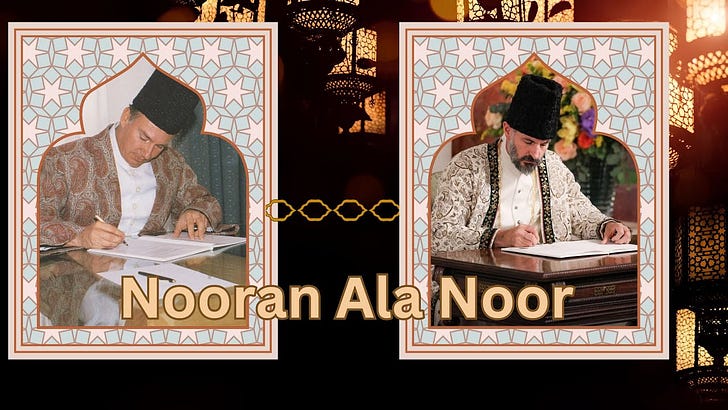
The Noor (Divine Light) of Imamat is an unbroken chain, a sacred trust passed from one Imam to the next, just as a flame transfers seamlessly from one lamp to another—never extinguished, always illuminating. This Noor has shone through the ages, from Mawlana Ali (A.S) to Imam Jafar as-Sadiq (A.S), from Imam al-Mustansir Billah (A.S) to Mawlana Shah Karim al-Husayni (A.S), guiding the Jamat with wisdom, love, and divine grace. As we stand in the sacred moment of transition, the Noor of the 49th Imam, Mawlana Shah Karim al-Husayni (A.S) , continues its eternal journey, transferring to the 50th Imam, Mawlana Shah Rahim Shah (S.A) . Just as the sun sets in one horizon and rises in another, the Imam of the time remains ever-present—guiding, protecting, and blessing the murids with his divine Noor. This transition is not just a change of leadership; it is the continuity of divine guidance. As Imam al-Mustansir Billah (A.S) beautifully expressed: "Our Noor is one and the same, manifesting in different times but always carrying the eternal truth." Let us reaffirm our baiyat (spiritual allegiance) to the Imam of our time, Mawlana Shah Rahim Shah (S.A), with devotion and love, knowing that the Noor of Imamat remains our eternal beacon. 💖 Ya Ali Madad! Mubaraki to the Jamat on this sacred transition! 💖 Source: This is a public episode. If you would like to discuss this with other subscribers or get access to bonus episodes, visit www.ishqekarimi.com
Feb 9
Bismillahir Rahmanir Raheem. Ya Ali Madad, dear listeners! Welcome to today’s special episode, where we explore the eternal Noor of Imamat , its divine continuity, and its significance in our lives. The world we live in is faani —temporary. But if there’s something that is lafaani —eternal—it is the Noor of Allah . This Noor manifests through the institution of Imamat , continuing under the divine principle of Noorun Ala Noor —Light upon Light. Today, we reflect on this divine light that has guided humanity for centuries and continues to illuminate our path through the Haazir Imam of our time. It is natural to feel sorrow when we part from a face we have seen since birth. But, dear listeners, the Imam of the time instructs us not to grieve over this. But Why? Because when an Imam takes his final breath, the Noor of Allah instantly transfers to the next divinely appointed Imam . During his lifetime, the Imam designates his successor through Nass —a divine selection—ensuring that the Noor remains unbroken . However, this Noor stays hidden until the appointed moment —the moment when an Imam’s physical journey ends , but the spiritual leadership continues . This is what happened when our beloved Mawlana Shah Karim Al-Hussaini ( Allaihi Sallam ) took his final breath. At that very instant, the Noor transitioned to our Haazir Imam, Shah Rahim Shah Al-Hussaini ( Salwatulla Allaihi ). So, when the Noor is Haazir (present) and Naazir (watching over us), what is there to grieve? The Noor is always with us. Dear listeners, when we seek guidance from the Quran , we find the beautiful Ayat of Noor : 📖 “Light upon Light! Allah guides to His Light whom He wills.” (Surah An-Nur 24:35) This divine Noor has continued since the beginning of time and manifests through the institution of Imamat . The Imam of the time is the bearer of this Noor —guiding, protecting, and elevating the Murids toward divine truth. Just as Prophet Muhammad ( Salwatulla Allaihi ) was a light from Allah , his progeny has carried this Noor from generation to generation . One lamp lights another , and the Noor of Imamat is transferred from one Imam to the next . This process is called Nass , and it is not a human decision—it is Allah’s choice . In the Holy Quran , Allah says: 📖 “Indeed, Allah chose Adam, and Nuh, and the family of Ibrahim, and the family of 'Imran over the worlds.” (Surah Aal-e-Imran 3:33) 📖 “They were descendants of one another. And Allah is All-Hearing, All-Knowing.” (Surah Aal-e-Imran 3:34) This divine selection continued, and Allah’s Noor manifested in the family of Ibrahim ( Allaihi Sallam ), Imran ( Allaihi Sallam ), and Muhammad ( Salwatulla Allaihi ). The Ahl al-Bayt —the Holy Progeny of the Prophet—are the spiritual heirs of this divine Noor . Through them, the Noor of Allah remains preserved and continues in the form of Imamat . What is our role, as Murids ? Is it enough to simply acknowledge the Imam? No! A true Murid must not only accept the Imam but also attain Maarifat —deep spiritual understanding and recognition of the Imam. The Imam of the time is like a divine rope that connects us to Allah’s Noor . Allah commands in the Quran: 📖 "Hold firmly to the Rope of Allah all together and do not become divided." (Surah Aal-e-Imran 3:103) The Rope of Allah—Hablullah—is Imamat . It ensures that believers remain on the straight path , never straying into darkness and misguidance . From Imam Ali ( Allaihi Sallam ) to Mawlana Shah Karim Al-Hussaini ( Allaihi Sallam ) and now to Haazir Imam Shah Rahim Shah Al-Hussaini ( Salwatulla Allaihi ), this divine Noor remains unbroken . Noor is eternal —it never diminishes but continues its journey through the divinely appointed Imams . Our beloved Mawlana Shah Karim Al-Hussaini ( Allaihi Sallam ) carried this Noor for 67 years , guiding the Ismaili Jamaat with wisdom, love, and tireless service. With Divine Will , this Noor has now transferred to our Haazir Imam, Shah Rahim Shah Al-Hussaini ( Salwatulla Allaihi ), ensuring that the guidance of Allah remains unbroken . The Imamat continues to shine —leading the believers toward truth, knowledge, and enlightenment . Dear listeners, Imamat is the manifestation of Allah’s Noor on Earth . It is an unbroken chain , a lifeline that connects us to divine wisdom . From Imam Ali ( Allaihi Sallam ) to Imam Mustansir Billah ( Allaihi Sallam ), from Shah Karim Al-Hussaini ( Allaihi Sallam ) to Haazir Imam Shah Rahim Shah Al-Hussaini ( Salwatulla Allaihi ), the Noor remains. Those who hold firmly to this Noor will never be led astray . This is the path of divine truth . 📿 May Allah grant us the strength to remain steadfast in His Noor and to always recognize the Imam of our time as the guiding light of our souls. Ameen! Thank you for joining us today on this special episode. If you found this discussion insightful, do share it with your loved ones. Stay connected to the Noor, stay guided, and remember—Noor is always with you. Ya Ali Madad This is a public episode. If you would like to discuss this with other subscribers or get access to bonus episodes, visit www.ishqekarimi.com