About this episode
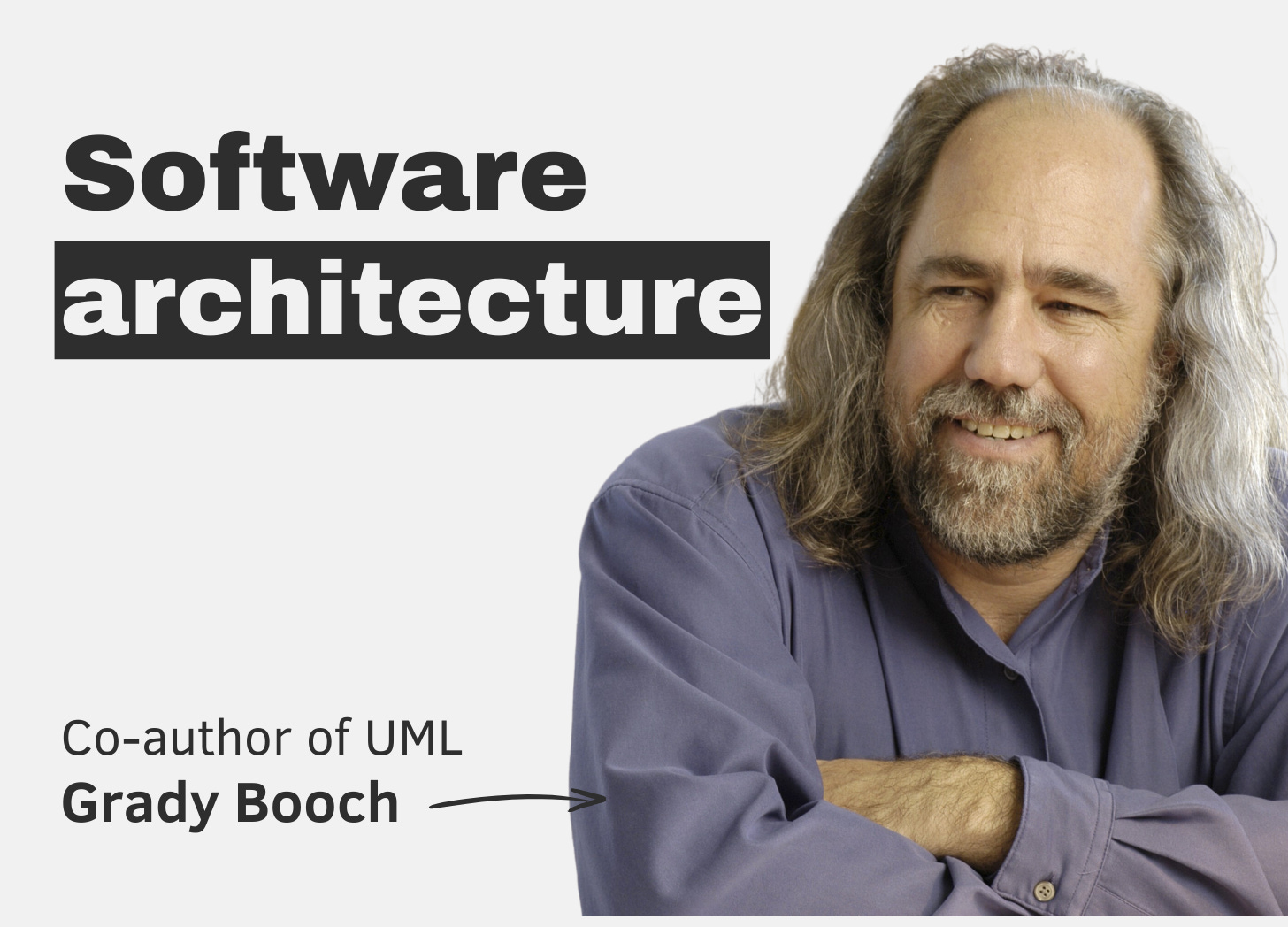
Brought to you by: • WorkOS — The modern identity platform for B2B SaaS. • Sevalla — Deploy anything from preview environments to Docker images. • Chronosphere — The observability platform built for control. — Welcome to The Pragmatic Engineer ! Today, I’m thrilled to be joined by Grady Booch, a true legend in software development. Grady is the Chief Scientist for Software Engineering at IBM , where he leads groundbreaking research in embodied cognition. He’s the mind behind several object-oriented design concepts, a co-author of the Unified Modeling Language, and a founding member of the Agile Alliance and the Hillside Group. Grady has authored six books, hundreds of articles, and holds prestigious titles as an IBM , ACM , and IEEE Fellow , as well as a recipient of the Lovelace Medal (an award for those with outstanding contributions to the advancement of computing). In this episode, we discuss: • What it means to be an IBM Fellow • The evolution of the field of software development • How UML was created, what its goals were, and why Grady disagrees with the direction of later versions of UML • Pivotal moments in software development history • How the software architect role changed over the last 50 years • Why Grady declined to be the Chief Architect of Microsoft – saying no to Bill Gates! • Grady’s take on large language models (LLMs) • Advice to less experienced software engineers • … and much more! — Timestamps (00:00) Intro (01:56) What it means to be a Fellow at IBM (03:27) Grady’s work with legacy systems (09:25) Some examples of domains Grady has contributed to (11:27) The evolution of the field of software development (16:23) An overview of the Booch method (20:00) Software development prior to the Booch method (22:40) Forming Rational Machines with Paul and Mike (25:35) Grady’s work with Bjarne Stroustrup (26:41) ROSE and working with the commercial sector (30:19) How Grady built UML with Ibar Jacobson and James Rumbaugh (36:08) An explanation of UML and why it was a mistake to turn it into a programming language (40:25) The IBM acquisition and why Grady declined Bill Gates’s job offer (43:38) Why UML is no longer used in industry (52:04) Grady’s thoughts on formal methods (53:33) How the software architect role changed over time (1:01:46) Disruptive changes and major leaps in software development (1:07:26) Grady’s early work in AI (1:12:47) Grady’s work with Johnson Space Center (1:16:41) Grady’s thoughts on LLMs (1:19:47) Why Grady thinks we are a long way off from sentient AI (1:25:18) Grady’s advice to less experienced software engineers (1:27:20) What’s next for Grady (1:29:39) Rapid fire round — The Pragmatic Engineer deepdives relevant for this episode: • The Past and Future of Modern Backend Practices https://newsletter.pragmaticengineer.com/p/the-past-and-future-of-backend-practices • What Changed in 50 Years of Computing https://newsletter.pragmaticengineer.com/p/what-changed-in-50-years-of-computing • AI Tooling for Software Engineers: Reality Check https://newsletter.pragmaticengineer.com/p/ai-tooling-2024 — Where to find Grady Booch: • X: https://x.com/grady_booch • LinkedIn: https://www.linkedin.com/in/gradybooch • Website: https://computingthehumanexperience.com Where to find Gergely: • Newsletter: https://www.pragmaticengineer.com/ • YouTube: https://www.youtube.com/c/mrgergelyorosz • LinkedIn: https://www.linkedin.com/in/gergelyorosz/ • X: https://x.com/GergelyOrosz — References and Transcripts: See the transcript and other references from the episode at https://newsletter.pragmaticengineer.com/podcast — Production and marketing by https://penname.co/ . For inquiries about sponsoring the podcast, email podcast@pragmaticengineer.com. Get full access to The Pragmatic Engineer at newsletter.pragmaticengineer.com/subscribe