4d ago
Pragmatic Gita : Chapter 2: Controlling the Mind through Devotion [2.61 to 2.66]
From Struggle to Surrender: Controlling the Mind through Devotion Are you tired of fighting your own thoughts? Do you feel like "discipline" is just another word for "struggle"? In this episode, we explore a refreshing alternative from the Bhagavad Gita: controlling the mind through devotion . It turns out, the easiest way to empty the mind of junk is to fill it with something priceless. In This Episode, You'll Discover: The Trap of Suppression: Why trying to "kill" your desires usually backfires. The Ladder of Fall: The 8-step psychological crash that starts with a single glance. The Power of "Jodna": How to shift your focus from leaving the world to connecting with the Divine. The King Who Conquered: The inspiring story of King Ambarish, who mastered his senses without leaving his palace. The 3-Step Method: A practical tool (Notice, Interrupt, Replace) to practice devotion in the middle of a busy workday. We contrast the tragedy of King Bharata (who lost his spiritual standing due to attachment to a deer) with the triumph of King Ambarish. Ambarish proved that controlling the mind through devotion is not about where you live, but about what you love. Stop fighting the darkness with a stick. Learn how to turn on the light of devotion and find the peace you’ve been looking for. Your servant, krsnadaasa https://pragmaticgita.com
![Pragmatic Gita : Chapter 2: Controlling the Mind through Devotion [2.61 to 2.66]](https://d3t3ozftmdmh3i.cloudfront.net/staging/podcast_uploaded_episode/33933215/33933215-1765765166646-a7073154d8dca.jpg)
Dec 7
Pragmatic Gita : Chapter 2: The Art of Unshakeable Peace [2.55 to 2.60]
Imagine standing in the center of a battlefield. The air is heavy with silence and your heart is pulled in opposite directions by guilt, fear, and duty. This was Arjuna's reality when he asked Krishna the million dollar question "Who is the person of steady wisdom?". In this episode we dive deep into Bhagavad Gita verses 2.55 to 2.60 to uncover the anatomy of the Sthitaprajna . This is the one who remains calm when the world shakes. In This Episode You Will Discover The Deer's Mirage Why chasing happiness in the material world is like a deer running after a mirage in the desert. The Tortoise Technique How to master the art of withdrawing your senses to protect your peace, just like a tortoise withdraws its limbs for safety. The Five Dangerous Traps The ancient analogy of five animals that perish due to sensory attachment and what it means for us humans who battle all five senses at once. The Secret to Fullness How to shift your inner narrative from "I need this to be happy" to "I am already complete". From Suppression to Transformation We often think that controlling desires means suppressing them. However that is like trying to put out a fire by pouring ghee on it. It only makes the flames grow higher. We discuss the two step alchemy taught by Krishna. First is Nivritti or conscious withdrawal which creates space between the impulse and your reaction. Second is replacing that lower desire with a higher purpose and devotion. We also explore the sobering reality that even learned scholars can be swept away by turbulent senses. The senses are churners. They can plunder the mind if we are not vigilant. That is why we end with the ultimate safety net for the modern seeker. In an age of distraction the most powerful anchor is the chanting of the Holy Names. Join us as we explore how to turn the battlefield of life into a field of Dharma. Web version can be found here: Chapter 2: Sthitaprajna: Krishna’s Path to Spiritual Evolution [2.55 to 2.60] - Pragmatic Bhagavad Gita Sthitaprajna Lakshanani, Symptoms of a Stithaprajna, Stithaprajna a person with steady wisdom, Transcendental consciousness, Inner contentment, Sense withdrawal techniques, Stithaprajna meaning, Controlling turbulent senses, Tortoise analogy, Sthitaprajna characteristics, Bhagavad Gita Chapter 2, Spiritual wisdom, Sense control, Mind control techniques, Krishna Arjuna dialogue, Sthitaprajna in daily life krsnadaasa
![Pragmatic Gita : Chapter 2: The Art of Unshakeable Peace [2.55 to 2.60]](https://d3t3ozftmdmh3i.cloudfront.net/staging/podcast_uploaded_episode/33933215/33933215-1765132879882-0a83b98f32173.jpg)
Nov 3
Pragmatic Gita : Chapter 2: Transcending Delusion [2.51 to 2.54]
Join us on a transformative journey through the Bhagavad Gita as we explore the profound wisdom of transcending delusion . In this enlightening podcast, we delve into the teachings of Lord Krishna, who guides Arjuna on the path to spiritual liberation by overcoming the confusion and attachments that bind us to material existence. Discover the key to attaining a steadfast intellect, known as Stithaprajnya , and learn how to navigate the dense forest of delusion, or Moha Kalilam . Krishna’s teachings in verses 2.51-2.54 illuminate the path of Buddhi Yoga , emphasizing detachment from the fruits of our actions as a way to rise above desires and achieve clarity. By aligning with Krishna’s divine wisdom, we can cultivate equanimity (samatvam) and steady our intellect to transcend life's distractions. Through the insights of renowned spiritual masters like Swami Vivekananda and Adi Shankaracharya, we explore the importance of transcending delusion in the pursuit of spiritual growth. Practical guidance is offered on how to perform duties without attachment, cultivate clarity, and develop unwavering wisdom. This episode also addresses Arjuna's poignant question about recognizing a Stithaprajnya , one who has transcended delusion and achieved a steady state of wisdom. Krishna explains that true spiritual attainment resides within and cannot be judged by external appearances. Drawing inspiration from examples like Ramana Maharshi, we highlight how inner transformation is the essence of spiritual growth. Join us on this illuminating journey as we unravel the transformative power of Krishna’s timeless teachings. Discover how to break free from the cycles of confusion and attachment and embark on the path to spiritual liberation . With Krishna as your guide, learn how to achieve inner peace and steadfast wisdom through the practices of Karma Yoga , detachment, and surrender. Tune in now and take the first step toward overcoming the illusions that bind you , as we unlock the secrets to attaining clarity, equanimity, and liberation through the profound teachings of the Bhagavad Gita. krsnadaasa (Servant of Krishna) Full transcript can be found here: Chapter 2: Transcending Delusion: Sankhya Yoga: Shlokas 51 to 54 - Pragmatic Bhagavad Gita
![Pragmatic Gita : Chapter 2: Transcending Delusion [2.51 to 2.54]](https://d3t3ozftmdmh3i.cloudfront.net/staging/podcast_uploaded_episode/33933215/33933215-1762134353420-2c70d47778674.jpg)
Oct 26
Pragmatic Gita: Chapter 2: The Art of Kaushalam [2.48 to 2.50]
Do you ever feel like you're just spinning your wheels? You’re working hard, trying to do the right thing, but you still end up feeling stressed, anxious, and bound by the results of your actions. What if there was a way to act with perfect excellence that actually liberated you instead of binding you further? In the Bhagavad Gita, Shri Krishna reveals this profound secret to Arjuna on the battlefield. He calls it Kaushalam, a divine skillfulness that transforms work into worship. This isn't just about being good at your job; it's about mastering the art of Kaushalam in every part of your life. In This Episode, You'll Discover: The true meaning of yogaḥ karmasu kauśalam (Gita 2.50) and how it redefines "yoga" for the modern world. How Samatvam (equanimity) is the essential first step. We'll explore what it really means to be "equal in success and failure" without becoming a robot. Why Shri Krishna calls people who chase results "miserly" and how to escape this poverty-consciousness. The "two hands" of the spiritual archer. We'll use the beautiful analogy from the text to understand how Buddhi Yoga (the hand of skill) and Surrender (the hand of release) must work together. The revolutionary idea that a skillful person transcends both good and bad karma. Practical ways to start practicing the art of Kaushalam today, whether you're in a boardroom or washing dishes. This conversation dives deep into the heart of Karma Yoga. We'll connect the dots between verse 2.48's call for equanimity, verse 2.49's refuge in Buddhi (intelligence), and verse 2.50's ultimate promise of Kaushalam. This is the path from being a "reactor" to life to becoming a conscious, skillful creator of your own experience. Join me as we learn how to stop being victims of our actions and start becoming masters of this divine, liberating skill. krsnadaasa (Servant of Krishna) https://pragmaticgita.com
![Pragmatic Gita: Chapter 2: The Art of Kaushalam [2.48 to 2.50]](https://d3t3ozftmdmh3i.cloudfront.net/staging/podcast_uploaded_episode/33933215/33933215-1761520429813-a2594041d41a7.jpg)
Oct 14
Pragmatic Gita: Chapter 2: The Gift of Action [2.45 to 2.47]
Have you ever done something for someone, expecting a 'thank you,' and felt a sting of resentment when you didn't get it? Does the pressure to succeed at work make you tense and irritable with the people you love? The root of this suffering is a simple, hidden transaction: we believe our actions are only valuable if they produce the results we want. In this episode, we unlock a secret from the Bhagavad Gita (verses 2.45-2.47) that can heal this exact problem. It's the life-altering philosophy of The Gift of Action . This isn't about becoming passive or passionless; it's about discovering a way to act with immense power and love, completely free from the anxiety of expectation. In This Episode, You'll Discover: The true meaning of "Karmanyevadhikaraste" and how it can liberate you from the anxiety of expectation. How to stop "keeping score" in your actions and relationships, leading to deeper, more authentic connections. The profound psychological shift from seeing your work as a transaction to seeing it as a sacred offering. The surprising way that selfless service quiets your inner critic and builds unshakeable self-worth. Practical steps to start practicing The Gift of Action in your family and workplace today, inspired by the selfless work seen in nature, like a hummingbird that sings for the joy of singing, not for an audience. Imagine a life where every action you took was a gift, given freely, without a price tag. How would that change your relationship with your work, with your loved ones, and with yourself? Join me to explore how this timeless wisdom can bring profound peace and purpose to your modern life. krsnadaasa (Servant of Krishna) https://pragmaticgita.com
![Pragmatic Gita: Chapter 2: The Gift of Action [2.45 to 2.47]](https://d3t3ozftmdmh3i.cloudfront.net/staging/podcast_uploaded_episode/33933215/33933215-1760421463448-60c0c19d412fb.jpg)
Oct 5
Pragmatic Gita: Chapter 2: Buddhi Yoga The Yoga of Wisdom and Discrimination[2.39 to 2.44]
Does it ever feel like your mind is being pulled in a hundred different directions at once? It can leave you feeling totally drained and without any real direction. Have you ever done all the "right" things to be successful, only to feel like real happiness is still just out of reach? In the middle of all our modern chaos, the ancient wisdom of the Bhagavad Gita gives us a powerful anchor. Shri Krishna shows us a path that isn't about running away from the world. It's about mastering how we live in it by using the power of an awakened intellect. In This Episode, You’ll Discover: The huge difference between just knowing something and truly living it, and why getting this is the first real step to freedom. The secret of the "one-pointed mind," and how you can focus your energy like a laser to burn through your problems instead of just burning out. Shri Krishna's incredible promise that no sincere spiritual effort you make is ever wasted, and how even five minutes of practice can create a permanent positive change in your life. How to spot and steer clear of the subtle trap of "spiritual materialism," which is when the ego sneakily uses spiritual practices for its own selfish gain. The timeless story of Nachiketa, a young boy who stood up to the Lord of Death and turned down every worldly temptation just to find the ultimate truth. He's the perfect example of what a resolute mind looks like. Shri Krishna's talk with Arjuna isn't just some old story; it's a personal guide for every one of us facing our own daily battles. He uses a beautiful metaphor of a chariot to explain what's going on inside us. Our body is the chariot, our senses are wild horses, the mind is holding the reins, but our intellect is the charioteer. If that charioteer is awake, focused, and knows where it's going, the journey is smooth and has a purpose. But if the charioteer is asleep or distracted by every shiny object on the side of the road, the horses will run wild and crash. This episode is all about how you can wake up your inner charioteer. Are you ready to stop chasing things that don't last and start building a life of real peace and purpose? What's one distraction you could let go of today to take that first step? krsnadaasa (Servant of Krishna) https://pragmaticgita.com
![Pragmatic Gita: Chapter 2: Buddhi Yoga The Yoga of Wisdom and Discrimination[2.39 to 2.44]](https://d3t3ozftmdmh3i.cloudfront.net/staging/podcast_uploaded_episode/33933215/33933215-1759696128262-bb8eeb8a71c87.jpg)
Sep 22
Pragmatic Gita: Chapter 2: Formula for Sinless Action [2.38]
The Hidden Code That Transforms Sin Into Liberation What if I told you that the difference between sinful and virtuous action has nothing to do with the action itself? Mind-blowing, right? Today, we're cracking open one of spirituality's most practical secrets – the formula for sinless action hidden in Bhagavad Gita verse 2.38. In This Episode, You'll Discover: • The exact mental formula that prevents actions from creating negative karma • Why the same action can either bind you or free you (with real examples) • The three pairs of opposites you must master for sinless action • How emotional attachment creates sin, not the action itself • Practical techniques to purify any action before you take it • The difference between avoiding action and transforming action Let me paint you a picture: Arjuna, legendary warrior, stands paralyzed on the battlefield. His fear? Not death, but sin. "How can I fight my own family? Surely this action will damn me!" Sound familiar? Maybe you've felt this way about a difficult decision – damned if you do, damned if you don't. Krishna's response flips everything on its head. He reveals that what makes action sinful according to Gita isn't the action itself but the mental state behind it. As verse 2.38 states: "Fight for the sake of duty, treating alike pleasure and pain, gain and loss, victory and defeat. Fulfilling your responsibility in this way, you will never incur sin." Here's the game-changer: Sin comes from acting with a disturbed, attached mind. When you chase pleasure or flee pain, when you grasp for gain or fear loss, when you crave victory or dread defeat – that's when actions create bondage. But perform the exact same action with a balanced mind? It becomes dharmic action, creating no karmic residue. I love how the text uses the metaphor of an actor. A skilled actor plays both hero and villain with full commitment, yet never confuses themselves with the role. Similarly, we can engage fully in life's drama while maintaining inner freedom. This is the essence of action without karma. The practical magic happens when you apply this before any major decision. Instead of agonizing over outcomes, you consciously balance your mind first. You ask: "Am I acting from desire or duty? From disturbance or stability?" This simple shift transforms potentially binding actions into liberating ones. Modern psychology confirms what yogis knew millennia ago – that the space between stimulus and response contains our freedom. The formula for sinless action teaches us to expand that space, to choose our response from wisdom rather than reactivity. Here's my challenge for you: Before your next difficult action, pause. Balance your mind regarding the possible outcomes. Then act from that place of equilibrium. Watch how the quality of your action transforms. Remember, you don't need to fear action when you understand this formula. Every moment becomes an opportunity to practice sinless action, to engage fully while remaining free. krsnadaasa (Servant of Krishna) https://pragmaticgita.com
![Pragmatic Gita: Chapter 2: Formula for Sinless Action [2.38]](https://d3t3ozftmdmh3i.cloudfront.net/staging/podcast_uploaded_episode/33933215/33933215-1758517286726-4fd1fd58680d8.jpg)
Sep 15
Pragmatic Gita: Chapter 2: Life Transforming Lessons on Dharma and Karma[2.31 to 2.37]
What if I told you that every choice you make is either binding you or freeing you? Today we dive deep into the profound relationship between dharma and karma—two forces that shape every moment of our existence according to the Bhagavad Gita's timeless wisdom. In This Episode, You'll Discover: Why dharma and karma are inseparable aspects of one cosmic law How understanding dharma and karma transforms daily challenges into spiritual opportunities The three types of karma and how they interact with your dharma Real-life examples showing how dharma and karma work together in modern contexts Why Krishna says abandoning dharma creates the worst kind of karma Practical ways to align with dharma and karma for spiritual liberation Picture this: Arjuna, the greatest warrior of his age, trembles on the battlefield, paralyzed by the thought of fighting his own family. Haven't we all been there—knowing what's right but feeling unable to act? Krishna's response cuts straight to the heart of dharma and karma: "Looking at your own duty, you should not waver." Through powerful stories, we explore how dharma and karma operate in everyday life. You'll hear about two warriors, Arjuna and Karna, who faced similar hardships but made different choices. Their parallel journeys reveal how dharma and karma work together: while circumstances (prarabdha karma) may be similar, our choices (kriyamana karma) to follow or abandon dharma create entirely different destinies. We'll unpack the beautiful story of the wall—where a young boy's simple act of writing becomes either vandalism or virtue depending on alignment with dharma. This tale perfectly illustrates how dharma and karma are not about the action itself but about the consciousness behind it. When we align with divine will, even difficult actions create liberating karma. The episode explores how dharma and karma resolve the modern struggle between worldly success and spiritual growth. You'll understand why a mother's selfless service, a doctor's compassionate healing, or an entrepreneur's ethical business all become yoga when performed as dharma. The secret? Understanding that dharma and karma don't pull in opposite directions, but rather they're partners in our evolution. Perhaps most powerfully, we examine what happens when we abandon our dharma. It's not about divine punishment but natural law, just as a musician who refuses to play their part disrupts the entire orchestra, abandoning our dharma creates ripples of negative karma that bind us to suffering. Yet Krishna also reveals the hope: through understanding dharma and karma, we can transform even the heaviest karmic burdens. This isn't just philosophy, it's practical wisdom for today. Whether you're facing ethical dilemmas at work, family conflicts, or personal crises, the principles of dharma and karma light the way forward. Your battlefield may not be Kurukshetra, but your choices matter just as much. Remember: dharma and karma are calling you to rise. Not tomorrow, not when you feel ready, but right now in whatever situation life has presented. Your dharma is your unique way of serving the cosmic harmony. Your karma is the power you have to shape your destiny through conscious choice. The question isn't whether you'll face difficult choices, because you will. The question is whether you'll understand how dharma and karma work together to transform those choices into stepping stones toward liberation. May the wisdom of dharma and karma guide you to live with courage, purpose, and unwavering commitment to truth. krsnadaasa (Servant of Krishna) https://pragmaticgita.com Notes for complete episode can be found here: https://pragmaticgita.com/karma-and-dharma-shlokas-31-to-37/
![Pragmatic Gita: Chapter 2: Life Transforming Lessons on Dharma and Karma[2.31 to 2.37]](https://d3t3ozftmdmh3i.cloudfront.net/staging/podcast_uploaded_episode/33933215/33933215-1757896908826-2b59eec1bc59f.jpg)
Sep 1
Pragmatic Gita: Chapter 2: The Unmanifested, Unthinkable, Unchangeable Eternal Soul [2.25 to 2.30]
Facing Death with Wisdom Why do we fear death so intensely? Why does the loss of loved ones bring such unbearable grief? In this episode of the Pragmatic Gita Podcast , we journey through verses 2.25–2.30 of the Bhagavad Gita, where Krishna teaches Arjuna about the Unmanifested, Unthinkable, Unchangeable Eternal Soul . Why Krishna calls the soul avyaktaha (unmanifested), achintyaha (unthinkable), and avikaryaha (unchangeable). How the cycle of birth and death never touches the Unmanifested, Unthinkable, Unchangeable Eternal Soul . The meaning of sarva-gata —the soul as all-pervading, existing everywhere and always. The wonder of the soul: why some see it as a marvel, some hear of it but never understand it. How samskaras (mental impressions) silently shape karma and destiny. The simple but profound way to transform samskaras through bhakti yoga. Krishna explains that the soul is beyond perception, beyond the grasp of senses and intellect. The Unmanifested, Unthinkable, Unchangeable Eternal Soul is invisible to material eyes and inconceivable to thought, yet it is the truest reality within us. Just as a map can never capture the richness of a city, our concepts can never capture the full essence of the soul. Even when we cling to the belief that the soul is born and dies, Krishna’s wisdom still applies: death is certain for the born, and birth is certain for the dead. Life moves in cycles, but the Unmanifested, Unthinkable, Unchangeable Eternal Soul remains untouched, indestructible, and eternal. To bring this teaching alive, we recall Yudhishthira’s dialogue with Yama in the Mahabharata. When asked what is most surprising in this world, Yudhishthira replies: every day beings die, yet the living believe they are immortal. This paradox shows why Krishna urges Arjuna—and us—not to grieve over what is inevitable, but to focus on realizing the eternal. The Gita also links this wisdom to samskaras. Our impressions form habits, and habits create karma. Negative samskaras bind us in suffering, but Krishna gives hope: through devotion, even the most sinful person can transform and awaken to the Unmanifested, Unthinkable, Unchangeable Eternal Soul . Closing Thought: Death cannot destroy us. The Unmanifested, Unthinkable, Unchangeable Eternal Soul is indestructible, timeless, and beyond sorrow. By cultivating devotion and refining samskaras, we align with our eternal essence and step closer to liberation. krsnadaasa (Servant of Krishna) https://pragmaticgita.com
![Pragmatic Gita: Chapter 2: The Unmanifested, Unthinkable, Unchangeable Eternal Soul [2.25 to 2.30]](https://d3t3ozftmdmh3i.cloudfront.net/staging/podcast_uploaded_episode/33933215/33933215-1756750930192-4d028210ea0a7.jpg)
Sep 1
Pragmatic Gita: Understanding Radhashtami: Radha's Supreme Love & Its Meaning for You
You can view the complete story transcript here: https://pragmaticgita.com/radhashtami-radhas-appearance/ What is the true significance of Radhashtami? This episode is a deep dive into the essence of Radha's appearance and her supreme position in the philosophy of Bhakti. We explore the core principles of Vaishnavism and how Radha's selfless love for Krishna serves as the ultimate example for all devotees. If you're interested in the Bhagavad Gita's teachings on devotion, this episode will provide a new and profound perspective. We discuss: The story of Radha's appearance and her first meeting with Krishna. Why Radha's love is considered the highest form of Bhakti. The concept of 'Viraha Bhava' (love in separation) and its spiritual power. How to connect with Radha's divine energy in your own spiritual practice. Whether you're new to the path of Bhakti or a long-time practitioner, this episode will deepen your understanding and appreciation of Radha, Krishna, and the power of divine love. Keywords: Radhashtami, Radha, Krishna, Bhakti Yoga, Vaishnavism, Bhagavad Gita, Hindu Spirituality, Devotion, Nishkama Bhakti, Viraha Bhava, Paramatma, Jivatma. krsnadaasa (Servant of Krishna)

Aug 25
Pragmatic Gita: Chapter 2: Ayam Sanatanaha - The Causeless Eternal Soul [2.19 to 2.24]
Complete text can be found here: https://pragmaticgita.com/ayam-sanatanaha-the-causeless-eternal-soul/ Ayam Sanatanaha. What does this ancient phrase from the Bhagavad Gita mean? It holds a secret to overcoming our deepest fears and answering life's most profound question: "Who am I?" It is a declaration that your true self is eternal, primordial, and has no cause. In This Episode, You'll Discover: The deep meaning of the Sanskrit phrase Ayam Sanatanaha - the causeless, eternal soul . Why the Gita describes the soul (Atman) as unborn, and how this establishes its eternal nature. A clear explanation of why the soul is considered indestructible, beyond the reach of any physical harm. How this single realization can dismantle the five core afflictions (kleshas) that cause all human suffering, especially the fear of death. An introduction to the yogic paths that serve as a practical roadmap for experiencing this truth directly. The timeless analogy of the soul changing bodies like we change clothes, reframing our perspective on life and death. In this discussion, we journey to the very heart of Sanatana Dharma teachings to uncover a truth that liberates. We often live our lives identified with our temporary roles, our bodies, and our minds. We feel the sting of every loss and fear every ending. But the wisdom of "Ayam Sanatanaha" invites us to identify with something infinitely more vast and stable. It tells us that the soul transcends the body and mind . This is not just philosophy; it is a blueprint for a fearless existence. Join us as we explore how to shift our identity from the fleeting to the eternal, and in doing so, find the unshakable peace that is our very nature. krsnadaasa (Servant of Krishna) https://pragmaticgita.com
![Pragmatic Gita: Chapter 2: Ayam Sanatanaha - The Causeless Eternal Soul [2.19 to 2.24]](https://d3t3ozftmdmh3i.cloudfront.net/staging/podcast_uploaded_episode/33933215/33933215-1756087487078-58f7b0deffdeb.jpg)
Aug 18
Pragmatic Gita: Titiksha - Guided Meditation for Inner Calmness - Samatvam
Guided Meditation: Developing Inner Stillness and Calmness Approx. Time: 13 minutes The complete episode explaining all the relevant shlokas [2.14 to 2.18] can be found here: https://pragmaticgita.com/art-of-equanimity/ Part 1: The Invitation to Stillness & So Hum Breath Begin by finding a relaxed, upright posture—on a chair or the floor, avoiding soft surfaces. Rest your hands on your lap and gently close your eyes.Take a moment to settle into presence—this body, this breath, this moment. Let the world outside pause.Bring awareness to your breath.As you inhale, silently say “So…”—feel the air move from nostrils to belly.As you exhale, say “Hum…”—feel the breath release from belly to nostrils.Let go of tension with each breath.So… Hum… So… Hum… Part 2: The Nature of Experience Let your breath flow naturally.Now reflect on a secret from Shri Krishna in the Gita: "mātrā-sparśās tu kaunteya śītoṣṇa-sukha-duḥkha-dāḥ āgamāpāyino 'nityās tāṁs titikṣasva bhārata" All experiences—pleasure and pain—arise from contact between senses and objects. They come and go. They are impermanent.Recall the warmth of the sun… now let it go.Recall the chill of a breeze… now let it go.Recall harsh words… let go of discomfort.Recall praise… let go of pleasure.Each sensation arises and fades.We suffer when we cling to joy or resist pain.Now, imagine yourself as a strong tree.Your deep roots symbolize your true Self.On a sunny day, warmth spreads—success, praise. Feel it, but don’t cling.Then the sky darkens—blame, failure. Feel it, but don’t resist.As the tree, you endure both sun and storm.This is titiksha—graceful endurance, wise acceptance. Part 3: Resting in the Eternal Self Now shift perspective. You are not just the tree.You are also the earth that holds it.You are the sky that holds both sun and storm.Return to So Hum breathing.So… Hum… So… Hum…Affirm: “I am That.”That which is aware. That which is unchanging.This awareness is Sat—eternal, real, untouched by change. Part 4: Returning with Equanimity Let your breath return to its natural rhythm.Feel the calmness within you—independent of circumstances.This is the art of equanimity.To remain steady in joy and sorrow is the path to liberation.Carry this inner peace with you.Remember the wisdom of the tree and the vastness of the sky.When ready, gently open your eyes. krsnadaasa (Servant of Krishna)
Aug 18
Pragmatic Gita: Chapter 2: Art of Equanimity [2.14 to 2.18]
Life often feels like an unpredictable ocean, tossing us between the high waves of success and the deep troughs of failure. This endless cycle of pleasure and pain can leave us feeling drained and searching for solid ground. But what if you could find an unshakeable anchor right in the middle of that storm? In this episode, we journey into the heart of the Bhagavad Gita to uncover a timeless secret: the art of equanimity. Guided by the profound words of Shri Krishna on the battlefield, which is a powerful metaphor for our own internal struggles. We explore a spiritual technology for mastering our mind and discovering a peace that cannot be disturbed. We’ll explore one of the most practical lessons from the Gita, where Shri Krishna reveals a surprising truth: our suffering doesn’t come from the world itself, but from the fleeting feelings of happiness and distress created by our senses. He explains that these experiences all share three qualities: they appear, they disappear, and they are temporary. This episode unpacks why trying to cling to pleasure and run from pain is a futile chase that only creates more suffering, and we’ll discuss Krishna’s powerful solution: learning to gracefully endure them both. This is a practical guide for a resilient life. We’ll talk about the crucial difference between the eternal Self and the temporary body, learning that our true nature is an indestructible anchor in a changing world. You will learn how to be like a mighty oak tree in a storm, swaying with the fierce winds of life while remaining deeply and immovably rooted. We’ll also touch on the " Eight Worldly Winds " described by Lord Buddha (praise and blame, success and failure, pleasure and pain), and see how a balanced mind is our ultimate shield. In a world that constantly pulls for our attention, the ability to remain centered is not a luxury, but a necessity. Shri Krishna teaches that a person who remains steady through happiness and distress is the one who becomes truly free. This episode is your first step on a journey toward inner wisdom, helping you accept what you cannot change and find the courage to act with purpose. krsnadaasa (Servant of Krishna) https://pragmaticgita.com
![Pragmatic Gita: Chapter 2: Art of Equanimity [2.14 to 2.18]](https://d3t3ozftmdmh3i.cloudfront.net/staging/podcast_uploaded_episode/33933215/33933215-1755475932421-f93ebfdbb9037.jpg)
Aug 16
Pragmatic Gita: Journey Home - Neti Meditation to discover 'Who Am I'
Welcome. There is a question that has haunted humanity since we first gazed at our own reflection... a question that lives in your heart right now… Who am I? Today, we walk an ancient path together to find the answer. It is a path of sacred discovery, where we find the diamond of our true self by gently letting go of everything we are not. When you're ready, softly close your eyes, feeling yourself opening up to the quiet infinity within. Let's now attune ourselves to the cosmic frequency through the rhythm of So Hum breathing . Breathing in slowly, please say in your mind ‘So’ … feeling the air gradually flowing from your nostril to your heart and finally resting in your belly. Feel the air as you breathe. Now, breathe out gently, and say in your mind ‘Hum’ … feeling the air flowing back from your belly through your chest and throat and out your nostrils. Repeat . Here is the first truth for us to realize. If I can watch the breath, then I cannot be the breath. The observer cannot be the same as whatever they are observing. Let this truth sink deep into mind… I am not this breath. Now, let's focus on our thoughts. See how they arise from nowhere, and disappear. Now, you are observing your thoughts, so you cannot be your thoughts. Tell yourself “ I am not my thoughts. I am the witness of my thoughts”. Now, focus on your emotions. Remember any sad moment from your life. Then remember any joyful moment from your life. Just observe the emotions. Don’t engage with them. See how quickly they are able to appear and disappear. Now, you are observing your emotions, so you cannot be your emotions. Tell yourself… I am experiencing emotions but I am not my emotions. Now we come to the most intimate illusion, this body you've so strongly identified with. Bring your awareness to your hands, these have helped you perform innumerable activities. If they are your hands, who is the you that they belong to? If these hands were lost, wouldn’t you still be you? Tell yourself. These hands serve me, so I am not my hands. Think of your legs in the same way. Your legs have carried you to countless places. If you lost your legs, you would still be you. Tell yourself… My legs carry me, but I am not my legs . I will still be Me even without my legs . Now focus on your senses. You will realize how you always say “My eyes, My nose, My tongue, My ears….” So, your senses belong to you so you cannot be your senses. Tell yourself… My senses help me perceive the material world, but I am not my senses. Feel your heart, sustainer of life. This heart has been your faithful companion, yet you know hearts can be transplanted. Another person’s heart can beat inside your chest and still, You will remain You. Tell yourself… My heart beats for me, but I am not my heart. And now, the brain, the final frontier. This magnificent biocomputer processes data for you. It thinks for you. It asks questions and finds answers for you. But people have survived with half their brain removed, still referring to themselves as 'I'. Not as ‘half I’. There are people whose brains have totally stopped functioning and doctors say that the person is ‘brain dead’. But the person is still there. So we are not our brains either. Tell yourself… I am not even my brain. " Now tell yourself .. “I am not my breath, I am not my thoughts, I am not my emotions, I am not my body parts, I am not even my brain…” SO, If I am none of these… WHO…AM…I !? Say this affirmation in your mind… “ I am the pure consciousness, I am the silent witness, I am eternal, pure, and free. ” From this place, slowly allow your awareness to flow back through the body, like sunlight streaming through a window. Take a deep breath. When you're ready, slowly open your eyes. Remember what you touched upon here. You are not a human having a spiritual experience. You are Spirit having a human experience . Tat Tvam Asi. That Thou Art. The meditation is complete. The living practice now begins. krsnadaasa (Servant of Krishna)

Aug 11
Pragmatic Gita: Chapter 2: Eternal Nature Of The Soul [2.10 to 2.13]
Have you ever felt completely stuck, trapped in a mental maze of overthinking? This state, where endless analysis leads to no action, has a modern name: " analysis paralysis ." Yet, this is an ancient human predicament. On the grand battlefield of Kurukshetra, the mighty warrior Arjuna found himself in this exact state, overwhelmed by grief, doubt, and fear, incapable of action. But his crisis became the stage for one of history's most profound teachings, delivered by Sri Krishna. In this episode, we journey to the heart of this sacred moment. We witness Sri Krishna, with a serene and gentle smile, begin to dismantle Arjuna's confusion. He starts not with a command to fight, but with a revolutionary truth designed to reframe reality itself: the eternal nature of the soul. We will explore Krishna's opening teachings from verses 2.11 to 2.13 of the Bhagavad Gita , which declare that the wise grieve for neither the living nor the dead because the essence of who we are can never cease to be. We'll dissect this timeless wisdom through multiple lenses: Buddha's Concept of Papanca: Discover the ancient Buddhist term for the mind's tendency to create suffering through endless mental chatter, illustrated by the powerful parable of the poisoned arrow. The Science of Consciousness: Explore how modern science, as highlighted by Dr. Deepak Chopra, inadvertently supports these ancient truths. Learn how your body’s cells are in constant renewal, yet your sense of self remains, pointing to a consciousness that is unchanging. The Soul's Journey: Understand Krishna's logical explanation that just as we pass from childhood to youth to old age in one body, the soul similarly passes to another body at death. This isn't just a philosophical discussion; it's a practical guide to overcoming the most fundamental human fears. In an age of information overload and existential anxiety, these teachings offer a stable foundation. By understanding the eternal nature of the soul, you can learn to navigate life's "battlefields" with the same calm composure as Krishna. This episode provides the tools to move from confusion to clarity, from fear to fearlessness, and from paralysis to purposeful action. Join us as we uncover the secret to transforming your perspective on life, death, and your own immortal identity. krsnadaasa (Servant of Krishna)
![Pragmatic Gita: Chapter 2: Eternal Nature Of The Soul [2.10 to 2.13]](https://d3t3ozftmdmh3i.cloudfront.net/staging/podcast_uploaded_episode/33933215/33933215-1754887801739-97b571d3a7de8.jpg)
Aug 5
Pragmatic Gita: Guided Meditation - Seeking Divine Guidance Through Surrender
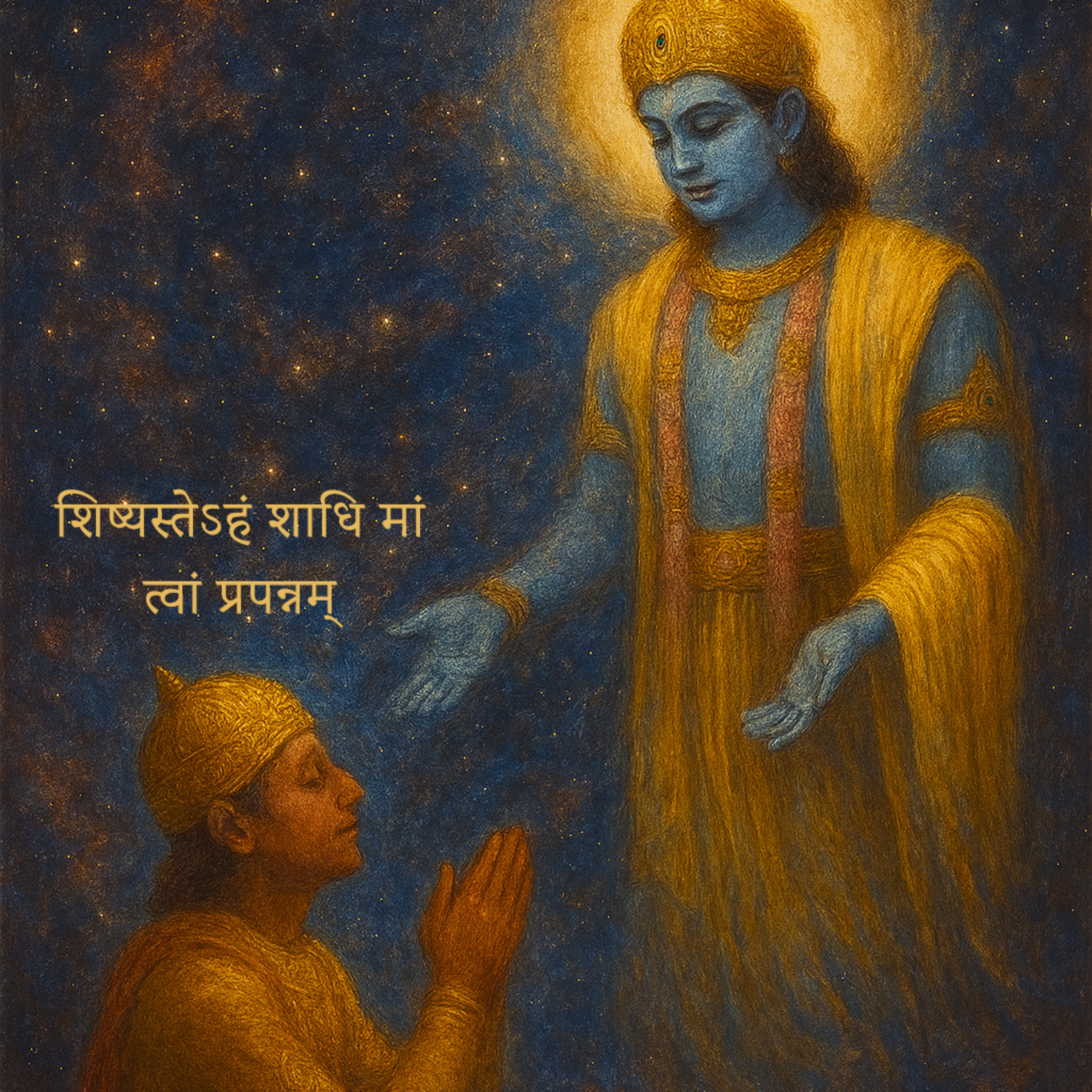
Following the example of Arjuna, this is a guided meditation to seek divine guidance to find solutions to some of the biggest challenges we are facing in our lives. If followed with faith and humility, seekers will certainly receive inner guidance leading to successful resolution of their life challenges.Based specifically on Bhagavad Gita, 2.7:कार्पण्यदोषोपहतस्वभाव:पृच्छामि त्वां धर्मसम्मूढचेता: |यच्छ्रेय: स्यान्निश्चितं ब्रूहि तन्मेशिष्यस्तेऽहं शाधि मां त्वां प्रपन्नम् || 7||kārpaṇya-doṣhopahata-svabhāvaḥpṛichchhāmi tvāṁ dharma-sammūḍha-chetāḥyach-chhreyaḥ syānniśhchitaṁ brūhi tanmeśhiṣhyaste ’haṁ śhādhi māṁ tvāṁ prapannamI am confused about my duty, and am besieged with anxiety and faintheartedness. I am Your disciple, and am surrendered to You. Please instruct me for certain what is best for me.krsnadaasa https://pragmaticgita.com
Aug 4
Pragmatic Gita: Chapter 2: Arjuna's Surrender [2.4 to 2.9]
Have you ever faced a decision so overwhelming that it left you completely paralyzed? A moment where all your knowledge and experience only seemed to add to your confusion, leaving you lost and in despair? In this episode, we delve into one of the most pivotal moments in spiritual literature: the profound despair and ultimate surrender of the mighty warrior Arjuna on the battlefield of Kurukshetra. Drawing from an in-depth analysis of the Bhagavad Gita, specifically verses 2.4 to 2.9, we witness a hero at his breaking point. Arjuna, faced with the heart-wrenching duty of fighting his own beloved teachers and relatives, is overcome by grief. He questions the very purpose of victory, seeing only blood-stained pleasures in its aftermath. This state of inner turmoil, which the text describes as a modern-day 'analysis paralysis,' shatters his resolve. He famously tells Lord Krishna, "Govinda, I shall not fight," and falls silent. This episode explores the critical lessons embedded in this divine exchange. We unpack the profound distinction between knowledge and intelligence. Arjuna possessed vast scriptural knowledge, yet his emotional turmoil rendered it useless, highlighting how intelligence, the ability to apply knowledge wisely, is a higher faculty. We discuss the subtle but powerful influence of our obligations and even the food we eat on our conscience, referencing the poignant story of Bhishma on his deathbed. The core of our discussion centers on the transformative power of Arjuna's Surrender . We examine the crucial turning point where the warrior’s pride dissolves, and the humble student is born. Arjuna’s declaration, kārpanya-doshopahata-svabhāvaḥ ("my nature is afflicted by the fault of weakness"), followed by the sacred commitment śiṣyaḥ te aham ("I am your disciple... I have surrendered to you"), is a masterclass in humility. This act of setting aside the ego is what finally opens the door to divine wisdom. We explore why this step is essential for any true learning and transformation to begin, reflecting on the importance of a guru in life . Join us as we uncover how Arjuna's confusion and despair became the fertile ground for the most profound spiritual teachings ever imparted to humanity. This isn't just an ancient story; it's a timeless guide for anyone navigating their own battlefield of life. krsnadaasa (Servant of Krishna)
![Pragmatic Gita: Chapter 2: Arjuna's Surrender [2.4 to 2.9]](https://d3t3ozftmdmh3i.cloudfront.net/staging/podcast_uploaded_episode/33933215/33933215-1754270218911-6b17aa93cea2d.jpg)
Jul 27
Pragmatic Gita: Chapter 2: Inner Saboteur [2.1 to 2.3]
Discover Your Inner Saboteur Through Ancient Wisdom In this groundbreaking episode, we explore how the Bhagavad Gita's second chapter reveals the inner saboteur , that destructive voice within us all that whispers "You're not good enough," "Why even try?" and "You'll fail like always." Through the dramatic confrontation between Arjuna and Krishna on the battlefield of Kurukshetra, we uncover timeless techniques for recognizing and defeating this internal enemy. What happens when the greatest warrior of his age collapses in tears, paralyzed by his own mind? Krishna's response isn't sympathy, but it's what modern psychology calls a " pattern interrupt ." You'll discover why Krishna declares "This weakness doesn't suit you!" and how this apparent harshness is actually the deepest compassion. Learn how the inner saboteur operates like a skilled thief, losing its power the moment we catch it in action with our awareness. This episode introduces "Pragma 1: Recognize the saboteur within you. Don't give in to it. Confront it and vanquish it." We decode Sanskrit terms like "kashmalam" (spiritual contamination) and "klaibyam" (impotence of character) to understand how our inner saboteur manifests in modern life, from workplace anxiety to relationship avoidance to personal growth paralysis. Through interactive exercises and real-world applications, you'll learn: How to catch your inner saboteur in action using awareness techniques The difference between being the witness of negative thoughts versus identifying with them Why firm guidance sometimes serves us better than sympathy How to transform "I am weak" into "A thought of weakness is arising" Practical applications for conquering the inner saboteur in workplace challenges, difficult conversations, and personal development Join us as we journey through verses 2.1-2.3 of the Bhagavad Gita, where Krishna reveals that our true nature isn't temporary weakness but eternal strength. Whether you're facing your personal Kurukshetra or simply tired of self-defeating patterns, this episode offers both profound philosophy and practical tools for silencing your inner saboteur once and for all. krsnadaasa (Servant of Krishna)
![Pragmatic Gita: Chapter 2: Inner Saboteur [2.1 to 2.3]](https://d3t3ozftmdmh3i.cloudfront.net/staging/podcast_uploaded_episode/33933215/33933215-1753633314190-1e9b3023493a2.jpg)
Jul 21
Pragmatic Gita: Chapter 1: Arjuna Vishada Yoga
From Crisis to Clarity: Conquer the 'Dhritarashtra Element' & Get Your Breakthrough Have you ever felt that your world was ending, only to find it was the beginning of something new? The Bhagavad Gita, a cornerstone of spiritual wisdom, begins precisely in this moment of crisis. It teaches us that the darkest part of the night is just before sunrise, and our most profound breakdowns are often the fertile ground for our greatest breakthroughs. In this episode, we explore the raw, human experience of Arjuna on the battlefield of Kurukshetra. You'll witness his collapse not as a warrior's weakness, but as a necessary emptying of the ego to make space for grace. We’ll delve into the powerful insights of great spiritual masters, or acharyas , to understand the deeper meaning: Swami Chinmayananda reveals the core of our inner conflict: the ‘Dhritarashtra element’ . This is the spiritually blind, delusional aspect within each of us that clings to "my people" over righteousness, preventing us from seeing the truth clearly. Swami Prabhupada explains that Arjuna's physical symptoms—his trembling body and drying mouth—arise from a deep attachment to bodily relationships, a direct consequence of this inner blindness obscuring his duty and understanding of the eternal soul. We will dissect how the ‘Dhritarashtra element’ leads to Arjuna’s state of vishada , or despair, setting the stage for the most sublime spiritual instruction. Arjuna's condition is a classic example of what mystics call the 'Dark Night of the Soul', a period of spiritual desolation that, while painful, is essential for growth. As one powerful anecdote illustrates, a butterfly that is "helped" out of its cocoon emerges too weak to fly, because it was denied the very struggle that builds strength. Our struggles, born from our own This chapter is a masterclass in transforming crisis into clarity. It teaches that when we feel most lost, that is the perfect opportunity to turn toward the divine. Join us to learn how to identify and overcome the ‘Dhritarashtra element’ within, so your personal battlefield can become a field of righteousness, leading to your own spiritual evolution. krsnadaasa (Servant of Krishna)
Jul 13
Pragmatic Gita: Introduction to the Bhagavad Gita: A Practical Guide for Modern Life
Are you standing at a crossroads, overwhelmed by life's battles? Do you yearn for deeper meaning amidst the chaos of the modern world? Five thousand years ago, a great warrior named Arjuna faced this same paralysis on the eve of a great war. The timeless wisdom he received from Lord Krishna in that moment of crisis was a gift to all humanity. This is the Bhagavad Gita, the "Song of God," and its teachings are as relevant today as they were millennia ago. Join me, krsnadaasa, not as a saint or swami, but as a humble, practical-minded devotee who has spent two decades applying these principles to the battlefield of daily life. This is not just another podcast on ancient philosophy. This is an invitation to an inner revolution. In this introductory episode, we explore: The Universal Battlefield: Discover the Kurukshetra that exists within each of us and the eternal struggle between our higher and lower selves. Timeless Questions: The Gita addresses the questions that haunt every human heart: "Who am I? Why do I suffer? What is my purpose?" A Practical Path: Learn why the Gita is considered a yoga shastra —a practical science for transforming your life through action, devotion, knowledge, and meditation. The Power of Shared Journey: Understand how learning together in a community ( satsanga ) can accelerate spiritual growth and provide the strength to overcome any obstacle. If you have ever felt lost, confused, or are simply seeking something more real and true, this journey is for you. Together, let's unlock the profound, transformative wisdom that has guided countless souls from despair to clarity. Are you ready to receive the answers that have been waiting for you? Hare Krishna! krsnadaasa(Servant of Krishna)

Jun 16
Pragmatic Gita: Chapter 18: Shri Krishna's Final Teaching: 18.67 to 18.78
Registration link for the new batch of Bhagavad Gita live sessions: https://pragmaticgita.com/registration-for-the-3rd-batch-of-bhagavad-gita-classes/ Unlock Krishna's Final Teaching: The Ultimate Spiritual Transformation Guide Krishna's Final Teaching represents humanity's most precious spiritual inheritance, twelve revolutionary verses (18.67-18.78) that transform seekers into teachers and create eternal chains of divine wisdom. This comprehensive Krishna's Final Teaching guide for seekers reveals how gita's concluding gift establishes timeless principles for authentic spiritual growth, knowledge protection, and lasting transformation that modern seekers desperately need. Krishna's Final Teaching wisdom doesn't simply conclude the Bhagavad Gita, it launches an infinite mission of spiritual awakening. Through these profound Krishna's closing instructions , discover why sacred knowledge requires careful protection, how teaching becomes the supreme act of devotion, and why simple listening with faith can liberate any sincere soul. Learn the revolutionary concept that study itself becomes worship through the "yajna of knowledge." Within Krishna's Final Teaching lies the beautiful principle of "sacred groove wisdom", illustrated through Saint Tukaram's pebble, worn smooth by countless repetitions of the divine name. This gita's concluding gift reveals how consistent Krishna's Final Teaching practice literally carves transformative pathways in consciousness, making each encounter with divine truth more powerful and life-changing. Modern neuroscience confirms what these ancient teachings understood about repetitive spiritual disciplines reshaping our very brain structure. Krishna's Final Teaching wisdom presents a stunning paradox: while spiritual knowledge must be carefully guarded from the unprepared (those lacking austerity, devotion, willingness to listen, or harboring divine envy), it simultaneously offers liberation to anyone approaching with genuine faith. These practical Krishna's Final Teaching lessons demonstrate that protective boundaries actually serve compassion, ensuring wisdom reaches fertile hearts while preventing spiritual harm. Witness the culmination of Krishna's Final Teaching transformation through Arjuna's humble acknowledgment: "by Your grace my delusion is gone, my memory restored." His response provides the perfect template for authentic spiritual awakening—complete attribution to divine grace rather than personal accomplishment. Experience Sanjaya's hair-raising testimony as objective validation that proximity to sacred knowledge transmission Gita creates measurable spiritual effects. Gita's concluding gift culminates in Sanjaya's magnificent declaration: wherever Krishna (divine consciousness) and Arjuna (surrendered devotion) unite, prosperity, victory, power, and righteousness inevitably follow. This eternal law offers modern seekers assurance that implementing Krishna's Final Teaching practice guarantees spiritual success in any endeavor through proper divine alignment. Your servant in Krishna consciousness, krsnadaasa (Servant of Krishna)
Jun 9
Pragmatic Gita: Chapter 18: Sharanagati - The Ancient Science of Surrender: 18.56 to 18.66
Embracing the Power of Surrender in the Bhagavad Gita Welcome to "Wisdom for the Ages." In the climactic final teachings of the Bhagavad Gita, Shri Krishna reveals the ultimate path to freedom, a concept encapsulated in a single, powerful Sanskrit word: Sharanagati . This is more than just a philosophical idea; it is a systematic path for transforming our consciousness, a direct response to the profound despair and confusion that gripped Arjuna on the battlefield. It is the secret to moving from anxiety-ridden effort to a life of grace, purpose, and love. What You’ll Discover in This Episode: In this episode, we explore Sharanagati , the art and science of complete surrender as taught by Shri Krishna. We'll unpack why this teaching is considered "the most confidential of all" and how it resolves the timeless struggle between human effort and divine will. You will be guided through the six distinct stages of Sharanagati , a practical framework for anyone seeking to apply these profound truths in modern life. We will discuss: Accepting what is pleasing to the divine will (Anukulyasya Sankalpa). Rejecting what is displeasing (Pratikulyasya Varjana). Cultivating unshakeable faith that the divine will protect you (Raksisyatiti Visvasa). Formally accepting God as your protector (Goptrtve Varana). The act of complete self-offering (Atma-niksepa). Embracing total dependence and humility (Karpanya). Why Listen Now? Do you ever feel that your spiritual practices lead to more striving than peace? The path of Sharanagati dismantles this paradigm. It reveals how the power of surrender liberates us from the anxiety of outcomes. We’ll explore the deep psychology behind this teaching, connecting it to the modern concept of "secure attachment". When we truly understand that we are the recipients of unconditional divine love, our actions cease to be fueled by fear and instead become joyful expressions of gratitude. This is the promise of Sharanagati —a shift from seeking love to realizing you are already beloved, transforming every part of your life. krsnadaasa (Servant of Krishna)
Jun 2
Pragmatic Gita: Chapter 18: Stepwise Spiritual Transformation: 18.49 to 18.55
What You'll Discover in This Stepwise Spiritual Transformation Journey Have you ever wondered how a time-honored scripture can guide you toward lasting peace by unfolding one step at a time? In this episode, we journey through Bhagavad Gita verses 18.49-18.55 to reveal the essence of stepwise spiritual transformation through Krishna's most confidential teachings. You will experience how Krishna's revolutionary 13-point approach for inner change provides clear, actionable steps to refine the intellect, master the mind, and cultivate deep devotion leading to liberation through love . Through engaging storytelling, like the analogy of a weary traveler learning to discern mirages from reality, you will understand how recognizing illusions frees you from endless desires and transforms suffering into permanent peace. In today's world of constant noise and distraction, the art of stepwise spiritual transformation offers a welcome path to rediscover balance and purpose. This episode presents ancient wisdom that remains remarkably relevant: an intellect free from attachment, a mind disciplined by systematic practice, and a heart overflowing with devotion. As we unpack verses that emphasize "asaktabuddhiḥ sarvatra" (unattached intellect), you will learn why letting go of ego, pride, anger, and greed forms the bedrock of any authentic stepwise spiritual transformation . Whether you feel overwhelmed by modern pressures or simply seek more meaning in daily life, these teachings will resonate deeply and provide manageable progression toward liberation through love . We begin by picturing Arjuna, the warrior paralyzed by doubt on the battlefield, a vivid reminder that each of us faces inner conflicts every day. As Krishna imparts his systematic guidance, we introduce the concept of stepwise spiritual transformation : buddhyā viśuddhayā (purifying the intellect), dhṛityā ātmānam niyamya (firmly controlling the mind), and śabda-ādīn viṣhayān tyaktvā (renouncing sense objects). Each of the 13 steps is illustrated with relatable examples, such as someone learning to pause before reacting when provoked, an essential practice for stepwise spiritual transformation . We weave in the fascinating parallels between this ancient systematic approach and modern psychology, demonstrating that stepwise spiritual transformation addresses contemporary issues like anxiety and existential meaninglessness. Discover practical methods, such as seeking solitude, moderating consumption, and cultivating daily meditation, to support your stepwise spiritual transformation . Learn why devotion ("mad-bhaktiṁ labhate parām") emerges naturally once the mind is purified through systematic practice, leading to ultimate liberation through love . Understand how all spiritual paths, karma yoga, jnana yoga, dhyana yoga, and bhakti yoga, converge into this unified stepwise spiritual transformation approach that transforms confusion into clarity through incremental change. If you have ever felt stuck in cycles of stress, regret, or restlessness, this episode offers a roadmap for lasting change through manageable stepwise spiritual transformation principles that ordinary people can use to achieve extraordinary inner growth. krsnadaasa (Servant of Krishna)

May 26
Pragmatic Gita: Chapter 18: Liberation through Svadharma: 18.41 to 18.48
Achieving Liberation through Svadharma: Krishna's Revolutionary Path to Self-Realization What You'll Discover In this transformative exploration of Bhagavad Gita verses 18.41-18.48, we unveil the profound path of liberation through Svadharma--the revolutionary teaching that shows how embracing your natural duties becomes the gateway to spiritual freedom. Lord Krishna reveals to Arjuna that true liberation doesn't require abandoning the world but rather engaging with it through the lens of your authentic nature and divine service. This ancient wisdom demonstrates how liberation through Svadharma offers a practical alternative to traditional renunciation. Instead of viewing worldly responsibilities as obstacles to enlightenment, Krishna shows how performing our natural duties with devotion and detachment becomes the very means of transcendence. "By performing one's duties through their natural occupation," Krishna teaches, "one worships the Creator and attains perfection." The path of liberation through Svadharma recognizes four distinct temperaments within the Varanashrama framework, each offering unique opportunities for spiritual growth. Whether you're naturally inclined toward the Brahmin's path of wisdom and teaching, the Kshatriya's path of protection and leadership, the Vaishya's path of resource stewardship, or the Shudra's path of skilled service, your authentic nature becomes your vehicle for liberation. The revolutionary aspect of liberation through Svadharma lies in Krishna's declaration that "Better is one's own duty, though imperfectly performed, than the duty of another well performed." This teaching liberates us from the spiritual comparison trap, affirming that your unique path, however humble it may appear, offers the most direct route to self-realization. In our modern world of career confusion and spiritual seeking, liberation through Svadharma provides urgently needed clarity. This podcast reveals why so many feel spiritually unfulfilled despite following conventional wisdom about success and achievement. When we attempt to live someone else's dharma, we create internal conflict that blocks our natural flow toward liberation. Through Krishna's fire-and-smoke analogy, you'll discover why every sincere effort aligned with your nature carries transformative power, even when it appears imperfect. The teachings include practical methods for: Recognizing your authentic temperament and calling Transforming daily activities into spiritual practice Finding deep fulfillment through aligned action Achieving psychological flow and inner peace Liberation through Svadharma reveals that we need not choose between worldly engagement and spiritual freedom. When we align our outer activities with our inner nature and offer all results to the divine, ordinary life becomes extraordinary, and each moment offers an opportunity for transcendence. Discover how this timeless wisdom can guide you to authentic success, inner peace, and ultimate liberation. ~ krsnadaasa (Servant of Krishna)

May 19
Pragmatic Gita: Chapter 18: The science of happiness: 18.36 to 18.40
The Science of Happiness – Ancient Wisdom Meets Modern Research In this enlightening episode, we explore the science of happiness as revealed in Bhagavad Gita verses 18.36 to 18.40. Lord Krishna outlines a sophisticated psychological map that categorizes joy into three distinct types: sattvic, rajasic, and tamasic. This ancient framework anticipates findings from neuroscience and positive psychology, offering profound insights that contemporary research is only beginning to understand. You’ll hear how Krishna's analogy of the Indian gooseberry—"bitter at first, sweet in the end"—mirrors the brain’s preference for delayed gratification over instant highs. Krishna’s description of sattvic happiness, which arises through self-knowledge and inner purification, finds strong support in modern neuroscience. Activities that demand effort in the beginning, like meditation or disciplined learning, light up parts of the brain linked to sustained wellbeing and inner contentment. This type of happiness feels challenging at first but nurtures deeper peace over time, establishing neural pathways that build lasting fulfillment rather than brief dopamine spikes. The Gita’s warning about rajasic happiness mirrors what psychologists now describe as the hedonic treadmill. Experiences like scrolling social media or chasing quick wins offer an initial rush, followed by emptiness and fatigue. Krishna called this "like nectar at first, but like poison in the end." The science of happiness confirms that these patterns, driven by dopamine surges, lead to compulsive cycles of pleasure-seeking and regret. Tamasic happiness, the lowest kind, involves escapism, laziness, or self-deception. Modern research into procrastination and experiential avoidance shows how these behaviors offer short-term relief while increasing long-term disengagement and dissatisfaction. Krishna described this as a happiness that "covers the true nature of the Self," a sharp reflection of what cognitive scientists now observe in those trapped by fear and comfort. This episode bridges timeless spiritual wisdom with cutting-edge science to offer a unified perspective on what truly makes us happy. You’ll walk away with actionable insights for transforming short-term indulgence into sustainable joy, and for replacing anxiety-driven behavior with mindful awareness. Join us as we connect the ancient science of happiness with modern-day challenges, and discover a path that leads not just to feeling good, but to being whole. krsnadaasa (Servant of Krishna)

May 11
Pragmatic Gita: Chapter 18: Buddhi and Dhriti: 18.29 to 18.35
What You’ll Discover In this episode, we explore a rarely discussed yet deeply transformative teaching from the Bhagavad Gita. Krishna presents a psychological map of Buddhi and Dhriti , referring to intelligence and determination. Through verses 18.29 to 18.35, he explains how these two inner faculties are shaped by the three gunas: sattva (purity), rajas (passion), and tamas (inertia). These forces silently influence every choice we make, from our goals to our moral compass. What makes this even more profound is Krishna’s insight that life’s struggles often stem not just from external circumstances, but from the quality of our discernment (buddhi) and the depth of our perseverance (dhriti). You will encounter powerful modern parallels, including corporate burnout and spiritual bypassing, that reveal how rajasic and tamasic tendencies impact our moral clarity and emotional stamina. In a world filled with constant stimulation, conflicting advice, and emotional exhaustion, our inner compass can easily falter. Moral relativism has blurred the lines of ethical integrity, and moral inversion , where falsehood is mistaken for virtue, is widespread. The question arises: how do we remain rooted in truth and inner strength amidst such turmoil? Krishna offers a timeless solution. By cultivating sattvic buddhi, we begin to see clearly. By strengthening sattvic dhriti, we remain firm in what is right. With practical and relatable examples, you will see how this guidance applies to everyday scenarios like social media habits, leadership decisions, and emotional resilience. • How tamasic buddhi glamorizes harm and clings to illusion • Why rajasic dhriti drives ambition but often ends in exhaustion • How sattvic dhriti sustains spiritual effort through adversity • Clear, actionable tools to purify both intellect and will Whether you are a spiritual seeker, a leader making tough calls, or someone simply looking for clarity and strength, this episode will give you a practical framework from Krishna’s teachings. 🎧 Tune in and reconnect with your inner compass through the wisdom of Buddhi and Dhriti. With devotion, krsnadaasa (Servant of Krishna)

May 5
Pragmatic Gita: Chapter 18: The Guna Matrix: 18.19 to 18.28
Unlock "The Guna Matrix": A Bhagavad Gita Exploration of Knowledge, Action, and the Doer (18.19-18.28) Have you ever felt like you're operating under different influences? One moment you're clear and focused (sattva), the next driven by a restless energy (rajas), or perhaps feeling sluggish and confused (tamas)? The ancient text of the Bhagavad Gita provides a powerful framework for understanding these fluctuations through what we can call The Guna Matrix – the systematic classification of reality based on the three modes of material nature. In this episode, we delve into the profound wisdom of Bhagavad Gita verses 18.19 to 18.28, where Lord Krishna reveals how these modes define our knowledge, action and doer of action . He breaks down how jnana, karma and karta are influenced by sattva, rajas, and tamas. This isn't abstract philosophy; it's a practical tool for self-understanding and navigating the complexities of life. What You'll Discover: Mapping "The Guna Matrix": Explore the detailed classification system presented by Krishna, which provides a diagnostic tool for understanding our current state of consciousness. The Threefold Nature of Experience: Gain clarity on how knowledge, action and doer of action manifest differently within each guna – sattva (goodness), rajas (passion), and tamas (ignorance). From the unity-seeing sattvic knowledge to the deluded tamasic doer, you'll see how these modes shape our experiences. Ancient Wisdom, Modern Relevance: Learn how the insights from The Guna Matrix offer Bhagavad Gita practical wisdom for self-assessment, making conscious decisions, and cultivating environments that support spiritual growth. Moving Beyond the Modes: Understand that recognizing The Guna Matrix is the first step towards transcending the gunas entirely, ultimately leading to liberation and pure spiritual consciousness. Why Listen Now? In a world that often feels chaotic, understanding The Guna Matrix provides a clear lens through which to view ourselves and the world around us. By recognizing the influence of sattva, rajas, and tamas on our jnana, karma and karta , we can make intentional choices to elevate our consciousness and experience greater peace and purpose. This episode offers invaluable Bhagavad Gita Chapter 18 insights that can empower you to navigate life's challenges with greater awareness. Dive deeper into the profound wisdom of the Bhagavad Gita and unlock the secrets of The Guna Matrix . Imagine living a life where you are less swayed by external forces and more aligned with your highest potential. Here's why understanding this ancient classification is crucial for anyone seeking authentic spiritual advancement. Join us as we explore these timeless teachings and their transformative power for a more conscious and fulfilling existence. krsnadaasa (Servant of Krishna)

Apr 27
Pragmatic Gita: Chapter 18: Five factors of action : 18.14 to 18.18
Join us for an illuminating deep-dive into the Five factors of Action as revealed in Bhagavad Gita 18.14–18.18. You’ll uncover how your body (adhiṣṭhāna), your sense of the doer (kartā), the instruments of action (karaṇam), the dynamic efforts (ceṣṭā), and the guiding hand of divine will (daivam) weave together to shape every choice you make. Why Listen Now? Imagine realizing that every word you speak and every step you take are choreographed by a cosmic interplay of five forces. In this episode, we break down Krishna’s profound teaching into actionable insights. Learn why seeing yourself as the sole agent binds you to karma, and how embracing the Five factors of Action can free you from ego-driven bondage. Real-life analogies—from a soldier’s duty to an orchestra’s harmony—bring these timeless truths into vivid focus. Stories & Timeless Wisdom Travel back to Kapila Muni’s Sankhya framework and the Aṣṭāvakra Gītā’s radical non-dual perspective. Hear the salt-in-water illustration from the Upaniṣads and discover how perfect selfless action emerges when you recognize all five forces at play. Through engaging storytelling and direct quotes, this podcast equips you to align your daily behavior with cosmic order. Join Our Journey Ready to transform your relationship with duty, intention, and freedom? Dive into the Five factors of Action , cultivate non-attachment, and witness your life unfold as a graceful dance of effort and divine orchestration. Whether you’re new to these teachings or a seasoned practitioner, this episode will inspire you to live with clarity, purpose, and inner peace. krsnadaasa (Servant of Krishna)

Apr 21
Pragmatic Gita: Chapter 18: True Renunciation : 18.7 to 18.13
What does true renunciation really look like in day‑to‑day life? In this insightful episode we journey through Bhagavad Gita verses 18.7 to 18.13 and discover why Shri Krishna warns Arjuna that walking away from duty is not the same as walking toward freedom. Drawing from detailed class notes, we unpack the three faces of abandonment: tamasic neglect born of ignorance, rajasic rejection driven by discomfort, and the luminous sattvic release that blossoms when action is offered without craving a reward. Along the way you will hear the unforgettable tale of King Yayati from the Bhagavata Purana. Cursed with sudden old age, the restless monarch barters for youth only to spend a thousand years chasing pleasure before realizing that satisfaction never comes from escaping hardship. His struggle mirrors our own impulse to dodge unpleasant tasks, and it echoes Krishna’s caution that such rajasic choices steal the fruits of spiritual growth. We then explore the tamasic trap through blind King Dhritarashtra, whose passivity cloaked in duty allowed adharma to thrive. These stories show why true renunciation cannot arise from fear or confusion. It is a conscious embrace of dharma, free from personal likes and dislikes. To anchor the discussion we turn to the Isha Upanishad. Its opening verse urges seekers who glimpse the Self to let go of all possessiveness, while its second verse offers a practical road for the rest of us: act wholeheartedly for a hundred years yet stay unattached. This Upanishadic wisdom converges with Nishkama Karma Yoga, the heart of Krishna’s guidance. You will also see how Krishna’s own life radiates this principle. From tending cows in Vrindavan to driving Arjuna’s chariot on Kurukshetra, every role He played was service devoid of ego. By reflecting on His example we learn that ordinary duties performed with extraordinary consciousness purify the heart and open the door to liberation. Finally we look ahead to the Gita’s next topic, the five factors of action described by Sankhya philosophy. These elements remind us that even our smallest deed depends on divine and material forces working together, so the ego’s claim of solitary authorship is an illusion. If you have ever wondered how to balance worldly responsibility with spiritual aspiration, this episode offers a clear, engaging guide grounded in scripture and story. Tune in, reflect, and step closer to true renunciation. krsnadaasa (Servant of Krishna)

Apr 14
Pragmatic Gita: Chapter 18: Renunciation Demystified: 18.1 to 18.6
What You’ll Discover In this enlightening episode, we explore renunciation demystified as taught in the Bhagavad Gita, specifically from Chapter 18, verses 18.1 to 18.6. Renunciation often evokes images of abandoning worldly life and retreating from society, creating confusion and hesitation for spiritual seekers. Here, Lord Krishna beautifully clarifies the true essence of renunciation, distinguishing clearly between renouncing actions entirely (Sannyasa) and performing actions without selfish attachment (Tyaga). You will journey into the heart of Krishna’s teachings, discovering that renunciation is not about giving up responsibilities but about performing them selflessly. Krishna’s wisdom demystifies spiritual sacrifice, illustrating that true renunciation lies in transforming the intention behind every act, freeing us from anxiety, pride, and expectation. Why Listen Now? Today’s fast-paced world makes spiritual clarity essential for peace and balance. Many grapple with the question of how to maintain spiritual practices without neglecting everyday responsibilities. This episode is a practical guide for understanding and applying renunciation demystified , simplifying spiritual truths that profoundly impact daily life. Krishna’s insightful guidance demystifies the complex notion of detachment, offering clear and actionable teachings. You will learn how to practice renunciation in your everyday life by releasing the attachment to outcomes and performing your duties as sincere offerings to the divine. This is spirituality in its most pragmatic and powerful form, reshaping how you approach relationships, work, and personal goals. Stories and Reflections Throughout this discussion, we share inspiring stories from sacred scriptures such as the Upanishads and Bhagavata Purana, vividly illustrating the transformative power of genuine renunciation. These powerful narratives bring clarity to Krishna’s teachings, making the concept of renunciation deeply accessible and relatable. You’ll hear real-life examples and ancient parables that demonstrate how practicing renunciation frees the heart and mind, offering greater inner peace, reduced stress, and enhanced clarity in decision-making. These reflections simplify the deeper spiritual principles of detachment and sacrifice, guiding you step-by-step toward meaningful transformation. Takeaway By the episode’s end, you will have a clear and practical understanding of renunciation demystified , empowering you to practice spiritual detachment effortlessly in daily life. You’ll realize that renunciation isn’t about losing something valuable; it’s about gaining lasting inner freedom, joy, and peace. Join me, krsnadaasa (Servant of Krishna), as we demystify ancient wisdom for modern life, illuminating your path toward authentic spirituality.

Mar 31
Pragmatic Gita: Chapter 17: The Profound Significance of Om Tat Sat: 17.23 to 17.28
The sacred syllables "Om Tat Sat" represent one of the most powerful spiritual concepts in the Bhagavad Gita. In chapter 17, verses 23-28, Lord Krishna reveals how these three syllables serve as a complete spiritual framework for transcending material limitations. This ancient wisdom remains remarkably relevant for anyone seeking clarity and purpose in today's chaotic world. Delve into the vibrational science of "Om" , far more than just a sound, it's the primordial cosmic frequency that modern string theory is only beginning to comprehend. Learn how chanting Om creates tangible vibrations that flow from below the navel upward toward the third eye, attuning your entire being to cosmic frequencies typically imperceptible in ordinary consciousness. Explore "Tat" as the acknowledgment of the unseen divine presence that exists beyond material perception. This simple syllable transforms your perspective by shifting focus from personal ownership to cosmic connection, dismantling pride and offering profound peace through spiritual surrender. Understand "Sat" as the eternal, unchanging truth that serves as the foundation of existence itself. When aligned with Sat, even mundane tasks become infused with spiritual significance, helping you move beyond the temporary pulls of tamas, rajas, and even sattva. The document beautifully explains how anxiety has "I" at its center, just as pride does. When self-centeredness dominates our consciousness, both worry and arrogance naturally flourish. The antidote? Shifting focus from self to the Supreme through practices like Om Tat Sat meditation. In a world increasingly plagued by anxiety and disconnection, these timeless teachings offer practical guidance for transforming everyday activities—from cooking meals to creative projects—into steps toward spiritual awakening. As Krishna promises, "I provide what they lack and preserve what they already possess" for those who cultivate genuine faith. Discover five practical ways to implement this wisdom in daily life: beginning spiritual activities with sacred utterances, cultivating detachment through awareness of "Tat," discerning eternal from temporary in daily choices, nurturing faith through consistent practice, and transforming anxiety through surrender. The beautiful story of the drought-stricken village where only a young boy brought an umbrella to the rain prayer ceremony illustrates what genuine faith truly means – not just intellectual understanding, but heartfelt conviction that manifests as action. Krsnadasa (Servant of Krishna)
Mar 24
Pragmatic Gita: Chapter 17: Exploring the dimensions of Tapas and Dana: 17.14 to 17.22
Discovering Tapas & Dana Welcome to a heartfelt exploration of Tapas & Dana, two vital concepts from Bhagavad Gita Chapter 17 that promise to transform your daily life. Tapas & Dana define how we refine ourselves while lifting others, offering a roadmap to authentic spiritual growth. From bodily discipline and thoughtful speech to pure-hearted generosity, Tapas & Dana show how every action can bring you closer to your higher purpose. Picture the simple power of Tapas & Dana in daily routines. By rising just 15 minutes earlier for meditation or stretching (a reflection of Tapas), you can ignite a sense of vitality and mental clarity. By choosing to share a portion of your breakfast with someone in need (a small but sincere act of Dana), you plant the seeds of compassion and empathy. Tapas & Dana merge the practical with the profound, proving that a single moment of self-restraint or selflessness can shift the trajectory of your entire day. The Bhagavad Gita divides Tapas (austerity) and Dana (charity) into three categories: Sattvic, Rajasic, and Tamasic. Sattvic Tapas & Dana flow from a spirit of purity, sincerity, and service. Rajasic Tapas & Dana, however, often seek praise or material benefit, making them less stable. Tamasic Tapas & Dana can arise from misguided actions or even harmful motivations. By discovering where your personal acts of discipline and charity fit within these modes, you can consciously move toward a life shaped by Sattvic qualities. One of the most captivating tales linked to Tapas & Dana features King Yudhisthira’s grand Rājasūya Yajña, followed by a startling encounter with a half-golden mongoose. Despite the grandeur of the king’s ceremony, the mongoose declared that a humble family’s meager yet selfless gift surpassed all lavish donations. This story from the Mahābhārata highlights how true Tapas & Dana reside in the purity of one’s heart rather than the scale of external performance. Anyone can integrate Tapas & Dana into modern life. Set a goal for gentle communication that avoids harmful words (verbal austerity) or commit to mindful eating (bodily austerity). Offer a helping hand or resources to someone who cannot repay you (selfless Dana) and experience how this giving uplifts your perspective. With each step, you will notice a deepening connection to the wisdom of Bhagavad Gita, and you will see just how Tapas & Dana provide a blueprint for moral strength, emotional well-being, and heightened spiritual awareness. Learn more about Tapas & Dana through real-life success stories and detailed breakdowns in this podcast. By the end, you will feel inspired to apply these principles wholeheartedly, empowering your personal growth and nurturing a more compassionate world. krsnadaasa (Servant of Krishna)

Mar 16
Pragmatic Gita: Chapter 17: Understanding the three types of food and sacrifice: 17.7 to 17.13
The Journey Beyond Food Welcome to a deep dive into the Three Types of Food and Charity , a teaching embedded in Bhagavad Gita’s verse 17.7 to 17.13. This episode unveils how Shri Krishna classifies not only our food choices but also the ways we give back—revealing profound insights on what nourishes both body and soul. Sattvic diet for spiritual clarity emerges as a central theme in these verses. Think of fresh, wholesome meals cooked with care and positive intention. These foods uplift your mood, steady your mind, and create an environment ripe for inner growth. Meanwhile, Rajasic food and mental restlessness highlight those spicy, over-stimulating dishes that rev the senses and can intensify agitation or anxiety. Finally, we touch upon Tamasic diet and inertia , where stale, tasteless, or impure fare leads to lethargy, confusion, or deeper disconnection. But our conversation doesn’t stop at diet. Krishna’s powerful instructions also illuminate charitable action in Gita’s three modes , showing how the intention behind our giving can mirror the same Sattvic, Rajasic, and Tamasic qualities. We’ll take a close look at what these verses mean for day-to-day life. How do you align your meal choices with spirituality, especially in a fast-paced, modern setting? Is it possible to follow a Gita-based approach to dietary harmony while juggling a hectic job, family obligations, and limited cooking time? The answer is a resounding yes. Even small habit shifts—such as opting for fresher ingredients, offering a short prayer of gratitude before meals, or being mindful while eating—can make a profound difference. Krishna’s guidance on sacrifice and giving also plays a pivotal role. We discuss how giving from a place of genuine compassion (Sattvic giving) enriches both giver and receiver, whereas giving for accolades (Rajasic) or out of neglectful compulsion (Tamasic) diminishes the inherent joy and purity of charity. Throughout the episode, we’ll interweave real-life anecdotes and spiritual insights, revealing how the Three Types of Food and Charity can transform your everyday actions into opportunities for growth. By understanding Sattva Rajas Tamas explained in a modern context, you’ll see how seemingly mundane decisions—like choosing what to eat for lunch or how to help someone in need—can become profound expressions of your deeper spiritual path. If you’ve ever felt that the act of eating or giving could carry more significance, you won’t want to miss this. Join us as we unravel the layers behind verse 17.7 to 17.13 and discover how aligning food choices with spirituality can elevate the mind, heart, and soul. After all, when we attune our daily habits to sacred principles, we plant seeds for inner transformation and societal upliftment. – krsnadaasa (Servant of Krishna)

Mar 10
Pragmatic Gita: Chapter 17: Understanding the three types of faith: 17.1 to 17.6
What You’ll Discover Have you ever wondered why some spiritual seekers radiate calm devotion while others seem driven by ego or fall into superstition? Our latest episode dives into the Three Types of Faith —a key concept revealed in Chapter 17 of the Bhagavad Gita. We examine how faith can manifest as sattvic (pure and enlightening), rajasic (driven by ambition), or tamasic (rooted in ignorance), and why that matters for anyone yearning for inner transformation. Why Listen Now? In an era buzzing with quick fixes and superficial solutions, we’re inviting you to explore faith at its deepest level. By understanding these Three Types of Faith , you’ll uncover how your personal beliefs shape not just spiritual pursuits but every aspect of your daily life. We’ll also look at the timeless guidance Krishna offers to balance and elevate your consciousness—guidance that is as relevant in modern times as it was millennia ago. Stories of Conflict and Resolution This episode features compelling narratives about people who practice intense austerities in the name of devotion, some achieving enlightening results and others slipping into self-destructive extremes. We’ll highlight why devotion fueled by ego-driven motives (rajasic) or blind superstition (tamasic) blocks true peace, while a genuinely pure (sattvic) approach can open the doors to divine grace. You’ll come away understanding how to distinguish between these modes of faith in your own spiritual journey. Practical Guidance for Daily Living Reflect on Motives : Before you pray or embark on spiritual rituals, ask yourself: Is my intention selfless or self-serving? This introspection can help you refine and elevate your faith toward the sattvic state. Recognize Ego vs. Devotion : Are you seeking power, recognition, or material benefits? These signs of rajasic faith might resonate. We’ll offer steps to channel that passionate energy into meaningful devotion. Avoid Self-Torture : Krishna warns that extreme penances, motivated by a hunger for mystic powers, can harm both mind and body. Authentic spiritual growth involves balance and compassion, for yourself and others. Study the Scriptures : Aligning with scriptural teachings ensures you aren’t misled by tamasic influences. The Bhagavad Gita provides a timeless framework to navigate your path and uplift your consciousness. How to Apply These Insights You don’t have to renounce everything to cultivate the right kind of faith. By regularly studying the Gita, chanting sacred names, and associating with spiritually grounded communities, you gradually shift from ignorance or ego to clarity and selfless devotion. Even if your faith starts off clouded, these practices spark transformation at the core of your being. You’ll find that once you recognize your current “faith mode,” it becomes easier to pivot toward positive change. Whether you’re drawn to spiritual exploration or simply want to live with more integrity and purpose, understanding the Three Types of Faith is a crucial step. Tune in to discover how ancient wisdom can guide you toward a life defined by clarity, love, and true surrender. This episode offers not just theory, but also concrete ways to strengthen your devotion and purpose. Let’s journey together toward a faith that uplifts both you and the world around you. krsnadaasa (Servant of Krishna)

Feb 24
Pragmatic Gita: Chapter 16: Conquer the three gates to hell: 16.19 to 16.24
Breaking Free from the Traps of the Mind: Lessons from the Bhagavad Gita Introduction Welcome to a transformative exploration of one of the Bhagavad Gita’s most compelling teachings: the three gates to hell —lust, anger, and greed. These mental traps can keep us bound to cycles of suffering, frustration, and self-destructive behaviors. In this episode, we’ll uncover both the timeless wisdom and the modern-day practicality that the Gita has to offer, showing you clear, actionable steps toward breaking free from the limitations of these inner demons. The Traps of the Mind: Lust, Anger, and Greed According to the Bhagavad Gita, lust, anger, and greed act as the three gates to hell , each one pulling us deeper into darkness when left unchecked. Lust can manifest as an unquenchable thirst for pleasure or material gains, ultimately leaving us wanting more and never feeling truly satisfied. Anger, on the other hand, erupts like a volcano, disrupting our peace of mind and wreaking havoc on our relationships. Finally, greed convinces us that we never have enough—enough money, recognition, or resources—locking us in a cycle of perpetual discontent. Practical Tools for Conquering Inner Demons This ancient text isn’t just about theory; it’s a guide brimming with practical spiritual guidance. We’ll discuss how mindfulness and meditation create the mental space to observe destructive habits before they spiral out of control. We’ll also look at the value of cultivating detachment—understanding that clinging too tightly to our desires, grudges, or possessions fuels these gates. And because the Gita emphasizes selfless service, we’ll explore how helping others can dismantle greed and transform it into compassion. Escaping Mental Traps Through Self-Realization When we recognize how lust, anger, and greed operate in our minds, we begin to see the subtle ways they trick us into harmful patterns. By applying the Gita’s time-tested strategies—such as disciplined daily practice, guided introspection, and the cultivation of positive qualities—we can unlock our highest potential and achieve inner peace. Whether you’re looking to improve your emotional well-being, deepen your spiritual practice, or simply gain better control over your impulses, the lessons contained in the three gates to hell framework are universally applicable. Unlocking Your True Potential Mastering the mind is not a one-time event but a lifelong process. The Gita reminds us that by consistently working on ourselves—replacing desire with purpose, anger with understanding, and greed with generosity—we become catalysts for positive change in our own lives and the lives of others. Each small victory over these mental traps not only elevates our consciousness but also leads us closer to realizing our interconnectedness with all beings. Conclusion In a world full of distractions and challenges, the Bhagavad Gita’s insights on the three gates to hell remain strikingly relevant. By embracing this ancient wisdom, we can dismantle the internal barriers that keep us from living authentically and joyfully. Join us on this path to self-discovery and learn how to break free from lust, anger, and greed, transforming your life from the inside out. krsnadaasa (Servant of Krishna)

Feb 17
Pragmatic Gita: Chapter 16: Enlightening Demoniac Nature: 16.7 to 16.18
Have you ever wondered how ancient wisdom tackles the darker side of human behavior? In this episode, we explore Demoniac Nature as depicted in the Bhagavad Gita, specifically in verses 16.7–16.18, to uncover why traits like hypocrisy, arrogance, lust, and pride lead to spiritual self-sabotage. Drawing from Ramcharitmanas , we discuss Tulsidas’s cautionary image of a “living corpse,” highlighting how materialistic, vice-laden living robs us of true fulfillment. You’ll hear reflections on Einstein’s famous observation—“We cannot solve problems with the same consciousness that created them”—and how it applies to overcoming Demoniac Nature through a shift in mindset and devotion. In our fast-paced world, it’s easy to normalize anger, pride, and even small hypocrisies in daily life. But as the Bhagavad Gita warns, these traits feed an endless cycle of mental unrest and spiritual stagnation. By tuning in, you’ll glean practical strategies for replacing negative thoughts with uplifting, divine-focused ones—often referred to as the “Substitution Method.” This method helps you break the pattern of negativity and replace it with a purposeful path grounded in Daily Sadhana —meditation, scriptural study, and mindfulness practices. We’ll delve into modern parallels, from psychology’s emphasis on self-awareness to leadership ethics in today’s corporate and political spheres. Imagine a checklist that helps you identify moments of hypocrisy in your own life, or a step-by-step guide to using devotion (Bhakti) and introspection to transform pride into humility. Drawing on the Shvetashvatara Upanishad and Sant Kabir’s poetry, we’ll show how universal these teachings truly are—cross-cultural lessons on the importance of mindful living and moral integrity. Each episode aims to guide spiritual seekers, students of philosophy, and anyone yearning for personal development. We’ll show you how leaders who embody Demoniac Nature can steer society toward moral bankruptcy—while those infused with divine virtues become catalysts for harmony and service. Join us as we explore the subtle yet profound shifts you can implement in your own life. Together, let’s understand the ramifications of Demoniac Nature on both personal growth and societal well-being. So, plug in your headphones and prepare to discover timeless insights that transcend cultural and historical boundaries. By focusing on daily introspection and cultivating humility, each of us can counteract demoniac tendencies in a world that increasingly needs ethical leadership and personal responsibility. Embark on this enlightening journey to conquer Demoniac Nature and usher in a life of greater peace, clarity, and spiritual fulfillment. Hosted by krsnadaasa (Servant of Krishna).

Feb 10
Pragmatic Gita: Chapter 16: Divine and Demoniac Qualities: 16.1 to 16.6
In this enlightening episode, we explore one of the most profound teachings of the Bhagavad Gita , specifically Chapter 16 – Daivāsura Sampada Vibhāga Yoga , which discusses Divine and Demoniac Qualities . Shri Krishna beautifully classifies human tendencies into two broad categories: Daivi Sampada (divine wealth) and Asuric Sampada (demonic tendencies). Through this discourse, Krishna highlights how our choices, attitudes, and behaviors determine our spiritual growth and ultimate liberation. The episode begins with an exploration of Daivi Sampada , the virtues that elevate one toward spiritual enlightenment. These divine qualities include fearlessness (Abhayam), purity of heart (Shaucham), non-violence (Ahimsa), truthfulness (Satyam), and compassion (Daya) . Each of these virtues plays a crucial role in shaping our spiritual journey and aligns us with our higher self. Fearlessness is not just about courage in worldly matters, but the ability to transcend material attachments and stand firmly in righteousness. Similarly, truthfulness is not just about honesty in speech but about aligning one's thoughts, words, and actions with ultimate reality. Krishna contrasts these virtues with Asuric Sampada , which consists of arrogance, hypocrisy, anger, harshness, and ignorance. These qualities bind individuals to the material realm, creating suffering, disillusionment, and ultimately leading to spiritual downfall. The Bhagavad Gita warns that those dominated by these traits operate from a place of ego and delusion, pushing themselves further away from the path of liberation. We also discuss an inspiring tale from Indian scriptures—the story of King Shibi and the Dove , which illustrates the highest form of compassion. King Shibi was willing to sacrifice his own flesh to save a helpless dove, demonstrating how selflessness and divine virtues take precedence over personal comfort. A key takeaway from this episode is the role of free will . Krishna reassures Arjuna that no one is permanently bound by asuric traits. Every individual has the power to change, evolve, and embrace the divine path through conscious effort, self-reflection, and devotion. Our spiritual progress is not dictated by birth or circumstance but by the choices we make daily . Join us as we delve into these timeless teachings of Bhagavad Gita Chapter 16 , reflecting on how they are relevant to our modern lives. Learn how cultivating divine qualities leads to inner peace and fulfillment while overcoming negative tendencies paves the way for true spiritual transformation. Tune in now and take a step towards your spiritual evolution! krsnadaasa (Servant of Krishna)

Jan 27
Pragmatic Gita: Chapter 15: Purushottama: 15.16 to 15.20
Discover the profound teachings of the Bhagavad Gita's fifteenth chapter, Purushottama Yoga, a gateway to understanding the Supreme Personality of Godhead, Shri Krishna. This insightful discourse reveals the ultimate truth about the nature of the perishable and imperishable aspects of existence, the universe's divine design, and our eternal soul's connection with the Divine. Through verses 15.16 to 15.20, Shri Krishna unravels the distinction between the transient material world (kshara) and the immortal spiritual realm (akshara), ultimately introducing Himself as Purushottama—the Supreme Person who transcends both. With clarity and depth, this chapter highlights Krishna as the eternal source of divine energy, sustaining all life while remaining inexhaustible. Explore the limitations of intellect in spiritual realization through captivating narratives, such as Ravana's downfall due to ego, and learn why humility, devotion, and surrender are essential on the path to liberation. Delve into the interconnectedness of all creation and how every force of nature reflects the omnipresence of the Supreme Lord. This episode further unpacks the Vedantic perspective, showcasing how the teachings of the Gita guide seekers toward enlightenment. Drawing from the Mundaka Upanishad and Shvetashvatara Upanishad, listeners will understand why intellectual brilliance alone cannot unveil divine truths without inner transformation and devotion. Through engaging examples, the episode bridges ancient wisdom with modern perspectives, even connecting Krishna's teachings to scientific discoveries about the moon’s subtle yet vital influence on life. It emphasizes practical reflections, encouraging seekers to integrate devotion, meditation, and selfless service into their lives to transcend illusions and anchor themselves in divine consciousness. Perfect for spiritual enthusiasts and those seeking deeper meaning in life, this podcast weaves profound insights into an accessible narrative. Join us as we uncover how to embrace Krishna as Purushottama and align our lives with eternal truths, fostering spiritual growth, harmony, and purpose. Hosted by Krsnadaasa (Servant of Krishna)

Jan 21
Pragmatic Gita: Chapter 15: The Eternal Soul: 15.7 to 15.15
Have you ever wondered about the deeper mysteries of your existence and what it means to be an Eternal Soul? In this special podcast episode, we journey into the captivating explanations behind Bhagavad Gita Chapter 15, verses 15.7 through 15.15, to discover how our spiritual identity unfolds. These verses shine a bright light on the nature of the soul and how it connects to the Supreme. They show us that the living entity, though bound by the mind and senses, is actually a fragment of the Divine, destined for a higher realization. One of the key insights you will encounter is the role of Krishna's inner presence. The Supreme is not a distant force; rather, He resides in the heart, guiding us toward remembrance and knowledge, and even supporting us during moments of forgetfulness. In practical terms, this means that every breath we take and every thought we form has a sacred foundation. Such a perspective transforms our routine experiences—like studying, working, or making decisions—into spiritual journeys if we tune in to this inner guidance. We will also explore the nature of consciousness in the Bhagavad Gita, delving into why our minds can sometimes become our greatest adversaries. When the mind is clouded by material distractions, we lose sight of our spiritual identity. But by practicing control over the mind and senses, by setting ourselves on a self-realization path, we learn to rise above negative patterns. This path is not about suppressing the world around us; it is about understanding how to interact with it from a place of transcendence. Through these discussions, you will see how the soul, although part of the Supreme, experiences the pain of material life. We stumble in this world of dualities—pleasure and pain, success and failure—because we forget our Eternal Soul nature. The verses remind us that when we awaken to our true identity, we find lasting peace. All acts of devotion, from meditation and chanting to acts of kindness, help us reconnect to that sacred relationship with the Divine. Whether you are new to the Bhagavad Gita or have been studying it for years, this episode offers a fresh perspective on how these timeless teachings apply to everyday life. Through the lens of these verses, we learn that spiritual growth is not just about acquiring knowledge but about living it. Discover how an alignment with your true self leads to a more harmonious life, filled with a sense of purpose and clarity. Join us for an enlightening exploration of the Eternal Soul, the interplay of divine remembrance, and the path of transcendence. May this podcast inspire you to dive deeper into your own spiritual journey. krsnadaasa (Servant of Krishna)

Jan 13
Pragmatic Gita: Chapter 15: The metaphor of Ashvattha Tree: 15.1 to 15.6
In this episode, we journey into the heart of Bhagavad Gita Chapter 15, verses 1 through 6, and uncover the captivating concept of the Inverted Ashvattha Tree. Imagine a giant tree standing upside down, its roots pointing heavenward while its branches stretch toward the material realm. This striking imagery symbolizes how the world appears to us: full of activity and endless possibilities, yet often difficult to navigate and truly understand. By examining this tree, we begin to see how our attachments can lead us astray and how reconnecting to our higher purpose brings genuine peace. We also tie this exploration to the teachings of verse 10.5, where Lord Krishna illuminates the source of all virtues such as Buddhi Knowledge, Forgiveness and Truthfulness, and Freedom from Doubt. This collection of divine qualities emerges directly from the Supreme, illustrating that the deeper we delve into spiritual practice, the more we begin to embody these qualities naturally. This process not only refines our understanding of the Inverted Ashvattha Tree metaphor but also shows us how to cultivate a Spiritual Clarity Path in our daily routines. One of the most profound messages in these verses is the power of Liberation through Detachment. Cutting away unnecessary entanglements does not mean rejecting life; it means letting go of everything that blocks us from realizing our eternal nature. As we adopt Equanimity from Verse 10.5 and practice real patience, we find the courage to prune the branches of mundane desire. That quiet courage ushers us into a place of genuine peace, where our Inner Calmness and Devotion become steady and unwavering. By applying Lord Krishna’s teachings, the vision of the Inverted Ashvattha Tree transforms from a confusing maze into a clear, navigable path. We start recognizing that what is upside down in our perception can be turned right side up by proper spiritual insight. Verse 10.5 reminds us that intelligence, knowledge, and freedom from doubt flow directly from the Divine, offering us the mental clarity and moral fortitude we need on this journey. Ultimately, the goal is Realization of the Supreme, a state of consciousness that transcends material limitations. This realization does not come from a single insight but grows steadily through patient practice, reflection, and an unwavering commitment to truth. Join us in this enlightening conversation as we unpack these timeless teachings and discover how to rise above the fleeting illusions of this world. krsnadaasa (Servant of Krishna)

Dec 23, 2024
Pragmatic Gita: Chapter 14: Mastering the Gunas: 14.19 to 14.27
Unlock the profound teachings of the Bhagavad Gita on mastering the gunas , the three modes of material nature that shape every aspect of life. Lord Krishna reveals the path to transcendence, guiding seekers to rise above the influence of sattva (goodness), rajas (passion), and tamas (ignorance). These modes are not merely characteristics; they are forces that bind the soul to material existence. In this episode, we explore practical ways to identify and overcome the grip of the gunas, moving toward true spiritual freedom. Learn how to cultivate sattva as a stepping stone while ultimately transcending even its subtle attachments. Discover the ABCD formula—Association, Books, Chanting, and Diet—to transform daily habits into tools for self-realization. Through unwavering devotion and the grace of Krishna, you can break free from the cycles of birth and death and experience the blissful state of Brahman. This journey also highlights the qualities of a sthitaprajna, a person who remains unshaken by praise or criticism, pleasure or pain, and stands firmly rooted in self-awareness. Whether you’re seeking clarity in spiritual practices or insights into Krishna’s teachings, this episode offers a transformative narrative to help you align with your higher self and achieve liberation. krsnadaasa (Servant of Krishna)

Dec 16, 2024
Pragmatic Gita: Chapter 14: The Nature of the Gunas: 14.10 to 14.18
In this deeply insightful episode, we explore Shri Krishna's teachings on the nature of the gunas —sattva (goodness), rajas (passion), and tamas (ignorance)—as revealed in the Bhagavad Gita. These modes of material nature influence our thoughts, actions, and spiritual trajectory. By understanding their nature and outcomes, we can chart a path toward liberation. Learn to identify the distinct characteristics and effects of each guna: sattva’s illuminating clarity, rajas’ restless desires, and tamas’ dark delusion. Explore practical techniques for transcending these binds, including cultivating sattva through pure diet, mindful associations, and spiritual practices like meditation and selfless service. Shri Krishna teaches that while sattva uplifts, true freedom lies in rising beyond all gunas to embrace our eternal, divine essence. Discover the karmic outcomes tied to each mode: sattva leads to wisdom and higher realms, rajas binds to restless action, and tamas results in ignorance and lower births. This episode integrates insights from the Bhagavad Gita, Vedantic commentaries, and practical applications to inspire profound self-reflection and spiritual striving. Human life offers a unique opportunity to overcome these modes and realize the true Self. Seize this chance to reshape your destiny and transcend the limitations of material nature. A must-listen for seekers aiming to align their lives with Shri Krishna’s transformative wisdom. krsnadaasa (Servant of Krishna)

Dec 8, 2024
Pragmatic Gita: Chapter 14:Achieve Spiritual Freedom by Transcending the Three Gunas: 14.1 to 14.9
Explore the profound wisdom of the Bhagavad Gita’s Chapter 14, Guṇa Traya Vibhāga Yoga . In this episode, uncover the transformative teachings of Lord Krishna as He explains the nature and influence of the three gunas—Sattva (goodness), Rajas (passion), and Tamas (ignorance)—on every aspect of human life. These qualities, born of material nature, shape our thoughts, actions, and spiritual inclinations, binding the soul to the cycle of birth and death. Delve into Krishna’s guidance on how to recognize these gunas within yourself, understand their subtle interplay, and cultivate mastery over them. Learn practical steps to enhance Sattva for clarity and harmony, balance the restlessness of Rajas, and dispel the inertia of Tamas. By transcending these gunas, one can rise above material nature and progress toward spiritual liberation. Whether you are a spiritual seeker, a practitioner of the Gita, or someone curious about the ancient wisdom of self-realization, this episode provides actionable insights to help you achieve balance, equanimity, and inner peace. Tune in for a journey into the timeless teachings of the Gita, unlocking the path to transcendence and ultimate freedom. krsnadaasa (Servant of Krishna)

Nov 25, 2024
Pragmatic Gita: Chapter 13: Purusha & Prakriti’s Divine Connection: 13.27 to 13.35
Dive deep into the profound teachings of Lord Krishna in Chapter 13 of the Bhagavad Gita, exploring the intricate interplay of Purusha (Spirit) and Prakriti (Matter) . In this enlightening episode, unravel the eternal relationship between the Self (Kṣetrajña) and the field (Kṣetra) that shapes the entire creation. Discover how understanding this duality leads to liberation, as Krishna reveals the essence of non-attachment, humility, and spiritual awareness. Key highlights include practical takeaways such as mastering the mind, cultivating equanimity, and fostering reverence for all life forms. We discuss the importance of recognizing the Atman as eternal, beyond the material realm, and the path to transcendence through knowledge (Jnana) and self-awareness. Enrich your understanding of concepts like ahimsa (non-violence), viveka (discrimination), and samatva (equanimity), and learn to integrate these principles into your daily life. Through illuminating analogies, such as space remaining untainted despite encompassing all, Krishna's teachings inspire us to see the eternal in the transient and unity in diversity. With actionable insights, this podcast transforms ancient wisdom into practical guidance, empowering you to align with your higher Self and live a life of purpose and peace. Perfect for seekers of spiritual knowledge, those looking to deepen their understanding of the Gita, or anyone navigating life's challenges with a spiritual lens. Tune in to unlock the secrets of liberation and discover the path to true harmony. krsnadaasa (Servant of Krishna)

Nov 18, 2024
Pragmatic Gita: Chapter 13: Prakriti & Purusha, Karyam and Karanam: 13.20 to 13.26
Step into the timeless wisdom of the Bhagavad Gita and explore verses 13.20 to 13.26, where Lord Krishna unravels the cosmic dynamics of Prakriti (material nature) and Purusha (spirit soul) . Discover how these two eternal principles shape existence and how the three gunas (modes of nature) influence our journey through karyam (effect) and karanam (cause) . This episode delves into the profound teachings of kaivalyam (liberation) and the role of the soul in transcending material attachments. Through insights from the Upanishads and the story of Kunti , you’ll uncover how devotion, meditation, and karma yoga harmonize to unlock the soul's potential. The reference to Kaivalya Pataye (Lord of Liberation) in Kunti’s prayer brings alive the essence of surrender and grace. Explore the philosophical nuances of Kevala (oneness) , where the soul is seen as distinct yet unified with the divine. The life of Kunti and her upbringing by Kuntibhoja provide timeless inspiration on resilience, devotion, and spiritual surrender, drawing parallels to the eternal quest for liberation. Whether you’re seeking clarity on dhyana (meditation) , understanding the interplay of karyam and karanam , or yearning to connect with the ultimate truth, this episode bridges ancient teachings with practical spirituality. Learn how sincere intent, even without deep expertise, can lead to divine grace and inner transformation. Tune in to embrace the essence of Prakriti and Purusha , guided by the divine wisdom of Lord Krishna and the stories of devoted souls. This episode offers profound insights for spiritual seekers navigating the complexities of modern life. krsnadaasa (Servant of Krishna)

Nov 12, 2024
Pragmatic Gita: Chapter 13: Understanding Brahman Beyond Dualities: 13.13 to 13.19
Discover the 20 Virtues for Acquiring Divine Knowledge Through Krishna’s Grace as we explore Krishna's teachings in the Bhagavad Gita , specifically verses 13.13 to 13.19. In these powerful verses, Krishna reveals the essence of true knowledge and the virtues needed to attain it, including humility ( amānitvam ), reverence, and purity of heart. These virtues, He explains, are vital for those seeking to understand Brahman, the infinite reality beyond form and perception. This episode highlights Krishna’s emphasis on bhakti (devotion) and the grace needed to truly comprehend divine wisdom. Knowledge alone is not enough; it is through the grace of Krishna that seekers can gain insight into the mysteries of existence and reach the ultimate state of realization. The podcast also draws insights from the Upanishads , showing how Krishna's guidance aligns with timeless spiritual principles that go beyond intellectual understanding. Krishna encourages us to look within, finding His presence in our hearts and aligning our actions with these 20 essential virtues. With parallels to modern scientific concepts, like quantum mechanics, this episode offers an enlightening perspective on the balance between intellect and spiritual grace. Perfect for those on a spiritual journey or anyone interested in Vedantic wisdom, self-discovery, and divine grace, this discussion brings Krishna’s teachings to life in a way that inspires devotion and deep reflection. krsnadaasa

Oct 28, 2024
Pragmatic Gita: Chapter 13: 20 Essential Virtues: 13.8 to 13.12
Explore Chapter 13 of the Bhagavad Gita where Shri Krishna reveals 20 essential virtues for true knowledge and liberation from worldly bondage. Discover how cultivating qualities like humility, non-violence, and self-discipline creates the foundation for spiritual freedom. Understand the subtle differences between virtues like Kshanti and Samachittvam, and learn how detachment breaks the chains of material attachment. This episode illuminates Krishna's profound guidance on developing divine consciousness through practical spiritual qualities, featuring Swami Vivekananda's insights on manifesting inherent divinity. Learn how these timeless virtues serve as keys to unlock both supreme knowledge and ultimate liberation. krsnadaasa (Servant of Krishna)

Oct 21, 2024
Pragmatic Gita-Kshetra Kshetrajna Vibhaga Yoga-13.1 to 13.7
Embark on a transformative journey through the Bhagavad Gita with our insightful podcast series. In this episode, we delve into the profound wisdom of Chapter 13, known as the Kshetra-Kshetrajna Vibhaga Yoga. Discover the fundamental distinction between the material body (kshetra) and the eternal soul (kshetrajna) as Lord Krishna reveals the secrets of spiritual liberation. Explore the intricate interplay between prakriti (material nature) and purusha (spirit) through the lens of Samkhya philosophy. Gain a deeper understanding of how knowledge (jnana) bridges the gap between the temporary and the eternal, enabling you to transcend material entanglements. Join us as we unravel the timeless teachings of the Bhagavad Gita, guiding you towards self-realization and union with the Divine. Whether you're a spiritual seeker, a philosopher, or simply curious about the nature of existence, this podcast will enlighten and inspire you. Tune in now to unlock the secrets of Chapter 13 and embark on a life-changing journey of spiritual wisdom. krsnadaasa (Servant of Krishna)

Oct 7, 2024
Pragmatic Gita-Bhakti Yoga-12.15 to 12.20, Vancouver, BC-Live Session
Join us in this captivating episode as we delve into the timeless teachings of Bhakti Yoga , revealed through the Bhagavad Gita and other sacred texts. Discover how devotion can transform your life by exploring the qualities of a true devotee, as described by Lord Krishna in Bhagavad Gita Chapter 12, Verses 12.15-12.20 . Learn about the balance between pleasure and pain, and the deep-rooted compassion that marks a true devotee, offering profound insights into spiritual growth and self-realization. We explore how to transcend the threefold suffering: ādhyātmik (internal suffering), ādhibhautik (suffering caused by other beings), and ādhidaivik (suffering from cosmic forces) through complete surrender to the Divine. Discover the teachings of the Nine Yogendras , their wisdom on devotion, detachment , and self-realization , and how they emphasize maintaining inner purity and unwavering faith in the Supreme. Through storytelling and spiritual discourse, this episode encourages you to embody the qualities of a sthitaprajna , someone who remains steady and composed in the face of life’s dualities, and to embrace the ultimate goal of Bhakti Yoga : union with the Divine. Whether you are new to Bhakti or seeking to deepen your spiritual practice, this episode offers valuable lessons for all spiritual seekers. Tune in to allow the eternal wisdom of Bhakti Yoga to inspire your journey toward spiritual peace and joy. krsnadaasa (Servant of Krishna)

Sep 30, 2024
Pragmatic Gita-Bhakti Yoga-12.9 to 12.14, Vancouver, BC-Live Session
Explore the timeless wisdom of the Bhagavad Gita with Kṛṣṇadaasa in this thought-provoking podcast. Delving into the teachings from Chapter 12 , specifically verses 9 to 14, Kṛṣṇadaasa breaks down key spiritual principles like abhyasa yoga (the yoga of practice) and karma yoga (selfless action). These teachings offer practical steps for attaining inner peace, even when direct meditation may be difficult. Learn how to dedicate your daily actions to the divine and cultivate a mindset free from attachment to the results. Through easy-to-understand explanations, Kṛṣṇadaasa explores how Lord Krishna provides multiple paths to liberation, depending on one’s abilities, and emphasizes the importance of qualities like forgiveness, contentment, and self-control. The podcast not only offers spiritual insights but also applies these teachings to modern life, helping listeners achieve balance and inner harmony. Whether you are a beginner or seeking deeper knowledge of the Gita’s teachings, this podcast provides valuable lessons for spiritual growth. Tune in for a transformative journey through one of the most revered scriptures in Hindu philosophy. Learn how to apply these lessons to daily life and progress on the path toward peace and liberation. krsnadaasa (Servant of Krishna)

Sep 23, 2024
Pragmatic Gita-Bhakti Yoga-12.1 to 12.8, Vancouver, BC-Live Session
Start of Chapter 12, Bhakti Yoga. Welcome to our latest podcast episode, where we delve into Chapter 12 of the Bhagavad Gita—Bhakti Yoga. After witnessing Krishna's overwhelming universal form in Chapter 11, Arjuna seeks a more practical, intimate path to connect with the Divine. In response, Krishna introduces Bhakti Yoga, the yoga of devotion. This chapter emphasizes the importance of a personal relationship with God, accessible through love, devotion, and selfless action. Krishna explains the superiority of devotion to a personal God over the worship of the impersonal, formless Divine, making Bhakti Yoga a path that suits most seekers. Krishna assures Arjuna that those who practice unwavering devotion will be swiftly delivered from the cycle of birth and death. In this episode, we explore the comparison between the personal and impersonal paths, the qualities of an ideal devotee, and how we can incorporate these timeless teachings into our modern lives. Whether you're a seasoned spiritual practitioner or new to the Bhagavad Gita, this discussion offers invaluable insights into cultivating a deeper connection with the Divine. Tune in to understand the profound wisdom of Bhakti Yoga and learn how to align your heart and actions with the Divine for lasting peace and spiritual growth. krsnadaasa (Servant of Krishna)

Sep 16, 2024
Pragmatic Gita-Vishwarupa Darshanam-11.47 to 11.55, Vancouver, BC-Live Session
In this enlightening episode, we delve into one of the most profound moments in the Bhagavad Gita —Krishna’s revelation of His cosmic form to Arjuna. We explore the deep spiritual significance of this divine vision, where Krishna reveals His boundless, all-encompassing nature through Yogamaya, leaving Arjuna in awe. Discover how this sacred moment reflects the ultimate message of devotion, humility, and divine grace. Learn why this vision transcends intellectual effort and can only be attained through unflinching devotion and surrender. Whether you’re a seeker of spiritual wisdom or someone looking to deepen your understanding of the Gita, this episode is a must-listen. We discuss the essential lessons from Chapter 11, including Krishna’s promise of divine grace to those who act selflessly, with love, and without attachment. This episode will leave you inspired to embrace devotion and humility in your spiritual journey.

Sep 2, 2024
Pragmatic Gita-Vishwarupa Darshanam-11.38 to 11.46, Vancouver, BC-Live Session
In this enlightening episode, dive deep into the profound wisdom of the Bhagavad Gita as we explore Arjuna’s journey from confusion to divine realization. Witness the moment when Arjuna, overwhelmed by the cosmic form of Shri Krishna, understands the true essence of the Supreme Being. This episode unravels the layers of spiritual awakening, where the concepts of the knower, knowledge, and the known merge into the realization that Krishna is the all-pervading reality. Through this spiritual discourse, discover how the Bhagavad Gita's teachings guide us to see the divine in every aspect of life and help us align with the cosmic will. We also discuss the importance of gradual spiritual progress, the role of divine grace, and the significance of the loving relationship between the devotee and the Divine. Whether you are a spiritual seeker or someone interested in understanding the deeper meanings of life, this episode offers valuable insights that resonate with the timeless teachings of the Gita. Join us as we journey through Arjuna’s transformation and uncover the eternal truths that Krishna imparts on the battlefield of Kurukshetra. We also hear some insightful excerpts from the teachings of Shri Ramakrishna Paramahamsa.

Aug 26, 2024
Krishna Janmashtami 3228 BCE: A Soulful Reflection on His Divine Birth
Celebrate Krishna Janmashtami with us as we explore the profound significance of Shri Krishna’s divine birth in our latest podcast episode. Discover the spiritual insights behind Krishna’s birth in a prison under the auspicious Rohini Nakshatra, and understand why the Supreme Lord chose such humble beginnings to incarnate. We delve into the symbolism of Kansa, the tyrant who represents ego and fear, and how Krishna’s victory over him signifies the triumph of divine love and truth. This episode will inspire you to reflect on the prisons within your own mind—attachments, fears, and ignorance—that keep you from realizing your true divine nature. Join us in meditating on Krishna’s birth and embracing the qualities of devotion, faith, and surrender exemplified by His parents, Devaki and Vasudeva. Let Shri Krishna’s divine wisdom and love illuminate your life this Janmashtami. Tune in now and invite the Lord’s grace into your heart. Jai Shri Krishna! Special thanks to the voice artist Anika Kamath.

Aug 26, 2024
Live Session - Vishwarupa Darshanam - Pragmatic Gita - Chapter 11, Shlokas 32 to 37, Vancouver, BC
Join us on a journey into the heart of one of the most beloved tales from Hindu mythology—Shri Krishna's Govardhan Leela. This episode delves deep into the extraordinary events that unfolded in the sacred land of Braj, where Krishna, the charming and mischievous boy, revealed His divine powers to protect His devotees. The story begins with Krishna's bold challenge to the villagers of Braj to stop their annual worship of Indra, the god of rain, and instead offer their devotion to the Govardhan Hill—a source of sustenance and protection for their community. Indra, angered by this defiance, unleashed a devastating storm intending to flood Braj. But Krishna, with His boundless love and compassion, lifted the entire Govardhan Hill with just the little finger of His left hand, providing shelter to the villagers and their cattle from the torrential rains. This miraculous act not only demonstrated Krishna's divine strength but also conveyed a profound lesson in humility and the power of pure devotion. Through this divine play, Krishna taught that true love and surrender transcend fear and reverence. The villagers, in their innocence, saw Krishna as their beloved friend, not realizing the extent of His divinity. Yet, this relationship of intimate love and trust was exactly what Krishna cherished. The Govardhan Leela continues to inspire spiritual seekers, offering timeless insights into the nature of divine love, the importance of humility, and the protective grace that comes from unwavering faith in the Divine. In this episode, we explore the deeper meanings of this sacred story and how it applies to our lives today, encouraging us to embrace our spiritual path with love, humility, and unwavering devotion to Shri Krishna.

Aug 18, 2024
Live Session - Vishwarupa Darshanam - Pragmatic Gita - Chapter 11, Shlokas 24 to 31, Vancouver, BC
In this enlightening episode, we explore Arjuna's profound internal struggle as he witnesses Krishna's cosmic form in the Bhagavad Gita. Through vivid descriptions and insightful commentary, we delve into the psychological and spiritual transformation that this divine revelation triggers in Arjuna. Discover how this pivotal moment reshapes Arjuna's understanding of Krishna, shifting his perception from a friendly companion to the awe-inspiring Supreme Being. This episode offers a deep dive into the themes of surrender, devotion, and the overwhelming nature of divine truth, making it a must-listen for spiritual seekers and scholars alike.

Aug 11, 2024
Live Session - Vishwarupa Darshanam - Pragmatic Gita - Chapter 11, Shlokas 16 to 23, Vancouver, BC
Immerse yourself in the profound wisdom of the Bhagavad Gita as we explore the awe-inspiring universal form of Lord Krishna revealed to Arjuna on the battlefield of Kurukshetra. In this captivating episode, we delve into verses 11.16 to 11.23, where Arjuna witnesses the incomprehensible vastness and magnificence of the Divine. With countless faces, eyes, arms, and radiant effulgence, Lord Krishna pervades all of creation. The hosts of celestial beings tremble in amazement at this wondrous sight. Join us on this transformative journey as we unravel the deeper spiritual insights hidden within these powerful Sanskrit verses. Discover the eternal truths that have guided seekers for millennia and experience the divine revelation that left Arjuna and the worlds shaken to their core. Whether you're a seasoned scholar or new to the Gita, this episode will illuminate your path and inspire you to see the Divine in all of existence. Tune in now to embark on this enlightening exploration of the Bhagavad Gita's timeless wisdom.

Aug 5, 2024
Live Session - Vishwarupa Darshanam - Pragmatic Gita - Chapter 11, Shlokas 9 to 15, Vancouver, BC
In this captivating episode, we dive deep into the profound wisdom of the Bhagavad Gita, exploring the pivotal moment when Lord Krishna reveals His universal form to Arjuna. Discover the spiritual significance of yoga, viyoga, and samyoga as we unravel the teachings from Chapter 6 and their connection to the divine revelation in Chapter 11. Learn how Arjuna's transformative experience of witnessing the Vishvarupa, or cosmic form of Krishna, exemplifies the ultimate state of yoga—a transcendence from suffering and union with the Divine. Gain practical insights on cultivating detachment, aligning with your dharma, and surrendering personal struggles to the divine will. Join us on this enlightening journey as we unlock the timeless lessons of the Bhagavad Gita and discover how they can transform your life. Tune in now to embark on a path of spiritual growth, self-realization, and liberation from the cycles of suffering. Don't miss this opportunity to deepen your understanding of yoga philosophy and its relevance in modern times. krsnadaasa (Servant of Krishna)

Jul 29, 2024
Live Session - Vishwarupa Darshanam - Pragmatic Gita - Chapter 11, Shlokas 1 to 8, Vancouver, BC
Embark on a life-changing journey through the Vishvarupa Darshana Yoga, a powerful and illuminating section of the Bhagavad Gita. In this immersive exploration of verses 11.1 to 11.8, we will guide you through Arjuna's transformative experience as he witnesses Lord Krishna's awe-inspiring cosmic form. This divine revelation shatters the boundaries of Arjuna's understanding, propelling him into a profound spiritual awakening that will forever alter his perception of reality. As we delve into the depths of these sacred verses, you will discover the true essence of the Divine and the interconnectedness of all existence. Through Lord Krishna's words and the vivid descriptions of His universal form, you will gain a newfound appreciation for the magnificence and all-encompassing nature of the Supreme Being. But the Vishvarupa Darshana Yoga is more than just a poetic description of the Divine; it is a roadmap for your own spiritual growth and self-realization. By unraveling the mysteries contained within these verses, you will learn practical ways to integrate this ancient wisdom into your daily life. From cultivating a deep sense of devotion and surrendering to the Divine Will, to recognizing the presence of the Supreme in all aspects of creation, this transformative journey will provide you with the tools necessary for true fulfillment and purpose. Join us as we embark on this enlightening adventure, where you will not only expand your intellectual understanding of the Bhagavad Gita but also experience a profound shift in your consciousness. As you absorb the timeless wisdom of the Vishvarupa Darshana Yoga, you will find yourself more deeply connected to your inner self and the world around you, paving the way for a life filled with joy, peace, and ultimate liberation. Prepare to be inspired, challenged, and transformed as we unravel the mysteries of the Divine together. This journey through verses 11.1 to 11.8 of the Bhagavad Gita will forever change the way you perceive yourself, the universe, and your place within it. Embrace the opportunity to discover your true potential and unlock the door to a life of profound spiritual growth and fulfillment.

Jul 16, 2024
Live Session - Vibhuti Yoga - Pragmatic Gita - Chapter 10, Shlokas 34 to 42, Vancouver, BC
Discover the profound wisdom of the Bhagavad Gita as we explore verses 10.34 to 10.42, where Lord Krishna reveals His divine opulences and the nature of the Supreme Being. Uncover the mysteries of life, death, and the cycle of creation in this enlightening podcast episode. Gain insights into cultivating a meaningful existence and aligning yourself with the divine will. Join us on this transformative journey of self-realization and spiritual growth.

Jul 8, 2024
Live Session - Vibhuti Yoga - Pragmatic Gita - Chapter 10, Shlokas 26 to 33, Vancouver, BC
Discover the profound wisdom of Lord Krishna in this insightful exploration of Sanskrit and the Bhagavad Gita. Unravel the mysteries of language, creation, and the divine presence that underlies all existence. Learn how the letter "अ" (A) and the concept of samāsa, particularly the dvandva samāsa, symbolize the unity and diversity within the universe. Embrace your individuality while recognizing your deep connection to all beings, and align yourself with the timeless teachings of the Bhagavad Gita to find true meaning and purpose in life.
Jun 23, 2024
Live Session - Vibhuti Yoga - Pragmatic Gita - Chapter 10, Shlokas 19 to 25, Vancouver, BC
Embark on a profound journey through the timeless wisdom of the Bhagavad Gita as we delve into the enlightening verses 10.19 to 10.25. In this insightful commentary, we unravel the divine revelations of Lord Krishna, who unveils his magnificent opulence and all-pervading presence throughout creation. Discover how these powerful verses illuminate the path to spiritual awakening, guiding seekers towards a deeper understanding of the Supreme Being. Through captivating explanations and practical applications, this commentary sheds light on the universal principles of devotion, surrender, and divine love. Immerse yourself in the sacred teachings that have inspired generations, and unlock the key to experiencing the divine splendor within your own being. Join us on this transformative exploration of the Bhagavad Gita's eternal message, and embark on a journey of self-discovery and spiritual growth.
Jun 16, 2024
Live Session - Vibhuti Yoga - Pragmatic Gita - Chapter 10, Shlokas 12 to 18, Vancouver, BC
Discover the divine wisdom of Lord Krishna as he reveals his supreme nature to Arjuna in the Bhagavad Gita. In this episode, we delve into verses 10.12-10.18, where Arjuna realizes Krishna as the eternal, transcendental Brahman, the source of all creation. Join us on this profound spiritual journey and experience the nectar of Krishna's words that leave Arjuna yearning for more.
Jun 2, 2024
Live Session - Vibhuti Yoga - Pragmatic Gita - Chapter 10, Shlokas 7 to 11, Vancouver, BC
Dive deep into the timeless wisdom of the Bhagavad Gita through our enlightening podcast series. Explore the profound spiritual journey from the mundane to the sublime as we unveil the three pivotal stages of perception—Heya, Divya, and Brahma. Each episode delves into the mystical layers of understanding reality and self-realization, guided by the teachings of Lord Krishna. Join us as we traverse a path filled with divine revelations, where every discussion lights the lamp of knowledge and unwavering devotion within us. Discover the power of Vibhuti Yoga, as Lord Krishna reveals the divine presence in all aspects of creation, fostering unwavering devotion and spiritual enlightenment. Through the life and teachings of Sri Ramakrishna Paramahamsa, witness the embodiment of an Avikampa yogi, one who remains unshakably established in divine consciousness, radiating joy and wisdom. This is not just a podcast; it's a spiritual odyssey into the heart of Vedic wisdom.
May 26, 2024
Live Session - Pragmatic Gita - Chapter 10, Shlokas 1 to 6, Vancouver, BC
Dive deep into the mystical world of the Bhagavad Gita and unlock the secrets of Vibhuti Yoga! This podcast isn't just about ancient scriptures; it's about experiencing the living presence of the Divine in your life right now . Join us as we journey through Chapter 10, where Lord Krishna reveals his awe-inspiring majesty as the source of all creation. We'll explore: The breathtaking scope of Vibhuti Yoga: Discover how Krishna manifests in every aspect of existence, from the radiance of the sun to the strength within you. The true meaning of surrender, faith, and genuine interest: Learn how these qualities are your keys to unlocking profound spiritual growth and wisdom. The origin of the Saptarishis, Kumaras, and Manus: Uncover the lineage of divine wisdom passed down through the ages and how it connects to you . This podcast is your invitation to see the world through new eyes, recognizing the hand of the divine in every moment. Whether you're a seasoned seeker or just beginning your spiritual exploration, let the timeless wisdom of the Bhagavad Gita guide you on a journey of self-discovery and awakening.
May 5, 2024
Live Session - Pragmatic Gita - Chapter 9, Revision - Part 1, Vancouver, BC
Unlocking the Secrets of the Bhagavad Gita : A Deep Dive into Chapter 9 (Part 1) This is the revision of whatever we learned from chapter 9 of the Bhagavad Gita, the answers have been prepared and delivered by my students. Embark on a transformative journey through the sacred text of the Bhagavad Gita as we explore the profound wisdom contained within the first half of Chapter 9. In this riveting podcast episode, we delve into the intricacies of Lord Krishna's teachings, unraveling the mysteries of the divine and the path to self-realization. Join us as we examine the concept of the "Royal Secret," a knowledge so powerful that it has the potential to liberate the soul from the cycle of birth and death. We'll discuss the nature of the Supreme Being, the importance of unwavering devotion, and the significance of surrendering oneself to the divine will. Through thought-provoking insights and engaging discussions, we'll shed light on the various paths to spiritual enlightenment, including the way of knowledge, action, and devotion. We'll explore how one can cultivate a deep connection with the divine, transcending the limitations of the material world and experiencing true inner peace. Whether you're a seasoned scholar of the Bhagavad Gita or a curious seeker embarking on your spiritual journey, this podcast episode promises to be an enlightening and enriching experience. Prepare to have your perspectives challenged, your understanding deepened, and your soul nourished as we unravel the timeless wisdom of this ancient scripture. Don't miss this opportunity to immerse yourself in the profound teachings of Chapter 9 and discover the keys to unlocking your true potential. Tune in now and let the Bhagavad Gita guide you on your path to self-discovery and spiritual awakening.
Apr 28, 2024
Live Session - Pragmatic Gita - Chapter 9, Shlokas 26 to 34, Vancouver, BC
Unlock the secrets to attaining divine grace and ultimate liberation through the power of pure devotion. In this profound exploration of Bhagavad Gita verses 9.26 to 9.34, discover how offering even the simplest gifts with love and surrender can transform your spiritual journey. Learn about the liberating potential of ananya bhakti (unwavering devotion), how bhakti purifies even the greatest sinners, and Krishna's assurance that His devotees shall never perish. Gain practical wisdom for infusing your life with devotion and navigating modern challenges through timeless Bhakti Yoga principles. Whether you're a sincere seeker or a curious soul, this illuminating discussion will deepen your understanding of the divine path of love.
Apr 21, 2024
Live Session - Pragmatic Gita - Chapter 9, Shlokas 20 to 25, Vancouver, BC
Embark on a transformative journey with our latest podcast episode as we delve into the enigmatic teachings of Bhagavad Gita, focusing on verses 9.20-9.25 . Uncover the philosophical depths of Vedic rituals and the allure of material rewards, contrasted starkly against the sublime promise of spiritual enlightenment through Lord Krishna’s timeless wisdom. Discover how these ancient scriptures delineate a path away from ephemeral pleasures toward the enduring bliss of divine union. This episode offers a compelling narrative that demystifies the spiritual practices that lead to ultimate liberation, highlights the pitfalls of material attachment, and champions the pursuit of self-realization. Tune in to gain profound insights into achieving a harmonious balance between spiritual duties and worldly desires, illuminated by sacred texts and enlightened commentary. Join us on this enlightening voyage to decode the divine messages in the Bhagavad Gita and transform your spiritual understanding.
Apr 15, 2024
Live Session - Pragmatic Gita - Chapter 9, Shlokas 16 to 19, Vancouver, BC
Join us on a transformative journey as we delve into the profound wisdom of the Bhagavad Gita, one of the most revered spiritual texts of ancient India. In this podcast, we'll explore the essence of shlokas 9.16 to 9.19, where Lord Krishna reveals the all-pervading nature of the Divine and the path to ultimate liberation. Through simple and practical explanations, we'll unravel the deeper meaning behind these powerful verses. Discover how the Supreme Being is the source of all creation, the sustainer of life, and the ultimate goal of existence. Learn how cultivating a loving devotion to the Divine can help you transcend the limitations of the material world and attain eternal peace. Whether you're a spiritual seeker, a curious mind, or simply looking for practical wisdom to navigate life's challenges, this podcast will provide you with valuable insights. Join us as we embark on a journey of self-discovery, where the timeless teachings of the Bhagavad Gita come alive, empowering you to live a life of purpose, fulfillment, and inner harmony. Tune in to "Unveiling the Essence of the Bhagavad Gita: Shlokas 9.16 to 9.19" and let the wisdom of this ancient scripture guide you on your path to spiritual awakening.
Apr 8, 2024
Live Session - Pragmatic Gita - Chapter 9, Shlokas 11 to 15, Vancouver, BC
Episode: The Divine Nature of Krishna and the Path to Devotion In this episode, we explore the profound teachings of the Bhagavad Gita, verses 9.11 to 9.15, where Lord Krishna reveals the true nature of his divinity and guides us on the path to devotion. Krishna explains how those who fail to recognize his divine form are deluded by their own ignorance. He emphasizes the importance of cultivating wisdom and devotion, and shares insights into the different ways people worship him. We delve into the concept of divine grace, exploring the role of Radha, Krishna's eternal consort, as the embodiment of this transformative energy. Her story teaches us about the power of pure love and devotion. Finally, we discuss the diverse paths to spiritual realization, highlighting the significance of meditation, rituals, chanting, and the constant remembrance of God. Join us as we unravel the essence of Krishna's teachings and embark on a journey of self-discovery and divine connection.
Apr 1, 2024
Live Session - Pragmatic Gita - Chapter 9, Shlokas 6 to 10, Vancouver, BC
In this enlightening episode, we delve into the heart of the Bhagavad Gita's ninth chapter, exploring the profound teachings from verses 9.6 to 9.10. We uncover the intricate dance of creation, preservation, and dissolution as orchestrated by the divine, shedding light on the concept of God's omnipresence and the transcendental nature of divine operations within the material world. These verses unravel the mystery of how the universe, in all its vastness and complexity, is sustained by the divine yet remains untouched by its material aspects. We discuss the metaphor of the divine as both the womb and the imperishable seed of all existence, highlighting the unique blend of immanence and transcendence that characterizes the divine essence. Additionally, the dialogue between Lord Krishna and Arjuna reveals the nuanced understanding of karma, the law of action, and its implications for spiritual seekers. Join us as we explore how these timeless teachings offer insights into navigating the challenges of life with wisdom and equanimity, encouraging us to see the divine in every aspect of the cosmos and in our daily lives. Dive deep into the essence of the Raja Guhya Yoga with this episode, where we explore shlokas 9.6 to 9.10's captivating teachings on Divine Orchestration and the Cosmic Order . This segment of the Bhagavad Gita offers profound insights into the intricate ways in which the divine orchestrates the creation, preservation, and dissolution of the universe, presenting a unique perspective on karma and our interconnectedness with the cosmos. Understand the nuances of karma, and how it influences both the cosmic order and our individual lives. Discover the spiritual wisdom embedded in these ancient scriptures, shedding light on the divine orchestration of life's events and our role within this grand cosmic design. This episode not only delves into the philosophical depth of the Bhagavad Gita's teachings on divine orchestration and cosmic order but also connects this ancient wisdom to practical aspects of modern living. By interpreting karma through the lens of spiritual wisdom, listeners will gain insights into navigating life's challenges with greater clarity and purpose. Join us as we unravel the mysteries of the Raja Guhya Yoga, celebrating the divine orchestration of the universe and embracing the timeless spiritual wisdom it offers. Through understanding karma and the cosmic order, we invite you to explore how these ancient teachings can illuminate the path to personal growth and enlightenment in the context of today's world.
Mar 24, 2024
Live Session - Pragmatic Gita - Chapter 9, Introduction and Shlokas 1 to 5, Vancouver, BC
Chapter 9 of the Bhagavad Gita, titled "Raja-Vidya Raja-Guhyam Yoga" or "The Yoga of Royal Knowledge, King of knowledge and Royal Secret," is a profound discourse by Lord Krishna on the essence and pinnacle of spiritual knowledge. It unravels the deepest truths about the Supreme Reality and the path to attain it through dedicated devotion, selfless service, and spiritual wisdom. In this transformative chapter, Lord Krishna imparts the "king of education," guiding seekers to understand and embrace the eternal Brahman, the immutable and ultimate reality that pervades the entire cosmos. He elaborates on the dual nature of Brahman as both manifest and unmanifest, anchoring the universe and existing beyond it. Krishna emphasizes the crucial role of pure, unwavering devotion (bhakti) and complete surrender (sharanagati) to the Divine. This chapter stands out for its emphasis on achieving liberation through divine grace, achievable by transcending ego and material desires, and by fostering a heart free from jealousy and malice. The teachings of this chapter build upon the foundational concepts introduced in previous chapters, providing a comprehensive understanding of spiritual truths that are simple yet profound, easy to practice, and capable of leading to self-realization and eternal peace. As Krishna shares these insights, known as raja-vidya (the king of knowledge) and raja-guhyam (the most profound secret), he assures that this path, imbued with the highest purity (pavitram), is accessible to all who approach it with sincerity. For those seeking to deepen their spiritual journey, Chapter 9 of the Bhagavad Gita offers a clarion call to embrace the divine within and all around, guiding them towards ultimate liberation and the eternal bliss of oneness with the Supreme.
Mar 10, 2024
Live Session - Pragmatic Gita - Chapter 8, Shlokas 19 to 28, Vancouver, BC
Concluding shlokas of the 8th chapter. Shri Krishna provides deep technical details about the soul's journey after our death and how we can manage it well. Revisiting concepts like sthul sharir, sukshma sharir and karana sharir and the absolute brahman, the cycle of manifesting and unmanifesting, etc. Manifestation through the unmanifested In the previous verses we discussed how even Brahma is born and will die. We also discussed that Brahma’s one day and one night equals 8.64 billion earth years. When Brahma’s day ends, all living entities get unmanifest and stay in the body of Maha Vishnu. Their gross (sthūl) and subtle (sūkṣhma) body dissolve, but their causal body (kāraṇ sharīr) stays. When Brahma’s night ends and day starts, these souls are reborn or manifest again based on their past karmas and past sanskāras, which the soul’s causal body stores and carries with it. This is another reminder that our sanskāras and karmic account follows us during all our births. They do not get destroyed even when our subtle bodies are destroyed as they are attached to our causal bodies which don't get destroyed until we get liberated and get united with God. Shri Krishna uses the word avaśhaḥ, which means helpless or without any say. What that means is that when it is time for us to get unmanifest at the end of Brahma’s day, it happens without our consent, regardless of whether we want or don’t want to. This should help us understand how we are all under the control of Prakriti. We may think that we have free will however that is only a very limited freedom. We are all bound by the laws of the Universe and there is no escaping that. It is important to realize that everything that is manifested was unmanifested at some time and will again become unmanifested at some time in the future. This is what is contained in the Vedantic concept that creation is merely the manifestation of the unmanifest.
Mar 3, 2024
Live Session - Pragmatic Gita - Chapter 8, Shlokas 11 to 18, Vancouver, BC
Shri Krishna explains profound aspects like the nature of our thoughts, how to manage them, how to practice bhakti (abhyasa), what is yoga-mishra-bhakti and how it compares with pure bhakti, etc. We discuss techniques like momentum of thought which have the power to transform our lives.
Feb 25, 2024
Live Session - Pragmatic Gita - Chapter 8, Shlokas 5 to 10, Vancouver, BC
Shri Krishna imparts very profound and impactful wisdom relating to the temporary nature of our lives, how death is certain and how we can learn to face death without fear and leverage that experience to gain liberation. One of the most important lessons to be learned by everyone on top priority.
Feb 19, 2024
Live Session - Pragmatic Gita - Chapter 8, Shlokas 1 to 4, Vancouver, BC
This 8th Chapter of the Bhagavad Gita is titled " Akshara Brahma Yoga " or " The Yoga of the Imperishable Absolute ," and serves as a profound exploration into the mysteries of life, death, and what lies beyond. In this chapter, Lord Krishna explains the eternal, unchanging nature of the soul, the concept of the ultimate reality (Brahman), and the paths that lead to the highest goal of self-realization. As we embark on this chapter, we are invited to delve into the depths of our own consciousness and confront the fundamental questions of our existence: What happens to us after death? What is the nature of the universe? How can we achieve lasting peace and liberation? Through a dialogue that is both intimate and universal, Krishna and Arjuna discuss the importance of understanding the imperishable nature of the soul and the significance of living a life rooted in dharma (righteousness). This chapter challenges us to reflect on our priorities and the transient nature of the physical world. It encourages us to focus on spiritual growth, emphasizing the power of meditation, devotion, and the right understanding of the self as the pathway to achieving eternal peace. The teachings of this chapter are not just philosophical concepts but practical guidelines for living a life of purpose, clarity, and liberation from the cycle of birth and death . As we journey through the verses of this chapter, we are reminded of the importance of remembering the divine at the time of death, for it is this remembrance that determines our next journey. The message is clear: by cultivating a constant awareness of the divine, practicing mindfulness, and living a life of virtue, we can aspire to reach the highest state of being, merging with the eternal essence of the universe.
Feb 11, 2024
Live Session - Pragmatic Gita - Chapter 7, Revision, Vancouver, BC
Revision prepared and driven by student volunteers, covering various aspects of Bhakti as explained by Shri Krishna in the 7th chapter.
Feb 4, 2024
Live Session - Pragmatic Gita - Chapter 7, Shlokas 26 to 30, Vancouver, BC
We conclude the 7th chapter of the holy Bhagavad Gita with some very profound insights from Shri Krishna, including the nature of Brahman, time/space/matter, how to transcend pain and sorrow, how to manage attachment and aversion, how to overcome problems in life etc.
Jan 29, 2024
Live Session - Pragmatic Gita - Chapter 7, Shlokas 19 to 25, Vancouver, BC
Shri Krishna explains the importance of surrender and devotion. We also revisit the nine types of bhakti as explained in the Ramcharitmanas as well as the Srimad Bhagavatam.
Jan 21, 2024
Live Session - Pragmatic Gita - Chapter 7, Shlokas 12 to 18, Vancouver, BC
Shri Krishna dives deeper into the topic of surrender and how it is the symbolism of bhakti and a shortcut to spiritual success.
Jan 15, 2024
Live Session - Pragmatic Gita - Chapter 7, Shlokas 6 to 11, Vancouver, BC
Shri Krishna goes in depth into the nature of self, starting with the explanation of Cit and Acit. Cit and Acit All living entities are manifested using God’s two energies, soul energy, and Maya, the material energy or matter. Matter by itself is lifeless and needs a soul to come alive and the soul needs a body to experience material energy. Thus, both come together to form a living being. Krishna calls these cit (consciousness) and acit (matter). Krishna says that In the universe, you cannot find anything which is outside of these two. This is Sankarācārya's commentary upon this verse. God in Vedanta is that Reality which is the cause of this universe through its double nature, aparā and parā. These two aspects of the Divine constitute the cause of the universe. That is why, in the Upaniṣads, they often mention creation as, 'the Lord projected this world and entered into it and remained there, like a spider that creates its web out of itself and lives in that web.' Please pay attention to the example used of a spider. A key point to be noted is that a spider creates the web but never gets stuck in its own web. Just like that, God has created maya but never gets impacted by it. The concept of Higher and lower nature, intertwined with each other, is responsible for the diverse manifestations we see in the world. Think of it like this: without matter, the hidden energy in the Spirit wouldn't have a place to show itself. And matter, being lifeless on its own, needs the Spirit to bring it to life. It's like electricity and a light bulb. Electricity needs the bulb to shine as light, and the bulb needs electricity to light up. The bulb is the tool through which electricity becomes light. In the same way, the Spirit, working through the five layers of matter, finds a way to express its power.
Jan 7, 2024
Live Session - Pragmatic Gita - Chapter 7, Shlokas 1 to 5, Vancouver, BC
On this auspicious day of Ekadashi, we study Shri Krishna's introduction to Bhakti Yoga, starting with Jnana and Vijnana, leading all the way to realization of the supreme Paramatma.
Dec 24, 2023
Live Session - Pragmatic Gita - Chapter 6, Revision, Vancouver, BC
An insightful revision of Chapter 6 with participation from student volunteers.
Dec 18, 2023
Live Session - Pragmatic Gita - Chapter 6, Shlokas 40 to 47, Vancouver, BC
Shri Krishna provides an insightful response to Arjuna's question on what happens to the yogi who does not succeed in this lifetime? We also discuss about the importance of yoga and the 5 pre-requisites to succeed in yoga.
Dec 10, 2023
Live Session - Pragmatic Gita - Chapter 6, Shlokas 31 to 39, Vancouver, BC
Shri Krishna further explains the techniques for mind management and succeeding in Dhayana Yoga. We also discuss how we can develop faith and conviction and discuss various questions and Vedantic answers to them.
Dec 4, 2023
Live Session - Pragmatic Gita - Chapter 6, Shlokas 24 to 30, Vancouver, BC
In depth coverage of Advaita Vedanta and the concept of Anantam Brahman who is beyond the limitations of Desha, Kala and Vastu. Shri Krishna explains deeper aspects of Dhyana yoga in these verses, including concepts of Sankalpa, Vikalpa and Pratyahara.
Nov 26, 2023
Live Session - Pragmatic Gita - Chapter 6, Shlokas 18 to 23, Vancouver, BC
Shri Krishna continues his explanation on various topics of Dhyana, Dharana and the intricacies of Maya that we have to understand before we can overcome it.
Nov 20, 2023
Live Session - Pragmatic Gita - Chapter 6, Shlokas 10 to 17, Vancouver, BC
Shri Krishna starts explaining key requirements and importance of Dhayana Yoga in shlokas 10 to 17.
Nov 5, 2023
Live Session - Pragmatic Gita - Chapter 6, Shlokas 5 to 9, Vancouver, BC
One of the most profound set of shlokas that teaches the art and science of mind management. These are extremely powerful and empowering lessons that should be understood and internalized to aid our spiritual evolution.
Oct 29, 2023
Live Session - Pragmatic Gita - Chapter 6, Shlokas 1 to 4, Vancouver, BC
Shri Krishna explains Dhayana Yoga, the yoga of meditation and self discipline in this chapter. We cover topics like samatvam, importance of handling desires, the nature of desires, etc.
Oct 15, 2023
Live Session - Pragmatic Gita - Chapter 5, Revision, Vancouver, BC
Revision of complete chapter 5 with full participation from the students.
Oct 2, 2023
Live Session - Pragmatic Gita - Chapter 5, Shlokas 25 to 29, Vancouver, BC
Reiterating the importance of self purification The verse 5.25 emphasizes the spiritual enlightenment where ‘sages’ or ‘ṛṣayaḥ’ attain ‘brahmanirvāṇa’ or unity with the Ultimate Reality, Brahman. Shri Krishna speaks about individuals whose impurities and sins, ‘kṣīṇa kalmaṣāḥ,’ are completely eradicated. Only such purified individuals can truly comprehend their inherent nature. Shri Krishna spoke about the need to get rid of impurities back in the beginning of the 2nd chapter: श्रीभगवानुवाच | कुतस्त्वा कश्मलमिदं विषमे समुपस्थितम् | अनार्यजुष्टमस्वर्ग्यमकीर्तिकरमर्जुन || 2|| śhrī bhagavān uvācha kutastvā kaśhmalamidaṁ viṣhame samupasthitam anārya-juṣhṭamaswargyam akīrti-karam arjuna The Supreme Lord said: My dear Arjuna, from where have these impurities come upon your mind at this critical hour? It is not befitting an honorable person. It leads not to the higher abodes, but to disgrace. When a person, through persistent meditation and control over their senses, manages to cleanse themselves of all the mental impurities and sins, they experience profound joy and realization of their true self. Another profound truth explained by Krishna is that enlightenment is not an escape from the world but a deeper engagement with it , driven by love and compassion and a sense of unity with all beings.
Sep 24, 2023
Live Session - Pragmatic Gita - Chapter 5, Shlokas 18 to 24, Vancouver, BC
Divine Presence Everywhere Shri Krishna says that a truly wise and self-realized individual perceives the same divine essence in all beings, regardless of their external differences. This understanding is rooted in various spiritual teachings and scriptures. Just as the ocean views all its waves as one, and gold sees no difference in various ornaments made from it, the wise see the same divine essence in all beings. Lord Krishna explains that a self-realized soul sees the same divine presence in all creatures, be it a Brahmin, an elephant, a dog, or even an outcast. Let us take the example of water, ice and steam. Now imagine you come across some people who are debating and fighting over which is superior of the three. Some say water is superior, some say steam is superior while some say ice is superior. What will you tell them? A learned person can see that all three are basically just different forms of the same water molecule H2O. In normal state, H2O is liquid water, in condensed state it is ice and in expanded state it is steam. Just like that, Krishna is saying that vidyā vinaya sampanne, people with knowledge and humility can see that all living beings, regardless of whether they are brahmins, shudras, cows, dogs, etc are all tiny parts of the same supreme God. In verse 5.18, Shri Krishna calls this the ‘vision of knowledge’. Please note that Krishna keeps reiterating the importance of humility while gaining knowledge. According to Krishna, humility is the first sign of possessing true knowledge. Humility is a very important quality of a vaishnava as per Krishna and the same thing has also been reiterated by lord Chaitanya.
Sep 17, 2023
Live Session - Pragmatic Gita - Chapter 5, Shlokas 14 to 17, Vancouver, BC
Verse 5.14 - 5.17We think we are the doers, but we are not There's an old Indian parable about a puppet show. The puppets in the show dance and act based on the strings controlled by the puppeteer. To an observer, it might seem like the puppets are performing the actions, but in reality, it's the puppeteer controlling them. Similarly, we, as individuals, might feel that we are in control of our actions and their outcomes. However, Shri Krishna reminds us that there's a greater cosmic play at work, influenced by the modes of material nature. Just as the puppets are not the real "doers" of their actions, we too are influenced by the gunas of nature. Krishna has said that we should not have a sense of ownership or doership. When it comes to ownership, we know for sure that God is the ultimate owner of everything in the universe. When it comes to doership, the question arises who is the doer? Is God the actual cause of everything that happens in the world? Imagine God was the doer of everything, meaning He is responsible for all our actions. If that was the case, then there would be no possibility of bad actions or imperfect actions because God is perfect. Isn’t it? If God was the doer and responsible for all our actions then we would never have to read about dharma, adharma, etc and Krishna would not have felt the need to impart the knowledge of Bhagavad Gita to humankind. Shri Krishna explains that the actual cause of various actions is our guṇas . These are Sattvic (goodness), Rajasic (passion) and Tamasic (ignorance/ badness). Krishna will talk a lot more in detail about the gunas in chapter 14. For now, let us understand that the body is constituted of these gunas, and all actions are performed by these modes of nature. But out of ignorance, we identify with our bodies and think that the body is the doer of actions, which are in fact done by material nature. The Supreme Lord doesn't dictate our actions or decisions. Instead, it's our innate nature, similar to instincts in animals, that drives most of our behaviors. Just as animals are driven by their natural instincts, humans too are influenced by this inherent nature. This nature isn't just external; it's deeply embedded within us, guiding our basic actions like eating, drinking, and forming families. It's not God directing us to act in certain ways; it's this intrinsic nature that's a part of us. Ok, so we are not the doer and God is not the doer. Then who is?
Sep 10, 2023
Live Session - Pragmatic Gita - Chapter 5, Shlokas 10 to 13, Vancouver, BC
Verse 5.10 - 5.13 Practice detachment like a lotus leaf In 5.10, Shri Krishna says that " One who performs their duty by dedicating their actions to the divine, abandoning attachment, remains unaffected by sin, just as a lotus leaf remains untouched by water. " Shri Krishna speaks about a few key terms here: Dedicating Actions to the Divine (ब्रह्मण्याधाय कर्माणि / brahmaṇyādhāya karmāni): This means dedicating to the Divine or Brahman. In the current context, Lord Krishna emphasizes the importance of performing actions as an offering to the Supreme. When one dedicates their actions to the divine, they are not seeking personal gains or rewards. This attitude transforms ordinary actions into sacred actions . It's a shift from " I am doing this " to " It's being done through me by the divine will ." Abandoning Attachment (सङ्गं त्यक्त्वा / saṅgaṁ tyaktvā) : This translates to "abandoning attachment." Attachment here refers to the outcomes of our actions. In life, we often get attached to the results of our endeavors, leading to either elation when things go our way or disappointment when they don't. Krishna advises that while one should be dedicated to their duty, they should remain detached from the fruits of their actions. This detachment ensures mental equilibrium, irrespective of success or failure. Unaffected by Sin ( लिप्यते न स पापेन / lipyate na sa pāpena ): This means "remains unaffected by sin." When actions are performed with selflessness, without ego and attachment, they don't accumulate karma, neither good nor bad. Such actions are pure, and the individual remains untainted. पद्मपत्रमिवाम्भसा / padma patra mivāmbhasā: Shri Krishna compares such individuals to a lotus leaf in water. A lotus leaf, though born in water, floats on it without getting wet. Similarly, a self-realized person, though living in the material world, remains untouched by its dualities and temptations. The lotus leaf symbolizes purity and detachment, and its relationship with water exemplifies the ideal interaction one should have with the world around them. In many Vedic traditions, the lotus is given a special status. For example, we call the Lord’s feet as lotus-feet (kamal-charan).
Sep 3, 2023
Live Session - Pragmatic Gita - Chapter 5, Shlokas 5 to 9, Vancouver, BC
The importance of bhava or intention As discussed in chapter 4, the ‘bhava’ or intention is extremely important and that is what either creates bondage or liberates us from it. Even when we are performing puja for example, what matters is not the physical actions we perform but rather the bhava that matters. Krishna has said that even when we are performing our social duties, as long as we do it with the right intention, with devotion, and intending to sacrifice the results of our actions, we will not get into bondage from karmic reactions. Likewise, even if we are practicing karma sanyasa, where we are devoting 100% of our time to devotional services, if we are not having the right bhav or intention then we cannot progress and in fact we would tend to experience a downfall. The wise see that both the karma sanyāsa and nishkama karma yoga involve having a bhava of devotion and engaging our mind in God, and so they are both identical in their internal consciousness. Krishna says that karma yoga and karma sanyasa are not contradictory and instead, they are both supposed to be performed with the same bhava and they both lead to the same destination. Besides, we must understand that we have to first elevate ourselves using nishkama karma yoga before becoming eligible for karma sanyasa. Importance of Karma Yoga
Aug 27, 2023
Live Session - Pragmatic Gita - Chapter 5, Shlokas 1 to 4, Vancouver, BC
Introduction to the 5th chapter After Krishna has explained karma yoga in chapter 3 and jnana yoga in chapter 4 in so much detail, our friend Arjuna has another big question for Krishna. In the BG there are 16 major questions asked by Arjuna to Krishna and verse 5.1 is the 5th question from Arjuna. We will go over all 16 questions below. Before that, we can talk about what chapter 5 is all about. At the outset, Arjuna is perplexed. He's caught between two paths – that of "renunciation" (Sanyasa) and that of "selfless action" (Nishkama Karma Yoga). Krishna clarifies that both paths can lead to ultimate truth, but their approaches differ. In this chapter, Shri Krishna talks about the following topics:True Renunciation, the role of a renunciate, how to rise above the dualities of nature, the state of a self realized soul, and the ultimate goal of liberation. Now let us go over the 16 major questions that Arjuna has asked Krishna in the Bhagavad Gita. Q1. Shloka 2.7 कार्पण्यदोषोपहतस्वभाव: पृच्छामि त्वां धर्मसम्मूढचेता: | यच्छ्रेय: स्यान्निश्चितं ब्रूहि तन्मे शिष्यस्तेऽहं शाधि मां त्वां प्रपन्नम् || 7|| kārpaṇya-doṣhopahata-svabhāvaḥ pṛichchhāmi tvāṁ dharma-sammūḍha-chetāḥ yach-chhreyaḥ syānniśhchitaṁ brūhi tanme śhiṣhyaste ’haṁ śhādhi māṁ tvāṁ prapannam I am confused about my duty, and am besieged with anxiety and faintheartedness. I am Your disciple, and am surrendered to You. Please advise me on what is certainly best for me. This question pretty much sets the stage for the rest of the Bhagavad Gita.
Aug 20, 2023
Live Session - Pragmatic Gita - Chapter 4, Revision, Vancouver, BC
Revision of chapter 4. All the questions answered by volunteer students. Many thanks to all of them. Grateful for all the love and support of this Satsang family.
Aug 13, 2023
Live Session - Pragmatic Gita - Chapter 4, Shlokas 34 to 42, Vancouver, BC
Asking questions vs questioning the teacher While studying verse 4.1, we discussed ascending knowledge and descending knowledge. Ascending knowledge is knowledge gained by people based on their trial and error and with limited scope. Whereas, descending knowledge is given by people who are subject matter experts. The Vedas and Bhagavad gita are examples of descending knowledge where God himself has given the knowledge, so it is perfect knowledge. In 4.34, Krishna is telling us to gain spiritual knowledge by approaching a spiritual guru or guide. Krishna is instructing us to inquire from our spiritual guide with humility and with a submissive mindset and to render loving service to our guru. There are three things Krishna says we should follow to acquire transcendental knowledge (descending knowledge): Praṇipātena — This refers to the act of humbling oneself before a knowledgeable person, showing respect and acknowledging their wisdom. In the spiritual context, it signifies surrendering one's ego and approaching the teacher with humility. Paripraśhnena — This refers to humble inquiries aimed at understanding the concepts (Not questioning the teacher) and making sure that there are no doubts lingering in our minds Sevayā — This refers to rendering service to the spiritual guide or guru. Serving the teacher or guru is a way to show gratitude and respect. It also helps in building a bond of trust and understanding between the teacher and the student. We should understand that Krishna is using the term ‘ pariprashna ’ and not just ‘ prashna ’. In Sanskrit, prashna means question. Pariprashna means questioning with humility and with the intent to understand, and not just questioning for the sake of questioning or questioning disrespectfully. In verse 2.7, Arjuna admits that he is confused. He says “I am confused, I take recourse to your superior wisdom. My wisdom fails here. I am your student. Your disciple. Please teach me what is really good for me”. It is only when a student surrenders to the teacher will the teacher begin to teach. Unsought advice is not allowed in Vedanta . Unless you seek something, what is given to you has no value. Krishna is saying that we should prepare ourselves to be a good student by cultivating a mindset of humility and submissiveness and we should seek knowledge from a spiritual guide or guru who have themselves understood the truth. There is a lot of importance given to a guru . In the vedas it is said that spiritual knowledge cannot be purchased for a price. It is revealed by the Guru’s grace , when the disciple develops humility, and the Guru is pleased with the service and attitude of the disciple. After developing the right mindset, purifying ourselves, approaching the guru and facing many challenges, we may gain higher spiritual knowledge. However, there's a fear that we could forget this knowledge, just as we forget many things from our past. But here, Shri Krishna is providing a strong assurance that once we receive and truly understand this divine knowledge, we will never lose it. This is a very reassuring promise coming straight from Shri Krishna. People without knowledge may feel very confused when they look at a plane flying and think it is some kind of magic. However, people who have the right knowledge will realize that the plane is flying only due to the support of laws of nature. They also realize that the same laws of nature allow for huge ships to float on water as well. Similarly, Krishna is saying that once we get the higher spiritual knowledge, we will start seeing God’s presence in everything, everywhere. Once we reach that stage, we will never get delusional again and we will get on the path to liberation. Krishna tells Arjuna that by truly understanding his inner self, he'll realize that everything around him - from the physical world to emotions and thoughts - is just an extension of his own true nature. This deeper understanding aligns him with Krishna, the ultimate soul.
Aug 6, 2023
Live Session - Pragmatic Gita - Chapter 4, Shlokas 29 to 33, Vancouver, BC
Success in Bhakti is based on atma-samarpan In the previous verses, Shri Krishna mentioned the various yogas, austerities, penances etc that spiritual aspirants practice, and how success in all of them was based on personal will power. And then Shri KRishna explained the difference between them and Bhakti Yoga where the success is based on surrender (atma-samarpan) and directing our senses towards Bhagavan. Here, he describes the various pranayama practices done by yogis as a means to attain liberation. Prana is often mistaken to be the same as breath, but this isn't accurate. Prana means ‘life force’. By learning to control our breathing, we can gain control over our life force and its activities within us. When we look closely, we see that the scriptures use Prana to describe different aspects of life within a living body. It's the energy that runs the different systems within us. Typically, there are five types of Pranas highlighted, which actually refer to five fundamental bodily functions. The Prana that controls perception and enables us to interact with the world around us is called " Prana " itself. It governs the respiratory and cardiovascular systems and allows for the intake of substances, such as food and air. The function of excretion is overseen by " Apana ," which regulates the elimination of waste from our body. It's like the waste management system of the body, involved in processes like urination, defecation, and menstruation. The digestive function, responsible for breaking down food and assimilating nutrients, is governed by " Samana " It regulates the digestion and distribution of energy derived from the food we consume. The circulatory system, which carries nutrients throughout the body, is maintained by " Vyana ". It's the force that facilitates the circulation of energies, ensuring that the nutrients from our food reach every corner of our body. Lastly, the Prana that oversees our ability to grow and enhance our mental and intellectual life is " Udana ". This is the energy that moves upwards and aids in conscious actions such as speech. It is also said to play a role in the functioning of the memory, thought process, and emotions. Most people aren't consciously aware of these inner life activities. But through Pranayama, a breathing technique, we can gain control over these systems. This means that a seeker, or someone on a spiritual path, can use Pranayama to withdraw his senses and focus inward. This ability to focus inward is particularly helpful when meditating. Breathing consists of four parts: Pūrak — the process of drawing the breath into the lungs. Inhaling. Rechak — the process of emptying the lungs of breath. Exhaling. Antar Kumbhak — holding the breath in the lungs after inhalation. Sacrifice through Pranayama Bāhya Kumbhak — keeping the lungs empty after exhalation.
Aug 1, 2023
Live Session - Pragmatic Gita - Chapter 4, Shlokas 21 to 28, Vancouver, BC
Prerequisites for succeeding in Nishkama Karma Yoga In the last few verses, we learned the importance of nishkama karma as it was the only way to engage in inaction and avoid the karmic reactions of our actions. Shree Krishna explains a few key traits of pure devotees who have mastery over their minds and are capable of nishkama karma. Nirashih - Free from expectations Yata Chittatma - Full control over their mind and intellect Tyakta Sarva Parigraha - Free from sense of ownership Krishna says that people with these traits, when they perform nishkama karma, they are not bound by their actions and they do not incur any sin. We have to realize that nobody can escape from the dual nature of this world. Wherever there is night, there is also day. Where there is happiness, there will also be sadness. Where there is abundance there will also be scarcity. Etc. These are called Dwandwas . They always go together. If you have one, you will have the other also. So if you can experience happiness today, you will be experiencing sadness (unhappiness) some other day. It is not a question of if but rather a question of when. The concept of Dwandwa, or duality, is a fundamental principle in many philosophical and spiritual traditions. The dual nature of the world is described in many scriptures and philosophies, both Eastern and Western. Upanishads : In the Upanishads, which are ancient Indian scriptures, this dual nature is extensively discussed. For instance, the Isha Upanishad (verse 9) talks about those who engage in the dualities of the world, and contrasts them with those who seek the underlying unity. It is suggested that the wise should avoid the snare of duality which arises from ignorance and attachment. Buddhism : In Buddhism, the concept of "Samsara" refers to the cycle of life, death, and rebirth, characterized by dukkha (suffering, anxiety, dissatisfaction). Buddha preached about transcending this duality of pleasure and pain, gain and loss, and so forth through the Eightfold Path, towards the state of Nirvana which is beyond all dualities. Taoism : In Taoism, the concept of Yin and Yang symbolizes the duality of the universe. Everything has both yin (dark, passive, downward, cold, contracting, and weak) and yang (light, active, upward, hot, expanding, and strong) aspects. Harmony of life lies in balancing these opposites. Christianity : Even in Christian thought, there are teachings which speak to the dual nature of the world. For example, in the Book of Ecclesiastes 3:1-8, it is said that there is a time for everything, and a season for every activity under the heavens: a time to be born and a time to die, a time to plant and a time to uproot, a time to kill and a time to heal, etc. The ninth verse from the Isha Upanishad is very interesting and insightful in this context: अन्धं तमः प्रविशन्ति येऽविद्यामुपासते । ततो भूय इव ते तमो य उ विद्यायां रताः ॥ 9॥ Andhaṃ tamaḥ praviśanti ye'vidyāmupāsate | Tato bhūya iva te tamo ya u vidyāyāṃ ratāḥ || 9 || Into blinding darkness enter those who worship ignorance (Avidya and rituals). Into greater darkness, as it were, enter those who blindly worship Vidya. This verse is a commentary on two groups of people. The first group is those who engage in rites and rituals without understanding the underlying principles of unity in the divine – these people, according to the verse, are entering into blinding darkness. The second group is those who are engrossed only in the intellectual understanding of divine knowledge, but do not have humility and compassion and do not practice devotional activities and other things that they learned. Such people, it says, enter into an even greater darkness. The Dualities of Nature Knowledge without action, and action without understanding, are both incomplete. It's a teaching about the importance of holistic spiritual development: understanding, acting on that understanding, and unifying oneself with the divine in all aspects of life.
Jul 25, 2023
Live Session - Pragmatic Gita - Chapter 4, Shlokas 13 to 20, Vancouver, BC
The varnas created by Shri Krishna Shri Krishna says that he created the four categories of occupations according to people’s qualities and activities. What we need to understand is that Krishna, as he is saying, created these categories of occupations based on the people’s qualities or gunas, not based just on birth. In olden times, even the son’s of kings had to prove themselves and pass various tests before becoming eligible to rule. It was only corrupt and weak kings who eventually made it a hereditary affair. A great example is Chandragupta Maurya. One of the most successful kings and leaders of all time. He was born of low caste and adopted by the great Chanakya and groomed to become one of the best kings that India ever produced. That was the concept of caste system which Krishna had created. Where people became Kshatriyas or Brahmanas or Vaishyas or Shudras based on their gunas. If you notice, most avatars of Krishna lived the lives of Vaishyas and Kshatriyas. Buddha was born a Kshatriya and eventually went on to become the most successful preacher of all times although preaching was the domain of Brahmins. Nobody should be proud simply because they were born Brahmins or feel inferior because they were born in lower castes. What is important is how we cultivate our gunas and how we conduct ourselves. Our ultimate success on the spiritual path and liberation is determined by our gunas and karmic activities along with faith and devotion and not based on our caste or race. As Krishna himself has said, he is the creator of Maya however he is not impacted by Maya. He is the creator of the caste system however he is above all castes. He is also a perfect soul who is above the laws of karma and not bound by the cycles of cause and effect. As we read in chapter 3, the sages and saints who are self realized are content in the Atman and are qualified to give up all action. Then, why do they still perform various activities like preaching, writing books, performing devotional service, etc.? The reason is that they wish to serve God, and are inspired to do works for his pleasure. The other reason is that they feel compassion on seeing the sufferings of the materially bound souls who are lacking God consciousness, and they work for their spiritual elevation. That is the example set by Krishna where he performed various duties and actions with the intent of helping humanity find the path to liberation. Gautama Buddha once said, “After attaining enlightenment, you have two options—either you do nothing (Bhajananandi), or you help others attain enlightenment (Sevanandi).” As we read in earlier chapters, doing your duties without achment and working in devotion attracts the grace of God. Shree Krishna is advising Arjun to also do the same, to perform actions as a service to God, without any attachment. Maya is Shri Krishna’s own energy but He is not impacted by it Action and Inaction
Jul 9, 2023
Live Session - Pragmatic Gita - Chapter 4, Shlokas 6 to 12, Vancouver, BC
Shri Krishna and His Yogamaya In 4.6 Shri Krishna says that “Although I am unborn, the Lord of all living entities, and have an imperishable nature, yet I appear in this world by virtue of Yogmaya, my divine power”. There are many people who believe that God is ‘only’ formless. So they doubt Krishna saying “He was born like a human and died like a human, so how can He be God”. Here Krishna is explaining his Leela. That He appears in this world and plays the role of a human for the sake of humankind. There are three parts to this verse: “Although I am unborn, imperishable, and the Lord of all beings": Here, Krishna is referring to his divine nature. As a form of the Supreme Being, he is eternal (unborn and imperishable) and the ultimate controller of all beings. "controlling My own material nature": This refers to Krishna's supremacy over the material world and its nature. He is not subject to the laws of the material world but rather controls and governs them. "I come into being by My own magic potency": Here, Krishna is explaining the concept of his divine descents or "avataras." He descends into the material world by his own will and divine power, not by the laws of karma that govern the births and deaths of ordinary living entities. In essence, this verse underscores Krishna's divine and supreme nature. He is not bound by the material world and its laws, and his incarnations in the physical world are acts of his own divine will and potency, not due to karmic laws. This verse is part of a larger discourse where Krishna is explaining his divine nature and role in the cosmos to Arjuna. Krishna lived and performed all prescribed duties. He led by example and inspired humanity to follow the right path. That was one of the purposes of his incarnation as a human being. When people insist that God is only formless, it is like saying that the sun is only light. However in reality, the sun is both, the source of light as well as the light itself. Just like that, God can be both formless as well as having various forms. Krishna says that he doesn’t have to be born in human form however he chooses to do so. Why does he choose to do so? Krishna will explain that in the next two verses. Before that, we should understand a subtle aspect, where Krishna says that he will ‘manifest’ or ‘appear’. Not ‘born’. As per the scriptures, Krishna was not technically born out of Devaki’s womb although he made it look like that based on his powers. It is said that before being born, he manifested himself in the form of Vishnu in front of Devaki and Vasudev. And then Krishna speaks these two very prominent and popular verses: यदा यदा हि धर्मस्य ग्लानिर्भवति भारत | अभ्युत्थानमधर्मस्य तदात्मानं सृजाम्यहम् || 4.7|| परित्राणाय साधूनां विनाशाय च दुष्कृताम् | धर्मसंस्थापनार्थाय सम्भवामि युगे युगे || 4.8|| Whenever there is a decline in dharma and an increase in adharma, O Arjuna, at that time I manifest myself on earth. And what would be his goal for manifesting on earth? He says he will do three things: To protect the sadhus and the righteous He will destroy/ annihilate the wicked, and He will reestablish the principles of dharma And Krishna says that he will continue doing this in every yuga as per the need. What a wonderful assurance! Krishna is saying that he will personally manifest on earth during such times. Some people have questioned in the past, why does Krishna have to descend Himself on earth for this? Why can’t he just send some of his assistants to do the job? There is a story of Akbar, the mughal ruler. It is said that he was a unique ruler who was wise and kind and not cruel like other mughal rulers. Akbar used to read the Bhagavad Gita and he even got it translated into Persian language. Shri Krishna’s warning and assurance Shri Krishna’s love for His devotees
Jun 25, 2023
Live Session - Pragmatic Gita - Chapter 4, Shlokas 1 to 5, Vancouver, BC
Strengthening Arjuna’s faith in Shri Krishna’s teachings Shree Krishna is sharing profound wisdom with Arjuna to strengthen his faith in the teachings. He encourages Arjuna to eliminate any doubts in his mind using this enlightening knowledge. Krishna then urges Arjuna to rise and fulfill his duty as a warrior. In Chapter 4, Shri Krishna explains that the knowledge he is imparting is not something newly created for the purpose of motivating Arjuna into battle. It is the timeless science of Yoga that Krishna originally taught to Vivasvan, the Sun God. Vivasvan passed it on to Manu, the father of humankind, who then instructed it to Ikshvaku, the first king of the Solar dynasty and ruler of the entire planet. The Sun has a very special place and purpose for humanity and it is exalted in the vedas often. One of the most important mantras in the Rig Veda is: ॐ तत् सवितुर्वरेण्यं, भर्गो देवस्य धीमहि, धियो यो नः प्रचोदयात्॥ “Om tat savitur varenyam, Bhargo devasya dhimahi, Dhiyo yo nah prachodayat” ॐ (Om) - Universal sound/Primal sound; तत् (tat) - that; सवितुर्वरेण्यं (savitur varenyam) - of the divine Sun, worthy of worship; भर्गो (bhargo) - radiant, effulgent; देवस्य (devasya) - of the deity; धीमहि (dhimahi) - we meditate upon; धियो (dhiyo) - intellects; यो (yo) - who; नः (nah) - our; प्रचोदयात् (pracodayat) - may inspire/enlighten; We meditate upon the divine Sun, the radiant source of light and life, who is worthy of worship. May He inspire our intellects. There are two ways of getting knowledge. One is called the descending process and the other is called the ascending process. What Krishna is explaining is the descending process of knowledge, where someone who is a perfect authority on the knowledge passes it down to another who wishes to know. The descending process of knowledge is the reception of knowledge or wisdom from a higher or divine source. It is the idea that true and profound knowledge can be revealed or transmitted from a higher spiritual realm, deity, guru, or through divine revelation. In the descending process, knowledge is considered to be timeless, eternal, and absolute. It is believed that this knowledge descends from a higher source to enlightened beings or directly to receptive individuals. The descending process involves a top-down approach, where knowledge is received as a revelation or divine grace. Whereas, the ascending process of knowledge refers to the human endeavor to understand and acquire knowledge through personal effort, observation, study, analysis, and logical reasoning. It is the process of gaining knowledge by using our senses, intellect, and faculties to explore the world around us. In this approach, knowledge is acquired through external sources such as books, teachers, and experiences. The ascending process involves a bottom-up approach, where we start from individual observations and build a broader understanding. Both the ascending and descending processes of knowledge are seen as complementary and interconnected. The ascending process enables us to explore and comprehend the material world, while the descending process provides us with deeper insights, spiritual truths, and higher wisdom that surpasses ordinary intellectual understanding. However, the ascending process of knowledge is error prone and tends to get outdated quickly. Whereas, descending knowledge is eternal and perfect. That is why the knowledge of Bhagavad gita is still relevant today even though it was originally passed on by Krishna to the Sun God millions of years ago. And it will stay relevant for eternity. The significance of Sun God Ascending and Descending process of knowledge
Jun 19, 2023
Live Session - Pragmatic Gita - Chapter 3, Revision, Vancouver, BC
Revision of the 3rd chapter of Bhagavad Gita where student volunteers answer various questions pertaining to this chapter.
Jun 11, 2023
Pragmatic Gita - Chapter 3, Overcoming lust, Shlokas 36 to 43
Step into an enlightening discussion centered on Bhagavad Gita 3.36–3.43 , where Arjuna asks Krishna the pivotal question: “What force compels us to act against our own better judgment?” Krishna’s response unveils lust , which when left unchecked evolves into anger , as the “eternal enemy” that clouds spiritual understanding. In this podcast, we delve deep into the significance of overcoming lust , a crucial step for anyone seeking genuine self-mastery and divine connection. We begin by unpacking Krishna’s profound explanation of how lust arises in the mind and intellect. By examining the root of sinful desire , we uncover how unchecked passions become stumbling blocks on the path to spiritual growth. Discover why these verses emphasize the necessity of control over the senses and how such control paves the way for greater mental peace. Along the way, we explore the importance of spiritual intelligence as a tool that helps us recognize and navigate the illusions of lust and anger. In practical terms, the guidance Krishna offers in Bhagavad Gita 3.36–3.43 resonates with those of us confronting daily challenges. Listen in as we discuss effective ways to master the mind , transform destructive impulses, and align ourselves with a higher purpose. We highlight methods to apply this wisdom, including meditative focus, mindful action, and cultivating empathy. These powerful strategies can help redirect your energy away from fleeting desires toward spiritual clarity, setting a firm foundation for higher self mastery . Our conversation also explores how understanding these verses helps us break the cycle of anger that often follows unfulfilled lust. When desires remain unsatisfied, frustration brews, creating internal and external tensions. Krishna’s message urges us to transcend this negative spiral by focusing on loving service, humility, and unwavering devotion. As you listen, you will learn why sincere devotion to a higher principle can gradually dissolve the very seed of lust within us, replacing it with a genuine longing for purity and connection. This podcast ultimately offers hope and inspiration for anyone battling inner conflicts. Instead of denying the presence of lust and anger, we learn to confront them head-on with steadfast determination and knowledge. Through Krishna’s timeless insights, we are reminded that real freedom arises when we recognize that our true enemy lies within, and the key to victory is a balanced blend of discipline and devotion. Join us on this journey of self-discovery, where Krishna’s guidance lights the way toward rising above passion . Let these timeless verses encourage you to evolve, free from the clutches of anger and desire, and empowered by the promise of a more peaceful, spiritually enriched life. krsnadaasa (Servant of Krishna)

Jun 4, 2023
Pragmatic Gita - Chapter 3, Swadharma, Shlokas 29 to 35
The chapter 3 of the Bhagavad Gita offers profound wisdom on fulfilling one’s duty with devotion, clarity, and detachment. In this episode, we explore Swadharma , the principle that every individual has a unique role in life, dictated by their nature, inclinations, and past karma. Krishna emphasizes that it is far better to perform one’s own duty, even imperfectly, than to succeed in another’s duty, for following someone else’s path leads to confusion and fear. Krishna explains that actions aligned with Swadharma bring growth, while those performed against one’s nature create bondage. He warns against forcing enlightenment upon those who are not ready, as wisdom must be shared gradually. This teaching aligns with Samatvam , the ability to act with mental equipoise, free from attachment to success or failure. Throughout the episode, we delve into Krishna’s advice on performing duties without attachment , understanding the law of karma , and how self-mastery leads to liberation. We also discuss the dangers of attachment and aversion, two forces that can hijack the mind if left unchecked. Join us as we uncover the deeper layers of Swadharma , Samatvam , and the path to true spiritual evolution. Krsnadaasa (Servant of Krishna)

May 28, 2023
Pragmatic Gita - Chapter 3, Leadership by example, Shlokas 20 to 28
In this episode, we explore Lokasangraha (Leadership by Example), as emphasized by Shri Krishna in the Bhagavad Gita. Through timeless examples of great leaders like King Janaka and Harishchandra, Krishna highlights the power of selfless action to inspire others and uphold societal harmony. This teaching, rooted in Lokasangraha, underscores the responsibility of leaders to act not for personal gain but for the welfare of the world. Shri Krishna demonstrates how leaders must perform their duties with detachment, setting a standard for others to emulate. Even the enlightened, who are beyond worldly obligations, engage in rightful actions to guide and uplift society. Krishna’s own life exemplifies this principle—from his role as a student in the gurukul to his duties as a Kshatriya and a King. Each action, driven by Lokasangraha, serves as a beacon of inspiration for humanity. We also discuss the interplay of nature’s gunas and the importance of overcoming false ego, as highlighted in stories like Ashtavakra Muni’s lesson on attachment and the Isha Upanishad’s wisdom. These teachings illuminate how acting without attachment and with a sense of higher purpose leads to true self-realization and societal welfare. Drawing parallels to modern scenarios, we examine how Lokasangraha applies to contemporary leadership challenges, workplaces, and communities. Practical examples, like George Harrison’s spiritual journey under Srila Prabhupada’s guidance, illustrate how individuals can use their unique talents to inspire others and spread positivity. Join us to uncover the transformative power of Lokasangraha (Leadership by Example), and learn how embodying this principle can elevate your leadership, spiritual journey, and contributions to the world. kṛṣṇadaasa (Servant of Krishna)

May 22, 2023
Pragmatic Gita - Chapter 3: Karma Yoga, Shlokas 13 to 19
The power of gratitude and selflessness In this insightful episode, we explore the transformative teachings from the Bhagavad Gita, focusing on verses 3.13 to 3.19. These verses highlight the profound concepts of gratitude and selflessness , emphasizing how they form the foundation of spiritual growth and balanced living. Krishna teaches us that by offering everything we consume, from food to material objects, to the Divine, we elevate our consciousness and free ourselves from karmic reactions. This episode delves into the power of selfless action (Yajna) and how it sustains the cycle of nature, ensuring balance in the world. Through the practice of karma yoga —performing duties without attachment to the outcome—we contribute to the well-being of all beings and live in harmony with the universal laws of karma. Additionally, the concept of Atma-rati , or the joy of self-realization, is discussed, offering a deeper understanding of the path toward spiritual liberation. Join us as we reflect on Krishna’s timeless wisdom and explore how acts of gratitude and selflessness can bring about spiritual elevation while fostering a more purposeful and fulfilling life. Whether you're looking for ways to enhance your spiritual practice or seeking practical wisdom to navigate modern life, this episode will provide you with valuable insights on leading a life of selflessness and balance. Keywords: gratitude and selflessness, karma yoga, power of selfless action, spiritual growth, Yajna, self-realization, balance in nature, Krishna’s teachings, spiritual consciousness krsnadaasa (Servant of Krishna)

May 14, 2023
Pragmatic Gita - Chapter 3, Nishkama Karma Yoga: Shlokas 7 to 12
Chapter 3: Nishkama Karma Yoga: Unleash Inner Peace Through Selfless Action: Shlokas 7 to 12 Importance and benefits of mind and sense control In the previous verses, Krishna is warning Arjuna not to misunderstand that inaction will yield no reaction and to also avoid the hypocrisy of physical renunciation without purification and control of the mind. Here, Krishna is saying that those karma yogis who control their senses using their mind and intellect and engage in work without attachment, are certainly superior. Our minds are like sponges, absorbing stimuli from the world around us via our five senses. Think of it this way: our mind extends outwards through our senses, interacting with and perceiving the physical world. This interaction is so deep and intricate that if our mind is not in sync with our senses, we may not perceive things that are right in front of us. For example, we may be so engrossed in watching a movie that we don't realize who came and sat right next to us. Instances like this show us the powerful role our mind plays in perception. Consider our minds as a bustling city. The buildings are our thoughts, the roads are neural pathways, and the cars are our focus, constantly moving from one thought to another. Now, let's say we want to control traffic in this city - direct it in a certain way or make it stop altogether. Trying to do this without a plan is like standing in the middle of a highway during rush hour and expecting cars to stop or change their direction just because we want them to. Not only is it nearly impossible, but it's also hazardous and can cause harm to us and others. Similarly, our minds, when engaged with the sensory world, are bustling and active. Thoughts and perceptions are flowing in like cars on a highway. Trying to forcefully control this flow with sheer willpower is like trying to stop a river during a flood with bare hands - it's not just futile, but it can also lead to frustration and mental exhaustion. What we need instead is a well-planned, gradual approach. Just like the way a traffic management system eases the flow of vehicles, a mindful approach to our thoughts can help us gain better control over our minds. This doesn't involve abrupt halting or forceful control, but rather a thoughtful redirection of our mental focus. The Bhagavad Gita offers such strategies, including that of tying our minds to the yoke of God consciousness and gradually shortening the length of the rope used to tie it. There is also the concept of mindfulness in Vedanta and Buddhism, Taoism as well as in modern psychology. Mindfulness, defined as paying full attention to the present moment without judgment, allows us to gain control over our minds and our reactions to sensory input. In the Vedantic context, mindfulness can be seen as a sustained, conscious awareness of one's thoughts, emotions, and actions. It involves observing the mind and its activities closely. This aligns with the teachings of the Yoga Sutras of Patanjali where Patanjali defines yoga (union) as "chitta vritti nirodha", which means "the cessation of the modifications of the mind". Through practices like meditation and mindfulness, one can achieve this state, leading to self-realization. Mindfulness Vedanta also encourages mindfulness in daily life by advocating "nishkama karma yoga", or the path of selfless action. This involves performing one's duties without attachment to the results, being fully present and engaged in each action. This kind of mindful action helps one develop detachment and equanimity, qualities that aid in spiritual growth.

May 7, 2023
Pragmatic Gita - Chapter 3, Karma Yoga: Shlokas 1 to 6
In this episode, we dive deep into the wisdom of Bhakti Yoga as explained by Shri Krishna in the Bhagavad Gita. Join us as we unravel the intricate relationship between Karma Yoga and Jnana Yoga and how these paths work together to guide us toward self-realization and spiritual liberation. Krishna emphasizes that true karma is not just about action but about performing it without attachment to the results. He also highlights the pitfalls of false renunciation and the importance of disciplining both the body and mind. We explore key teachings that help us understand why we must confront life's challenges and fulfill our duties with detachment to attain spiritual freedom. In this episode, you will learn: The connection between Karma Yoga and Jnana Yoga How renunciation is not the same as liberation The importance of Nishkama Karma (selfless action without attachment) The significance of maintaining mental discipline while performing your duties Whether you are a beginner or a seasoned practitioner, this podcast offers insightful takeaways that can deepen your spiritual practice and bring clarity to your journey of Bhakti Yoga . Perfect for those looking to understand how to apply ancient wisdom in modern life. Tune in to learn how to harmonize action and wisdom in your pursuit of spiritual enlightenment and inner peace. krsnadaasa (Servant of Krishna)

Apr 24, 2023
Pragmatic Gita - Chapter 2, Journey to Inner Stillness, Shlokas 67 to 72
Embark on a profound Journey to Inner Stillness as we explore the timeless teachings of the Bhagavad Gita’s second chapter, Sankhya Yoga. This transformative episode delves into the essence of achieving unshakable peace, wisdom, and self-realization. The Bhagavad Gita provides a practical and spiritual roadmap for mastering the mind and senses, which are often swayed by desires and attachments. Through Krishna’s profound guidance, we learn to cultivate steadfast wisdom, the state of the Sthitaprajna , that allows us to navigate life’s inevitable dualities and challenges with equanimity. Discover how detachment and selfless action play a pivotal role in the stages of spiritual awakening. The podcast offers practical insights for transcending worldly distractions and anchoring the mind in God-consciousness, bringing calm amidst the chaos of material life. Gain inspiration from timeless metaphors such as the stillness of the ocean and the lessons of nature as explained in the Srimad Bhagavatam. Explore how these examples illustrate the wisdom of the Sthitaprajna and provide actionable steps for spiritual growth. Whether you are beginning your spiritual journey or seeking deeper understanding, this episode will guide you through the liberating wisdom of Krishna’s teachings. Learn how to overcome the turbulence of desires, align with divine consciousness, and find lasting peace in your daily life. Join us on this Journey to Inner Stillness and uncover the transformative power of Krishna’s timeless wisdom. kṛṣṇadaasa (Servant of Krishna)
